
Life, 1920-03-04 · page 26 of 78
Life — March 4, 1920 — page 26: what you’re looking at
What you’re looking at
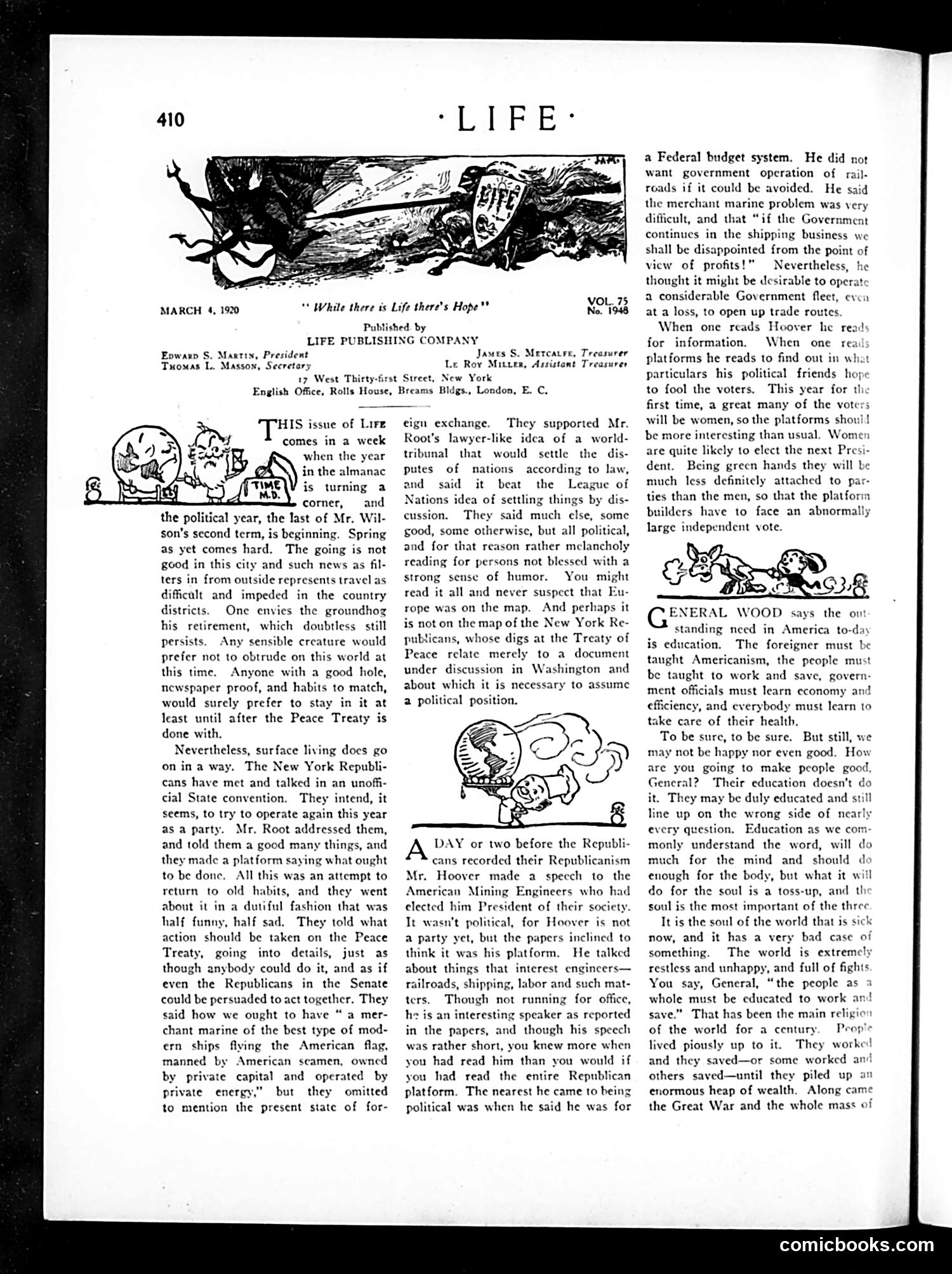
This editorial page critiques the New York Republican State Convention held days earlier. The cartoons (small illustrations) appear to mock political posturing, though they're difficult to identify with precision. The text contrasts two recent speeches: the Republican platform's abstract platitudes about the Peace Treaty and merchant marine, versus Herbert Hoover's address to mining engineers. Life suggests Hoover—not yet a political candidate—spoke more substantively about practical matters (railroads, shipping, labor) than the Republicans' lengthy platform. The satire targets Republican vagueness on post-WWI issues while praising Hoover's pragmatic approach. The piece reflects 1920's anxiety: Wilson's second term ending, European problems (the map reference), and uncertainty about America's postwar role—whether regarding the League of Nations, merchant ships, or foreign exchange. The tone is mordant about politics generally.
📄 Transcribed text from this page (OCR, searchable)
Machine-transcribed from the original scan — historical spelling and the odd misread are preserved.
MARCH 4, 1920 ‘* While there is Life there's Hope"* Published by LIFE PUBLISHING COMPANY Epwanp S. Martiy, President Tuomas L. Masson, Secretary James S. Mercarre, Treasurer Le Roy Mitter, Assistant Treasurer 17 West Thirty-first Street, New York English Office, Rolls House, Breams Bldgs., London, E. C. HIS issue of Lire comes in a week when the year in the almanac is turning a corner, and the political year, the last of Mr. Wil- son’s second term, is beginning. Spring as yet comes hard. The going is not good in this city and such news as fil- ters in from outside represents travel as difficult and impeded in the country districts. One envies the groundhog his retirement, which doubtless still persists. Any sensible creature would prefer not to obtrude on this world at this time. Anyone with a good hole, newspaper proof, and habits to match, would surely prefer to stay in it at least until after the Peace Treaty is done with. Nevertheless, surface living does go on in a way. The New York Republi- cans have met and talked in an unoffi- cial State convention. They intend, it seems, to try to operate again this year asa party. Mr. Root addressed them, and told them a good many things, and they made a platform saying what ought to be done. All this was an attempt to return to old habits, and they went about it in a dutiful fashion that was half funny, half sad. They told what action should be taken on the Peace Treaty, going into details, just as though anybody could do it, and as if even the Republicans in the Senate could be persuaded to act together. They said how we ought to have “ a mer- chant marine of the best type of mod- ern ships flying the American flag, manned by American scamen, owned by private capital and operated by private energy,” but they omitted to mention the present state of for- eign exchange. They supported Mr. Root’s lawyer-like idea of a world- tribunal that would settle the dis- putes of nations according to law, and said it beat the League of Nations idea of settling things by dis- cussion. They said much else, some good, some otherwise, but all political, and for that reason rather melancholy reading for persons not blessed with a Strong sense of humor. You might read it all and never suspect that Eu- rope was on the map. And perhaps it is not on the map of the New York Re- publicans, whose digs at the Treaty of Peace relate merely to a document under discussion in Washington and about which it is necessary to assume a political position. DAY or two before the Republi- cans recorded their Republicanism Mr. Hoover made a specch to the American Mining Engineers who had elected him President of their society. It wasn’t political, for Hoover is not a party yet, but the papers inclined to think it was his platform. He talked about things that interest engincers— railroads, shipping, labor and such mat- ters. Though not running for office, he is an interesting speaker as reported in the papers, and though his speech was rather short, you knew more when you had read him than you would if you had read the entire Republican platform. The nearest he came to being political was when he said he was for a Federal budget system. He did not want government operation of rail- roads if it could be avoided. He said the merchant marine problem was very difficult, and that “if the Government continues in the shipping business we shall be disappointed from the point of view of profits!" Nevertheless, thought it might be desirable to opera a considerable Government fleet, even at a loss, to open up trade routes. When one reads Hoover he reads for information. When one read platforms he reads to find out in what particulars his political friends hope to fool the voters. This year for the first time, a great many of the voters will be women, so the platforms shoul! be more interesting than usual. Women are quite likely to elect the next Presi- dent. Being green hands they will be much less definitely attached to par- ties than the men, so that the platform builders have to face an abnormally large independent vote. RAL WOOD says the out standing need in America to-day is education, The foreigner must be taught Americanism, the people must be taught to work and save, govern- ment officials must learn economy and efficiency, and everybody must learn to take care of their health. To be sure, to be sure. But still, we may not be happy nor even good. How are you going to make people good, General? Their education doesn’t do it. They may be duly educated and still line up on the wrong side of nearly every question. Education as we com- monly understand the word, will do much for the mind and should do enough for the body, but what it will do for the soul is a toss-up, and th soul is the most important of the three It is the soul of the world that is sick now, and has a very bad case of something. The world is extreme! restless and unhappy, and full of fights You say, General, “the people as a whole must be educated to work and save.” That has been the main religion of the world for a century. Prop'e lived piously up to it. They worke and they saved—or some worked and others saved—until they piled up an enormous heap of wealth. Along came the Great War and the whole mass of comicbooks.com