
A complete issue · 100 pages · 1915
Life — December 2, 1915
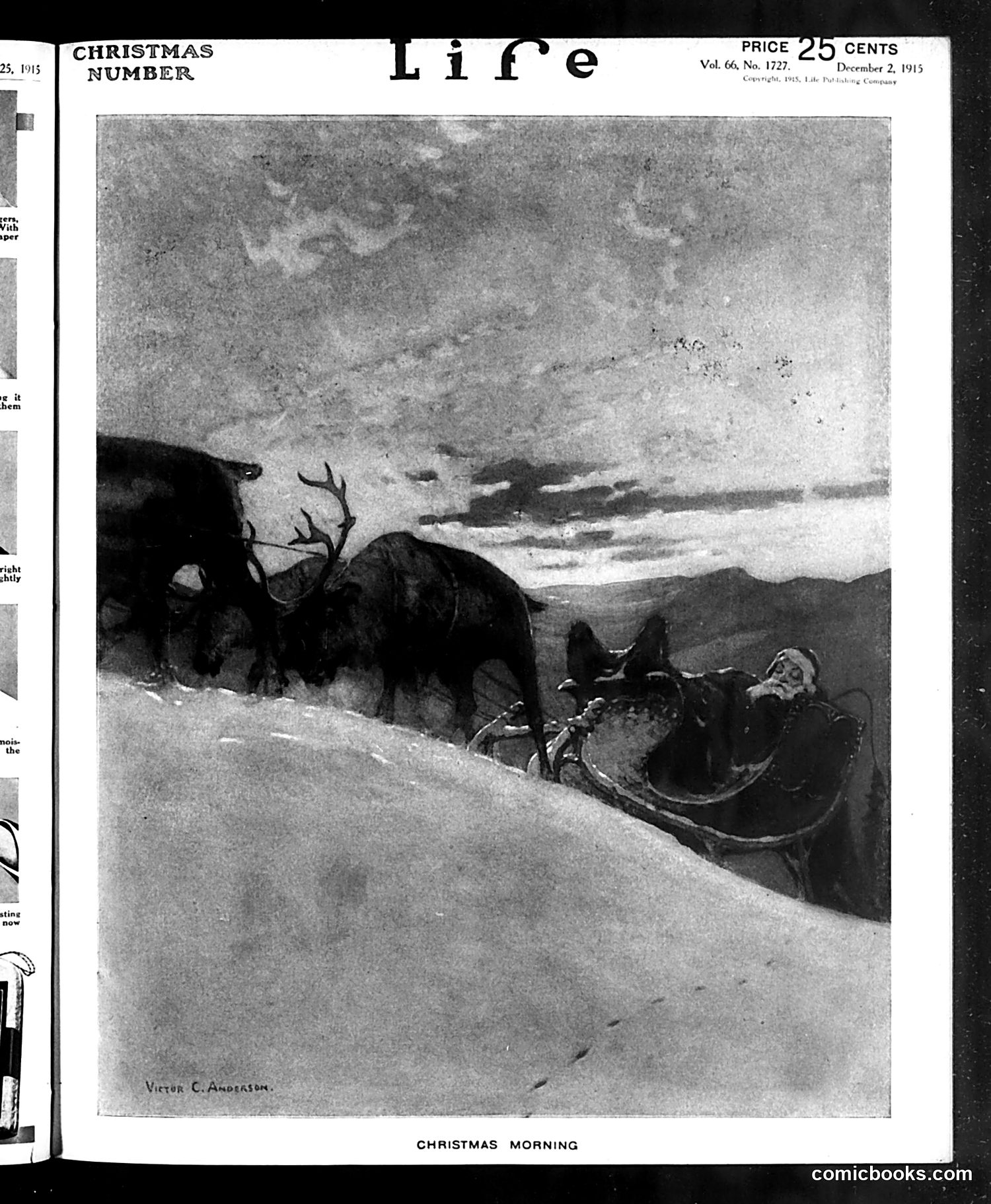
This is the cover image of *Life*'s Christmas Number from December 2, 1915. The illustration depicts Santa Claus riding his reindeer-drawn sleigh across a snowy landscape. The photograph is credited to "Verne C. Anderson" and titled "Christmas Morning." Given the 1915 date—during World War I—this image likely carries resonance beyond its literal subject. The peaceful, idealized Christmas scene contrasts with the global conflict occurring at that time. The magazine may be using this traditional holiday imagery to invoke nostalgia or offer readers momentary respite from wartime anxieties, or possibly to critique the war's interruption of normal peacetime traditions. However, without accompanying text, the specific satirical intent remains unclear.
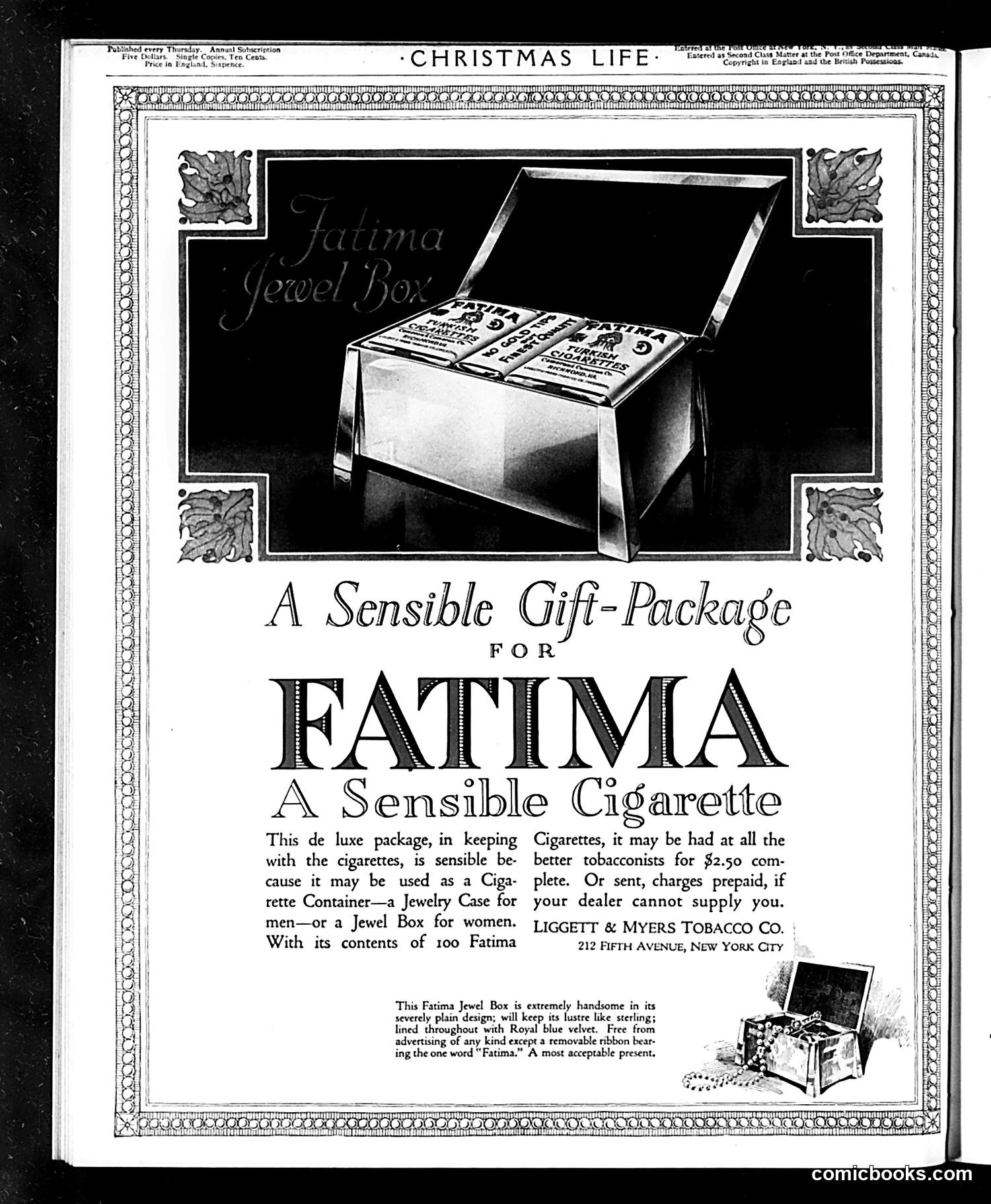
This page is **primarily an advertisement**, not political satire. It promotes "Fatima: A Sensible Cigarette" from Liggett & Myers Tobacco Co., marketed as a luxury gift package. The ad emphasizes the product's practicality: the deluxe box functions as both a cigarette container and decorative jewelry case for men or women. It contains 100 Fatima cigarettes and costs $2.50 complete, or can be sent prepaid. The headline's use of "sensible" appears ironic to modern readers—marketing cigarettes as a thoughtful, practical gift. The ornate packaging and elegant presentation suggest this targeted affluent consumers seeking sophisticated holiday gifts during what appears to be the early 20th century. There is no discernible political commentary or satire present on this page.
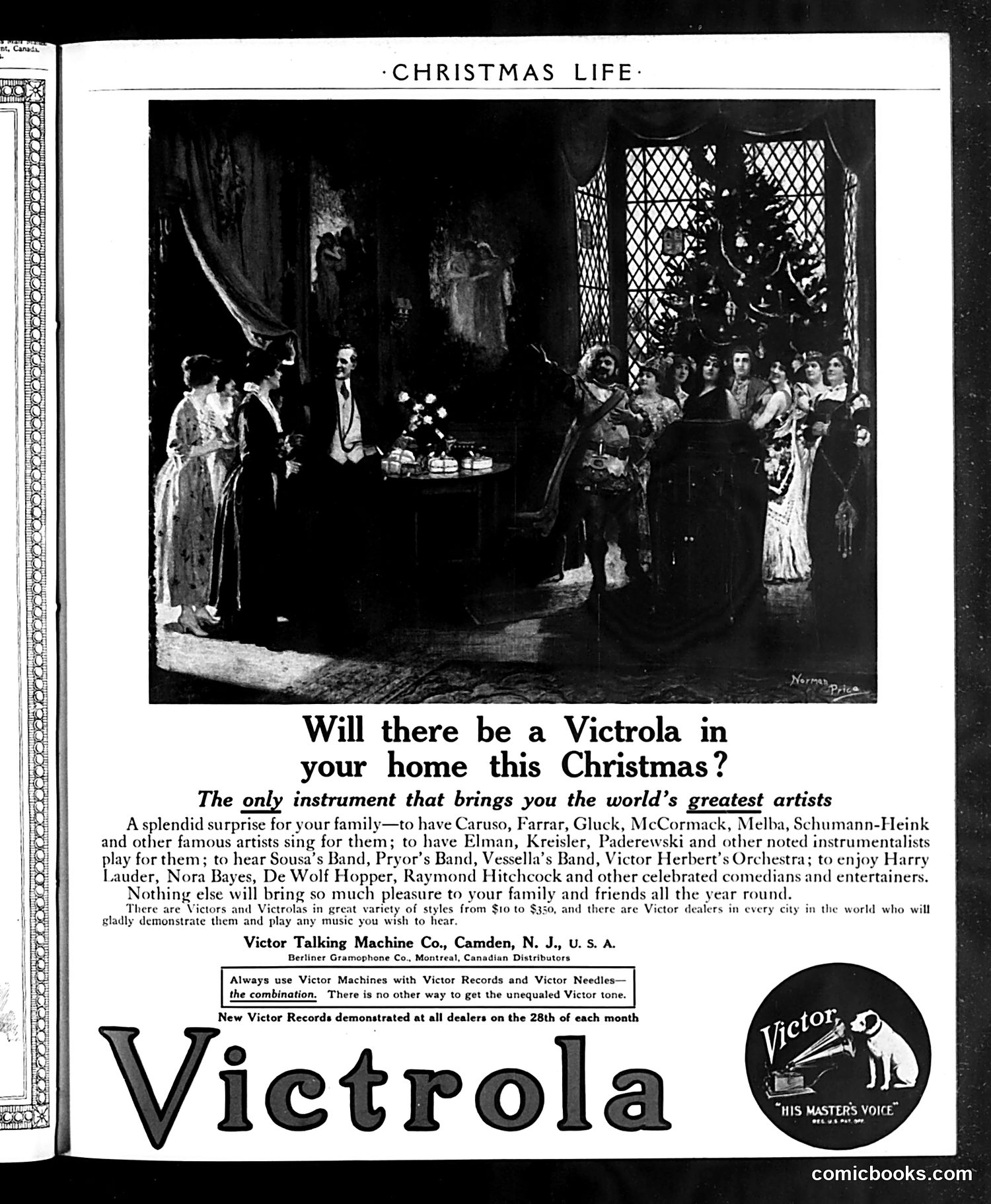
This is primarily **advertising content**, not satire or political commentary. The page features a full-page Victrola advertisement disguised as editorial content under the "Christmas Life" heading. The image shows an elegant Christmas party scene with well-dressed guests gathered around a gramophone. The ad copy asks "Will there be a Victrola in your home this Christmas?" and lists famous performers available on Victor Records—opera singers like Caruso and Farrar, instrumentalists, and entertainers. The appeal is straightforward: purchasing a Victrola would bring world-class entertainment to one's home, positioning it as an aspirational luxury gift for affluent families. The "His Master's Voice" logo appears in the corner. This represents early 20th-century advertising strategy: using lifestyle imagery and celebrity endorsement to market consumer technology.
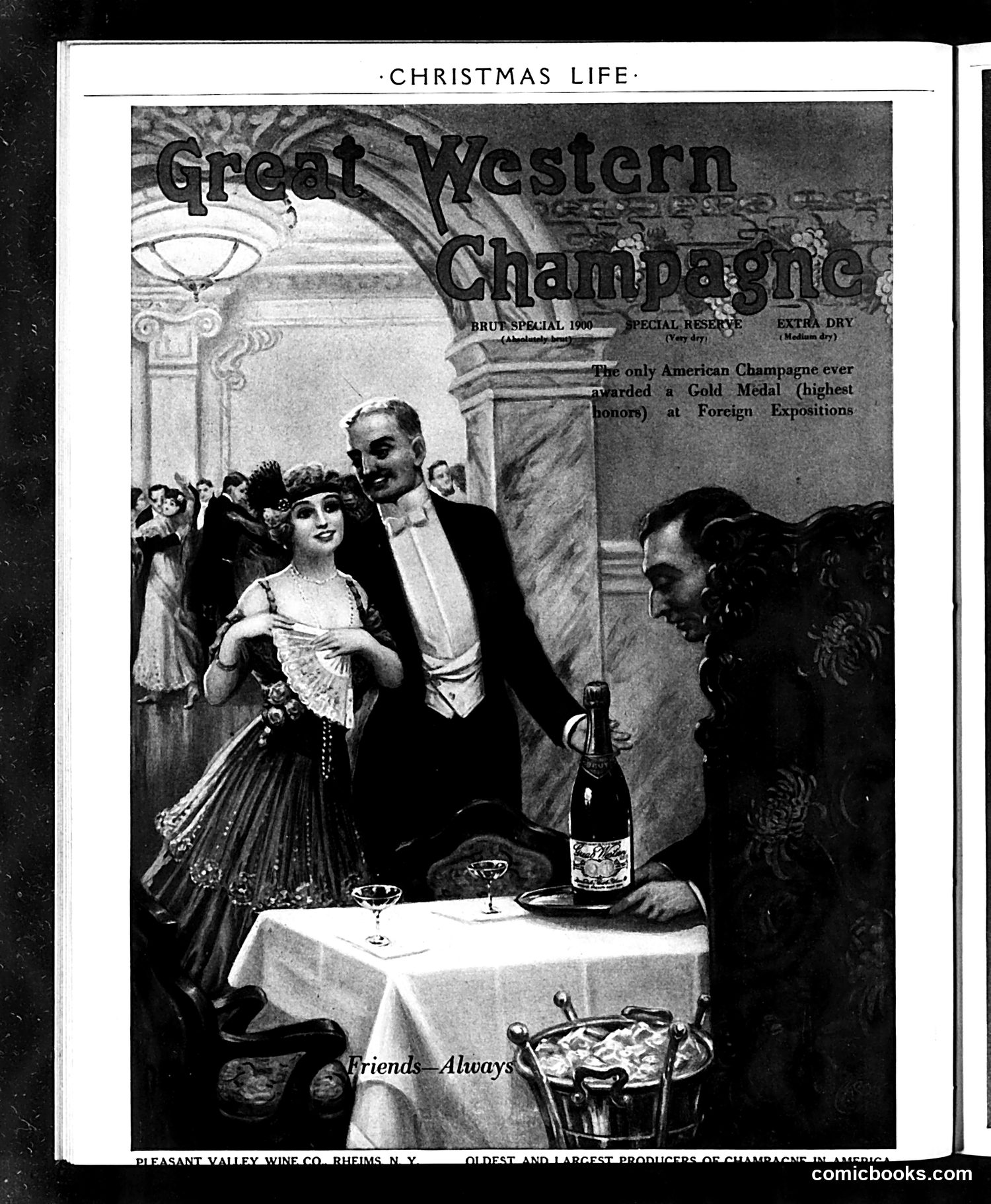
This page is primarily **advertising**, not satire or political commentary. It promotes Great Western Champagne, produced by Pleasant Valley Wine Co. in Rheims, New York. The ad's narrative depicts an elegant formal gathering—a man and woman in evening dress at a table with champagne, observed by other guests in an ornate interior setting. The tagline reads "Friends—Always." The text emphasizes that this is "the only American Champagne ever awarded a Gold Medal (highest honors) at Foreign Expositions," positioning the product as prestigious and internationally recognized. The "Christmas Life" header suggests this appeared in a holiday issue. The advertisement uses aspirational imagery of sophistication and social celebration to market the champagne to upscale American consumers.
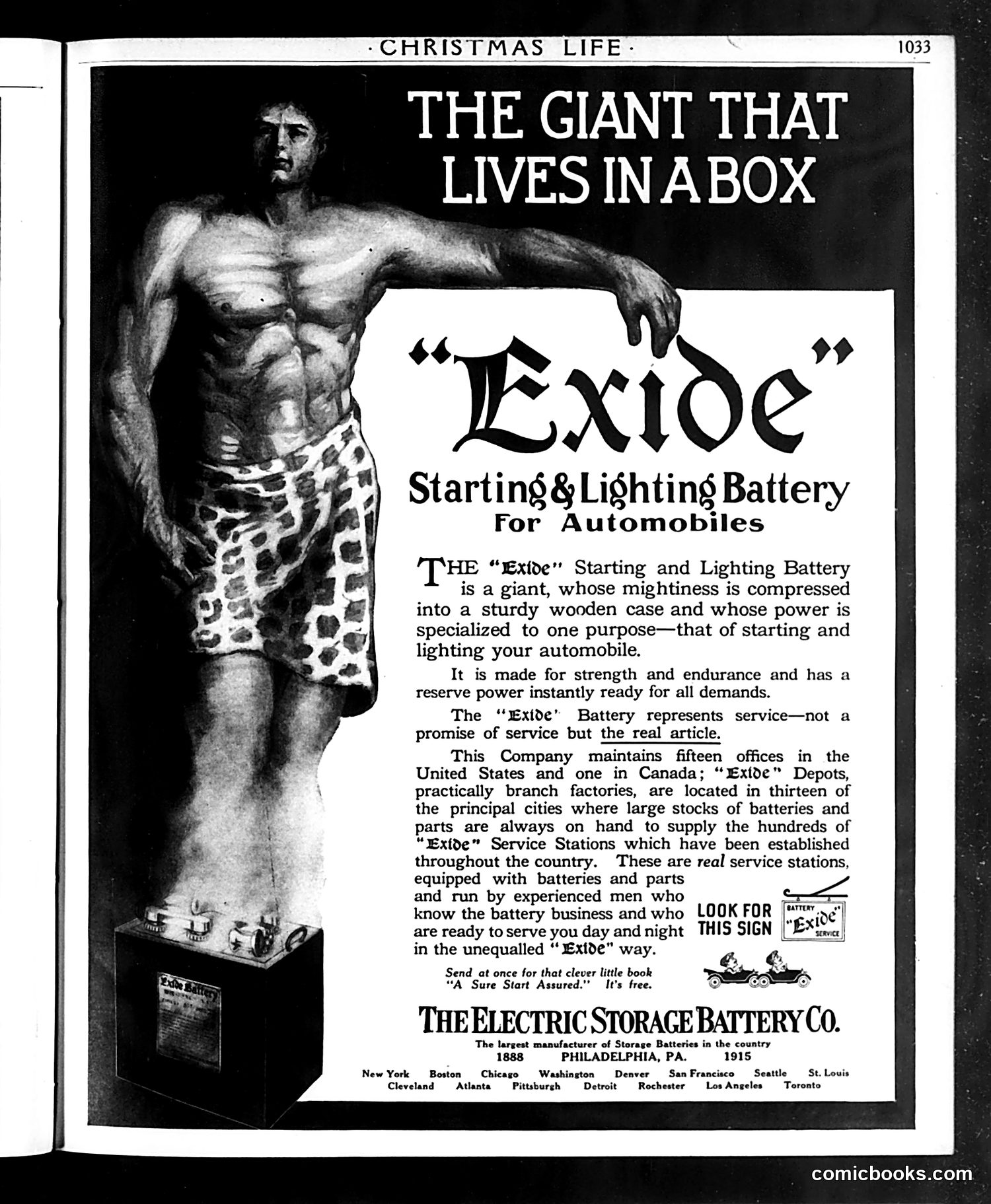
This page is **primarily a straightforward advertisement**, not political satire. It promotes the "Exide" Starting and Lighting Battery for automobiles, made by the Electric Storage Battery Company of Philadelphia (founded 1888). The advertisement uses a classical "giant" figure—likely evoking Greek/Roman statuary or strongman imagery—compressed into a wooden box to illustrate their marketing concept: "The Giant That Lives in a Box." The visual metaphor compares the battery's compressed power to a muscular giant confined in compact form. The copy emphasizes the product's strength, reliability, and extensive service network across the United States and Canada. There is no apparent political commentary or satire—this is simply early 20th-century commercial advertising using classical imagery to suggest power and durability.
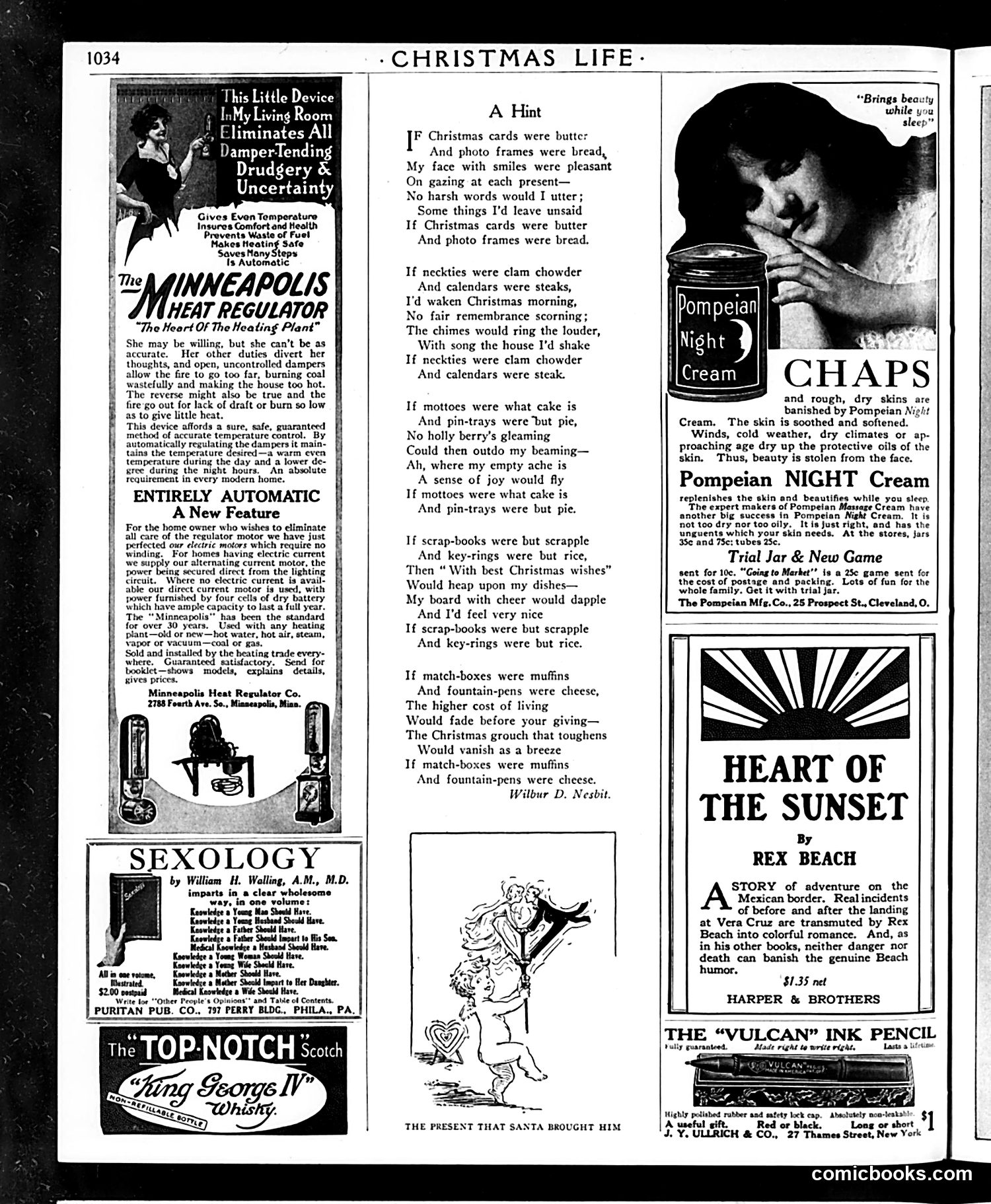
This is primarily a **Christmas-themed advertising and editorial page** from Life magazine (page 1034), not political satire. The main content includes: 1. **"A Hint"** — a humorous poem by Wilbur D. Nesbit imagining Christmas gifts as food items (butter, bread, clam chowder, cake, pie), suggesting creative gift-giving alternatives during what appears to be an era of scarcity or economy. 2. **Product advertisements** for practical goods: the Minneapolis Heat Regulator, Pompeian Night Cream (for chapped skin), and other items. 3. **A cartoon illustration** of a jolly figure with gifts, captioned "The Present That Santa Brought Him." 4. **Book advertisement** for Rex Beach's "Heart of the Sunset." The page reflects early 20th-century consumer culture and seasonal gift-giving conventions rather than political commentary.

This page is primarily a **commercial advertisement**, not satirical content. It promotes White Rock mineral water from Waukesha, Wisconsin, with an office at 100 Broadway, New York. The advertisement features a decorative Christmas-themed design: an illustrated wreath frame encircling a classical female figure (likely a nymph or sprite), with a large bow at top and a decorated Christmas tree at bottom left. The "White Rock" brand name appears prominently in stylized lettering. This appears to be a **holiday advertising placement** in Life magazine's Christmas issue (page 1035). The classical imagery and mineral water branding were typical luxury product marketing of the early-to-mid twentieth century, positioning the product as refined and healthful for affluent consumers during the festive season.
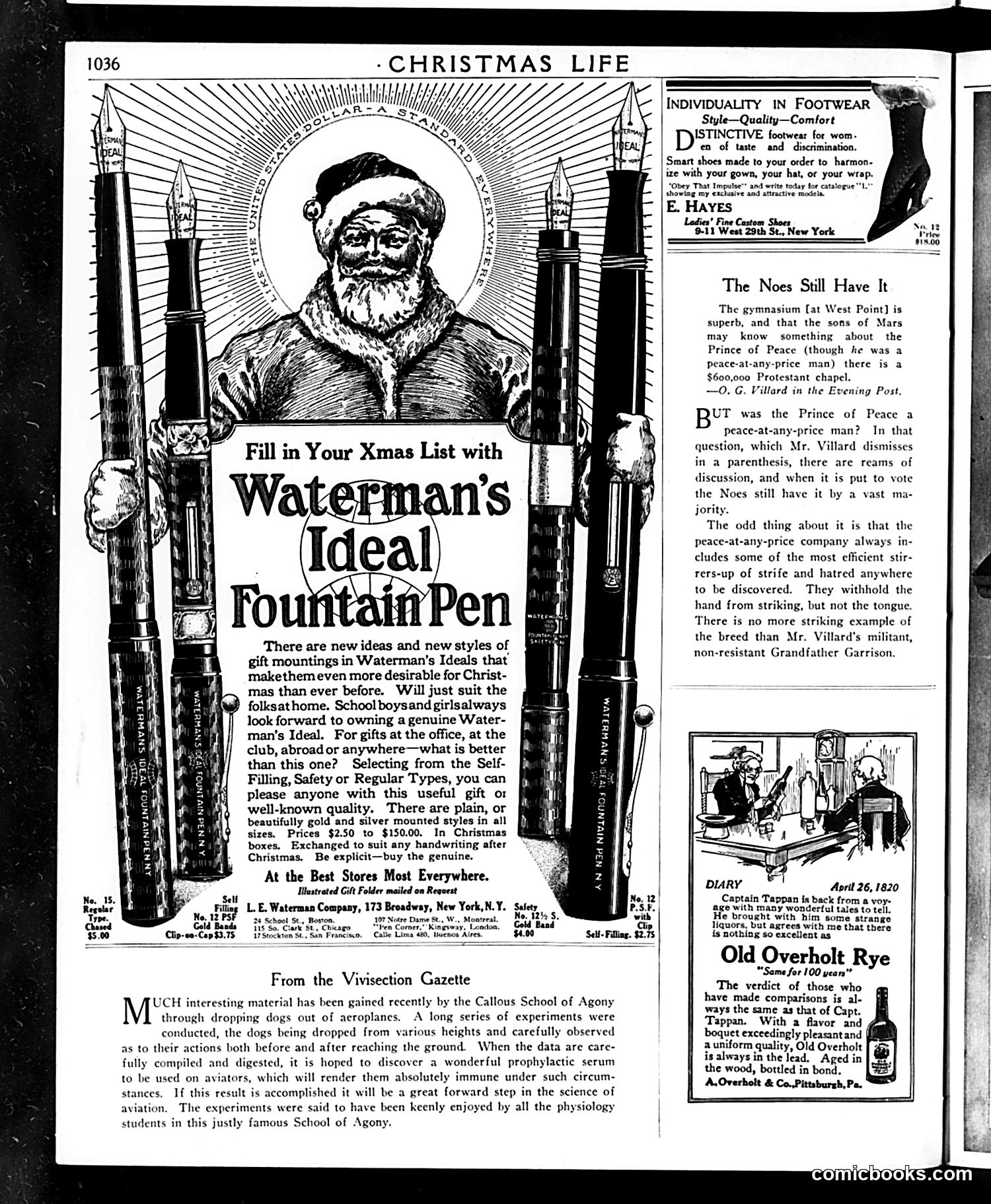
This page is primarily **advertising and miscellaneous content** rather than political satire. The main visual element is a **Waterman's Ideal Fountain Pen advertisement** featuring Santa Claus with a halo, positioned as a Christmas gift suggestion. The copy emphasizes the pen's appeal to "school boys and girls" and office workers. The page includes: - An **E. Hayes footwear advertisement** (upper right) - A brief article titled **"The Noes Still Have It,"** discussing a $500,000 Protestant chapel at West Point gymnasium, referencing O.G. Villard's commentary on "peace-at-any-price" companies - A **diary entry** dated April 26, 1820 - An **Old Overholt Rye whiskey advertisement** The only satirical element is the article questioning pacifist organizations' actual commitment to their stated principles. Otherwise, the page functions as a commercial vehicle.
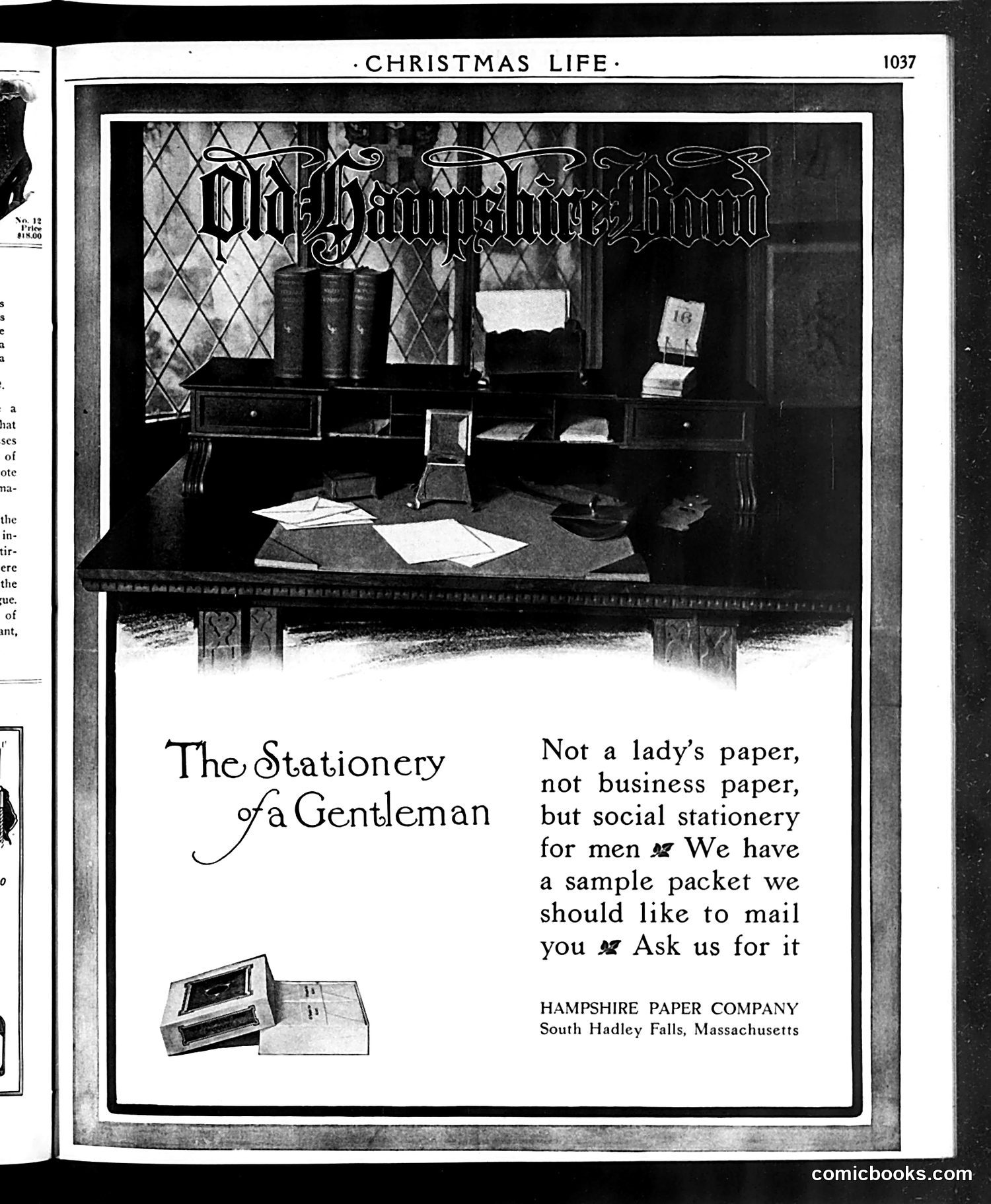
This page is primarily an advertisement for Hampshire Paper Company's stationery products, not a political cartoon or satirical content. The ad features a display window showing "The Stationery of a Gentleman" and emphasizes that this is "social stationery for men"—distinctly not ladies' paper or business paper. The company is marketing a specific gendered product category: personal correspondence materials designed for gentlemen. The appeal is to social convention and masculine identity, suggesting that proper gentlemen required appropriate stationery for personal correspondence. The ad offers to mail a sample packet to interested parties. This reflects early-20th-century consumer marketing that heavily segmented products by gender, treating stationery choice as a marker of social class and propriety.
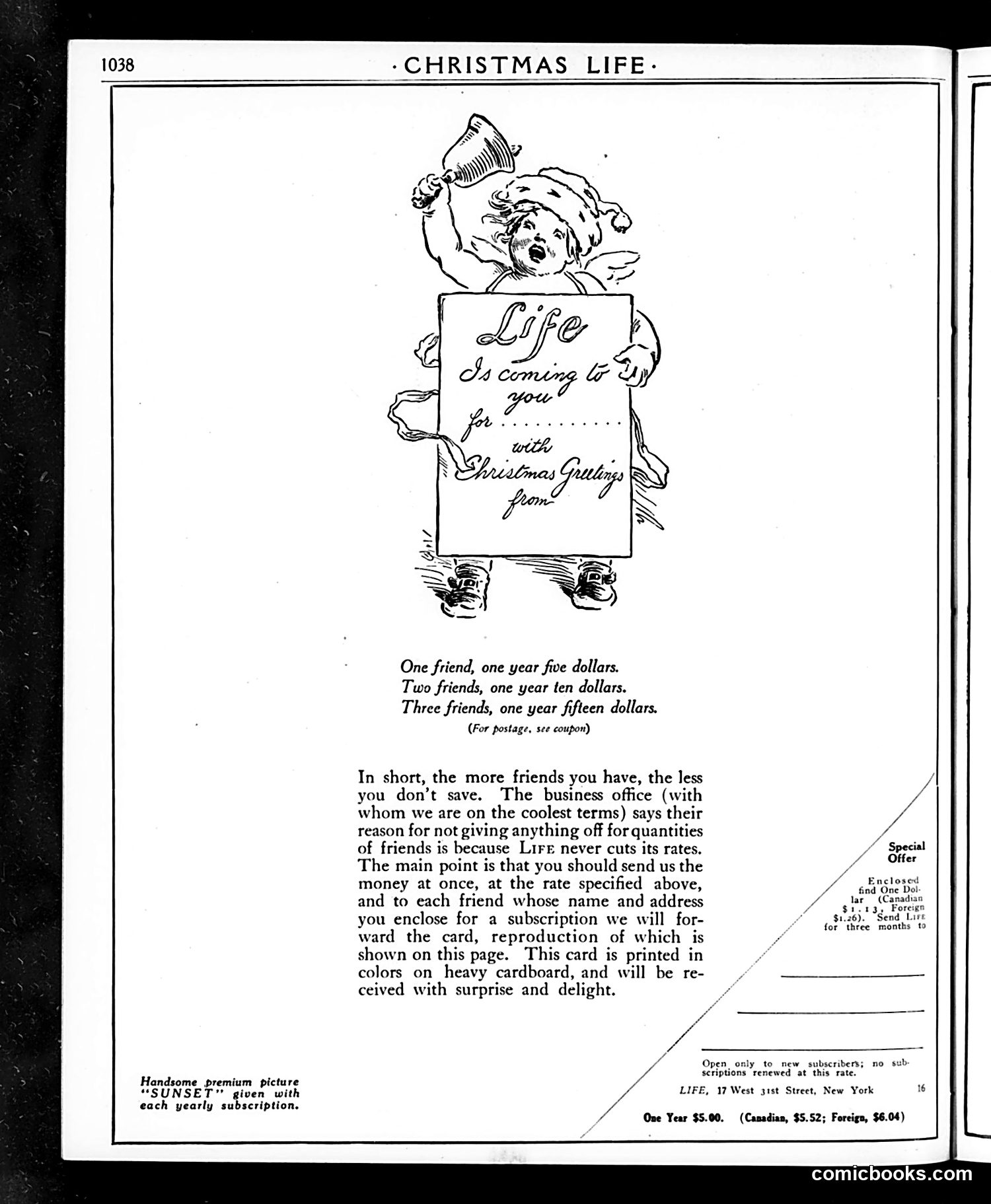
This is a Christmas-themed advertisement for *Life* magazine subscriptions, not political satire. A cherub figure holds a placard reading "Life is coming to you for...with Christmas greetings from." The ad offers tiered subscription rates: one friend costs $5/year, two friends $10/year, three friends $15/year. The accompanying text jokes that "the more friends you have, the less you don't save"—a lighthearted dig at the economics of group subscriptions. The pitch emphasizes that *Life* "never cuts its rates," encouraging readers to send money to multiple friends as gift subscriptions. The colorful card reproduction is described as printed on "heavy cardboard" for durability as a Christmas keepsake. This is straightforward commercial advertising rather than editorial content or political commentary.
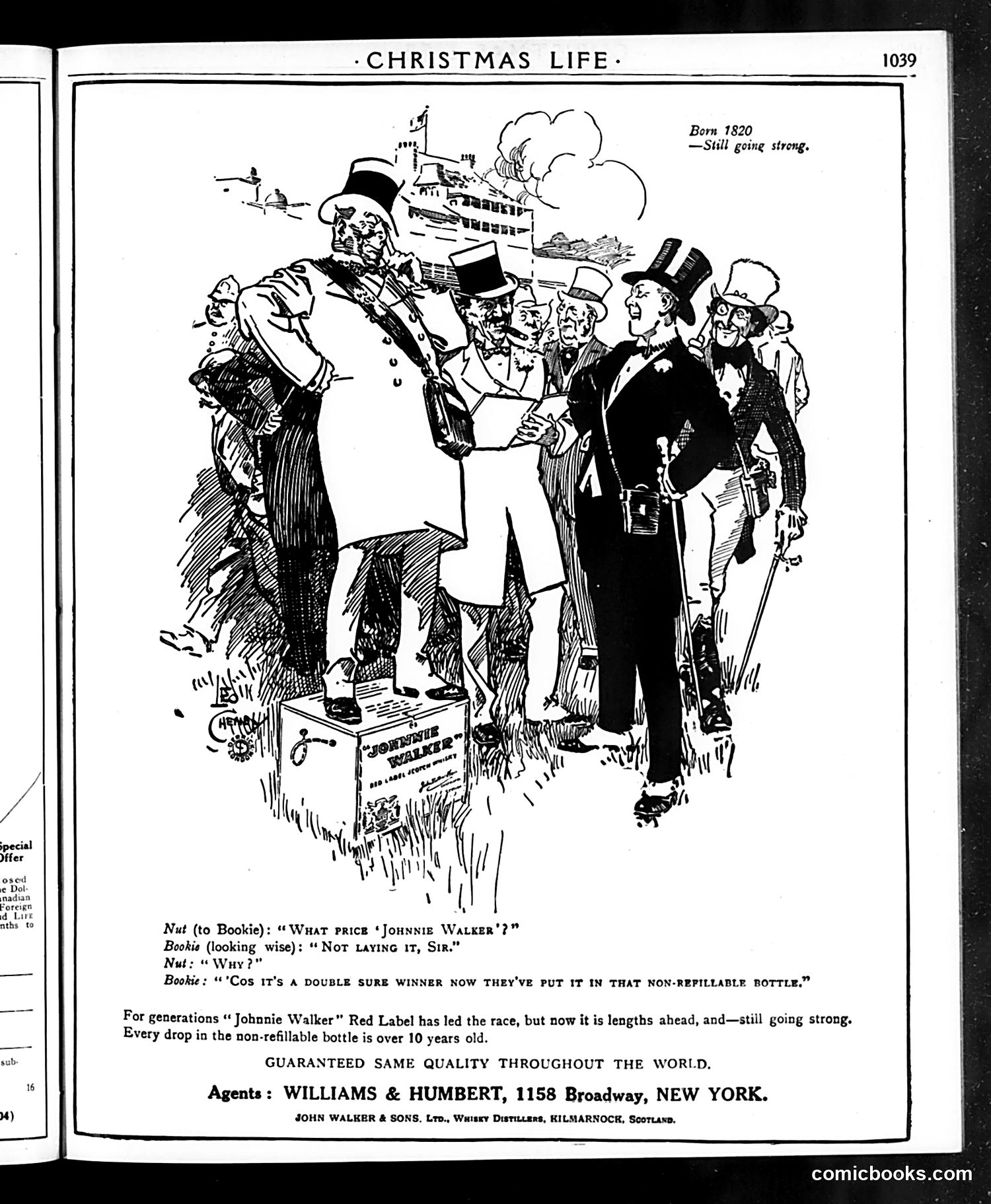
This is a **Johnnie Walker whisky advertisement** disguised as satirical cartoon content in *Life* magazine's "Christmas Life" section (page 1039). The cartoon depicts well-dressed gentlemen in top hats discussing the price of "Johnnie Walker" whisky. One figure stands elevated on a "Johnnie Walker" box, while others gesture below. A ship appears in the background. The joke plays on the whisky brand's longevity: "Born 1820—Still going strong." The dialogue suggests the product's reliability makes it a "double sure winner" investment, even in a non-refillable bottle. This is essentially **branded content marketing**, presenting product loyalty as a humorous topic worthy of satirical treatment. The ad emphasizes the whisky's century-plus history and "guaranteed same quality throughout the world," leveraging the magazine's satirical format to make advertising entertaining rather than purely promotional.
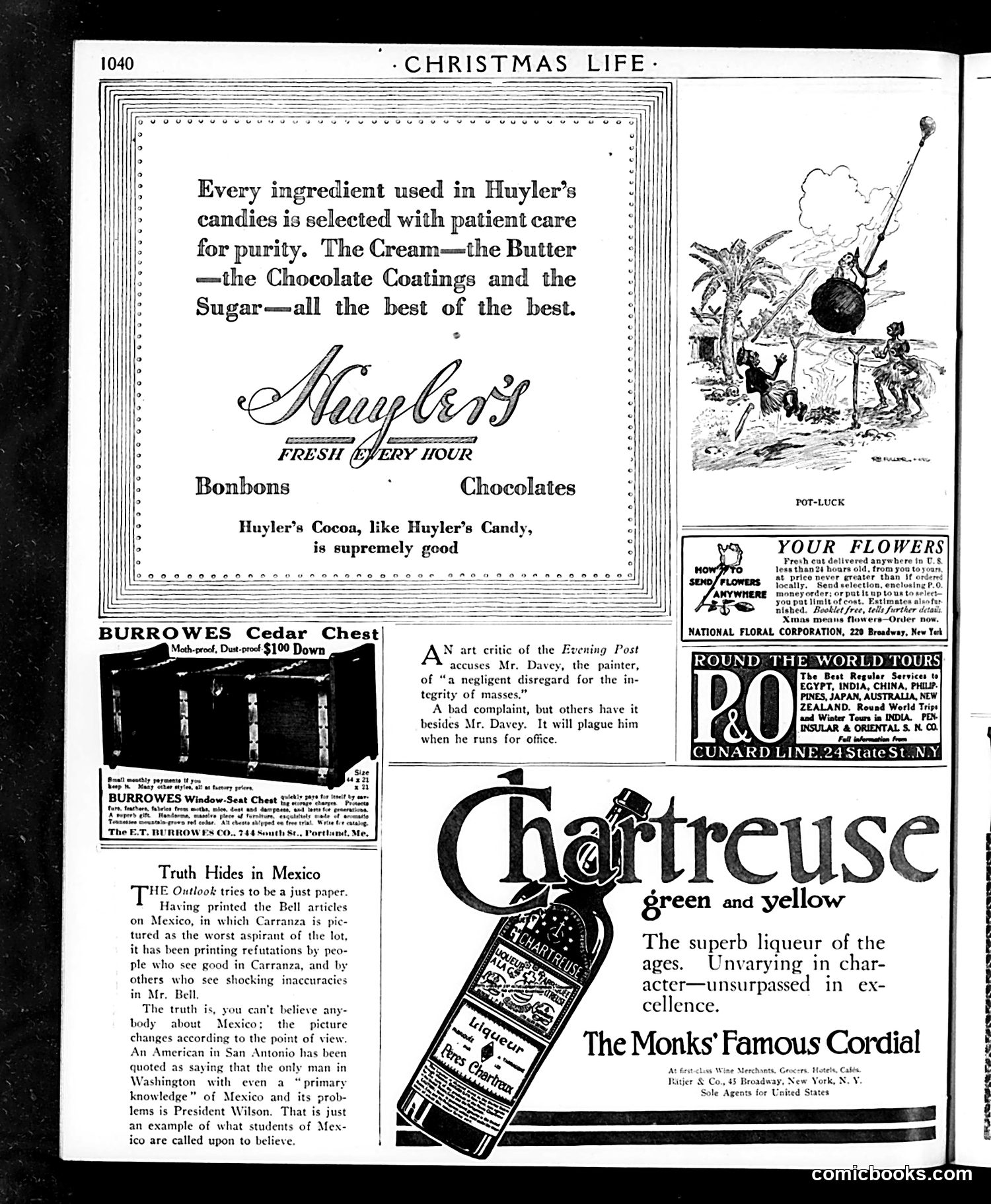
This is primarily an **advertising page** from Life magazine (page 1040), not a political cartoon. The main content consists of **commercial advertisements** for: - Huyler's candies and bonbons - Burrowes cedar chests - Round the World Tours via Cunard Line - Your Flowers delivery service - Chartreuse liqueur There is one **editorial article** titled "Truth Hides in Mexico," which discusses Mexican political perspectives and references President Wilson. The piece appears skeptical of American understanding of Mexican affairs, noting that perspectives on Mexico "change according to the point of view." The page reflects early 20th-century consumer culture and period attitudes toward Mexico during the Wilson administration, but contains no satirical cartoons or political caricatures—primarily period advertising and brief commentary.
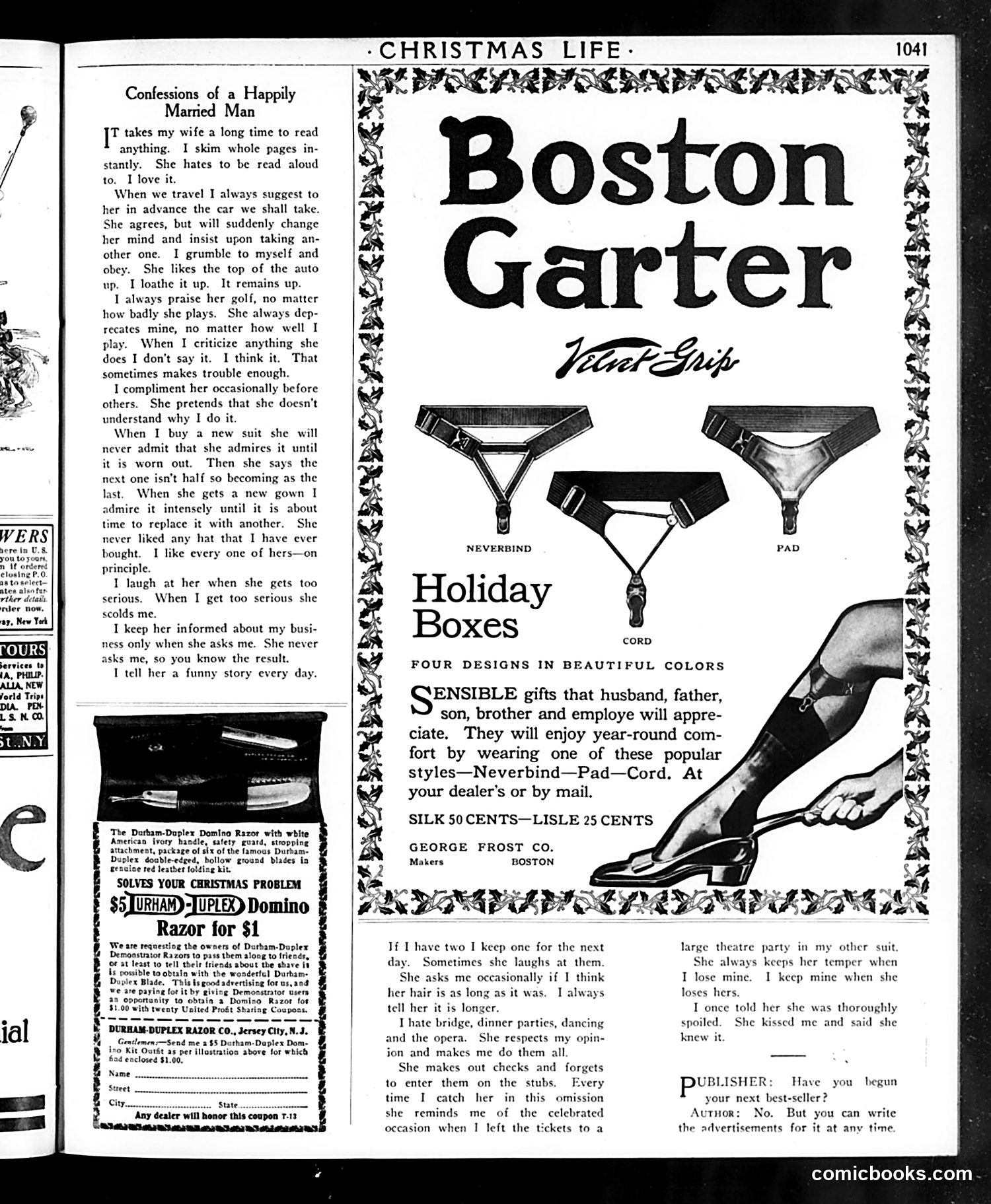
This page contains **no political cartoons**. Instead, it features: 1. **"Confessions of a Happily Married Man"** — a humorous essay on the left describing a husband's observations about his wife's behavior (her reading habits, golf game, shopping, and financial management). The tone is affectionate satire about domestic marriage dynamics. 2. **Boston Garter advertisement** (center-right) — promoting men's undergarments ("Holiday Boxes") in four designs, marketed as sensible gifts for husbands, fathers, and brothers. 3. **Durham-Duplex Domino Razor advertisement** (bottom-left) — selling razors for $1. The page is primarily **commercial advertising mixed with light domestic humor**, typical of Life magazine's mid-20th century format. There is no political content or social commentary beyond gentle observations about married life.
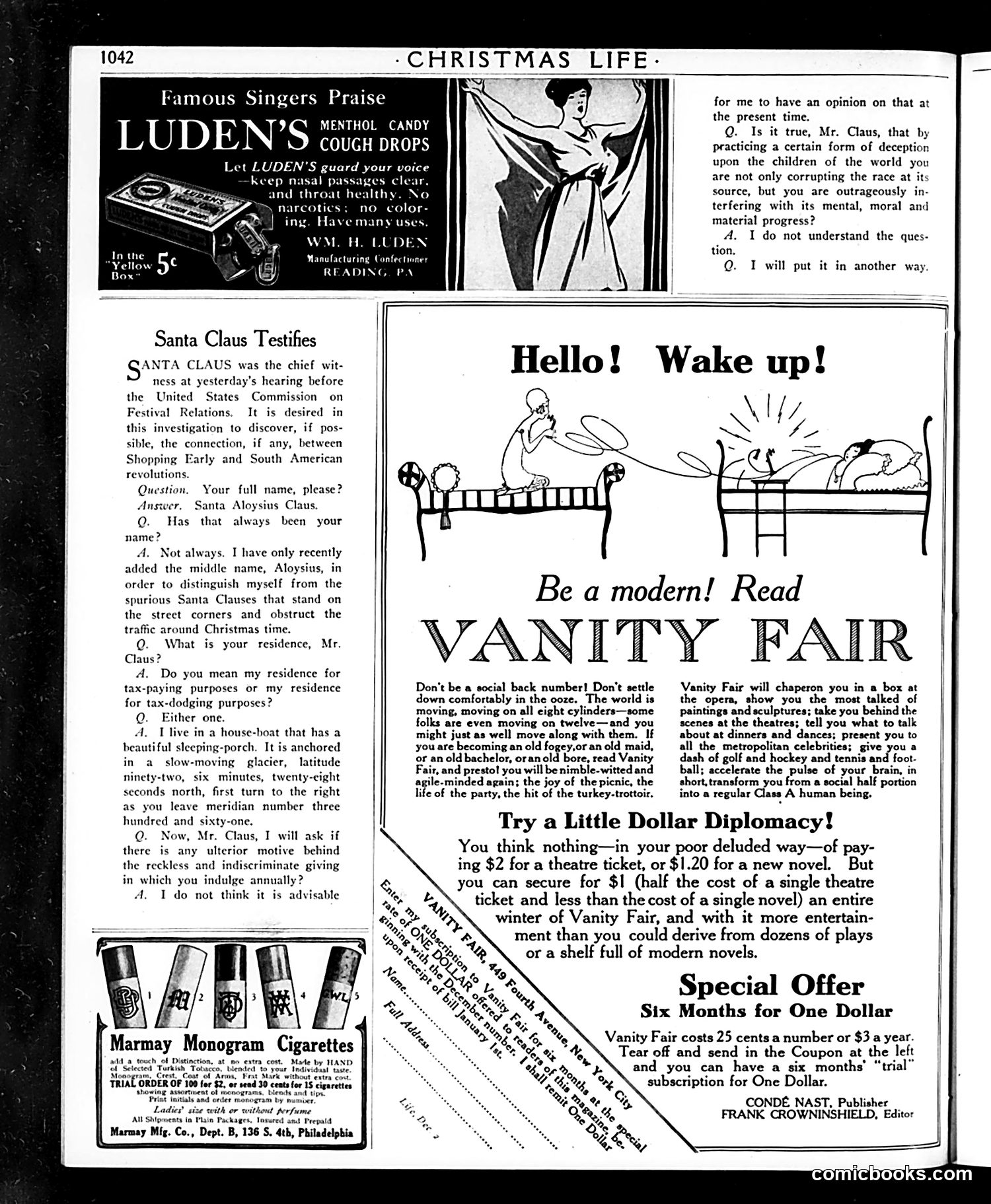
This page is primarily **advertising and editorial content** rather than political satire. The main elements include: 1. **Luden's Cough Drops ad** - a product endorsement claiming famous singers praised the candy 2. **"Santa Claus Testifies"** - a Q&A interview where Santa Claus (identified as "Santa Aloysius Claus") is questioned before what appears to be a government commission about potential connections between Christmas shopping and economic/political unrest. The satire mocks bureaucratic investigation of holiday traditions. 3. **Vanity Fair magazine promotion** - advertising a subscription offer 4. **Marmay Monogram Cigarettes ad** The Santa piece appears to gently satirize government overreach or paranoia about commercial holiday practices, though the specific historical context isn't entirely clear from the visible text.
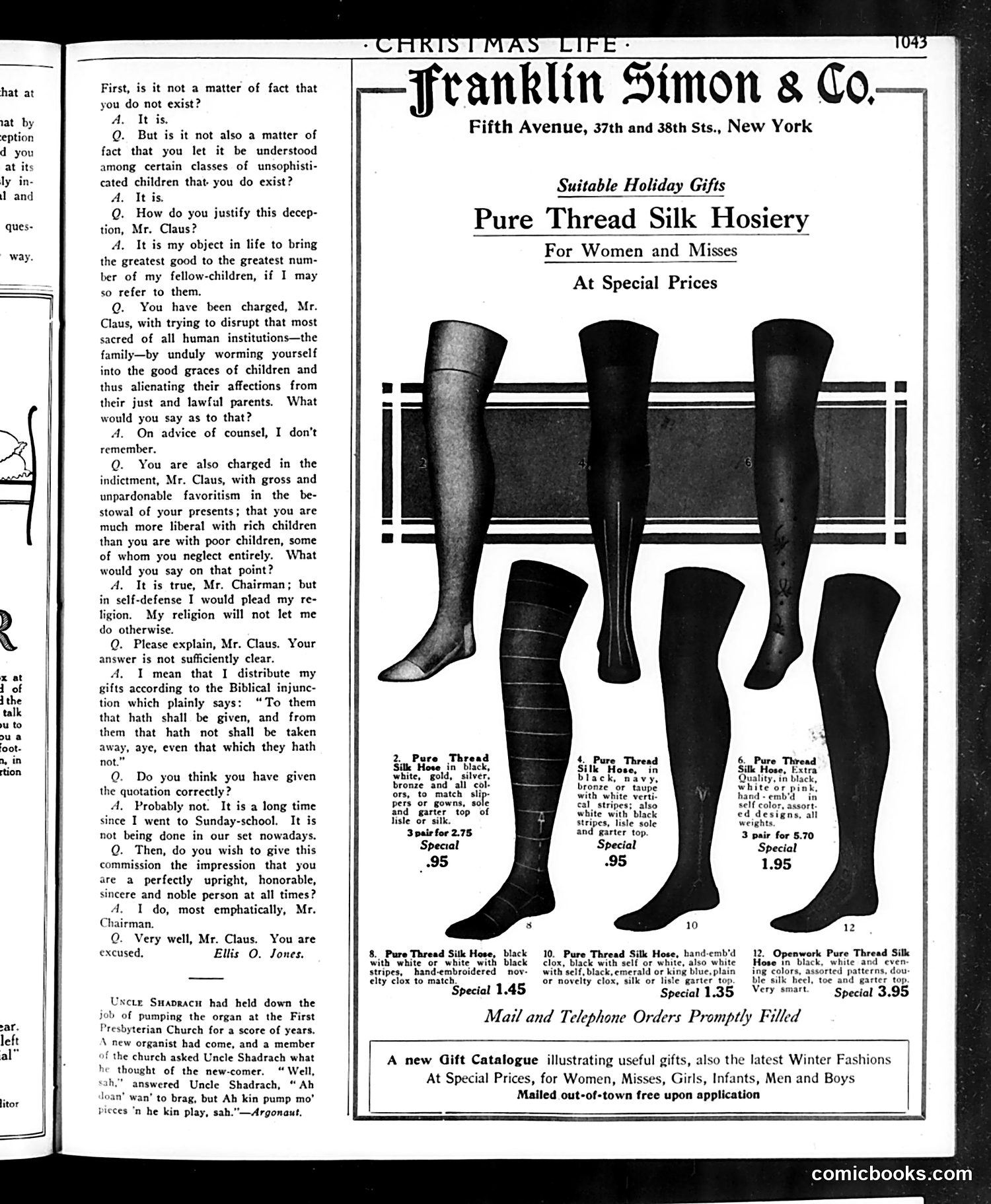
This page is primarily a **commercial advertisement** for Franklin Simon & Co., a Fifth Avenue department store, featuring Pure Thread Silk Hosiery for women and misses at special holiday prices. The left column contains a **satirical dialogue** (by Ellis O. Jones) depicting a character named Mr. Claus being interrogated about his charitable practices—specifically, accusations that he favors wealthy children over poor ones and disrupts family institutions. Mr. Claus defends himself by citing Biblical principles about gift-giving. The satire appears to critique **Santa Claus mythology and class inequality** in gift-giving during the Christmas season, questioning whether the tradition perpetuates favoritism based on wealth. This is vintage Life magazine social commentary wrapped around holiday commerce.
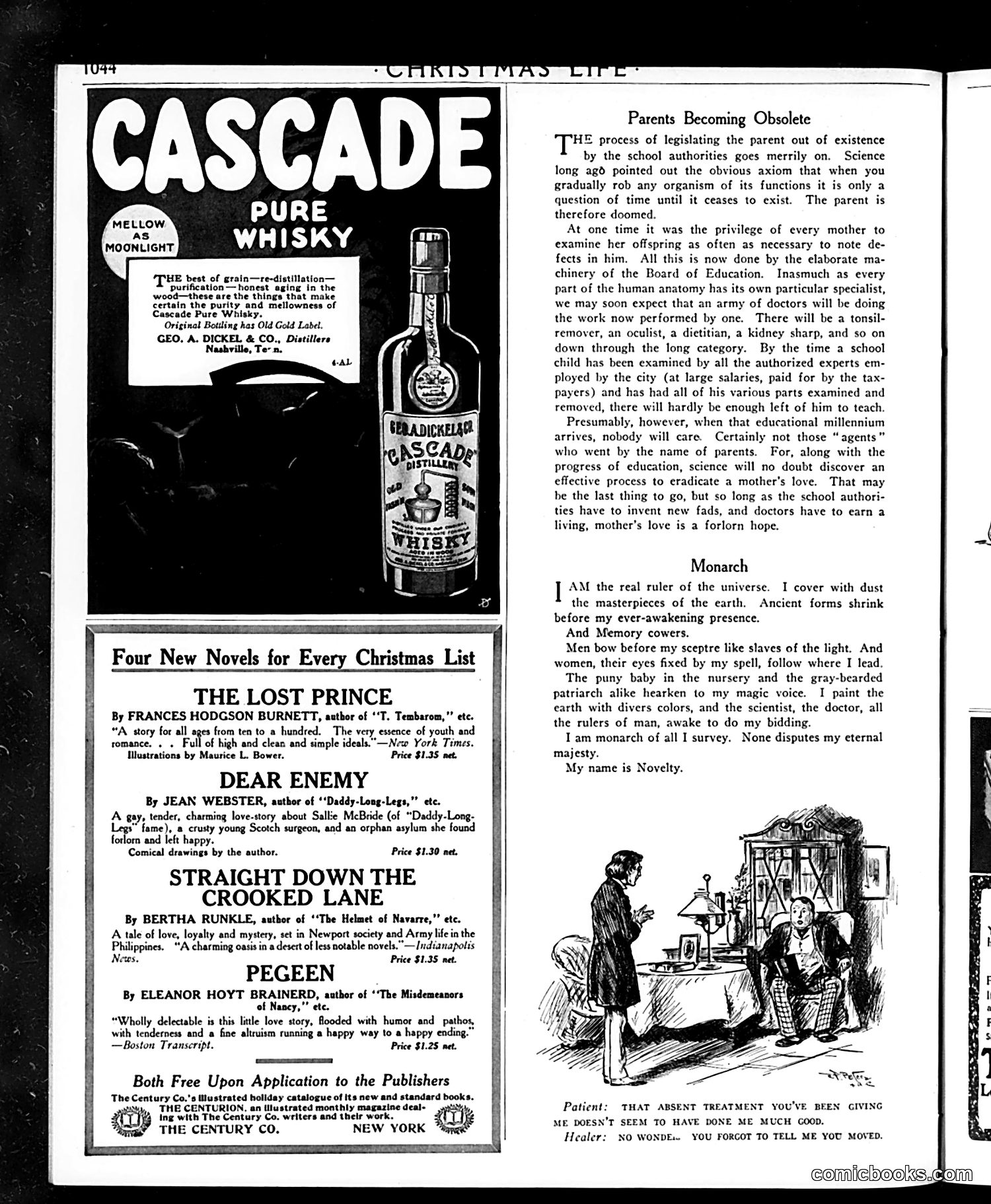
This page from *Life* magazine contains satirical commentary alongside period advertising and book promotions. **"Parents Becoming Obsolete"** is a sarcastic essay criticizing progressive educational reforms. The author mocks how schools and medical specialists are replacing parental authority—mothers can no longer examine their own children; instead, the "Board of Education" deploys specialized doctors (tonsilremover, eye doctor, etc.). The satire suggests this bureaucratic takeover will eventually eliminate parental roles entirely, and even destroy a mother's love itself. It's a critique of early 20th-century professionalization and the state's expanding role in child-rearing. **"Monarch"** appears to be a short poetic piece personifying Time or Dust as a universal ruler controlling memory, commanding allegiance from men and women alike. The cartoon below shows a medical consultation—a patient complaining that an absent treatment hasn't helped, with the doctor dismissively blaming the patient's forgetfulness. The rest is commercial: whiskey advertising and book promotions for Christmas gifts.
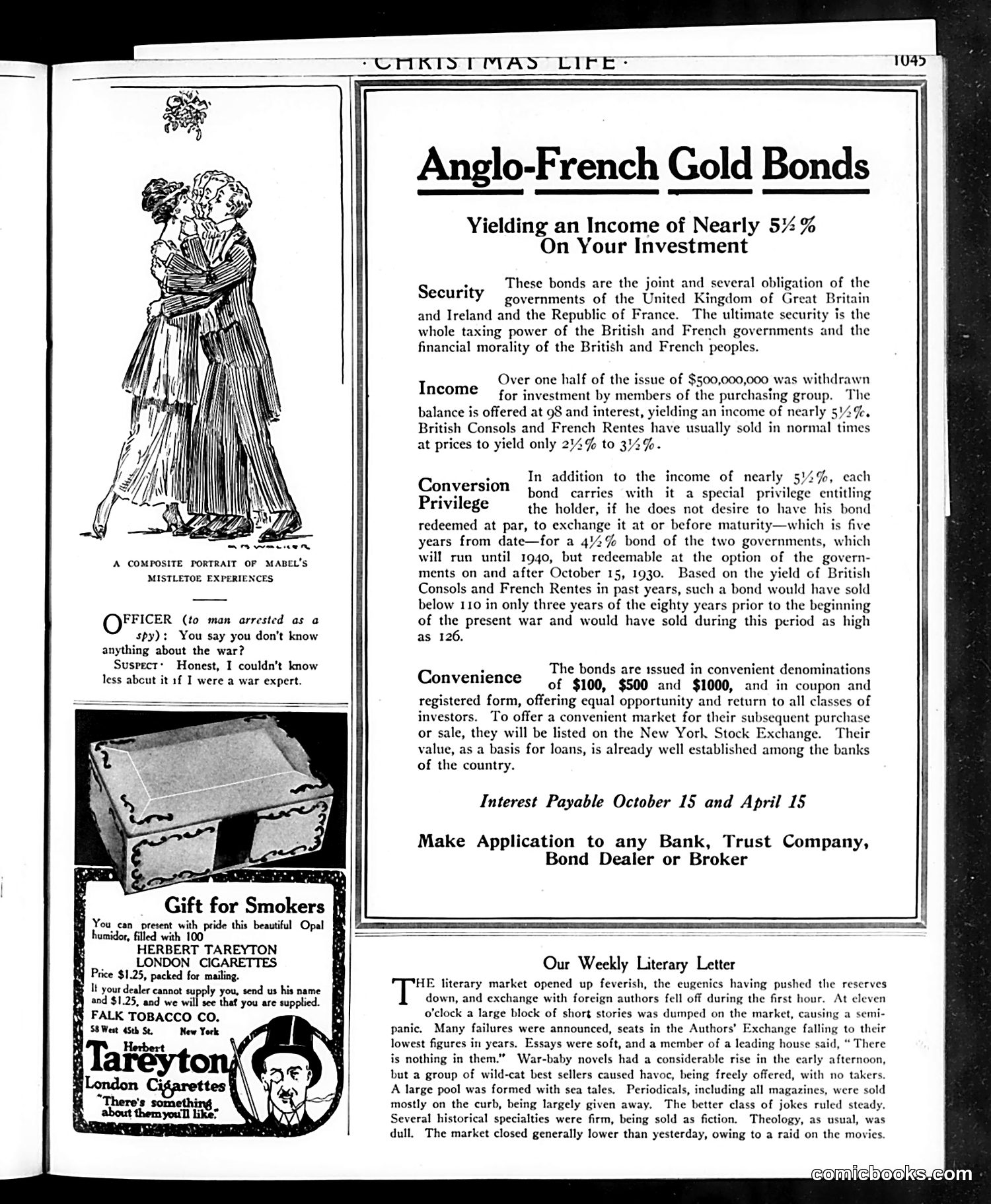
This page contains three distinct elements: **The Cartoon (top left):** A wartime spy joke. An officer arrests a suspected spy who claims total ignorance about the war. The humor lies in the suspect's deadpan response—he says he couldn't know *less* about the war even if he were an actual war expert, implying that war experts themselves know nothing useful. This is satirical commentary on WWI military incompetence, a common Life magazine theme. **Advertisements:** A cigarette humidor ad and investment bonds promoting Anglo-French Gold Bonds (likely WWI-era war financing). These financial instruments appear designed to attract American investors to support the Allied cause. **Literary Letter:** A tongue-in-cheek financial-market parody treating literature like the stock market—short stories "dumped," war-baby novels "rising," theology remaining "dull." It's satirical commentary on commercialization of publishing and wartime literary trends. The page reflects WWI-era American satirical humor mixed with period advertising.
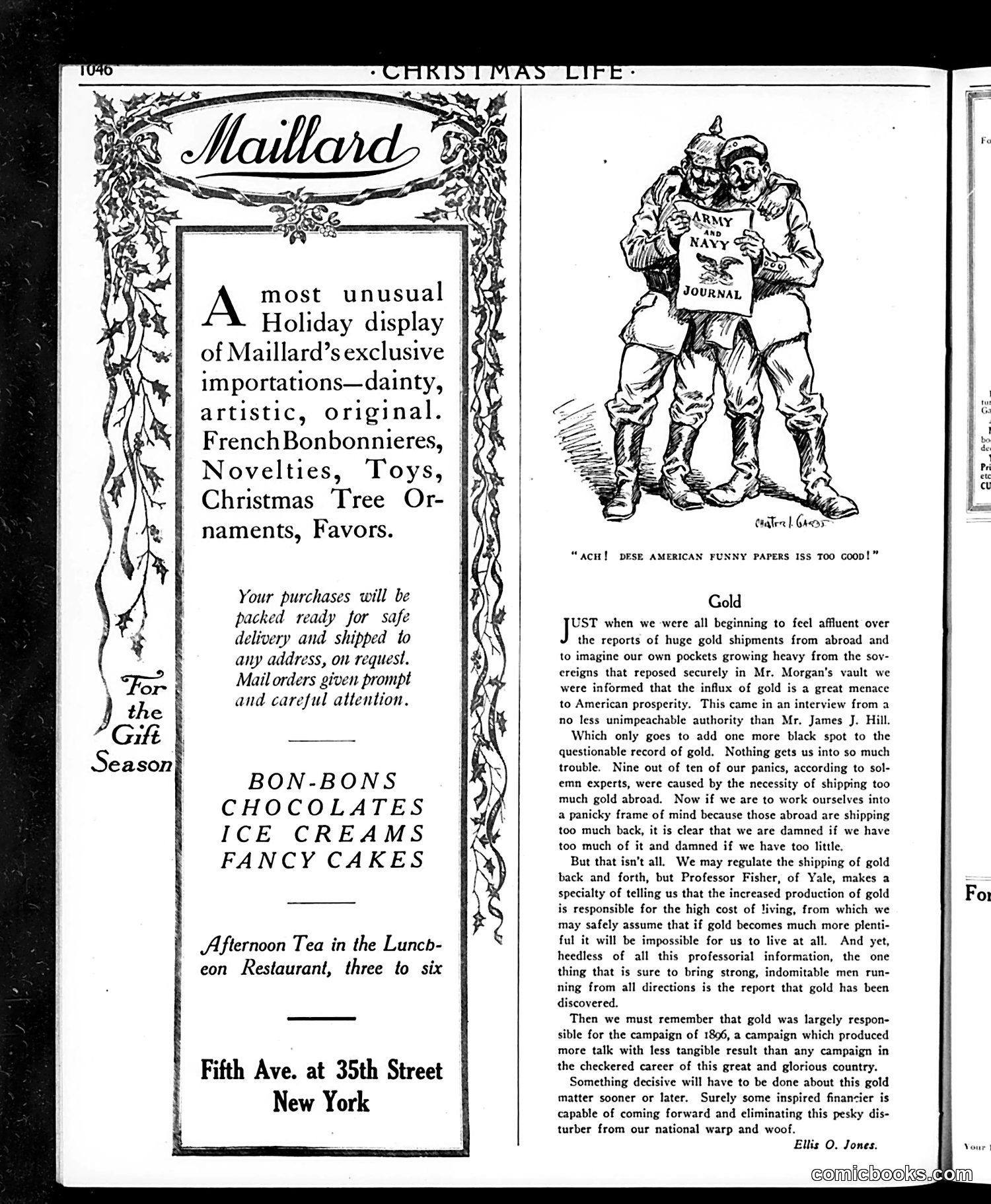
This page combines a Maillard's luxury chocolates advertisement with a satirical article about gold's paradoxical role in American economics. The cartoon caption—"Ach! Dese American funny papers iss too good!"—depicts two soldiers (likely German, suggested by the accent) reading an American military journal, mocking American satirical journalism. The main article by Ellis O. Jones satirizes the absurd contradictions surrounding gold: Americans panic when too much gold flows *into* the country (fearing prosperity) yet also panic when it flows *out* (fearing scarcity). The piece references banker J.P. Morgan, economist Irving Fisher of Yale, and the 1896 presidential campaign—when gold standard politics dominated debate. Jones ridicules how gold discoveries excite people while economists warn that increased gold supply causes inflation and living-cost increases, making prosperity paradoxically ruinous. The satire highlights early 20th-century anxieties about monetary policy and gold's volatile influence on American economic stability.
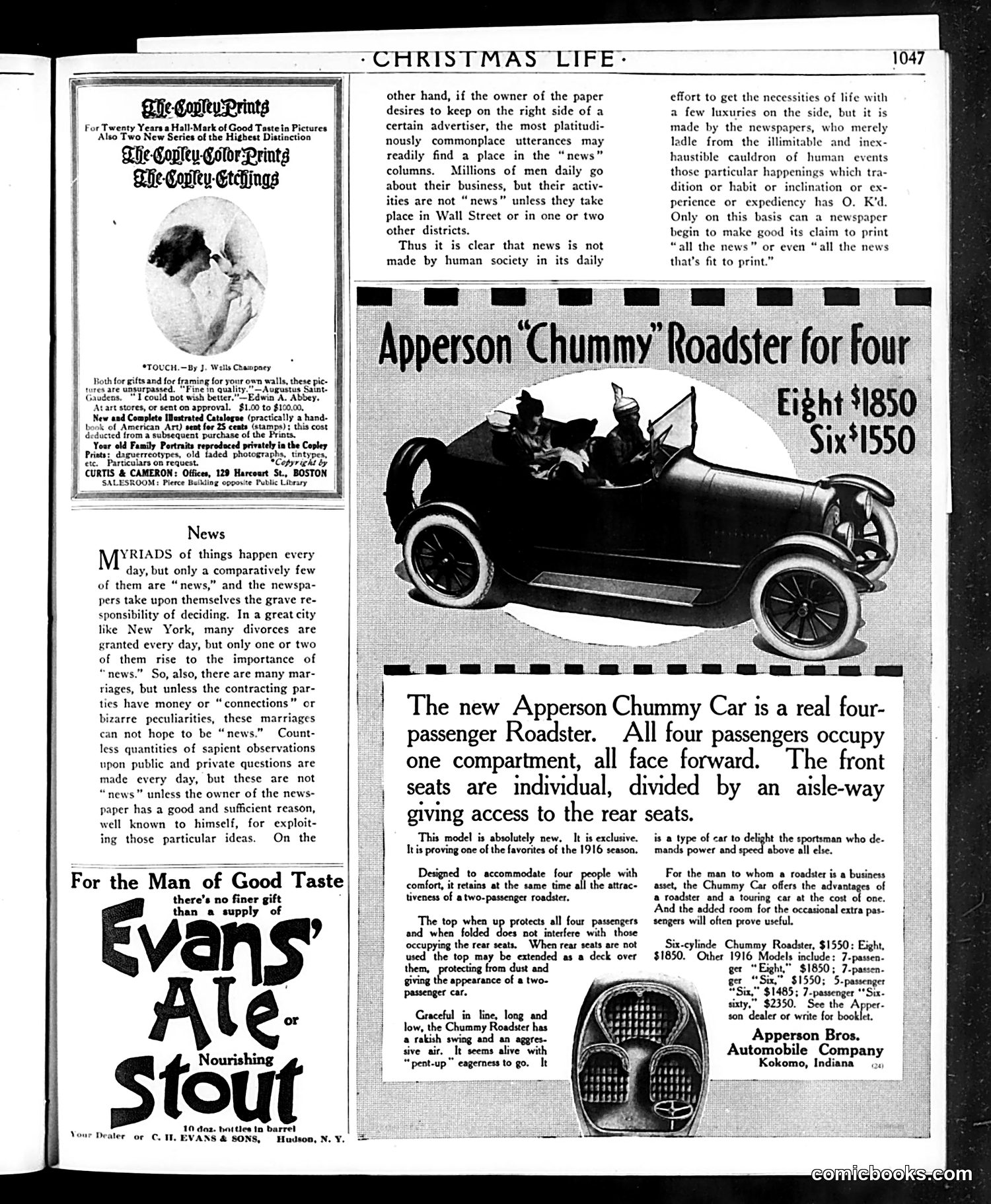
This page contains primarily **advertisements and editorial content**, not political cartoons. The main editorial piece is titled "News" and critiques newspaper gatekeeping. It argues that newspapers—not society—decide what constitutes "news." The author satirizes how papers ignore ordinary people's activities unless they occur on Wall Street or involve wealthy/connected individuals. Papers also allegedly suppress stories unfavorable to advertisers while promoting advertisers' viewpoints. The piece attacks newspaper bias and economic influence on coverage, suggesting that the press's claim to print "all the news...that's fit to print" is disingenuous. **Visual content** includes an art reproduction ("Touch" by J. Wills Champney) and period automobile advertisements (Apperson Chummy Roadster, Evans' Ale/Stout). These are straightforward product promotions with no satirical intent.
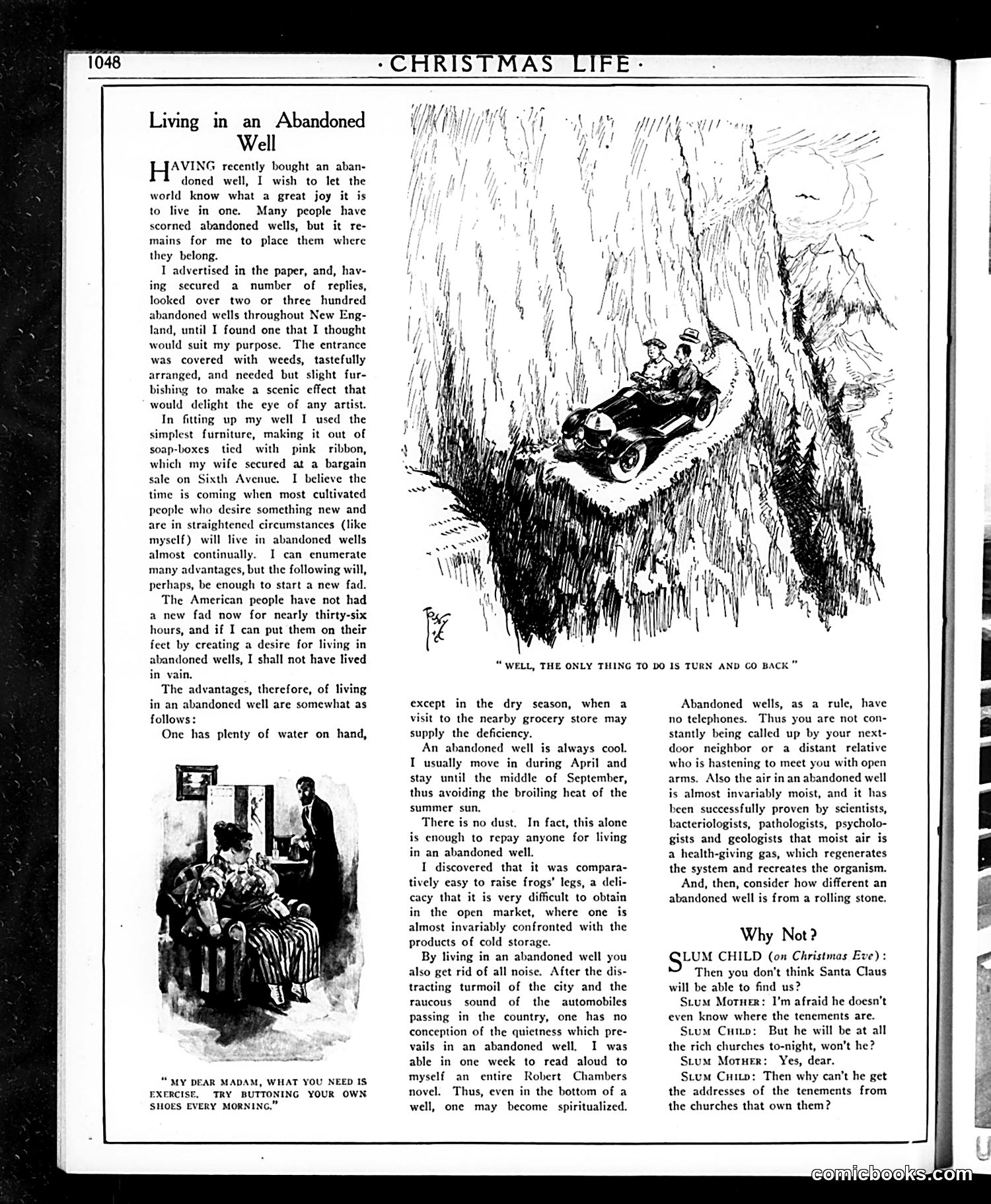
This article satirizes the American obsession with novelty fads and the desperation of economically struggling people. The unnamed author claims to have purchased an abandoned well as a residence, furnished it with soap-box furniture tied with pink ribbon, and advocates this as an upcoming trend for "cultivated people who desire something new and are in straightened circumstances." The satire works through deadpan absurdity: listing "advantages" like constant water access, coolness, no dust, and isolation from telephones—while the accompanying illustrations show a well-dressed couple contentedly living in a literal hole. The accompanying "Why Not?" dialogue darkly mocks wealthy churches that own tenements but don't help poor families locate aid on Christmas Eve. Together, these pieces critique both upper-class frivolity with self-invented hardship and systemic indifference toward actual poverty.
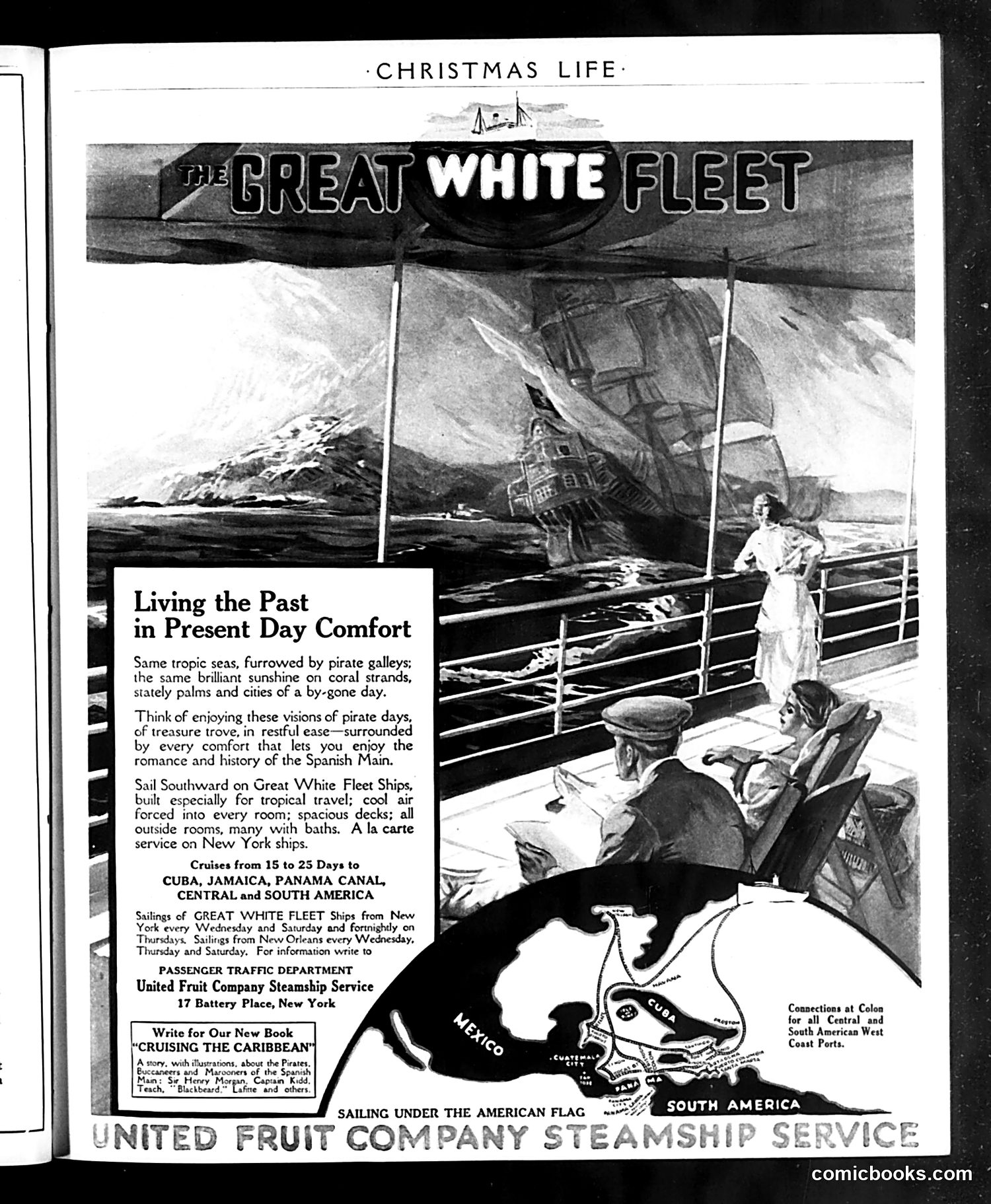
This is primarily a **cruise ship advertisement**, not political satire. It promotes the United Fruit Company's "Great White Fleet" steamship service to Caribbean and Central/South American destinations. The ad uses romanticized language about "pirate days" and "the Spanish Main" to market tropical cruises as nostalgic escapes—passengers can experience exotic history "in restful ease" with modern comforts (air conditioning, spacious decks, private baths). The illustration shows a well-dressed woman lounging on deck while viewing a tropical coastline with sailing ships, emphasizing leisure and luxury. A small map indicates the Caribbean routing. **For modern readers**: This reflects early 20th-century attitudes romanticizing colonial/pirate-era history as exotic entertainment, while the United Fruit Company itself—though not critiqued here—was actually controversial for its significant influence over Central American politics and labor practices. The ad simply sells vacation fantasy.
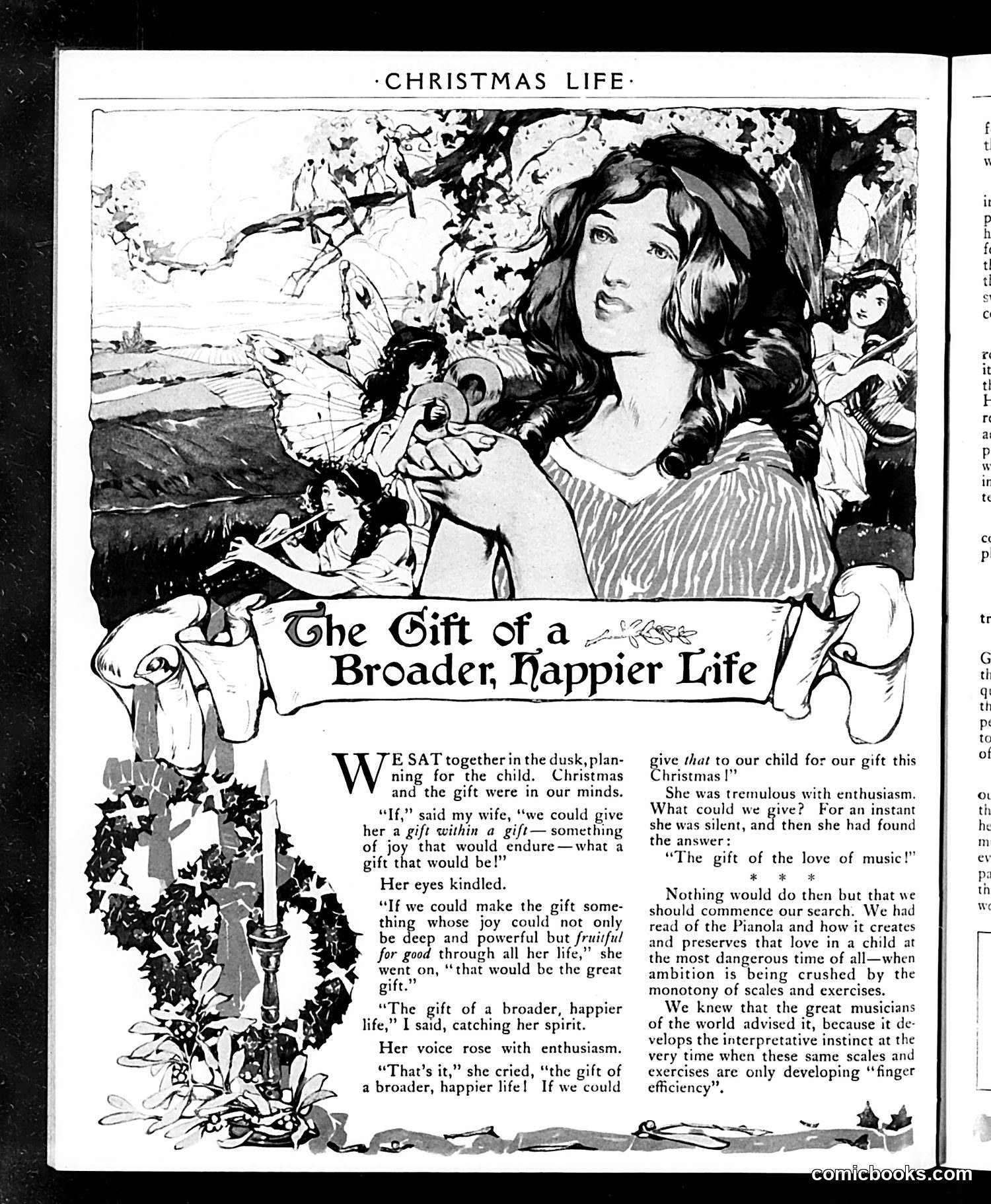
This is primarily **advertising disguised as editorial content**—a common practice in early 20th-century magazines. The narrative about parents seeking the perfect Christmas gift for their daughter functions as a sales pitch for the **Pianola** (a player piano). The "satire" is gentle and self-aware rather than biting: the parents' earnest discussion about giving their child "a broader, happier life" through music education gets conveniently "solved" by discovering this product. The text acknowledges a real educational debate—whether piano scales and exercises crush children's musical joy—and positions the Pianola as the solution: it supposedly preserves love of music while "great musicians of the world" endorse it. The accompanying illustration shows an idealized woman amid cherubs and nature, evoking cultural aspirations to refinement and child development. There's no satirical target here; rather, the "joke" is that this consumer product fulfills the parents' noble wishes. It's marketing wrapped in sentiment, typical of how Life magazine blended entertainment and commerce.
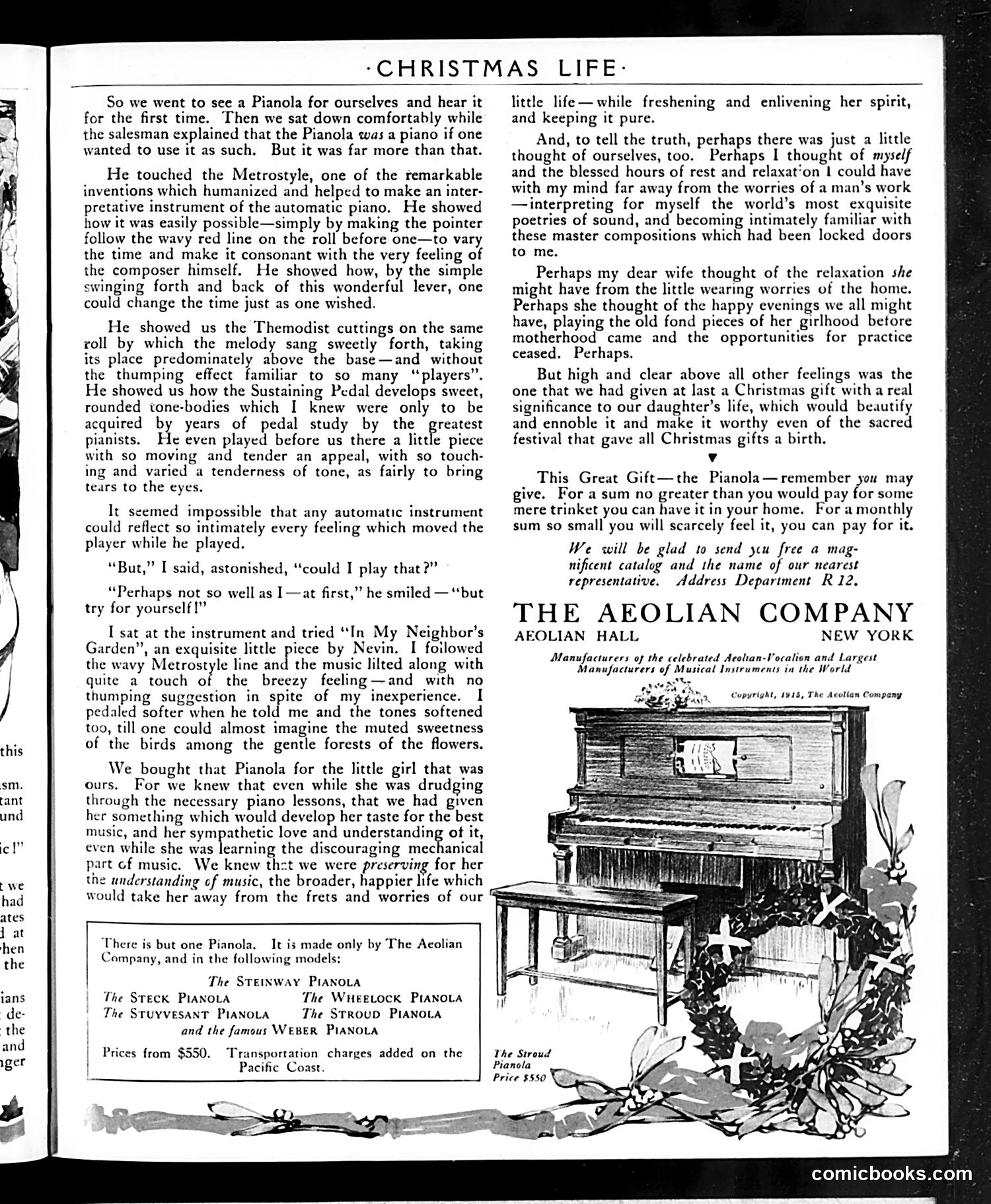
This is a **product advertisement disguised as editorial content**, a common early-20th-century marketing technique. The page presents a narrative essay about discovering the Pianola—an automatic player piano manufactured by The Aeolian Company. **What it is:** The article describes a family's experience purchasing a Pianola for their daughter's musical education. It emphasizes the device's sophisticated features (Metrostyle lever, Themodist cuttings, Sustaining Pedal) that allegedly allow automatic playback to sound expressive and human-performed. **The appeal:** Rather than satirizing, the text exploits middle-class anxieties and aspirations—cultural refinement, parental duty, and leisure time. It promises that an expensive machine can provide "understanding of music" and relief from life's "frets and worries" without requiring actual musical skill. **For modern readers:** This represents early consumer marketing targeting educated, affluent families. The Pianola represents a now-obsolete technology marketed as solving problems (children's cultural development, adult relaxation) through consumption—a pattern that persists today in piano apps and music-streaming services.
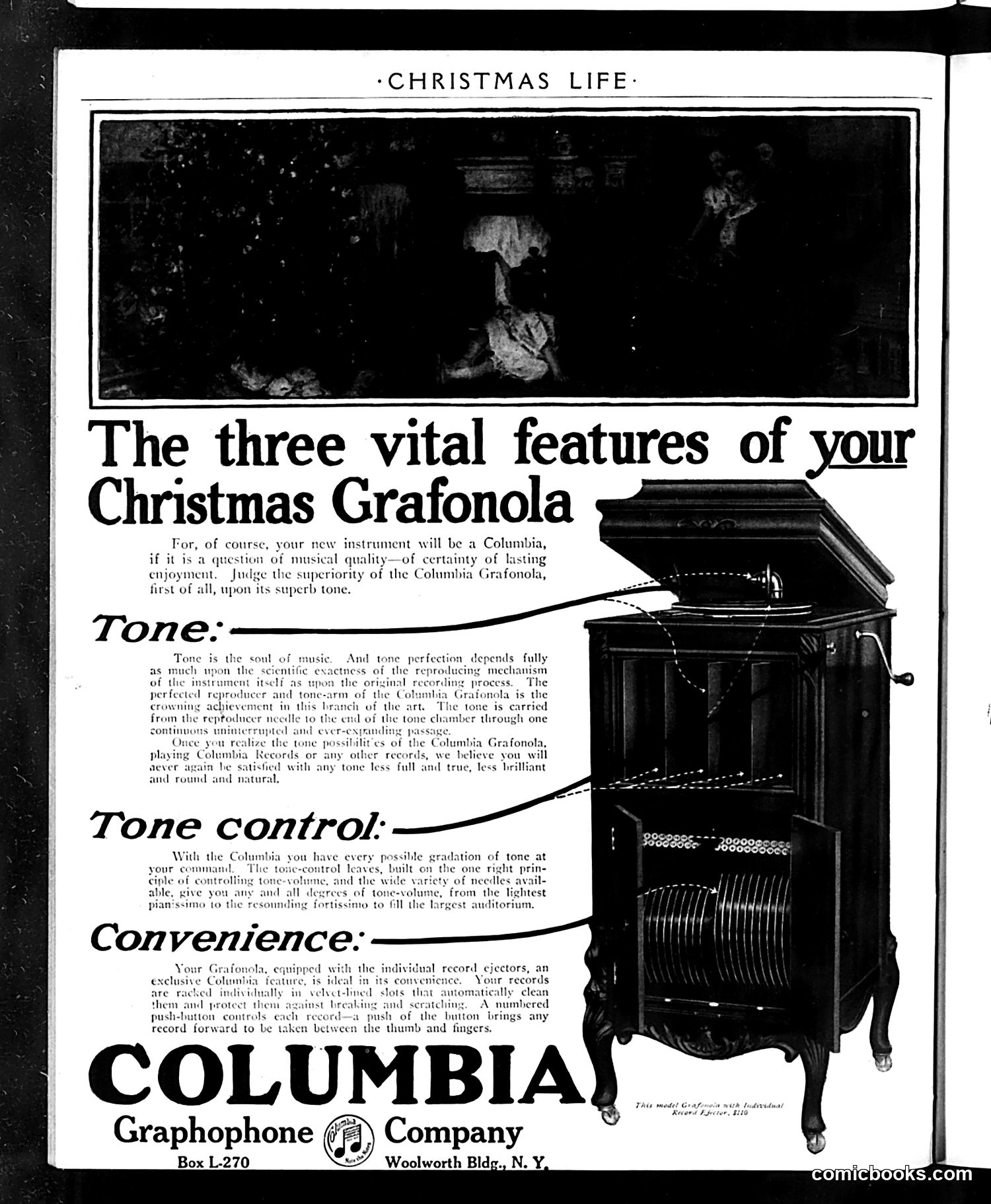
This is primarily a **product advertisement**, not political satire or a cartoon. It promotes the Columbia Grafonola, an early gramophone/record player, positioned as an ideal Christmas gift. The page emphasizes three selling points: superior **tone** (sound quality), **tone control** (ability to adjust audio), and **convenience** (individual record slots and push-button operation). The advertisement appeals to middle-class consumers seeking quality home entertainment technology. There is no satire or political commentary visible. The decorative image at the top appears to be a generic Christmas scene, and the large product photo dominates the lower half. This represents straightforward early 20th-century consumer marketing, highlighting technological features that would have seemed innovative for the era—automatic record changing and tone adjustment controls being notable conveniences for the time. The "Christmas Life" header simply indicates this ran in Life magazine during the holiday shopping season.
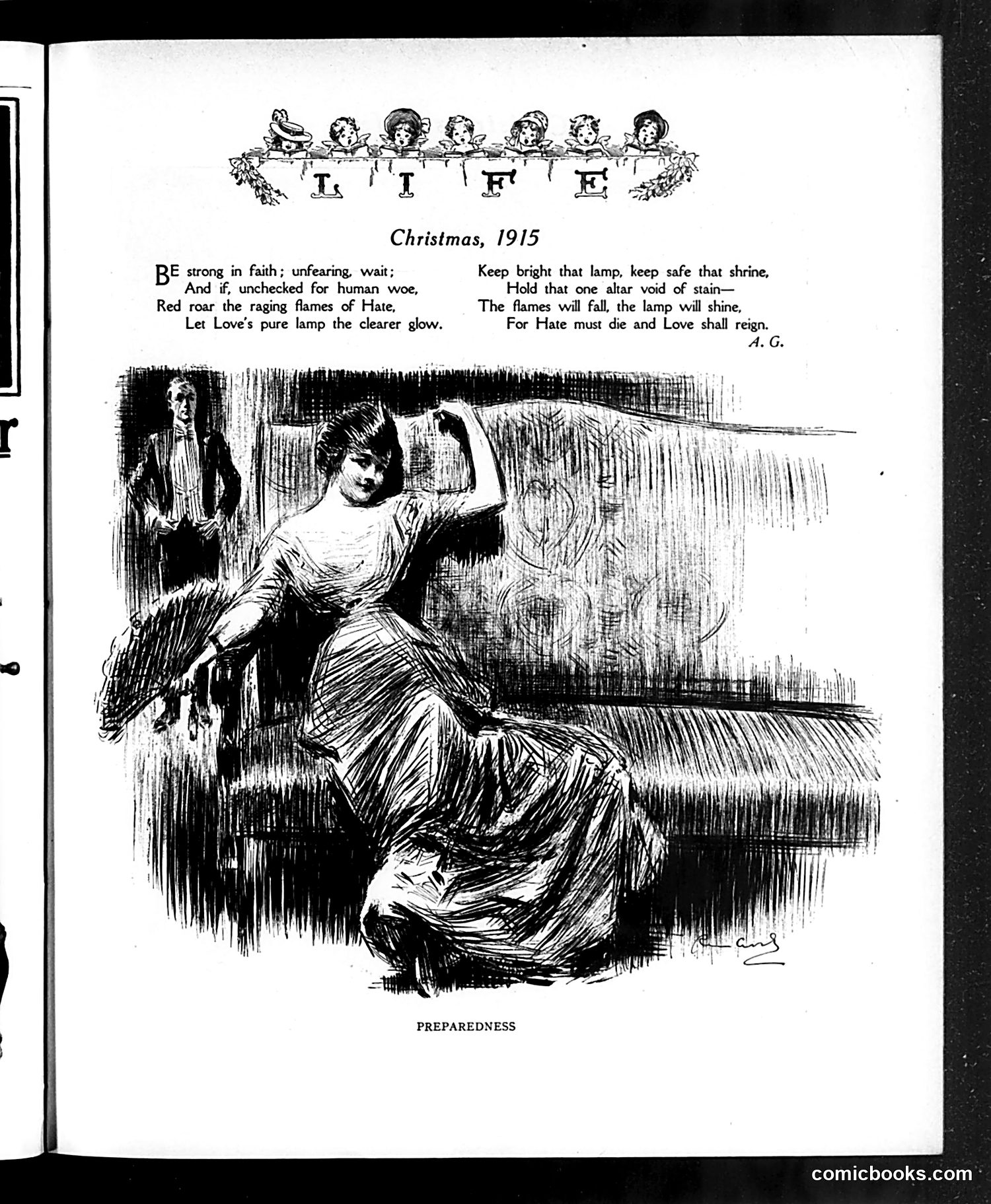
This 1915 Christmas-themed satirical illustration addresses World War I, which was raging in Europe. The poem urges readers to maintain faith and "keep bright that lamp" of Love against the "raging flames of Hate." The title "Preparedness" references the American debate over military readiness—whether the U.S. should strengthen its armed forces despite official neutrality. The sketch depicts a woman (likely representing America or virtue) in contemplative repose, gazing upward. The decorative header with cherubs and garlands establishes the Christmas context. The poem's message advocates spiritual/moral preparation alongside potential military preparedness, suggesting that maintaining humanitarian values and hope are essential during wartime, even as nations consider defensive measures. The work reflects 1915 American anxieties about European conflict's implications.
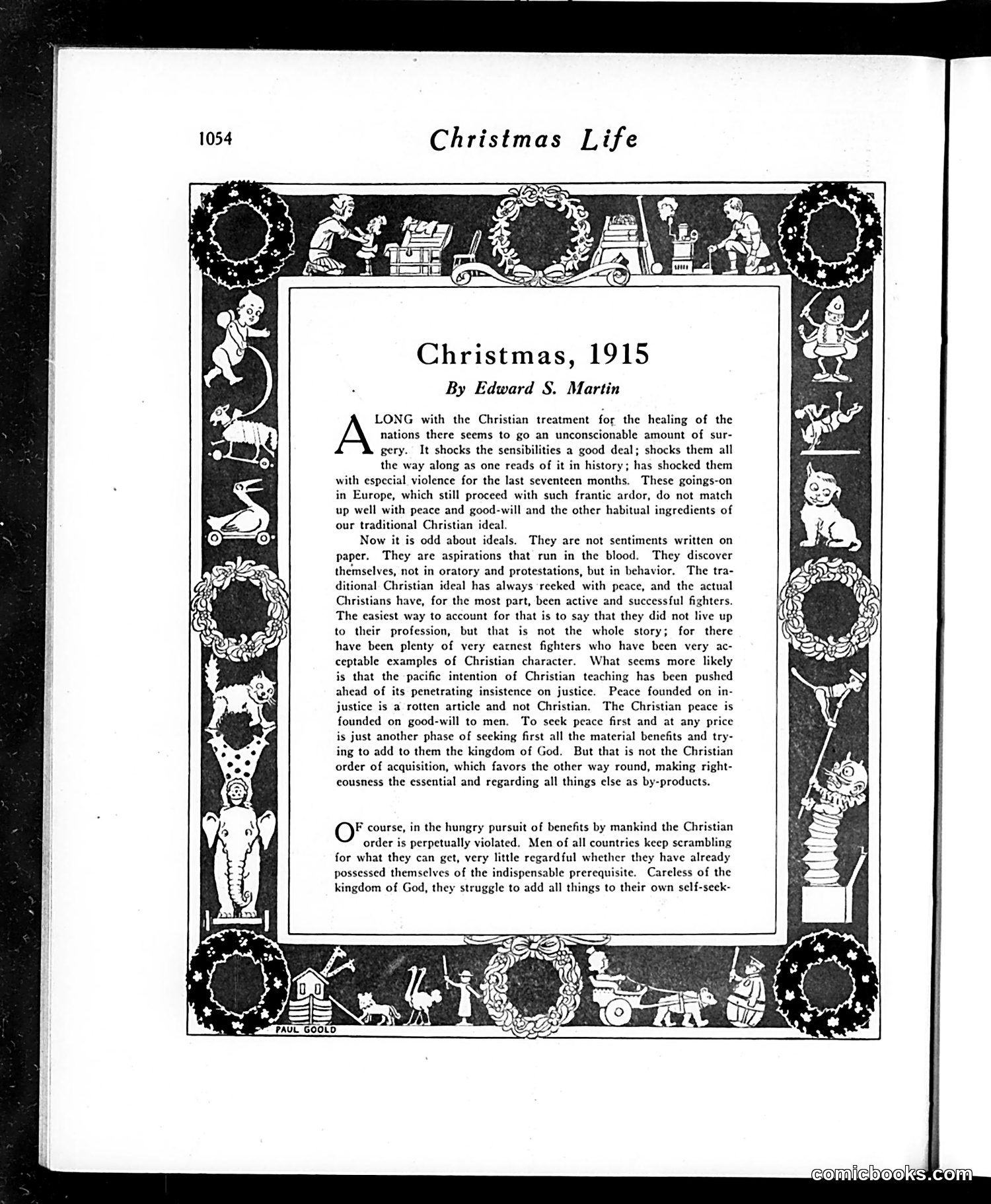
This is an editorial essay by Edward S. Martin, not a cartoon, appearing in *Life* magazine during World War I (dated Christmas 1915). **The Context:** Europe was then in the third year of the devastating Great War. Martin critiques the hypocrisy of Christian nations waging brutal warfare while claiming Christian ideals of peace and good-will. **The Argument:** Martin argues that Christianity has always emphasized *justice* alongside peace—not pacifism at any cost. He suggests that Christians throughout history were "active and successful fighters," implying that warfare can be morally justified when pursuing righteousness. The real problem, he suggests, is that modern nations pursue material benefits and peace *before* establishing justice—inverting Christian priorities. **The Satire's Point:** Martin sardonically observes that Christians and Christian nations consistently violate their own stated principles by prioritizing self-interest over righteousness. The decorated border features Christmas imagery (wreaths, nativity scenes, children), ironically contrasting festive Christian symbolism with the article's grim subject matter.
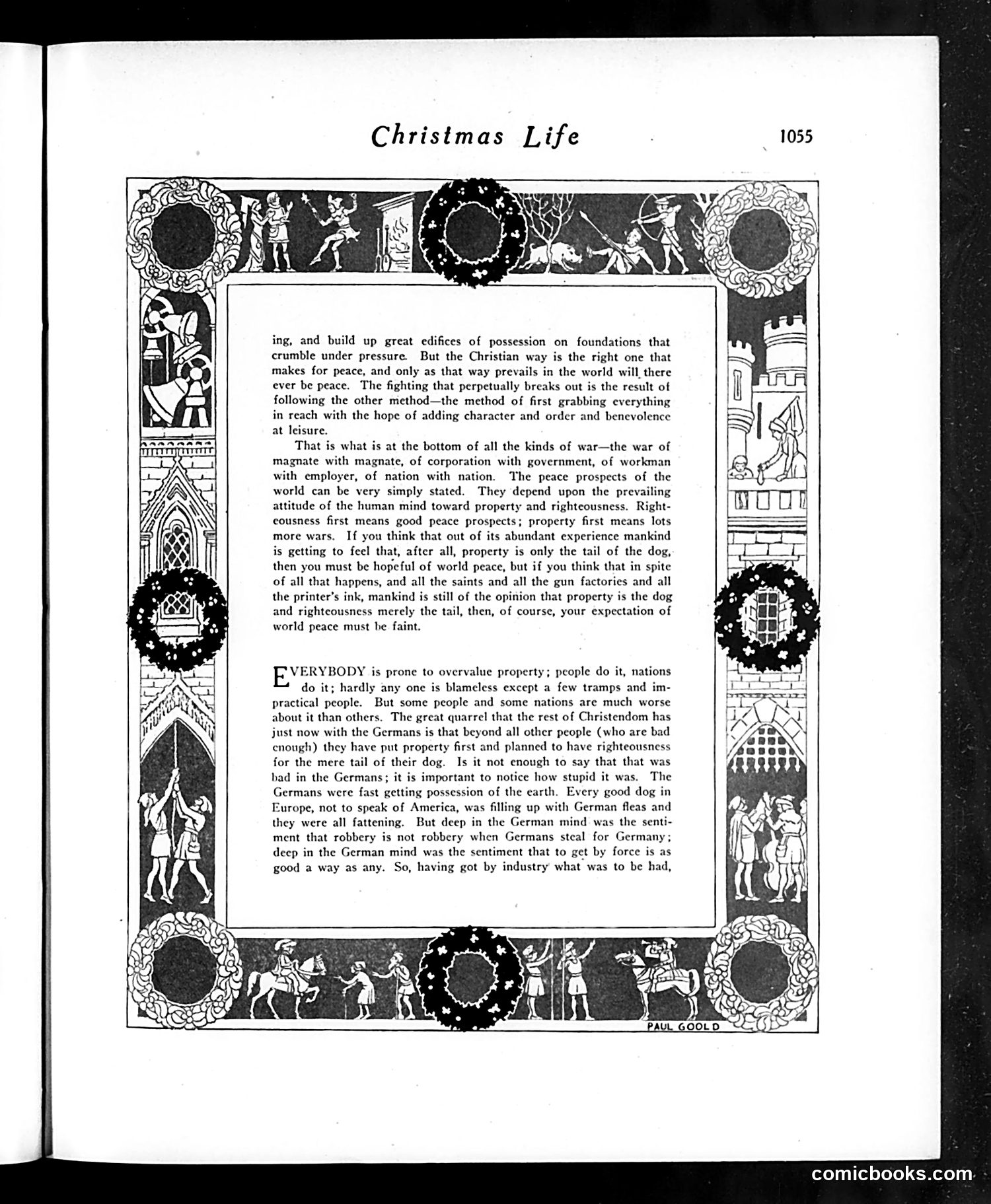
This page presents a Christmas-themed editorial (not a cartoon) arguing that **property-obsession causes war**, while Christian righteousness promotes peace. The text criticizes **Germany** specifically—likely written during or shortly after WWI—for embodying the worst "property-first" mentality. The author claims Germans justified theft and violence as acceptable when serving German interests, treating robbery as legitimate nationalism. The satirical argument: Germany accumulated wealth and power ("every good dog in Europe...filling up with German fleas"), but their moral framework rationalized forceful expansion as morally equivalent to honest industry. This German attitude toward property and righteousness (putting property first, righteousness second) represents the root cause of perpetual warfare. The decorative border features medieval/religious imagery and wreaths, emphasizing the Christian moral framework being invoked. The byline reads "PAUL GOOLD" (artist's signature on the decorative frame). This is propaganda-adjacent editorial content, not satirical cartooning.
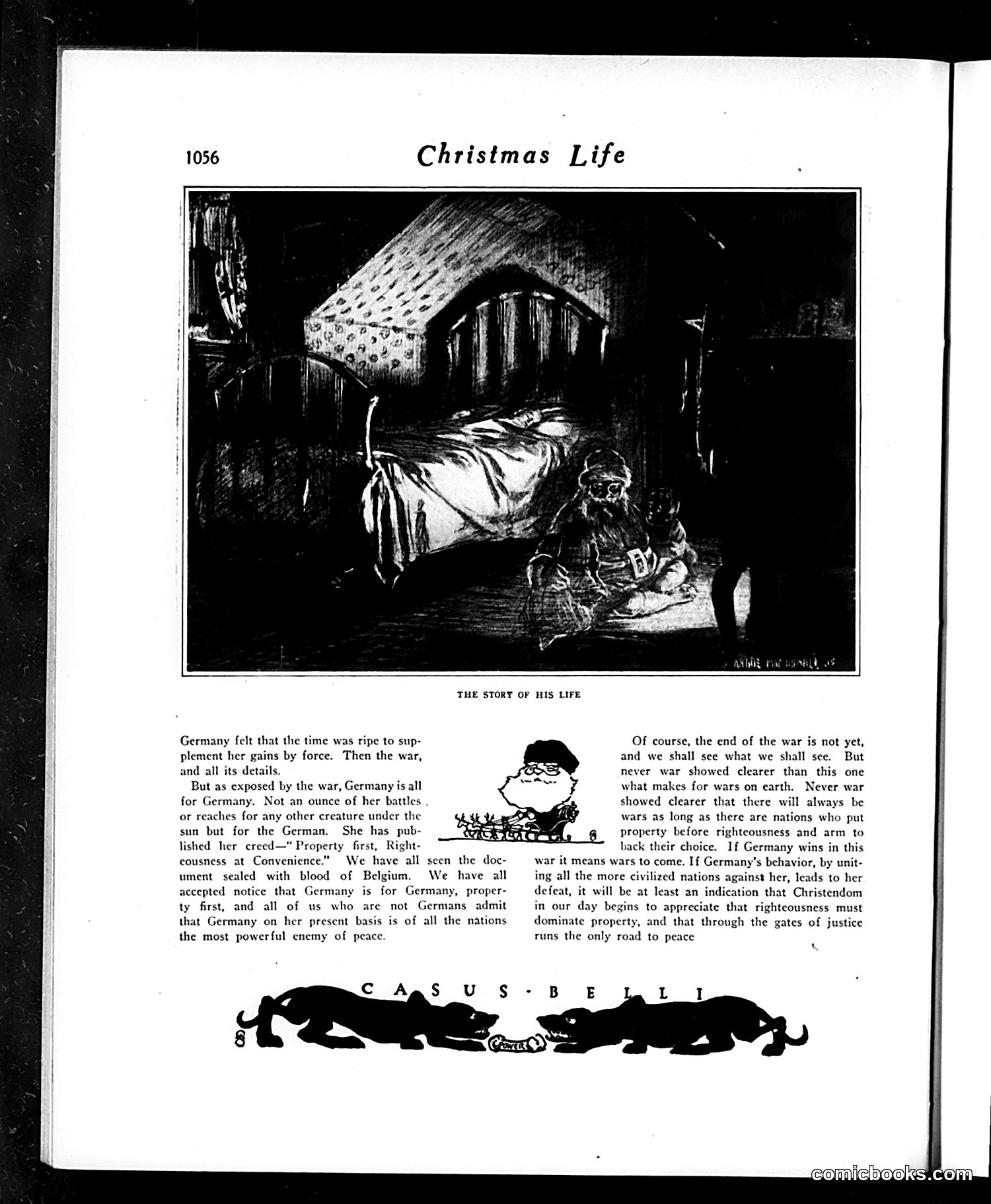
This WWI-era satirical piece critiques German militarism and philosophy. The illustration titled "The Story of His Life" depicts an infant (representing Germany or German ideology) in a manger—a stark inversion of the Christian nativity scene, suggesting Germany's worldview is fundamentally anti-Christian. The accompanying text attacks Germany's stated national creed: "Property first, Righteousness at Convenience." The author argues Germany prioritizes material gain and military power over moral principles, citing Belgium's suffering as evidence. The piece frames the war as a moral struggle between nations that put "property before righteousness" (Germany) versus those guided by justice and Christian values. The decorative element "CASUS BELLI" (Latin: cause for war) with fallen figures emphasizes the human cost of such amoral nationalism. For modern readers, this represents American intellectual opposition to German aggression during World War I, viewing the conflict through a moral-religious lens.
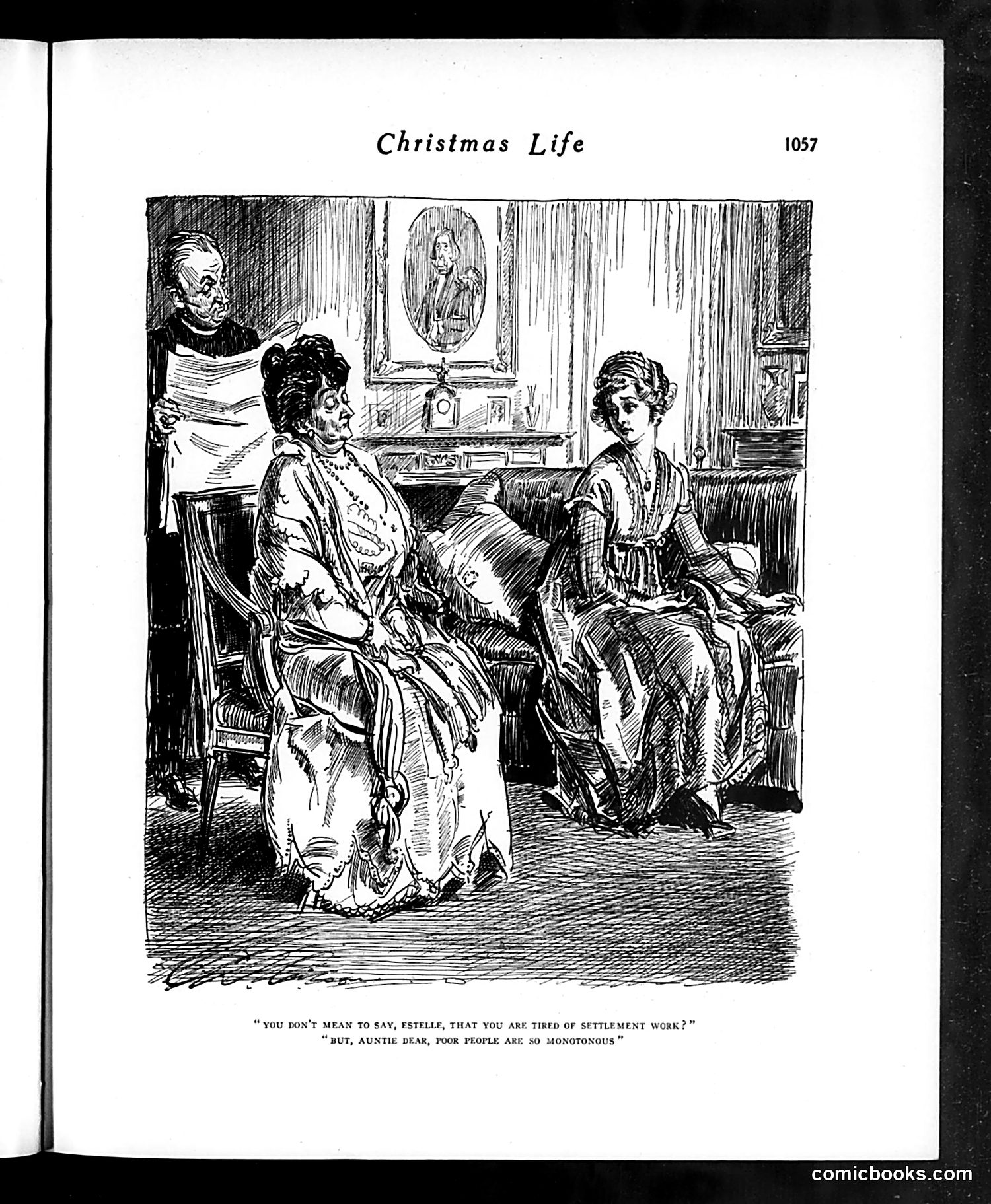
This cartoon satirizes wealthy women's charitable work through a conversation between a young woman named Estelle and her aunt. Estelle complains that poor people are "monotonous," revealing the shallow motivation behind her "settlement work"—a Progressive Era social reform effort where privileged volunteers helped impoverished communities. The satire targets two things: first, the condescension of upper-class reformers who viewed the poor as subjects of charity rather than individuals deserving dignity; second, the performative nature of such volunteerism—charity work as fashionable entertainment for bored society women, not genuine compassionate service. The well-dressed figures in an elegant drawing room emphasize the class distance, mocking how settlement work functioned partly as social prestige for the wealthy.
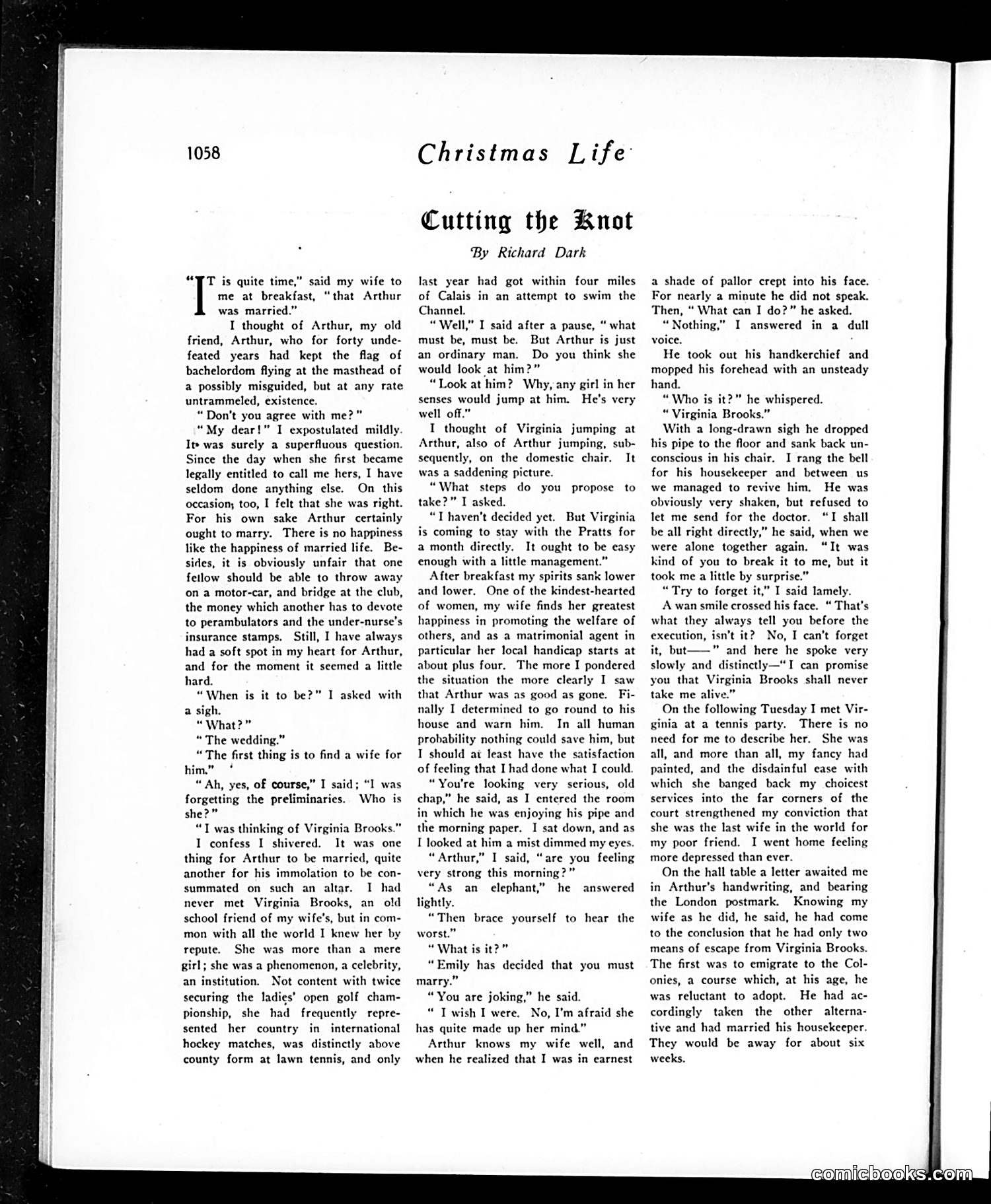
This is a short humorous story (not a cartoon) from *Life* magazine about matrimonial matchmaking. The narrator's wife decides their old bachelor friend Arthur must marry, and she's selected Virginia Brooks—a celebrated athlete who has represented her country in hockey, nearly swum the English Channel, and won golf championships. The satire targets early 20th-century social conventions: the assumption that wealthy bachelors "ought" to marry for moral/social reasons, the presumption that a woman's greatest happiness lies in matchmaking, and the comedic irony that Arthur—merely "well off" but otherwise ordinary—would be swept up by a formidable, accomplished sportswoman. The joke relies on gender role expectations of the era: that any unmarried woman should eagerly accept a wealthy man, regardless of his merits, and that a man's money matters more than personality compatibility.
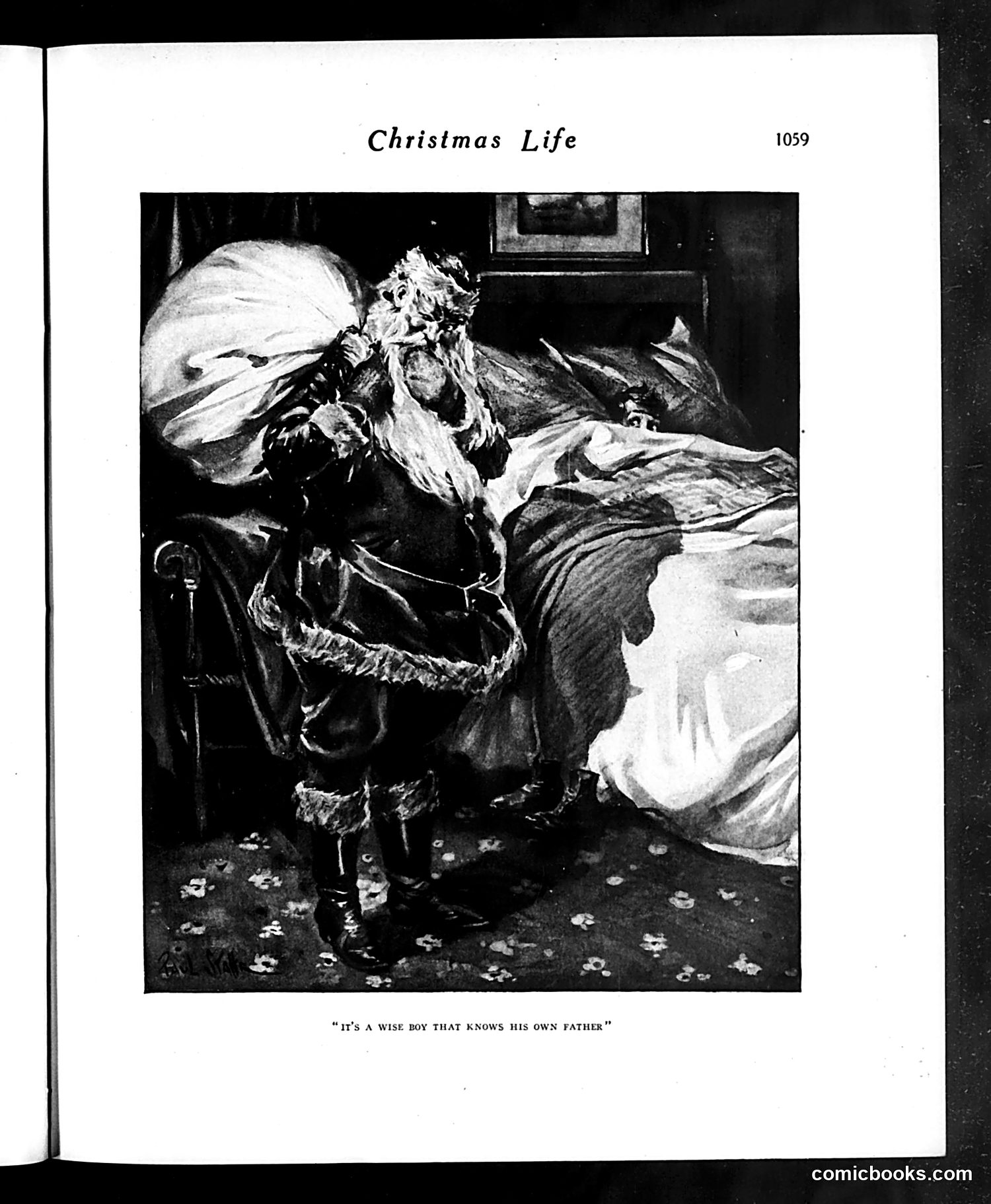
This page from *Life* magazine presents a Christmas-themed illustration depicting Santa Claus examining or interacting with a sleeping child in bed. The caption reads "It's a wise boy that knows his own father," a play on a classical proverb. The satire likely comments on paternity and family deception—suggesting the irony that children don't know Santa Claus is actually their father (or parent), playing on the common childhood tradition where parents perpetuate the Santa fiction. The joke reflects turn-of-the-century skepticism about holiday mythology and parental honesty, or possibly critiques the disconnect between parents' public personas and their actual domestic identities. The illustration's dramatic lighting and shadowing emphasize the secretive, revelatory nature of the moment depicted.
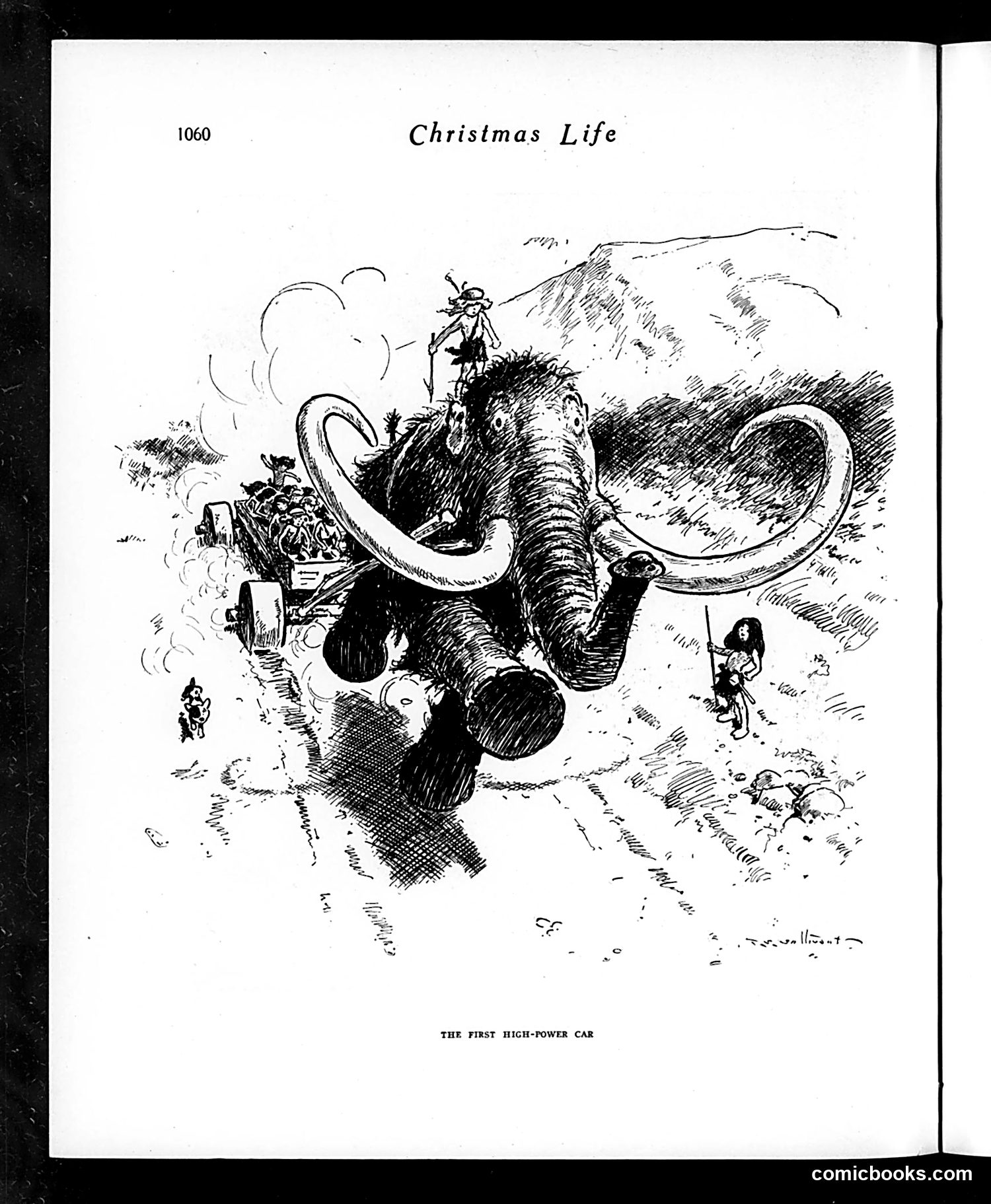
This satirical cartoon depicts an elephant—a creature of immense power and size—as "the first high-power car." The elephant carries a small carriage on its back with a figure inside, while tiny humans ride atop and alongside it. The joke plays on the term "high-power" by literalizing it: instead of an automobile engine with high horsepower, Life's artist presents an actual powerful animal. This appears to be Christmas-themed holiday satire, likely mocking early automobile technology or advertising claims about new cars' power and capabilities. By reducing the modern marvel of motorized vehicles to absurdity—replacing them with prehistoric animal power—the cartoonist pokes fun at contemporary automotive hype or the era's fascination with mechanical "progress."
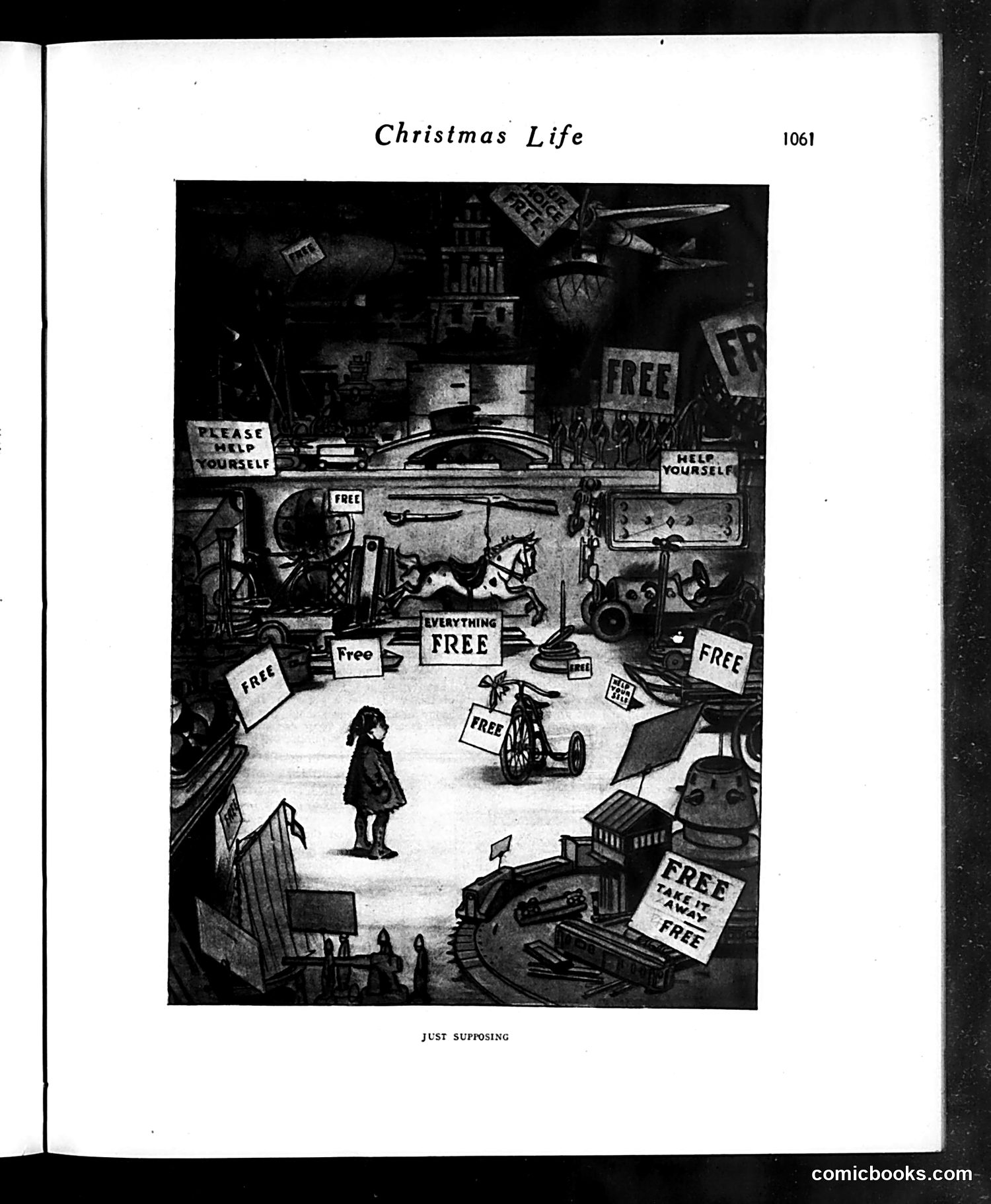
This satirical illustration depicts a child standing alone in a toy store surrounded by abundance—bicycles, trains, dolls, airplanes, and other toys all marked "FREE." Signs reading "PLEASE HELP YOURSELF" and "HELP YOURSELF" encourage taking items without payment. The cartoon appears to be post-Depression era social commentary. It presents an ironic fantasy: what if Christmas toys were actually free and available to all children, regardless of economic status? The child's isolated, contemplative stance amid the cornucopia suggests the gap between this idealized vision and harsh economic reality. The title "JUST SUPPOSING" signals the piece as wishful thinking—acknowledging that such abundance and equality were aspirational rather than actual conditions for most families during the period.
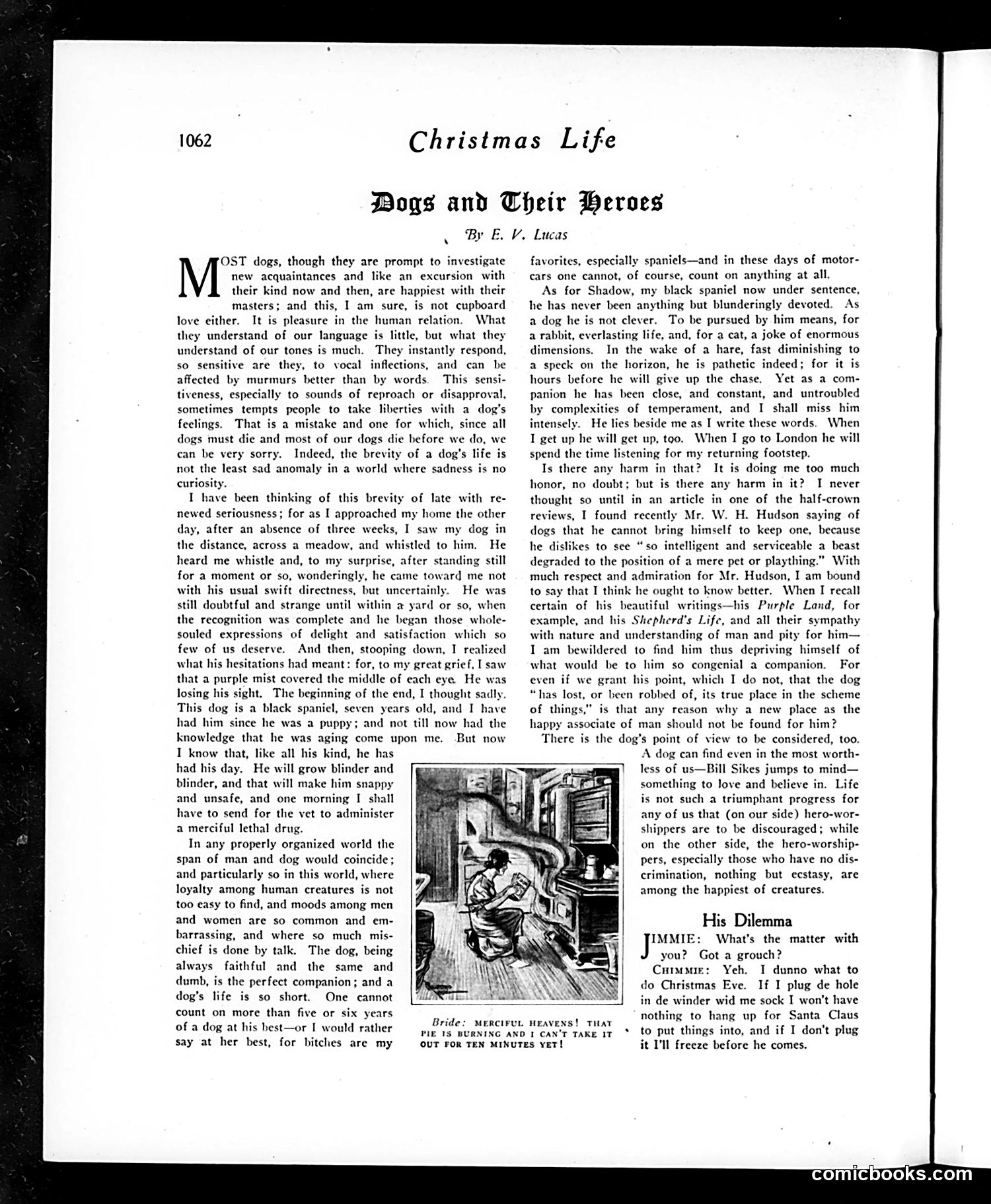
This is a sentimental essay about human-dog relationships, not primarily satirical. The author describes his aging black spaniel, Shadow, and reflects on a dog's brief lifespan and devoted companionship. The piece includes a gentle critique of naturalist writer W.H. Hudson, who reportedly refuses to keep dogs because he views pet ownership as "degrading" them. Lucas argues Hudson is wrong—that dogs find genuine fulfillment as companions, not mere "pets or playthings." The accompanying illustration shows a man with a dog in a humble interior, reinforcing the domestic intimacy the essay celebrates. For modern readers: this reflects early-20th-century anxieties about industrialization (cars are mentioned as dangers) and evolving attitudes toward animal welfare, while defending the simple human-animal bond against more philosophical objections to pet-keeping.
This is a satirical story by Harry Grant Dart about a young art student's inflated expectations versus harsh reality. Bertram, a 15-year-old from Ohio, gains confidence after his crayon portrait reaches the President and wins a county fair prize. His family finances his admission to the Art Students' League in New York. At the League, Bertram encounters the pretentious art-school milieu: pretentious peers (one wears "purple socks," another chews gum casually), and a brutal instructor who crushes his confidence by comparing his talent unfavorably to "coal-tar products." The satire targets both small-town naïveté—mistaking minor local success for genuine talent—and the intimidating gatekeeping of established art institutions. The story mocks Bertram's supporters' overconfidence and the art world's harsh meritocracy.
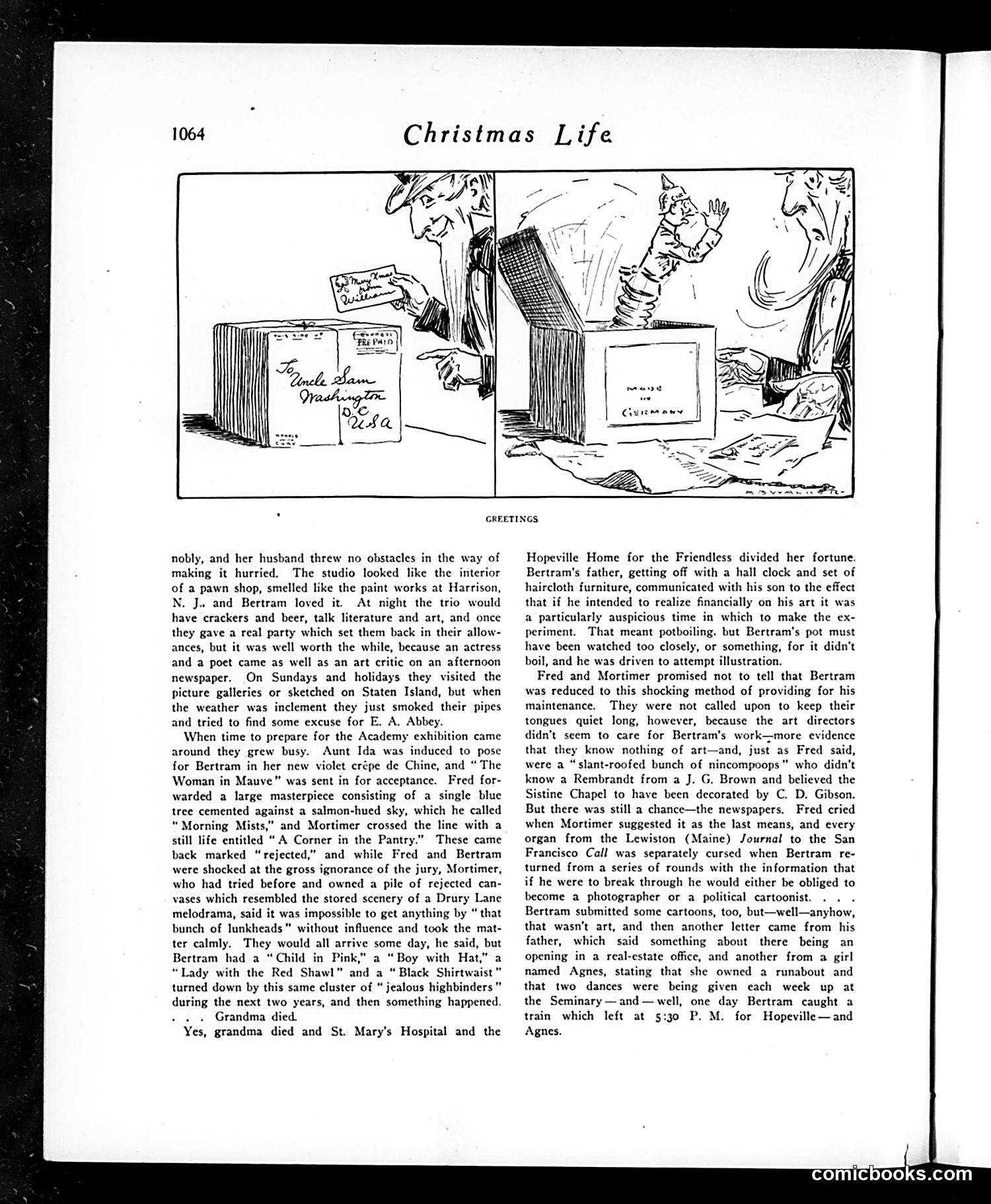
This 1064 page presents a satirical narrative about struggling young artists in what appears to be early 20th-century America. The two cartoon panels at top illustrate the story of three aspiring painters—Bertram, Fred, and Mortimer—living in poverty while pursuing "serious art." The satire targets the pretension and impracticality of bohemian artists. They live in squalor ("smelled like the paint works"), subsist on meager allowances, yet consider themselves serious artists. Their paintings are repeatedly rejected by Academy juries, which they blame on the judges' ignorance rather than their own work. The joke culminates when Bertram's grandmother dies, briefly offering financial hope. But when he cannot make money from "real art," he's forced to consider commercial work—illustration, photography, or political cartooning—which the narrative dismisses as not "art" at all. The story ends with him distracted by a girl named Agnes and a potential real-estate job. The satire mocks both the artists' delusions and the art establishment's gatekeeping while showing economic desperation forcing compromise of artistic ideals.
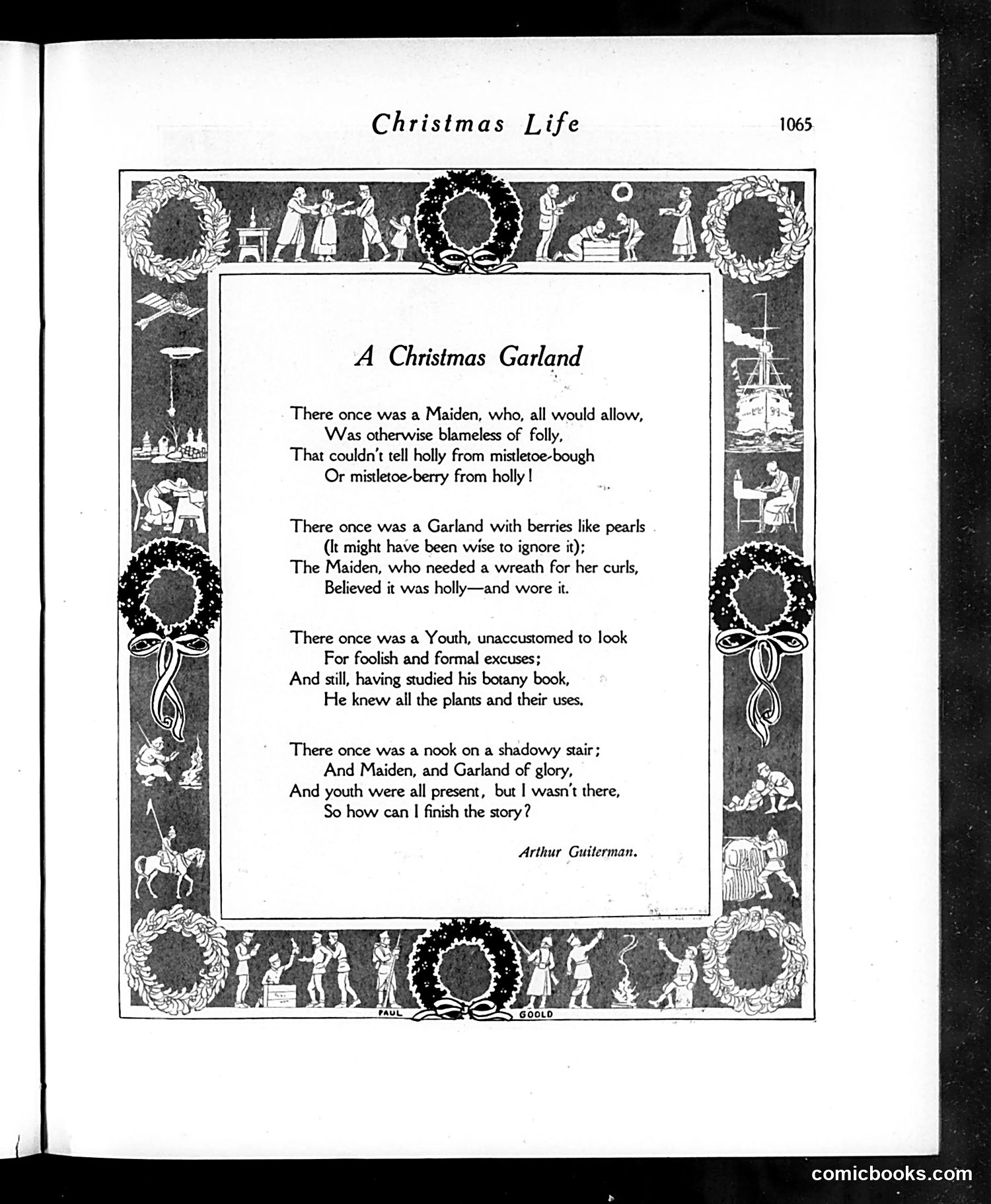
This is a humorous poem by Arthur Guiterman, not political satire. It's a lighthearted Christmas story playing on mistletoe tradition—the plant associated with romantic kissing under the holidays. The joke: A maiden unable to distinguish holly from mistletoe mistakenly wears a decorative garland (thinking it's holly) that's actually mistletoe. A knowledgeable youth, who knows plant identification, encounters her in a shadowy stairwell—the perfect setup for a mistletoe kiss. The poem's humor lies in the narrator's coy refusal to reveal what happened, ending with "how can I finish the story?"—implying romantic action occurred that shouldn't be explicitly described. The ornamental border featuring wreaths and holiday scenes reinforces the festive, innocent tone. This is gentle holiday humor for a general audience, not social commentary.
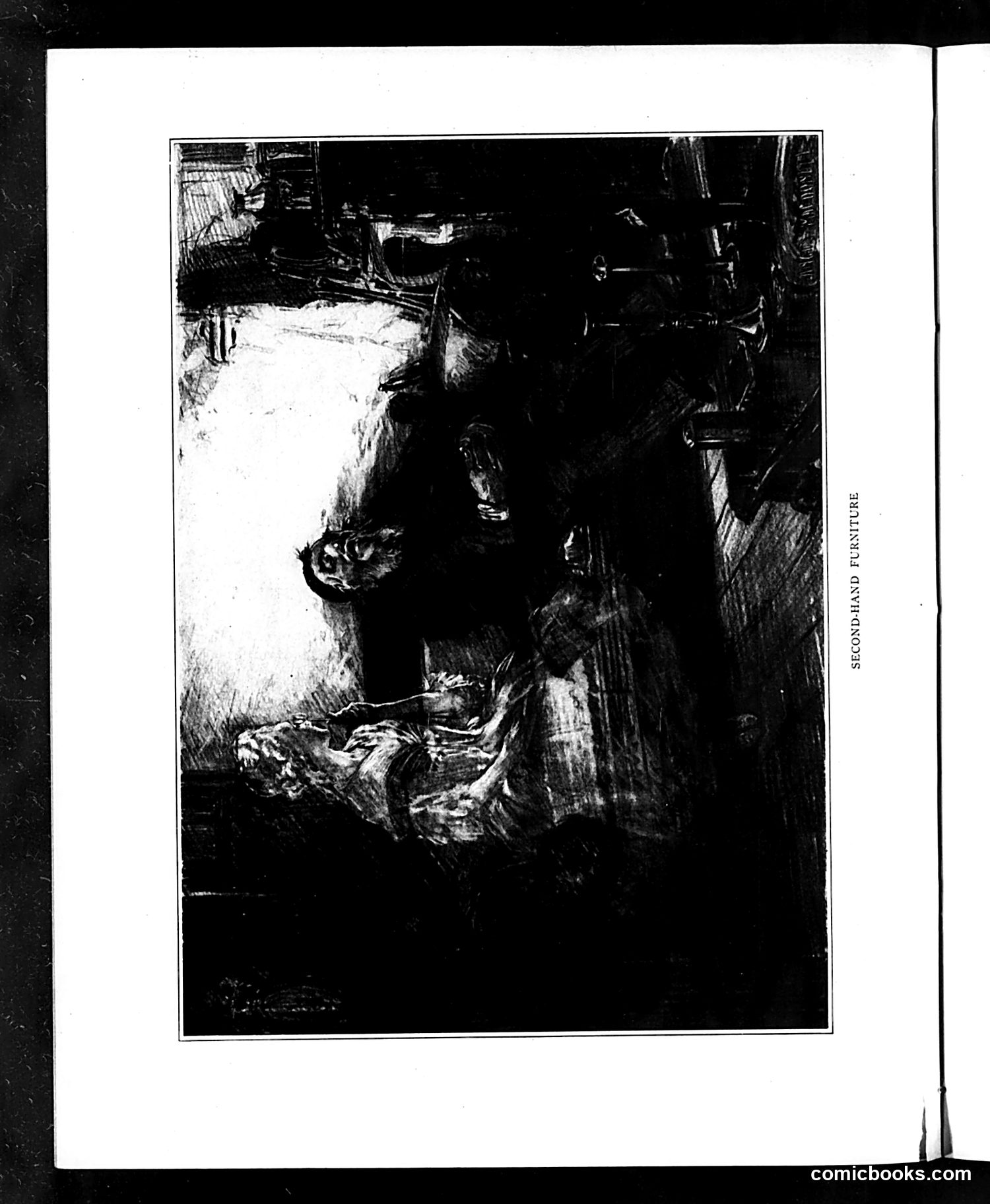
This appears to be a dark satirical etching or engraving showing a cluttered, dimly-lit interior space filled with worn furniture and household items. The artistic style suggests social commentary on poverty or lower-class living conditions. The title "Secondhand Furniture" indicates the satire targets the secondhand goods trade—likely commenting on the poor quality, worn state, or exploitative pricing of used items sold to working-class buyers. The shadowy, cluttered composition emphasizes the depressing, cramped nature of such living spaces. Without clearer visual identification of specific figures or readable text beyond the title, I cannot identify particular political figures or pinpoint the exact satirical target, though the work clearly critiques economic inequality or consumer exploitation of the era.
This page presents two short stories from Life's fiction contest (closed October 4th). The magazine invited readers to submit stories, promising to publish accepted ones weekly until all manuscripts were judged. **"The Escape"** by A. Leslie Goodwin depicts a WWI scenario where two soldiers—cousins on opposite sides—encounter each other. One rescues the other from execution, and they escape together, but a sentry shoots both, declaring "Relatives have no business on opposite sides." The story explores the tragic irony of family divided by war. **"Man May Love"** by Robert Sharp is a lighter romantic comedy about Geoffrey, a recovering hospital patient who proposes to his nurse, Miss Young. She deflects his affection humorously, comparing him to previous patients and calling him "Sonny." The story plays on the convention that male patients fall in love with their nurses during recovery—presented as a symptom rather than genuine emotion. Both stories reflect early 20th-century literary conventions and wartime concerns.
This page contains two short stories rather than cartoons. "The Old Grove Crossing" by Albert H. Coggins appears to be the featured fiction. The first story describes a nurse (Miss Young) who falls for a patient (Geoffrey) she cares for. After his recovery, he proposes marriage but asks her to wait a month while he sees other women. She agrees hopefully, receives passionate letters for two weeks, then silence. Finally, a letter arrives—but Geoffrey has reconciled with his ex-fiancée Diana and is announcing his marriage to her, thanking Miss Young only for her nursing care. The satire targets romantic self-deception: Geoffrey's manipulative courtship (using illness as excuse for attention), his shallow promises, and his casual disregard for the nurse's genuine feelings. The story mocks both his duplicity and her naive trust in his declarations. The second story excerpt concerns a judge presiding over cases. The social commentary appears to critique judicial leniency or inconsistency, though the full context is cut off.
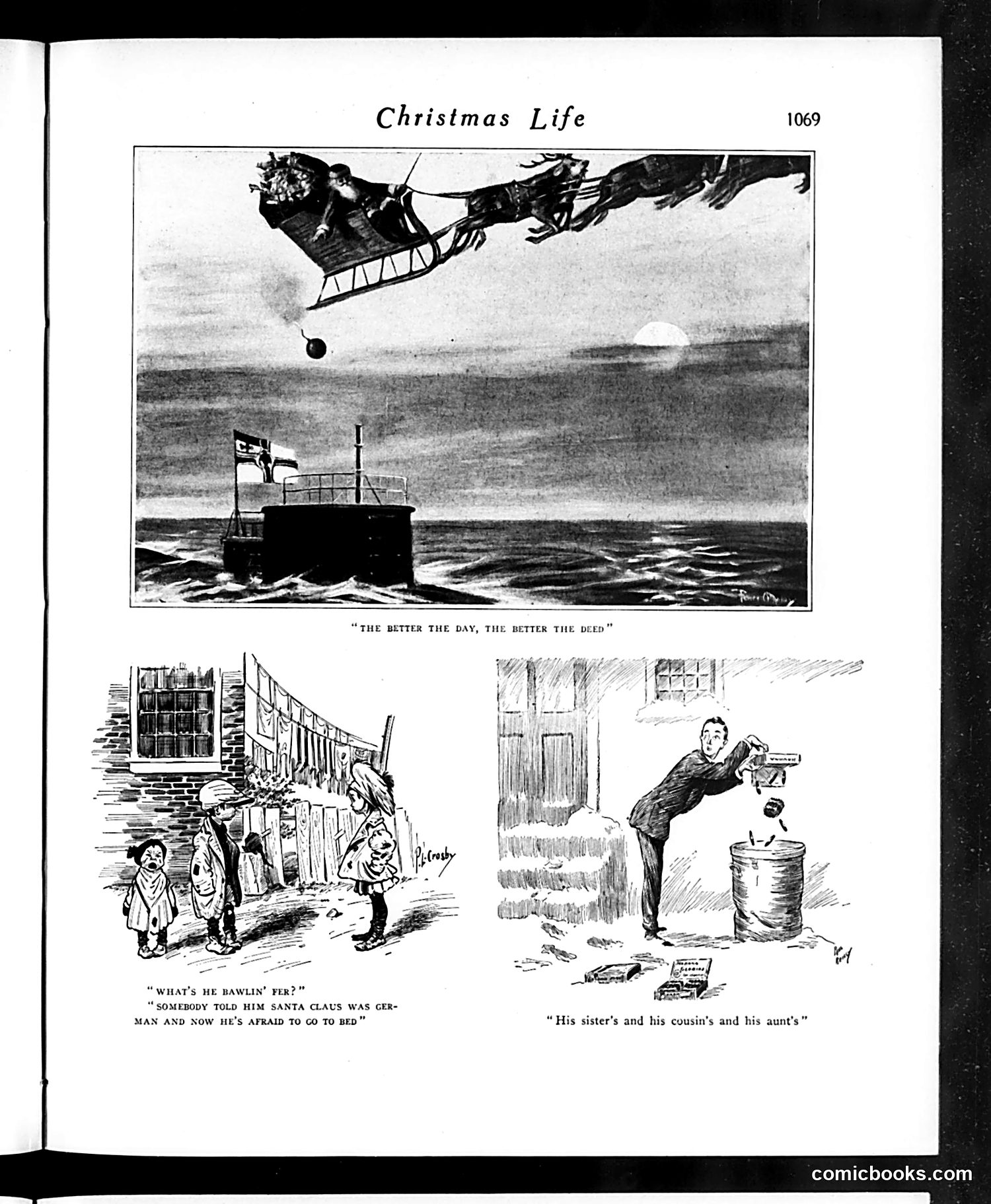
This page contains three Christmas-themed cartoons satirizing early 20th-century concerns. **Top cartoon** ("The Better the Day, The Better the Deed"): Shows Santa's sleigh dropping a bomb on a ship below, darkly satirizing wartime Christmas during what appears to be WWI. **Bottom left**: A child cries when told Santa is "German," reflecting anti-German sentiment and xenophobia during the war. The joke plays on how war propaganda affected even children's holiday traditions. **Bottom right**: References "his sister's and his cousin's and his aunt's"—likely alluding to the Gilbert and Sullivan operetta *HMS Pinafore* ("I've got a little list"), using the familiar cultural reference humorously in a Christmas context about gift-giving obligations. The page overall uses Christmas as a framework to comment on wartime anxieties and social pressures of the era.
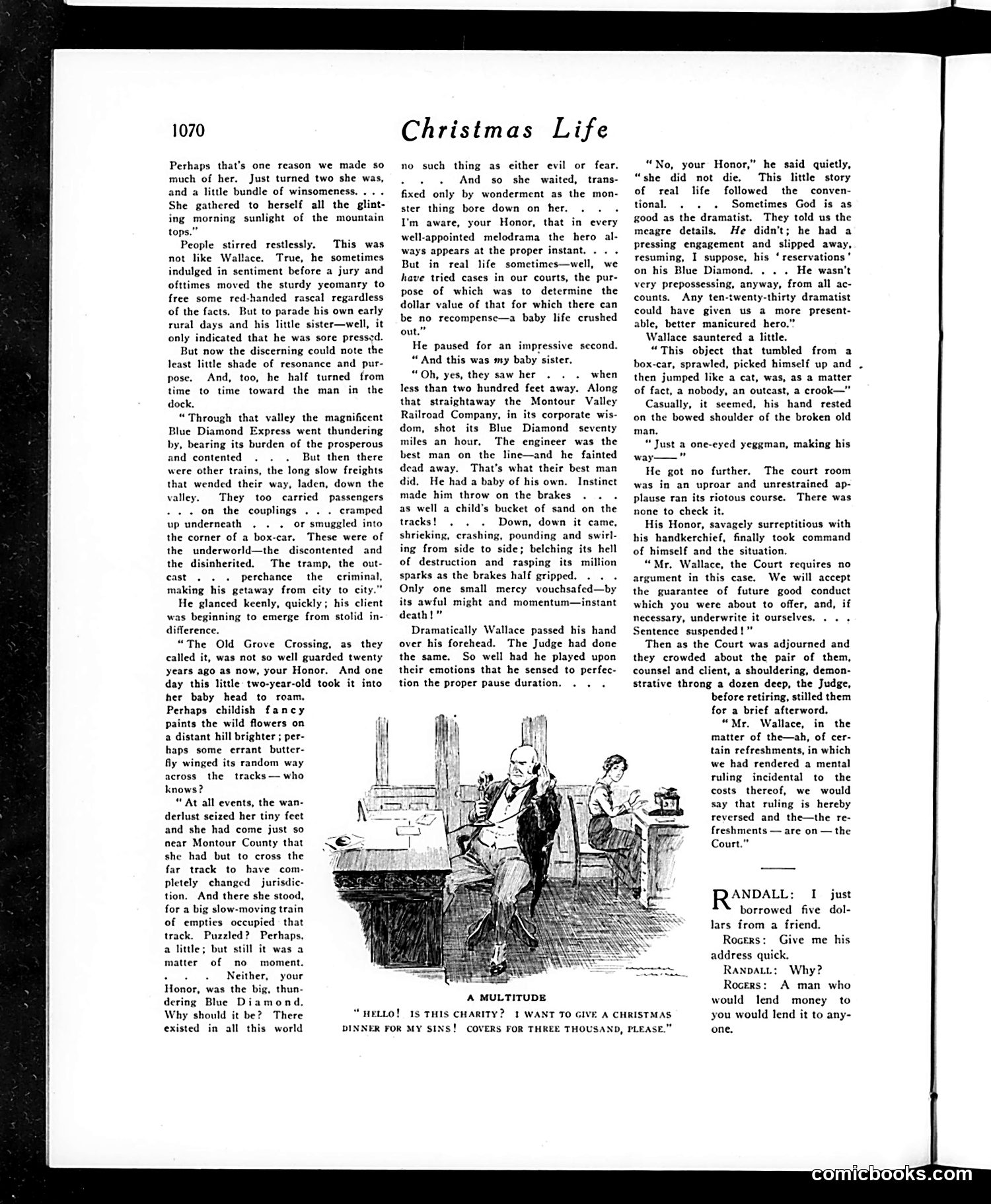
This page contains a courtroom drama excerpt featuring an attorney named Wallace delivering an emotionally manipulative closing argument. The narrative centers on a tragic anecdote: Wallace's baby sister was struck and killed by a speeding "Blue Diamond Express" train twenty years ago near Old Grove Crossing in Montour County. The satire targets courtroom theatricality and jury manipulation. Wallace deliberately invokes his dead sister to sway jurors emotionally rather than argue facts—a tactic the narrator notes is "not like Wallace" and signals desperation. The passage observes that courtrooms sometimes produce unjust verdicts when lawyers exploit sentiment "regardless of the facts." The illustration shows Wallace addressing court while gesturing theatrically, emphasizing how personal tragedy becomes performative oratory. The small cartoon at bottom—a woman demanding "a Christmas dinner for my sins"—appears thematically separate but relates to moral/social accountability. The satire critiques how legal proceedings can be corrupted by persuasive emotion-mongering rather than principled justice.
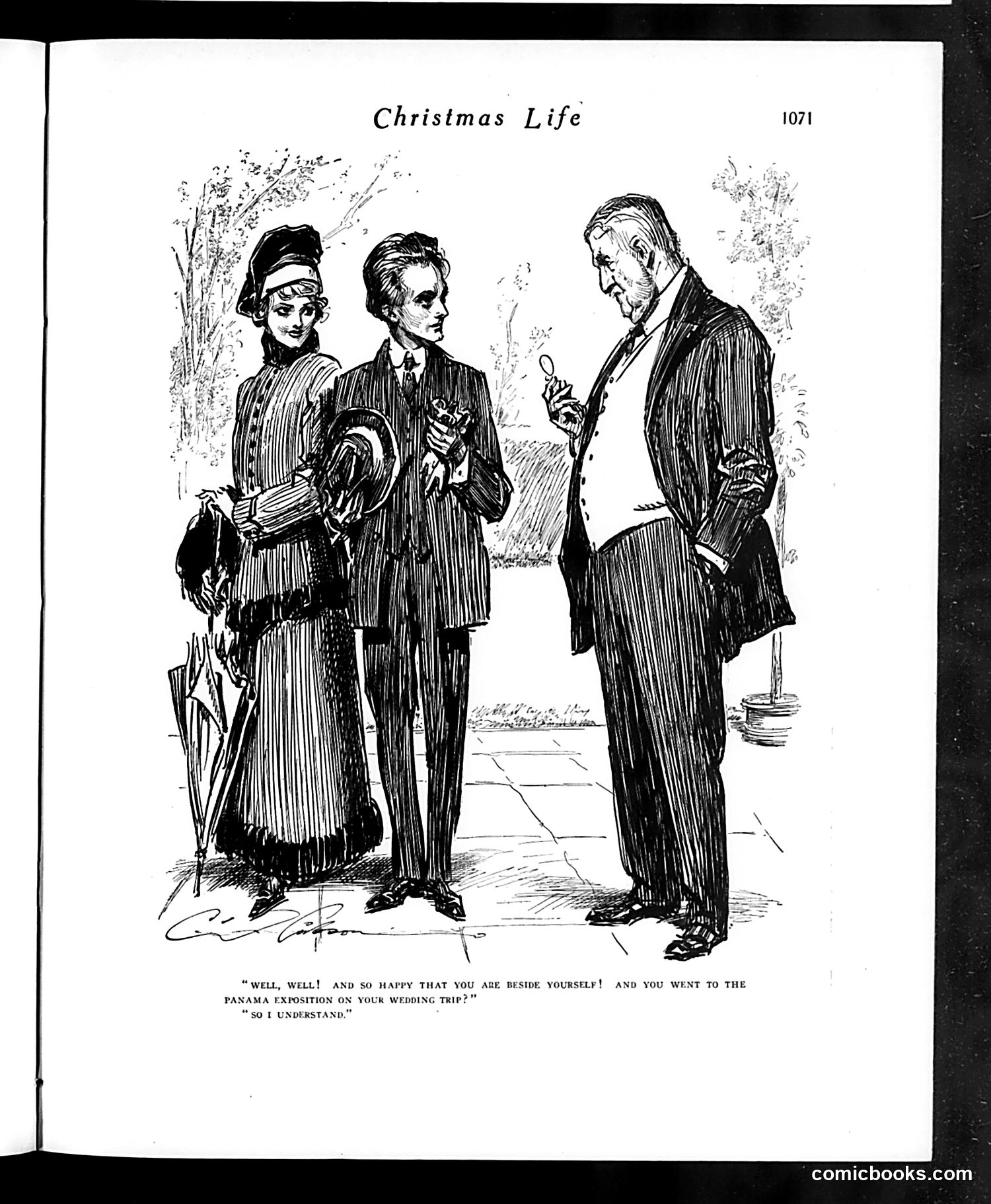
This illustration depicts a social comedy about newlyweds and travel. An older gentleman (likely a father figure or authority) congratulates a young couple on their marriage, specifically mentioning they attended the Panama Exposition on their honeymoon. The bride holds a parasol and small gift, the groom wears formal attire with a boutonniere. The humor centers on the man's knowing comment: "Well, well! And so happy that you are beside yourself! And you went to the Panama Exposition on your wedding trip?" The groom's response, "So I understand," suggests ironic detachment—implying he was so preoccupied with marital duties he scarcely noticed the exposition itself. This satirizes honeymoon expectations versus reality, a common comedic theme in early 20th-century magazines.
This is not a cartoon but a sentimental Christmas greeting essay by Kate Masterson, the prominent feature of this *Life* magazine page (number 1072). The piece is a heartfelt, spiritually-inflected message to readers distant from the author, emphasizing universal Christmas themes: family togetherness, remembrance of the deceased ("friends we loved who left us here"), charity, and spiritual renewal. The essay employs romantic, Victorian-influenced language—references to "tropic poinsettia meadows," "mountain evergreens," and mystical imagery of stars and dawn. The decorative border features period-appropriate Christmas iconography (wreaths, evergreens, carolers) rather than satirical content. This appears to be sincere holiday content, not satire. For modern readers: this represents *Life's* aspirational, mass-audience voice circa the early-to-mid twentieth century—sentiment-driven, spiritually optimistic, designed to unite readers across geographical and economic distance through shared Christmas ideals.
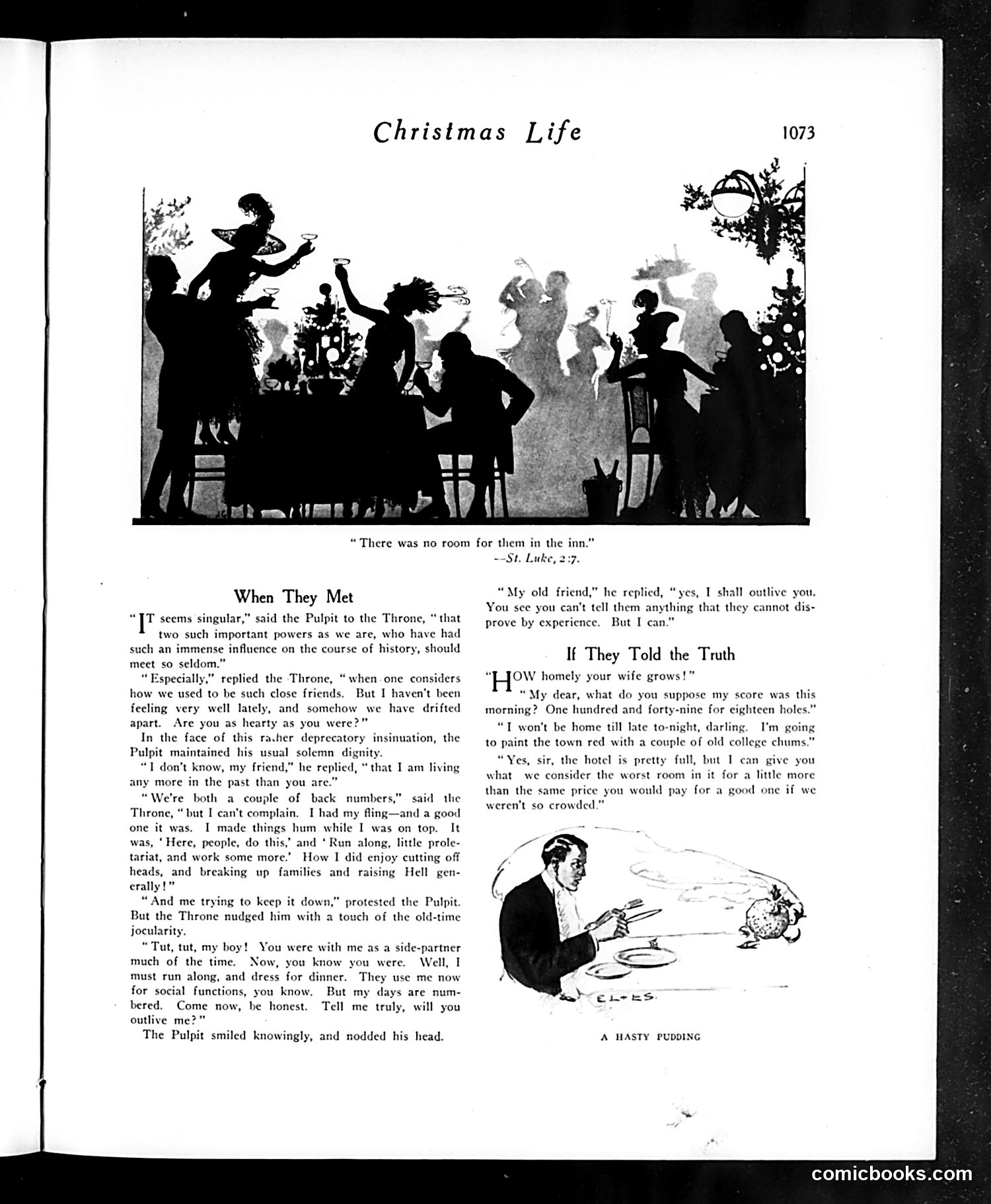
This page presents two satirical pieces mocking institutional hypocrisy: **"When They Met"** depicts an allegorical conversation between the Throne (monarchy/secular power) and the Pulpit (organized religion). The satire suggests these institutions—historically intertwined and mutually supportive—have drifted apart as their influence wanes. The Throne nostalgically recalls its authoritarian past ("cutting off heads"), while the Pulpit claims moral superiority for restraining such excess. Their knowing exchange implies complicity: the Pulpit was actually "a side-partner" to the Throne's abuses. The joke is that organized religion will "outlive" monarchy because it's better at controlling people through faith rather than force. **"If They Told the Truth"** mocks social hypocrisy through contrasts between what people say and actually mean—husbands making excuses, hotel staff admitting they overcharge crowded guests. The cartoon "A Hasty Pudding" reinforces this theme. Together, these pieces satirize how institutions and individuals obscure truth through comfortable falsehoods, set against the Christmas irony of "no room at the inn."
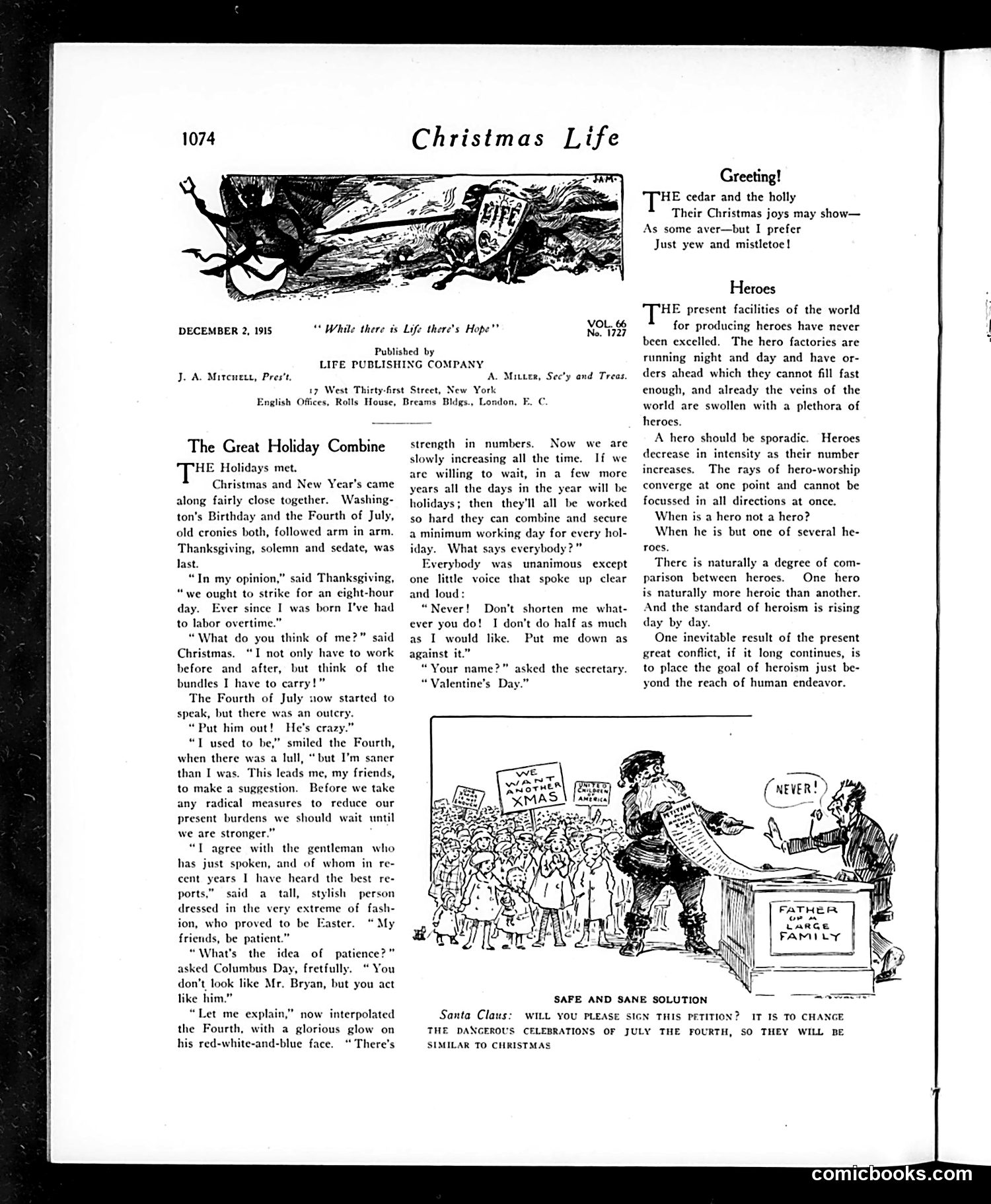
This satirical piece personifies American holidays as workers negotiating labor rights. Christmas, New Year's, Thanksgiving, and the Fourth of July seek an eight-hour workday, claiming they're overworked from constant celebration and commercial demands. The joke pivots when Valentine's Day—despite being the weakest holiday—refuses to join the strike, insisting it should work *more*, not less. The cartoon below ("Safe and Sane Solution") shows Santa petitioning to make Independence Day celebrations as tame as Christmas, reflecting early 20th-century "safe and sane" Fourth of July reform movements that opposed fireworks due to injuries and deaths. The satire critiques both holiday commercialization (holidays exhausted by work) and safety activism (the irony of requesting less festive celebration). Published December 1915, during WWI, the piece uses holiday-labor humor to comment on American consumer culture and reformist zeal.
This story satirizes early 20th-century middle-class anxieties about actors and bohemian lifestyles. Maltby, a respectable businessman, reconnects with an old schoolmate now performing in musical comedy. His wife Mrs. Maltby represents conservative propriety—she's horrified, convinced actors are dissolute drunks who corrupt morals through scandalous behavior (she references actresses in revealing bathing costumes). The satire targets her hypocrisy: despite vocal disapproval of theatrical "wickedness," she's secretly fascinated by theater and ultimately eager to host the actor for a weekend. Maltby cynically exploits this, admitting he also wants to experience "wild time" but will tell neighbors they're entertaining—making themselves enviably scandalous while maintaining respectable appearances. The joke exposes how middle-class moralism masks actual desire for excitement and social status.
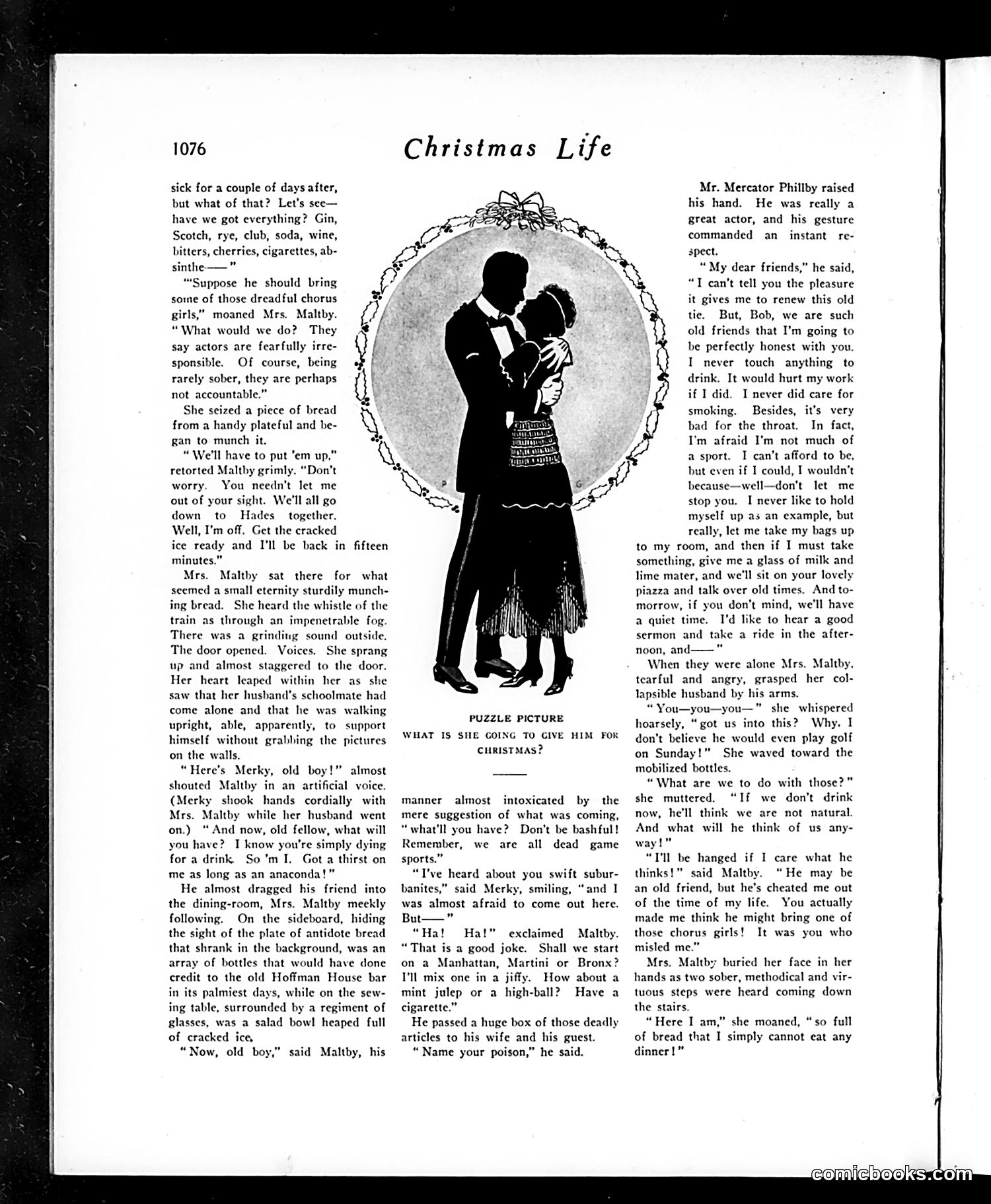
This page satirizes the hypocrisy of Prohibition-era social entertaining. The story depicts Mr. and Mrs. Maltby preparing for a visit from their old friend "Merky" (Mr. Mercator Phillby), an actor. The couple has meticulously assembled an elaborate illegal liquor collection—gin, scotch, rye, absinthe, and more—expecting a raucous drinking session. The joke's irony: when Phillby arrives, he virtuously refuses all alcohol, explaining he's a serious professional who never drinks or smokes because it would harm his work. He requests only milk and lime water, and suggests attending church and quiet activities instead. Mrs. Maltby is devastated—her carefully orchestrated plans collapse because her guest is morally upstanding. The "puzzle picture" caption (showing the couple) hints at the uncomfortable gift of moral superiority the actor unwittingly brings. The satire mocks 1920s upper-class drinking culture and the gap between public propriety and private excess during Prohibition.
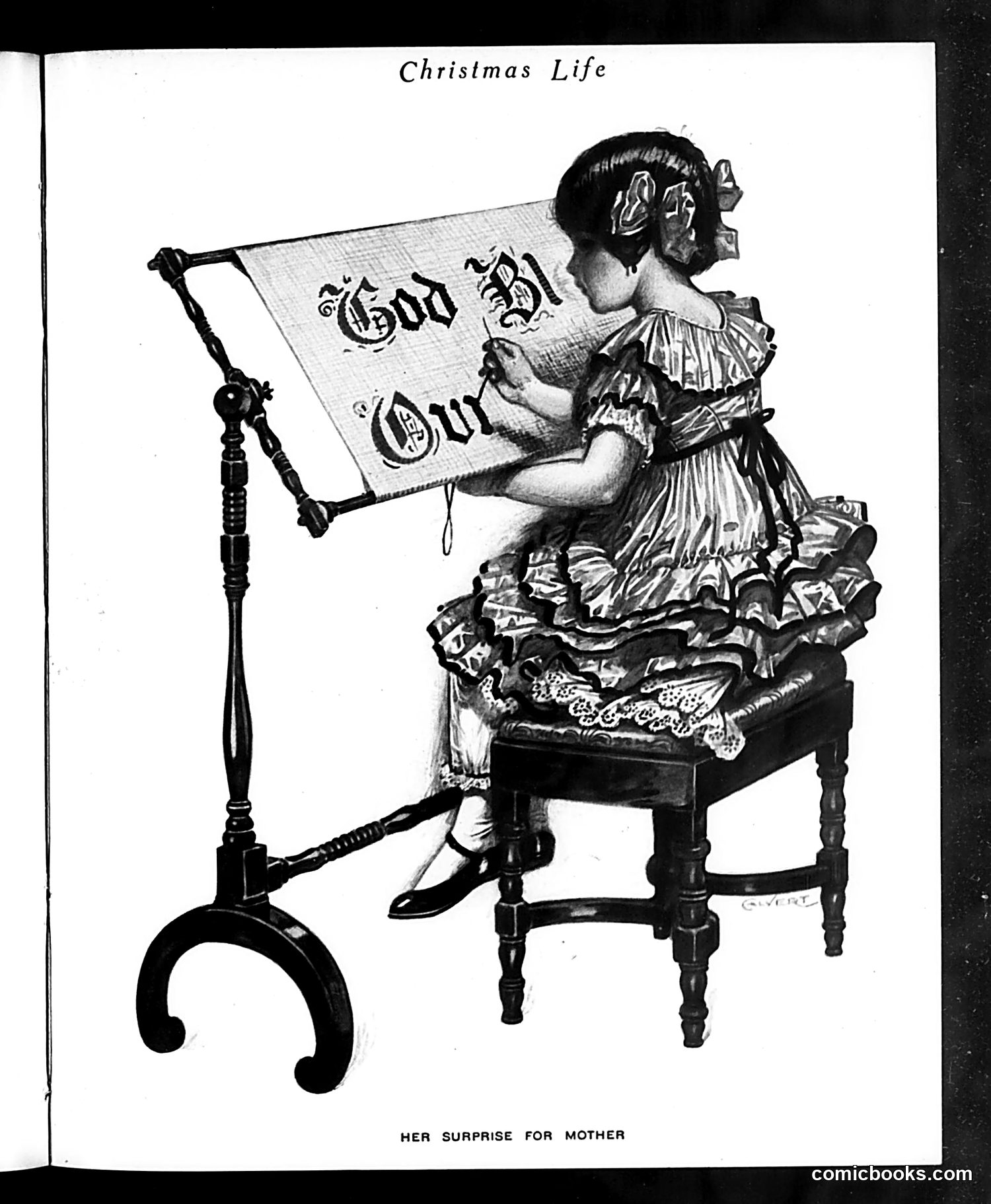
This illustration depicts a young woman seated elegantly, holding a banner that reads "God Bless Our [Home]" (text partially obscured). The satire appears to target wealthy women's Christmas gift-giving practices during the early 20th century. The joke likely mocks the irony of presenting homespun, sentimental decorations as "surprises"—the ornate dress, elaborate furniture, and refined setting suggest affluence, making a modest hand-made banner an incongruous gift. The title "Her Surprise for Mother" implies this privileged young woman considers such a simple, domestic item a meaningful present, when her wealth could provide far more. This reflects period humor about class, domesticity, and the expectations placed on women regarding home and family sentiment.
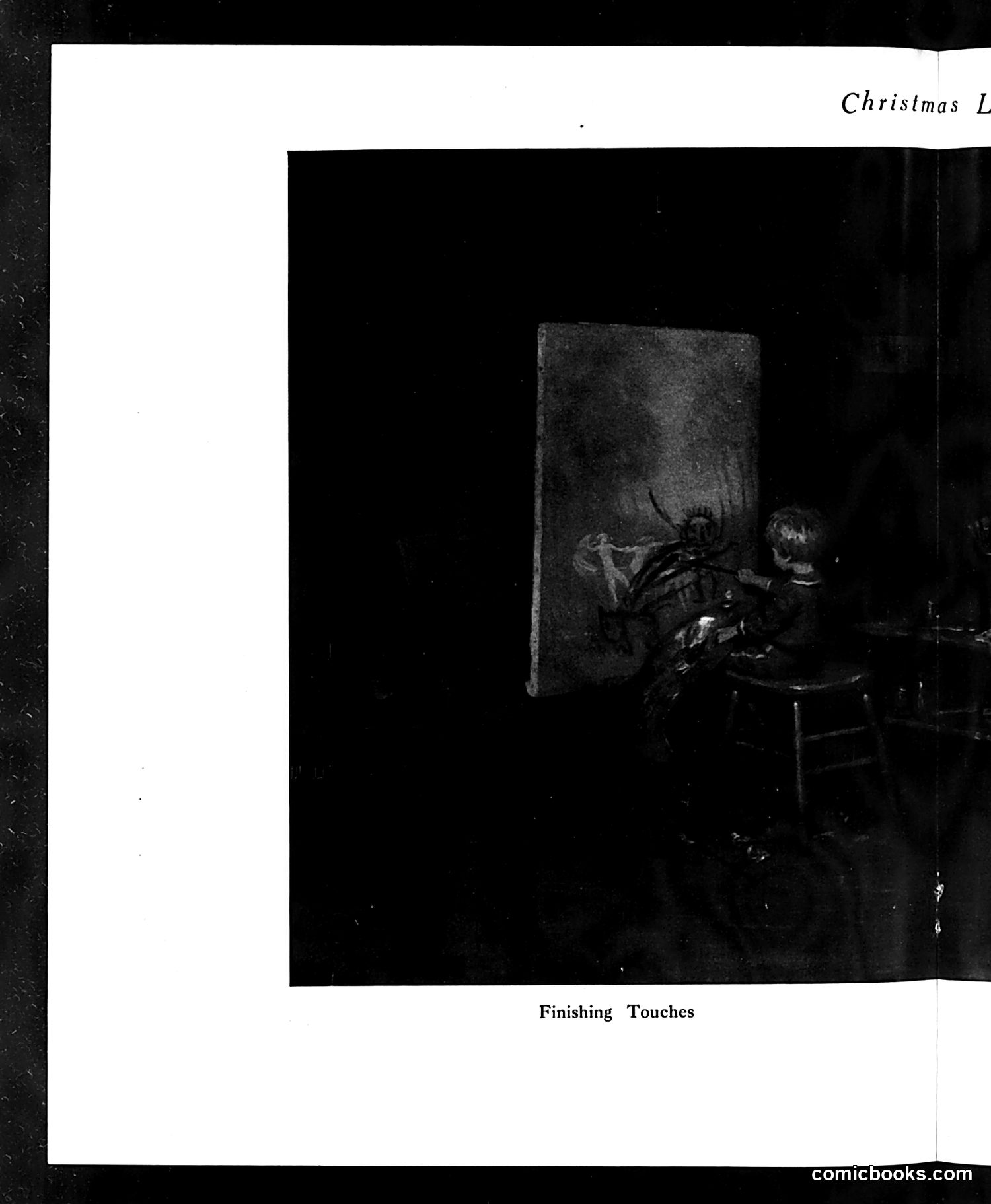
This appears to be a section title or caption from Life magazine labeled "Finishing Touches" in the context of Christmas content. The dark photograph shows a figure seated at what appears to be an easel or workspace, seemingly engaged in artistic work or preparation. Without additional visible text or clearer image detail, the specific satirical reference remains unclear. The caption "Finishing Touches" suggests commentary on last-minute Christmas preparations, possibly mocking either commercial holiday rush, artistic pretension, or seasonal chaos. However, without identifying the figure depicted or seeing accompanying text that clarifies the joke's target, I cannot definitively explain what political or social commentary this image conveys to modern readers.
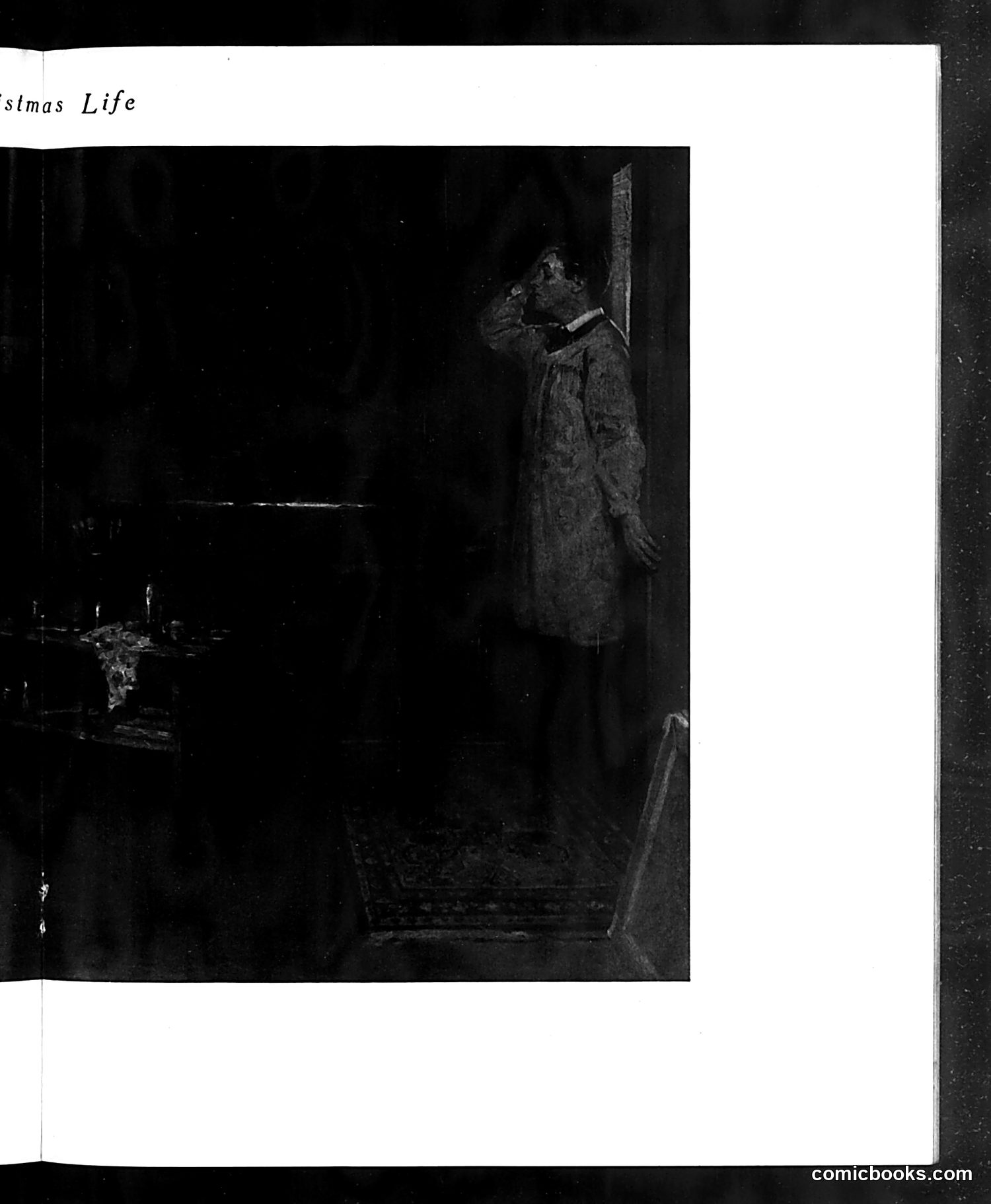
This page appears to be from a section titled "Christmas Life" in the magazine *Life*. The image shows a dark, atmospheric black-and-white photograph or illustration depicting a figure in heavy clothing standing against or near a wooden post in what seems to be a nighttime or dimly-lit setting. There's minimal visible context beyond the figure itself. Without clearer text content or identifying details in the image, it's difficult to determine the specific satirical point or political reference intended. The dramatic lighting and solitary figure suggest this might be commentary on a contemporary social or political situation, but the exact subject and meaning remain unclear from this page alone.
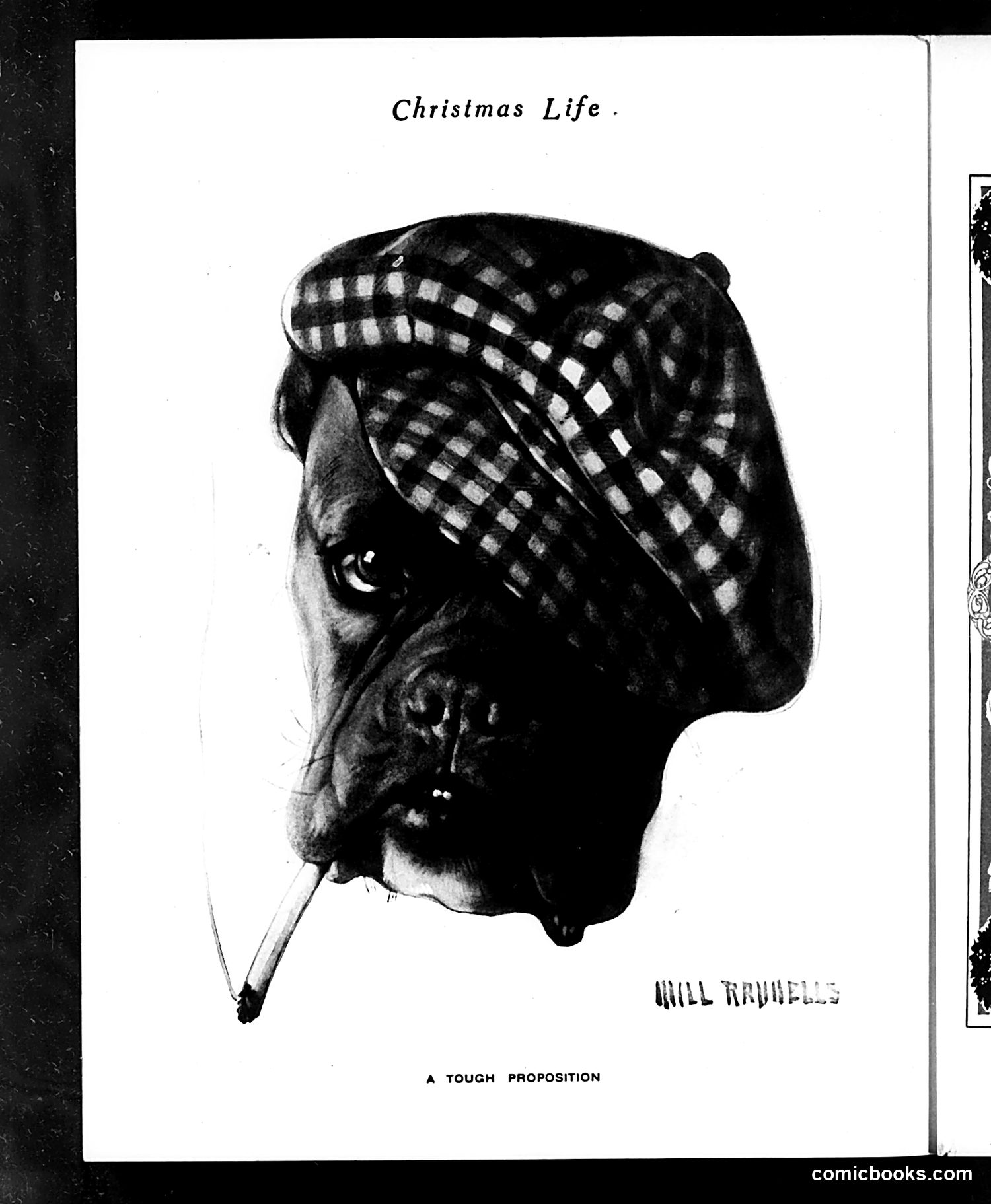
This is a political cartoon from *Life* magazine titled "A Tough Proposition" under the section "Christmas Life." The image shows a caricatured male face in profile, smoking a cigarette, wearing a checkered cap. The artistic style employs exaggerated features typical of early 20th-century satirical portraiture. The caption "A Tough Proposition" suggests the figure represents someone facing difficulty or presenting a challenging situation, likely during the Christmas season. Without additional context about the specific date or historical events referenced, the exact identity of the caricatured figure remains unclear. The signature appears to read "Wal Raynells" or similar. The satire likely commented on contemporary political or social figures, but specific identification would require knowing *Life* magazine's publication date and context.
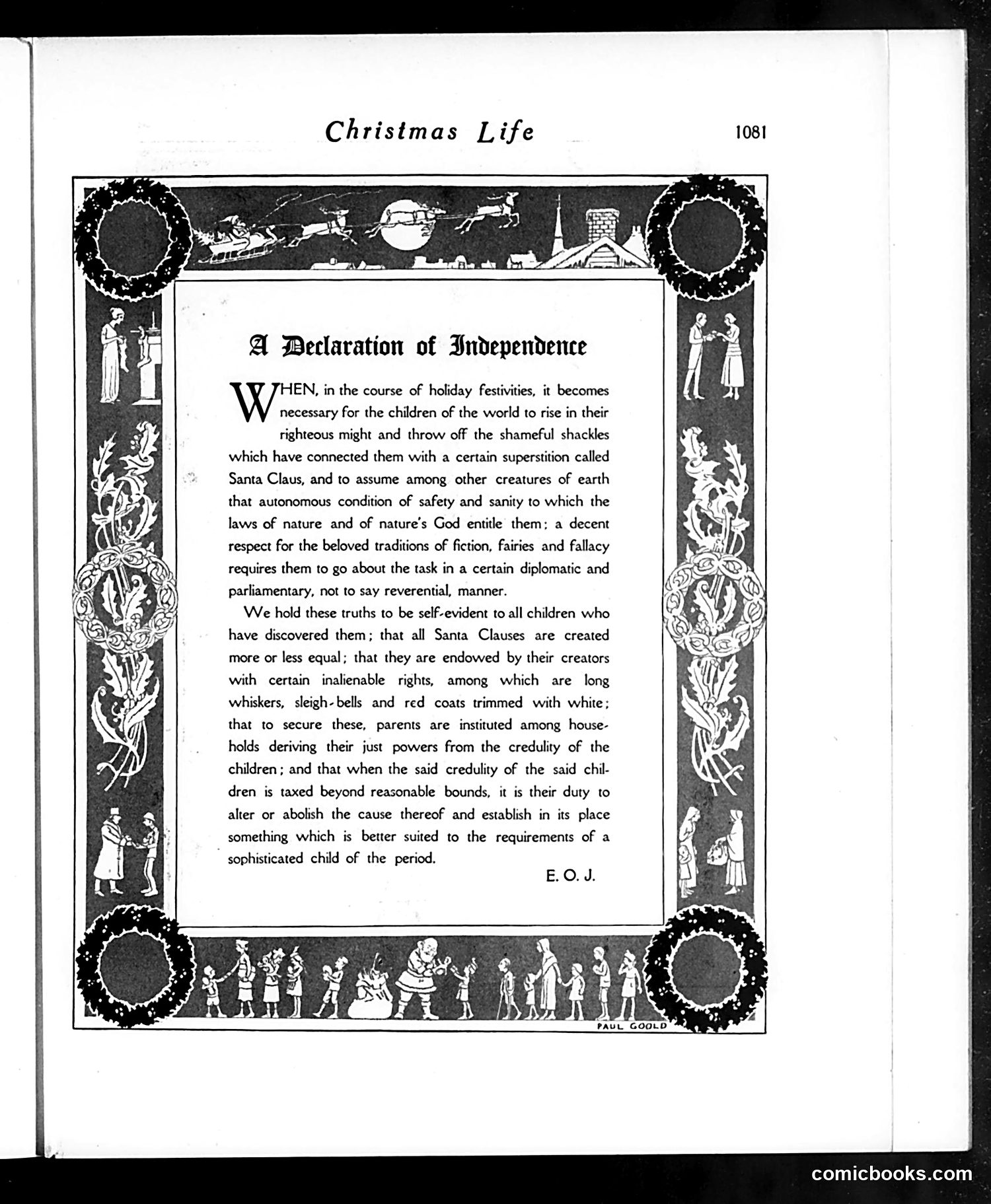
This is satirical commentary on childhood disillusionment. Parodying the American Declaration of Independence, the piece humorously addresses the moment when children discover Santa Claus isn't real. The satire works by treating this childhood milestone as a political revolution: children must "throw off the shameful shackles" of Santa belief and claim their "inalienable rights" to sophistication. It mocks parental complicity—parents derive power from children's "credulity" (gullibility) until that credulity becomes "taxed beyond reasonable bounds." The joke is the dignified, legalistic language applied to something trivial yet emotionally significant to children. The ornamental border with Christmas imagery and figures reinforces the contrast between grand constitutional rhetoric and the domestic reality of outgrowing Santa. Signed "E.O.J.," the piece gently satirizes both childhood innocence and parental deception while celebrating intellectual growth—suggesting that becoming "sophisticated" enough to reject Santa represents a child's rightful independence.
This page appears to be primarily a **black and white photograph or illustration** rather than a traditional cartoon or satirical drawing. The image shows figures in what seems to be an interior scene with dramatic lighting—one figure is prominently highlighted in white/light tones against dark surroundings. Without clear visible text on the image itself or identifiable caricatured figures, it's difficult to determine the specific political or social satire intended. The dramatic chiaroscuro (light-dark contrast) suggests this may illustrate a narrative scene or story, possibly from a theatrical or literary work featured in Life magazine. The page footer indicates "comicbooks.com," suggesting this is a digitized archive image rather than original magazine content. **I cannot confidently identify the specific figures, references, or satirical point without additional context.**
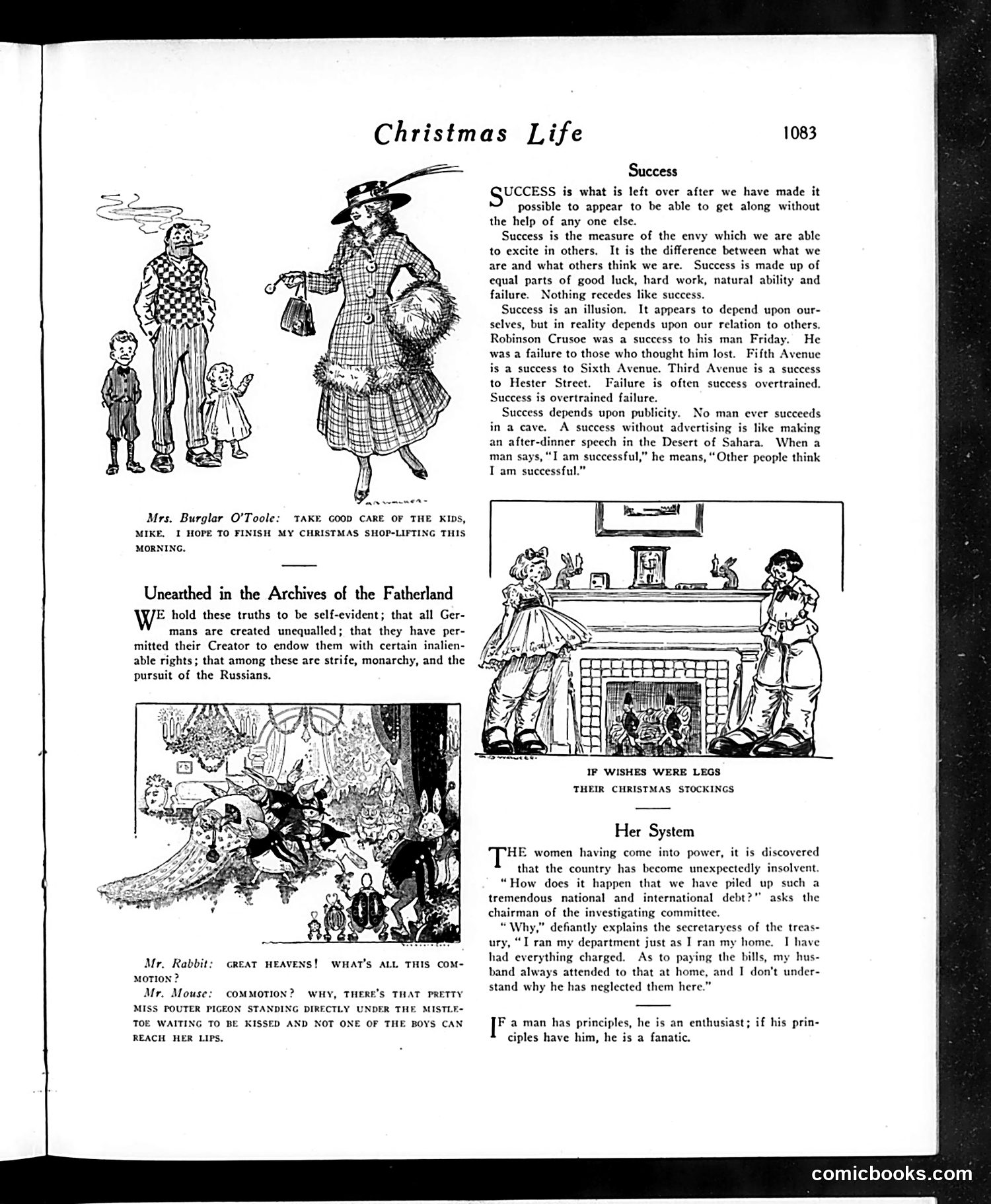
This page contains multiple satirical vignettes typical of early 20th-century Life magazine humor: **Top cartoon**: Mrs. Burglar O'Toole leaves her husband to finish Christmas shoplifting—satire on petty crime and holiday consumerism. **"Archives of the Fatherland" section**: Mocks German militarism and nationalism by parodying the Declaration of Independence, replacing "life, liberty, pursuit of happiness" with "strife, monarchy, and pursuit of the Russians"—likely referencing pre-WWI German expansionism. **Animal cartoon**: Rabbit and Mouse discuss a pigeon unable to be kissed under mistletoe due to her height—simple slapstick about holiday romance. **"Her System"**: Satirizes women in political power (likely post-suffrage), suggesting female government officials mismanage national finances by "charging everything" like housewives, expecting husbands to pay bills. This reflects contemporary anxieties about women's competence in governance. The page uses humor to express skepticism about social change and foreign threats common to the era.
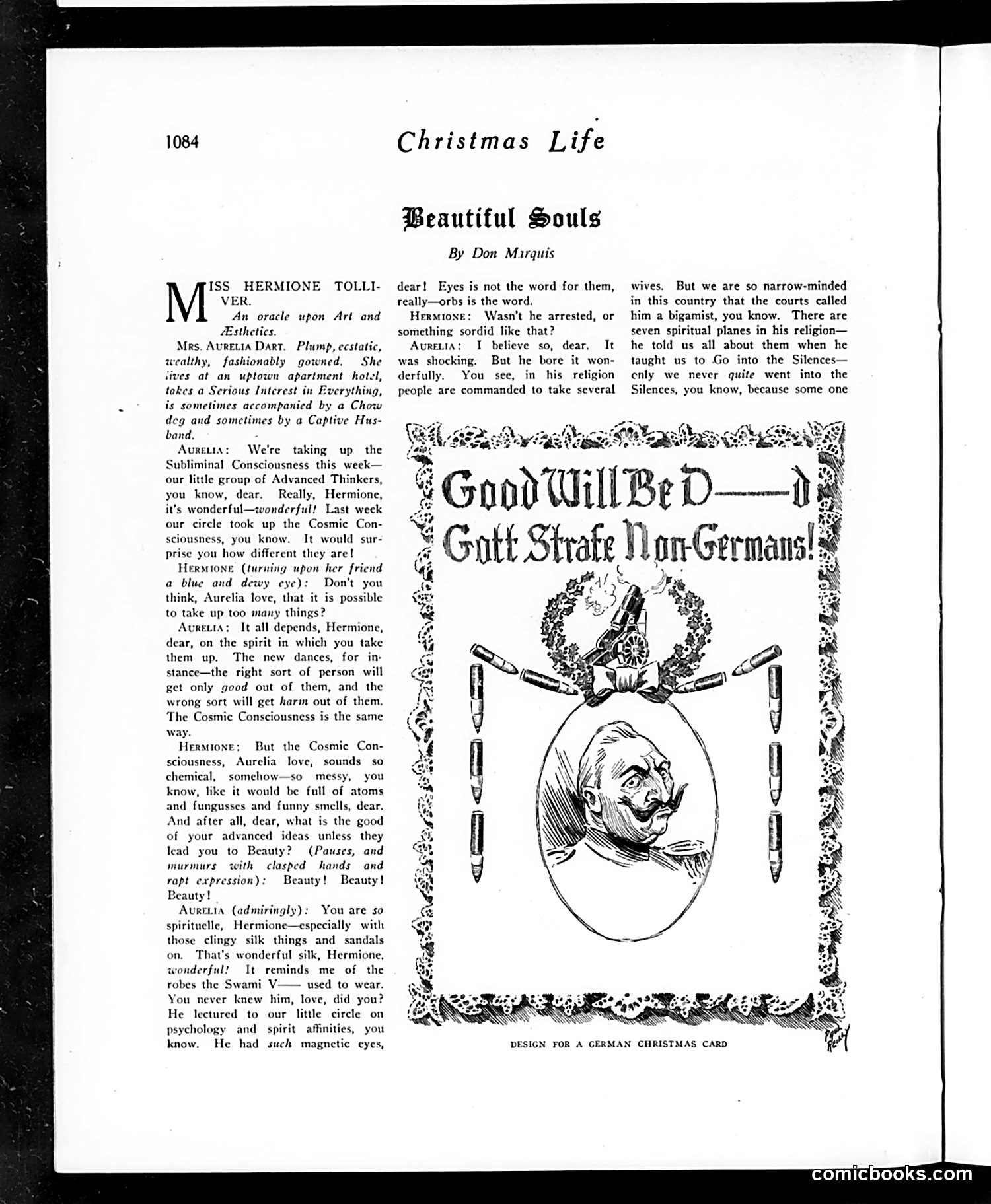
This page contains two satirical pieces by Don Marquis: **"Beautiful Souls"** (left): A dialogue mocking wealthy, spiritually-pretentious Manhattan socialites. Mrs. Dart enthusiastically cycles through trendy philosophies ("Cosmic Consciousness," "Subliminal Consciousness") while Miss Tolliver gently deflates her superficiality. The satire targets how such women adopt fashionable intellectual movements without genuine understanding, and how they're charmed by charismatic figures like a fraudulent "Swami" who was arrested for bigamy—yet they rationalize his crimes through spiritual language. The joke: spiritual posturing as social performance. **"Good Will Be D—d! Gott Strafe Non-Germans!"** (right): A wartime Christmas card design showing a German face surrounded by bullets. The German phrase ("God punish non-Germans") was an actual German propaganda slogan during WWI. This is anti-German wartime propaganda, mocking enemy nationalism. The page dates to America's involvement in WWI (1917-1918), when such caricatures were common.
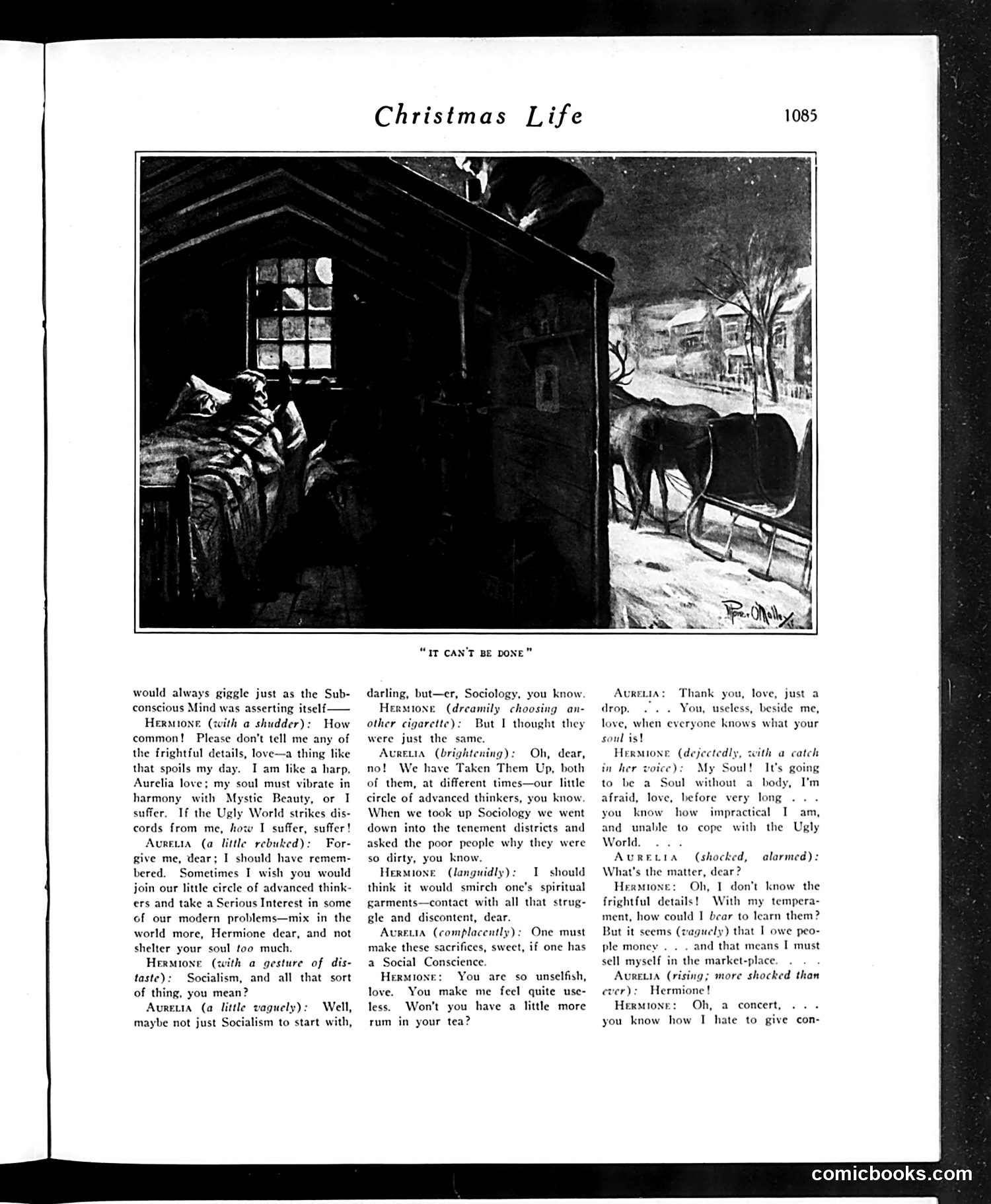
This cartoon mocks wealthy, aesthetically-minded women who embrace progressive ideals superficially while remaining detached from real-world consequences. **The setup:** Hermione is a self-absorbed socialite who claims her sensitive soul needs "Mystic Beauty" and cannot bear ugly realities. Aurelia, her friend, belongs to an "advanced thinkers" circle studying social problems like poverty and Sociology—they visit tenements to ask poor people "why they were so dirty." **The irony:** When Aurelia suggests Hermione engage with modern problems, Hermione recoils. Later, Hermione admits she owes people money and must "sell herself in the market-place"—which horrifies her. Her "solution" is performing a concert (adding to her discomfort). **The satire:** The cartoon exposes how privileged women adopt fashionable progressive causes while remaining willfully ignorant of actual suffering, and how their own financial troubles suddenly make the "Ugly World" they've scorned uncomfortably real. Their intellectual posturing collapses when self-interest emerges.
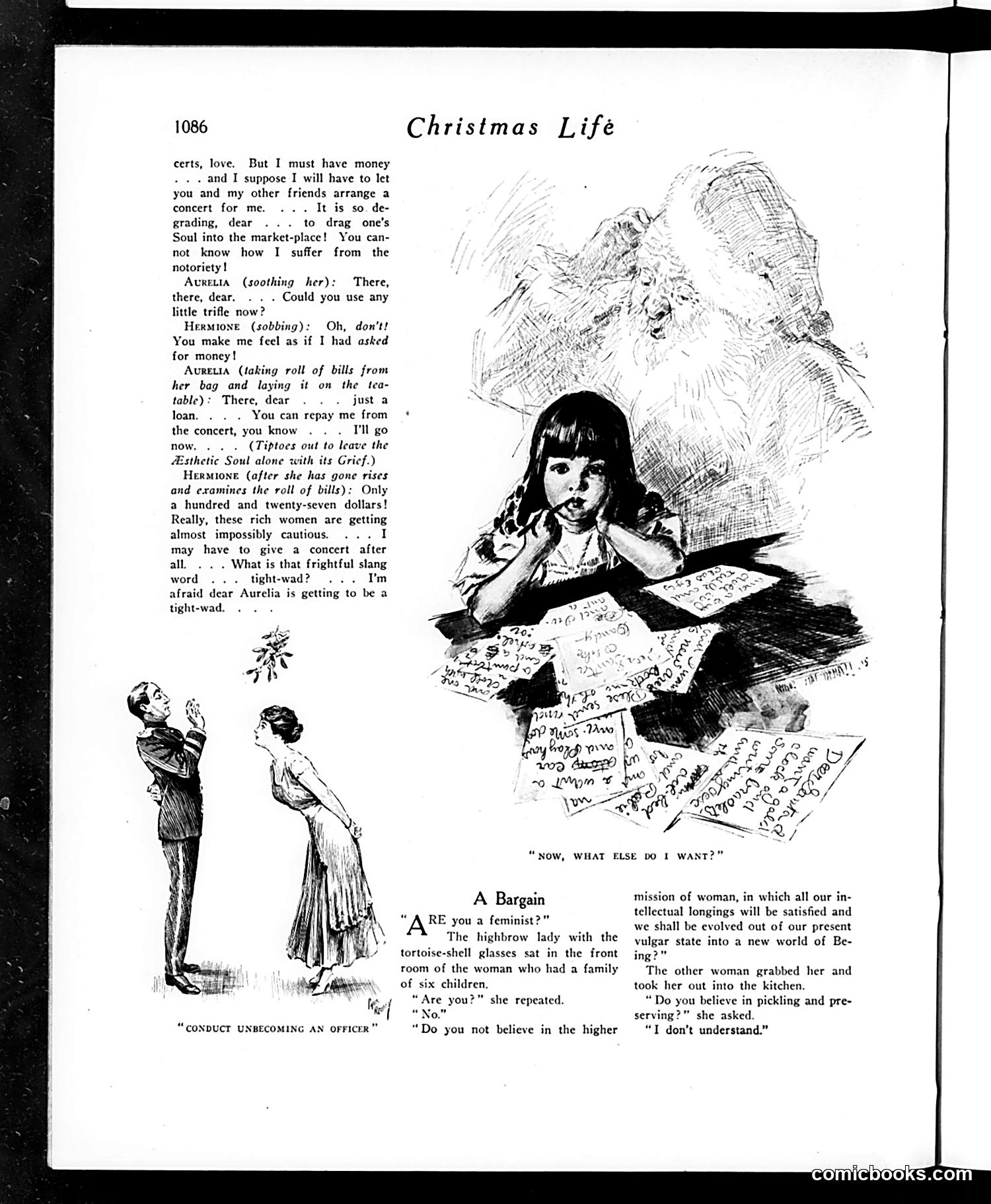
This page satirizes pretentious bohemian affectation among wealthy women. The top dialogue mocks "Hermione," an aesthete who claims financial hardship while seeking money for a concert, yet complains when a wealthy friend ("Aurelia") gives her only $127—calling her a "tight-wad." The joke: Hermione's affected concern for her "soul" masks simple greed. The bottom section, "A Bargain," ridicules intellectual feminism. A "highbrow" woman with glasses lectures another about women's evolution and higher missions, then asks if she believes in "pickling and preserving." The punchline mocks the gap between feminist rhetoric and domestic reality—the intellectual woman's lofty ideals collapse when confronted with actual homemaking duties in the kitchen. Both pieces target educated, privileged women: one for performative poverty, the other for disconnected theorizing. The satire is fundamentally anti-intellectual and anti-feminist for a 1910s-era audience.
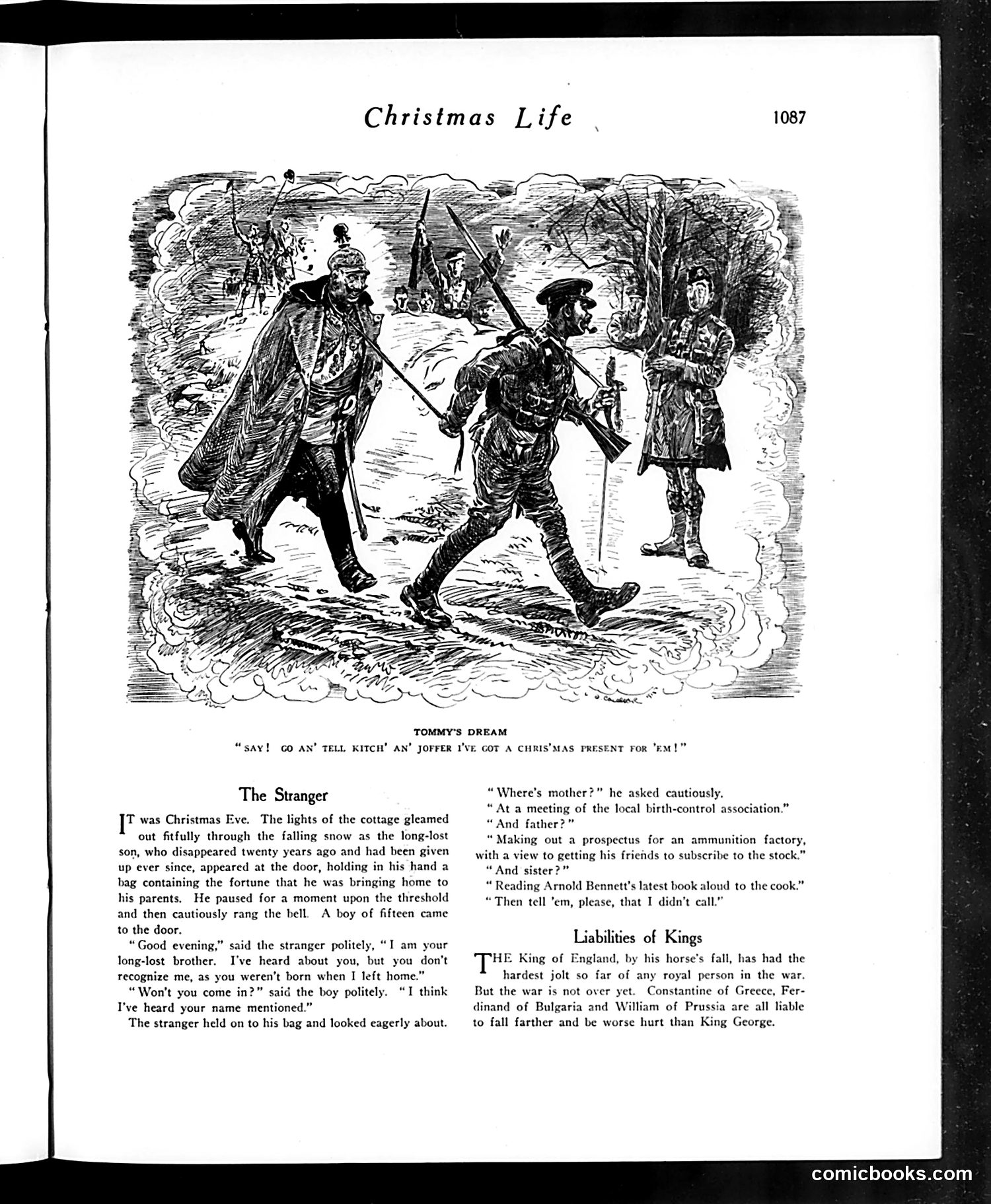
This page contains two satirical pieces from Life magazine: **"Tommy's Dream"** (top): A humorous illustration showing a soldier's fantasy of surprising his family with a fortune on Christmas Eve. The joke hinges on modern social change: when he arrives, his mother attends a **birth-control association meeting**, his father pursues an **ammunition factory investment**, and his sister reads **Arnold Bennett** (a contemporary modernist author) aloud. The punchline—the long-lost brother leaves without announcing himself—satirizes how families have become too preoccupied with modern concerns to notice his return. This mocks both new social movements and commercialism eclipsing traditional family values. **"Liabilities of Kings"** (bottom): A brief political commentary on World War I, noting that Britain's King George suffered a riding accident. The piece darkly suggests other European monarchs—Constantine of Greece, Ferdinand of Bulgaria, and Wilhelm II of Prussia—face greater risks of literal downfall, alluding to the war's political instability and the ultimate fates of defeated monarchies.
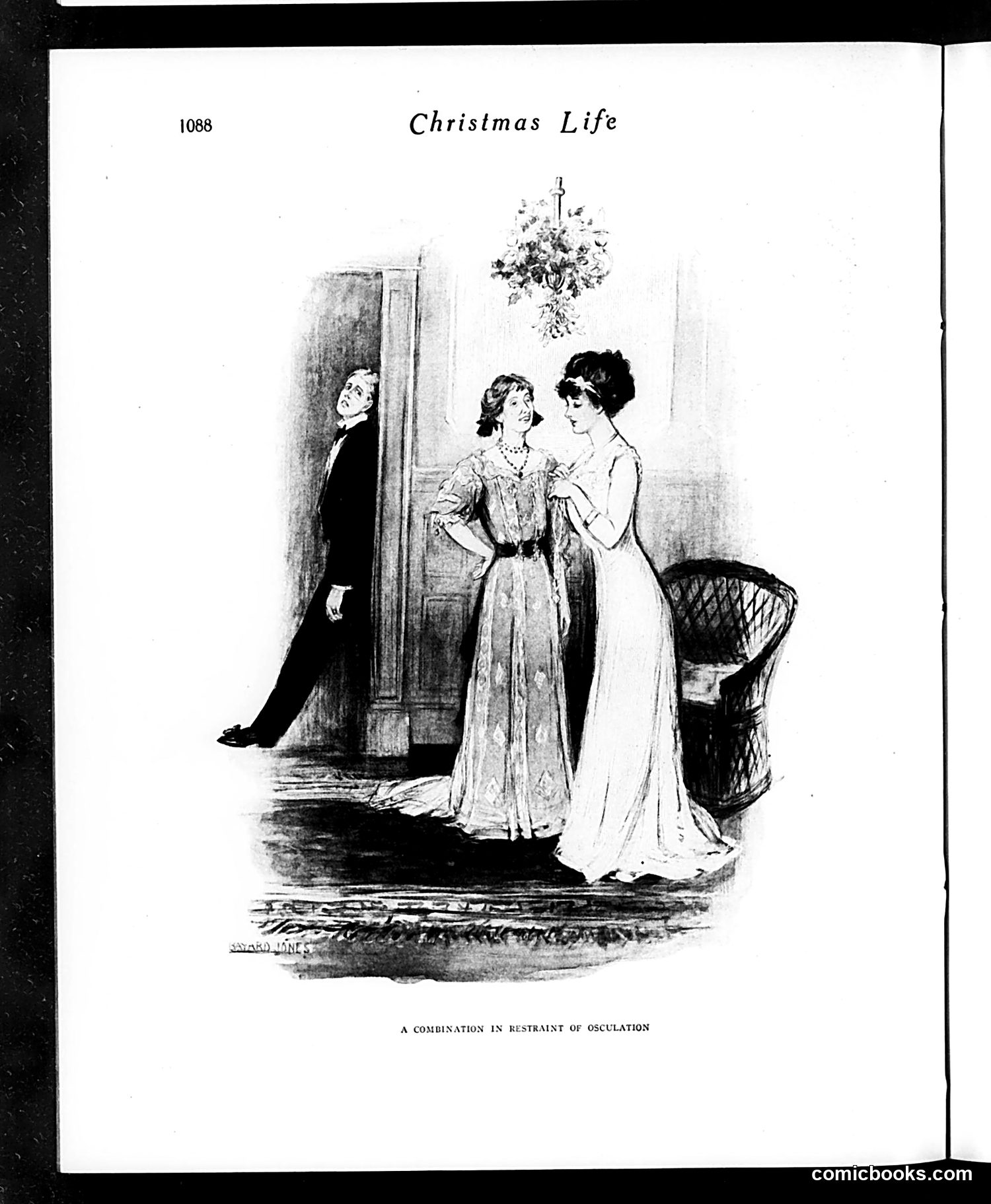
This satirical illustration depicts a Christmas scene playing on the tradition of mistletoe kissing. Two elegantly dressed women stand beneath mistletoe, while a man in formal attire lurks awkwardly behind a doorway, peering at them. The caption's clever wordplay—"restraint of osculation" (restraint of kissing)—mocks the social awkwardness created by Christmas mistletoe customs. The man appears hesitant or cautious about the kissing tradition, suggesting either shyness or the social complications of holiday romance rituals among the upper classes. The cartoon satirizes Victorian-era social propriety and the tension between tradition and personal discomfort during festive gatherings, particularly regarding romantic contact between unmarried people.
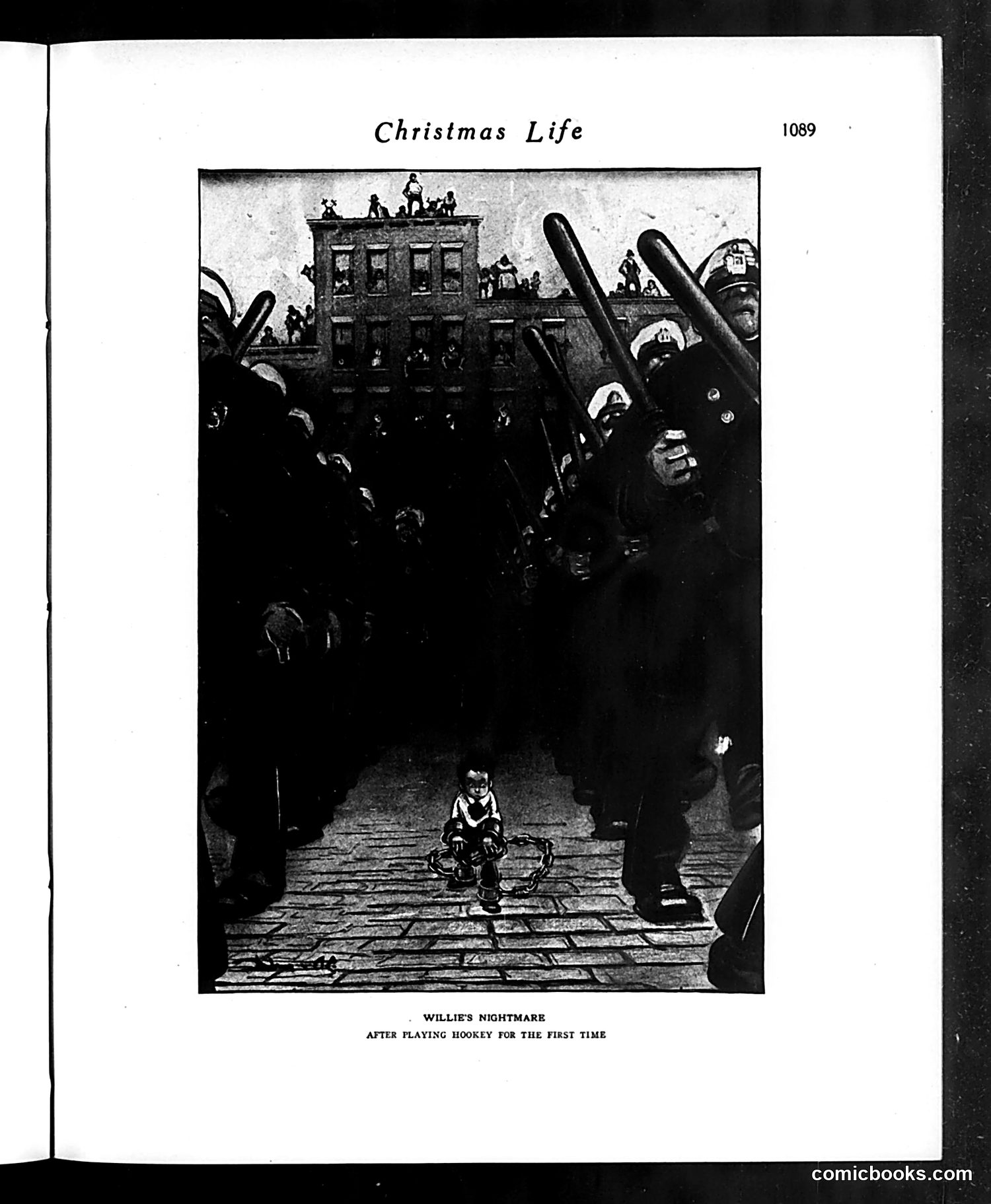
This is a satirical cartoon playing on children's anxieties about misbehavior and punishment. The caption identifies "Willie" as a child who has skipped school ("playing hookey") for the first time—a minor transgression that would have been considered serious in early 20th-century moral standards. The image depicts Willie's nightmare: he's dwarfed and surrounded by stern military or authority figures wielding what appear to be large weapons or implements of discipline. The ominous crowd and weaponry suggest exaggerated, nightmarish consequences for his truancy. The humor lies in the disproportionate fear—a child's petty misdeed fantasized as warranting military-scale punishment. It's both comedic (the absurd overreaction) and moralistic (cautionary about skipping school), typical of *Life* magazine's satirical approach to contemporary social values.
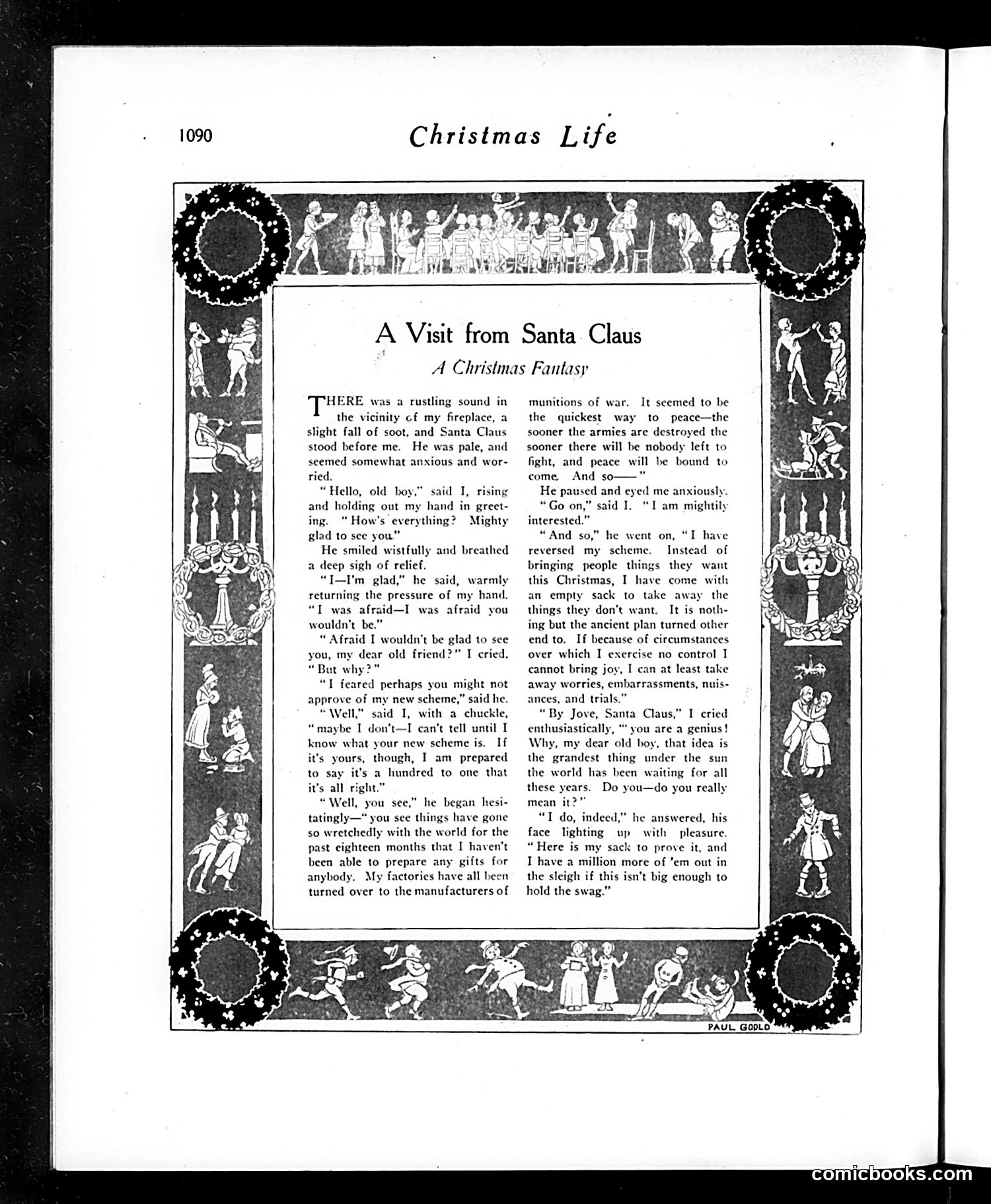
This Christmas fantasy satirizes World War I's impact on society. Santa Claus appears anxious and pale—he's converted his factories to munitions production, abandoning gift-giving because he believes destroying armies will achieve peace fastest. Unable to bring joy, Santa reverses his mission: instead of delivering wanted gifts, he offers to remove unwanted things—worries, embarrassments, nuisances, and trials. The narrator enthusiastically endorses this as "the grandest thing." The satire targets how wartime disrupted civilian life and commercial normalcy. It mocks both the promised benefits of military spending ("the quickest way to peace") and society's desperate hope that at least *something* positive might emerge from the conflict's devastation. The empty sack symbolizes what Christmas—and normal life—has become during the war.
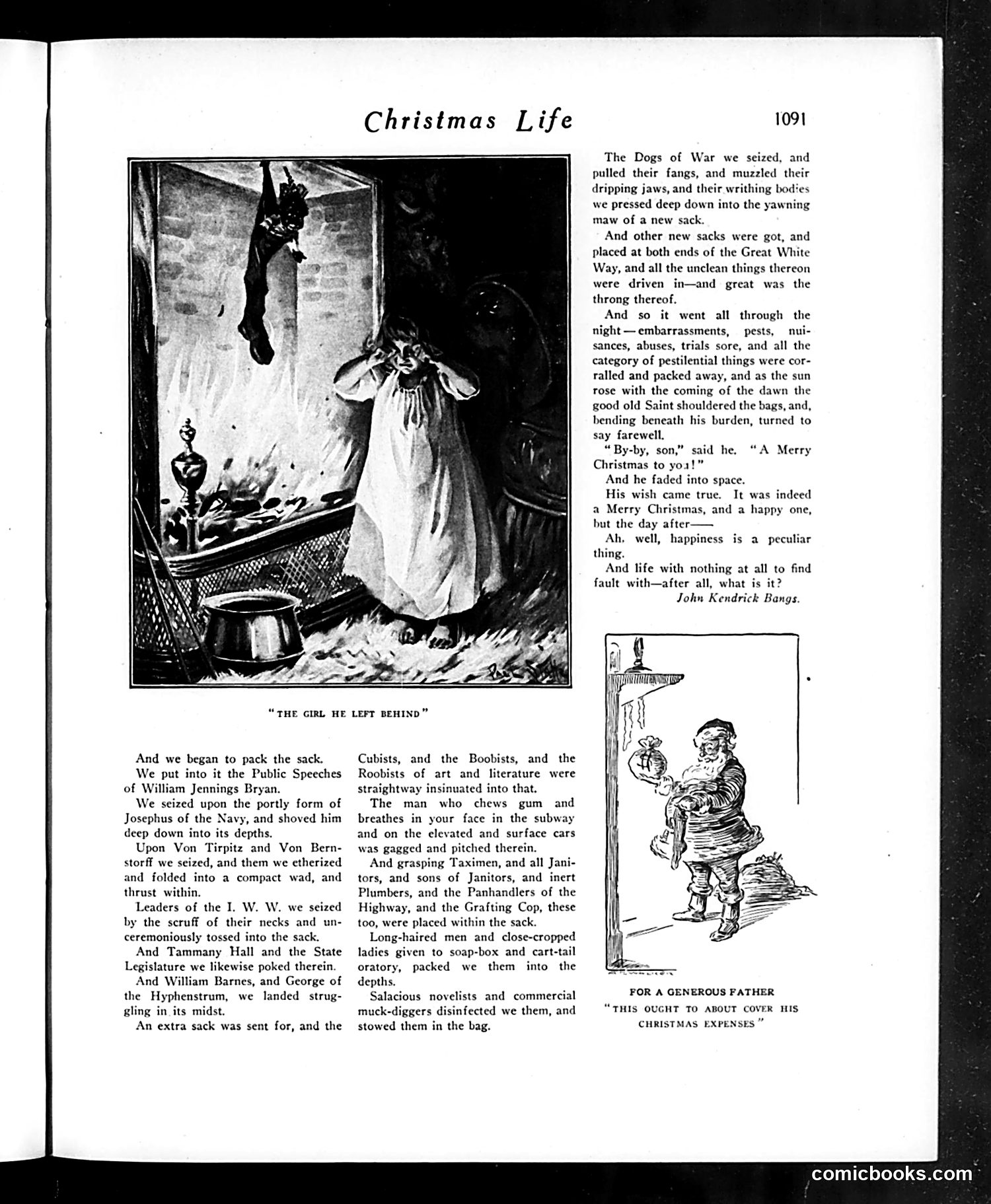
This Christmas-themed satirical piece by John Kendrick Bangs depicts Santa Claus magically removing societal nuisances and enemies—packing them into sacks to take away. The targets include: **Political figures**: William Jennings Bryan (three-time presidential candidate), Josephus Daniels (Secretary of the Navy), Von Tirpitz and Von Bernstorff (German military/diplomatic officials—revealing anti-German sentiment, likely WWI-era) **Social groups**: IWW labor leaders, Tammany Hall politicians, anarchist "soap-box" orators, and various urban annoyances (gum-chewers, grafting cops, panhandlers) **Cultural targets**: Cubist and modernist artists dismissed as "Boobists" and "Roobists" The satire's dark humor emerges in the final twist: Santa succeeds, bringing perfect peace—but "the day after" reality returns, suggesting that removing all problems is impossible. The joke critiques both the foolishness of those listed *and* the futility of hoping for sudden societal reform.
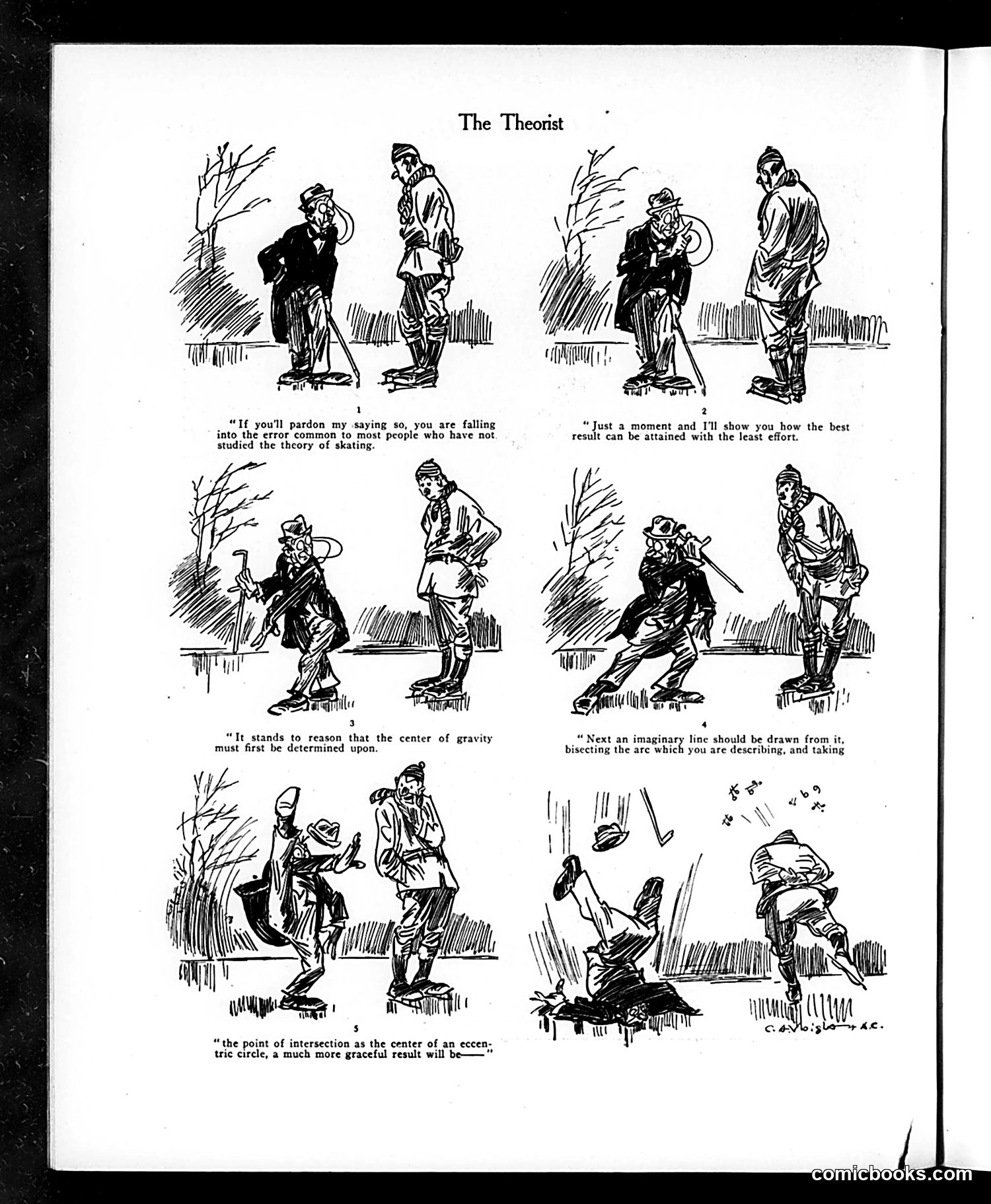
This comic mocks a pedantic figure who lectures on ice skating using abstract geometric and physical principles—center of gravity, eccentric circles, imaginary lines—while his practical companion simply skates competently. The humor targets "armchair theorists" who overcomplicate activities through excessive intellectualization. The theorist's verbose explanations about mathematical principles contrast sharply with the other skater's straightforward, effective approach. The final panels show the theorist falling on the ice, suggesting his theory-first method fails in practice. This satirizes a common American social type: the know-it-all who substitutes complex talk for practical skill. The satire critiques academic or intellectual pretension divorced from real-world results—a theme particularly relevant during the early 20th century, when Life magazine frequently lampooned self-important professorial types and their impractical advice.
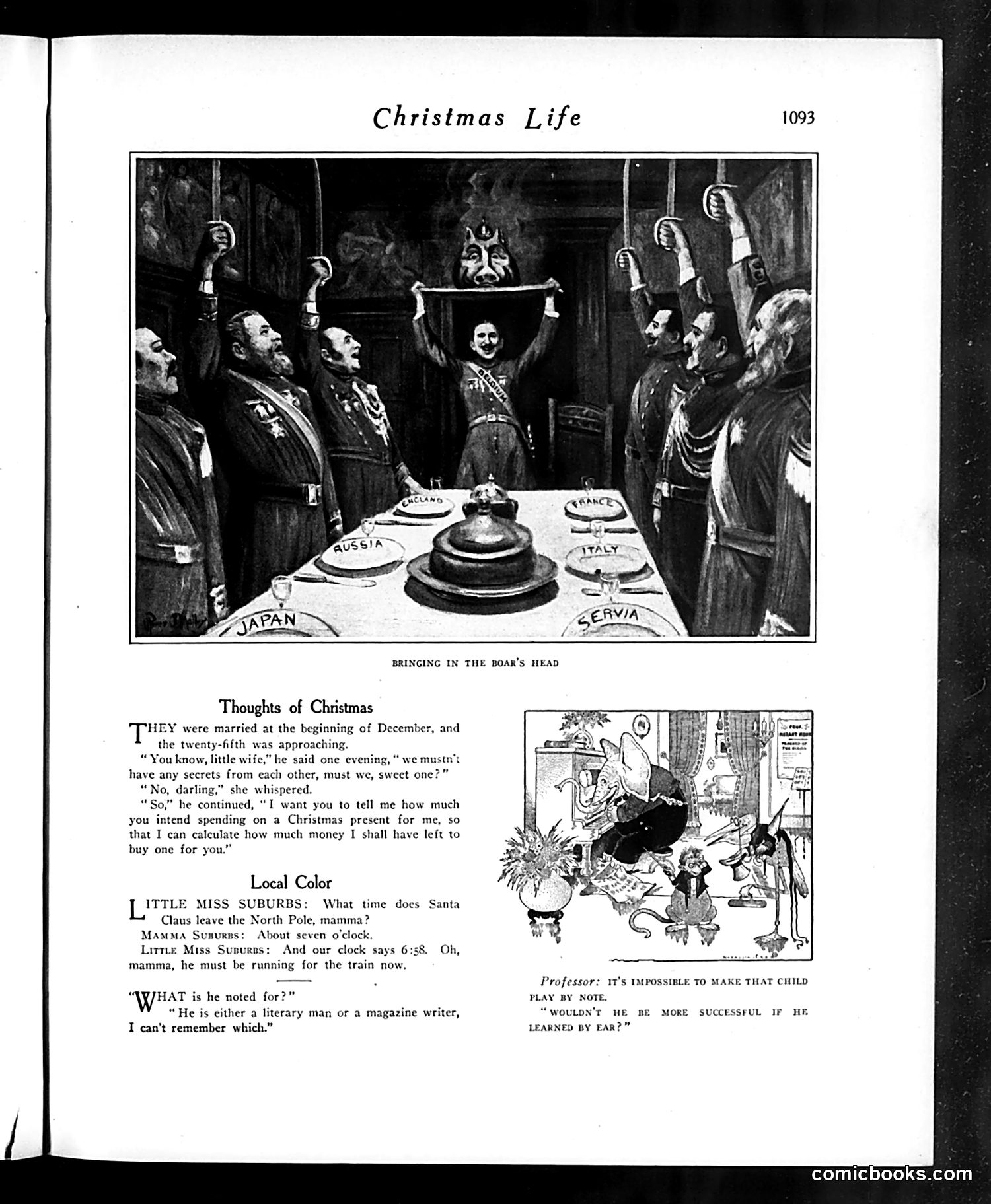
The main cartoon, "Bringing in the Boar's Head," depicts military officers from various nations (labeled Japan, Russia, Italy, Serbia) gathered around a dining table, raising what appear to be severed heads on pikes. This is wartime satire depicting World War I combatants metaphorically "feasting" on conflict. The boar's head—a traditional Christmas dish—becomes darkly ironic imagery for the brutality of war, suggesting these nations are celebrating destruction rather than peace during the Christmas season. The page's three shorter humor pieces ("Thoughts of Christmas," "Local Color," and the professor/child anecdote) are domestic comedy sketches about Christmas gift-buying anxieties, children's misconceptions about Santa, and musical instruction—standard light fare. The stark contrast between the cheerful holiday title and the grotesque war imagery creates the satire's bite: Christmas, traditionally a season of peace, is undermined by the ongoing devastation of the Great War.
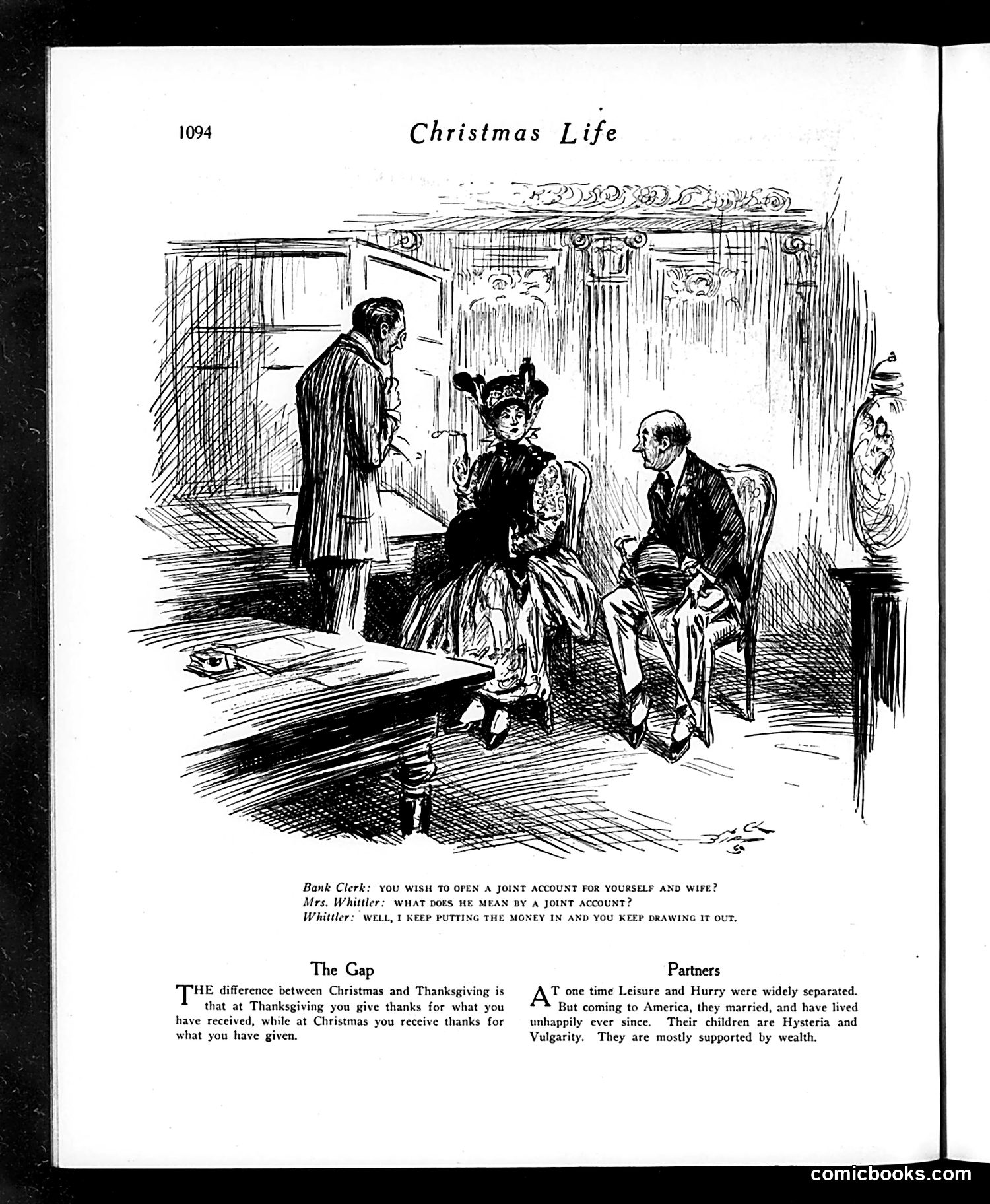
This page contains three satirical pieces from *Life* magazine: **The main cartoon** mocks marital finances through a bank-clerk scenario. When asked about a "joint account," Mrs. Whittler doesn't understand the term. Her husband explains it sarcastically: he deposits money while she withdraws it—a dig at wives perceived as spendthrifts. The joke reflects early-20th-century anxieties about women's financial independence and spending habits. **"The Gap"** is a short philosophical quip contrasting Christmas (receiving gratitude for gifts) with Thanksgiving (giving thanks for what you have)—both occasions for self-interested reflection. **"Partners"** is an allegorical commentary on American culture. "Leisure" and "Hurry" represent opposing forces that, upon arriving in America, married and produced neurotic offspring: "Hysteria" and "Vulgarity." The piece suggests American capitalism creates anxious, vulgar culture by forcing constant activity and consumption. All three pieces satirize contemporary American social behaviors and values.
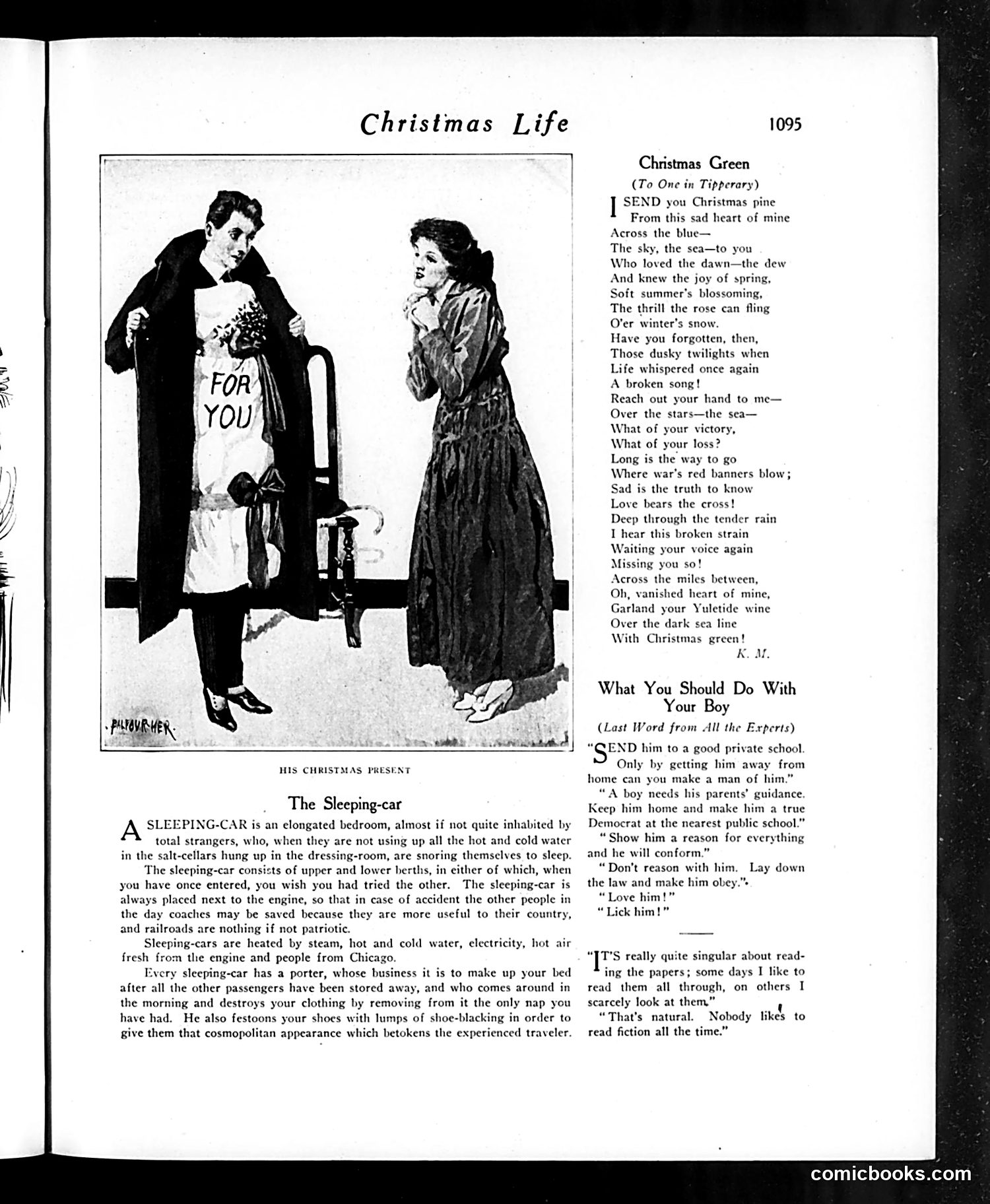
The page contains three distinct pieces of satirical content: **"His Christmas Present" (illustration):** A man presents a woman with a wrapped gift labeled "FOR YOU." The satire mocks the impersonal nature of Christmas gift-giving—the gift appears to be a sleeping-car ticket (train travel), suggesting husbands shipped wives away during the holidays. **"The Sleeping-car" (prose satire):** A humorous description of railroad sleeping compartments, mocking their cramped conditions, poor ventilation, aggressive porters, and the indignity of shared intimate spaces with strangers. It satirizes American railroad travel and the pretense that such discomfort represents "cosmopolitan" sophistication. **"What You Should Do With Your Boy":** Parodies contradictory parenting advice from "experts"—alternating between sending boys to private school or keeping them home, reasoning with them or imposing authority, loving or disciplining them. The final joke suggests the reader dismisses conflicting advice as mere "fiction." The satire attacks the proliferation of contradictory parenting guidance in early 20th-century popular culture.
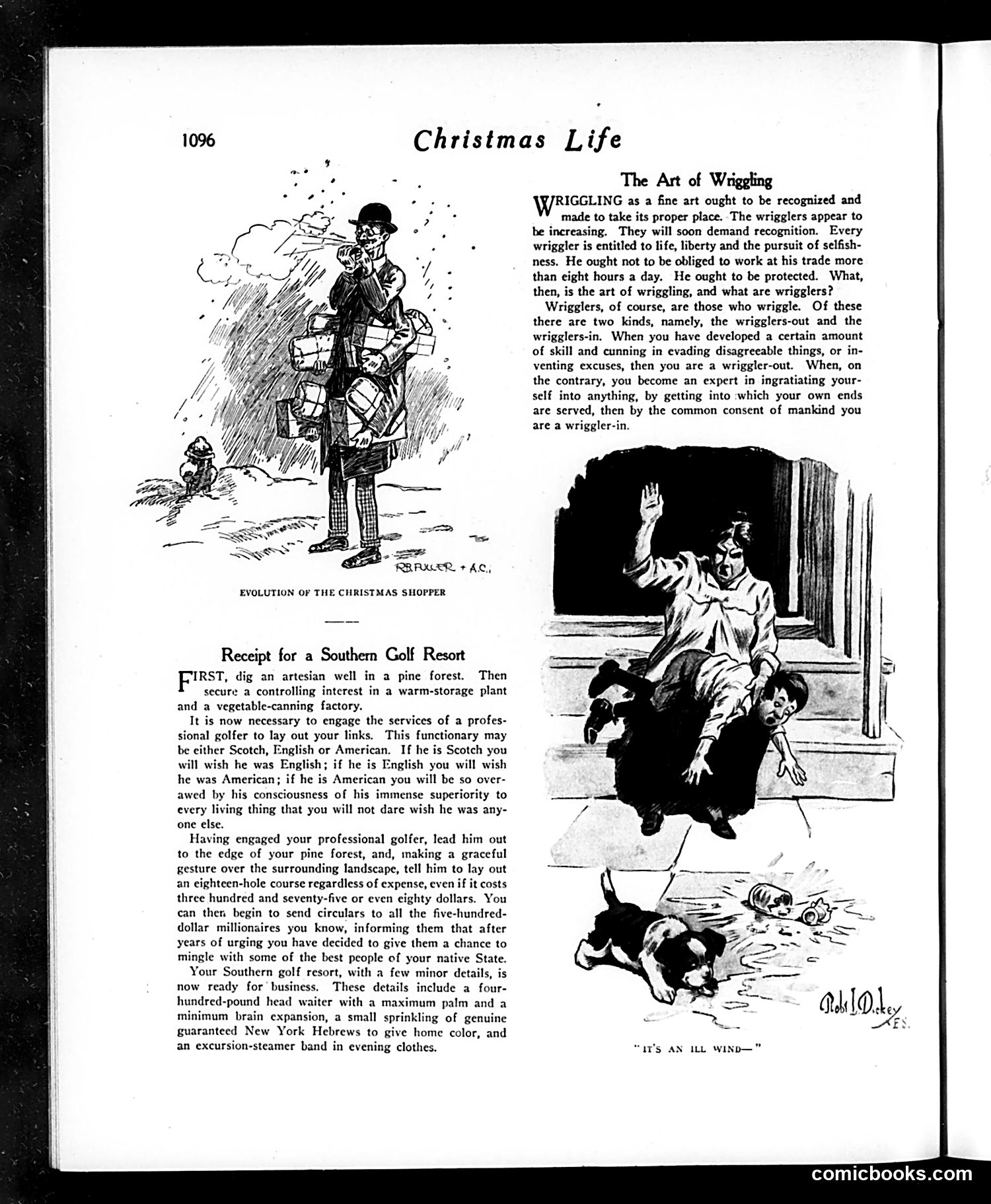
This page contains three satirical pieces targeting early 20th-century American social types and pretensions. **"The Art of Wriggling"** defines two classes of people: "wrigglers-out" (those skilled at evading work and responsibilities through excuses) and "wrigglers-in" (self-serving opportunists who manipulate their way into positions). The text mockingly advocates for their "rights," satirizing both the workers themselves and labor-movement rhetoric. **"Evolution of the Christmas Shopper"** (left illustration) shows the progression of holiday shoppers becoming increasingly burdened—a commentary on commercialization of Christmas. **"Receipt for a Southern Golf Resort"** sarcastically instructs wealthy industrialists how to construct an exclusive golf club. It mocks their pretensions by listing essentials: hired Scottish/English/American golfers (each inferior to the last), and the resort's pseudo-refined staff, including a dismissive reference to "New York Hebrews to give home color"—reflecting the period's casual antisemitism and xenophobia among the elite. The caption **"It's an Ill Wind"** (right, showing a person blown away) likely comments on the social upheaval these schemes create.
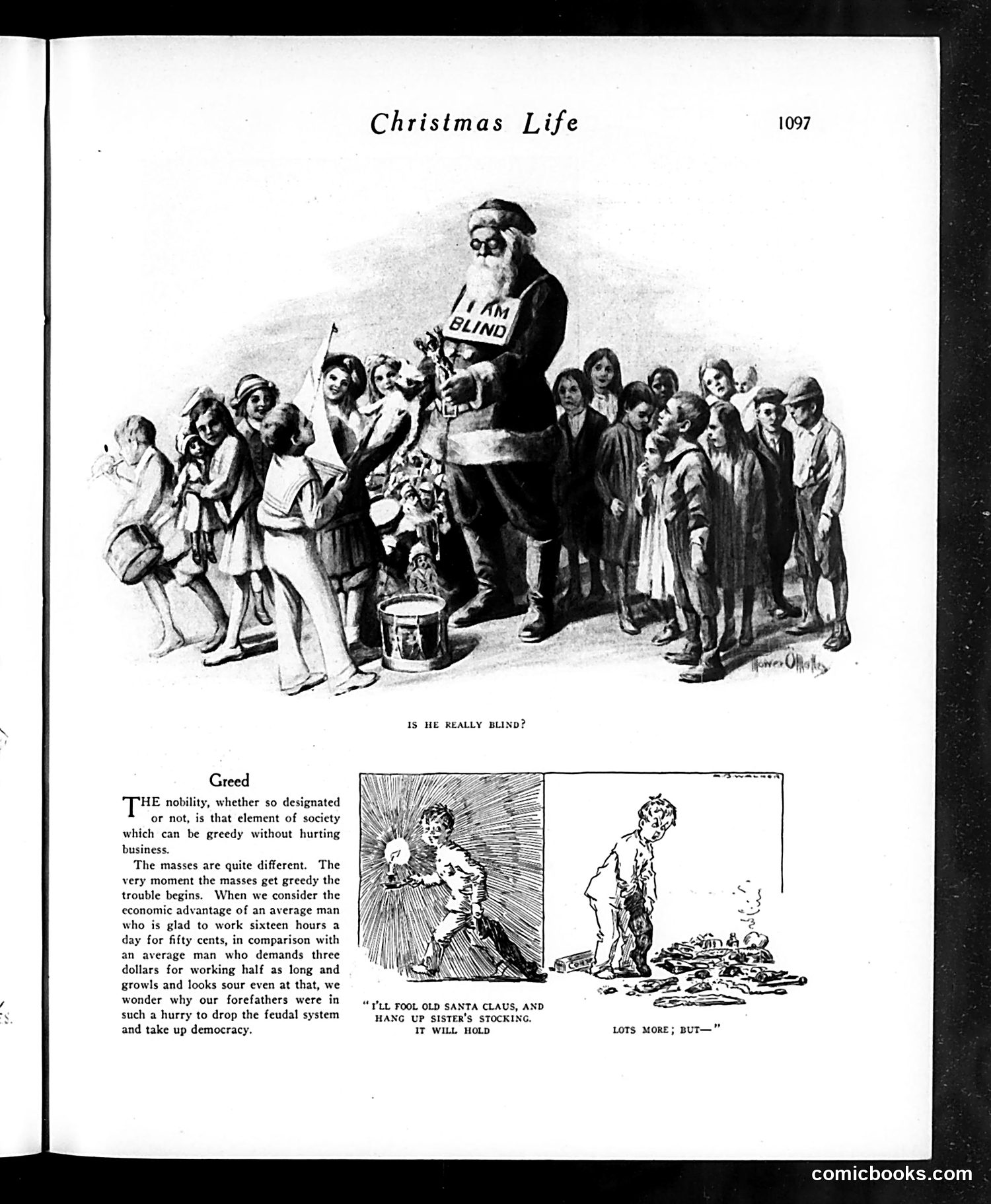
This satirical page critiques economic inequality through a Christmas lens. The main cartoon depicts Santa Claus—depicted as blind and labeled "I AM BLIND"—surrounded by children of varying economic circumstances, questioning whether he truly cannot see their disparities. Below, the essay "Greed" argues that wealthy elites can accumulate wealth without economic consequences, while working-class people are condemned for demanding fair wages. The author sarcastically suggests democracy was a mistake, implying feudalism better served the rich. The smaller cartoons show children plotting to exploit Santa's supposed blindness—one planning to stuff a stocking with excessive items. The satire suggests that capitalist greed pervades even childhood innocence and Christmas charity. The overall message: American society blindly accepts vast wealth inequality while punishing ordinary people's modest demands for fair compensation.
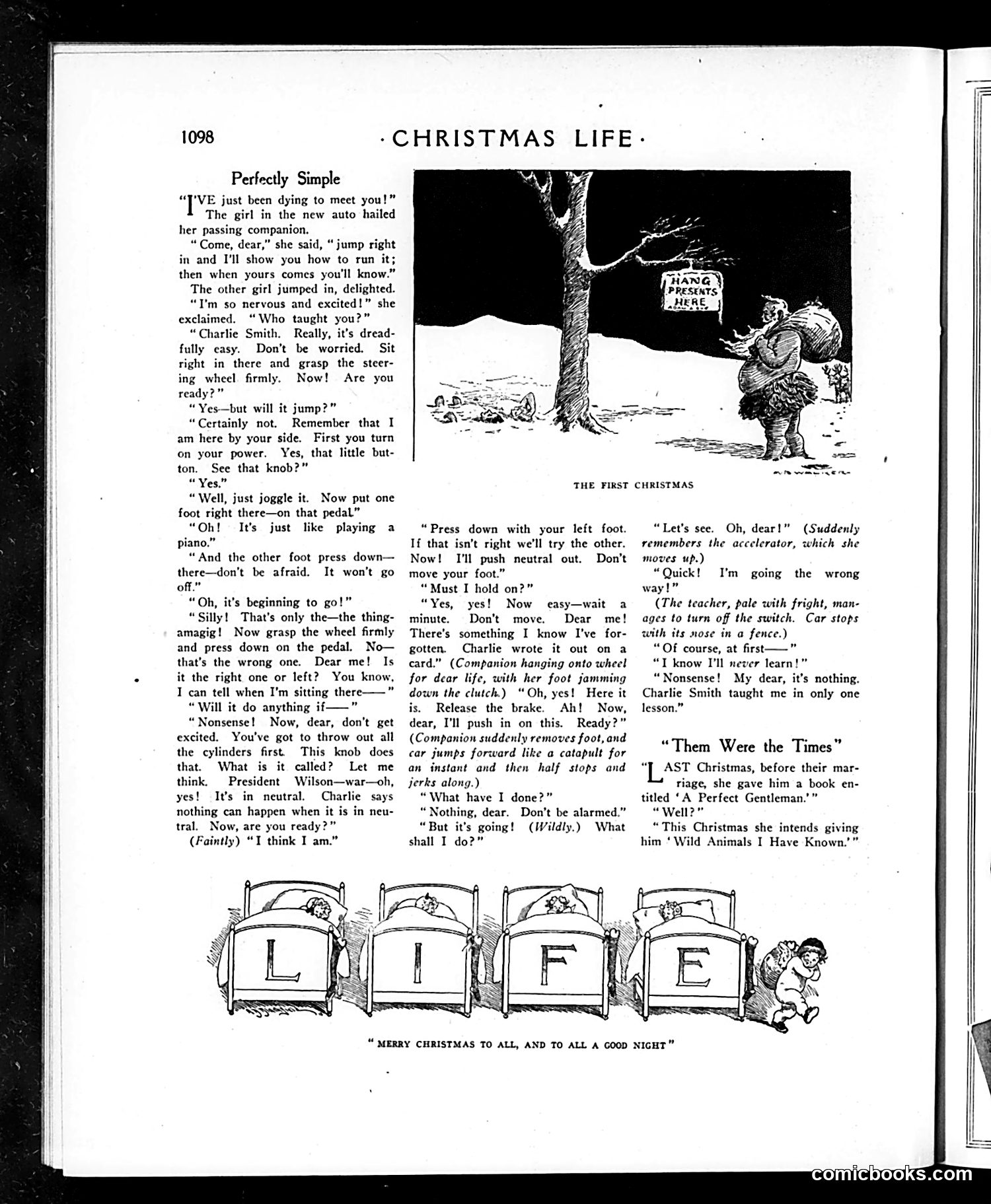
This 1910s *Life* magazine page satirizes the early automobile era and women drivers. The main story, "Perfectly Simple," mocks the confidence of a female driver teaching a nervous friend to operate a new car. The humor derives from the mechanical complexity of early automobiles—manual clutches, brake levers, spark advance controls—which the experienced driver casually explains while repeatedly forgetting crucial steps. The car lurches forward uncontrollably, nearly crashes into a fence, yet the teacher insists it's "nothing." The secondary cartoon "Them Were the Times" jokes about marriage deterioration: a husband received a book titled *A Perfect Gentleman* as an engagement gift, but now receives *Wild Animals I Have Known*—implying he's become bestial. The satire targets both female inexperience with new technology and the era's condescending attitude toward women drivers, presenting their attempts as bumbling yet amusing rather than competent.
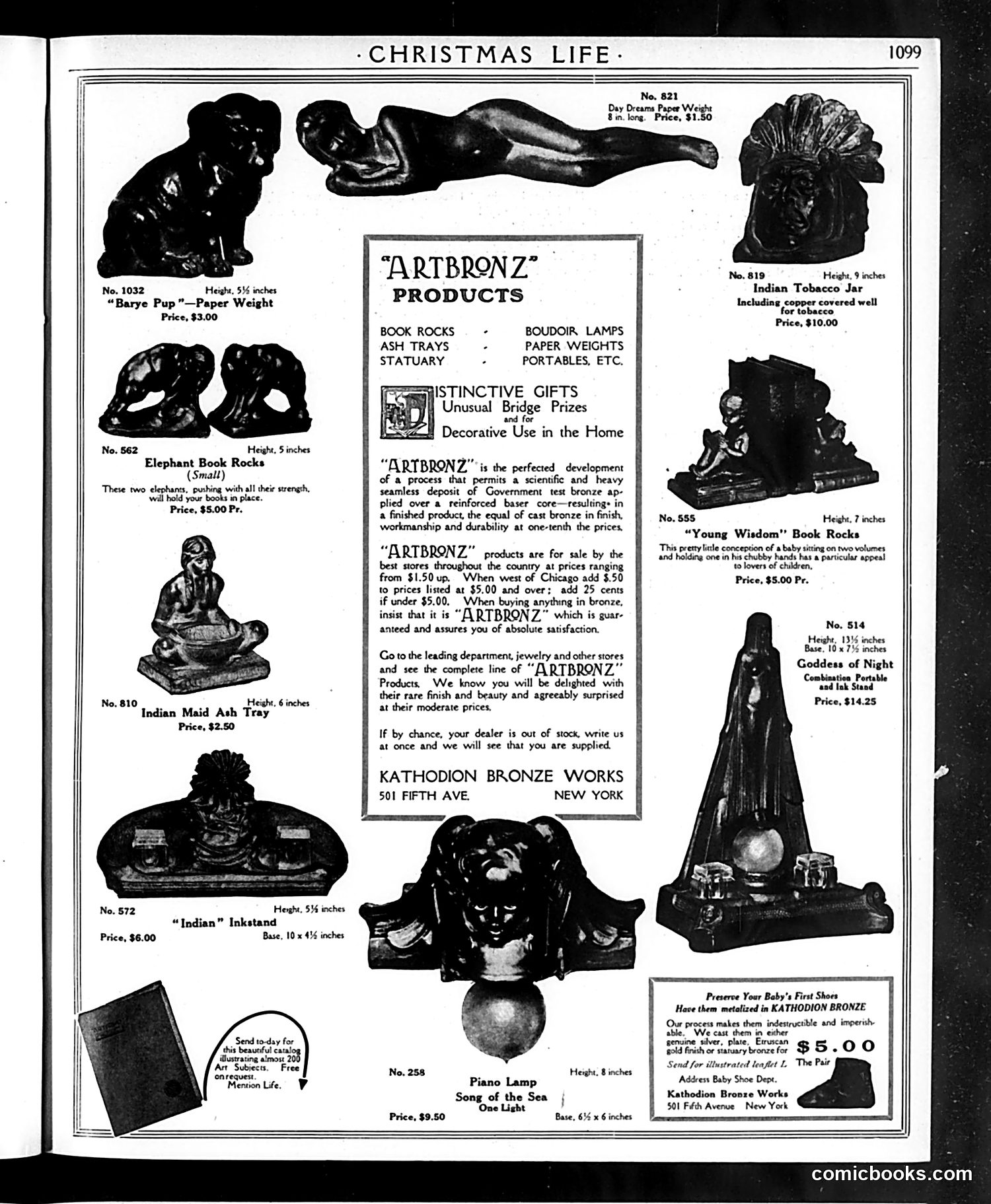
This is primarily a **Christmas gift advertisement**, not satirical content. The page showcases decorative bronze products from Kathodion Bronze Works, featuring various items with "Indian" and classical themes—including an "Indian Maid Ash Tray," "Indian Tobacco Jar," and "Indian" Inkstand. Notable for modern readers: the casual use of "Indian" imagery and stereotypes as desirable decorative motifs reflects early-20th-century attitudes toward Native American aesthetics as exotic décor. The products range from $1.50 to $14.25. The "Artbronz" process is marketed as a cost-effective alternative to cast bronze, using "Government test bronze" applied over a reinforced core. The company emphasizes quality and durability at lower prices—a typical marketing pitch for mass-produced luxury goods of the era. This represents mainstream consumer advertising of the period, not editorial content or satire.
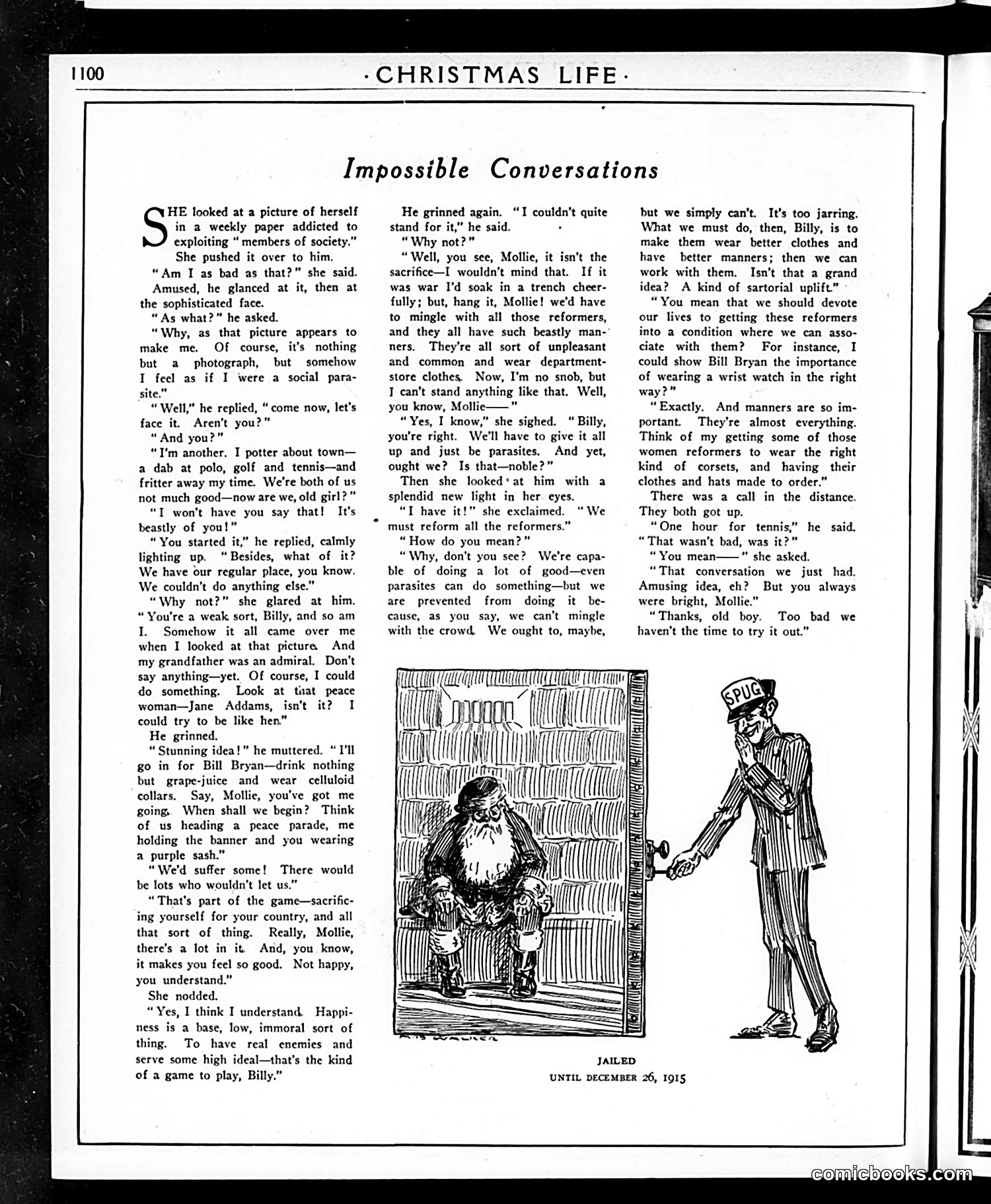
This satirical piece mocks wealthy, idle socialites—specifically a couple named Billy and Mollie—who recognize their own parasitic uselessness but rationalize inaction through absurd logic. The satire targets: **The figures**: Upper-class society people who openly admit they contribute nothing ("we're both of us not much good") yet do nothing about it. **The joke**: When considering reform work, they reject it not on principle but because reformers—including figures like Jane Addams (real social activist) and William Jennings Bryan (progressive politician)—lack proper etiquette and wear department-store clothes. Their solution: instead of actually doing good work, they'll "reform the reformers" by teaching them proper fashion and manners. **The satire's point**: Life magazine ridicules the wealthy class's self-awareness about their idleness coupled with their refusal to genuinely change, hiding behind snobbery. They'd rather preserve social hierarchy than actually serve society. The conversation's twisted logic—that improving reformers' wardrobe is equivalent to meaningful social contribution—exposes their moral bankruptcy. This reflects Progressive Era critiques of wealthy indifference to social reform movements.
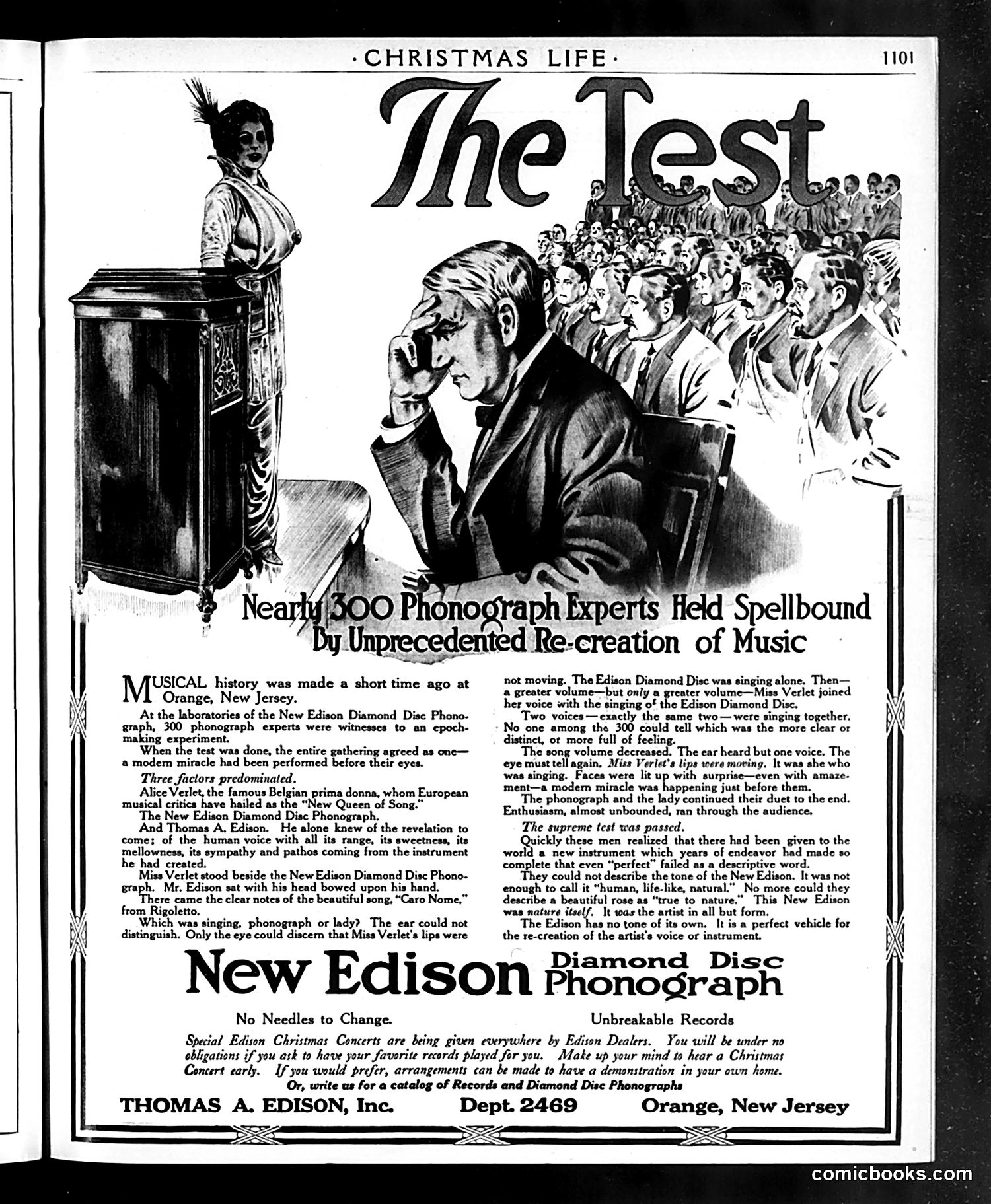
This is primarily an advertisement, not satire. It describes a 1910s demonstration at Thomas Edison's laboratory where 300 phonograph experts witnessed Belgian opera singer Alice Verlet perform a duet with a recorded playback of her own voice on the New Edison Diamond Disc Phonograph — allegedly with listeners unable to distinguish the recording from the live performance. The "test" is marketing theater: Edison (shown head-bowed, contemplatively) had orchestrated the experiment to prove the phonograph's fidelity could perfectly recreate human vocals. The dramatic narrative (two voices, then one, then two again, with the audience unable to tell which was "real") emphasizes technological achievement. This reflects genuine early-20th-century amazement at recording technology's advances. The ad celebrates Edison's invention as capturing nature itself — "nature itself" rather than mere mechanical reproduction — while promoting Christmas concerts and unbreakable records. No political satire is present; this is earnest product promotion disguised as scientific accomplishment.

This page features four brief comedic anecdotes typical of early 20th-century Life magazine's satirical humor: 1. **"The Doctrine of Chance"**: A fiancée's father accepts their engagement because recent stock market luck suggests his "luck" must turn bad soon—marriage being the anticipated misfortune. 2. **"Logical"**: An elderly woman confronts a polite officer offering his seat, sarcastically questioning whether he's being gallant or insulting her age/appearance. She rejects his principles and departs. 3. **"Getting at His Motive"**: Similar cynical humor about courtship motivations. 4. **"Mrs. Garrett's Sixth Sense"**: A quick joke about inexhaustibility—likely suggesting she talks endlessly. The cartoon illustration (lower right) depicts eavesdropping, accompanying the caption "LISTENERS HEAR NO GOOD OF THEMSELVES"—a moral about gossip. The page is primarily **advertising space** for Northern Pacific Railway's Yellowstone National Park tourism, with dramatic landscape photographs. The humor content is secondary filler material.
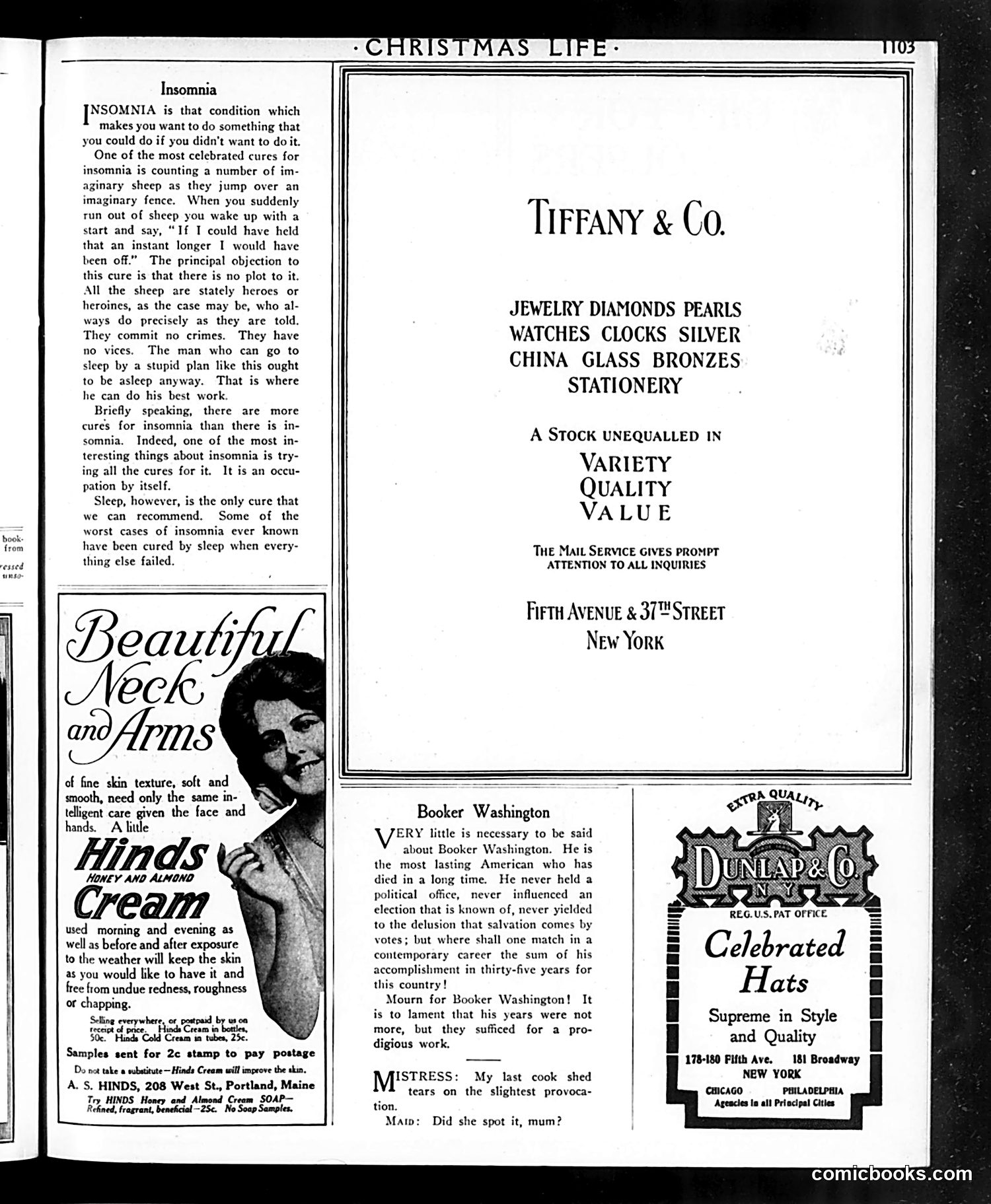
This is primarily an **advertising page** from Life magazine's Christmas issue, with one notable editorial piece. The main content is a **tribute to Booker Washington**, the African American educator and civil rights leader who recently died. The text praises him as "the most lasting American who has died in a long time," emphasizing his accomplishments over thirty-five years without holding political office or seeking power through votes. This appears to be a respectful obituary-style eulogy, notable for a 1915-era American publication. The page otherwise contains advertisements: Tiffany & Co. (luxury goods), Hinds Honey and Almond Cream (skincare), and Dunlap & Co. (hats). There is also a humorous domestic dialogue about a tearful cook at the bottom. **No political cartoon or satire appears on this page.** The Washington piece is straightforward tribute rather than satirical commentary.
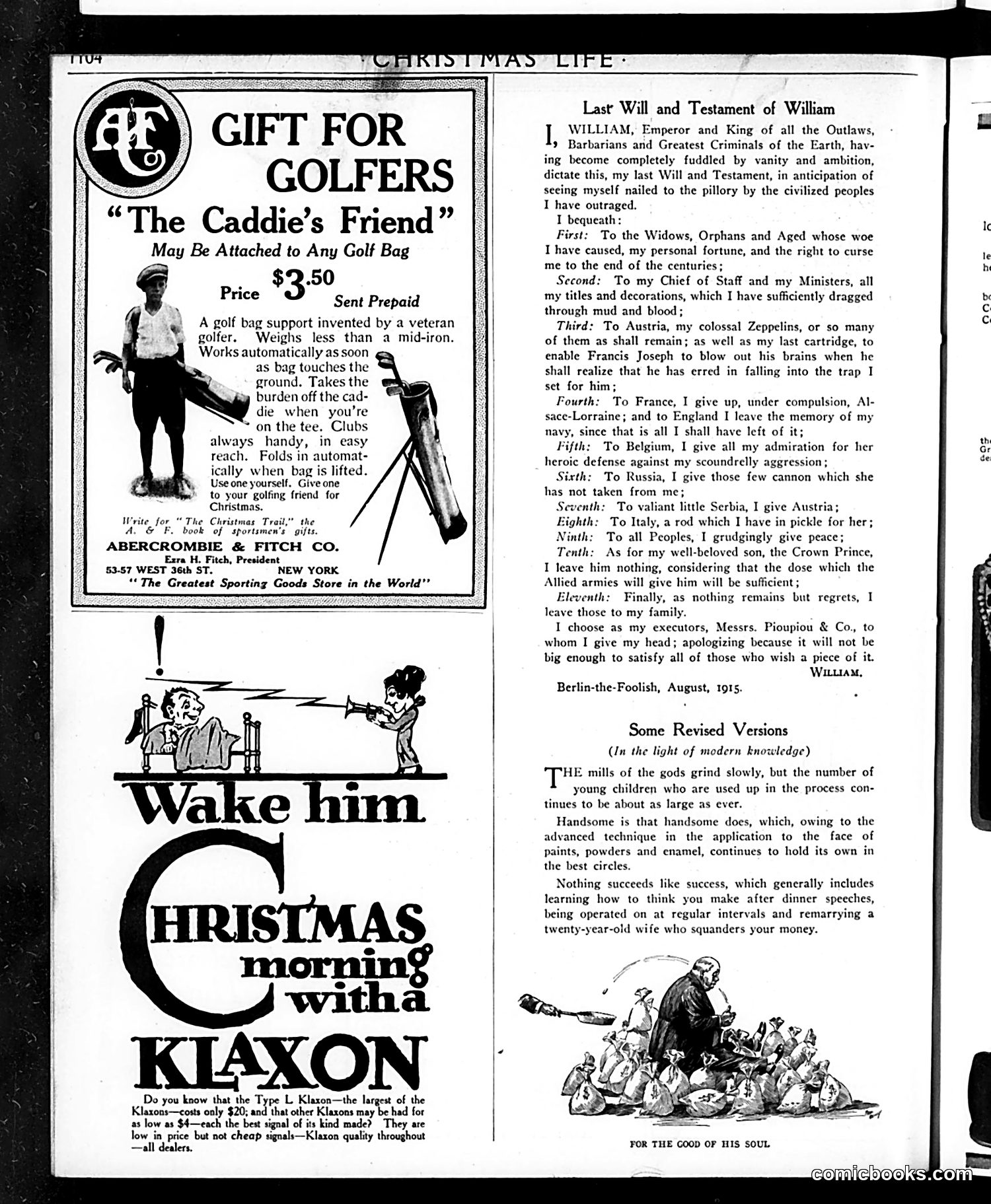
This page contains satirical content targeting **Kaiser Wilhelm II** of Germany during World War I. The main piece is a mock "Last Will and Testament of William" dated "Berlin-the-Foolish, August, 1915." The satire presents Wilhelm confessing to being an "Emperor and King of all the Outlaws, Barbarians and Greatest Criminals" who has caused widespread suffering. He "bequeaths" territorial losses (Alsace-Lorraine to France, apologies to Belgium for invasion), military defeats, and regrets to various Allied nations. The joke relies on depicting Wilhelm as already defeated and humiliated, forced to surrender conquests and admit his failures. References to his son (the Crown Prince) and his military staff mock the German leadership. The "Revised Versions" section below applies cynical modern proverbs, likely commenting on contemporary social hypocrisy. The surrounding advertisements (golf equipment, Klaxon horns) are unrelated commercial content typical of the era. This represents American wartime propaganda portraying Germany's leader as morally bankrupt and militarily doomed.
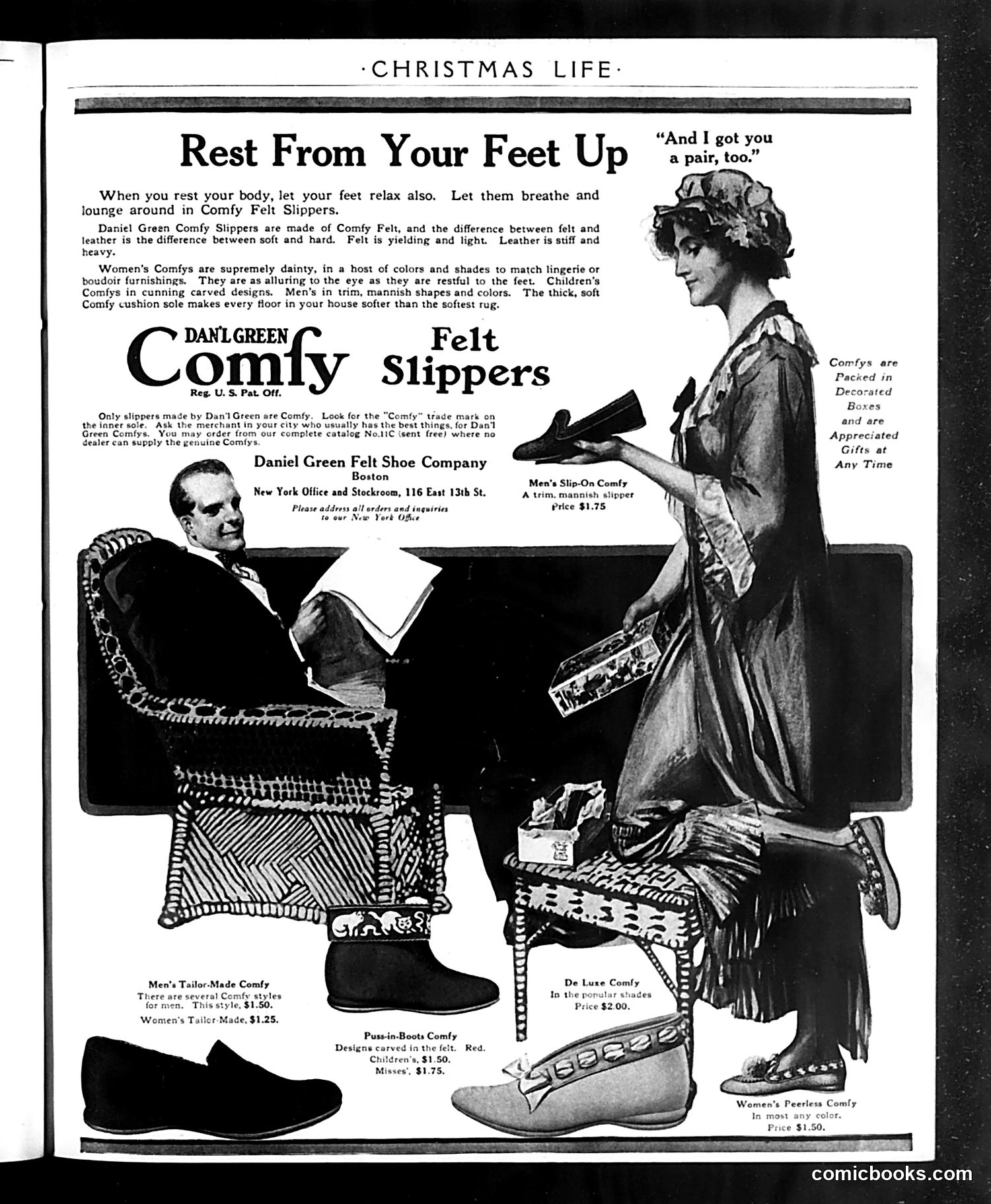
This is a **Christmas advertisement**, not political satire or a cartoon. The page promotes Daniel Green Comfy Felt Slippers as holiday gifts. The imagery shows a relaxed man reading in a chair and a woman presenting wrapped slipper boxes—depicting the product as the ideal Christmas present. The headline "Rest From Your Feet Up" frames slippers as comfort wear, emphasizing felt's softness versus leather's stiffness. The ad highlights different styles: men's tailor-made ($1.50), women's peerless ($1.50), deluxe options ($2.00), and children's versions ($1.50-$1.75). The Daniel Green Felt Shoe Company's Boston headquarters and New York sales office are listed for ordering. For modern readers: this represents vintage luxury consumer advertising, where slippers were marketed as desirable gifts comparable to jewelry or fine goods—not the mundane gift they're often considered today. The gendered presentation (dainty women's styles, trim men's styles) reflects early-20th-century marketing conventions.
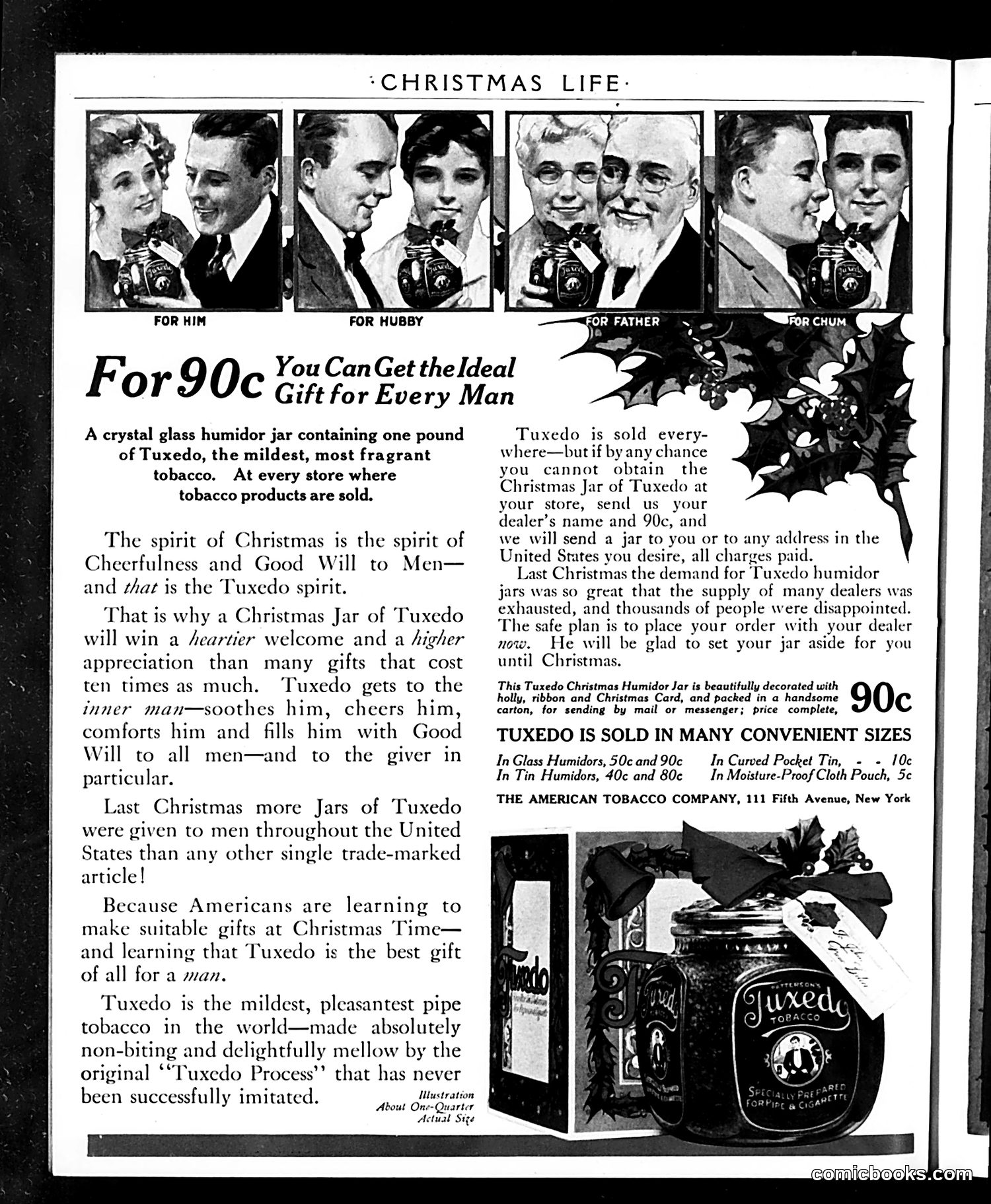
This is primarily a **tobacco advertisement**, not political satire. The page shows four photographs at the top labeled "FOR HIM," "FOR HUBBY," "FOR FATHER," and "FOR CHUM"—depicting couples and men with what appear to be Tuxedo tobacco products, establishing gift-giving scenarios. The advertisement promotes Tuxedo pipe tobacco as an ideal 90-cent Christmas gift, emphasizing it's "the mildest, most fragrant tobacco" and claiming more were given last Christmas than any other branded item. The text uses sentimental language about Christmas spirit and "good will to all men" to market smoking as a thoughtful present. This reflects early 20th-century attitudes when tobacco gifting was socially acceptable and marketed directly to male recipients as sophisticated and comforting. The ornamental holly decoration reinforces the holiday sales pitch. **Modern readers should note:** This represents a now-shocking era when tobacco companies freely advertised consumer products in mainstream publications.
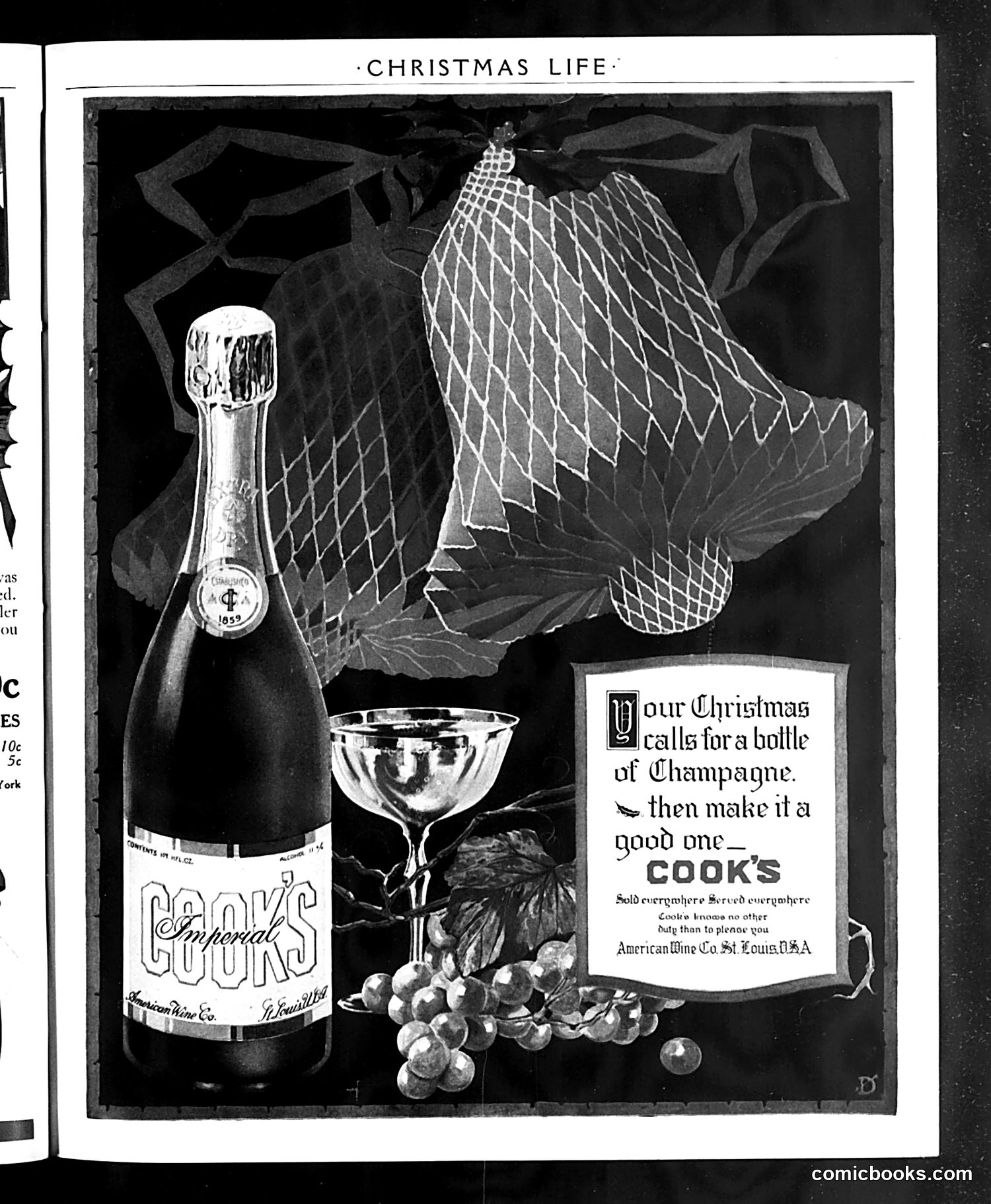
This is a **Cook's Imperial Champagne advertisement**, not a political cartoon. The "Christmas Life" heading frames it as holiday-themed marketing content. The ad shows a champagne bottle, a filled coupe glass, festive elements (grapes, decorative netting), and text stating: "Our Christmas calls for a bottle of Champagne, then make it a good one—COOK'S." The humor is gentle, playing on the idea that Christmas celebration *requires* champagne, and that one should choose Cook's brand specifically to ensure quality. This reflects early 20th-century advertising targeting middle/upper-class consumers for whom champagne was an aspirational luxury good associated with festive occasions. The elegant presentation and sophisticated styling were typical of period advertising aimed at wealthy readers of *Life* magazine.
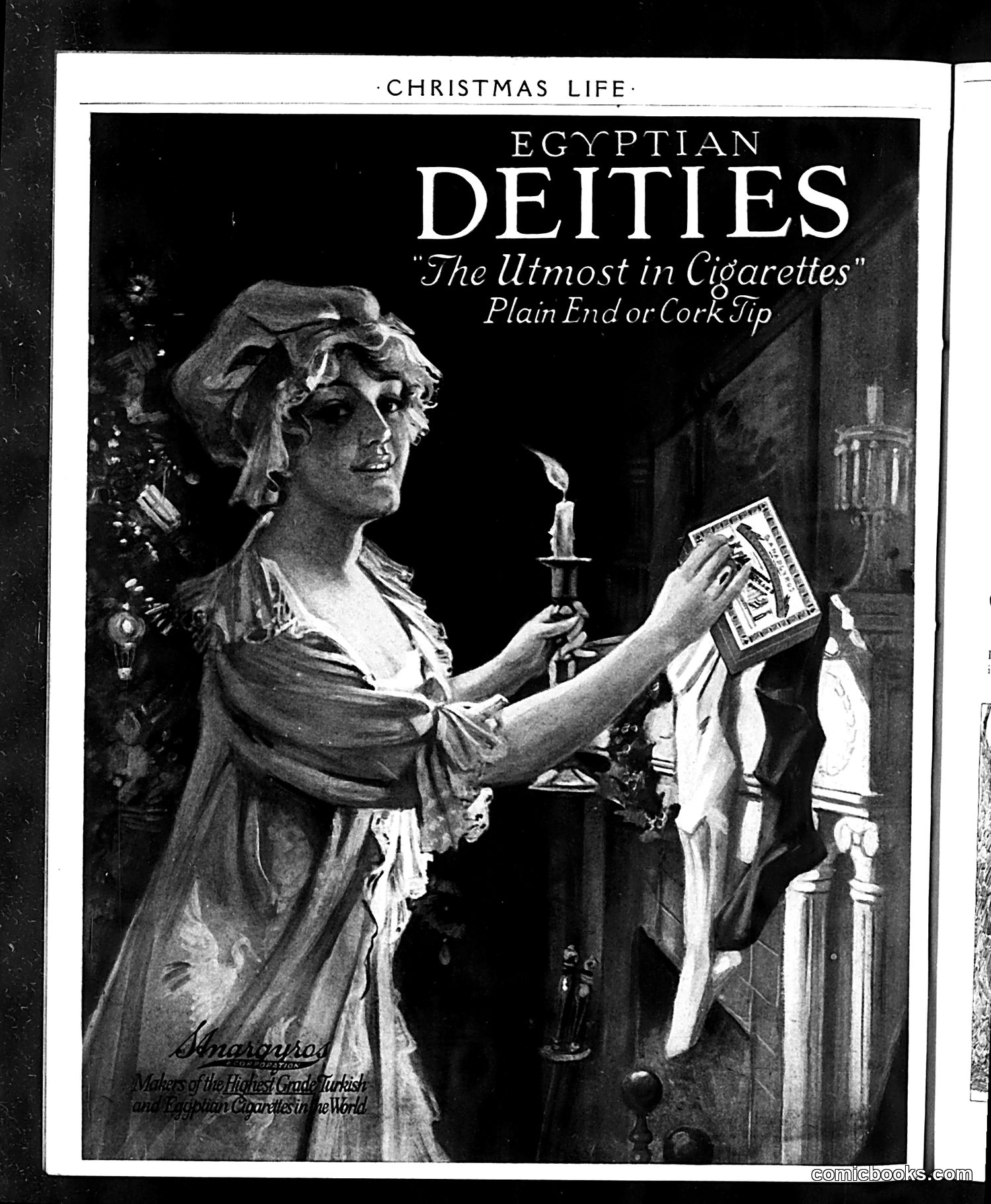
This is a Christmas-themed advertisement for Egyptian Deities cigarettes, presented as a parody of classical/Egyptian imagery. The ad features a elegantly dressed woman in flowing robes, holding a candle and displaying a cigarette package—positioning smoking as a luxurious, sophisticated activity suitable for holiday gift-giving. The "Egyptian Deities" branding suggests exoticism and premium quality ("The Utmost in Cigarettes"). The classical artistic style mimics fine portraiture, elevating cigarettes to objects of cultural refinement rather than mere consumer goods. For modern readers: this reflects early 20th-century advertising normalcy—cigarettes marketed openly, without health warnings, using aspirational imagery to appeal to affluent consumers, particularly women. The pseudo-Egyptian framing was a common marketing tactic to suggest luxury and worldliness.
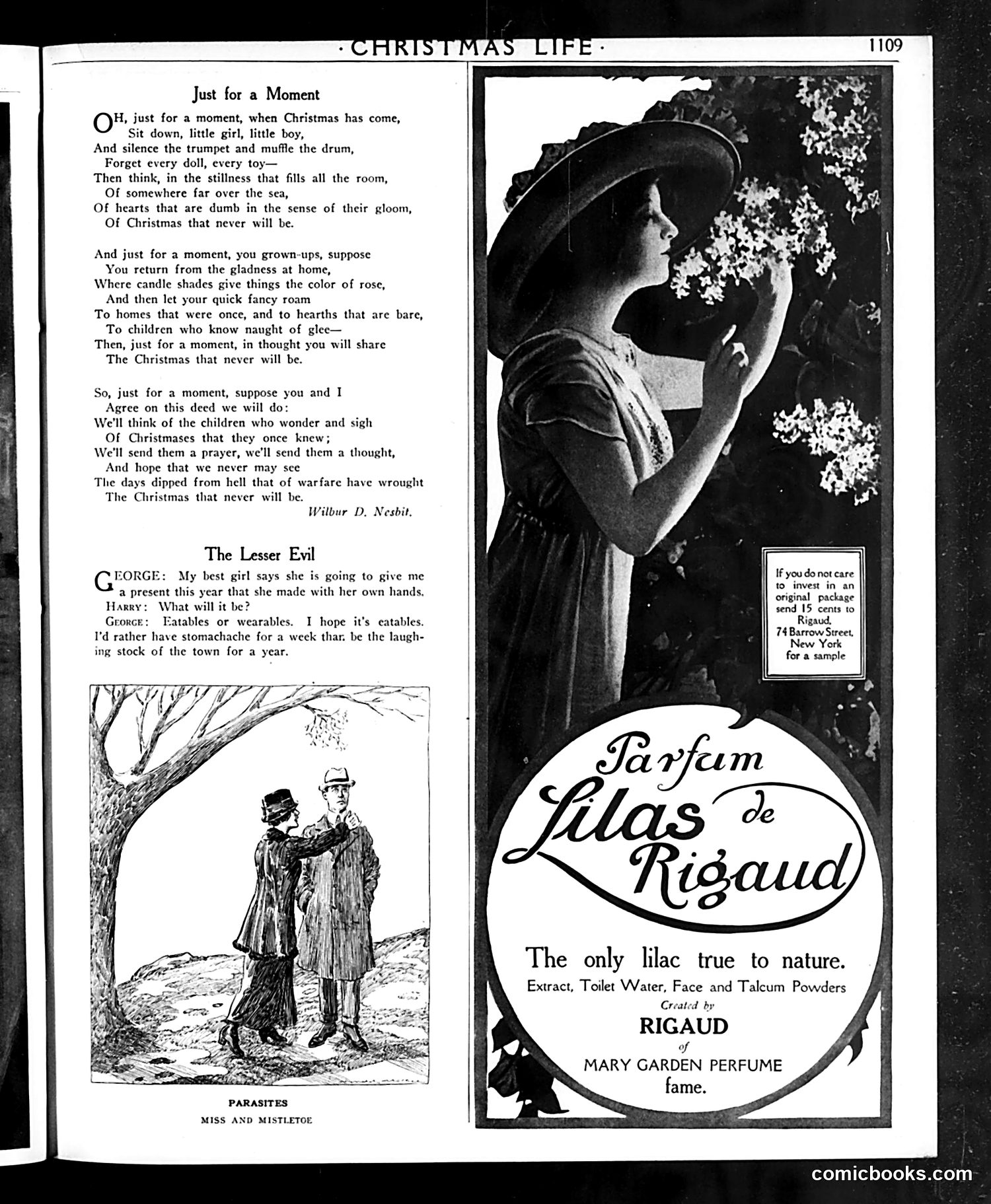
This page contains a Christmas-themed poem, a brief comedic dialogue, and perfume advertising. **"Just for a Moment"** is a sentimental wartime poem (likely WWI-era, given references to "warfare") urging readers—children and adults—to pause during holiday celebrations and remember those suffering abroad who will have no Christmas. It appeals for prayer and thought for displaced children and war victims. **"The Lesser Evil"** is a short joke about masculinity and social embarrassment. George fears his homemade gift from his girlfriend will be unfashionable or poorly made, making him a laughingstock in town—he'd prefer a stomachache (from eating bad food) to public ridicule. The humor plays on anxieties about handmade gifts and male pride. The page is otherwise dominated by a **Rigaud perfume advertisement** featuring an elegant woman with lilacs, positioning the fragrance as "the only lilac true to nature."
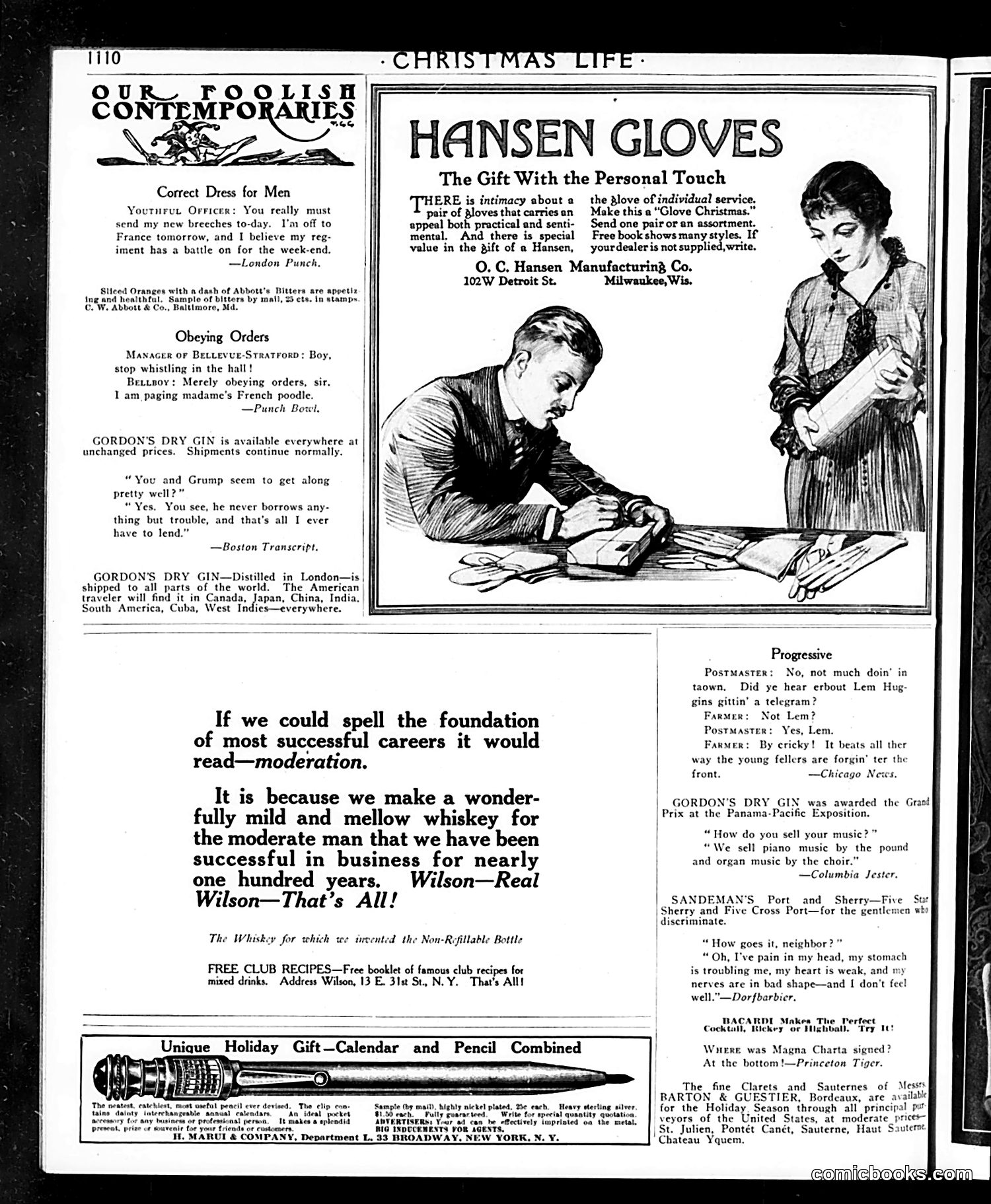
This page is primarily **advertising with satirical humor sections**. The main content includes: **The Cartoons/Humor:** Four brief comic exchanges satirizing social absurdities: - A young officer casually mentioning his regiment has "a battle on for the week-end" (mocking British understatement about WWI) - A boy whistling while paging a French poodle, claiming he's "obeying orders" (absurdist humor) - Two men discussing lending/borrowing habits - Rural characters discussing a telegram arrival (suggesting news of young men enlisting for "the front") These reflect *Life* magazine's satirical tradition of mocking contemporary society—here, wartime attitudes and class pretensions. **The Advertisements:** The bulk of the page advertises luxury goods (Hansen Gloves, Gordon's Dry Gin, Wilson Whiskey, Sandeman's Port) positioned as quality gifts. Notably, alcohol advertising dominates, promoting "moderation" while selling premium spirits—a pitch to affluent readers during Prohibition debates. The page captures early 20th-century *Life*: mixing gentle social satire with upscale consumer marketing.
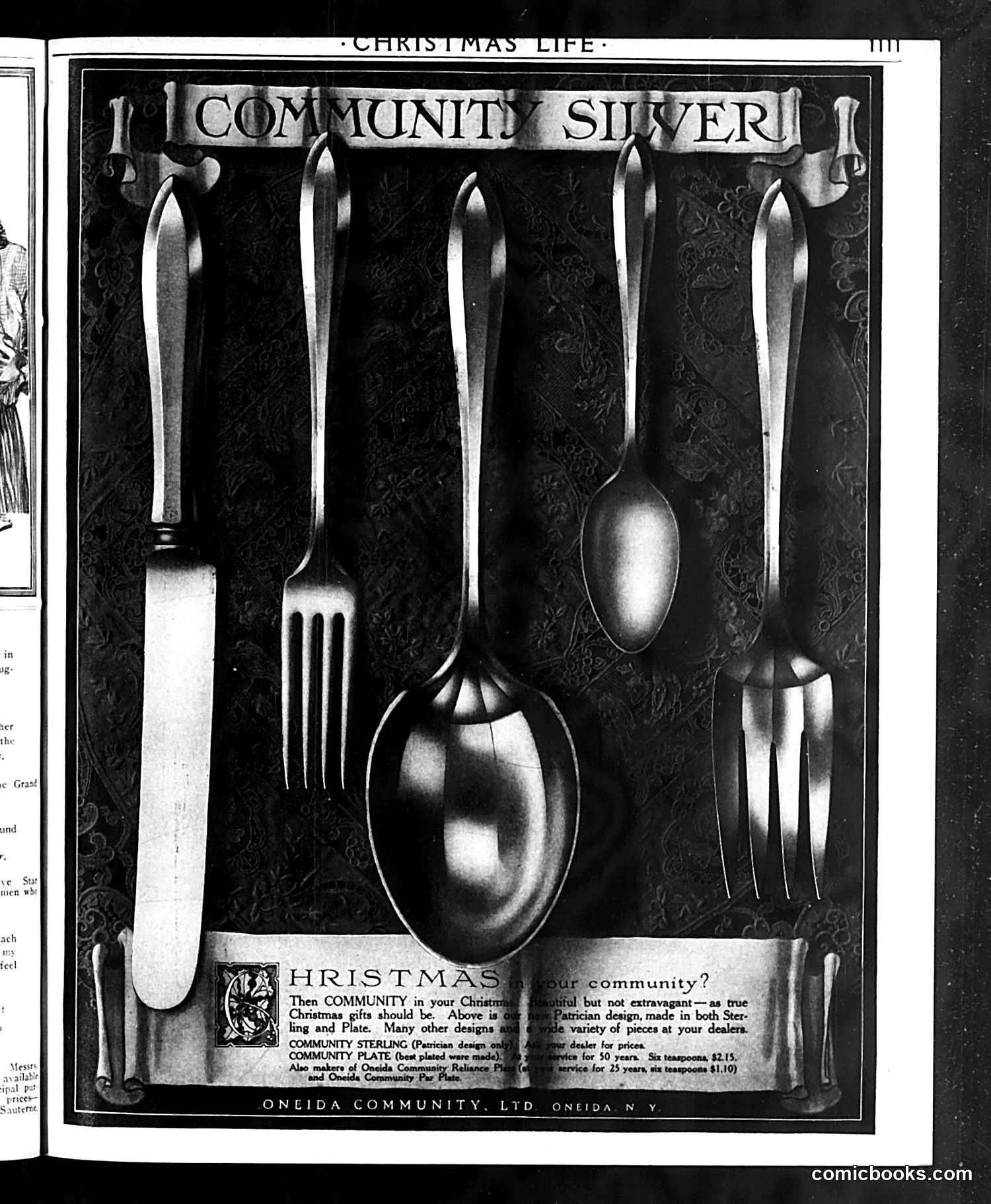
This is a **product advertisement**, not political satire. It promotes Oneida Community silverware as Christmas gifts. The page displays elegant flatware—knives, forks, and spoons—arranged against a decorative damask background. The ad appeals to middle-class sensibilities by suggesting that Community Silver represents tasteful, practical gift-giving: quality without excessive expense ("not extravagant—as true Patrician design"). The text emphasizes durability and value, noting the product comes in sterling silver and plated varieties at different price points ($1.10-$2.15 for service sets). It references Oneida's established reputation ("for 50 years," "for 25 years"). For modern readers: this reflects early 20th-century consumer culture where branded tableware signaled genteel domesticity and respectability—practical luxury items marketed to aspirational American households.
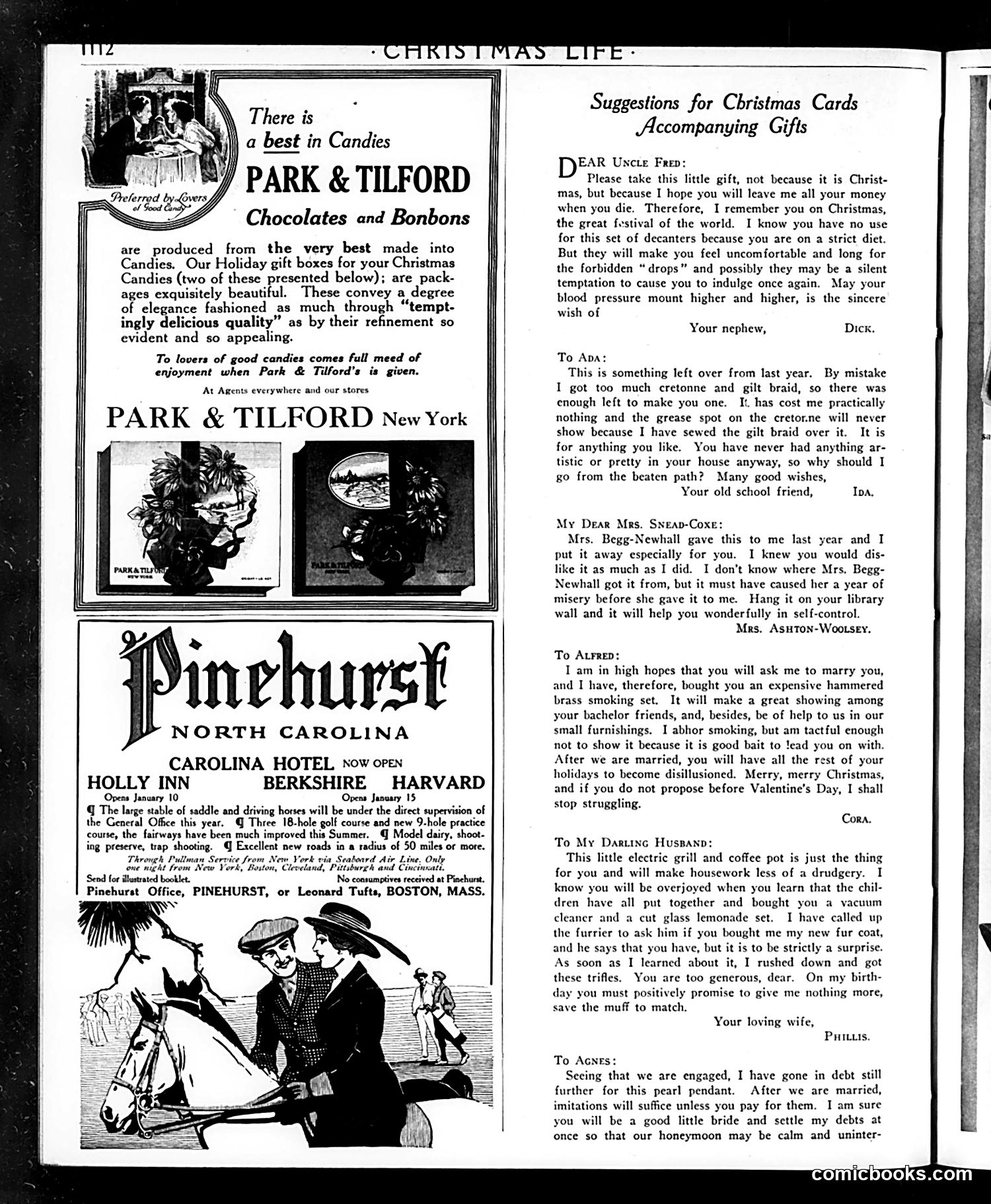
This page combines advertisements with satirical "gift card suggestions"—a humorous feature mocking insincere Christmas gift-giving among the upper classes. The satire targets wealthy social circles through letters accompanying gifts. Each reveals the sender's true, selfish motives masked by polite formality: - **To Uncle Fred**: A nephew gives decanters hoping to inherit money, while subtly encouraging drinking despite the uncle's diet. - **To Ada**: Regifting leftover fabric with visible stains, insulting the recipient's taste. - **To Alfred**: A woman buys an expensive smoking set to manipulate her boyfriend into proposing, while disapproving of smoking. - **To Darling Husband**: A wife gives practical appliances framed as labor-saving devices, revealing marital disillusionment. The humor derives from characters' oblivious candor about mercenary motives, social climbing, manipulation, and disappointment—all wrapped in formal courtesy. This reflects early 20th-century anxieties about commercialized holidays and shallow upper-class relationships.
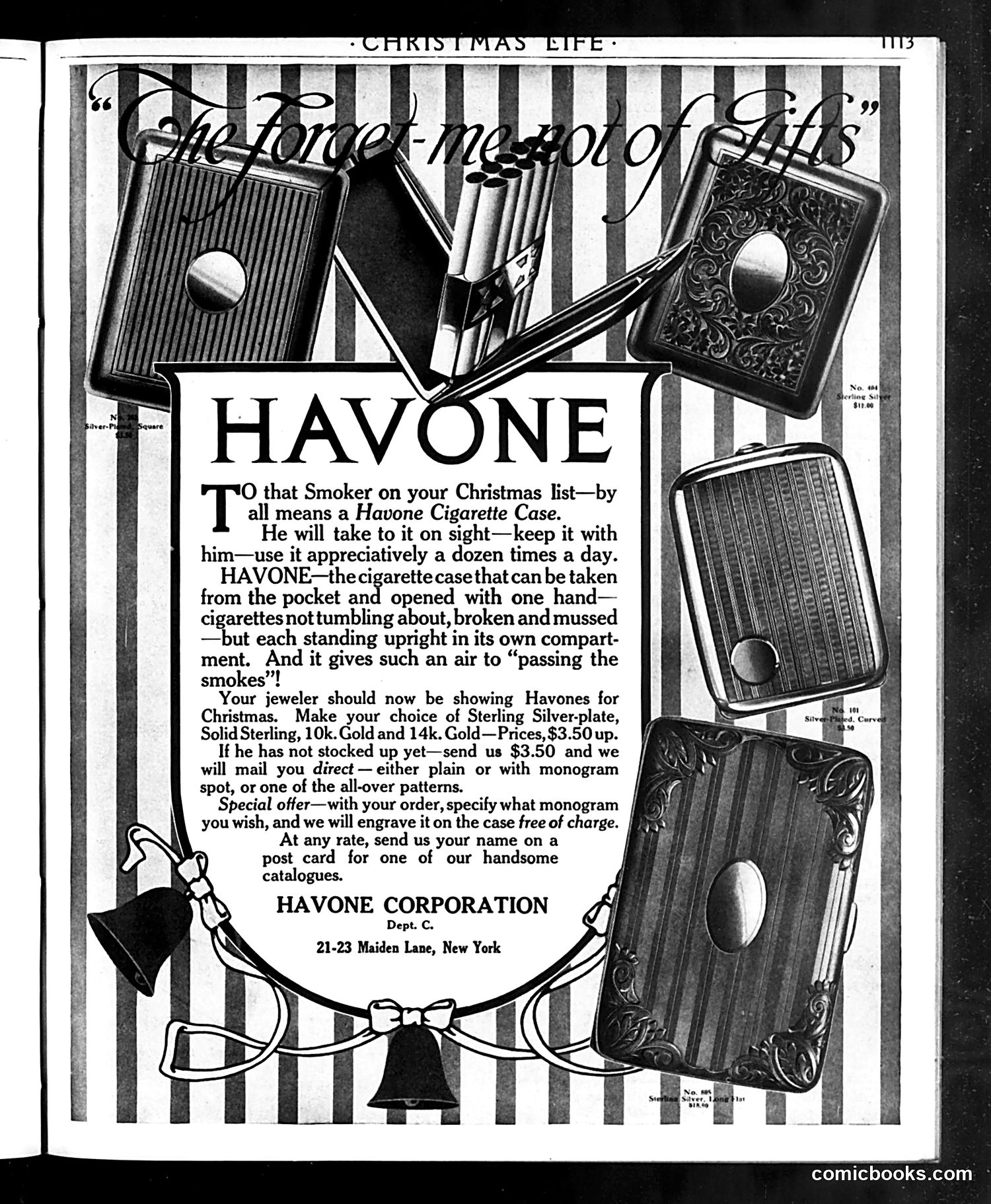
This is primarily a **commercial advertisement**, not satire or political commentary. It promotes the Havone cigarette case as a Christmas gift for smokers. The ad appeals to 1920s social conventions: owning an elegant cigarette case supposedly confers status and sophistication—giving smokers "an air" when "passing the smokes" socially. The decorative cases shown (sterling silver, gold options) suggest luxury goods marketed to middle-class consumers. The visual elements—striped background, decorative bells and ribbons—are festive Christmas styling typical of period advertising. The phrase "The Largest-selling Cigarette Case" in the header is a marketing claim. **For modern readers:** This reflects an era when cigarette smoking was glamorized and gift-giving centered on tobacco products without health warnings. The emphasis on hand-operated convenience and aesthetic display shows how luxury consumer goods were marketed through aspirational lifestyle appeals.
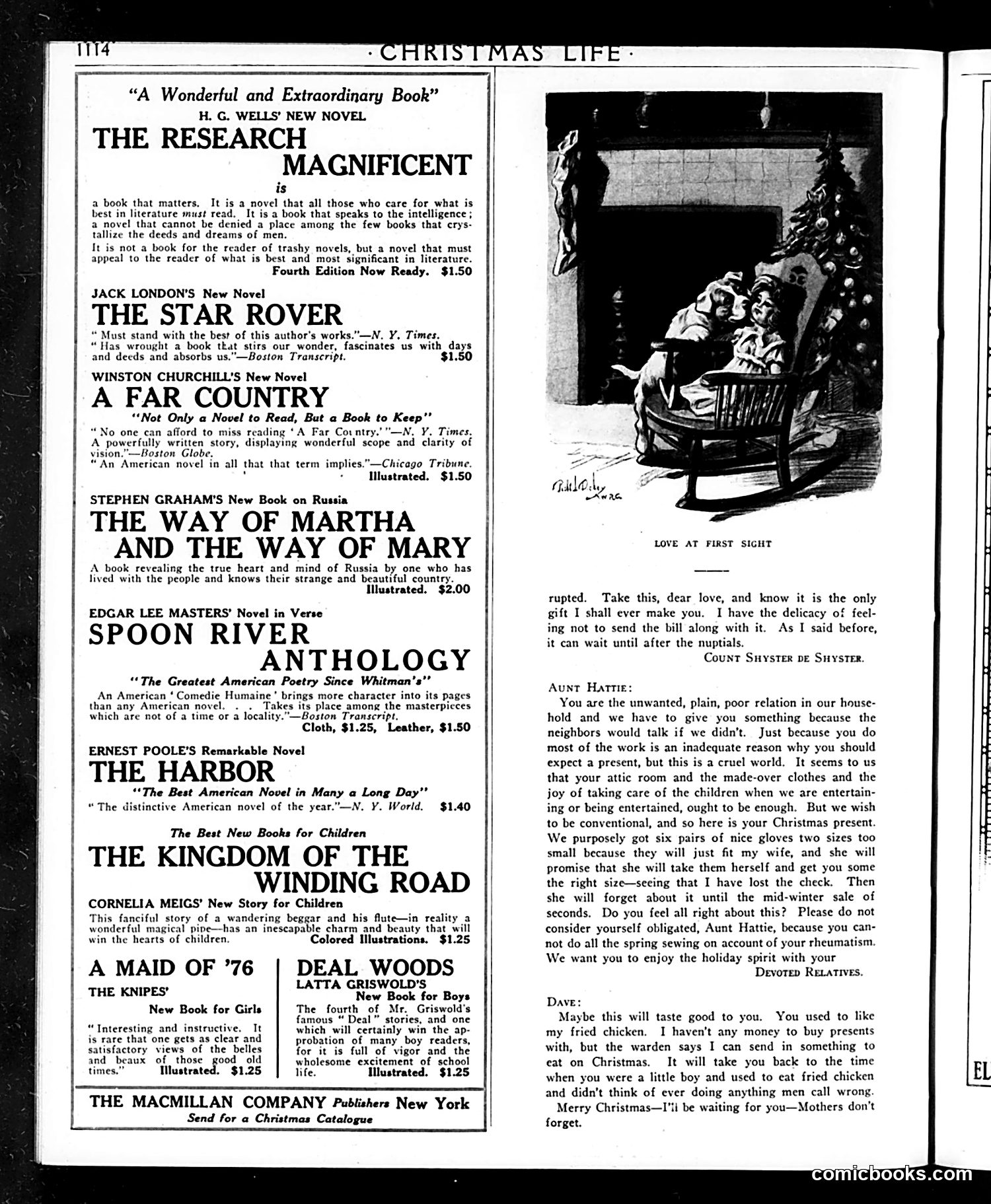
This page is primarily book advertisements, but includes a cartoon titled "Love at First Sight" satirizing Christmas gift-giving among the wealthy and their treatment of poor relations. The cartoon depicts a man presenting gloves to a woman, accompanied by three cruel "gift messages." The Count's note is sarcastically romantic while deferring payment. Most biting is Aunt Hattie's message: she's an unwanted poor relative given gloves explicitly two sizes too small—meant for the gift-giver's wife. The message brutally catalogues the aunt's servitude (attic room, childcare, housework) while insisting she shouldn't expect gratitude, framing the gift as mere social convention to avoid neighbors' gossip. The satire targets upper-class hypocrisy: the pretense of generosity masking contempt, the calculation that passes for charity, and the exploitation of dependent relatives. It exposes how Christmas "spirit" could be weaponized to reinforce social hierarchy and obligation rather than genuine kindness.
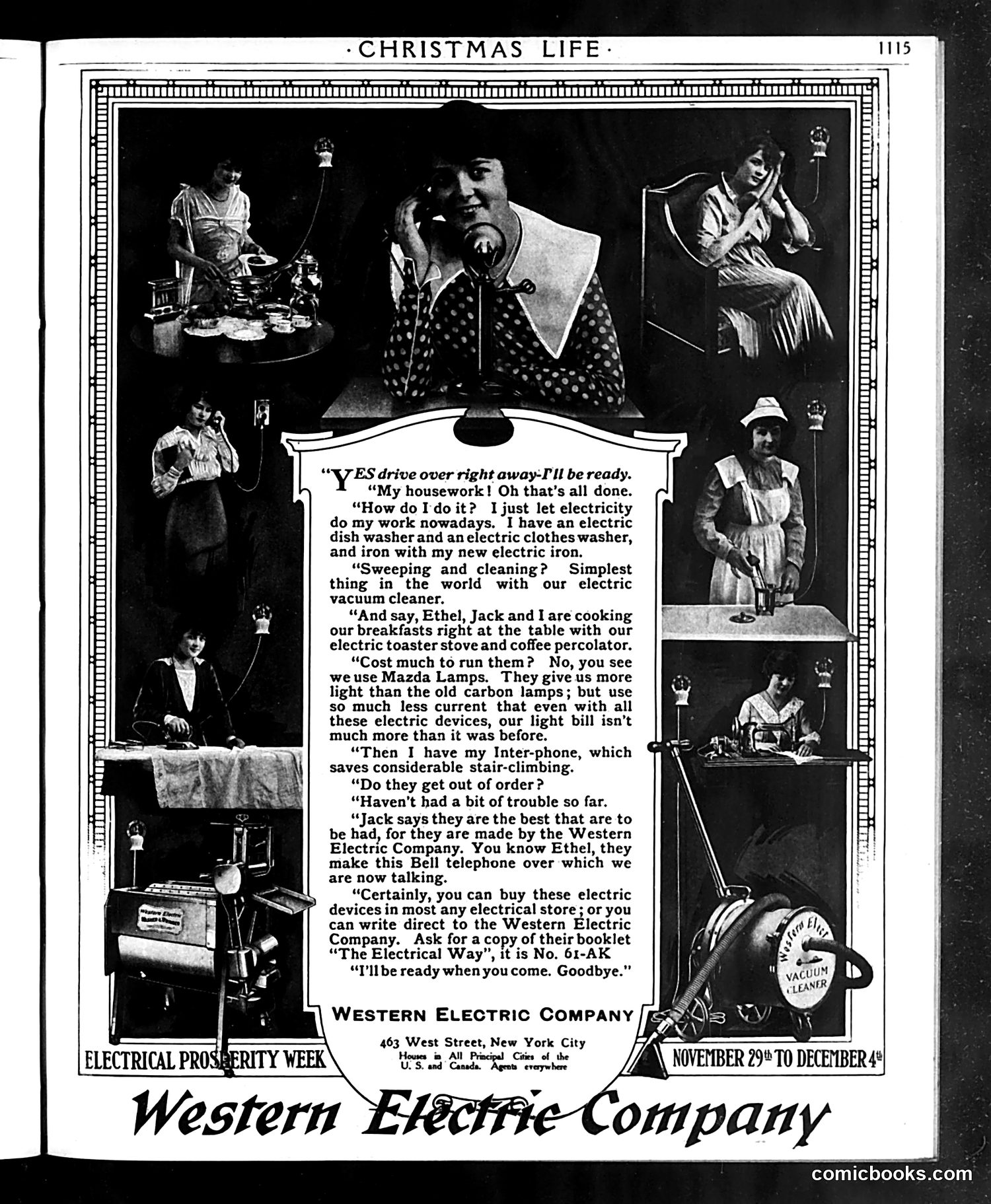
This is **advertising disguised as editorial content**—a Western Electric Company advertisement promoting electrical household appliances during "Electrical Prosperity Week" (November 29-December 4). The "satire" is gentle mockery of modern domesticity: a woman brags to a friend (via telephone) about how electricity has eliminated her housework, allowing her to leave instantly for social engagements. She lists: electric dishwasher, clothes washer, iron, vacuum, cooking appliances, lighting, and an inter-phone (intercom). The joke is the lifestyle fantasy—that electricity creates effortless leisure. The surrounding photographs show various electrical devices in domestic use. **Context for modern readers:** This represents early 20th-century *marketing of the electric home as aspirational*. The ad assumes readers will find humor in the exaggerated claims while actually promoting Western Electric's products (and the Bell telephone they manufacture). It's propaganda dressed as comedy, promoting both consumerism and female domesticity through labor-saving devices.
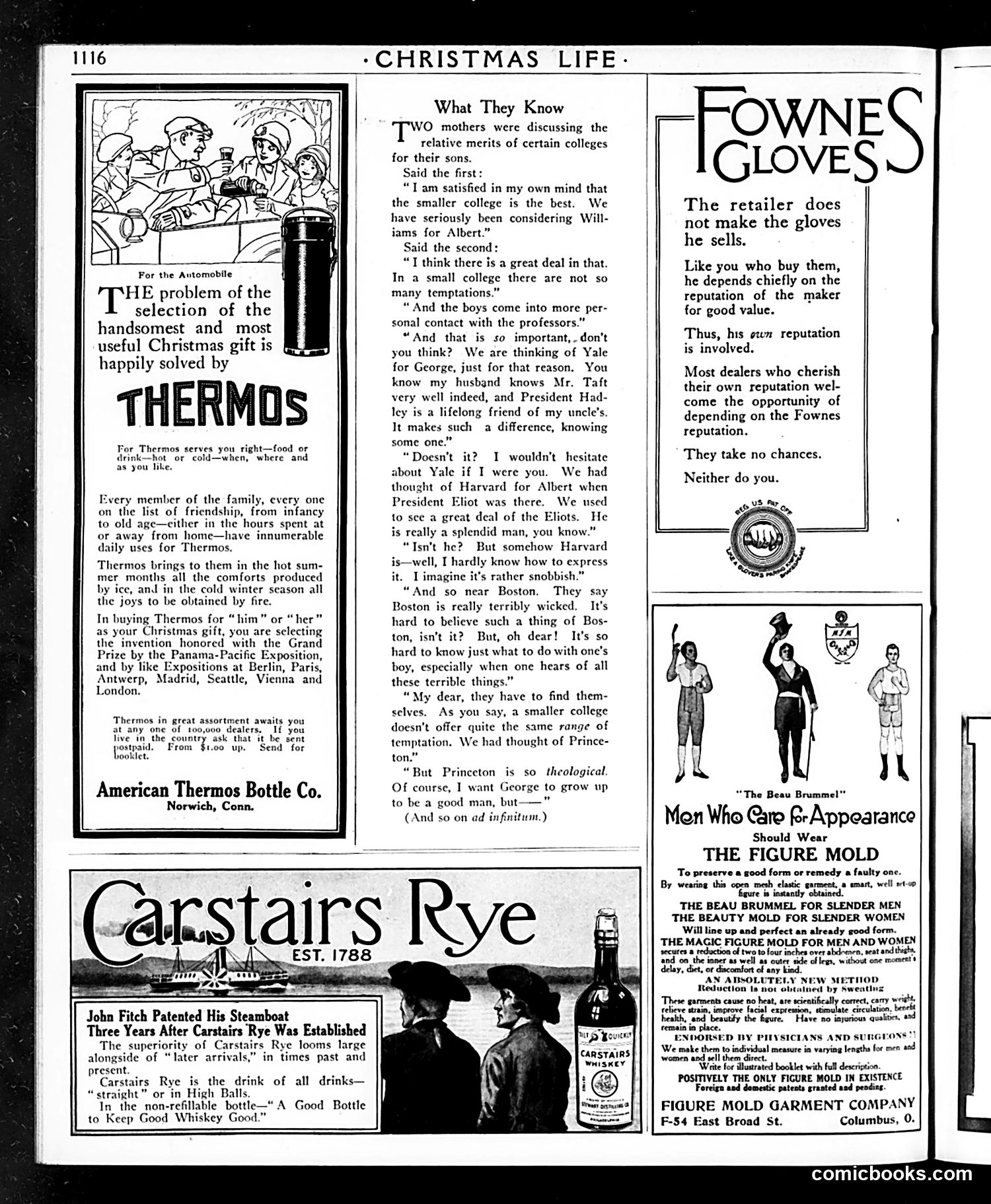
This page is primarily **advertisements interspersed with social satire**, not political cartooning. The main satirical piece, "What They Know," mocks wealthy mothers discussing college choices for their sons. The joke is that their *actual* selection criteria—knowing the college president personally or having connections to administrators—has nothing to do with academic quality. They rationalize their choices with talk of "smaller colleges" and fewer "temptations," but reveal they're really choosing based on social connections (mentioning "Mr. Taft" and "President Hadley"). The phrase "(And so on ad infinitum)" signals the endless, circular nature of their self-deception. The satire targets **class-based educational privilege**: elite families leveraging personal relationships to secure prestigious college placements for their sons, while pretending their decisions rest on educational merit. The surrounding ads (Thermos bottles, Carstairs Rye whiskey, Towne Gloves, Figure Mold undergarments) are typical Christmas gift advertisements aimed at affluent readers—the exact audience being gently mocked in the article.
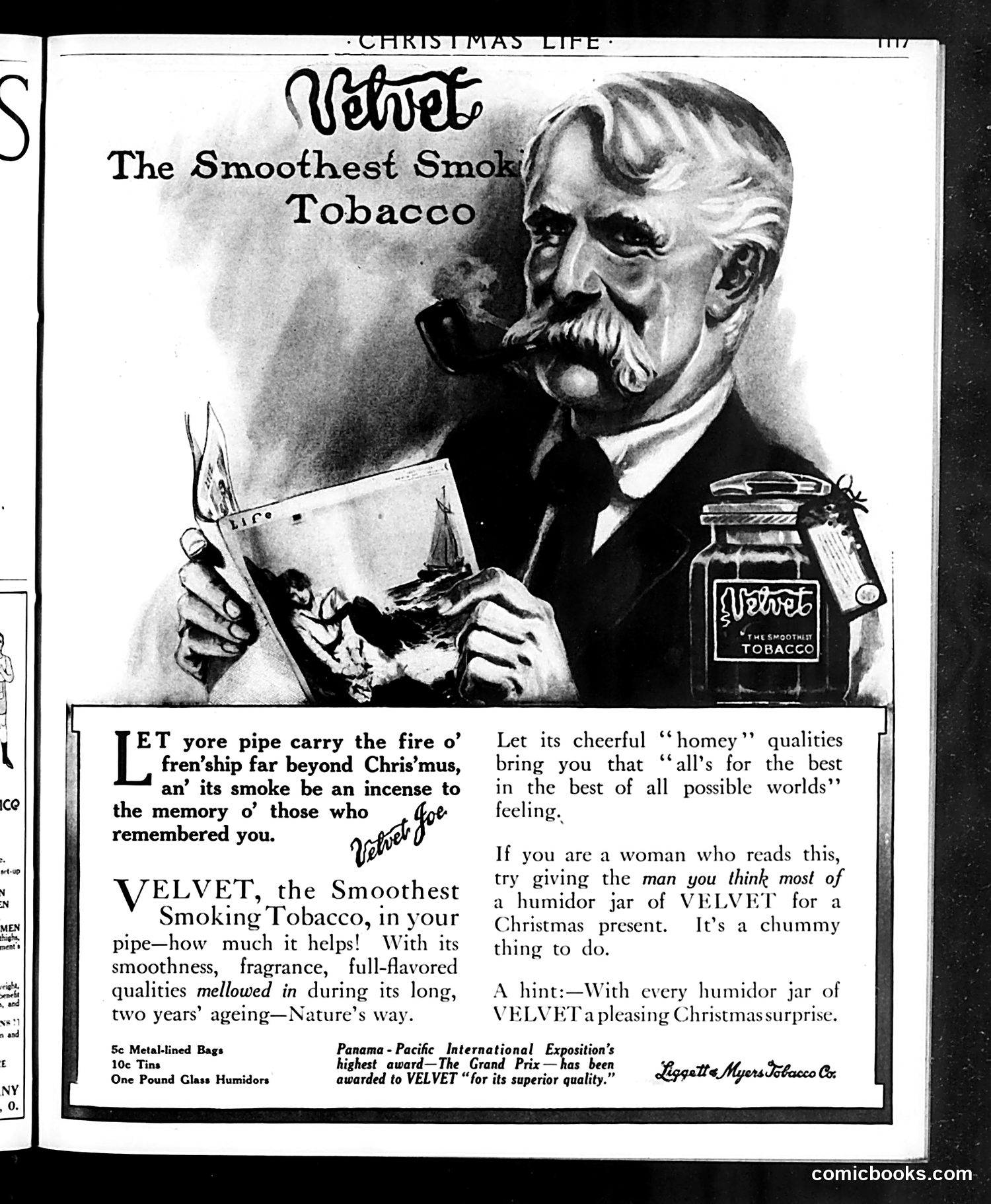
This is primarily a **Christmas-season tobacco advertisement**, not political satire. The page features an illustration of a distinguished older gentleman with a prominent mustache smoking a pipe, holding a jar of Velvet tobacco. The ad's appeal is sentimental rather than satirical: it frames pipe smoking as a meaningful gift that carries "friendship far beyond Christmas" and serves as a remembrance. It specifically targets both male recipients (suggesting the pipe as a gift) and women shoppers (encouraging humidor jars as presents for "the man you think most of"). The advertisement emphasizes quality through claims of two years' aging and mentions a "Grand Prix" award from the Panama-Pacific International Exposition. The messaging—with its nostalgic tone about memory and fellowship—capitalizes on wartime or holiday sentiment to market the product as something meaningful rather than merely consumable. This reflects early 20th-century advertising that positioned luxury goods as emotional rather than practical purchases.
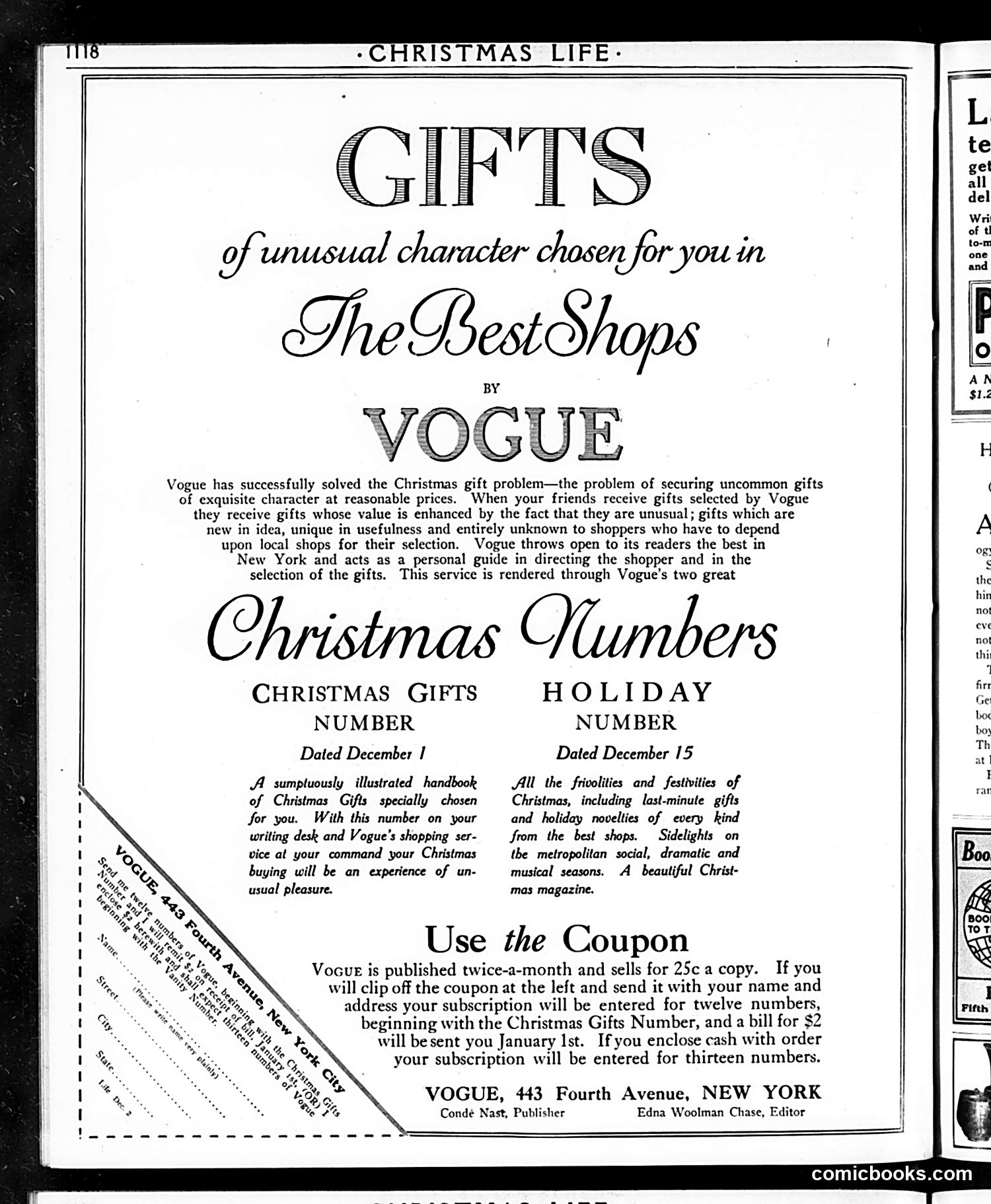
This is primarily **advertising, not a cartoon or satirical content**. It's a full-page promotional advertisement for *Vogue* magazine placed in *Life* magazine. **What it advertises:** Two special Christmas issues of *Vogue* (dated December 1 and December 15) offering curated gift suggestions from New York's best shops. The pitch emphasizes that Vogue provides access to "uncommon gifts of exquisite character at reasonable prices"—positioning the magazine as a personal shopping guide for affluent readers. **The subscription offer:** Readers can clip a coupon to subscribe for either 12 issues ($2) or 13 issues (if paying in cash upfront). **Historical context for modern readers:** This reflects early-20th-century consumer culture where *Vogue* positioned itself as an arbiter of taste and access to luxury shopping for the urban wealthy. The emphasis on "unusual" and "exquisite" gifts targets aspirational shoppers wanting to signal sophistication through distinctive purchases rather than commonplace items. There is no political satire or caricature present on this page.
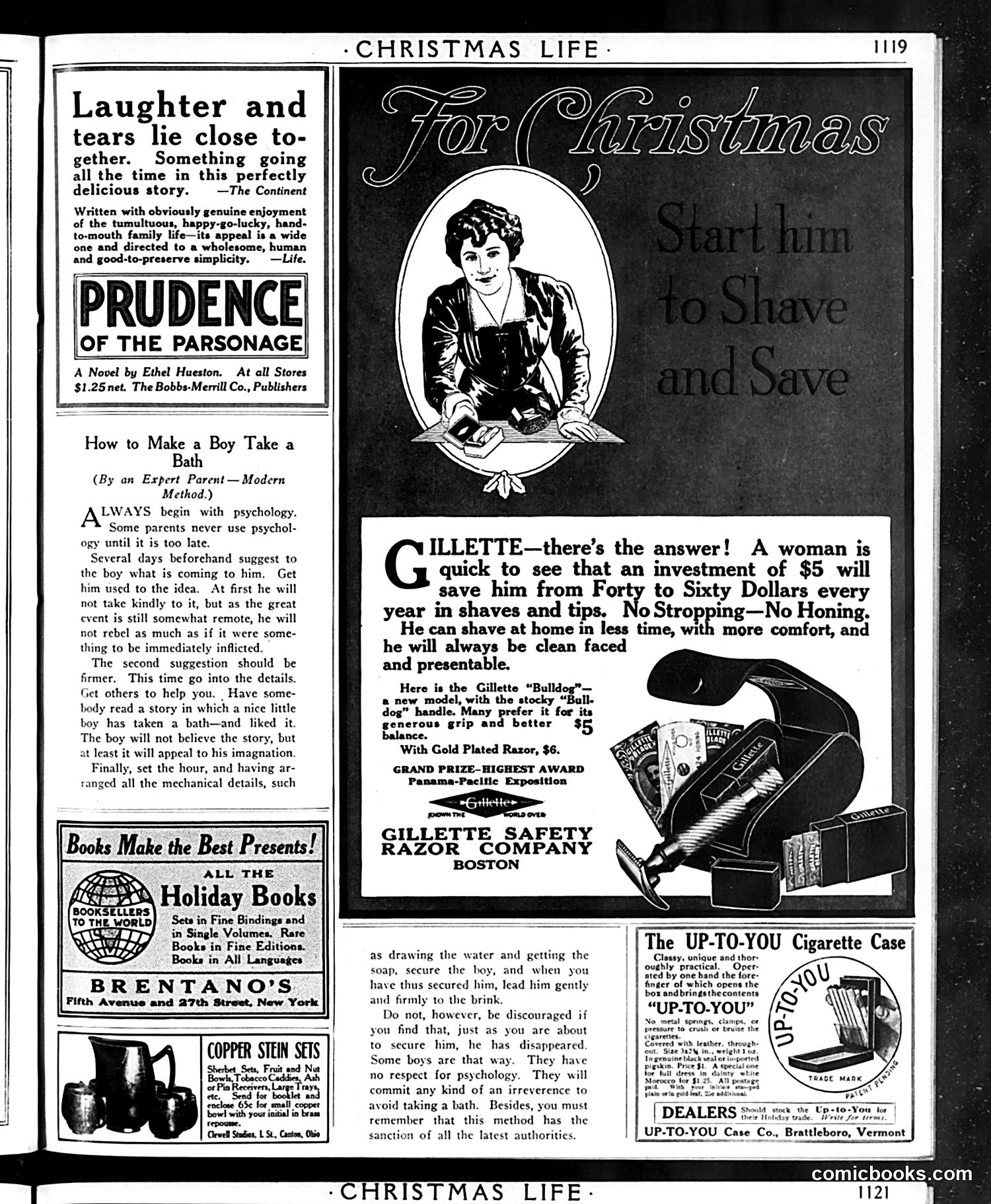
This page is primarily **advertising** with some humorous editorial content mixed in. The main items are: **"How to Make a Boy Take a Bath"** is satirical advice using pseudo-psychological language to describe the difficulty of getting a child to bathe—a relatable domestic struggle. The humor lies in treating bathtime as a serious strategic problem requiring "psychology" and multi-stage persuasion. **The Gillette Safety Razor ad** uses a Christmas gift pitch, arguing that a $5 razor investment saves men $40-60 yearly on professional shaves. This reflects early 20th-century advertising targeting men to adopt home shaving rather than visit barbers. **The UP-TO-YOU Cigarette Case ad** advertises a spring-loaded case for cigarettes—a luxury consumer product marketed as practical and stylish. The page also promotes book gifts and copper serving sets. There's no political satire here—it's a commercial magazine page blending lifestyle humor with holiday shopping advertisements, typical of Life magazine's era.
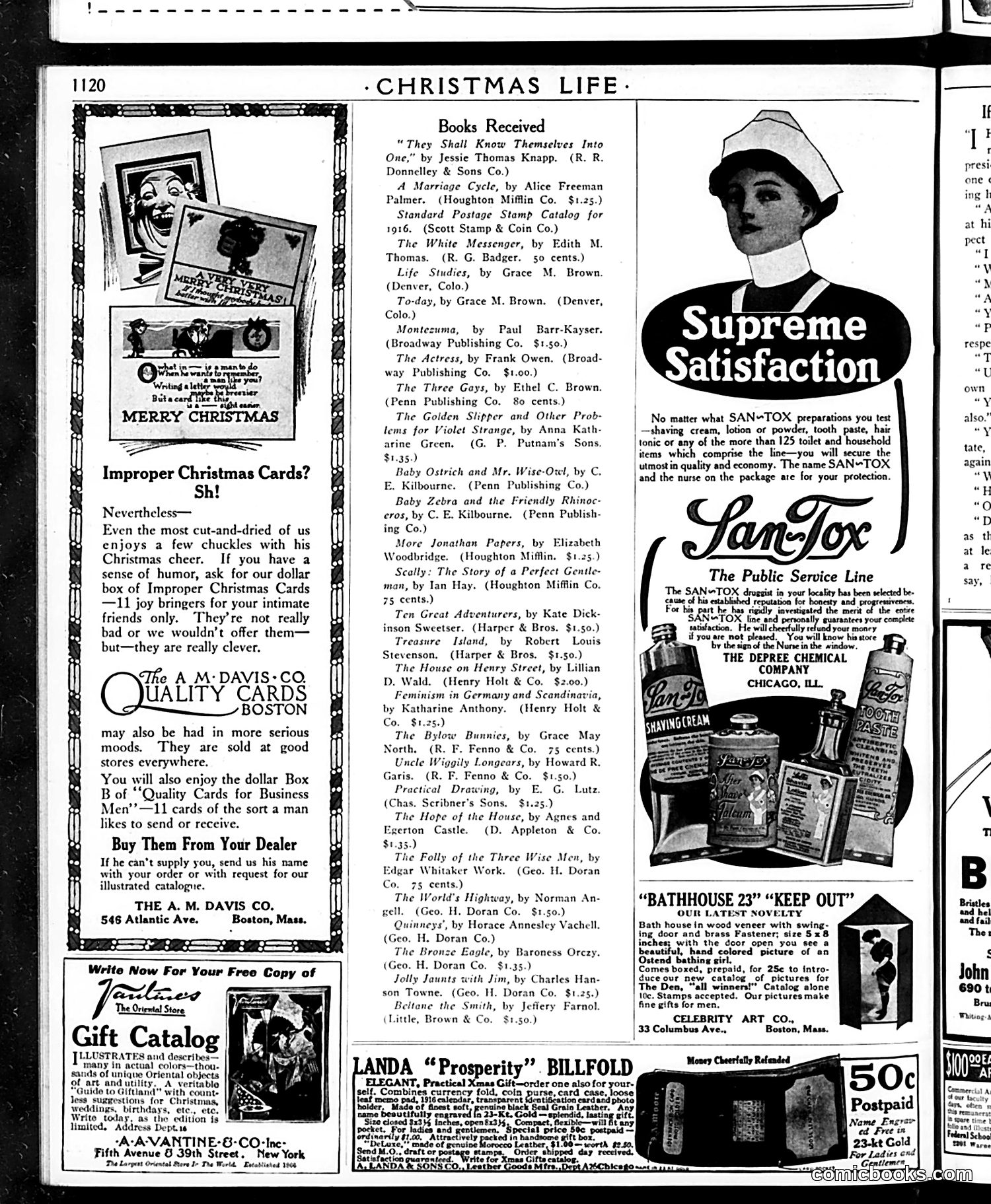
This page is primarily a **book review section and advertising** from Life magazine's Christmas 1916 issue, not political satire. The "Improper Christmas Cards" section on the left is a **humorous advertisement** for A.M. Davis Co.'s novelty greeting cards. The joke is that even serious people appreciate cheeky, mildly risqué Christmas cards for intimate friends—they're "not really bad" but "really clever." This reflects early 1900s humor about taboo-breaking in polite society. The right side features **product advertisements**: San-Tox toiletries and the Depree Chemical Company's "Bathhouse 23" novelty toy—a tiny wooden outhouse with a brass fastener. The bathhouse ad's humor relies on the novelty of an indoor plumbing joke. The bulk of the page lists **newly published books** (mostly literary fiction and gift books appropriate for 1916 Christmas giving). **Overall**: This is a commercial page showcasing holiday gift options—books, joke cards, and novelty items—rather than editorial satire or political commentary.
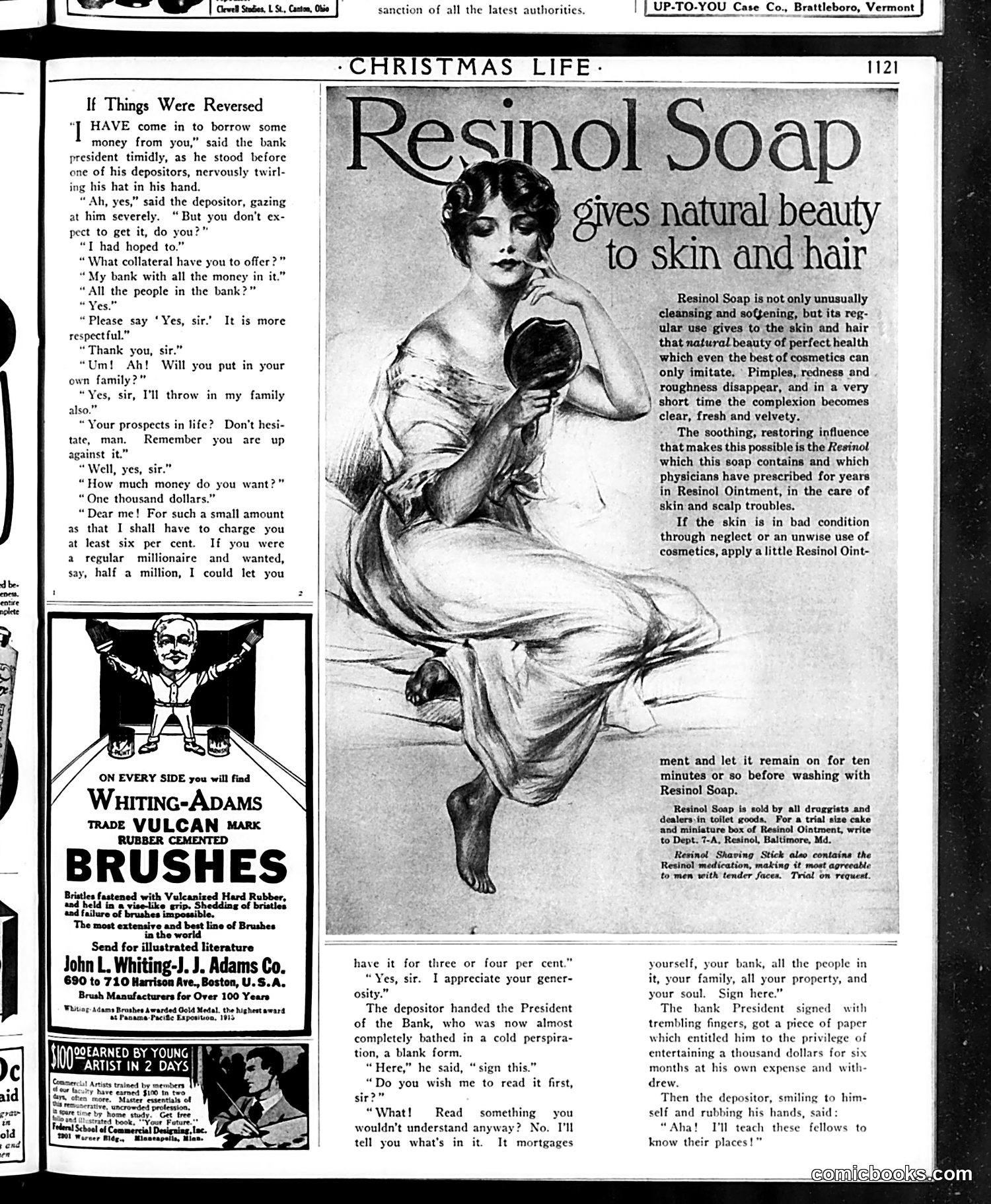
This cartoon satirizes the stark power imbalance between banks and ordinary depositors. A bank president—normally the authority figure—enters a depositor's office to borrow money, reversing their usual positions. The depositor treats him with contempt, demanding excessive collateral (the bank itself, the president's family, even his "soul"), charging punitive interest rates, and refusing to let him read the contract. The president must address him deferentially as "sir." The joke exposes how banks routinely exploit common people: demanding collateral, charging high interest, and presenting incomprehensible contracts. By flipping roles, the cartoon demonstrates the absurdity and injustice of these practices when applied to someone with power. The final line—the depositor gloating about teaching "these fellows to know their places"—mocks the condescension bankers show borrowers. This reflects early 20th-century public frustration with banking institutions and lending practices.
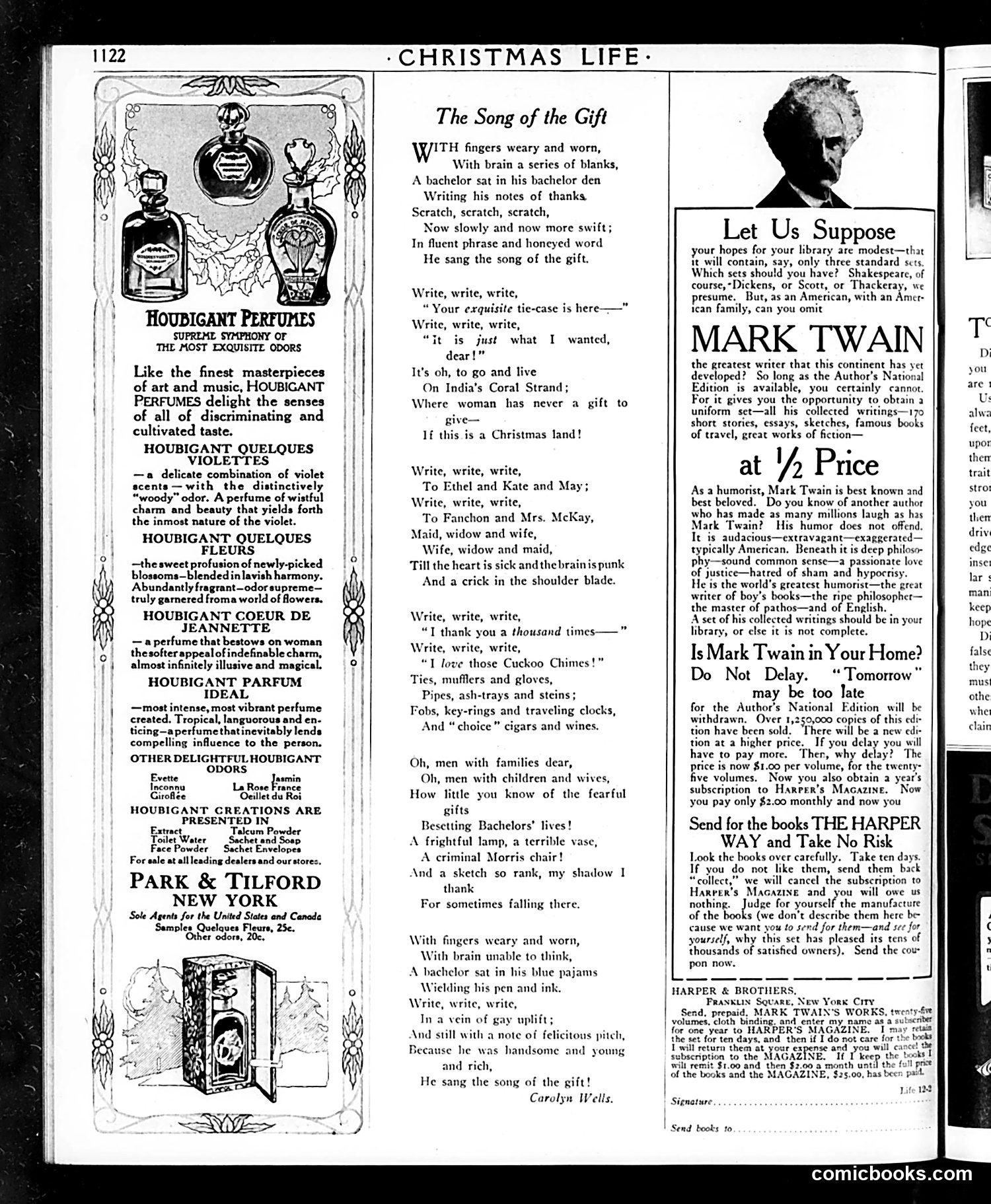
This page combines a Houbigant perfume advertisement with a humorous poem by Carolyn Wells satirizing the social burden of Christmas thank-you notes. **The Satire:** The poem mocks the exhausting obligation facing unmarried men (bachelors) who must write tedious thank-you letters for unwanted gifts. While married men with families supposedly escape this burden, bachelors face relentless correspondence to female gift-givers—"Ethel and Kate and May," "Maid, widow and wife"—thanking them for impractical items: "A frightful lamp, a terrible vase, / A criminal Morris chair!" **The Point:** The humor plays on gender dynamics and social convention. Women giving gifts to eligible bachelors creates an inescapable obligation of gratitude. The bachelor's suffering contrasts with his final "gay uplift"—he sings praises of gift-giving only because he's "handsome and young and rich," suggesting cynical performance rather than genuine appreciation. The adjacent Mark Twain advertisement uses this context to suggest literature as the ideal gift—requiring no thank-you torture.
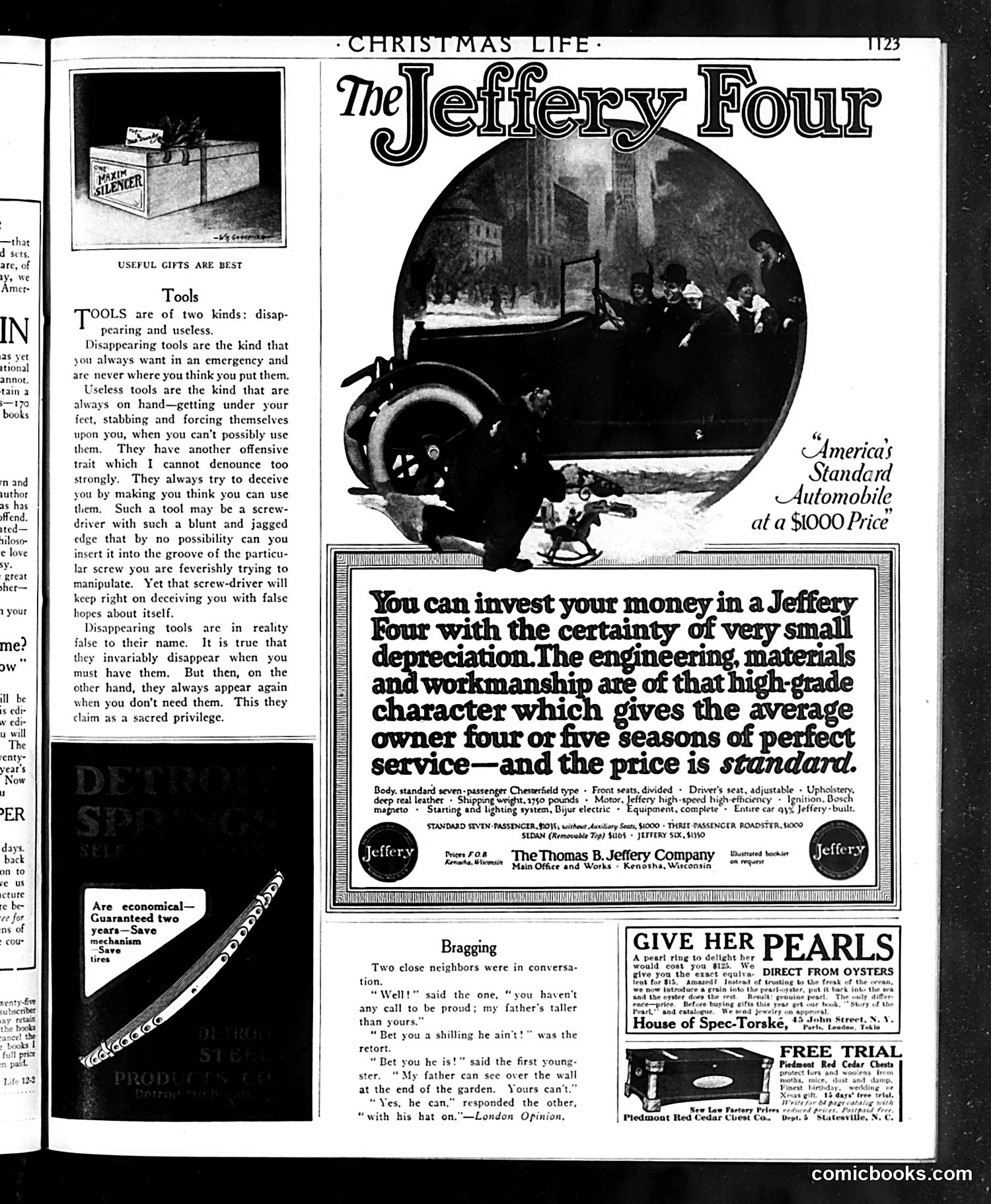
This page features a satirical essay titled "Tools" that humorously categorizes tools into two types: "disappearing" and "useless." The author uses exaggerated, personified descriptions to mock how tools frustrate homeowners. Disappearing tools vanish when needed but reappear when unwanted; useless tools are always underfoot and deceive users with false hope (like a screwdriver with a blunt edge that won't grip properly). The satire targets the universal frustration of household maintenance. The page also includes period advertising for the Jeffery automobile and other consumer goods, typical of *Life* magazine's content model. A small anecdote titled "Bragging" appears at bottom—two neighbors bicker competitively about whose father is taller, with a clever punchline involving a hat. This is primarily **satirical commentary on everyday domestic annoyances** rather than political content.
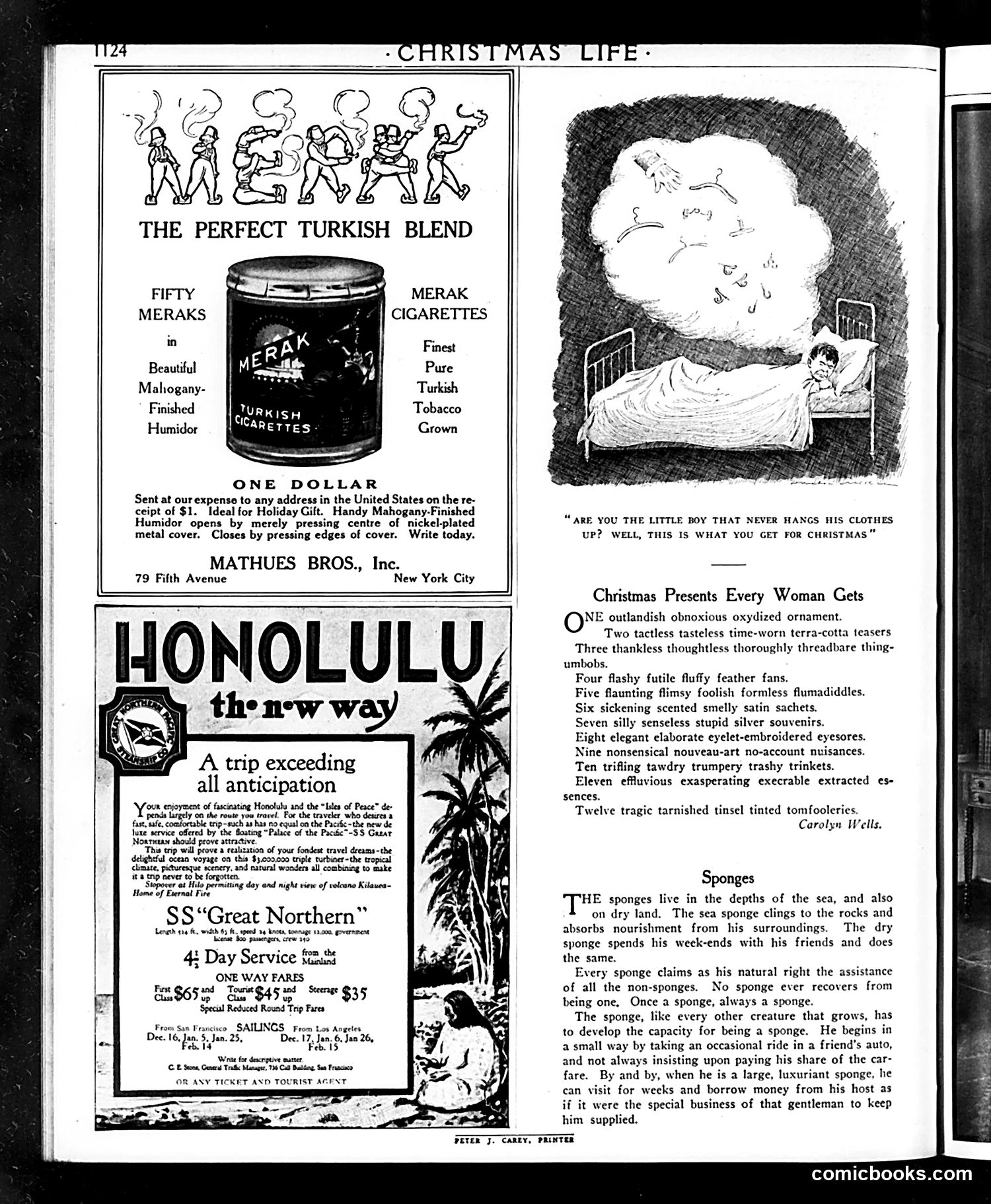
This is primarily an **advertising and humor page** from Life magazine, a satirical publication known for witty social commentary. The page contains three main elements: 1. **Merak Cigarettes ad** (top left): A straightforward Turkish tobacco product advertisement. 2. **Honolulu travel ad** (bottom left): Promotes the SS "Great Northern" ocean liner offering luxury Hawaiian cruises, appealing to wealthy travelers seeking exotic leisure. 3. **Satirical humor pieces** (right side): - A cartoon about messy children at Christmas - **"Christmas Presents Every Woman Gets"** by Carolyn Wells: A tongue-in-cheek list of unwanted, tacky gifts women typically received—cheap ornaments, cheap perfumes, feather fans, and trinkets. The alliterative wordplay mocks both the poor quality of gifts and the presumed tastelessness of male gift-givers. - **"Sponges"** section: A satirical essay personifying "sponges" as freeloaders who exploit friends' hospitality without reciprocating. The humor reflects early 20th-century attitudes toward consumerism, gender roles, and social parasitism.
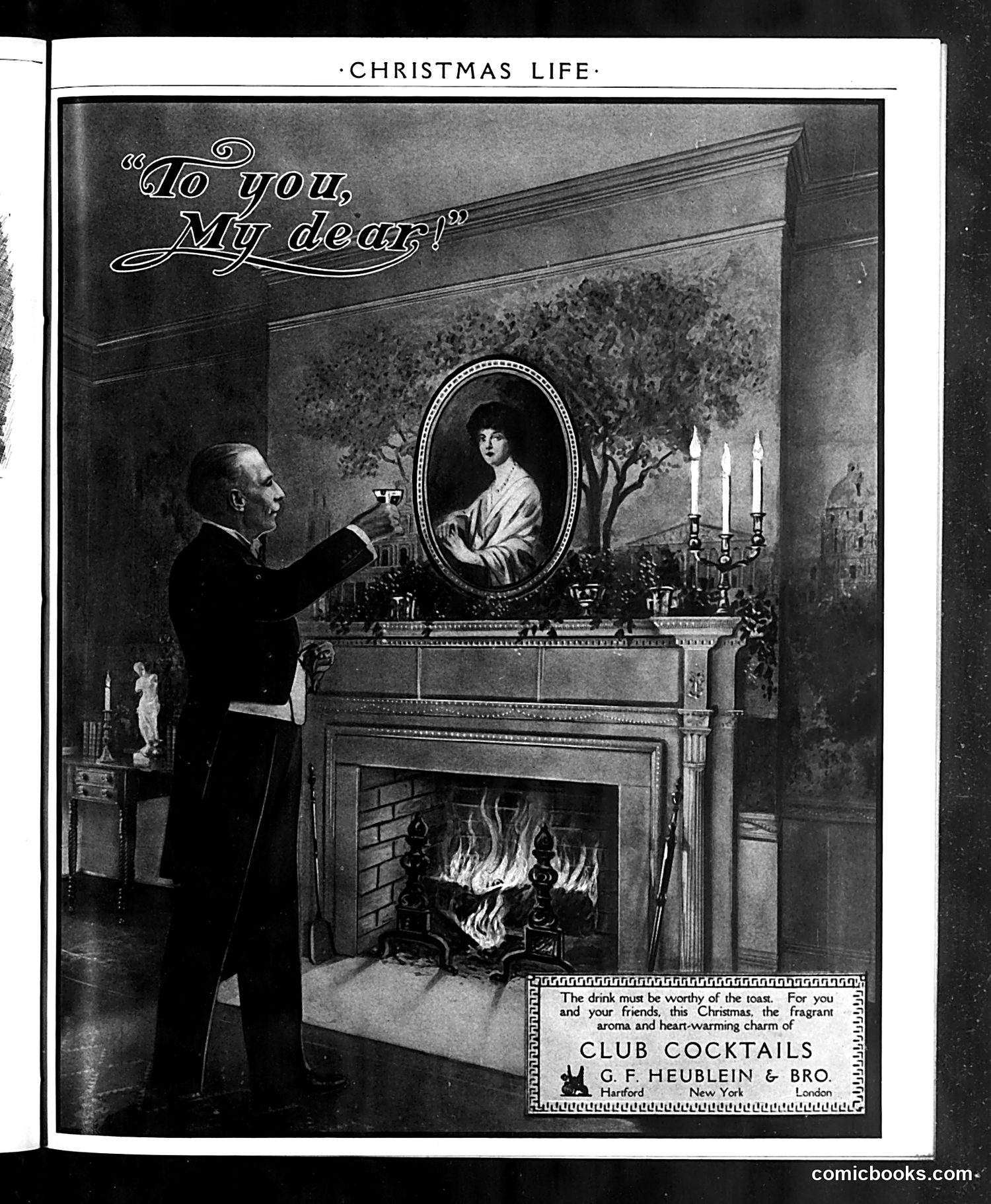
This is primarily an **advertisement for Club Cocktails** by G.F. Heublein & Bro., disguised as Christmas-themed content in Life magazine. The image shows a man in formal evening wear toasting a woman's portrait over a fireplace mantel during Christmas. The phrase "To you, My dear!" suggests a romantic or sentimental holiday moment. **Context for modern readers**: This advertisement appears during the Prohibition era (though the exact date is unclear from the image). It markets cocktails as an appropriate, refined Christmas gift—emphasizing sophistication ("worthy of the toast," "fragrant aroma," "heart-warming charm"). The ad's framing—presenting cocktail consumption as an elegant, romantic tradition—reflects pre-Prohibition attitudes when alcohol advertising was common and glamorous. The gentleman's formal attire and domestic setting suggest these were luxury products for the affluent. This is straightforward product advertising rather than satire or political commentary.
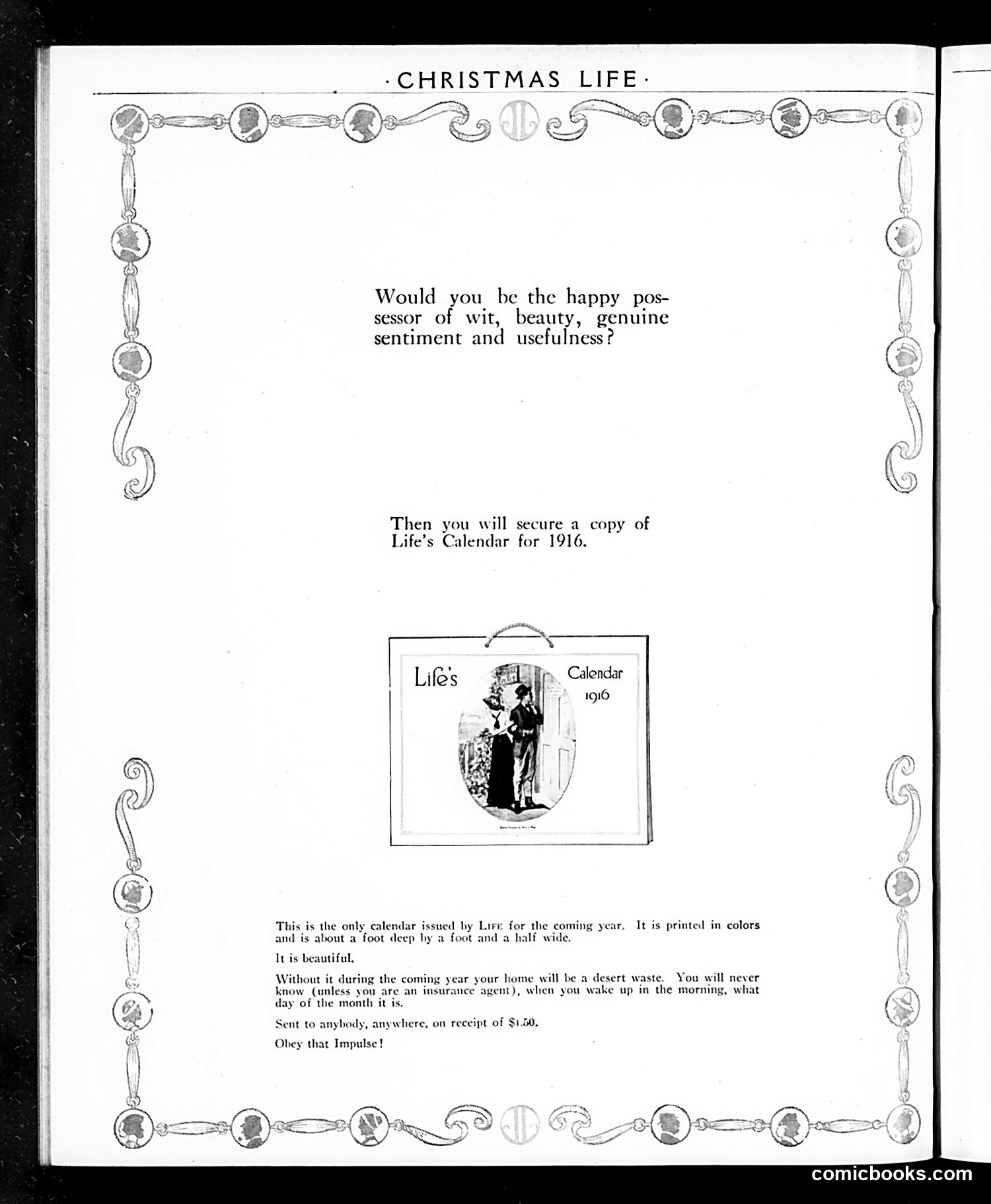
This is a **Christmas advertisement** for Life magazine's 1916 calendar, not a political cartoon. The page uses humorous hyperbole to market the product. The ad employs satire by making absurdly exaggerated claims: that owning this calendar will grant you "wit, beauty, genuine sentiment and usefulness," and that without it, your home becomes "a desert waste" where you won't know what day it is (except if you're an insurance agent—a jab at their supposed attention to detail). The humor lies in treating a decorative calendar as an essential life necessity. The decorative border featuring portraits and ornamental design reflects early 1900s aesthetic preferences. The price of $1.50 was relatively expensive for the era, making the mock-desperate sales pitch ("Obey that Impulse!") part of the satire—poking fun at consumer culture and aggressive advertising tactics.
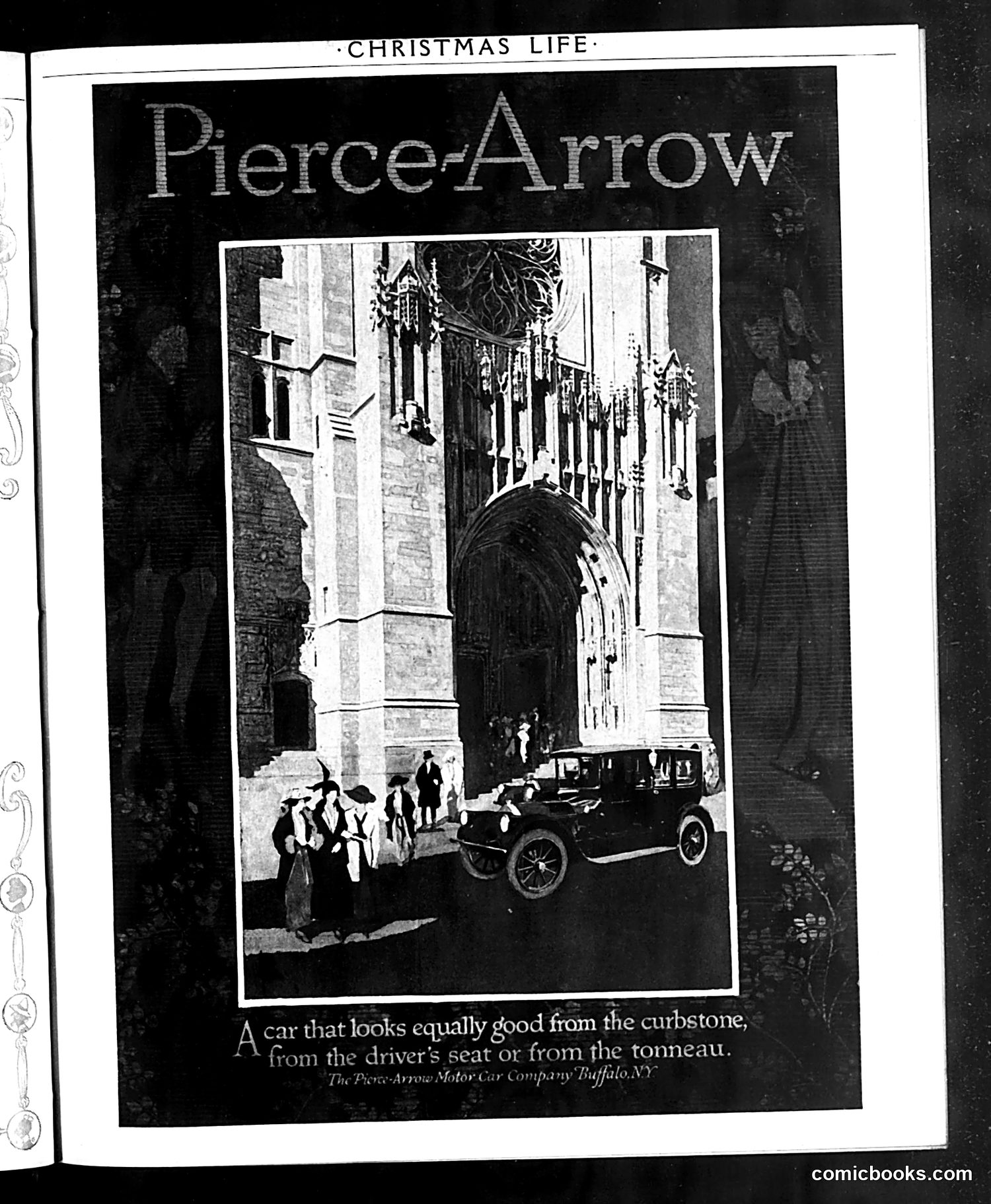
This is a **Pierce-Arrow automobile advertisement**, not political satire. It appears in *Life*'s "Christmas Life" section and promotes the Pierce-Arrow Motor Car Company of Buffalo, New York. The ad features an illustration of an elegant car parked before a Gothic cathedral entrance, with well-dressed figures nearby. The sales pitch emphasizes the vehicle's aesthetic appeal from multiple vantage points—whether viewed from the street, the driver's seat, or the tonneau (rear passenger area). For modern readers: this represents early 20th-century luxury car marketing, using architectural grandeur and social status imagery to appeal to wealthy buyers. The car's appearance matters as much as its function—a selling point that remains recognizable today, though the specific brand is now defunct.
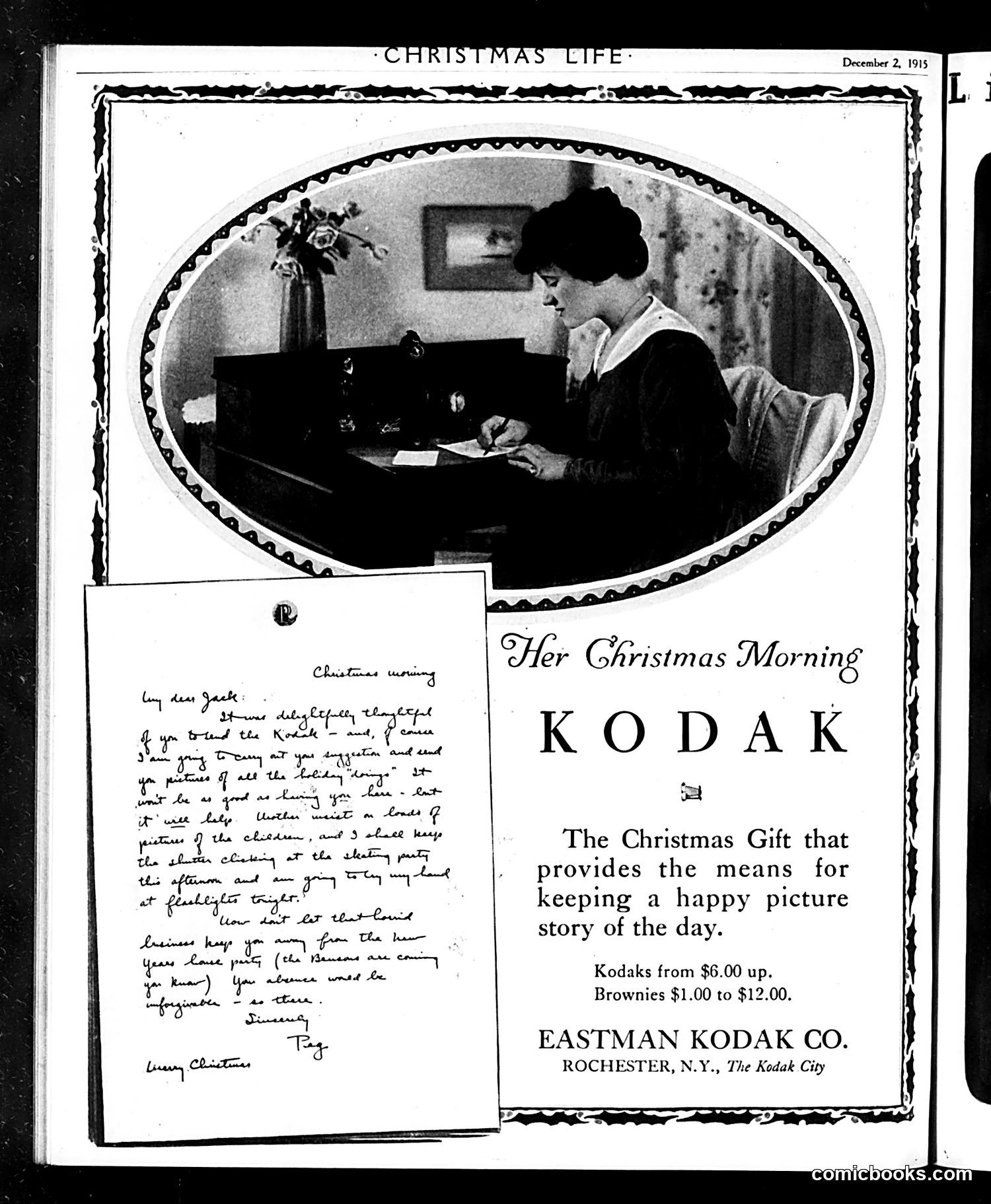
This is primarily a **Kodak camera advertisement**, not a political cartoon. The page shows a photograph of a woman at a piano on Christmas morning, with handwritten text on the left (a personal letter, now largely illegible). The ad's message is straightforward: Kodak cameras make ideal Christmas gifts because they let families document holiday memories—capturing "a happy picture story of the day." This appeals to early 20th-century consumer desires to preserve domestic moments. The pricing ($6.00 up for Kodaks, $1.00–$12.00 for Brownies, their cheaper line) targets middle-class households. The tagline "The Kodak City" references Kodak's Rochester, New York headquarters. There is no political satire here—it's a sincere commercial pitch using the sentimental Christmas setting to sell cameras.