
Life, 1915-12-02 · page 36 of 100
Life — December 2, 1915 — page 36: what you’re looking at
What you’re looking at
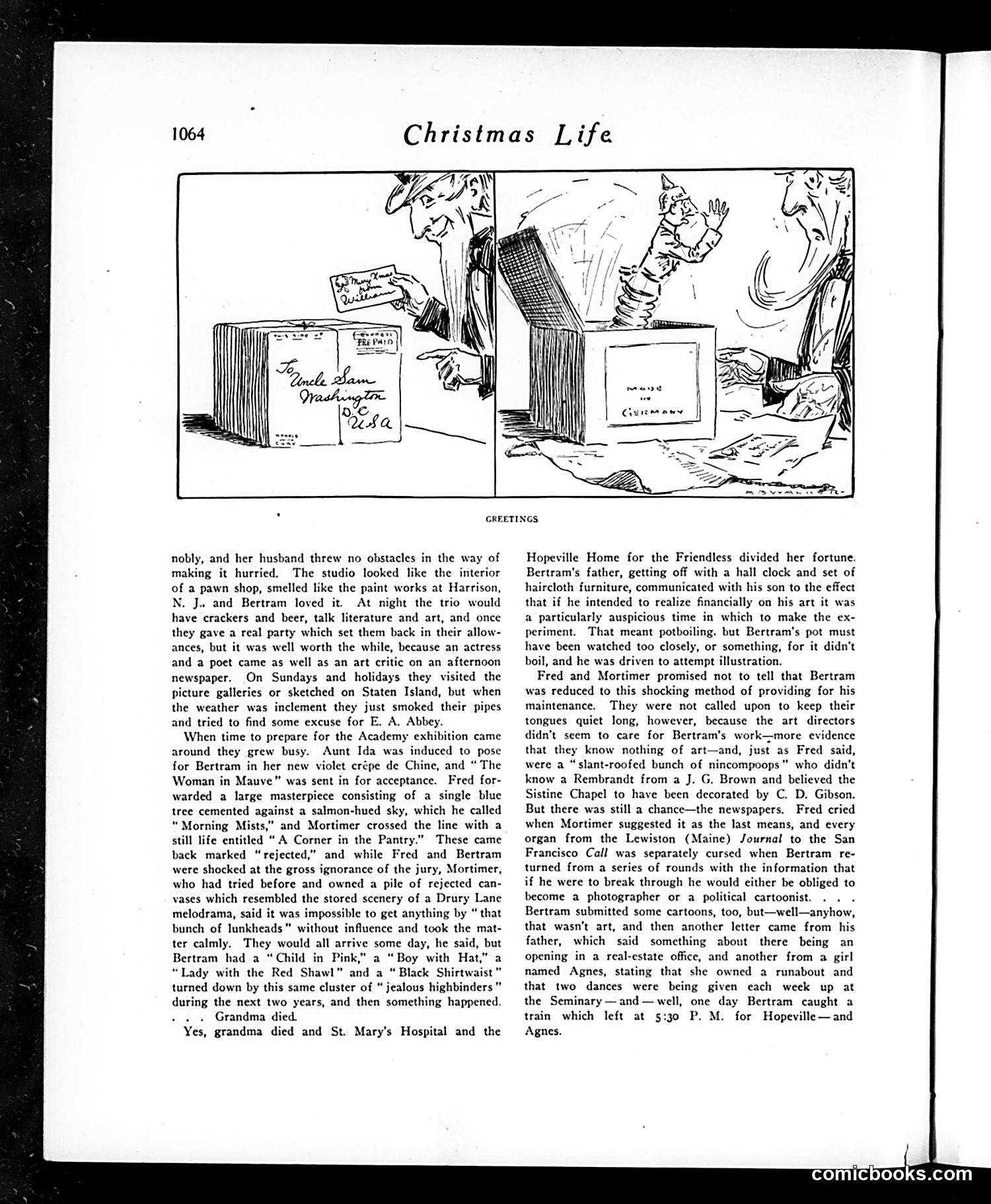
This 1064 page presents a satirical narrative about struggling young artists in what appears to be early 20th-century America. The two cartoon panels at top illustrate the story of three aspiring painters—Bertram, Fred, and Mortimer—living in poverty while pursuing "serious art." The satire targets the pretension and impracticality of bohemian artists. They live in squalor ("smelled like the paint works"), subsist on meager allowances, yet consider themselves serious artists. Their paintings are repeatedly rejected by Academy juries, which they blame on the judges' ignorance rather than their own work. The joke culminates when Bertram's grandmother dies, briefly offering financial hope. But when he cannot make money from "real art," he's forced to consider commercial work—illustration, photography, or political cartooning—which the narrative dismisses as not "art" at all. The story ends with him distracted by a girl named Agnes and a potential real-estate job. The satire mocks both the artists' delusions and the art establishment's gatekeeping while showing economic desperation forcing compromise of artistic ideals.
📄 Transcribed text from this page (OCR, searchable)
Machine-transcribed from the original scan — historical spelling and the odd misread are preserved.
Christmas Life GREETINGS nobly, and her husband threw no obstacles in the way of making it hurried. The studio looked like the interior of a pawn shop, smelled like the paint works at Harrison, N. J. and Bertram loved it. At night the trio would have crackers and beer, talk literature and art, and once they gave a real party which set them back in their allow- ances, but it was well worth the while, because an actress and a poet came as well as an art critic on an afternoon newspaper. On Sundays and holidays they visited the picture galleries or sketched on Staten Island, but when the weather was inclement they just smoked their pipes and tried to find some excuse for E. A. Abbey. When time to prepare for the Academy exhibition came around they grew busy. Aunt Ida was induced to pose for Bertram in her new violet crépe de Chine, and “ The Woman in Mauve” was sent in for acceptance. Fred for- warded a large masterpiece consisting of a single blue tree cemented against a salmon-hued sky, which he called “Morning Mists,” and Mortimer crossed the line with a still life entitled “A Corner in the Pantry.” These came back marked “rejected,” and while Fred and Bertram were shocked at the gross ignorance of the jury, Mortimer, who had tried before and owned a pile of rejected can- vases which resembled the stored scenery of a Drury Lane melodrama, said it was impossible to get anything by “ that bunch of lunkheads” without influence and took the mat- ter calmly. They would all arrive some day, he said, but Bertram had a “Child in Pink,” a “Boy with Hat,” a “Lady with the Red Shawl” and a “ Black Shirtwaist” turned down by this same cluster of “ jealous highbinders ” during the next two years, and then something happened. « . Grandma died. Yes, grandma died and St. Mary's Hospital and the Hopeville Home for the Friendless divided her fortune. Bertram’s father, getting off with a hall clock and set of haircloth furniture, communicated with his son to the effect that if he intended to realize financially on his art it was a particularly auspicious time in which to make the ex- periment. That meant potboiling, but Bertram's pot must have been watched too closely, or something, for it didn’t boil, and he was driven to attempt illustration. Fred and Mortimer promised not to tell that Bertram was reduced to this shocking method of providing for his maintenance. They were not called upon to keep their tongues quict long, however, because the art directors didn’t seem to care for Bertram’s work—more evidence that they know nothing of art—and, just as Fred said, were a “slant-roofed bunch of nincompoops” who didn’t know a Rembrandt from a J. G. Brown and believed the Sistine Chapel to have been decorated by C. D. Gibson. But there was still a chance—the newspapers. Fred cried when Mortimer suggested it as the last means, and every organ from the Lewiston (Maine) Journal to the San Francisco Call was separately cursed when Bertram re- turned from a series of rounds with the information that if he were to break through he would either be obliged to become a photographer or a political cartoonist. Bertram submitted some cartoons, too, but—well—anyhow, that wasn’t art, and then another letter came from his father, which said something about there being an opening in a real-estate office, and another from a girl named Agnes, stating that she owned a runabout and that two dances were being given each week up at the Seminary —and—well, one day Bertram caught a train which left at 5:30 P. M. for Hopeville—and Agnes. comicbooks.com