
Life, 1915-12-02 · page 23 of 100
Life — December 2, 1915 — page 23: what you’re looking at
What you’re looking at
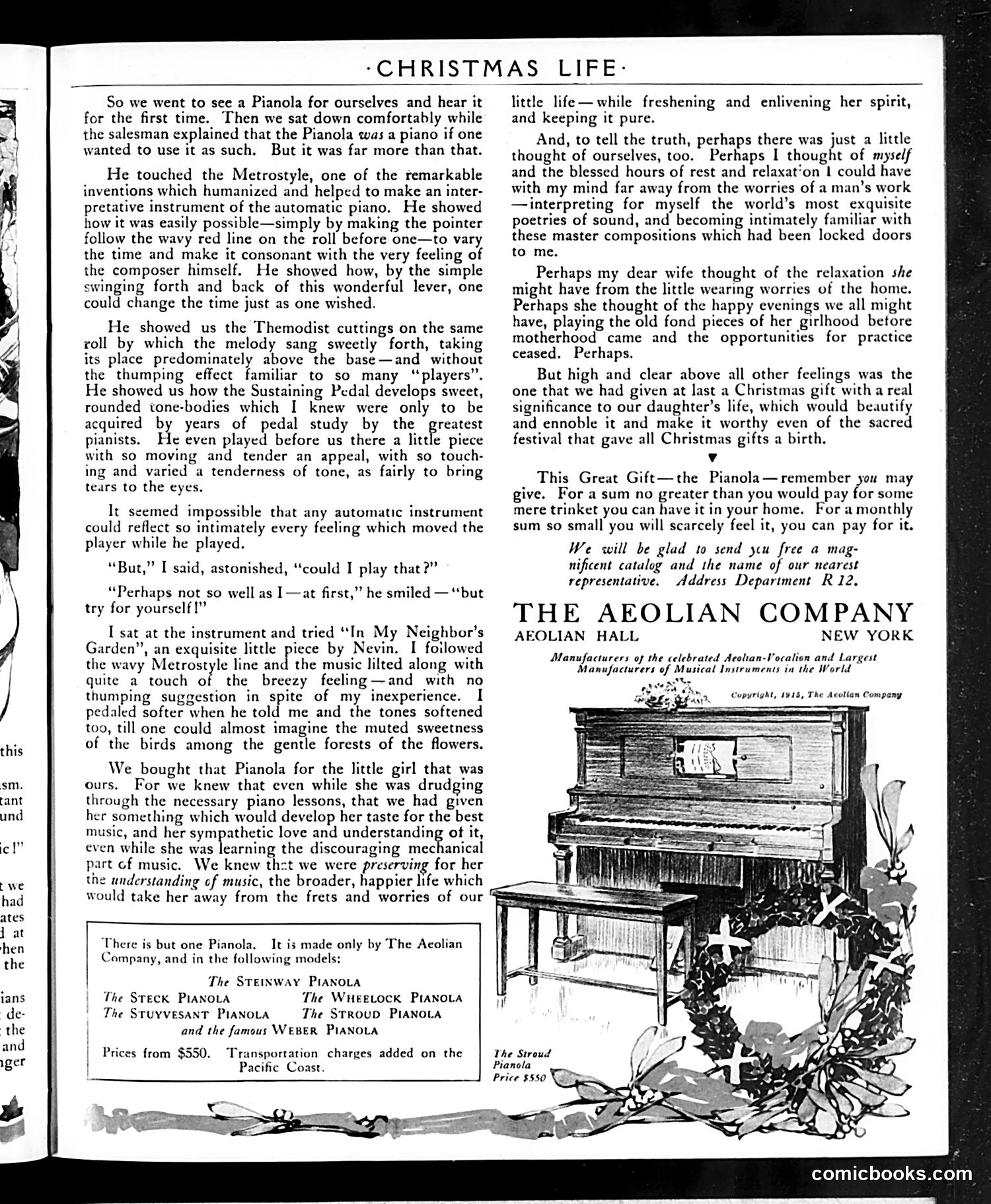
This is a **product advertisement disguised as editorial content**, a common early-20th-century marketing technique. The page presents a narrative essay about discovering the Pianola—an automatic player piano manufactured by The Aeolian Company. **What it is:** The article describes a family's experience purchasing a Pianola for their daughter's musical education. It emphasizes the device's sophisticated features (Metrostyle lever, Themodist cuttings, Sustaining Pedal) that allegedly allow automatic playback to sound expressive and human-performed. **The appeal:** Rather than satirizing, the text exploits middle-class anxieties and aspirations—cultural refinement, parental duty, and leisure time. It promises that an expensive machine can provide "understanding of music" and relief from life's "frets and worries" without requiring actual musical skill. **For modern readers:** This represents early consumer marketing targeting educated, affluent families. The Pianola represents a now-obsolete technology marketed as solving problems (children's cultural development, adult relaxation) through consumption—a pattern that persists today in piano apps and music-streaming services.
📄 Transcribed text from this page (OCR, searchable)
Machine-transcribed from the original scan — historical spelling and the odd misread are preserved.
j t we had ates 1 at hen the ians de- the and ger , ‘CHRISTMAS LIFE- So we went to see a Pianola for ourselves and hear it for the first time. Then we sat down comfortably while the salesman explained that the Pianola was a piano if one wanted to use it as such. But it was far more than that. He touched the Metrostyle, one of the remarkable inventions which humanized and helped to make an inter- pretative instrument of the automatic piano. He showed how it was easily possible—simply by making the pointer follow the wavy red line on the roll before one—to vary the time and make it consonant with the very feeling of the composer himself. He showed how, by the simple swinging forth and back of this wonderful lever, one could change the time just as one wished. He showed us the Themodist cuttings on the same roll by which the melody sang sweetly forth, taking its place predominately above the base—and without the thumping effect familiar to so many “players”. He showed us how the Sustaining Pedal develops sweet, rounded tone-bodies which I knew were only to be acquired by years of pedal study by the greatest pianists. He even played before us there a little piece with so moving and tender an appeal, with so touch- ing and varied a tenderness of tone, as fairly to bring tears to the eyes. It seemed impossible that any automatic instrument could reflect so intimately every feeling which moved the player while he played. “But,” I said, astonished, “could I play that?” “Perhaps not so well as 1—at first,” he smiled — “but try for yourself!” I sat at the instrument and tried ‘In My Neighbor's Garden”, an exquisite little piece by Nevin. I foilowed the wavy Metrostyle line and the music lilted along with quite a touch of the breezy feeling—and with no thumping suggestion in spite of my inexperience. I pedaled softer when he tol me and the tones softened too, till one could almost imagine the muted sweetness of the birds among the gentle forests of the flowers. We bought that Pianola for the little girl that was ours. For we knew that even while she was drudging through the necessary piano lessons, that we had given her something which would develop her taste for the best music, and her sympathetic love and understanding ot it, even while she was learning the discouraging mechanical part of music. We knew thzt we were preserving for her the understanding of music, the broader, happier life which would take her away from the frets and worries of our There is but one Pianola, It is made only by The Acolian Company, and in the following models: The STEINWAY PIANOLA The STECK PIANOLA The WiHeeLtock PIANOLA The STUYVESANT PIANOLA The STROUD PIANOLA and the famous WEBER PIANOLA Prices from $550. Transportation charges added on the Pacific Coast. little life—while freshening and enlivening her spirit, and keeping it pure. And, to tell the truth, perhaps there was just a little thought of ourselves, too. Perhaps I thought of myself and the blessed hours of rest and relaxat‘on | could have with my mind far away from the worries of a man’s work —interpreting for myself the world’s most exquisite poetries of sound, and becoming intimately familiar with these master compositions which had been locked doors to me. Perhaps my dear wife thought of the relaxation she might have from the little wearing worries of the home. Perhaps she thought of the happy evenings we all might have, playing the old fond pieces of her girlhood betore motherhood came and the opportunities for practice ceased. Perhaps. But high and clear above all other feelings was the one that we had given at last a Christmas gift with a real significance to our daughter’s life, which would beautify and ennoble it and make it worthy even of the sacred festival that gave all Christmas gifts a birth. v This Great Gift—the Pianola—remember you may give. For a sum no greater than you would pay for some mere trinket you can have it in your home. For a monthly sum so small you will scarcely feel it, you can pay for it. We will be glad to send yeu free a mag- nificent catalog and the name of our nearest representative. Address Department R12. THE AEOLIAN COMPANY AEOLIAN HALL NEW YORK Manufacturers of the celebrated Aeoltan-Vocalion and Largest Manufacturers of Musical Instruments in the World Aw Ni Copyright, 1918, The Acotian Company The Stroud Pianola Price $550 comicbooks.com