
Life, 1915-12-02 · page 40 of 100
Life — December 2, 1915 — page 40: what you’re looking at
What you’re looking at
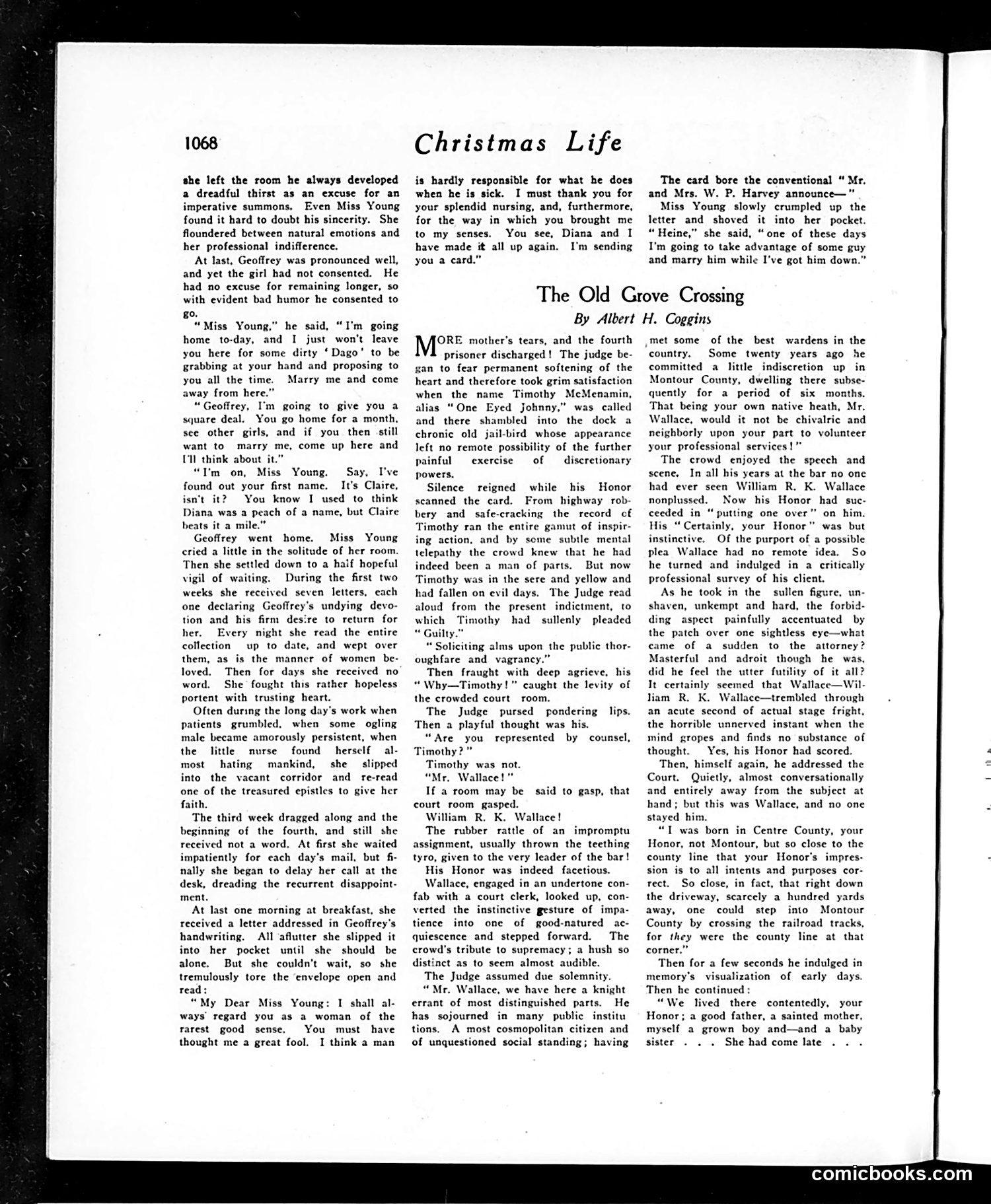
This page contains two short stories rather than cartoons. "The Old Grove Crossing" by Albert H. Coggins appears to be the featured fiction. The first story describes a nurse (Miss Young) who falls for a patient (Geoffrey) she cares for. After his recovery, he proposes marriage but asks her to wait a month while he sees other women. She agrees hopefully, receives passionate letters for two weeks, then silence. Finally, a letter arrives—but Geoffrey has reconciled with his ex-fiancée Diana and is announcing his marriage to her, thanking Miss Young only for her nursing care. The satire targets romantic self-deception: Geoffrey's manipulative courtship (using illness as excuse for attention), his shallow promises, and his casual disregard for the nurse's genuine feelings. The story mocks both his duplicity and her naive trust in his declarations. The second story excerpt concerns a judge presiding over cases. The social commentary appears to critique judicial leniency or inconsistency, though the full context is cut off.
📄 Transcribed text from this page (OCR, searchable)
Machine-transcribed from the original scan — historical spelling and the odd misread are preserved.
1068 she left the room he always developed a dreadful thirst as an excuse for an imperative summons, Even Miss Young found it hard to doubt his sincerity. She floundered between natural emotions and her professional indifference. At last, Geoffrey was pronounced well, and yet the girl had not consented. He had no excuse for remaining longer, so with evident bad humor he consented to g0. “Miss Young,” he said, “I'm going home to-day, and I just won't leave you here for some dirty ‘Dago’ to be grabbing at your hand and proposing to you all the time. Marry me and come away from here.” “Geoffrey, I'm going to give you a square deal. You go home for a month, see other girls, and if you then still want to marry me, come up here and (il think about it.” “I'm on, Miss Young, Say, I've found out your first name. It’s Claire, n't it? You know I used to think Diana was a peach of a name, but Claire beats it a mile.” Geoffrey went home. Miss Young cried a little in the solitude of her room. Then she settled down to a haif hopeful vigil of waiting. During the first two weeks she reccived seven letters, each one declaring Geoffrey's undying devo- tion and his firm desire to return for her. Every night she read the entire collection up to date, and wept over them, as is the manner of women be- loved. Then for days she received no word, She fought this rather hopeless portent with trusting heart. Often during the long day's work when patients grumbled, when some ogling male became amorously persistent, when the little nurse found herself al- most hating mankind, she slipped into the vacant corridor and re-read one of the treasured epistles to give her faith. The third week dragged along and the beginning of the fourth, and still she received not a word. At first she waited impatiently for each day's mail, but fi- nally she began to delay her call at the desk, dreading the recurrent disappoint- ment. At last one morning at breakfast, she received a letter addressed in Geoffrey's handwriting. All aflutter she slipped it into her pocket until she should be alone, But she couldn't wait, so she tremulously tore the envelope open and read: “My Dear Miss Young: I shall al- ways’ regard you as a woman of the rarest good sense. You must have thought me a great fool. I think a man Christmas Life is hardly responsible for what he does when he is sick. I must thank you for your splendid nursing, and, furthermore, for the way in which you brought me to my senses. You see, Diana and I have made it all up again. I'm sending you a card.” The card bore the conventional “ Mr. and Mrs. W. P. Harvey announce—" Miss Young slowly crumpled up the letter and shoved it into her pocket. “Heine,” she said, “one of these days I'm going to take advantage of some guy and marry him while I’ve got him down.” The Old Grove Crossing By Albert H. Coggins ORE mother's tears, and the fourth prisoner discharged! The judge be- gan to fear permanent softening of the heart and therefore took grim satisfaction when the name Timothy McMenamin, alias “One Eyed Johnny,” was called and there shambled into the dock a chronic old jail-bird whose appearance left no remote possibility of the further painful exercise of discretionary powers, Silence reigned while his Honor scanned the card. From highway rob- bery and safe-cracking the record of Timothy ran the entire gamut of inspir- ing action, and by some subtle mental telepathy the crowd knew that he had indeed been a man of parts. But now Timothy was in the sere and yellow and had fallen on evil days. The Judge read aloud from the present indictment, to which Timothy had sullenly pleaded “ Guilty. “ Soliciting alms upon the public thor- oughfare and vagrancy.” Then fraught with deep agrieve, his “ Why—Timothy!" caught the levity of the crowded court room. The Judge pursed pondering Then a playful thought was his. “Are you represented by Timothy? Timothy was not. “Mr. Wallace!" If a room may be court room gasped. William R. K, Wallace! The rubber rattle of an impromptu assignment, usually thrown the teething tyro, given to the very leader of the bar! His Honor was indeed facetious. Wallace, engaged in an undertone con- fab with a court clerk, looked up, con- verted the instinctive gesture of impa- tience into one of good-natured ac- quiescence and stepped forward. The crowd's tribute to supremacy; a hush so distinct as to seem almost audible. The Judge assumed due solemnity. “Mr. Wallace, we have here a knight errant of most distinguished parts. He has sojourned in many public institu tions. A most cosmopolitan citizen and of unquestioned social standing; having lips. counsel, said to gasp, that ;met some of the best wardens in the country. Some twenty years ago he committed a little indiscretion up in Montour County, dwelling there subse- quently for a period of six months. That being your own native heath, Mr. Wallace, would it not be chivalric and neighborly upon your part to volunteer your professional services!” The crowd enjoyed the speech and scene, In all his years at the bar no one had ever seen William R. K. Wallace nonplussed. Now his Honor had suc- ceeded in “ putting one over” on him. His “Certainly, your Honor” was but instinctive. Of the purport of a possible plea Wallace had no remote idea. So he turned and indulged in a critically professional survey of his client. As he took in the sullen figure, un- shaven, unkempt and hard, the forbid- ding aspect painfully accentuated by the patch over one sightless eye—what came of a sudden to the attorney? Masterful and adroit though he was, did he feel the utter futility of it all? It certainly seemed that Wallace—Wil- liam R. K. Wallace—trembled through an acute second of actual stage fright, the horrible unnerved instant when the mind gropes and finds no substance of thought. Yes, his Honor had scored. Then, himself again, he addressed the Court. Quietly, almost conversationally and entirely away from the subject at hand; but this was Wallace, and no one stayed him. “T was born in Centre County, your Honor, not Montour, but so close to the county line that your Honor's impres- sion is to all intents and purposes cor- rect. So close, in fact, that right down the driveway, scarcely a hundred yards away, one could step into Montour County by crossing the railroad tracks, for they were the county line at that corne| Then for a few seconds he indulged in memory's visualization of early days. Then he continued: “We lived there contentedly, your Honor; a good father, a sainted mother, myself a grown boy and—and a baby sister . . She had come late . . comicbooks.com