
Life, 1915-12-02 · page 22 of 100
Life — December 2, 1915 — page 22: what you’re looking at
What you’re looking at
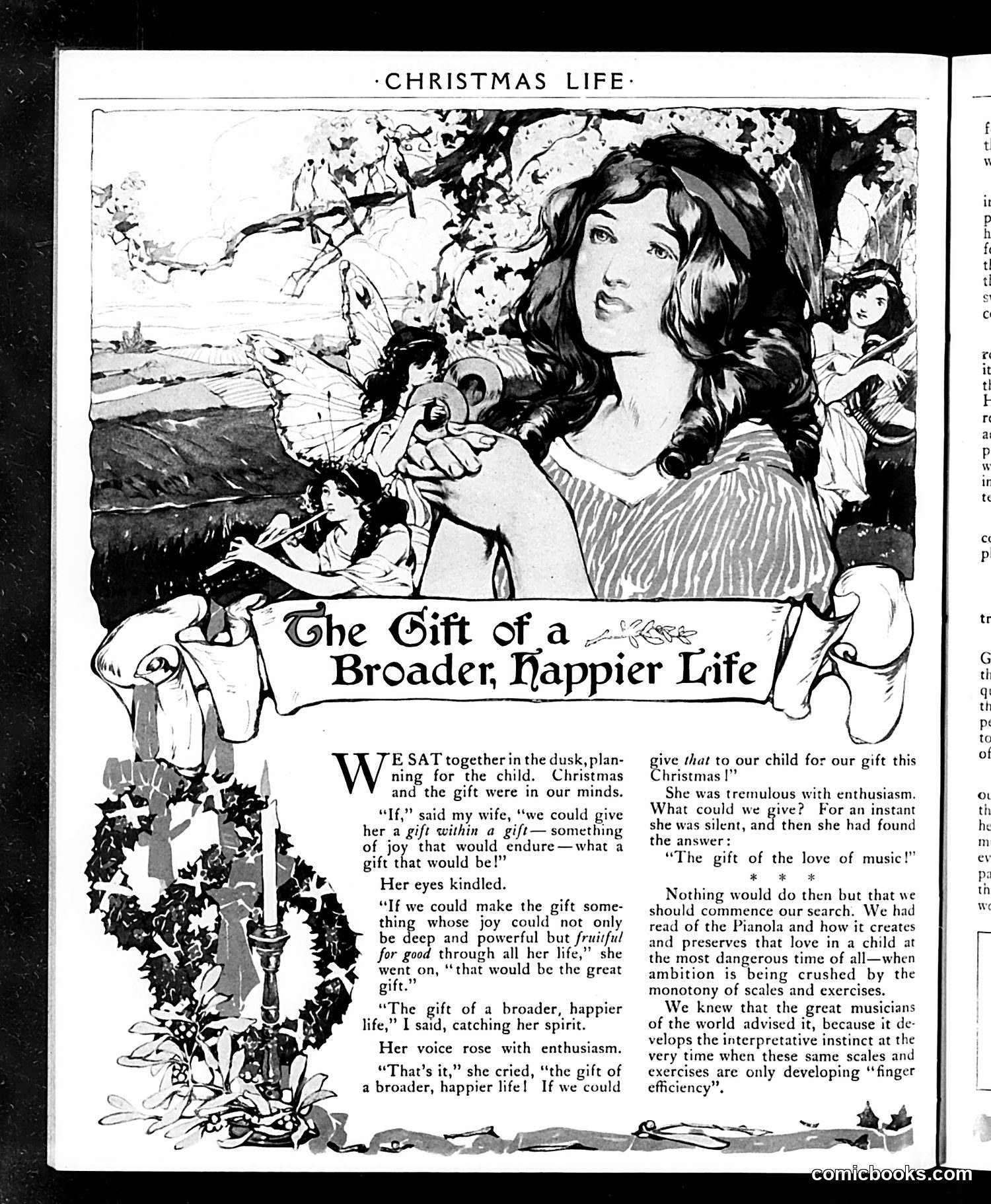
This is primarily **advertising disguised as editorial content**—a common practice in early 20th-century magazines. The narrative about parents seeking the perfect Christmas gift for their daughter functions as a sales pitch for the **Pianola** (a player piano). The "satire" is gentle and self-aware rather than biting: the parents' earnest discussion about giving their child "a broader, happier life" through music education gets conveniently "solved" by discovering this product. The text acknowledges a real educational debate—whether piano scales and exercises crush children's musical joy—and positions the Pianola as the solution: it supposedly preserves love of music while "great musicians of the world" endorse it. The accompanying illustration shows an idealized woman amid cherubs and nature, evoking cultural aspirations to refinement and child development. There's no satirical target here; rather, the "joke" is that this consumer product fulfills the parents' noble wishes. It's marketing wrapped in sentiment, typical of how Life magazine blended entertainment and commerce.
📄 Transcribed text from this page (OCR, searchable)
Machine-transcribed from the original scan — historical spelling and the odd misread are preserved.
“CHRISTMAS LIFE: SS ~ 1) Broader, Mappier Life , E SAT together in the dusk, plan- ning for the child. Christmas and the gift were in our minds. De “If,” said my wife, ‘we could give her_a gift within a gift— something of joy that would endure—what a a1) gift that would be! Her eyes kindled. “If we could make the gift some- thing whose joy could not only be deep and powerful but fruitful for good through all her life,” she went on, “that would be the great gift.” “The gift of a broader, happier life,” I said, catching her spirit. Her voice rose with enthusiasm. “That’s it,” she cried, “the gift of a broader, happier life! If we could give that to our child for our gift this Christmas !”” She was tremulous with enthusiasm. What could we give? For an instant she was silent, and then she had found the answer: “The gift of the love of music!” x * Ox Nothing would do then but that we should commence our search. We had read of the Pianola and how it creates and preserves that love in a child at the most dangerous time of all—when ambition is being crushed by the monotony of scales and exercises. We knew that the great musicians of the world advised it, because it de- velops the interpretative instinct at the very time when these same scales and exercises are only developing “finger efficiency”.