
Life, 1915-12-02 · page 72 of 100
Life — December 2, 1915 — page 72: what you’re looking at
What you’re looking at
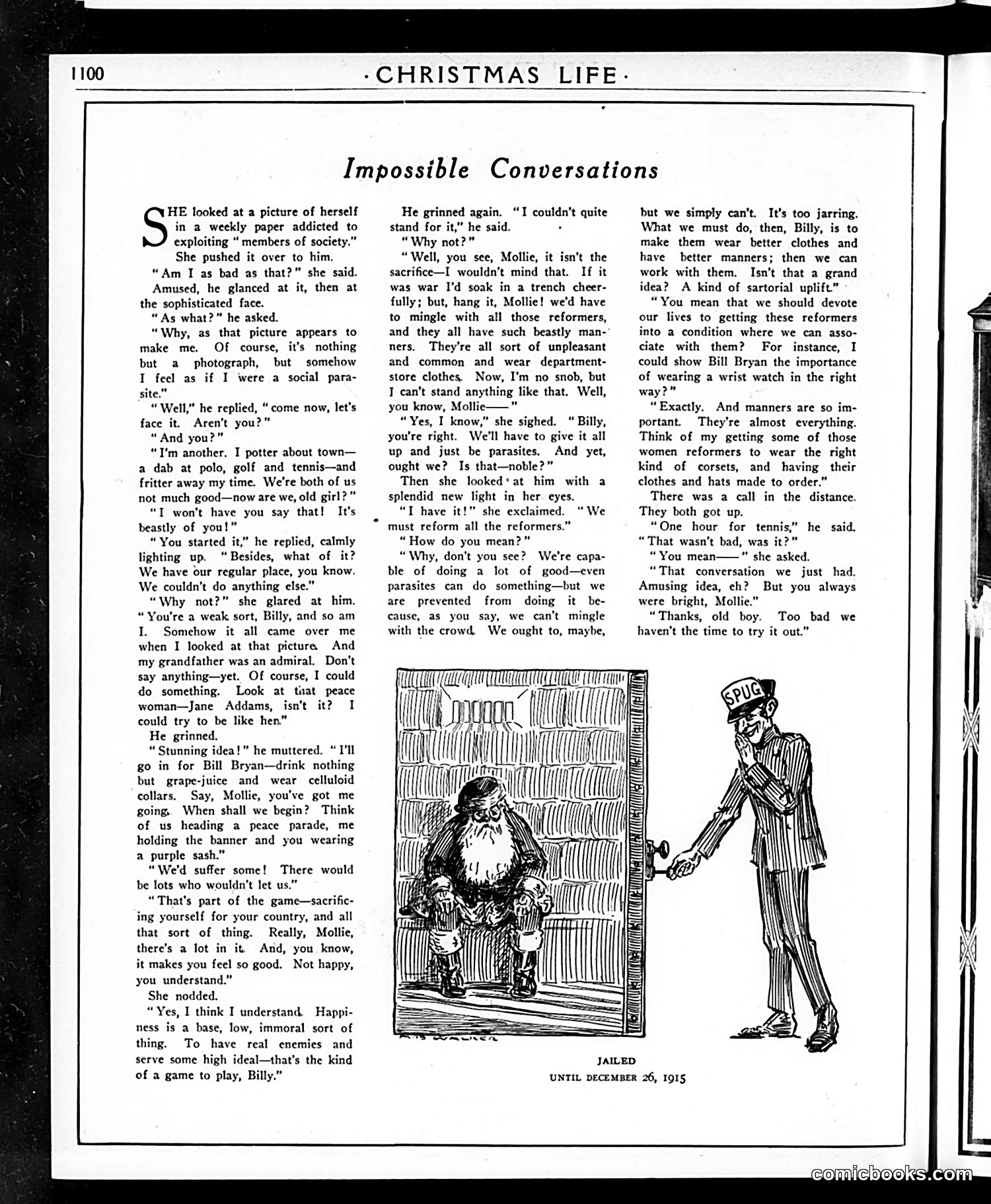
This satirical piece mocks wealthy, idle socialites—specifically a couple named Billy and Mollie—who recognize their own parasitic uselessness but rationalize inaction through absurd logic. The satire targets: **The figures**: Upper-class society people who openly admit they contribute nothing ("we're both of us not much good") yet do nothing about it. **The joke**: When considering reform work, they reject it not on principle but because reformers—including figures like Jane Addams (real social activist) and William Jennings Bryan (progressive politician)—lack proper etiquette and wear department-store clothes. Their solution: instead of actually doing good work, they'll "reform the reformers" by teaching them proper fashion and manners. **The satire's point**: Life magazine ridicules the wealthy class's self-awareness about their idleness coupled with their refusal to genuinely change, hiding behind snobbery. They'd rather preserve social hierarchy than actually serve society. The conversation's twisted logic—that improving reformers' wardrobe is equivalent to meaningful social contribution—exposes their moral bankruptcy. This reflects Progressive Era critiques of wealthy indifference to social reform movements.
📄 Transcribed text from this page (OCR, searchable)
Machine-transcribed from the original scan — historical spelling and the odd misread are preserved.
-CHRISTMAS LIFE- Impossible Conversations in a weekly paper addicted to exploiting “ members of society.” She pushed it over to him. “Am I as bad as that?” she said. Amused, he glanced at it, then at the sophisticated face. “As what?” he asked. “Why, as that picture appears to make me. Of course, it’s nothing but a photograph, but somehow I feel as if I Were a social para- site.” “Well,” he replied, “come now, let's face it. Aren't you?” “And you?” “I'm another. I potter about town— a dab at polo, golf and tennis—and fritter away my time. We're both of us not much good—now are we, old girl?” “T won't have you say that! It’s beastly of you!” “You started it,” he replied, calmly lighting up. “Besides, what of it? We have our regular place, you know. We couldn’t do anything else.” “Why not?” she glared at him. “You're a weak sort, Billy, and so am I. Somehow it all came over me when I looked at that pictura And my grandfather was an admiral. Don’t say anything—yet. Of course, I could do something. Look at that peace woman—Jane Addams, isn’t it? I could try to be like hen.” He grinned. “Stunning idea!” he muttered. “I'll go in for Bill Bryan—drink nothing but grape-juice and wear celluloid collars, Say, Mollie, you've got me going, When shall we begin? Think of us heading a peace parade, me holding the banner and you wearing a purple sash.” “We'd suffer some! There would be lots who wouldn’t let us.” “That's part of the game—sacrific- ing yourself for your country, and all that sort of thing. Really, Mollie, there's a lot in it And, you know, it makes you feel so good, Not happy, you understand.” She nodded. “Yes, I think I understand. Happi- ness is a base, low, immoral sort of thing. To have real enemies and serve some high ideal—that’s the kind of a game to play, Billy.” Si: looked at a picture of herself He grinned again. “I couldn't quite stand for it,” he said. . “Why not?” “Well, you see, Mollie, it isn’t the sacrifice—I wouldn't mind that. If it was war I'd soak in a trench cheer- fully; but, hang it, Mollie! we'd have to mingle with all those reformers, and they all have such beastly man- ners. They're all sort of unpleasant and common and wear department- store clothes. Now, I'm no snob, but I can’t stand anything like that. Well, you know, Mollie— “Yes, I know,” she sighed. “Billy, you're right. We'll have to give it all up and just be parasites. And yet, ought we? Is that—noble?” Then she looked‘ at him with a splendid new light in her eyes. “T have it!” she exclaimed. “We must reform all the reformers.” “How do you mean?” “Why, don’t you see? We're capa- ble of doing a lot of good—even parasites can do something—but we are prevented from doing it be- cause, as you say, we can’t mingle with the crowd We ought to, maybe, Le a (Uf IT ce UU but we simply can't. It’s too jarring. What we must do, then, Billy, is to make them wear better clothes and have better manners; then we can work with them. Isn't that a grand idea? A kind of sartorial uplift” “You mean that we should devote our lives to getting these reformers into a condition where we can asso- ciate with them? For instance, I could show Bill Bryan the importance of wearing a wrist watch in the right way?” “Exactly, And manners are so im- portant. They're almost everything. Think of my getting some of those women reformers to wear the right kind of corsets, and having their clothes and hats made to order.” There was a call in the distance. They both got up. “One hour for tennis,” he said. “That wasn’t bad, was it?” “You mean——" she asked. “That conversation we just had. Amusing idea, eh? But you always were bright, Mollie.” “Thanks, old boy. Too bad we haven't the time to try it out.” UNTIL DECEMBER 26, I9I5 rh —————