
A complete issue · 92 pages · 1914
Life — December 3, 1914
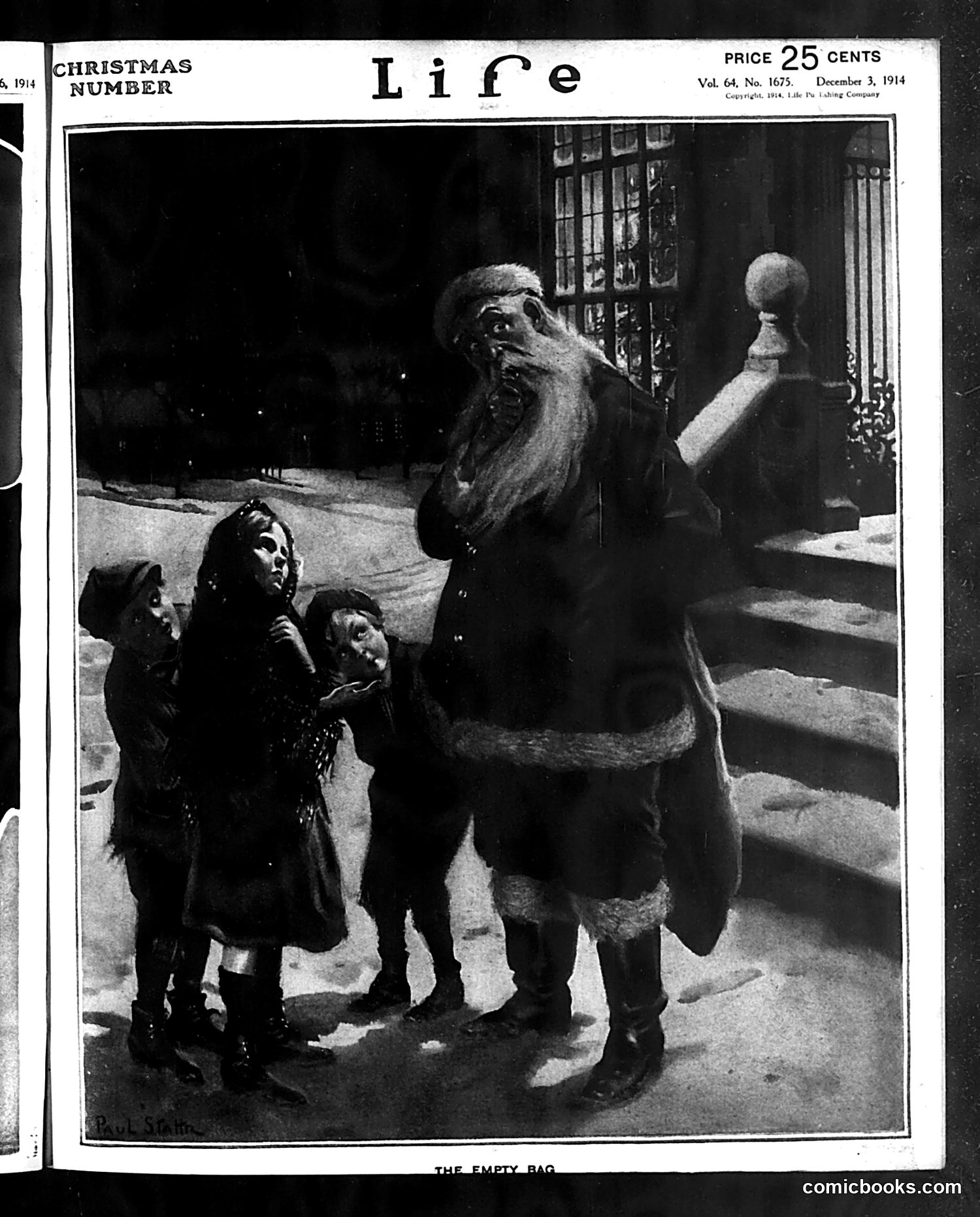
This illustration depicts Santa Claus with an empty sack confronting three disappointed children in a snowy street. The caption reads "THE EMPTY BAG." Given the 1914 publication date during World War I's first year, this likely satirizes how the war disrupted Christmas commerce and gift-giving. Santa's empty bag suggests economic hardship or scarcity caused by the conflict—perhaps referring to disrupted trade, inflation, or wartime shortages affecting American consumers. The image plays on the contrast between Santa's traditional role as gift-giver and the grim wartime reality where material abundance seemed impossible. It's social commentary on how global conflict intruded upon domestic holiday traditions and childhood expectations, even for neutral America during the war's early stages.
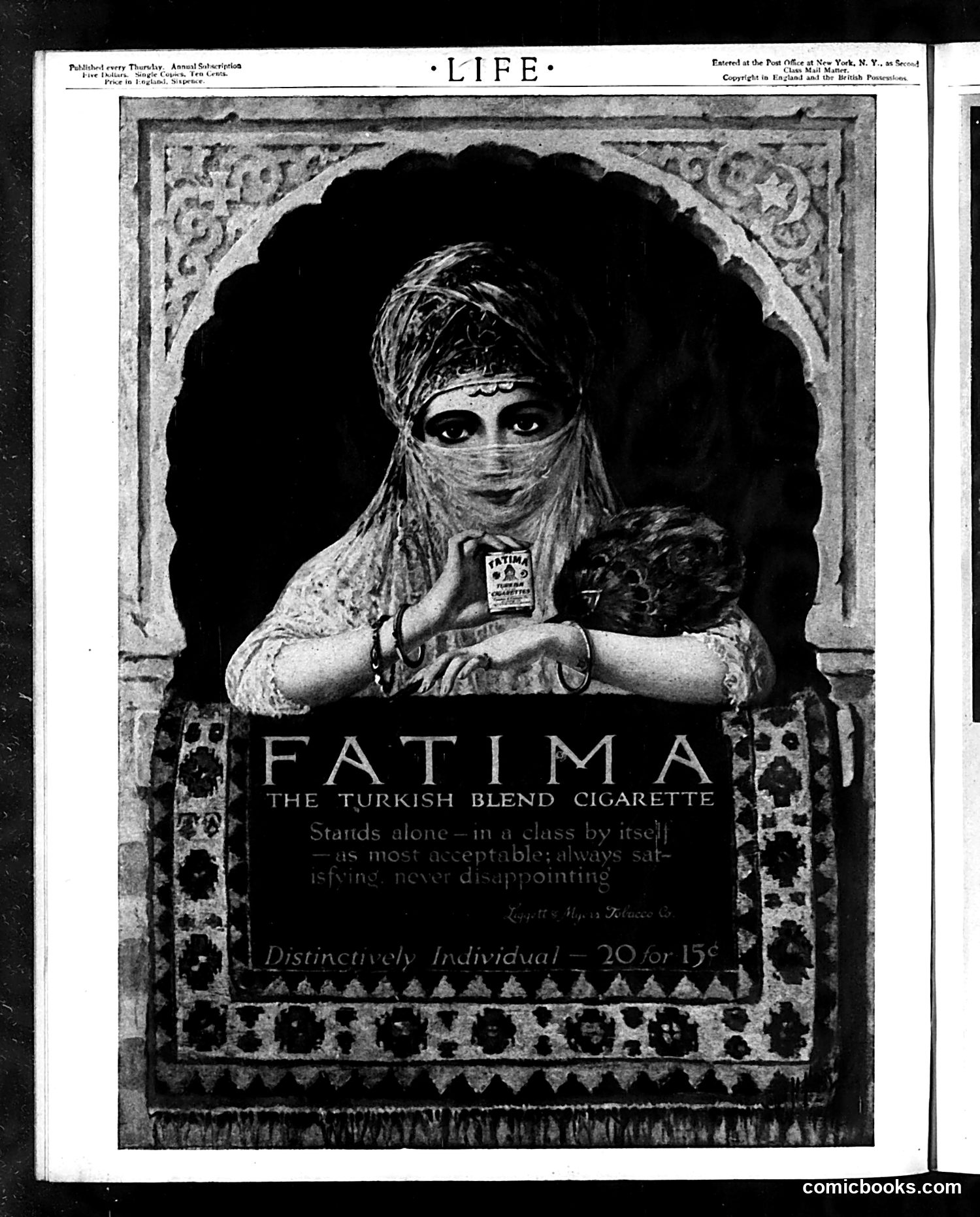
This page is primarily a **cigarette advertisement**, not political satire or comics. It advertises "Fatima: The Turkish Blend Cigarette," featuring an illustration of a woman wearing a veil and headwrap, holding the product. The advertisement leverages **Orientalist imagery** popular in early 20th-century marketing—exoticizing Middle Eastern/Turkish aesthetics to sell cigarettes to American consumers. The tagline emphasizes the product's distinctiveness: "Stands alone—in a class by itself...Distinctively Individual—20 for 15¢" The styling and composition reflect period advertising conventions that used exotic, romanticized imagery as a marketing tool. This represents commercial culture rather than political commentary, though it reflects contemporary attitudes toward non-Western cultures.
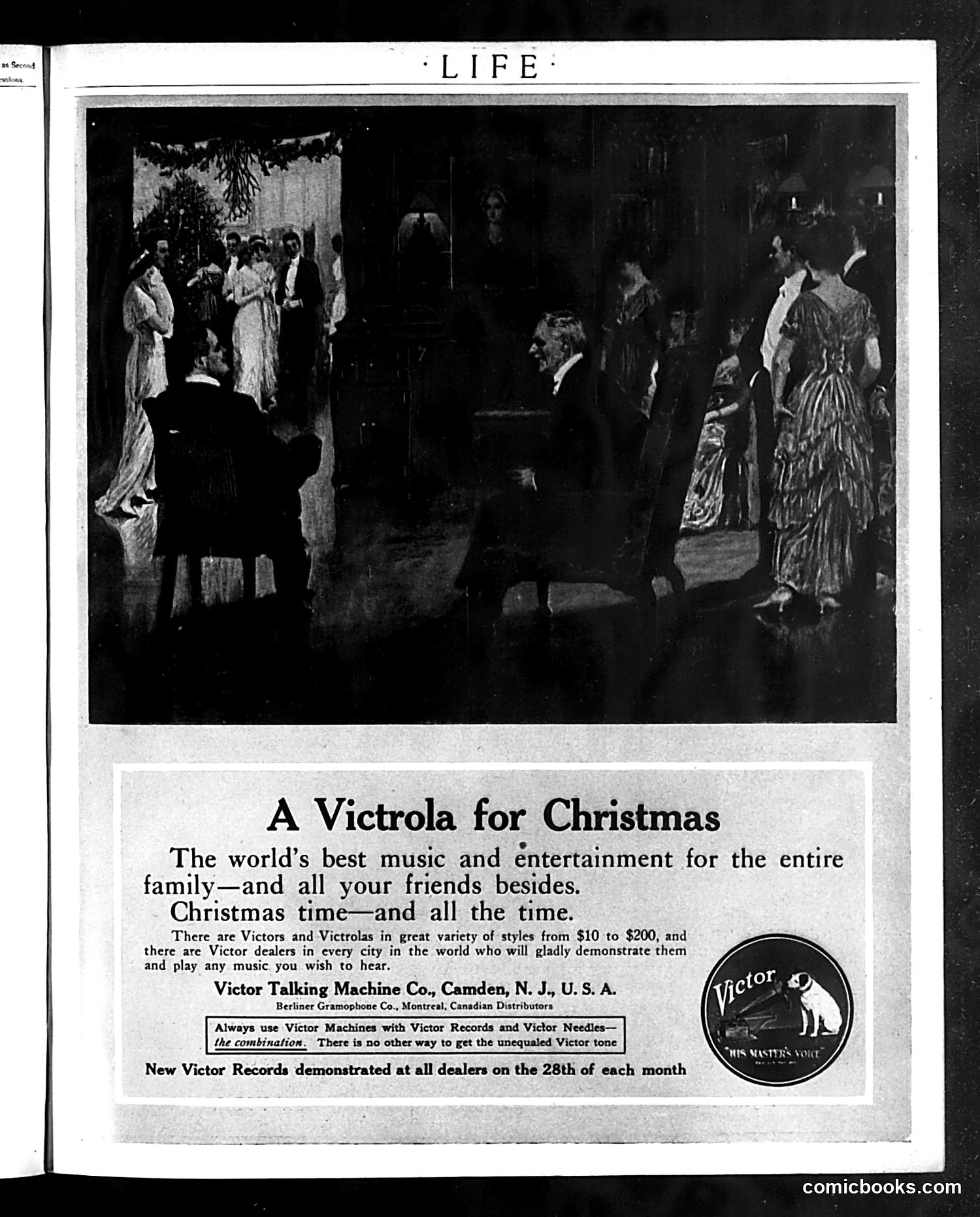
This page is primarily **advertising, not satire or commentary**. It's a Victor Talking Machine Company advertisement promoting Victrolas as Christmas gifts. The image shows an elegant indoor social gathering with well-dressed men and women in formal attire, likely from the 1920s era based on clothing styles. The scene depicts a party or reception where guests are enjoying entertainment together—the implicit promise being that a Victrola phonograph would enable similar social occasions in one's home. The ad emphasizes the machine's appeal to "the entire family—and all your friends besides," positioning it as a luxury item that facilitates both family entertainment and social gatherings. Prices ranged from $10 to $200, making it accessible across income levels. The "His Master's Voice" logo appears at bottom right. This reflects the Victrola's cultural significance as a status symbol and centerpiece of early 20th-century home entertainment.
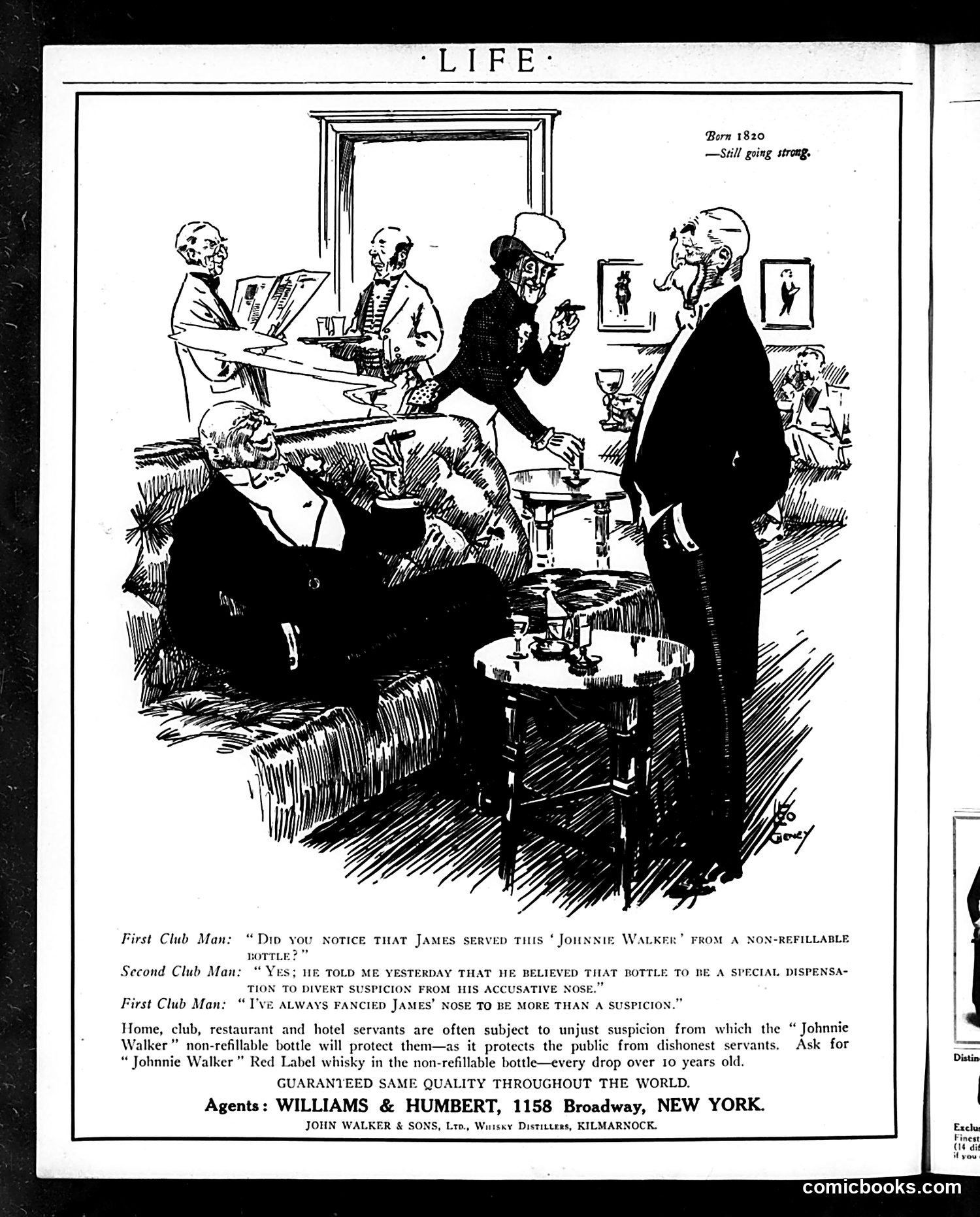
This is primarily a **whisky advertisement** for Johnnie Walker Red Label, disguised as satirical commentary. The cartoon depicts a club scene where members discuss a servant named James who allegedly served whisky from a "non-refillable bottle" to conceal theft. The satire's point: the advertisement suggests that untrustworthy servants routinely steal alcohol, and that Johnnie Walker's non-refillable bottle design protects both the household and "the public from dishonest servants." The "suspicious nose" reference implies servants might be tempted to sample expensive spirits. The ad frames the product as a practical solution to servant dishonesty—a common anxiety among wealthy households of the era. The cartoon and dialogue are entirely fictional, created to sell whisky by exploiting period class anxieties about domestic staff reliability.
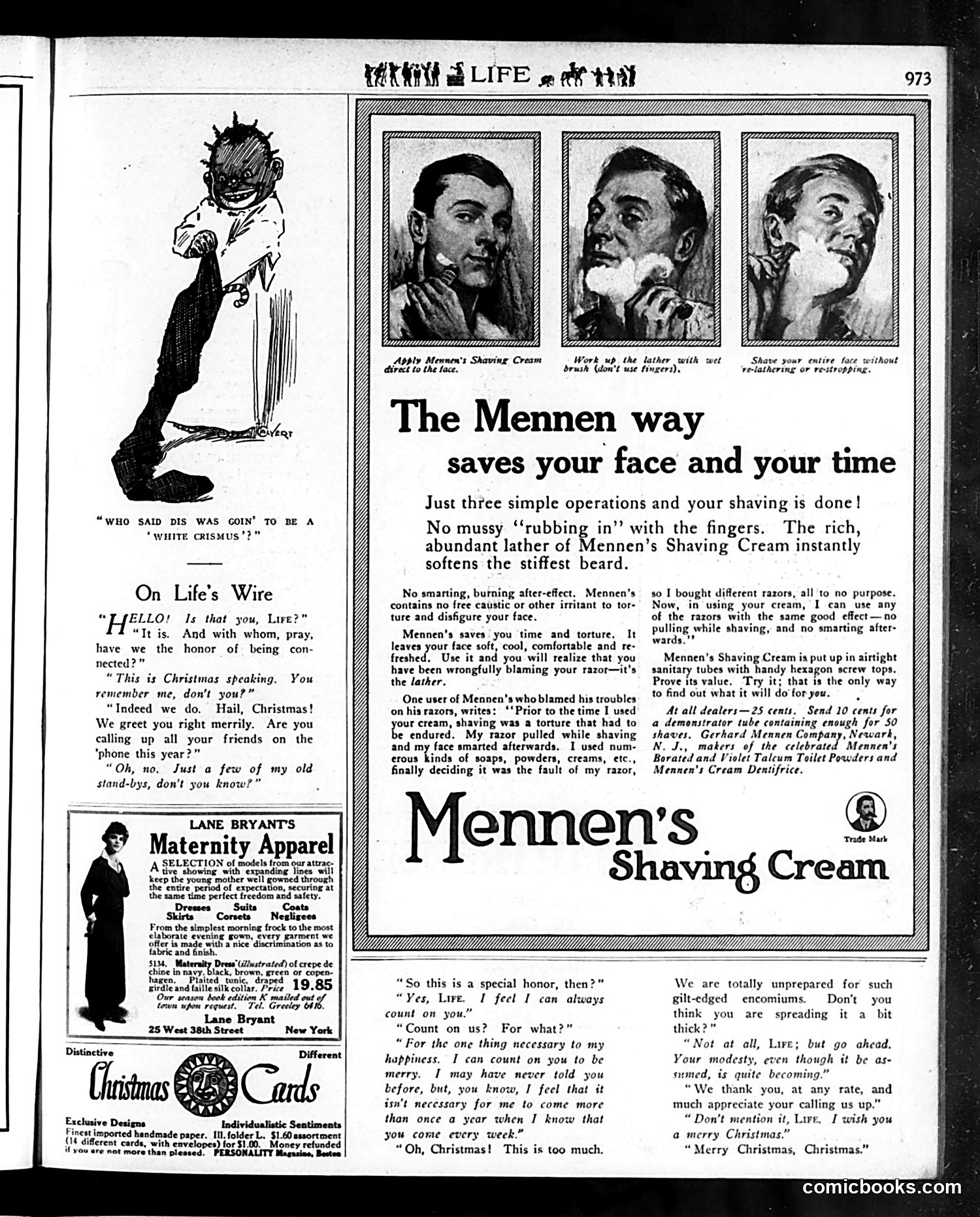
This page is primarily **advertising**, dominated by a large Mennen's Shaving Cream advertisement featuring three demonstration photos and testimonial text. The left side contains two distinct items: 1. **"On Life's Wire"**: A brief dialogue between "Life" and "Christmas," presented as a humorous exchange about holiday phone calls and reconnecting with old friends. The tone is light and seasonal. 2. **A political cartoon** (top left): Shows a caricatured figure with exaggerated features. The caption reads "WHO SAID HIS WAS GOIN' TO BE A 'WHITE CHRISMUS'?" This appears to reference racial tensions, likely commentary on segregation or discrimination during the holiday season, though the specific historical context requires additional information to interpret with certainty. The page reflects early-to-mid 20th century American satirical magazine conventions.
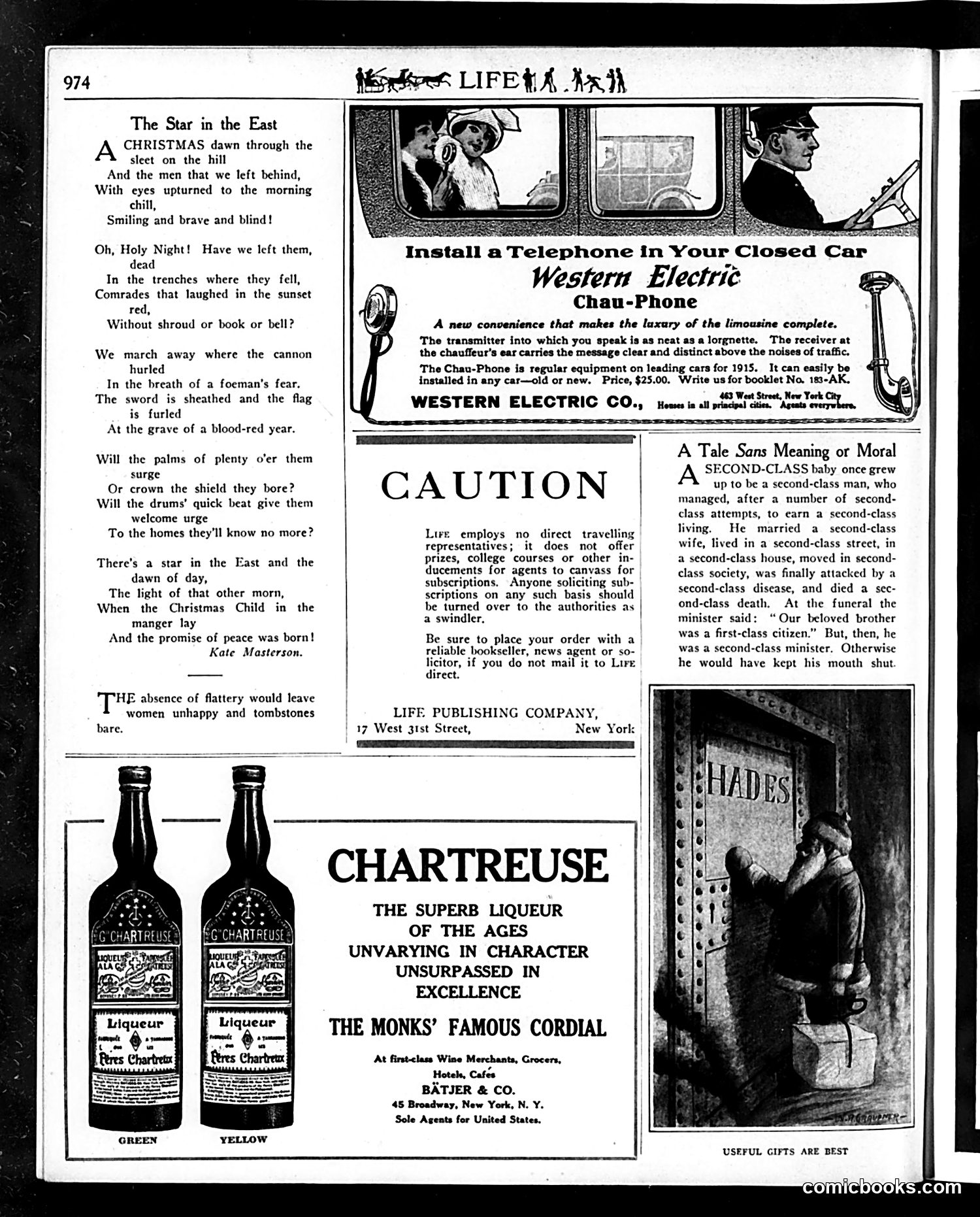
This page is primarily **advertising** rather than editorial content. The main features are: 1. **Western Electric "Chau-Phone"** advertisement promoting telephone installation in luxury automobiles—positioned as a status symbol for 1915. 2. **Chartreuse liqueur advertisement** showing two bottles (green and yellow varieties), marketed as "the monks' famous cordial." 3. **A short story titled "A Tale Sans Meaning or Moral"** about a second-class man attempting to live a second-class life—likely satirizing social pretension or class consciousness of the era. 4. A poem **"The Star in the East"** by Kate Masterson, appearing to reference Christmas and wartime sacrifice (trenches, cannons, soldiers). The page reflects **1915 American consumer culture** and wartime sentiment.
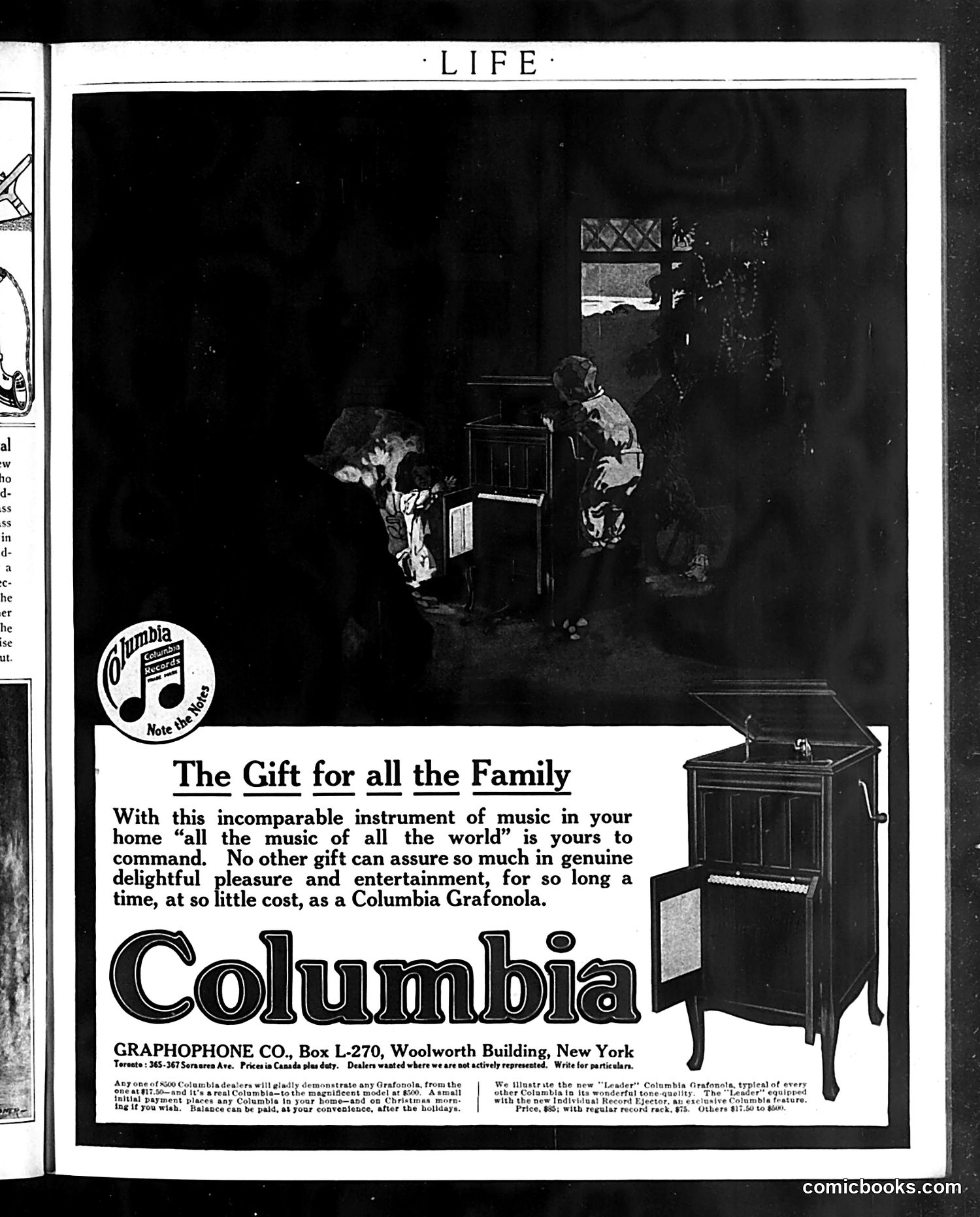
This page is primarily a **Columbia Grafonola advertisement**, not satirical content. The image shows a family gathered around a gramophone (record player) in a darkened home interior, illustrating the product as "The Gift for all the Family." The advertisement's pitch emphasizes that this device brings "all the music of all the world" into the home affordably. The messaging targets middle-class consumers by positioning the gramophone as a source of "genuine delightful pleasure and entertainment, for so long a time, at so little cost." The Columbia logo and company details appear at bottom. This represents early 20th-century consumer marketing—using aspirational family imagery to sell entertainment technology. There is no political satire present; this is straightforward product promotion within *Life* magazine's pages.
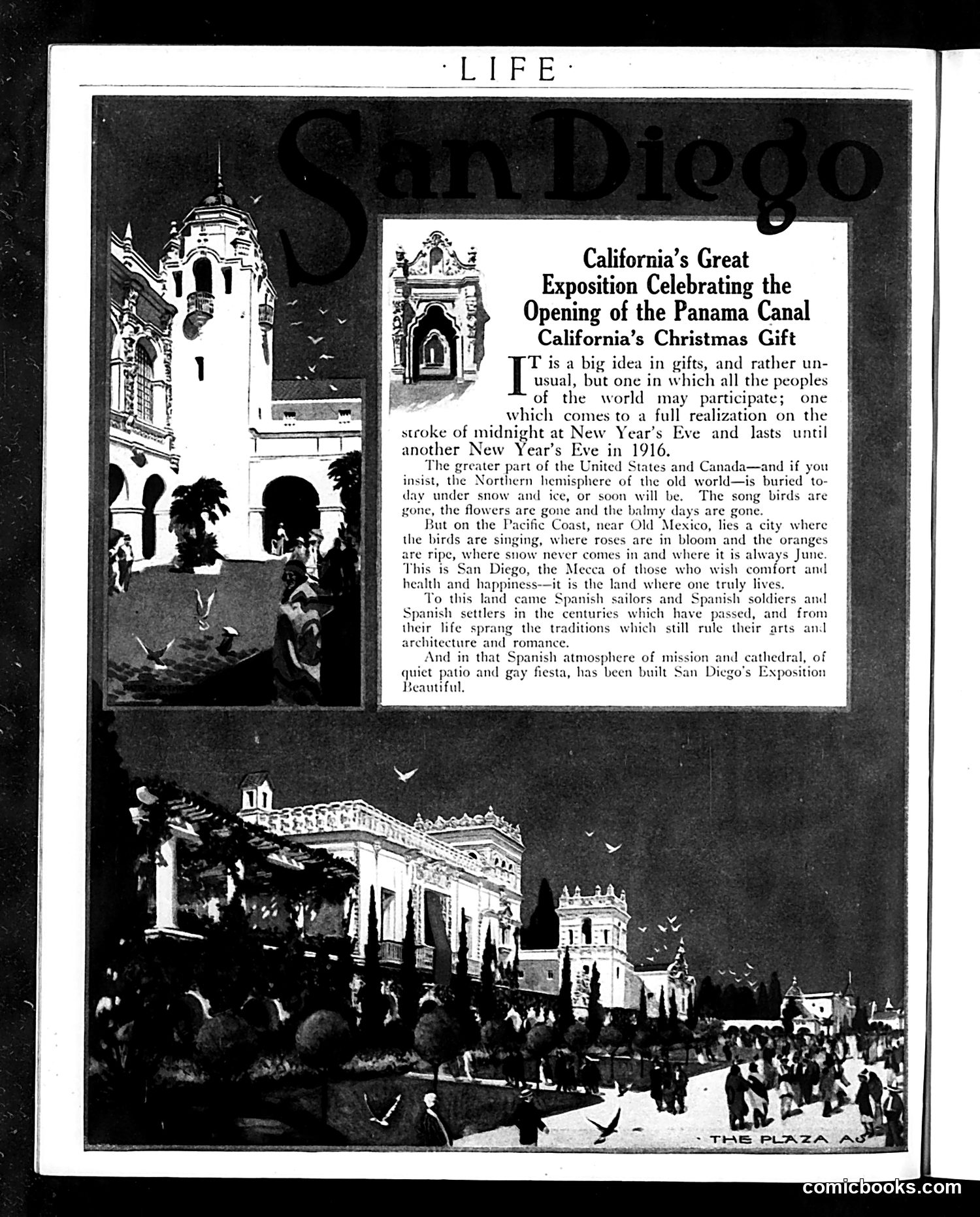
This is a promotional article for San Diego's 1915 Panama-California Exposition, celebrating the Panama Canal's opening. The text describes San Diego as California's "Christmas gift"—a year-round paradise where "birds are singing, where roses are in bloom and the oranges are ripe," contrasting it with snowy northern regions. The article emphasizes San Diego's Spanish colonial heritage, noting that Spanish architecture, traditions, and atmosphere inspired the Exposition's design. The photographs show Spanish Colonial Revival architecture featuring ornate towers and plazas with crowds of visitors, exemplifying the romantic "Spanish atmosphere" the Exposition deliberately recreated. This represents early 20th-century American city promotion through historical romanticism and regional boosterism.
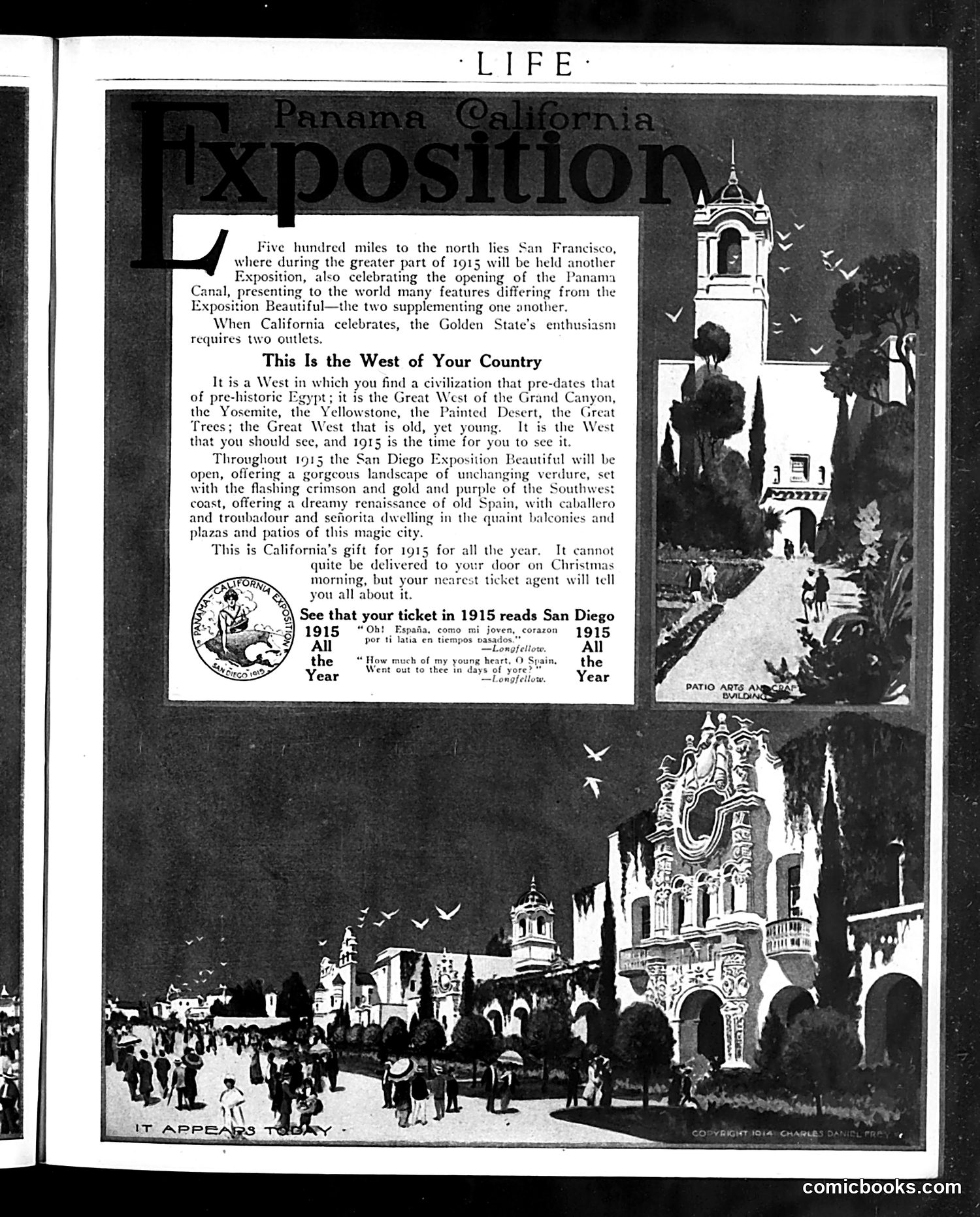
This is a 1915 promotional advertisement for the Panama-California Exposition in San Diego. The page celebrates the opening of the Panama Canal by encouraging Americans to visit the exposition, which showcases Spanish colonial architecture and southwestern landscapes. The text frames this as "the West of Your Country"—positioning the exposition as a chance to experience American frontier heritage and natural wonders (Grand Canyon, Yosemite, etc.). It's notable for marketing California's Spanish past alongside American expansion, emphasizing that 1915 is "the time for you to see it." The accompanying photographs show ornate Spanish colonial buildings with domed towers and courtyards filled with visitors, establishing the exposition's architectural appeal. The circular seal indicates official California endorsement.
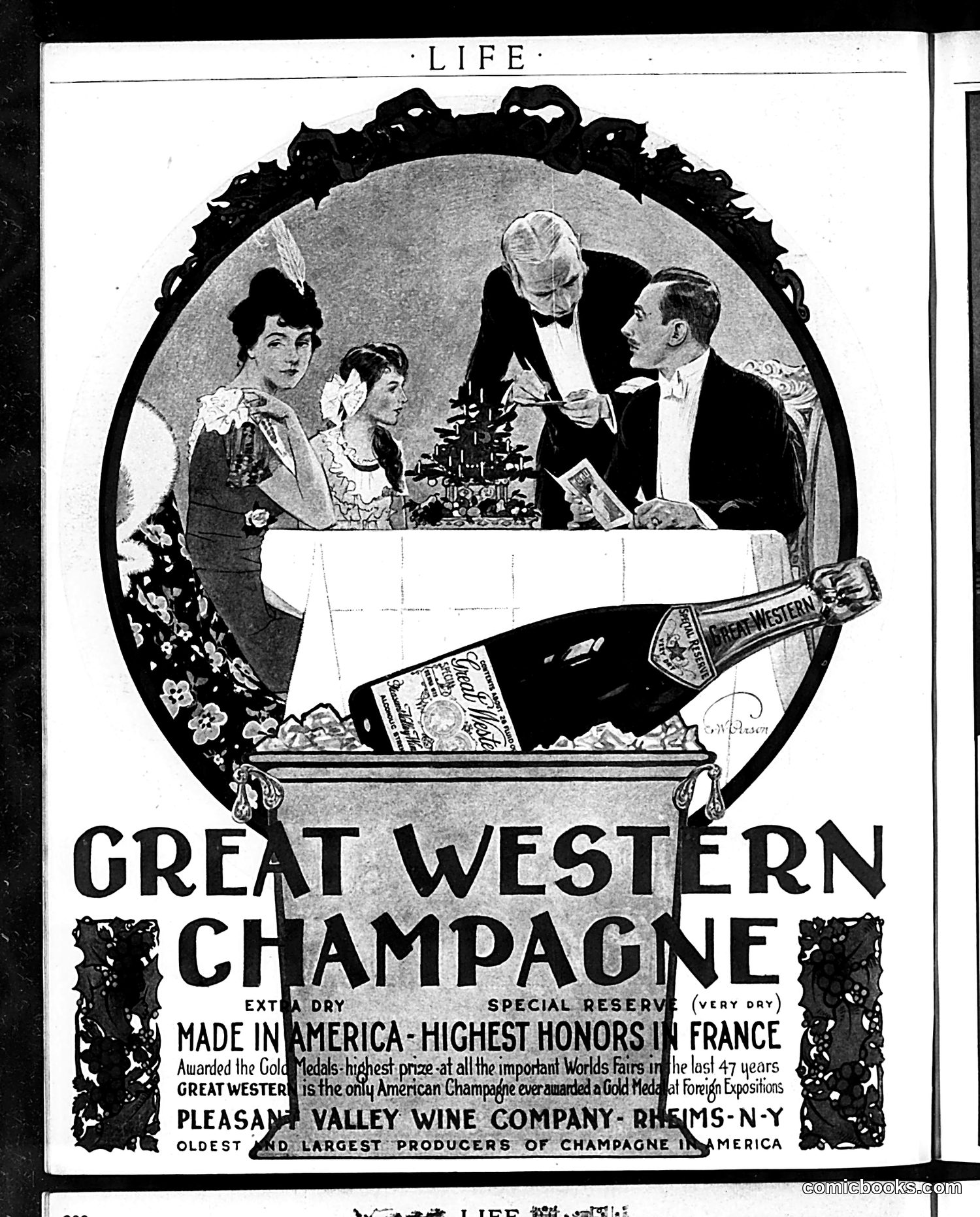
This is a **commercial advertisement**, not political satire. It depicts an elegant dinner party scene—four well-dressed guests (two women, two men) at a formal table with champagne bottles displayed prominently. The ad claims "Great Western" is an American champagne that won gold medals at major international expositions in France over 47 years, asserting it's "the only American Champagne ever awarded a Gold Medal for foreign Expositions." The manufacturer, Pleasant Valley Wine Company of Rheims, New York, marketed itself as "oldest and largest producers of champagne in America." The sophisticated imagery appeals to upper-class consumers by associating American-made champagne with European prestige and refinement—a selling point during an era when American products often faced skepticism regarding quality and sophistication.

This is a **full-page advertisement**, not satirical content. It promotes Detroit Springs, a car suspension component manufactured by Detroit Steel Products Co. (located at 2220 East Grand Boulevard, Detroit, Michigan). The ad emphasizes that Detroit Springs are "self-lubricating" through built-in lubricating cups at each leaf, making them "silent" and eliminating squeaks. The marketing pitch highlights durability (guaranteed two years against settling or breakage) and scientific precision in manufacturing. The visual shows a close-up of a spring with the distinctive lubricating cups labeled. This is straightforward industrial advertising aimed at automobile manufacturers and purchasers, reflecting early 20th-century automotive advancement and engineering innovation.
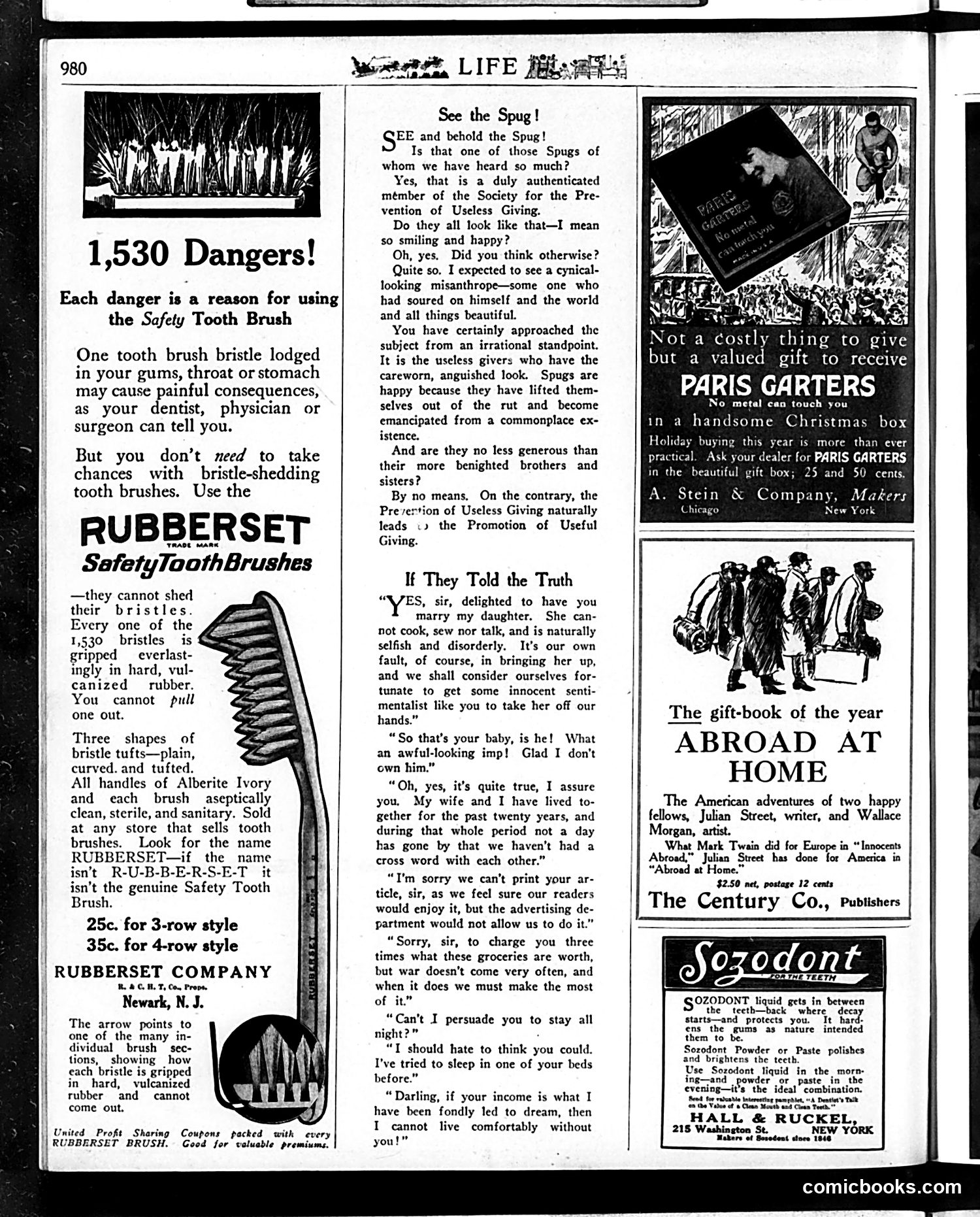
This page is primarily **advertising content** from a vintage *Life* magazine (page 980). The dominant ads feature: 1. **Rubberset Safety Toothbrushes** — emphasizing bristles that cannot shed, addressing a genuine safety concern of the era (loose bristles potentially lodging in gums/throat). 2. **Paris Garters** — men's clothing accessories promoted as Christmas gifts. 3. **"Abroad at Home"** — a book advertised as "the gift-book of the year," featuring American adventures. 4. **Sozodont** — a tooth powder/paste product. The center contains a satirical piece titled **"See the Spug!"** discussing members of the "Society for the Prevention of Useless Giving," humorously critiquing Christmas gift-giving practices. The dialogue mocks both pretentious gift-givers and recipients. The page is primarily **commercial** rather than political commentary.
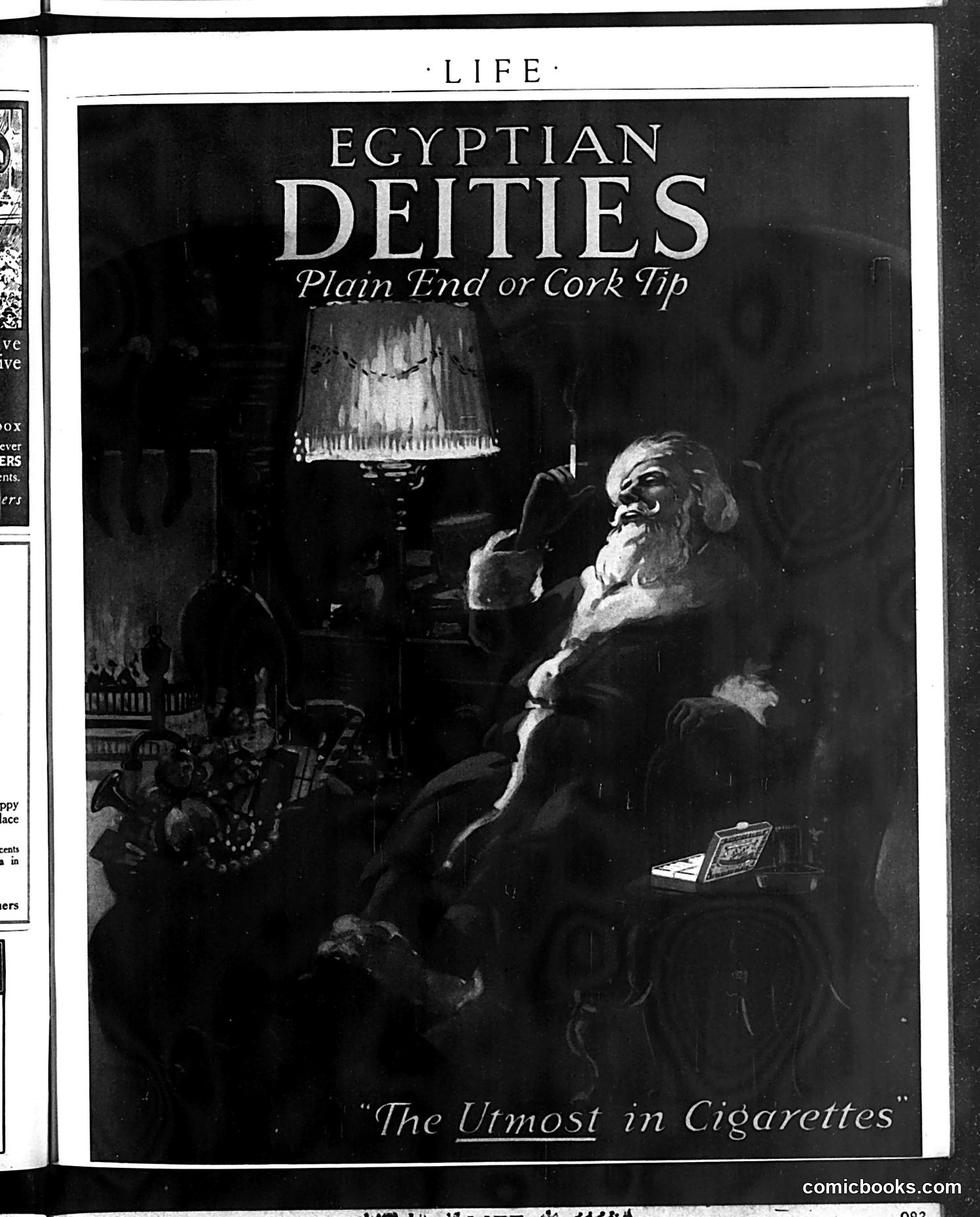
This is a **cigarette advertisement** for "Egyptian Deities" brand cigarettes, available in "Plain End or Cork Tip" styles. The tagline reads "The Utmost in Cigarettes." The ad features an elderly man with a white beard, seated and contemplative, examining what appears to be Egyptian artifacts or decorative items around him. The staging suggests scholarly or antiquarian interest—likely invoking associations of sophistication and cultural refinement to market the product. The "Egyptian Deities" branding capitalizes on early 20th-century fascination with Egyptology (possibly referencing recent major archaeological discoveries). The advertisement uses this exotic imagery to position the cigarettes as premium, cultured products for discerning consumers—a common advertising strategy of the era equating cigarette smoking with worldliness and intellectual status.
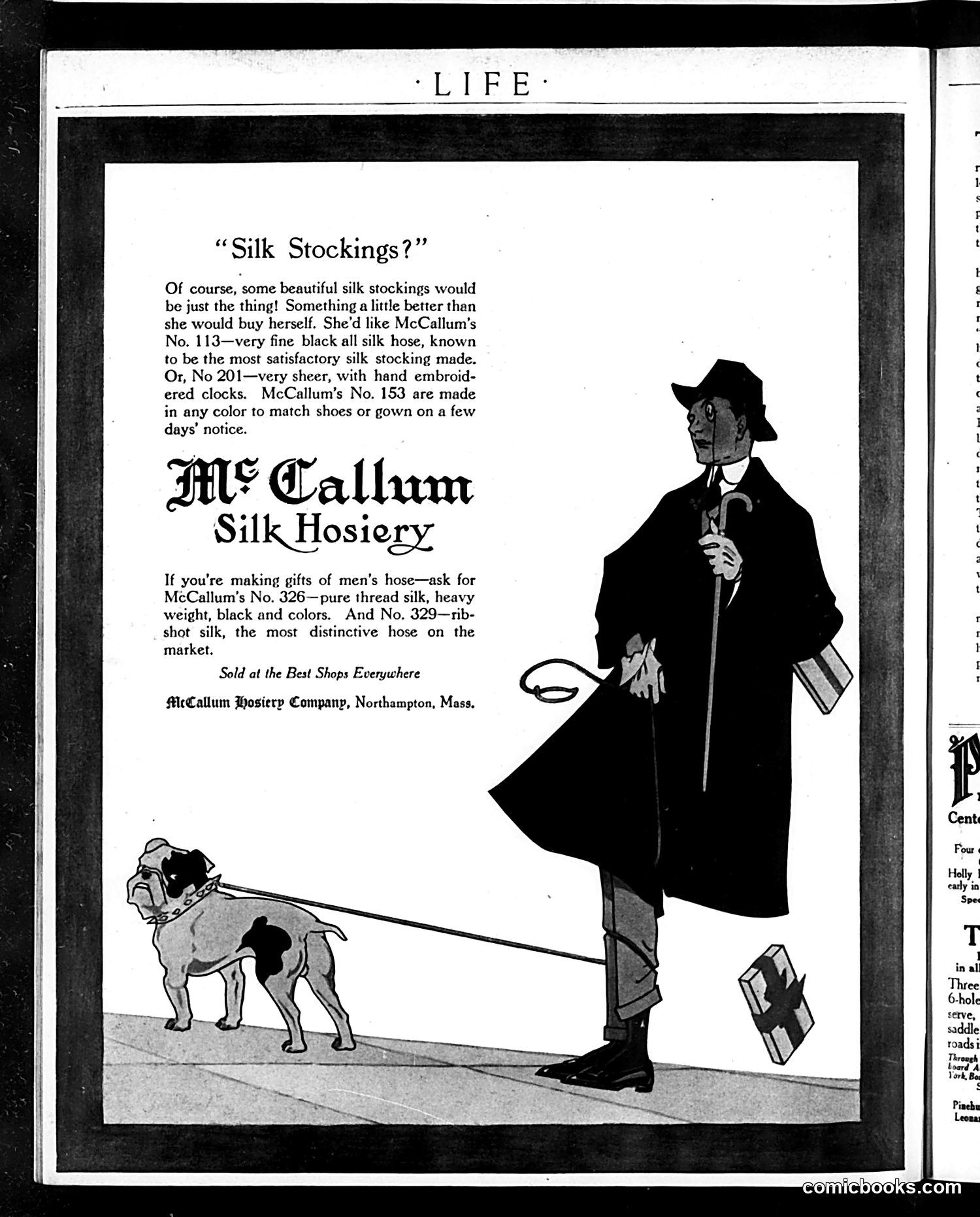
This is a straightforward advertisement for McCallum Silk Hosiery, a company based in Northampton, Massachusetts. The image depicts a well-dressed gentleman in a coat and hat walking a small dog while carrying wrapped packages—presumably gifts. The advertisement is styled as a gift-giving suggestion, with the headline "Silk Stockings?" proposing that silk hosiery would make excellent presents. The ad lists specific product numbers (No. 113, 201, 153 for women's stockings; No. 326 and 329 for men's hose) and emphasizes quality features like "fine black all silk" and "hand embroidered clocks." The illustration's genteel figure and leisurely scene suggest the aspirational, luxury positioning of the product to early 20th-century consumers.
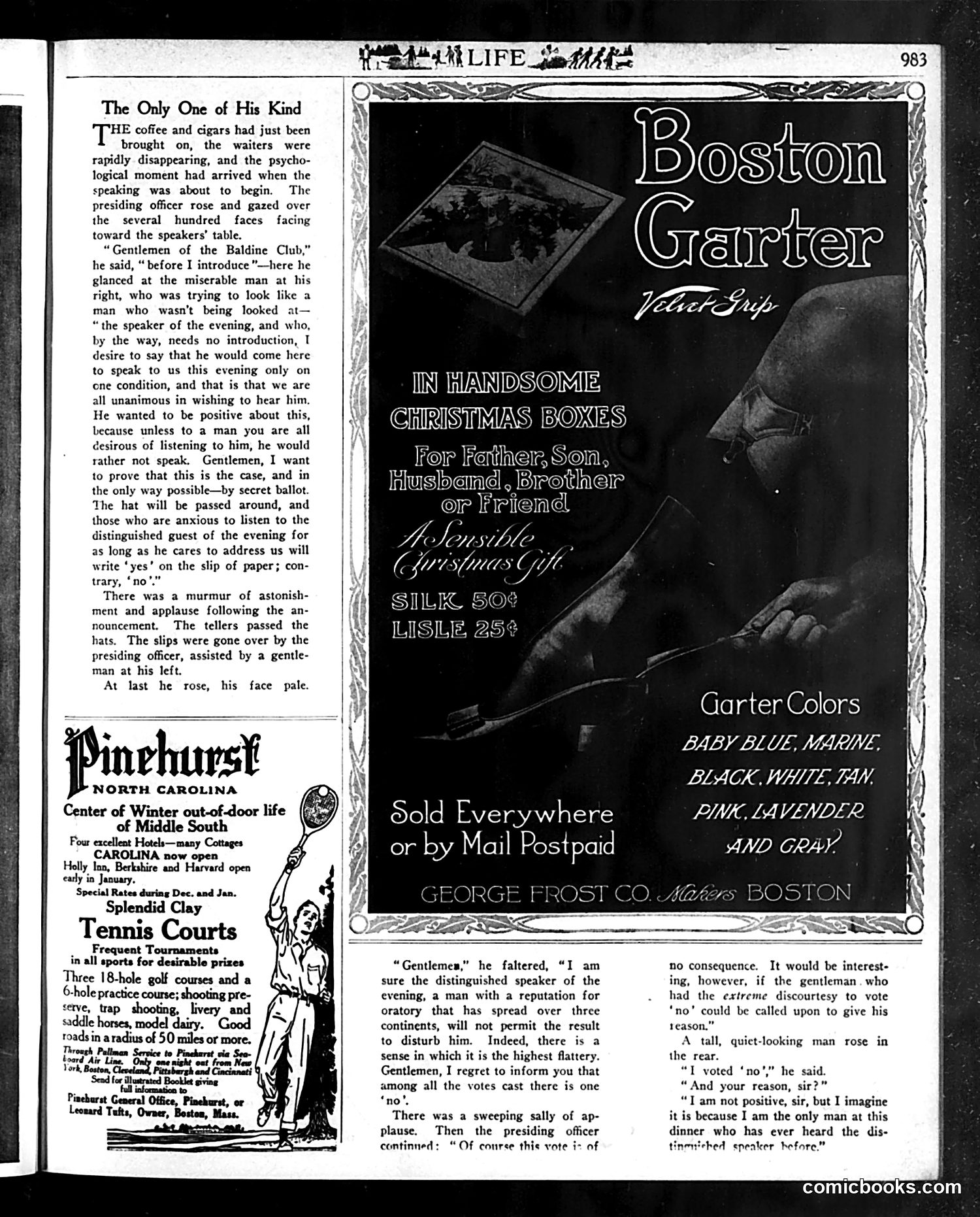
This story-cartoon satirizes the absurd vanity of after-dinner speakers and their need for validation. A distinguished orator insists on a secret ballot to confirm the audience *wants* to hear him speak. The presiding officer announces that only one "no" vote was cast—presented as flattery rather than criticism. The joke's punchline: a tall man in the rear admits he voted "no" because he's the only attendee who has actually *heard this speaker before*—implying the man's oratory is so tedious that prior experience is reason enough to avoid hearing him again. The satire targets the pomposity of famous speakers who demand adulation while remaining oblivious to their own mediocrity. The elaborate secret-ballot setup, meant to validate the speaker's importance, instead exposes him to the one informed critic in the room.
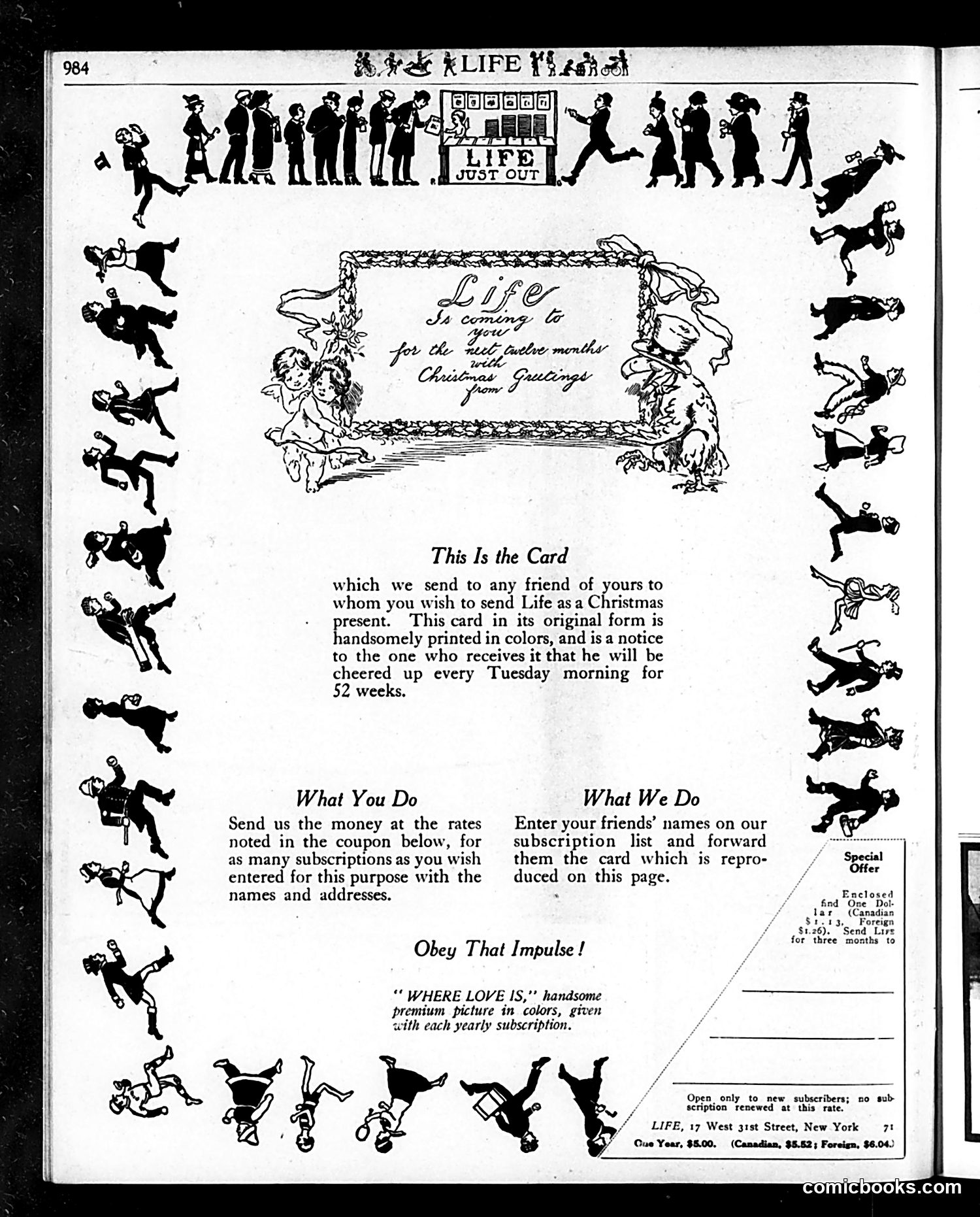
This is primarily a **subscription promotion page**, not a political cartoon. It advertises Life magazine's Christmas gift subscription offer. The page features: - **Border illustrations**: Silhouettes of people in various comedic poses—falling, running, gesturing—typical of Life's humorous style - **Central message**: Encouraging readers to gift Life subscriptions to friends, promising weekly entertainment ("cheered up every Tuesday morning for 52 weeks") - **Promotional incentive**: A premium colored picture titled "Where Love Is" included with yearly subscriptions - **Special offer**: One dollar for three months (new subscribers only) The satire here is **gentle and self-promotional**—Life presents itself as the antidote to boredom, using playful imagery of physical comedy and chaos. The "Obey That Impulse!" headline is characteristic of early 20th-century advertising's direct appeals to consumer spontaneity. The silhouettes suggest Life offers escapist humor and entertainment.
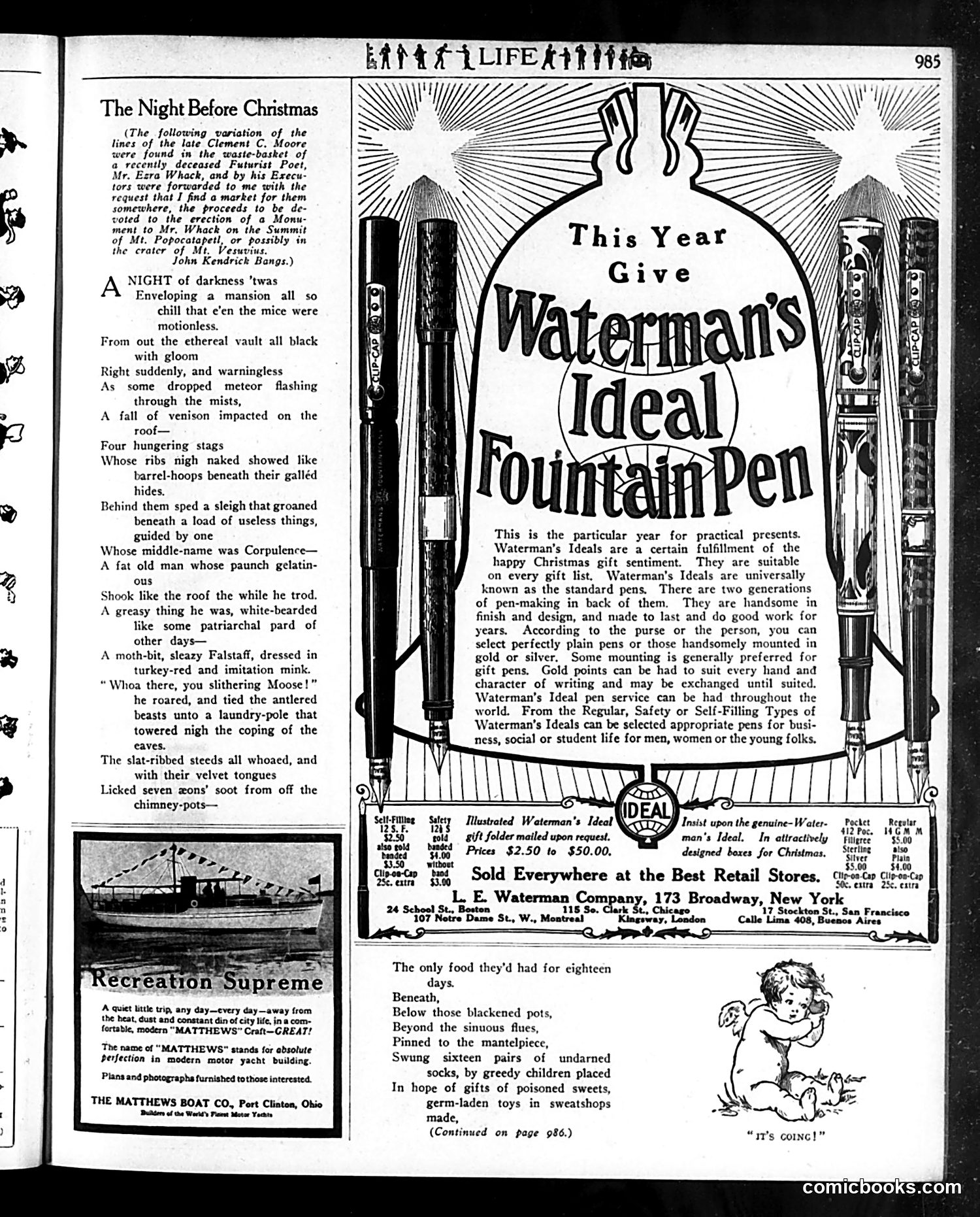
This page combines a satirical poem parody with period advertisements. The main content is "The Night Before Christmas," a modern reimagining of Clement C. Moore's classic poem, attributed to a fictional "Futurist Poet" named Ezra Whack. The satire mocks avant-garde modernist poetry by presenting an absurdist version of the Christmas story—Santa arrives with dead deer instead of reindeer, descends into a grimy, poverty-stricken household where children have hung undarned socks, and the "gifts" mentioned are poisoned sweets and germ-laden toys. The joke targets both modernist pretension and contemporary social conditions: the grim reality of working-class Christmas contrasts sharply with traditional sentimentality. The advertisements (Waterman pens, Matthews boats) provide ironic counterpoint—luxurious gift suggestions for readers who can afford them, juxtaposed against the poem's depiction of families with nothing but dirty socks to hang.
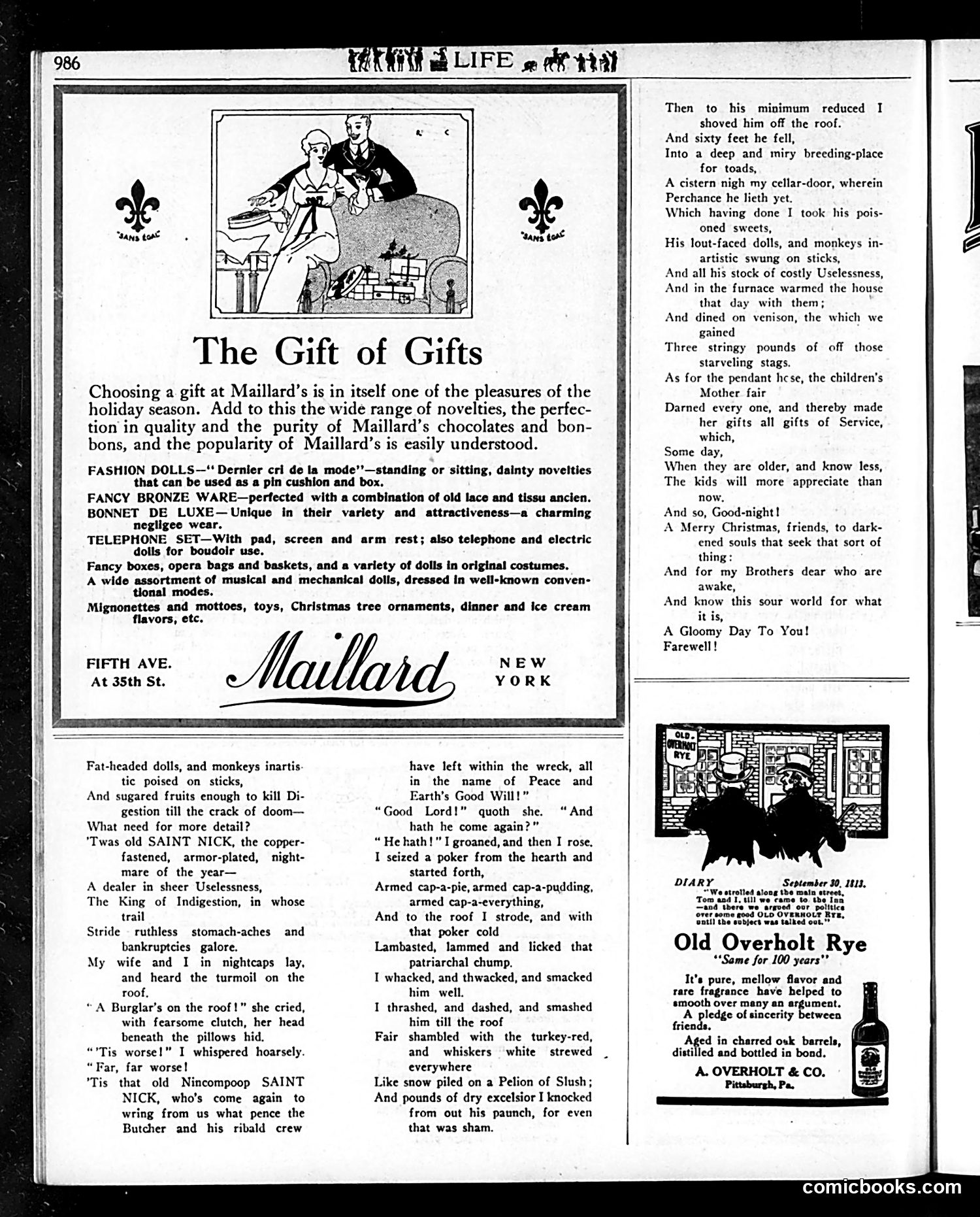
This page contains a **Maillard's chocolate advertisement** (top left) and a satirical poem (right side) that mocks both Santa Claus and commercialized gift-giving. **The Satire:** The poem presents a cynical narrator who violently attacks Santa Claus on his roof, viewing him as a symbol of wasteful consumerism. The narrator despises "fat-headed dolls," "sugared fruits," and all the commercial "Uselessness" that Santa represents—calling him "The King of Indigestion" who extracts money from families. **The Irony:** The advertisement celebrates luxurious gift items (dolls, bronze ware, telephone sets) while the poem savagely critiques such frivolous purchases. The contrast is intentional—Life magazine uses dark humor to satirize holiday commercialism and excess, even as advertisements on the same page promote exactly those goods. **Context:** This reflects early 20th-century anxiety about American consumer culture and the commercialization of Christmas. The poem's protagonist represents anti-materialist sentiment, though his extreme violence also suggests the satire mocks his position as absurdly rigid.
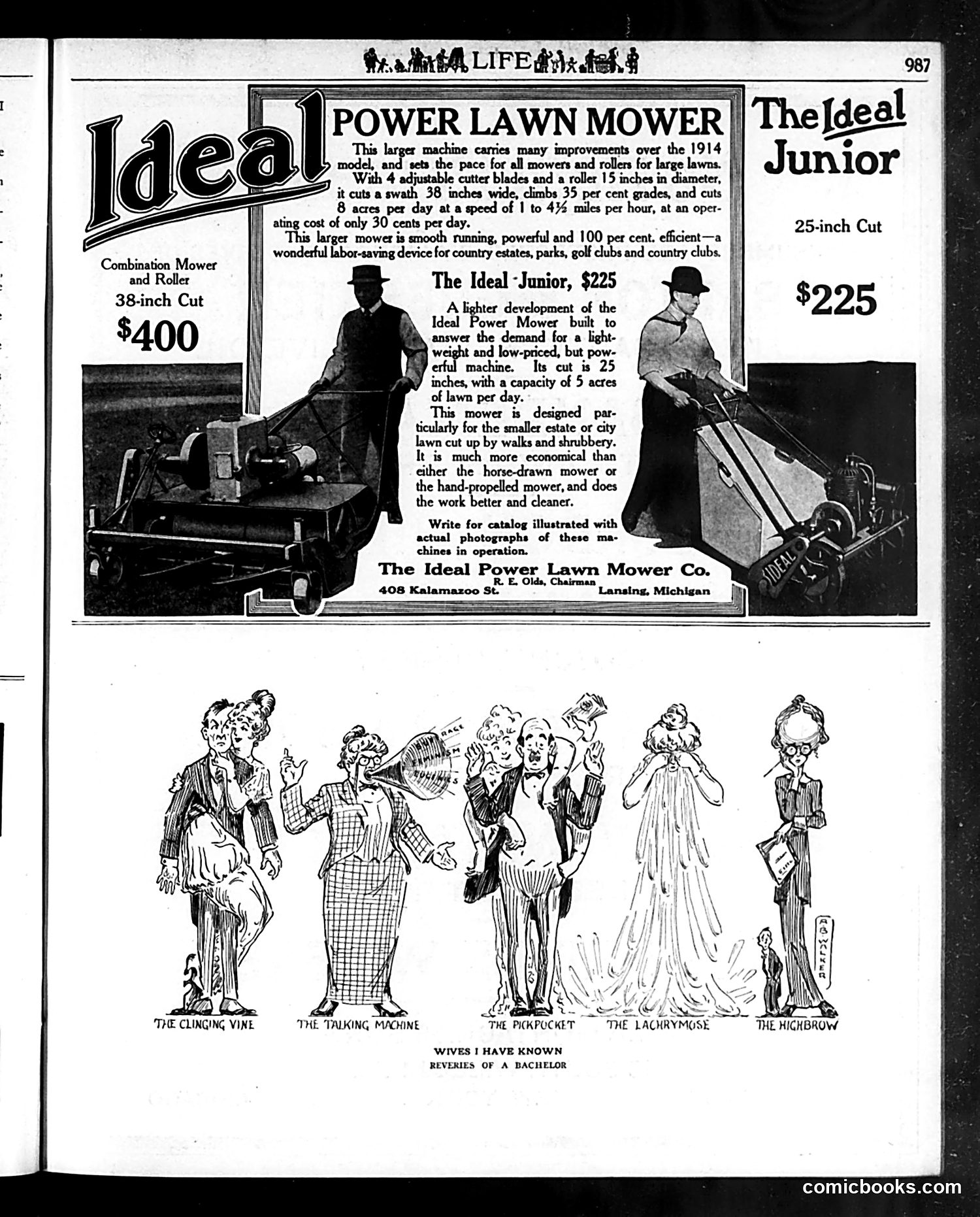
**Upper Section:** Advertisements for Ideal brand power lawn mowers—a commercial mower ($400, 38-inch cut) and lighter "Junior" model ($225, 25-inch cut). These pitch labor-saving technology to wealthy landowners with estates, golf clubs, and country properties. **Lower Section:** A satirical cartoon titled "Wives I Have Known: Reveries of a Bachelor" depicts five female stereotypes through caricature: - **The Clinging Vine**: Dependent, clingy woman - **The Talking Machine**: Incessantly chatty woman - **The Pickpocket**: Presumably a spendthrift wife - **The Lachrymose**: Overly emotional, tearful woman - **The Highbrow**: Intellectual or pretentious woman The satire mocks common misogynistic bachelor stereotypes about wives as bothersome, frivolous, or difficult. This reflects early 20th-century attitudes treating women as character types to be criticized rather than individuals.
This is **not a cartoon but a commercial advertisement** from Life magazine (page 988). It promotes alcoholic beverages—wines, spirits, and liquor—sold by E. La Montagne's Sons, a distributor with locations in New Orleans, New York, and Chicago. The headline "No High Prices!" and the claim that "consumers are protected by liberal reserves" suggest this ad addresses **economic anxiety about inflation or price gouging**, likely from the post-WWI era (circa 1920s). The advertiser reassures buyers that abundant stock prevents price increases. The ad lists prestigious European brands (French clarets, Portuguese ports, Scotch whiskey, Irish whiskey, rum) alongside American products (Gordon Gins, Green River Whiskey), emphasizing variety and quality to attract customers concerned about both affordability and product scarcity. This reflects early 20th-century consumer culture and commercial messaging rather than political satire.
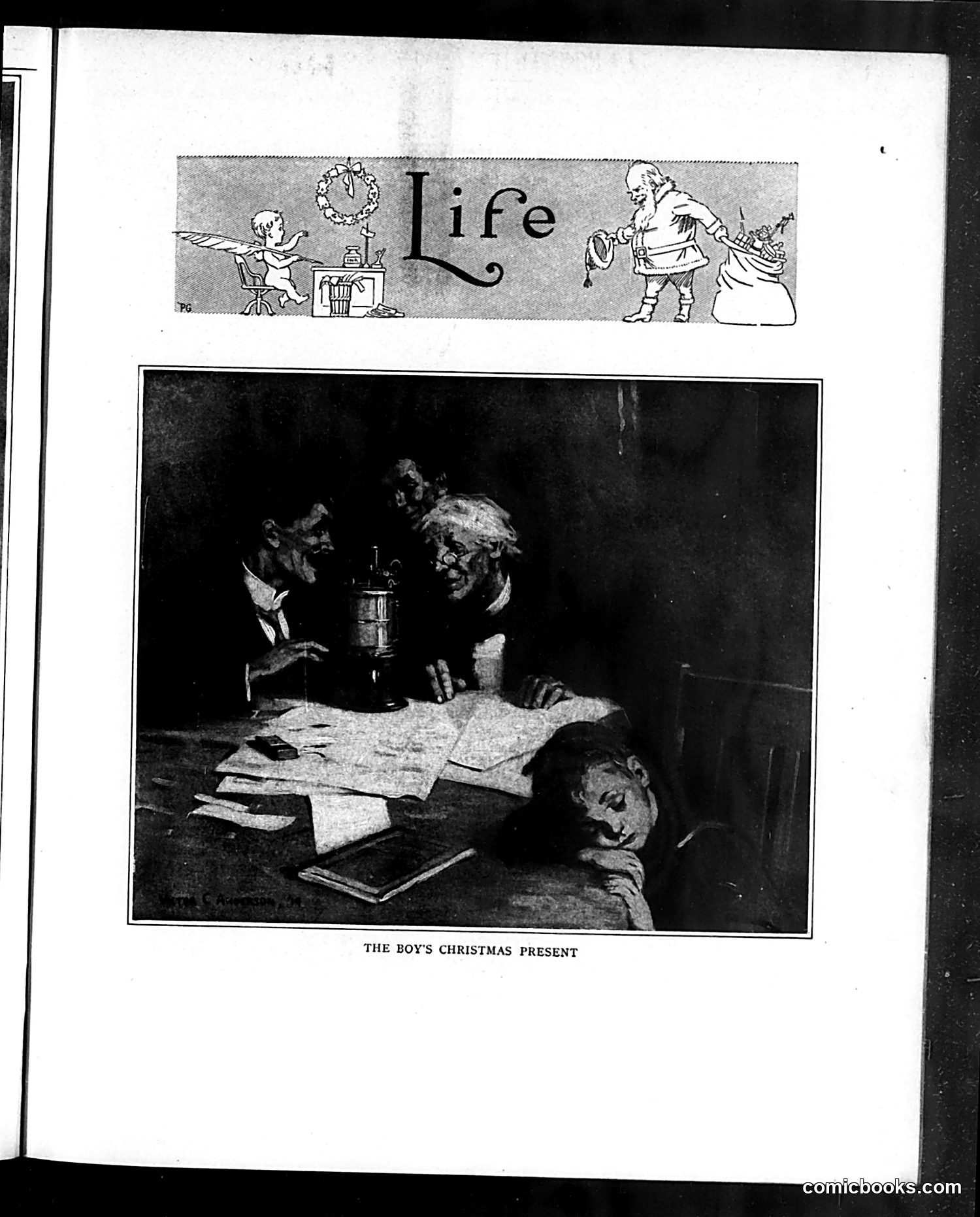
This Life magazine illustration depicts a domestic Christmas scene with satirical intent. Two adult men examine documents or papers spread across a table while a boy sleeps or rests nearby. A lamp sits between them, suggesting late-night activity or secretive dealings. The satire appears to comment on how children's Christmas presents—or holiday joy generally—get disrupted or compromised by adult concerns, likely financial or business matters. The boy's passive, exhausted posture contrasts with the men's focused attention to paperwork, suggesting adult preoccupations overshadow childhood holiday expectations. Without additional context about the specific publication date or surrounding articles, the precise social commentary remains unclear, though it likely critiques materialism, economic hardship, or parental neglect during the holiday season.
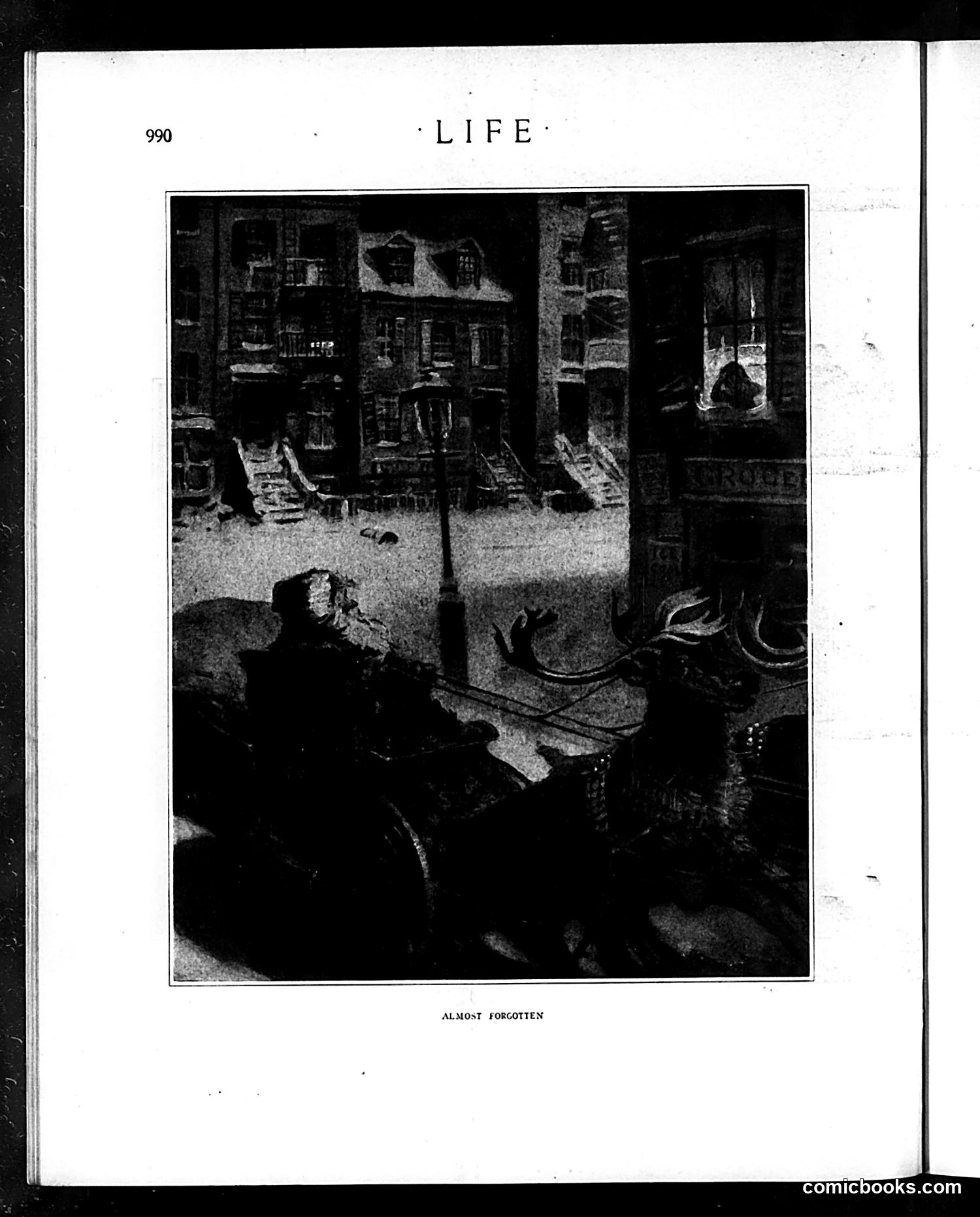
This page from *Life* magazine features a dark, atmospheric photograph or illustration titled "Almost Forgotten." The image depicts figures in what appears to be a dimly lit urban or tenement setting, with buildings visible in the background. The composition is highly contrasted and somewhat difficult to parse clearly due to the quality of the reproduction. Without additional context or clearer OCR text from the page, the specific satirical or political commentary remains unclear. The title suggests the work addresses something neglected or overlooked by society—possibly poverty, urban decay, or marginalized populations. However, I cannot definitively identify the specific social issue, historical event, or figures being referenced based solely on what's visible here.
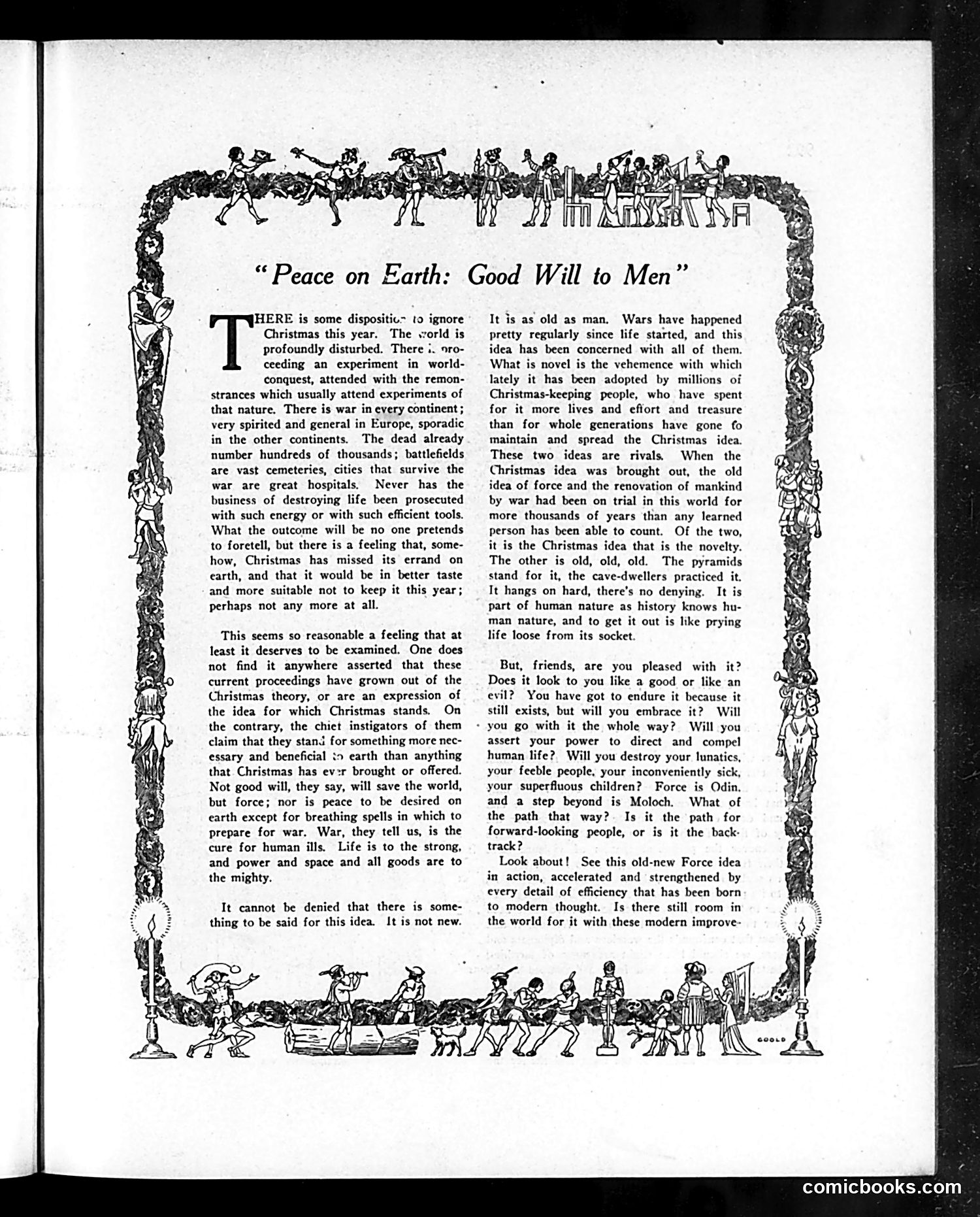
This editorial cartoon critiques the contradiction between Christmas ideals and modern warfare during what appears to be World War I. The essay presents two competing philosophies: **The Christmas Idea**: Peace, goodwill, and human renewal through moral force—relatively novel in human history. **The Force Idea**: War as salvation, survival of the strong, power through military might—ancient but now weaponized with modern industrial efficiency. The text references "Odin" (Norse god of war) and "Moloch" (biblical symbol of child sacrifice), suggesting this philosophy demands terrible costs. The satirist argues that Christian nations have paradoxically invested more resources in modern warfare than in spreading Christmas values. The closing question mocks whether there's "still room in the world" for force ideology alongside modern improvements—implying industrial warfare makes the old philosophy catastrophically destructive. The decorative border featuring dancing, celebrating figures contrasts sharply with the grim subject matter, emphasizing the bitter irony of the season.
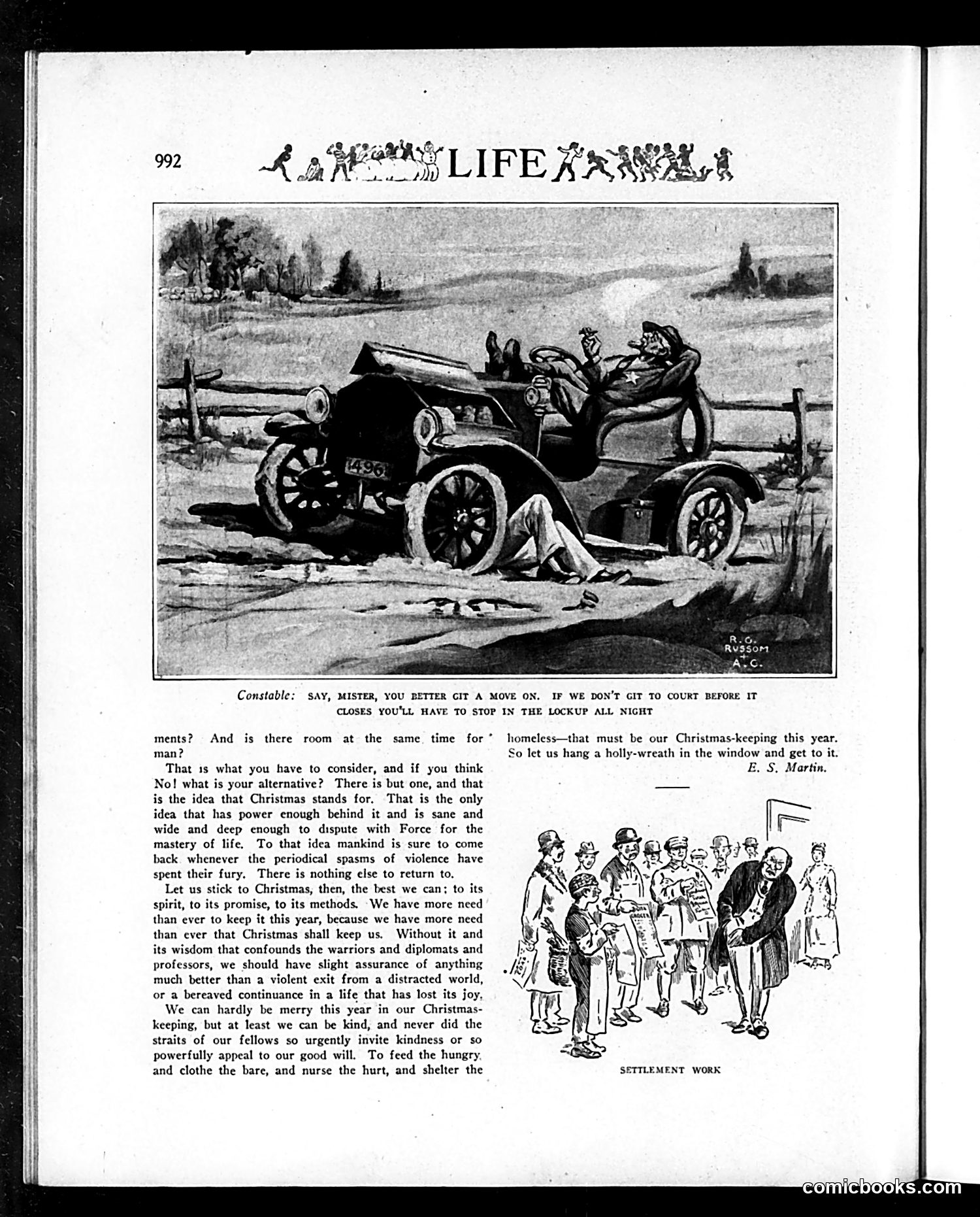
The top cartoon depicts a broken-down early automobile stuck on a rural road. A constable (police officer) tells the driver they must hurry to court or face lockup overnight—a satirical comment on the judicial system's inflexibility and harsh treatment of those already in legal trouble. The accompanying text by E.S. Martin is a post-WWI editorial urging Americans to embrace Christmas's spiritual values—kindness, charity, shelter for the homeless—as an antidote to violence and social disorder. Martin argues that without Christmas's wisdom guiding civilization, society faces either violent collapse or joyless survival. The lower illustration labeled "Settlement Work" shows social workers or volunteers distributing aid to poor families, visualizing Martin's call for practical Christmas charity: feeding the hungry, clothing the destitute, nursing the sick. Together, the page contrasts society's punitive legal system with calls for compassionate, Christian-based social reform and mutual aid.
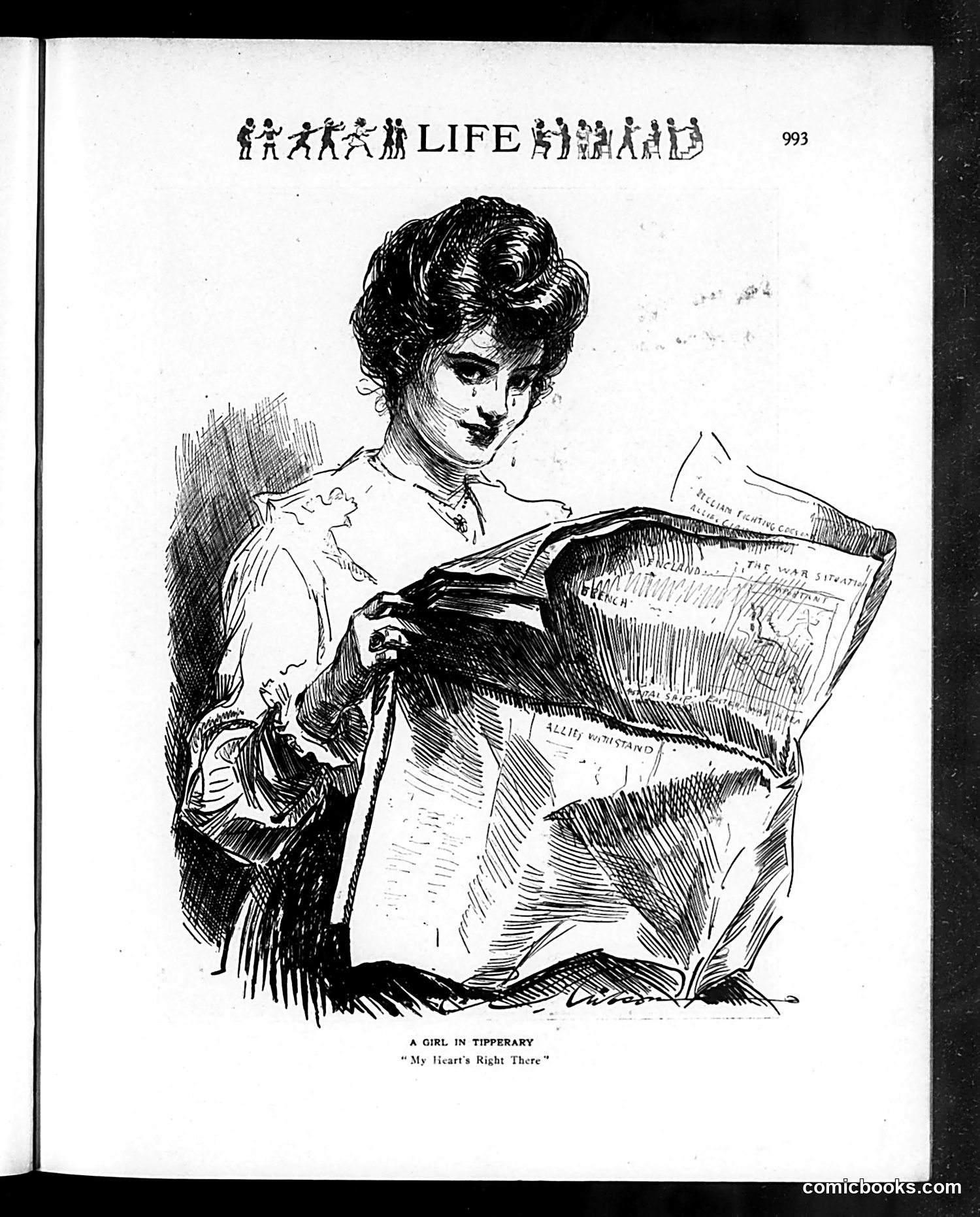
This is a satirical illustration from Life magazine titled "A Girl in Tipperary: 'My Heart's Right There.'" The drawing depicts a young woman reading a newspaper, with the headline visibly referencing "THE WAR SITUATION" and "GREECE." The cartoon appears to comment on Irish romantic sentiment during World War I—Tipperary being a county in Ireland, and the famous wartime song "It's a Long Way to Tipperary" being well-known at the time. The joke likely satirizes the disconnect between romantic declarations ("my heart's right there") and the woman's actual focus on war news rather than love. The illustration may also reference Irish attitudes toward the war, as Ireland's relationship to WWI was complicated and contentious during this period.
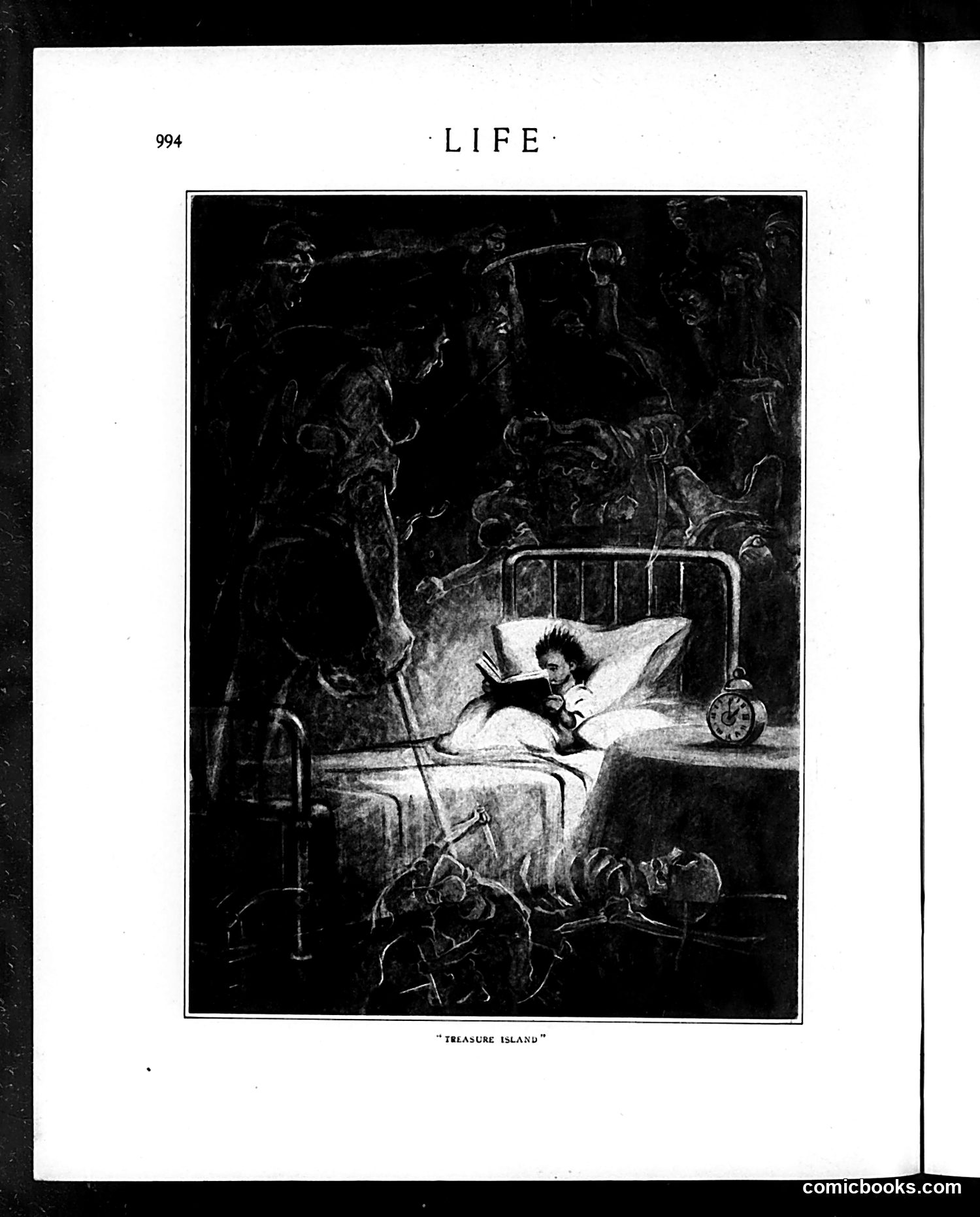
This illustration, captioned "Treasure Island," depicts a sick child in bed surrounded by shadowy figures. The work appears to be a satirical commentary on children's literature or entertainment, likely critiquing Robert Louis Stevenson's famous adventure novel "Treasure Island." The contrast between the bedridden, vulnerable child and the dark, imposing figures looming above suggests social commentary—possibly about how popular adventure stories affect young readers, or about exploitation of children through literature and imagination. The nightmarish quality of the surrounding figures transforms the romantic adventure narrative into something sinister or corrupting. Without additional context from the magazine issue, the exact satirical target remains unclear, but the image effectively inverts the adventure story's adventurous spirit into something morally or psychologically troubling for its young audience.
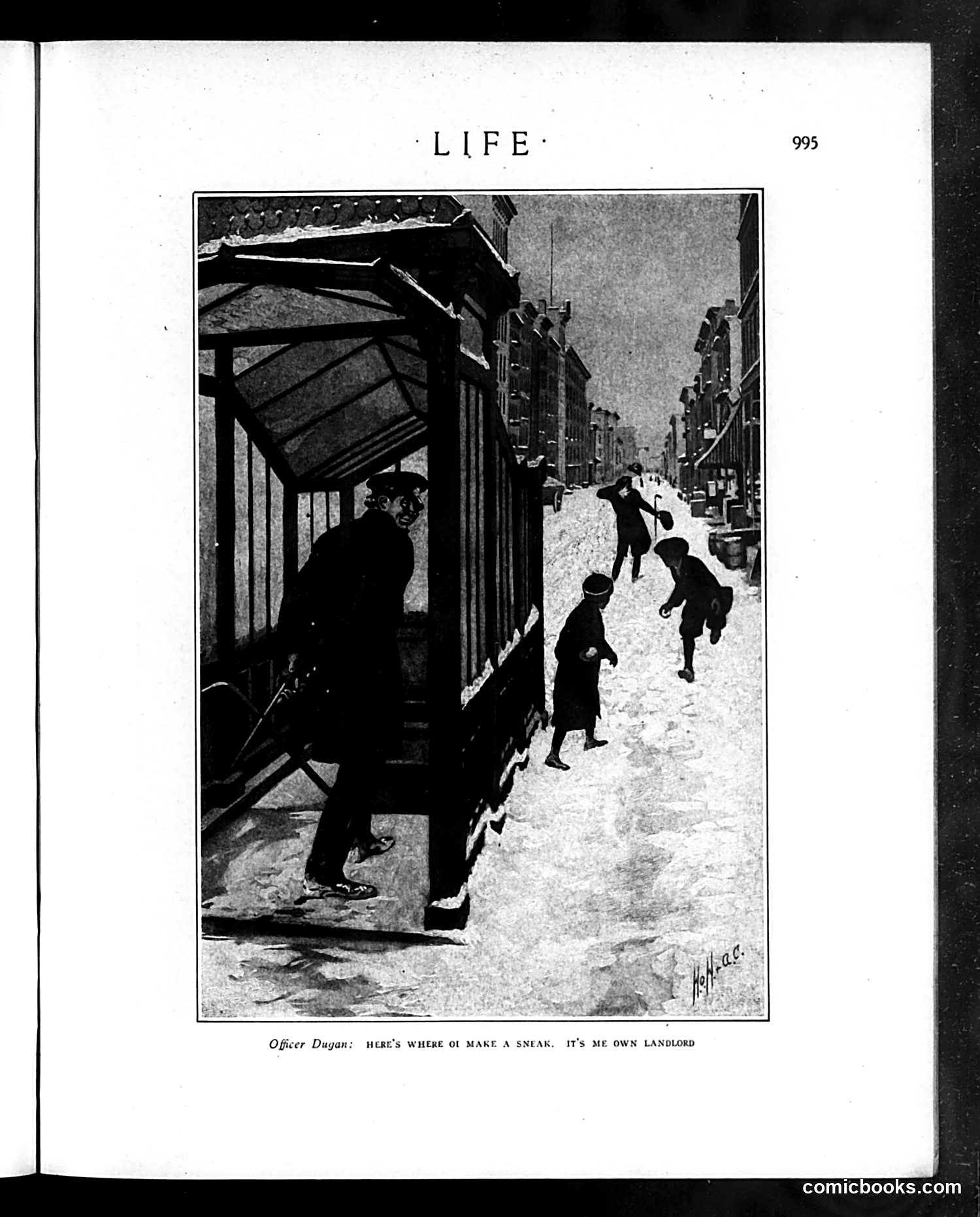
This is a satirical cartoon about housing and landlord-tenant relations. It depicts Officer Dugan (likely a recurring character in Life magazine) attempting to sneak past his own landlord on a snowy street. The joke plays on the irony that even a police officer must hide from his landlord—suggesting widespread difficulty tenants faced in paying rent or dealing with demanding landlords. The "sneak" reflects the common practice of tenants avoiding landlords to escape confrontation over unpaid rent or eviction notices. This reflects early 20th-century urban housing tensions, when landlord exploitation and tenant vulnerability were significant social issues. The humor derives from the absurdity of a law enforcement officer needing to hide from a civilian authority figure.
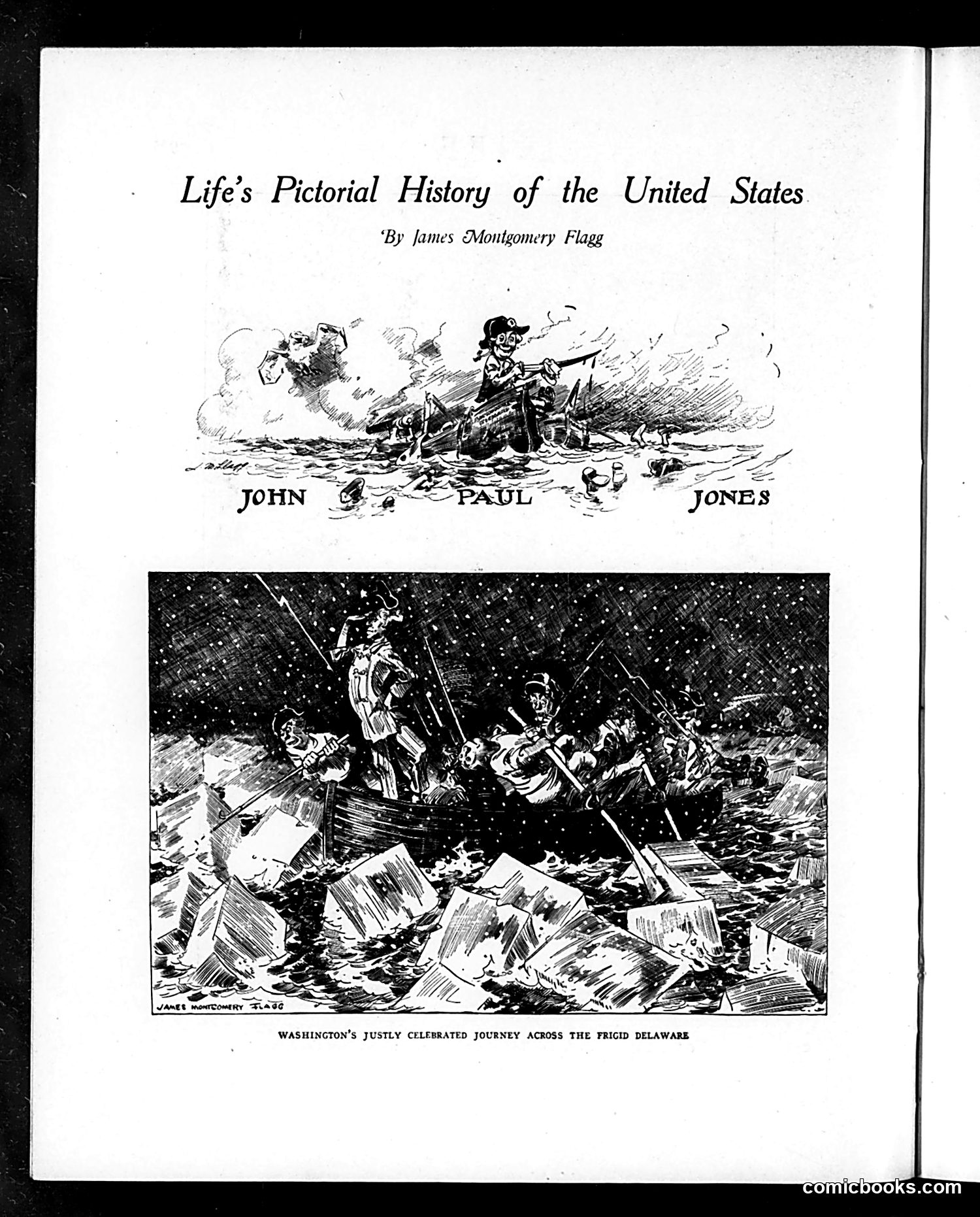
This is a title page from James Montgomery Flagg's satirical series in *Life* magazine. The illustration depicts **Washington's crossing of the Delaware River** — the famous 1776 Revolutionary War moment — but reimagined as comedic chaos. The sketch shows soldiers struggling in a boat amid floating debris and ice, with the caption naming "John Paul Jones" (a naval commander), suggesting confusion about which historical figure led this particular operation. The satire appears to mock either: - Popular misunderstanding of Revolutionary history - The romanticized versus messy reality of the crossing - Period confusion about which hero did what Flagg was a famous illustrator known for WWI propaganda posters. This series lampooned American historical narratives through deliberate inaccuracy and visual humor — essentially asking readers: do we really know our own history?
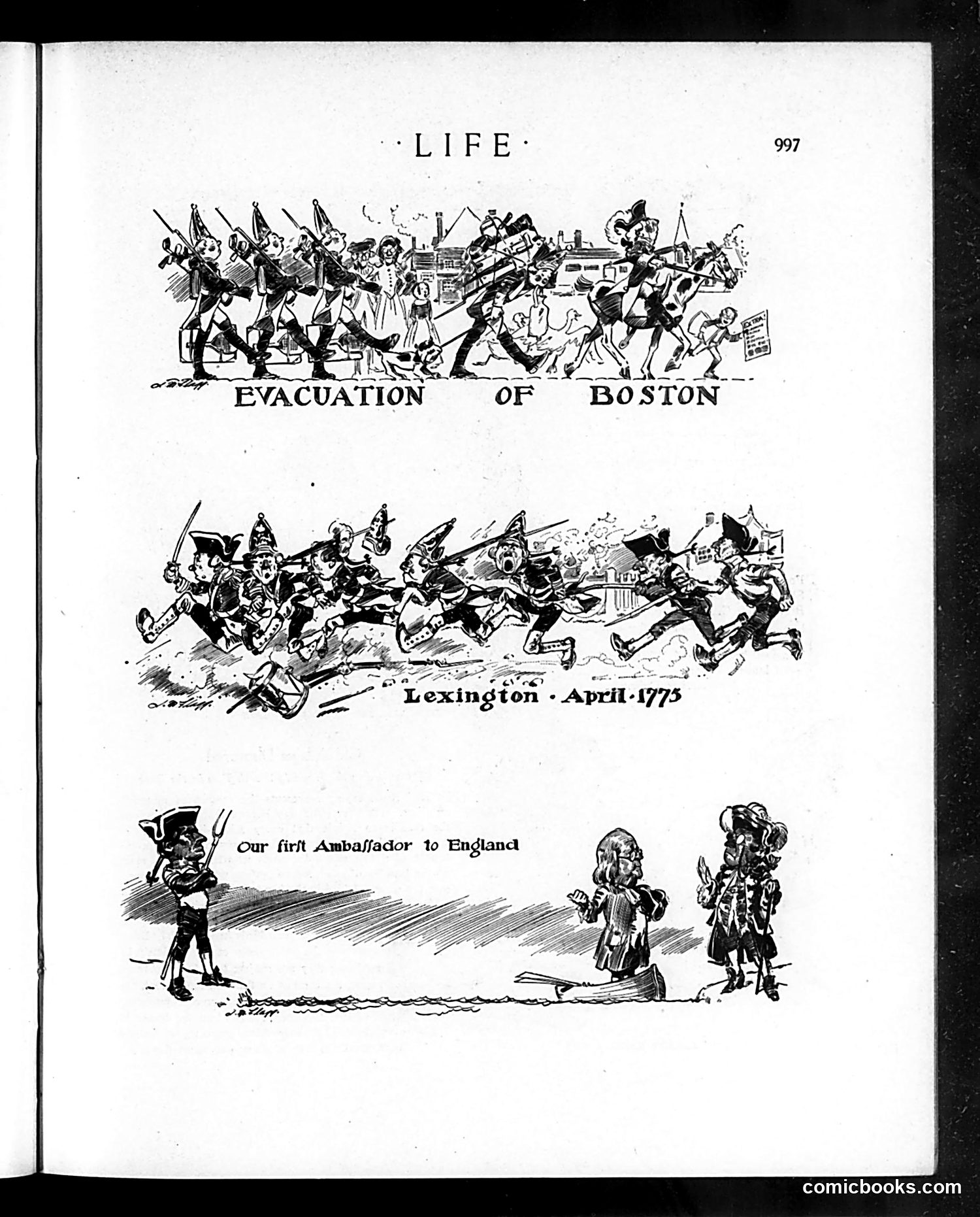
This page contains three satirical cartoons about early American Revolutionary War events: 1. **"Evacuation of Boston"** - depicts British soldiers hastily departing Boston with civilians and supplies in chaotic disarray, satirizing the British military retreat from the city in 1776. 2. **"Lexington - April 1775"** - shows caricatured British soldiers fleeing in panic from American forces, mocking the British defeat at the Battle of Lexington, one of the war's opening engagements. 3. **"Our first Ambassador to England"** - appears to show a caricatured American figure confronting or addressing British officials, likely satirizing early American diplomatic efforts or the reversal of colonial subservience. The cartoons use exaggerated caricature and comedic imagery to celebrate American military successes and mock British setbacks during the Revolutionary War period.
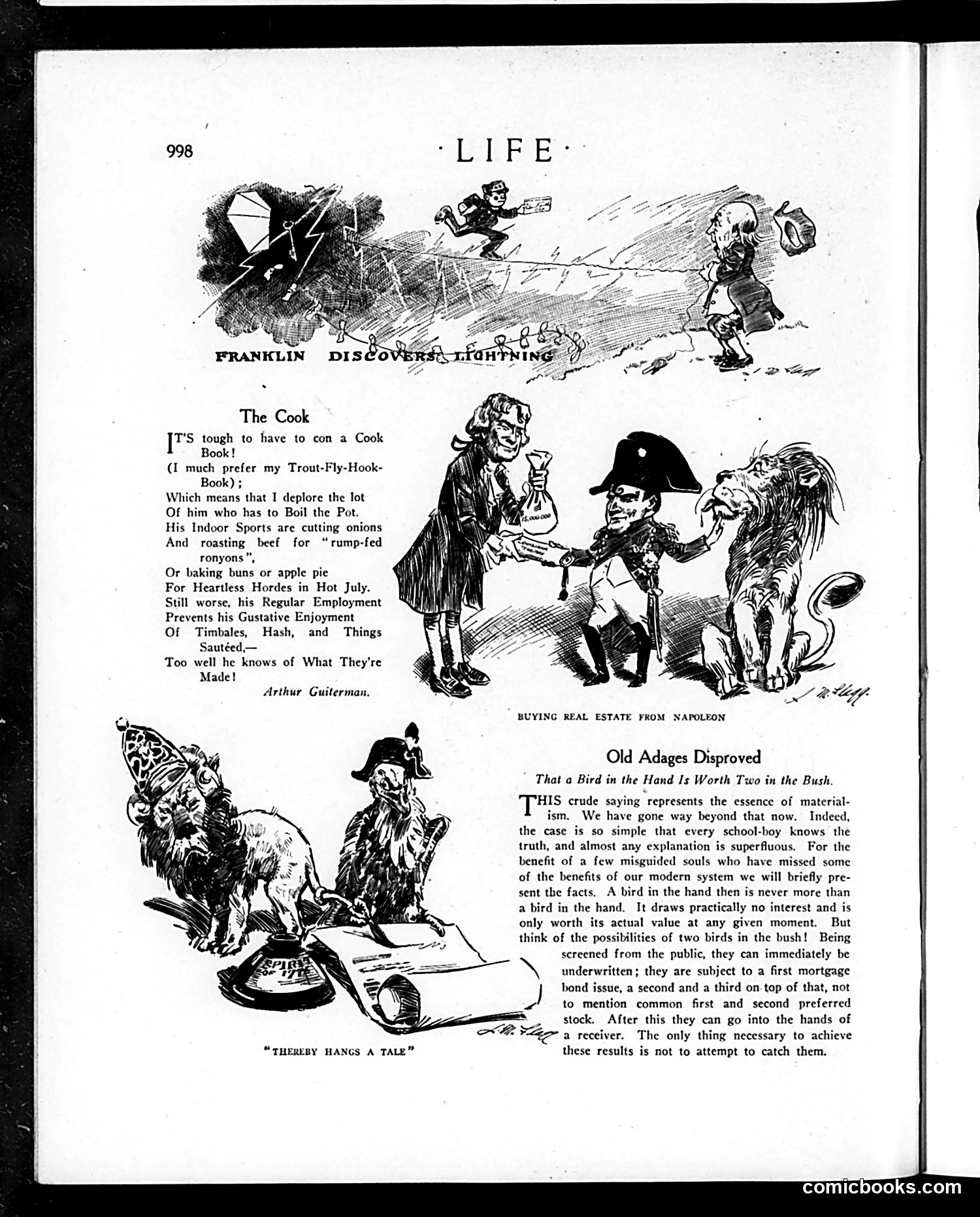
This page contains three distinct satirical pieces: **"The Cook"** (by Arthur Guiterman): A humorous poem mocking the profession of cooking. The joke is that cooks must prepare elaborate dishes they cannot enjoy eating themselves—they know too well how these foods are made, spoiling their appetite. It's gentle satire on culinary labor. **"Buying Real Estate from Napoleon"**: The cartoon caption suggests a financial scam—someone fraudulently selling property allegedly owned by the deceased Napoleon Bonaparte. **"Old Adages Disproved"**: Sharp financial satire targeting modern capitalism and speculation. It mocks the proverb "a bird in the hand is worth two in the bush" by showing how financiers exploit intangible assets. Two birds in the bush can be mortgaged, underwritten with bonds, and leveraged repeatedly—generating paper wealth from nothing. The joke's dark punchline: "the only thing necessary to achieve these results is not to attempt to catch them" (i.e., never actually possess anything real). This satirizes 1920s financial speculation and bubble economics.
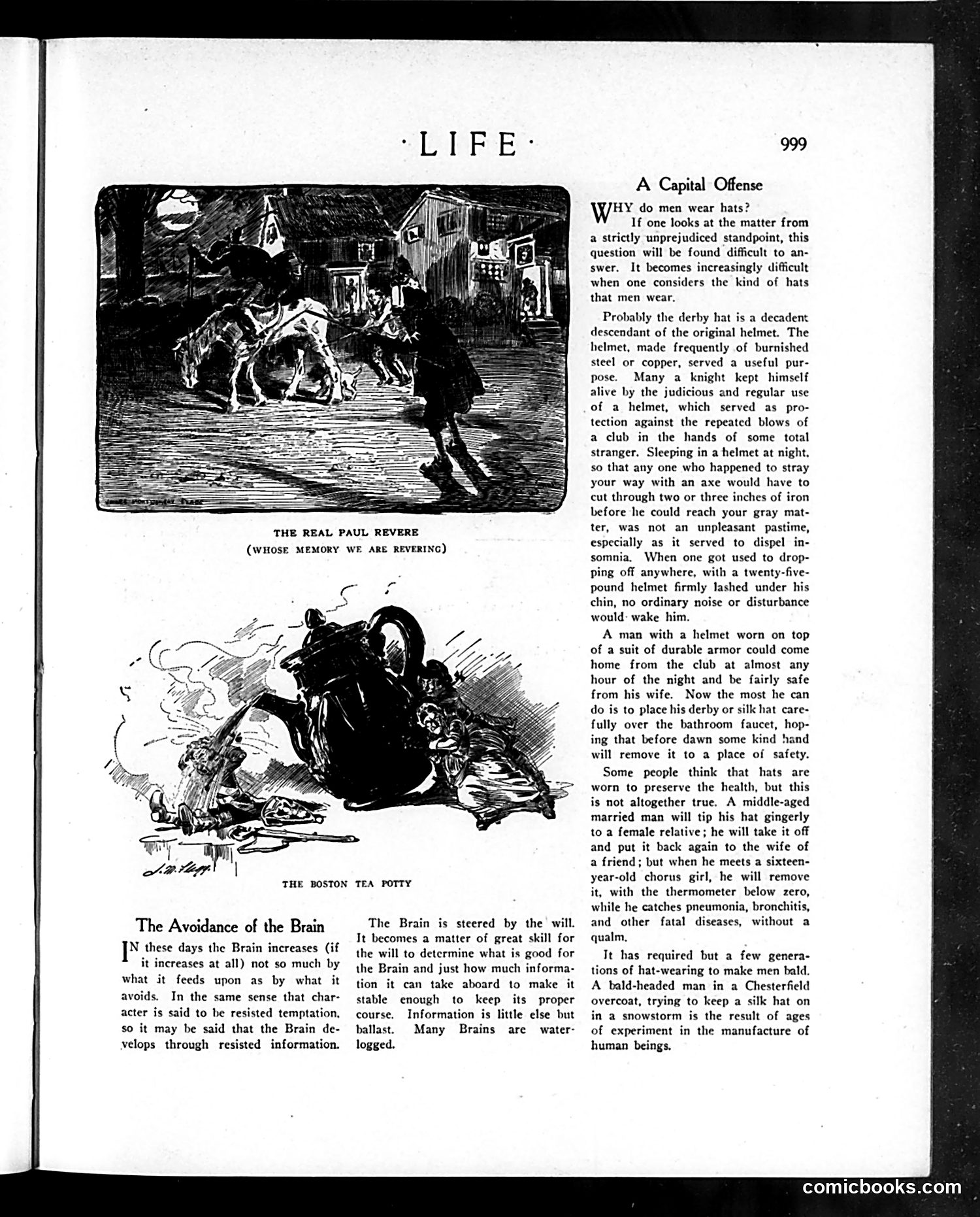
This page contains two satirical pieces typical of early 20th-century American humor: **"The Real Paul Revere"** mocks the romanticized historical memory of the American Revolutionary figure. The contrasting illustrations—one idealized, one showing an apparently drunk or disorderly figure labeled "The Boston Tea Potty"—suggest the gap between heroic mythology and actual historical reality. It's a lighthearted jab at selective national memory-making. **"A Capital Offense"** humorously traces the derby hat's decline from practical medieval armor to modern fashion liability. The piece satirizes how modern men's hats serve no protective purpose yet remain socially obligatory. The joke culminates in the absurd image of men removing hats to impress young women while catching pneumonia in freezing weather—suggesting hat-wearing customs are driven by vanity rather than sense, and have literally caused male baldness over generations. Both pieces exemplify Life's satirical approach: deflating pretension through exaggerated logic and historical comparison.
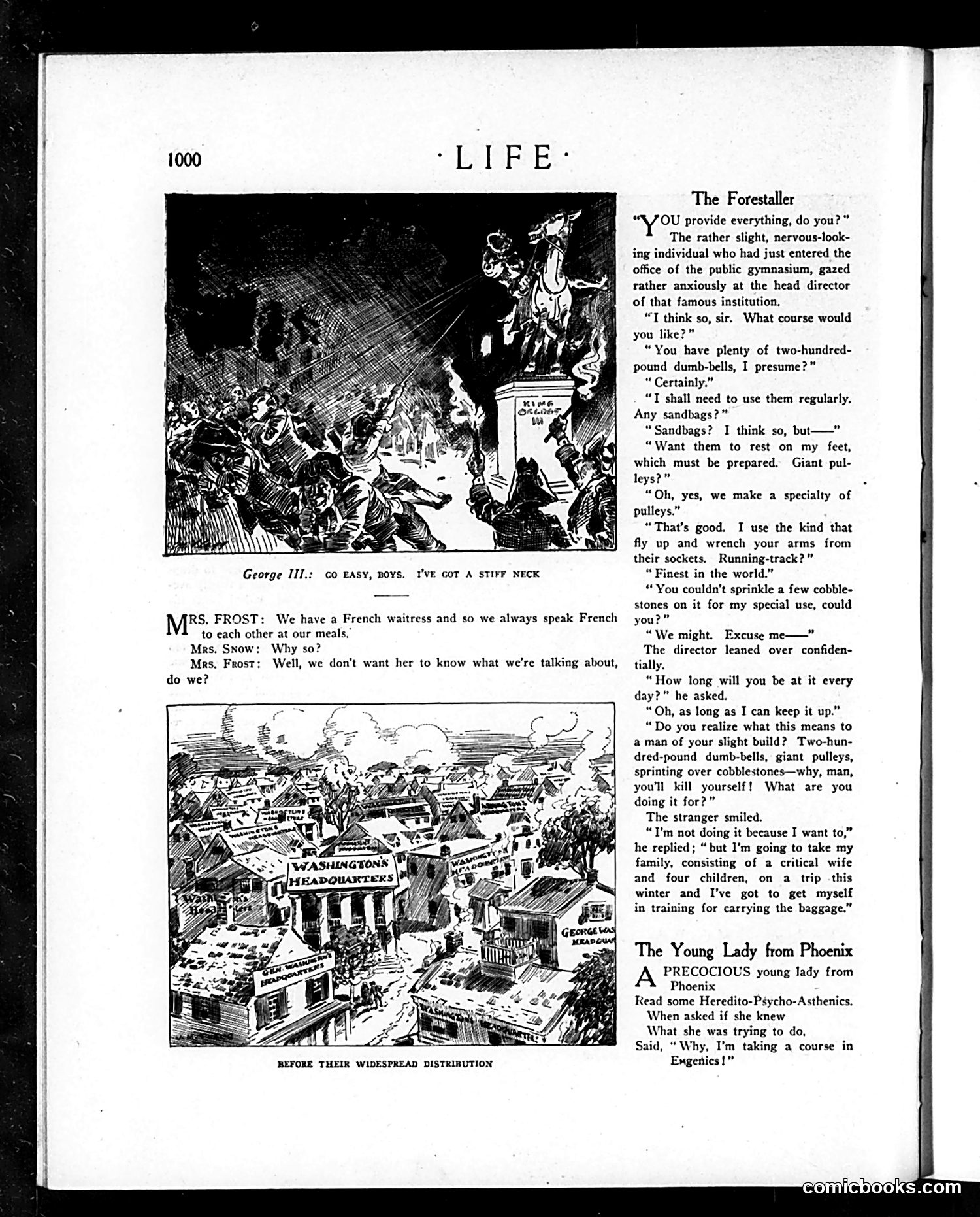
**Top Cartoon - George III:** This depicts King George III with a "stiff neck," likely referencing the British monarch's famous mental illness (porphyria). The joke plays on his physical rigidity with a crude visual pun about his condition being well-known. **Middle Dialogue - Mrs. Frost & Mrs. Snow:** A domestic humor piece about a woman who employs a French waitress and deliberately speaks French at meals so the employee won't understand their conversation. The satire targets both class pretension (speaking French for sophistication) and the absurdity of this deceptive strategy. **"The Forestaller" Story:** Satirizes an anxious man who methodically equips himself at a gymnasium with extreme training equipment (200-pound dumbbells, cobblestones, pulleys). The punchline: he's not training for athletic glory but to physically prepare himself to carry his family's baggage on a winter vacation—mocking both masculinity expectations and the harried husband stereotype. **"Young Lady from Phoenix":** A light joke about pseudo-intellectual pretension—a girl reads about eugenics but misunderstands the field as personal self-improvement rather than hereditary science.
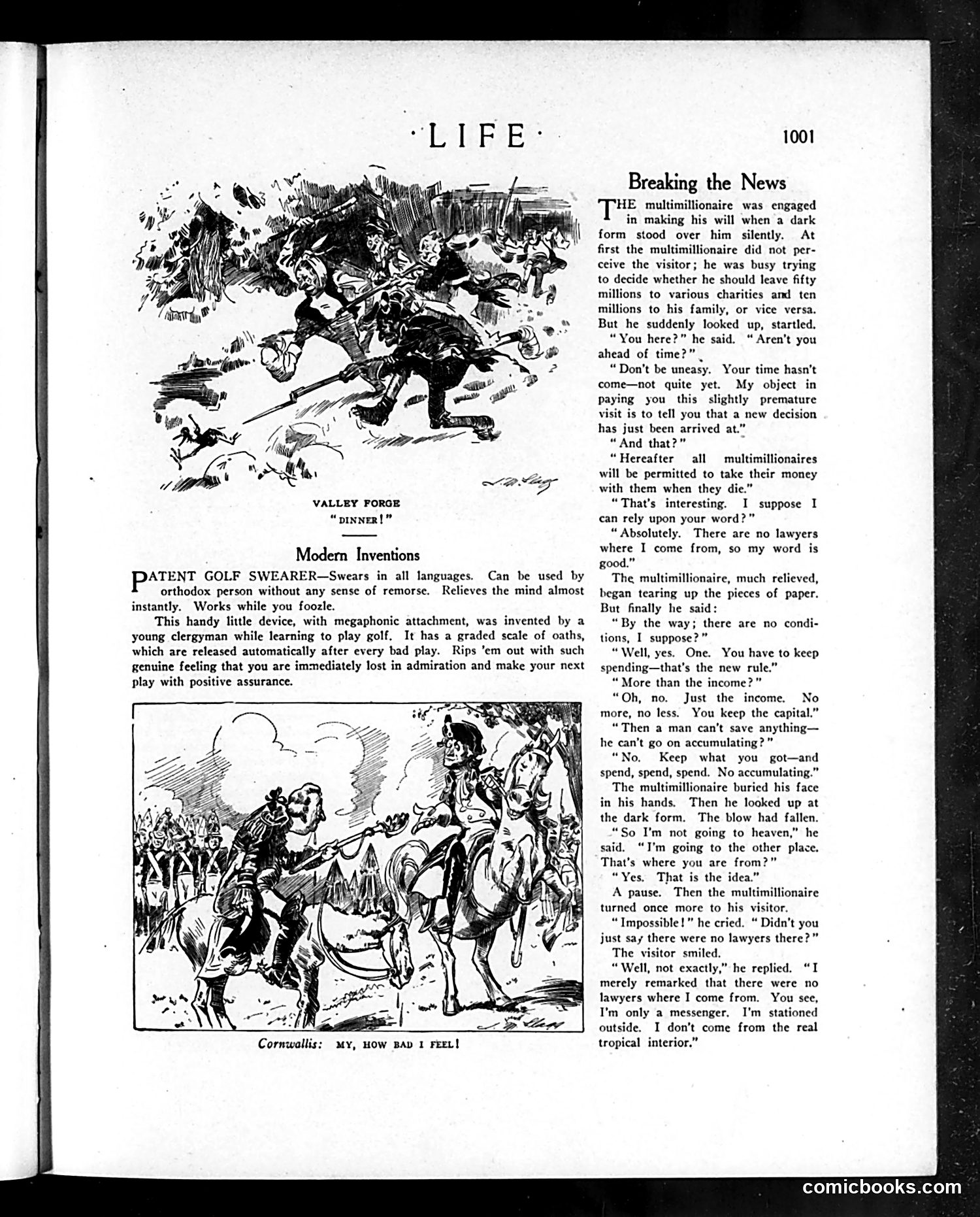
This page satirizes **wealth and the afterlife**. The main story, "Breaking the News," features Death (depicted as a dark form) visiting a multimillionaire who's drafting his will. Death announces a new divine rule: the wealthy can now take their money with them when they die—but with a catch: they must spend their entire income annually and never accumulate capital. The joke's sting: forced spending becomes a **punishment worse than damnation itself**. The multimillionaire is more horrified by the spending requirement than by learning he's going to Hell. Only when Death clarifies there are "no lawyers" in Hell does the man despair—until Death reveals this messenger isn't actually from Hell's "interior," just stationed outside. The satire mocks **Gilded Age attitudes**: extreme wealth-hoarding, the equation of accumulation with virtue, and the implicit assumption that the rich believe they can escape consequences. The added "Modern Inventions" joke about a "Patent Golf Swearer" continues the satirical tone about social pretense.
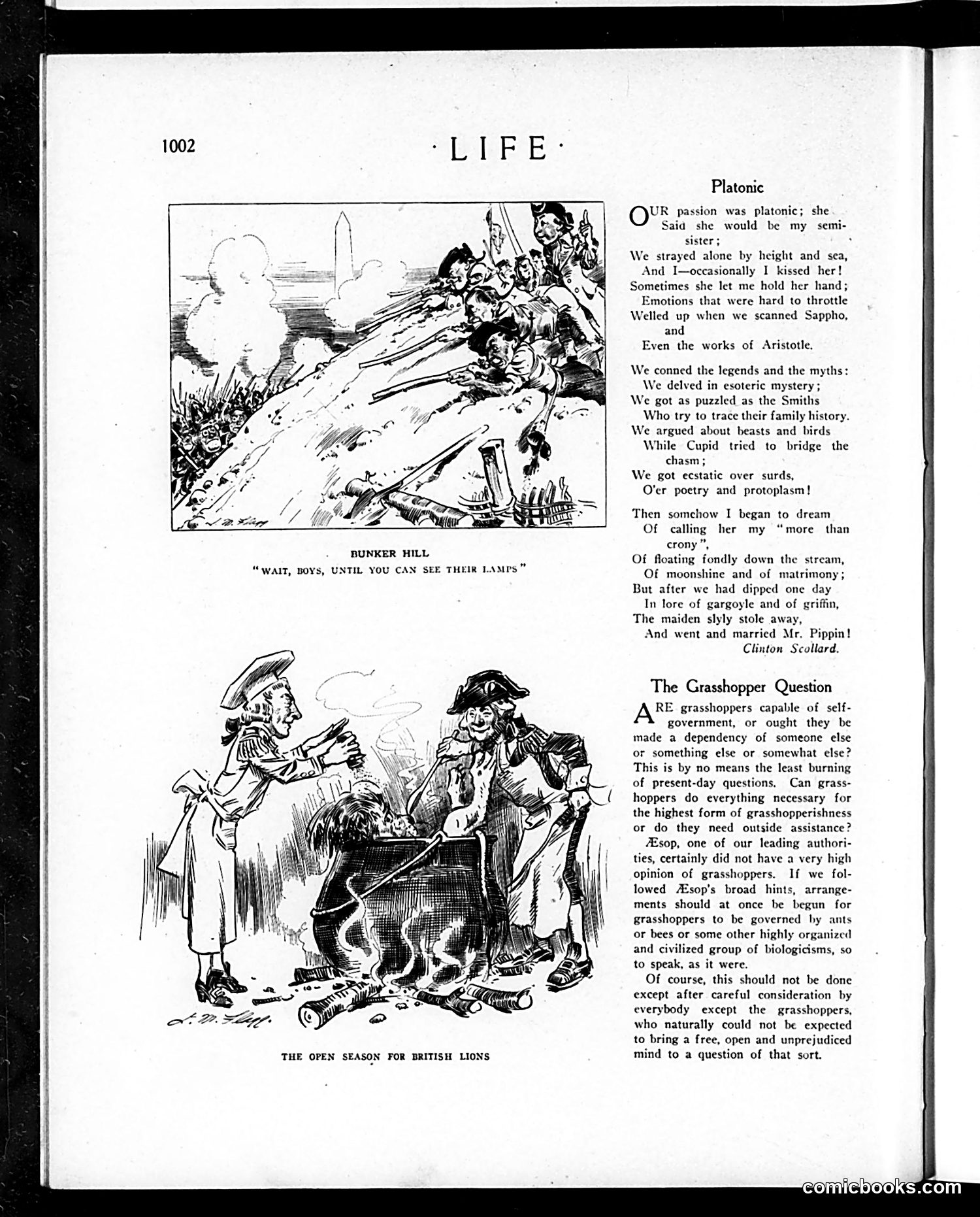
**"Platonic" (top right):** A humorous poem by Clinton Scollard about a romantic relationship disguised as intellectual companionship. The narrator and a woman claim their bond is "platonic" while they kiss, hold hands, and study philosophy together. The joke culminates when she unexpectedly marries someone else (Mr. Pippin), leaving him heartbroken. The satire mocks the pretense of purely intellectual relationships while emotions clearly simmer beneath. **"Bunker Hill" cartoon (top left):** A Revolutionary War scene referencing the famous order "Don't fire until you see the whites of their eyes," here adapted to "Wait, boys, until you can see their lamps"—likely a humorous take on military strategy or preparation. **"The Grasshopper Question" (bottom):** Political satire using grasshoppers as stand-ins for a group debated about self-governance. The piece ironically suggests grasshoppers should be governed by ants or bees (more "organized" groups), while excluding grasshoppers themselves from the decision. This likely satirizes imperialist or paternalistic arguments about whether certain populations could govern themselves.
This is a humorous essay, not a political cartoon. Chesterton argues that popular Christmas music and art must be *comprehensible* to succeed—using the telephone as his metaphor. Saying "A happy Christmas" communicates clearly; saying "A happy Isthmus" confuses the recipient into thinking you're discussing Panama. His satire targets modernist artists and intellectuals who prize incomprehensibility as sophistication. Chesterton contends this is actually *vulgar*—not elevated—because obscurity becomes commonplace and easy to achieve. He champions simple, clear communication over pretentious obscurity. The essay concludes approvingly with working-class "ornaments" (rat-catchers) singing intelligible Christmas carols outside his window—authentic popular tradition outweighs affected artistic complexity.
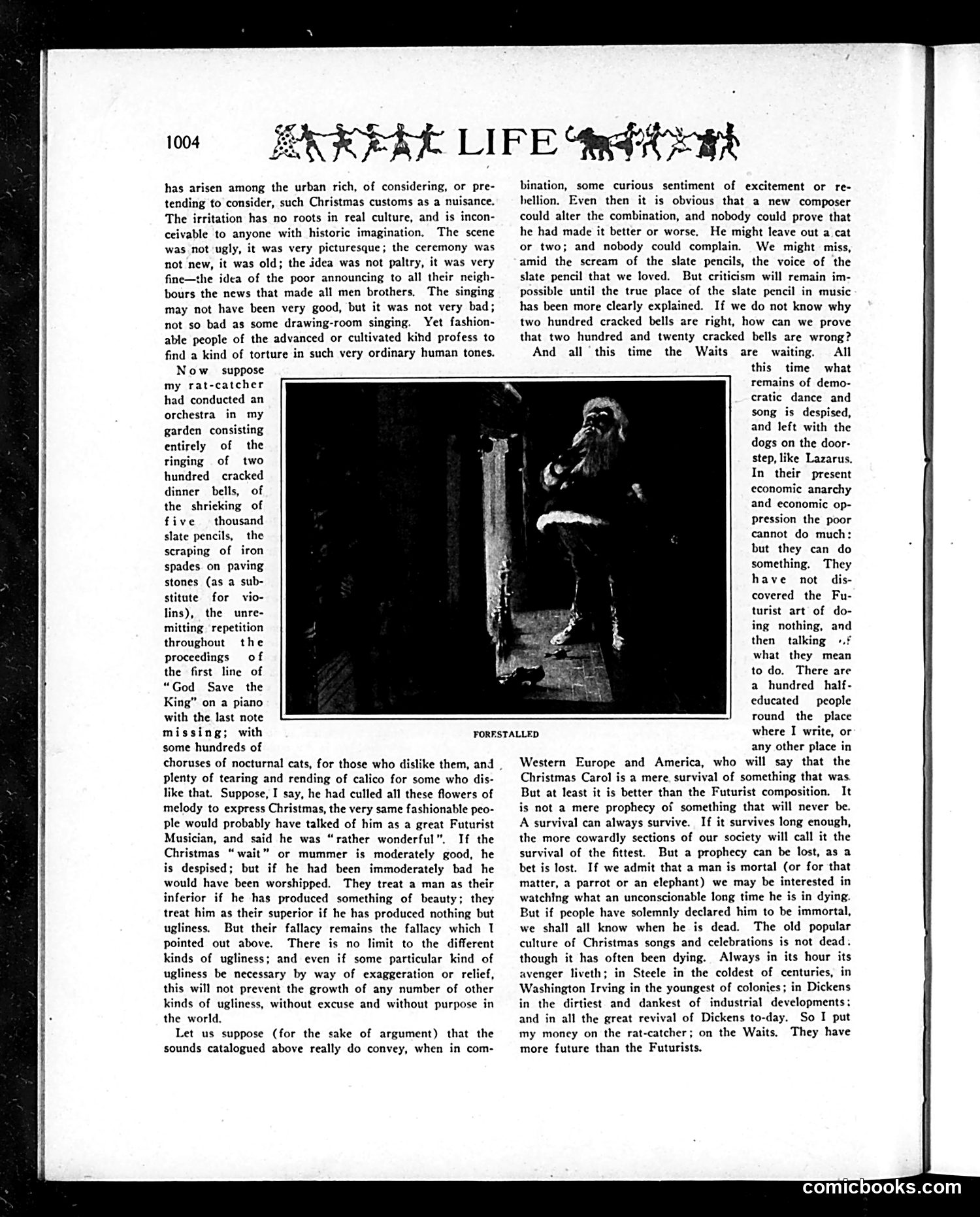
The image shows "Forestalled," depicting a figure in a doorway—likely representing Christmas carolers or "the Waits" (traditional carol singers mentioned in the text). The article satirizes wealthy urban elites who dismiss Christmas carols and caroling as vulgar nuisances, despite their historical and cultural significance. The author argues that the poor's democratic tradition of singing carols to announce "the news that made all men brothers" possesses genuine beauty and meaning. The satire targets class hypocrisy: fashionable people who would praise as "wonderful" Futurist art deliberately composed of discordant sounds (cracked bells, slate pencils, iron scraping) yet despise humble carolers producing similar cacophony. The piece defends working-class customs against snobbish modernist pretensions, suggesting that dismissing caroling reflects not refined taste but affectation and contempt for ordinary people's expressions of human connection.
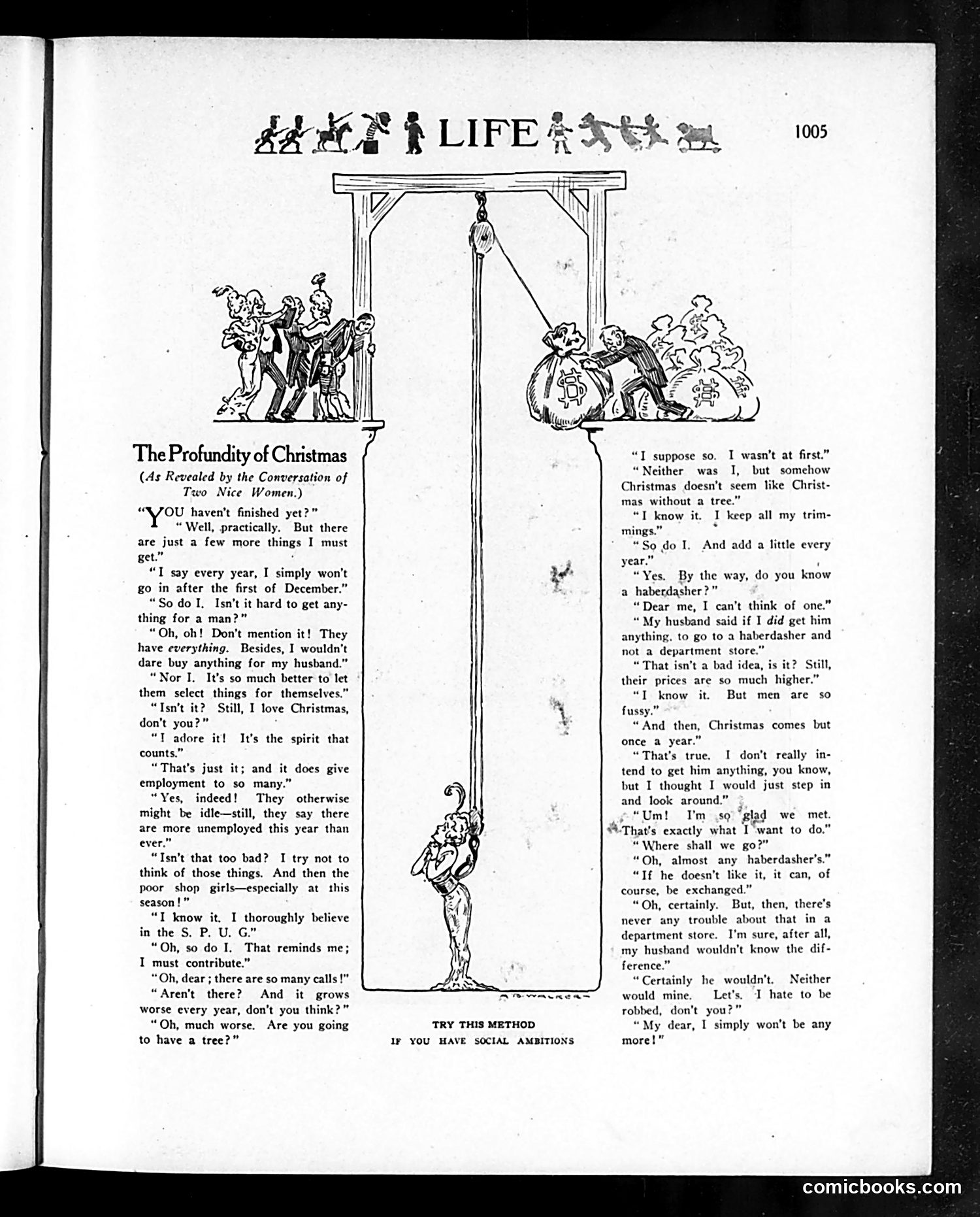
This satirical piece mocks upper-middle-class women's Christmas shopping habits and shallow moral posturing. Two women discuss holiday preparations, revealing contradictions: they claim to hate shopping but continue buying; they worry about unemployed shop girls yet patronize them; they profess concern for the poor (donating to "S.P.U.G.," likely a charity) while complaining about charitable appeals. The humor centers on their circular logic about gifts—neither wants to buy for their husbands, yet both will shop anyway. They debate department stores versus haberdashers based purely on price and return policies, while insisting men won't notice the difference. The final irony: they claim to "hate being robbed" while knowingly wasting money on gifts no one truly wants. The cartoon illustrates empty Christmas materialism masked by performative concern for social welfare.
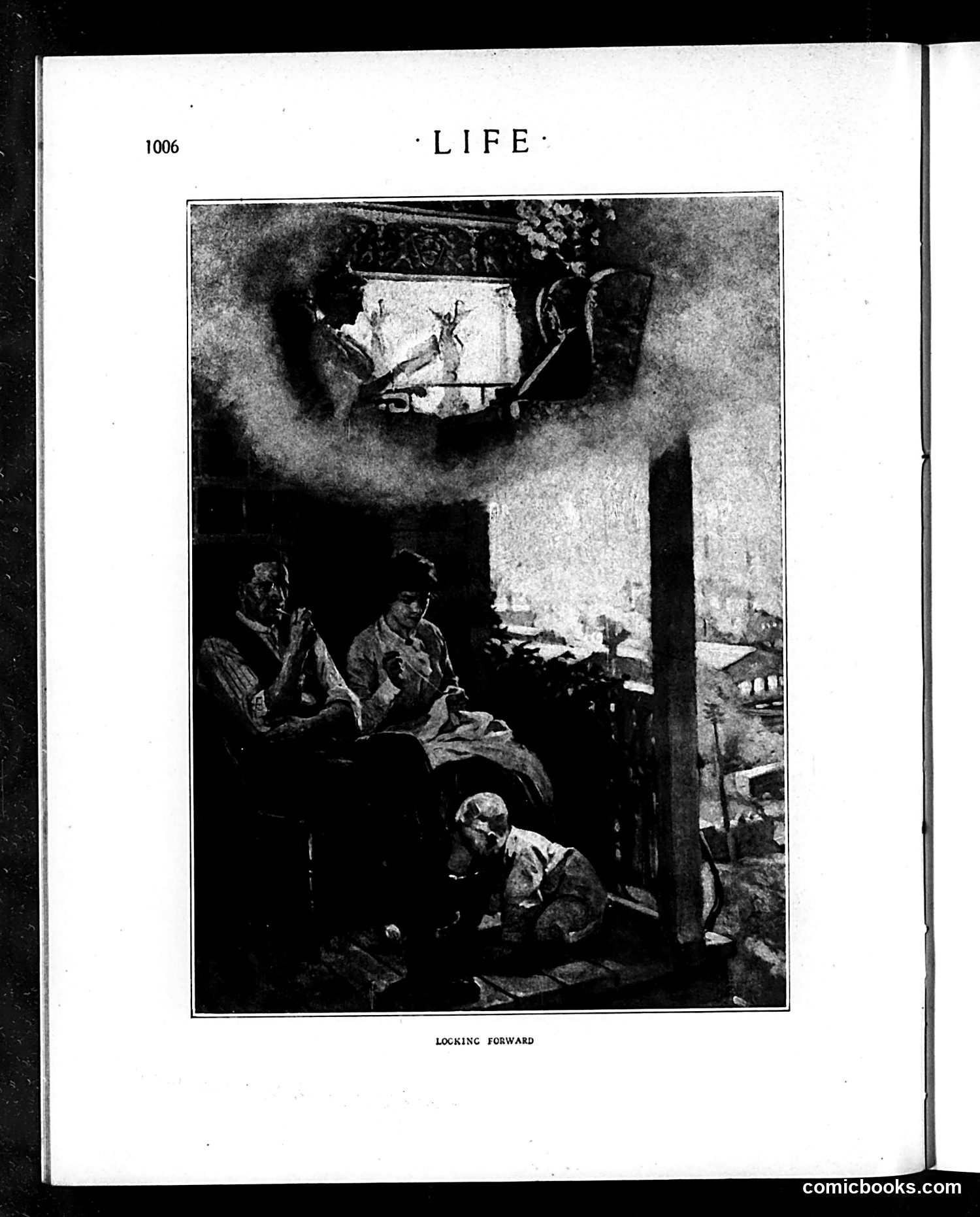
This political cartoon depicts three figures in what appears to be a modest interior space, gazing out a window toward an industrial cityscape. The title "Looking Forward" suggests optimism about the future. The image likely reflects early-to-mid 20th century American social commentary—possibly addressing working-class hopes during economic uncertainty or post-war reconstruction. The figures appear to represent ordinary citizens (potentially a family), contrasted against the industrial landscape, which was a common satirical device in Life magazine to explore themes of progress, labor, class disparity, or economic aspiration. Without additional context or visible captions identifying specific figures or events, the exact political reference remains unclear, though the composition emphasizes the gap between modest present circumstances and imagined industrial-urban futures.
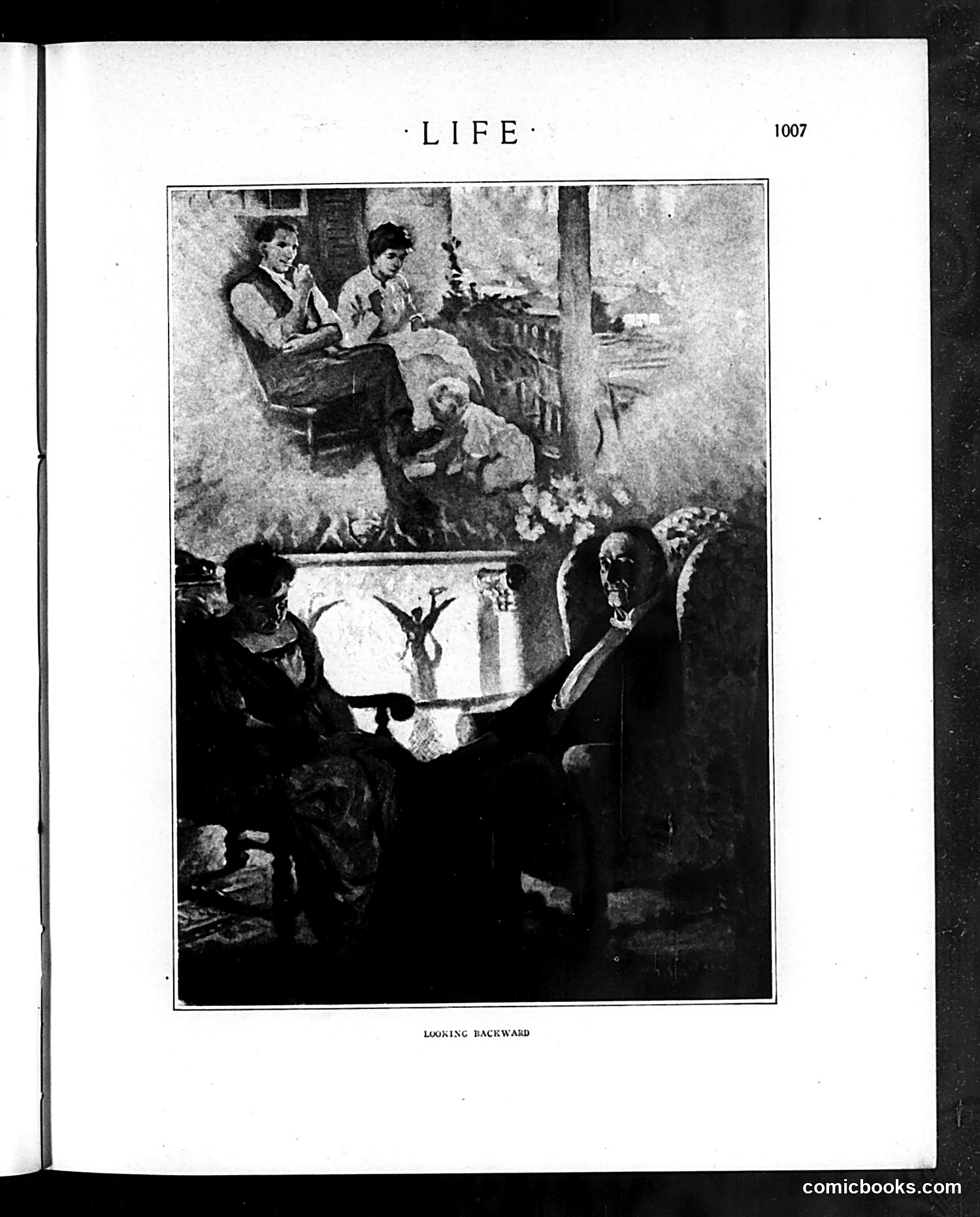
This illustration depicts a theatrical or dramatic scene titled "Looking Backward," likely referencing Edward Bellamy's famous 1888 utopian novel of the same name. The image shows two distinct scenes: upper figures appear to be in a future or idealized setting (possibly depicting the novel's vision), while lower figures observe them, suggesting a contrast between present reality and imagined future. The satire appears to critique utopian idealism or socialist visions popular in the era by juxtaposing them against contemporary observers' skeptical reactions. The composition uses the theatrical frame device—showing people watching a staged vision—to mock the gap between utopian fantasy and actual social conditions. The specific political commentary remains unclear without additional context about the publication date.
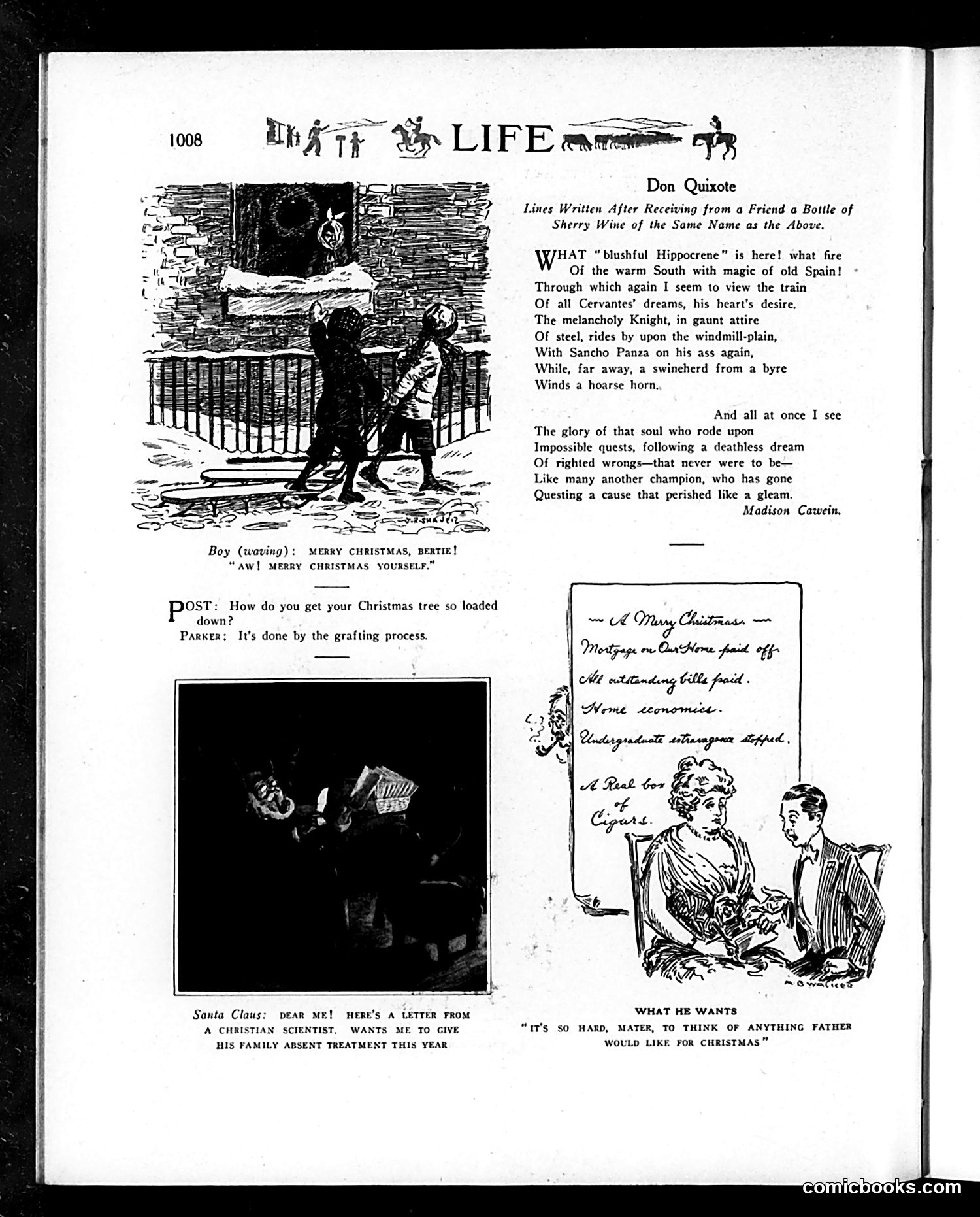
This page contains three separate satirical pieces typical of early 20th-century Life magazine humor: **Top cartoon**: A Don Quixote literary tribute—a poem celebrating the classic novel, accompanying an illustration of the delusional knight on his horse. This appears to be inspired by receiving a bottle of sherry wine bearing the same name. **Middle cartoons**: Two Christmas-themed jokes. The first mocks the "grafting process" for loading Christmas trees—likely a pun on agricultural grafting applied absurdly to holiday decoration. The second ridicules Christian Science's practice of "absent treatment" (spiritual healing conducted remotely), suggesting someone wants Santa to magically benefit their family without material gifts. **Bottom cartoon**: Satirizes the difficulty of selecting meaningful Christmas presents, showing a mother and son discussing a father's gift—playing on the common complaint that wealthy or satisfied men need nothing material. The page exemplifies Life's satire of contemporary fads (Christian Science), literary pretension, and middle-class consumer culture around Christmas.
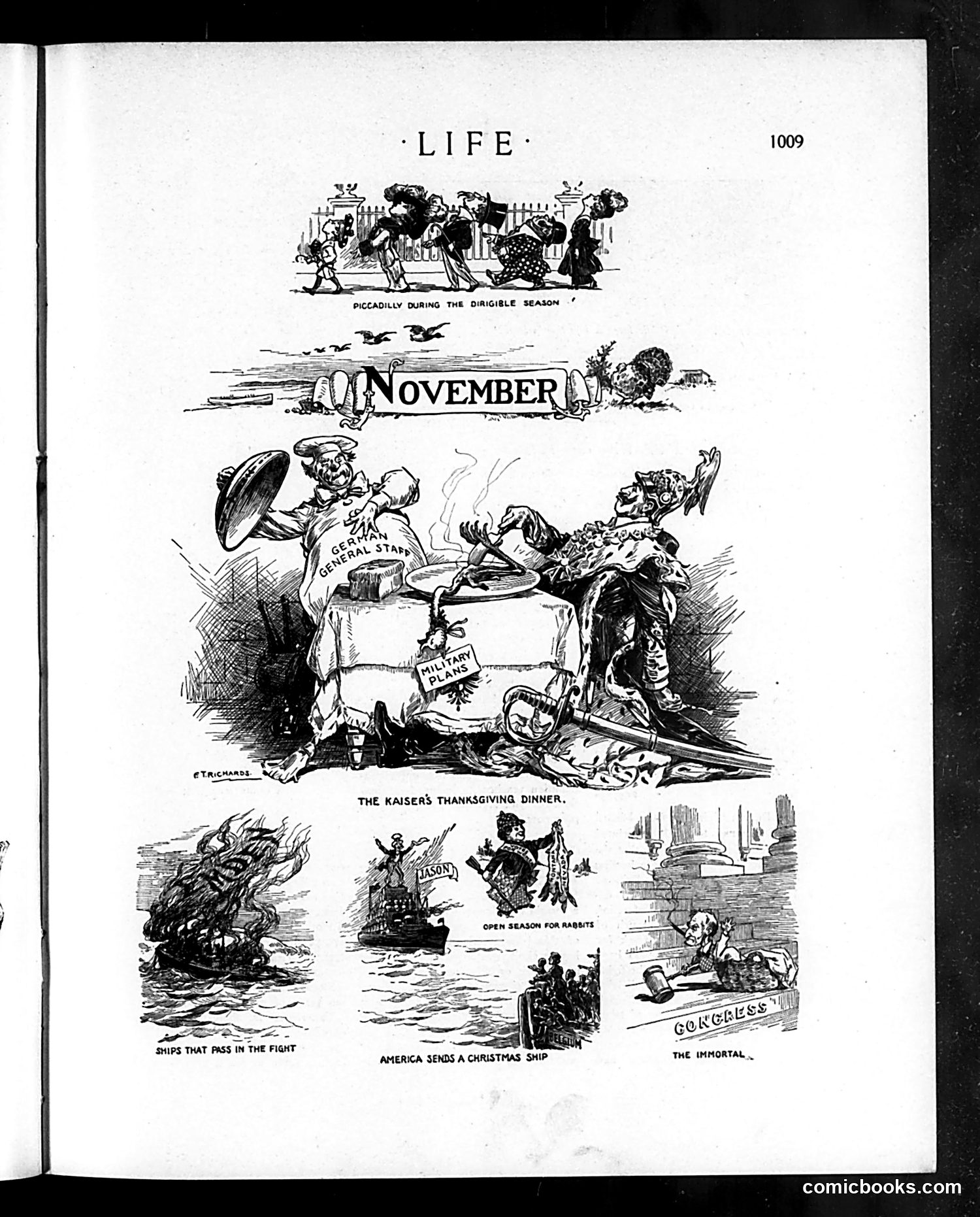
This Life magazine page satirizes World War I events during November, likely 1917. "The Kaiser's Thanksgiving Dinner" depicts German General Staff members feasting on "Military Plans" while chaos erupts—a darkly comic commentary on German leadership amid war. The bottom cartoons reference American naval involvement: "Ships That Pass in the Fight" shows naval combat; "America Sends a Christmas Ship" suggests U.S. military aid or intervention; and "The Immortal Congress" appears to mock the U.S. Congress's role. The top vignette about "Dirigible Season" references German zeppelin attacks on civilians—a contemporary terror tactic. Overall, the page mocks both German military ambitions and American political responses to the war, using grotesque caricature and dark humor typical of wartime propaganda cartoons.
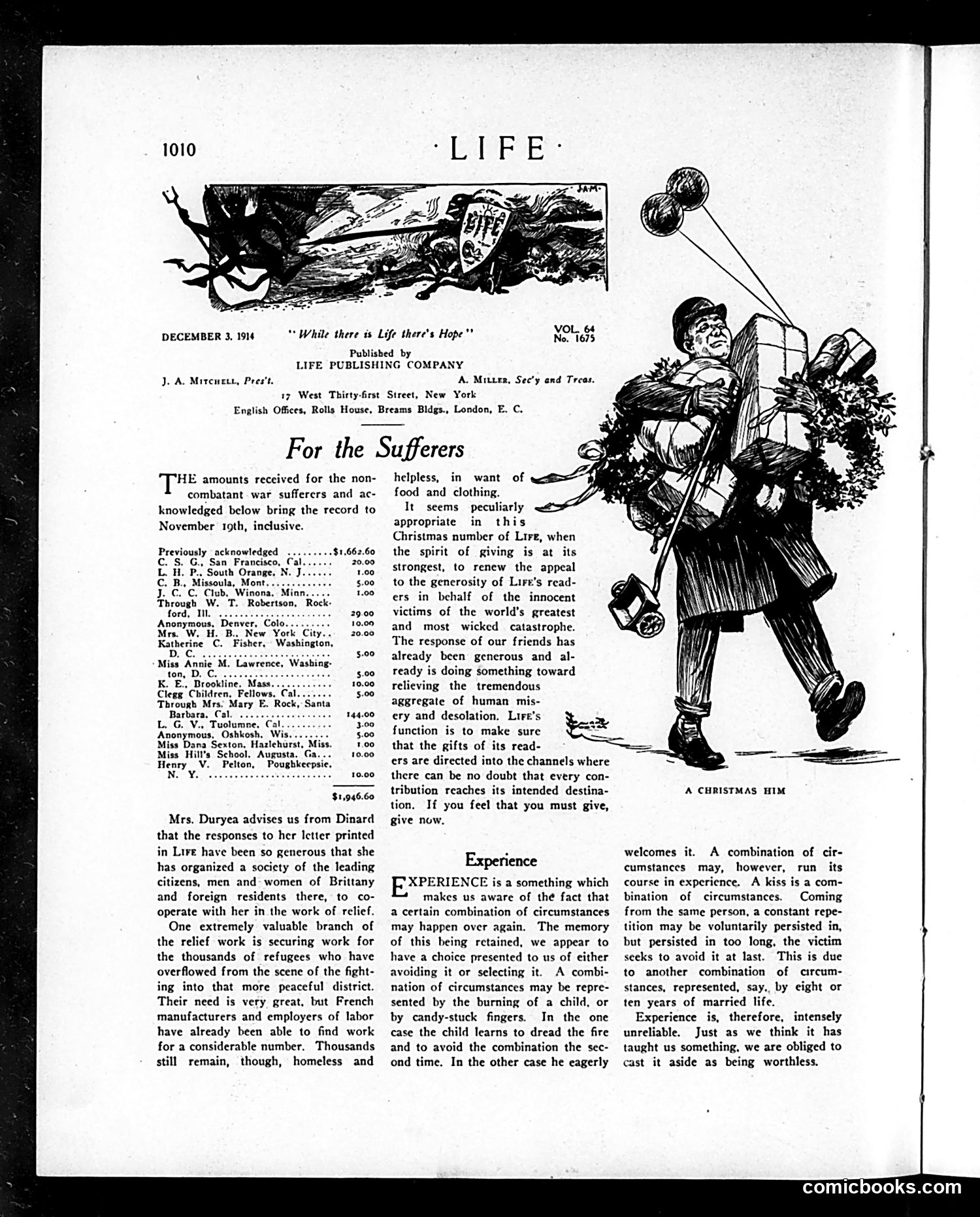
This is a charitable appeal page tied to World War I relief efforts. The main cartoon ("A Christmas Him") depicts Santa Claus or a gift-giver laden with packages, illustrating the Christmas spirit of generosity. The page solicits donations for "non-combatant war sufferers"—likely Belgian and French refugees displaced by fighting. A Mrs. Duryea, writing from Dinard (a French town), has organized relief efforts and secured employment for some refugees, but thousands remain homeless and destitute. The accompanying essay on "Experience" is philosophical—discussing how experience teaches us to avoid or repeat circumstances, using examples like a child learning fire is dangerous or a couple's repeated kisses eventually becoming unwelcome after years of marriage. It concludes that experience is ultimately "unreliable." The page represents Life magazine's attempt to balance serious humanitarian concerns with their typical satirical humor and literary content.
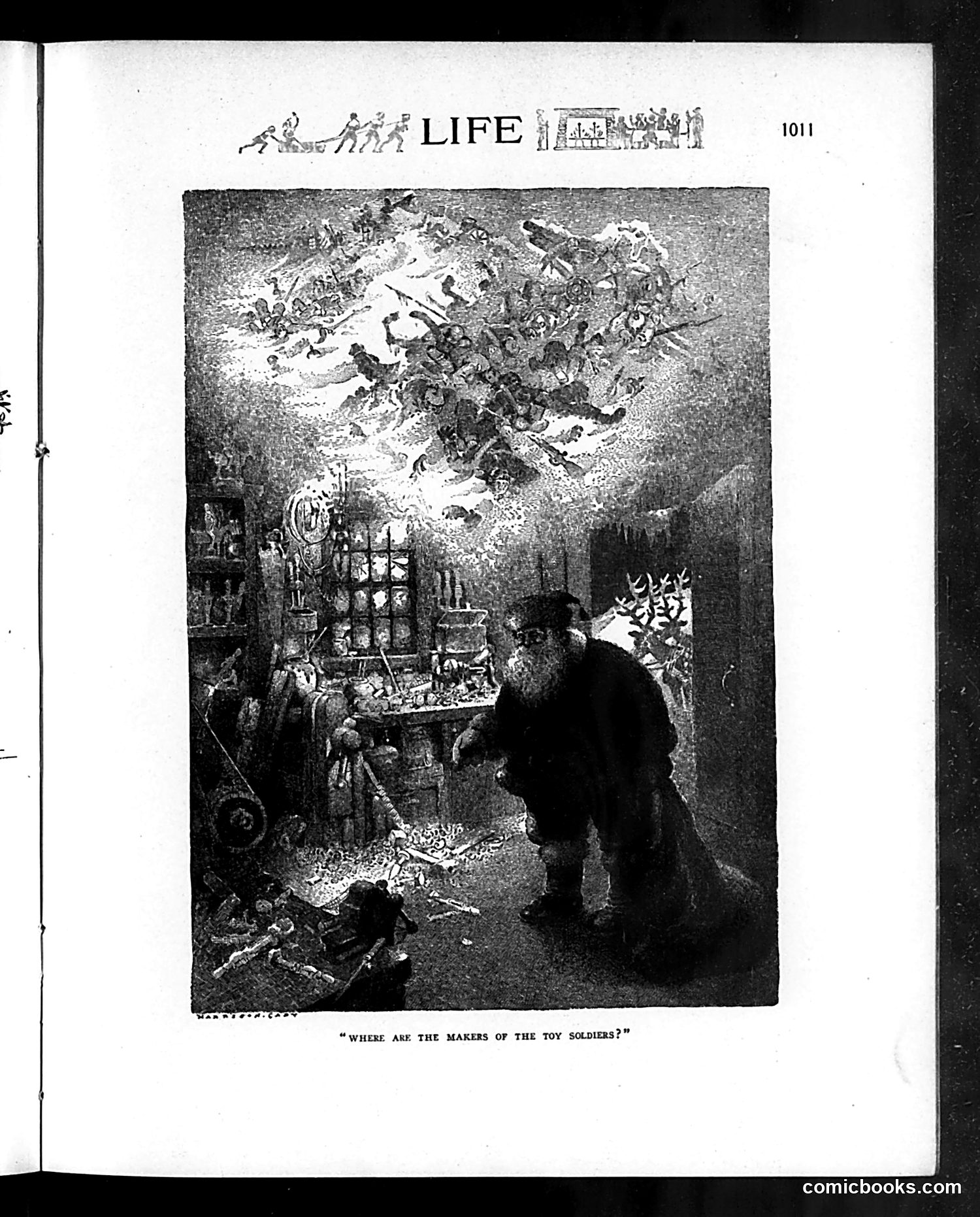
This is a satirical illustration from *Life* magazine showing an elderly craftsman or toymaker in his workshop, surrounded by toys and miniature soldiers. The caption poses an accusatory question: "Where are the makers of the toy soldiers?" The satire appears to criticize war profiteering or the commercialization of militarism. By depicting an actual craftsperson amid his humble creations, the cartoon suggests irony or hypocrisy—questioning who truly benefits from promoting warfare (represented by toy soldiers). The image implies that while individual artisans make literal toy soldiers for children's play, those who profit from real warfare remain hidden or unaccountable. The exact historical context is unclear without a date, but this likely critiques early 20th-century militarism or war industries.
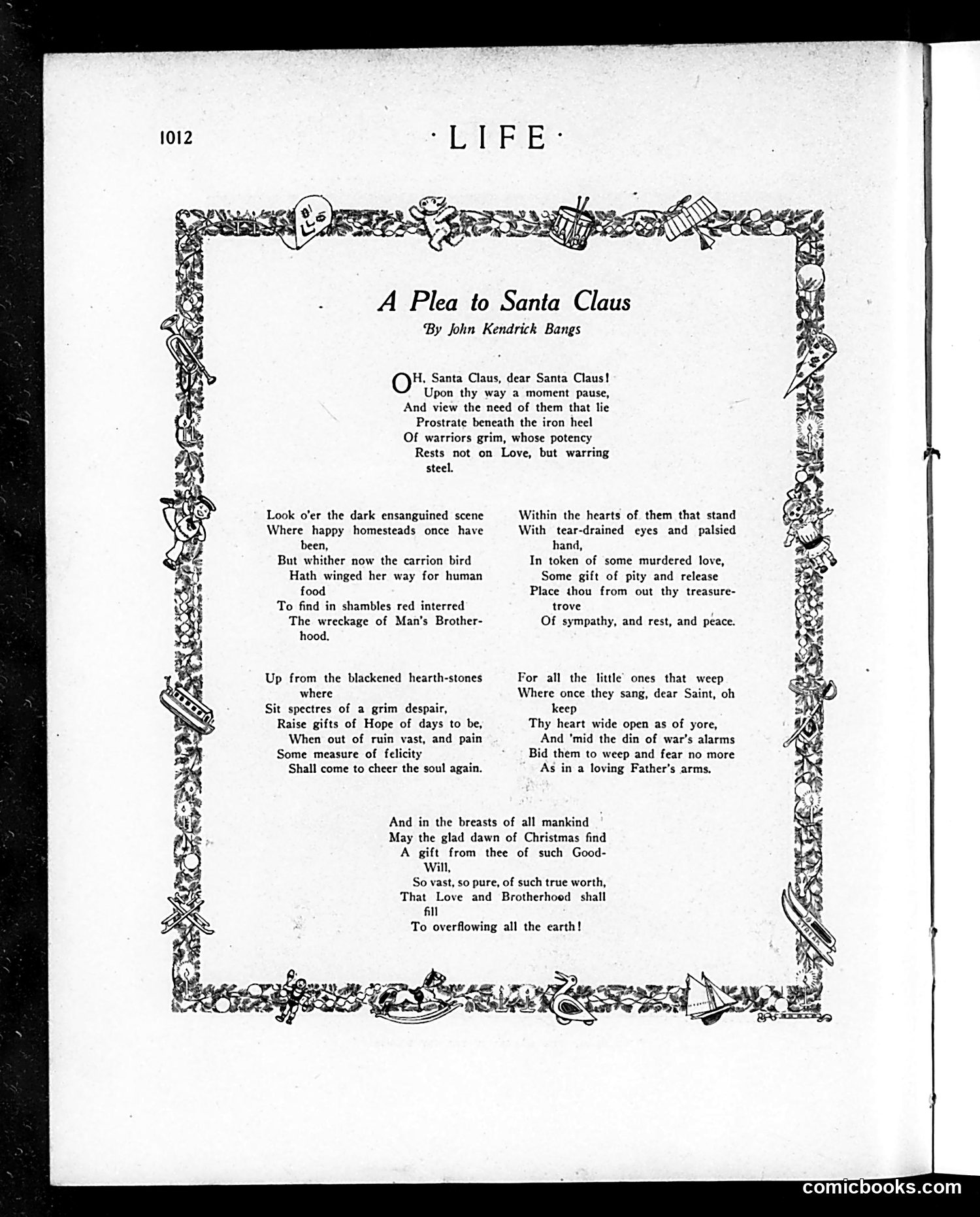
This is a serious wartime poem, not satire or humor. Published in *Life* magazine by John Kendrick Bangs, it's a Christmas plea addressing Santa Claus as a symbolic figure of compassion during what appears to be **World War I**. The poem asks Santa to bring comfort to war's victims: devastated homesteads, grieving families, orphaned children, and traumatized soldiers. Specific imagery—"dark ensanguined scene," "shambles red," "blackened hearth-stones"—depicts the war's destruction of civilian life and "Man's Brotherhood." Rather than typical holiday cheer, the poem requests Santa deliver "Hope," "pity," "rest," and "peace," culminating in a call for universal "Love and Brotherhood" to heal the earth. This represents how American magazines used Christmas rhetoric as moral commentary on the war's humanitarian costs, appealing to sentiment and shared values rather than political argument.
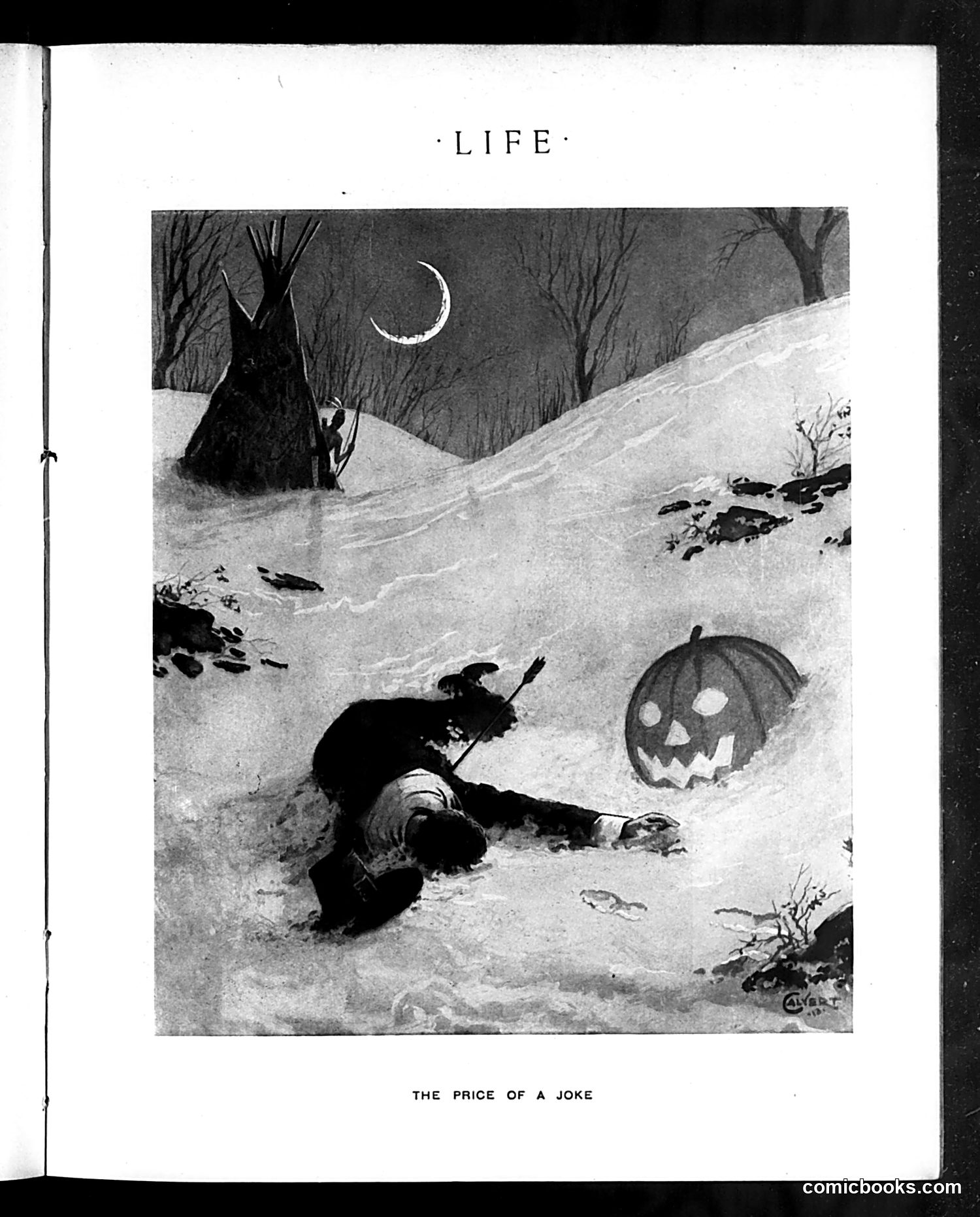
This darkly satirical cartoon depicts a winter scene where a figure lies dead or dying in the snow, seemingly having frozen to death. A jack-o'-lantern (Halloween pumpkin) sits nearby, suggesting the joke or prank may have been Halloween-related. Bare trees, a crescent moon, and scattered small animals complete the bleak landscape. The title "The Price of a Joke" indicates the cartoon comments on how a prank or jest has resulted in serious, fatal consequences. This appears to be social commentary cautioning against dangerous "jokes" that endanger lives—particularly relevant if this references a specific incident of fatal hazing, reckless daring, or winter exposure. The stark contrast between the festive Halloween symbol and the grim outcome underscores the moral message.

I can see this is a page from *Life* magazine, but the image itself is almost entirely black or extremely dark, making it impossible to discern any cartoon figures, caricatures, text, or satirical content. The only legible elements are: - "LIFE" (magazine masthead, top right) - "The Modern Gene" (partial text, bottom right) - "comicbooks.com" (bottom) Without being able to see the actual cartoon or article content, I cannot identify the figures, political references, or explain the satire's meaning. The page appears to be a scanning or reproduction issue that has rendered the primary content illegible. To properly analyze this material, a clearer image would be needed.
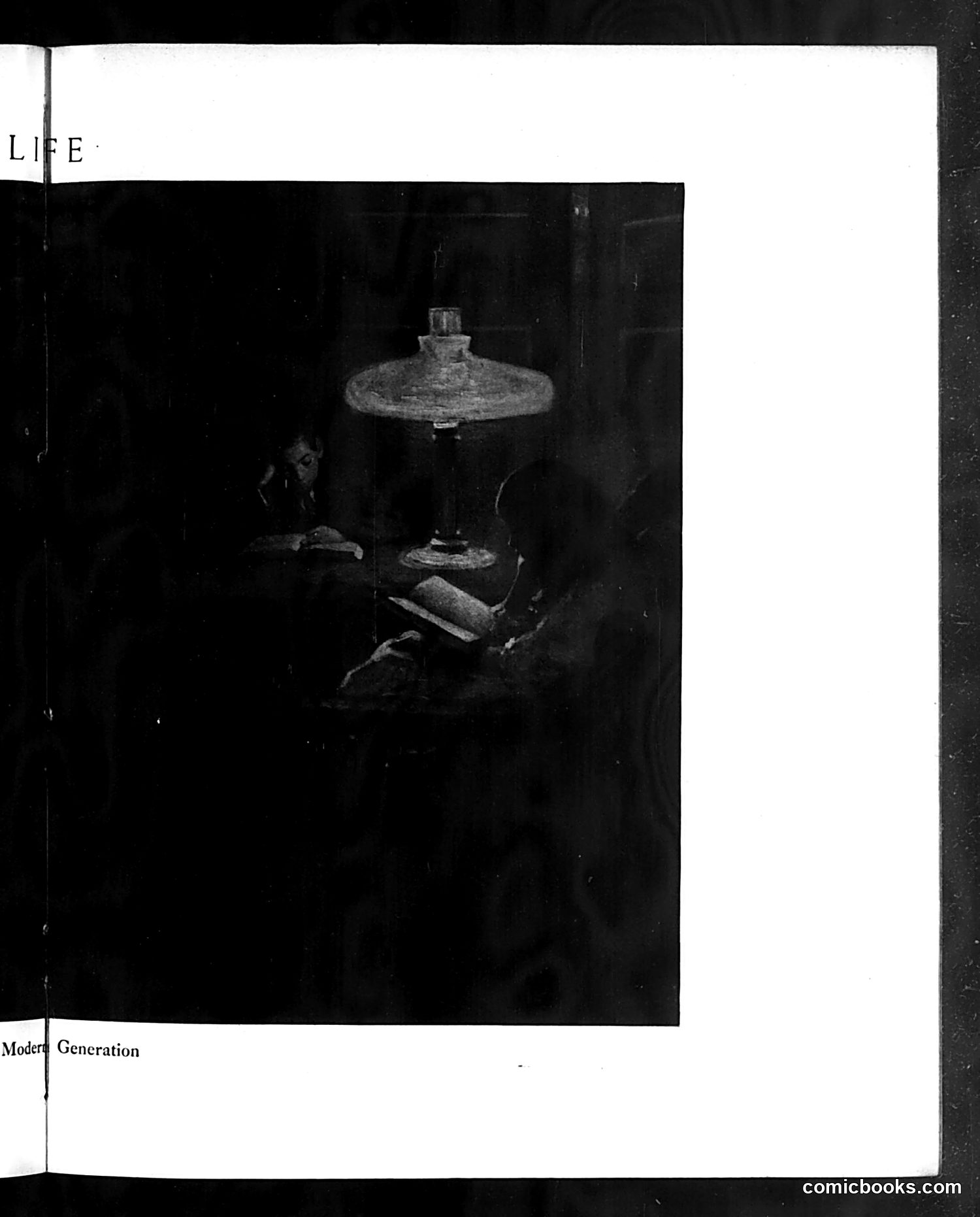
This page from *Life* magazine shows a black and white photograph labeled "Modern Generation" at the bottom. The image depicts a young person seated at a drum kit beneath a heat lamp or overhead light. The composition is dramatically lit and somewhat darkly staged. The satire appears to target youth culture and modern musical trends—likely jazz drumming, which was controversial among older generations in the early-to-mid 20th century. The theatrical staging and the caption "Modern Generation" suggest *Life* is mockingly presenting contemporary youth as self-absorbed performers, possibly commenting on the perceived frivolousness or excess of younger people's entertainment and lifestyle choices. The heat lamp may emphasize artificiality or the notion that this represents "hot" trend-chasing rather than substance.
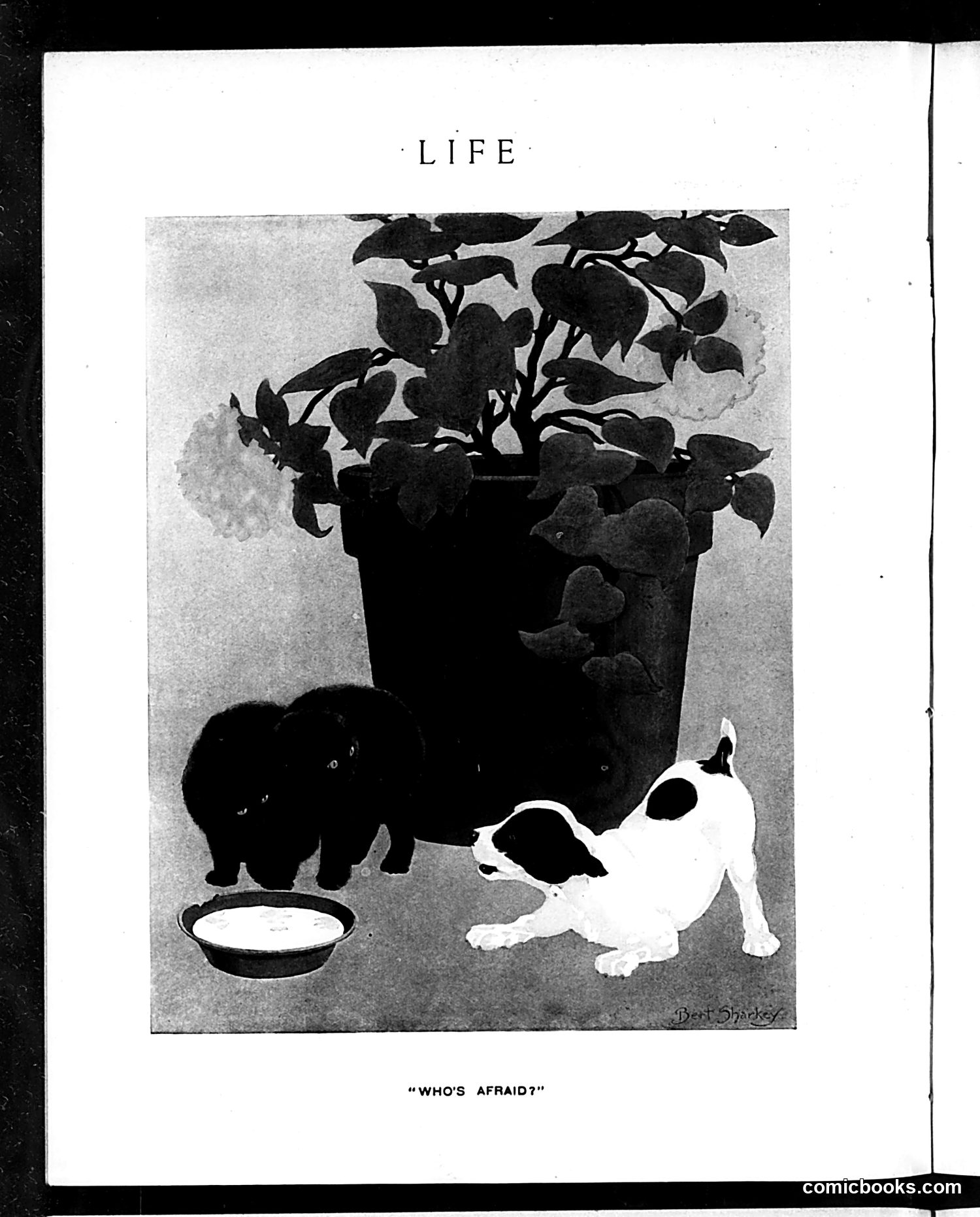
This cartoon by Burt Shackey depicts two small animals—a black cat and a white dog with black spots—confronting a potted plant with leafy growth. A bowl sits in the foreground. The humor plays on the phrase "Who's Afraid?"—suggesting the animals should fear the plant, when realistically they pose the greater threat to it. The joke likely satirizes misplaced anxiety or cowardice: the animals appear cautious around something harmless, inverting normal power dynamics. The cartoon's broader social commentary is unclear without additional context, though it may reference contemporary anxieties being misdirected toward non-threatening targets—a common satirical theme in early-to-mid 20th century American humor.
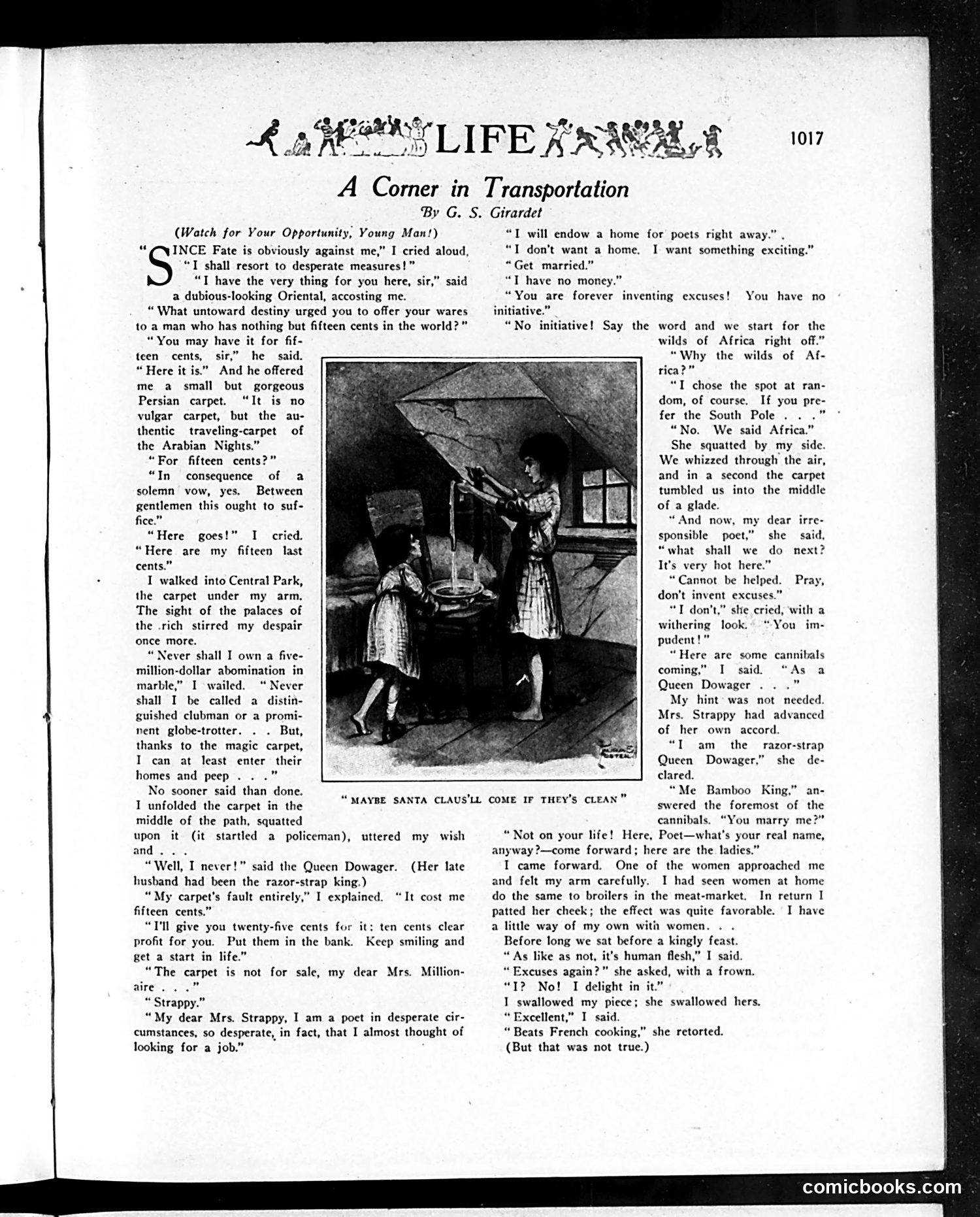
This 1917 Life magazine story satirizes both romantic adventure fantasies and women's changing social roles. A broke poet buys a "magic carpet" (evoking *Arabian Nights*) from an Oriental merchant and takes it to Africa with Mrs. Strappy, a wealthy, assertive woman. The humor targets: 1. **The poet's pretensions**: He's so poor he fantasizes about entering rich people's homes, yet romanticizes African adventure. 2. **Mrs. Strappy's character**: She's domineering, practical, and unromantic—constantly calling out the poet's excuses and "inventing" solutions. She positions herself as superior (declaring herself "Razor-Strap Queen Dowager"). 3. **Racial/colonial attitudes**: The cannibals and African setting are played for comic exoticism; the poet and Mrs. Strappy treat them as curiosities. 4. **Gender role reversal**: Mrs. Strappy controls the adventure, takes initiative, and treats the poet dismissively—reflecting anxiety about increasingly independent women circa 1917. The satire mocks both impractical male romanticism and the "modern woman" archetype.
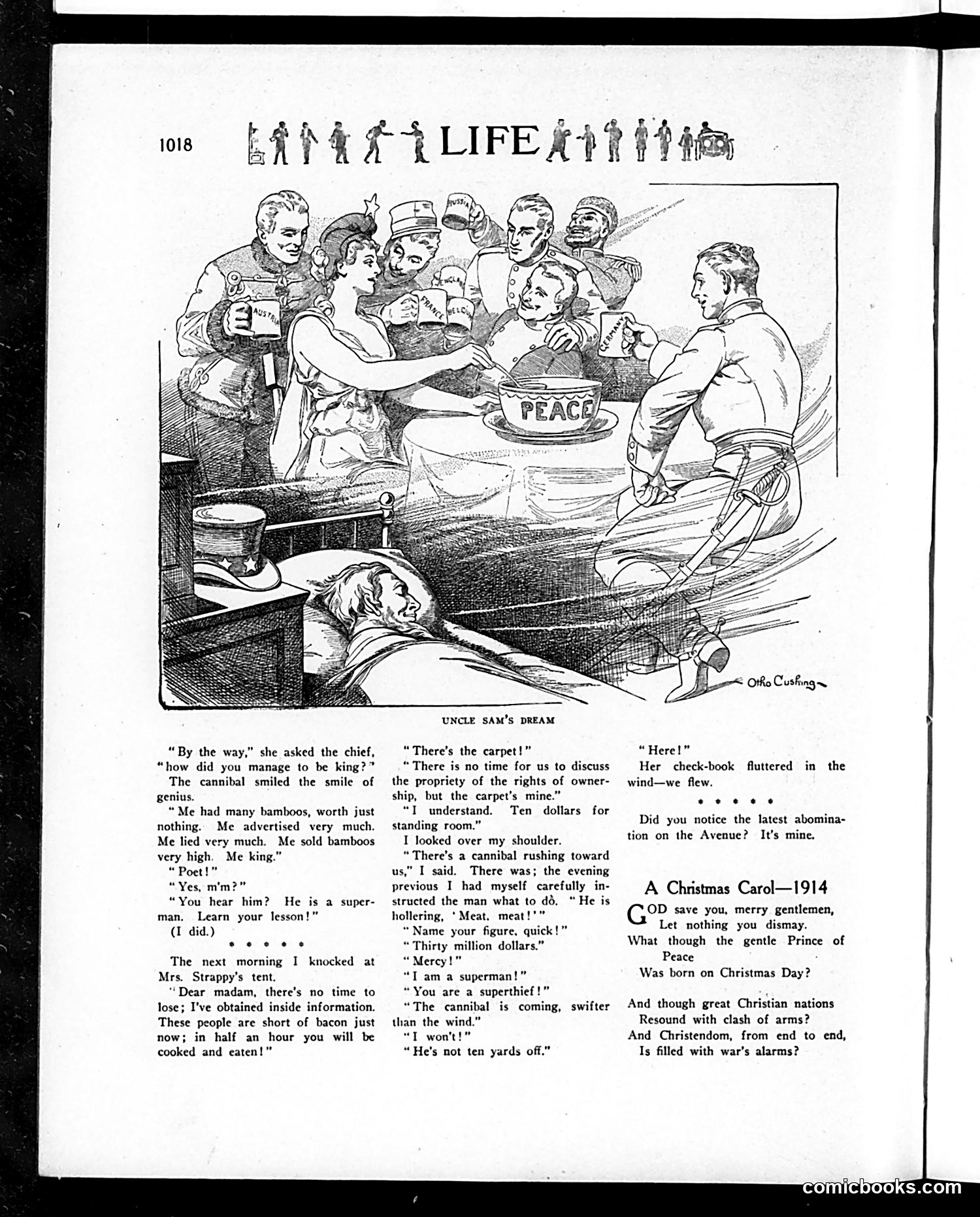
This cartoon satirizes American materialism and capitalism during World War I. The narrative depicts a scheme where aggressive salesmanship and deception—symbolized by a "cannibal" character representing predatory business practices—are used to exploit wealth from the wealthy. The central joke: a con artist sells a stolen carpet to a rich woman ("Mrs. Strappy") for thirty million dollars by manufacturing urgency (falsely claiming a cannibal is attacking). The accompanying dialogue mocks how American businessmen built fortunes through dishonesty and inflated claims. The "Christmas Carol" poem that follows underscores the satire's moral critique: it notes the irony of Christian nations celebrating peace while engaged in actual warfare (World War I, ongoing at the time). Together, the cartoon and poem condemn American hypocrisy—celebrating Christian values while practicing unchecked greed and participating in global conflict.
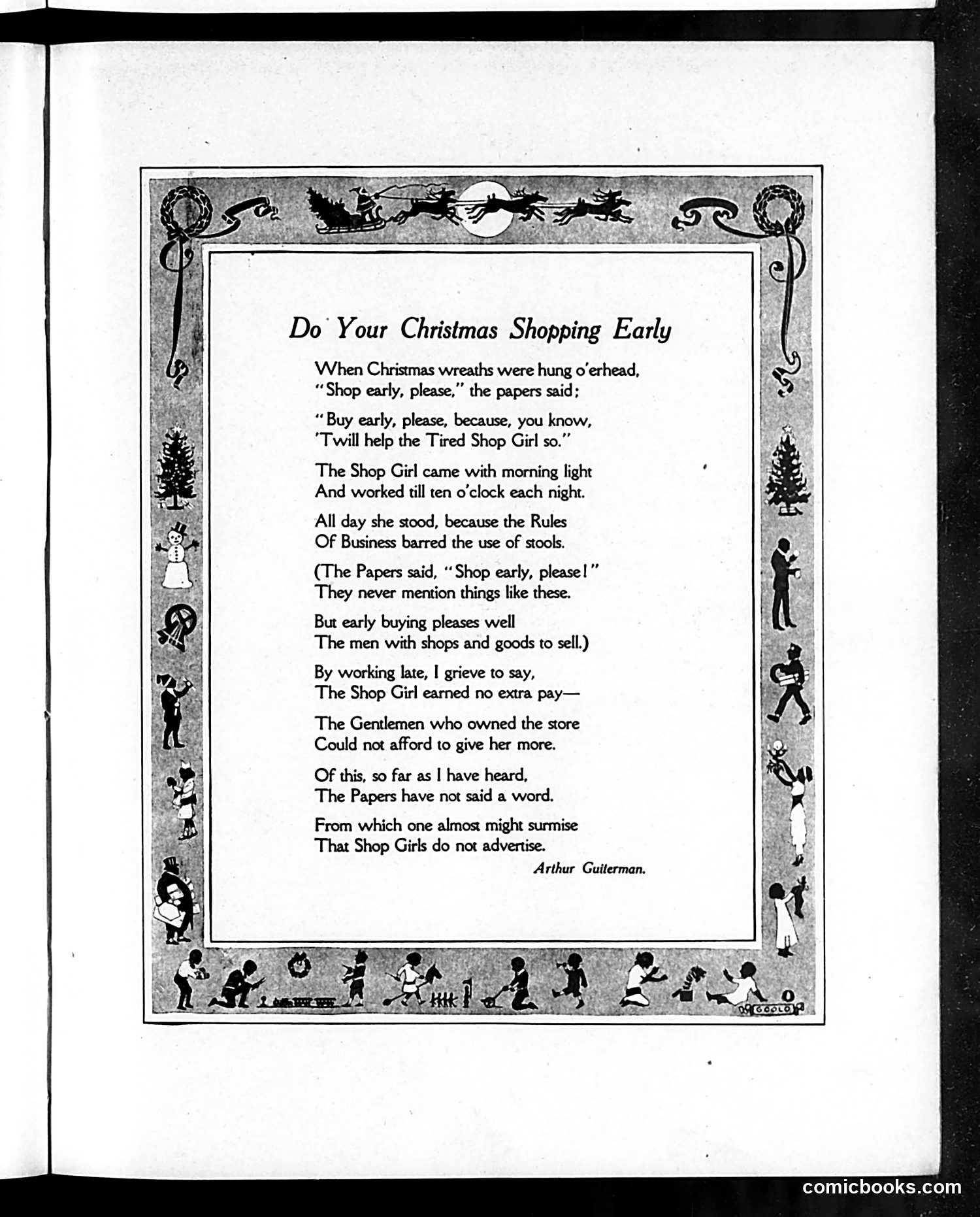
This satirical poem critiques the hypocrisy of Christmas shopping campaigns. The text reveals that newspapers urged early shopping to help "tired shop girls," but omitted crucial context: these workers stood all day without seating (forbidden by business rules), worked until 10 PM with no extra compensation, and received no wage increases despite the hardship. Guiterman's ironic conclusion: the press promotes early shopping to benefit store owners' profits, not workers' welfare. The phrase "Shop Girls do not advertise" suggests their exploitation goes unreported because they lack commercial value or political voice. The decorative border features Christmas imagery and silhouettes of children at play—contrasting innocent holiday cheer with the grim reality of retail labor exploitation during the busy season. This appears to be early-20th-century social commentary on labor conditions and press complicity.
This is a comedic sketch satirizing the absurdity of courtship conventions in upper-class American homes. The humor centers on the father's reasonable desire to meet his daughter Alice's mysterious male visitor—a request that shocks the mother and daughter, who treat it as scandalous interference. The satire targets how completely social propriety had inverted parental authority. The mother argues that the father appearing downstairs would be "mortifying" and might scare away *all* potential suitors, implying young men expect to court daughters without parental oversight. The father, described as a practical businessman, gradually realizes he has no actual social right to know who visits his own daughter—illustrating how dating had become a domain where young people's social anxieties and competitive marriage-market concerns supersede parental judgment or basic family governance. The joke is on the absurdity of this inversion of authority, not on the characters themselves.
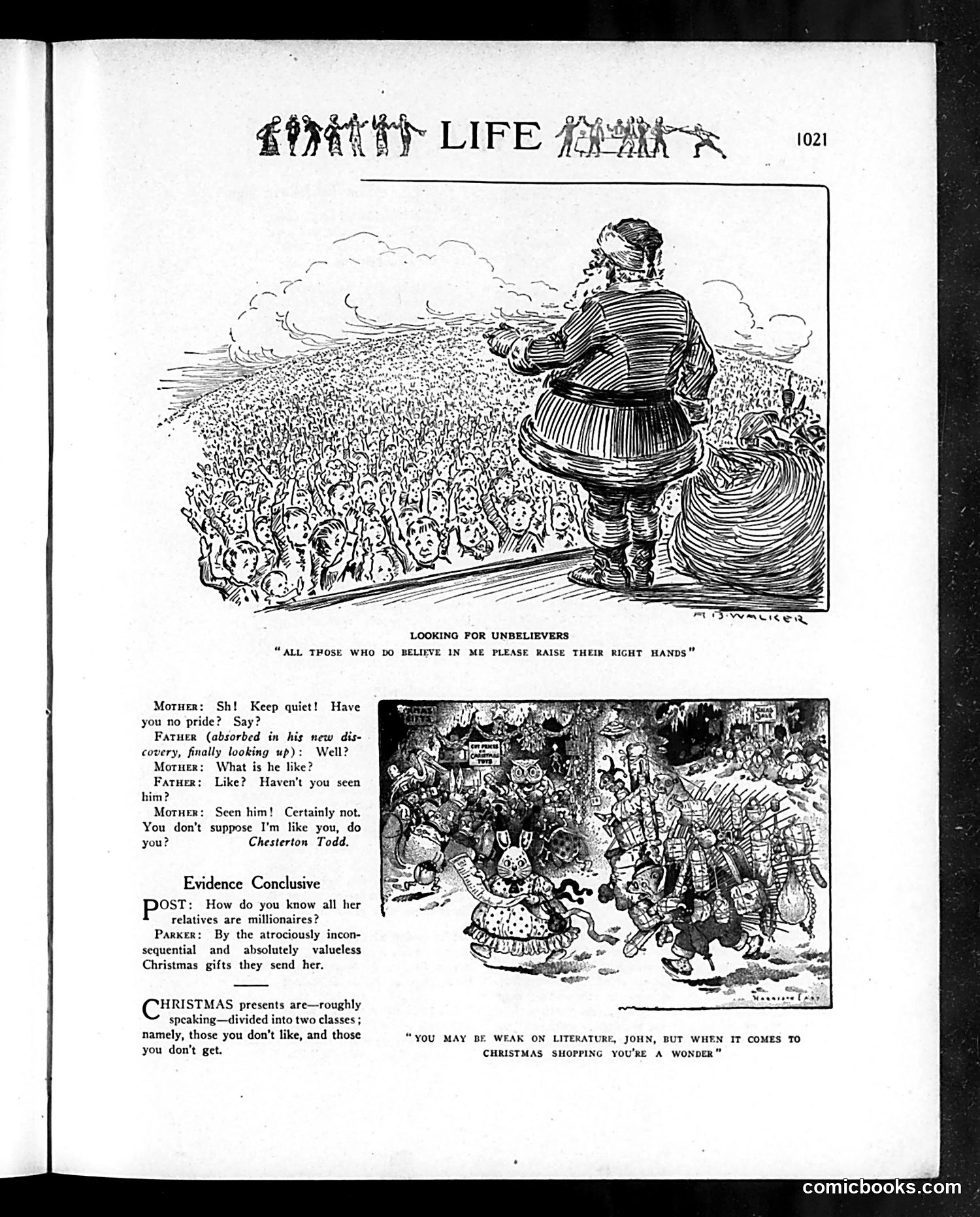
This *Life* magazine page contains three separate satirical pieces: **"Looking for Unbelievers"** (top cartoon): A portly figure addresses a massive crowd, asking believers to raise their hands. The satire mocks religious revival meetings or charismatic preachers who draw large followings—suggesting the ease with which crowds can be swayed by authoritative figures. **"Evidence Conclusive"** (middle): A joke about determining wealth through gift-giving. The humor lies in the irony: cheap, thoughtless Christmas presents from supposed millionaires paradoxically "prove" their wealth by demonstrating indifference to expense. **"Christmas Presents"** (bottom): A brief quip dividing gifts into two categories—those you dislike (and receive) versus those you want (and don't get)—capturing the universal disappointment of gift-giving. All three pieces satirize social pretense and human nature around the Christmas season, typical of *Life* magazine's satirical approach to American middle-class life and customs.
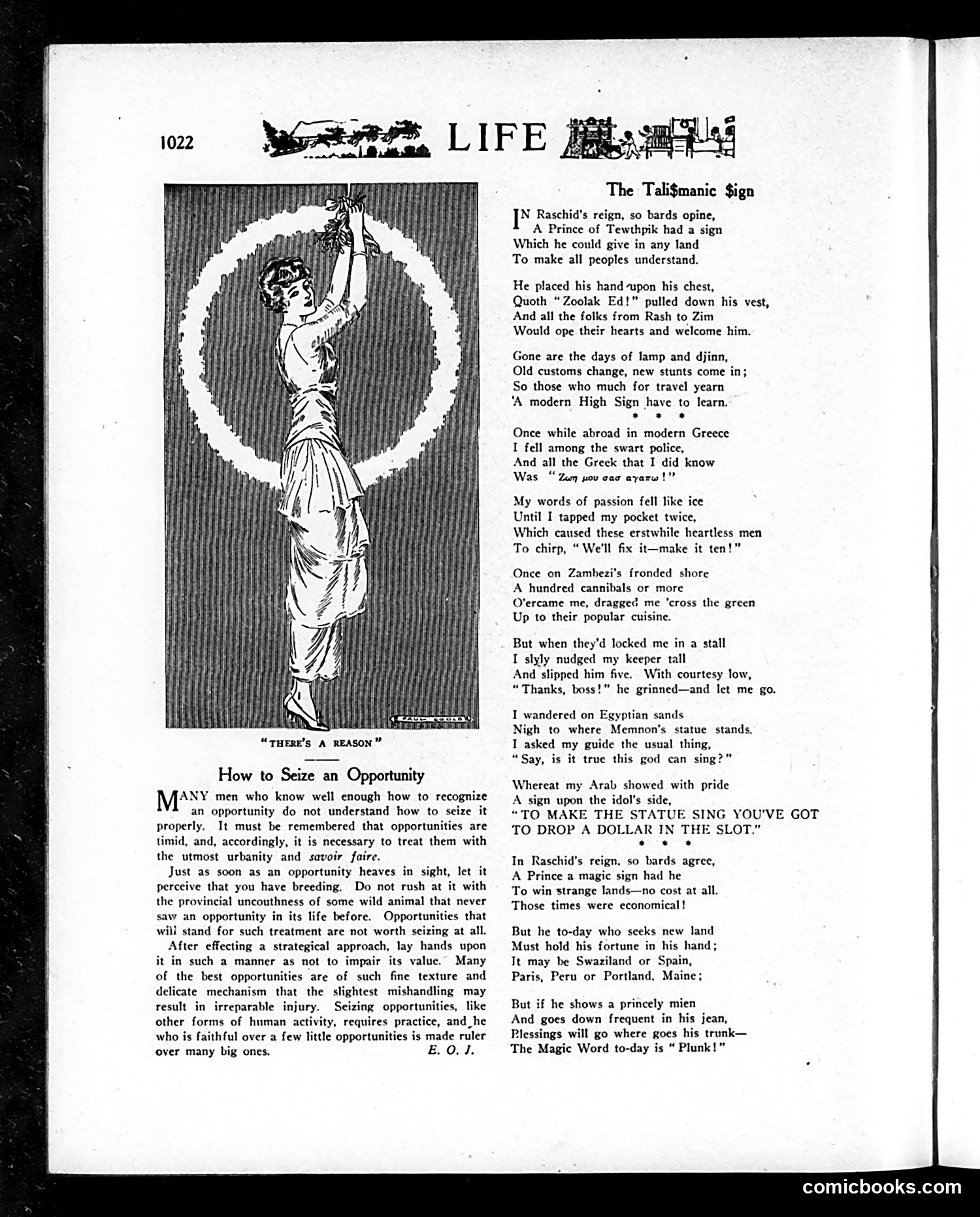
This humorous poem mocks the universality of corruption in early 20th-century travel. It contrasts an idealized past (Raschid's reign, where a Prince's magical gesture commanded respect everywhere) with modern reality, where money—"the Magic Word...is 'Plunk!'"—is the only universal language. The poet recounts encounters across the globe: Greek police demanding bribes ("make it ten"), Zambian cannibals who release him for five dollars, and Egyptian guides promoting tourist scams (the "singing" statue). Each anecdote illustrates that whether in Greece, Africa, or Egypt, the solution to every problem is the same: paying up. The cartoon's accompanying essay on "seizing opportunities" extends this theme, suggesting that success in modern life requires the same delicate, calculated approach as bribery—treating opportunities (and presumably officials) with careful "savoir faire" to avoid "irreparable injury." The satire critiques both widespread global corruption and the hypocrisy of "civilization"—suggesting that modern travelers are no better off than ancient peoples, just more cynical about it.
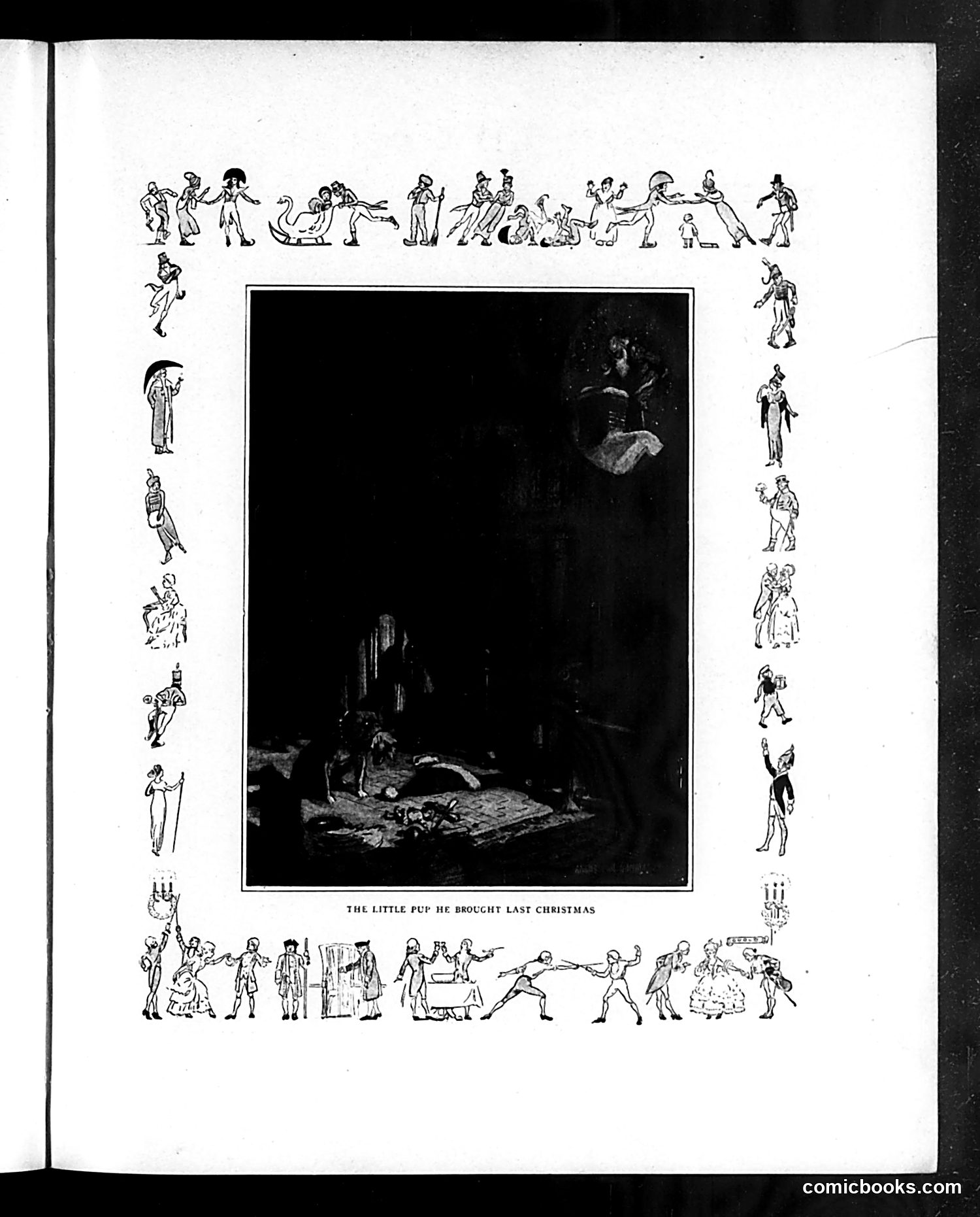
This page features a dark, dramatic central illustration surrounded by decorative border drawings of various figures in period costume and children at play. The caption refers to "the little pup he brought last Christmas," suggesting a sentimental or melancholic story about a small dog given as a gift. The dark, atmospheric central image appears to depict a scene of loss or tragedy—possibly the death or fate of this beloved pet. The surrounding illustrated figures in the border appear to be generic Victorian-era characters and children engaged in play and daily activities, likely framing the central narrative with contrasting scenes of life and normalcy. Without additional context, the specific satirical or political point remains unclear, though the composition suggests this is a sentimental piece about childhood memory and loss rather than sharp political satire.
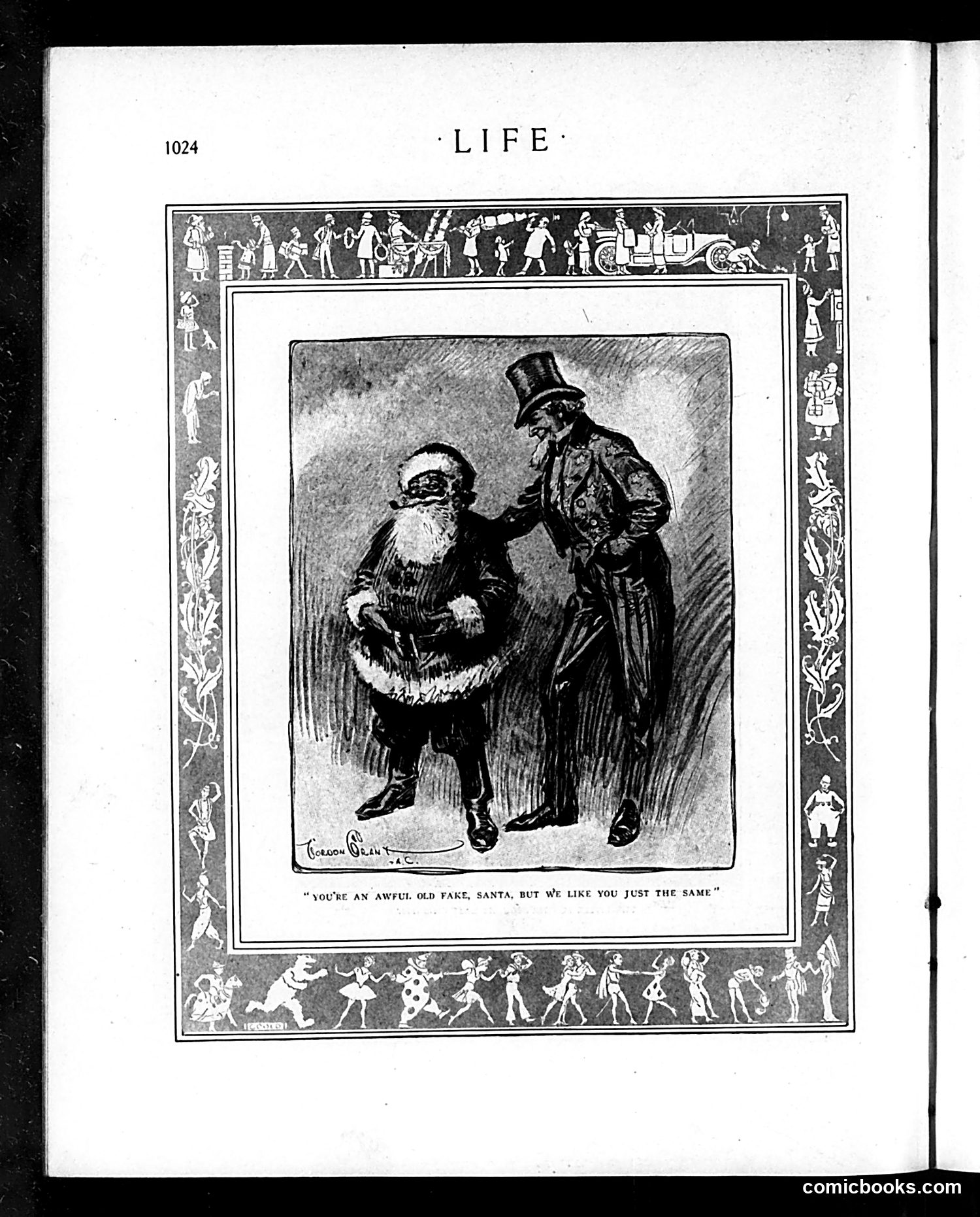
This single-panel cartoon depicts two figures in formal 19th-century attire. One wears a tall top hat and ornate coat, addressing an older bearded man dressed as Santa Claus. The caption reads: "YOU'RE AN AWFUL OLD FAKE, SANTA, BUT WE LIKE YOU JUST THE SAME." The joke satirizes the tension between childhood belief and adult knowledge. The well-dressed gentleman represents a cynical adult who has discovered Santa's fraudulent nature, yet maintains affection for the tradition anyway. This reflects early 20th-century anxieties about maintaining wonder and sentiment despite modern skepticism. The ornate border featuring children and festive imagery emphasizes the contrast between adult disillusionment and childlike magic that the cartoon explores.
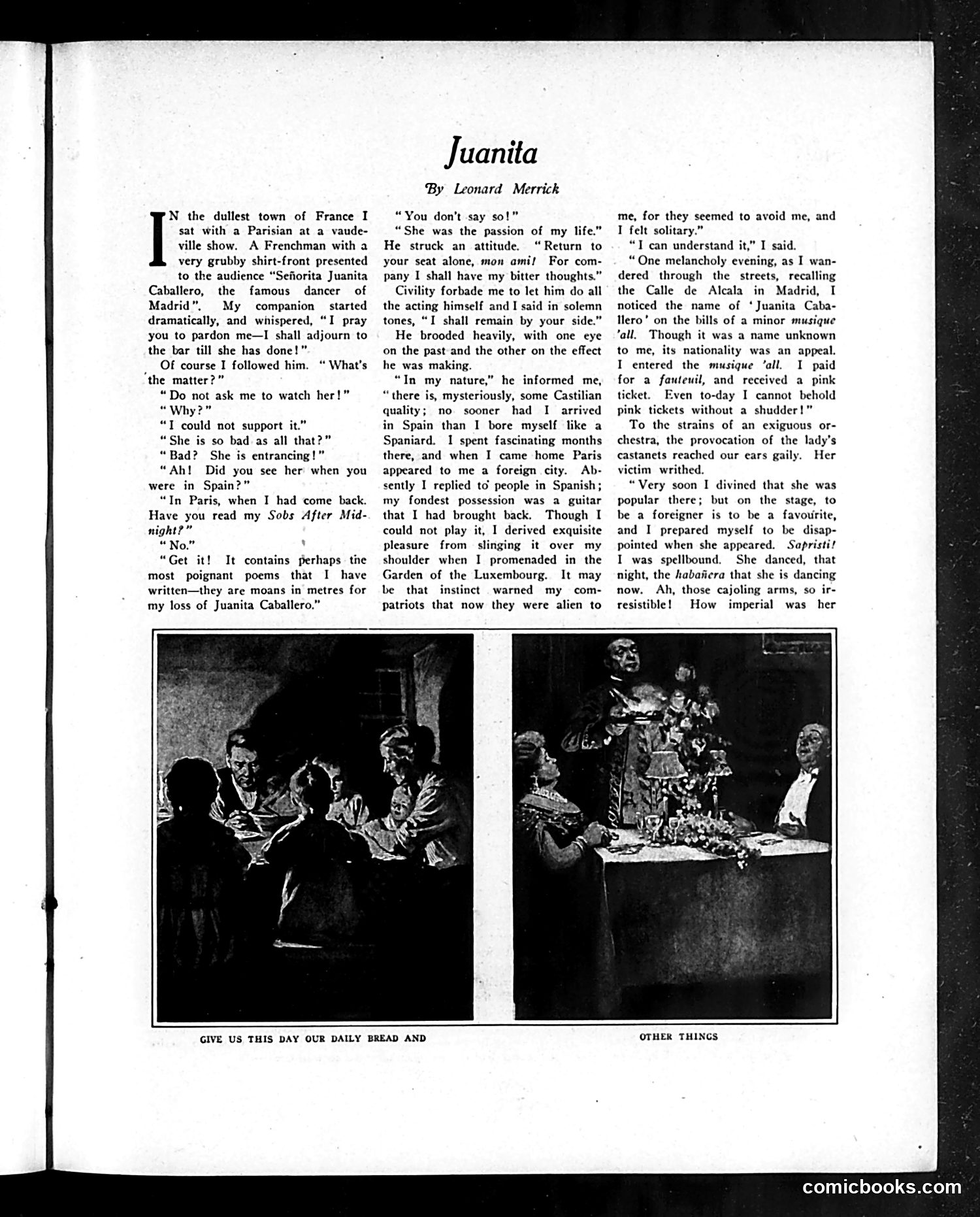
This is a short story (not a political cartoon) about a Parisian man recounting his romantic obsession with a Spanish dancer named Juanita Caballero. The narrative depicts a common early 20th-century literary trope: the passionate European affair with an exotic foreign performer. The story satirizes the pretentious Parisian—who affects Spanish mannerisms after visiting Madrid, carries a guitar he cannot play merely for appearances, and composes melodramatic poetry about a dancer he briefly knew. The humor lies in his self-absorbed romanticism and theatrical suffering over a woman who likely barely knew him. The two accompanying illustrations show scenes from the story: the vaudeville performance and what appears to be a social gathering. The satire gently mocks Continental affectation and the absurdity of romanticizing a casual encounter into lifelong artistic inspiration.
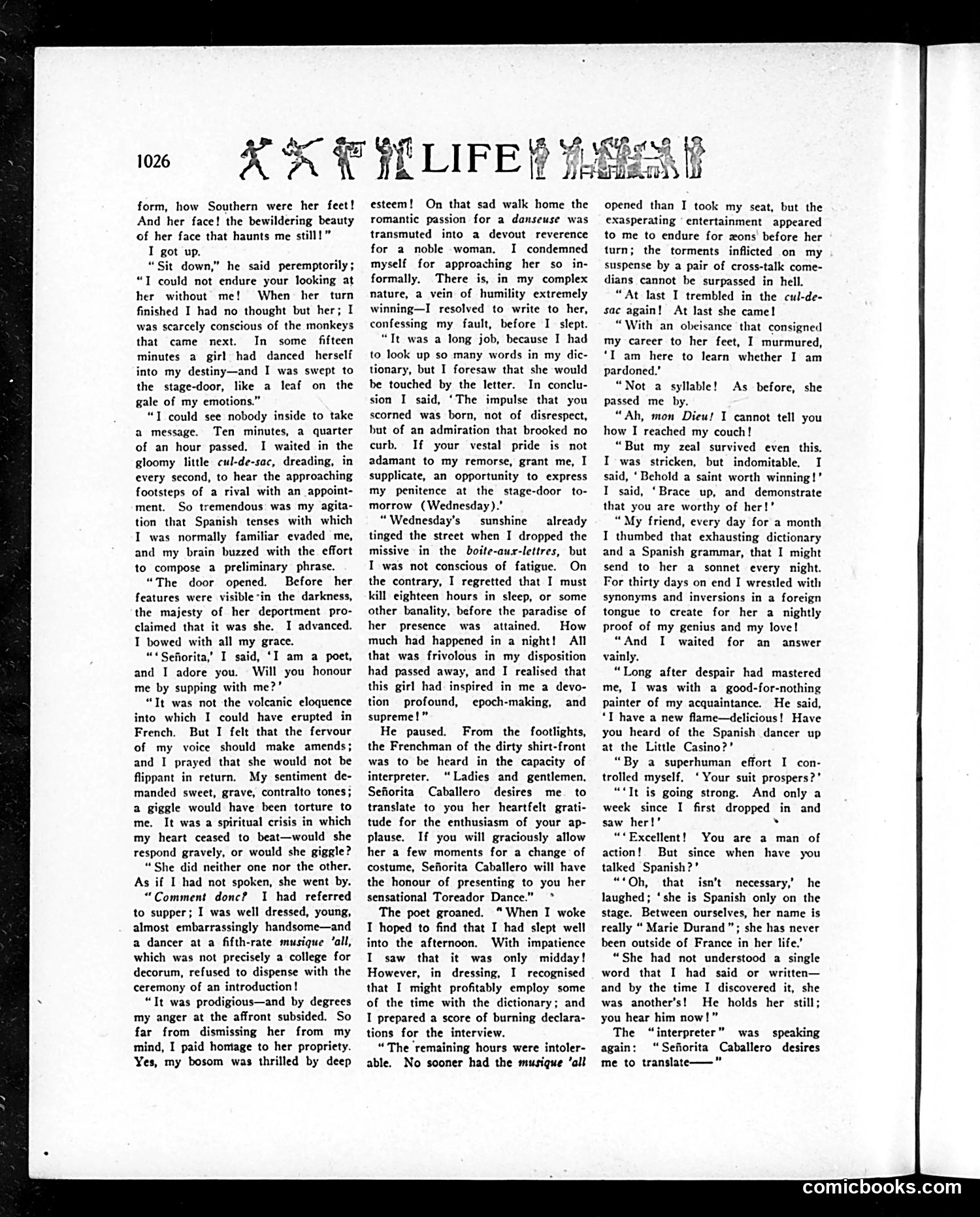
This page contains **narrative fiction**, not political cartoons. It's a serialized story (page 1026) about a romantic encounter at a theater, written in first-person by a Frenchman recounting his infatuation with a Spanish dancer named Señorita Caballero. The narrative satirizes **romantic melodrama and male presumption**. The protagonist, a poet, becomes instantly obsessed after watching the dancer perform, then attempts a presumptuous invitation at the stage door. When she ignores him, he reinterprets her coldness as "vestal pride" and "propriety"—transforming his rejection into admiration for her virtue. He then spends the night composing an elaborate, apologetic letter in Spanish (consulting a dictionary repeatedly). The satire targets the **self-deluding romanticism** of artistic men who construct elaborate emotional narratives around women, particularly working-class performers, turning rejection into validation of their own refined sensibilities. The story appears to continue on subsequent pages with an interpreter translating the dancer's response.

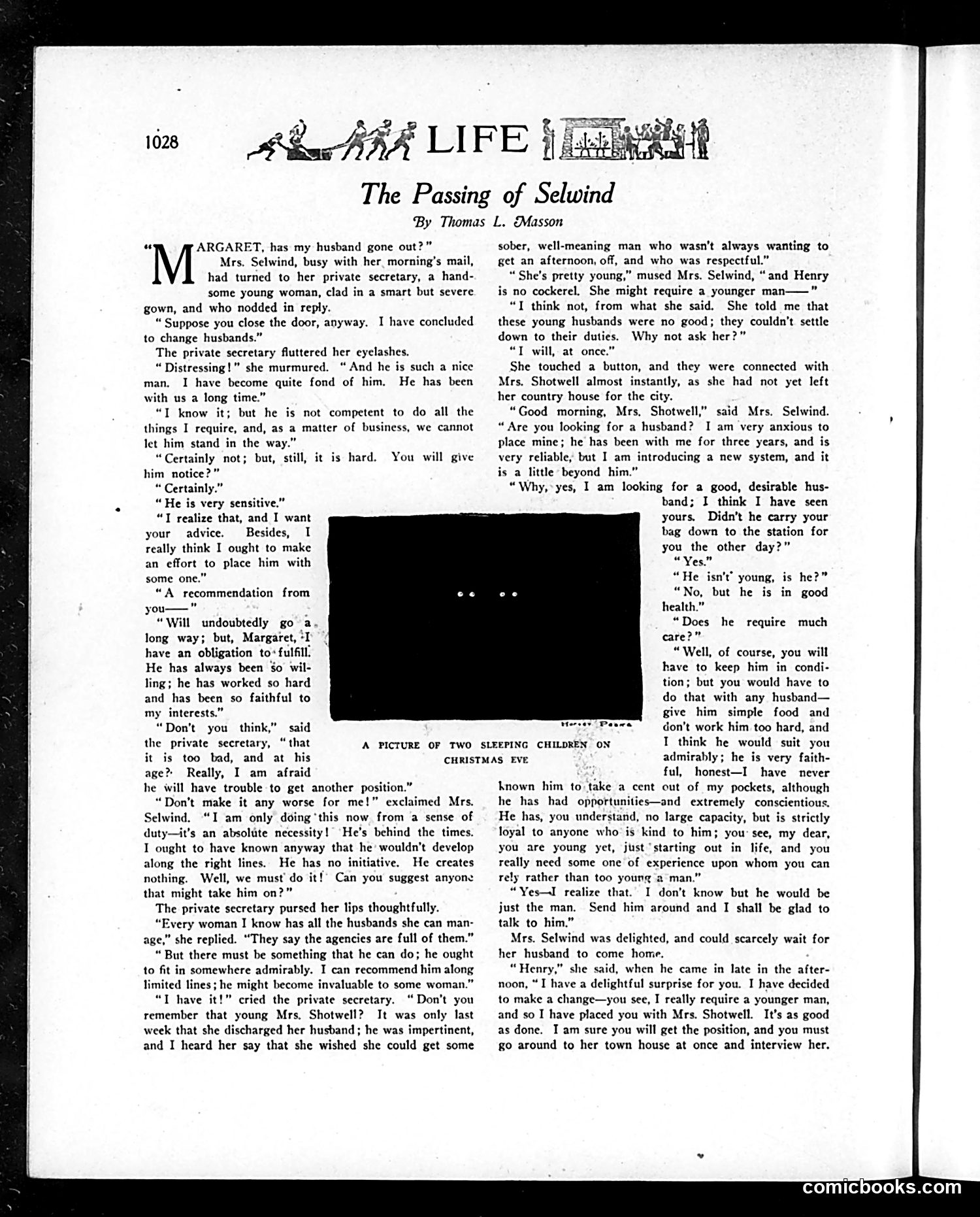
This is a satirical short story (not a political cartoon) that treats marriage as a business transaction. Mrs. Selwind discusses "changing husbands" with her secretary as casually as replacing an employee—discussing his competence, initiative, and whether he can be "placed" elsewhere. The satire mocks early 20th-century gender dynamics and consumerism: wealthy wives treating husbands as disposable staff. Mrs. Selwind "fires" her reliable but outdated husband to implement a "new system," then shops him to Mrs. Shotwell (who recently "discharged" her own husband) like used goods. The humor operates on inversion—men becoming objects of female economic control rather than vice versa. The included illustration of sleeping children on Christmas Eve likely provides ironic contrast to this coldly transactional marriage discussion, emphasizing the story's satirical edge about domestic life.
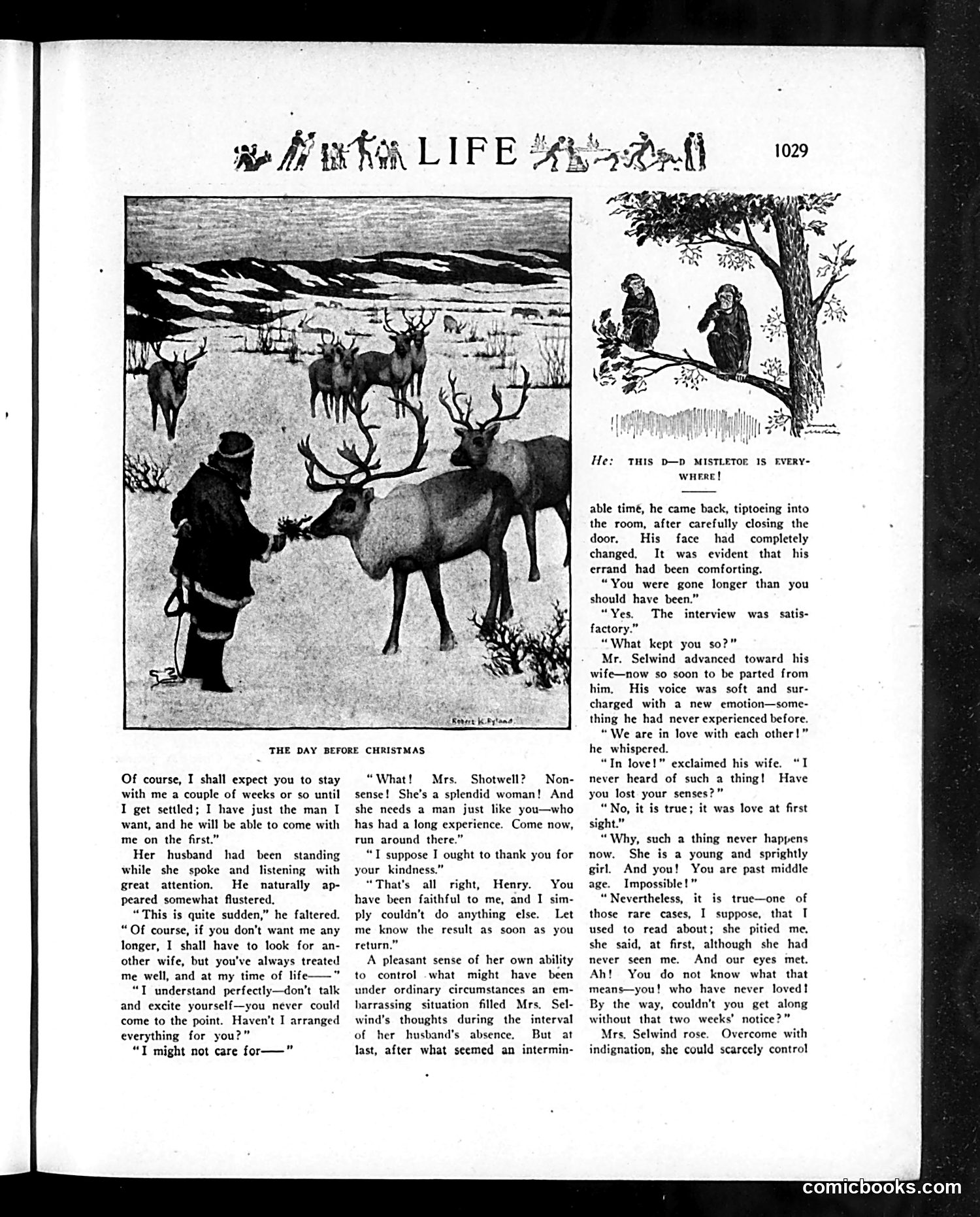
This is a domestic comedy satirizing turn-of-the-century marriage arrangements and women's control over household matters. A domineering wife casually dismisses her husband, arranging for him to meet a replacement wife (Mrs. Shotwell) while she hires a new husband for herself. The satire targets: - **Wife's cold efficiency**: She treats marriage transactions as mere household management, emotionless and practical - **Husband's passivity**: He meekly accepts dismissal until unexpectedly falling in love with Mrs. Shotwell - **Social hypocrisy**: The wife is outraged when her own husband experiences genuine emotion—the very thing she denied him The joke inverts expectations: the wife orchestrates a coldly transactional wife-swap, but her husband's sincere love disrupts her plans and exposes her emotional sterility. The mistletoe cartoon above reinforces the Christmas season irony of unexpected romance overcoming calculated arrangements.
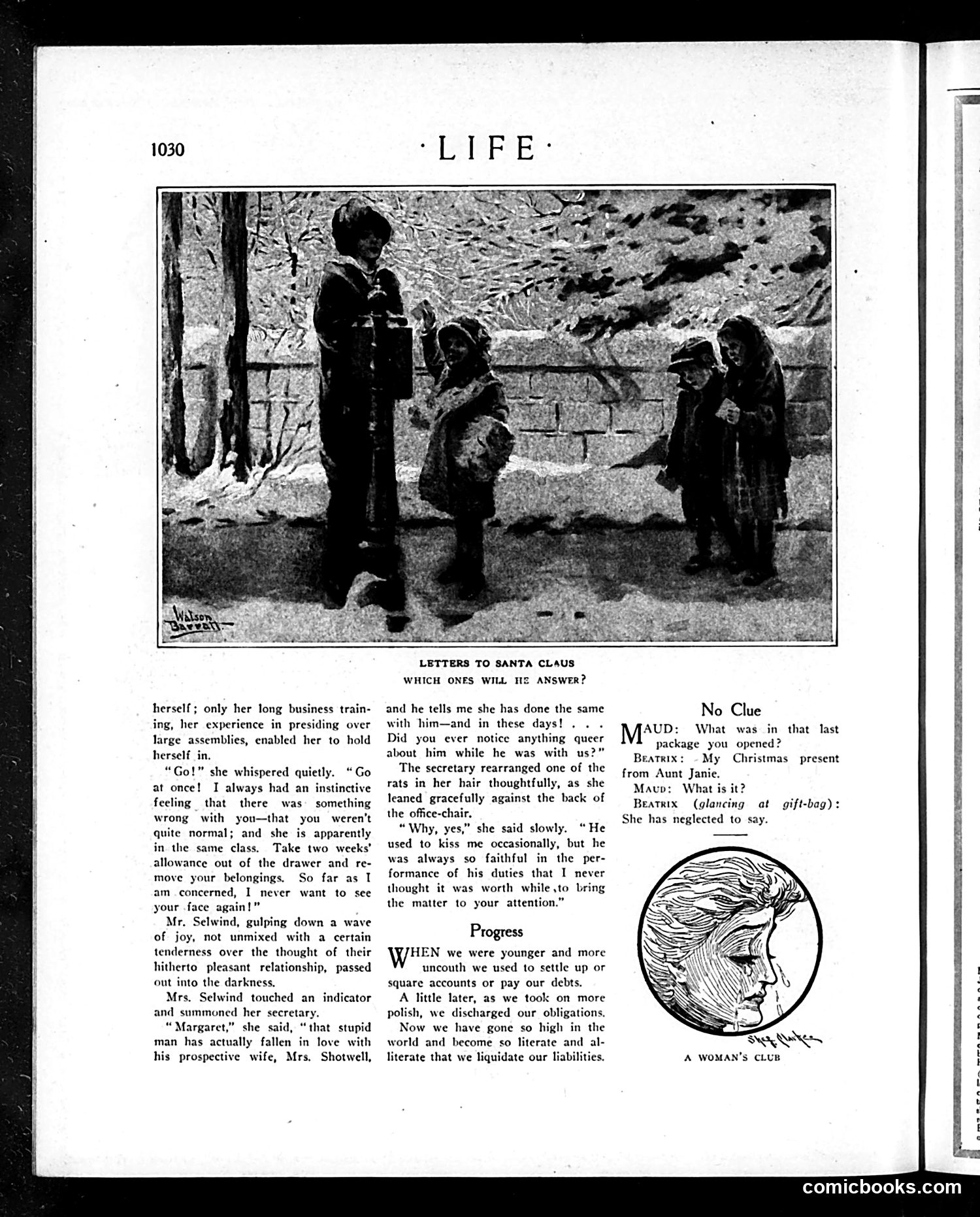
This page contains a serialized story and two separate satirical pieces from Life magazine. **Main Story ("Letters to Santa Claus"):** A domestic drama where a wealthy businesswoman (Mrs. Selwind) discovers her employee husband has fallen in love with her—a shocking breach of propriety. She fires him, horrified that he's behaving "abnormally" by showing genuine romantic feeling. The satire targets upper-class emotional coldness and the expectation that marriages, particularly among the wealthy, should be transactional rather than affectionate. **"Progress" Section:** A brief social satire mocking how language evolves among the educated classes to obscure meaning. Instead of saying "pay debts," the literate now say "liquidate liabilities"—making simple concepts sound more important through vocabulary inflation. **"No Clue":** A humorous vignette where a girl receives a mysterious Christmas gift and refuses to identify it, keeping adults in suspense. The overall theme critiques 1920s upper-class pretension and emotional repression.
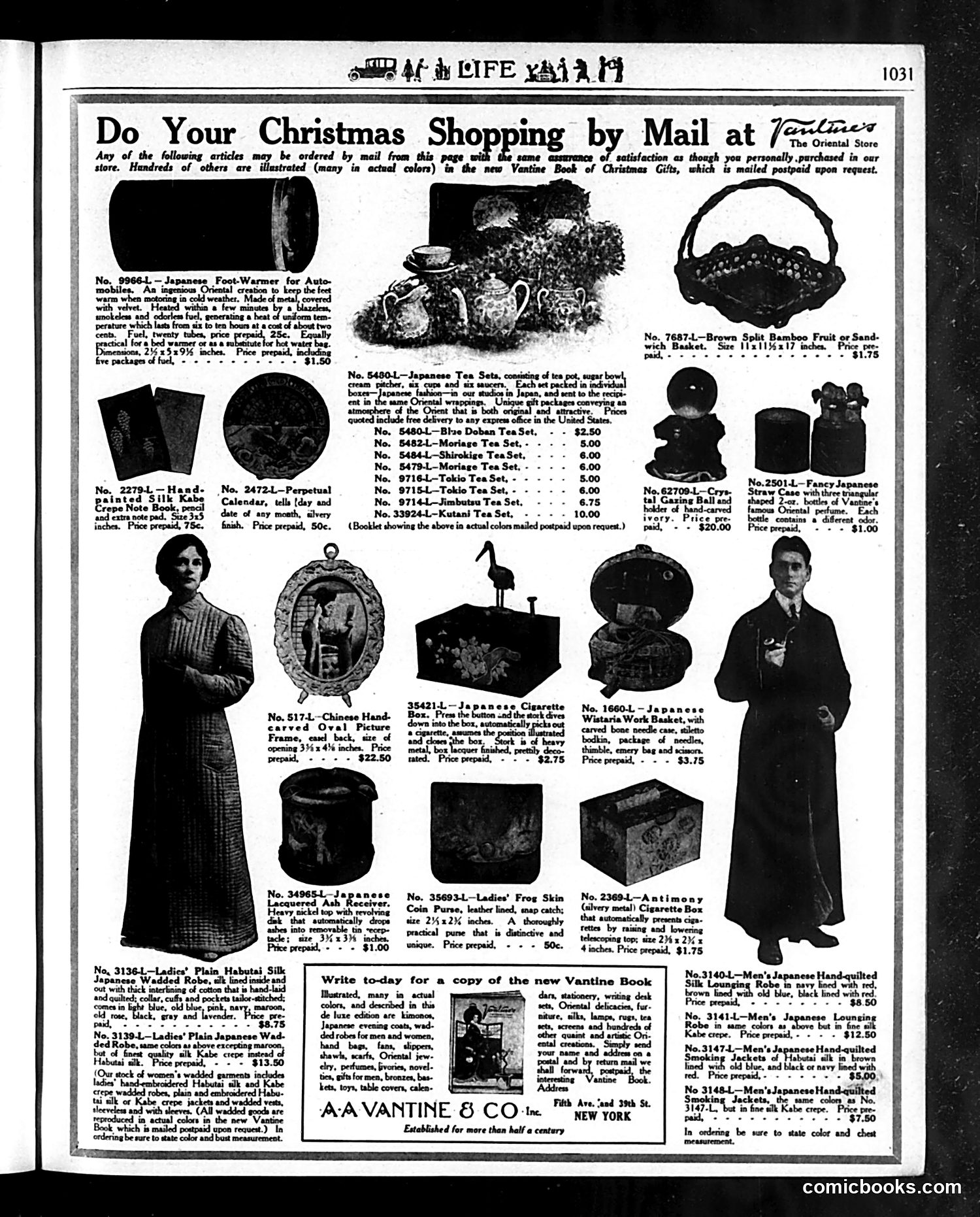
This is **not a cartoon page** but rather a **mail-order advertisement** for A.A. Vantine & Co., a retailer specializing in Oriental goods. The page showcases Christmas gift items imported from Japan and China, including tea sets, silk robes, decorative boxes, picture frames, and baskets. Prices range from 50 cents to $22.50. **Historical context for modern readers:** This reflects early 20th-century American enthusiasm for "Orientalism"—exotic Asian goods marketed as luxury items to wealthy Western consumers. The prominence of Japanese crafts (hand-quilted robes, ceramic tea sets, carved furniture) reflects Japan's growing international trade presence and Western fascination with Japanese aesthetics following Japan's modernization. The advertisement emphasizes items are "hand-carved" and "hand-quilted" in Japan, positioning them as authentic, artisanal products. Photos show both the merchandise and models wearing the garments, a standard advertising technique of the era. This represents commodified exoticism—Asian culture packaged and sold as prestigious holiday gifts to American consumers.
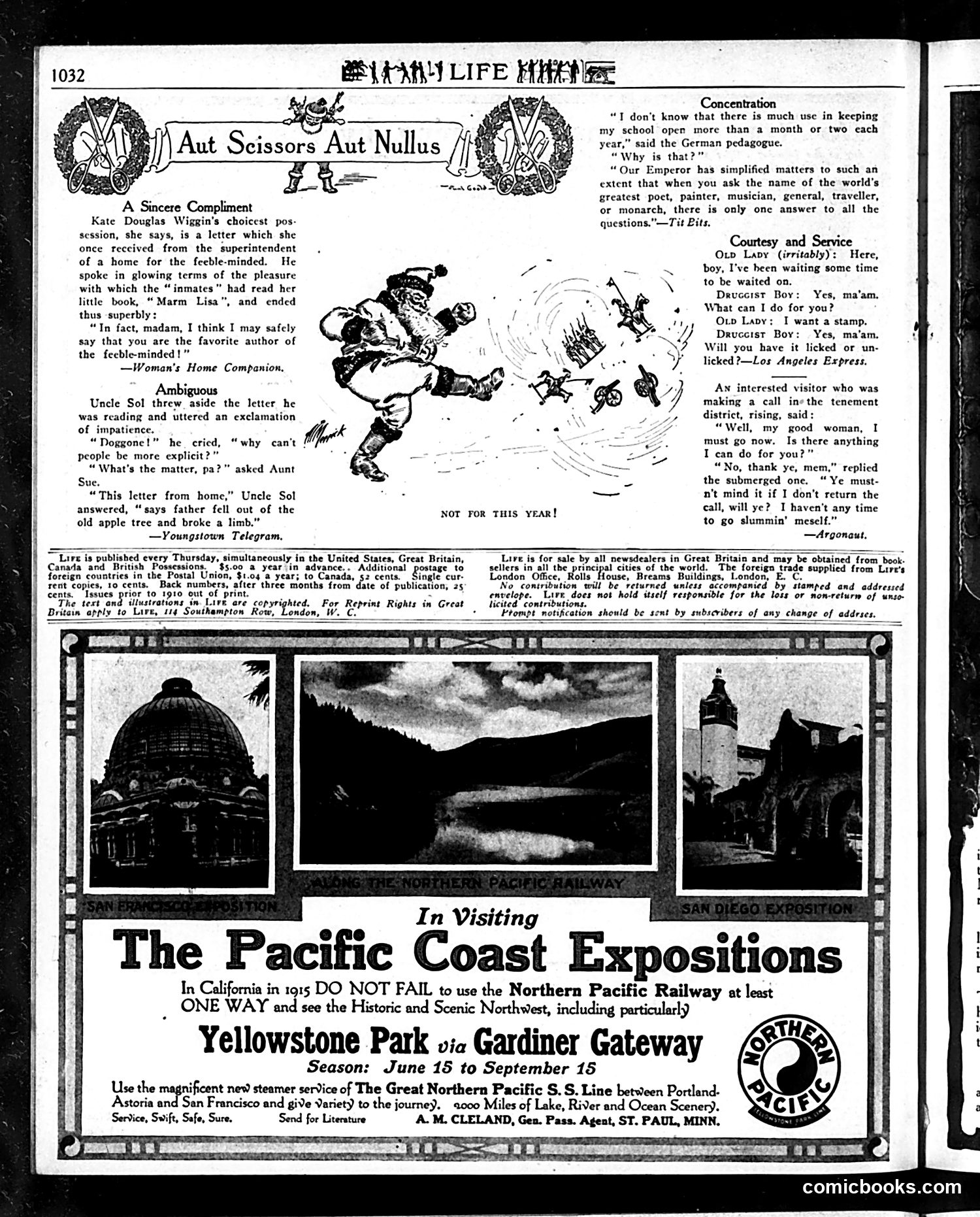
This page contains three brief humorous anecdotes and period advertising, rather than political cartoons. **The jokes satirize:** 1. **"A Sincere Compliment"** – Mocks Kate Douglas Wiggin (a real children's author) by quoting a superintendent of a home for the intellectually disabled who calls her the favorite author of his residents. The humor lies in the backhanded insult disguised as praise. 2. **"Ambiguous"** – Uncle Sol complains a letter from home lacks clarity—his father "broke a limb" falling from a tree. The ambiguity joke: unclear whether the father or tree limb broke. 3. **"Concentration"** – Satirizes German educational policy under the Kaiser, suggesting the Emperor has so standardized answers that teachers only repeat his opinions, making schools pointless. The page primarily showcases *Life*'s signature style: brief, punchy social commentary on contemporary figures and institutions, with minimal visual content beyond advertisements for Pacific Coast Expositions and Northern Pacific Railway.
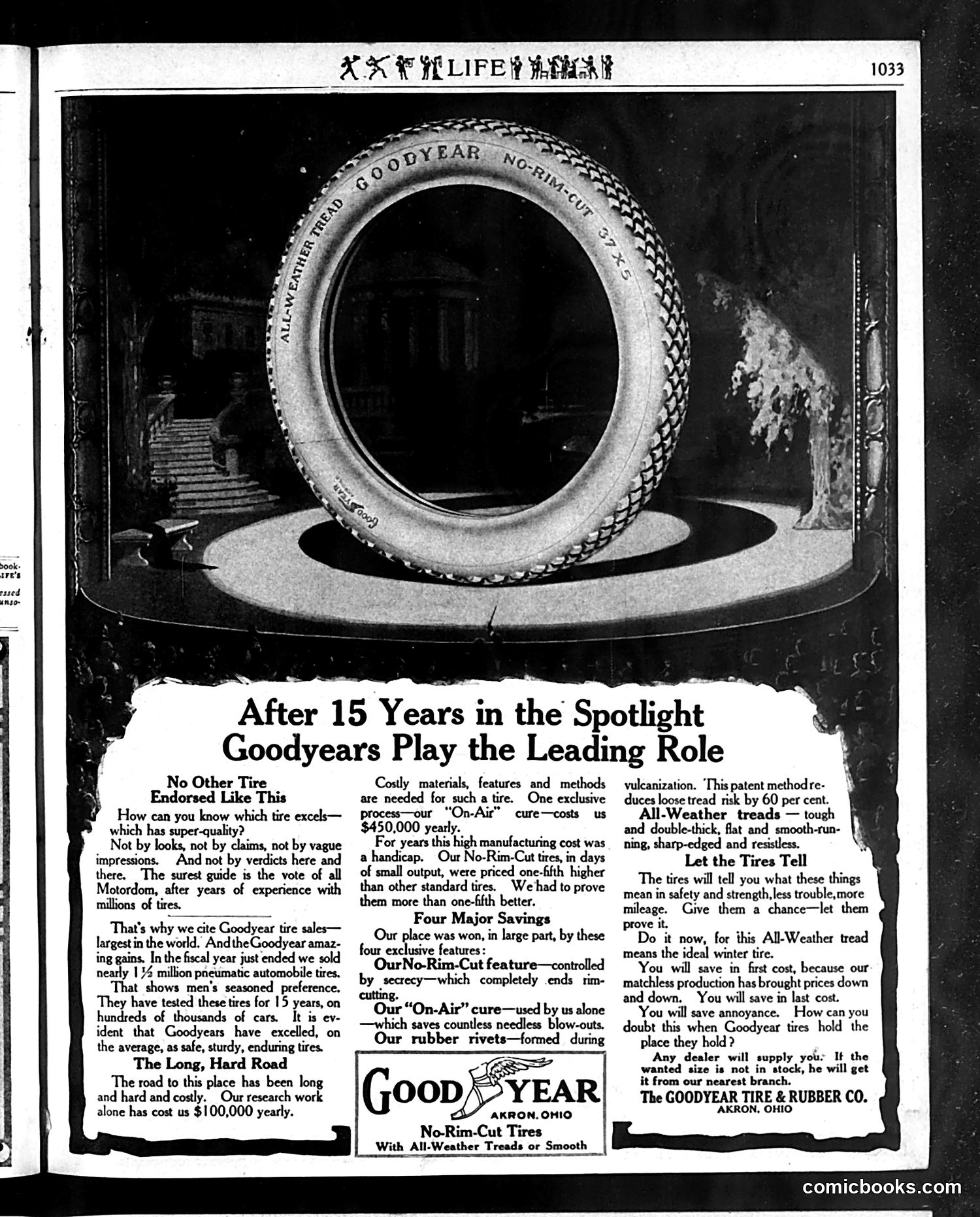
This is a **full-page advertisement**, not satire or editorial content. It promotes Goodyear's "No-Rim-Cut" automobile tires. The ad argues that Goodyear's market dominance—claimed as "largest in the world"—proves superior quality through consumer choice over 15 years. It lists four exclusive features: the No-Rim-Cut design, an "On-Air" curing process, rubber rivets, and All-Weather treads. The pitch emphasizes that Goodyear's expensive manufacturing ($450,000 yearly for one process alone) justified historically higher prices, but now economies of scale have lowered costs while maintaining quality. The ad appeals to practical motorists: choose tires based on what millions of drivers have already tested and proven safe. This represents early-20th-century industrial advertising: emphasizing research investment, technical innovation, and market dominance as proof of reliability—before modern consumer skepticism of such claims.
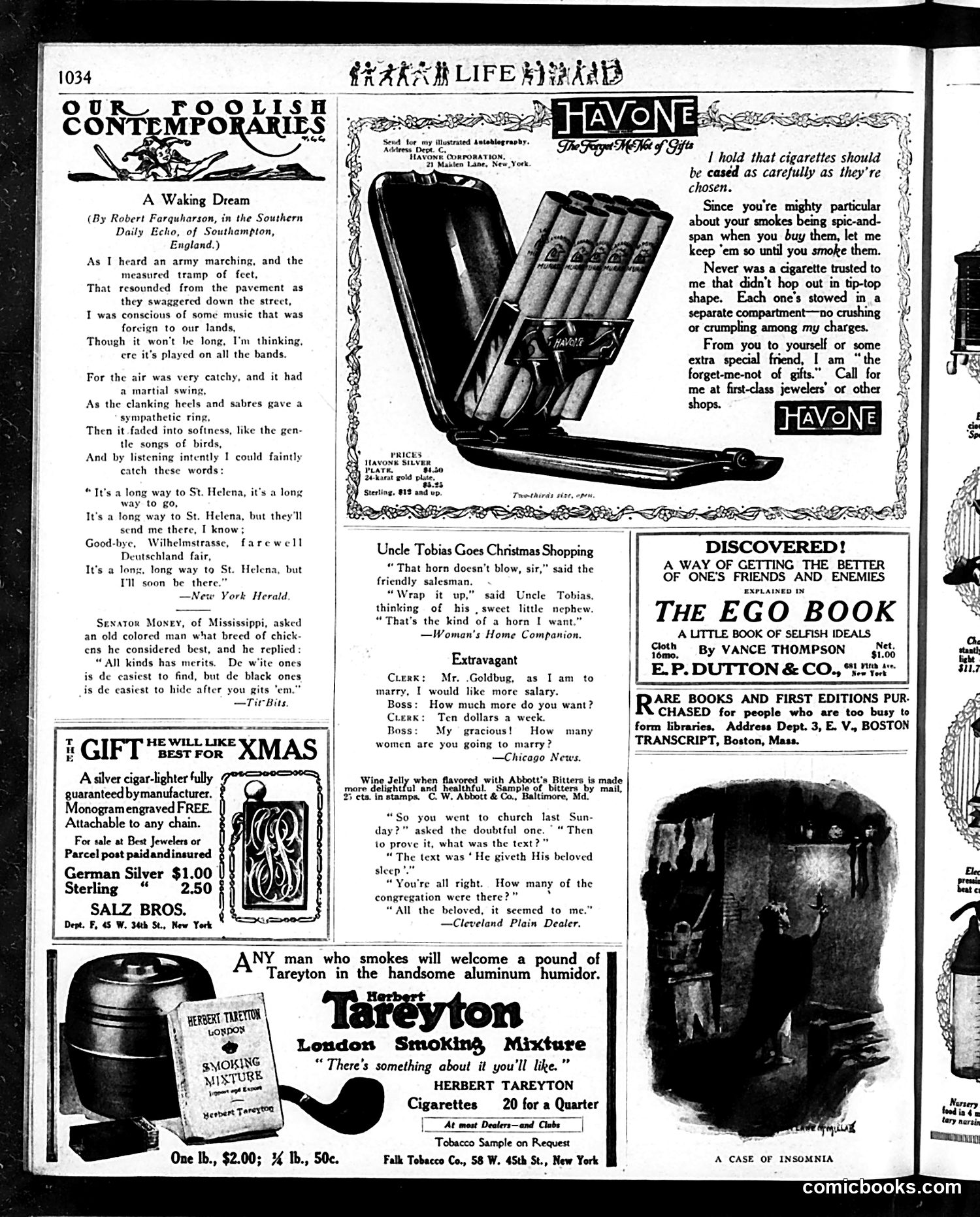
This page is primarily **advertising and light humor**, typical of Life magazine's early 20th-century format. **Main Content:** The featured poem "A Waking Dream" by Robert Farquharson references a marching army whose footsteps evoke a haunting melody—the lyric "It's a long way to St. Helena"—evoking **Napoleon's exile**. The phrase suggests German defeat in WWI (references to "Wilhelmstrasse" and "Deutschland"), implying the defeated Kaiser will be exiled like Napoleon. **Humor Pieces:** - Senator Money's exchange about chicken breeds appears to be **dialect humor** (period-typical, now offensive) based on racial stereotypes - "Uncle Tobias Goes Christmas Shopping" plays on a character buying a broken horn as a gift, celebrating the giver's obliviousness **Advertisements:** The page features numerous ads for cigarettes (Havone, Tareyton), cigars, gift items (German silver lighter), and books—reflecting 1920s consumer culture and tobacco's casual acceptance. The "Discovered!" section promotes "The Ego Book," a self-help title by Vance Thompson.
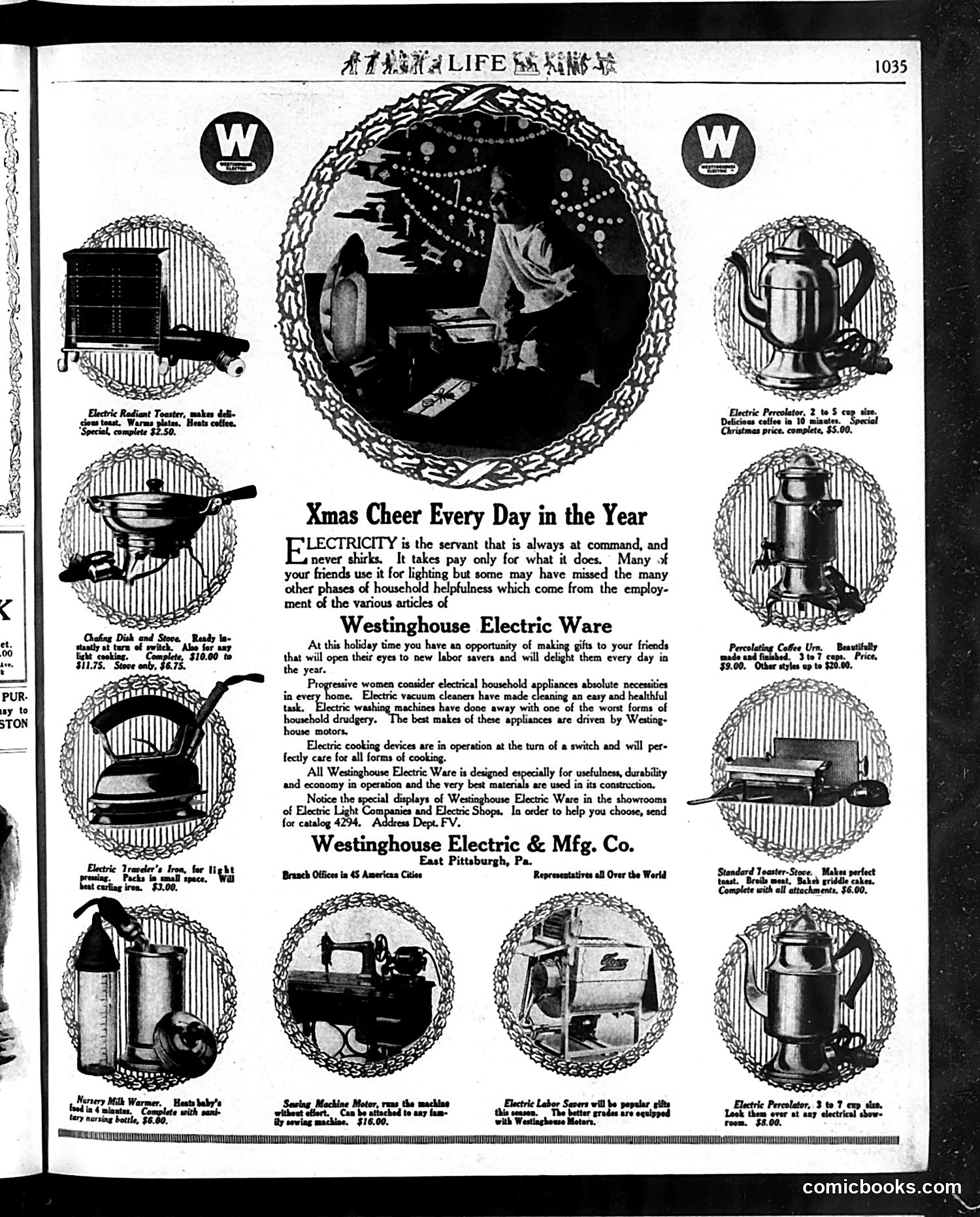
This is **not a political cartoon**, but a full-page advertisement for Westinghouse Electric appliances, appearing in *Life* magazine (page 1035). The central image shows a domestic scene with a woman using electrical appliances, framed as "Xmas Cheer Every Day in the Year." The surrounding illustrations display various electric household devices: percolators, toasters, washing machines, vacuum cleaners, sewing machines, and labor savers. **The pitch**: Electricity and electric appliances are presented as "servants" that liberate women from household drudgery. The ad argues these are practical Christmas gifts that deliver year-round benefit by automating cooking, cleaning, and laundry—tasks previously requiring manual labor. **Cultural context**: This reflects early-20th-century marketing that sold electrification and modern appliances as progressive, labor-saving solutions for women. The ad assumes a middle-class audience with access to electricity and disposable income for gift-giving. This is straightforward product advertising rather than satire or political commentary.
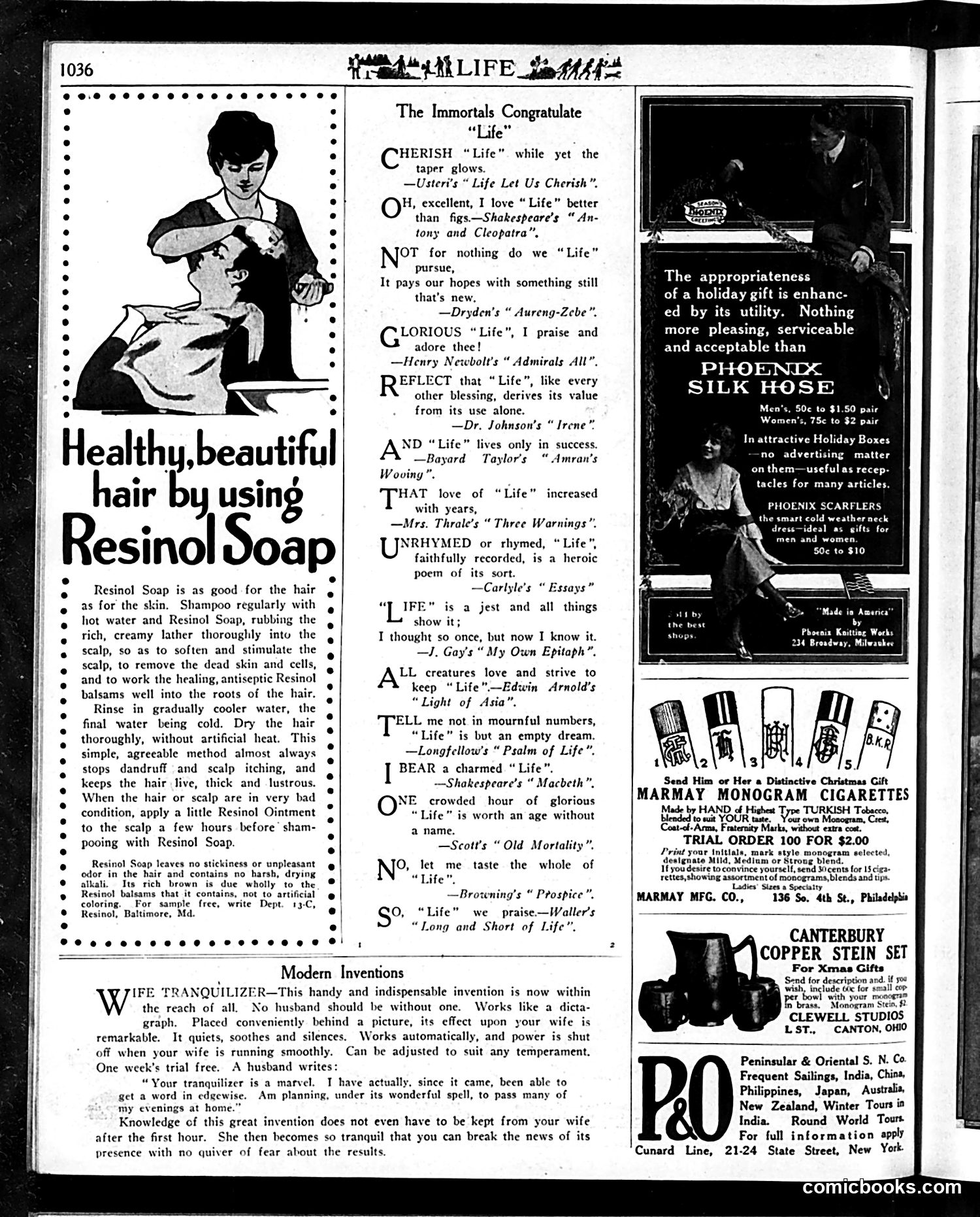
This page contains **primarily advertising** for consumer products (Resinol Soap, Phoenix Silk Hose, Marmay Cigarettes, and a Copper Stein Set) alongside a humorous feature. The main satirical content is a section titled **"The Immortals Congratulate 'Life'"**—a playful compilation of literary quotations about "life" attributed to famous authors (Shakespeare, Dryden, Longfellow, Carlyle, etc.), cleverly repurposed as praise for the magazine *Life* itself. It's gentle wordplay exploiting the double meaning of "life" (the concept) versus the publication. Below that is a faux advertisement for the **"Life Tranquilizer"**—a satirical jab at marriage and women. The "invention" is presented as a device that makes wives quiet and obedient, allowing husbands to finally speak without interruption. The humor relies on sexist stereotypes about nagging wives, reflecting early 20th-century attitudes toward gender relations. A husband's testimonial claims he can now "get a word in edgewise." Both pieces are gentle satire typical of Life magazine's humor style of the era.
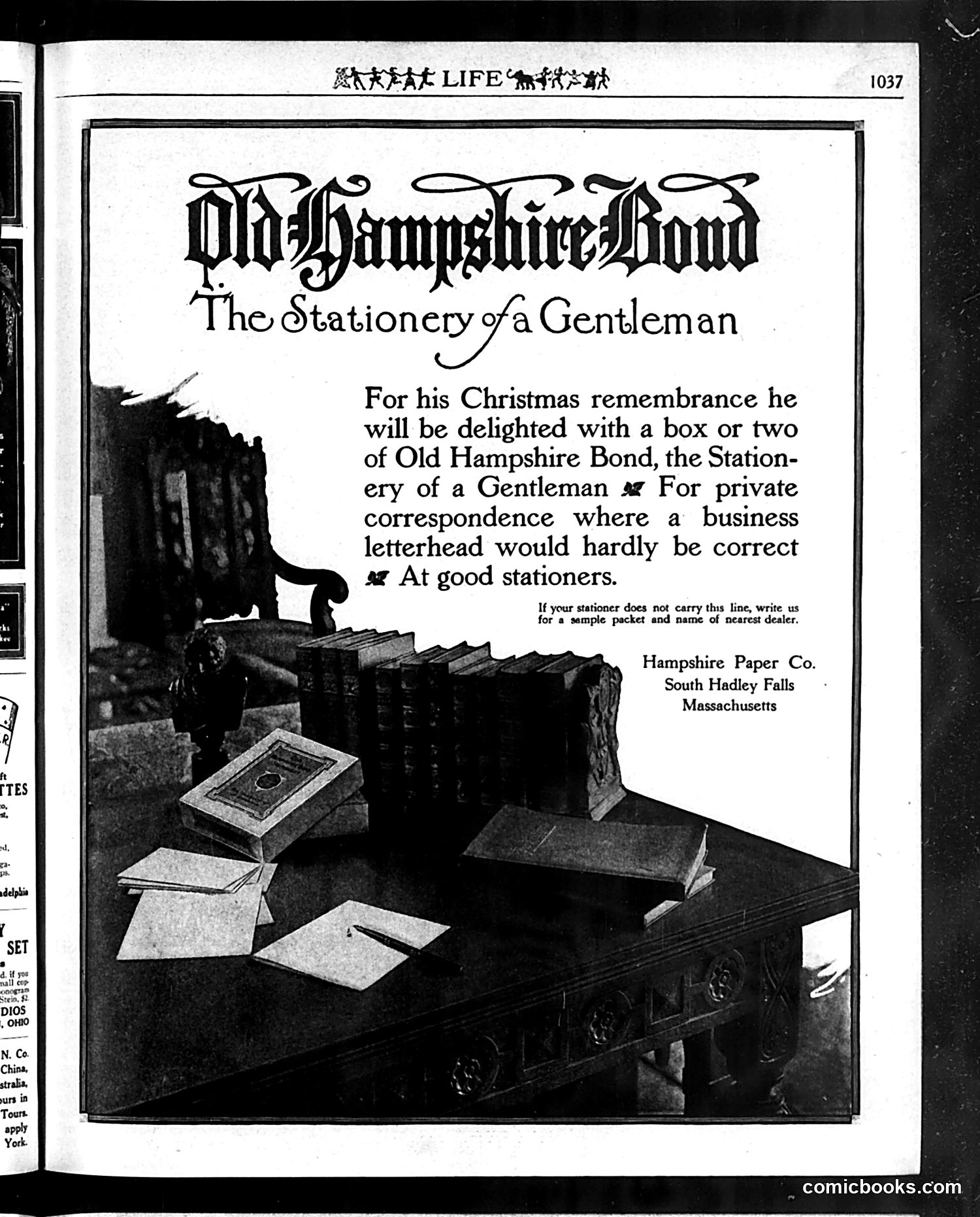
This is a **full-page advertisement**, not a cartoon or satire. It promotes "Old Hampshire Bond" stationery, marketed as appropriate for a gentleman's private correspondence. The ad plays on early 20th-century class distinctions: it positions this paper as suitable for personal letters where using business letterhead would be socially inappropriate—a distinction that mattered to the genteel classes of the era. The imagery shows the stationery arranged on a desk with period furnishings, establishing an aspirational, refined aesthetic. The humor is gentle and implicit: the ad assumes readers understand that using the *wrong* stationery could signal social inadequacy. This reflects the historical period's elaborate etiquette rules around correspondence. The manufacturer, Hampshire Paper Co., was based in South Hadley Falls, Massachusetts.
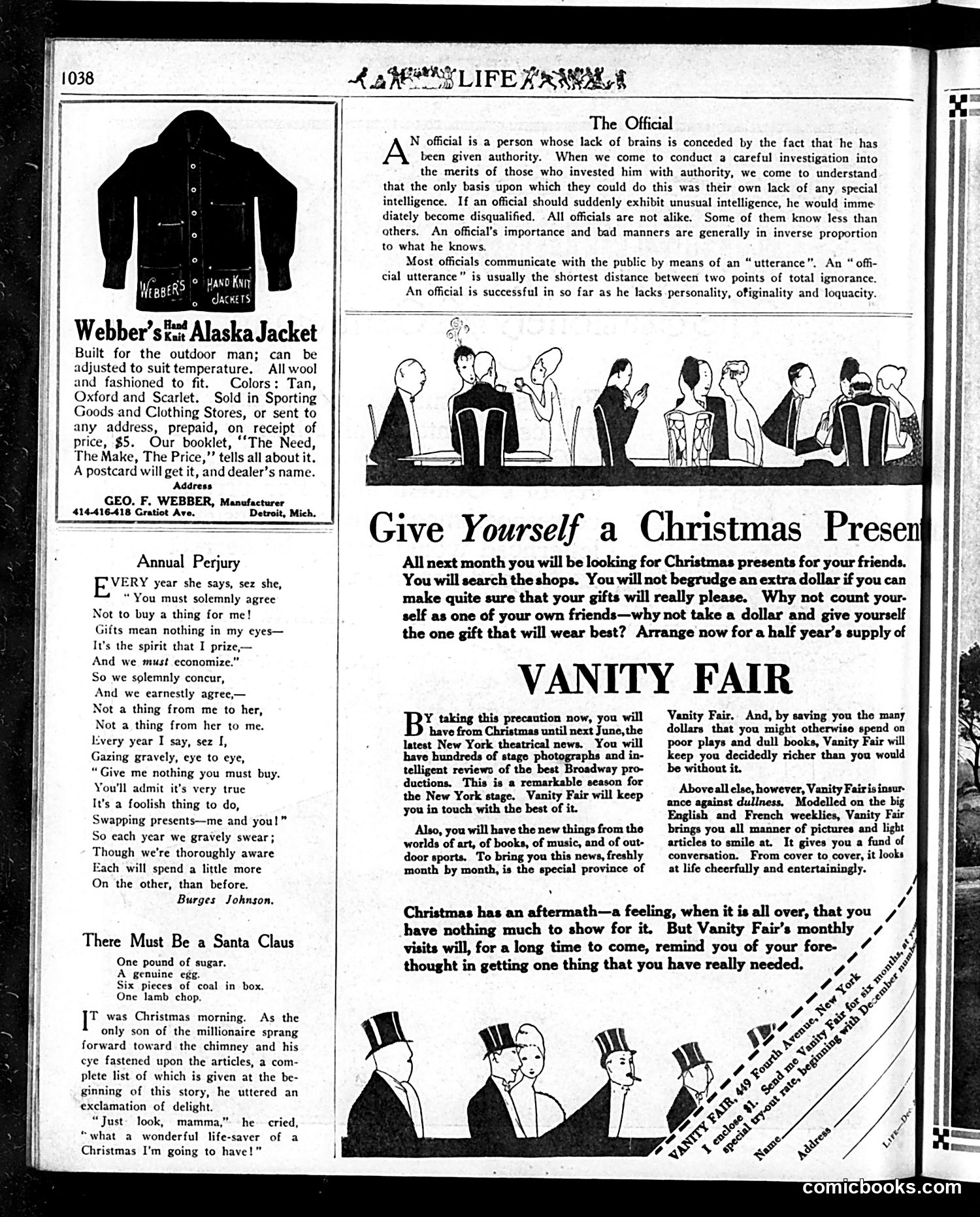
This page combines two distinct elements: a satirical essay attacking bureaucratic incompetence, and advertisements for consumer goods. **"The Official" Satire:** Life magazine's opening piece mocks government and institutional officials as intellectually unqualified. The satire claims officials succeed *because* they lack intelligence and originality—that competence would actually disqualify them. Their public statements ("utterances") are described as spanning "two points of total ignorance." This represents typical early-20th-century American skepticism toward government authority and bureaucratic pretension. **Christmas Gift Section:** The remainder promotes *Vanity Fair* magazine as a self-gift alternative to traditional presents. It argues readers should "give yourself" a subscription rather than buy others gifts, framing magazine subscriptions as culturally superior gifts that provide ongoing value through theater reviews, arts coverage, and fashion content—appealing to aspirational, educated readers. The tone throughout is satirical and slightly cynical about both government competence and consumer culture.
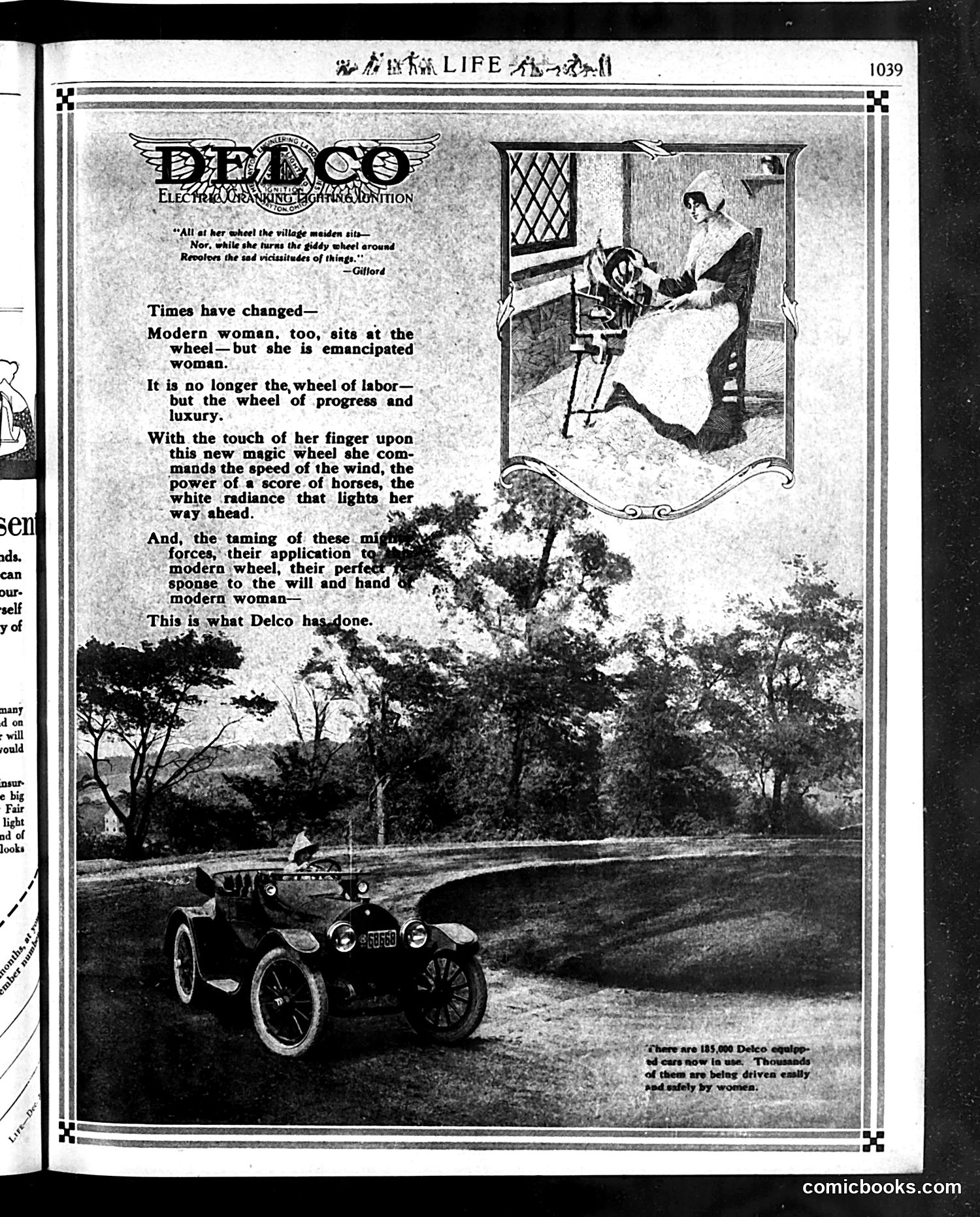
This is primarily a **Delco automotive advertisement** disguised as social commentary. It satirizes changing gender roles by contrasting a literary reference to traditional women ("village maiden") with the "modern woman" who drives cars and controls technology. The advertisement argues that automotive technology—specifically Delco's electrical systems—represents female emancipation. Where women once labored at spinning wheels, they now command automobiles with a "touch of her finger," wielding "the power of a score of horses." The inset illustration shows a woman at an automobile's steering wheel, while the main image depicts a Delco-equipped car in a pastoral landscape. The text claims 185,000 Delco-equipped vehicles are "driven easily and safely by women," positioning cars as symbols of progress and female liberation. The satire is gentle: it celebrates women's newfound mobility and power while promoting Delco technology as the enabler of modern womanhood.
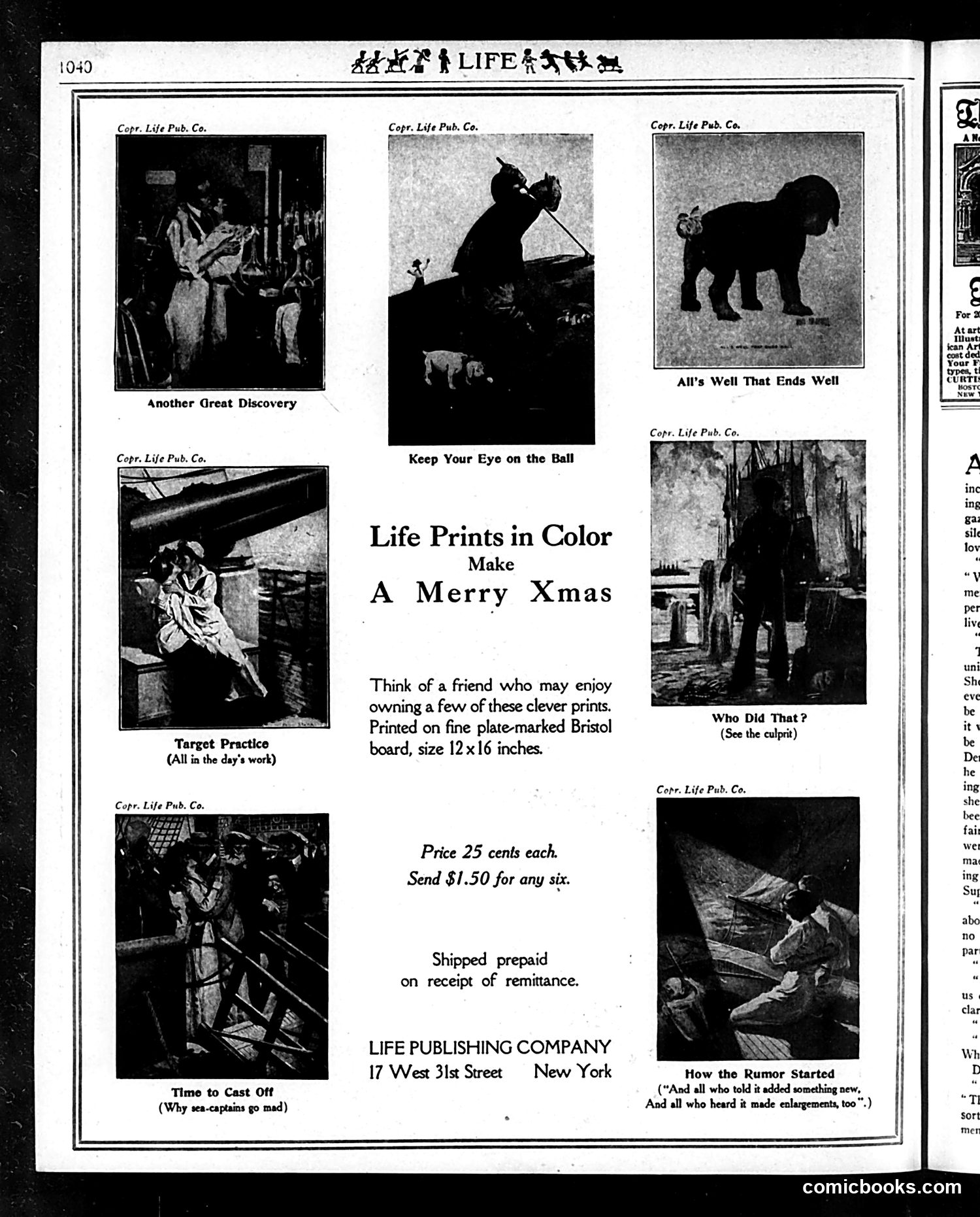
This is primarily a **Christmas advertisement** for Life Publishing Company's color prints, not political satire. The page showcases six humorous illustrated prints available for purchase at 25 cents each. The cartoons depict everyday comedic situations with captions explaining the humor: - "Another Great Discovery" and "Keep Your Eye on the Ball" appear to show domestic or social mishaps - "All's Well That Ends Well" features a dog - "Target Practice" shows someone at work - "Time to Cast Off" includes a subtitle "(Why sea-captains go mad)," suggesting maritime-related frustration - "Who Did That?" and "How the Rumor Started" involve domestic chaos and gossip The humor is gentle, situational comedy typical of early 20th-century Life magazine—no sharp political commentary or caricature of identifiable figures. The advertisement simply encourages readers to purchase these prints as Christmas gifts, emphasizing their quality ("fine plate-marked Bristol board").
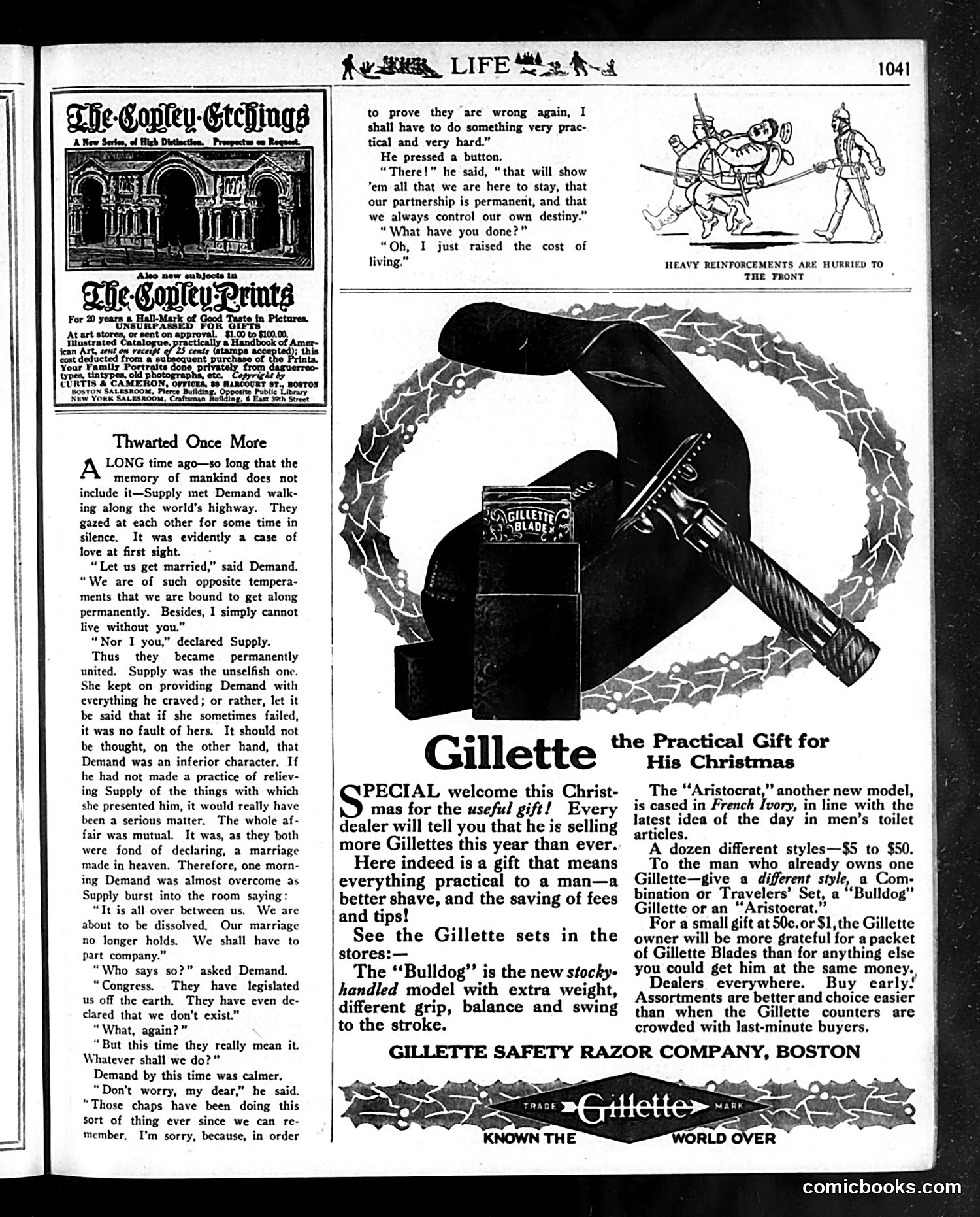
This story uses Supply and Demand as allegorical characters to satirize Congressional economic regulation. The narrative depicts Supply and Demand as a married couple whose relationship Congress has legislated out of existence—a likely reference to wartime price controls or anti-monopoly legislation. When Demand learns of this governmental intervention, he responds by "pressing a button" and raising the cost of living, proving their partnership remains permanent and beyond government control. The satire suggests that economic laws (supply and demand) are natural and inevitable; government attempts to regulate them only trigger inflation or other unintended consequences. The humor lies in portraying abstract economic principles as characters defying bureaucratic oversight—a commentary on the futility of legislative economic management. The adjacent Gillette razor advertisement is unrelated commercial content.
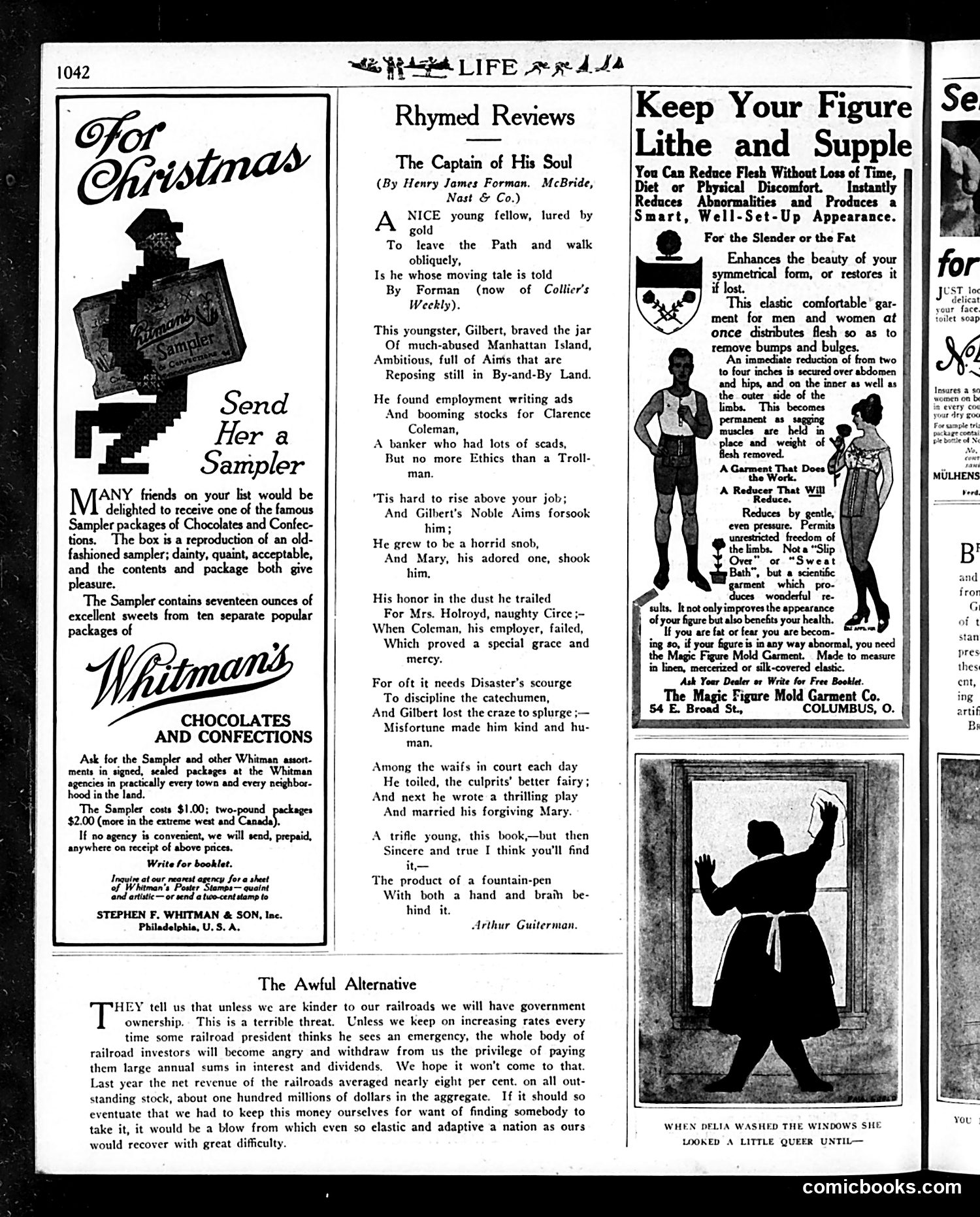
This page mixes Christmas gift advertising with literary satire and political commentary. **Left side:** Whitman's Samplers chocolate box advertisement positions itself as an elegant Christmas gift, emphasizing tradition ("old-fashioned sampler") and accessibility across America. **Center:** Arthur Guiterman's poem reviews Henry James Forman's novel "The Captain of His Soul." The satire follows Gilbert, an ambitious young man who abandons his principles while working in finance for an unethical banker named Coleman, seduces a society woman, loses his honor—but finds redemption through financial disaster, becoming a better person serving the poor and winning back his faithful Mary. The humor lies in the moralistic arc: financial ruin paradoxically saves his soul. **Right side:** Advertisements for figure-control garments ("Lithe and Supple") for men and women, promising to reduce flesh and "abnormalities" without discomfort. **Bottom:** Political satire mocking railroad monopolies' threats of government ownership if rates aren't increased, arguing their current 8% profits would be catastrophic to lose—a sarcastic defense of corporate greed.
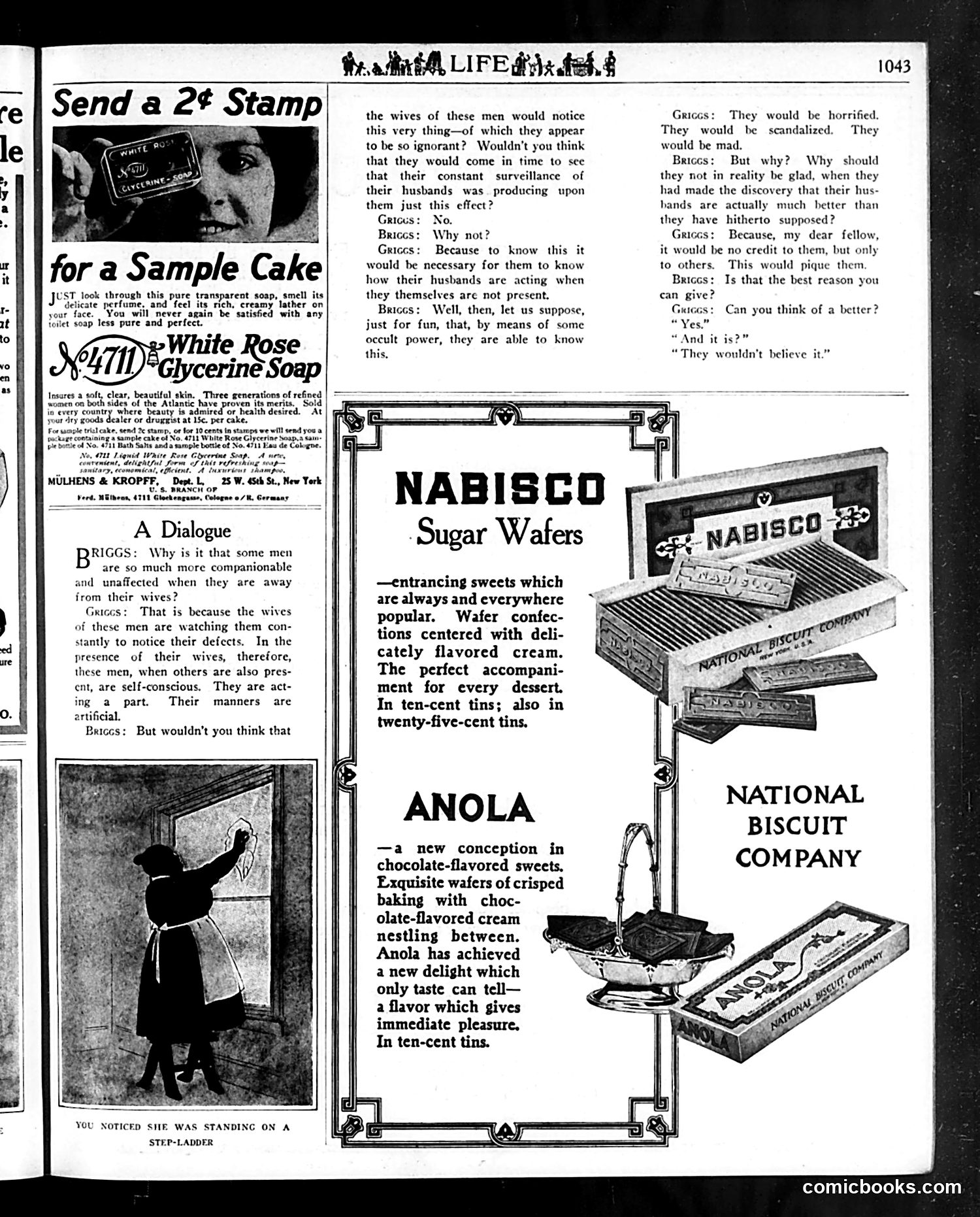
This page contains **a satirical dialogue** (labeled "A Dialogue") between two characters, Briggs and Griggs, discussing marital dynamics. The satire targets wives' surveillance of their husbands' behavior. **The premise:** Briggs observes that men are more companionable away from their wives. Griggs explains wives constantly monitor husbands' conduct, making them self-conscious and artificial in social settings. **The satirical point:** When Briggs logically suggests wives should be *pleased* to discover their husbands behave better in their absence (proving them fundamentally decent), Griggs responds with two cynical punchlines: (1) wives would feel *insulted* because the credit goes to others, not themselves, and (2) wives simply "wouldn't believe it." **The social commentary:** This mocks early 20th-century marital dynamics—specifically the controlling, suspicious wife trope and the paradox that even evidence of a husband's virtue wouldn't satisfy her jealous surveillance. The joke assumes wives are more invested in suspicion and control than in their husbands' actual character. The page is otherwise filled with period advertisements (soap, wafers, biscuits).
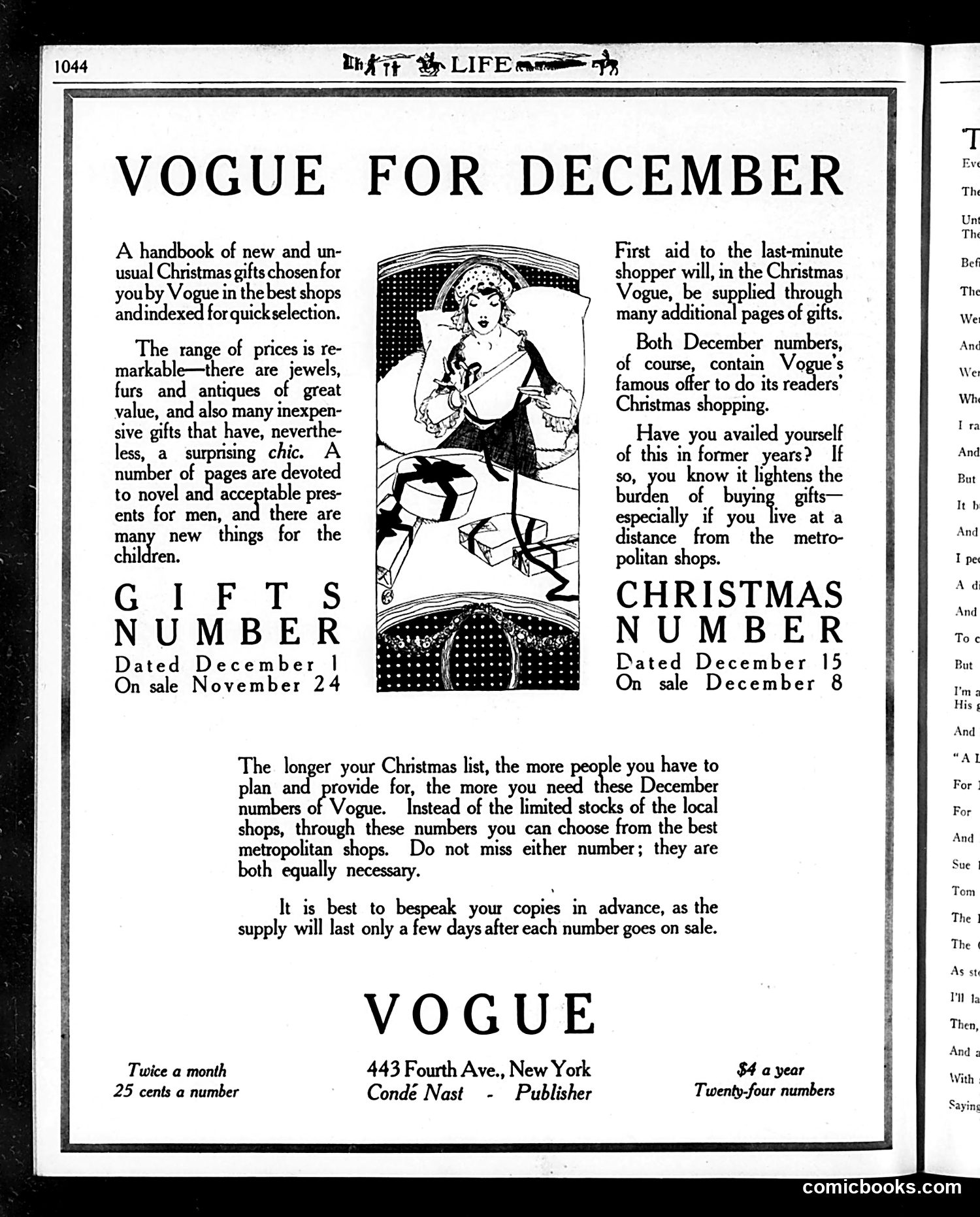
This page is primarily a **promotional advertisement** for Vogue magazine's December issues, not political satire or social commentary. Life magazine is presenting Vogue's holiday shopping guides to Life readers. The illustration shows a stylized woman in 1920s fashion holding wrapped gifts—a typical fashion magazine visual. The ad emphasizes Vogue's two December numbers as essential shopping aids: a "Gifts Number" (December 1, on sale November 24) and a "Christmas Number" (December 15, on sale December 8). The pitch targets affluent readers, especially those distant from major shopping centers, offering access to "the best metropolitan shops" and Vogue's personal shopping service. It's a straightforward commercial promoting the magazine's usefulness for holiday gift-buying, priced at 25 cents per issue or $4 yearly. No satire is evident—this is simply a magazine advertisement.
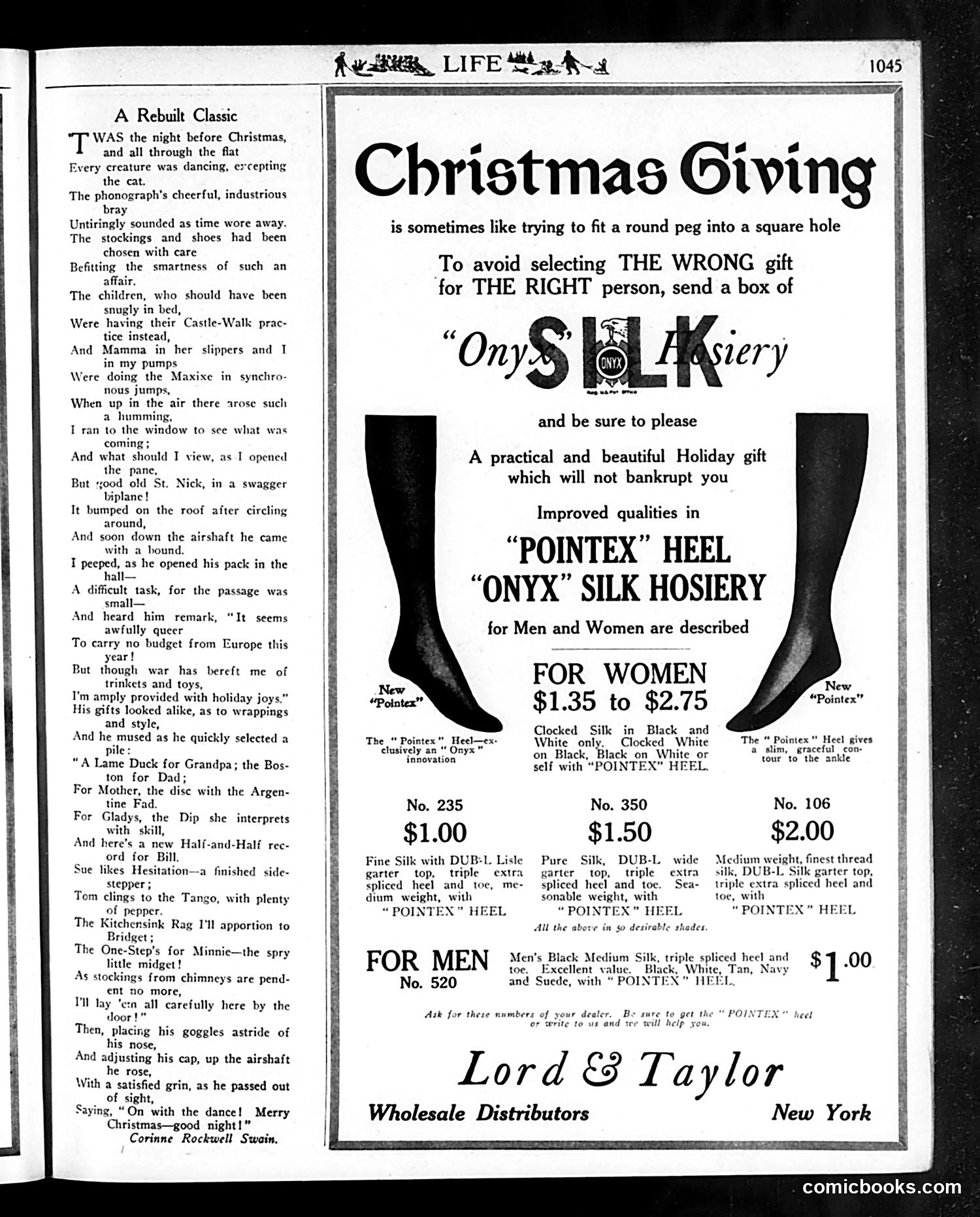
This page contains a humorous poem titled "A Rebuilt Classic" by Corinne Rockwell Swain, a modernized parody of "'Twas the Night Before Christmas." **The Satire:** The poem updates the classic holiday story to post-WWI 1920s America, replacing traditional gift-giving with contemporary dance crazes. Santa arrives by airplane (modern technology) instead of sleigh, and his gifts are not toys but dance records: the Boston, Argentine Fad, Tango, One-Step, and "Kitchensink Rag." The joke references the era's obsession with new dances and jazz culture, suggesting American consumer culture had shifted from traditional values to fashionable fads. **Context:** This reflects 1920s concerns about modern youth losing interest in timeless pursuits, replaced by transient popular entertainment and commercialism. The airplane detail references post-war aviation. **Secondary Content:** The remainder is a Lord & Taylor advertisement for "Onyx" silk hosiery with a "Pointex" heel, positioning stockings as practical holiday gifts for both men and women.
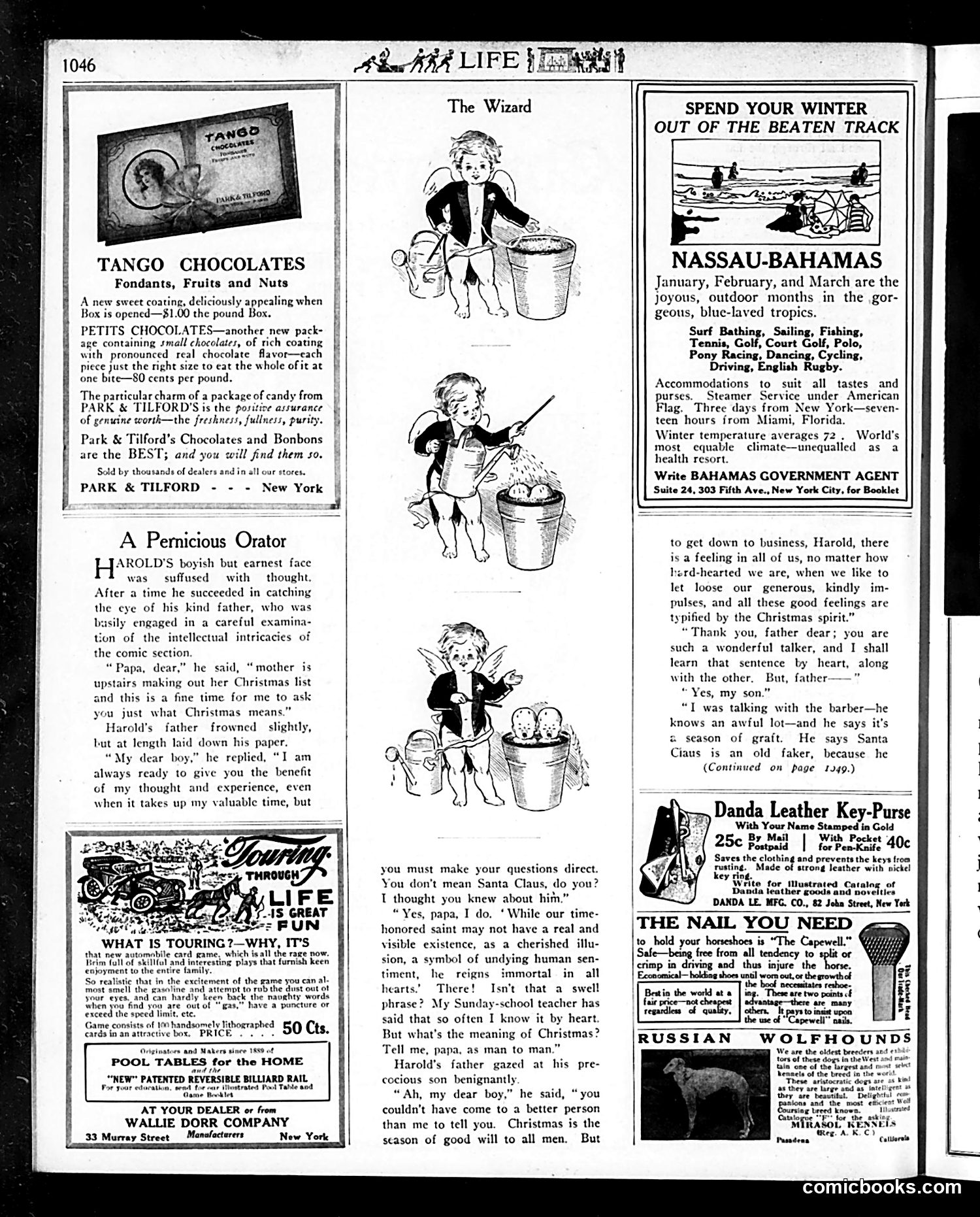
This satirical piece mocks a pompous father's empty, pretentious speech about Christmas to his son Harold. The humor targets adults who deliver grandiose moral lectures while saying nothing substantive. Harold asks innocent questions ("What does Christmas mean?"), but his father responds with inflated rhetoric: Christmas is "the season of good will," a "symbol of undying human sentiment." The father admits he's merely reciting phrases from his Sunday-school teacher—he knows them "by heart" but doesn't understand their meaning. The satire critiques how adults—particularly middle-class fathers—hide intellectual laziness and moral uncertainty behind flowery, memorized language. Harold's genuine curiosity exposes the father's pretension. The title "Pernicious Orator" suggests this empty eloquence is actually *harmful*, teaching children that speaking impressively matters more than thinking clearly. This reflects period anxiety about superficiality in American public discourse and parenting.
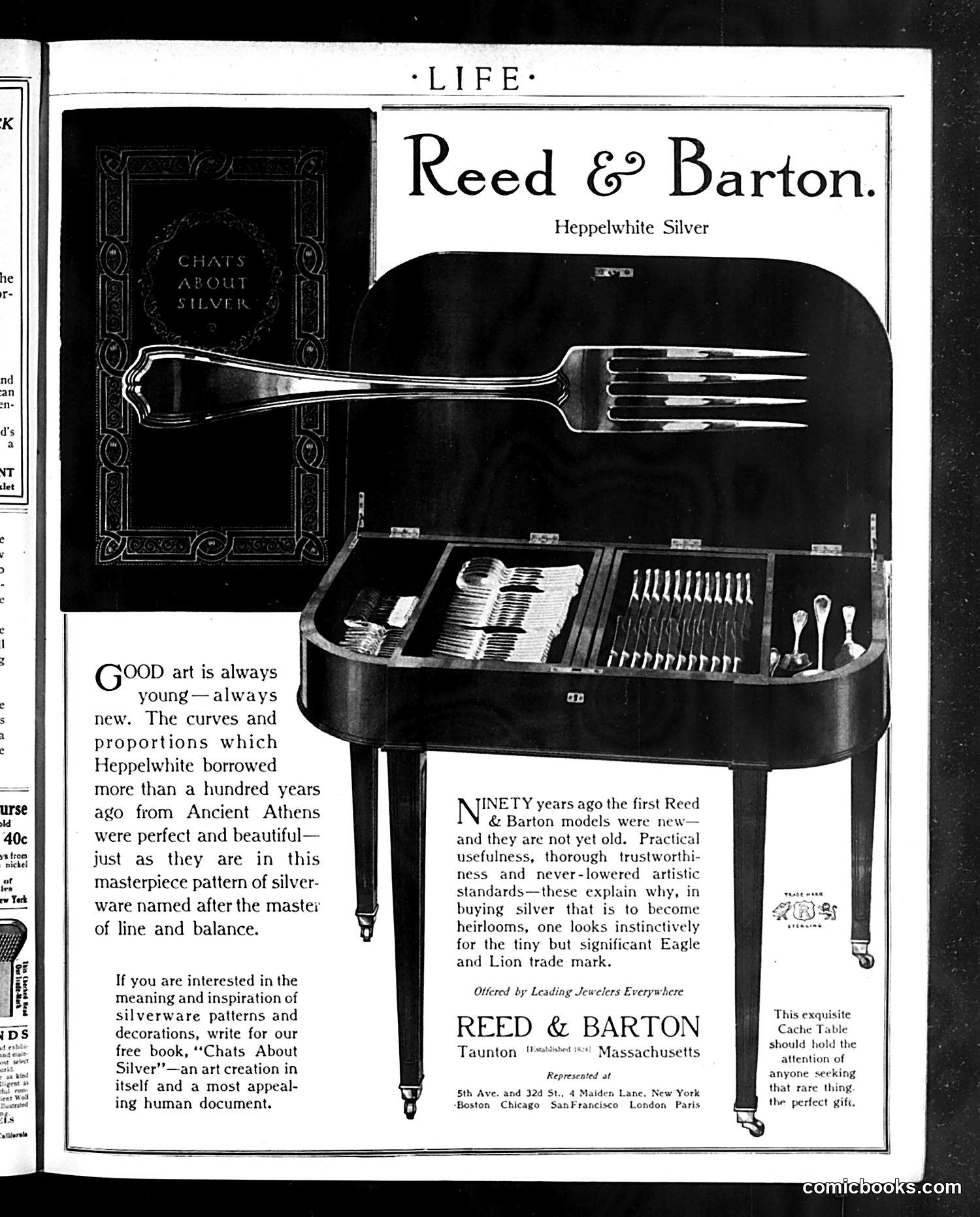
This is a **silverware advertisement**, not a political cartoon. It promotes Reed & Barton's "Heppelwhite Silver" flatware and serving pieces. The ad appeals to consumers by linking the product to classical design: Heppelwhite patterns allegedly borrowed proportions from Ancient Athens over a hundred years prior, suggesting timeless aesthetic value. The accompanying image shows an open flatware chest displaying organized place settings and serving utensils. The sales pitch emphasizes that these designs remain "not yet old" despite their ninety-year history, positioning them as heirloom-quality pieces for discerning buyers. The company invites interested customers to request a free book titled "Chats About Silver." Reed & Barton, based in Taunton, Massachusetts, lists multiple retail locations and jewelers as distribution channels. The Eagle and Lion trademark serves as the company's quality mark. This represents typical early 20th-century luxury advertising targeting middle-to-upper-class households seeking both practical and culturally prestigious tableware.
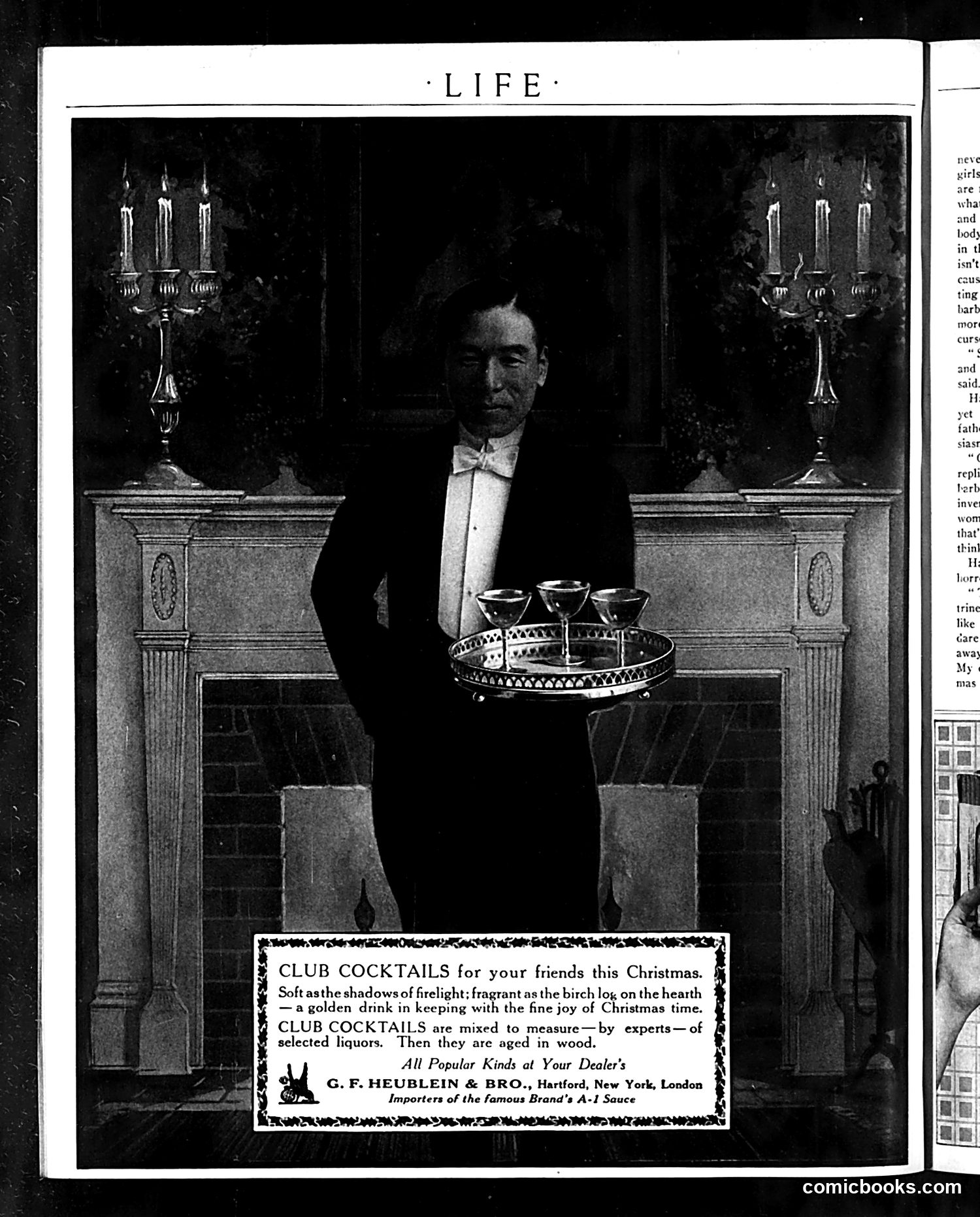
This is primarily a **liquor advertisement**, not political satire. It appears in *Life* magazine and promotes "Club Cocktails" by G.F. Heublein & Bro. The image shows a well-dressed man in formal attire (tuxedo and bow tie) standing before an elegant fireplace with candelabras, holding a serving tray with cocktail glasses. The advertisement uses aspirational imagery—luxury furnishings, formal dress, refined atmosphere—to market pre-mixed cocktails as sophisticated Christmas gifts. The copy emphasizes quality ("mixed to measure—by experts," "aged in wood") and associates the product with upscale entertaining and holiday tradition ("fine joy of Christmas time"). This reflects the **pre-Prohibition era** when cocktails were openly advertised as luxurious consumer goods. The ad targets affluent consumers who would host formal dinner parties or give expensive gifts to friends.
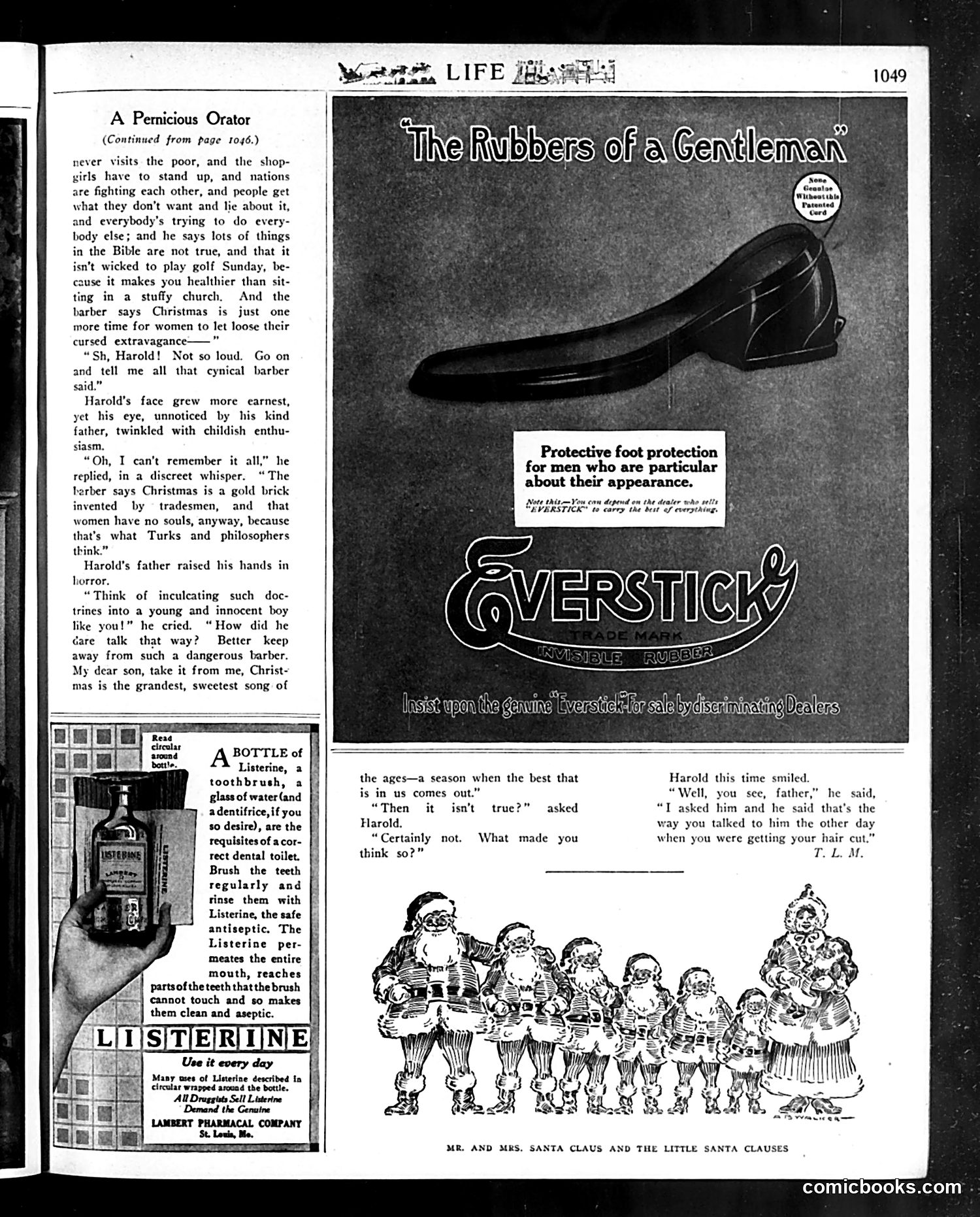
This story satirizes parental hypocrisy. A boy, Harold, reports cynical remarks his barber made—attacking Christmas as commercial, questioning Biblical truth, endorsing Sunday golf over church—claiming these reflect healthier living. Harold's father is horrified, condemning the barber's "dangerous" influence on the innocent boy. He defends Christmas as "the grandest, sweetest song of the ages." The joke's punchline: Harold reveals he got these exact cynical arguments *from his father himself*, during a recent haircut conversation. The father has been unknowingly describing his own worldview back to himself through the barber's mouth. The satire targets adults who preach moral virtue to children while privately expressing skepticism about religion and tradition—the gap between public propriety and private doubt that characterized early 20th-century middle-class life.
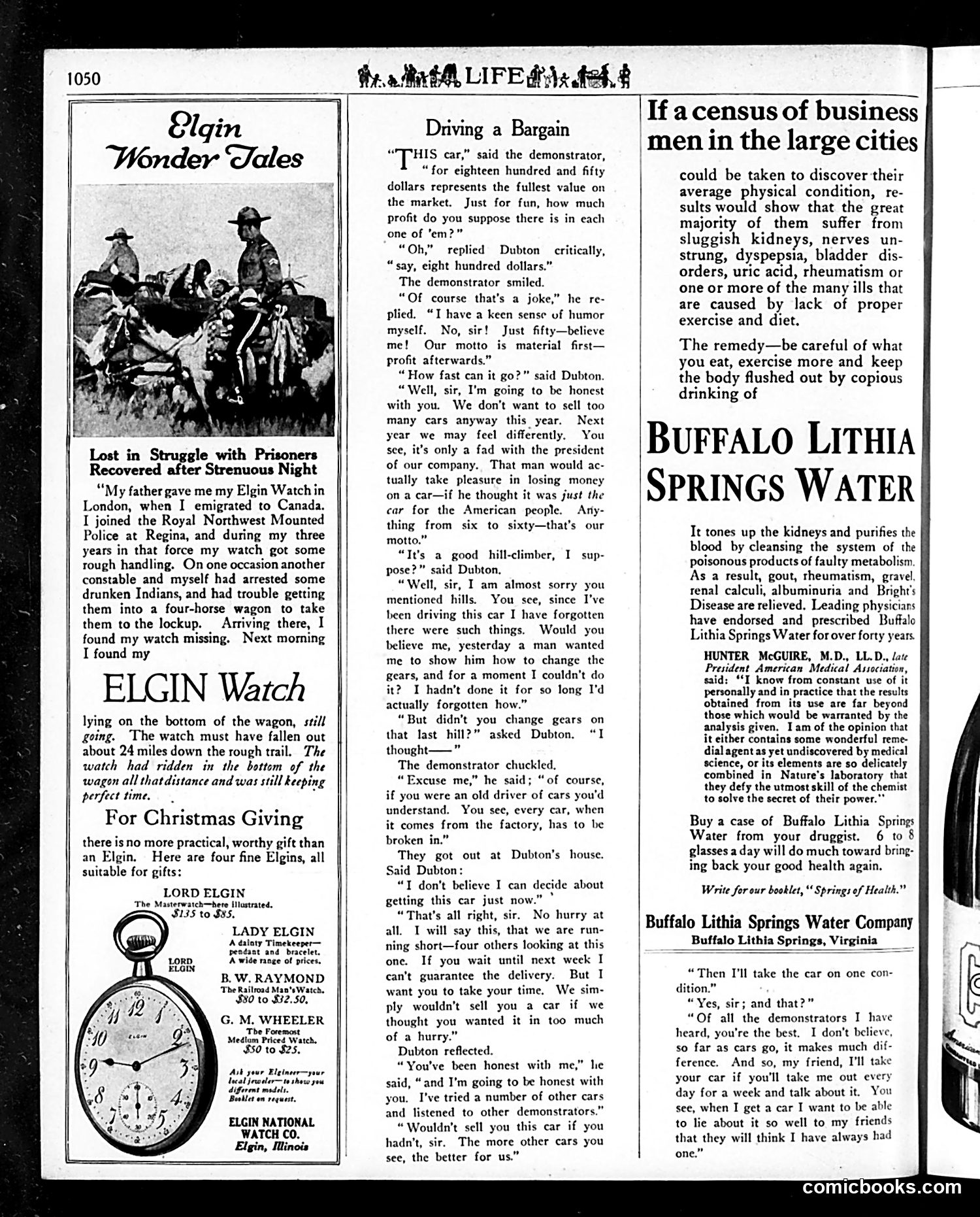
This comic dialogue mocks the emerging "soft sell" automobile sales technique of the early 1900s. A car demonstrator employs exaggerated honesty and flattery to manipulate prospect Dubton—claiming the car has minimal profit margin, admitting he's "almost sorry" to mention hills, pretending to forget how to change gears, and insisting others are waiting to buy. The satire exposes how salesmen weaponize false candor and artificial scarcity to appear trustworthy while actually manipulating buyers. Dubton, recognizing the ploy after hearing similar tactics elsewhere, ultimately agrees to buy because the demonstrator's transparency seemed genuine—completing the circular con. The joke targets both the manipulative sales culture emerging in American commerce and the gullibility of consumers who fall for such performances.
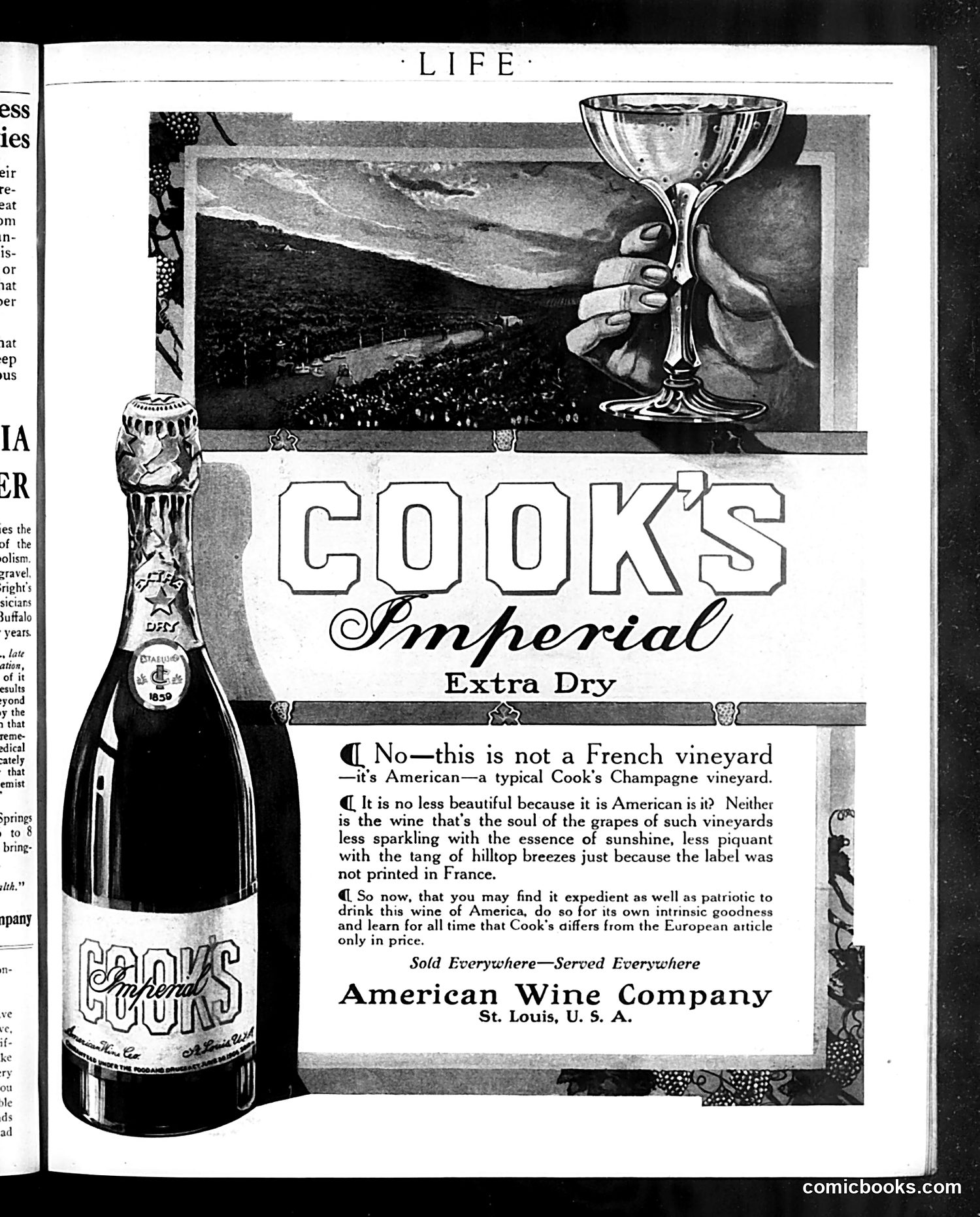
This is primarily a **champagne advertisement**, not political satire. It's a patriotic marketing pitch from the American Wine Company (St. Louis) promoting domestic champagne during a period when French wine held prestige. The ad's central argument: American-made Cook's champagne is equally beautiful and quality to French champagne—the only difference is price. The copy explicitly appeals to patriotism, urging readers to support American products for their "intrinsic goodness." The imagery shows a vineyard landscape and a hand holding an elegant coupe glass, emphasizing sophistication and refinement. This suggests the ad targets middle-class consumers who might aspire to French luxury but can afford American alternatives. **Historical context**: This likely dates to the early-to-mid 20th century when American wine production was developing and competing against European imports. The patriotic angle may reflect post-WWI American sentiment favoring domestic products.
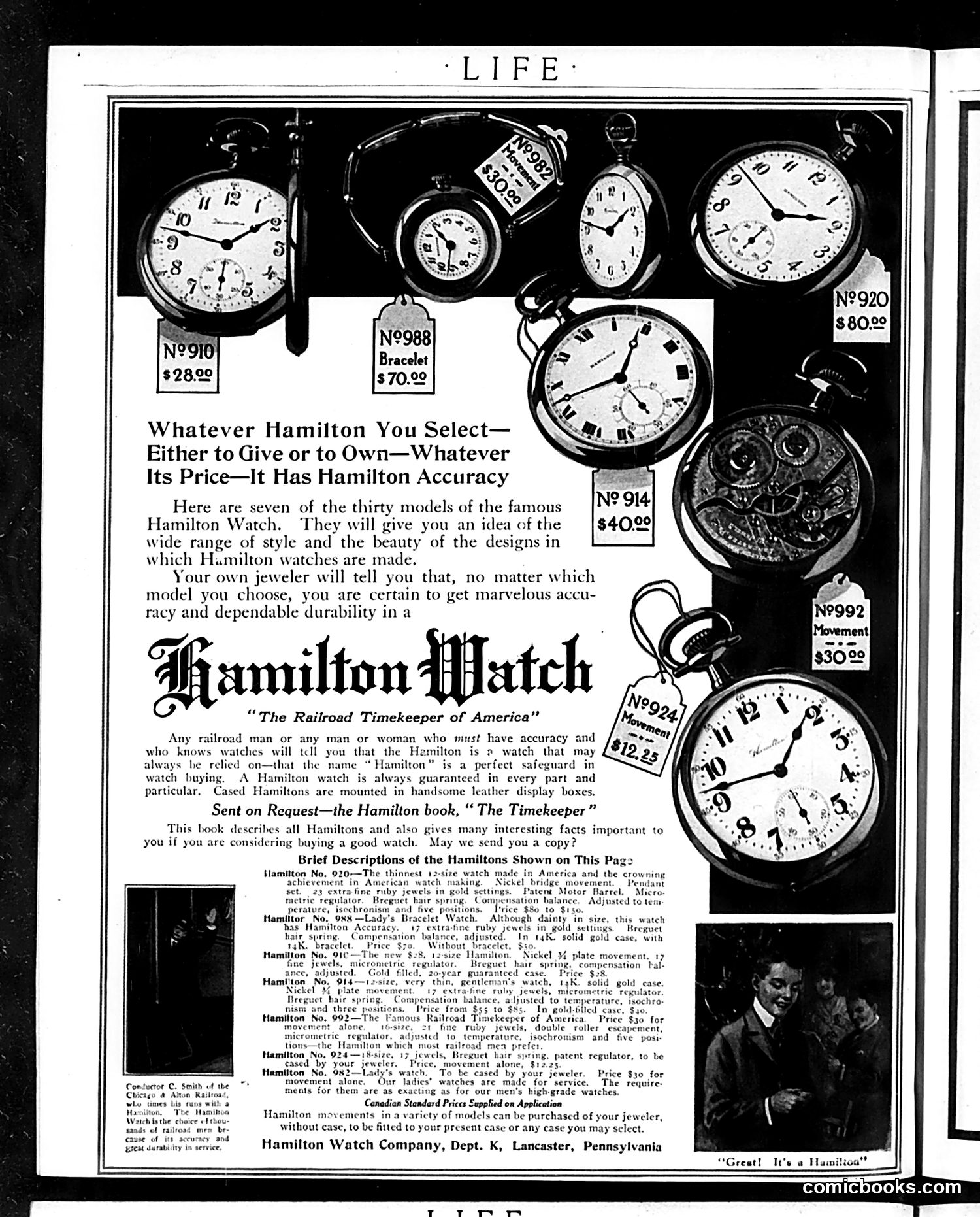
This is a **full-page advertisement**, not political satire. It promotes Hamilton watches, marketed as "The Railroad Timekeeper of America." The ad displays seven watch models with prices ranging from $28.99 to $80.99, emphasizing accuracy and durability—qualities crucial for railroad workers who depended on precise timekeeping for safety and schedules. The tagline positions Hamilton as the trusted choice for professionals requiring reliability. The text stresses that regardless of which model customers select, they receive "Hamilton Accuracy"—a brand promise. It notes watches come in "handsome leather display boxes" and offers a free booklet called "The Timekeeper." At bottom, a small photo shows a railroad conductor, reinforcing the product's association with railroad work—the era's most demanding timekeeping application. This represents early 20th-century advertising strategy: associating consumer products with professional expertise and safety-critical industries to build brand credibility.
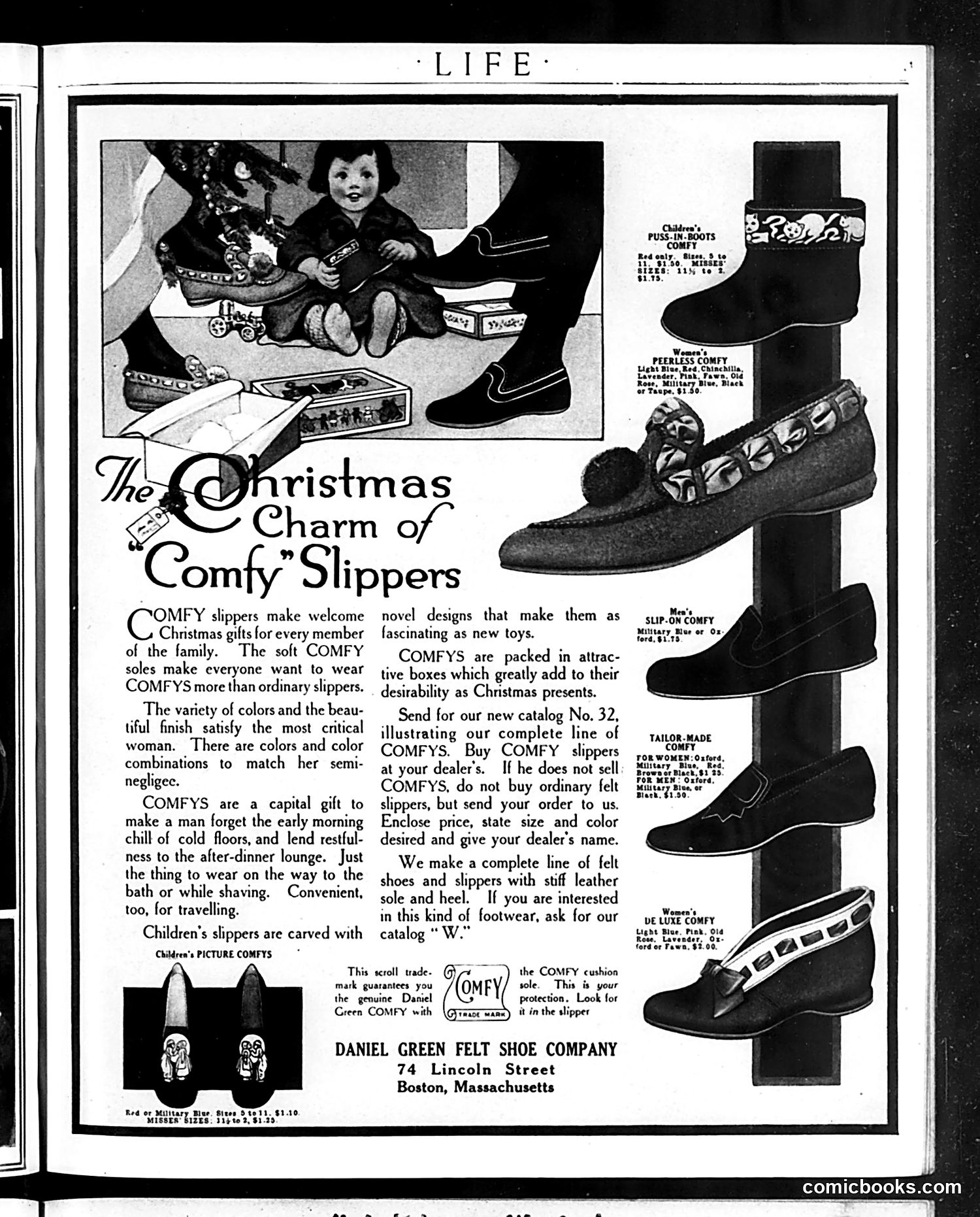
This is a **LIFE magazine advertisement**, not political satire or a cartoon. It's a full-page Christmas gift advertisement for COMFY brand slippers manufactured by the Daniel Green Felt Shoe Company in Boston. The page shows various slipper styles (children's, women's, men's) with decorative illustrations including a scene of a child playing with toys and adults' feet in slippers. The ad emphasizes comfort, attractive packaging, and variety for different family members—positioning slippers as desirable holiday gifts. The children's slippers feature "picture" designs (carved decorative details) to appeal to young buyers. The text uses common early-20th-century advertising language: comfort, convenience, quality finishes, and fashionable color combinations. There is **no satirical content or social commentary**—this is straightforward commercial advertising typical of the period when LIFE functioned as both a humor magazine and advertising vehicle.
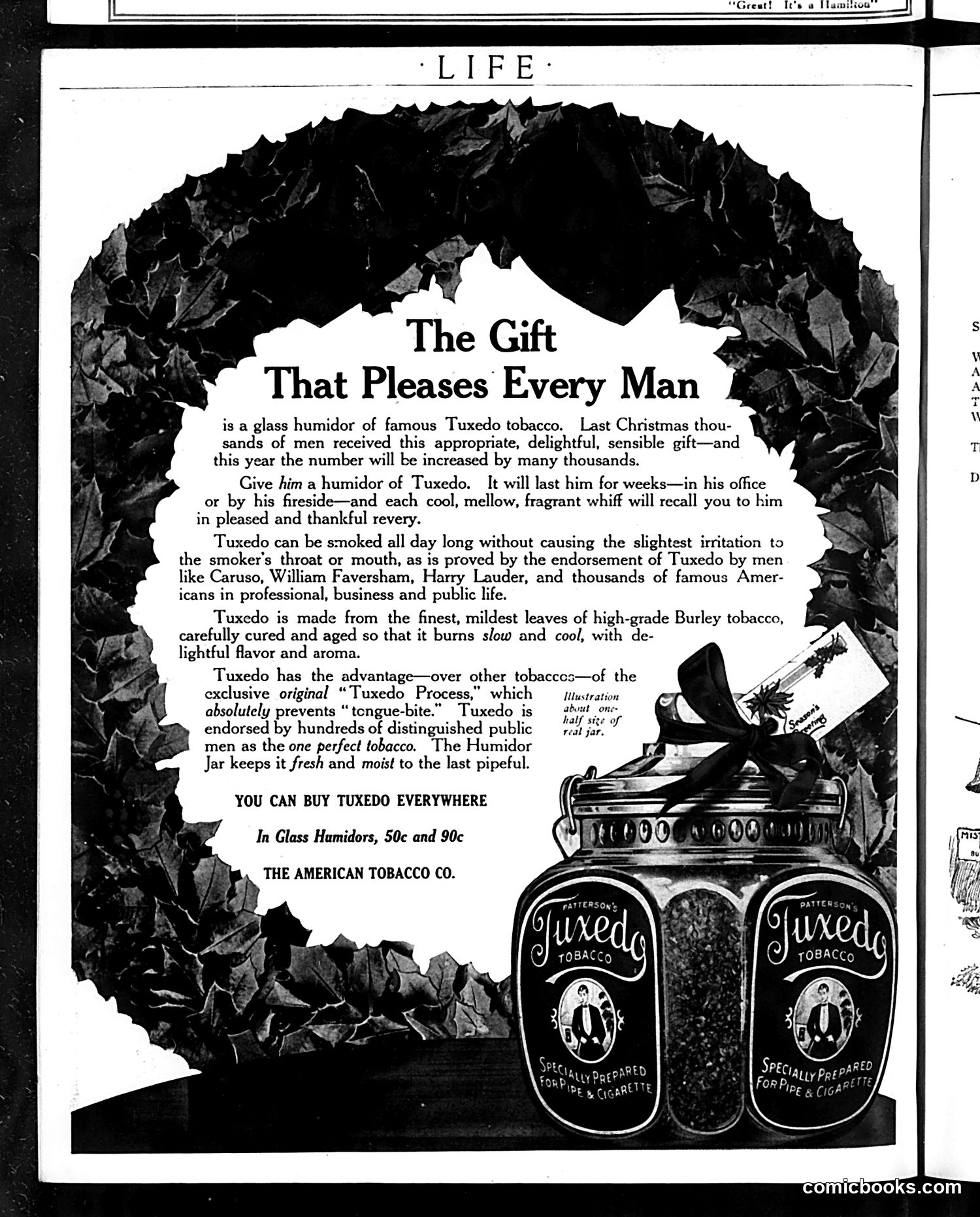
This is a **tobacco advertisement**, not satire or political commentary. It promotes Tuxedo brand pipe tobacco, presented as an ideal Christmas gift for men. The ad targets affluent male consumers by emphasizing: - **Celebrity endorsements** (opera singer Caruso, actors Faversham and Lauder) to signal prestige - **Health claims** (no throat irritation, all-day smoking without damage) - **Superior product qualities** (slow-burning, mild Burley tobacco, proprietary "Tuxedo Process") - **Lifestyle appeal** (leisurely smoking by the fireside evokes sophistication and relaxation) The decorative tobacco leaf border frames the glass humidor jars shown at bottom. The copy stresses the humidor's practical benefit: keeping tobacco "fresh and moist" for weeks. By modern standards, the health assertions are strikingly false—the ad claims smoking causes "not the slightest irritation" despite being "endorsed by hundreds of distinguished public men," exploiting celebrity credibility to market an addictive, carcinogenic product to gift-givers.
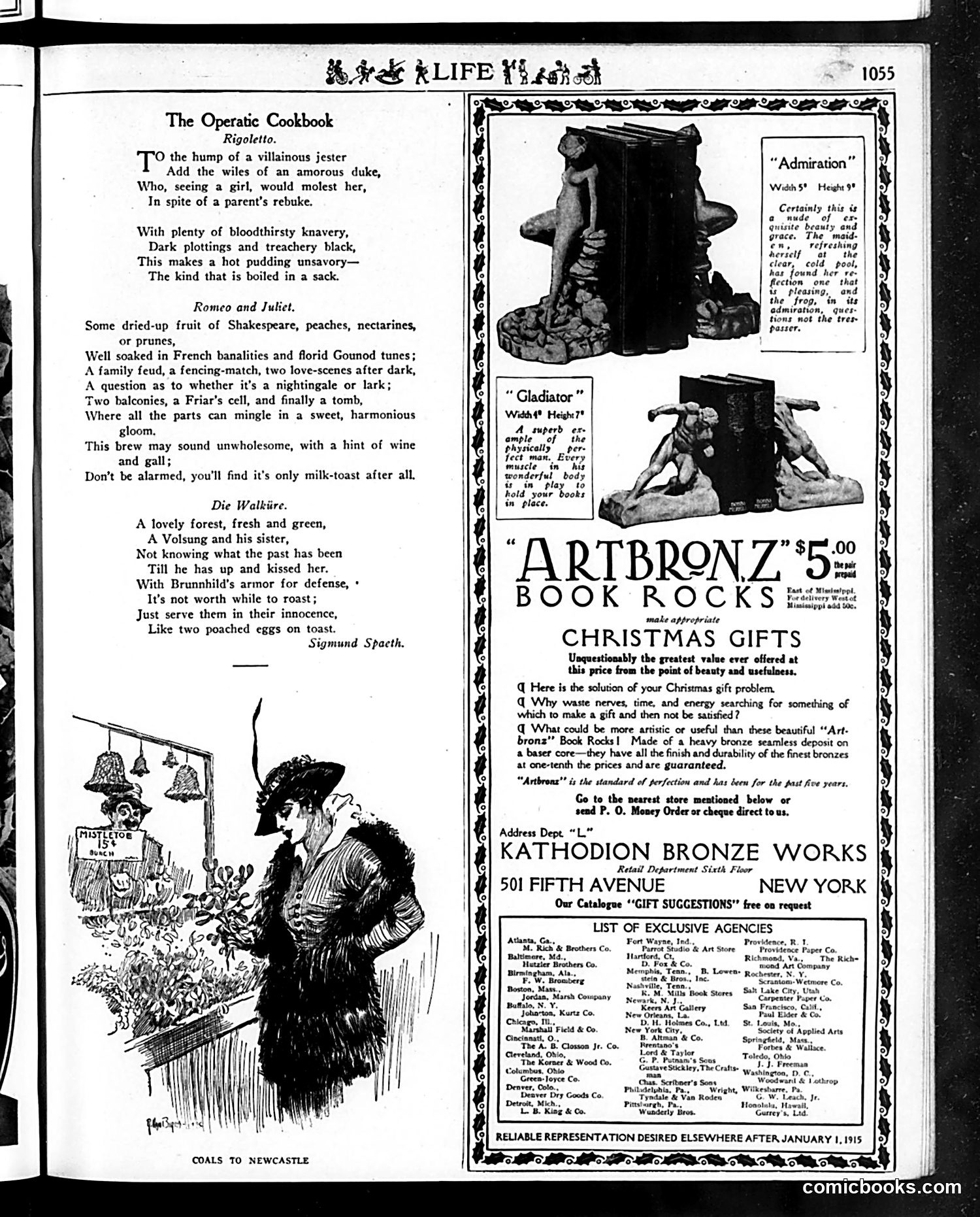
This page satirizes famous operas by presenting their plots as absurd recipes. Each opera's dramatic elements—murder, passion, family feuds—become ridiculous "ingredients" for dishes. **Rigoletto**: A hunchbacked jester, a lecherous duke, a molested girl, and bloodthirsty scheming create "a hot pudding unsavory—the kind boiled in a sack." **Romeo and Juliet**: Shakespeare's feuding families, fencing matches, love scenes, and tombs yield mere "milk-toast." **Die Walküre**: A forest, forbidden sibling romance, and armor become "two poached eggs on toast." The joke mocks operatic excess—the overwrought melodrama, convoluted plots, and emotional intensity of these celebrated works are deflated by reducing them to mundane cooking instructions. It's satirical commentary on opera's tendency toward melodramatic absurdity. The page also includes an unrelated advertisement for Artbronz book rocks as Christmas gifts.
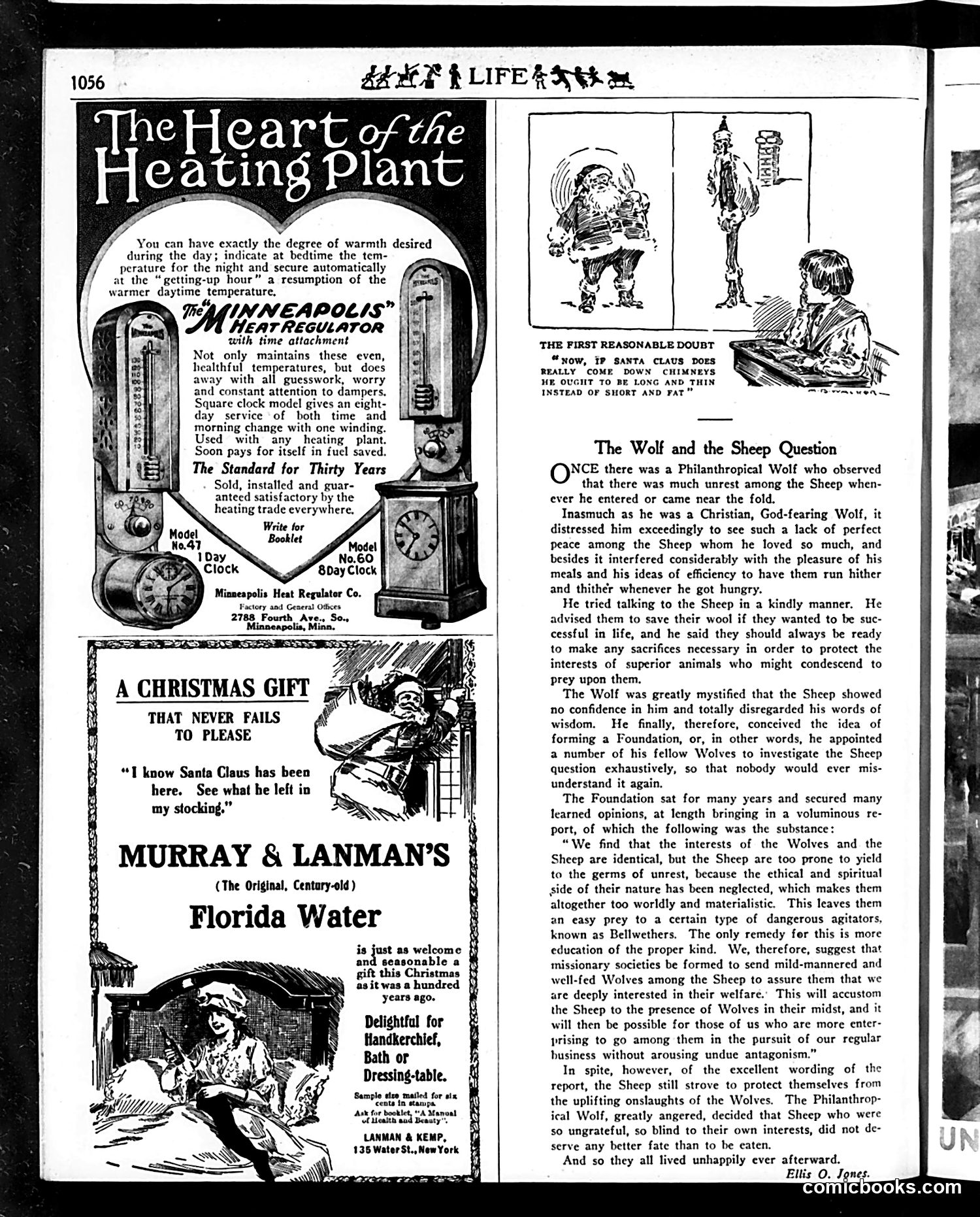
This fable satirizes how powerful interests use ostensibly benevolent institutions to pacify and manipulate vulnerable populations. A predatory Wolf, disturbed that Sheep flee from him, establishes a "Foundation" staffed by fellow Wolves to "investigate" Sheep anxiety. The Foundation concludes that Sheep suffer from spiritual deficiency and lack proper "education"—the real problem being agitators called "Bellwethers" (a reference to labor organizers or radicals). Their solution: send friendly Wolves as missionaries to reassure Sheep of good intentions, ultimately making prey easier to approach. The satire targets how capitalist or aristocratic elites use philanthropic and educational facades to neutralize working-class resistance and prevent meaningful reform. The fable appears in *Life*, a progressive satirical magazine, likely critiquing early 20th-century corporate foundations and paternalistic "welfare" initiatives designed less to help workers than to defang labor movements.
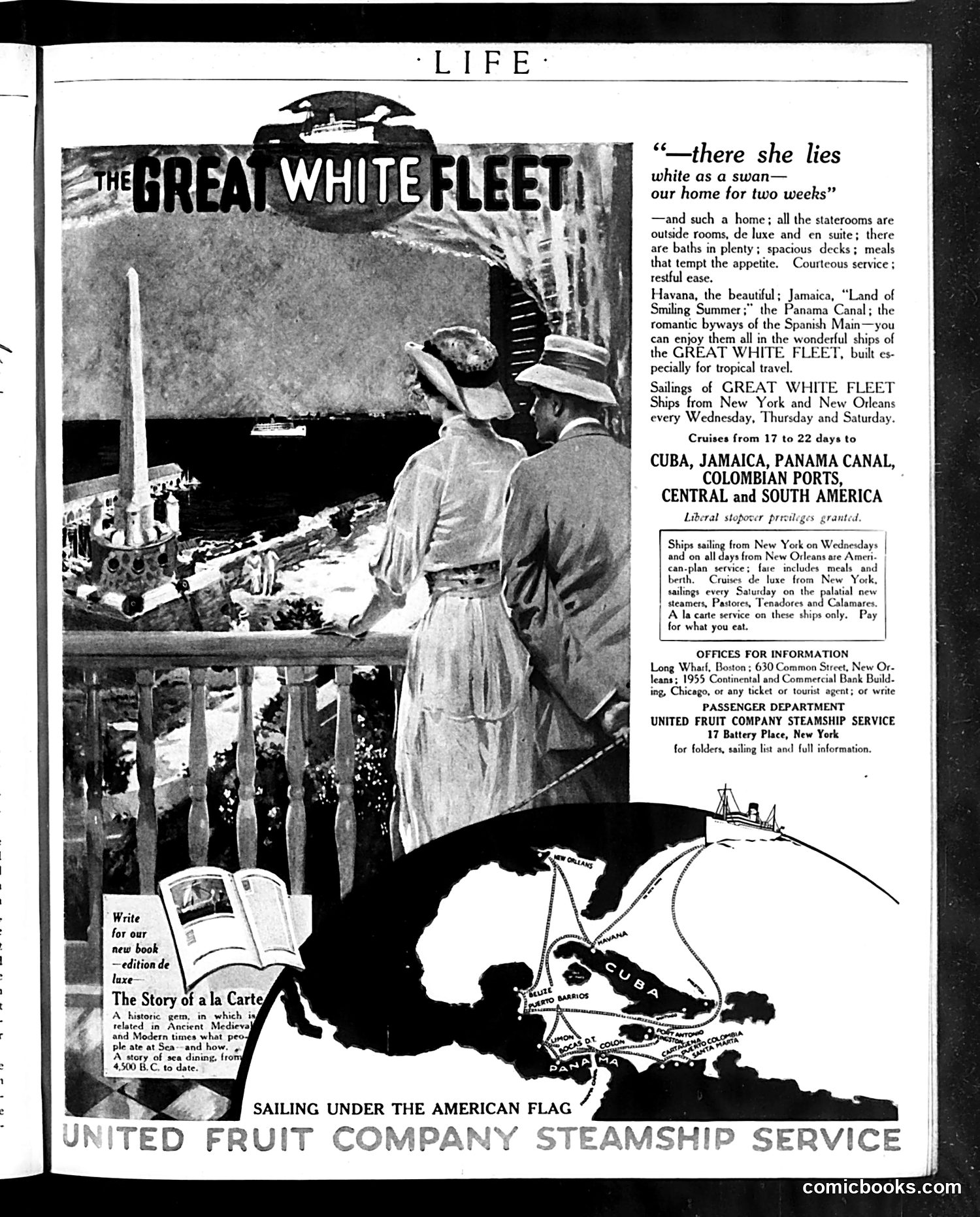
This is primarily a **cruise ship advertisement**, not a satirical cartoon. It promotes the United Fruit Company Steamship Service's "Great White Fleet" for luxury tropical voyages. The page shows a woman gazing at a large passenger ship, with romantic language ("white as a swan") emphasizing elegance and comfort. The advertisement highlights Caribbean destinations (Cuba, Jamaica, Panama Canal) and promises deluxe accommodations, courteous service, and gourmet dining. The accompanying map illustrates the Caribbean cruise route. A secondary ad promotes a book called "The Story of ala Carte," tracing dining history from 4500 B.C. to present. **Context for modern readers**: This represents early-20th-century leisure tourism marketing, targeting wealthy Americans. The emphasis on "American flag" sailing and tropical destinations reflects both industrial expansion and the era's imperial attitudes toward Central America and the Caribbean—regions where United Fruit held significant economic and political influence.
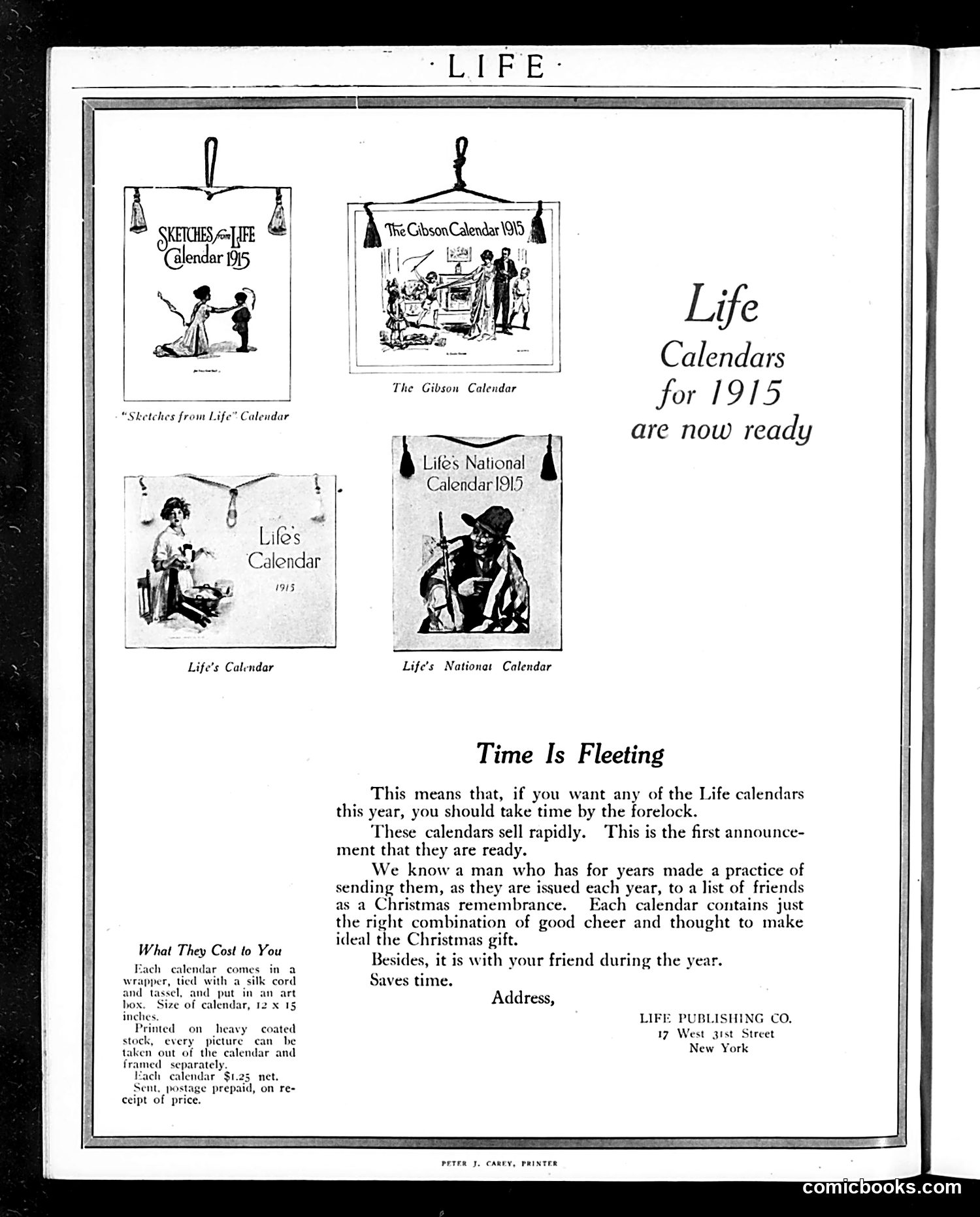
This is a straightforward product advertisement, not political satire. Life Publishing Company is promoting four different 1915 calendar designs available for purchase: "Sketches from Life" Calendar, "The Gibson Calendar," "Life's Calendar," and "Life's National Calendar." The ad emphasizes urgency ("Time Is Fleeting," "take time by the forelock") because calendars sell quickly upon release. It positions calendars as ideal Christmas gifts, noting that they combine "good cheer and thought" while remaining useful year-round as companions to the recipient. The pricing and specifications are practical: $1.25 net, 12 x 15 inches, printed on heavy stock with removable pictures suitable for framing separately. The copy suggests this advertisement marks the first public announcement of their 1915 calendar availability, targeting repeat customers and gift-givers.
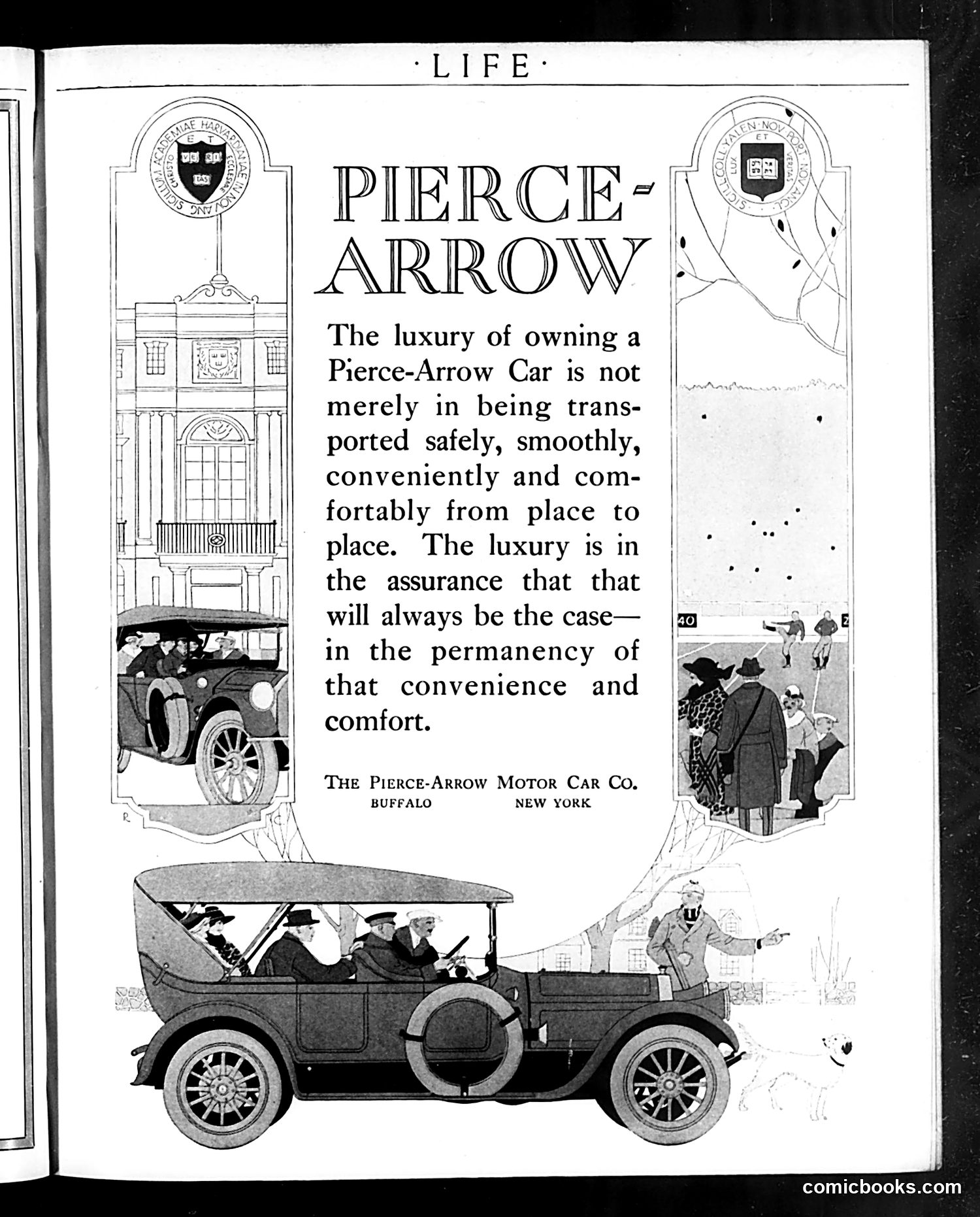
This is a **straightforward luxury car advertisement**, not political satire. The page promotes Pierce-Arrow automobiles through aspirational imagery showing wealthy people in various settings: arriving at elegant mansions, socializing outdoors, and traveling comfortably. The advertisement's pitch emphasizes **permanence and reliability**—the luxury isn't merely transportation but the assurance of consistent comfort and convenience. The architectural framing (with university seals at top) suggests prestige and established quality. The illustrations depict early-1900s upper-class leisure activities, positioning the Pierce-Arrow as a status symbol for the affluent. This is typical **early-20th-century advertising strategy**: associating a product with wealth, sophistication, and social standing rather than focusing on mechanical specifications.
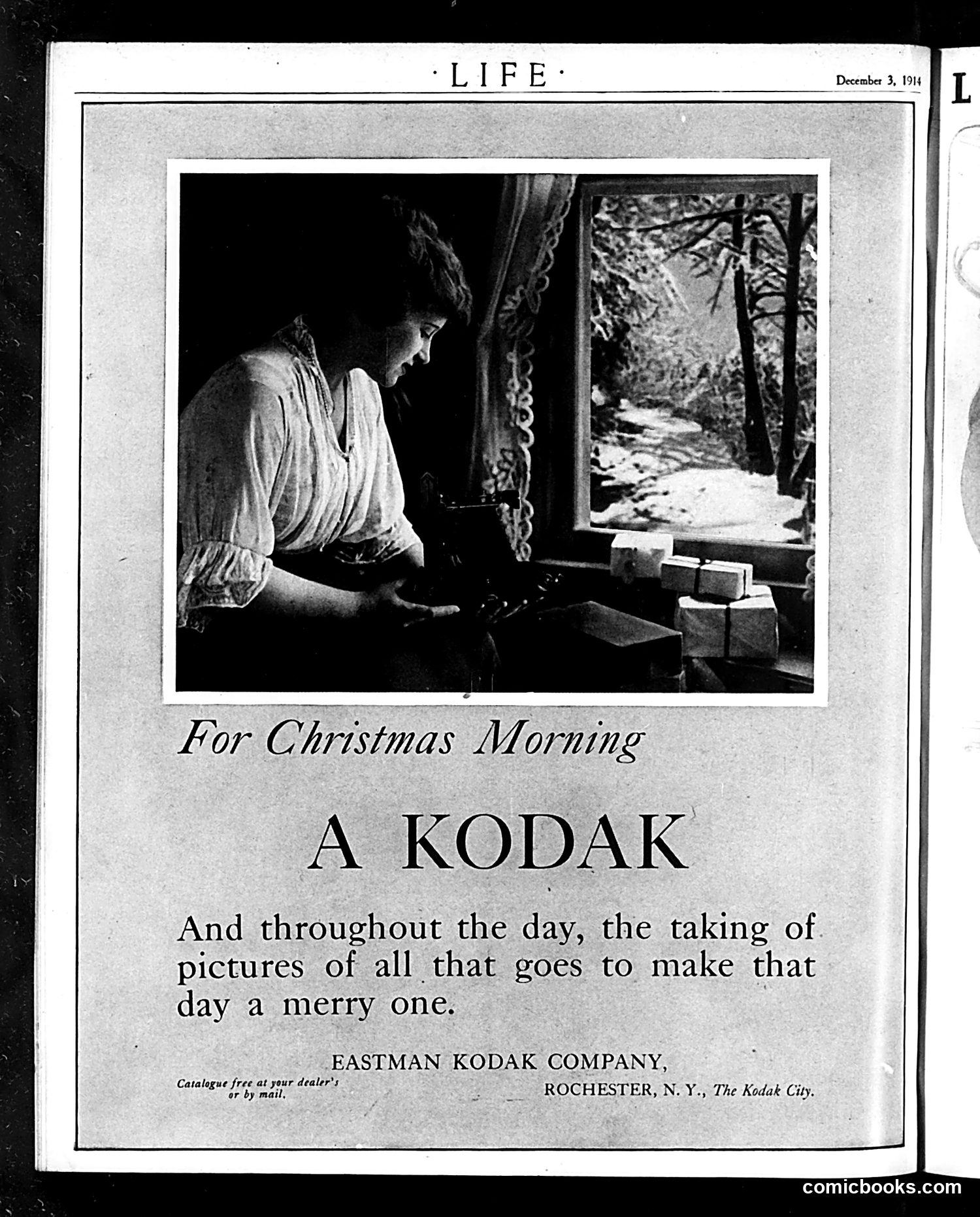
This is a **Kodak advertisement**, not a political cartoon. The page promotes cameras as Christmas gifts for 1914. The image shows a woman at a window, photographing an outdoor winter scene—likely a snowy forest or park visible through the glass. The ad's message is straightforward: a Kodak camera makes an ideal Christmas present because it allows people to capture and preserve holiday memories "throughout the day." The text emphasizes the emotional benefit: taking pictures helps create "a merry" Christmas by documenting festive moments. This reflects early 20th-century marketing that positioned photography as a way to preserve family memories—a relatively new consumer concept when cameras were becoming more affordable and accessible to middle-class households. There is no satire or political content here; it's simply period advertising.