
Life, 1914-12-03 · page 36 of 92
Life — December 3, 1914 — page 36: what you’re looking at
What you’re looking at
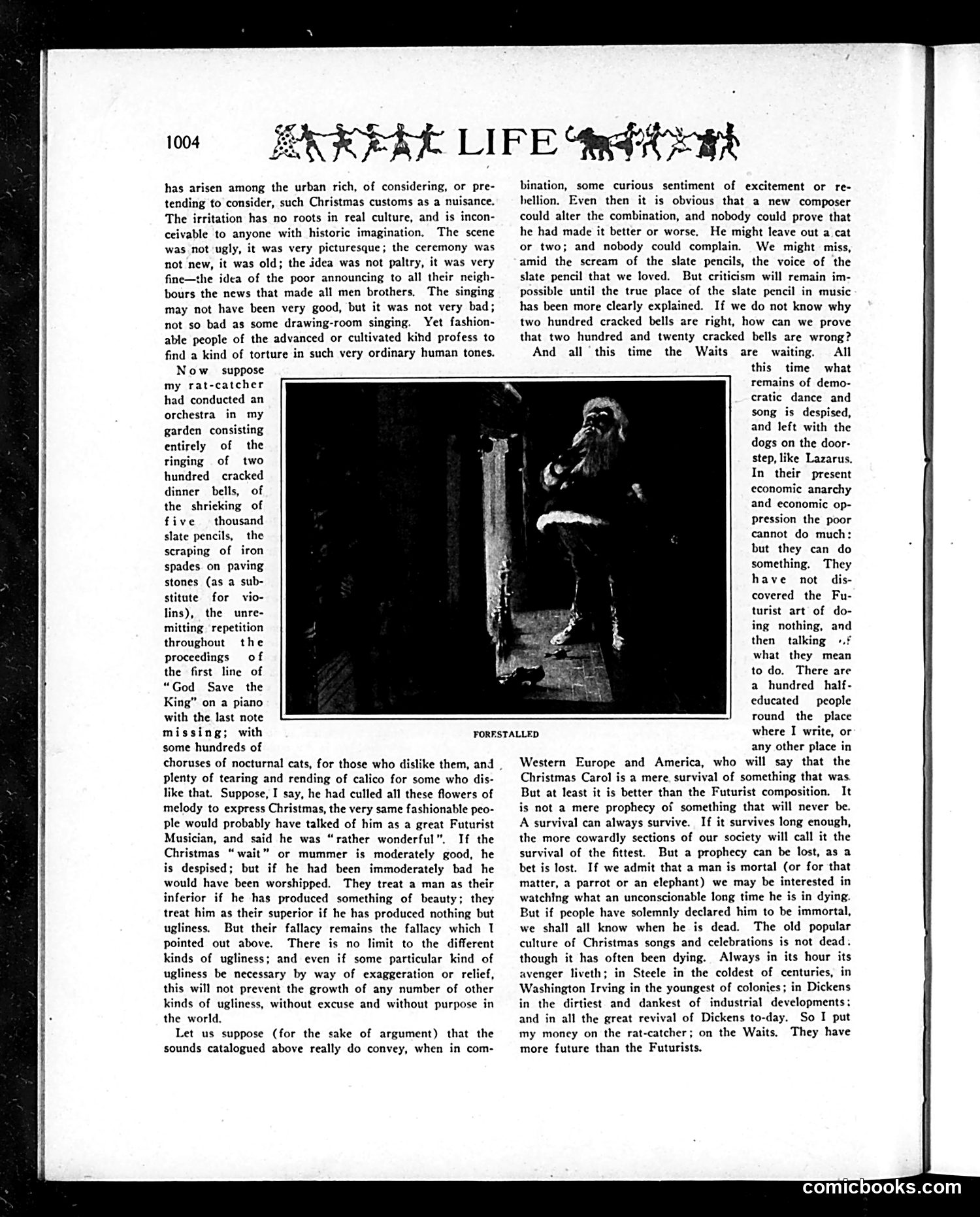
The image shows "Forestalled," depicting a figure in a doorway—likely representing Christmas carolers or "the Waits" (traditional carol singers mentioned in the text). The article satirizes wealthy urban elites who dismiss Christmas carols and caroling as vulgar nuisances, despite their historical and cultural significance. The author argues that the poor's democratic tradition of singing carols to announce "the news that made all men brothers" possesses genuine beauty and meaning. The satire targets class hypocrisy: fashionable people who would praise as "wonderful" Futurist art deliberately composed of discordant sounds (cracked bells, slate pencils, iron scraping) yet despise humble carolers producing similar cacophony. The piece defends working-class customs against snobbish modernist pretensions, suggesting that dismissing caroling reflects not refined taste but affectation and contempt for ordinary people's expressions of human connection.
📄 Transcribed text from this page (OCR, searchable)
Machine-transcribed from the original scan — historical spelling and the odd misread are preserved.
ORREAE LIFE ed tanh has arisen among the urban rich, of considering, or pre- tending to consider, such Christmas customs as a nuisance. The irritation has no roots in real culture, and is incon- ceivable to anyone with historic imagination, The scene was not ugly, it was very picturesque; the ceremony was not new, it was old; the idea was not paltry, it was very fine—the idea of the poor announcing to all their neigh- bours the news that made all men brothers, The singing may not have been very good, but it was not very bad; not so bad as some drawing-room singing. Yet fashion- able people of the advanced or cultivated kind profess to find a kind of torture in such very ordinary human tones. Now _ suppose bination, some curious sentiment of excitement or re- hellion, Even then it is obvious that a new composer could alter the combination, and nobody could prove that he had made it better or worse. He might leave out a cat or two; and nobody could complain. We might miss, amid the scream of the slate pencils, the voice of the slate pencil that we loved. But criticism will remain im- possible until the true place of the slate pencil in music has been more clearly explained. If we do not know why two hundred cracked bells are right, how can we prove that two hundred and twenty cracked bells are wrong? And all this time the Waits are waiting. All this time what my rat-catcher had conducted an orchestra in my garden consisting entirely of the ringing of two hundred cracked dinner bells, of the shrieking of five thousand slate pencils, the scraping of iron spades on paving stones (as a sub- stitute for vio- lins), the unre- mitting repetition throughout the proceedings of the first line of “God Save the King” on a piano with the last note remains of demo- cratic dance and song is despised, and left with the dogs on the door- step, like Lazarus. In their present economic anarchy and economic op- Pression the poor cannot do much: but they can do something. They have not dis- covered the Fu- turist art of do- ing nothing, and then talking +f what they mean to do. There are a hundred half- educated people round the place missing; with some hundreds of choruses of nocturnal cats, for those who dislike them, and . plenty of tearing and rending of calico for some who dis- like that. Suppose, I say, he had culled all these flowers of melody to express Christmas, the very same fashionable peo- ple would probably have talked of him as a great Futurist Musician, and said he was “rather wonderful”. If the Christmas “wait” or mummer is moderately good, he is despised; but if he had been immoderately bad he would have been worshipped. They treat a man as their inferior if he has produced something of beauty; they treat him as their superior if he has produced nothing but ugliness. But their fallacy remains the fallacy which 1 pointed out above. There is no limit to the different kinds of ugliness; and even if some particular kind of ugliness be necessary by way of exaggeration or relief, this will not prevent the growth of any number of other kinds of ugliness, without excuse and without purpose in the world, Let us suppose (for the sake of argument) that the sounds catalogued above really do convey, when in com- FORFSTALLED where I write, or any other place in Western Europe and America, who will say that the Christmas Carol is a mere. survival of something that was. But at least it is better than the Futurist composition. It is not a mere prophecy of something that will never be. A survival can always survive. If it survives long enough, the more cowardly sections of our society will call it the survival of the fittest. But a prophecy can be lost, as a bet is lost. If we admit that a man is mortal (or for that matter, a parrot or an elephant) we may be interested in watching what an unconscionable long time he is in dying. But if people have solemnly declared him to be immortal, we shall all know when he is dead. The old popular culture of Christmas songs and celebrations is not dead. though it has often been dying. Always in its hour its avenger liveth; in Steele in the coldest of centuries, in Washington Irving in the youngest of colonies; in Dickens in the dirtiest and dankest of industrial developments: and in all the great revival of Dickens to-day. So I put my moncy on the rat-catcher; on the Waits. They have more future than the Futurists. comicbooks.com