
Life, 1914-12-03 · page 35 of 92
Life — December 3, 1914 — page 35: what you’re looking at
What you’re looking at
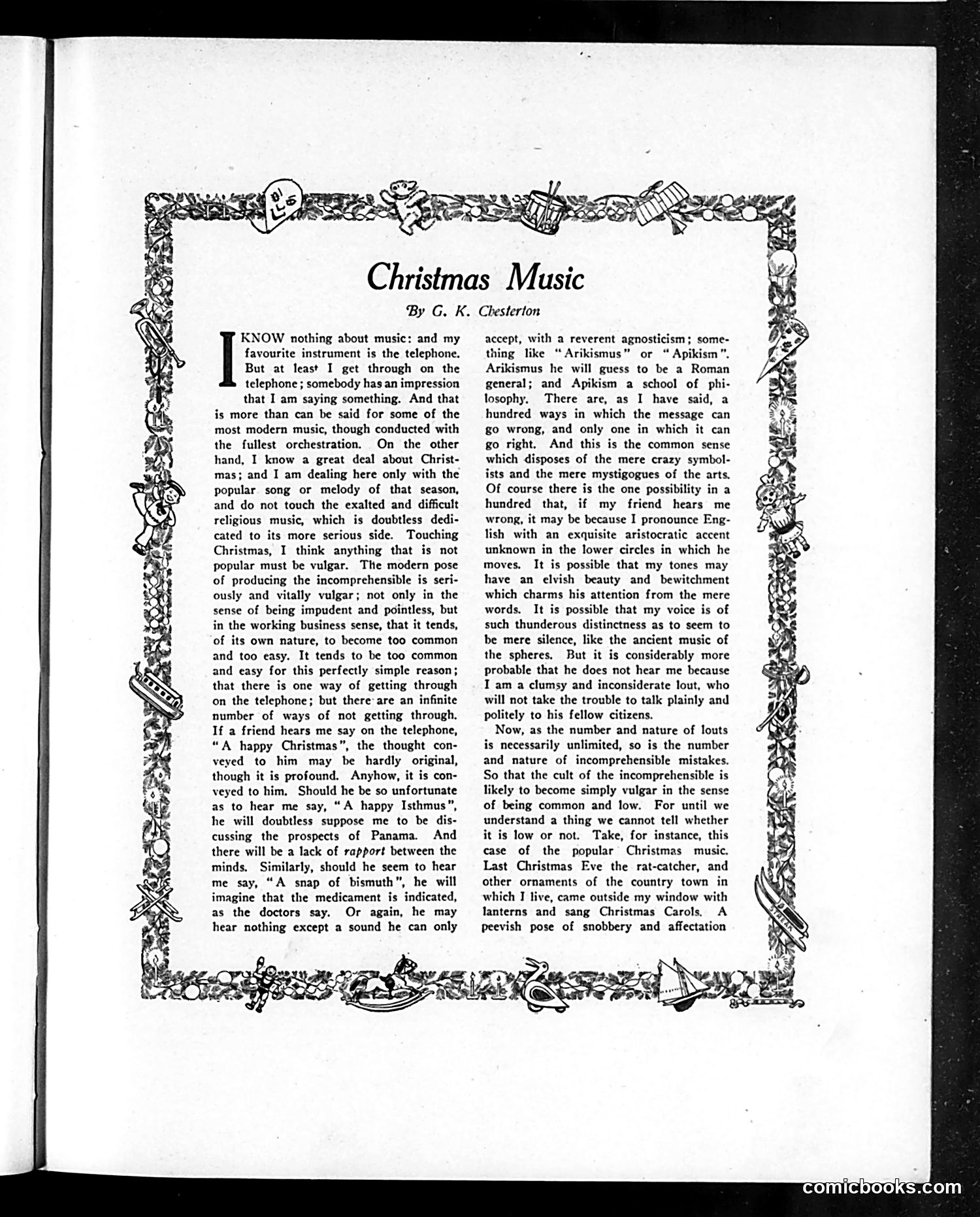
This is a humorous essay, not a political cartoon. Chesterton argues that popular Christmas music and art must be *comprehensible* to succeed—using the telephone as his metaphor. Saying "A happy Christmas" communicates clearly; saying "A happy Isthmus" confuses the recipient into thinking you're discussing Panama. His satire targets modernist artists and intellectuals who prize incomprehensibility as sophistication. Chesterton contends this is actually *vulgar*—not elevated—because obscurity becomes commonplace and easy to achieve. He champions simple, clear communication over pretentious obscurity. The essay concludes approvingly with working-class "ornaments" (rat-catchers) singing intelligible Christmas carols outside his window—authentic popular tradition outweighs affected artistic complexity.
📄 Transcribed text from this page (OCR, searchable)
Machine-transcribed from the original scan — historical spelling and the odd misread are preserved.
Christmas Music By G. K. Chesterton KNOW nothing about music: and my favourite instrument is the telephone. But at least I get through on the telephone ; somebody has an impression that I am saying something. And that is more than can be said for some of the most modern music, though conducted with the fullest orchestration. On the other hand, I know a great deal about Christ- mas; and I am dealing here only with the popular song or melody of that season, and do not touch the exalted and difficult religious music, which is doubtless dedi- cated to its more serious side. Touching Christmas, I think anything that is not popular must be vulgar. The modern pose of producing the incomprehensible is seri- ously and vitally vulgar; not only in the sense of being impudent and pointless, but in the working business sense, that it tends, of its own nature, to become too common and too easy. It tends to be too common and easy for this perfectly simple reason; that there is one way of getting through on the telephone; but there are an infinite number of ways of not getting through. If a friend hears me say on the telephone, “A happy Christmas”, the thought con- veyed to him may be hardly original, though it is profound. Anyhow, it is con- veyed to him, Should he be so unfortunate as to hear me say, “A happy Isthmus”, he will doubtless suppose me to be dis- cussing the prospects of Panama. And there will be a lack of rapport between the minds, Similarly, should he seem to hear me say, “A snap of bismuth”, he will imagine that the medicament is indicated, as the doctors say. Or again, he may hear nothing except a sound he can only accept, with a reverent agnosticism; some- thing like “Arikismus” or “ Apikism”. Arikismus he will guess to be a Roman general; and Apikism a school of phi- losophy, There are, as I have said, a hundred ways in which the message can go wrong, and only one in which it can go right. And this is the common sense which disposes of the mere crazy symbol- ists and the mere mystigogues of the arts. Of course there is the one possibility in a hundred that, if my friend hears me wrong, it may be because I pronounce Eng- lish with an exquisite aristocratic accent unknown in the lower circles in which he moves, It is possible that my tones may have an elvish beauty and bewitchment which charms his attention from the mere words. It is possible that my voice is of such thunderous distinctness as to seem to be mere silence, like the ancient music of the spheres, But it is considerably more probable that he does not hear me because I am a clumsy and inconsiderate lout, who will not take the trouble to talk plainly and politely to his fellow citizens. Now, as the number and nature of louts is necessarily unlimited, so is the number and nature of incomprehensible mistakes. So that the cult of the incomprehensible is likely to become simply vulgar in the sense of being common and low. For until we understand a thing we cannot tell whether it is low or not. Take, for instance, this case of the popular Christmas music. Last Christmas Eve the rat-catcher, and other ornaments of the country town in which I live, came outside my window with lanterns and sang Christmas Carols, A peevish pose of snobbery and affectation