
Life, 1914-12-03 · page 57 of 92
Life — December 3, 1914 — page 57: what you’re looking at
What you’re looking at
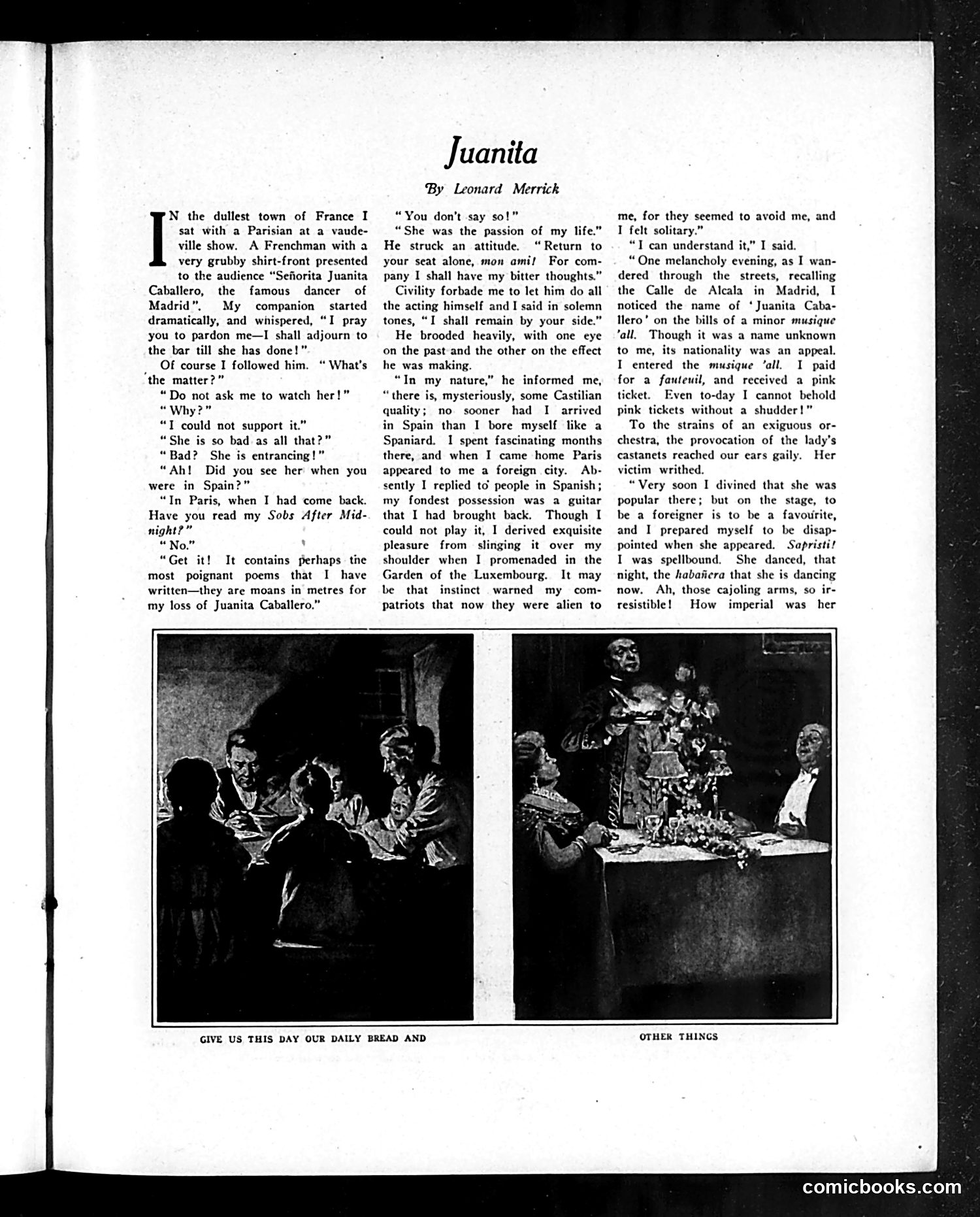
This is a short story (not a political cartoon) about a Parisian man recounting his romantic obsession with a Spanish dancer named Juanita Caballero. The narrative depicts a common early 20th-century literary trope: the passionate European affair with an exotic foreign performer. The story satirizes the pretentious Parisian—who affects Spanish mannerisms after visiting Madrid, carries a guitar he cannot play merely for appearances, and composes melodramatic poetry about a dancer he briefly knew. The humor lies in his self-absorbed romanticism and theatrical suffering over a woman who likely barely knew him. The two accompanying illustrations show scenes from the story: the vaudeville performance and what appears to be a social gathering. The satire gently mocks Continental affectation and the absurdity of romanticizing a casual encounter into lifelong artistic inspiration.
📄 Transcribed text from this page (OCR, searchable)
Machine-transcribed from the original scan — historical spelling and the odd misread are preserved.
N the dullest town of France I sat with a Parisian at a vaude- ville show. A Frenchman with a very grubby shirt-front presented to the audience “Sefiorita Juanita Caballero, the famous dancer of Madrid”. My companion _ started dramatically, and whispered, “I pray you to pardon me—I shall adjourn to the bar till she has done!" Of course I followed him. ‘the matter?” “Do not ask me to watch her!” “Why?” “T could not support it.” “She is so bad as all that?” “Bad? She is entrancing!” “Ah! Did you see her when you were in Spain?” “In Paris, when I had come back. Have you read my Sobs After Mid- night?” “No.” “Get it! It contains perhaps the most poignant poems that I have written—they are moans in metres for my loss of Juanita Caballero,” “ What's Juanita By Leonard Merrick “You don’t say so!” “She was the passion of my life.” He struck an attitude. “Return to your seat alone, mon ami! For com- pany I shall have my bitter thoughts.” Civility forbade me to let him do all the acting himself and I said in solemn tones, “I shall remain by your side.” He brooded heavily, with one eye on the past and the other on the effect he was making. “In my nature,” he informed me, “there is, mysteriously, some Castilian quality; no sooner had I arrived in Spain than I bore myself like a Spaniard. 1 spent fascinating months there, and when I came home Paris appeared to me a foreign city. Ab- sently I replied to people in Spanish; my fondest possession was a guitar that I had brought back. Though I could not play it, I derived exquisite pleasure from slinging it over my shoulder when I promenaded in the Garden of the Luxembourg. It may be that instinct warned my com- Patriots that now they were alien to me, for they seemed to avoid me, and I felt solitary.” “T can understand it,” I said. “One melancholy evening, as I wan- dered through the streets, recalling the Calle de Alcala in Madrid, I noticed the name of ‘Juanita Caba- lero’ on the bills of a minor musique Yall. Though it was a name unknown to me, its nationality was an appeal. I entered the musique ‘all. I paid for a fauteuil, and received a pink ticket. Even to-day I cannot behold pink tickets without a shudder!” To the strains of an exiguous or- chestra, the provocation of the lady’s castanets reached our ears gaily. Her victim writhed. “Very soon I divined that she was popular there; but on the stage, to be a foreigner is to be a favourite, and I prepared myself to be disap- pointed when she appeared. Sapristi! I was spellbound. She danced, that night, the habajiera that she is dancing now. Ah, those cajoling arms, so ir- i How imperial was her OTHER THINGS GIVE US THIS DAY OUR DAILY BREAD AND comicbooks.com