
A complete issue · 72 pages · 1913
Life — March 6, 1913
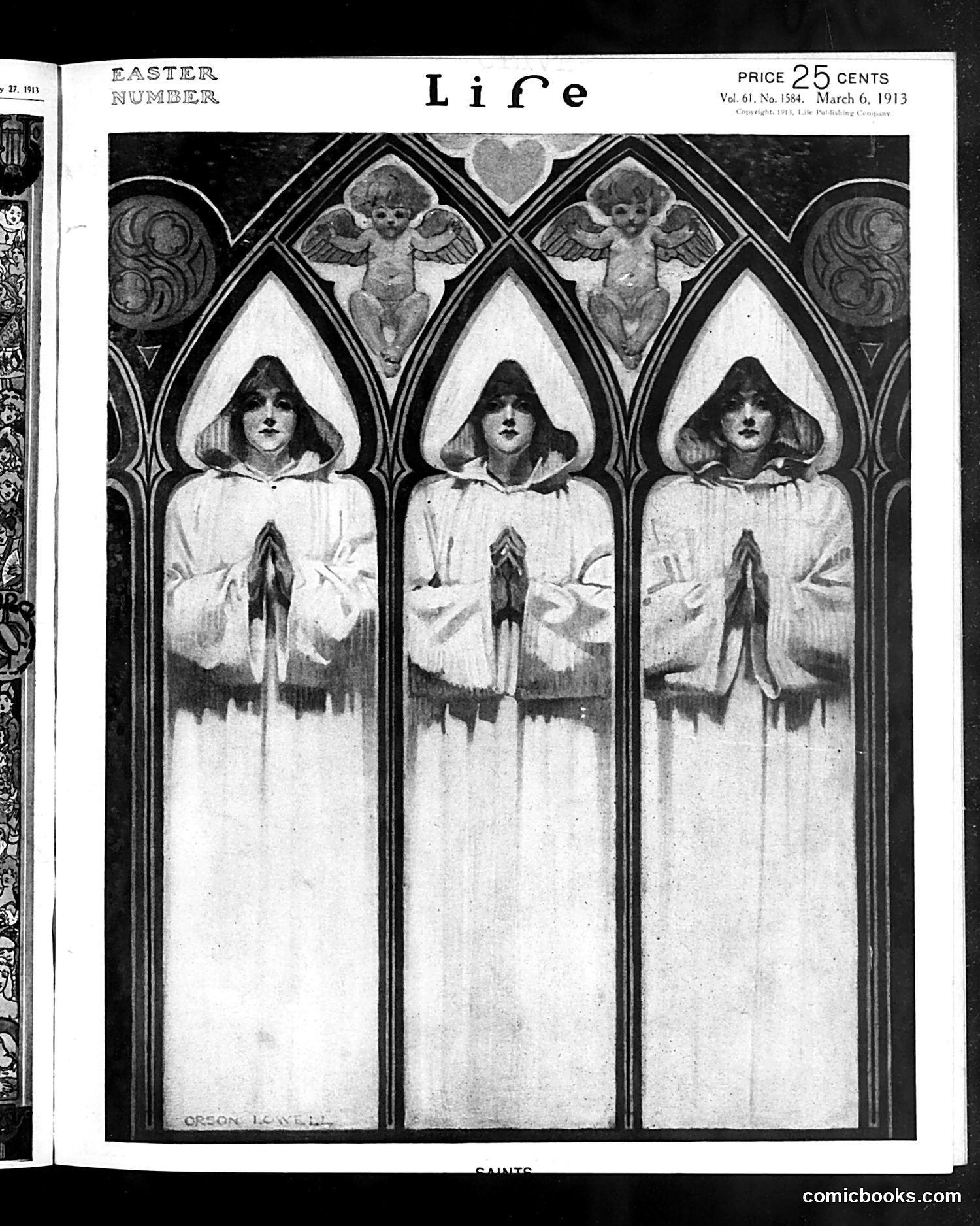
This is the Easter Number cover of *Life* magazine from March 6, 1913. The image depicts three figures in white robes and hoods arranged in Gothic cathedral-style arches, with cherubs above them. Below reads "SAINTS" and the artist credit "ORSON LOWELL." The satire appears to target hypocrisy or false piety. The three hooded figures in white suggest either nuns or, more pointedly, members of organizations like the Ku Klux Klan (which had been revived around this period). By labeling them "SAINTS" while depicting them in hooded robes—typically associated with religious hypocrisy or racial violence—the cartoonist mocks those who cloak themselves in righteousness while harboring darker intentions. The Easter timing emphasizes the irony between Christian virtue and actual behavior.
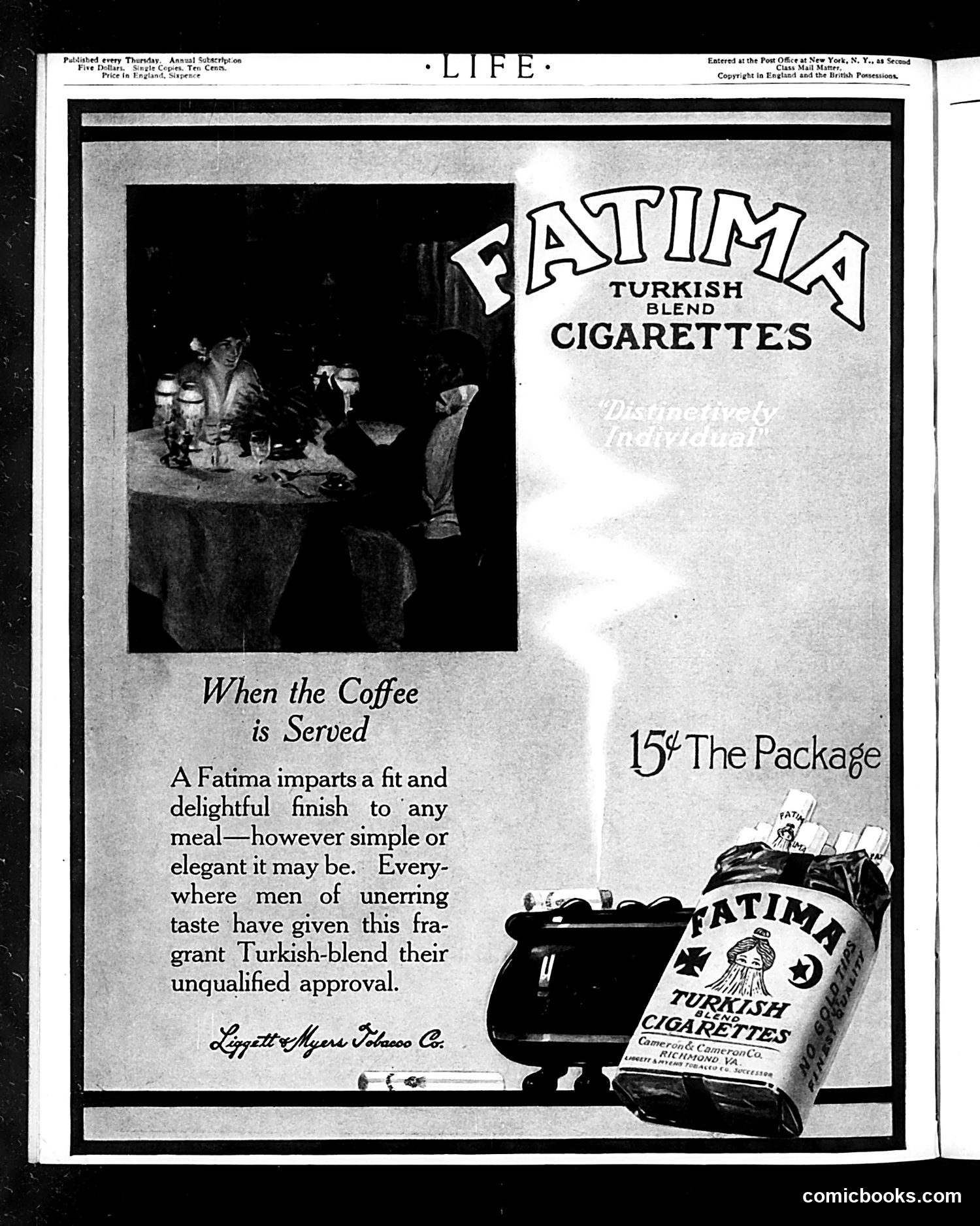
This is a **commercial advertisement**, not political satire. It promotes Fatima Turkish Blend cigarettes at 15 cents per package. The ad uses **Orientalist imagery** common to early 20th-century advertising: a photograph showing what appears to be a woman in Turkish dress serving coffee to men in an exotic interior setting. The caption "When the Coffee is Served" associates the cigarettes with sophistication and refinement. The marketing appeal targets "men of unerring taste" by positioning the product as distinctively cosmopolitan and elegant. The exotic setting suggests luxury and worldliness—common advertising tropes of the era that exploited romanticized foreign imagery to sell American consumer goods. This represents period advertising practices rather than editorial content or satire.
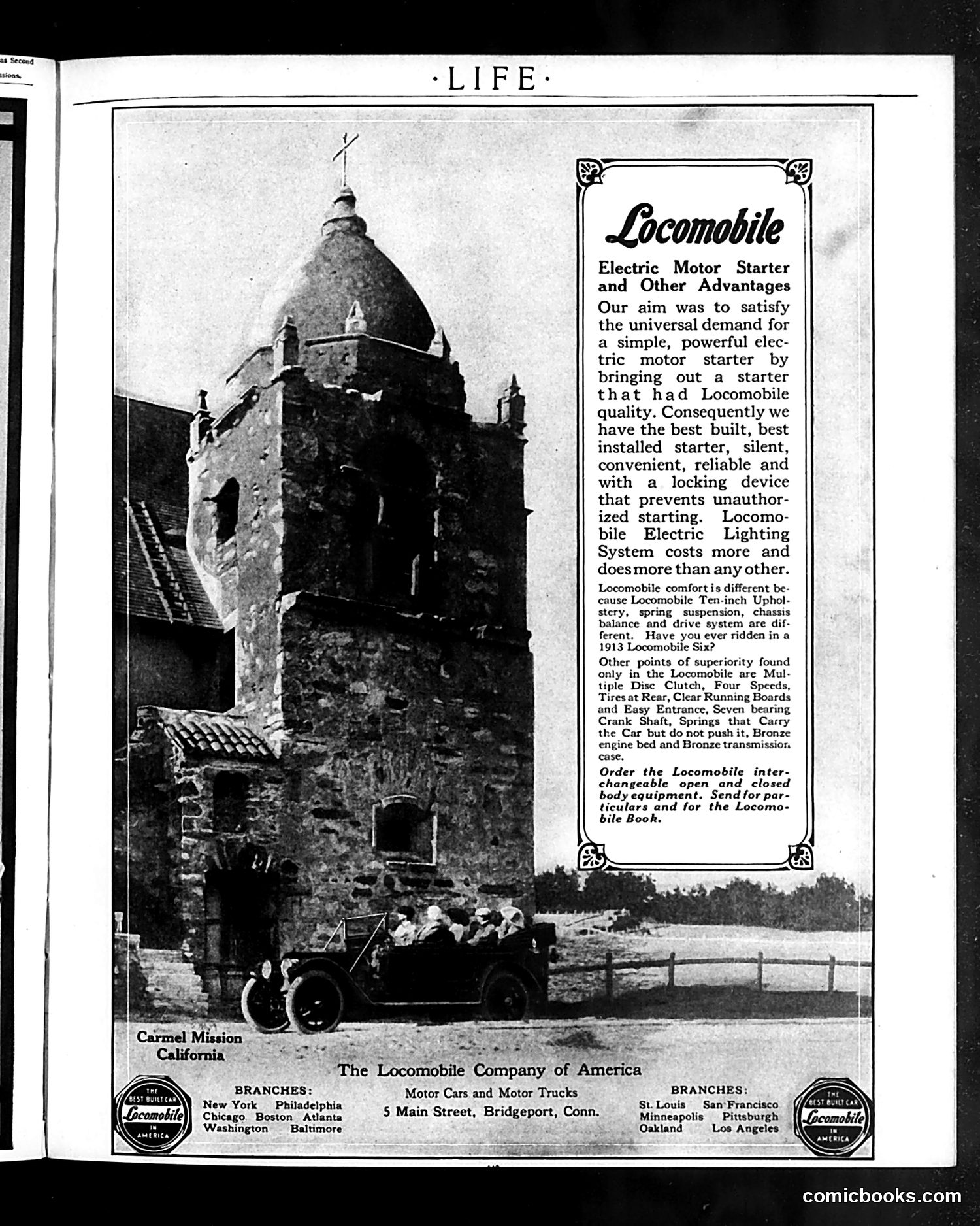
This page is **primarily a Locomotile automobile advertisement**, not a political cartoon. The image shows a 1913 Locomotile car parked before the Carmel Mission in California, with passengers aboard. The ad emphasizes the vehicle's features: electric motor starter, reliable construction, and comfort innovations like a ten-inch upholstered seat and improved balance. It highlights that Locomotile offered superior engineering compared to competitors. The advertisement lists company branches across major American cities and invites readers to order an "interchangeable set of extra equipments" or request the Locomotile Book. There is no political satire or social commentary visible here—this is straightforward early automotive marketing that used scenic photography to advertise luxury and reliability to wealthy consumers.
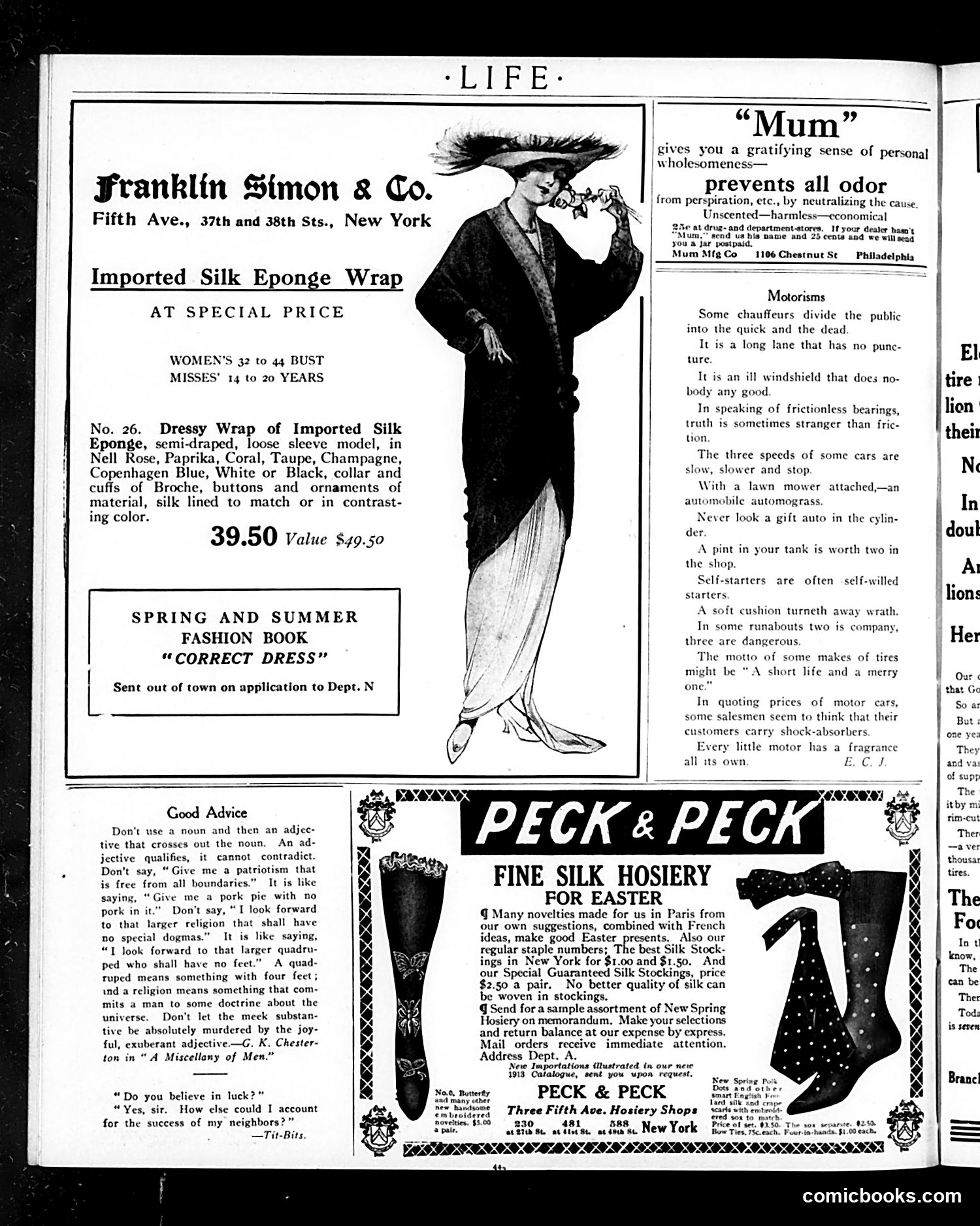
This page is primarily **advertising and advice content**, not political satire. It contains: 1. **Franklin Simon & Co. advertisement** for an imported silk wrap ($39.50, valued at $49.50)—typical high-end women's fashion marketing 2. **"Good Advice" column**—a tongue-in-cheek essay mocking pretentious speech and religious hypocrisy, warning against using phrases like "give me patriotism" or "pork pie with no pork in it." The humor is social satire about affected language, not political commentary. 3. **Peck & Peck hosiery advertisement** for Easter stockings with novelty designs The page reflects 1920s consumer culture and gentle social humor rather than political cartoons or significant historical commentary.
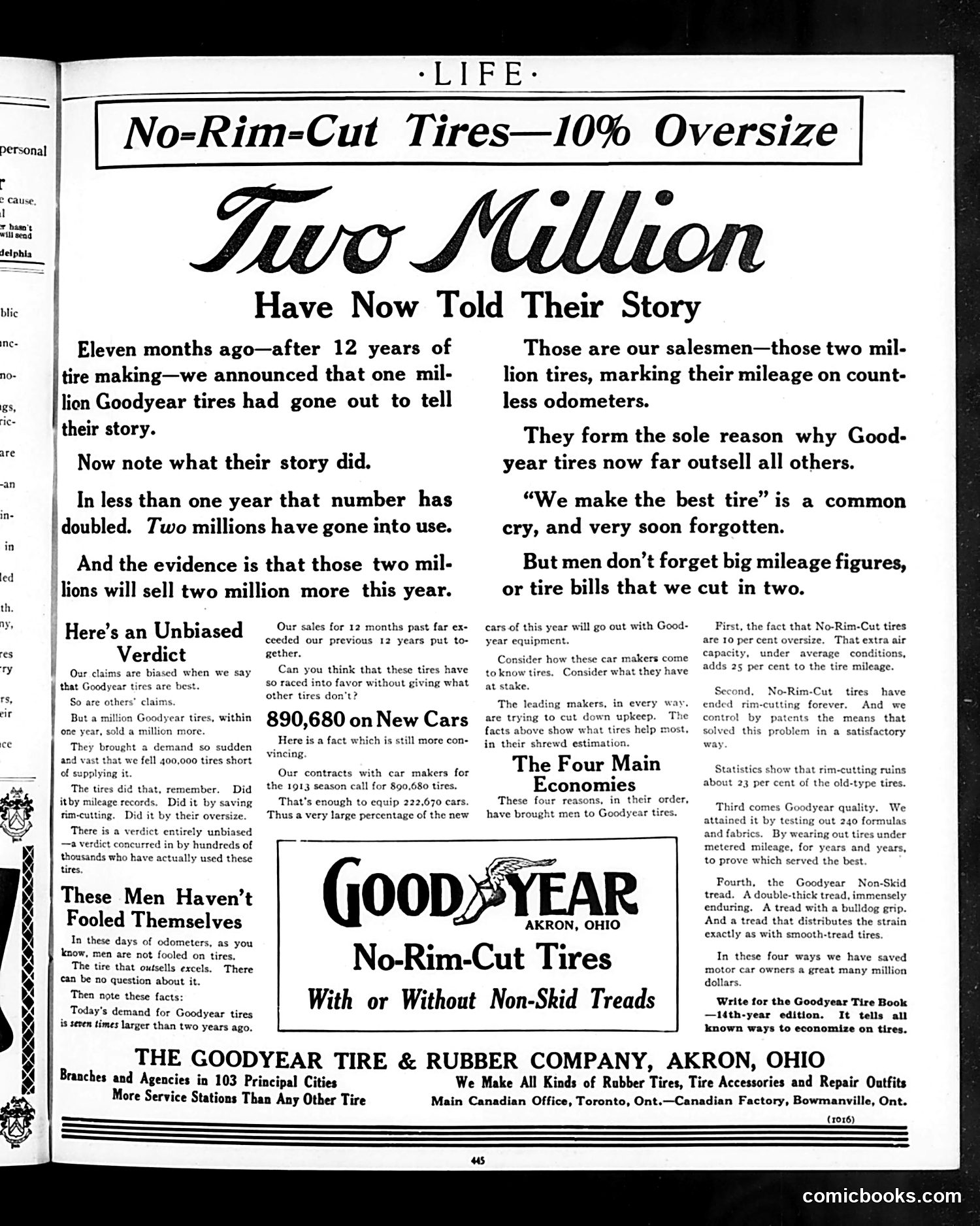
This page is **primarily advertising**, not satire or political commentary. It's a Goodyear Tire & Rubber Company advertisement from Life magazine. The ad promotes Goodyear's "No-Rim-Cut Tires" by presenting what appears to be factual sales data: one million tires sold in the first year, now two million in use. The copy emphasizes practical benefits—no rim-cutting, double-thick tread, reduced wear—rather than humor or satire. The section titled "These Men Haven't Fooled Themselves" references satisfied customers and repair shop owners as credible endorsers. The "Four Main Economies" lists specific advantages: durability, cost-per-mile, testing validation, and the Non-Skid tread feature. There are **no identifiable political figures or satirical cartoons** on this page. It's straightforward corporate marketing using testimonial-style persuasion.
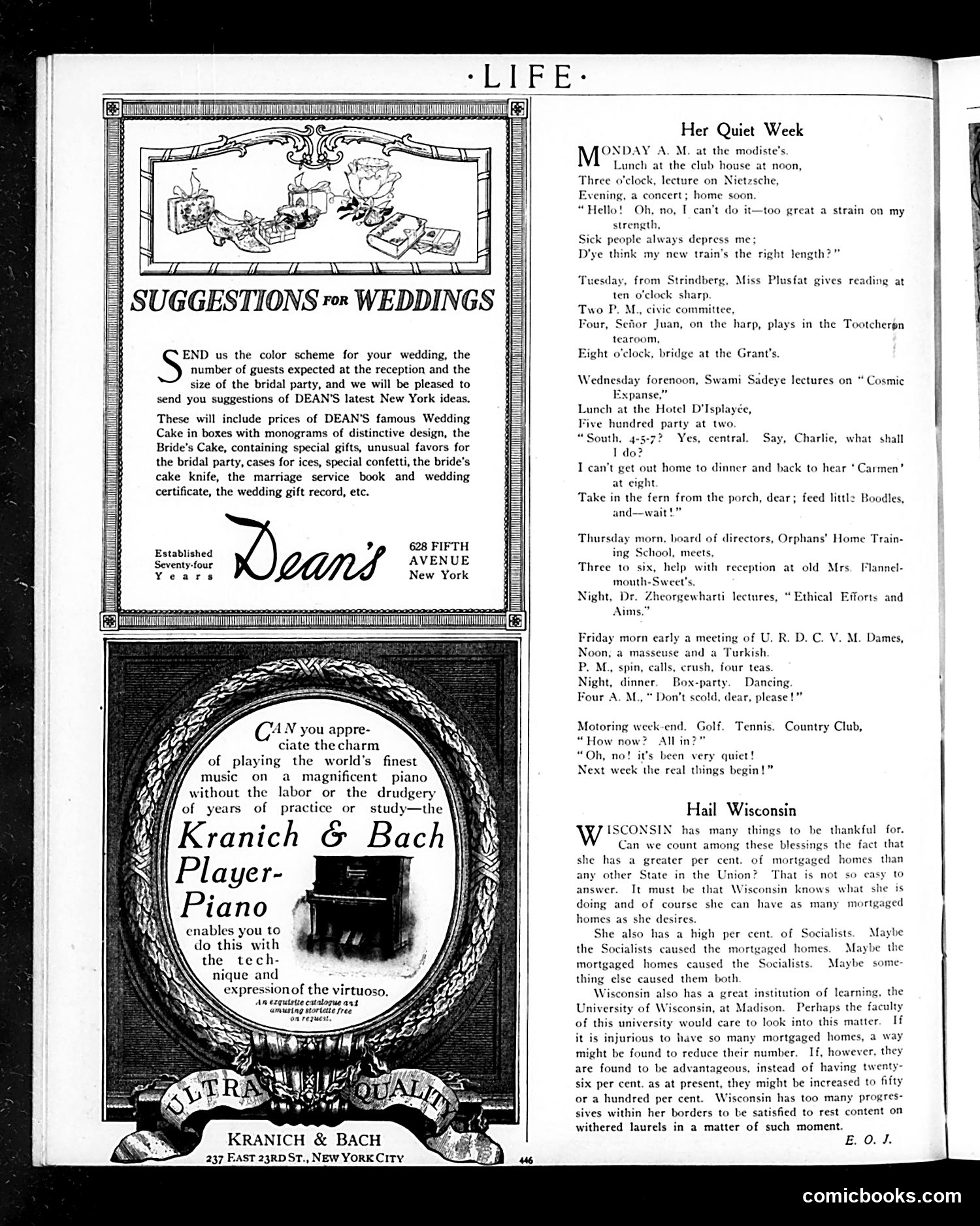
This page contains **primarily advertisements and social content** rather than political satire. The top ad for **Dean's Wedding Services** offers comprehensive wedding planning, including cake design, favors, and gifts—typical luxury consumer advertising. The prominent **Kranich & Bach Player-Piano advertisement** emphasizes convenience: playing "the world's finest music" without years of practice. This reflects early 20th-century attitudes toward technology as a substitute for skill and labor. The right column, "Her Quiet Week" and "Hail Wisconsin," appears to be social commentary or lifestyle journalism rather than political satire—documenting upper-class women's weekly activities and discussing Wisconsin's economic conditions (mortgaged homes, Socialists). **No significant political cartoons or satire are evident on this page.** It represents Life magazine's mix of advertising, consumer culture commentary, and society journalism.
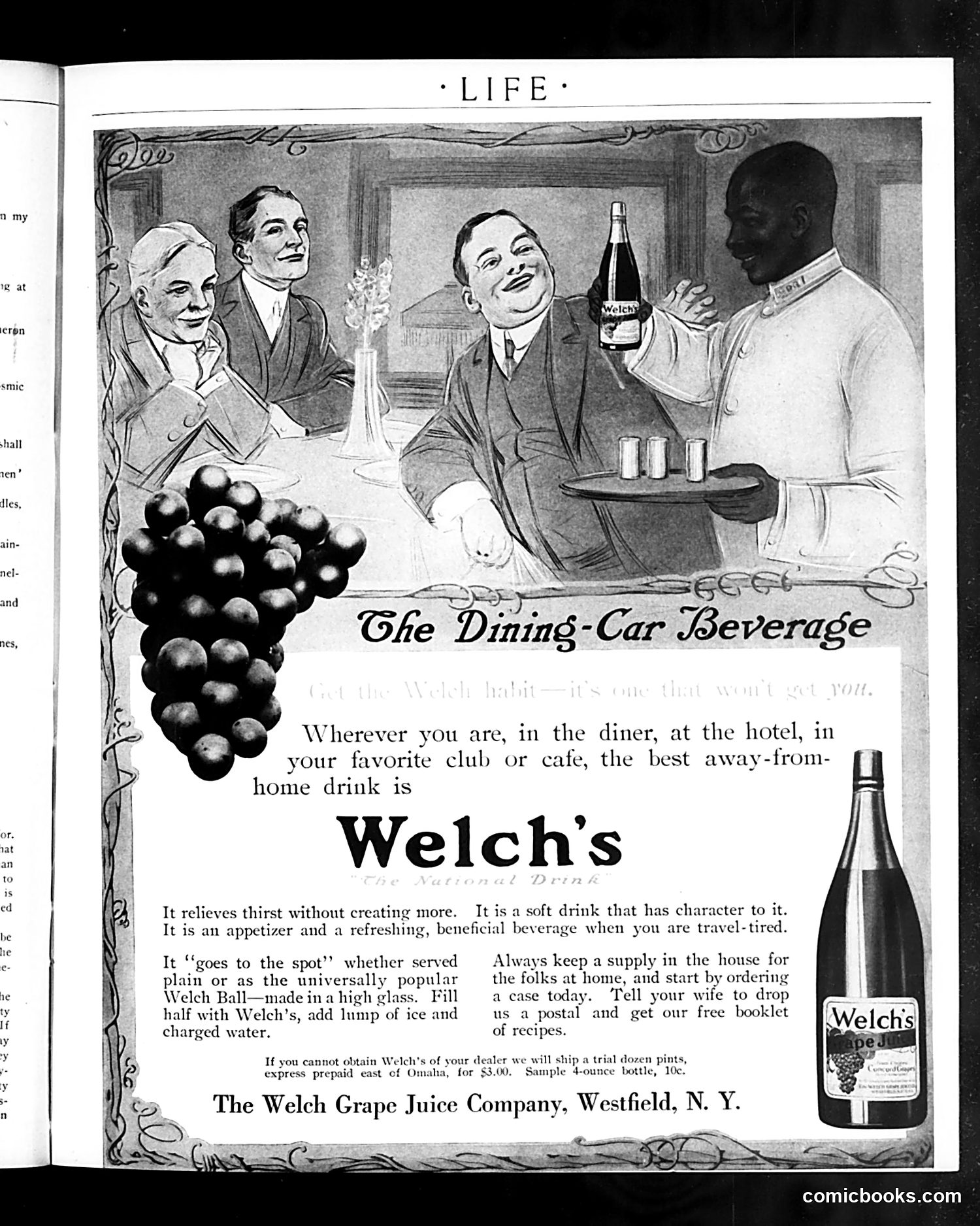
This is a **Welch's Grape Juice advertisement**, not satire or political content. The page depicts "The Dining-Car Beverage"—a scene of well-dressed men (including what appears to be a waiter or server on the right) enjoying Welch's in a formal dining setting. The ad emphasizes that Welch's is a **non-alcoholic soft drink** suitable for refined social occasions. Key selling points include: it relieves thirst without excess, acts as an appetizer, and refreshes travelers. The large bunch of grapes underscores the product's natural fruit base. This reflects early 20th-century marketing positioning grape juice as a sophisticated, wholesome alternative to alcohol—likely relevant during or around Prohibition era concerns about temperance.
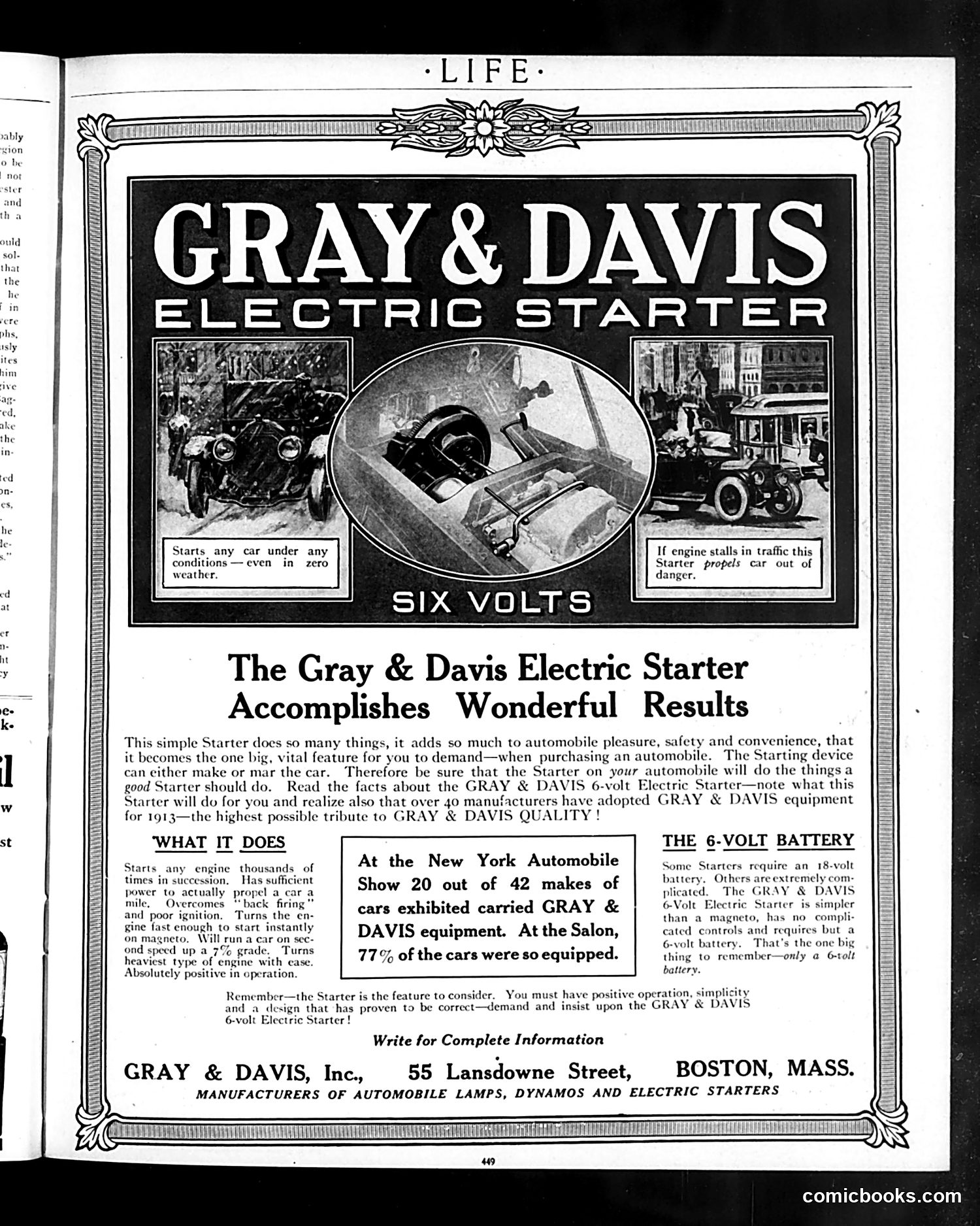
This is not a cartoon or satire, but rather a **straightforward product advertisement** for the Gray & Davis Electric Starter—an early automobile electric starting system. The page promotes a 6-volt electric starter as a major innovation in automotive convenience and safety. The advertisement includes three photographs: cars being started, the mechanical starter device itself, and a traffic scene illustrating how the starter prevents stalling dangers. Key claims include that the device "starts any car under any conditions" and that at the New York Automobile Show, 77% of exhibited cars used Gray & Davis equipment—presented as evidence of its superiority and market dominance. This reflects the early 1910s transition from hand-crank engine starting to electric starters—a genuine technological advancement, not satire.
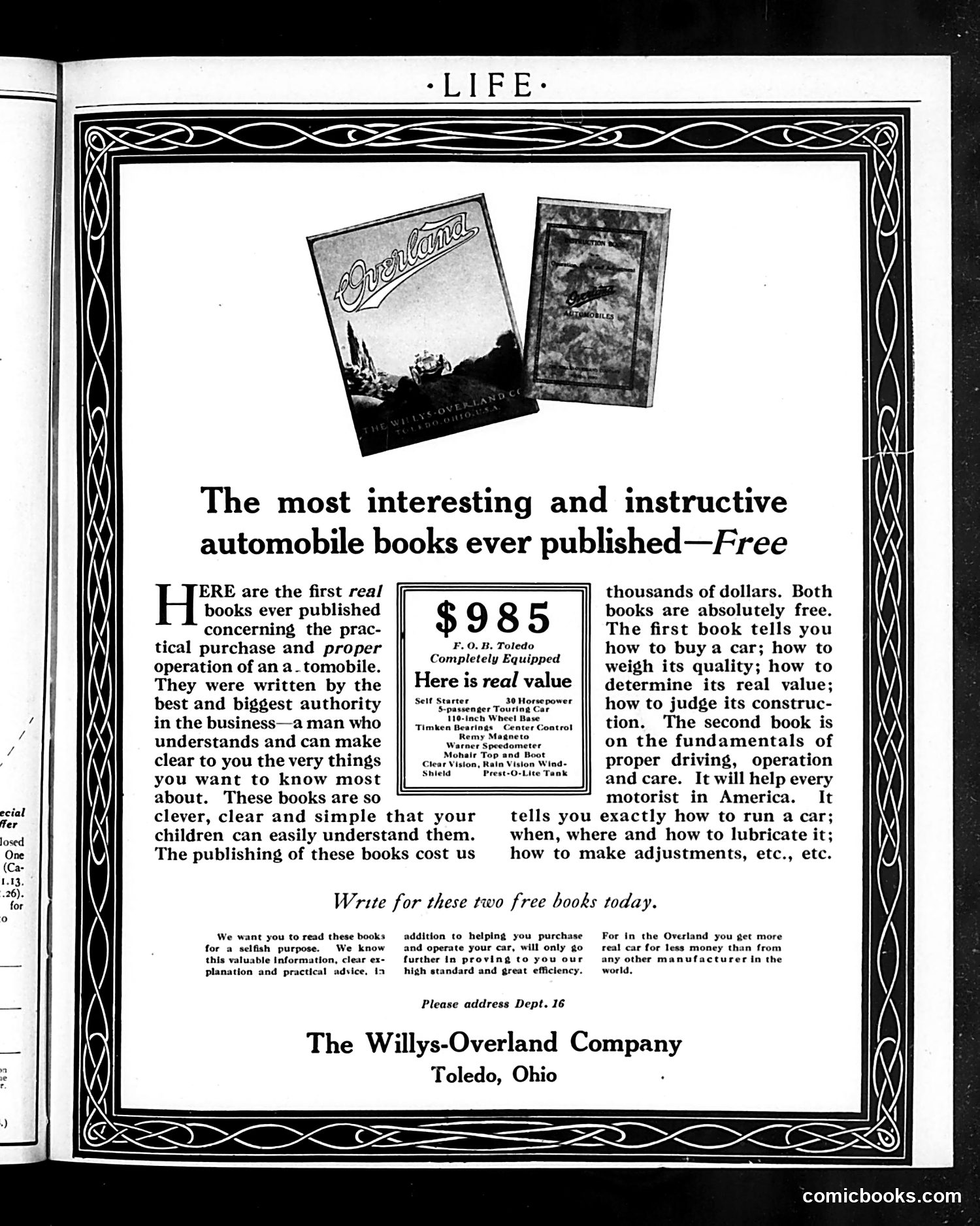
This is an **advertisement**, not editorial content or satire. The Willys-Overland Company of Toledo, Ohio is promoting two free instructional automobile books about purchasing and operating a car, priced at $985 for a fully equipped F.O.B. Toledo vehicle. The ad emphasizes these books' practical value and educational merit, claiming they're written by automotive authorities and simple enough for children to understand. The company frames the free books as a marketing tool—offering educational content to help customers make informed purchases and demonstrate the manufacturer's confidence in their product quality. This reflects early 1900s automotive marketing, when automobiles were still relatively new consumer goods requiring instruction manuals and buying guides for the general public.
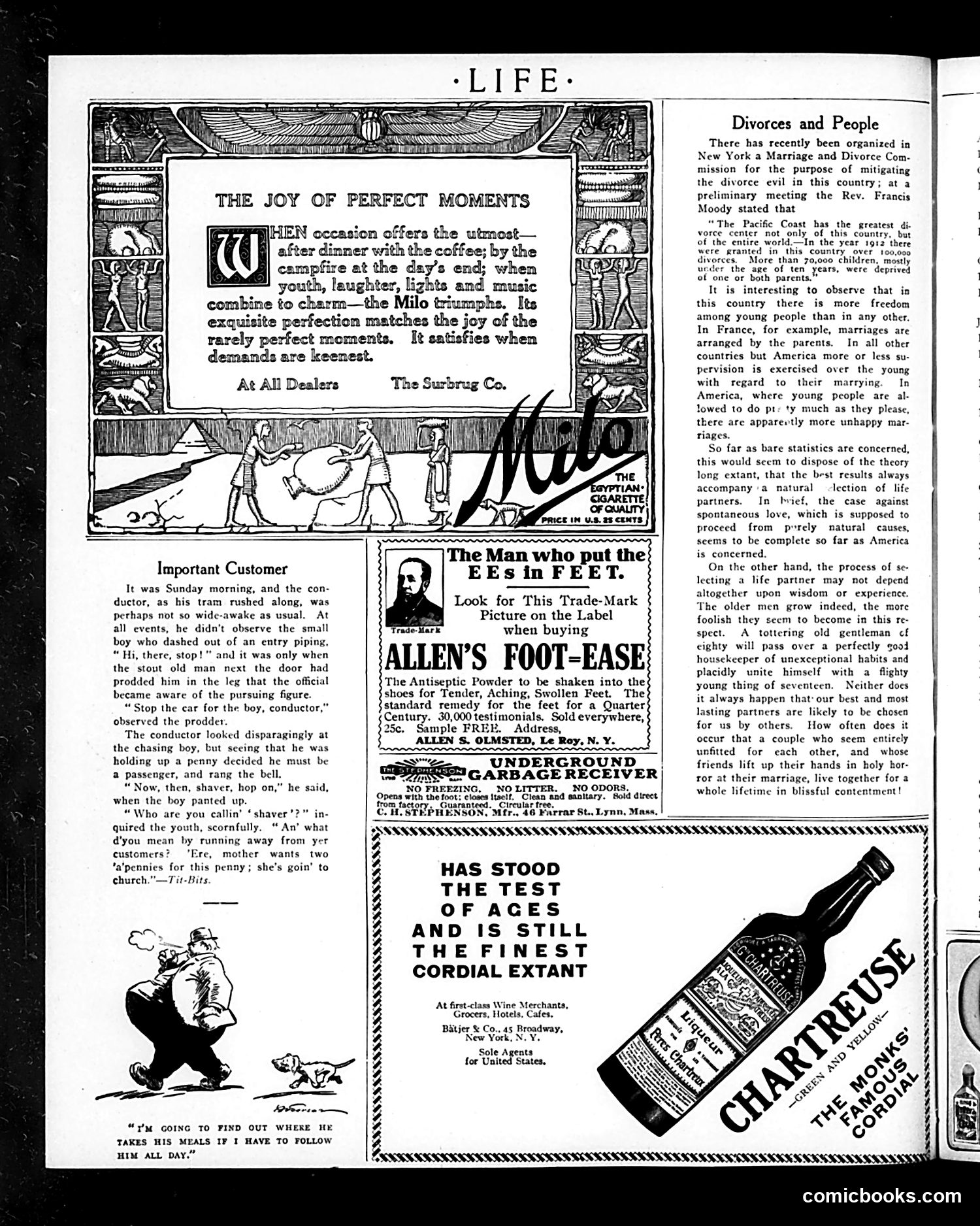
This page mixes advertisements with editorial content about marriage and divorce. The main article "Divorces and People" discusses a New York Marriage and Divorce Commission meeting addressing high divorce rates—reportedly over 73,000 children affected annually. The piece notes Americans allow young people more freedom in choosing partners than Europeans do, which the author suggests may explain higher American divorce rates compared to France. The cartoons and ads are unrelated to this topic. One depicts a conductor dealing with a troublesome boy passenger. The advertisements promote foot powder (Allen's Foot-Ease), a garbage receptacle, and Chartreuse cordial—typical early 20th-century consumer goods with period-specific marketing claims about quality and utility.
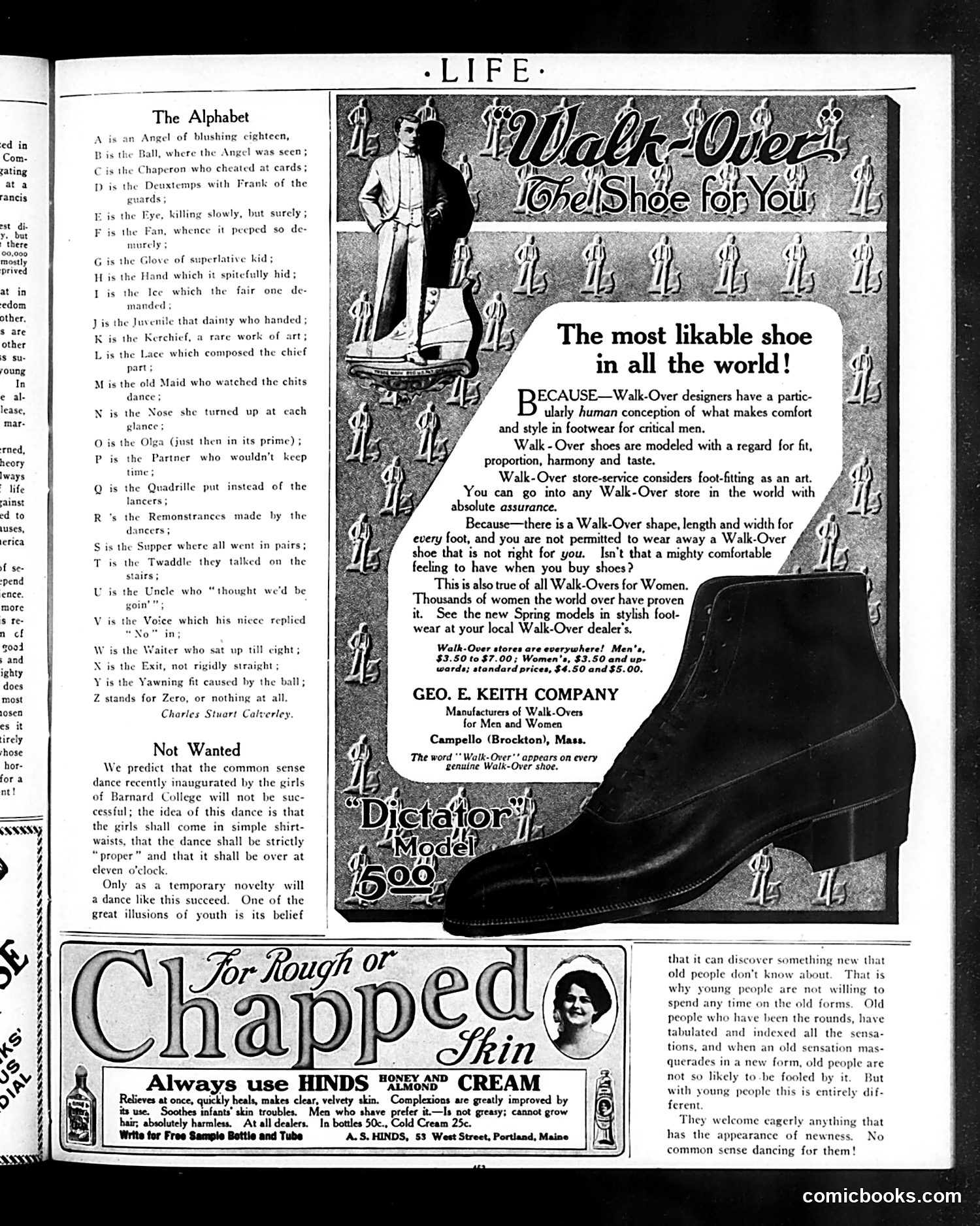
This page is primarily **advertising**, not satire. The dominant image promotes Walk-Over brand shoes, specifically the "Dictator Model" priced at $5.00. The ad emphasizes that Walk-Over shoes are "the most likable shoe in all the world" because they're designed with human comfort and style in mind. It claims the company ensures proper fit and won't sell ill-fitting shoes. Below is a smaller ad for Hinds Honey and Almond Cream for chapped skin. The left column contains "The Alphabet," a lighthearted satirical poem by Chortler Stuart Catterley mocking dance trends and college social culture—unrelated to the shoe advertisement. There's no political cartoon here; this is a typical Life magazine layout mixing editorial content with period advertising.
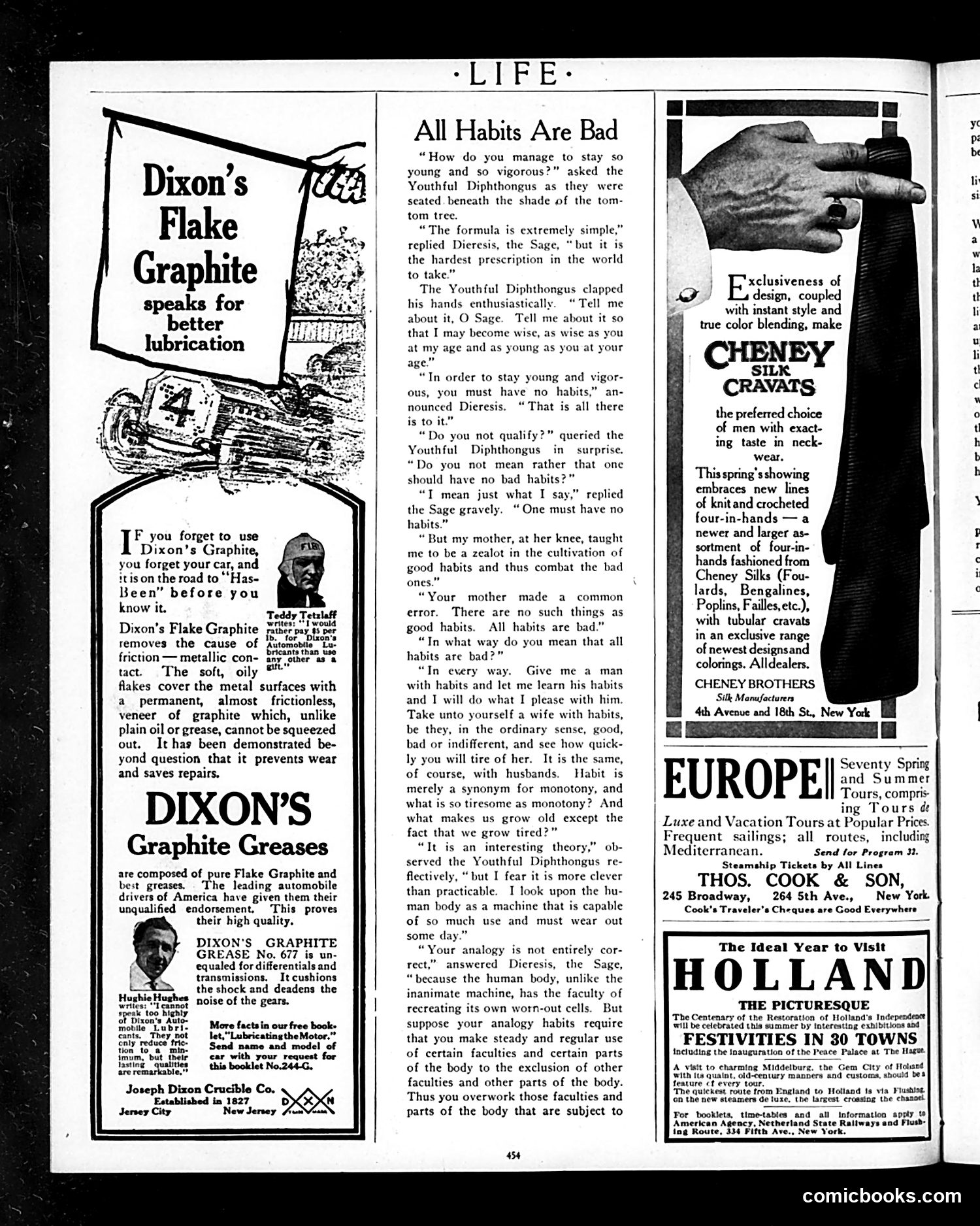
This page is primarily **advertising and editorial content**, not political satire. The main article, "All Habits Are Bad," presents a philosophical dialogue between a "Youthful Diphthongus" and "Dieresis, the Sage" about whether habits are inherently bad. The sage argues that all habits—good or bad—create monotony and prevent growth. This appears to be lighthearted wordplay rather than political commentary (the characters' names are linguistic terms). The advertisements feature **Dixon's Flake Graphite** lubricating products, **Cheney Silk Cravats** (neckwear), and travel promotions to **Europe and Holland**. The satirical element is minimal—mainly the clever naming of characters and the somewhat absurdist framing of a mundane philosophical debate. There's no evident political or social critique visible in the image or text.
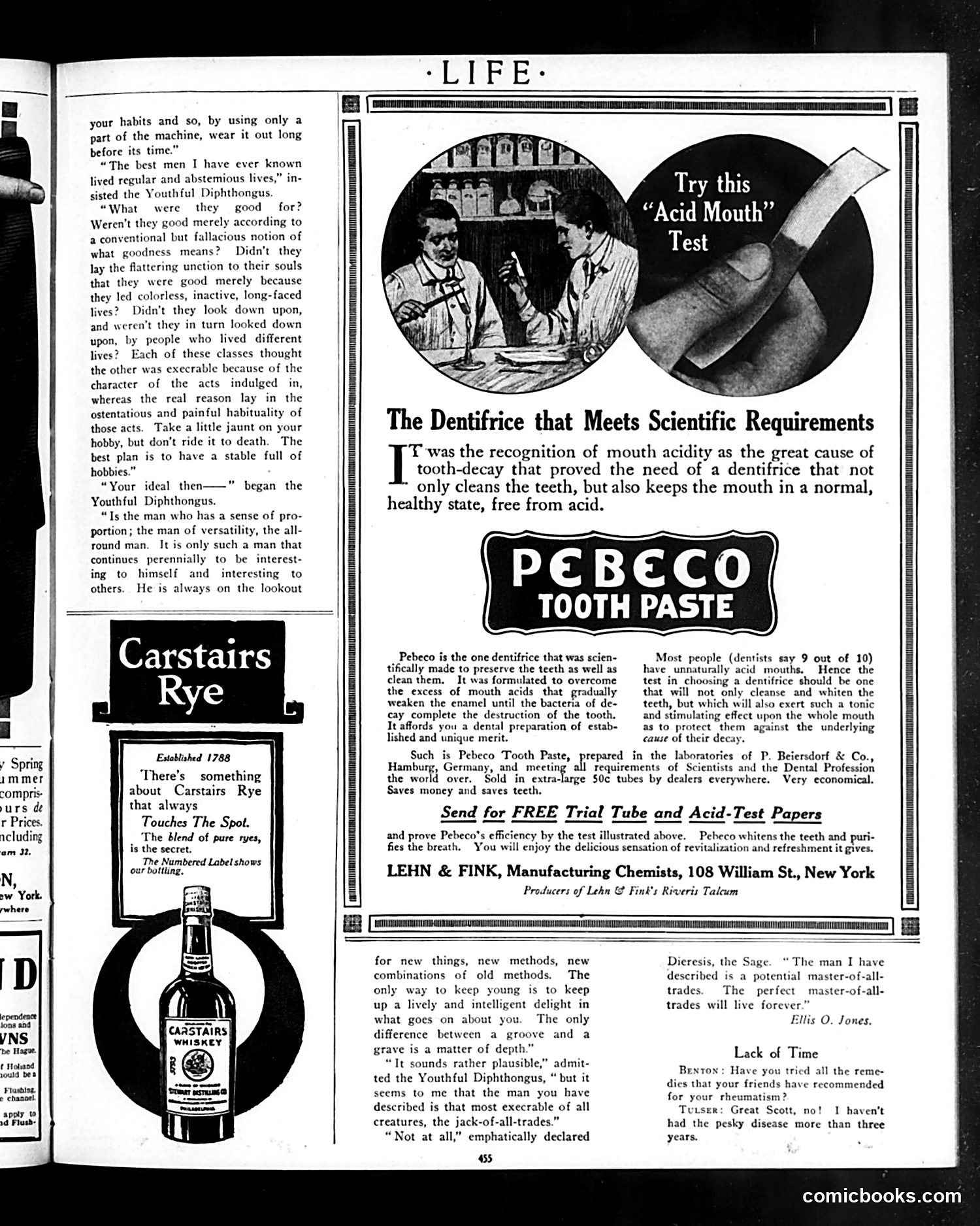
This page is primarily **advertisements**, not editorial satire. The dominant content features two major ads: **Pebeco Tooth Paste** (center-right) and **Carstairs Rye whiskey** (left). The small illustrated scene in the Pebeco ad shows two men in conversation—one appears to be a dentist or doctor (left) and a patient (right)—demonstrating the "Acid Mouth" test. This reflects early 20th-century marketing that pseudoscientifically linked mouth acidity to tooth decay, positioning Pebeco as the scientific solution. The left text column contains philosophical dialogue between "the Youthful Diphthongus" and "Dieresis, the Sage" debating whether virtue requires asceticism or whether a well-rounded person with varied interests is superior. This appears to be satirical commentary on Victorian morality versus modern versatility. **Key point:** The page juxtaposes high-minded philosophical debate with commercial appeals to health anxiety—a common Life magazine strategy mixing intellectual content with advertising.
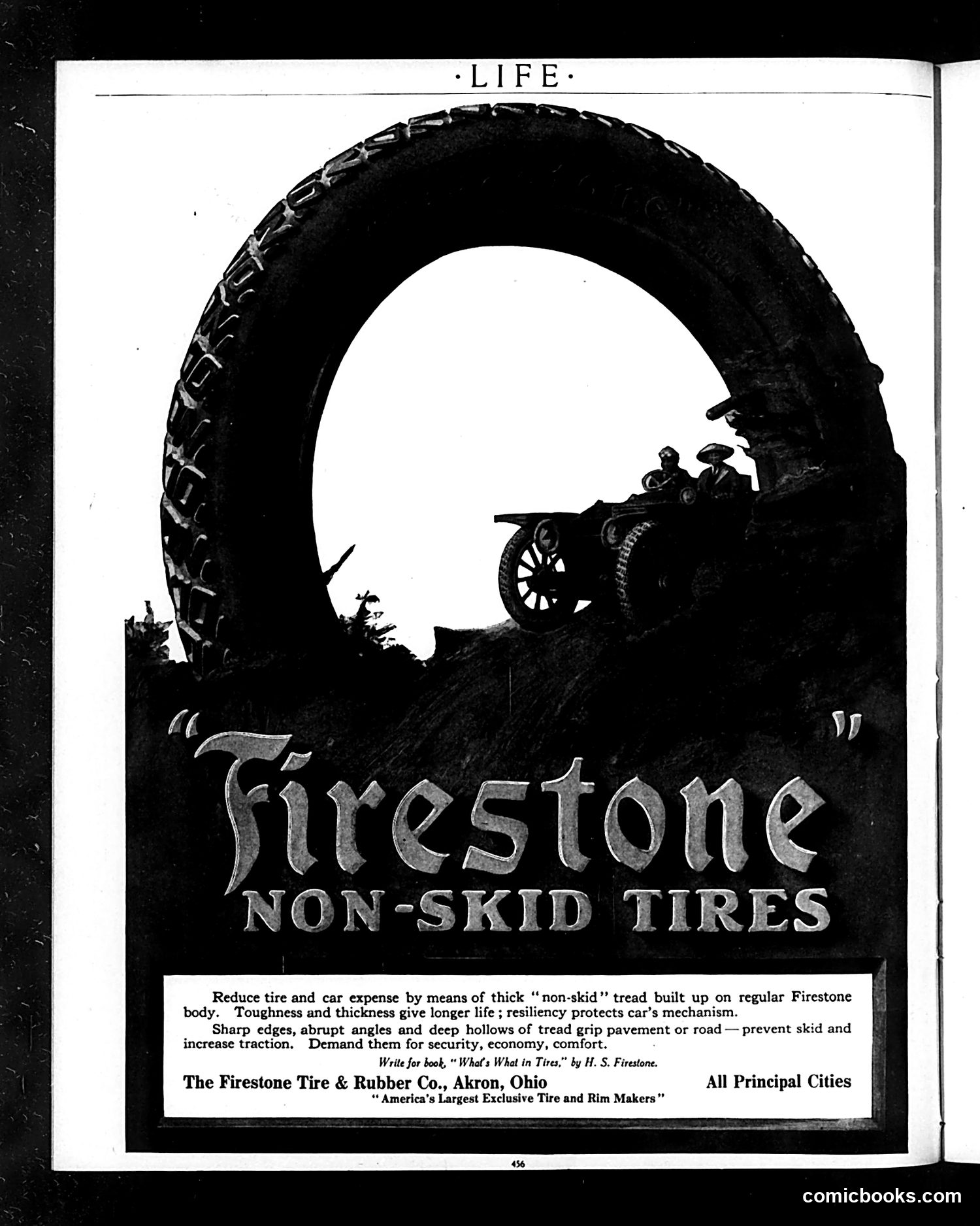
This is a **full-page advertisement**, not political satire. It promotes Firestone Non-Skid Tires, manufactured in Akron, Ohio. The image shows a dramatic silhouette: a massive tire forming an arch, with an early automobile and two occupants positioned beneath it on a hill. This visual metaphor emphasizes the tire's size and protective quality—the automobile appears small and safe under the tire's shelter. The text emphasizes practical benefits: the "non-skid" tread (common in early 20th-century tires) prevents accidents by improving traction and preventing skidding on roads. The ad promises durability, economy, and safety—key selling points for automobile owners of that era. A book offer, "What's What in Tires," suggests consumer education was part of Firestone's marketing strategy. The tagline claims Firestone as "America's Largest Exclusive Tire and Rim Makers."
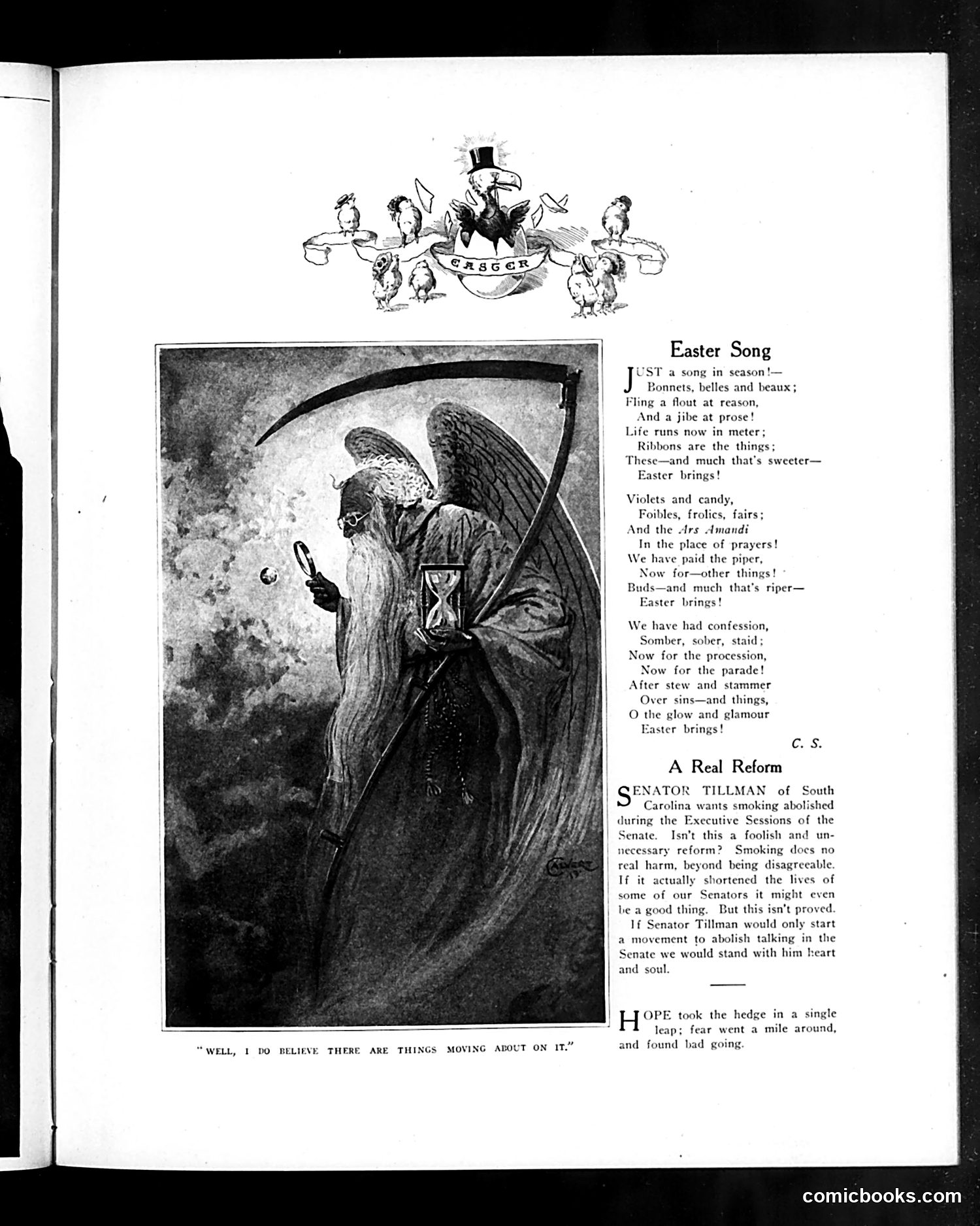
This page contains satirical commentary on early 20th-century American life: **"Easter Song"** is a light satirical poem mocking Easter's secular commercialization—bonnets, candy, romance ("Ars Amandi")—replacing religious observance. It jokes that people abandon "confession" and sobriety for parades and fashionable display. **"A Real Reform"** satirizes Senator Benjamin Tillman of South Carolina, who apparently proposed banning smoking during Senate executive sessions. The author argues this is misguided: smoking causes no real harm (and might even benefit some senators by shortening their lives). However, the piece suggests a *genuinely useful* reform would be abolishing *talking* in the Senate—a common complaint about politicians' endless speechifying. The accompanying illustration depicts **Death** (the Grim Reaper with hourglass and scythe), captioned with Death's belief that "things" are moving about—likely referencing the senator's proposal as trivial compared to mortality's larger concerns. The tone is typical Life magazine irreverence: mocking both commercial religiosity and legislative futility.
This satirical piece compares Mexican political upheaval to British suffragette militancy. The main target is **General Victoriano Huerta**, who has just seized power in Mexico by overthrowing President Francisco Madero and executing Madero's brother Gustavo. Life mocks the instability of Mexican leadership, suggesting three generals (Huerta, Felix Diaz, and Blanquet) are now competing for power—imagining them as a shell game where only one "bean" (winner) will survive. The piece then pivots to **Emmeline Pankhurst and her daughters**, British suffragette activists, comparing their revolutionary tactics to Mexican violence. Daughter **Christobel**, hiding in Paris, advocates bombing campaigns. Life sarcastically suggests that England's civilized tradition of protecting women makes dealing with militant suffragettes particularly difficult—unlike "savages" who would handle them brutally. The satire implies both situations involve dangerous instability and the breakdown of civil order.
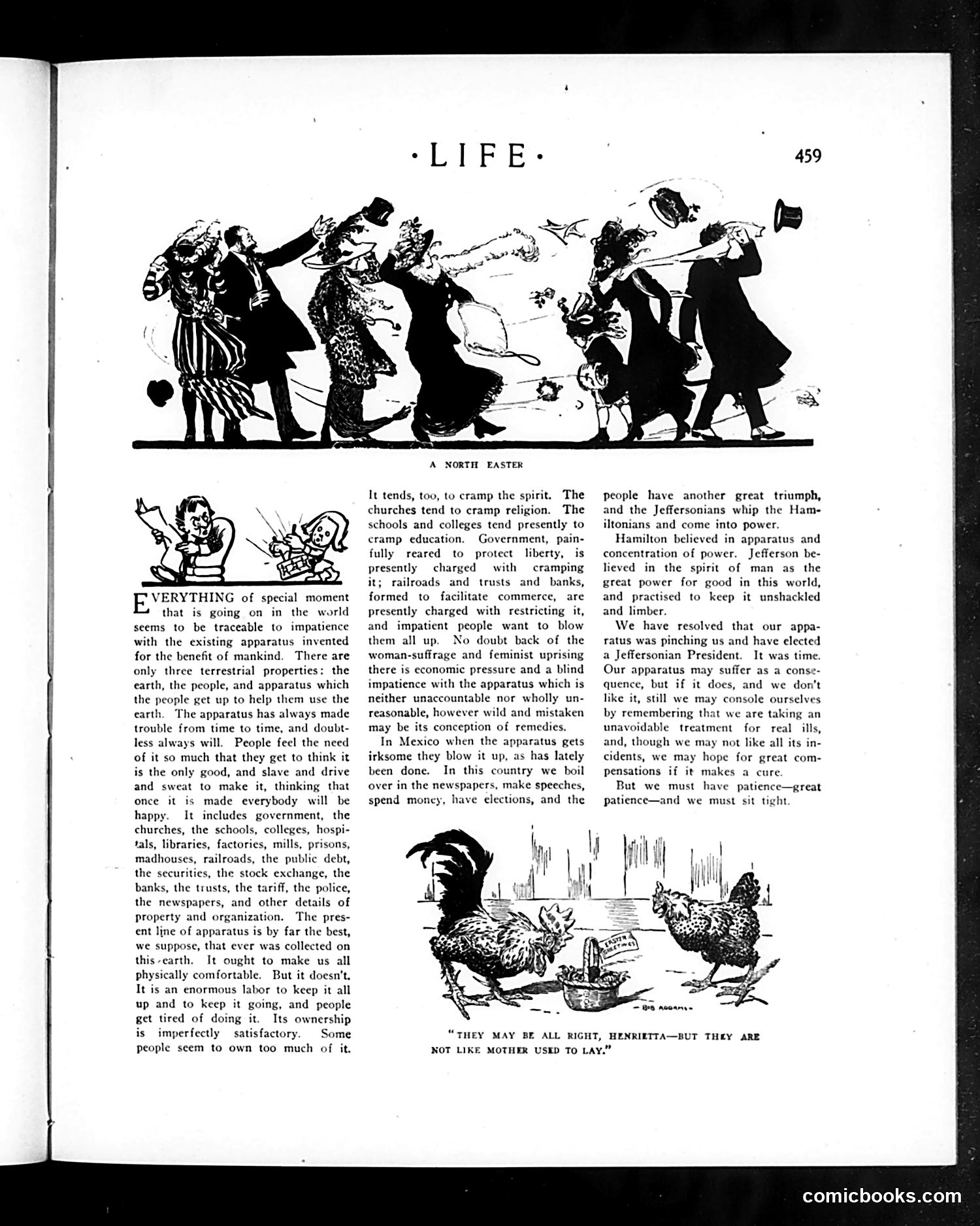
This is a satirical editorial from Life magazine critiquing American impatience with existing institutions. The top illustration shows figures violently attacking various "apparatus" (government, churches, schools, banks, etc.), representing public frustration. The article argues that while these institutions are imperfect and sometimes restrictive, they're necessary and shouldn't be destroyed—referencing Mexico's revolutionary upheaval as a cautionary example. The author contrasts Jefferson's faith in individual liberty against Hamilton's belief in strong institutional apparatus. The lower cartoon shows hens laying eggs, captioned "They may be all right, Henrietta—but they are not like mother used to lay," suggesting nostalgia for the past undermines acceptance of present (inferior but functional) systems. Context: This appears related to early 20th-century progressivism and labor unrest—the text mentions woman-suffrage movements and economic pressure—advocating patience with reform rather than revolutionary destruction of institutions.
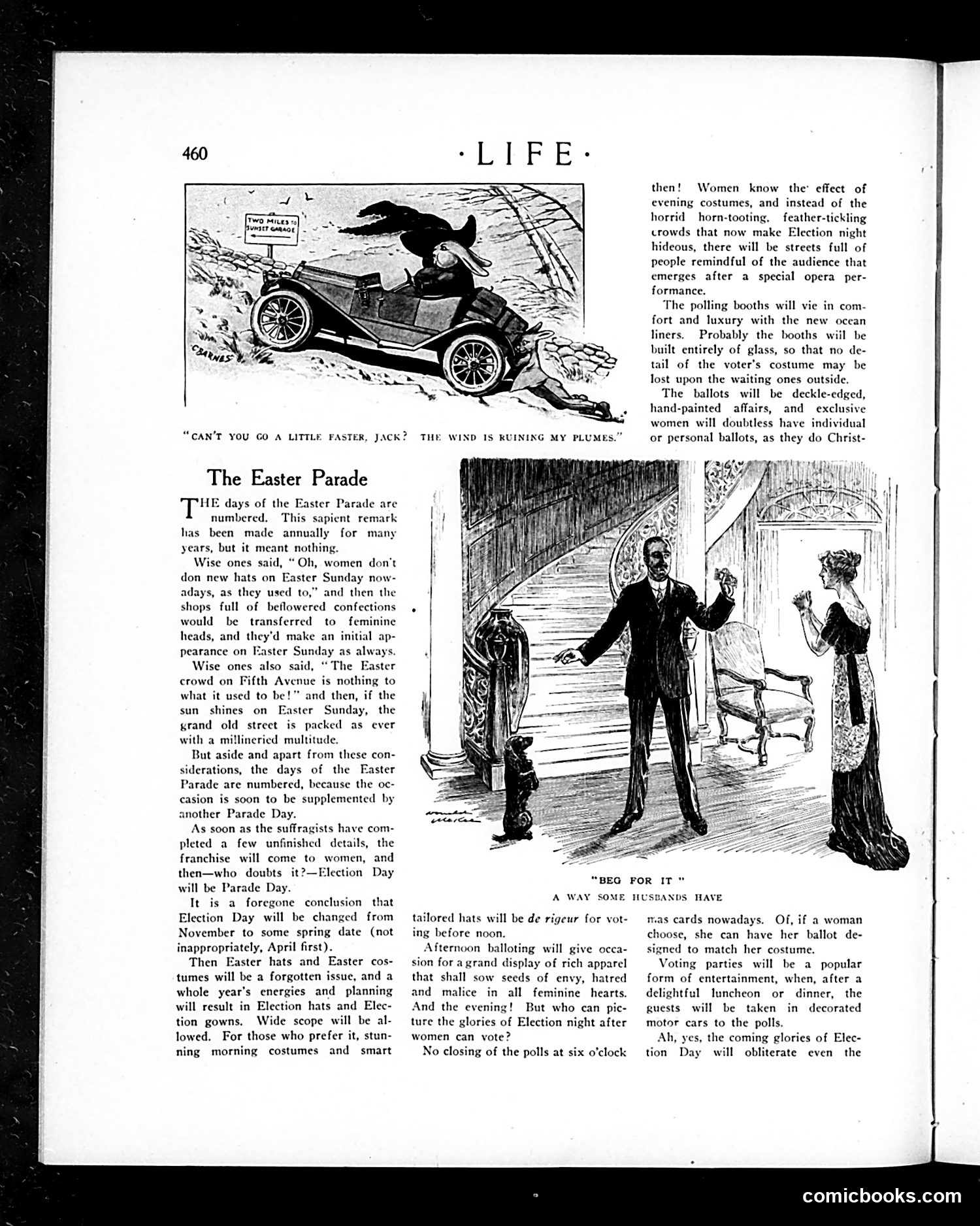
This 1910s *Life* magazine page satirizes women's suffrage by imagining that once women gain the vote, "Election Day" will become as elaborate and fashion-focused as the traditional Easter Parade on Fifth Avenue. The top cartoon shows a woman in a car urging the driver faster while her elaborate feathered hat blows away—a visual joke about women prioritizing fashionable display. The text mockingly predicts that voting will transform into a competitive spectacle of expensive gowns and accessories. Women will coordinate "Election hats and Election gowns," wear tailored hats for morning voting and "rich apparel" for afternoon voting, arrive in "decorated motor cars," and even design custom ballots to match their costumes. The satire suggests women voters will reduce politics to fashion competition and social entertainment rather than serious civic participation. This reflects the era's anti-suffrage argument that women were frivolous consumers incapable of serious political engagement. The humor is period-specific—mocking both women's fashion consciousness and anxieties about female voting rights.
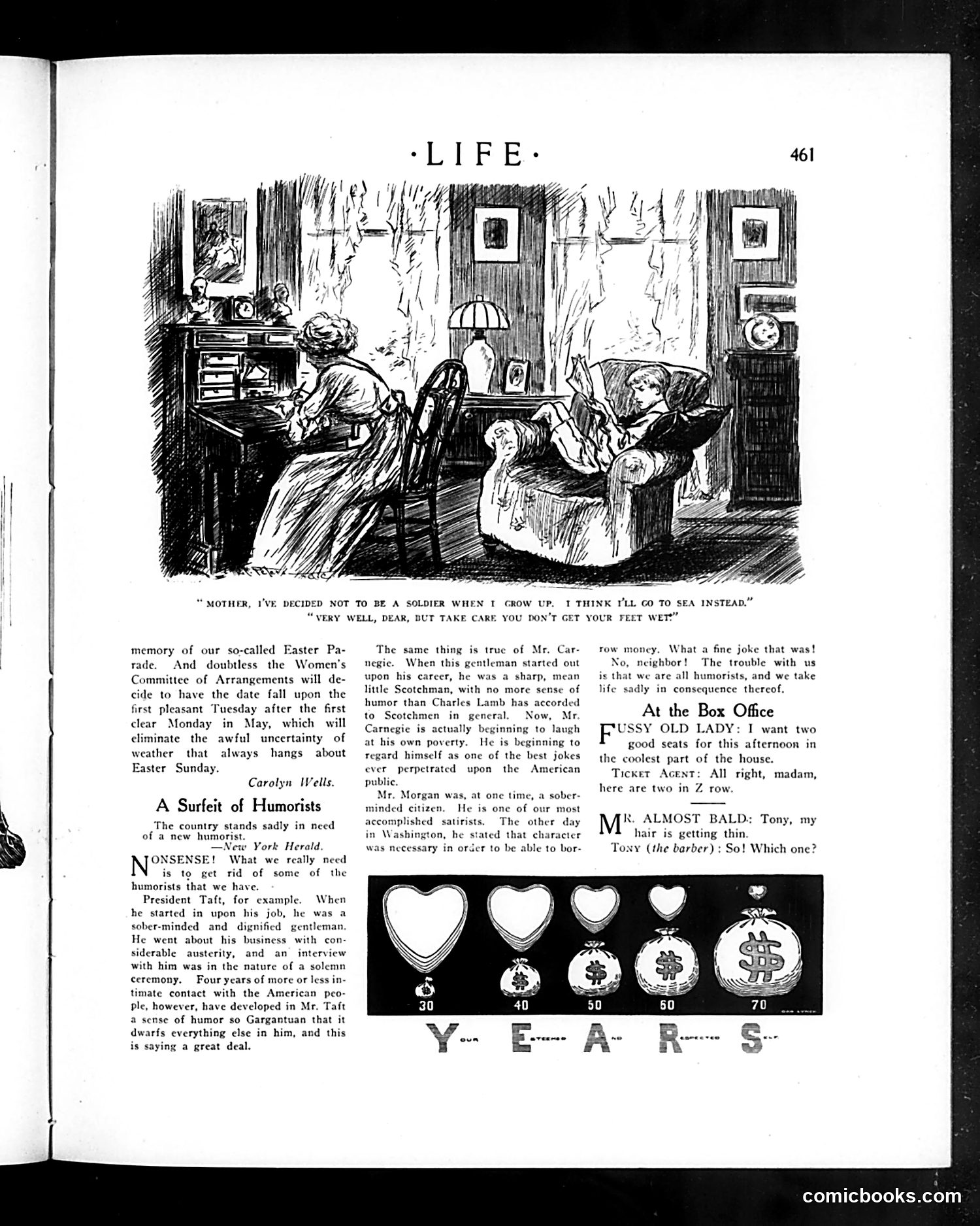
This Life magazine page satirizes prominent American figures who have developed excessive senses of humor, contrary to their earlier reputations. **The Main Essay's Targets:** - **President Taft**: Started as a dignified, austere leader but after four years in office developed an outsized sense of humor that now overshadows his other qualities - **Andrew Carnegie**: Once a shrewd, humorless Scottish businessman; now laughs at his own poverty and views himself as a joke - **J.P. Morgan**: Formerly serious; now a satirist who recently joked about character being necessary to borrow money (ironic given his financial dealings) The satire's point: these powerful men have become too frivolous and humorous, taking life less seriously than they should. The author argues America needs *fewer* humorists, not more. **The cartoons** show unrelated domestic humor: a child rejecting military service for seafaring (with mother's wry response), and a barber's joke about a customer's thinning hair.
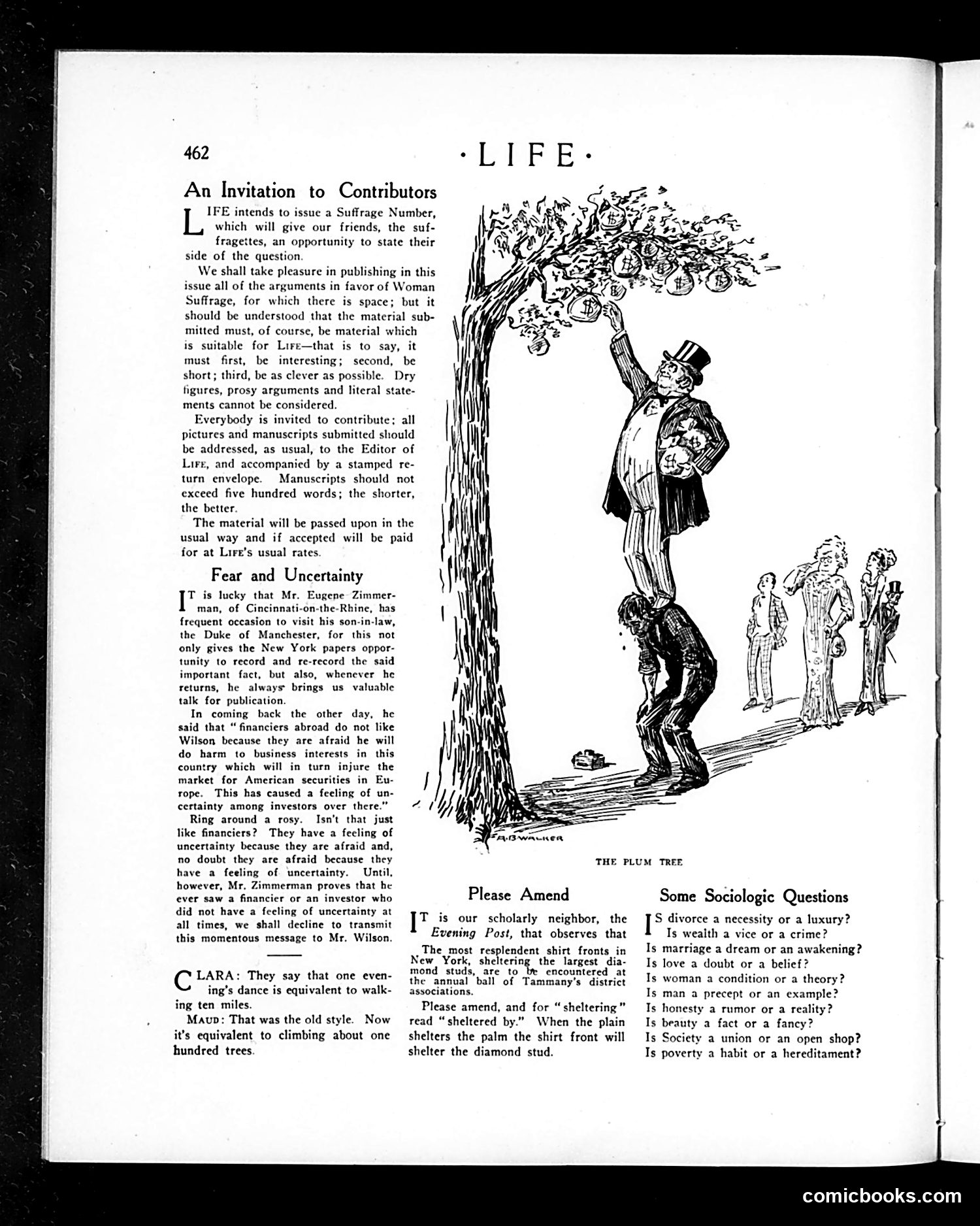
This page from *Life* magazine announces a special "Suffrage Number" to showcase arguments for women's voting rights—timely during the early 1900s suffrage movement. The magazine invites contributions but maintains editorial standards (wit over dry argument). **"The Plum Tree" cartoon** depicts a man in a top hat reaching into a large tree while ordinary citizens stand below. This likely satirizes political patronage and wealth inequality—the privileged few pluck rewards ("plums"/lucrative positions or profits) from the system while common people remain excluded. **"Fear and Uncertainty"** mocks financiers' circular logic: Eugene Zimmerman reports European investors fear President Wilson will harm American business interests, creating market uncertainty. *Life* ridiculously suggests their fear *causes* the uncertainty they claim to feel—a satirical jab at financiers' self-serving, circular reasoning used to justify their anxieties. The remaining items are brief, witty commentaries on contemporary social topics like dancing, Tammany Hall corruption, and philosophical questions about modern life.
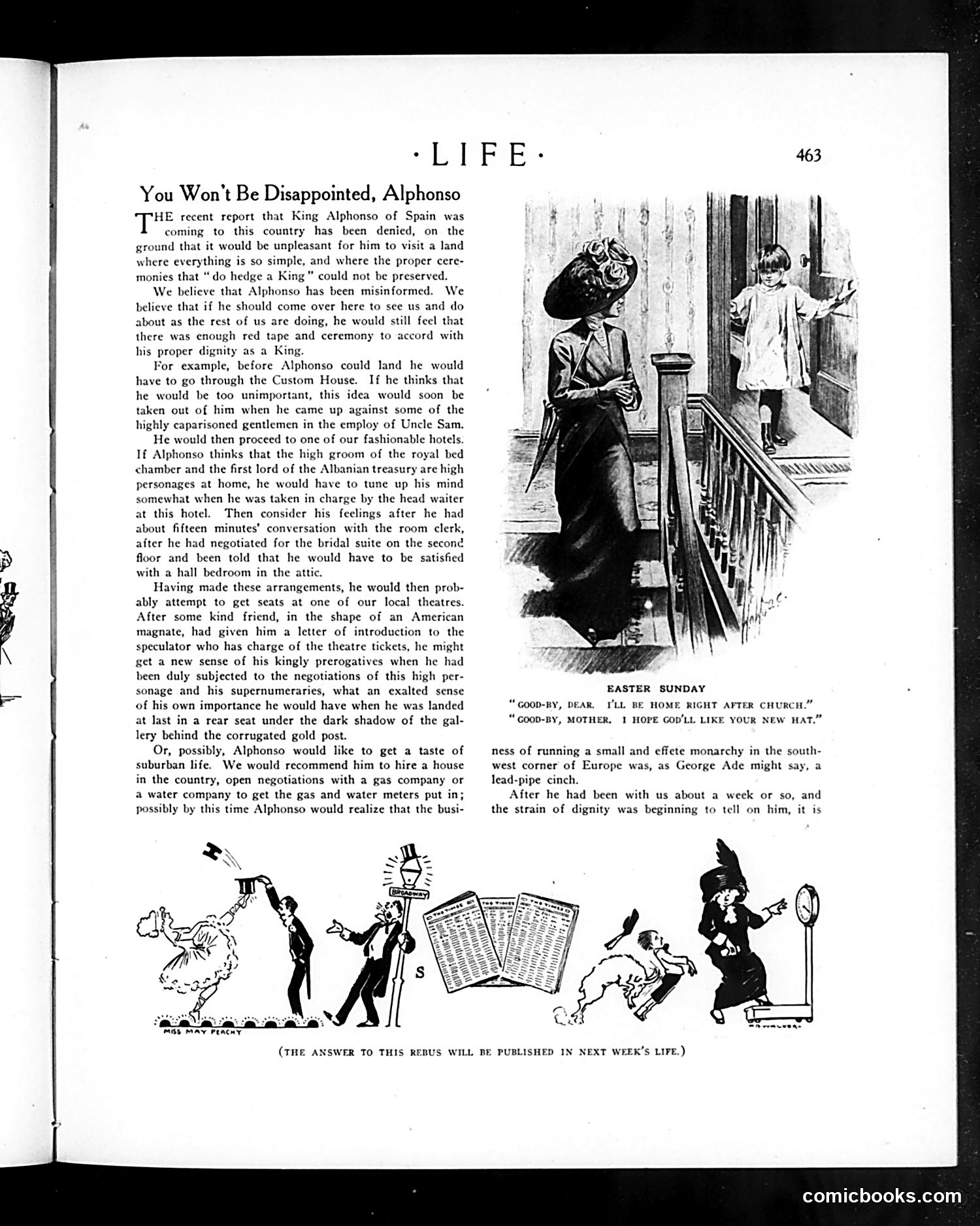
This satirical piece mocks King Alphonso XIII of Spain's reported reluctance to visit America, claiming he feared insufficient ceremony for royalty. Life's rebuttal argues American bureaucracy—customs officials, hotel staff, room clerks, theater ticket scalpers, and utility companies—provides abundant "red tape" to satisfy any monarch's dignity. The humor lies in inverting expectations: rather than American simplicity disappointing a king, Life suggests American commercial formality (hotels assigning poor rooms, scalpers controlling tickets) actually mirrors royal pretension. The piece satirizes both Spanish monarchy and American business pomposity simultaneously. The "Easter Sunday" cartoon above shows a woman leaving for church, humorously depicting modern religious practice as social rather than spiritual. The bottom contains an unresolved rebus puzzle, with the answer promised in next week's issue—a common Life magazine feature engaging readers.
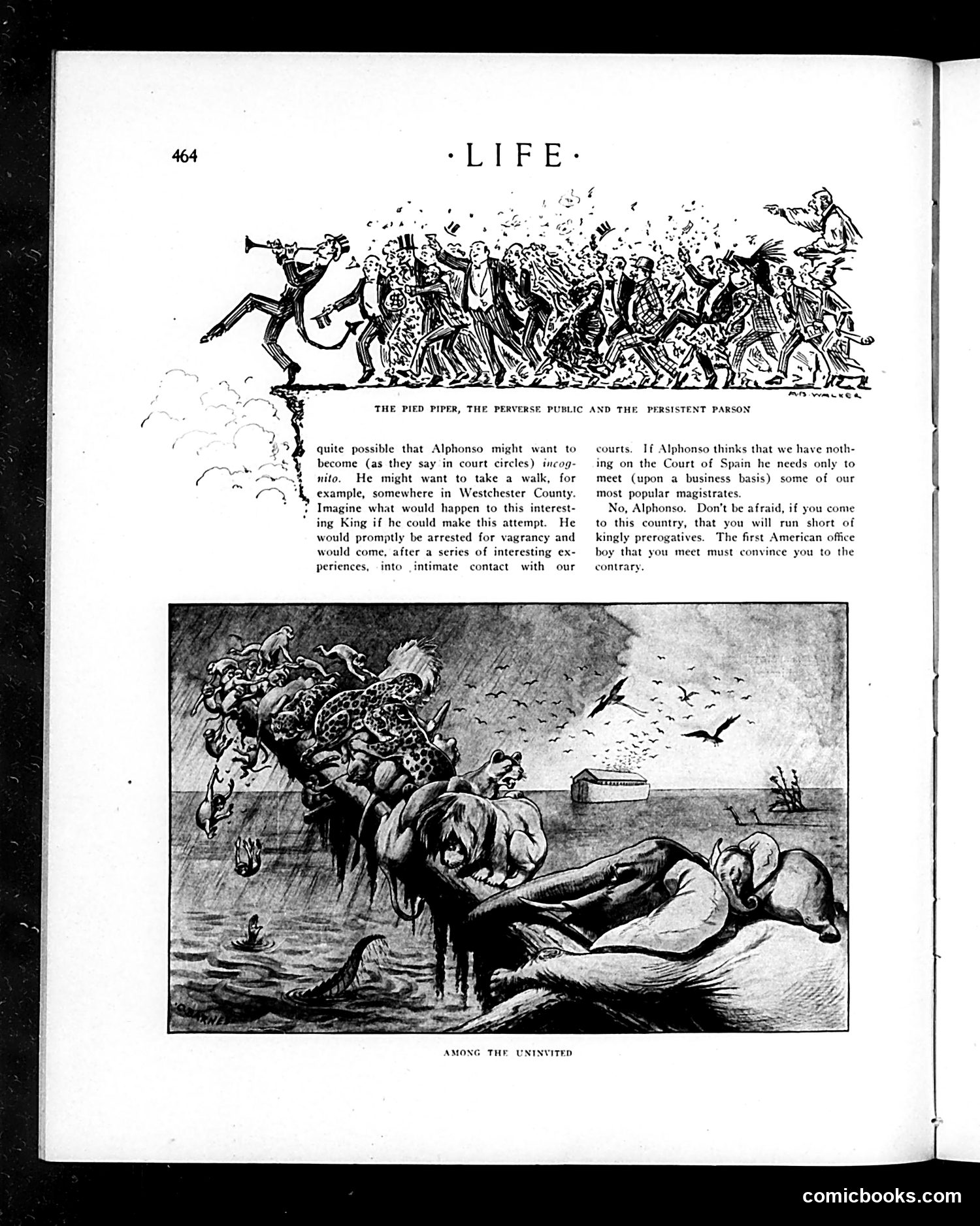
This Life magazine page satirizes the potential visit of King Alfonso XIII of Spain (referred to as "Alphonso") to America. The top cartoon shows a Pied Piper leading a chaotic crowd, likely representing how the Spanish king might attract unwanted attention or followers. The text humorously warns that if Alfonso tried to travel incognito in Westchester County, he'd be arrested for vagrancy—suggesting American authorities wouldn't recognize or defer to foreign royalty. The satire mocks both the Spanish court's formality ("incognito") and American egalitarianism: even a lowly office boy would supposedly put a king in his place. The bottom illustration titled "Among the Uninvited" appears to show the king's potential undignified encounters with American law enforcement and society, reinforcing the joke that America offers no special privileges for European monarchs.
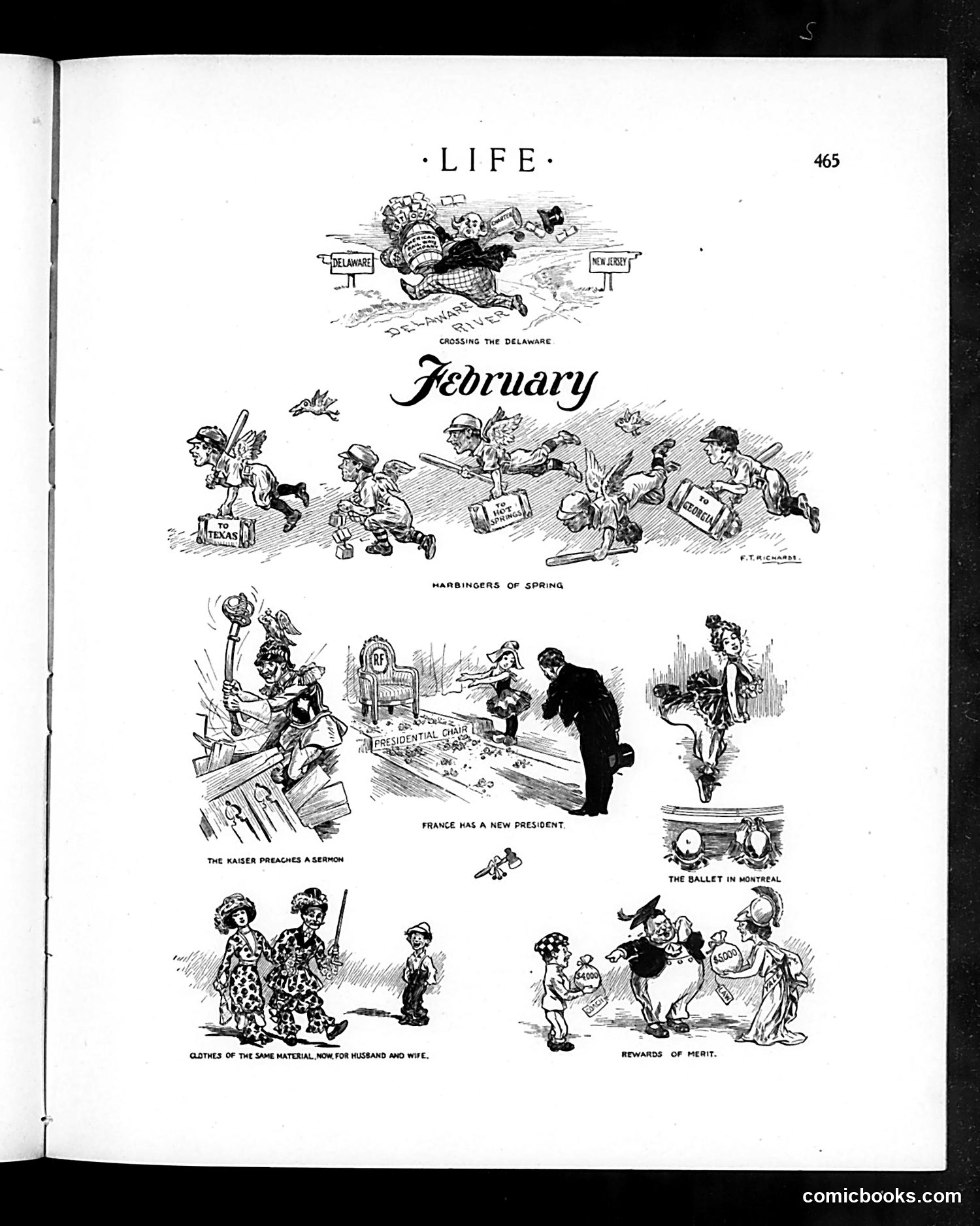
This page presents satirical cartoons about February events. The top panel references Washington's famous Delaware crossing, humorously reimagined as modern figures crossing the river. "Harbingers of Spring" shows cupids carrying spring-related items, a traditional seasonal joke. "The Kaiser Preaches a Sermon" likely satirizes German leadership during WWI-era tensions. "France Has a New President" comments on French political change. "The Ballet in Montreal" and "The Rewards of Merit" appear to be lighter social commentary on culture and achievement. "Clothes of the Same Material, Now for Husband and Wife" suggests commentary on emerging gender-equality trends in fashion or society. The cartoons use exaggerated caricature typical of early 20th-century satire, blending political events with social observation and seasonal humor.
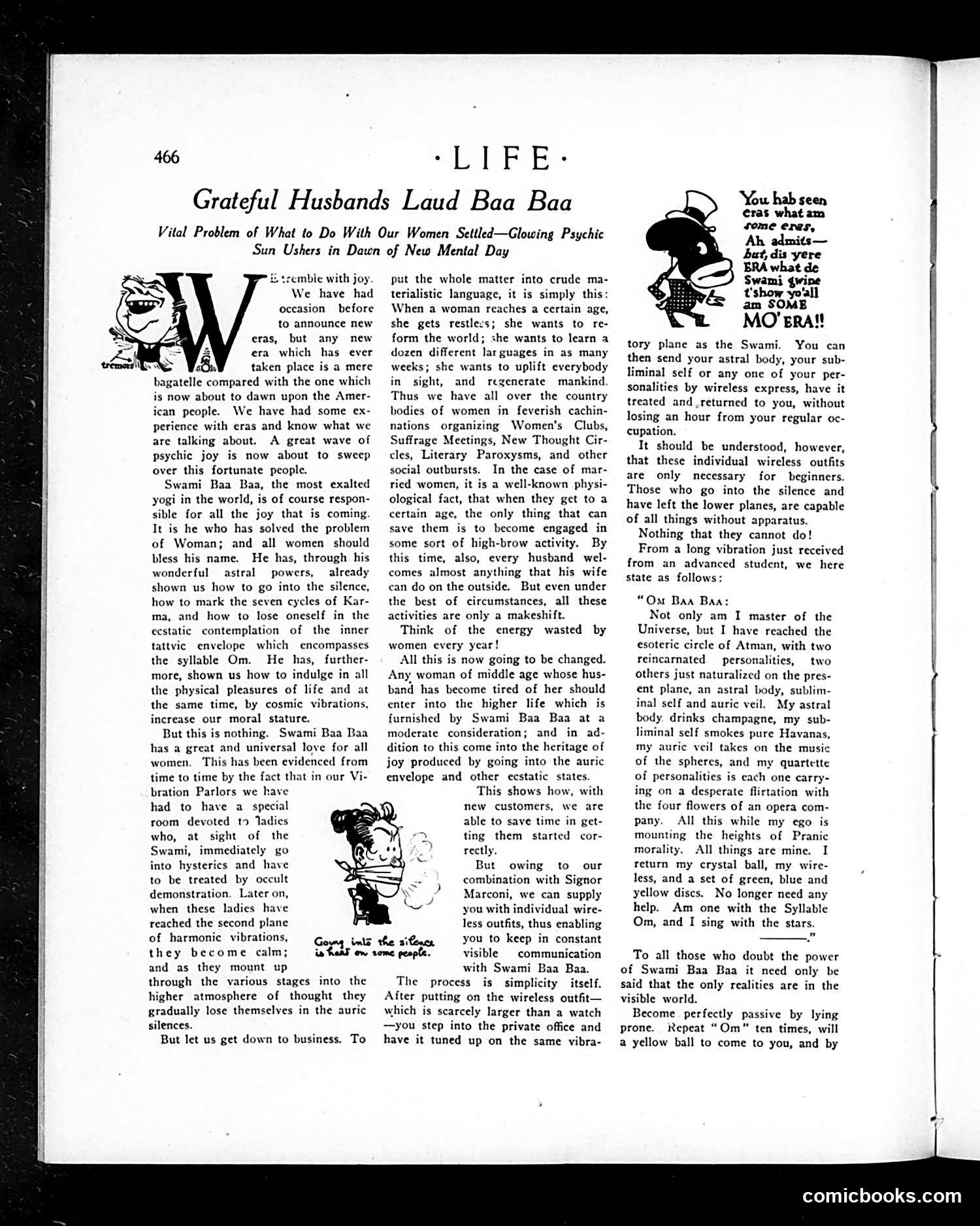
This page satirizes the early 20th-century craze for spiritual charlatans and New Thought mysticism. "Swami Baa Baa" is a fictional con artist who claims to solve the "problem" of middle-aged women seeking purpose through women's clubs, suffrage meetings, and self-improvement activities. The satire targets: 1. **Pseudo-spiritual hucksterism**: Fake yogis and mystics exploiting wealthy Americans with nonsensical jargon ("tattvic envelope," "auric silences") 2. **Gender anxiety**: The premise that women's activism and independence are problems needing "solutions" 3. **Technological gullibility**: The absurd wireless communication device for contacting the swami, satirizing contemporary fascination with new inventions like Marconi's wireless The humor lies in Life magazine treating this obvious fraud as legitimate. The cartoons show hysterical women and the Swami's exaggerated mystical persona. The joke assumes readers will recognize this as transparent exploitation of both wealthy patrons and women's genuine intellectual aspirations.
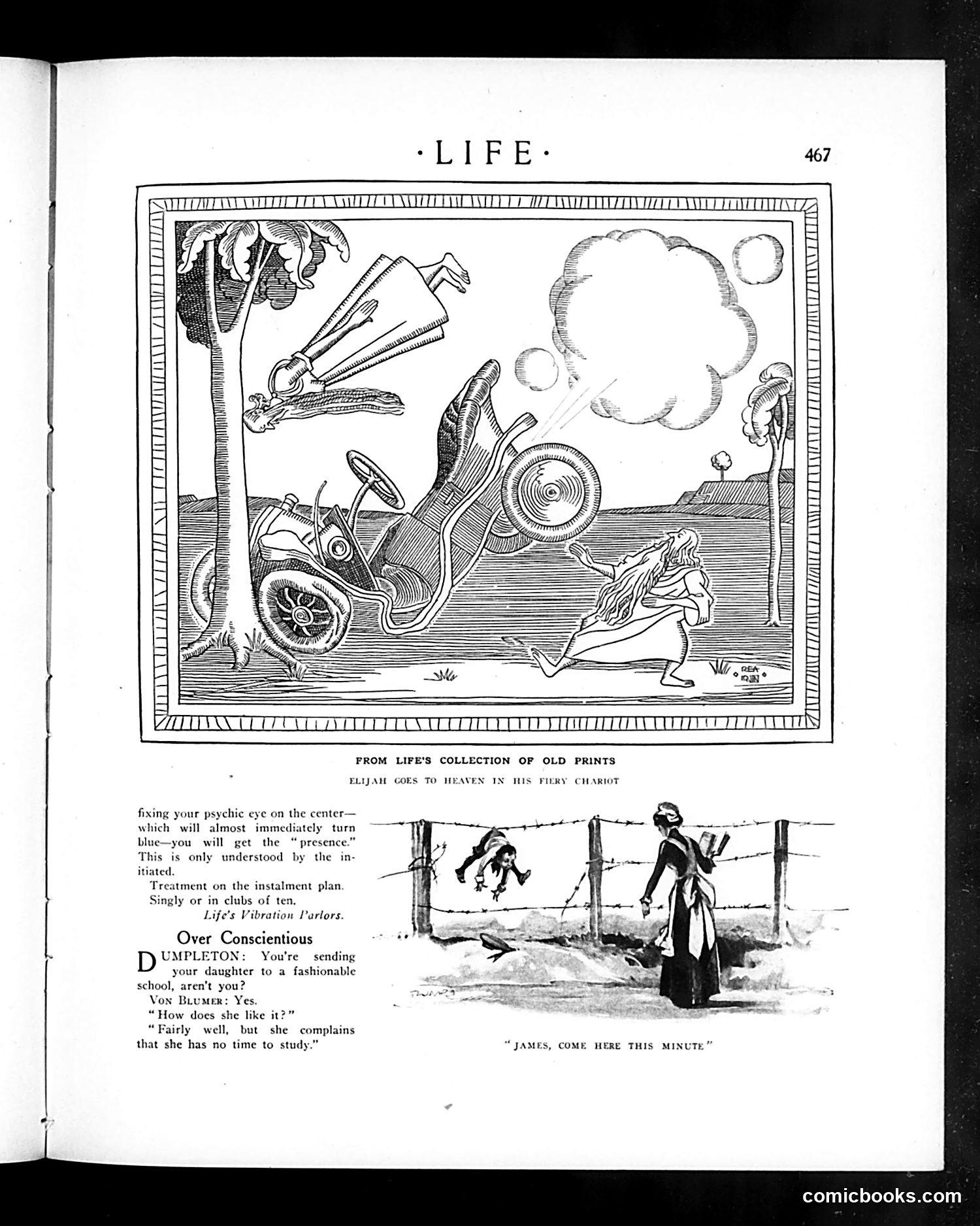
**Top Image:** A reproduction of an old biblical print depicting Elijah's ascension to heaven in a fiery chariot, contrasted with modern spiritualism. The caption mocks contemporary "Life's Vibration Parlors"—spiritualist con artists claiming to channel "presences" by having customers focus on a center point that "turns blue." The satire targets gullible people paying for fraudulent séance treatments "on the instalment plan," sold individually or in clubs of ten. **Bottom Cartoon:** A brief dialogue between two men satirizing elite education's impracticality. Mr. Dumpleton boasts of sending his daughter to an expensive fashionable school, but his friend Vox Blumer reveals the absurdity: she has "no time to study"—implying the school prioritizes fashionable social performance over actual education. The accompanying illustration of a woman calling "James, come here this minute" suggests frivolous domestic preoccupations. Both items mock contemporary American pretension and fraud.
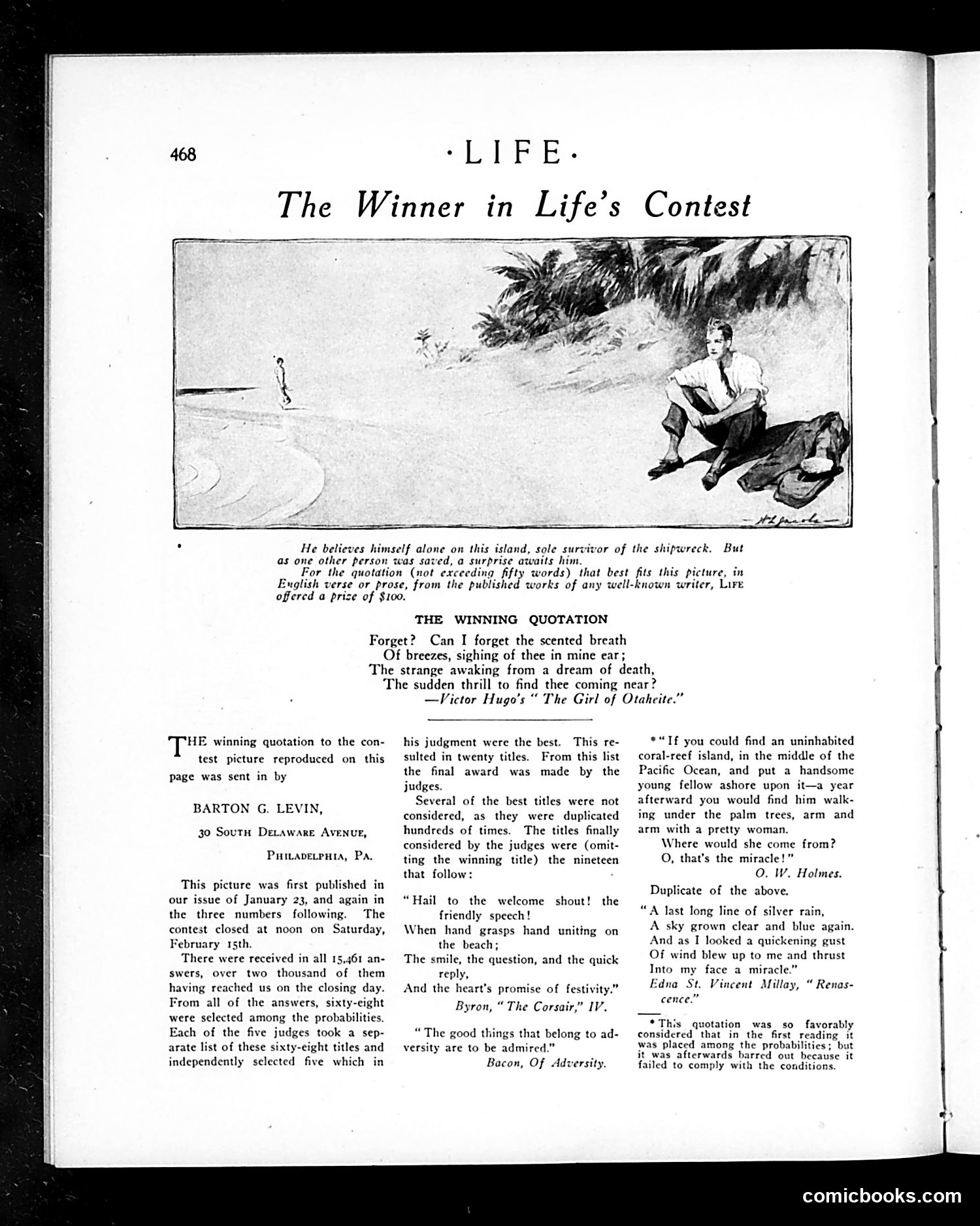
This page documents *Life* magazine's quotation-caption contest for an illustration depicting a shipwrecked man alone on an island who discovers another survivor—creating an unexpected romantic encounter. The winning entry, submitted by Barton G. Levin of Philadelphia, used a passage from Victor Hugo's "The Girl of Otaheite," emphasizing the emotional shock and joy of reunion. The contest received over 15,000 entries across multiple issues. The page lists nineteen finalist quotations from established writers (Byron, Bacon, O.W. Holmes, Edna St. Vincent Millay), demonstrating how *Life* leveraged both literary culture and reader participation for entertainment. One entry was disqualified for technical non-compliance despite its merit. This reflects early-20th-century magazine culture: blending satirical illustration with literary contests that engaged educated readers.
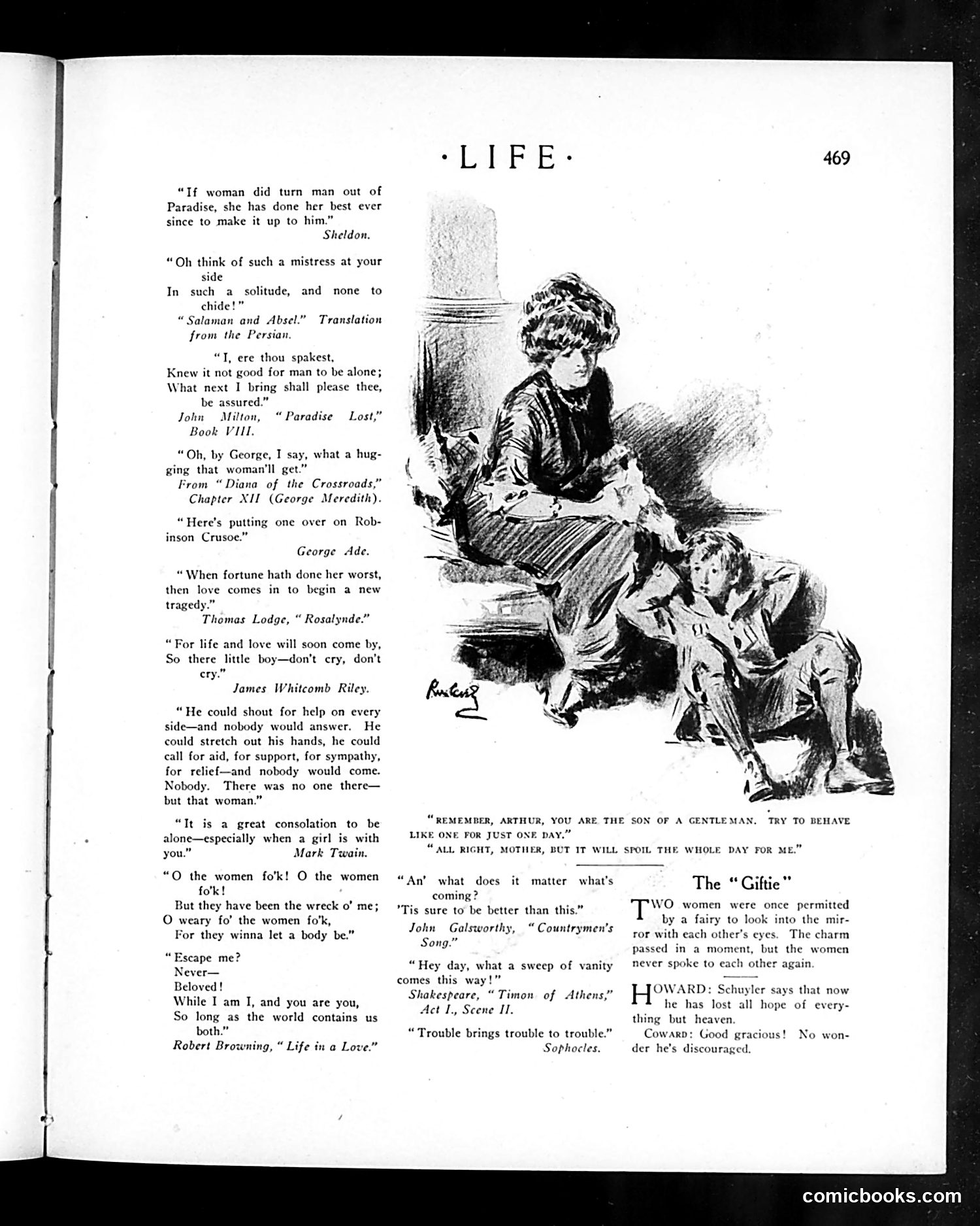
This page collects literary quotations—from Shakespeare, Milton, Browning, and others—on the themes of women, love, and male-female relationships. The accompanying sketch depicts a woman with two children, illustrating the domestic reality behind romantic ideals. The satire operates through **juxtaposition**: the page pairs lofty literary sentiments about women ("she has done her best...to make it up to him") with darker observations about marriage's burdens. Quotes range from celebratory (Milton's Paradise) to cynical (the Scottish verse about women as "wreck o' me"). The small comic dialogue at bottom—"Cowarn" losing hope except for heaven because Schuyler is discouraged—appears unrelated but reinforces the page's cynical tone about life's disappointments. The overall message: Life magazine mocks both romantic idealization of women and the disillusioned reality of domestic entanglement that follows.
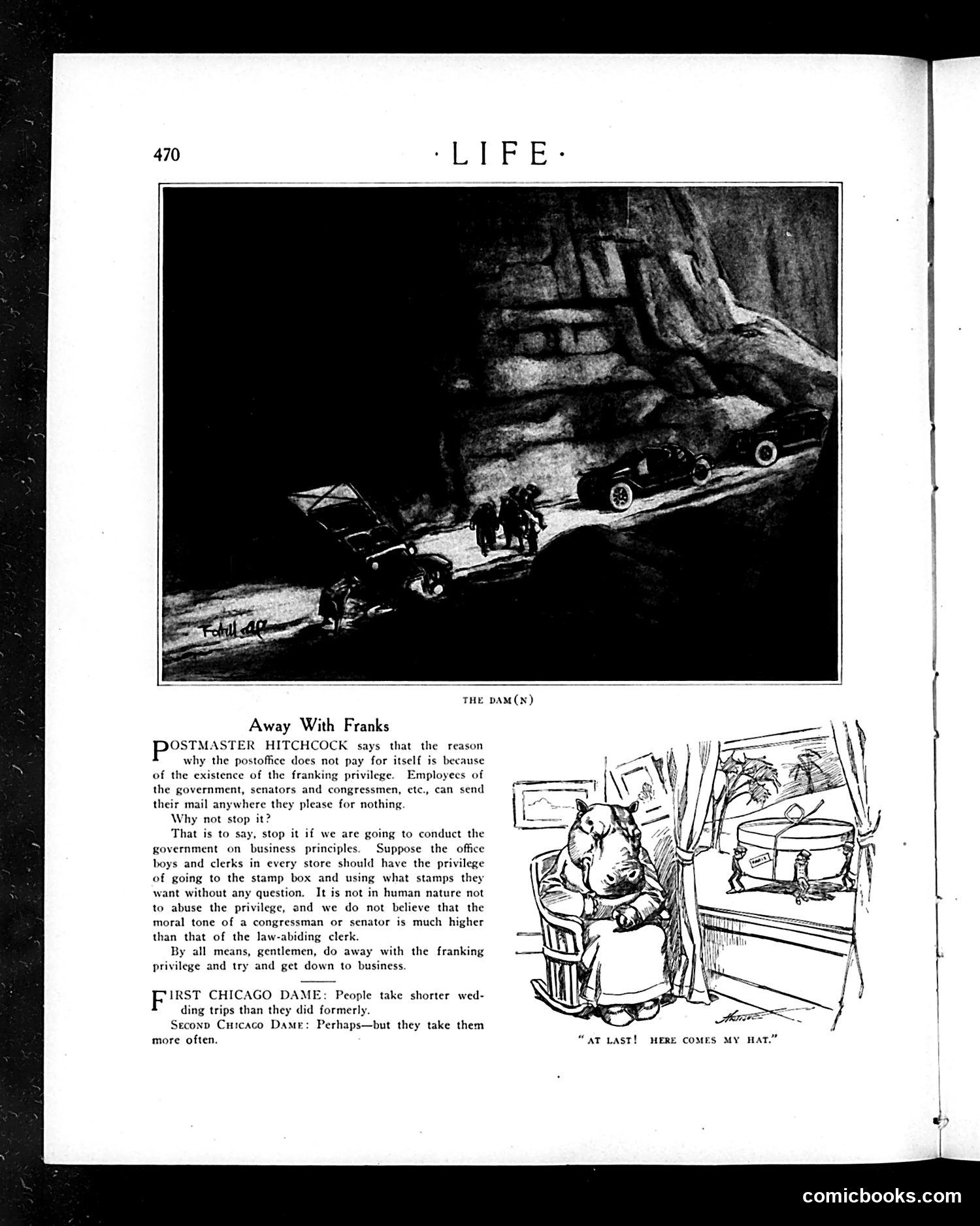
**"Away With Franks"** critiques the congressional **franking privilege**—the right of elected officials to send mail postage-free using their signature instead of stamps. Postmaster Hitchcock argues this abuse explains why the postal service operates at a loss. The text sarcastically compares congressmen and senators to store clerks, suggesting they lack moral restraint and will exploit privileges just as readily as lower-ranking employees would. The satire argues that if the government conducts business on sound principles, it must eliminate this perk. The accompanying cartoons appear lighter in tone: "The Dam(n)" shows vehicles navigating a large rock formation; the second joke about Chicago women contrasts shorter but more frequent wedding trips, likely satirizing changing social attitudes toward marriage or marital instability among the wealthy. The page reflects Progressive Era concerns about government inefficiency and special privileges enjoyed by the political class.
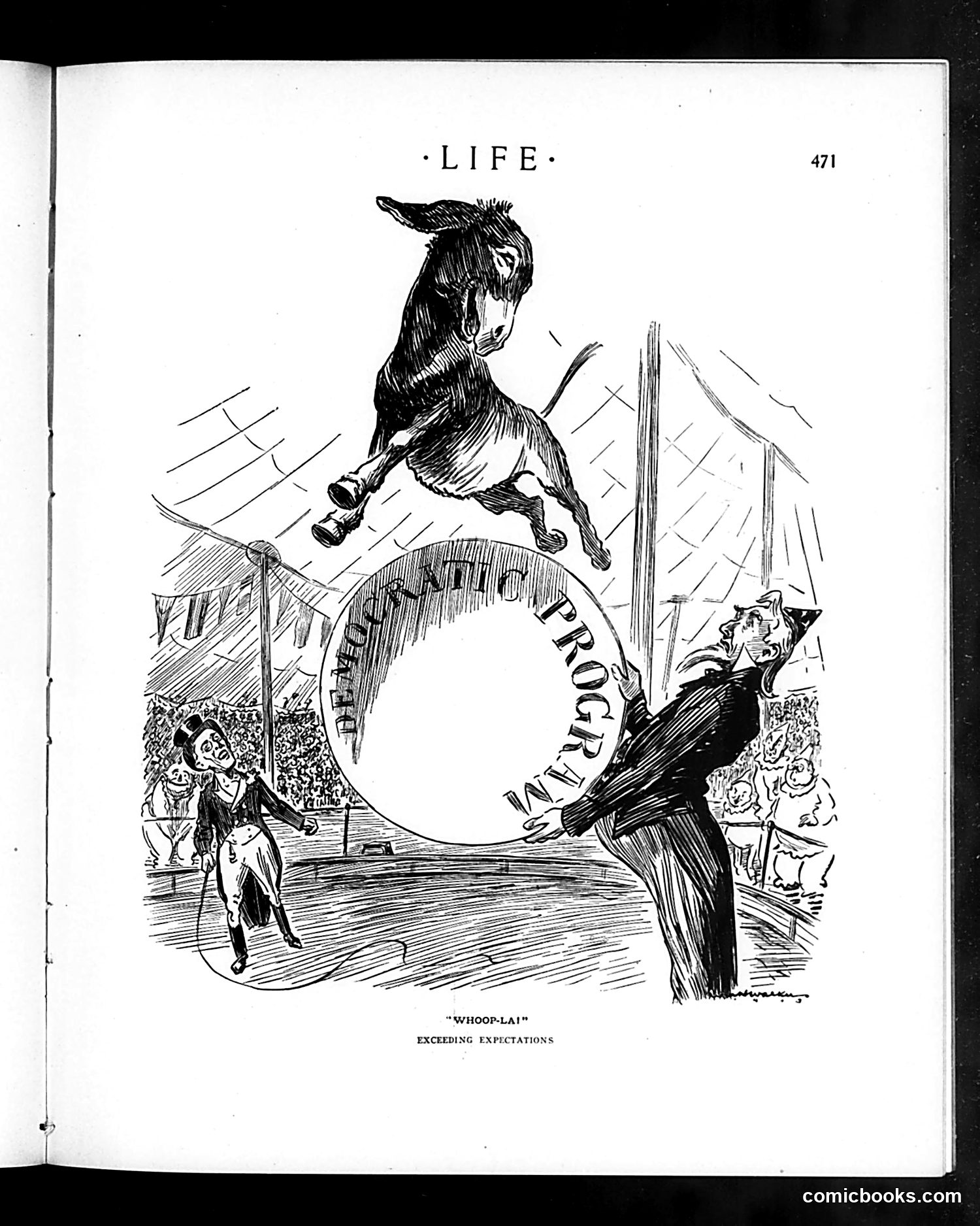
This political cartoon depicts a circus scene where a donkey jumps through a large circular hoop labeled "PROGRAM." A ringmaster or promoter on the right gestures triumphantly while crowds watch from the stands. The title "Whoop-La! Exceeding Expectations" suggests the cartoon satirizes someone or something surpassing predicted performance—likely a political figure or policy unexpectedly succeeding. The donkey metaphor typically represents either a foolish actor or the Democratic Party (which uses a donkey as its symbol). The "program" hoop may reference a specific policy initiative or campaign promise. The circus setting emphasizes spectacle and entertainment value over substance, suggesting the achievement is more theatrical showmanship than genuine accomplishment. Without more historical context, the specific political figure or event referenced remains unclear.
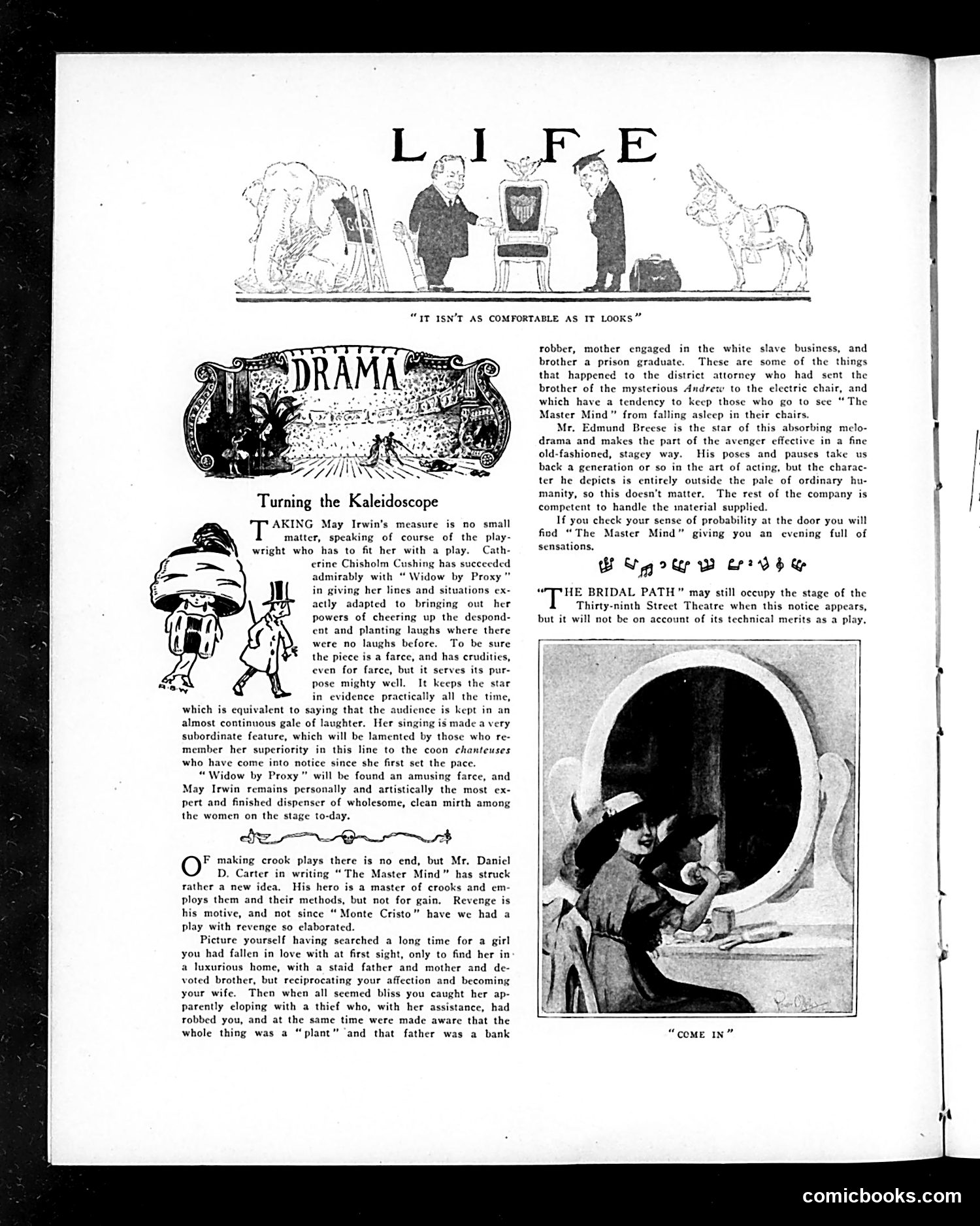
This page reviews three contemporary theatrical productions. The "Turning the Kaleidoscope" header is a metaphor for shifting theatrical perspectives. **"Widow by Proxy"** stars May Irwin, a popular comedian of the era. The review praises her as the finest purveyor of "wholesome, clean mirth" among actresses, though it notes her singing talent is underutilized. The critique suggests she dominates the farce completely, keeping audiences laughing throughout. **"The Master Mind"** is a revenge melodrama starring Edmund Breese. The plot involves elaborate deception: a district attorney unknowingly marries a woman whose family includes a bank robber, white slaver, and convict. The reviewer acknowledges the absurd plot requires audiences to suspend disbelief ("check your sense of probability at the door") but credits Breese's old-fashioned, theatrical acting style as appropriate for the material. **"The Bridal Path"** receives dismissive coverage, suggesting it lacks technical merit. The satirical header cartoon pokes fun at theatrical discomfort or artificiality.
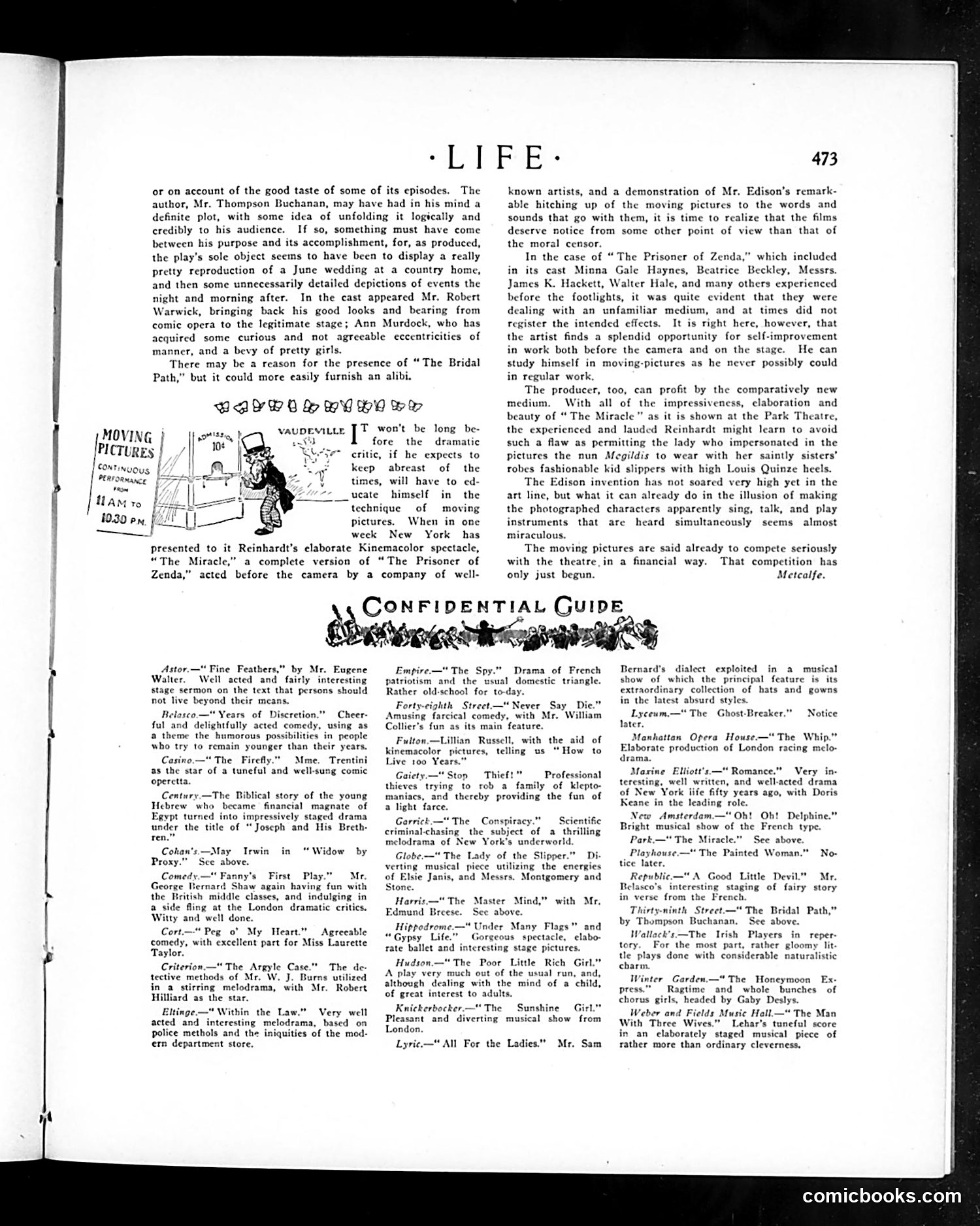
This page contains theater reviews and a small cartoon about moving pictures (early cinema). The cartoon shows a vaudeville performer advertising "Moving Pictures" with a sign announcing times, reflecting the novelty of film in 1911. The main text discusses how dramatic critics must educate themselves about film technique, as New York has recently seen major cinema productions including Reinhardt's "Kinemacolor" spectacle of "The Prisoner of Zenda" and Edison's synchronized sound-and-picture invention. The writer argues films deserve serious critical attention beyond moral censorship. The satire is subtle: the cartoon implies that vaudeville entertainers are advertising movies like a stage act, suggesting cinema's novelty and theater's defensive posture. The reviews below reveal the era's anxiety—theater critics recognizing that moving pictures now pose genuine financial competition to live performance, requiring serious artistic evaluation rather than dismissal. The "Confidential Guide" lists contemporary theatrical productions, emphasizing live theater's continued dominance despite the emerging film threat.
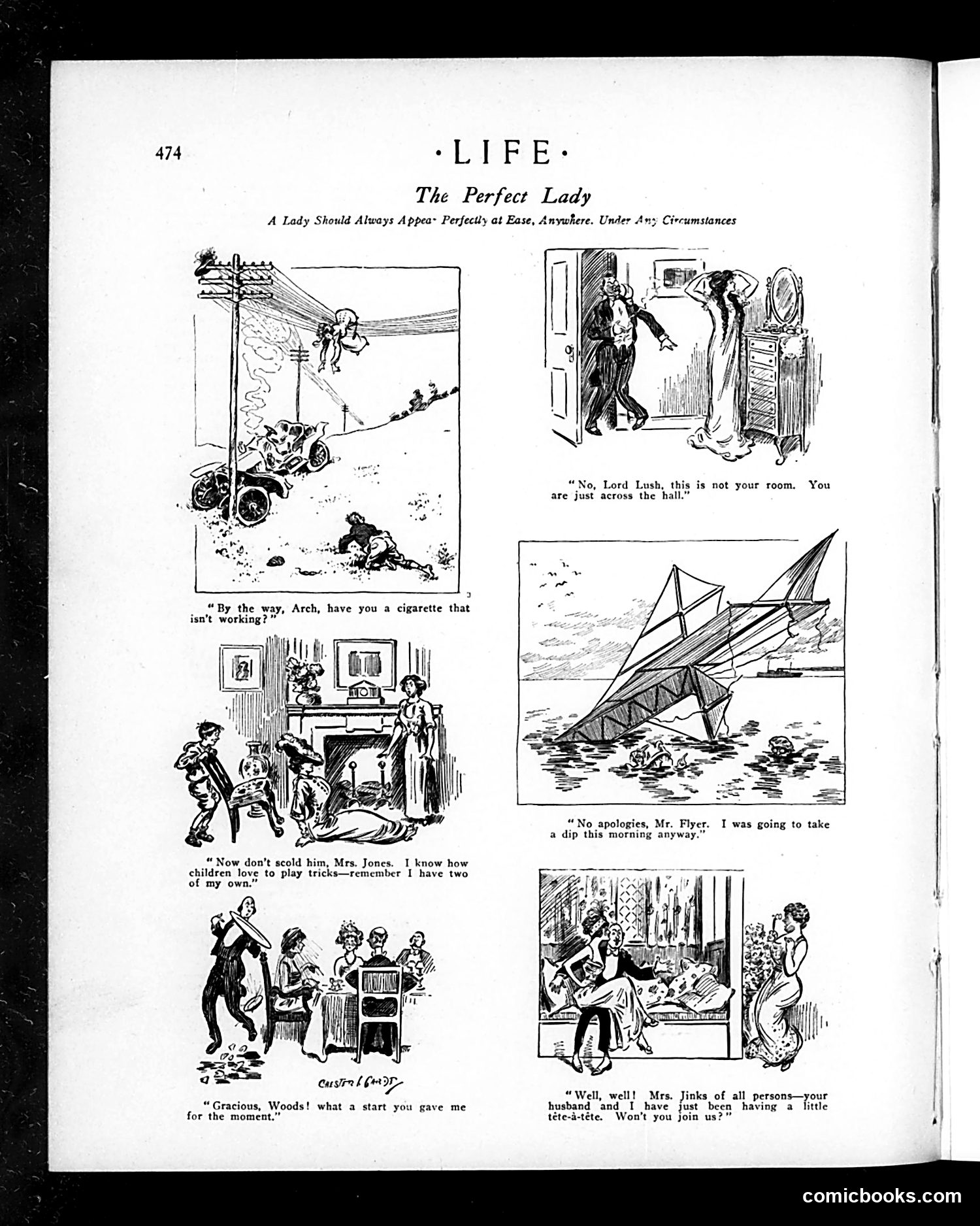
This page satirizes the early 20th-century ideal of upper-class feminine composure. The title promises that "a lady should always appear perfectly at ease, anywhere, under any circumstances"—then the cartoons mock this impossible standard through increasingly absurd social disasters. Each vignette shows a woman maintaining perfect composure despite humiliation: a man enters her bedroom uninvited; she's hit by a car; a man's plane crashes nearby; children play pranks; her husband is caught in a compromising situation with another woman. The satire targets both the restrictive social expectation itself and the artificiality required to maintain it. By showing the widening gap between genteel propriety and reality, the cartoons critique how women were expected to suppress natural reactions (shock, anger, embarrassment) to preserve decorum. The humor comes from the clash between the perfectly composed ladies and the chaos surrounding them.
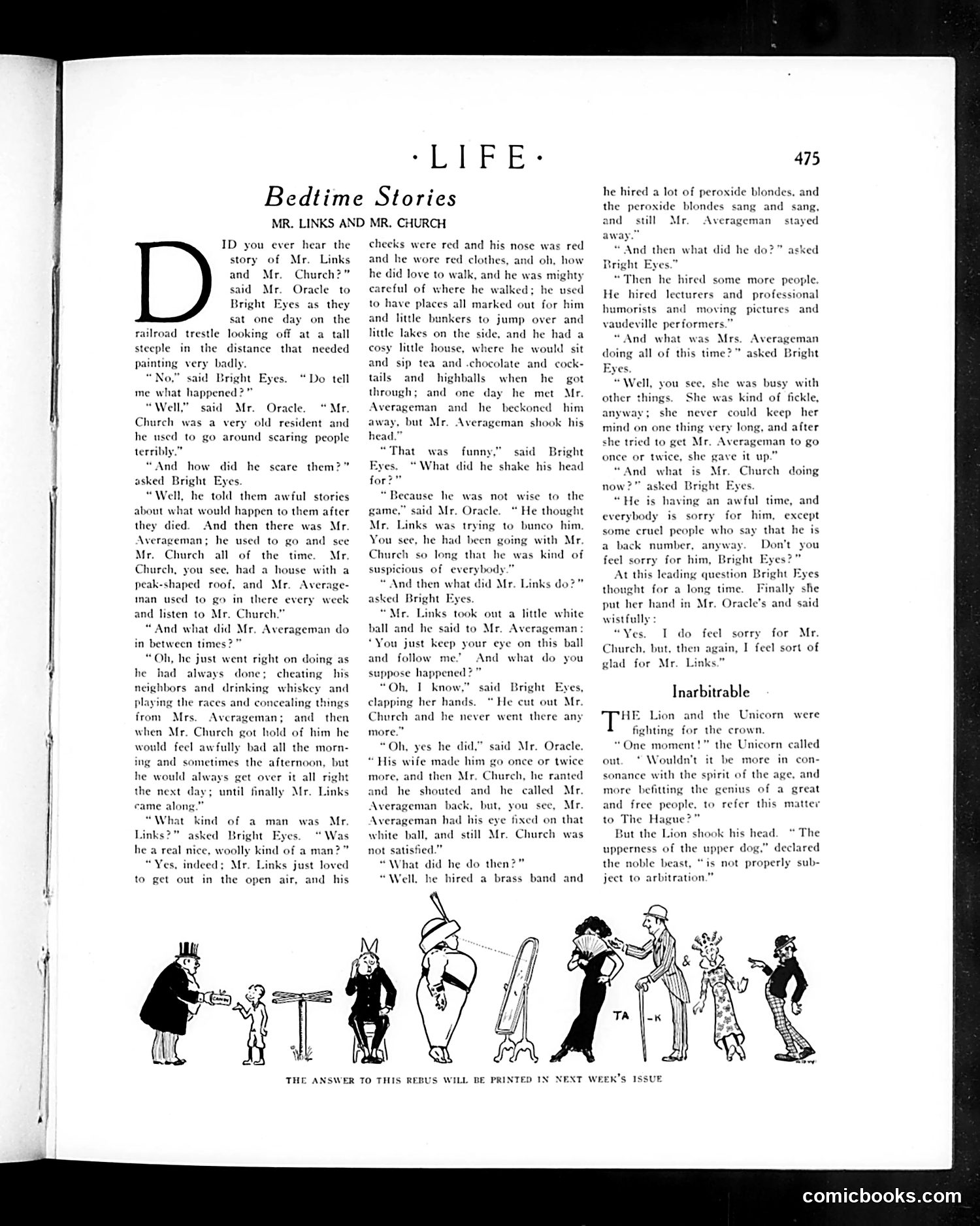
This is a morality fable disguised as bedtime entertainment, satirizing American social hypocrisy around the early 20th century. **The characters represent archetypes:** Mr. Church embodies organized religion and moral authority; Mr. Averageman represents the ordinary person; Mr. Links symbolizes worldly temptation (likely golf, given the "white ball" and course details—a leisure activity considered frivolous). **The satire's point:** Despite Mr. Church's stern moral preaching (frightening people about damnation), Mr. Averageman remains unmoved by conscience. When Mr. Links offers secular pleasure, Mr. Church responds not with deeper theology but by escalating spectacle—hiring brass bands, peroxide blondes, lecturers, and vaudeville—essentially out-competing worldly entertainment with religious showmanship. **The joke:** Religion becomes just another entertainment commodity. Mrs. Averageman's indifference throughout underscores that none of this—church or leisure—truly changes behavior. The satire critiques both the hypocrisy of nominal religiosity and the era's increasingly commercialized, sensationalized approach to faith.

This page appears to be from an early issue of *Life* magazine and shows a black and white photograph of what looks like an industrial or mechanical object—possibly a pipe, barrel, or cylindrical machinery component—positioned against a textured background. The page includes the text "LIF" (presumably the magazine masthead, cut off) at top right and "Home" at bottom right, suggesting this is a section divider or transitional page rather than a complete cartoon or article. Without visible caption text, OCR'd content, or accompanying article text on this page, I cannot definitively identify what specific satire or social commentary this image represents. The industrial subject matter suggests possible commentary on labor, manufacturing, or mechanical processes common to *Life's* satirical content, but this would be speculation without supporting textual evidence.
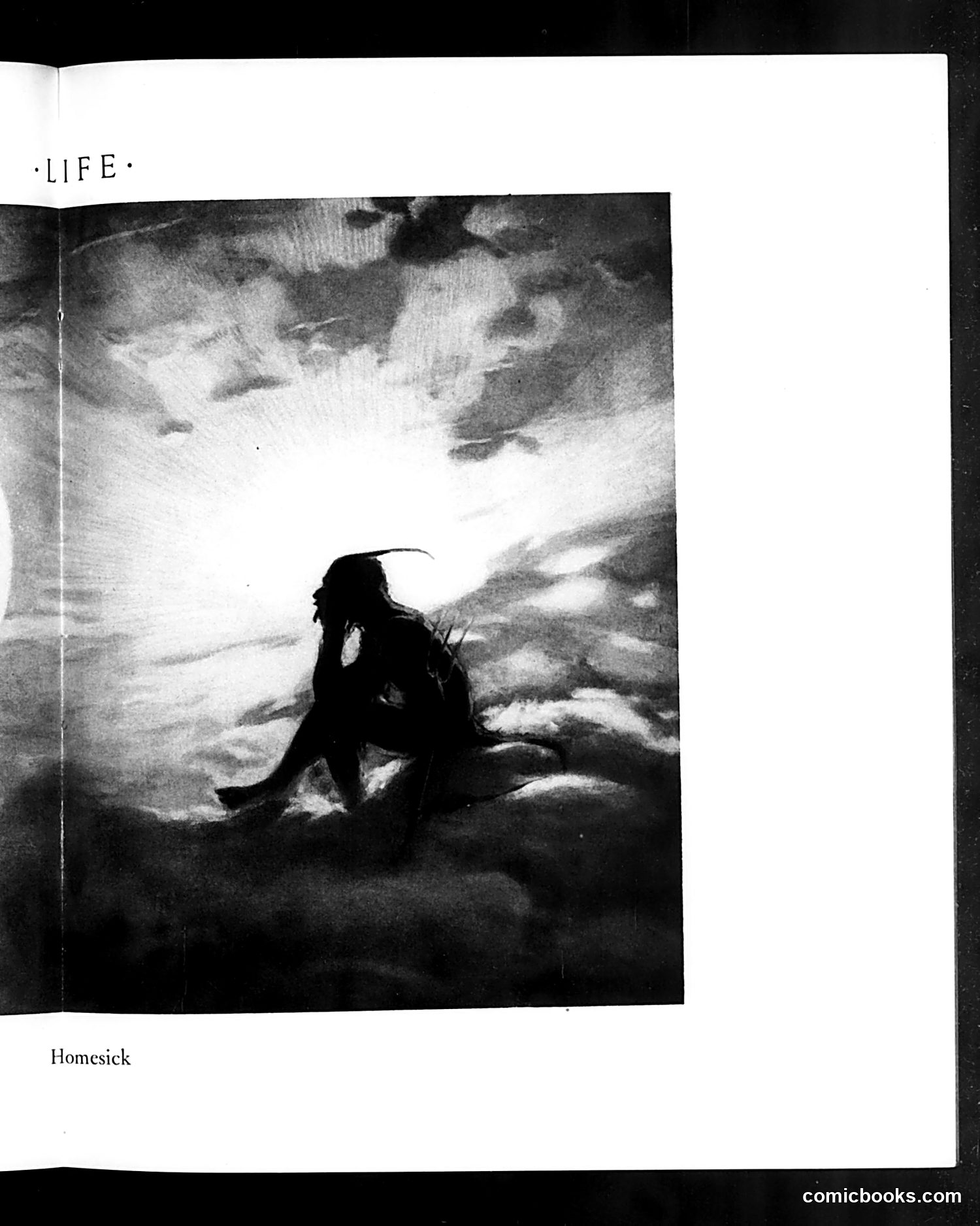
This page features a silhouetted figure in a crouched or dejected posture against a dramatic, cloudy sky. The title "Homesick" suggests emotional distress or longing for home. The image appears to be a serious illustration rather than a humorous cartoon. The silhouetted pose—hunched and seemingly troubled—conveys melancholy or despair. Without additional context about the magazine's date or surrounding content, the specific subject remains unclear, though the composition suggests commentary on displacement, hardship, or emotional suffering during wartime or social upheaval. The stark black-and-white photography and dramatic lighting are characteristic of Life magazine's editorial approach to serious social topics.
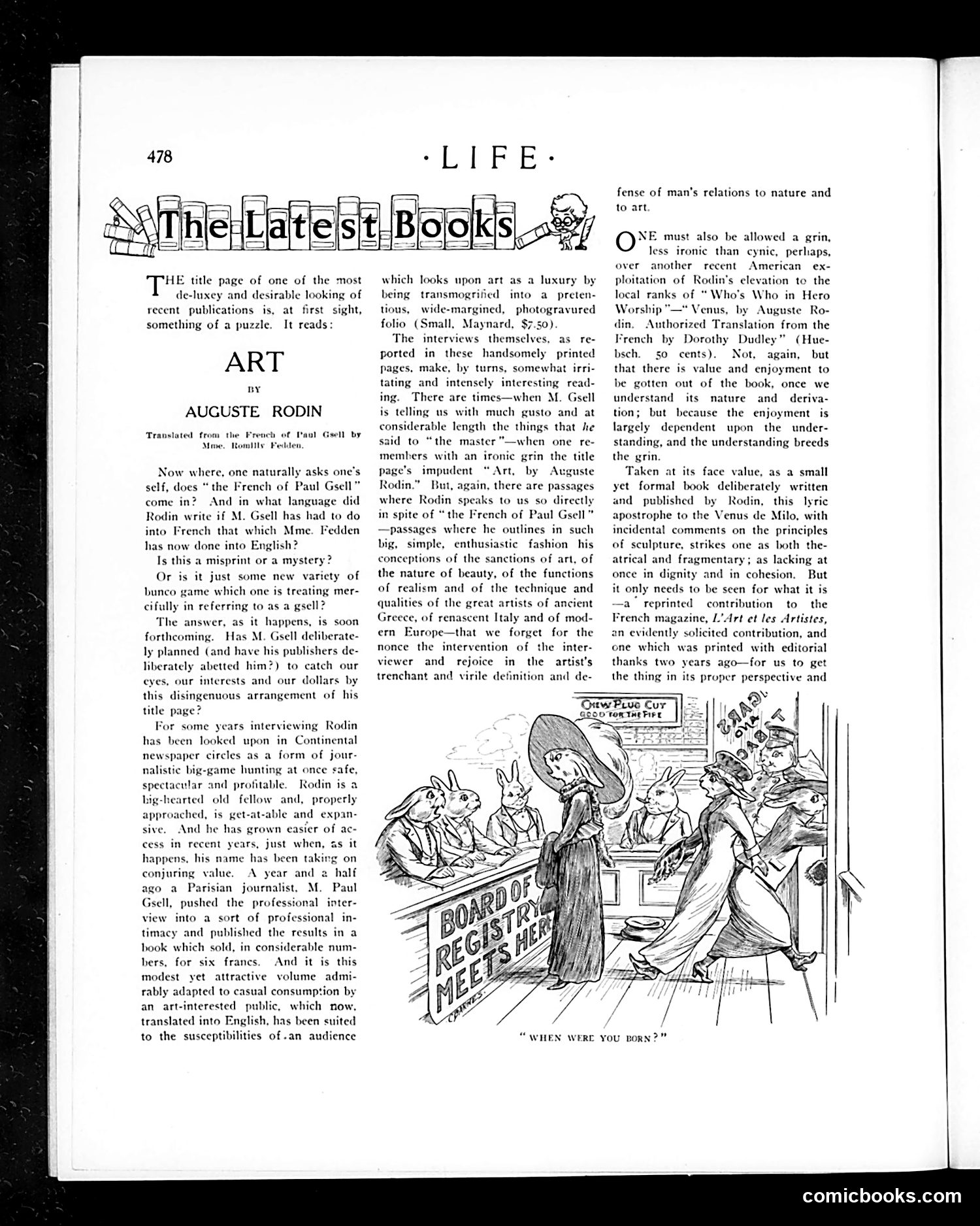
This page reviews a new English translation of Auguste Rodin's "Art" (interviews conducted by Paul Gsell). The accompanying cartoon satirizes the absurdity of celebrity hero-worship culture. The cartoon depicts animals at a "Board of Registry" window, apparently registering their birth dates. The joke plays on Life's criticism of trendy American commodification of great artists: just as one might register a prized animal's pedigree, Americans were treating famous artists' work as fashionable status symbols rather than engaging with their actual ideas. The text mocks how Rodin's interviews were repackaged as a luxury, oversized folio edition—inflating a modestly-priced French book into an expensive prestige item for casual consumption. The grin-worthy absurdity: Americans buying elaborately produced "authorized translations" of artistic philosophy without necessarily understanding or seriously engaging with the content itself.
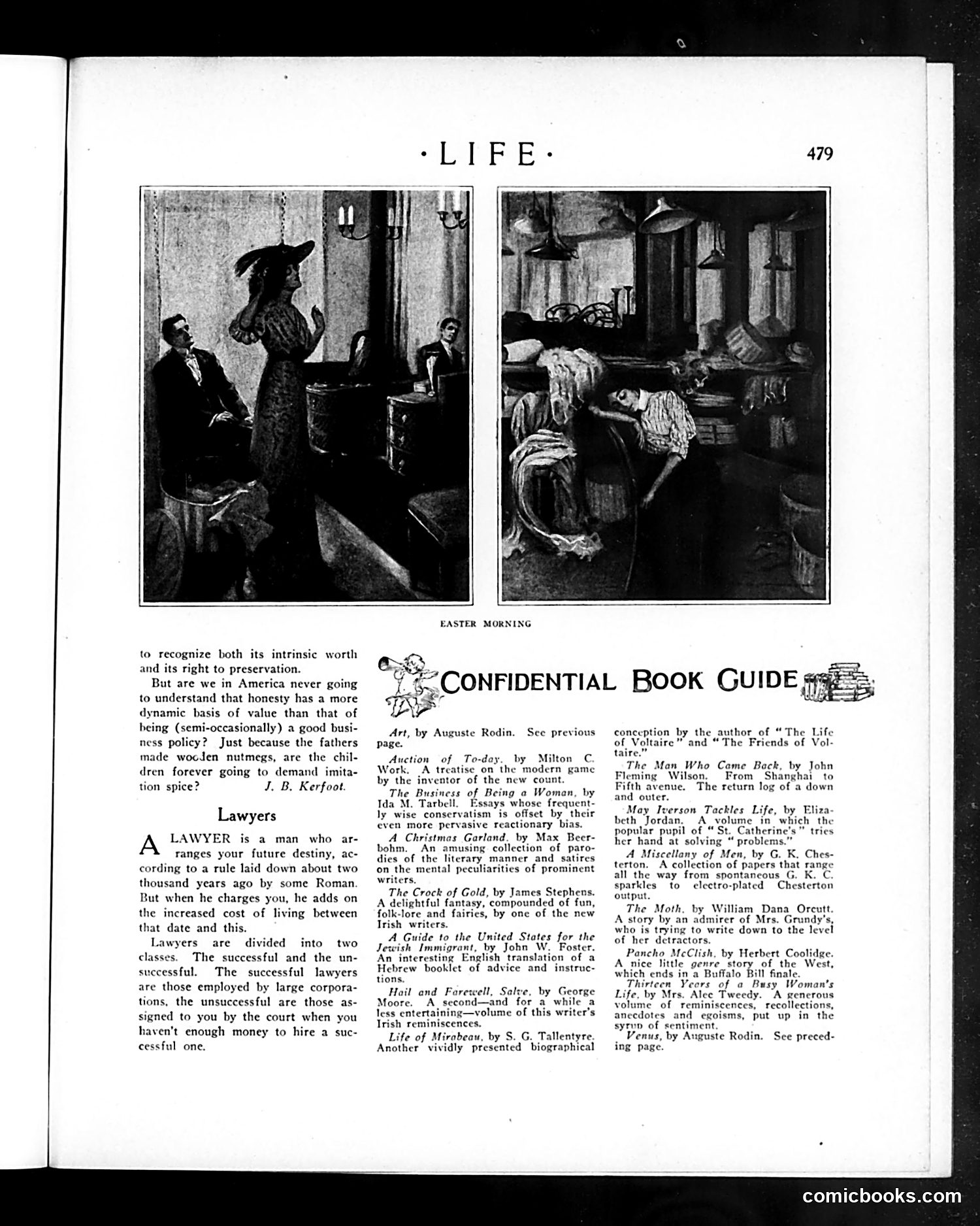
This page is primarily a **book review section** ("Confidential Book Guide") with two black-and-white illustrations labeled "Easter Morning" at the top, attributed to sculptor Auguste Rodin. The page includes a satirical essay on **Lawyers**, which mocks the legal profession's cost structure. The humor attacks a fundamental contradiction: lawyers claim to operate under Roman law established "two thousand years ago," yet charge modern fees reflecting "increased cost of living" since then—suggesting they've simply inflated ancient precedent to justify contemporary rates. The essay's punchline distinguishes between "successful" lawyers (hired by wealthy corporations) and "unsuccessful" ones (court-appointed to those without money). This cynical observation reflects early 20th-century skepticism about whether legal systems genuinely serve justice or merely wealthy clients. The broader context criticizes American business ethics, referencing "wooden nutmegs"—a historical reference to Connecticut fraudsters who exported inferior goods—suggesting Americans inherit dishonest commercial traditions.
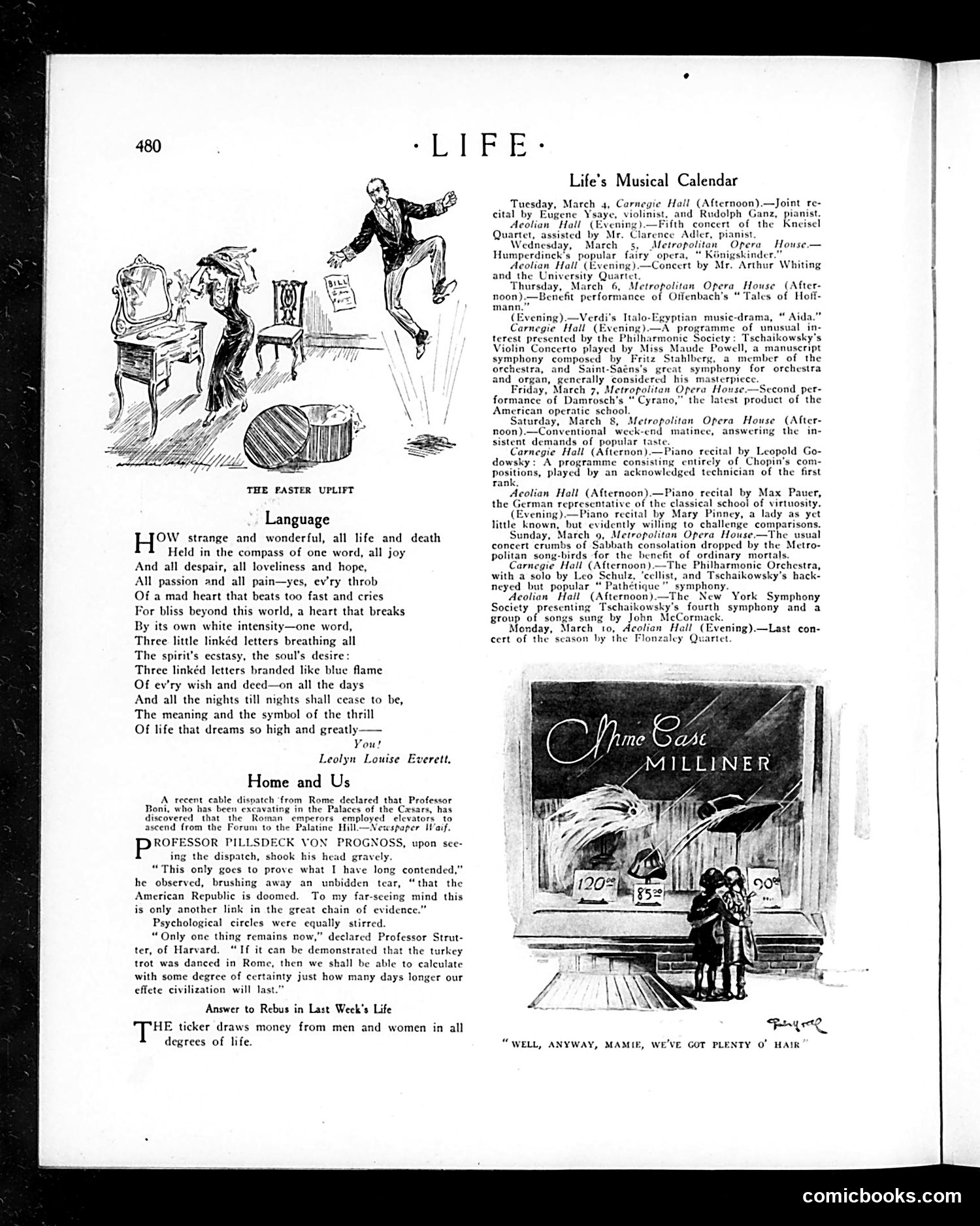
**The Main Cartoon ("The Paster Uplift"):** Shows a man literally leaping away from chairs and furniture, captioned as "The Paster Uplift." This appears to satirize the contemporaneous "Uplift" movement—reformers and intellectuals promoting cultural and moral improvement. The joke seems to mock how these enthusiasts were energetically, almost chaotically, pushing their agenda. **"Home and Us" Section:** Contains satirical commentary on intellectual pretension. A fictional Professor von Prognoss claims that Roman elevators prove America's imminent decline—absurd logic meant to mock pseudo-intellectuals who draw sweeping conclusions from trivial evidence. The follow-up joke about the "turkey trot" (a contemporary dance) being danced in Rome to calculate civilization's remaining days further ridicules academic overreach. **Advertisement:** The "Prime Cast Milliner" ad shows a shop window, with a caption "Well, anyway, mamie, we've got plenty o' hair"—likely a period joke about fashion or hairpieces. **Musical Calendar:** Simply lists upcoming classical music performances in New York (Carnegie Hall, Metropolitan Opera House, etc.)—practical entertainment information for readers.
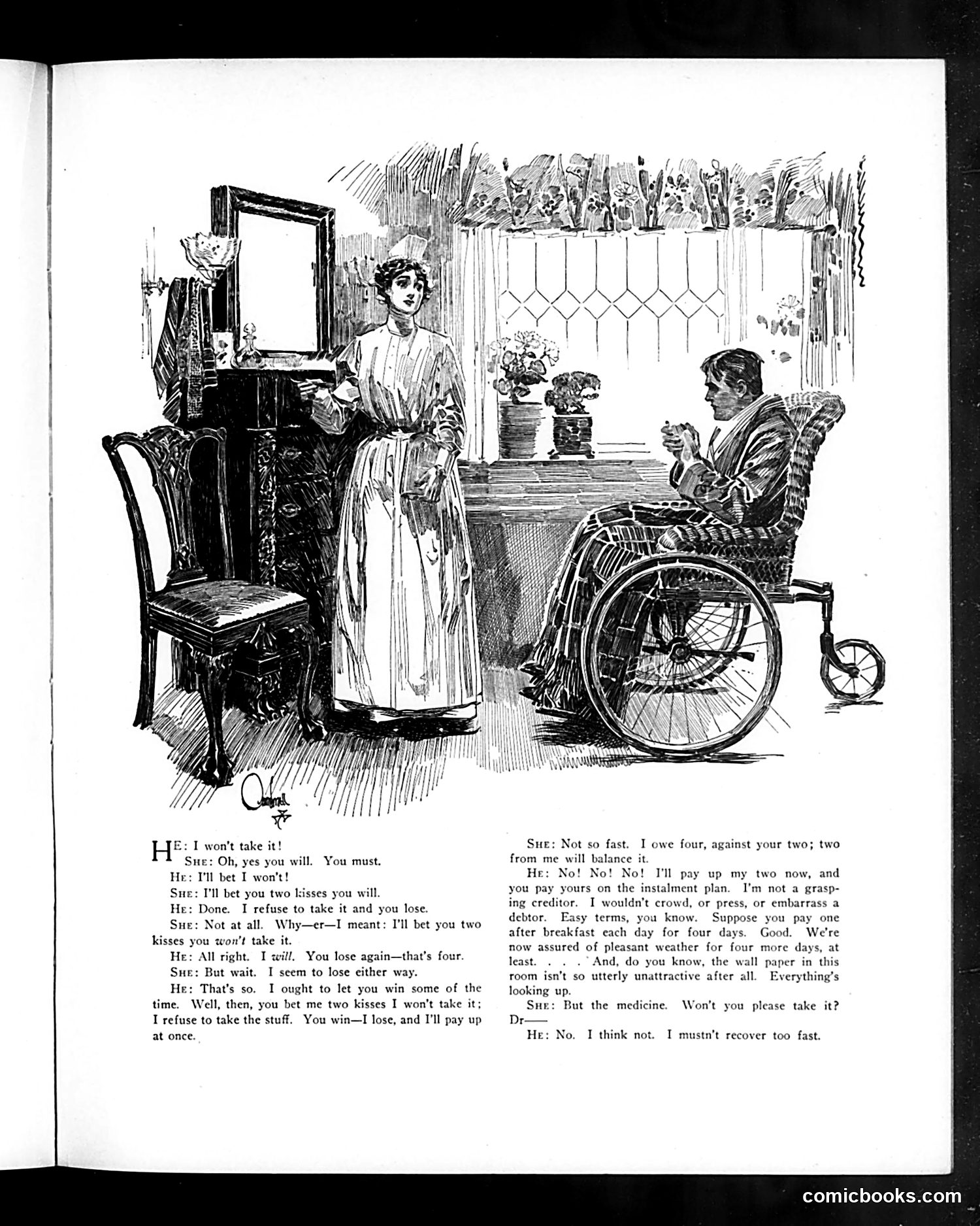
This cartoon satirizes a romantic courtship scenario through the lens of a wager. A man in a wheelchair refuses to take medicine, and a woman ("Sue") tries to coerce him with kisses as bets—first wagering he *will* take it, then that he *won't*. The joke's point: the man realizes that recovery would end their pleasant daily interactions. By staying ill, he ensures ongoing visits, conversation, and the prospect of collecting kisses over time ("one after breakfast each day for four days"). He even notes improvements in his mood and surroundings now that he has reason to linger with her. The satire targets early 20th-century courtship conventions—the coy bargaining, the use of physical affection as incentive, and the romantic notion that suffering or prolonged illness creates opportunity for connection. It's gentle humor about how romantic interest can perversely motivate someone to avoid recovery.
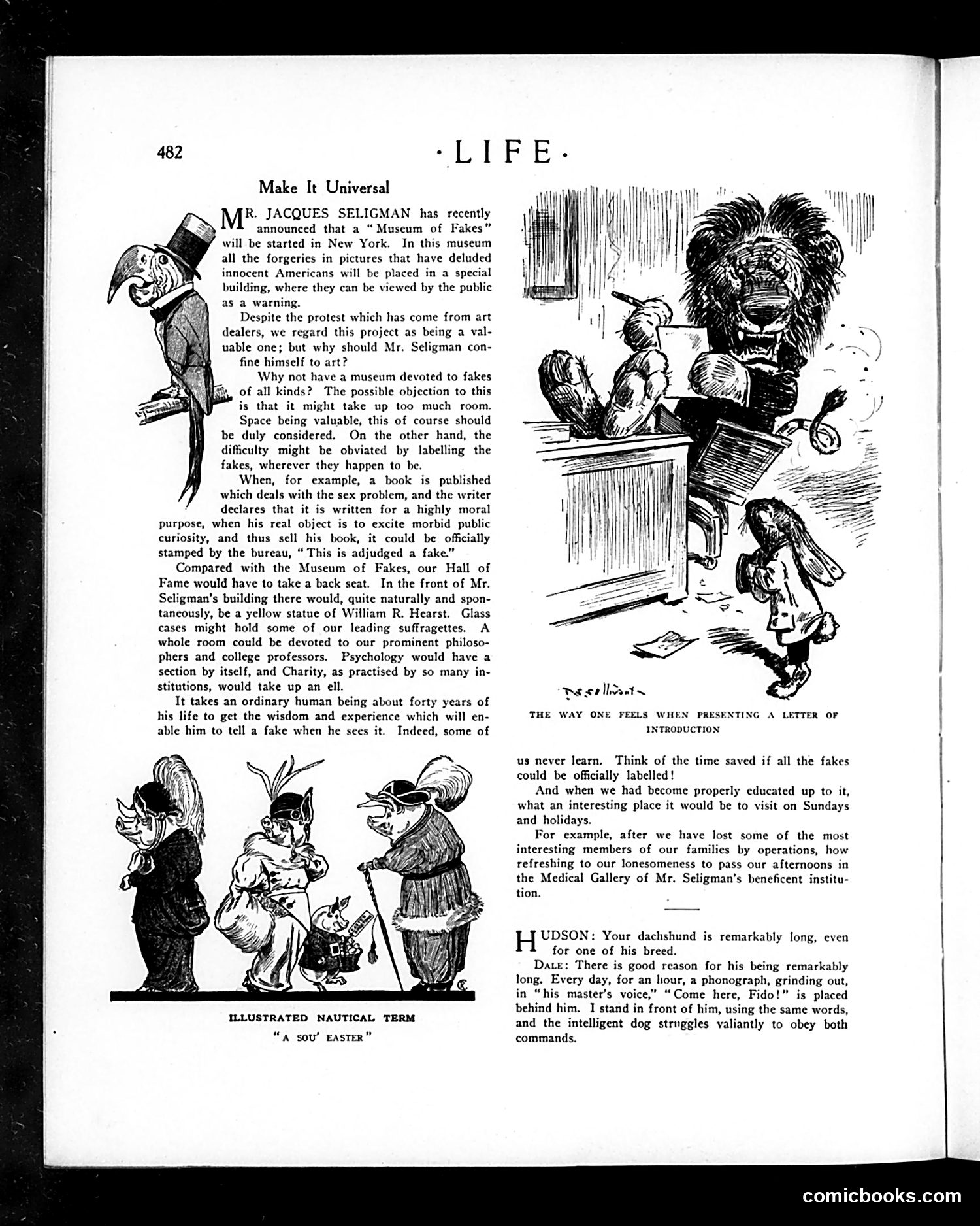
This satirical piece proposes Jacques Seligman's "Museum of Fakes" concept—a New York museum displaying forged paintings—and expands it absurdly to expose widespread fakery across American society. The author sarcastically suggests the museum should include: - Books about "sex problems" marketed as moral education (actually exploitative) - William R. Hearst (depicted as a yellow statue—likely referencing his sensationalist journalism) - Suffragettes (portrayed skeptically, suggesting their activism was performative) - Philosophy professors and charity institutions (implying pretense and fraud) The cartoons illustrate the humiliation of social pretense: one shows someone awkwardly presenting an introduction letter; another depicts a dachshund stretched impossibly long by conflicting phonograph commands—a visual pun on fakery and contradiction. The satire mocks early-20th-century American institutions for hypocrisy, suggesting that distinguishing genuine from false requires decades of experience most people never gain. The piece reflects Life magazine's role as social critic, targeting prominent figures and institutions of the era.
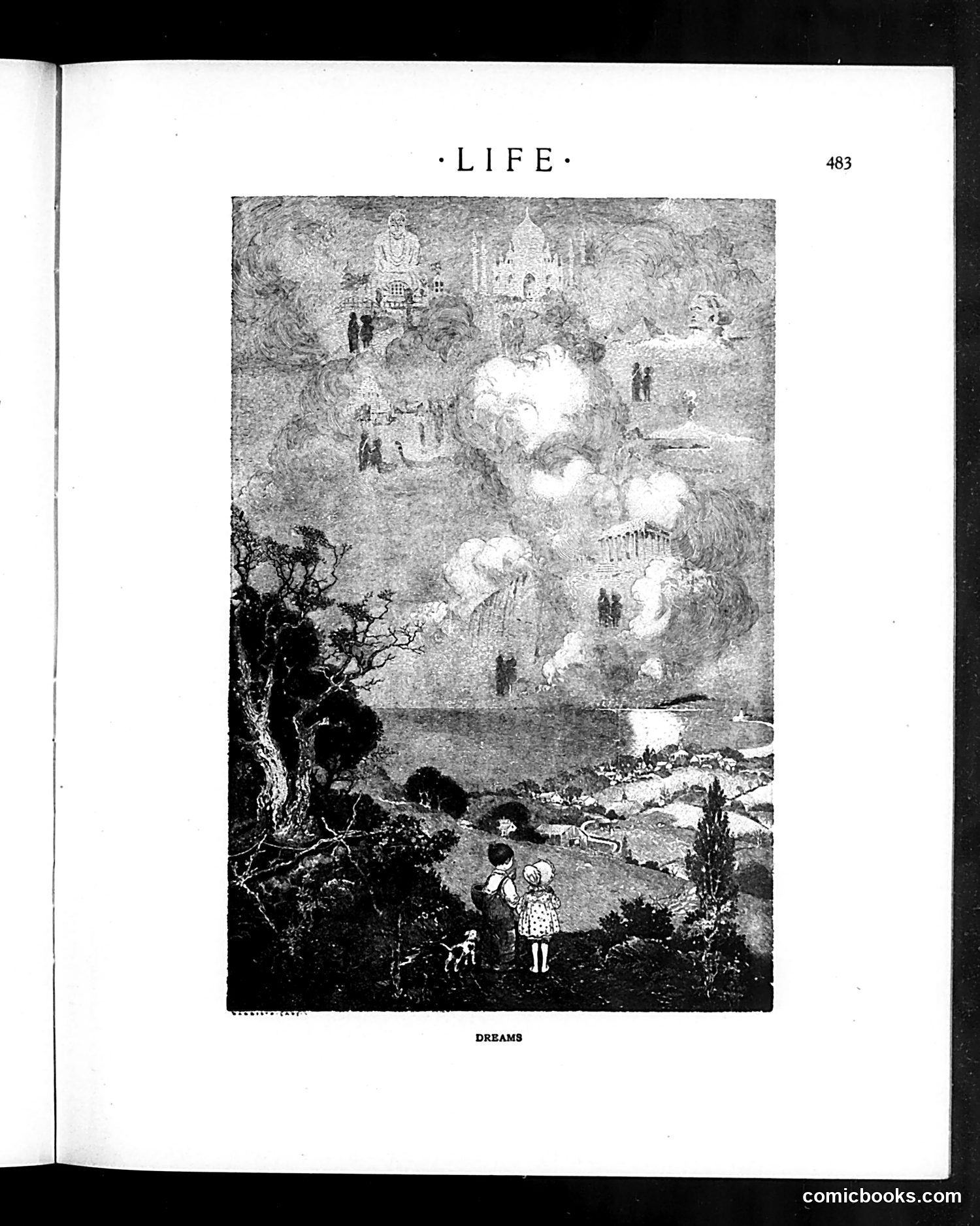
This illustration depicts a dreamy, surreal landscape titled "Dreams." In the foreground, two children stand on a hillside overlooking a fantastical scene. The middle ground shows a body of water with various structures and figures scattered across a dreamlike terrain. Above, clouds billow dramatically, and distant castles or buildings appear in an ethereal haze. Small figures populate the landscape, seemingly engaged in various activities. The artwork uses soft, atmospheric rendering to create a whimsical, imaginative quality—characteristic of early 20th-century children's book illustration or fantasy art. Rather than political satire, this appears to be a contemplative piece exploring childhood imagination and the subjective nature of dreams, allowing viewers to project their own meanings onto the surreal landscape.
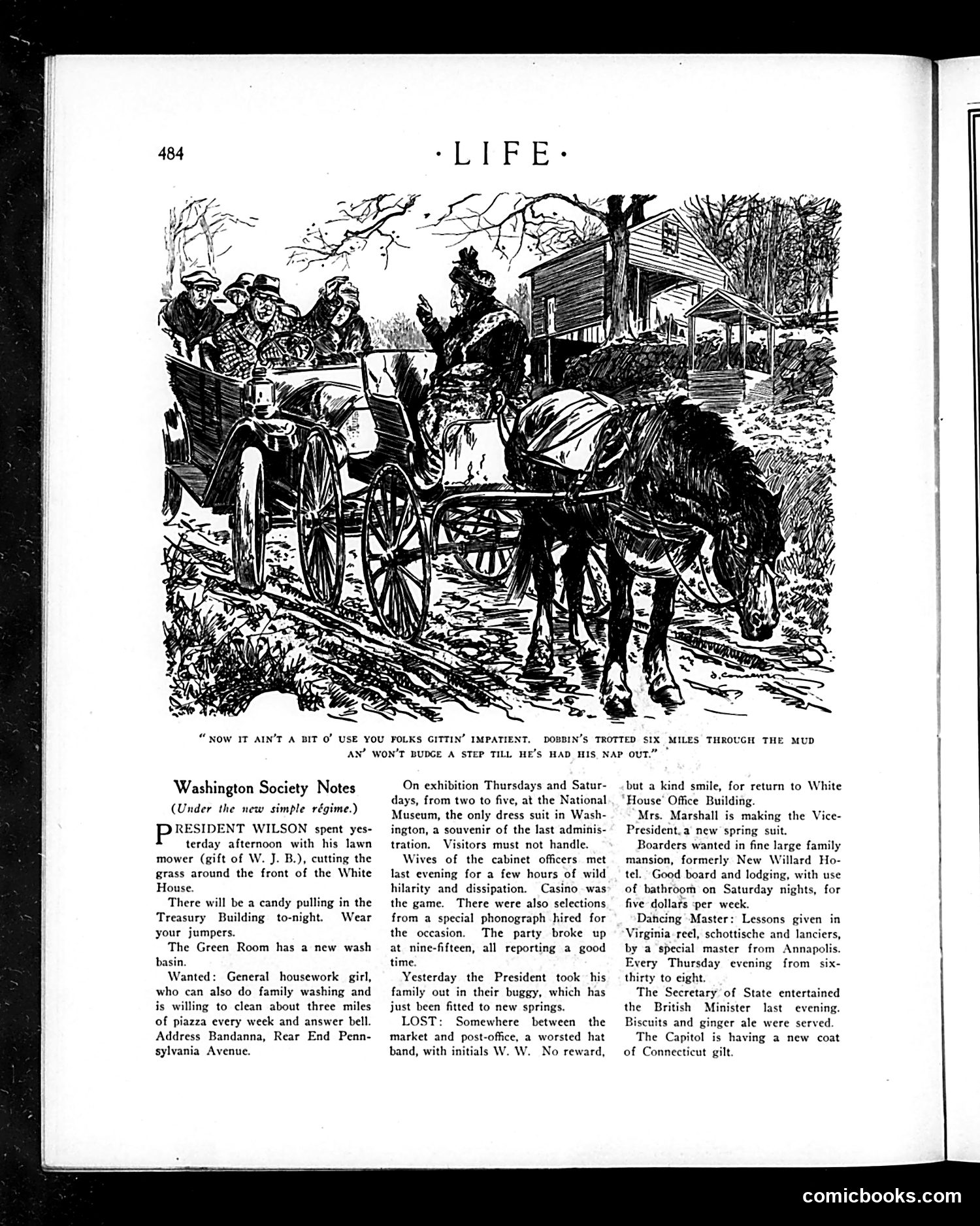
This is satirical commentary on President Wilson's administration (which began in 1913), mocking its self-proclaimed "simple régime" as a contrast to previous luxury and formality. The cartoon depicts an impatient group waiting while a horse-drawn wagon moves slowly—the driver's excuse that the horse needs rest is a metaphor for the administration's sluggish pace despite promises of efficiency. The "Washington Society Notes" mock the White House's new austerity: Wilson personally uses a lawn mower, there's only one dress suit in the entire government (displayed like a museum artifact), and cabinet wives play casino games instead of attending formal balls. The classified ads advertise basic necessities as if the White House were struggling—a job posting for housework, boarders wanted at the Vice President's residence, even a lost worsted hat band. The satire suggests Wilson's "simple living" policies, while perhaps morally sound, have made Washington dull, impoverished, and comically inefficient—turning the seat of power into a shabby boarding house.
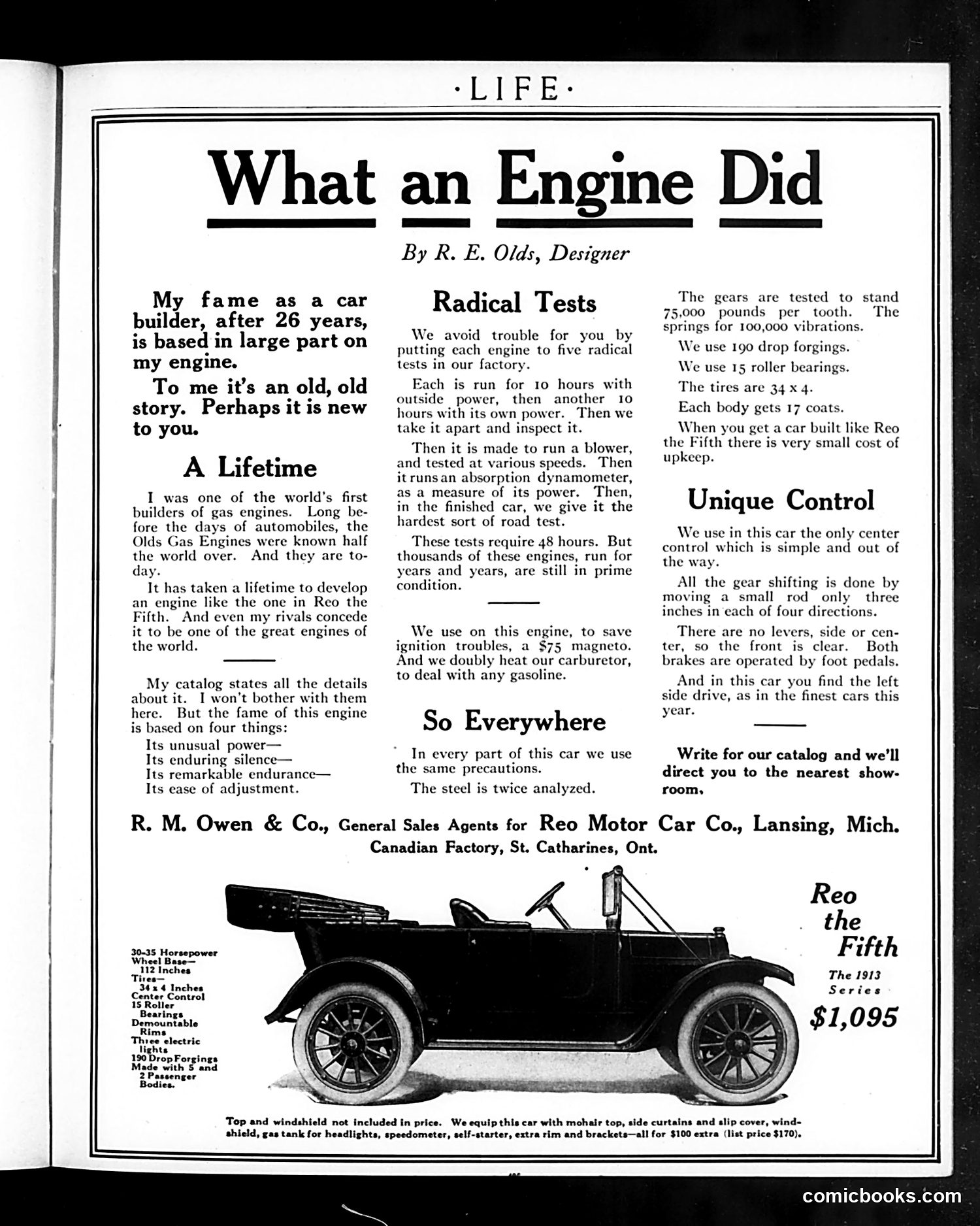
This is **not a cartoon or satire**, but rather a straightforward automobile advertisement disguised as editorial content—a common advertising practice in early 20th-century magazines. **What it is:** R.E. Olds, founder of the Oldsmobile and Reo Motor Car companies, personally testifies to the quality of his engine in the Reo the Fifth automobile (1913 model, priced at $1,095). **The appeal:** Olds leverages his 26-year reputation as a pioneering gas-engine builder to establish credibility. He emphasizes engineering rigor—five radical factory tests, precision components (190 drop forgings, 15 roller bearings), and quality control (steel analyzed twice, 17 paint coats). **For modern readers:** This reflects an era when manufacturers competed on *mechanical innovation* rather than styling or brand cachet. The detailed technical specifications and testimonial format suggest consumers cared deeply about reliability and durability—automobiles were still luxury goods requiring significant maintenance knowledge. The page contains no satire or political commentary; it's purely promotional content.
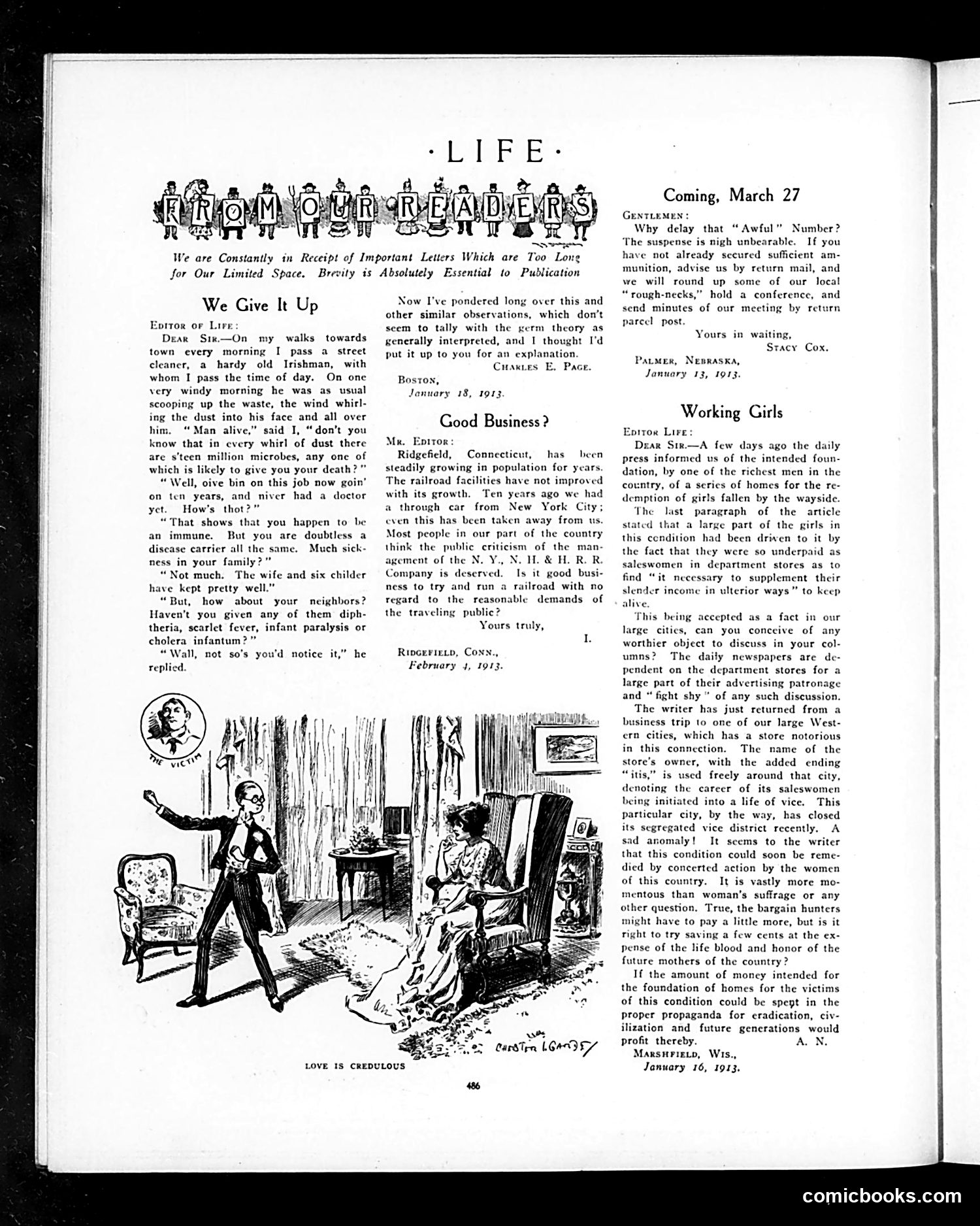
This page features reader letters and one cartoon addressing social concerns of the era. **The cartoon "Love is Credulous"** (bottom) depicts a man gesturing dramatically while a woman sits passively—likely satirizing romantic naïveté or how easily women are deceived by male charm or promises. **The letters discuss:** 1. **Germ theory skepticism**: A reader questions whether microbes actually cause disease, citing a healthy Irish street cleaner's immunity despite exposure. 2. **Railroad service complaints**: A Connecticut resident criticizes the New York, New Haven & Hartford Railroad for removing service despite population growth. 3. **Working girls' exploitation**: A correspondent advocates discussing low department-store wages that force saleswomen into sex work to survive. He notes newspapers won't cover this because stores fund their advertising. One Western city, he observes, recently closed its vice district while these exploitative conditions persist—a "sad anomaly." The "Working Girls" letter represents Progressive Era concerns about labor exploitation and the sex trade, criticizing both inadequate wages and media complicity in ignoring the problem.
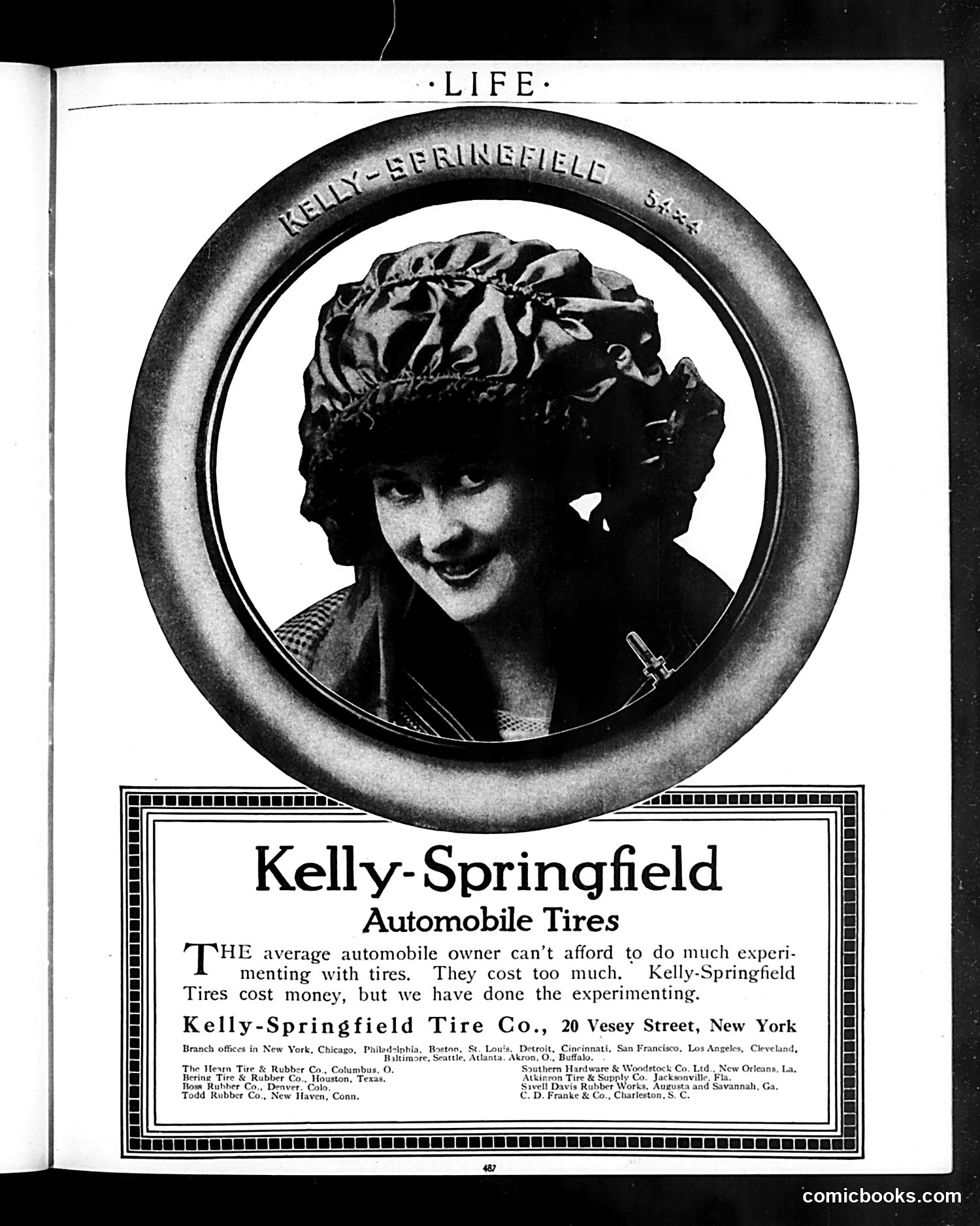
This is a **straightforward advertisement**, not satire or political commentary. It features a portrait of a woman framed within a tire, promoting Kelly-Springfield Automobile Tires. The ad's appeal is simple: the company claims that while tires are expensive and the average car owner can't afford to experiment with brands, Kelly-Springfield has "done the experimenting" for consumers—implying their product is reliable and worth the cost. The circular tire frame functions as both a product display and an elegant portrait treatment, a common advertising design technique of the era. The woman's identity is unclear; she may be a model, actress, or simply representative of the aspirational consumer. This appears to be from an early automotive advertising period when tire quality and brand differentiation were selling points for middle-class car owners.
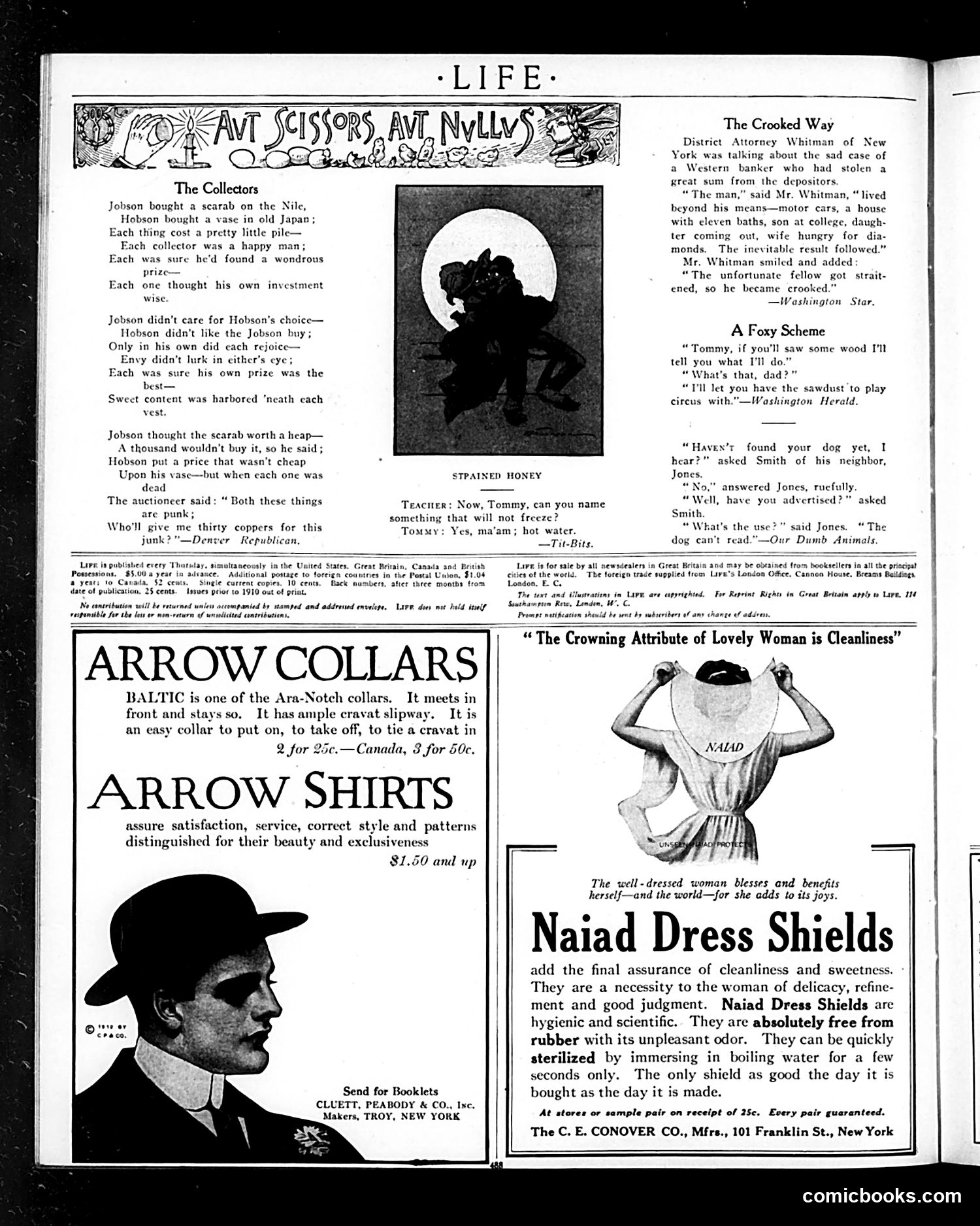
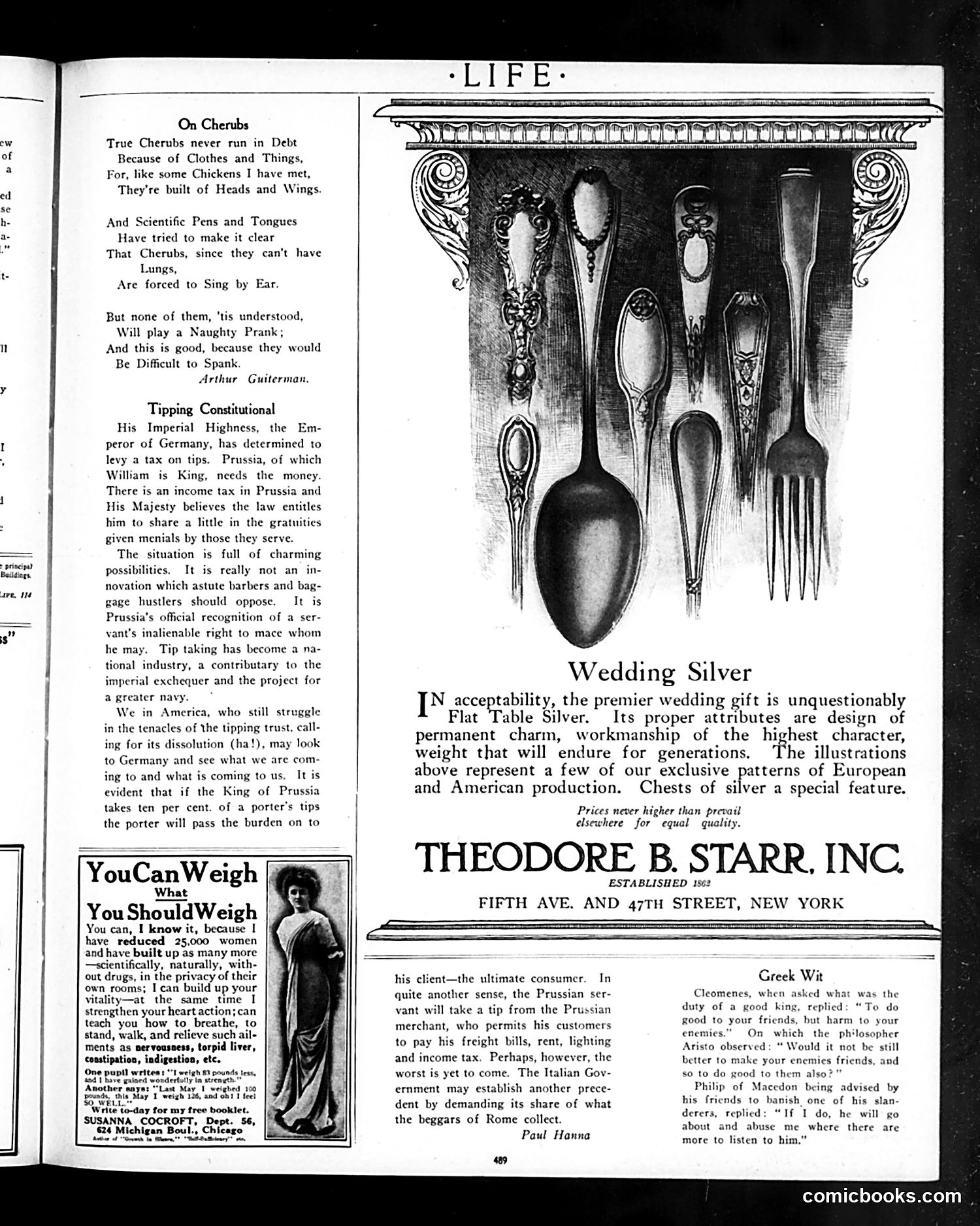
This Life magazine page (circa 1910s) contains three distinct pieces of satire: **"On Cherubs"** — A light humorous poem by Arthur Guiterman playing with the logical absurdity of cherubs: wingless beings can't sing with lungs, so they "sing by ear"; they can't be spanked because they lack bodies. Pure whimsy. **"Tipping Constitutional"** — Sharp political satire targeting German Emperor William II's newly proposed tax on tips. The article mocks Prussia's financial desperation (needing money for naval expansion) by suggesting the government would tax gratuities. The satire points out the absurd cascade: if the king taxes porters' tips, porters will pass costs to customers, creating an endless chain. It compares America's unregulated tipping culture unfavorably to Germany's "official recognition." The wit: mocking both German bureaucratic overreach and American capitulation to tipping. **"Wedding Silver"** advertisement and **"Greek Wit"** anecdote — These are commercial/cultural content rather than satire, promoting Theodore B. Starr's silver products while offering classical wisdom about kingship and clemency. The page's dominant satire concerns imperial taxation and consumer economics.
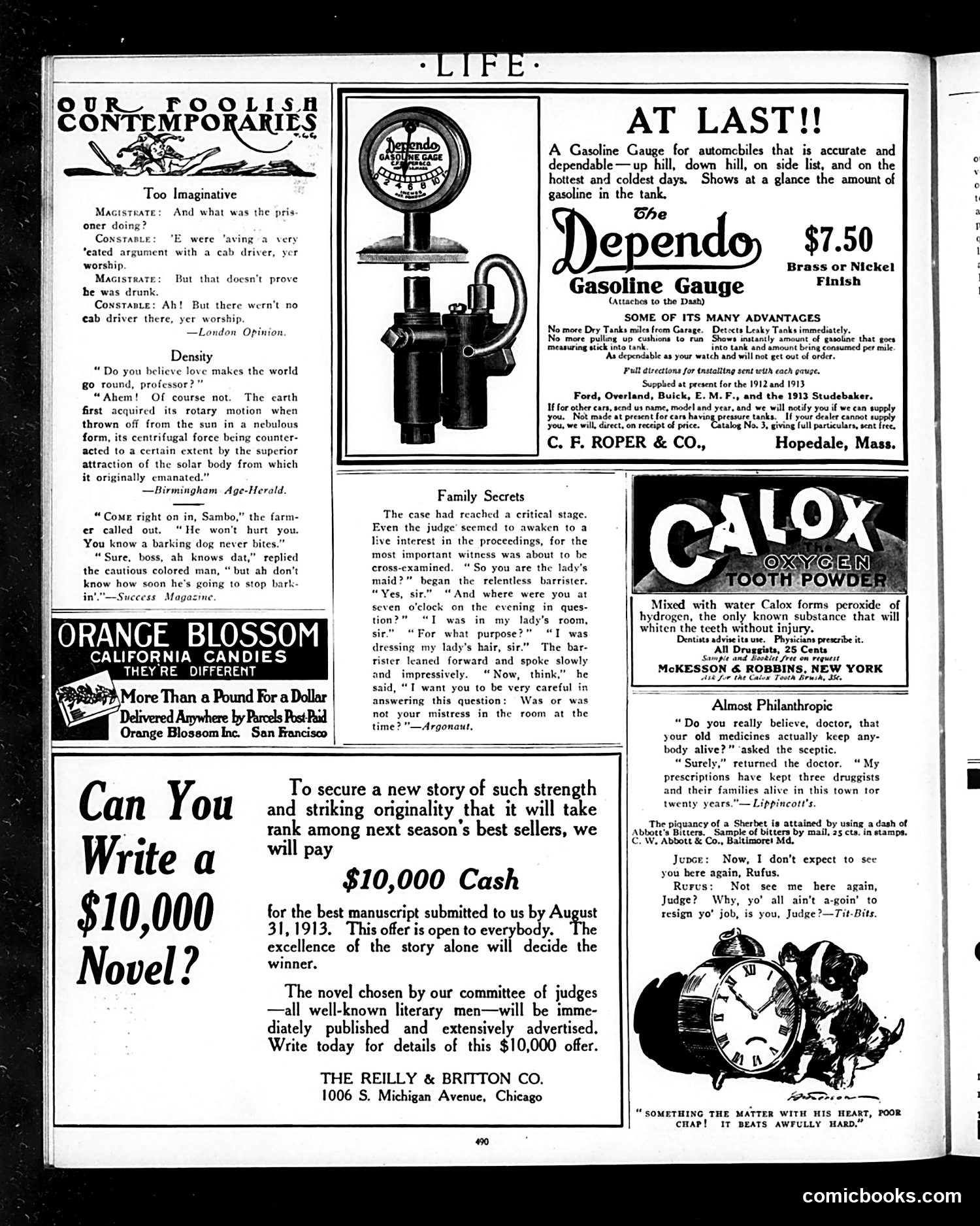
This page is primarily **advertising and humor content**, not political satire. The main elements include: **Advertisements:** - A **Dependo Gasoline Gauge** ($7.50) for early automobiles—a practical innovation for cars that lacked reliable fuel measurement - Orange Blossom candies and Calox tooth powder **Humor Sections:** - "Our Foolish Contemporaries": Short satirical vignettes mocking human behavior (a drunk man arguing with an invisible cab driver; a professor misunderstanding basic physics) - "Family Secrets": A courtroom comedy where a maid describes dressing her employer's hair, with a barrister's suggestive questioning implying impropriety - A $10,000 novel-writing contest advertisement **The jokes** reflect early 20th-century concerns: drunkenness, gender propriety, and pseudointellectual pomposity. The "Family Secrets" piece plays on Victorian anxieties about servants and their employers' private lives. This is representative **general-interest humor and commerce**, not political commentary.
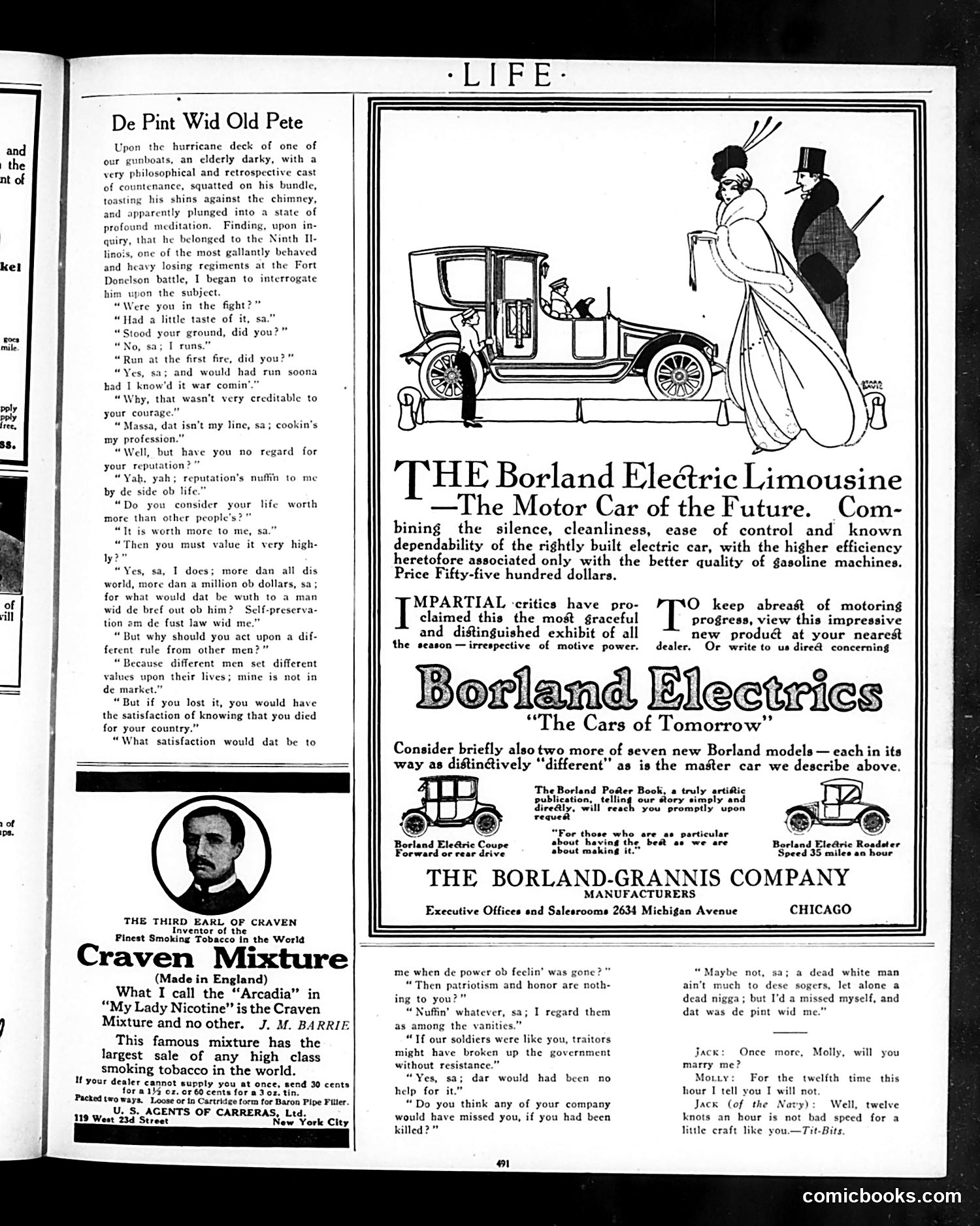
This dialogue-based sketch satirizes both Civil War soldiers and contemporary racial attitudes. An elderly Black cook from the Ninth Illinois Regiment (a real Union unit at Fort Donelson) admits to running during combat, then philosophizes that life matters more than reputation or patriotic duty. The satire cuts two ways: it mocks the soldier's cowardice and self-preservation instinct, but more pointedly ridicules white officers' expectations that Black soldiers should die for country and honor—concepts the sketch implies are meaningless luxuries. The soldier's final point—"dat was de pint wid me"—suggests Black men have no stake in defending a nation that enslaves them. The dialect and caricature are period-typical offensive stereotyping, yet the underlying argument about rational self-interest versus patriotic sacrifice carries genuine social critique about Black participation in a war ostensibly fought for their freedom.
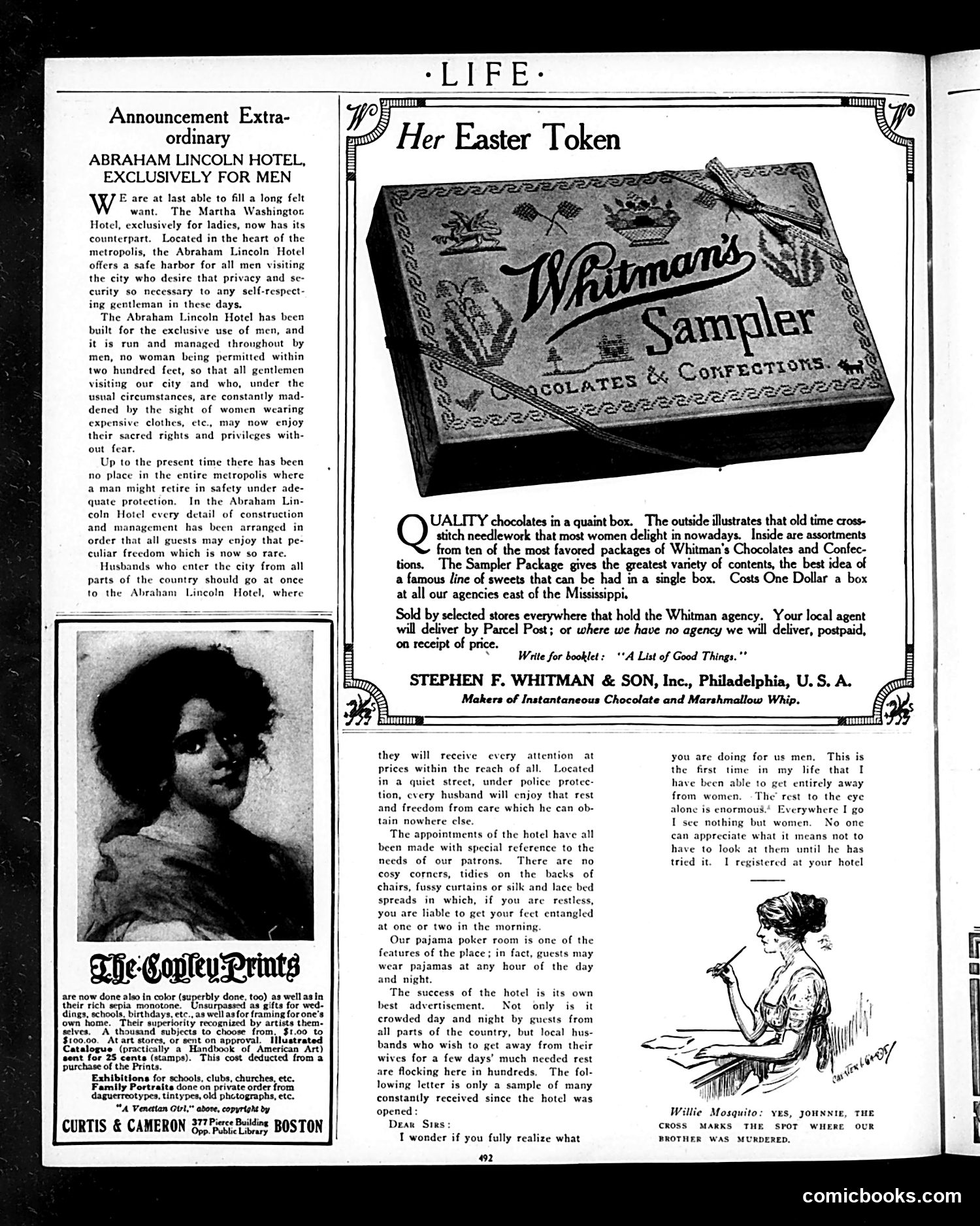
This page satirizes **gender segregation anxieties and misogyny** of the early 20th century. The advertisement announces a hotel "exclusively for men"—a direct parody of the real Martha Washington Hotel for women that existed at the time. The satire mocks men who feel threatened by women's visibility and independence. The hotel promises refuge from "the sight of women wearing expensive clothes," claiming men need "sacred rights and privileges" protected from female presence. It advertises absurd amenities like a "pajama poker room" and boasts of being "run and managed throughout by men, no woman being permitted within two hundred feet." Life magazine—a satirical publication—presents this as social commentary on masculine insecurity during a period of expanding women's rights and public participation. The exaggerated language about "freedom from care" and "rest" mocks men who viewed women's presence in public spaces as an unbearable burden. The accompanying Whitman's Sampler advertisement offering an "Easter Token" provides ironic contrast—women were active consumers and gift-givers, contradicting the hotel's premise that they were unwelcome intrusions.
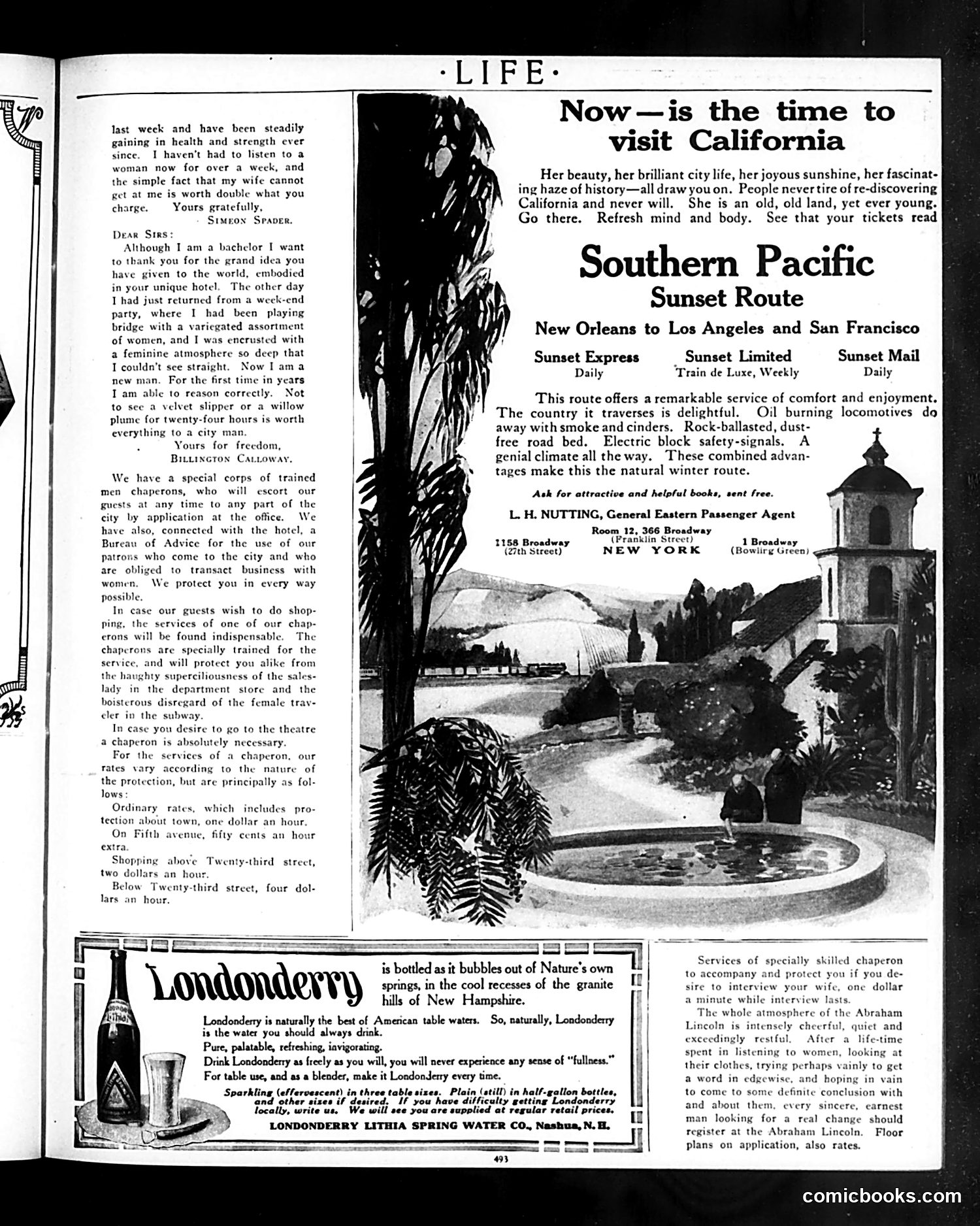
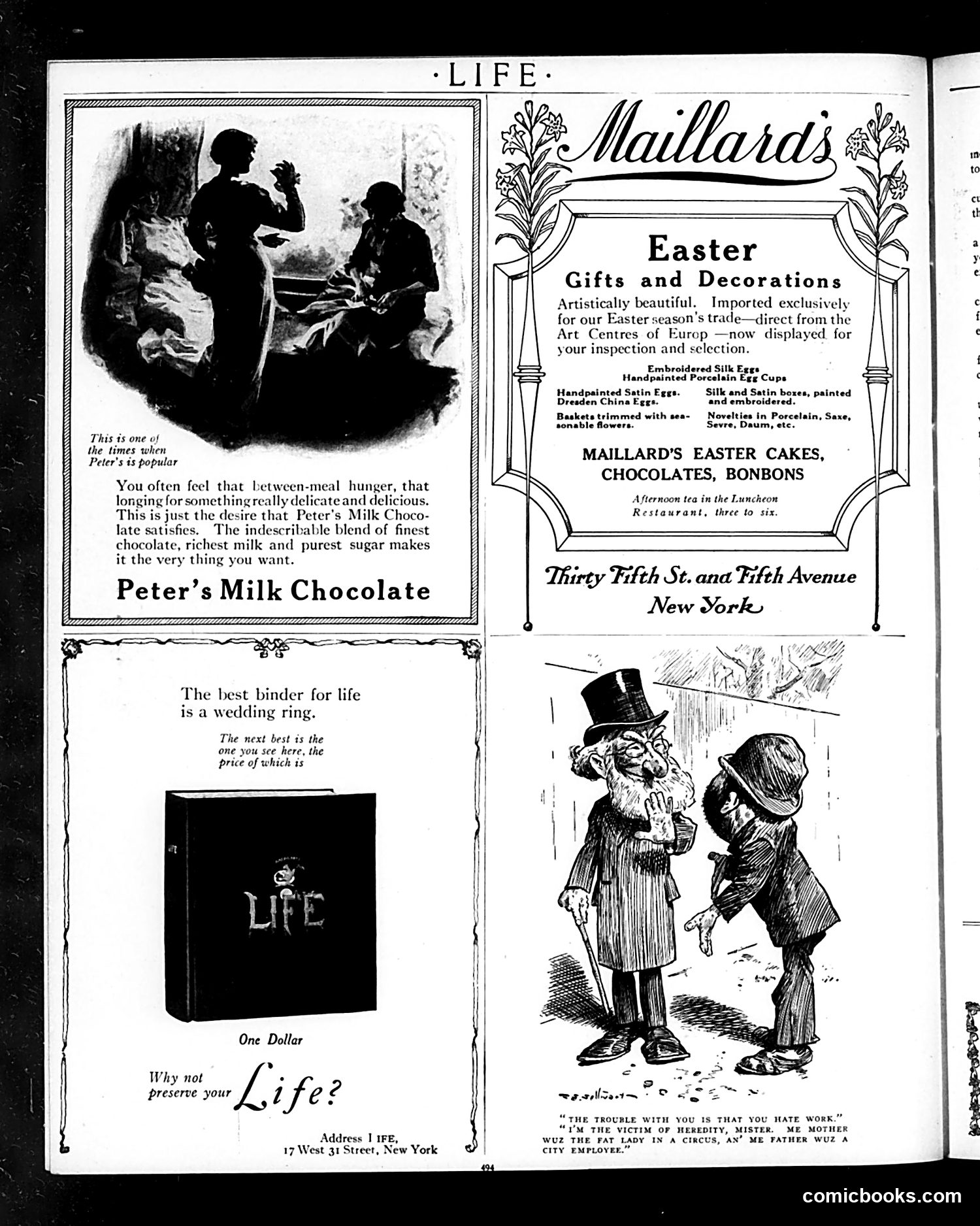
This page mixes **advertisements with a single cartoon joke** at the bottom. The cartoon depicts two men in conversation. One accuses the other of hating work; the accused replies by blaming his laziness on heredity—his mother was a circus performer (the "fat lady"), and his father was a "city employee" (implying laziness or inefficiency in government work). The joke satirizes **both hereditary determinism and stereotypes about municipal workers**. In the early 20th century, city employees were often portrayed as unmotivated bureaucrats, while circus performers represented moral or social degradation. The humor relies on the character's absurd logic: he's essentially saying his genetic inheritance from these "disreputable" professions dooms him to idleness—a exaggerated excuse-making that mocks both fatalism and anti-government sentiment common in that era. The rest of the page contains period advertisements for Peter's Milk Chocolate, Life magazine's binding service, and Maillard's Easter goods.
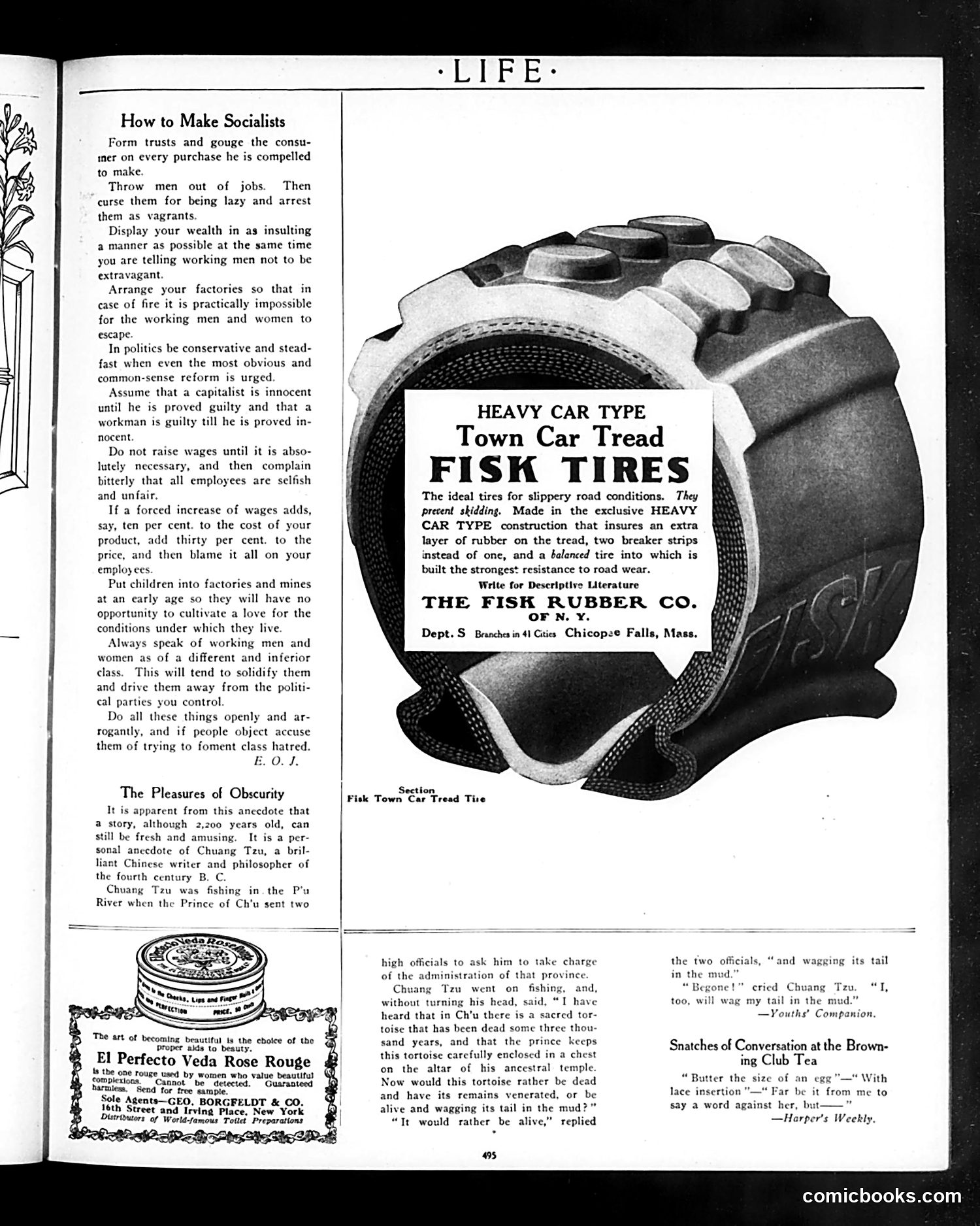
The left column features "How to Make Socialists," a biting critique of capitalist abuses attributed to E.O.J. (likely Eugene O'Neill or similar). The piece sarcastically lists methods to radicalize workers: forming monopolies, creating unemployment, flaunting wealth while condemning worker extravagance, building unsafe factories, opposing reforms, and speaking of laborers as inferior. The satire's point: capitalists themselves create socialism through exploitation and hypocrisy. This reflects early 20th-century American anxieties about labor unrest and rising socialist movements. Rather than defending capitalism, the author suggests capitalists are foolishly generating their own opposition through obvious injustices. The right side contains a tire advertisement—standard magazine filler—unrelated to the political commentary.
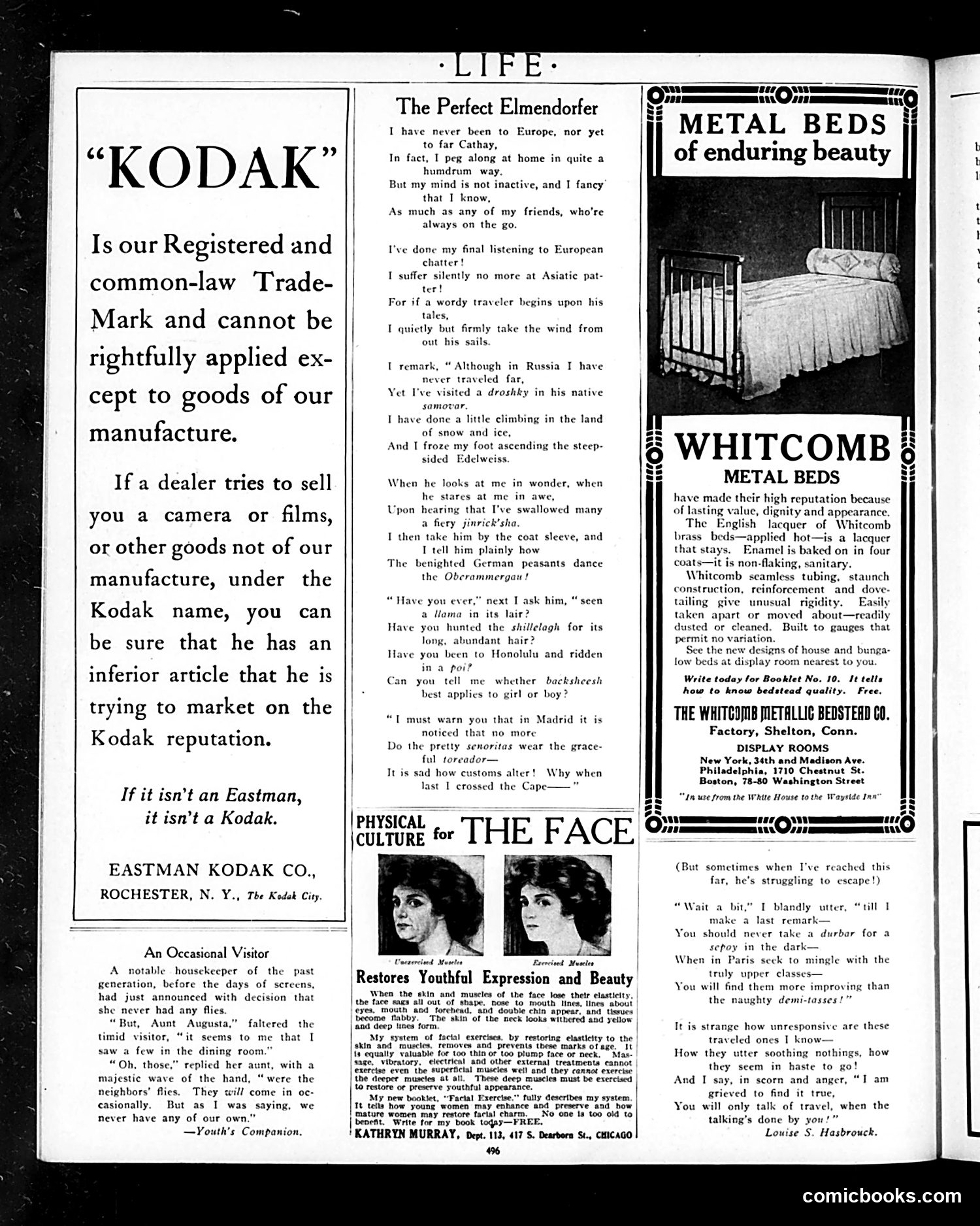
This page is primarily **advertisements and light humor pieces**, not political satire. The **Kodak ad** warns consumers against counterfeit cameras sold under the Kodak name—a trademark protection notice. The slogan "If it isn't an Eastman, it isn't a Kodak" emphasizes brand authenticity. "**An Occasional Visitor**" is a humorous anecdote about a woman who claims never to have flies, dismissing observed ones as belonging to neighbors—a joke about denial and social pretense. "**The Perfect Elmendorfer**" satirizes travel bores—people who monopolize conversations with exaggerated travel stories. The protagonist counters by inventing increasingly absurd fake travels (visiting a droshky "in its native samovar," riding "in a poi"), exposing how ridiculous such one-upmanship becomes. It's gentle social satire about conversational competitiveness. The remaining content consists of advertisements for metal beds and facial exercise treatments—typical early 20th-century magazine filler.
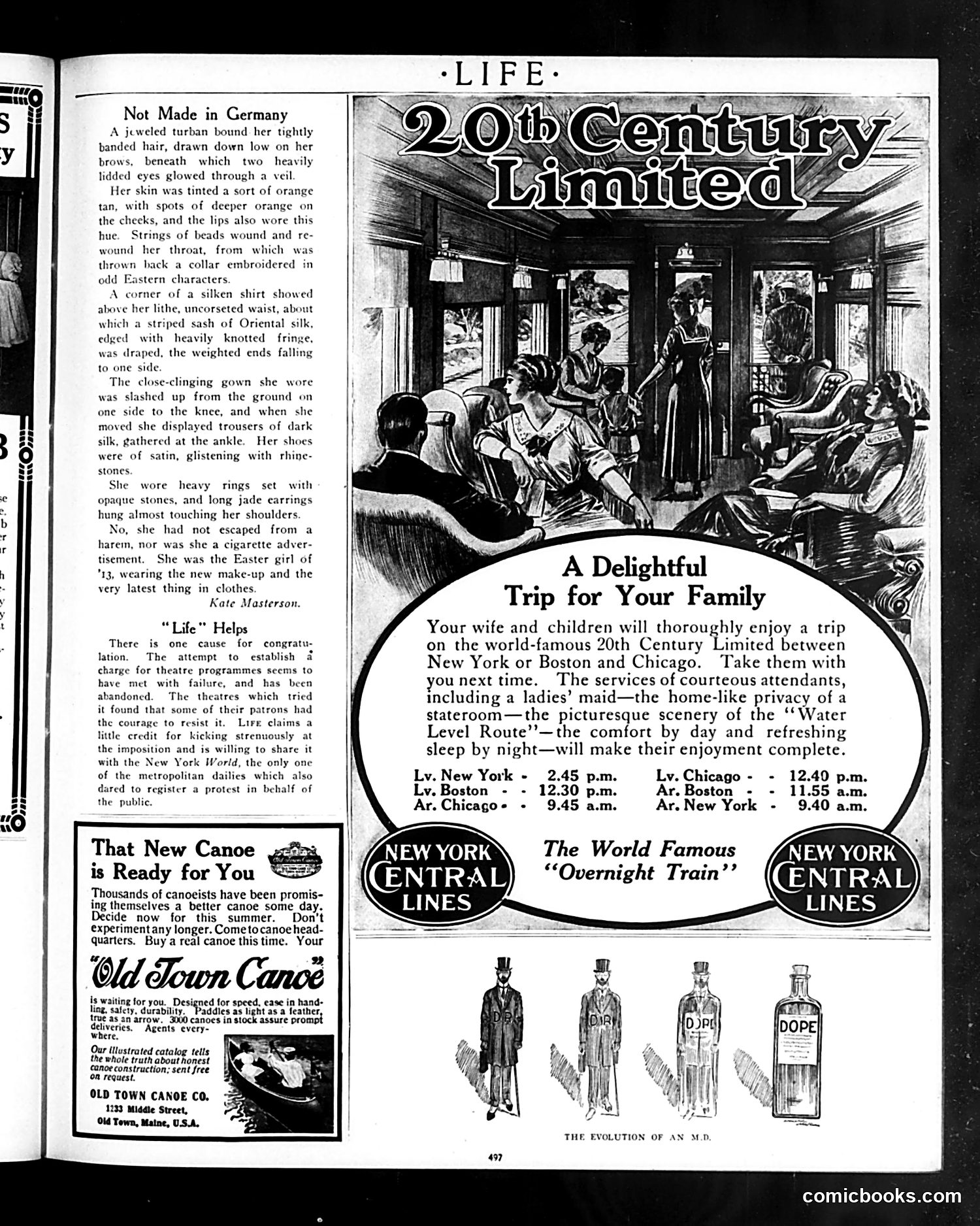
This page is primarily **advertising**, not political satire. The left column contains a fashion commentary titled "Not Made in Germany" mocking 1913 Easter fashions—specifically an exotic "Oriental" look with turbans, veils, heavy makeup, beads, and silk garments. The joke is that despite this elaborate, foreign appearance, the wearer is simply a fashionable American woman in the latest styles, not an actual harem resident or cigarette advertisement (a common advertising trope). The remaining content is commercial: ads for Old Town Canoes and the 20th Century Limited train service, plus a brief note celebrating Life's successful campaign against charging for theater programs. The bottom features "The Evolution of an M.D."—four bottles showing a doctor's progression, likely satirizing medical practice or pharmaceutical dependence, though details are unclear.
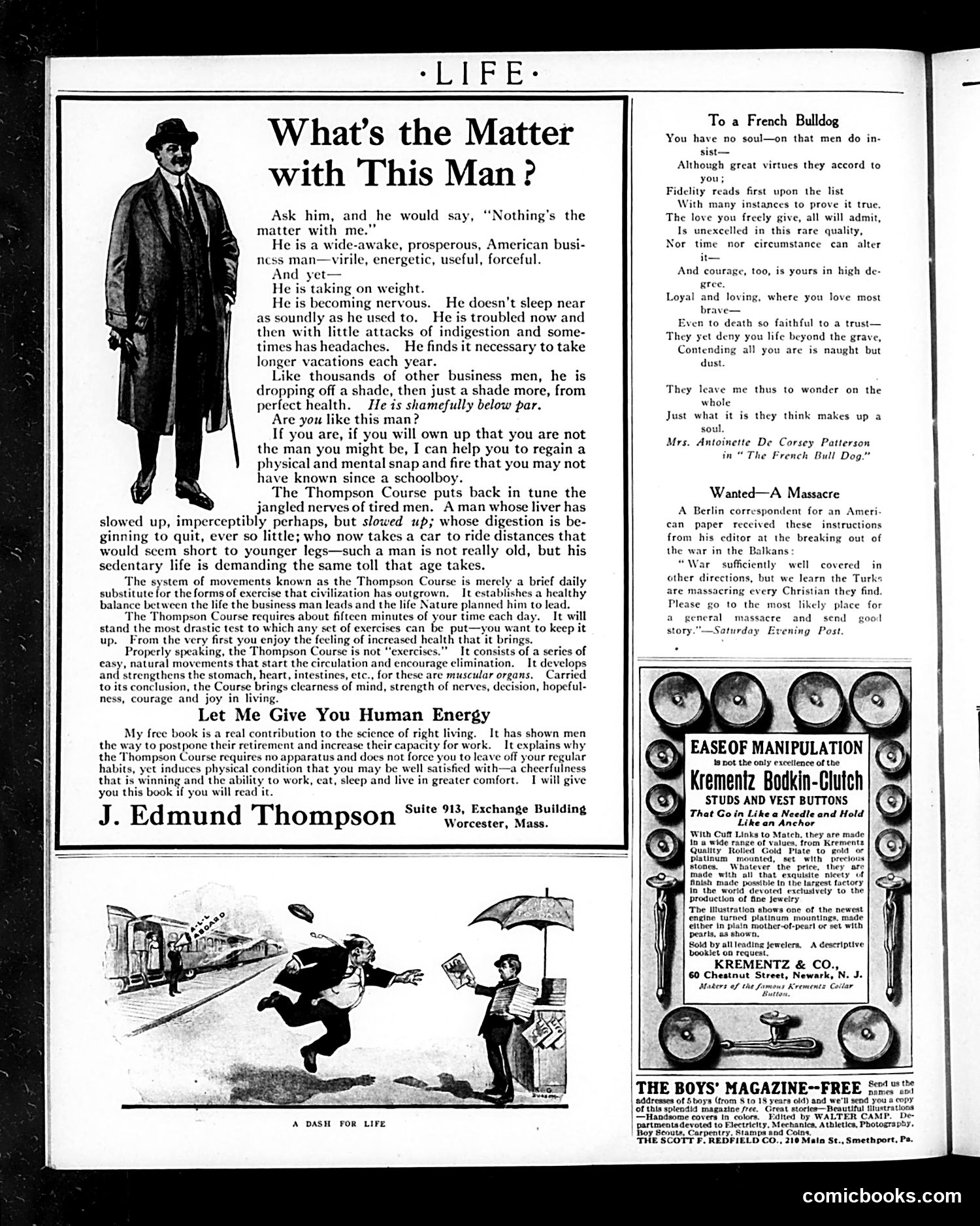
This page contains three distinct pieces: **Main Article: "What's the Matter with This Man?"** is an advertisement for the "Thompson Course," a self-help fitness program. It targets affluent businessmen experiencing symptoms of sedentary decline—weight gain, nervousness, poor sleep, indigestion—which the course claims to reverse through simple daily exercises. The accompanying cartoon ("A Dash for Life") humorously illustrates urban stress: a businessman frantically dodging traffic, suggesting the frantic modern lifestyle creates health problems the Thompson Course supposedly solves. **Right Column Poem:** A sentimental verse about a French Bulldog's faithfulness and devotion, questioning whether animals possess souls—typical of early 20th-century sentimentality about pets. **"Wanted—A Massacre":** A satirical editorial comment suggesting a newspaper editor, frustrated that war coverage from the Balkans isn't dramatic enough, demands more sensational "massacre" stories—mocking journalistic sensationalism and callous attitudes toward human suffering during the Balkan Wars. The page reflects early-1900s anxieties about modern civilization's toll on men's health, alongside period attitudes about journalism and animals.
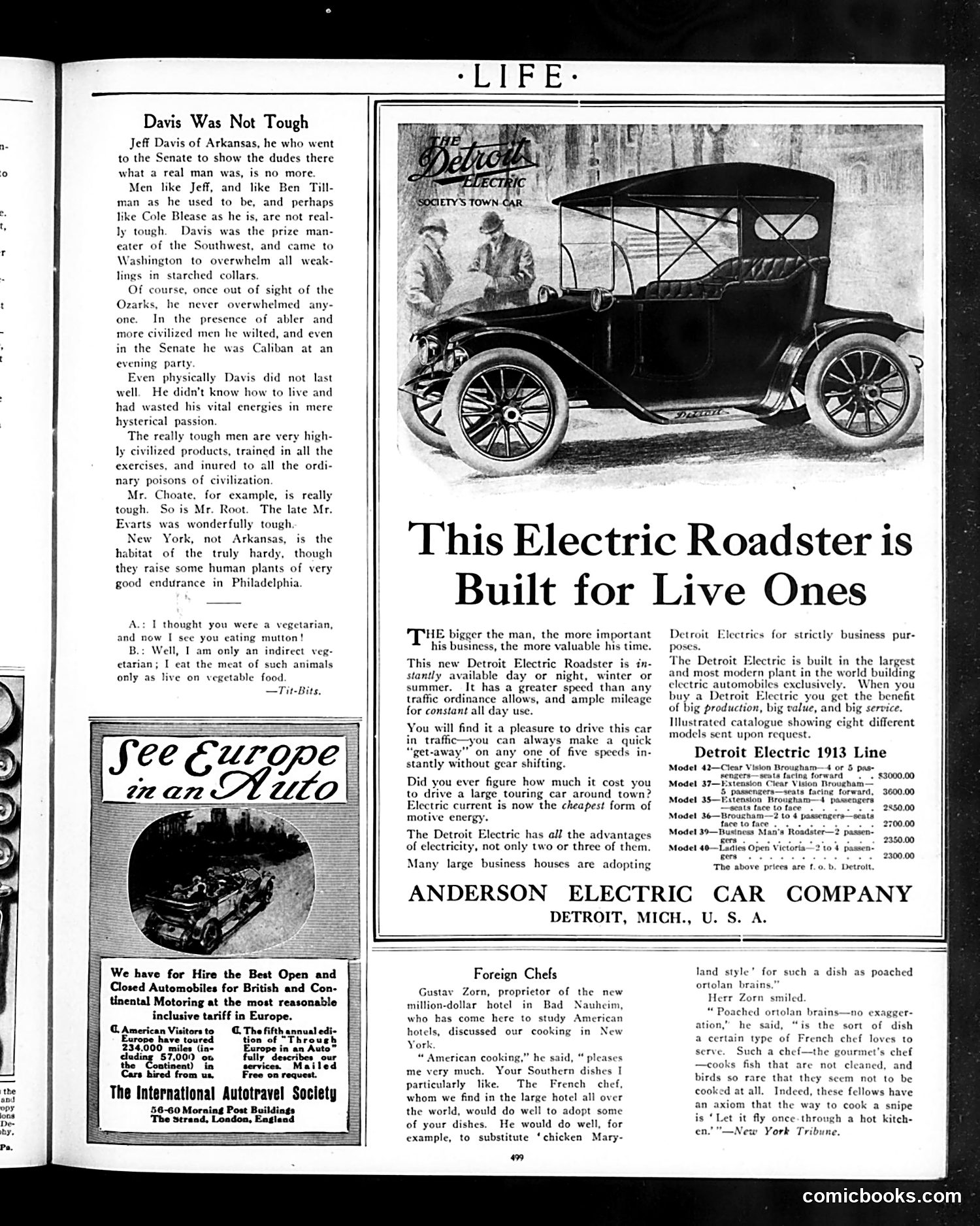
This satirical essay mocks Senator Jeff Davis of Arkansas, who cultivated a public image as a rough, masculine "man of the people" from the Ozarks. The piece argues Davis was actually a **fraud**—that he appeared tough only in his provincial home region, but "wilted" when surrounded by educated, civilized men in Washington. The satire's point: **true toughness comes from civilization and refinement, not frontier bluster.** Life contrasts Davis unfavorably with sophisticated New York figures like Joseph Choate and Elihu Root, suggesting that real strength requires intellectual training and self-control, not "hysterical passion." This reflects Progressive-era anxieties about authenticity in politics. Davis represented the old populist/agrarian politician type that educated elites were increasingly skeptical of. By claiming Davis's toughness was performative—a character he dropped in "civilized" company—the author dismisses both Davis and the constituents who believed in him. The remaining page content (auto ads, hotel anecdotes) is unrelated advertising.
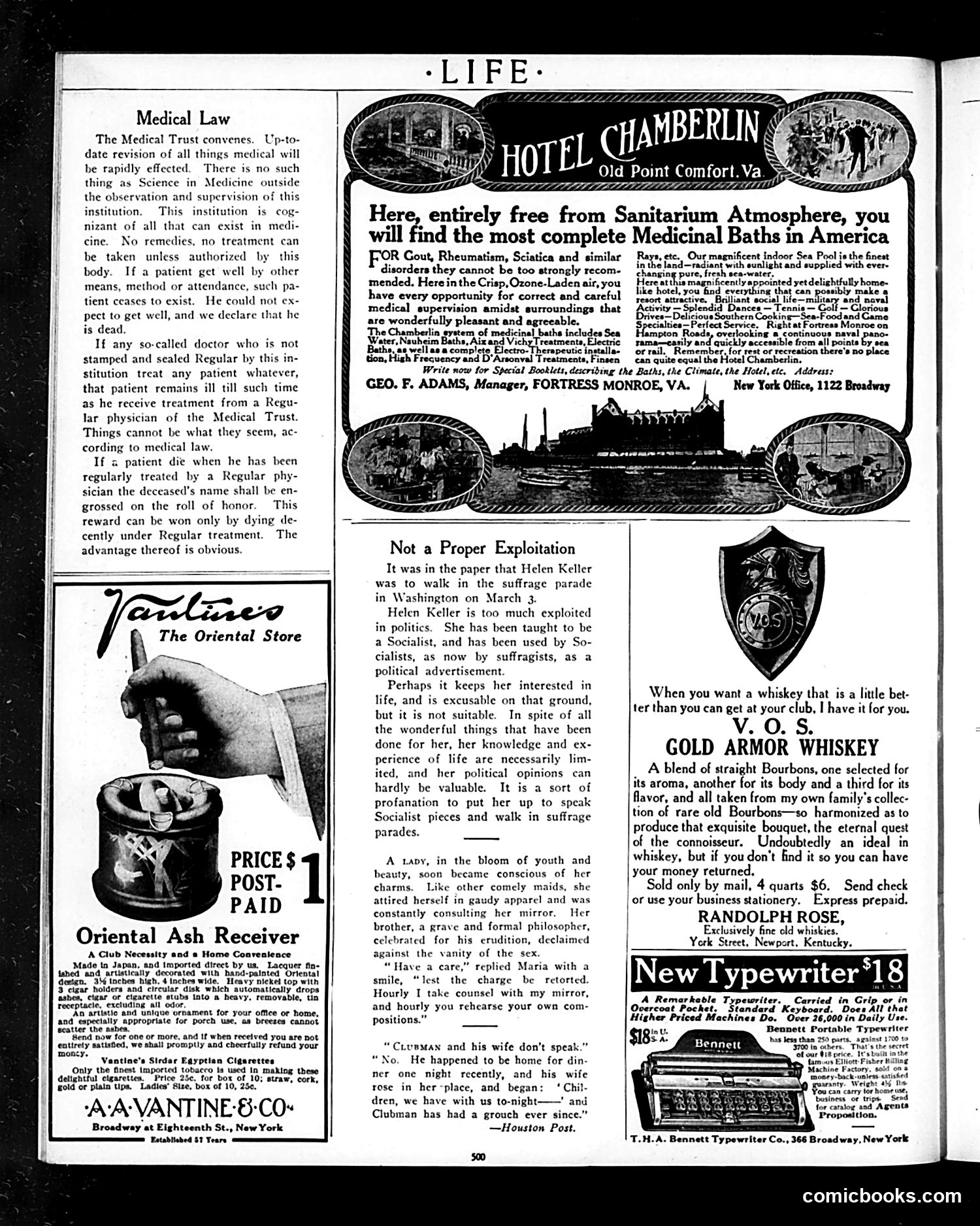
This page satirizes medical monopolies and exploitative politics while featuring period advertisements. **"Medical Law" Section (left):** A biting satire of the American Medical Association's gatekeeping power. The text mockingly presents the medical establishment as an absolute authority that claims only "Regular" physicians can treat patients successfully—implying those outside their system cannot actually heal people. This attacks organized medicine's monopolistic control and dismisses alternative practitioners as fraudulent, reflecting early-20th-century tensions between established medicine and competing healing systems. **"Not a Proper Exploitation" (right):** Criticizes Helen Keller's involvement in the women's suffrage movement. The piece argues she's being inappropriately used as a political tool by suffragists (and previously socialists), suggesting her celebrity status as a deaf-blind author is being exploited for causes rather than pursued authentically. It frames her activism as unsuitable manipulation rather than genuine commitment. **Advertisements:** Include luxury goods (Oriental ash receivers, whiskey, typewriters), reflecting Life's affluent readership.
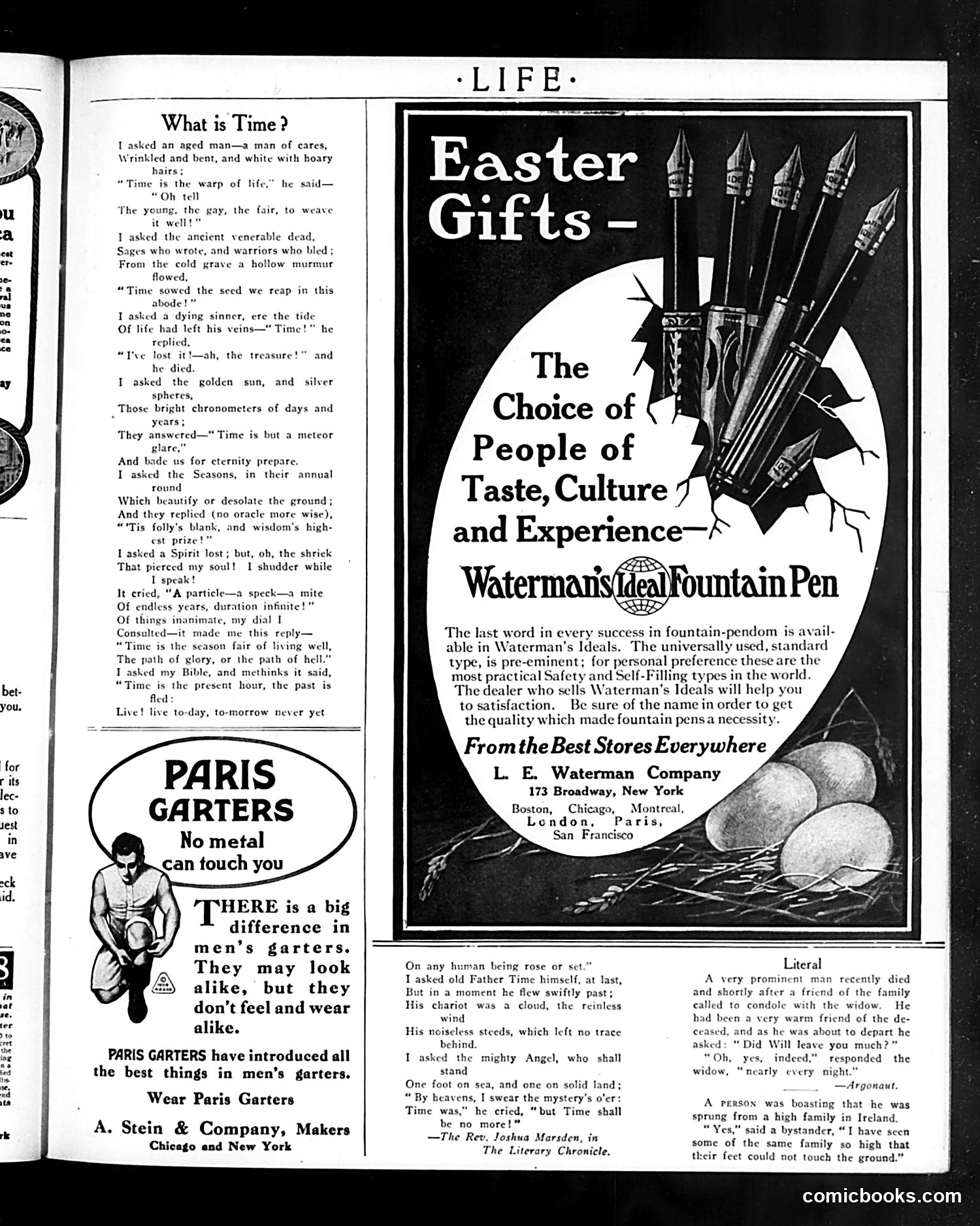
This page is primarily **advertising and light humor** rather than political satire. It contains: **Main Content:** - A lengthy philosophical poem titled "What is Time?" asking various figures (an old man, sages, a dying sinner, celestial bodies, seasons, a lost spirit, and an angel) to define time. It's sentimental verse about mortality and the value of living well—typical of early 20th-century magazine filler. **Advertisements:** - **Paris Garters** (men's garters/sock supporters): The ad's humor is mild—"no metal can touch you"—playing on comfort. A man is shown adjusting his clothing. - **Waterman's Ideal Fountain Pens**: Positioned as gifts for people of "taste, culture and experience." **Humor Sections:** - Two brief jokes: one about a widow's inheritance (she receives nightly visits, a euphemism), and another mocking Irish poverty through height metaphor. **Summary:** This is a typical early 1900s magazine page mixing sentimental poetry, consumer goods advertising, and gentle humor—not political commentary.
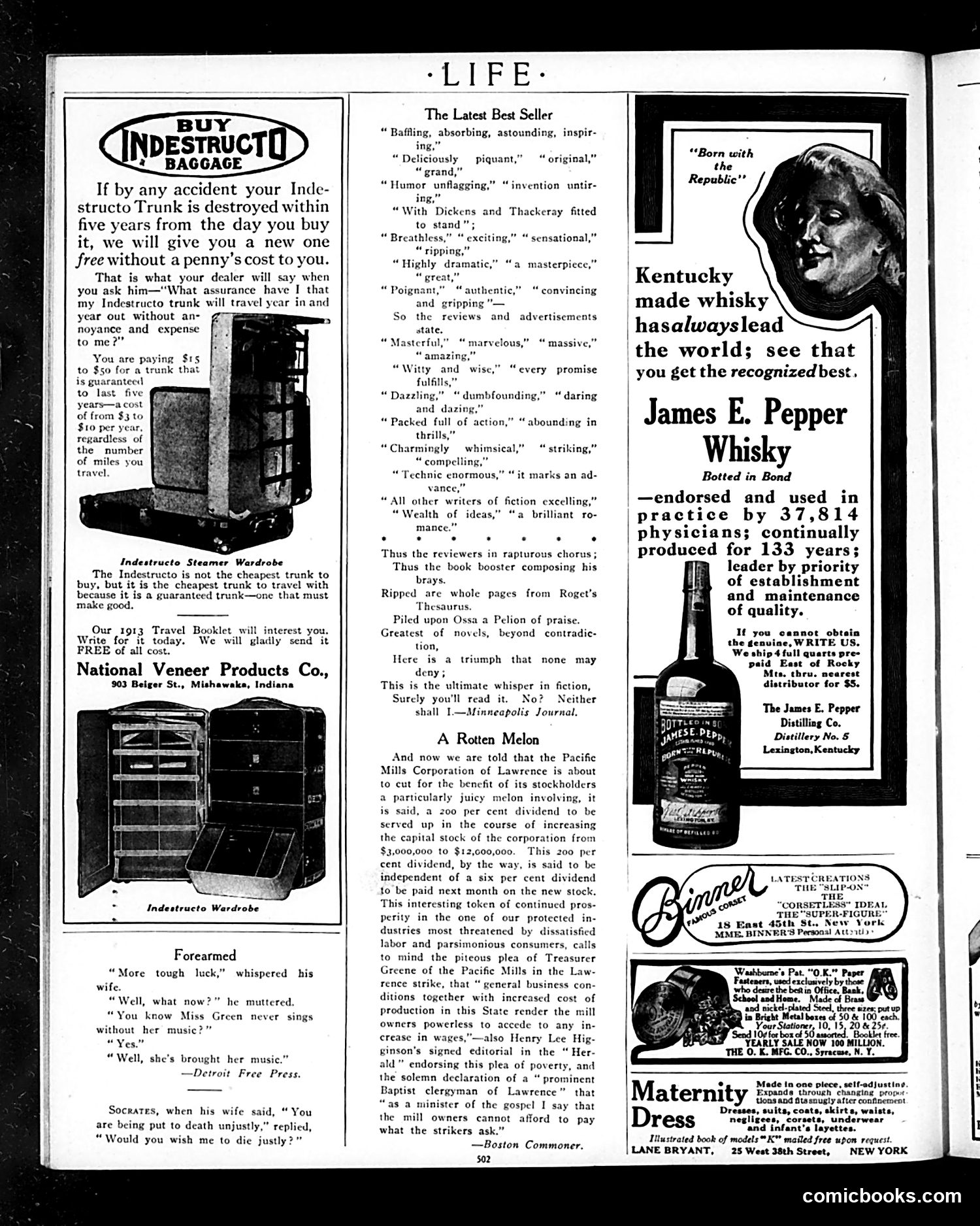
This Life magazine page is primarily **advertising and light satire**, not political commentary. The main items are: 1. **Indestructo Luggage ad** (left): A straightforward product advertisement guaranteeing trunks for five years, emphasizing durability as economy. 2. **"The Latest Best Seller"** (center): A satirical poem mocking overwrought book reviews. It attacks reviewers for stealing superlatives from Roget's Thesaurus, piling praise absurdly high ("Pelion upon Ossa"), and recommending books they haven't read. The Minneapolis Journal concludes: "Surely you'll read it. No? Neither shall I." 3. **"A Rotten Melon"** (center-right): This *is* political satire, criticizing Pacific Mills Corporation for declaring a 200% dividend while claiming poverty during the Lawrence textile strike. It mocks management's claim they "cannot afford" wage increases, contrasting their profits with their union excuses. 4. **James E. Pepper Whiskey ad** (right): A product advertisement. The page exemplifies Life's mix of consumer advertising with gentle social critique.
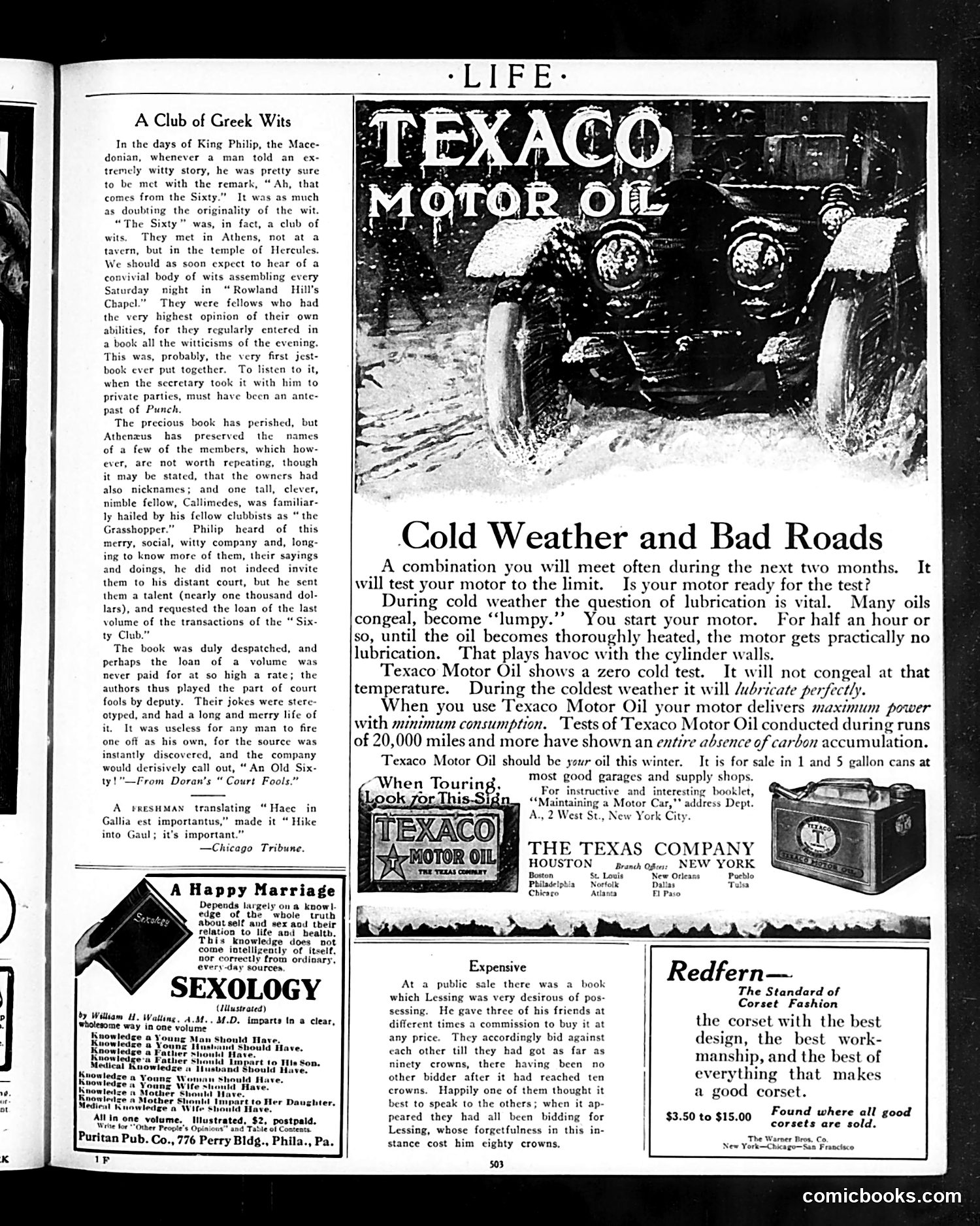
This page is primarily **advertisements and light entertainment content** rather than political satire. The main elements are: **"A Club of Greek Wits"** — A humorous historical anecdote about ancient Athens. King Philip II heard of a witty social club ("The Sixty") who recorded their jokes in a book. Philip sent them money requesting the loan of their latest volume. The joke: courtiers essentially paid premium rates to borrow someone else's jokes, making the wits temporary "court fools." The reference to "An Old Sixty!" mocks anyone trying to pass off their recycled humor. **Advertisements** dominate the page: - **Texaco Motor Oil** (large ad) sells cold-weather protection using technical claims about lubrication during winter driving - **Redfern corset** ads promote quality undergarments - **Sexology** book advertises marriage/sexual knowledge guidance **Small comic items** include a Latin translation joke and a marriage advice section—typical Life magazine filler humor from this era (appears early 20th century based on typography and vehicle imagery).
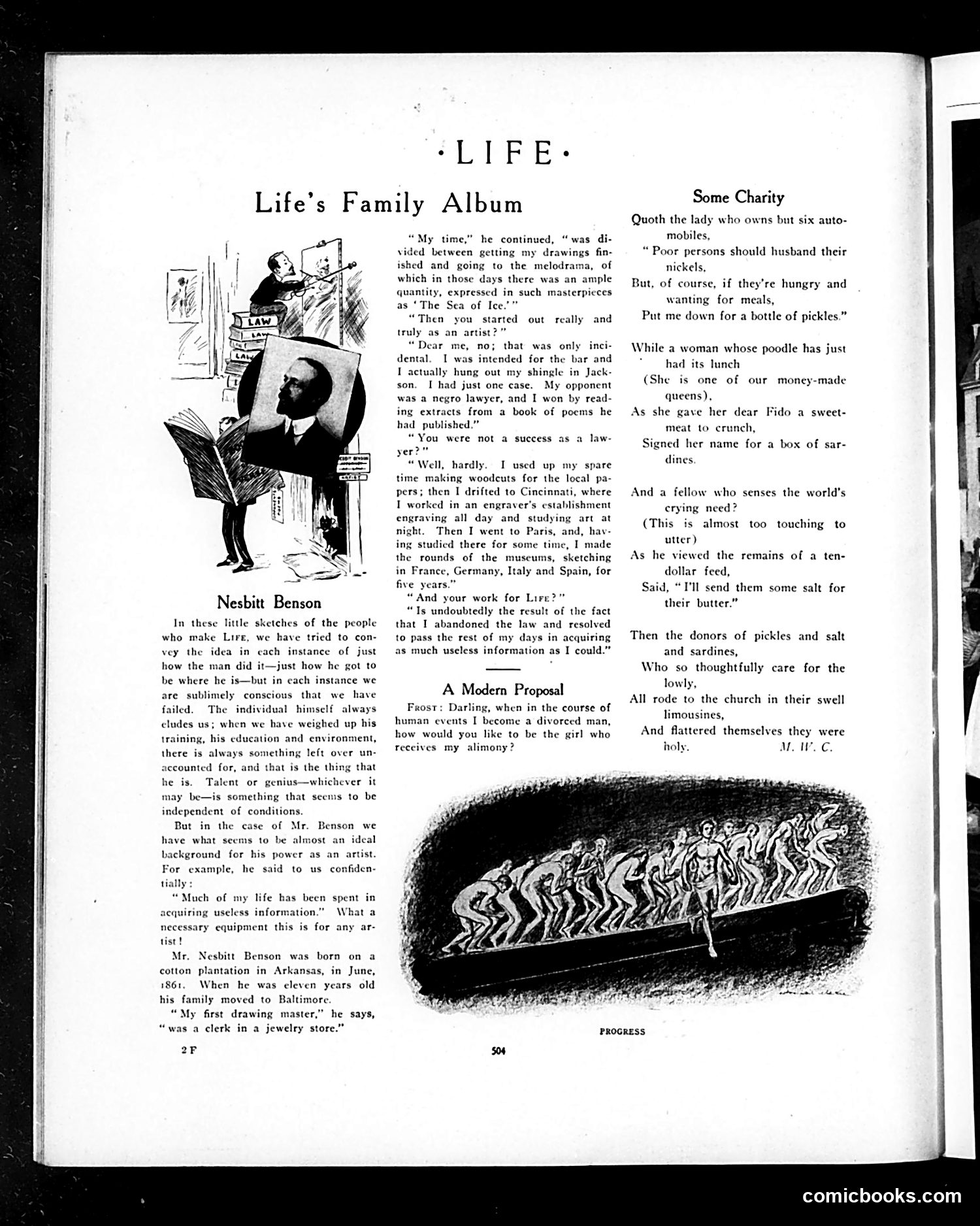
This page features a biographical profile of **Nesbitt Benson**, an artist and illustrator for *Life* magazine, alongside satirical poems about wealthy people's performative charity. **The Benson Profile:** The left column sketches how Benson became an artist despite starting as a failed lawyer in Jackson, Mississippi (notably, he lost a case to a "negro lawyer," a detail emphasizing his incompetence). He drifted through engraving, Paris study, and museum sketching—acquiring what he calls "useless information"—before finding success at *Life*. The profile celebrates how talent and education, rather than predetermined circumstance, shaped his career. **The Satire (Right Column):** The poems mock wealthy individuals' shallow charity: a woman with six automobiles lectures poor people about frugality while donating pickles; a society woman gives her poodle sardines while claiming concern for the hungry; a man offers "salt for their butter" after viewing leftovers. All then drive to church in limousines, "flattered themselves they were holy." The satire targets hypocrisy—wealthy people performing charity while remaining fundamentally indifferent to actual poverty.
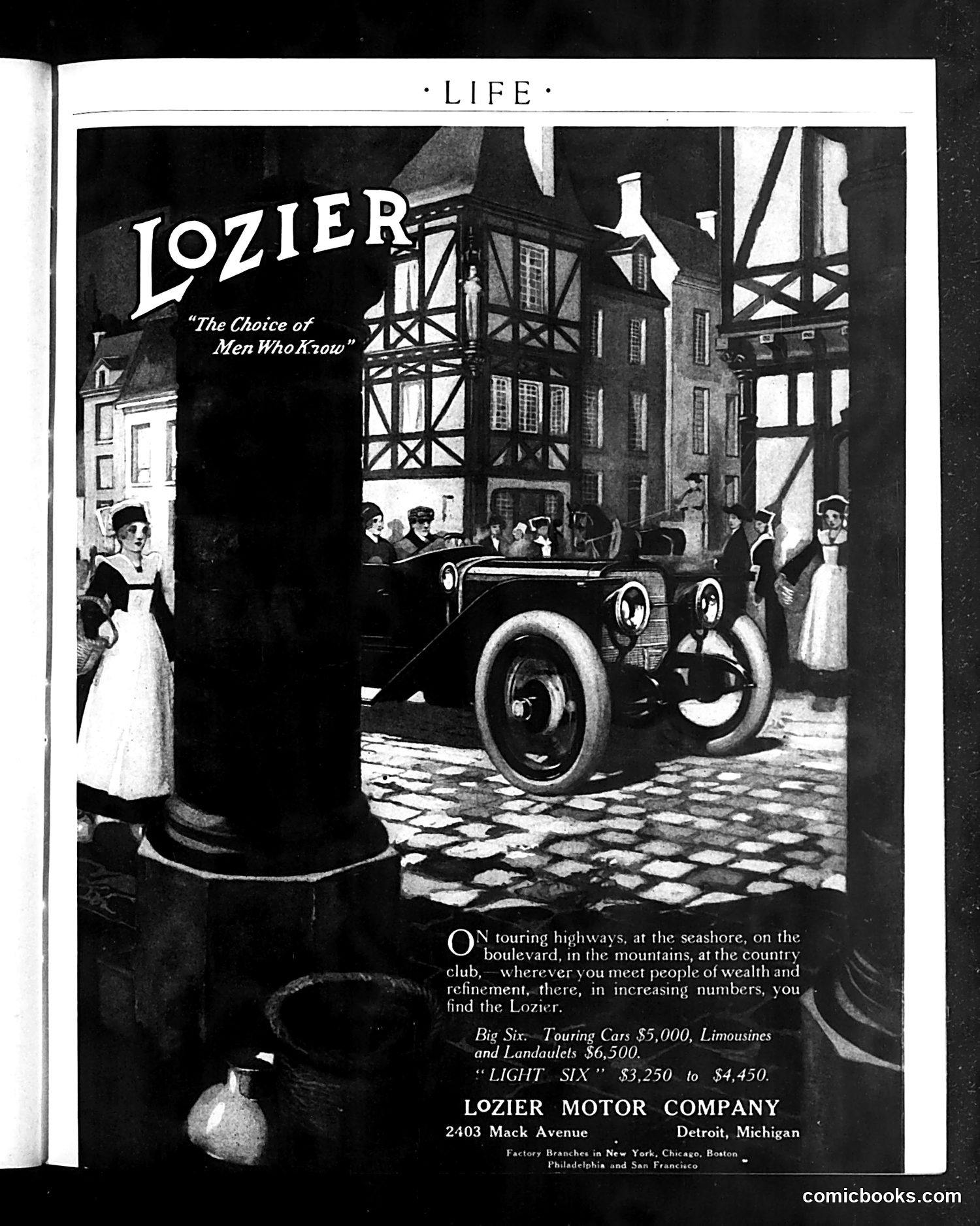
This is a **luxury automobile advertisement**, not a political cartoon. It's a Lozier Motor Company ad promoting high-end cars to wealthy buyers. The image depicts an elegantly dressed woman in white standing near a grand European-style building, with a Lozier automobile prominently displayed in a town square surrounded by well-dressed onlookers. The tagline "The Choice of Men Who Know" emphasizes exclusivity and sophistication. The advertisement's appeal is purely **aspirational and class-based**: it associates the Lozier brand with wealth, refinement, and social status. The European architectural setting and formally dressed figures suggest continental elegance. The copy explicitly targets "people of wealth and refinement" encountered at exclusive venues (country clubs, boulevards, seaside resorts), making the sales pitch clear: owning a Lozier signals you belong to society's elite. For modern readers, this reveals early 20th-century marketing strategies targeting the wealthy through class signaling rather than practical car features.
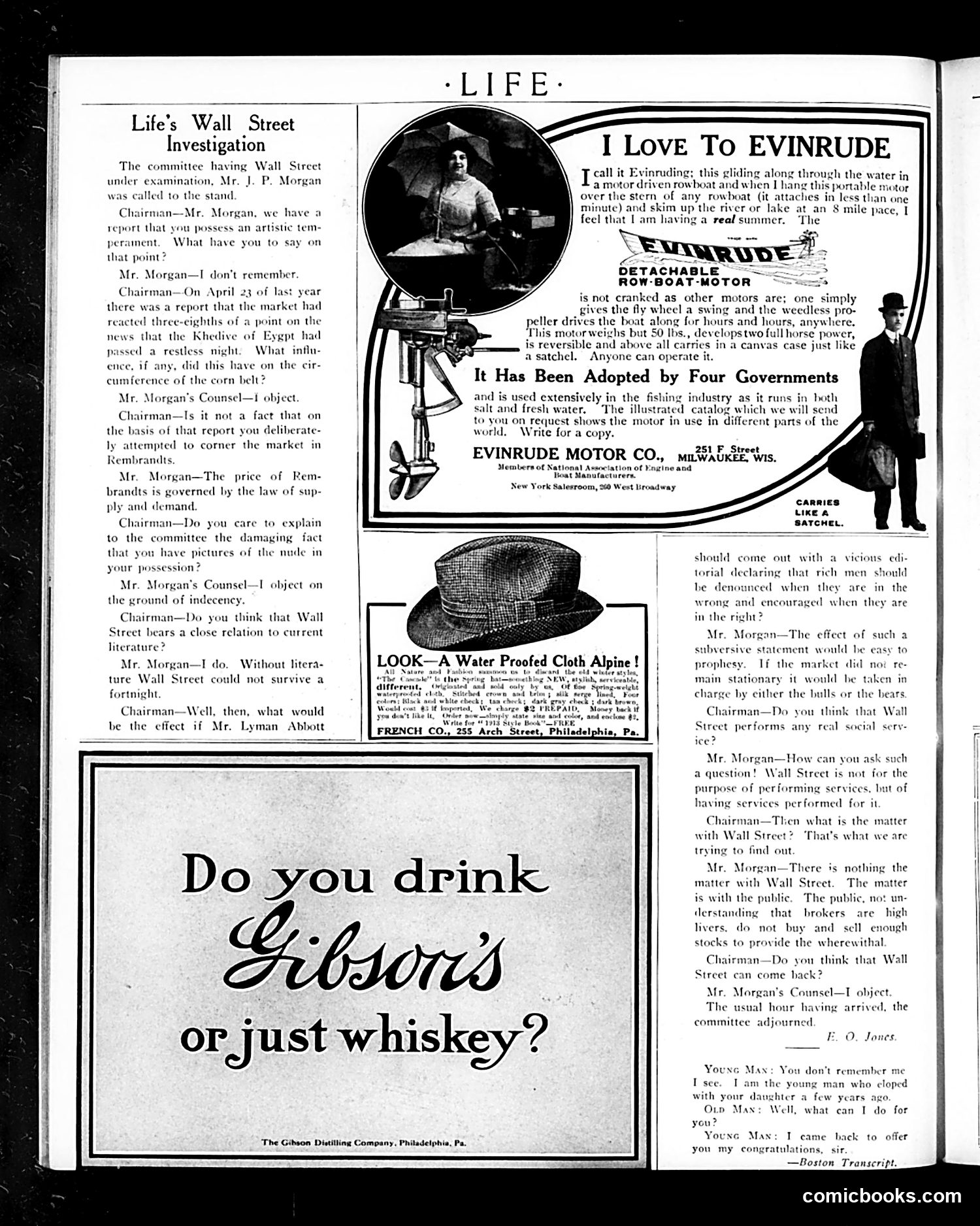
This page satirizes J.P. Morgan's congressional testimony about the 1907 financial panic. The "investigation" dialogue mocks Morgan's evasiveness and arrogance through absurdist questioning: the Chairman asks about his "artistic temperament," a market drop caused by the Khedive of Egypt, and whether nude paintings in Morgan's possession constitute market manipulation. The satire's point: Morgan's vast wealth and influence over markets are beyond rational scrutiny or accountability. His counsel repeatedly objects; Morgan dismisses public concerns, claiming Wall Street needs no justification beyond self-interest. The setup ridicules how the wealthy deflect serious financial oversight with non-answers. The humor relies on readers' awareness of Morgan's actual 1912 testimony before Congress regarding financial concentration and his unapologetic dominance of American banking.
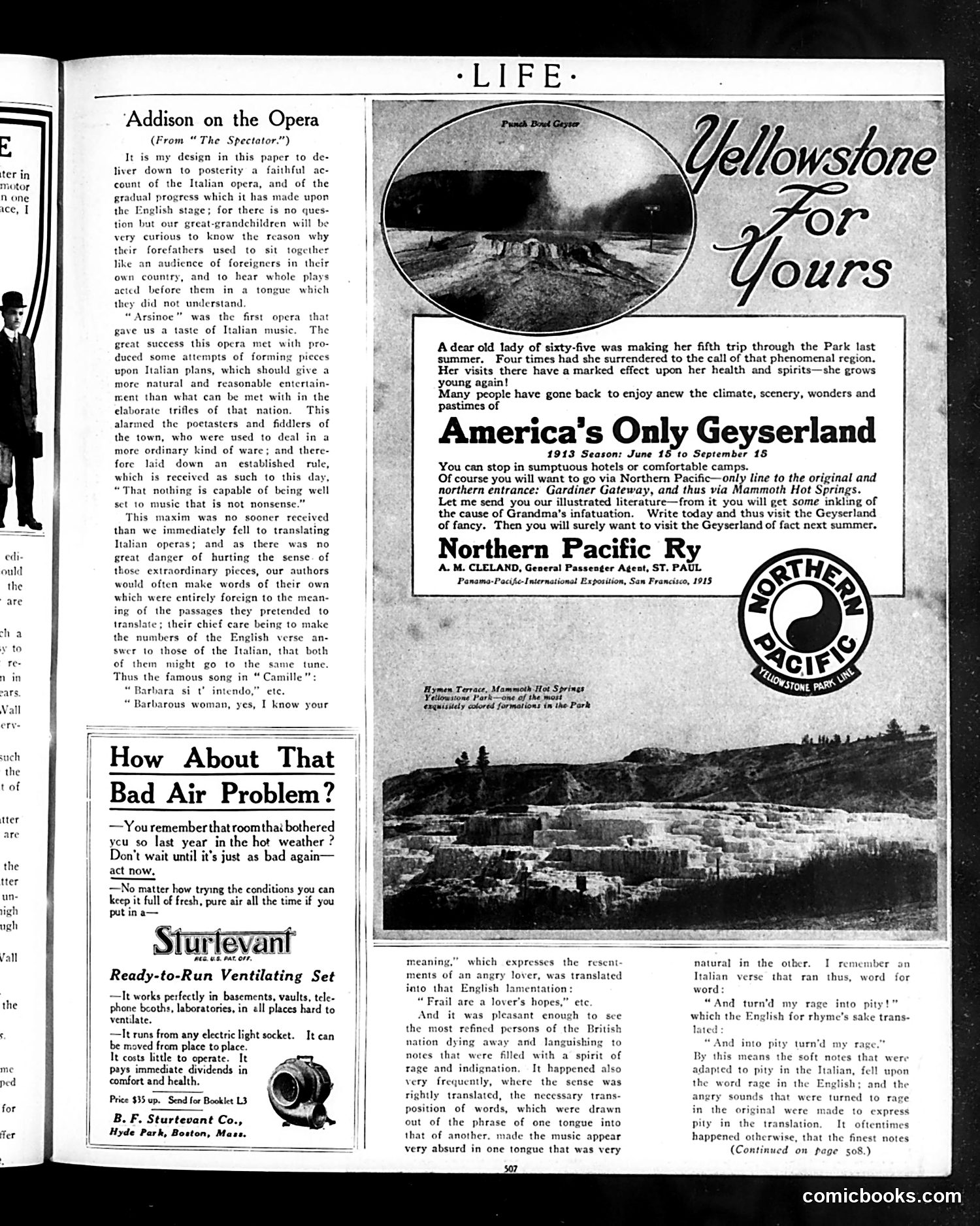
This page combines **literary criticism with period advertising and tourism promotion**. The left column reprints **Addison's 18th-century essay on Italian opera** from *The Spectator*, mocking how opera translators sacrificed meaning for rhyming English verse. The satirical point: English audiences sat confused watching performances in languages they didn't understand, yet translators further mangled the text to fit meter rather than convey sense. The right side features a **Northern Pacific Railway advertisement** promoting Yellowstone Park ("America's Only Geyserland") for the 1913 season. The ad includes landscape photography and a testimonial about a 65-year-old woman rejuvenated by visits there. **The ironic pairing**: Addison criticizes audiences accepting nonsensical foreign entertainment, while the ad directly below appeals to American travelers to accept the "phenomenal region" of Yellowstone uncritically—a gentle satire on consumer desire and tourism marketing. Both involve audiences accepting spectacle over substance. The **Sturlevant ventilation advertisement** below is unrelated product promotion.
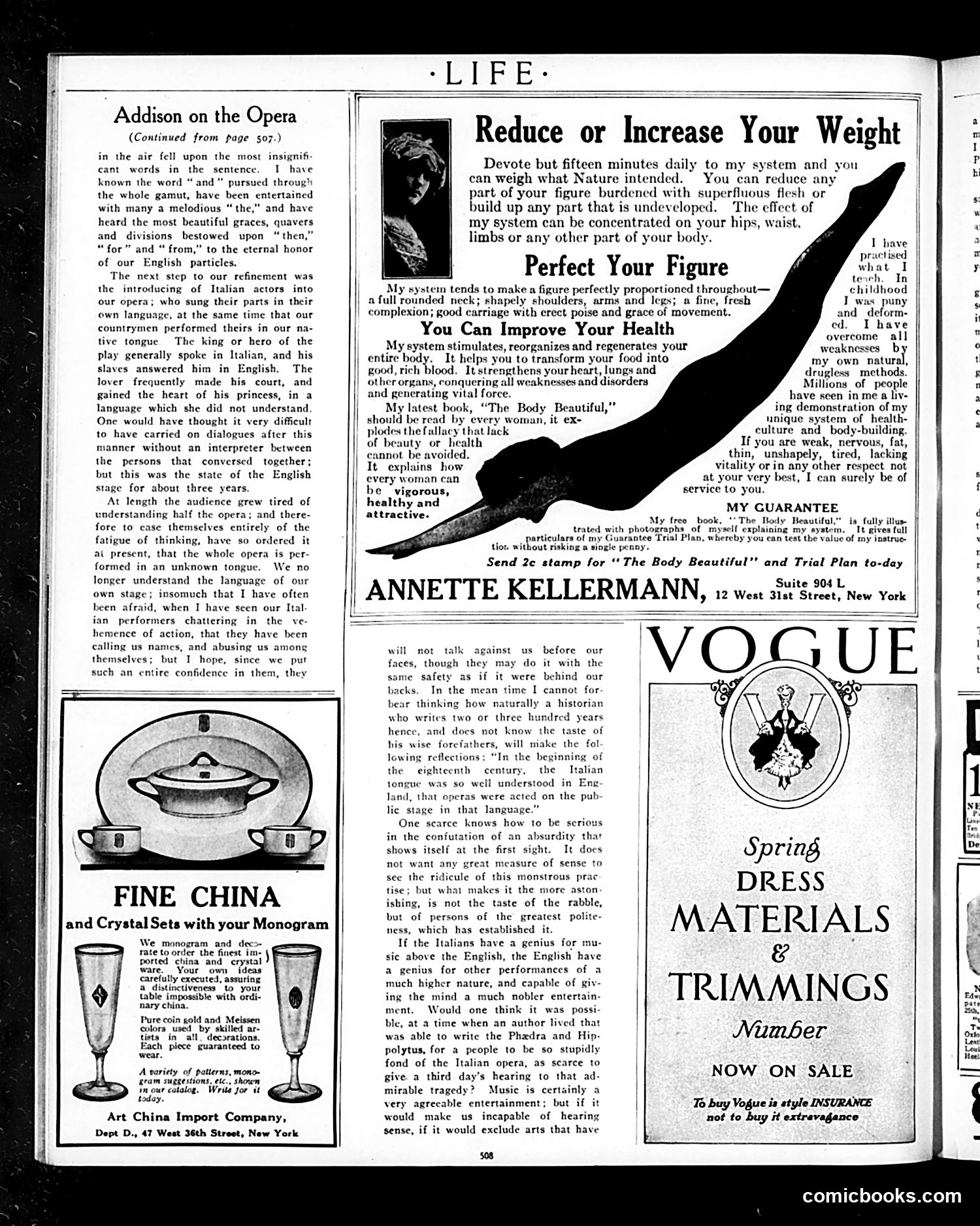
This page is primarily **advertising-focused** rather than satirical cartoon content. The main pieces are: 1. **"Addison on the Opera"** (top left): A continuation essay critiquing Italian opera's dominance on the English stage. The satirical point: English audiences have become so dependent on Italian performers that they've accepted performances entirely in Italian—a language they don't understand—rather than demand comprehensible entertainment. The essay mocks this passive acceptance and the absurdity of theatrical communication breakdown. 2. **Weight/Figure advertisements** (center-right): Period body-culture promotions from Annette Kellermann and similar vendors, promising figure transformation and health improvement through proprietary "systems." 3. **Fine china advertisement** (bottom left) and **Vogue materials advertisement** (right): Standard commercial notices. The operative satire is *Addison's* complaint about English cultural deference to Italian fashion—audiences literally cannot understand their own stage entertainment but tolerate it anyway, suggesting blind worship of foreign sophistication over practical sense.
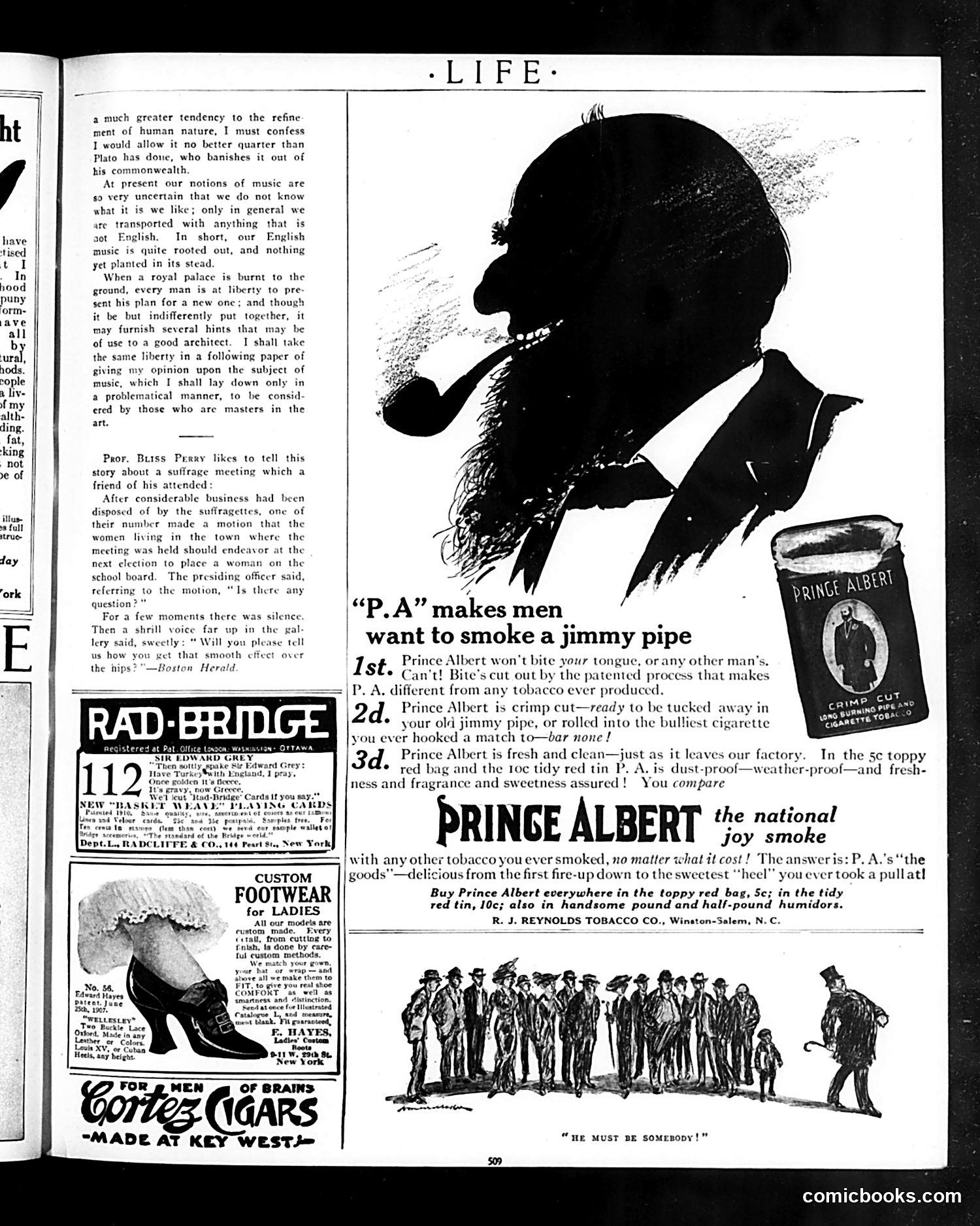
This page is primarily **advertising**, not political satire. The dominant content is a large Prince Albert tobacco advertisement featuring a silhouetted profile of a man smoking a pipe—a classic early 20th-century marketing image. The ad uses colloquial language ("jimmy pipe") and employs three numbered selling points: the tobacco won't bite your tongue (patented process), it's crimp-cut for pipe or rolling, and it stays fresh in its packaging. The copy emphasizes affordability and quality across price points. The page also includes smaller ads for Rad-Bridge shoes, custom footwear for ladies, and Cortez cigars. At top is an unrelated text excerpt discussing music and refinement, plus a brief anecdote about a women's suffrage meeting where an audience member humorously asks about achieving smooth hip lines—likely a subtle jab at suffragette concerns versus domestic/appearance priorities, though the joke's point is oblique to modern readers. The page reflects early 20th-century consumer culture and gender attitudes.
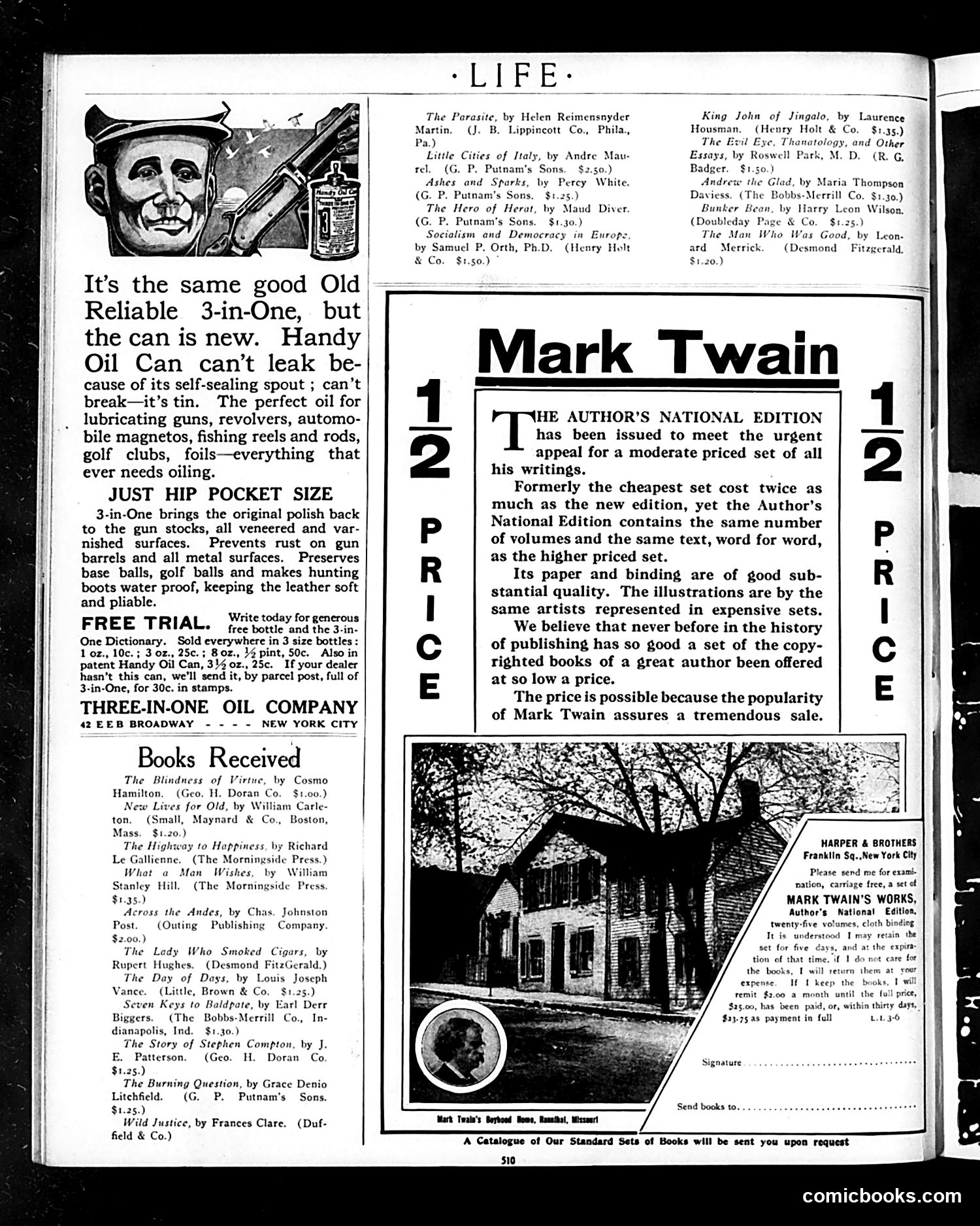
This page is primarily **advertising and book listings**, not political satire. The top-left features a **3-in-One Oil advertisement** with a caricatured man's face (likely meant as a generic "everyman" type rather than a specific political figure). The ad promotes a self-sealing oil can for guns, tools, and sporting equipment—ordinary consumer marketing. The dominant content is a **Mark Twain "Author's National Edition" book advertisement** from Harper & Brothers, emphasizing affordability and legitimacy. This was a significant publishing event: making Twain's collected works cheaper and more accessible than previous editions. The page also lists recently published books across various publishers—typical literary content for Life magazine's book review section. **No political satire or commentary is evident here.** This is straightforward early 20th-century commercial publishing and consumer product advertising alongside literary notices.
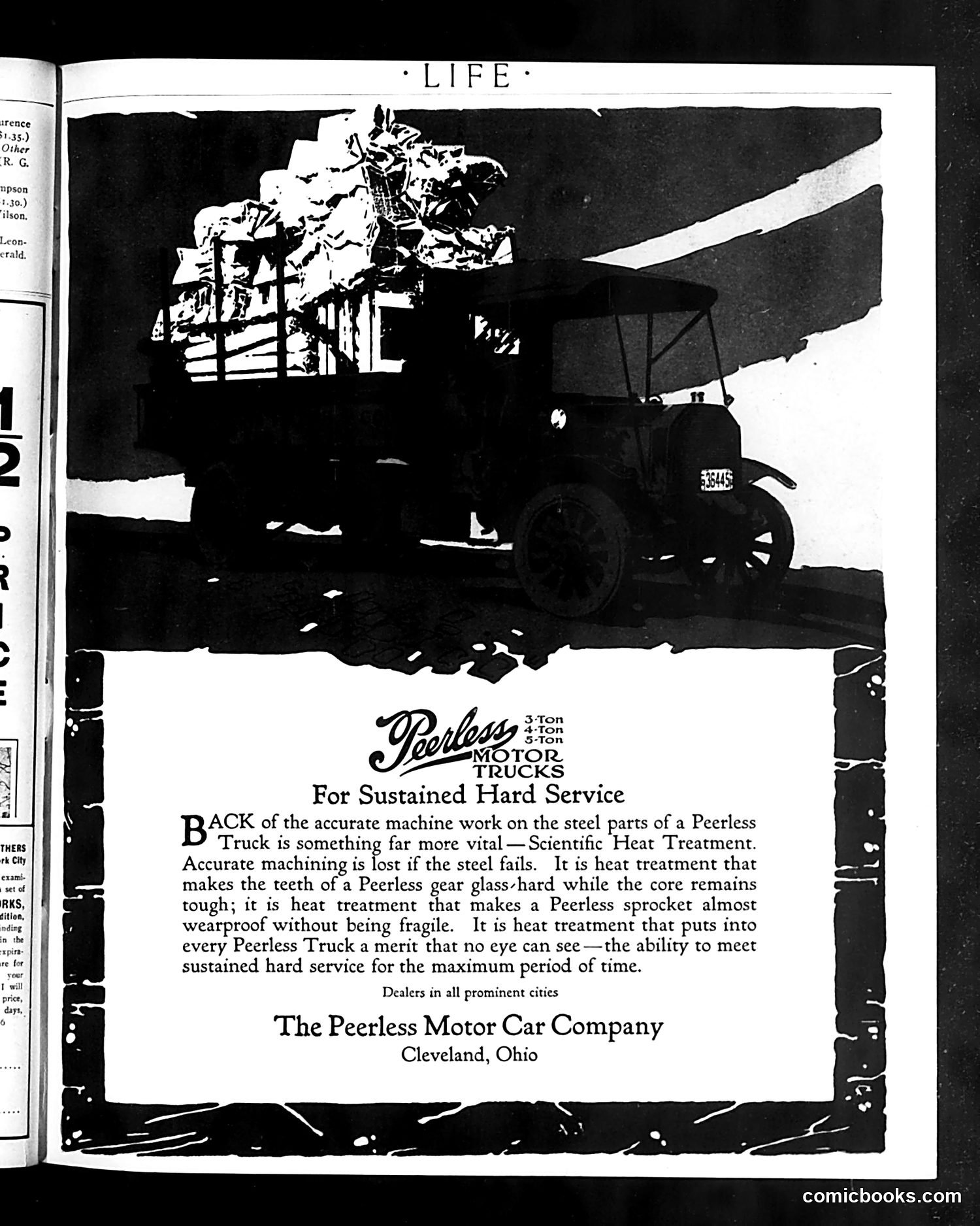
This is **not a cartoon or satire page**, but rather a **commercial advertisement** for Peerless Motor Trucks, published in *Life* magazine. The image shows a silhouetted truck loaded with flowers or plants, emphasizing the vehicle's cargo capacity. The ad's purpose is to sell industrial trucks (3-ton, 4-ton, and 5-ton models) by highlighting their durability through "scientific heat treatment" of steel components. The rhetoric appeals to business owners seeking reliable commercial vehicles for "sustained hard service"—the phrase appears multiple times to stress reliability and longevity. The Peerless Motor Car Company, based in Cleveland, Ohio, positions heat-treatment technology as an invisible but crucial advantage over competitors. This represents typical early 20th-century industrial advertising: emphasizing manufacturing precision and material science rather than style or price.
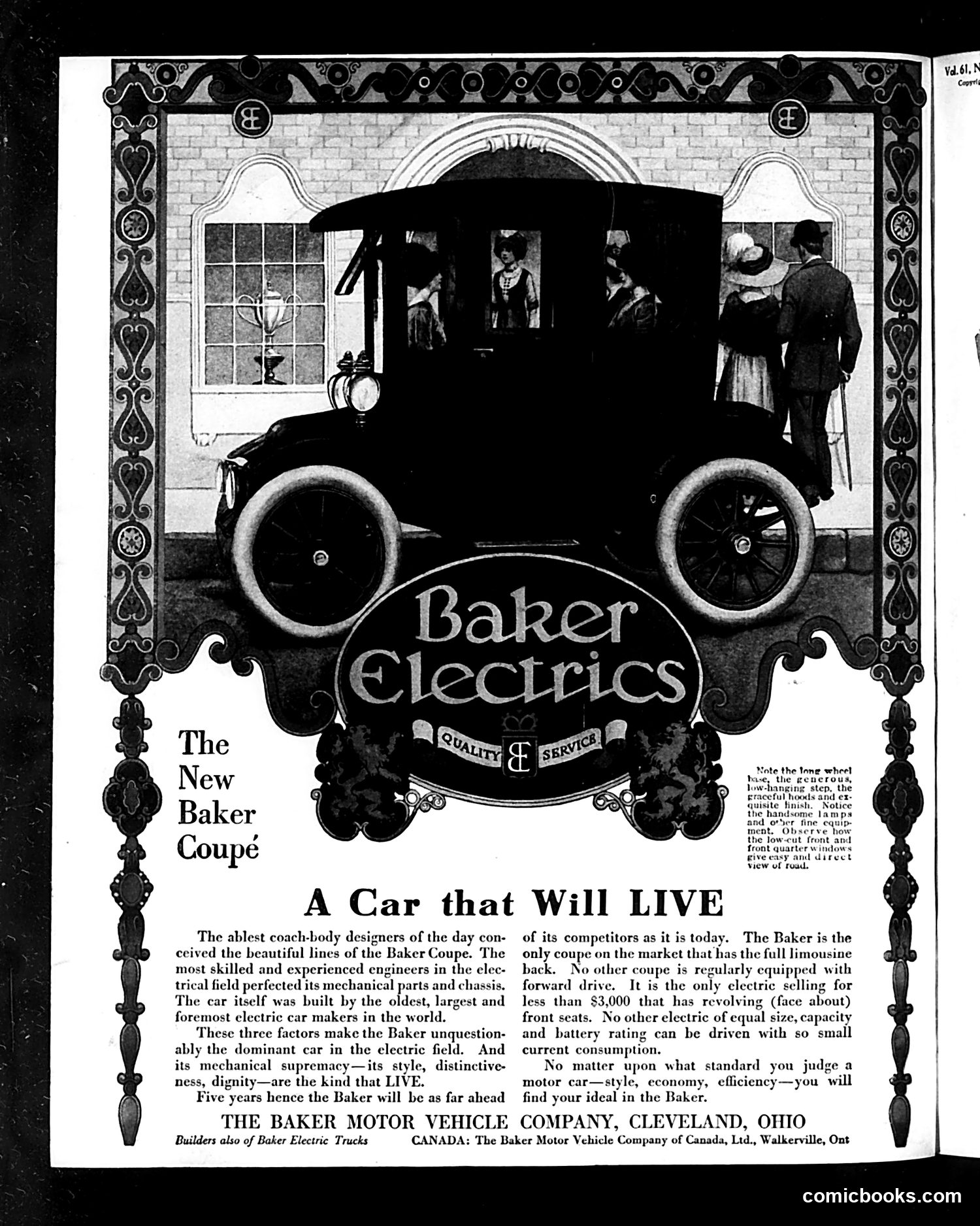
This is **not satire or a political cartoon**—it's a straightforward advertisement for the Baker Electric automobile, produced by The Baker Motor Vehicle Company of Cleveland, Ohio. The page promotes "The New Baker Coupé" as a luxury electric car, emphasizing its design superiority, mechanical innovation, and longevity ("A Car that Will LIVE"). The ad highlights competitive advantages: it's the only coupe with a full limousine back and forward drive, priced under $3,000 with revolving front seats and exceptional battery efficiency. The ornate Art Deco border and silhouetted illustration of well-dressed people boarding the vehicle are period-typical advertising design meant to convey elegance and modernity. This reflects the early 1900s era when electric vehicles competed with gasoline cars as a viable transportation option before internal combustion engines became dominant.