
Life, 1913-03-06 · page 64 of 72
Life — March 6, 1913 — page 64: what you’re looking at
What you’re looking at
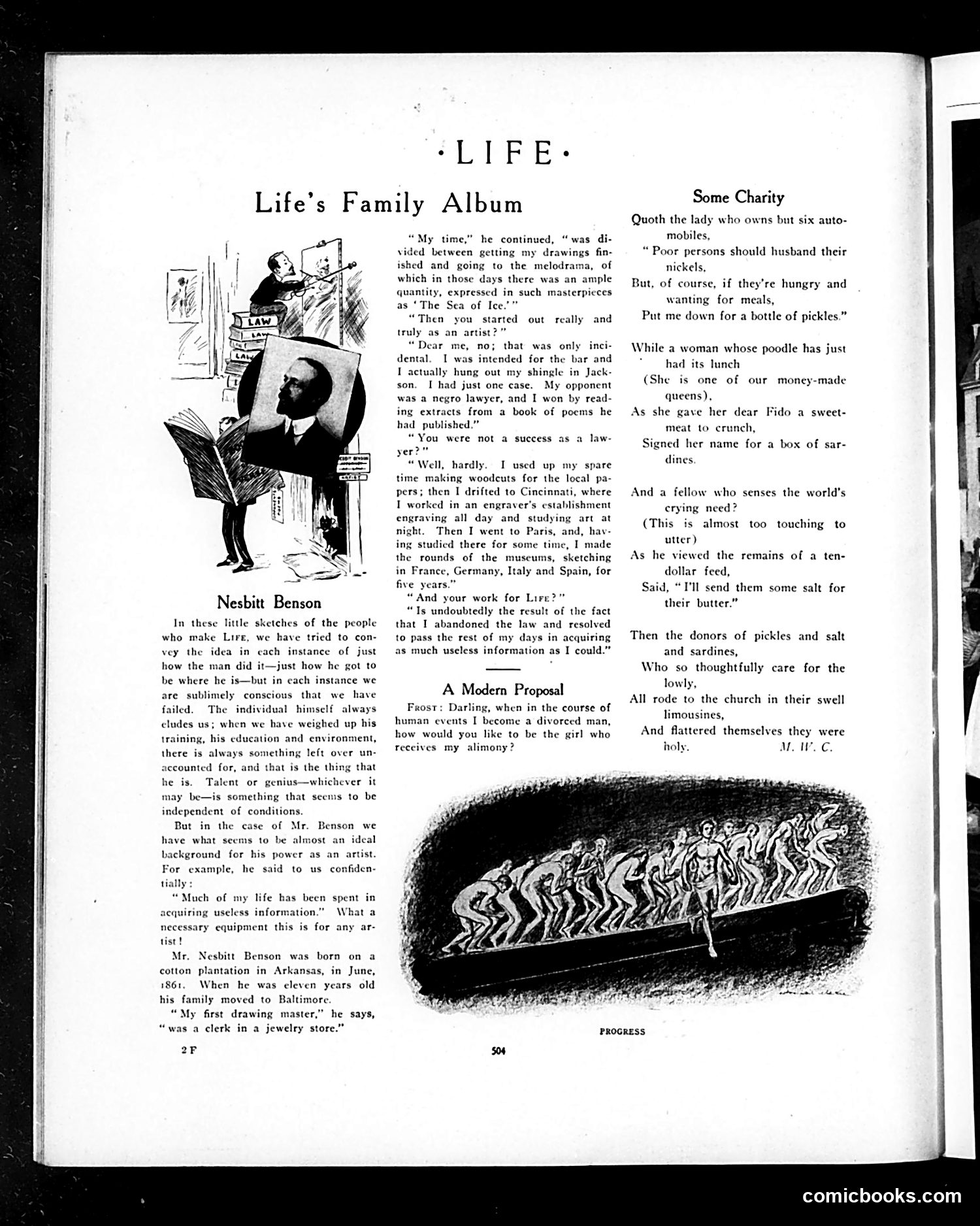
This page features a biographical profile of **Nesbitt Benson**, an artist and illustrator for *Life* magazine, alongside satirical poems about wealthy people's performative charity. **The Benson Profile:** The left column sketches how Benson became an artist despite starting as a failed lawyer in Jackson, Mississippi (notably, he lost a case to a "negro lawyer," a detail emphasizing his incompetence). He drifted through engraving, Paris study, and museum sketching—acquiring what he calls "useless information"—before finding success at *Life*. The profile celebrates how talent and education, rather than predetermined circumstance, shaped his career. **The Satire (Right Column):** The poems mock wealthy individuals' shallow charity: a woman with six automobiles lectures poor people about frugality while donating pickles; a society woman gives her poodle sardines while claiming concern for the hungry; a man offers "salt for their butter" after viewing leftovers. All then drive to church in limousines, "flattered themselves they were holy." The satire targets hypocrisy—wealthy people performing charity while remaining fundamentally indifferent to actual poverty.
📄 Transcribed text from this page (OCR, searchable)
Machine-transcribed from the original scan — historical spelling and the odd misread are preserved.
“LIFE¢ Life’s Family Album Nesbitt Benson In these little sketches of the people who make Lire, we have tried to con- vey the idea in cach instance of just how the man did it—just how he got to be where he is—but in each instance we conscious that we have individual himself hed up his ion and environment, are sublimely failed. The cludes us; when we have we always training, his edu there is always sé accounted for, and that is the thing that nething left over un- Talent or genius—whichever it s to be he is may be—is something that se independent of conditions. But in the case of Mr. have what seems to be almost an ideal background for his power as an artist. us confiden- Benson we For example, he said to tially: “Much of my life has been spent in acquiring useless information.” What a necessary equipment this is for any ar- tist! Mr. Nesbitt Benson cotton plantation in Arkansas, in June, 1861 When he was eleven years old his family moved to Baltimore. “My first drawing master,” he says, “was a clerk in a jewelry store.” was born on a 2F “My time,” he continued, “was di- vided between getting my drawings fin- ished and going to the melodrama, of which in those days there was an ample quantity, expressed in such masterpieces as ‘The Sea of Ice “Then you started out truly as an artist?” “Dear me, no; that was only dental. I was intended for the bar and I actually hung out my shingle in Jack- son. I had just one case. My opponent was a negro lawyer, and I won by read- ing extracts from a book of poems he had published.” “You were not a success as a law- really and inci- yer? “Well, hardly. I used up my spare time making woodcuts for the local pa- pers; then I drifted to Cincinnati, where I worked in an engraver’s establishment engraving all day and studying art at night. Then I went to Paris, and, hav- ing studicd there for some time, I made the rounds of the muscums, sketching in France, Germany, Italy and Spain, for five years. “And your work for Lire “Is undoubtedly the result of the fact that I abandoned the law and resolved to pass the rest of my days in acquiring as much useless information as I could.” A Modern Proposal Frost: Darling, when in the course of human events I become a divorced man, how would you like to be the girl who receives my alimony? Some Charity Quoth the lady who owns but six auto- mobiles, “ Poor persons should husband their nickels, But, of course, if they’re hungry and wanting for meals, Put me down for a bottle of pickles.” While a woman whose poodle has just had its lunch (She is one of our money-made queens), As she gave her dear Fido a sweet- meat to crunch, ned her name for a box of sar- dines. And a fellow who senses the world’s crying need? (This is utter) As he viewed the remains of a ten- dollar feed, Said, “I'll send them some salt for their butter.” almost too touching to Then the donors of pickles and salt and sardines, Who so thoughtfully care for the lowly, All rode to the church in their swell limousines, And flattered themselves they were holy. MW. C. PROGRESS comicbooks.com