
Life, 1913-03-06 · page 33 of 72
Life — March 6, 1913 — page 33: what you’re looking at
What you’re looking at
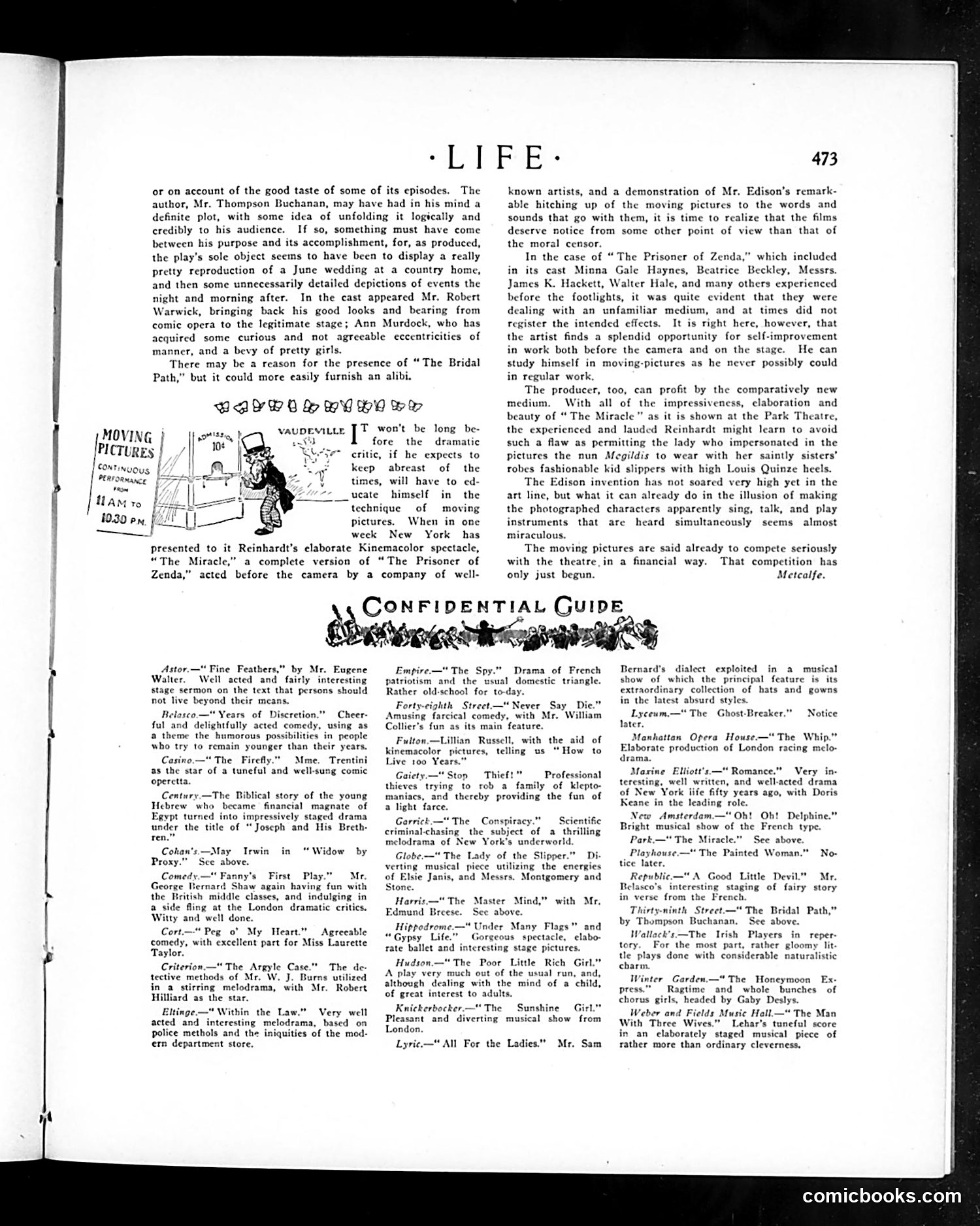
This page contains theater reviews and a small cartoon about moving pictures (early cinema). The cartoon shows a vaudeville performer advertising "Moving Pictures" with a sign announcing times, reflecting the novelty of film in 1911. The main text discusses how dramatic critics must educate themselves about film technique, as New York has recently seen major cinema productions including Reinhardt's "Kinemacolor" spectacle of "The Prisoner of Zenda" and Edison's synchronized sound-and-picture invention. The writer argues films deserve serious critical attention beyond moral censorship. The satire is subtle: the cartoon implies that vaudeville entertainers are advertising movies like a stage act, suggesting cinema's novelty and theater's defensive posture. The reviews below reveal the era's anxiety—theater critics recognizing that moving pictures now pose genuine financial competition to live performance, requiring serious artistic evaluation rather than dismissal. The "Confidential Guide" lists contemporary theatrical productions, emphasizing live theater's continued dominance despite the emerging film threat.
📄 Transcribed text from this page (OCR, searchable)
Machine-transcribed from the original scan — historical spelling and the odd misread are preserved.
! or on account of the good taste of some of its episodes. The author, Mr. Thompson Buchanan, may have had in his mind a definite plot, with some idea of unfolding it logically and credibly to his audience. If so, something must have come between his purpose and its accomplishment, for, as produced, the play’s sole object seems to have been to display a really pretty reproduction of a June wedding at a country home, and then some unnecessarily detailed depictions of events the night and morning after. In the cast appeared Mr. Robert Warwick, bringing back his good looks and bearing from comic opera to the legitimate stage; Ann Murdock, who has acquired some curious and not agreeable eccentricities of manner, and a bevy of pretty girls. There may be a reason for the presence of “The Bridal Path,” but it could more easily furnish an alibi, BAYH SH wSY HY BY T won't be long be- _ ‘ VAUDEMLUE ROVING || Ghee. A, fore, the dramatic PICTURES } ,/ Kbser critic, if he expects to | fostwous i ‘Ze keep abreast of the Penroearce ~ 7 T times, will have to ed- Zio _veate himself in the HAM ro technique of moving 19.30 pw, pictures. When in one — week New York has presented to it Reinhardt’s elaborate Kinemacolor spectacle, LVPE 473 known artists, and a demonstration of Mr. Edison’s remark- able hitching up of the moving pictures to the words and sounds that go with them, it is time to realize that the films deserve notice from some other point of view than that of the moral censor. In the case of “The Prisoner of Zenda,” which included in its cast Minna Gale Haynes, Beatrice Beckley, Messrs. James K. Hackett, Walter Hale, and many others experienced before the footlights, it was quite evident that they were dealing with an unfamiliar medium, and at times did not register the intended effects. It is right here, however, that the artist finds a splendid opportunity for self-improvement in work both before the camera and on the stage. He can study himself in moving-pictures as he never possibly could in regular work, The producer, too, can profit by the comparatively new medium. With all of the impressiveness, claboration and beauty of “The Miracle” as it is shown at the Park Theatre, the experienced and lauded Reinhardt might learn to avoid such a flaw as permitting the lady who impersonated in the pictures the nun Megildis to wear with her saintly sisters’ robes fashionable kid slippers with high Louis Quinze heels. The Edison invention has not soared very high yet in the art line, but what it can already do in the illusion of making the photographed characters apparently sing, talk, and play instruments that heard simultancously scems almost are The moving pictures are said already to compete seriously with the theatre,in a financial way. That competition has only just begun. Metcalfe. GUIDE cogransages Drama of French “The Miracle,” a complete version of “The Prisoner of Zenda,” acted before the camera by a company of well- CONFIDENTIAL Astor.—" Fine Feathers,” by Mr. Eugene Empire.—" The Spy.” Walter. Weill acted and fairly interesting patriotism and the usual domestic triangle. stage sermon on the text that persons should not live beyond their means. Belasco.—" Years of Discretion.” Cheer- ful delightfully acted comedy, using as a theme the humorous possibilities in people who try to remain younger than their years. Casino.—" The Firefly.” Mme. Trentini as the star of a tuneful and well-sung comic operetta. Century.—The Biblical story of the young Hebrew ‘who became financial magnate of Egypt turned into impressively staged drama under the title of “Joseph and His Breth- ren,” Cokan'’s—May Irwin in Proxy.” See above, Comedy nny’s First Play. Mr. George Vernard Shaw again having fun with the Hritish middle classes, and indulging in a side fling at the London dramatic critics. Witty and well done. Peg o' My Heart." Agreeable with excellent part for Miss Laurette “Widow by Cort— comed: Taylor. Criterion. —" The Argyle Case." The de- tective methods of Mr. W. J. Burns utilized in a stirring melodrama, with Mr. Robert Hilliard as the star. Eltinge-—" Within the Law.” Very well acted and interesting melodrama, based on police methols and the iniquities of the mod- ern department store. Rather old-school for to-day. Forty-eighth Street—" Never Say Amusing farcical comedy, with Mr. William Collier's fun as its main feature. Fulton.—Lillian Russell, with the aid of kinemacolor pictures, telling us ‘How to Live 100 Years.” Gaiety.—" Stop Thief!" Professional thieves trying to rob a family of klepto- maniacs, and thereby providing the fun of a light farce. Garrick —" The Conspirac: Scientific criminal-chasing the subject of a thrilling melodrama of New York's underworld. Globe-—" The Lady of the Slipper.” Di- verting musical piece utilizing the energies of Elsie Janis, and Messrs. Montgomery and Stone. Harris.—" The Master Mind,” with Mr, Edmund Breese. See above. Hippodrome.—" Under Many Flags" and “Gypsy. Life.” Gorgeous spectacle, elabo- rate ballet and interesting stage pictures. Hudson.—" The Poor Little Rich Girl.’ A play very much out of the usual run, and, although dealing with the mind of a child, of great interest to adults. Knickerbocker—" The Sunshine Girl."* Pleasant and diverting musical show from London. Lyrie.—' “All For the Ladies." Mr. Sam Bernard’s dialect exploited in a musical show of which the principal feature is its extraordinary collection of hats and gowns in the latest absurd styles. “The Ghost-Breaker.”” Lyceum — Notice later. Manhattan Opera House-—" The Whip.” Elaborate production of London racing melo- drama. Marine Elliott’s—" Romance.” Very in- teresting, well written, and well-acted drama of New York jife fifty years ago, with Doris Keane in the leading role. New Amsterdam.—" Oh! Ob! Delphine." Bright musical show of the French type. Park.— The Miracle.” See above. Playhouse.—" The Painted Woman.” No- tice later. Republic-—" A Good Little Devil.” Mr. Relasco’s interesting staging of fairy story in verse from French. Thirty-ninth Street—" The Bridal Path,” by Thompson Buchanan, See above. Wallack’s.—The Irish Players in reper- tory. For the most part, rather gloomy lit- tle plays done with considerable naturalistic charm Winter Garden.—“ The Honeymoon Ex- press.” Ragtime and whole bunches of chorus girls, headed by Gaby Deslys. Weber and Fields Music Hall.—“ The Man With Three Wives.” Lehar’s tuneful score in an claborately staged musical piece of rather more than ordinary cleverness, comicbooks.com