
Life, 1913-03-06 · page 18 of 72
Life — March 6, 1913 — page 18: what you’re looking at
What you’re looking at
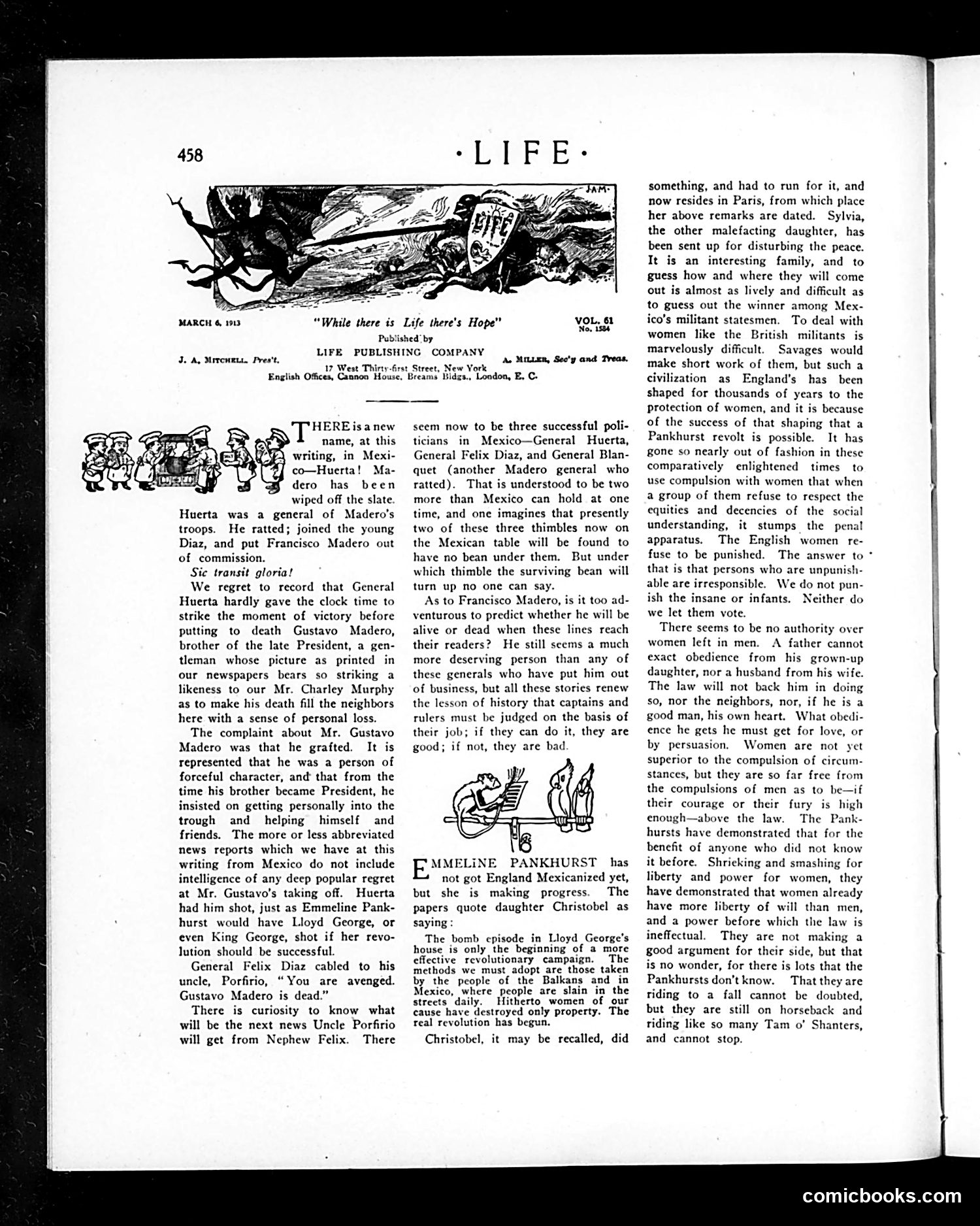
This satirical piece compares Mexican political upheaval to British suffragette militancy. The main target is **General Victoriano Huerta**, who has just seized power in Mexico by overthrowing President Francisco Madero and executing Madero's brother Gustavo. Life mocks the instability of Mexican leadership, suggesting three generals (Huerta, Felix Diaz, and Blanquet) are now competing for power—imagining them as a shell game where only one "bean" (winner) will survive. The piece then pivots to **Emmeline Pankhurst and her daughters**, British suffragette activists, comparing their revolutionary tactics to Mexican violence. Daughter **Christobel**, hiding in Paris, advocates bombing campaigns. Life sarcastically suggests that England's civilized tradition of protecting women makes dealing with militant suffragettes particularly difficult—unlike "savages" who would handle them brutally. The satire implies both situations involve dangerous instability and the breakdown of civil order.
📄 Transcribed text from this page (OCR, searchable)
Machine-transcribed from the original scan — historical spelling and the odd misread are preserved.
MARCH 6, 1913 “While there is Life there's Hope” Published’ by LIFE PUBLISHING COMPANY J. A, Mrrowmit. Pres't, English Offices, HEREisanew name, at this writing, in Mexi- co—Huerta! Ma- dero has been wiped off the slate. Huerta was a general of Madero’s troops. He ratted; joined the young Diaz, and put Francisco Madero out of commission. Sic transit gloria! We regret to record that General Huerta hardly gave the clock time to strike the moment of victory before putting to death Gustavo Madero, brother of the late President, a gen- tleman whose picture as printed in our newspapers bears so striking a likeness to our Mr. Charley Murphy as to make his death fill the neighbors here with a sense of personal loss. The complaint about Mr. Gustavo Madero was that he grafted. It is represented that he was a person of forceful character, and that from the time his brother became President, he insisted on getting personally into the trough and helping himself and friends. The more or less abbreviated news reports which we have at this writing from Mexico do not include intelligence of any deep popular regret at Mr. Gustavo’s taking off. Huerta had him shot, just as Emmeline Pank- hurst would have Lloyd George, or even King George, shot if her revo- lution should be successful. General Felix Diaz cabled to his uncle, Porfirio, “You are avenged. Gustavo Madero is dead.” There is curiosity to know what will be the next news Uncle Porfirio will get from Nephew Felix. There A. Minin, Sec'y and Treas. 17 West Thirty-first Street, New York Cannon House, Breams Bidgs., London, E, C- seem now to be three successful poli- ticians in| Mexico—General Huerta, General Felix Diaz, and General Blan- quet (another Madero general who ratted). That is understood to be two more than Mexico can hold at one time, and one imagines that presently two of these three thimbles now on the Mexican table will be found to have no bean under them. But under which thimble the surviving bean will turn up no one can say. As to Francisco Madero, is it too ad- venturous to predict whether he will be alive or dead when these lines reach their readers? He still seems a much more deserving person than any of these generals who have put him out of business, but all these stories renew the lesson of history that captains and rulers must be judged on the basis of their job; if they can do it, they are good; if not, they are bad iNE PANKHURST has not got England Mexicanized yet, but she is making progress. The papers quote daughter Christobel as saying: The bomb cpisode in Lloyd George's house is only the beginning of a more effective revolutionary campaign. The methods we must adopt are those taken by the people of the Balkans and in Mexico, where people are slain in the streets ‘daily. Hitherto women of our cause have destroyed only property. The real revolution has begun. Christobel, it may be recalled, did something, and had to run for it, and now resides in Paris, from which place her above remarks are dated. Sylvia, the other malefacting daughter, has been sent up for disturbing the peace. It is an interesting family, and to guess how and where they will come out is almost as lively and difficult as to guess out the winner among Mex- ico’s militant statesmen. To deal with women like the British militants is marvelously difficult. Savages would make short work of them, but such a civilization as England's has been shaped for thousands of years to the Protection of women, and it is because of the success of that shaping that a Pankhurst revolt is possible. It has gone so nearly out of fashion in these comparatively enlightened times to use compulsion with women that when a group of them refuse to respect the equities and decencies of the social understanding, it stumps the penal apparatus. The English women re- fuse to be punished. The answer to that is that persons who are unpunish- able are irresponsible. We do not pun- ish the insane or infants. Neither do we let them vote. There seems to be no authority over women left in men. A father cannot exact obedience from his grown-up daughter, nor a husband from his w The law will not back him in doing so, nor the neighbors, nor, if he is a good man, his own heart. What obedi- ence he gets he must get for love, or by persuasion. Women are not yet superior to the compulsion of circum- stances, but they are so far free from the compulsions of men as to be—if their courage or their fury is high enough—above the law. The Pank- hursts have demonstrated that for the benefit of anyone who did not know it before. Shrieking and smashing for liberty and power for women, they have demonstrated that women already have more liberty of will than men, and a power before which the law is ineffectual. They are not making a good argument for their side, but that is no wonder, for there is lots that the Pankhursts don’t know. That they are riding to a fall cannot be doubted, but they are still on horseback and riding like so many Tam o Shanters, and cannot stop. comicbooks.com