
Life, 1913-03-06 · page 38 of 72
Life — March 6, 1913 — page 38: what you’re looking at
What you’re looking at
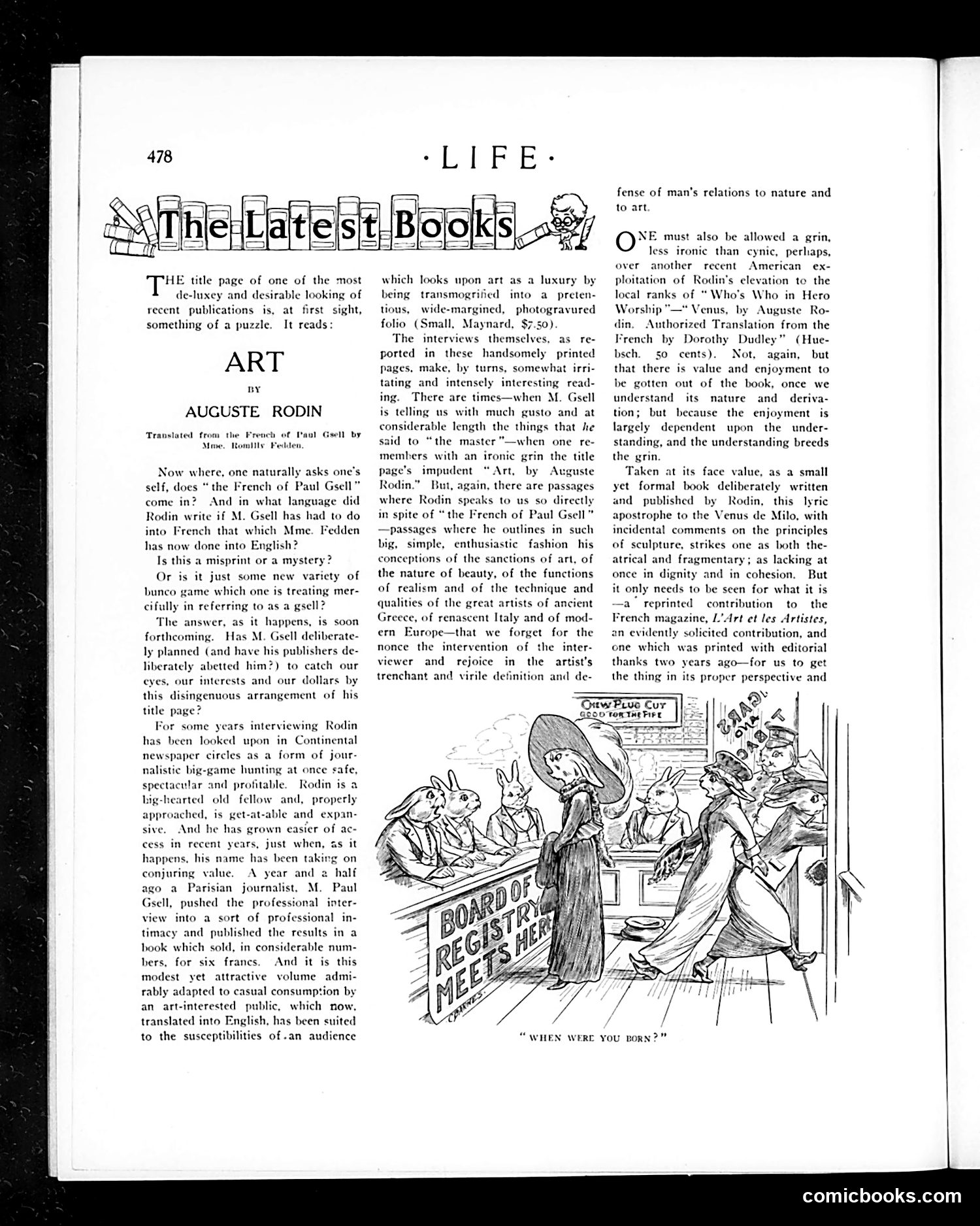
This page reviews a new English translation of Auguste Rodin's "Art" (interviews conducted by Paul Gsell). The accompanying cartoon satirizes the absurdity of celebrity hero-worship culture. The cartoon depicts animals at a "Board of Registry" window, apparently registering their birth dates. The joke plays on Life's criticism of trendy American commodification of great artists: just as one might register a prized animal's pedigree, Americans were treating famous artists' work as fashionable status symbols rather than engaging with their actual ideas. The text mocks how Rodin's interviews were repackaged as a luxury, oversized folio edition—inflating a modestly-priced French book into an expensive prestige item for casual consumption. The grin-worthy absurdity: Americans buying elaborately produced "authorized translations" of artistic philosophy without necessarily understanding or seriously engaging with the content itself.
📄 Transcribed text from this page (OCR, searchable)
Machine-transcribed from the original scan — historical spelling and the odd misread are preserved.
HE title page of one of the most de-lu, d desirable looking of recent publications is, at first sight, something of a puzzle. It reads: ART AUGUSTE RODIN the Freach of Paul Gsell by Now where, one naturally asks one’s self, does “the French of Paul Gsell” come in? And in what language did Rodin write if M. Gsell has had to do into French that which Mme. Fedden has now done into English? Is this a misprint or a mystery? Or is it just some new varicty of bunco game which one is treating mer- cifally in referring to as a gsell? The answer, as it happens, is soon forthcoming. Has M. Gsell delibe ned (and have his publishers de- cly abetted him?) to catch our eyes, our interests and our dollars by this disingenuous arrangement of his title i For some years interviewing Rodin has been looked upon in Continental newspaper circles as a form of jour- nalistic big-game hunting at once safe, spectacular and profitable. Rodin is a hig-hearted old fellow and, properly pproached, is get-at-able and expan- sive. And he has grown easier of ac- cess in recent years, just when, as it happens, his name has been taking on conjuring value. A year and a half ago a Parisian journalist, M. Paul Gsell, pushed the professional inter- view into a sort of professional in- timacy and published the results in a book which sold, in considerable num- bers, for six francs. And it is this modest yet attractive volume admi- rably adapted to casual consumption by an art-interested public, which now, translated into English, has been suited to the susceptibilities of-an audience which looks upon art as a luxury by being transmogritied into a preten- tious, wide-margined, photogravured folio (Small, Maynard, $7.50) The interviews themselves, as_re- ported in these handsomely printed pages, make, by turns, somewhat irri- tating and intensely interesting read- ing. There are times—when M. Gsell is telling us with much gusto and at considerable length the things that he said to “the master "—when one re- members with an ironic grin the title page’s impudent “Art, by Auguste Rodin.” But, again, there are passages where Rodin speaks to us so directly in spite of “the French of Paul Gsell —passages where he outlines in such big, simple, enthusiastic fashion his conceptions of the sanctions of art, of the nature of beauty, of the functions of realism and of the technique and qualities of the great artists of ancient Greece, of renascent Italy and of mod- ern Europe—that we forget for the nonce the intervention of the inter- viewer and rejoice in the artist's trenchant and virile definition and de- fense of man’s relations to nature and to art O = must also be allowed a grin, less ironic than cynic, perhaps, over another recent American ex- ploitation of Rodin’s elevation to the local ranks of “Who's Who in Hero Worship "—"* Venus, by Auguste Ro- din, Authorized Translation from the French by Dorothy Dudley” (Hue- bsch. 50 cents). Not, again, but that there is value and enjoyment to be gotten out of the book, once we understand its nature and deriva- tion; but because the enjoyment. is largely dependent upon the under- standing, and the understanding breeds the grin. en at its face value, as a small yet formal book deliberately written and published by Rodin, this lyric apostrophe to the Venus de Milo, with incidental comments on the principles of sculpture, strikes one as both the- atrical and fragmentary; as lacking at once in dignity and in cohesion. But it only needs to be seen for what it is -a’ reprinted contribution to the French magazine, L’Art et les Artistes, an evidently solicited contribution, and one which was printed with editorial thanks two years ago—for us to get the thing in its proper perspective and GOD TOR THE FIFE Ouw Provo Cur |}. - “WITEN WERE YOU BORN?” comicbooks.com