
Life, 1913-03-06 · page 21 of 72
Life — March 6, 1913 — page 21: what you’re looking at
What you’re looking at
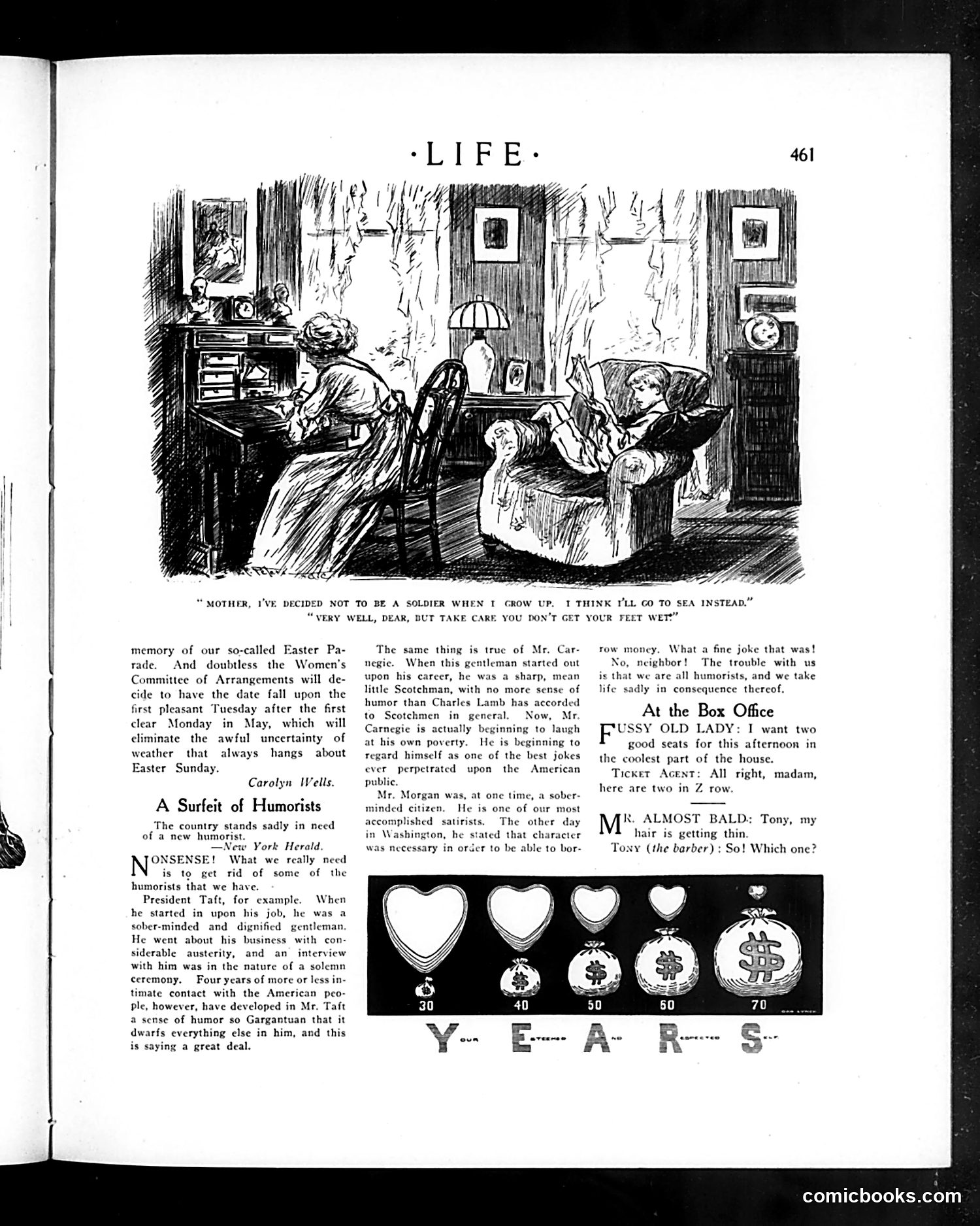
This Life magazine page satirizes prominent American figures who have developed excessive senses of humor, contrary to their earlier reputations. **The Main Essay's Targets:** - **President Taft**: Started as a dignified, austere leader but after four years in office developed an outsized sense of humor that now overshadows his other qualities - **Andrew Carnegie**: Once a shrewd, humorless Scottish businessman; now laughs at his own poverty and views himself as a joke - **J.P. Morgan**: Formerly serious; now a satirist who recently joked about character being necessary to borrow money (ironic given his financial dealings) The satire's point: these powerful men have become too frivolous and humorous, taking life less seriously than they should. The author argues America needs *fewer* humorists, not more. **The cartoons** show unrelated domestic humor: a child rejecting military service for seafaring (with mother's wry response), and a barber's joke about a customer's thinning hair.
📄 Transcribed text from this page (OCR, searchable)
Machine-transcribed from the original scan — historical spelling and the odd misread are preserved.
memory of our so-called Easter Pa- rade. And doubtless the Women's Committee of Arrangements will de- cide to have the date fall upon the first pleasant Tuesday after the first clear, Monday in May, which will eliminate the awful uncertainty of weather that) always hangs about Easter Sunday. Carolyn Wells. A Surfeit of Humorists The country stands sadly in need of a new humor York Herald. ONSENSE! What we really need is to get rid of some of the humorists that we have. President Taft, for example. When he started in upon his job, he was a sober-minded and dignified gentleman. He went about his business with con- siderable austerity, and an’ interview with him was in the nature of a sol ceremony, Four years of more or less i timate contact with the American peo- ple, however, have developed in Mr. Taft a sense of humor so Gargantuan that it dwarfs everything else in him, and this is saying a great deal. MOTHER, I'VE DECIDED NOT TO BE A SOLDIER WHEN I GROW UP. I THINK I'LL GO TO SEA INSTEAD.” “VERY WELL, DEAR, BUT TAKE CARE YOU DON’T GET YOUR FEET WET?” The same thing is truc of Mr. Car- negie. When this gentleman started out upon his carcer, he was a sharp, mean little Scotchman, with no more sense of humor than Charles Lamb has accorded to Scotchmen in gene Now, Mr. Carnegie is actually beginning to laugh at his own poverty. He is beginning to regard himself as one of the best jokes ever perpetrated upon the American public. Mr. Morgan was, at one time, a sober- minded citizen. He is one of our most accomplished satirists. The other day in Washington, he stated that character was necessary in order to be able to bor- 461 el } row money. What a fine joke that was! No, neighbor! The trouble with us is that we are all humorists, and we take life sadly in consequence thereof. I want two At the Box Office 6 F good seats for this afternoon in Y OLD LADY the coolest part of the house. Ticket Acent: All right, madam, here are two in Z row. M* ALMOST BALD::; Tony, my hair is getting thin. Toxy (the barber) :; So! Which one? comicbooks.com