
Life, 1913-03-06 · page 46 of 72
Life — March 6, 1913 — page 46: what you’re looking at
What you’re looking at
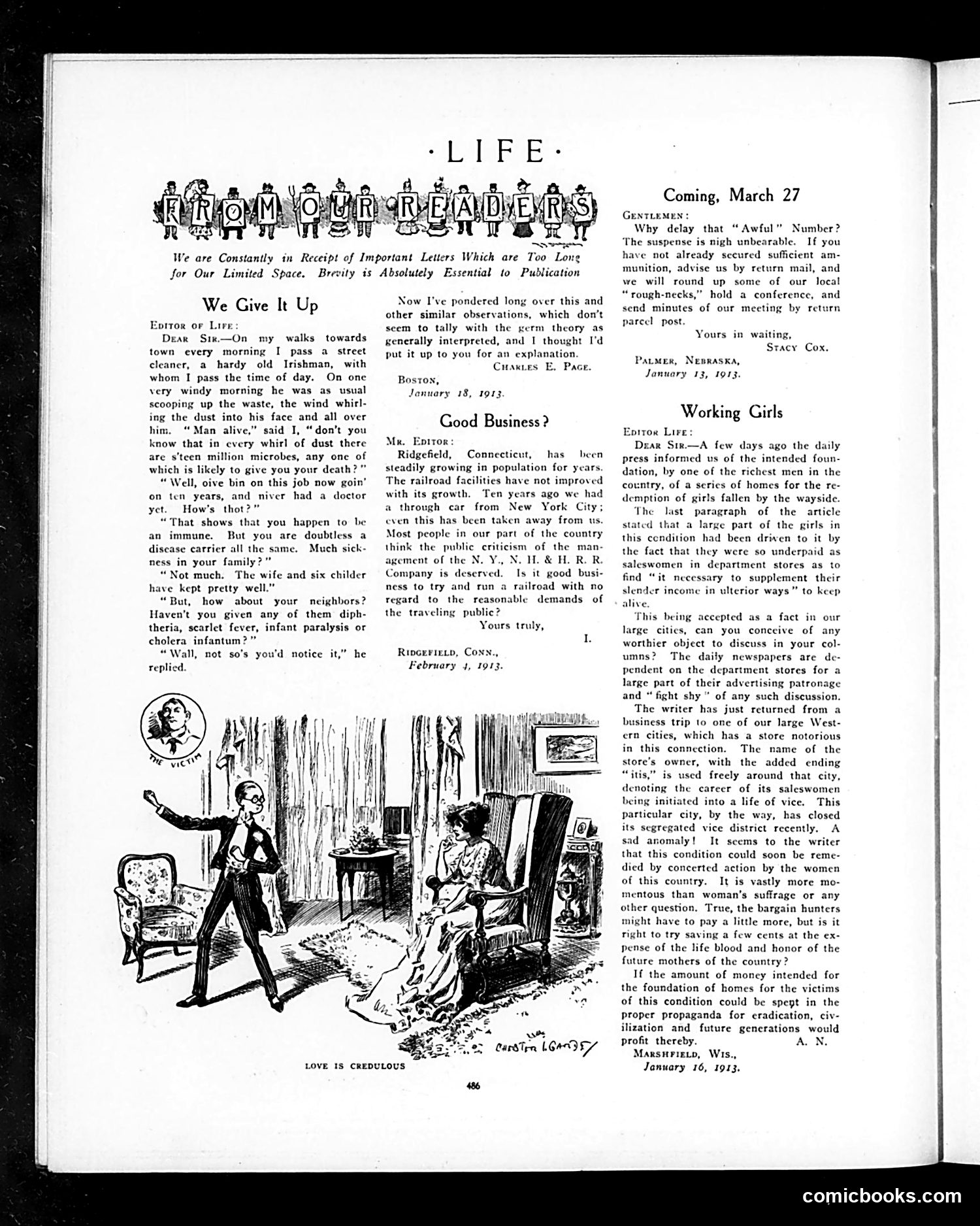
This page features reader letters and one cartoon addressing social concerns of the era. **The cartoon "Love is Credulous"** (bottom) depicts a man gesturing dramatically while a woman sits passively—likely satirizing romantic naïveté or how easily women are deceived by male charm or promises. **The letters discuss:** 1. **Germ theory skepticism**: A reader questions whether microbes actually cause disease, citing a healthy Irish street cleaner's immunity despite exposure. 2. **Railroad service complaints**: A Connecticut resident criticizes the New York, New Haven & Hartford Railroad for removing service despite population growth. 3. **Working girls' exploitation**: A correspondent advocates discussing low department-store wages that force saleswomen into sex work to survive. He notes newspapers won't cover this because stores fund their advertising. One Western city, he observes, recently closed its vice district while these exploitative conditions persist—a "sad anomaly." The "Working Girls" letter represents Progressive Era concerns about labor exploitation and the sex trade, criticizing both inadequate wages and media complicity in ignoring the problem.
📄 Transcribed text from this page (OCR, searchable)
Machine-transcribed from the original scan — historical spelling and the odd misread are preserved.
We are Constantly in Receipt of Important Letters Which are Too Long for Our Limited Space. We Give It Up Eprtor or Lire Dear Six.—On town every morning cleaner, a hardy old Irishman, with whom I pass the time of day. On one very windy morning he was as usual scooping up the waste, the wind whirl- ing the dust into his face and all over him. “ Man alive,” said I, “don’t you know that in every whirl of dust there are s'teen million microbes, any onc of which is likely to give you your death?” “Well, oive bin on this job now goin’ on ten years, and niver had a doctor yet. How's thot?” “That shows that you happen to be an immune. But you are doubtless a disease carrier all the Much sick- ness in your family? “Not much. The wife and six childer have kept pretty well. “But, how about your neighbors? Haven't you given any of them diph- theria, scarlet fever, infant paralysis or cholera infantum? 1, not so’s you'd notice it,” he my walks towards I pass a street ame. replied. Brevity is Absolutely Essential to Publication Now I've pondered long over this and other similar observations, which don’t seem to tally with the germ theory as generally interpreted, and I thought I'd put it up to you for an explanation. Citaxies E. Pace. Bosrox, January 18, 1913. Good Business ? Mr. Eptror Ridgefield, Connecticut, has steadily growing in population for years. The railroad facilities have not improved with its growth. Ten years ago we had a through car from New York City; even this has been taken away from us. Most people in our part of the country think the public criticism of the man- agement of the N. Y., N. H. & H.R. R. Company is deserved. Is it good busi- ness to try and run a railroad with no regard to the reasonable demands of the traveling public? Yours truly, been Rivcerirty, Coxn., February 4, 1913. we Caren LGA} YY LOVE 18 CREDULOUS Coming, March 27 GentLEMEn: Why delay that “Awful” Number? ‘The suspense is nigh unbearable. If you have not already sceured sufficient: am- munition, advise us by return mail, and we will round up some of our local “ rough-necks,” hold a conference, and send minutes of our meeting by return parcel post Yours in waiting, Stacy Cox. Patater, NemrasKa, January 13, 1913. Working Girls Epitox Live: Dear Str.—A few days ago the daily press informed us of the intended foun- dation, by one of the richest men in the country, of a series of homes for the re- demption of girls fallen by the wayside. The last paragraph of the article stated that a large part of the girls in this condition had been driven to it by the fact that they were so underpaid as saleswomen in department stores as find “it ary to supplement their slender income in ulterior ways” to keep nece: alive. This being accepted as a fact in our large cities, can you conceive of any worthier object to discuss in your col- umns? The daily newspapers are de- pendent on the department stores for a large part of their advertising patronage and “fight shy” of any such discussion. The writer has just returned from a business trip to one of our large West- ern cities, which has a store notorious in this connection. The name of the store's owner, with the added ending is used freely around that city, denoting the career of its saleswomen being initiated into a life of vice. This particular city, by the way, has closed its segregated vice district recently, A sad anomaly! It scems to the writer that this condition could soon be reme- died by concerted action by the women of this country. It is vastly more mo- mentous than woman's suffrage or any other question. True, the bargain hunters might have to pay a little more, but is it right to try saving a few cents at the ex- pense of the life blood and honor of the future mothers of the country? If the amount of money intended for the foundation of homes for the victims of this condition could be spept in the Proper propaganda for eradication, civ- ilization and future generations would profit thereby. A. Marsurigip, Wis., January 16, 1913. comicbooks.com