
Life, 1913-03-06 · page 19 of 72
Life — March 6, 1913 — page 19: what you’re looking at
What you’re looking at
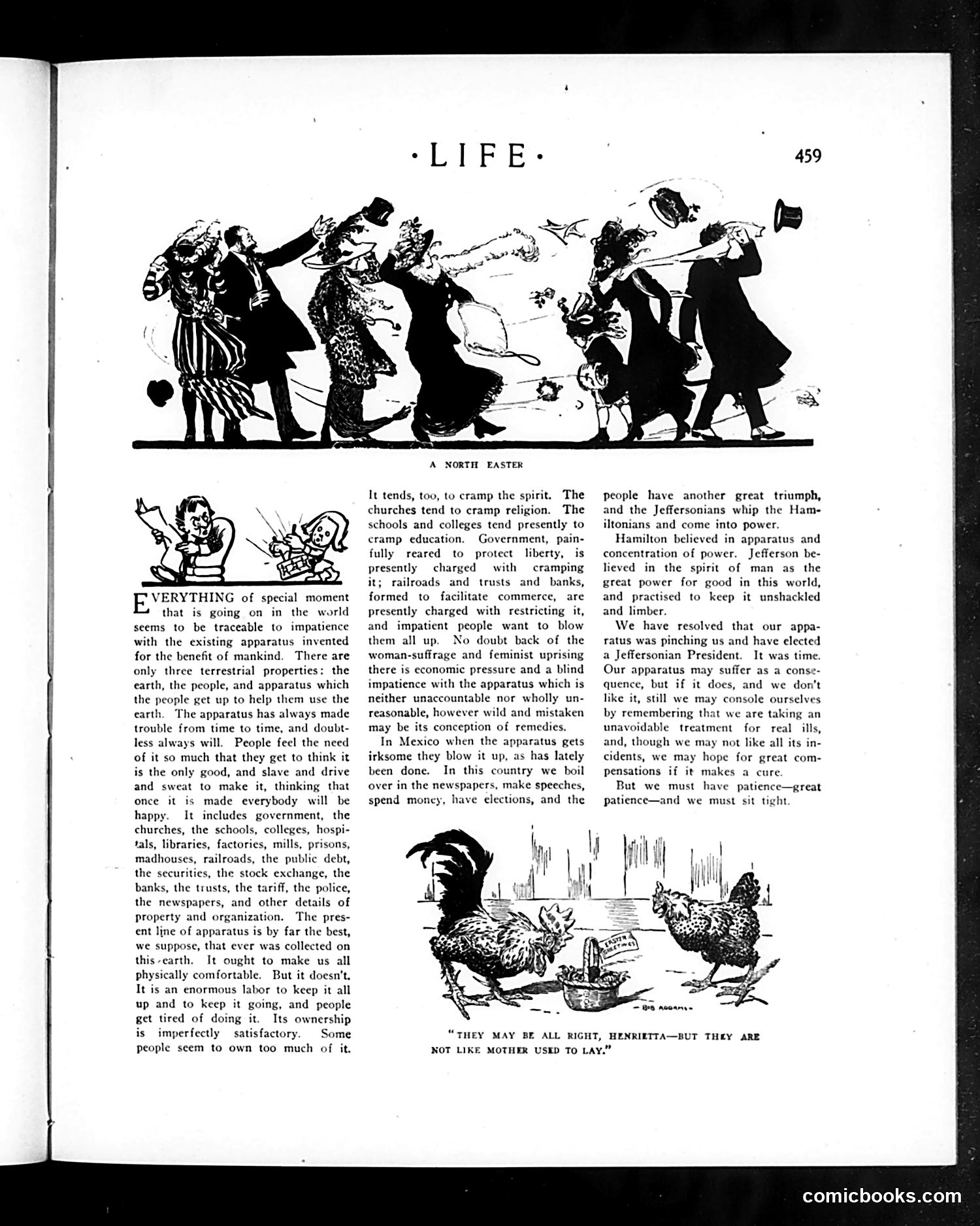
This is a satirical editorial from Life magazine critiquing American impatience with existing institutions. The top illustration shows figures violently attacking various "apparatus" (government, churches, schools, banks, etc.), representing public frustration. The article argues that while these institutions are imperfect and sometimes restrictive, they're necessary and shouldn't be destroyed—referencing Mexico's revolutionary upheaval as a cautionary example. The author contrasts Jefferson's faith in individual liberty against Hamilton's belief in strong institutional apparatus. The lower cartoon shows hens laying eggs, captioned "They may be all right, Henrietta—but they are not like mother used to lay," suggesting nostalgia for the past undermines acceptance of present (inferior but functional) systems. Context: This appears related to early 20th-century progressivism and labor unrest—the text mentions woman-suffrage movements and economic pressure—advocating patience with reform rather than revolutionary destruction of institutions.
📄 Transcribed text from this page (OCR, searchable)
Machine-transcribed from the original scan — historical spelling and the odd misread are preserved.
VERYTHING of special moment that is going on in the world seems to be traceable to impatience with the existing apparatus invented for the benefit of mankind. There are only three terrestrial properties: the earth, the people, and apparatus which the people get up to help them use the earth. The apparatus has always made trouble from time to time, and doubt- less always will. People feel the need of it so much that they get to think it is the only good, and slave and drive and sweat to make it, thinking that once it is made everybody will be happy. It includes government, the churches, the schools, colleges, hospi- tals, libraries, factories, mills, prisons, madhouses, railroads, the public debt, the securities, the stock exchange, the banks, the trusts, the tariff, the police, the newspapers, and other details of property and organization. The pres- ent line of apparatus is by far the best, we suppose, that ever was collected on this-earth. It ought to make us all physically comfortable. But it doesn’t. It is an enormous labor to keep it all up and to keep it going, and people get tired of doing it. Its ownership is imperfectly satisfactory. Some people seem to own too much of it. A NORTH EASTER It tends, too, to cramp the spirit. The churches tend to cramp religion. The schools and colleges tend presently to cramp education. Government, pain- fully reared to protect liberty, is presently charged with cramping it; railroads and trusts and banks, formed to facilitate commerce, are presently charged with restricting it, and impatient people want to blow them all up. No doubt back of the woman-suffrage and feminist uprising there is economic pressure and a blind impatience with the apparatus which is neither unaccountable nor wholly un- reasonable, however wild and mistaken may be its conception of remedies. In Mexico when the apparatus gets irksome they blow it up, as has lately been done. In this country we boil over in the newspapers, make speeches, spend moncy, have elections, and the people have another great triumph, and the Jeffersonians whip the Ham- iltonians and come into power. Hamilton believed in apparatus and concentration of power. Jefferson be- lieved in the spirit of man as the great power for good in this world, and practised to keep it unshackled and limber. We have resolved that our appa- ratus was pinching us and have elected a Jeffersonian President. It was time. Our apparatus may suffer as a con quence, but if it does, and we don't like it, still we may console ourselves by remembering that we are taking an unavoidable treatment for real ills, and, though we may not like all its in- cidents, we may hope for great com- pensations if it makes a cure. But we must have patience—great patience—and we must sit tight “THEY MAY BE ALL RIGHT, HENRIETTA—BUT THEY ARE NOT LIKE MOTHER USED TO LAY.” comicbooks.com