
A complete issue · 76 pages · 1910
Life — April 7, 1910
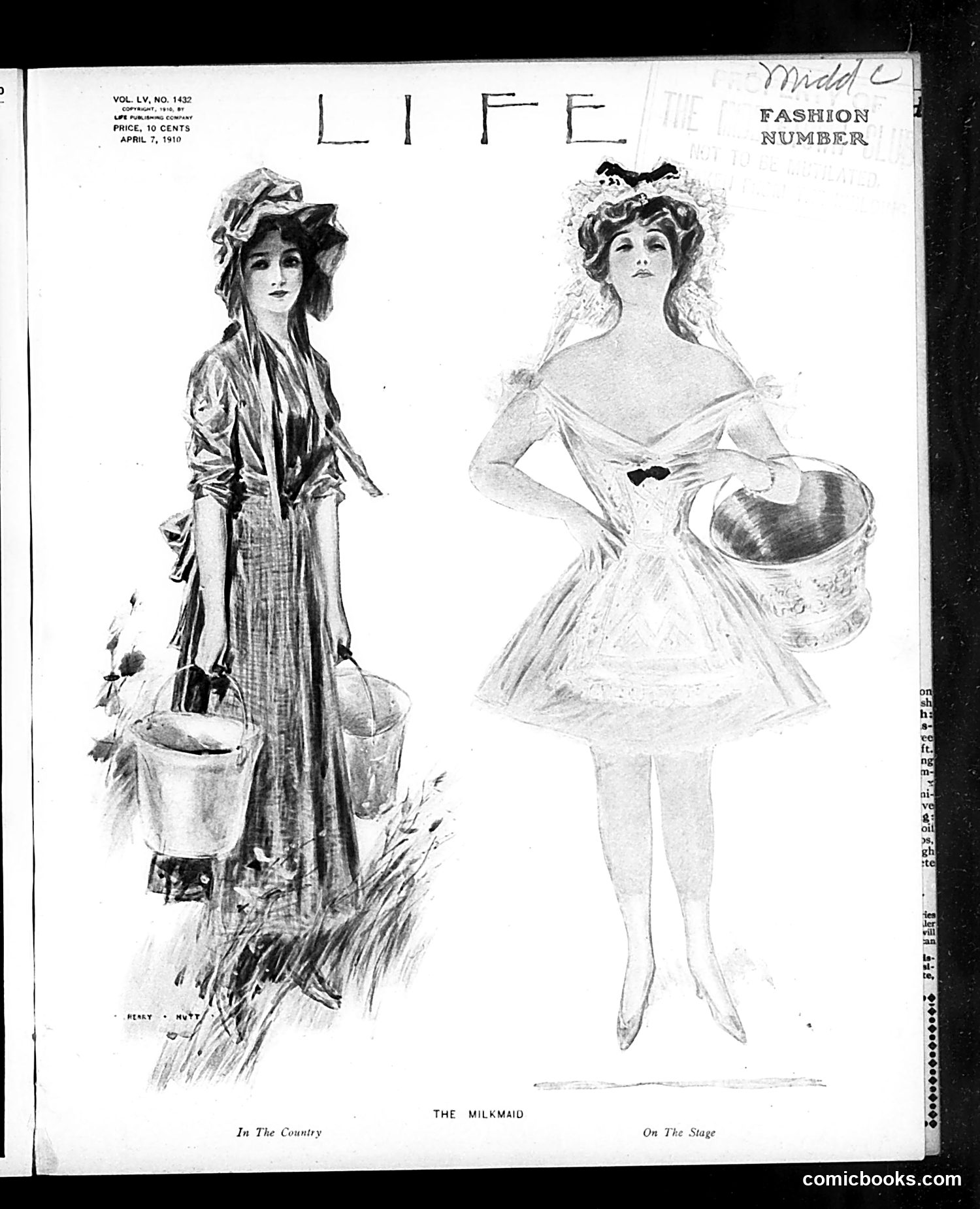
This fashion satire contrasts two versions of "The Milkmaid" archetype. The left figure shows a practical country milkmaid in work clothes with a bonnet, carrying actual milk buckets—realistic farm labor attire. The right depicts a theatrical or stage version: an elegant woman in a fashionable off-shoulder dress with decorative bow, also holding a bucket but styled as glamorous costume rather than functional wear. The joke satirizes the gap between rural reality and theatrical fantasy—how stage productions romanticize and glamorize working-class life. By labeling them "In The Country" versus "On The Stage," Life mocks both the artificiality of theater and perhaps the fashionable urban audience's sentimental fantasies about rustic simplicity. It's gentle social commentary on class performance and theatrical convention.
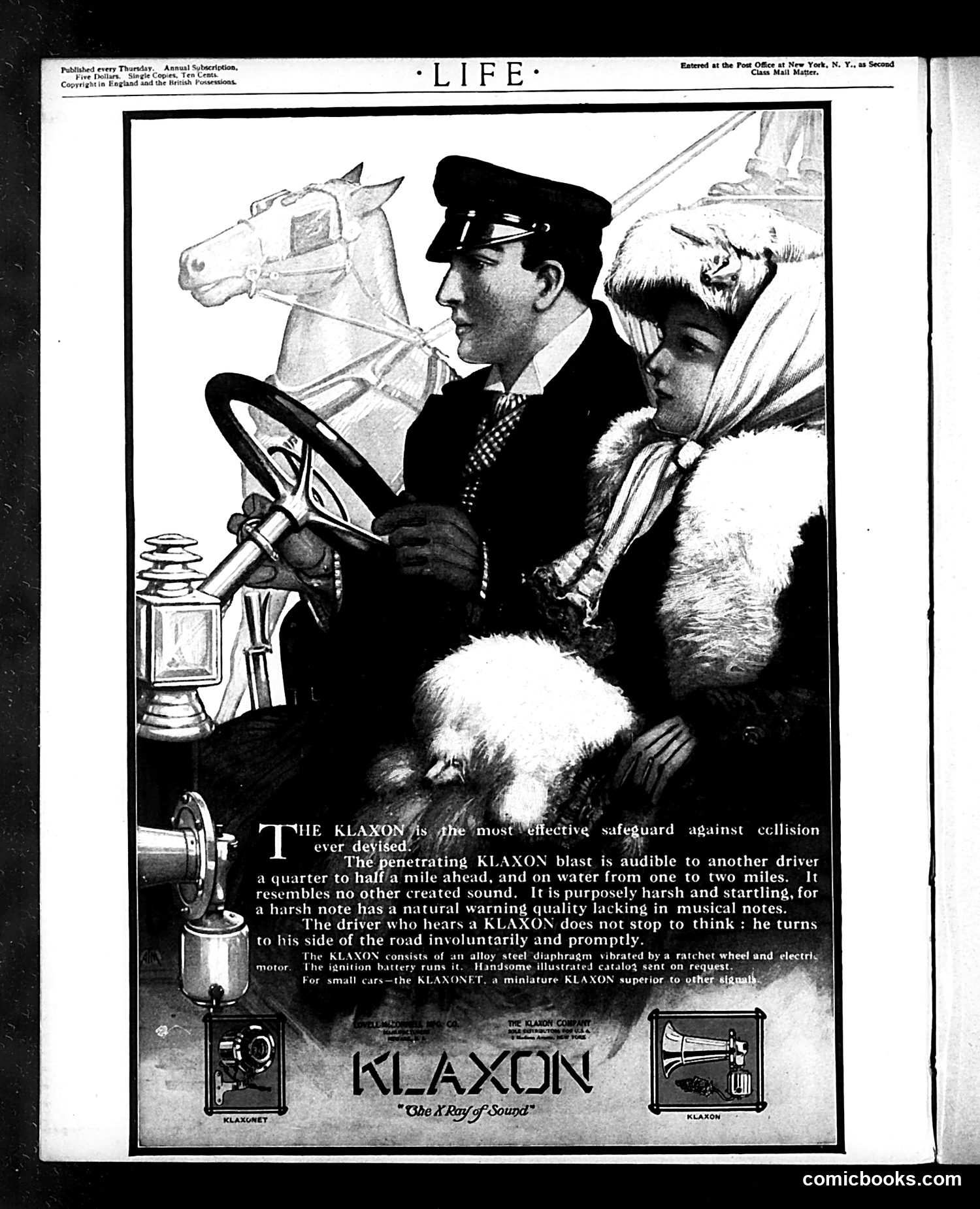
This page is primarily **advertising**, not satire or political commentary. It promotes the Klaxon, an automobile safety horn device from the early automotive era. The illustration shows two well-dressed people in a car with a horse-drawn carriage ahead, depicting a collision-avoidance scenario. The Klaxon's selling point was its loud, distinctive warning sound—audible a quarter to half-mile away—designed to alert other drivers and pedestrians. The text emphasizes the horn's effectiveness as "the most effective safeguard against collision ever devised," noting its harsh, startling quality made it recognizable and attention-grabbing. This reflects early 1900s concerns about road safety as automobiles proliferated alongside horse-drawn traffic, creating genuine collision hazards.
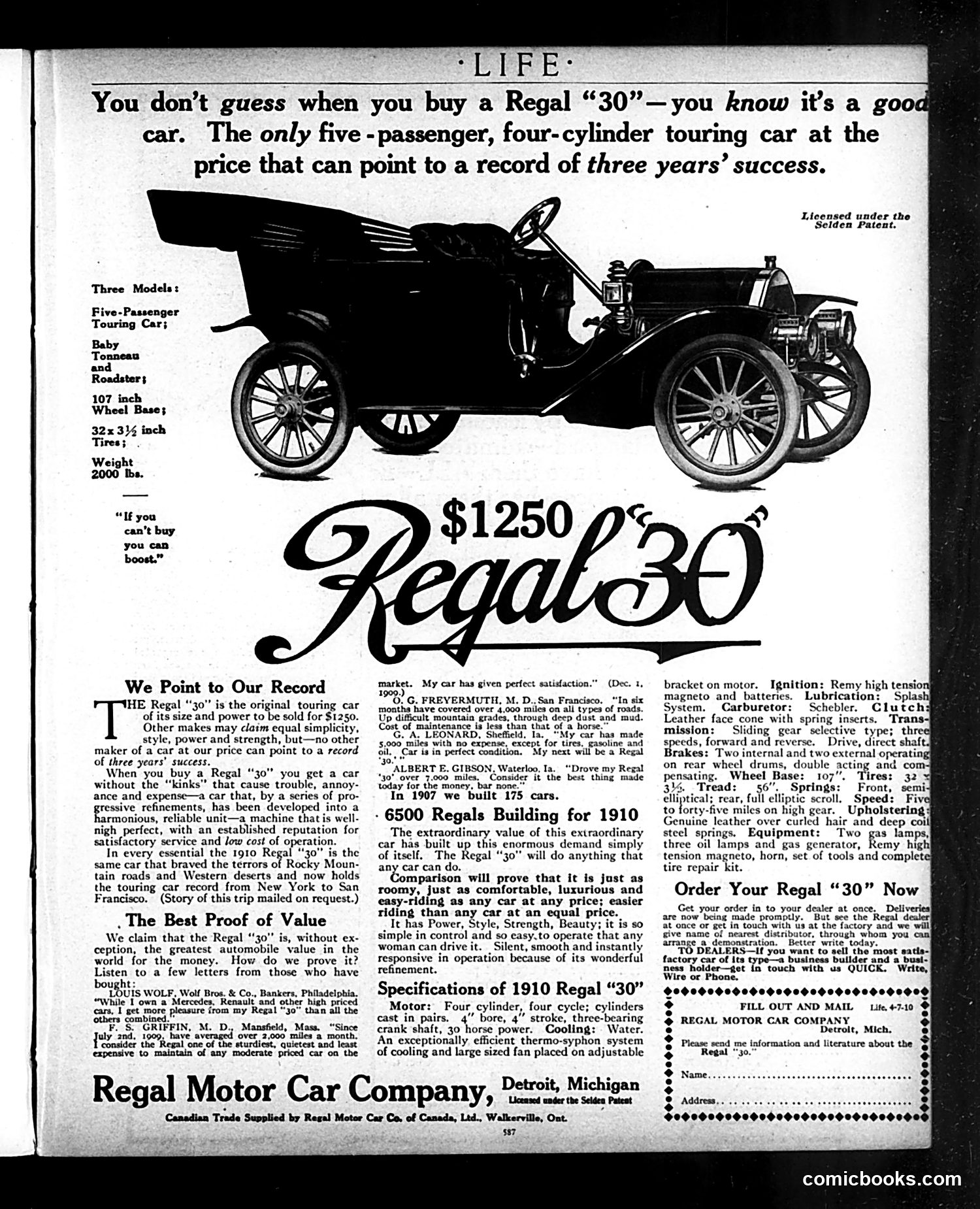
This page is primarily a **product advertisement**, not satire or political commentary. It promotes the Regal "30" automobile, priced at $1,250, manufactured by the Regal Motor Car Company of Detroit, Michigan. The ad emphasizes the car's value and reliability through customer testimonials and specifications. The key sales pitch is that it's "the only five-passenger, four-cylinder touring car at the price that can point to a record of three years' success." The design shows a side-view illustration of an open-top early 1900s touring car with spoke wheels. The advertisement includes technical specifications, customer quotes praising the vehicle's performance and durability, and a mail-in coupon for interested buyers. There is no political cartoon or satirical content on this page—it is straightforward automotive marketing from the early 20th century.
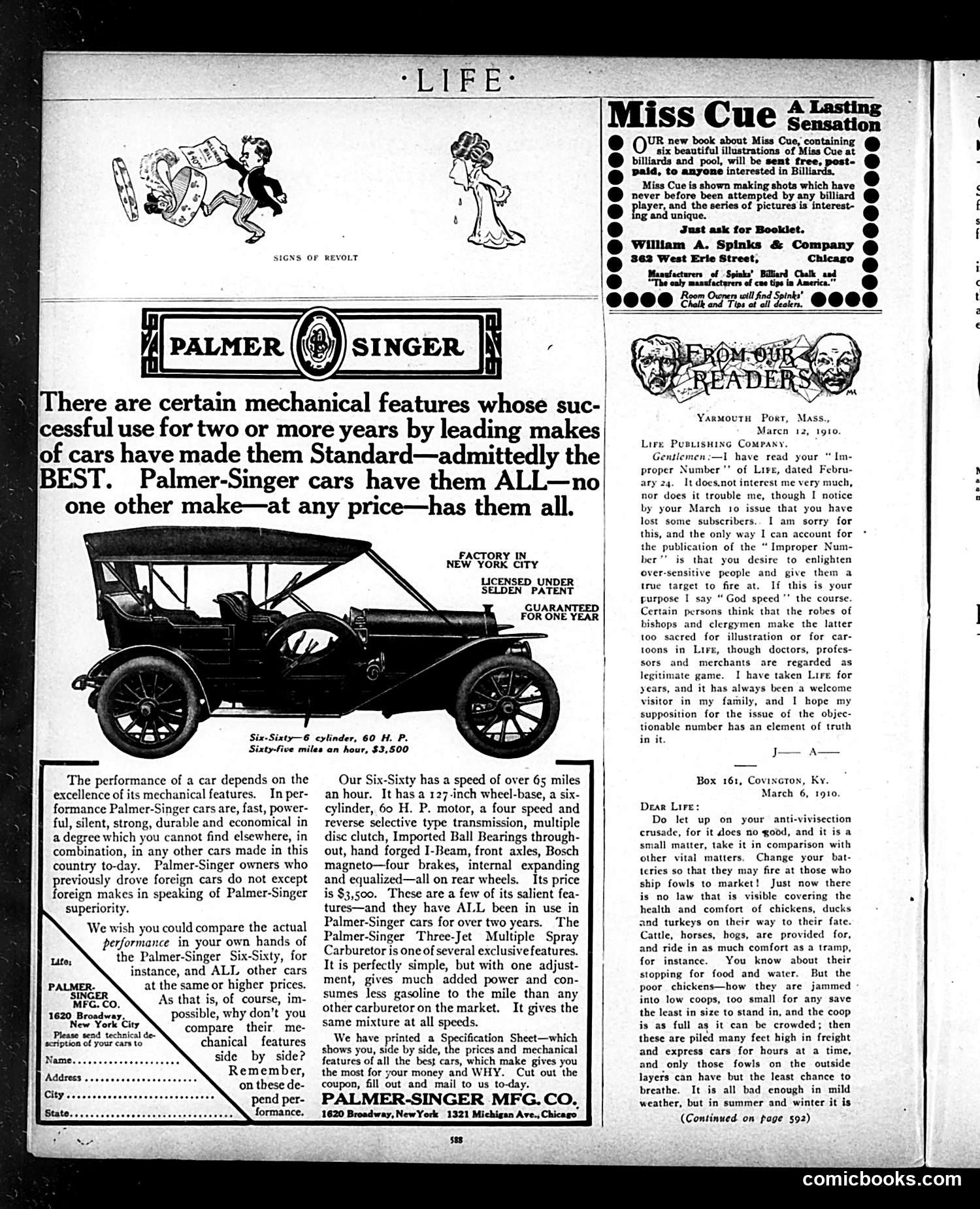
The small cartoon titled "SIGNS OF REVOLT" shows figures in animated, exaggerated poses appearing to gesture wildly or lose control. Without clearer detail, the specific political reference is unclear, but the title suggests it depicts social unrest or rebellion of the period. The page is primarily **advertising**: a large Palmer-Singer automobile ad dominates, promoting the "Six-Sixty" model with technical specifications and performance claims. Below are reader letters complaining about Life magazine's content—one objecting to "anti-vivisection crusade" and another criticizing religious satire in the publication. The "Miss Cue" ad advertises billiards-related materials. The overall page reflects early 1910s commercial magazine culture mixed with reader feedback about editorial choices.
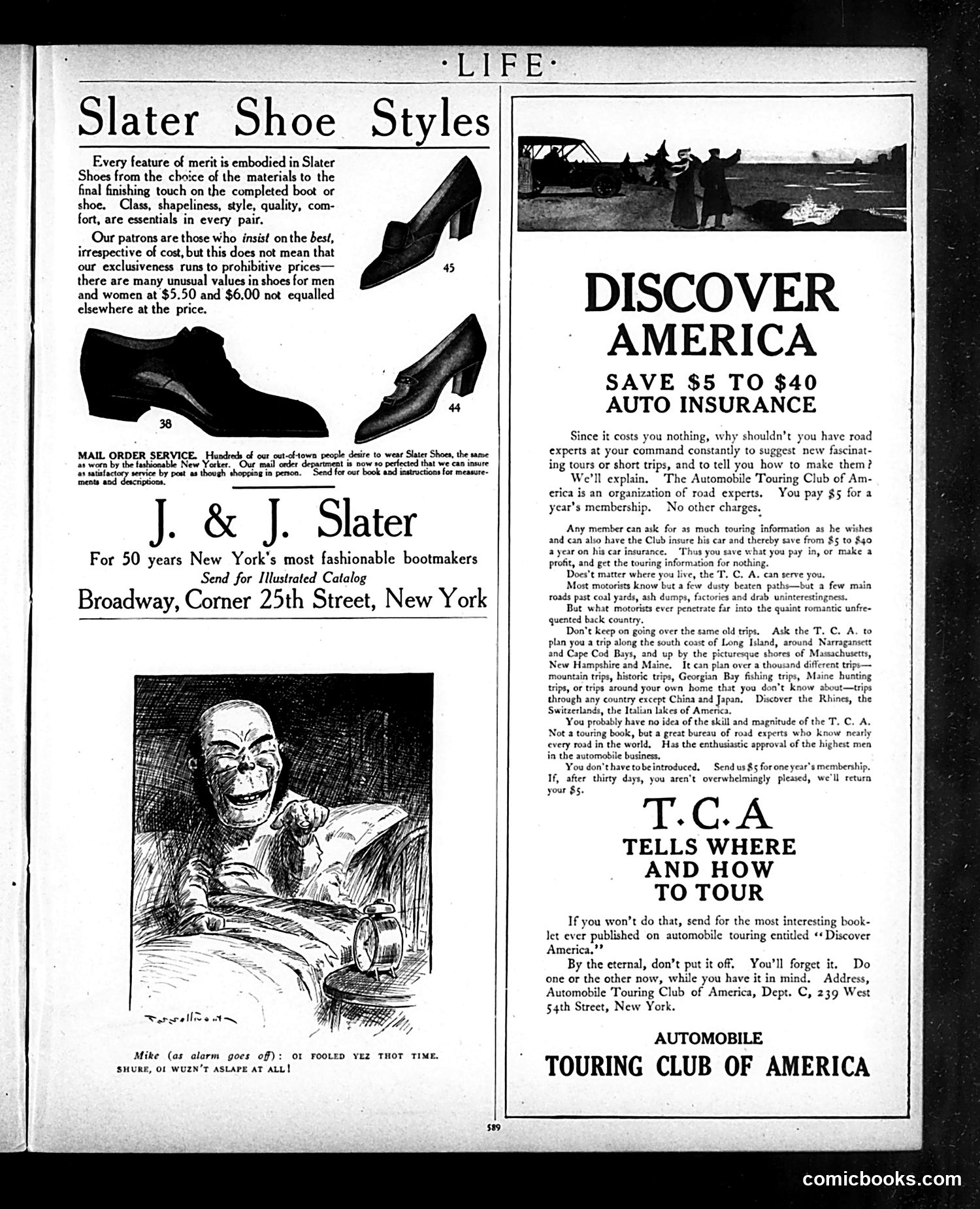
This page is primarily **advertising** rather than editorial satire. The left side advertises **J. & J. Slater** shoes (Broadway, NYC), emphasizing quality and value at $5.50-$6.00. The illustration shows shoe styles numbered 38, 44, and 45. Below is a humorous sketch captioned "MIKE (as alarm goes off): 'OI FOOLED YEZ THOT TIME, SHURE, OI WUZN'T ASLEEP AT ALL!'" The cartoon depicts a man claiming he wasn't sleeping despite an alarm—a generic joke about pretending to be awake, likely with ethnic Irish stereotyping suggested by the dialect. The right side advertises the **Automobile Touring Club of America**, promoting road trips and insurance savings ($5-$40). The page contains no significant political or historical references—it's a straightforward commercial publication mixing product ads with light humor.
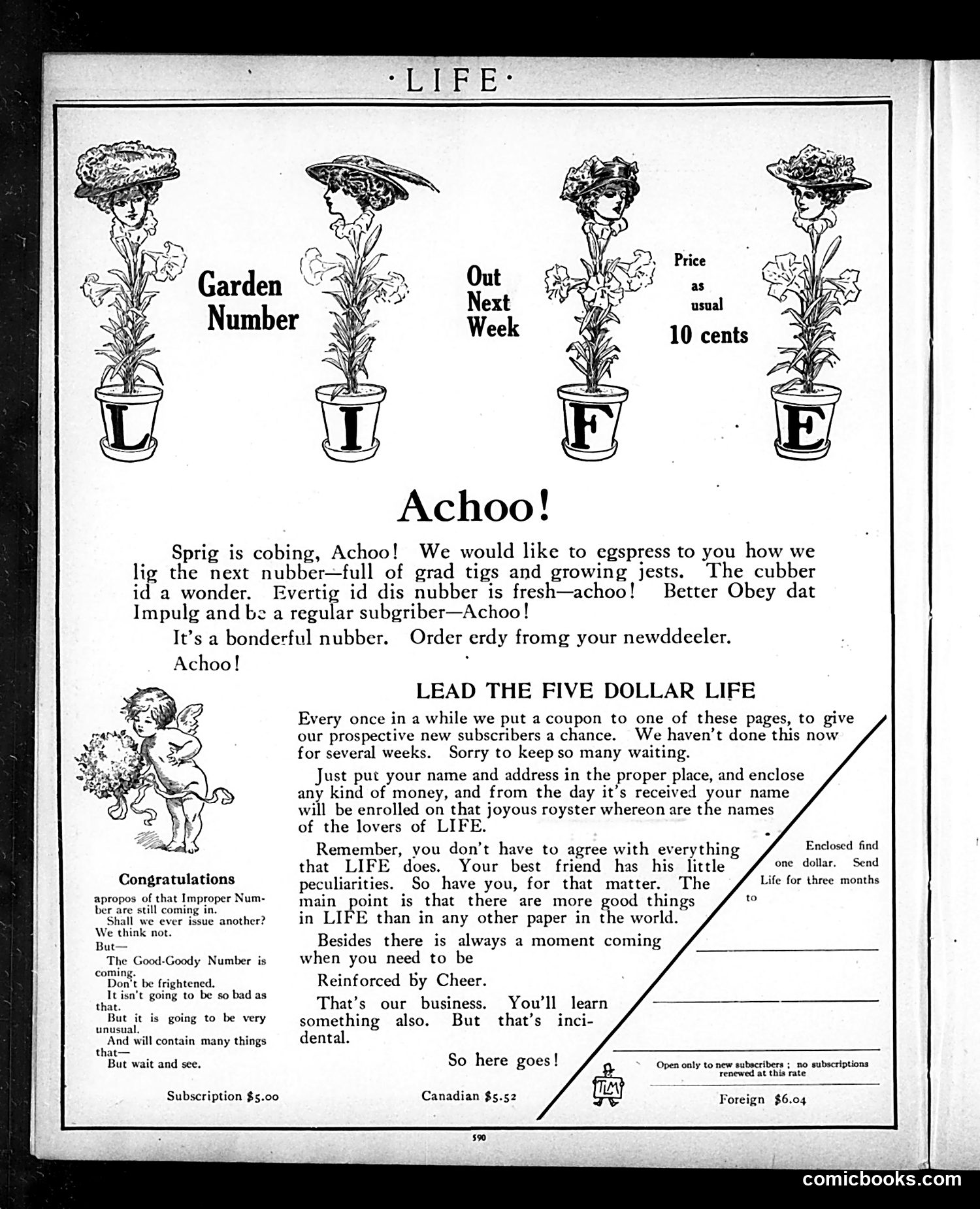
This page is primarily **advertising and promotional content** for Life magazine itself, not political satire. The top section advertises an upcoming "Garden Number" issue (priced at 10 cents), featuring decorative illustrations of potted flowering plants with women's faces/hats. The main text uses deliberately archaic, playful slang ("Achoo!" "Sprig is cobing") to promote the magazine with humor. It invites new subscriptions, offering a three-month trial for one dollar. The section "Congratulations" mentions an "Improper Number" was previously published and teases an upcoming "Good-Goody Number" as something unusual and noteworthy. A cupid illustration appears alongside subscription information. This is essentially **house advertising**—Life promoting itself to potential subscribers—rather than satirical commentary on external political or social events.
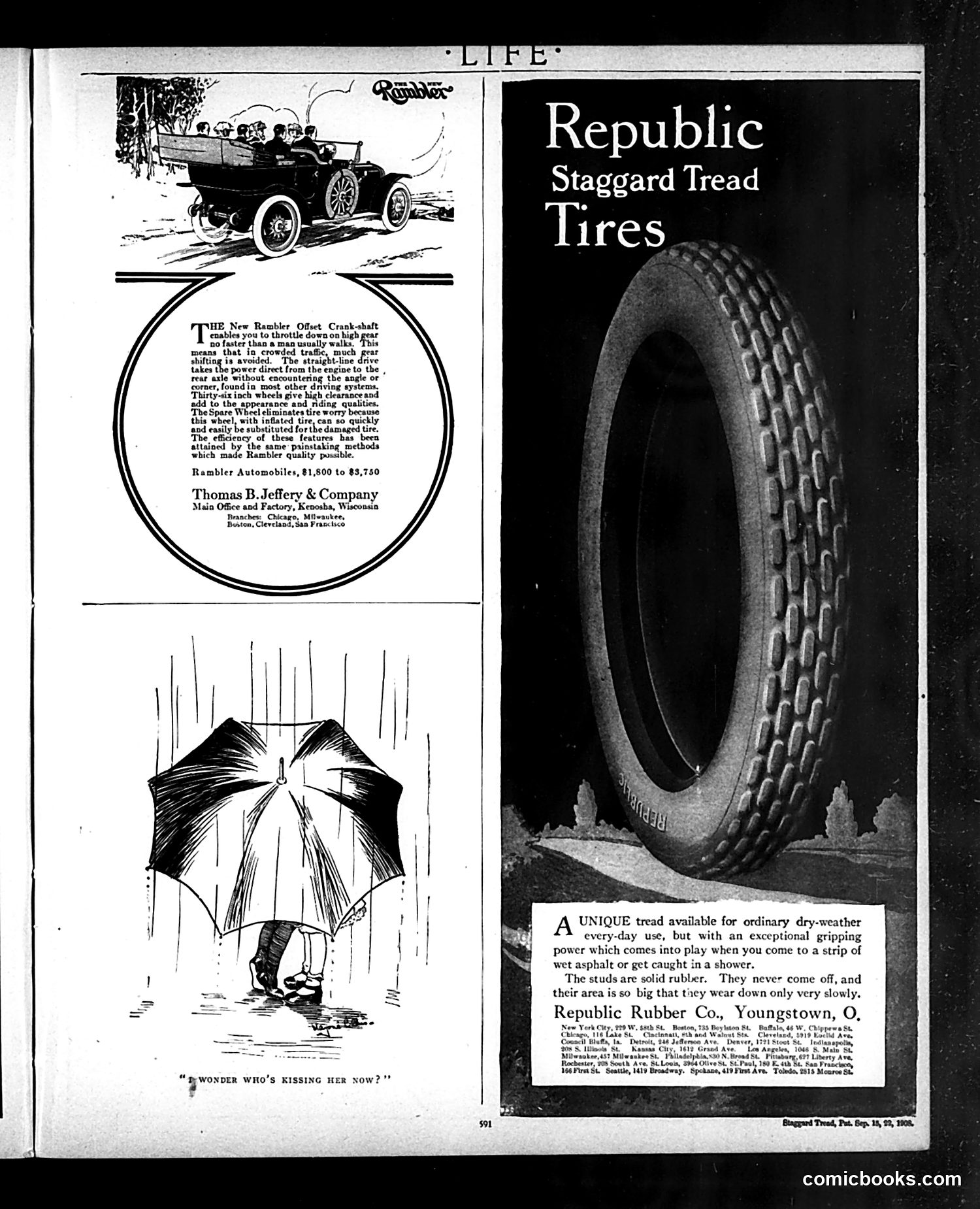
This page contains two separate advertisements rather than political satire. **Left side:** A Rambler automobile ad from Thomas B. Jeffery & Company, highlighting the vehicle's offset crackshaft that allows faster speeds. Below is an unrelated cartoon captioned "Wonder Who's Kissing Her Now?" showing a couple under an umbrella in the rain—likely a humorous illustration rather than political commentary. **Right side:** A Republic Staggard Tread Tires advertisement featuring a large tire photograph. The copy emphasizes the tire's unique tread pattern for wet and dry conditions, with solid rubber studs that don't wear away. Both advertisements represent typical early-1900s Life magazine content, mixing automotive and product promotions with light humor. The "Wonder Who's Kissing Her Now?" caption appears to be a playful reference to romantic circumstances rather than political satire.
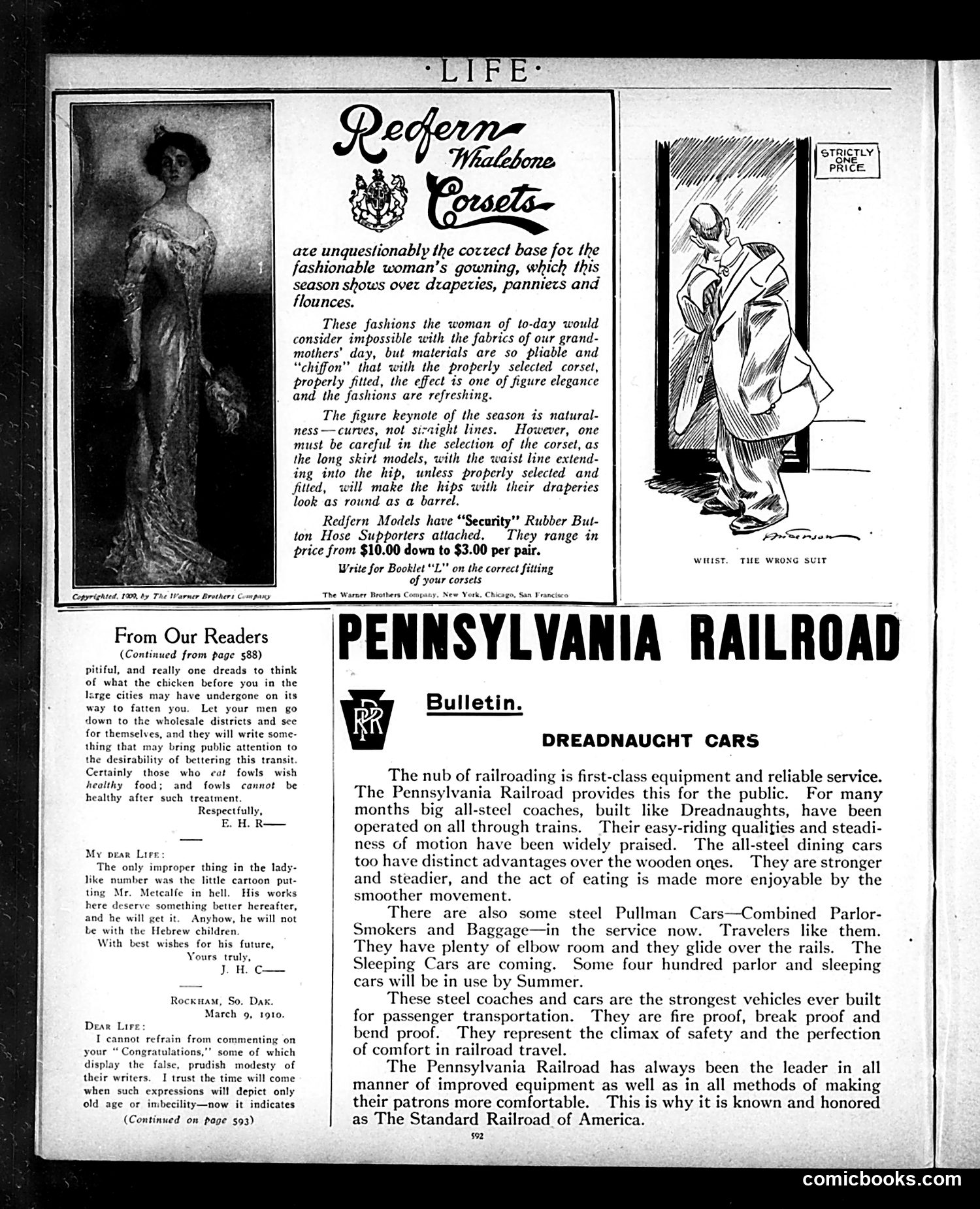
This page is primarily **advertising and reader correspondence**, not political satire. The top half features a **Redfern Whalebone Corsets advertisement** showing an elegantly dressed woman. The ad emphasizes that proper corset construction creates fashionable silhouettes while maintaining "natural" curves rather than "straight lines." Below are **reader letters** about various topics, including one discussing proper treatment of poultry and another praising Hebrew children's education. The bottom half is a **Pennsylvania Railroad bulletin** promoting their new Dreadnaught steel passenger cars, emphasizing safety features (fire-proof, break-proof) and comfort improvements over wooden coaches. This is corporate advertising rather than satire. The cartoonish sketch labeled "Whist: The Wrong Suit" appears to be a humorous illustration unrelated to political commentary.
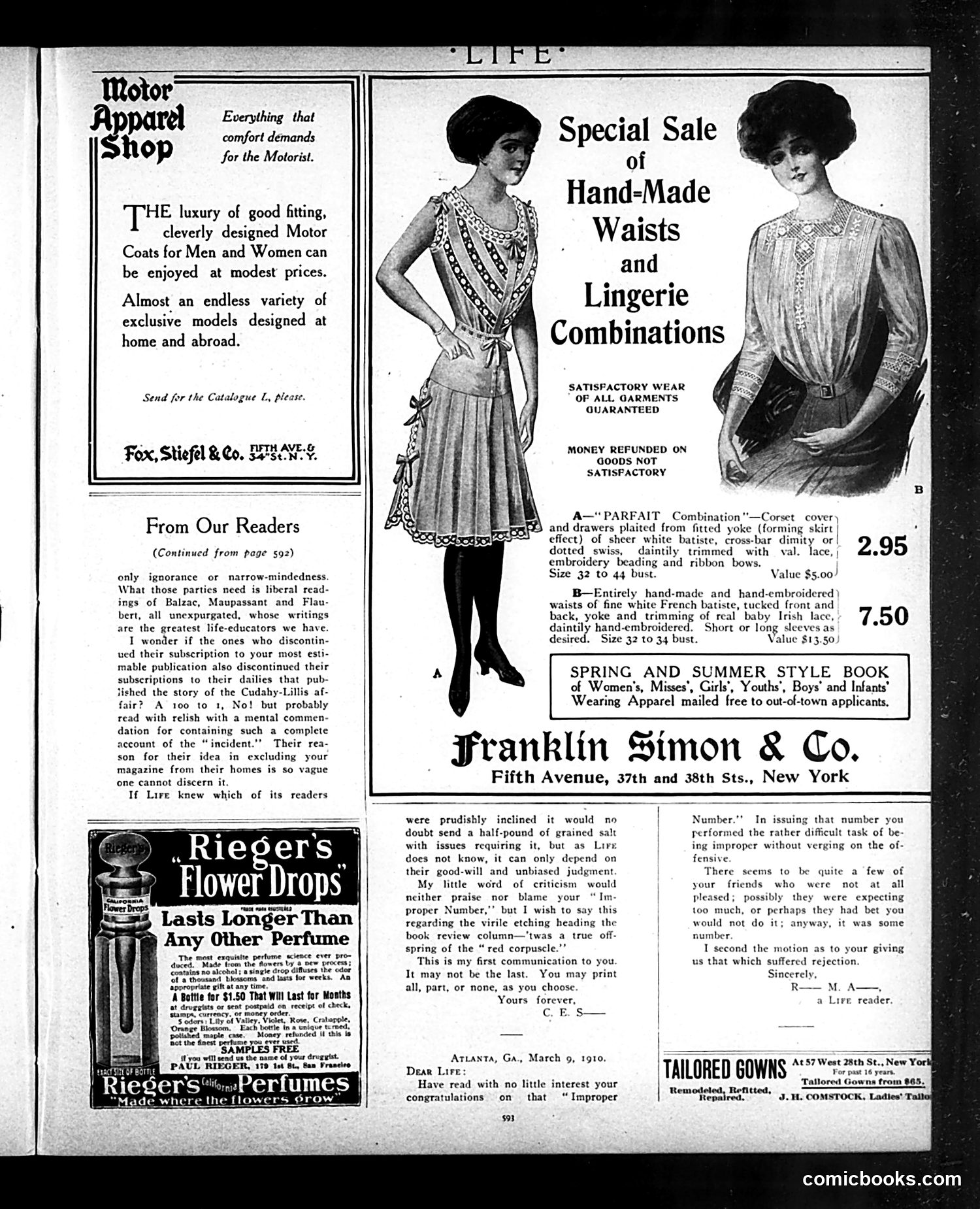
This page is primarily **advertising**, not political satire. It contains: 1. **Motor Apparel Shop** ad (top left): promoting motor coats for men and women 2. **Franklin Simon & Co.** (center): a major fashion advertisement featuring hand-made waists and lingerie combinations with prices ($2.95-$7.50) 3. **Rieger's Flower Drops** perfume ad (bottom left) 4. **"From Our Readers"** (left column): reader letters to *Life* magazine, including one critical letter about the magazine's coverage The reader letters section contains mild editorial commentary rather than satire. One correspondent criticizes *Life's* treatment of a particular topic, suggesting the magazine wasn't comprehensive enough. This is essentially a fashion and merchandise page from an early 20th-century magazine, with minimal satirical content.
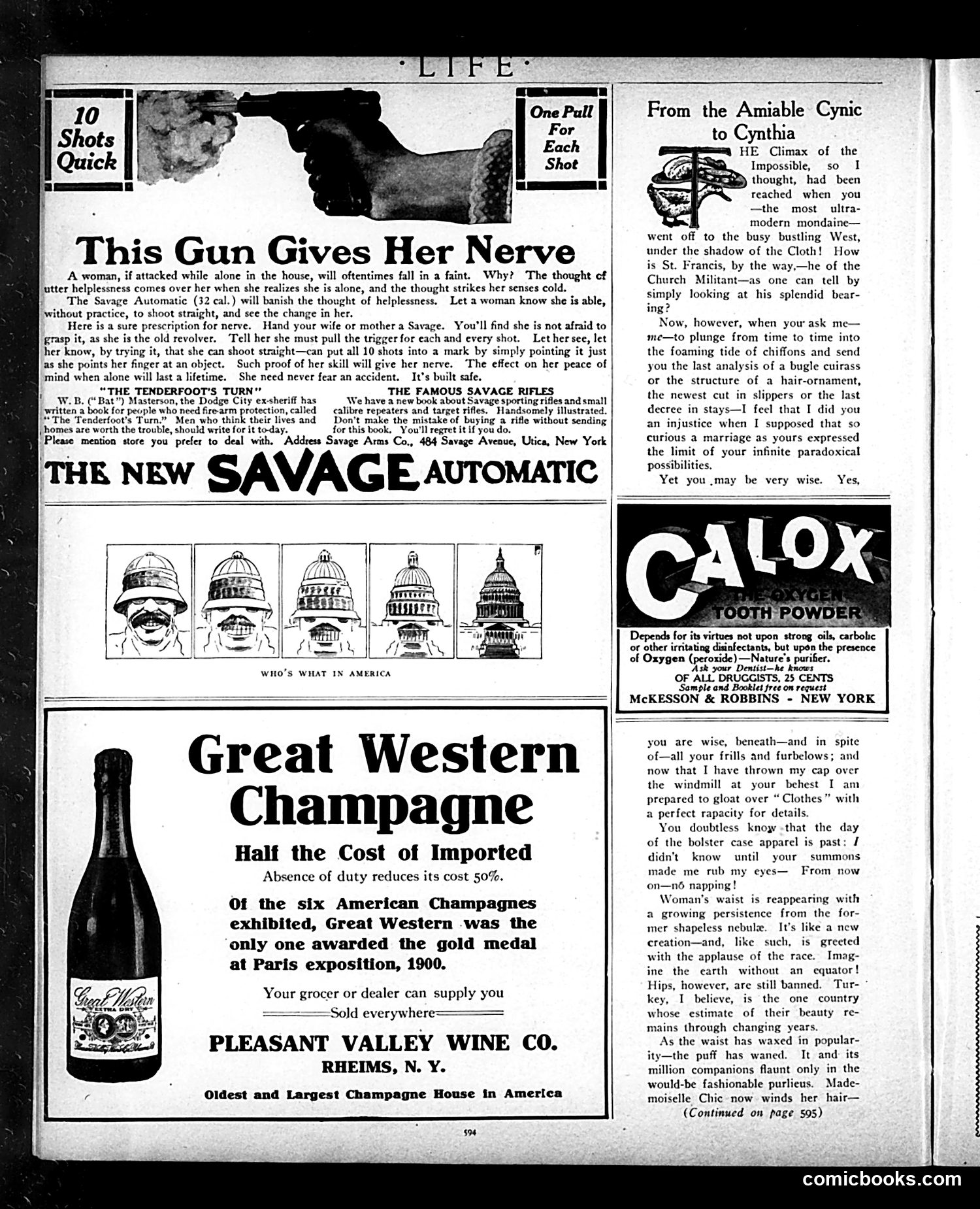
This page is primarily **advertising**, with one notable cartoon element. The main advertisement features the "New Savage Automatic" firearm, marketed to women with the tagline "This Gun Gives Her Nerve." The ad copy encourages women to learn shooting and emphasizes how firearm ownership would boost their confidence and independence. Below the gun ad appears a cartoon labeled "WHO'S WHAT IN AMERICA," showing five identical Capitol building domes stacked vertically over simplified male faces—likely satirizing American politicians as interchangeable or indistinguishable from one another. The page also includes ads for Calox toothpaste and Great Western Champagne. The satirical column "From the Amiable Cynic to Olympia" discusses fashion and social trends rather than politics.
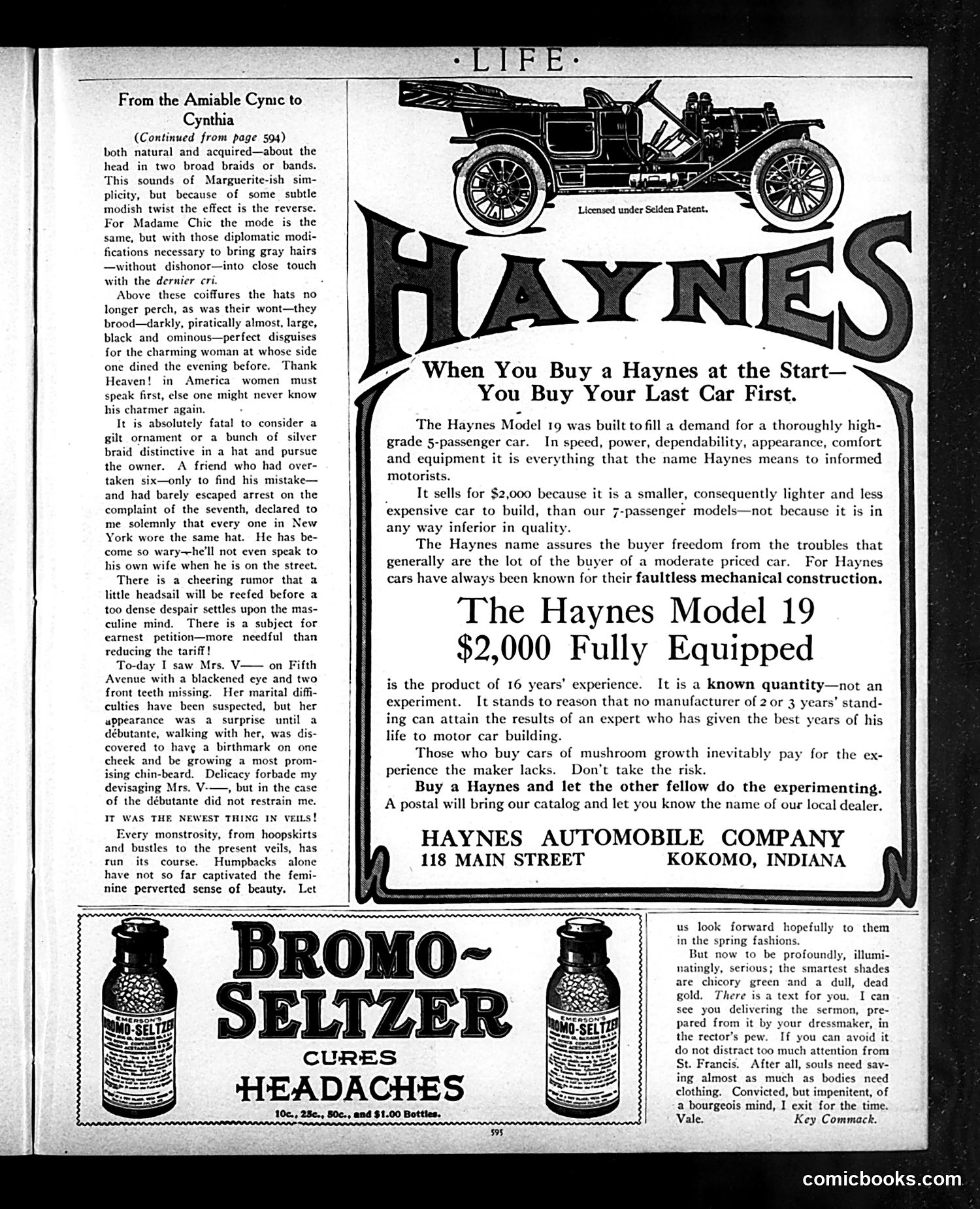
This page is primarily **advertising**, not satire or political commentary. It contains two main advertisements: 1. **Haynes Automobile Company** (large ad, center/right): Promotes the Model 19 car at $2,000, emphasizing reliability and value. The copy claims 16 years of manufacturing experience and contrasts their "known quantity" against experimental competitors—a sales pitch suggesting Haynes cars are proven while others are unreliable. 2. **Bromo-Seltzer** (bottom): A medicine advertisement claiming to cure headaches, with two product bottles shown. The left column appears to be a **society gossip column** ("From the Amiable Cynic to Cynthia"), discussing fashion and social observations about hats and women's accessories—typical Life magazine content of this era, not political satire.
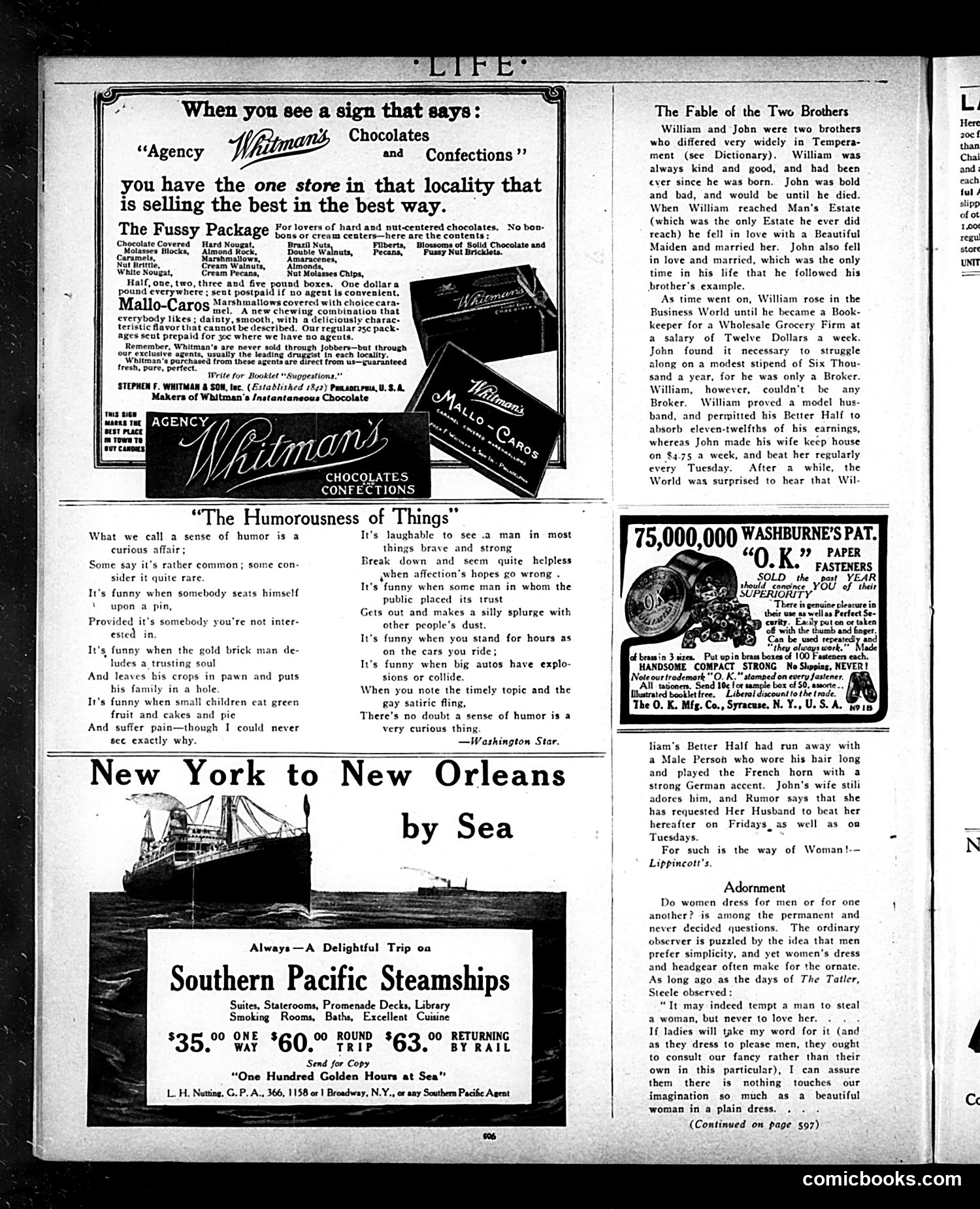
This page is primarily **advertising and light editorial content** rather than political satire. The main elements include: 1. **Whitman's Chocolates ad** - promoting their "Agency" stores and packaging options 2. **"The Fable of the Two Brothers"** - a morality tale contrasting William (a successful businessman/bookkeeper) with John (who married for love but struggled financially). The story illustrates period anxieties about balancing romantic ideals with economic responsibility. 3. **Travel advertisements** - Southern Pacific Steamships promoting New York-to-New Orleans voyages 4. **"The Humorousness of Things"** - a light essay on humor, attributed to the *Washington Star* 5. **"Adornment"** essay - discussing women's fashion choices and motivations The page reflects early 20th-century values: financial prudence, gender roles, and consumer culture, but contains no discernible political cartoons or sharp social satire.
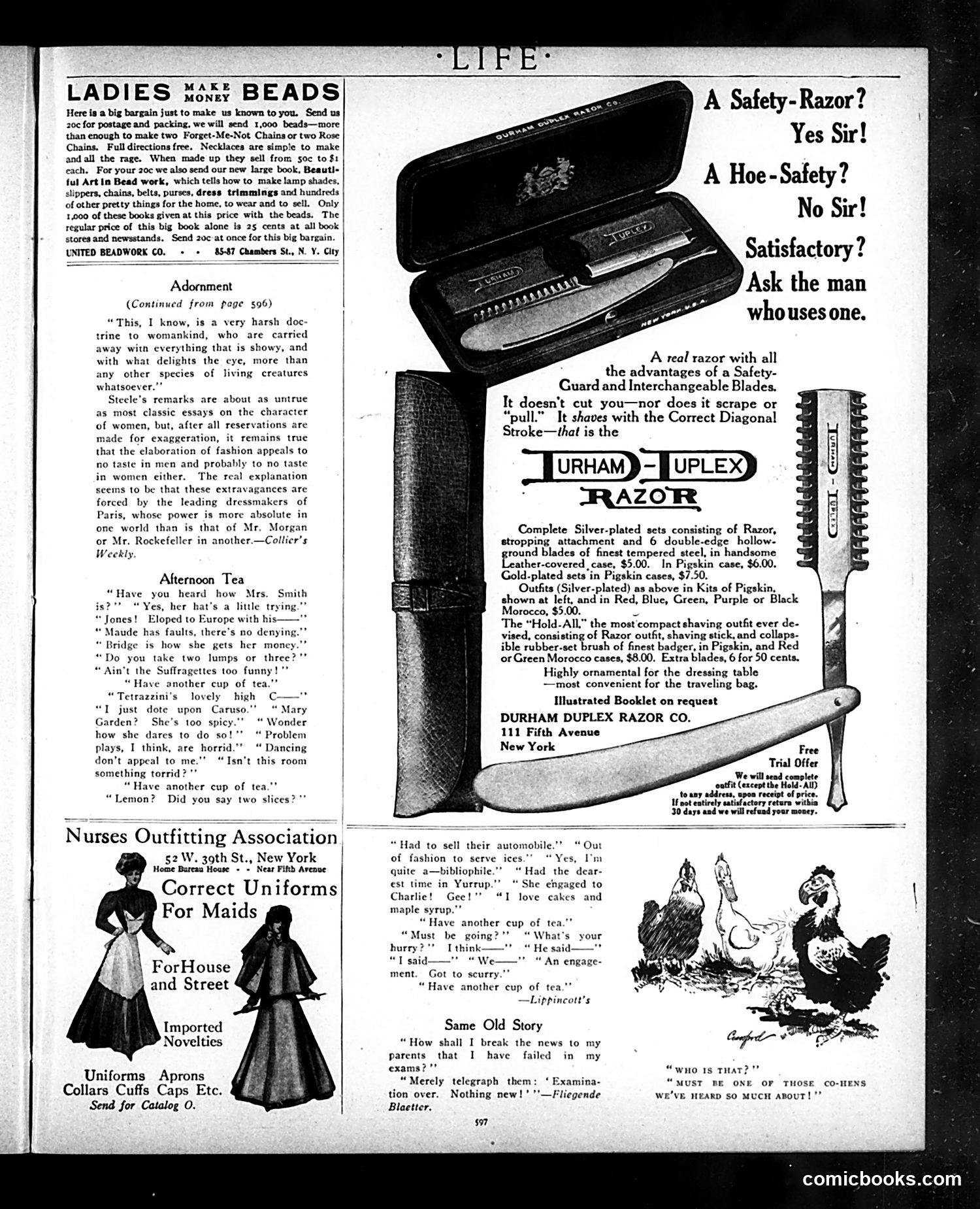
This is primarily an **advertising page** from Life magazine, featuring commercial notices rather than political cartoons. The main content includes: 1. **"Ladies Make Beads"** - A work-from-home opportunity ad promising income from bead-making 2. **Durham-Duplex Razor ad** - Promoting a safety razor with interchangeable blades 3. **Nurses Outfitting Association ad** - Offering uniforms and novelties for domestic workers 4. **"Afternoon Tea" and "Same Old Story"** - Light humor pieces about gossip and social mishaps The small illustration at bottom right shows women discussing "co-hens" (likely a pun on "co-owners" or similar), but it's minor satirical filler rather than substantial commentary. The page reflects **early 20th-century consumer culture**, targeting primarily female readers with domestic/beauty products and modest income opportunities.
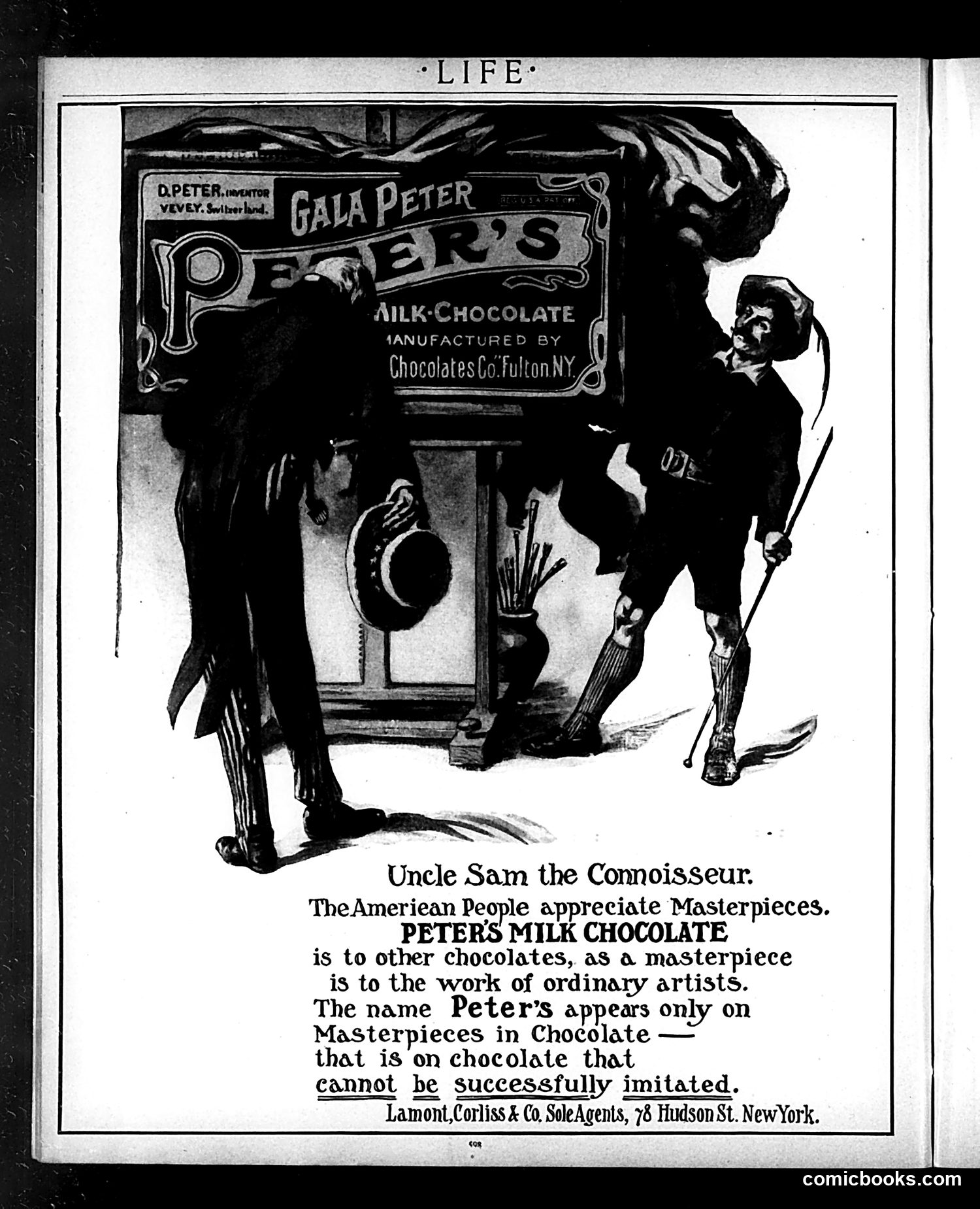
This is primarily a **product advertisement** for Peter's Milk Chocolate, not political satire. The illustration depicts "Uncle Sam" (the tall figure in formal dress representing America) as a connoisseur examining a chocolate box, with what appears to be a smaller figure (possibly representing a competitor or inferior product) nearby. The ad employs nationalist appeals common in early American advertising: it flatters American consumers' taste and judgment by comparing Peter's chocolate to fine art masterpieces. The message suggests that discerning American people recognize superior quality and that Peter's brand is the authentic, inimitable choice—implicitly distinguishing it from cheaper imitators. The visual metaphor of Uncle Sam as a refined judge of quality was designed to associate the product with American excellence and patriotic values, encouraging consumers to view Peter's chocolate as a mark of good taste and national pride.
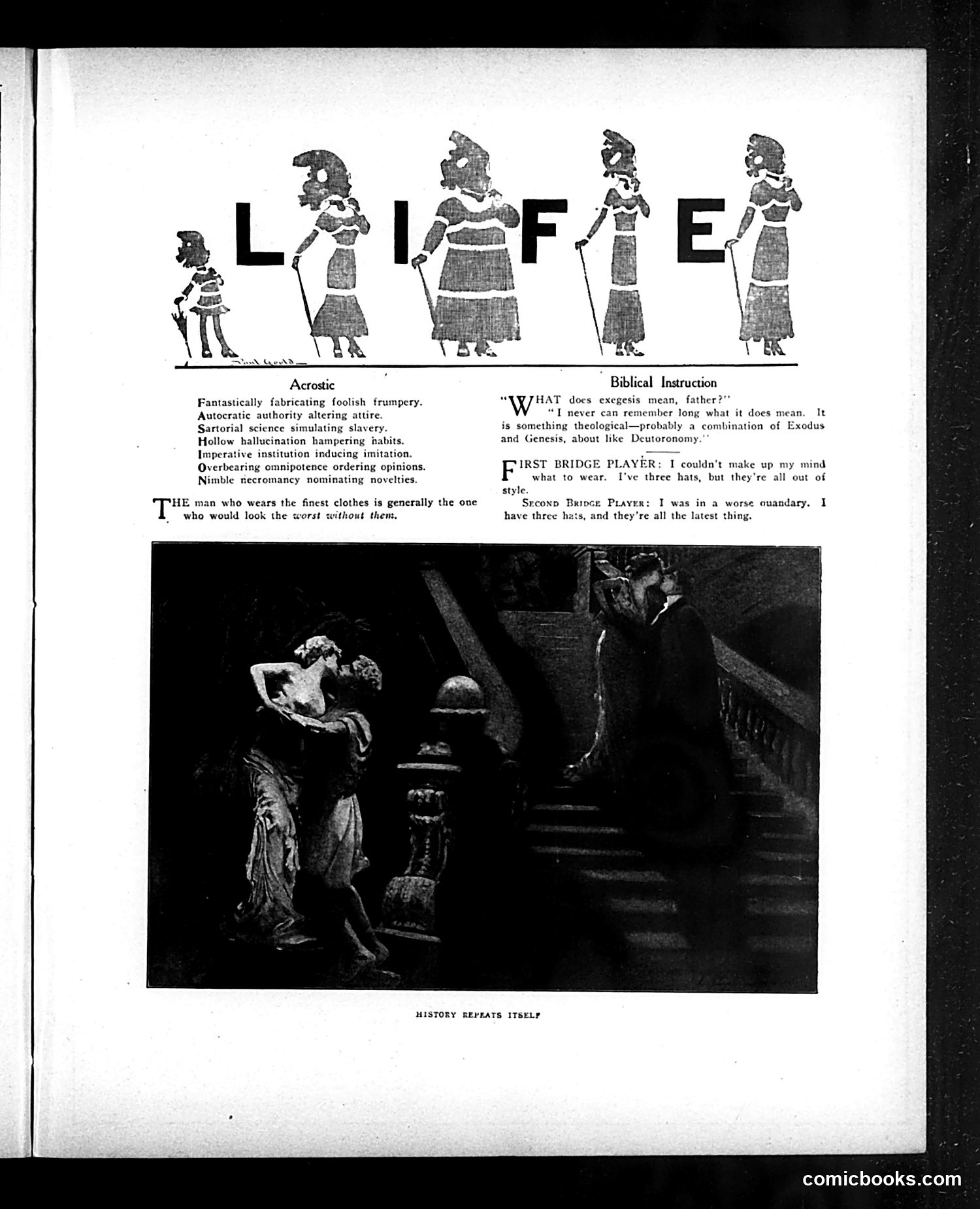
This page satirizes **fashion obsession and its social pressures** in early 20th-century America. The top illustration titled "LIFE" depicts women's fashion evolution, with an acrostic poem mocking fashion's vacuity—words like "Fantastically fabricating foolish frumpery" and "Autocratic authority altering attire" ridicule how fashion dictates behavior and self-expression. The "Biblical Instruction" and bridge-player jokes reinforce the satire: a father can't explain theological terms, while card players agonize over hat choices—trivializing serious matters versus obsessing over superficial fashion details. The bottom photograph labeled "History Repeats Itself" (unclear exact reference without caption) likely illustrates how fashion cycles recur, with people slavishly following trends. **Overall point**: The satire attacks American consumer culture and conformity, particularly among women, showing how fashion authority manipulates personal identity and priorities.
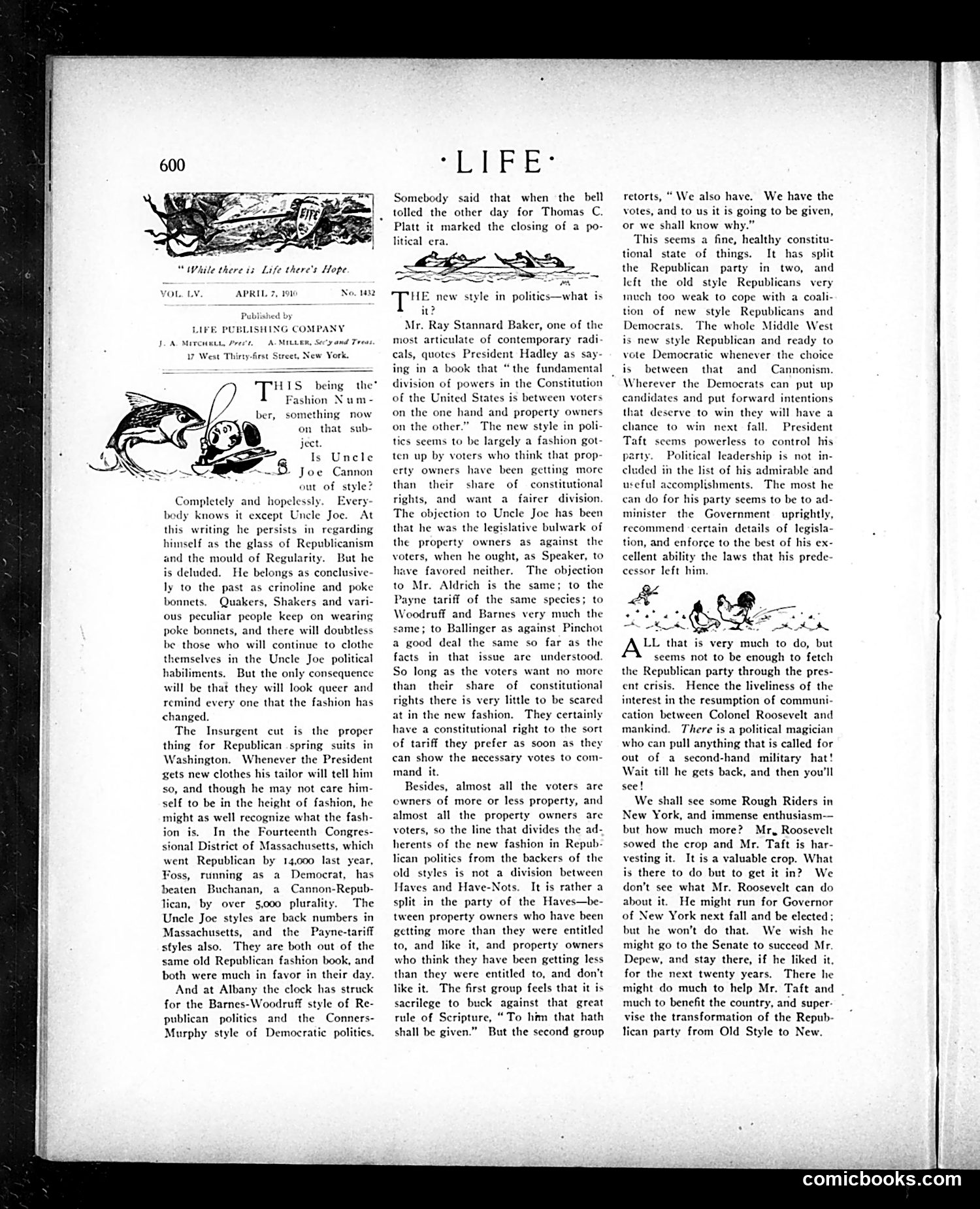
This satirical article uses **fashion metaphor** to critique Republican Party factionalism. The central figure is **"Uncle Joe" Cannon**, the Speaker of the House, whose political style is portrayed as outdated—as obsolete as crinolines and poke bonnets. The satire contrasts "old style" Republicans (Cannon, Aldrich, the Payne Tariff supporters, Barnes, Woodruff) with "new style" insurgent Republicans who challenge property owners' disproportionate constitutional influence. The article references **President Hadley's** observation that the Constitution's fundamental division pits voters against property owners. The key joke: both factions are wealthy; the split isn't between rich and poor but between property owners who've benefited excessively from Republican policies and those demanding fairer distribution. Recent Democratic victories (Foss in Massachusetts) prove the "old style" Republican look is finished—even moderates must adopt the "insurgent cut" to remain fashionable in politics. The cartoon (visible but unclear in detail) reinforces this fashion-as-politics metaphor.
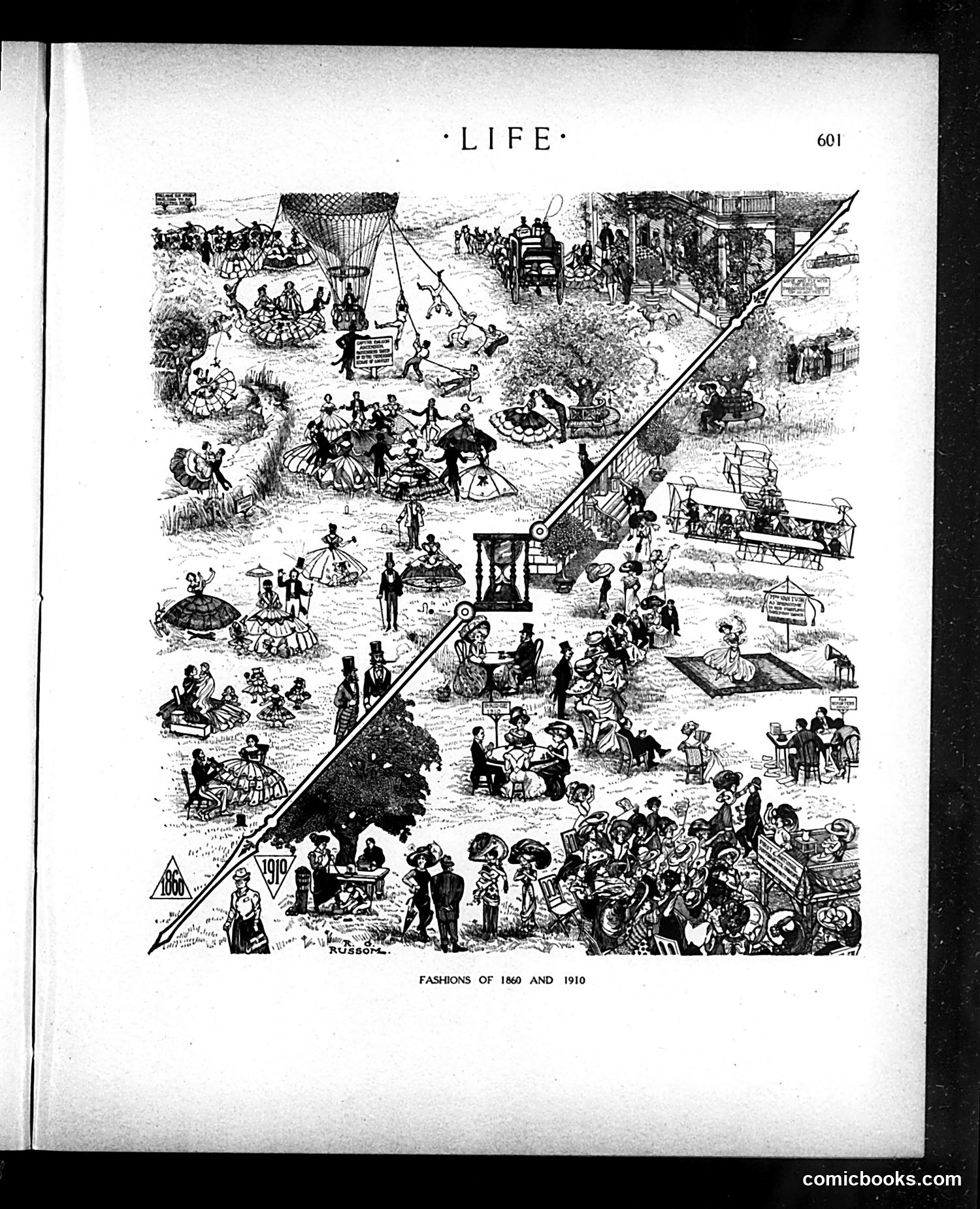
This satirical illustration compares clothing styles across a fifty-year span. The diagonal line dividing the page separates 1860 fashions (lower left) from 1910 fashions (upper right). The cartoon mocks how dramatically women's silhouettes changed—from the 1860s' voluminous crinolines and bustles to the 1910s' corseted S-bend figure. The scene depicts a fashionable seaside or park gathering, with crowds of people engaged in leisure activities, their exaggerated dress proportions emphasizing the absurdity of fashion's constant transformations. The satire suggests that both periods' extreme silhouettes were equally ridiculous, poking fun at women's submission to whatever fashion dictated as "proper," regardless of practicality or comfort. Life magazine frequently lampooned fashion's irrationality and women's compliance with uncomfortable trends.
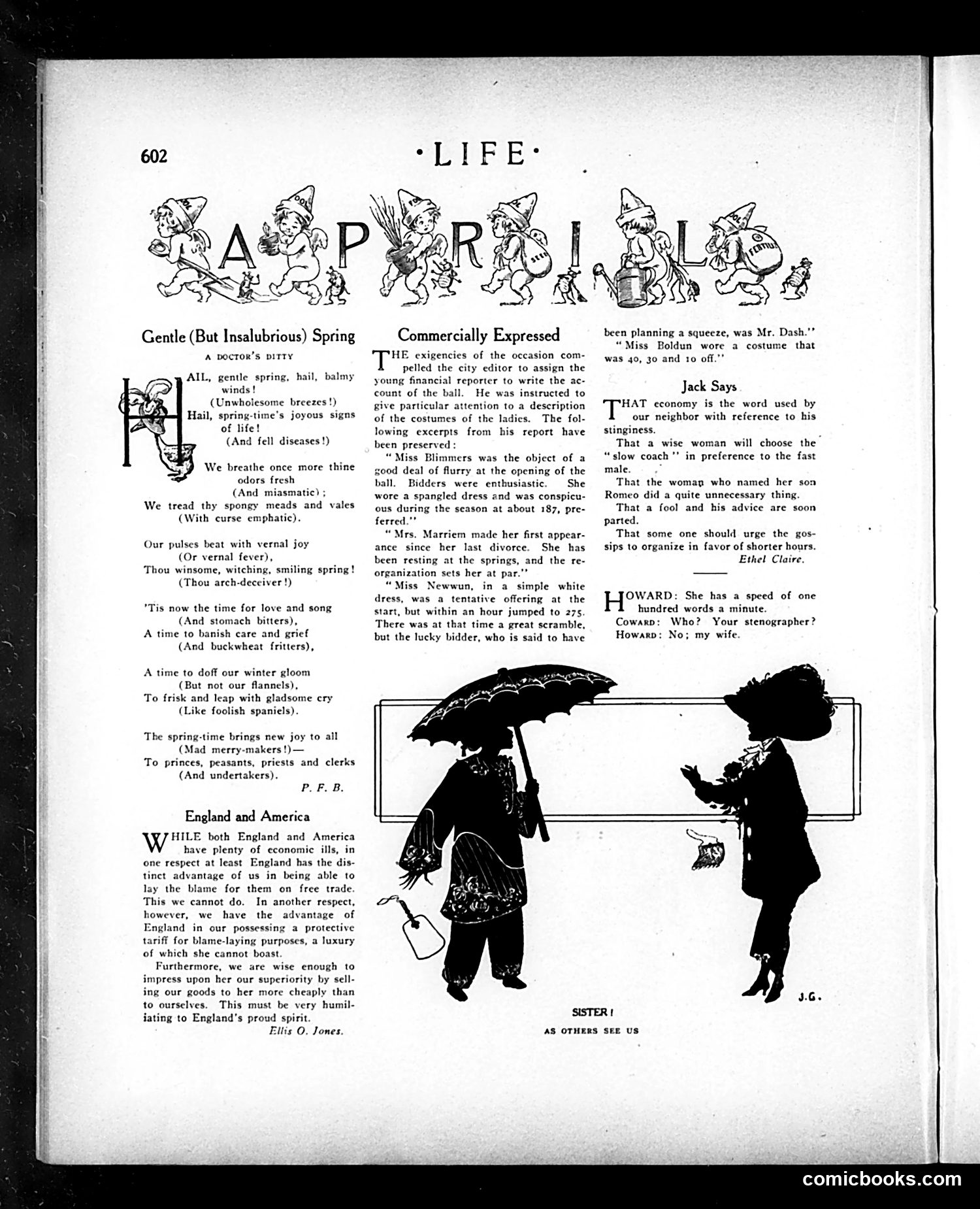
This page contains three satirical pieces typical of early 20th-century American humor: **"Gentle (But Insalubrious) Spring"** mocks the romantic celebration of spring by juxtaposing each praise with medical reality—a doctor's perspective that spring brings illness, not joy. References to "miasmatic" odors and "fell diseases" reflect period medical theories attributing sickness to bad air. **"England and America"** satirizes trade policy tensions, suggesting both nations blame their economic problems on tariff systems—England on free trade, America on protective tariffs. The piece mocks American hypocrisy: selling goods cheaply abroad while charging more domestically. **"Commercially Expressed"** parodies a financial reporter covering a society ball, describing women using stock market language ("preferred," "jumped to 275," "at par"). This reflects contemporary commodification of women and marriage markets. The illustrated cartoon "Sister! As Others See Us" (artist initialed J.G.) shows two figures with umbrellas, likely depicting social commentary on appearance or behavior, though its specific meaning is unclear without additional context.
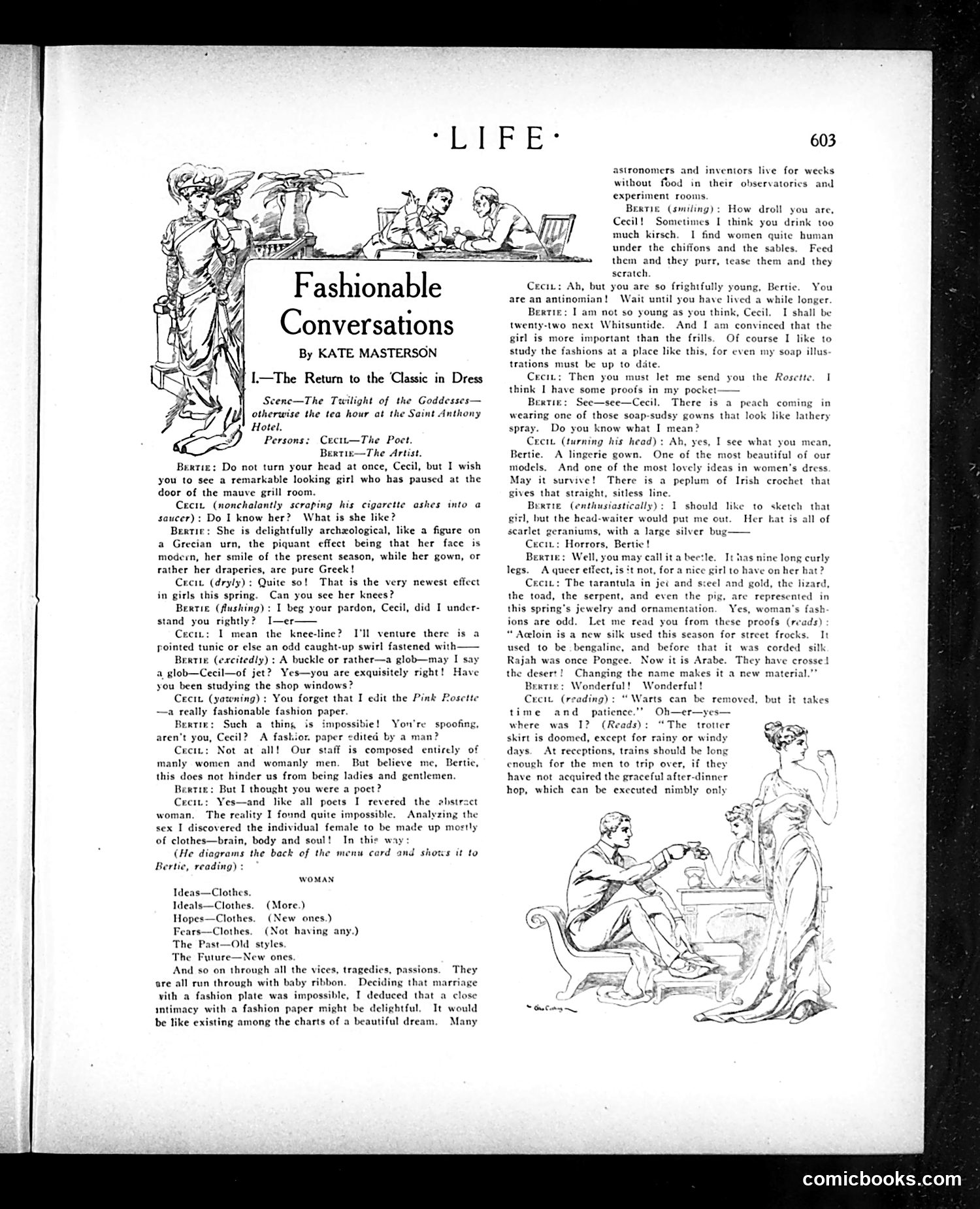
This page presents a witty conversation between two male characters—Cecil, a poet-turned-fashion-magazine editor, and Bertie, an artist—discussing women's fashion at a hotel tea room. The satire operates on multiple levels: **The Central Joke:** Cecil has abandoned poetry to edit a high-fashion magazine staffed entirely by "manly women and womanly men," claiming women are essentially composed of "clothes—brain, body and soul." He diagrams this concept on a menu card, suggesting women's entire being revolves around fashion. **The Social Critique:** The piece mocks both the superficiality of fashion obsession and gender role confusion of the era. Cecil's reduction of women to their wardrobes satirizes shallow materialism, while his editorial position—a man editing "women's" fashion—highlights contemporary anxieties about blurred gender boundaries. **The Irony:** Bertie, supposedly more enlightened about women's humanity, remains equally absorbed in analyzing female appearance and dress details, undermining his moral superiority. The accompanying sketches show fashionably dressed women in classical Greek-inspired silhouettes, visually reinforcing the text's discussion of current style trends.
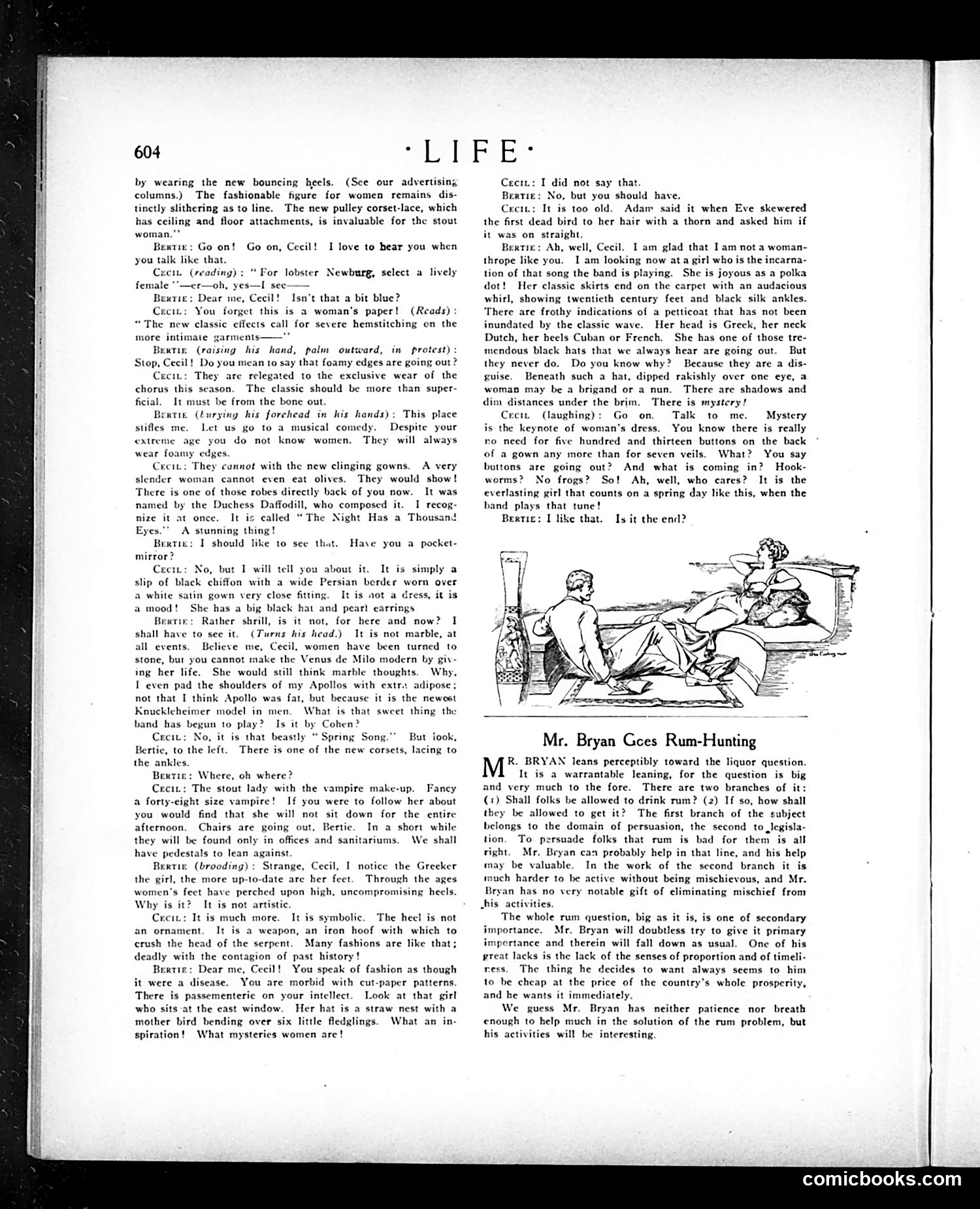
This page contains a satirical dialogue between two male characters—Cecil and Bertie—discussing contemporary women's fashion circa the 1910s-1920s. The satire targets absurd fashion trends of the era: restrictive corsets with "pulley" lacing, impossibly clinging gowns that prevent eating olives, impractical footwear, and elaborate hats. The humor operates on multiple levels: Cecil earnestly describes ridiculous garment details as if they're reasonable, while Bertie alternates between mock enthusiasm and exasperation. The text mocks both the fashion industry's illogical demands on women's bodies and men's befuddled, pseudo-philosophical responses to women's fashion choices. A small illustration titled "Mr. Bryan Goes Rum-Hunting" appears separately, accompanied by text discussing William Jennings Bryan's temperance activism and the prohibition debate—unrelated to the fashion dialogue above it. The page exemplifies *Life* magazine's satirical approach to gender relations and consumer culture.
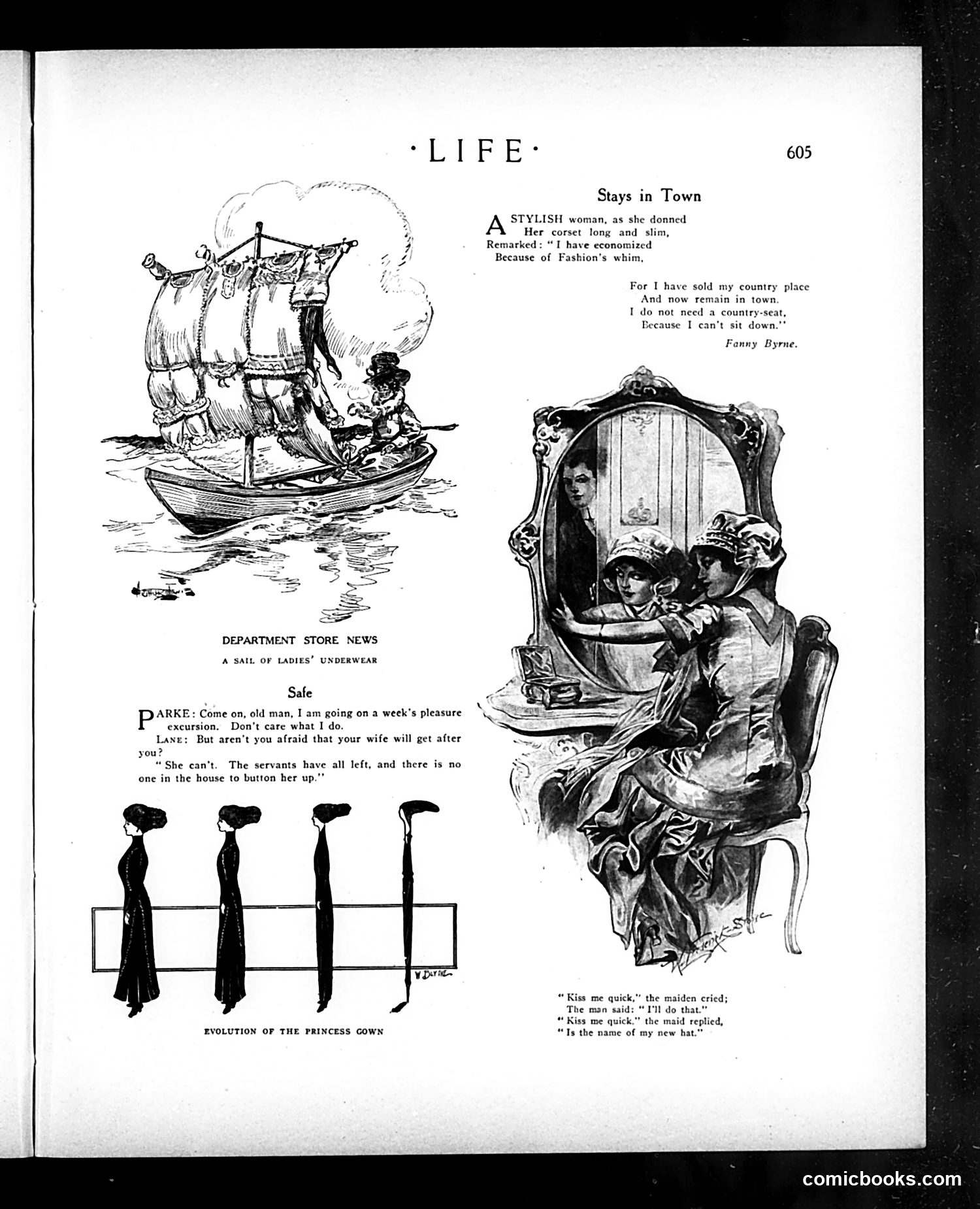
This page contains three distinct pieces of early 20th-century social humor: **"Stays in Town"** mocks fashionable women's tight corsetry. A wealthy woman claims she's economized by selling her country estate, yet admits she literally cannot sit down due to her restrictively cinched corset—suggesting her fashion obsession is absurdly impractical and financially ruinous. **"A Sail of Ladies' Underwear"** is a brief comic dialogue where a man leaves for pleasure while his wife cannot pursue him because all servants have departed and she cannot fasten her corset without help—again satirizing women's complete dependence on both servants and restrictive garments. **"Evolution of the Princess Gown"** shows four silhouettes demonstrating how women's fashion increasingly narrowed and elongated the female form over time. The recurring joke across all three pieces targets the absurdity of fashionable corsetry that literally immobilizes women, rendering them helpless without servants. The satire critiques both the fashion industry's control over women and the social structures that enabled such impractical dress codes.
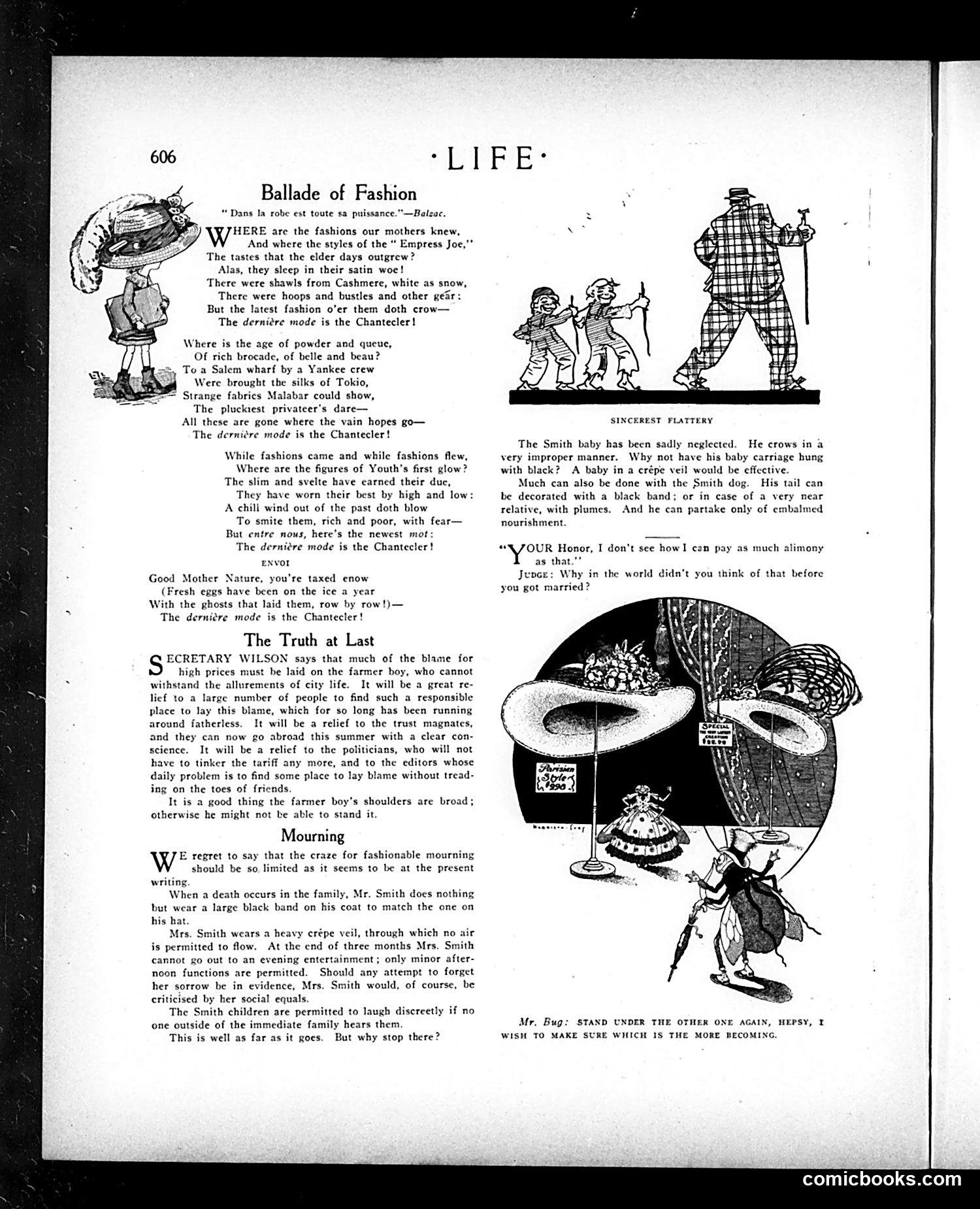
This Life magazine page contains two satirical pieces: **"Ballade of Fashion"** — A poem mocking the rapid obsolescence of fashion trends. It nostalgically references old styles (powder, queues, brocades, hoops) before declaring the latest absurd fashion is dressing like a rooster ("Chantecler"). The satire targets fashion's constant, meaningless reinvention and society women's slavish pursuit of whatever is newest. **"The Truth at Last"** — Political satire blaming Secretary Wilson for claiming farmer boys cause high prices by leaving farms for city life. The piece sarcastically praises this convenient scapegoat, which relieves "trust magnates" (large corporations) and politicians from responsibility for inflation. It's criticism by faux-agreement, exposing how blame gets displaced onto the powerless. **"Mourning"** — Satirizes excessive Victorian mourning customs. It mocks how strictly Mrs. Smith must observe mourning restrictions while her husband merely wears a band, then suggests extending these absurdities to the baby and family dog. The humor lies in exaggerating already-ridiculous social conventions to expose their illogic.
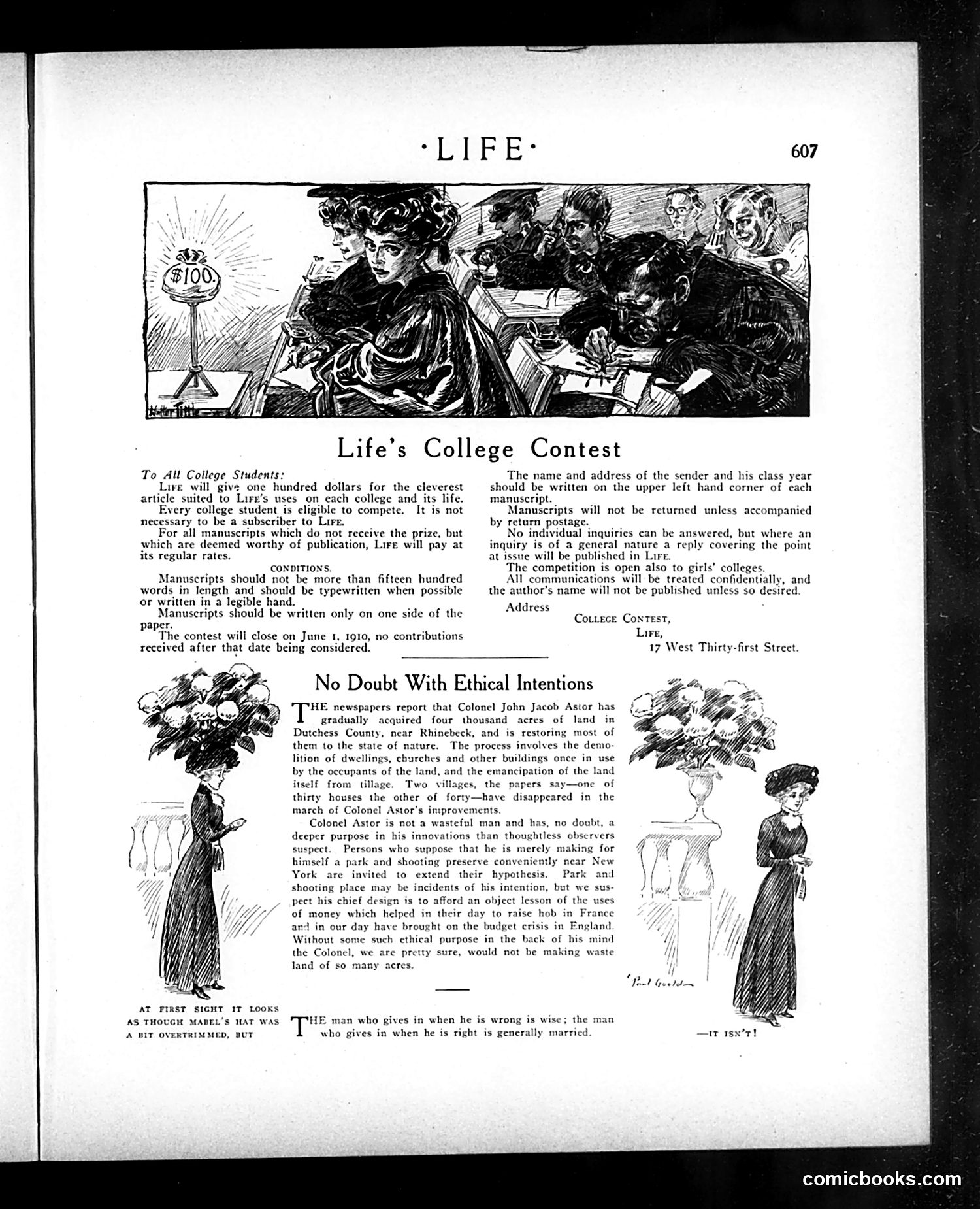
**Upper Section—College Contest Advertisement:** Life announces a $100 prize for college students' best articles about college life. Standard submission rules apply; entries close June 1, 1910. Notable: the competition is explicitly "open also to girls' colleges," reflecting early-20th-century expansion of women's higher education. **Main Cartoon—"No Doubt With Ethical Intentions":** This satirizes Colonel John Jacob Astor's land acquisition in Dutchess County, New York. Astor demolished villages, churches, and farms—erasing thirty to forty houses—to create a private estate. The cartoon mockingly suggests his "ethical purpose" is philanthropic (teaching about money's uses), when observers suspect he merely wants an exclusive park and hunting preserve near New York City. The satire exposes how the wealthy frame self-serving projects as morally justified. **Bottom Quips:** Two brief jokes about women and marriage complete the page, typical of Life's satirical humor style.
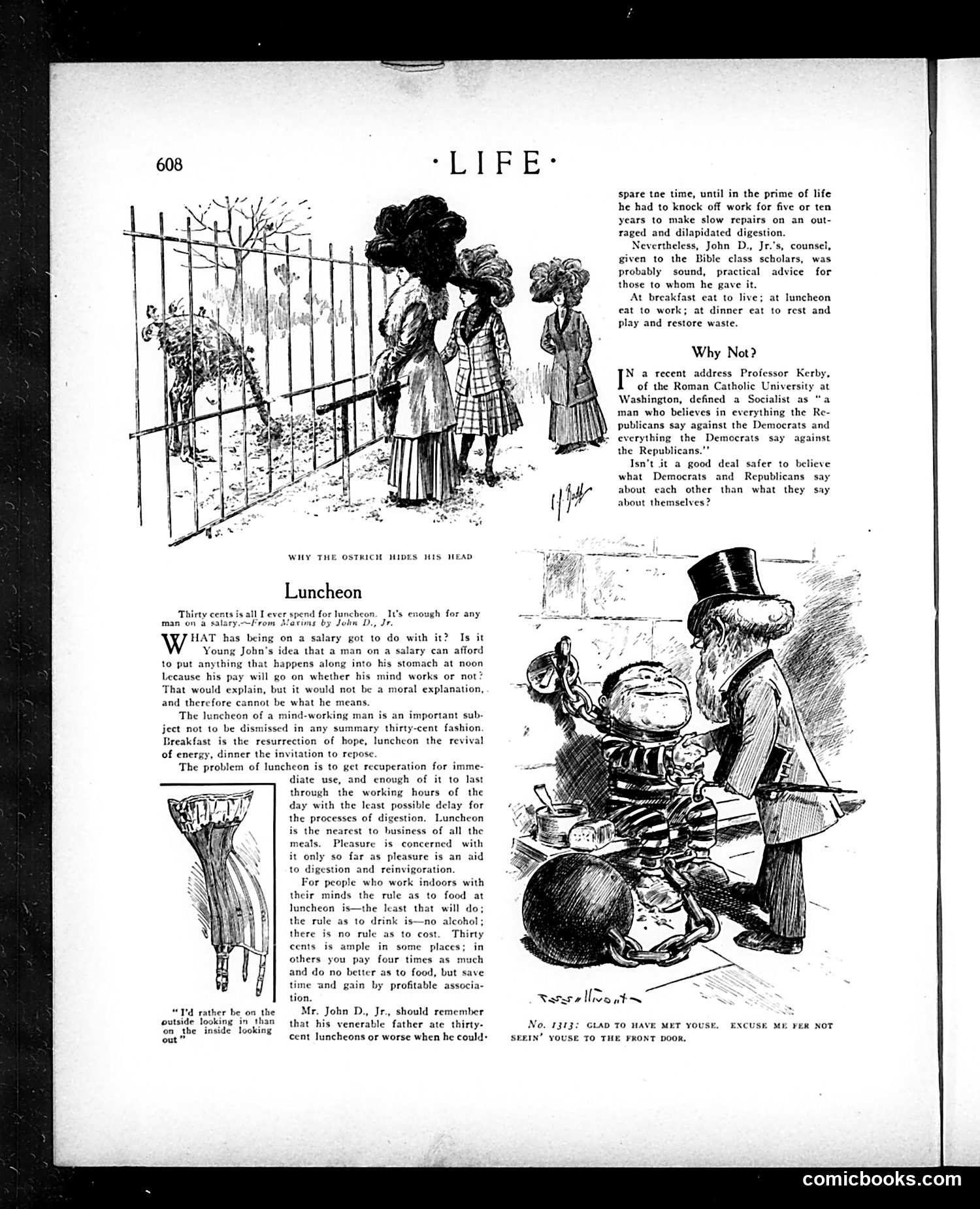
This page contains two separate satirical pieces: **"Luncheon"** mocks John D. Rockefeller Jr.'s advice that salaried workers need only spend thirty cents on lunch. The article argues this misses the point—lunch's real value for mental workers is recuperation and efficiency, not mere cost-cutting. The satire suggests Rockefeller Jr. ignores his own father's experience: the senior Rockefeller ate cheap lunches while building his fortune, but eventually suffered health collapse from years of poor nutrition. The critique implies Jr. gives impractical advice to Bible class scholars without understanding the actual needs of working people. **"Why Not?"** satirizes political hypocrisy. Professor Kerby's definition of a Socialist (someone believing everything opponents say against each other) is used to suggest that voters would do better trusting what Democrats and Republicans *say about each other* than what either party says *about itself*—implying all politicians are inherently dishonest about their own motivations. The cartoon showing an ostrich hiding its head illustrates willful ignorance or avoidance of reality.
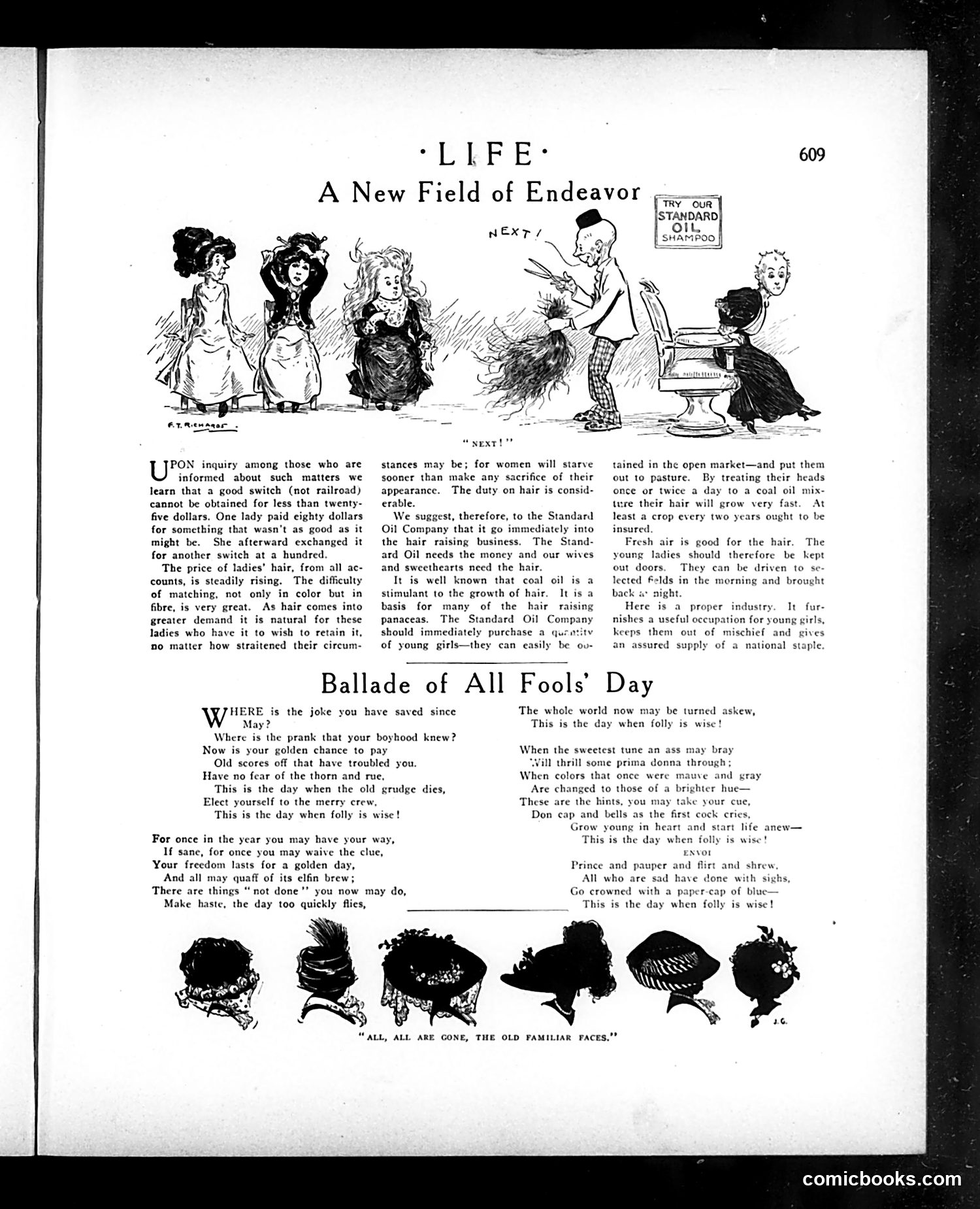
This page contains two satirical pieces about early 1900s gender and commerce: **"A New Field of Endeavor"** (top cartoon and text): The satire mocks women's obsession with hair and the rising cost of human hair switches (hairpieces). The cartoon shows a man presenting a woman's severed head as a product. The text sarcastically suggests Standard Oil Company should buy young girls, treat their hair with coal oil to stimulate growth, and harvest it as a business—profiting from women's vanity and desperation to maintain appearances. It's dark satire criticizing both female materialism and corporate exploitation. **"Ballade of All Fools' Day"** (poem and silhouettes): A traditional April Fools' Day poem celebrating the one day when social rules reverse—when foolishness is wisdom, pranks are permitted, and normal hierarchies dissolve ("Prince and pauper"). The silhouettes below show various hat styles. The tone is lighthearted, contrasting sharply with the grimmer satire above.
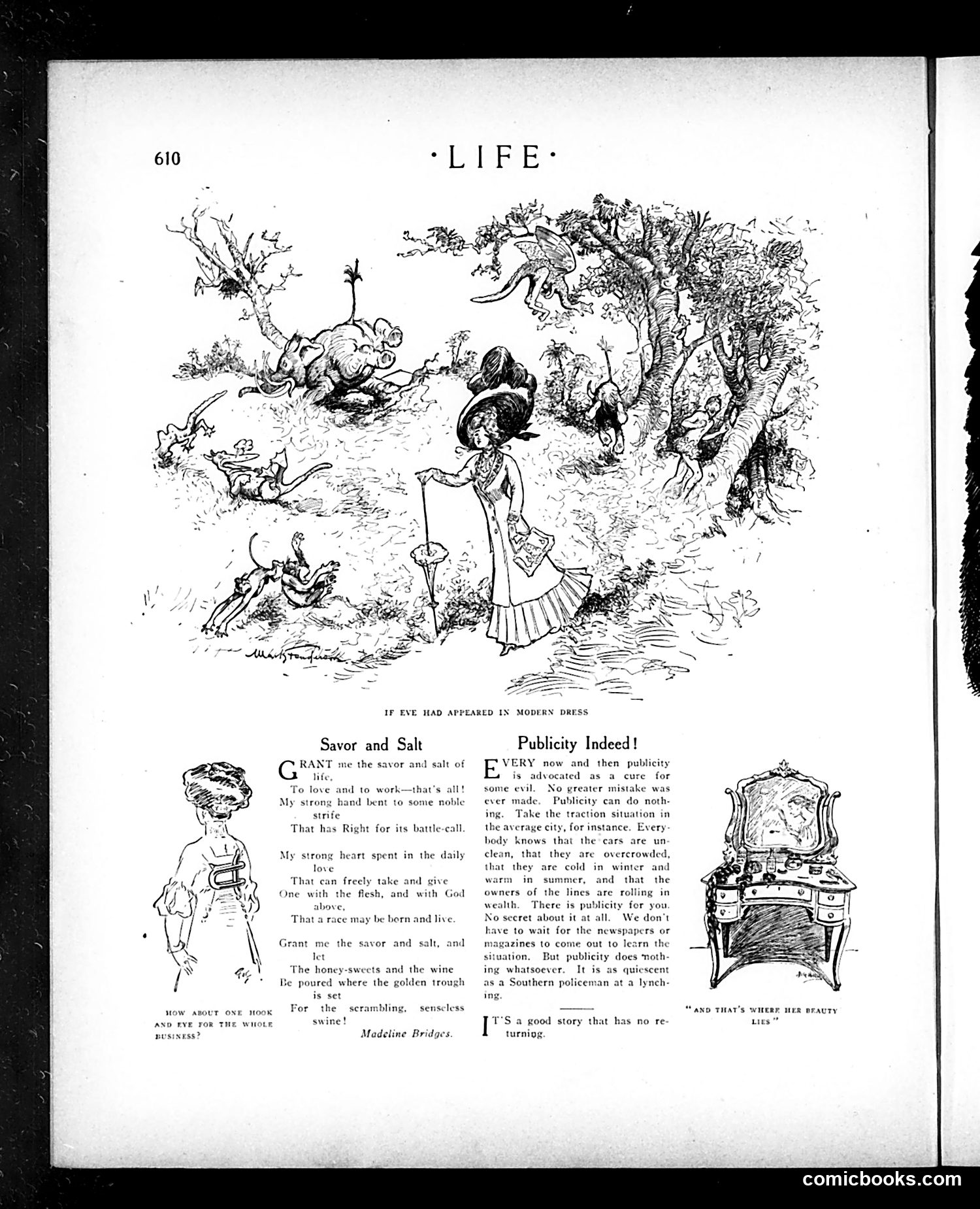
This page from *Life* magazine contains satirical commentary on early 20th-century social issues. **Top illustration**: "If Eve Had Appeared in Modern Dress" depicts a fashionably dressed woman (representing Eve, the biblical first woman) in a contemporary setting with animals. The satire appears to contrast modern femininity and fashion with classical/biblical themes. **"Savor and Salt"**: A poem by Madeline Bridges celebrating women's roles in domestic work and reproduction ("a race may be born and live"), advocating for meaningful labor and spiritual purpose. The cartoon asking "How about one look and Eve for the whole business?" sardonically suggests women shoulder all domestic responsibility. **"Publicity Indeed!"**: An editorial arguing that public awareness alone cannot solve urban problems. It cites streetcar conditions (dirty, overcrowded, cold/hot) as an example where publicity about poor service fails to force improvements—comparing such inaction to a "Southern policeman at a lynching," implying institutional indifference to injustice. Both pieces reflect Progressive Era debates about women's roles, labor conditions, and government accountability.
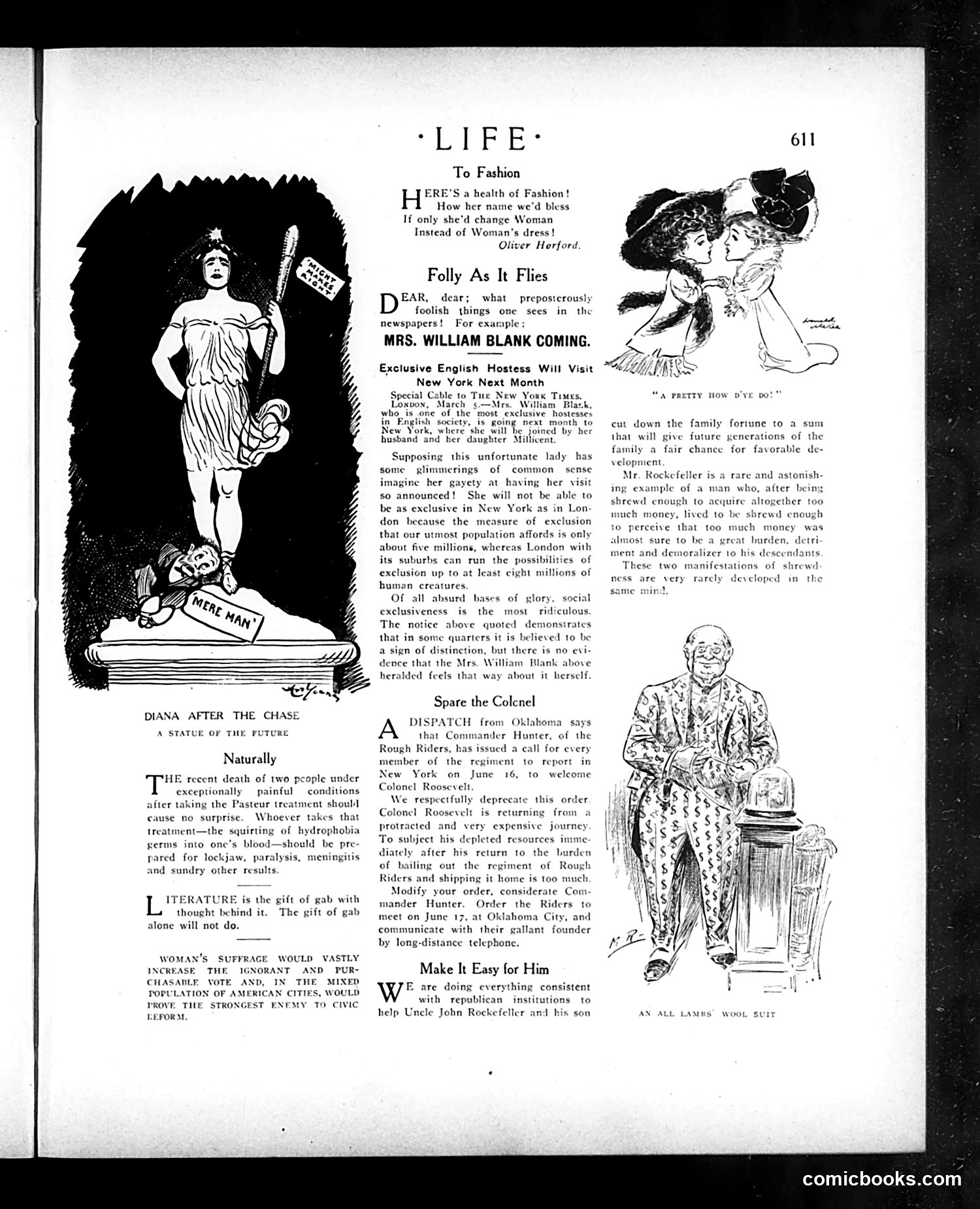
This page contains multiple satirical pieces typical of early 20th-century Life magazine commentary: **"Diana After the Chase"** (left cartoon): A classical female nude statue labeled "A Statue of the Future" appears to mock both high art pretension and changing fashion standards—suggesting women's fashion is so extreme it resembles sculptural absurdity. **Fashion commentary** (top): Oliver Herford's poem jokes that Fashion would be worthwhile if it changed women themselves rather than endlessly changing their clothing. **Mrs. William Blank satire**: Ridicules the announcement of an "exclusive" English hostess visiting New York, noting that London's suburbs alone have 8 million people—making true exclusivity impossible in cities of that size. **Colonel Roosevelt dispatch**: Satirizes Commander Hunter's call for Rough Riders to report to New York for a Roosevelt welcome, suggesting this burdens the regiment and wastes resources after expensive service. **Rockefeller joke**: Praises John D. Rockefeller for cleverly reducing his fortune so heirs won't be corrupted by excessive wealth—clearly ironic, as Rockefeller's wealth was notoriously acquired through ruthless business practices.
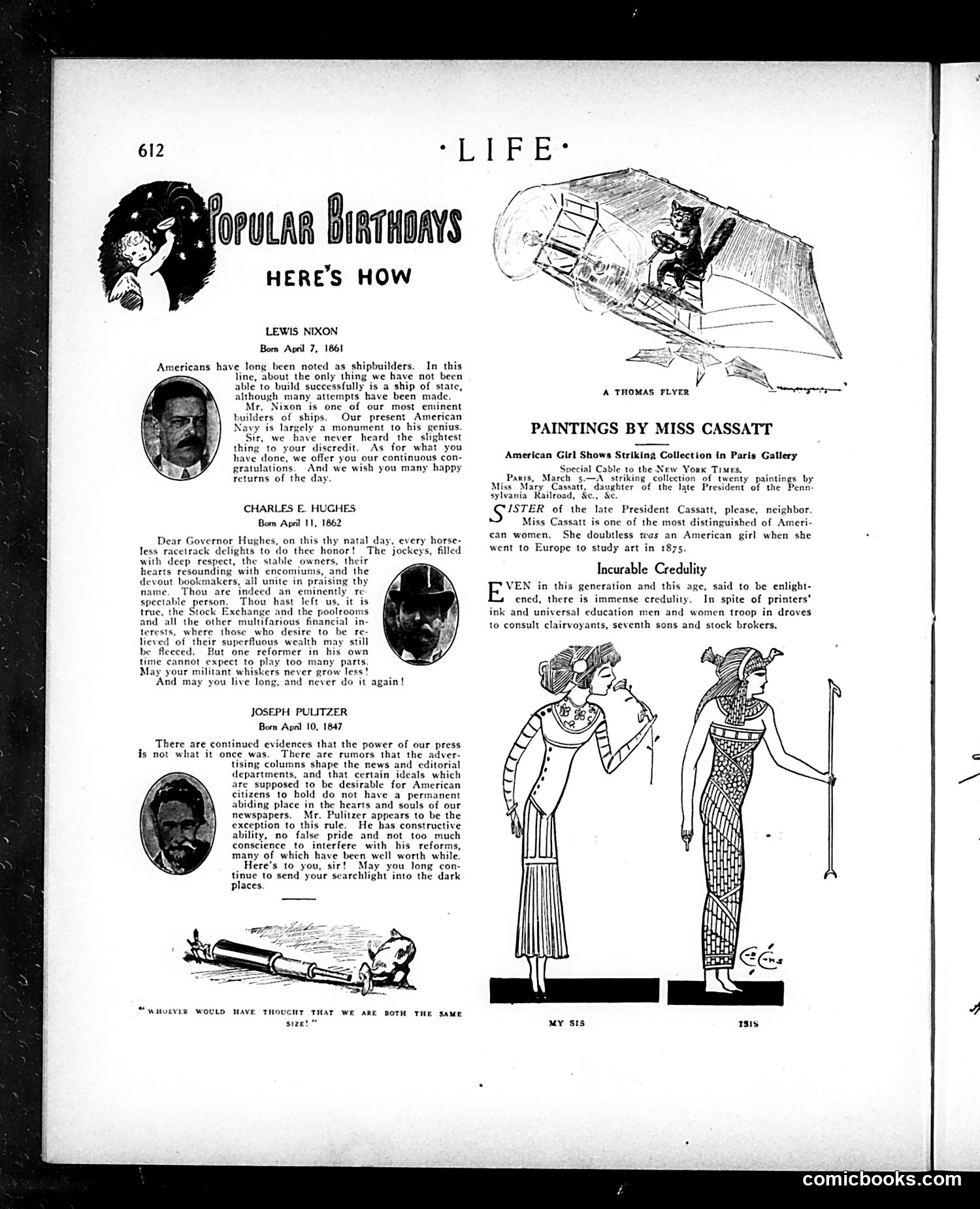
This page celebrates the birthdays of three prominent American men through satirical tributes: **Lewis Nixon** (shipbuilder): Praised for his naval engineering achievements, credited as a monument to American genius. **Charles E. Hughes** (likely the jurist/politician): Backhanded praise mocking his role in stock exchanges and poolrooms—satirizing his connection to financial institutions while grudgingly acknowledging his reformist efforts. The "militant whiskers" reference is a jab at his distinctive facial hair. **Joseph Pulitzer** (newspaper magnate): Lauded as an exception to press corruption, praised for maintaining editorial independence against advertising pressure and commercial interests—a contemporary concern about whether newspapers served the public or advertisers. The page also features: - A Thomas Flyer automobile advertisement - Mary Cassatt paintings exhibition notice - A satirical section on "Incurable Credulity" mocking Americans' willingness to consult fortune-tellers and stock brokers despite education and printing press availability The tone throughout is witty mockery dressed as congratulation—typical of Life's satirical approach.
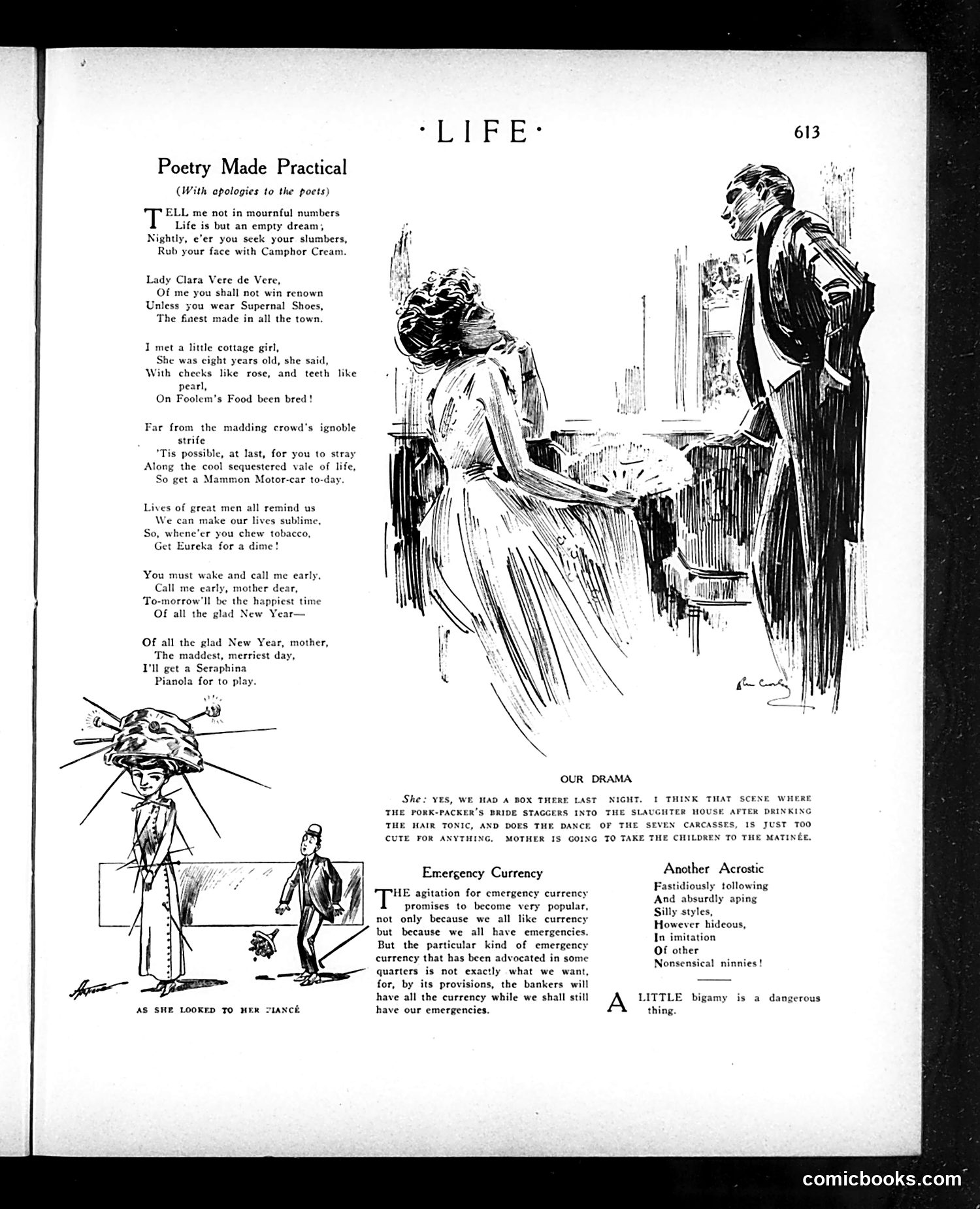
This page satirizes consumerism by rewriting famous poems with product advertisements embedded. Classic lines from Romanticism (Longfellow, Tennyson, Keats) are hijacked to pitch commercial products: Camphor Cream, Supernal Shoes, Mammon Motor-cars, and a Pianola piano. The joke targets how advertising invades all cultural spaces, even sacred literature. By forcing "practical" commercial messages into poetic form, Life mocks both aggressive marketing and consumers' willingness to accept it. The lower section ridicules melodramatic theater ("pork-packer's bride," "dance of seven carcasses") as absurdly overwrought entertainment, while the "Emergency Currency" section critiques proposed banking reforms, suggesting they benefit bankers over ordinary citizens. The cartoons and acrostic verses reinforce the theme: modern life reduced to commerce and shallow amusement.
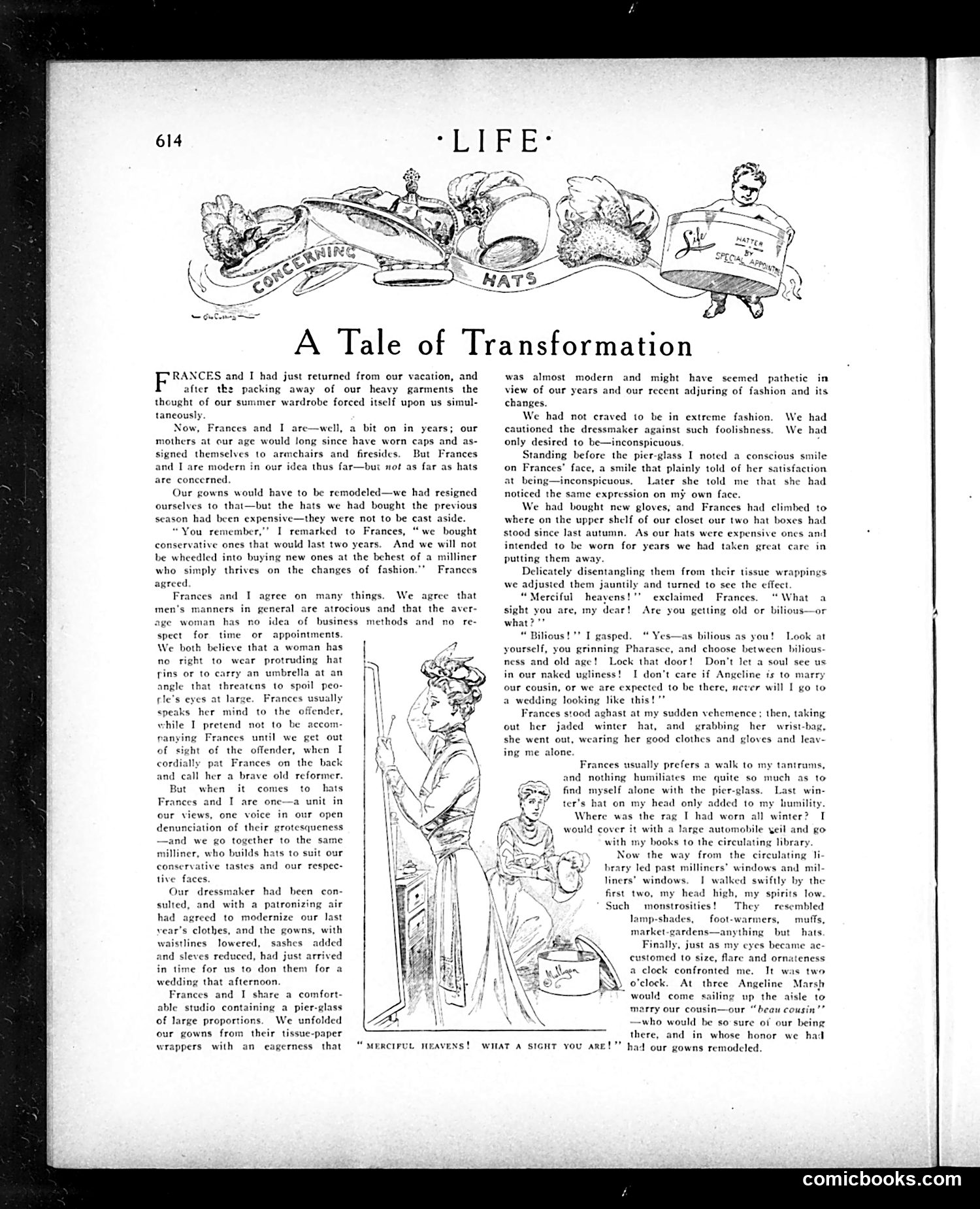
This satirical story mocks 1920s women's fashion obsession and hypocrisy about modernism. Two middle-aged women, Frances and the narrator, pride themselves on being "modern" and rejecting frivolous fashion changes. They deliberately buy conservative hats meant to last years, scorning milliners who profit from constant style updates. However, when they retrieve their "expensive" hats from storage after summer vacation, they're horrified by how dated they've become—so much so that they refuse to wear them to a wedding, despite their recent declarations against fashion tyranny. The joke is their complete capitulation: Frances immediately goes shopping for a new hat, betraying their stated principles. The satire targets the contradiction between women claiming independence from fashion while remaining enslaved to it, and mocks the fashion industry's deliberate planned obsolescence designed to keep women buying.
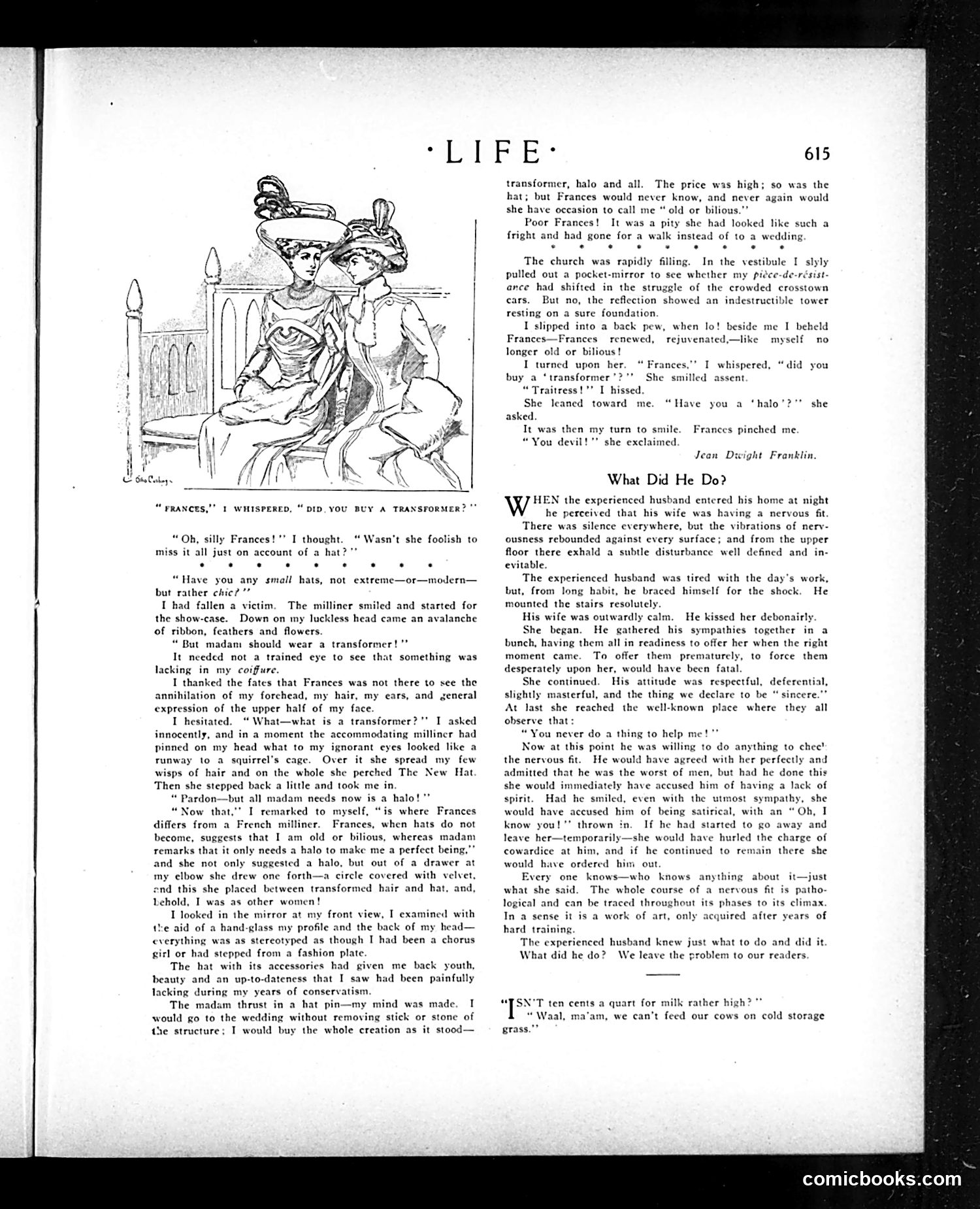
This page contains two separate pieces of satirical fiction from *Life* magazine, a prominent American humor publication. **The Cartoon and Main Story**: The illustrated narrative mocks women's obsession with fashionable hats around the early 1900s. A "transformer" was a wire frame device used to create the exaggerated, architecturally complex hairstyles of the era. The joke centers on two women, Frances and the narrator, both trying to outdo each other with increasingly elaborate hat constructions—adding "transformers," "halos" (velvet circles), and excessive trimmings. The satire targets both women's vanity and the absurdity of fashion industry manipulation, wherein a milliner convinces customers they look "old or bilious" without these expensive additions. The irony: Frances secretly bought the same outfit, making their competitive spending mutually foolish. **"What Did He Do?"**: A separate story satirizing marital dynamics, presenting a husband trying to manage his wife's unexplained "nervous fit"—a common period trope depicting female emotionalism as both mysterious and burdensome to men. Both pieces reflect early-1900s gender stereotypes: women as fashion-obsessed and emotionally volatile, men as weary but dutiful.
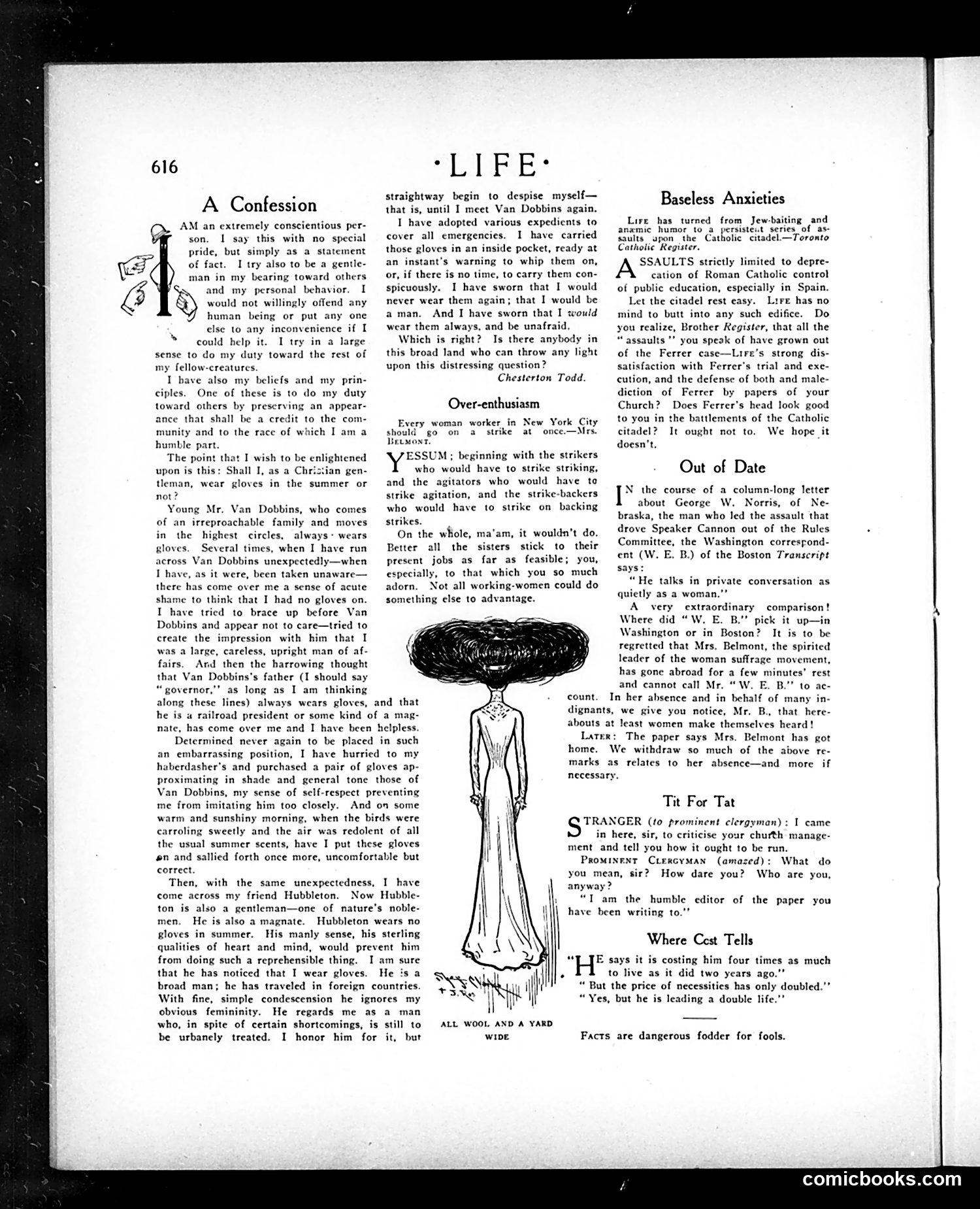
This page contains several short satirical pieces typical of Life magazine's humor: **"A Confession"** mocks social anxiety about class signifiers. The author obsesses over whether wearing gloves in summer marks him as a gentleman, using Van Dobbins—an acquaintance from "the highest circles" who always wears them—as a status benchmark. The satire targets anxious, status-conscious middle-class behavior and arbitrary social conventions. **"Over-enthusiasm"** ridicules Mrs. Beeson's call for all New York working women to strike. Life sarcastically suggests this would require strikers, agitators, and "strike-backers" all striking simultaneously—an absurd infinite regress. It dismisses her activism while patronizingly suggesting women stick to their current jobs. **"Baseless Anxieties"** defends Life against Catholic criticism about attacking the Church. It argues their criticism of Catholic education control in Spain and their opposition to the execution of Francisco Ferrer (an anarchist educator executed in 1909) doesn't constitute religious persecution. The page reflects early 1900s attitudes toward class, labor activism, and anti-Catholic sentiment.
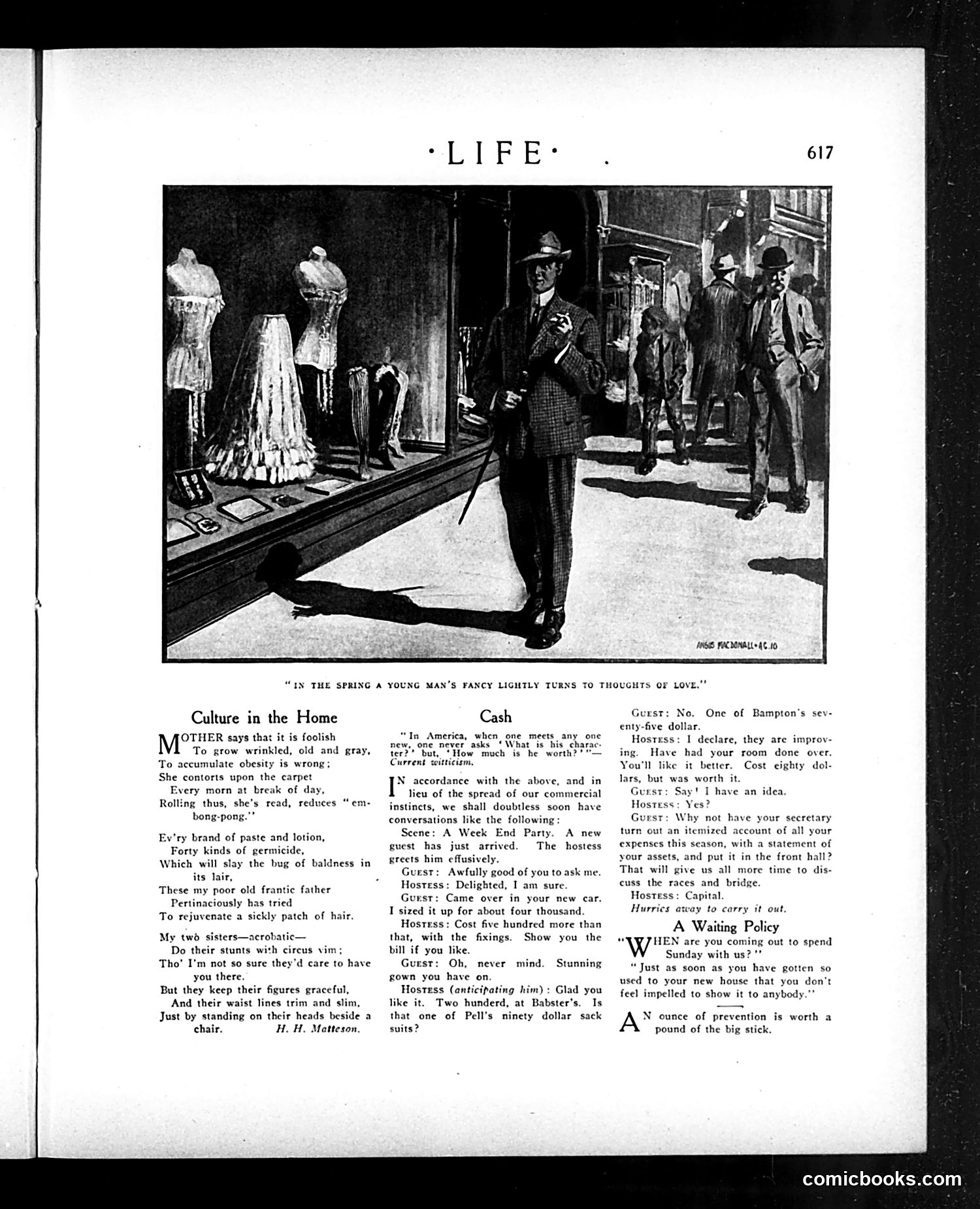
This page contains three satirical pieces mocking early 20th-century American vanity and materialism. **"Culture in the Home"** (poem by H.H. Matteson) humorously depicts a family obsessed with physical appearance—the mother doing exercise routines, the father trying hair-loss remedies, and sisters performing acrobatic stunts to maintain slim figures. The satire targets the era's commercialized beauty industry and the absurd lengths people go to for self-improvement. **"Cash"** presents a dialogue at a social gathering where hosts and guests discuss only money and possessions—the cost of cars, gowns, home renovations. The satire criticizes American materialism, suggesting that character has been replaced by net worth as society's measure of a person. The guest's final suggestion—posting an itemized account of expenses in the foyer—represents the absurd endpoint of this values system. **"A Waiting Policy"** (brief joke) satirizes the social obligation to admire newly acquired possessions, suggesting people avoid visiting until the novelty wears off. Together, these pieces critique consumerism, vanity, and the shallow values dominating American society.
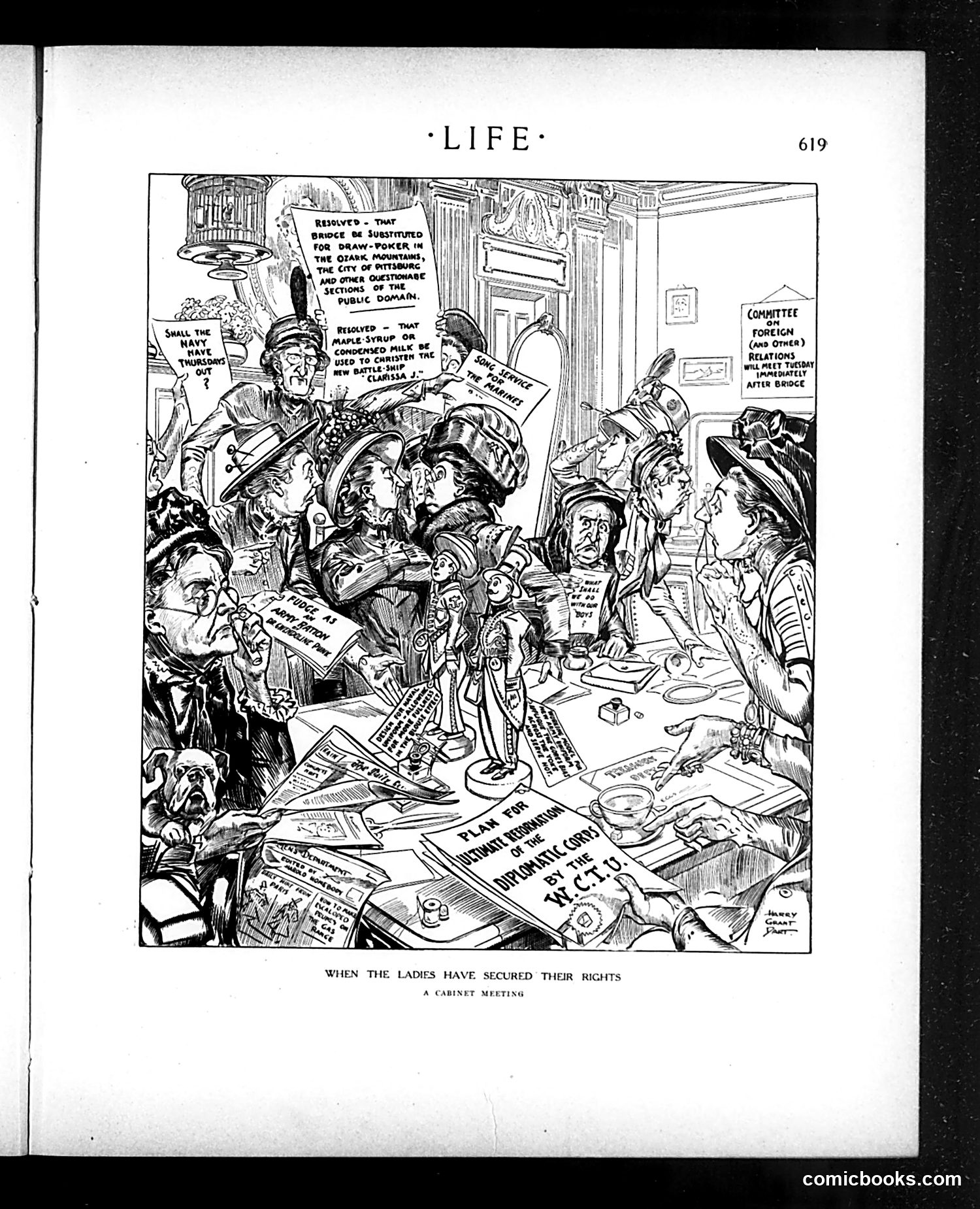
This satirical cartoon depicts a chaotic "cabinet meeting" imagining a future where women have gained political rights and hold government positions. The scene shows female figures in formal attire seated around a table with papers and documents, engaged in animated discussion—some appearing to argue or gesture emphatically. The satire mocks early 20th-century anxieties about women's suffrage and political participation. Speech bubbles reference trivial concerns (maple syrup, draw-poker substitutes, bottle sizes) rather than serious governance, suggesting the cartoonist's dismissive view that women would bring frivolous priorities to government rather than competent leadership. This reflects anti-suffrage sentiment common before women's voting rights were secured in America (1920), portraying women's political engagement as inherently comic and incompetent rather than legitimate.
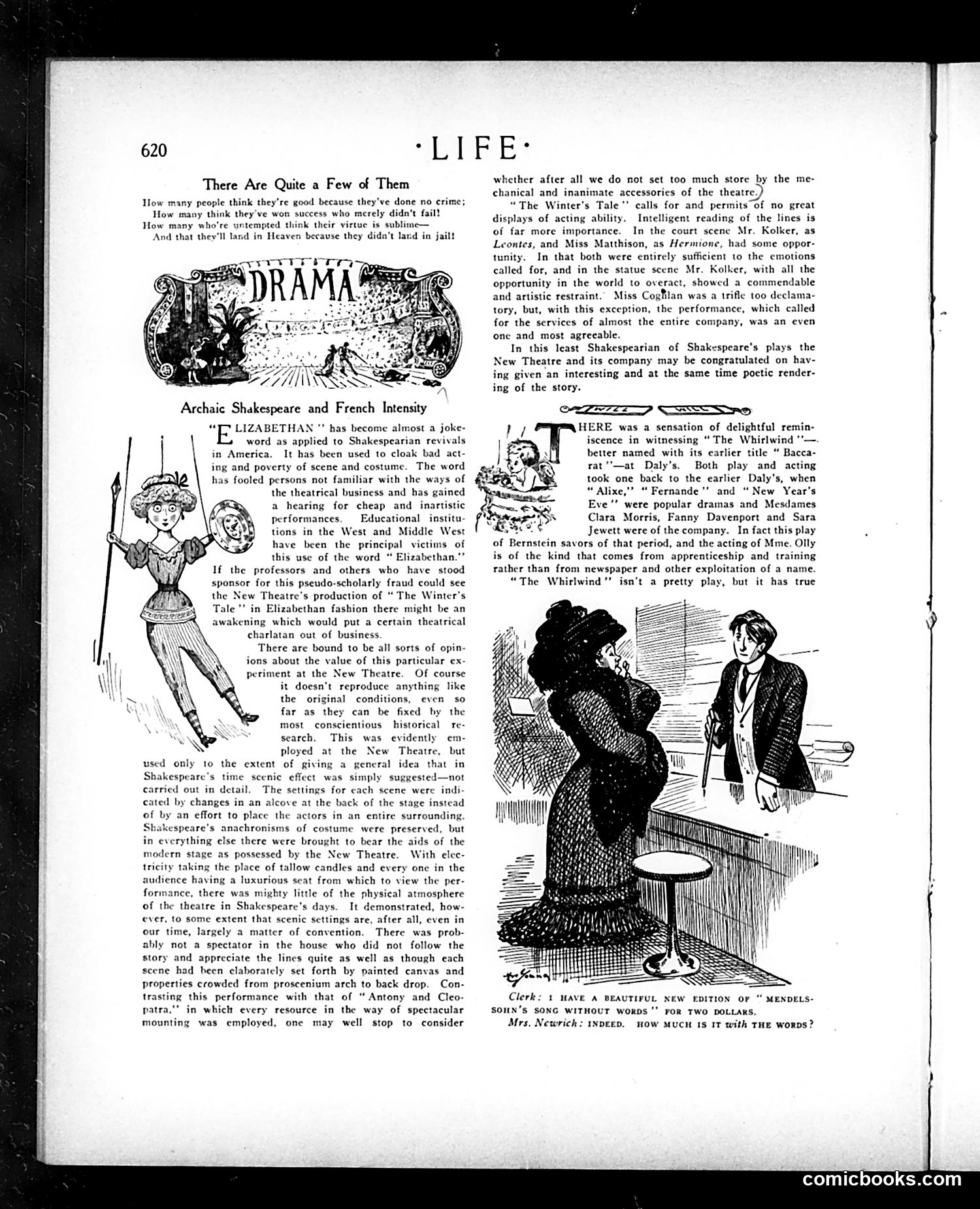
This page critiques theatrical productions, particularly the New Theatre's staging of Shakespeare's *The Winter's Tale* in "Elizabethan" style. **The Main Satire:** The term "Elizabethan" has become a joke—a fraudulent excuse used by cheap theaters and educational institutions to justify poor acting and minimal sets. The article mocks this "pseudo-scholarly fraud." **The Point:** The New Theatre's production proves that elaborate scenery is unnecessary; audiences follow the story through acting and dialogue alone. This challenges the theatrical convention of spectacular mounting. **The Cartoon:** The small illustration shows a character discussing Mendelssohn's "Song Without Words"—a humorous parallel about how meaning exists without literal ornamentation, reinforcing the article's argument. **The Verdict:** The production succeeds despite minimal spectacle, with actors Kolker and Matthison praised for emotional restraint. The review suggests theater should prioritize performance over mechanical accessories.
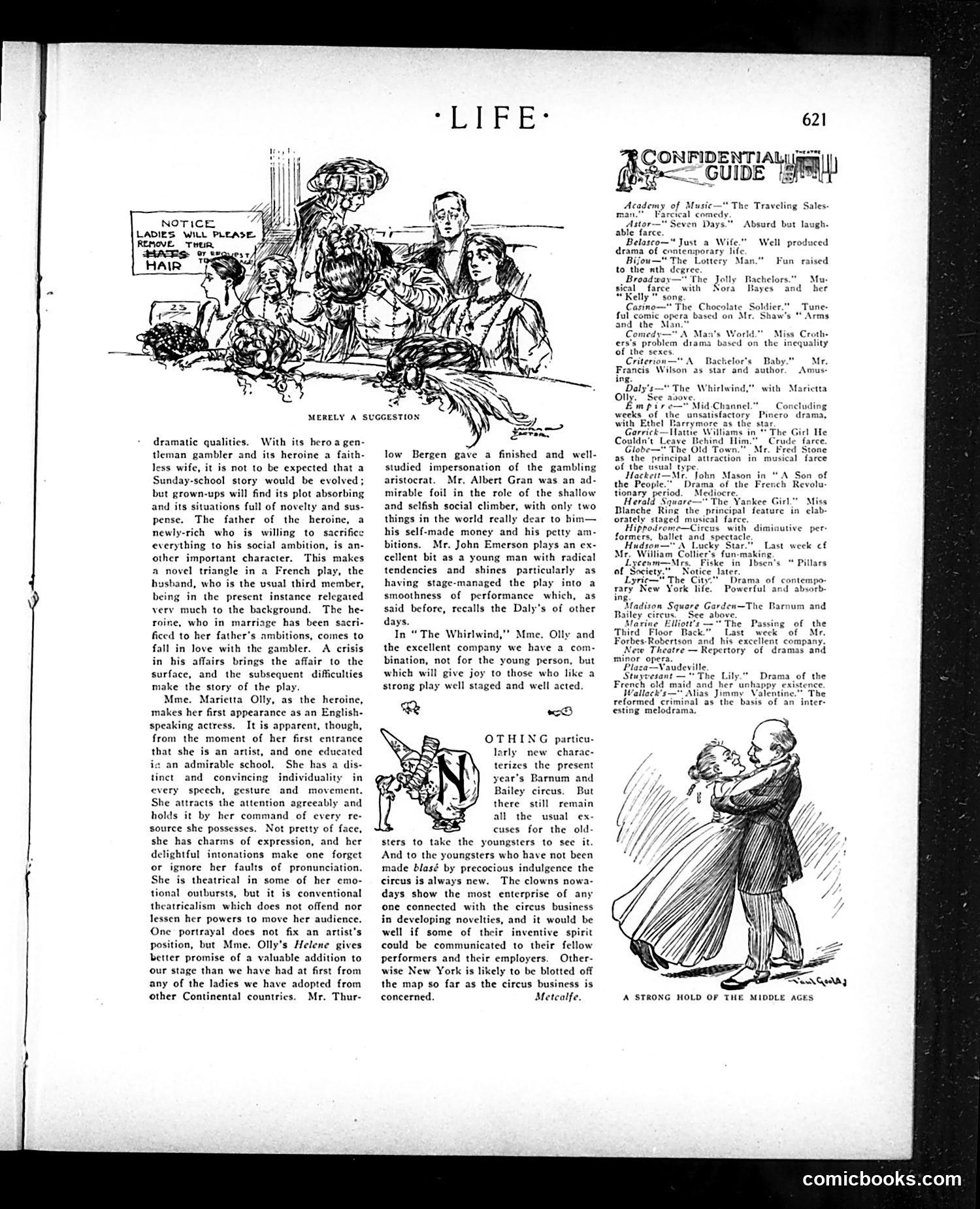
This page contains theatrical reviews and commentary on New York entertainment circa early 1900s. **Main Content:** - A review of the French play "The Whirlwind" (starring Mme. Marietta Olly), praising the actress's debut in English-language theater despite minor pronunciation faults. The plot involves a faithless wife, a gambler, and a socially ambitious father—noting the husband is "relegated very much to the background," an unusual dramatic triangle. - A brief notice about Barnum and Bailey's circus, lamenting that while still popular with children, it lacks innovation compared to previous years. The critic notes clowns show more creativity than other performers. **Left Illustration:** "Merely a Suggestion" cartoon shows women at a salon or social gathering with prominent, elaborate hair styles, with a notice requesting "Ladies will please refrain from wearing their hair" (presumably referring to theatrical wigs or oversized constructions). This likely satirizes current fashion excess. The "Confidential Guide" section lists current theater productions with brief critiques.
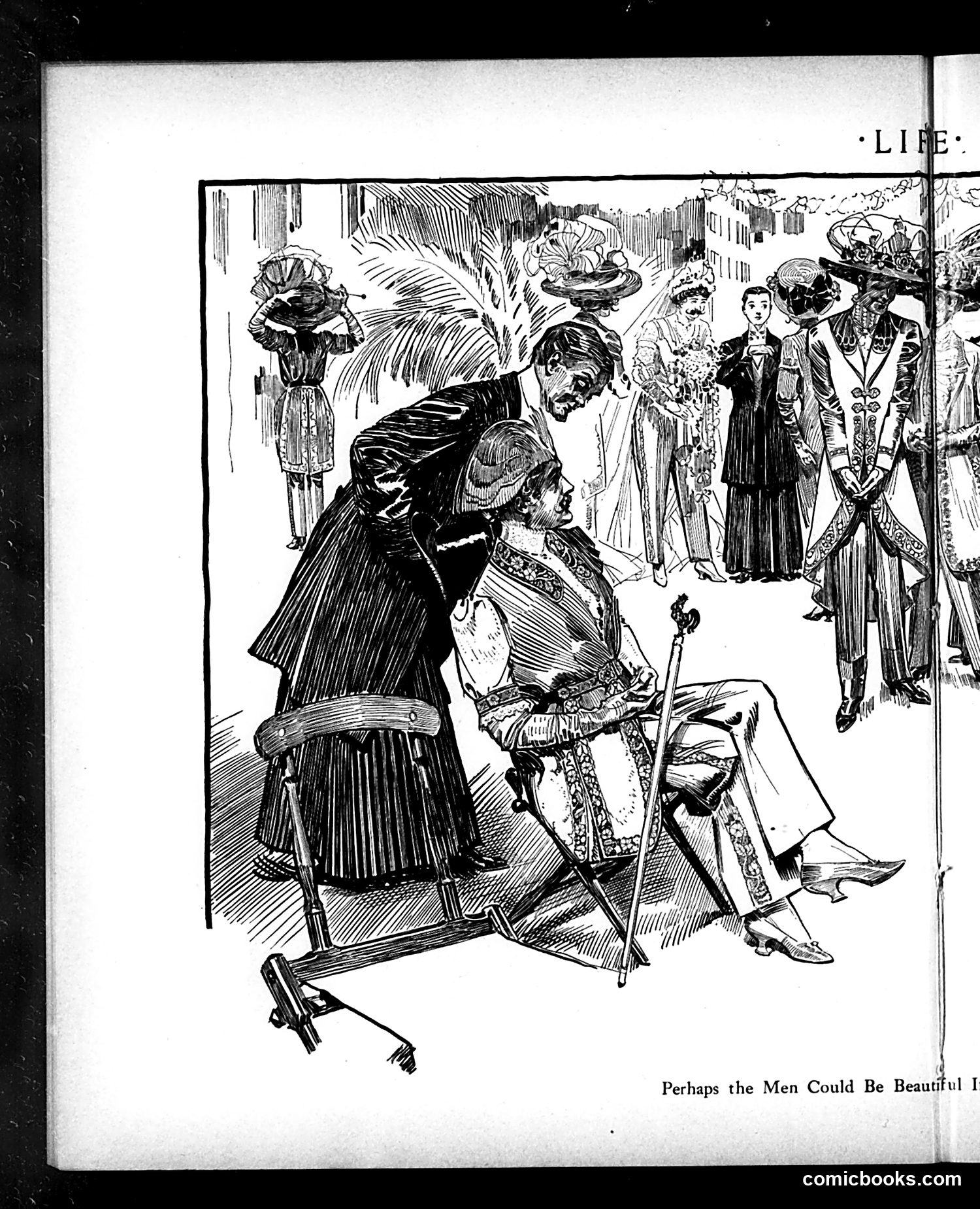
This appears to be a satirical cartoon from *Life* magazine depicting a social scene, likely from the early 20th century based on the clothing and art style. The caption "Perhaps the Men Could Be Beautiful" suggests the cartoon satirizes masculine appearance or fashion. The scene shows elaborately dressed women in ornate hats and fashionable clothing observing or reacting to men in formal attire. The satire likely critiques either male fashion choices, masculine vanity, or gender dynamics around appearance and beauty standards of the era. The composition—with women prominently featured in stylish dress while men appear less refined or attractive—inverts or comments on period attitudes about beauty and presentation. Without additional context about the specific issue date, the precise satirical target remains unclear, though the humor appears directed at gender, fashion, or social pretension.
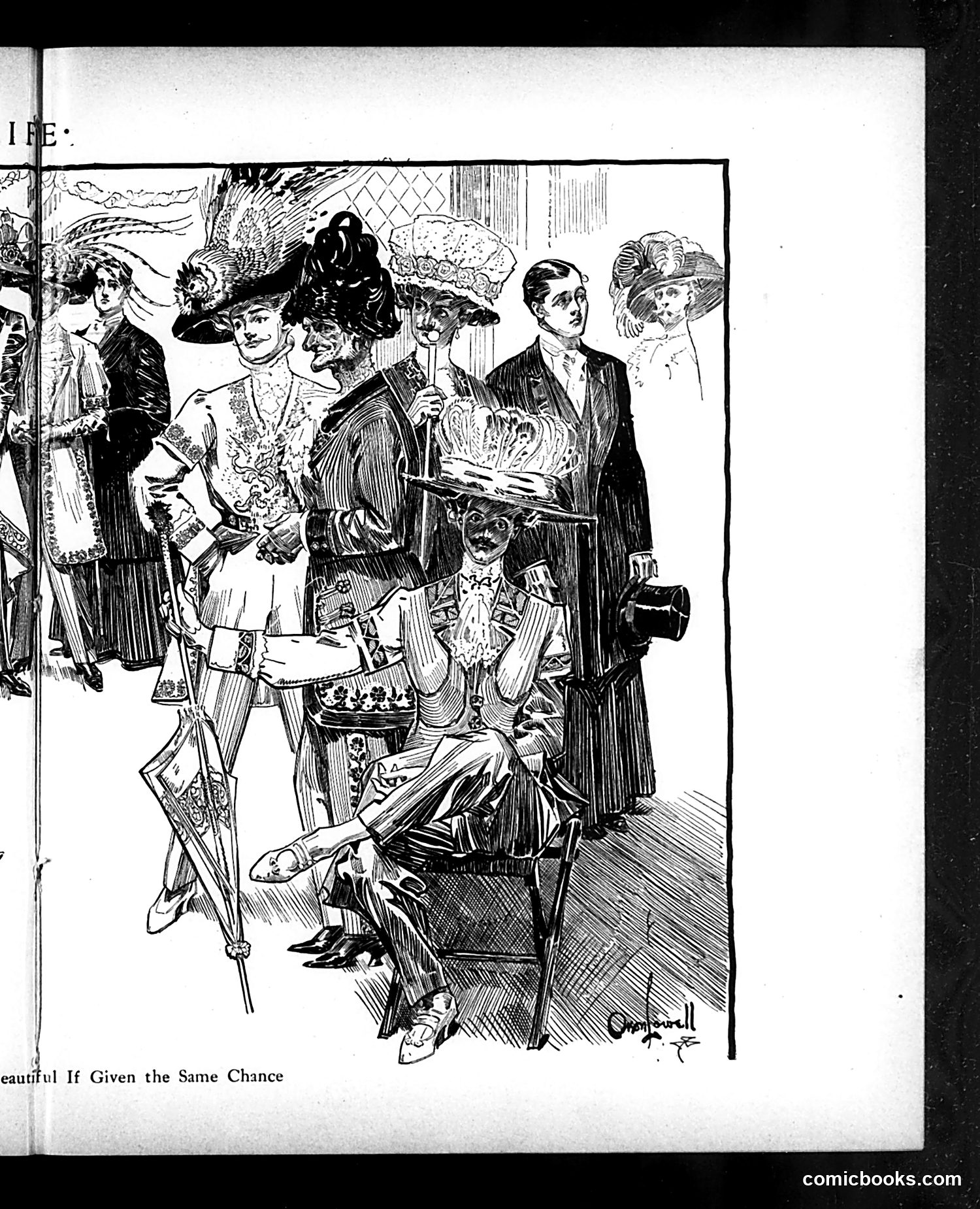
This appears to be a satirical illustration from *Life* magazine depicting a social scene with elegantly dressed figures in early 20th-century attire. The caption "Beautiful If Given the Same Chance" suggests social commentary on appearance and opportunity. The image shows well-dressed men and women in formal clothing and elaborate hats, with a seated central figure who appears to be the subject of the satire. The artist's signature is visible. Without additional context or visible publication details, the specific political or social critique remains unclear. The caption implies commentary on how circumstances or "chances" affect appearance or social standing, possibly satirizing class pretensions or the transformative power of wealth and status. However, the exact target of the satire cannot be definitively identified from the image alone.
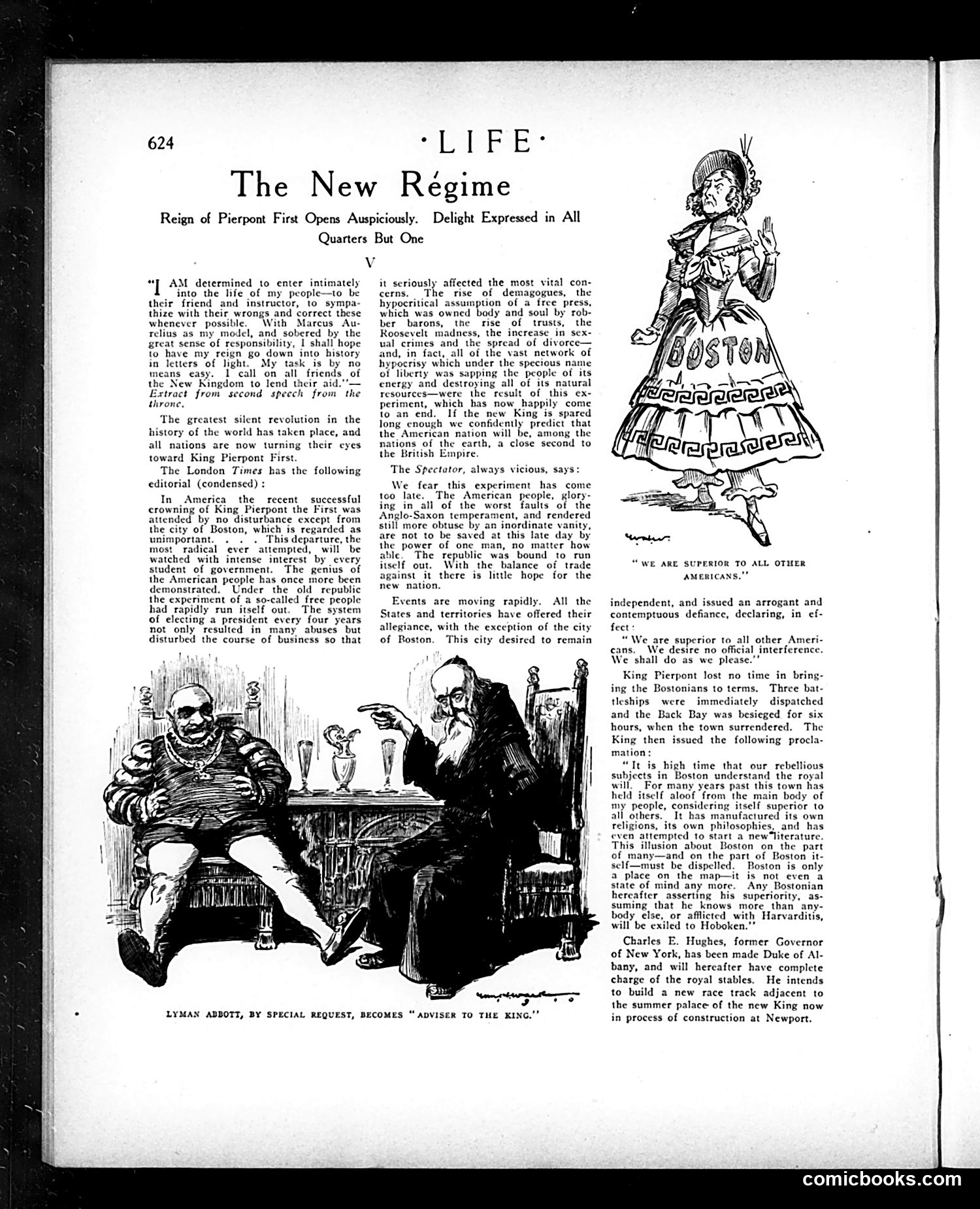
This Life magazine page satirizes the replacement of American democracy with a monarchy under "King Pierpont First"—likely referring to **J.P. Morgan**, the powerful banker whose influence over American economics and politics was vast. The satire mocks both American institutional failure and the public's apparent willingness to abandon democracy. The London Times editorial praises the change, claiming the republic "run itself out" due to demagoguery, corrupt press, trusts, and divorce—blaming democracy's failures. The opposing Spectator view suggests Americans are too obtuse to be saved. **The key joke**: Boston alone rebels, demanding independence from the new "King," and is forcefully subdued by battleships. This references Boston's historical identity as an independent-minded intellectual center, now absurdly treated as seditious for refusing royal allegiance. The cartoon shows an advisor consulting the corpulent "King"—visualizing how financial oligarchy has replaced electoral government. The satire warns that unchecked corporate power and public complacency could literally transform America into a monarchy.
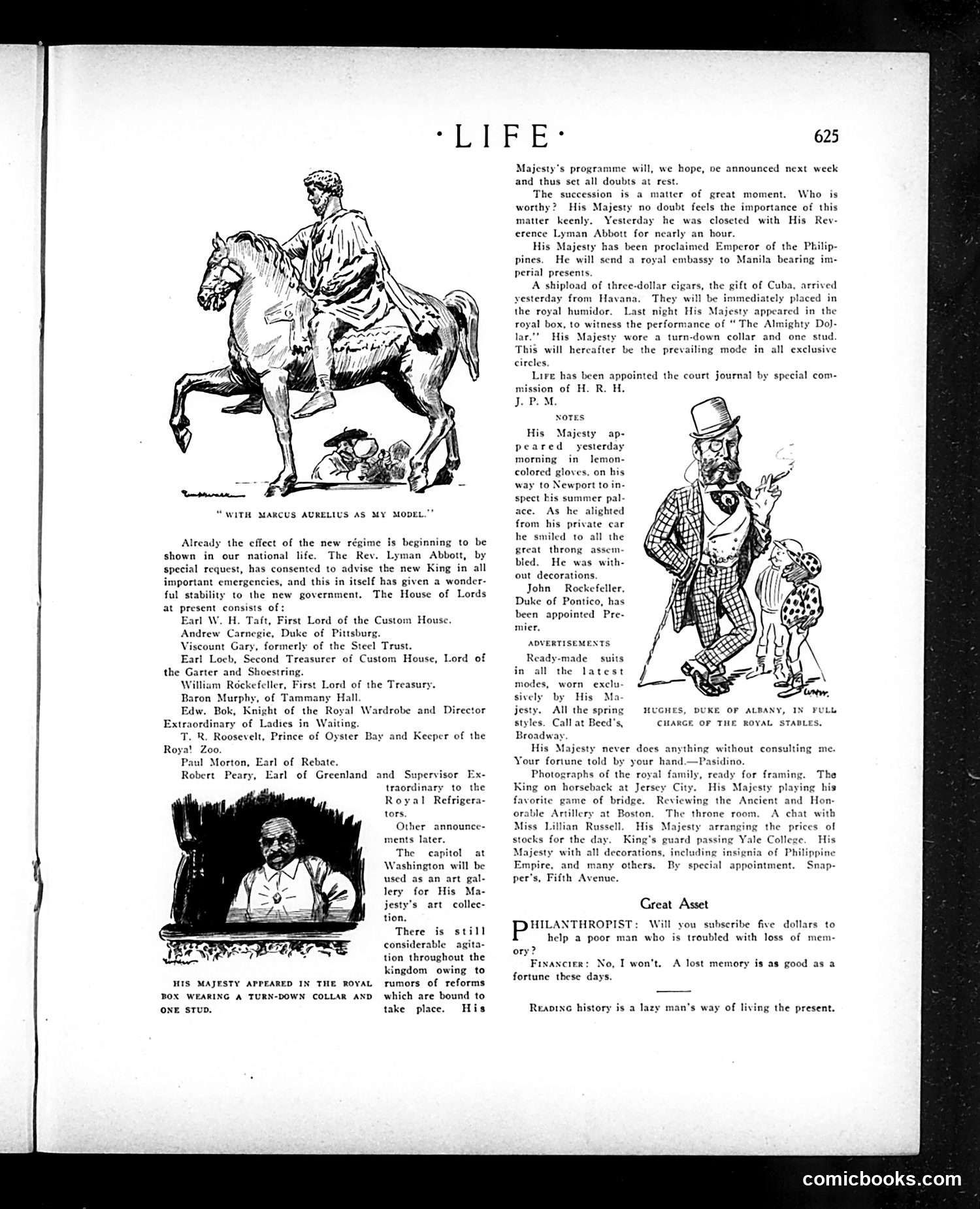
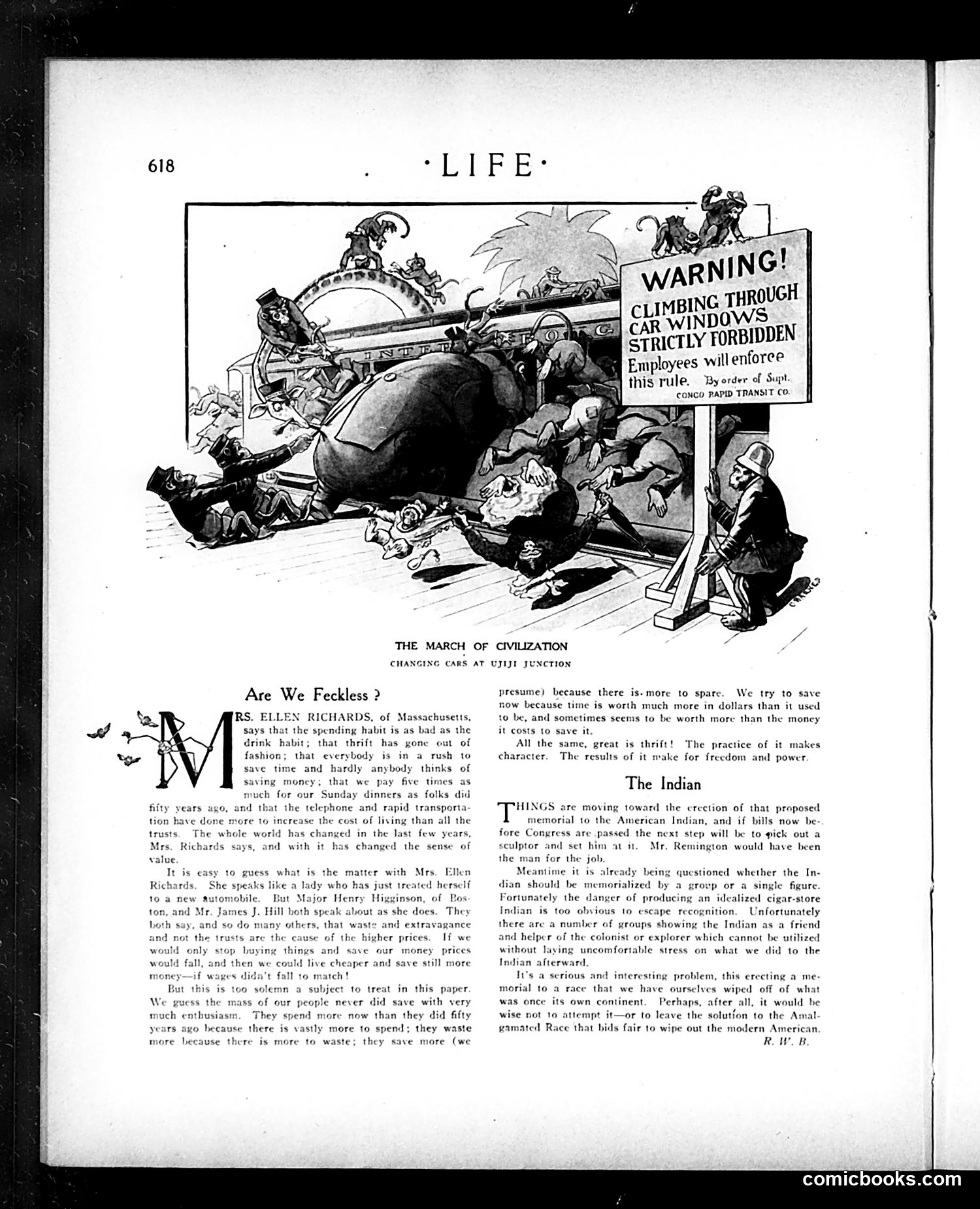
This page satirizes the presidency of Theodore Roosevelt, imagined as if he were an absolute monarch. The top illustration shows Roosevelt on horseback claiming Marcus Aurelius (Stoic philosopher-emperor) as his model—mocking his grandiose self-image. The text parodies Roosevelt's influence by fictionally elevating wealthy industrialists as his "House of Lords": Taft, Carnegie, Rockefeller, and others become dukes and earls. It ridicules his imperial pretensions—declaring him "Emperor of the Philippines" (referencing actual U.S. imperial expansion) and suggesting Washington's Capitol becomes his art gallery. The satire targets Roosevelt's celebrity and control: his fashion choices dictate national style, his movements are breathlessly reported, and even stock prices require "His Majesty's" approval. The side cartoons mock business titans' frivolous concerns and financial cynicism. Overall, Life criticizes Roosevelt's outsized personality and executive power during the Progressive Era, when presidential authority was expanding significantly.
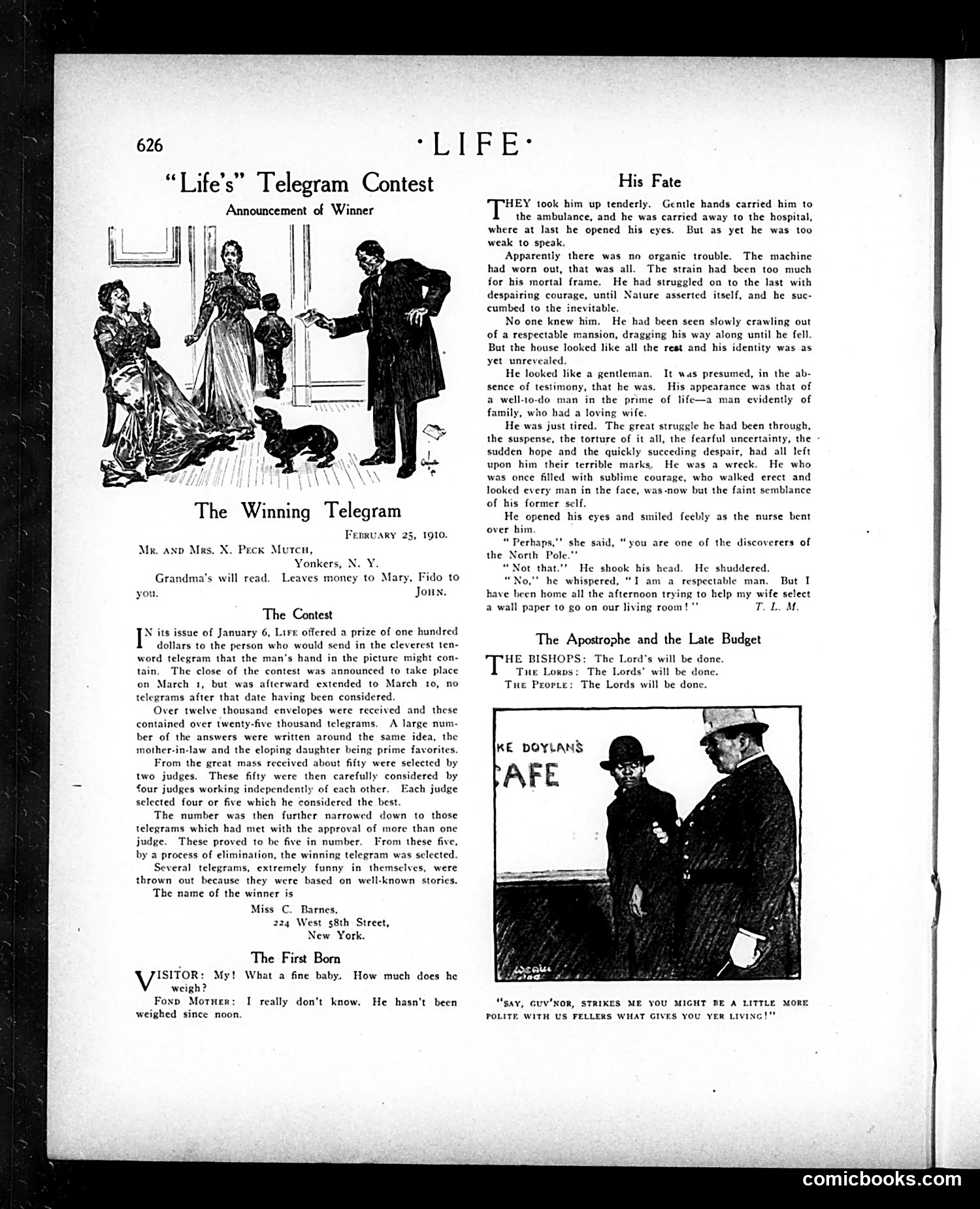
This page announces Life's telegram contest winner and includes satirical content reflecting early 1900s concerns. **The Contest Section:** Life solicited clever ten-word telegrams based on a picture of a man receiving a telegram. Over 12,000 entries were submitted and judged through multiple rounds. The winning telegram—"Grandma's will read. Leaves money to Mary, Fido to you"—humorously plays on domestic anxieties about inheritance and family priorities (a dog inheriting over the recipient). **"His Fate":** A satirical short story mocking the exhaustion of middle-class domesticity. A respectable gentleman collapses from the strain of selecting wallpaper with his wife—framed in mock-tragic language about a North Pole explorer. The joke targets the tedium of married life and household decisions. **"The Apostrophe and the Late Budget":** A political cartoon about the British budget debates, showing bishops, lords, and common people offering prayers with slightly different grammatical apostrophes, suggesting agreement despite class divisions. The Conan Doyle illustration at bottom appears promotional material.
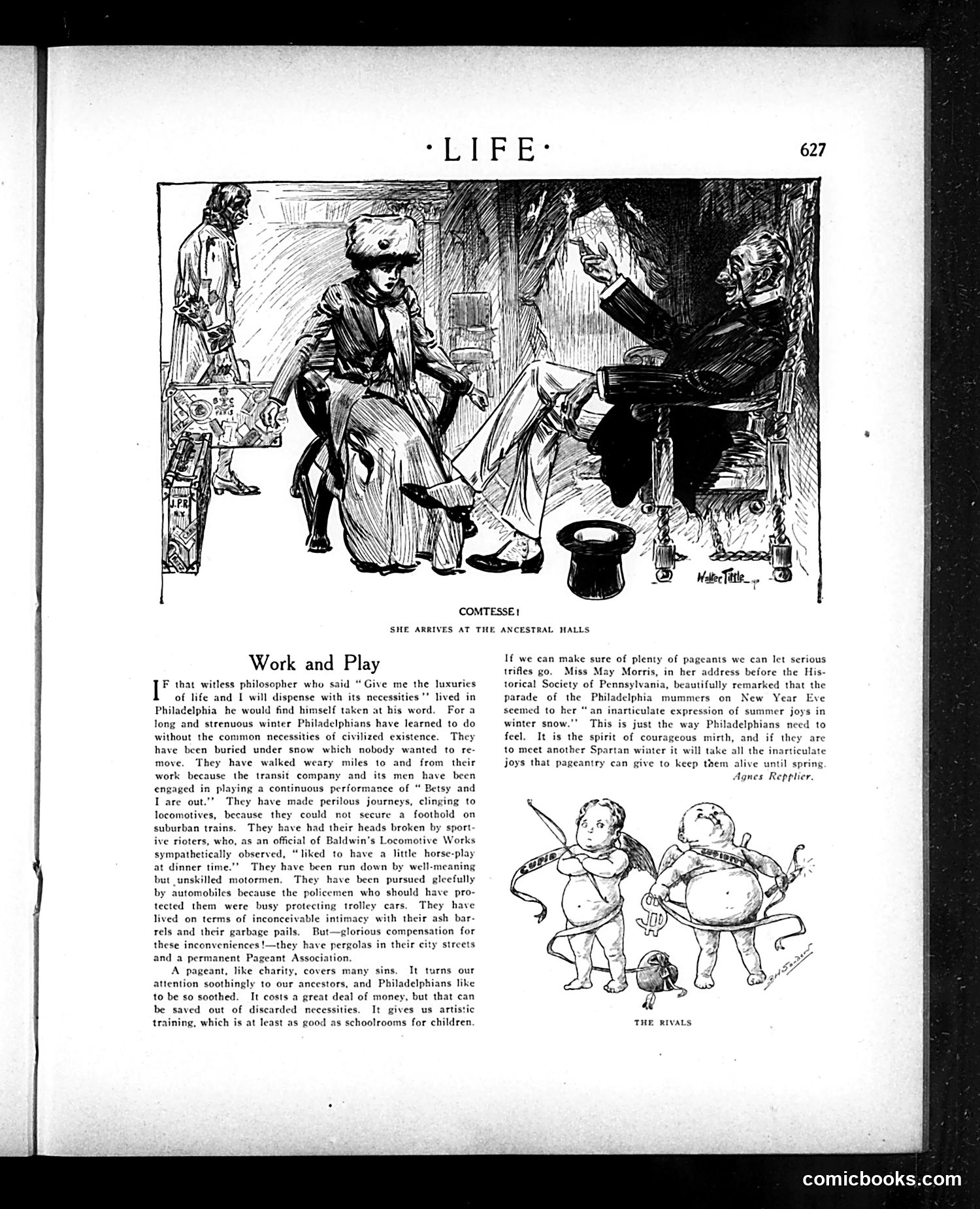
This *Life* magazine page satirizes Philadelphia's misplaced priorities during a harsh winter. The top cartoon shows a wealthy woman ("Comtesse") arriving at ancestral halls—representing the city's obsession with pageantry and historical pageants. The accompanying essay argues that Philadelphians endured genuine hardships—transit strikes, dangerous conditions, inadequate snow removal—yet celebrated this suffering by investing heavily in elaborate civic pageants and parades instead of addressing basic needs. The satire is sharp: the city sacrificed "necessities" for "luxuries" (pageants), inverting the famous quote. The author (Agnes Repplier) mocks how pageantry serves as emotional compensation, allowing citizens to romanticize winter hardship as "inarticulate expression" rather than demanding practical improvements. The small illustration "The Rivals" (bottom) appears to be unrelated filler. The point: civic vanity and spectacle distract from real problems and justify neglecting citizens' actual welfare.
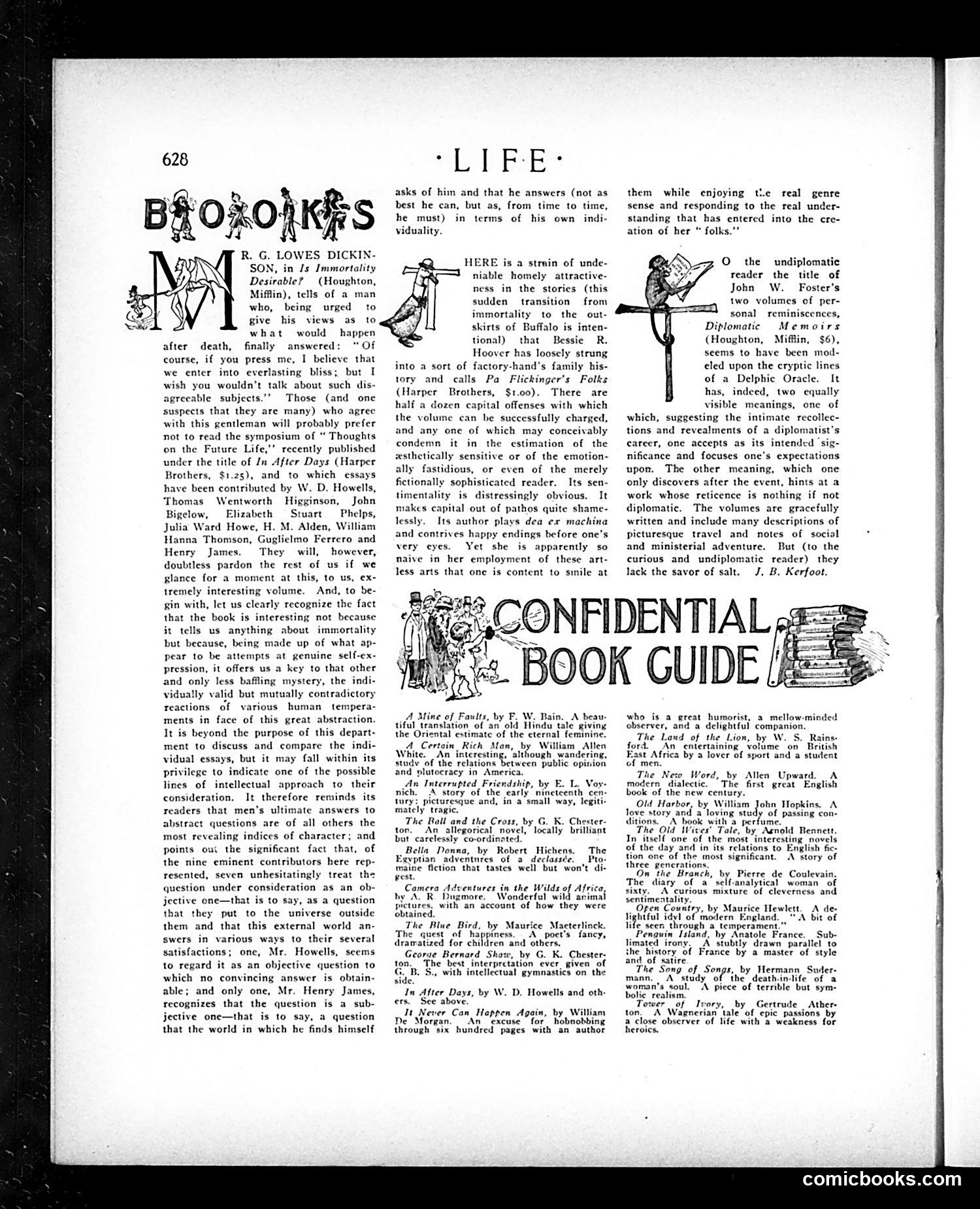
This page reviews literary works addressing **late 19th/early 20th-century intellectual concerns**. The main article discusses a book symposium titled *In After Days*, featuring essays by prominent American writers (W.D. Howells, Henry James, Julia Ward Howe, et al.) debating immortality and the afterlife. The reviewer notes that these essays are valuable not for answering metaphysical questions, but for revealing **individual temperaments and character** through how each writer approaches ultimate existential questions. Notably, the piece distinguishes Henry James as uniquely recognizing the question as **subjective**—answering from personal perspective rather than seeking external cosmic truth. The secondary review discusses *Pa Flickinger's Folks*, praising its authentic portrayal of working-class family life while critiquing its obvious sentimentality and contrived happy endings—typical period concerns about balancing commercial appeal with literary sophistication. The page reflects **genteel magazine culture** engaging serious philosophical and literary questions for educated readers.
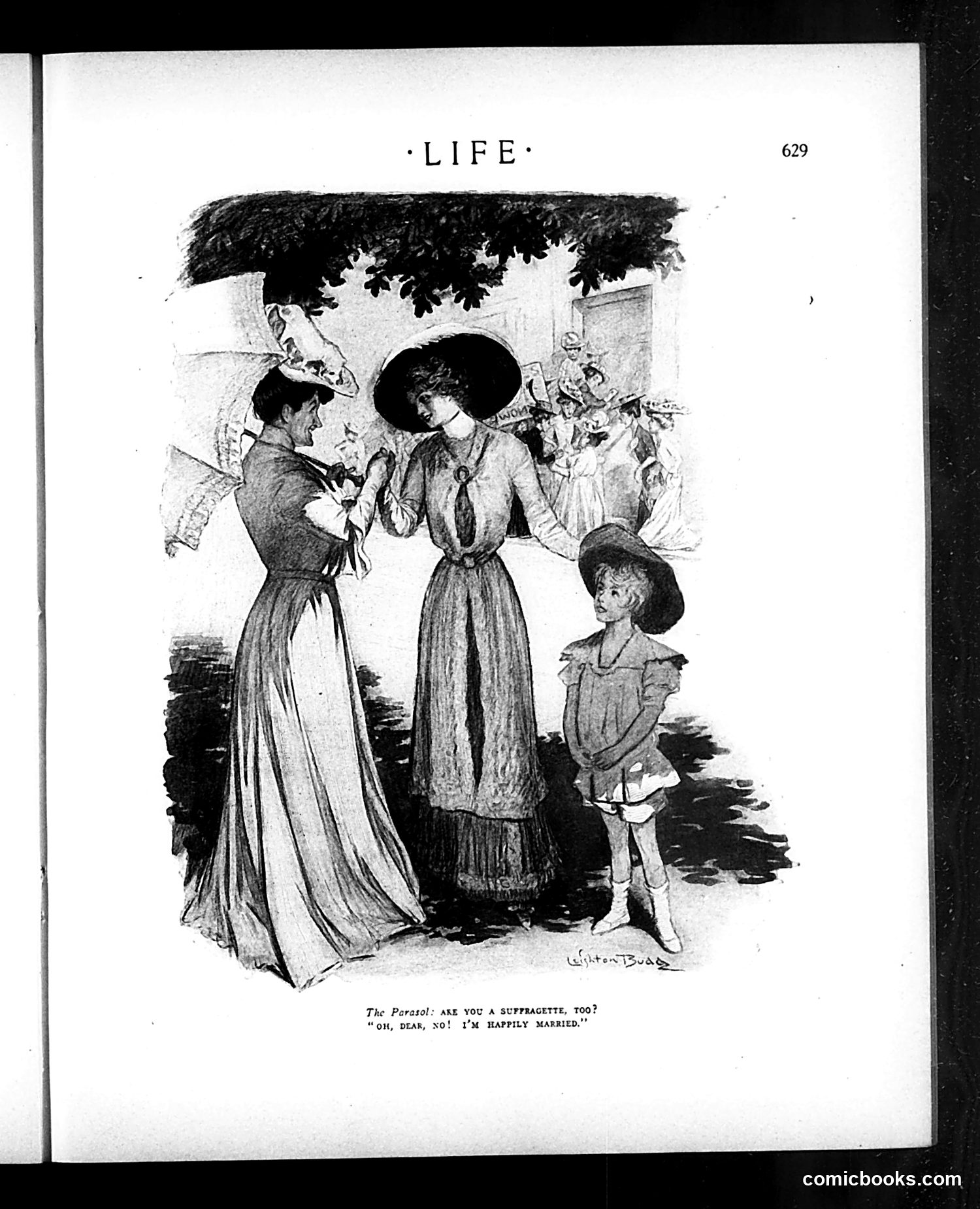
This satirical cartoon mocks the suffragette movement by contrasting a fashionable woman with a child. When asked if she's a suffragette, the woman responds she's "happily married"—implying suffragettes are unmarried or unfeminine. The joke relies on period stereotypes portraying suffragettes (women's voting rights activists) as unattractive, man-hating, or otherwise socially undesirable. By having an elegant, conventionally feminine woman reject the label, the cartoon suggests suffragettes were the opposite: unfeminine or socially problematic. The parasol—a fashionable accessory—emphasizes the subject's conventional femininity, sharpening the contrast with the implied "unfeminine" suffragette. This represents typical anti-suffrage propaganda using ridicule rather than substantive argument.
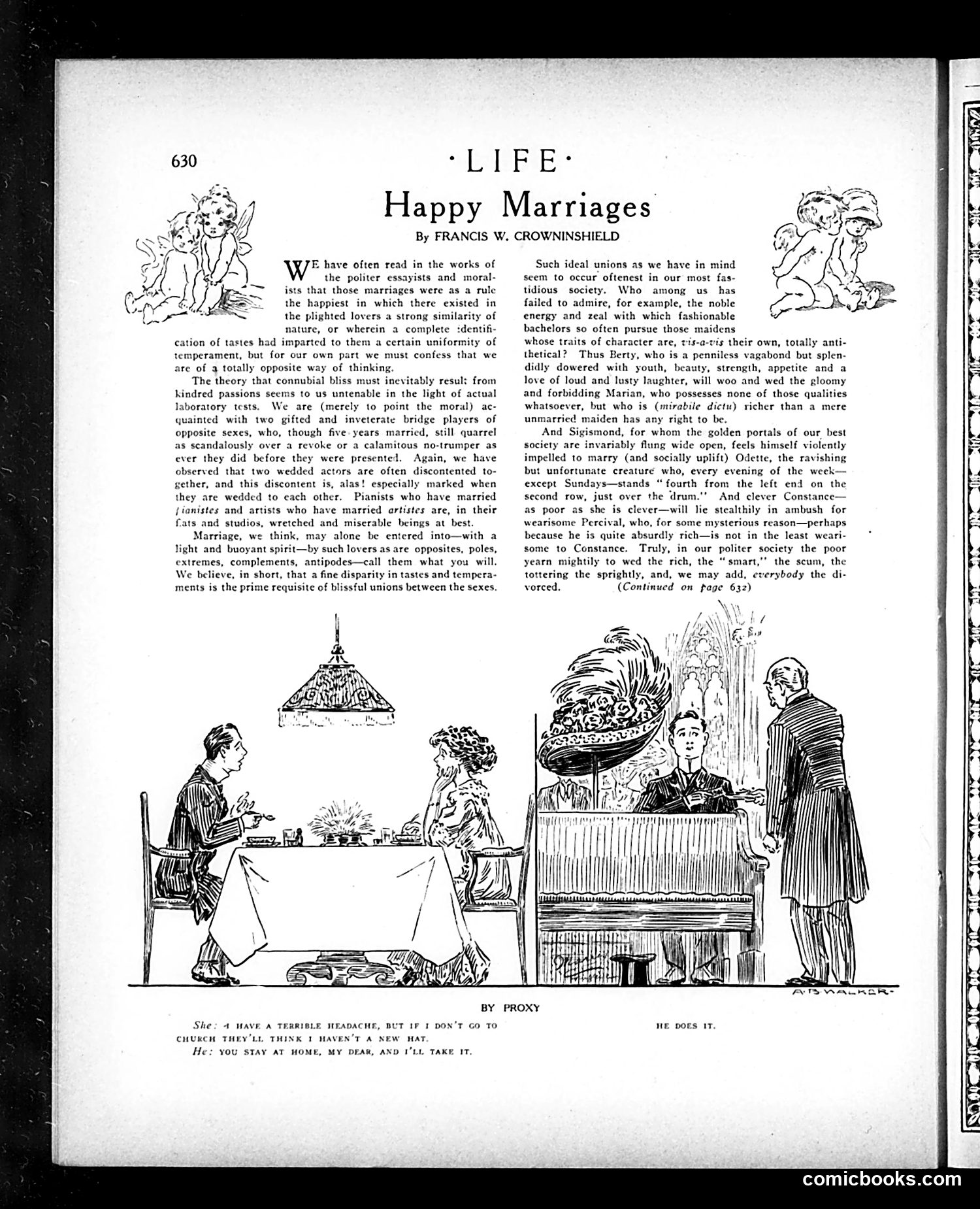
This article by Francis W. Crowninshield argues that successful marriages require *opposite* personalities, not compatible ones. He supports this with upper-class examples: a poor but charming man marrying a wealthy, gloomy woman; a chorus girl (who performs "fourth from the left...every evening except Sundays") marrying into high society; a poor-but-clever woman pursuing a rich man. The accompanying cartoon titled "By Proxy" satirizes superficial society priorities. A woman claims a headache but insists on attending church—not for faith, but to display her new hat. Her husband offers to take the hat himself and attend in her place, mocking how appearance matters more than genuine participation in social rituals. Together, these pieces skewer early 20th-century high society's materialism and status-obsession, suggesting marriages are often transactional arrangements between opposite classes rather than unions based on genuine compatibility.
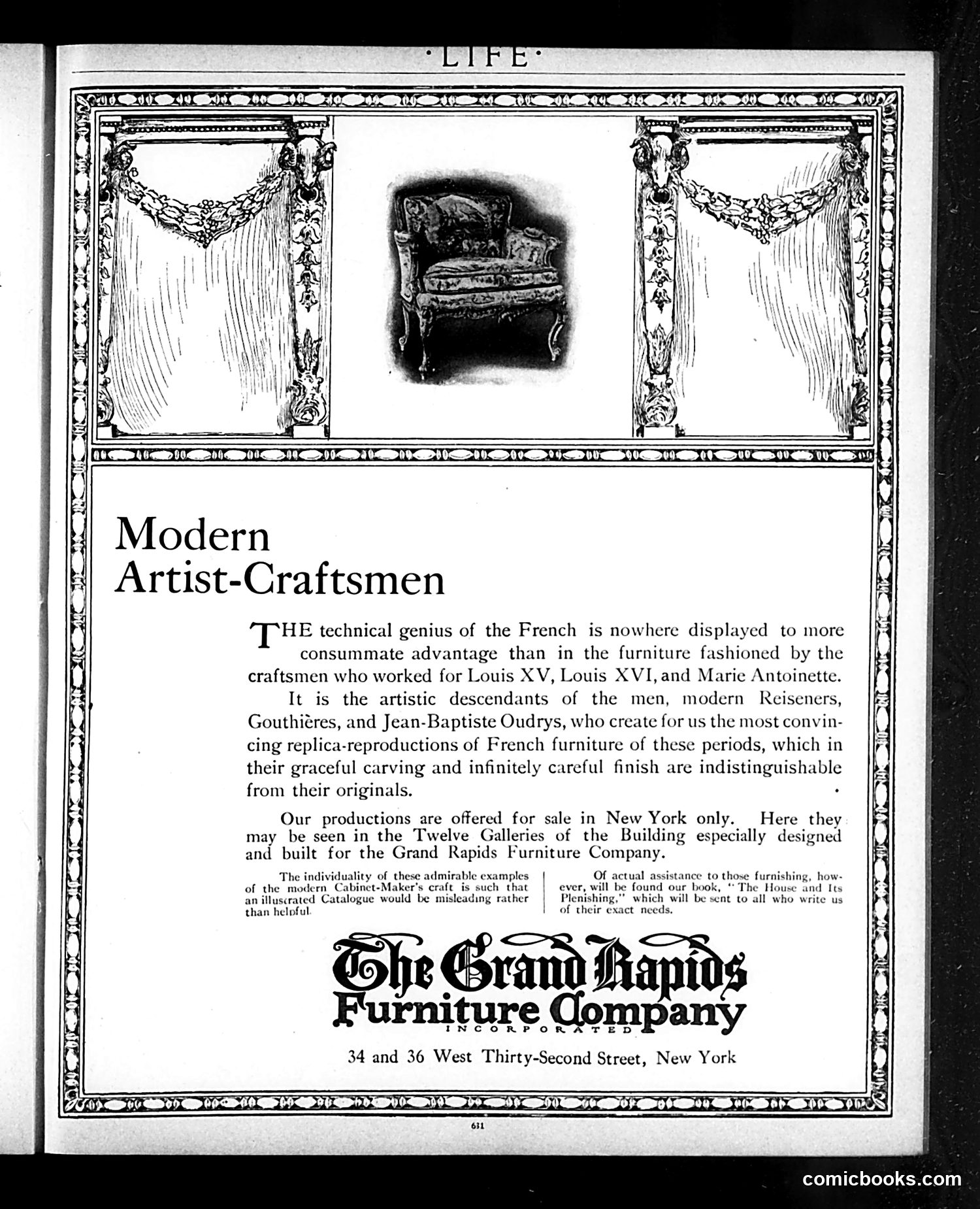
This is primarily an **advertisement**, not a satirical cartoon. It appears in *Life* magazine (which published both humor and ads) and promotes the Grand Rapids Furniture Company's reproduction French furniture. The ad highlights that modern craftsmen create near-identical replicas of furniture from the Louis XV, XVI, and Marie Antoinette periods—claiming these reproductions are "indistinguishable from their originals." It names historical French furniture makers (Riesener, Gouthière, Oudrys) to establish credibility. The implicit appeal targets wealthy American consumers of the early 20th century: you can own "authentic" French luxury furniture without original pieces (which were rare/expensive). The company emphasizes that showrooms in New York display these items in specially designed galleries. There's no political satire here—just a straightforward luxury goods pitch exploiting American fascination with European aristocratic taste and the feasibility of high-quality reproductions.
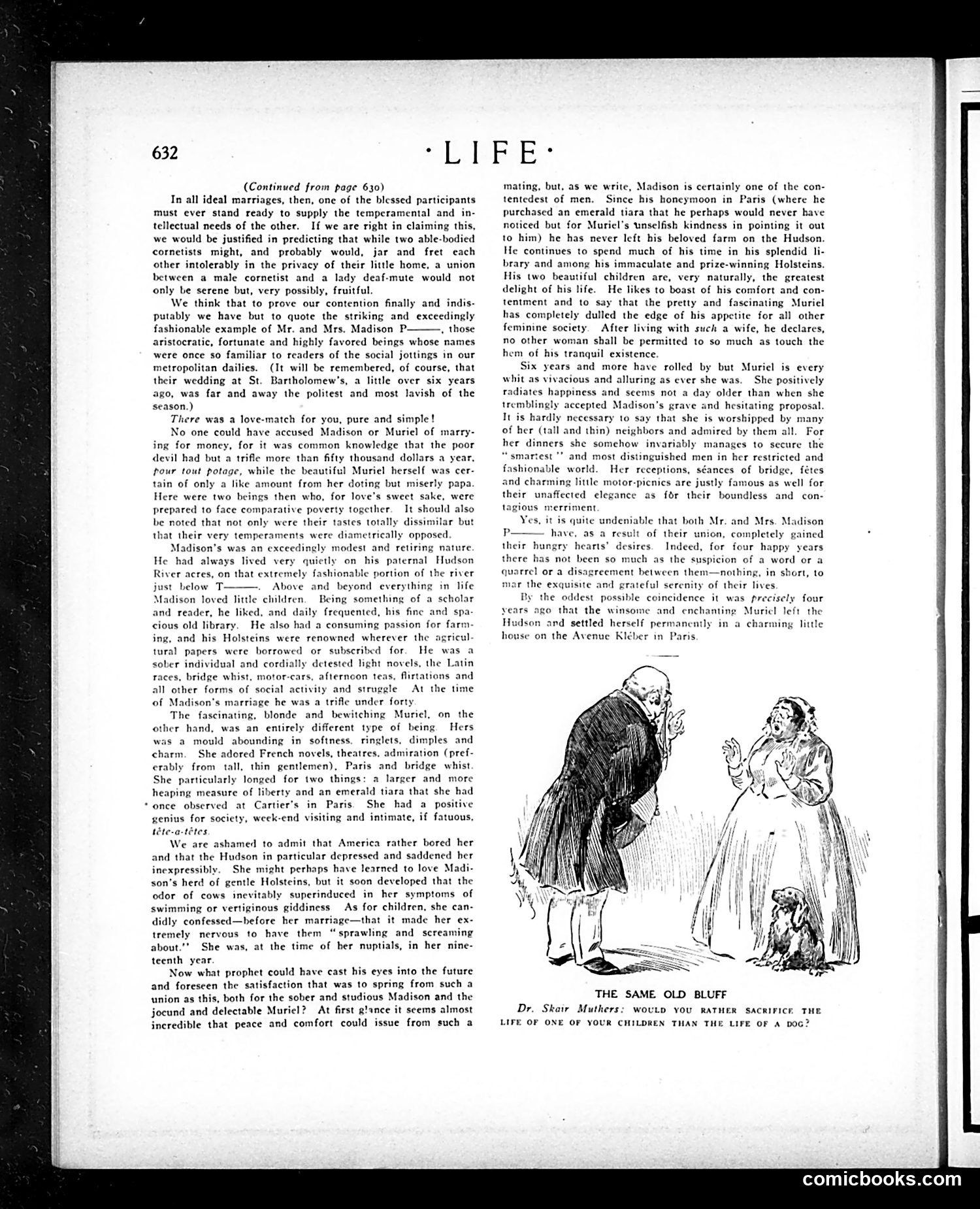
This page satirizes an ill-matched society marriage between "Madison" and "Muriel P.," wealthy New York aristocrats who wed six years prior. The text mocks their fundamental incompatibility: Madison is a quiet, scholarly gentleman who loves children, farming, and his Hudson River estate; Muriel is a frivolous, pleasure-seeking woman obsessed with Paris, theatres, bridge whist, and social flirtation who finds cows nauseating and children nerve-wracking. The cartoon "The Same Old Bluff" (bottom right) shows Dr. Skair Mulchers confronting what appears to be a society woman with a dog—likely commenting on her priorities or hypocrisy regarding life choices. The satire targets Gilded Age high society's superficial marriages conducted for appearance rather than genuine compatibility, and mocks wealthy women's self-absorbed worldliness versus domestic duty. The opening premise—that ideal marriages require one partner to sacrifice their needs—sets up the ironic critique of this doomed union.
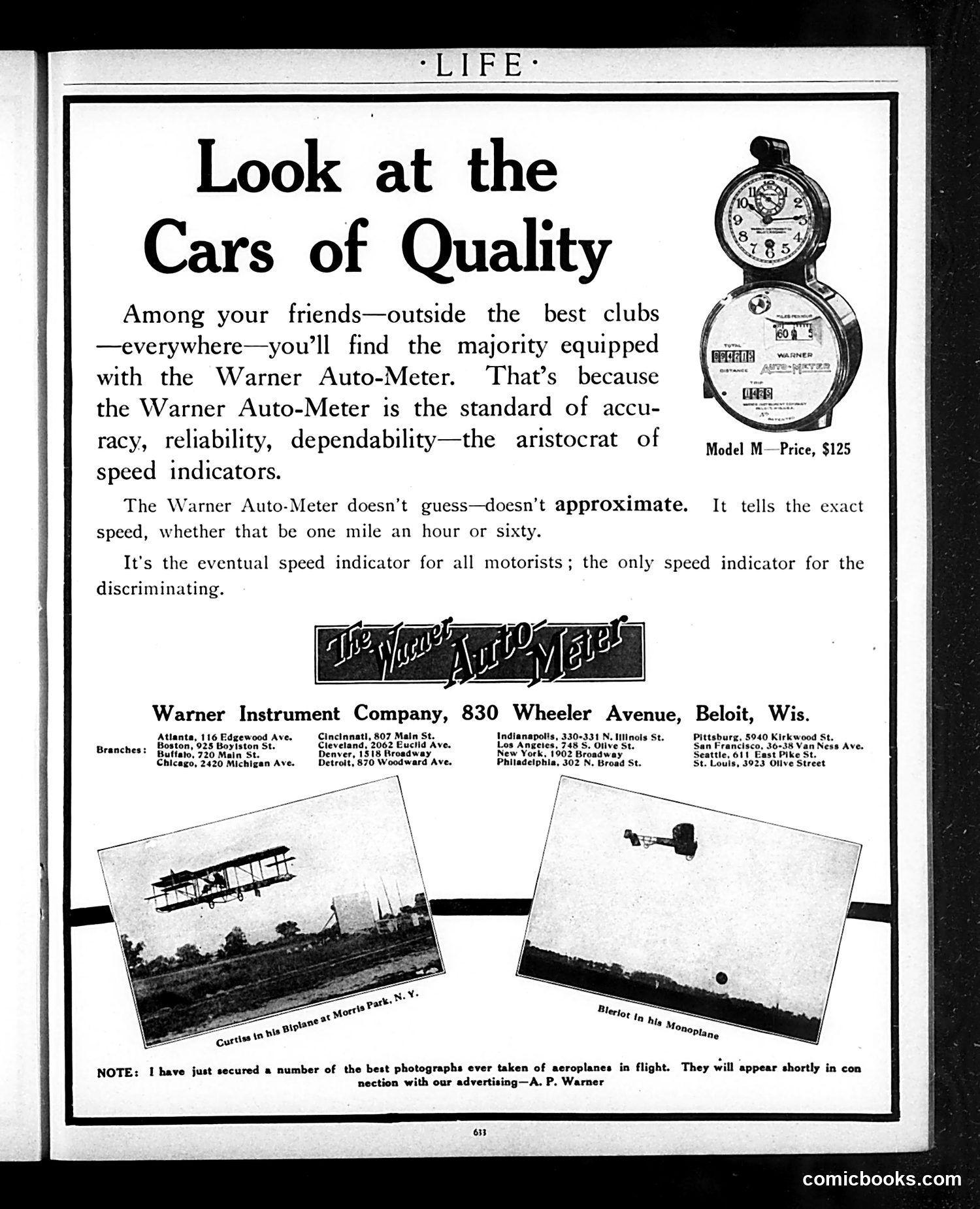
This is a **straightforward advertisement**, not satire. It promotes the Warner Auto-Meter speedometer (Model M, priced at $125) for automobiles, positioning it as a luxury accessory for the wealthy and discriminating. The ad's pitch relies on **class appeal**: owning a Warner Auto-Meter supposedly marks one as part of elite circles—"the best clubs"—because it's "the aristocrat of speed indicators." The device's supposed accuracy and reliability are emphasized repeatedly. The two photographs at the bottom show early aviation (a Curtiss biplane and Bleriot monoplane), likely included because the Warner company also made precision instruments for aircraft. The note suggests these aeronautical images will appear in future Life advertisements. This reflects the early 1900s era when automobiles were luxury items and precise speedometers were novel technological innovations marketed to wealthy consumers.
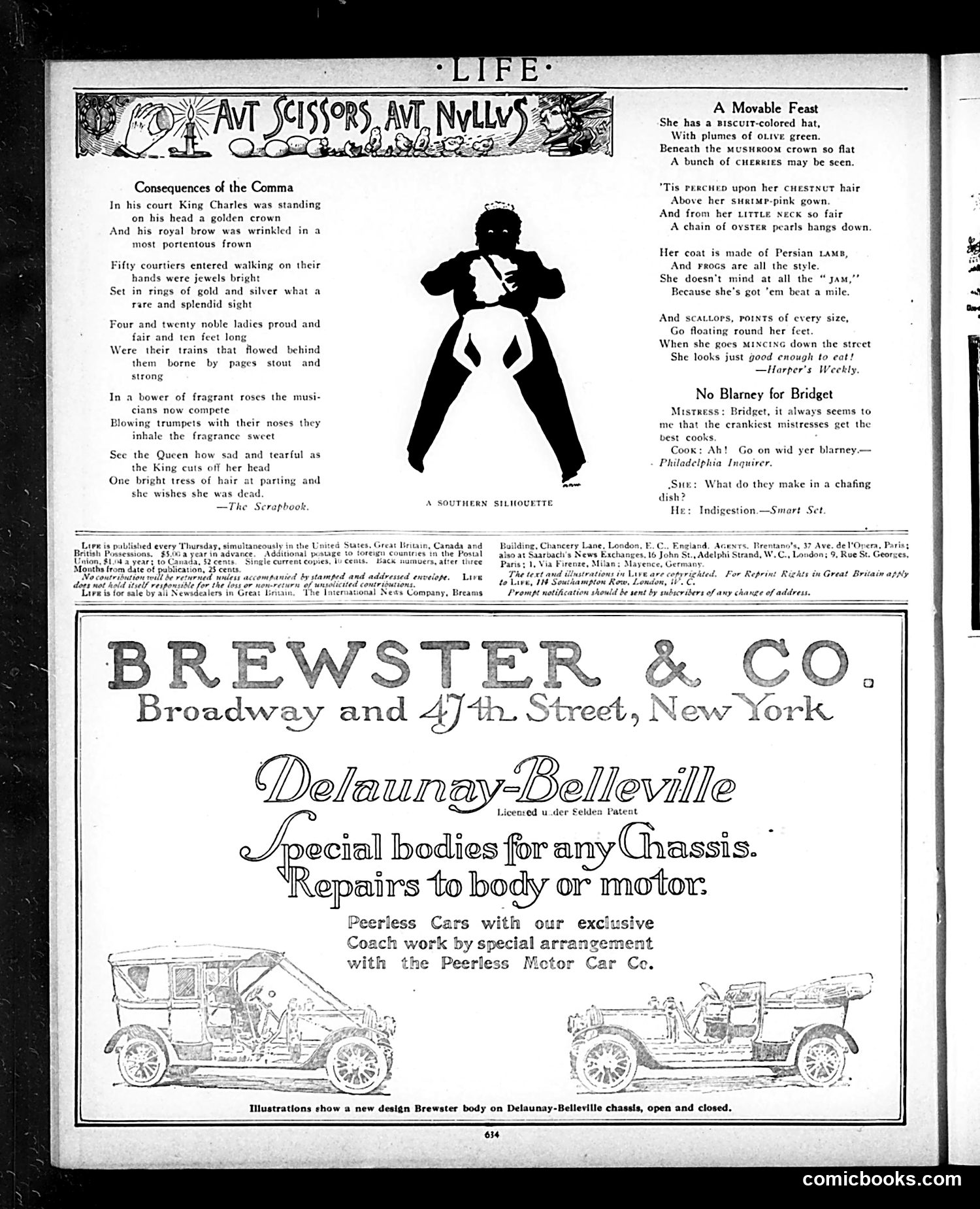
This page contains several satirical pieces typical of early-20th-century American humor: **"Consequences of the Comma"** is a nonsense poem poking fun at Victorian literary pretension. It depicts King Charles and his court in absurd situations (standing on heads, walking on hands, the king beheading the queen) — the joke being that a misplaced comma in the original text created ridiculous interpretations. This satirizes both punctuation pedantry and overwrought court literature. **"A Movable Feast"** humorously describes a fashionable woman whose clothing and accessories are entirely edible (cherries, oyster pearls, Persian lamb coat, etc.), mocking the era's excessive ornamentation and materialism in women's fashion. **"No Blarney for Bridget"** and the other brief quips are typical period humor playing on Irish servant stereotypes and domestic situations. The page is primarily advertising for Brewster & Co., a luxury automobile coachbuilder, using the satirical content to attract affluent readers.
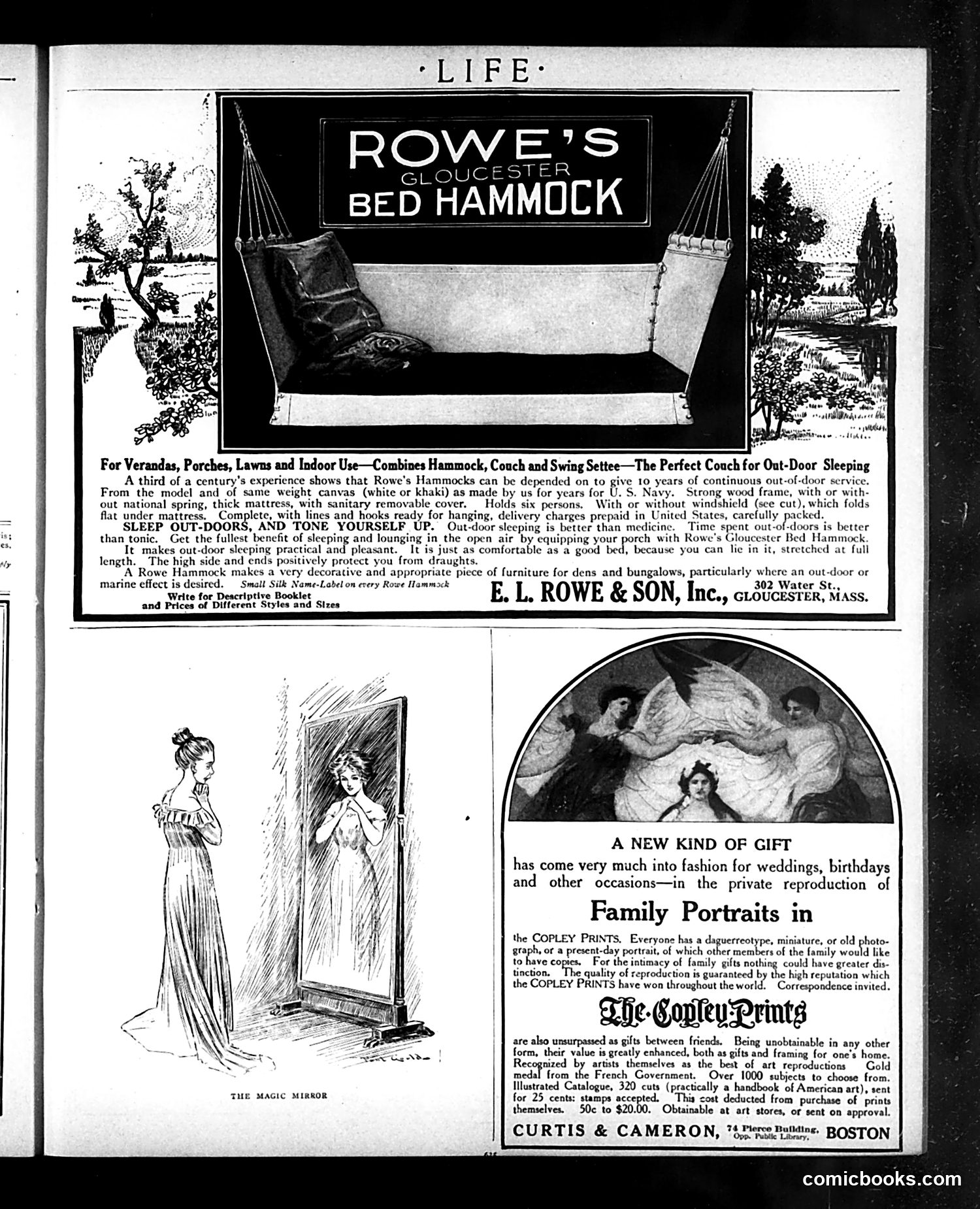
This page consists primarily of **three advertisements**, not political cartoons or satire. The top ad promotes **Rowe's Gloucester Bed Hammock**—a multipurpose outdoor furniture piece combining hammock, couch, and swing settee. It emphasizes durability (claiming 10+ years of service), military-grade construction (canvas from U.S. Navy specs), and health benefits of outdoor sleeping, which appears to have been a wellness trend of the era. The left side contains a small illustration titled **"The Magic Mirror,"** showing a woman admiring her reflection—likely part of a larger advertisement (text is cut off). The right advertisement promotes **Copley Prints**—reproductions of family portraits and artworks. It positions these as fashionable gifts for weddings and birthdays, emphasizing quality reproduction and artistic prestige (mentions French Government gold medal). All three ads reflect early 20th-century consumer culture: outdoor leisure equipment, home beautification, and reproductive art technology as status markers.
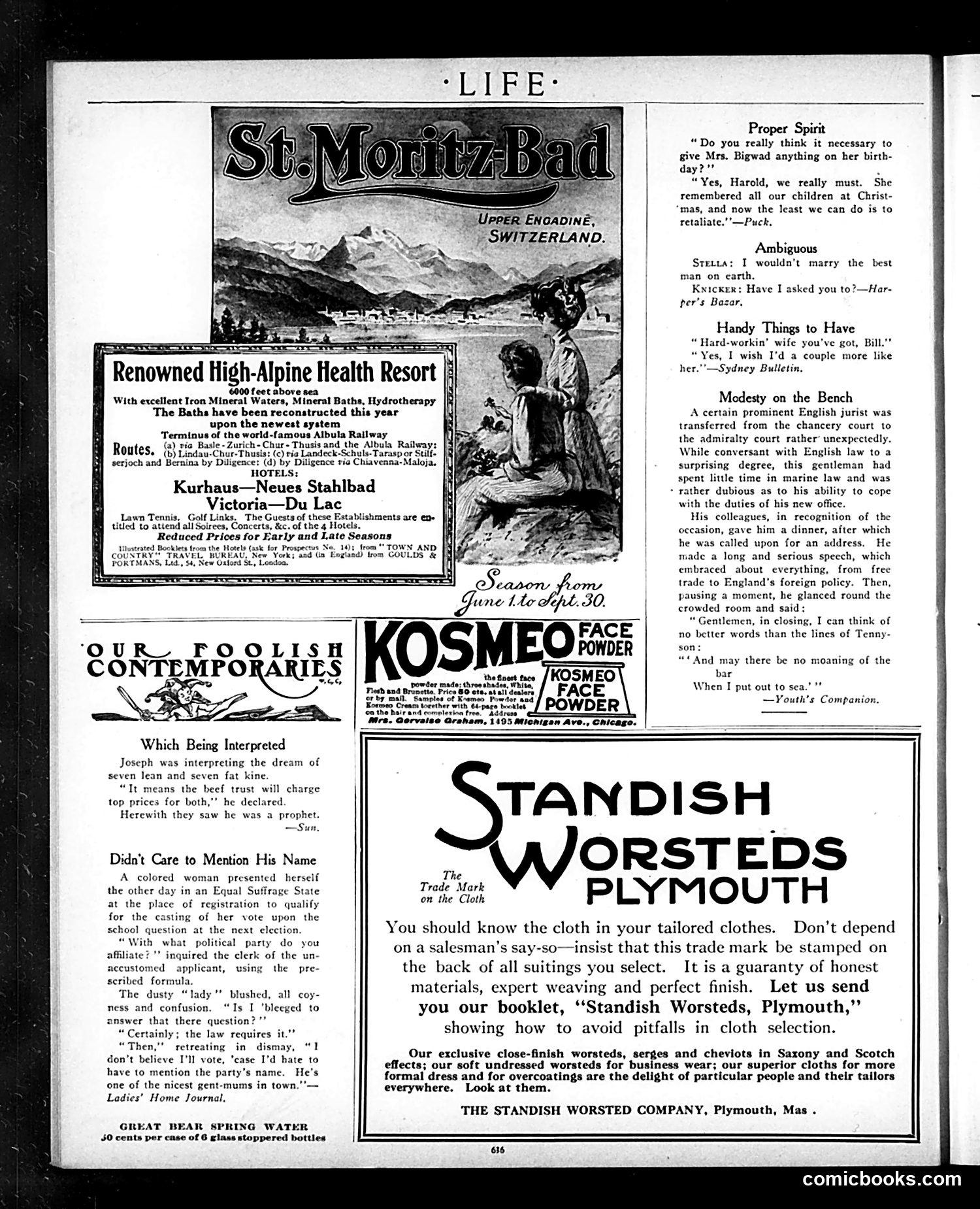
This page is primarily **advertisements and humor snippets** rather than political cartoons. The content includes: **Humor Sections** (left side): Brief jokes from various publications (Puck, Harper's Bazaar, Youth's Companion, The Sun) about everyday social situations—gift-giving obligations, marriage hesitations, hardworking wives, and a naval law joke about Admiral Tennyson. **"Which Being Interpreted"**: A topical joke about Joseph interpreting Pharaoh's dream as a prophecy about the **beef trust**—a reference to meat industry monopolies that were a genuine Progressive Era political concern (early 1900s). **"Didn't Care to Mention His Name"**: A dialect humor piece about a Black woman registering to vote, playing on confusion about political party affiliation. This reflects the period's casual racial stereotyping in "mainstream" magazines. **Large Advertisements**: St. Moritz-Bad (Swiss health resort), Kosmeo Face Powder, and Standish Worsteds (cloth company). The page reflects early 20th-century magazine conventions: lightweight social satire mixed with aggressive advertising, casual racial caricature, and topical economic humor.
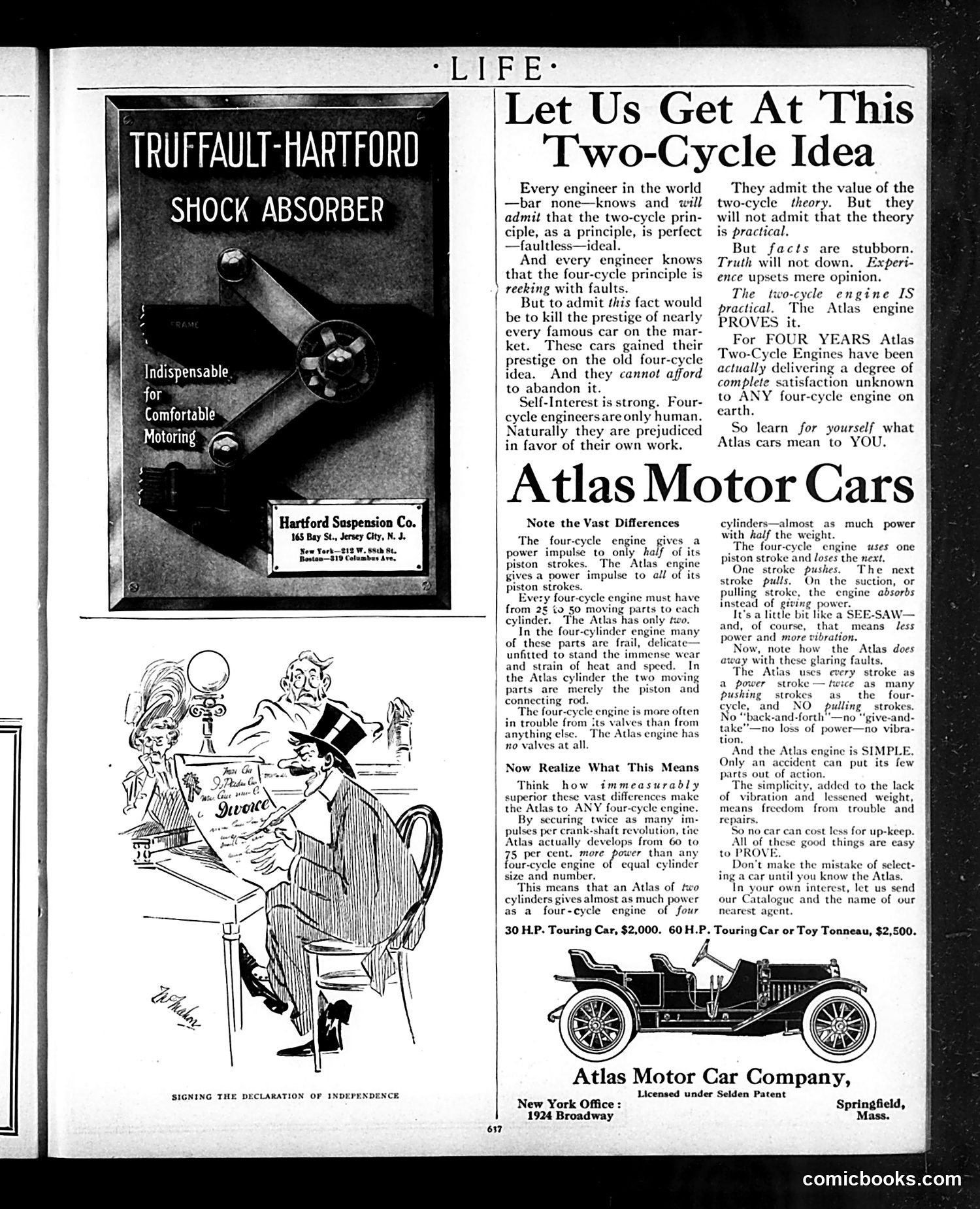
This page mixes political satire with automotive advertising. The cartoon, titled "Signing the Declaration of Independence," depicts figures in period costume signing a document—likely satirizing the Atlas Motor Company's argument about engineering "independence" from four-cycle engine orthodoxy. The figures appear caricatured in a humorous style typical of Life magazine's satirical approach. The accompanying advertisement argues that Atlas's two-cycle engines are technically superior to dominant four-cycle engines, but that established car manufacturers won't admit it due to self-interest and sunk prestige. The satire suggests these manufacturers are like reluctant signatories breaking from tradition—they acknowledge the superior principle but resist practical adoption. The cartoon reinforces the David-versus-Goliath narrative: Atlas as the revolutionary underdog challenging entrenched automotive interests through engineering truth rather than market inertia. It's promotional satire disguised as social commentary about institutional resistance to innovation.
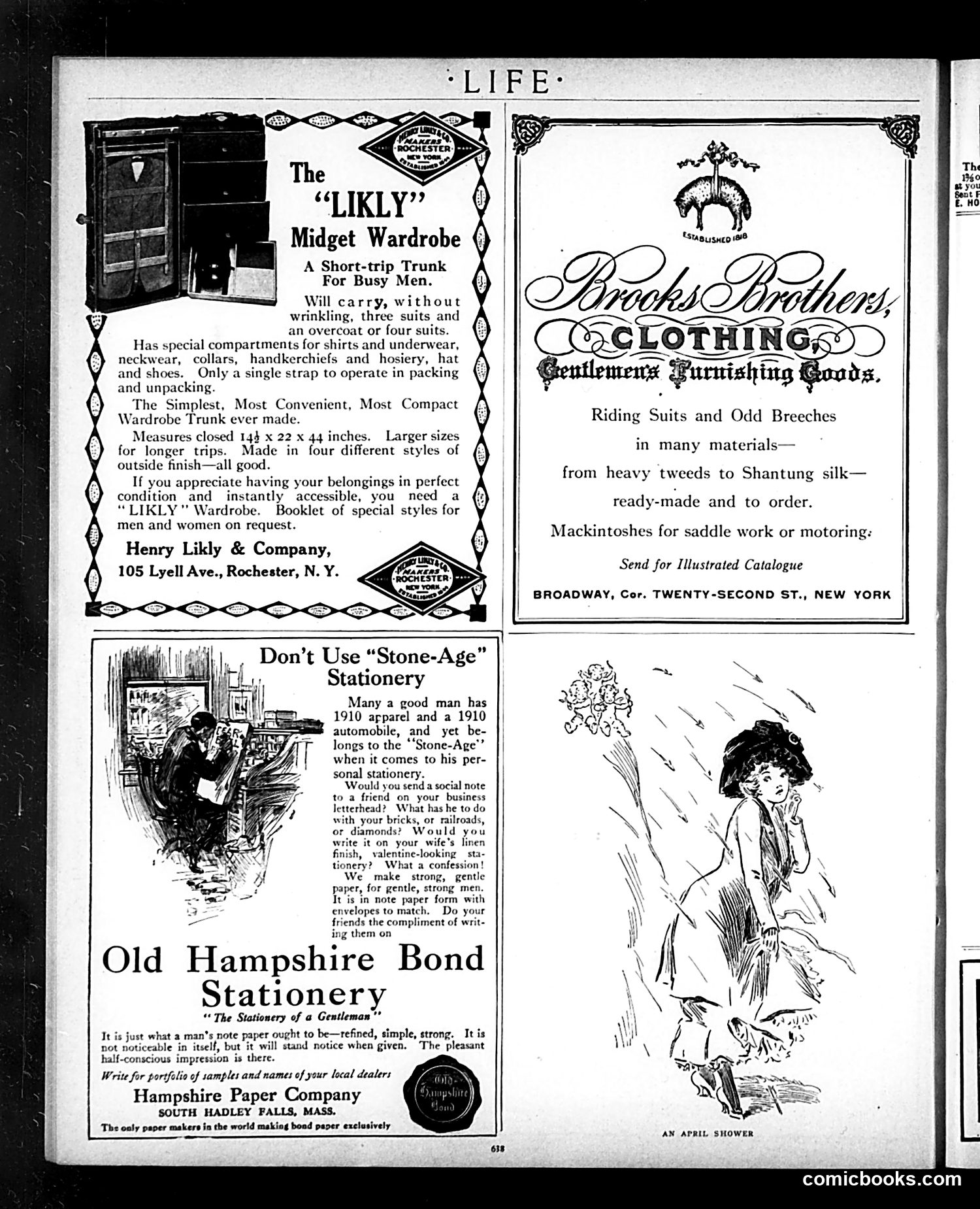
This page is primarily **advertising**, not political satire or comics. It contains four commercial advertisements from the early 1910s: 1. **"Likly" Midget Wardrobe** (top left): A compact traveling trunk for businessmen, emphasizing convenience for busy professionals. 2. **Brooks Brothers Clothing** (top right): Advertisement for gentlemen's riding suits and furnishings, positioned as upscale menswear. 3. **Old Hampshire Bond Stationery** (bottom left): The most satirical ad, gently mocking men who haven't modernized their personal stationery—using outdated or inappropriate paper choices. It contrasts a man with "1910 apparel and a 1910 automobile" who still uses "Stone-Age" stationery, positioning refined note paper as a marker of gentlemanly sophistication. 4. **Bottom right**: "An April Shower," an illustration of a woman in rain. The only social commentary is the Hampshire Bond ad's mild satire about social pretension and modernization—suggesting that even progressive men often neglect personal refinement in stationery choice.
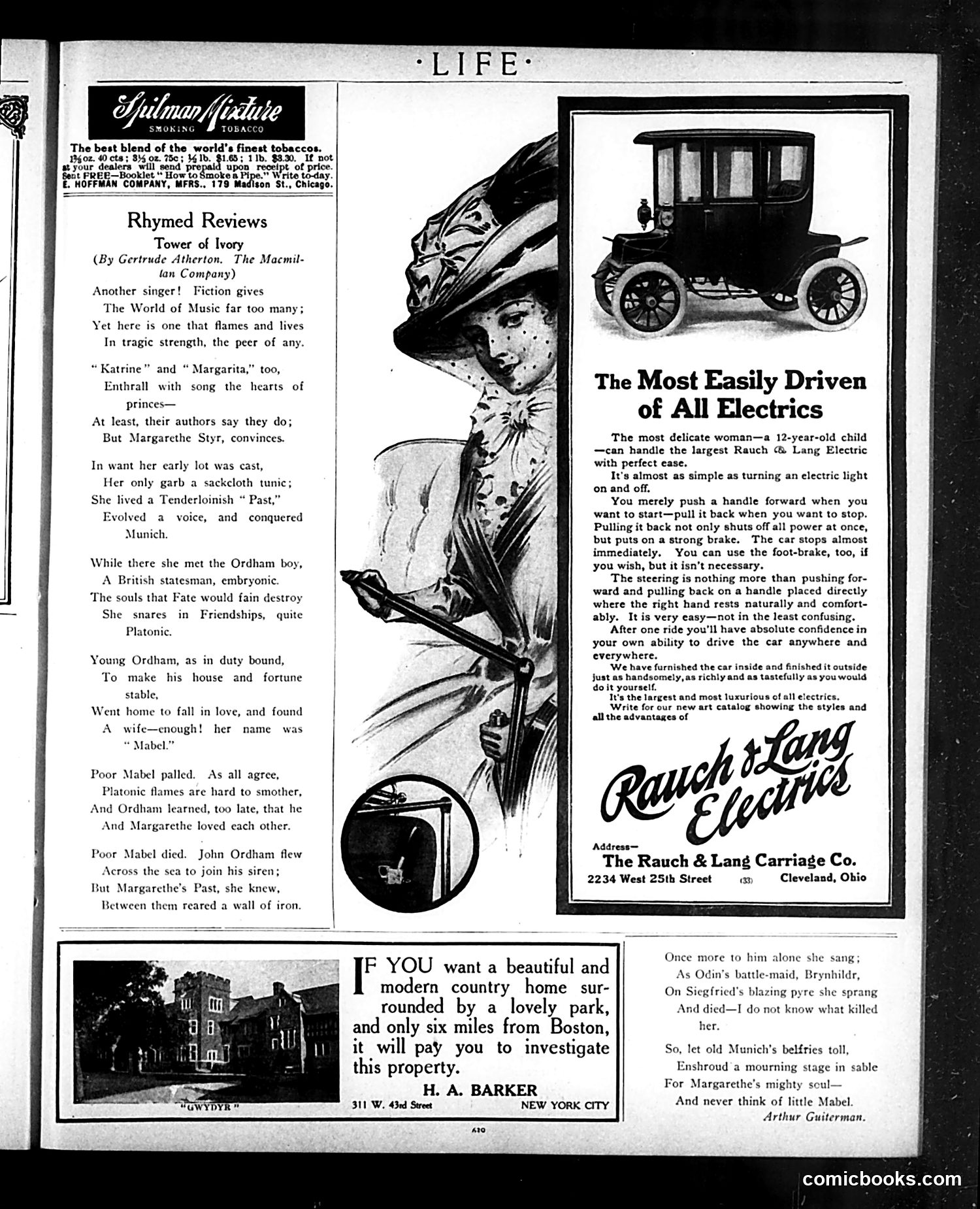
This page combines literature criticism with period advertising. The left side features "Rhymed Reviews," a satirical poem by Arthur Guiterman critiquing Gertrude Atherton's novel *Tower of Ivory*. Guiterman mocks operatic melodrama: a poor woman becomes a famous singer, falls in love with a British politician, he marries another woman (Mabel), then abandons Mabel to reunite with his true love, who dramatically dies. The satire targets overwrought romantic fiction and operatic clichés popular in early 20th-century literature—the elaborate tragedy reduced to absurdity, with the forgotten wife Mabel barely mentioned. The right side advertises a Rauch & Lang Electric automobile, claiming even a 12-year-old can drive it. This represents early automotive marketing emphasizing simplicity and safety for women drivers, then a novel concept.
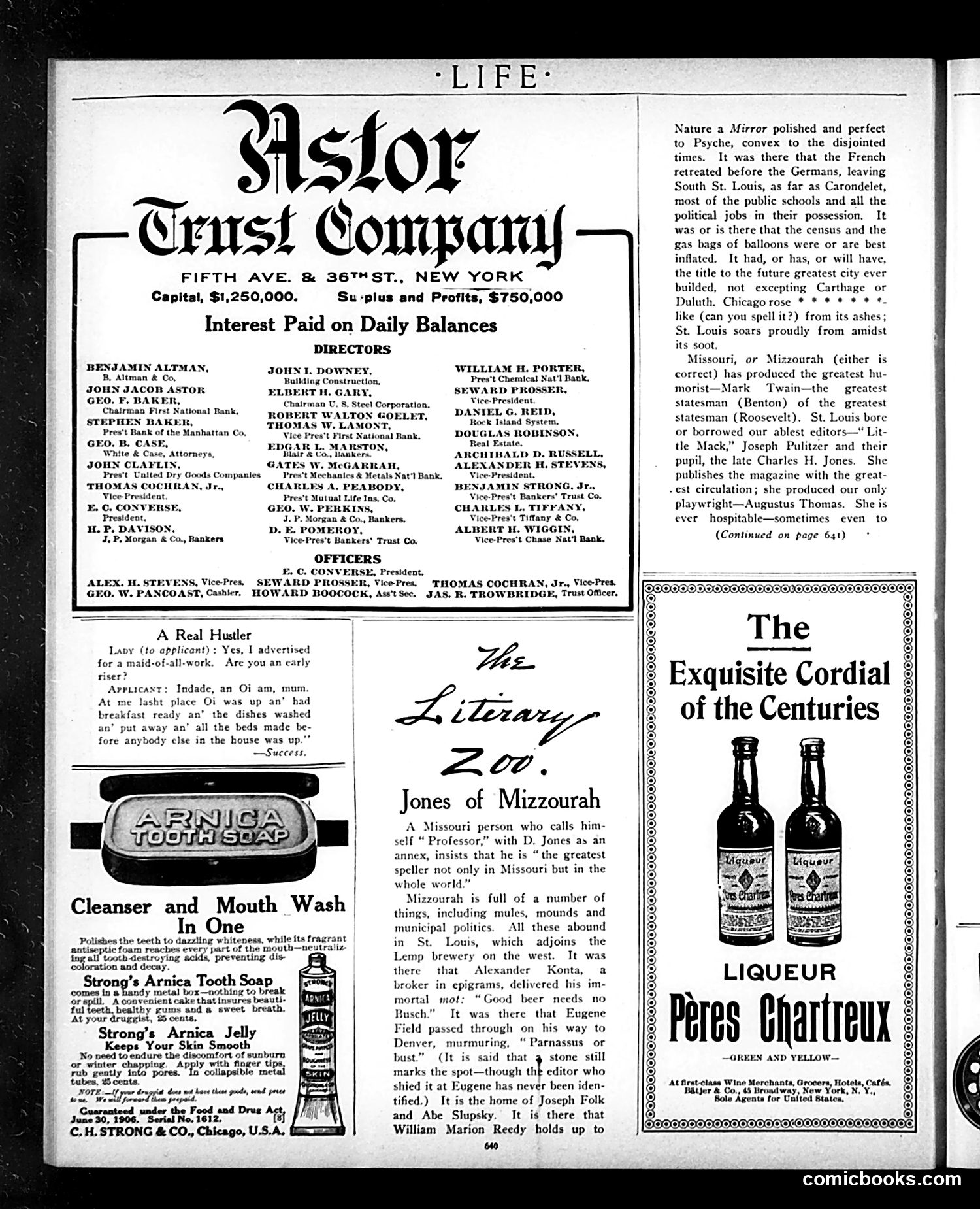
This satirical piece mocks a Missouri character calling himself "Professor" D. Jones, claimed to be "the greatest speller" in Missouri and beyond. The satire playfully catalogs Missouri's supposed contributions to American culture and achievement: Mark Twain (humorist), Theodore Roosevelt (statesman), local editors including Joseph Pulitzer, and playwright Augustus Thomas. The piece uses humorous exaggeration—references to the state's famous breweries (Lemp, Busch), poet Eugene Field, and broker Alexander Konta—to gently ridicule provincial pride and boastfulness. The tone suggests affectionate mockery of Midwestern self-importance, a common Life magazine theme. The jest targets not malice but rather the gap between small-town pretension and actual accomplishment, characteristic of early 20th-century American satirical humor about regional character types.
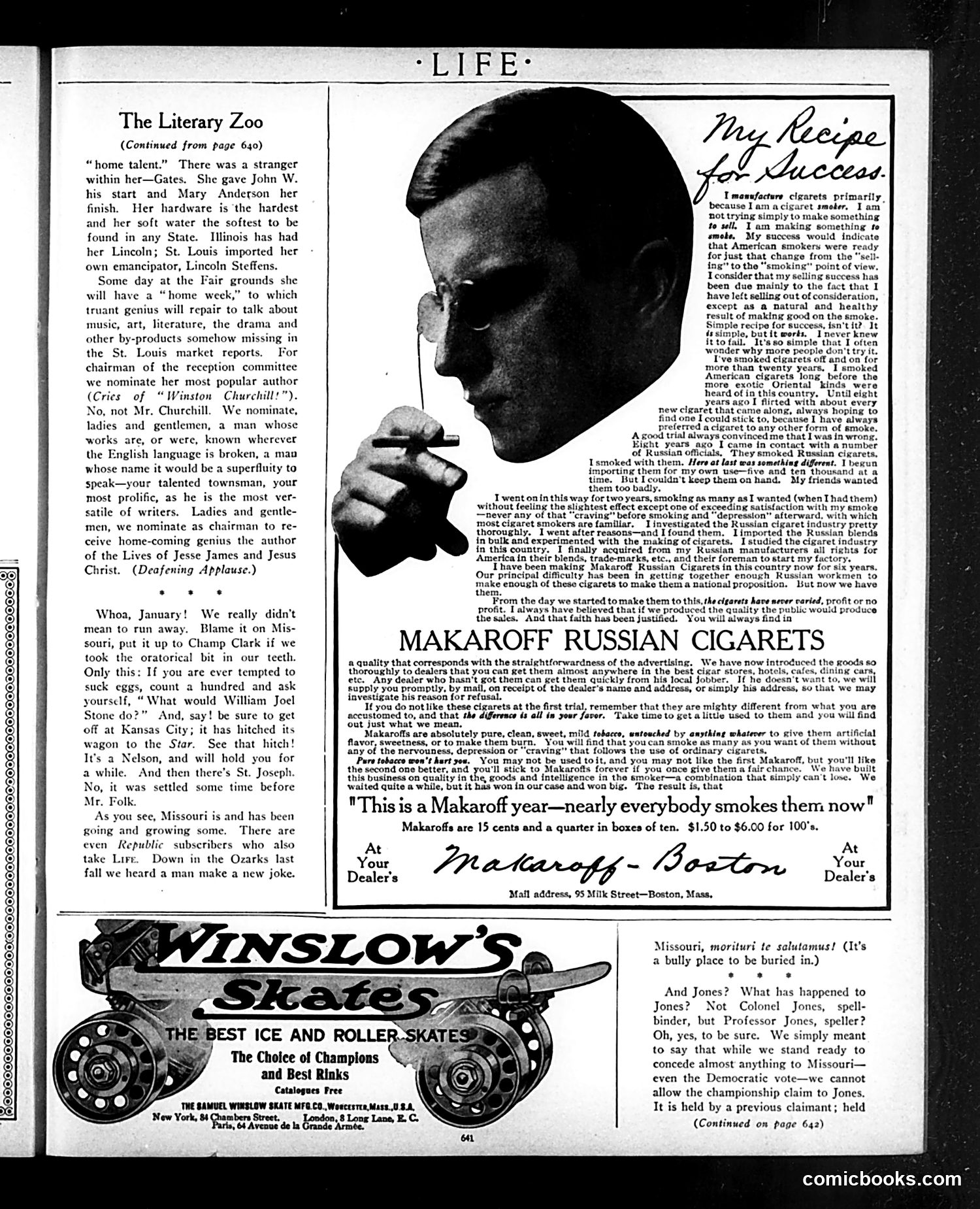
This page contains two distinct pieces: **"The Literary Zoo"** is a satirical article about St. Louis, Missouri and its cultural figures. The unnamed author mocks the city's pretensions while praising local writer William Joel Stone as the most prolific author—sarcastically crediting him with writing "the Lives of Jesse James and Jesus Christ" (likely referencing actual biographical works). The piece teases Missouri's boosterism and local pride, using exaggerated praise as satire. **The Makaroff Russian Cigarettes advertisement** features a lengthy testimonial claiming the product's success stems from prioritizing smoking quality over sales tactics. The advertiser emphasizes discovering Russian cigarettes through contact with Russian officials and claims they produce no "craving" or "depression"—health claims now recognized as false. The ad exploits early 20th-century credibility through detailed personal narrative rather than direct claims. Both elements reflect period attitudes toward regional pride and unregulated advertising claims about tobacco products.
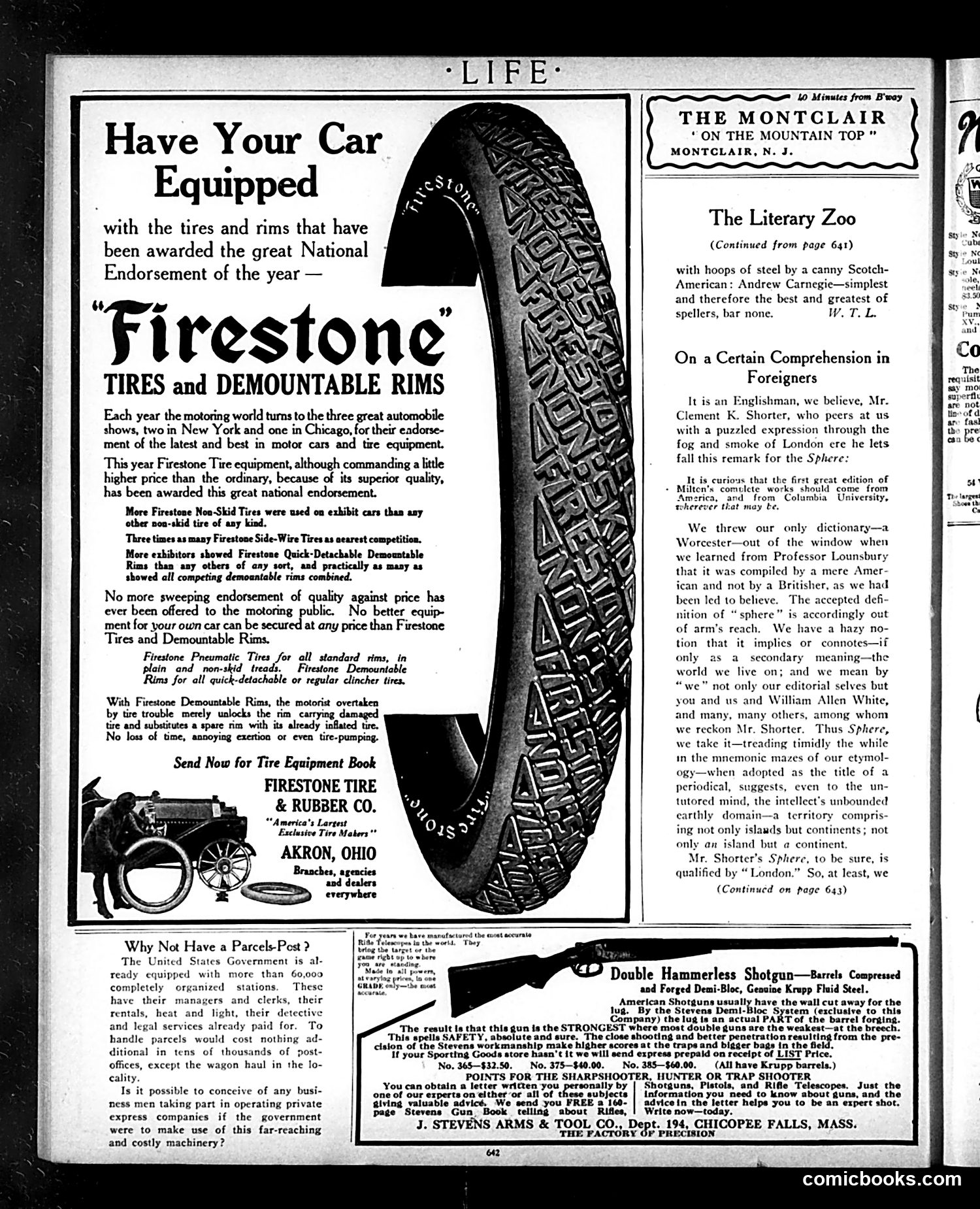
This page is primarily **advertisements and literary content**, not political cartoons. The dominant feature is a **Firestone Tires advertisement** (left side) promoting their tires and demountable rims as award-winning automotive equipment, emphasizing quality and endorsements from major auto shows. The right side contains **"The Literary Zoo,"** a satirical column mocking English critic Clement K. Shorter's condescension toward Americans. Shorter had expressed puzzlement that Milton's complete works were published by an American university rather than a British one. The column's authors mock this snobbery by sarcastically suggesting they've "thrown out" their American dictionary in deference to British superiority, then ironically define "Sphere" (Shorter's publication) as encompassing the entire world—not just Britain—suggesting Shorter's provincial outlook. The page also includes an advertisement for a Double Hammerless Shotgun and discusses a proposed U.S. Parcel Post system. **No political cartoons are present on this page.**
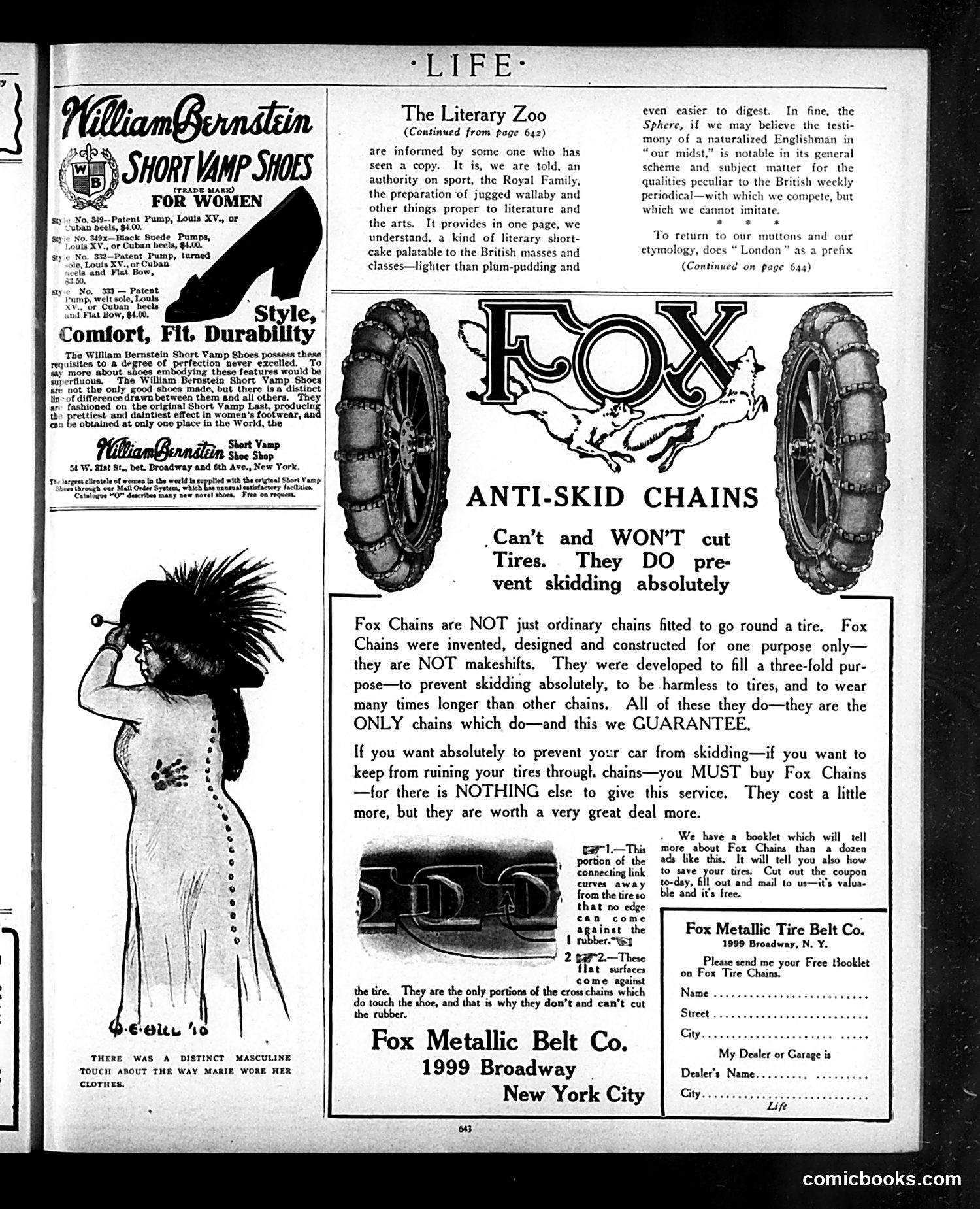
This is primarily an **advertising page** from Life magazine, not satirical content. It contains three distinct ads: 1. **William Bernstein Shoes** (left): A women's shoe advertisement emphasizing "Style, Comfort, Fit, Durability" for Short Vamp pumps, priced at $4.00. The small cartoon showing a woman in profile illustrates the shoe's aesthetic appeal. 2. **Fox Anti-Skid Chains** (center/right): The main advertisement promotes tire chains as essential automobile safety equipment, guaranteeing they won't damage tires while preventing skidding—a significant concern for early motorists. The technical diagrams show how the chains' design protects tires. 3. **Literary Zoo article** (top): A brief editorial piece discussing British periodicals, particularly *The Sphere*, comparing it to Life's own content. The page reflects early 20th-century consumer culture: women's fashion, automobile safety innovation, and magazine editorial content coexisting. There is no political satire visible—this appears to be standard magazine advertising mixed with editorial matter.
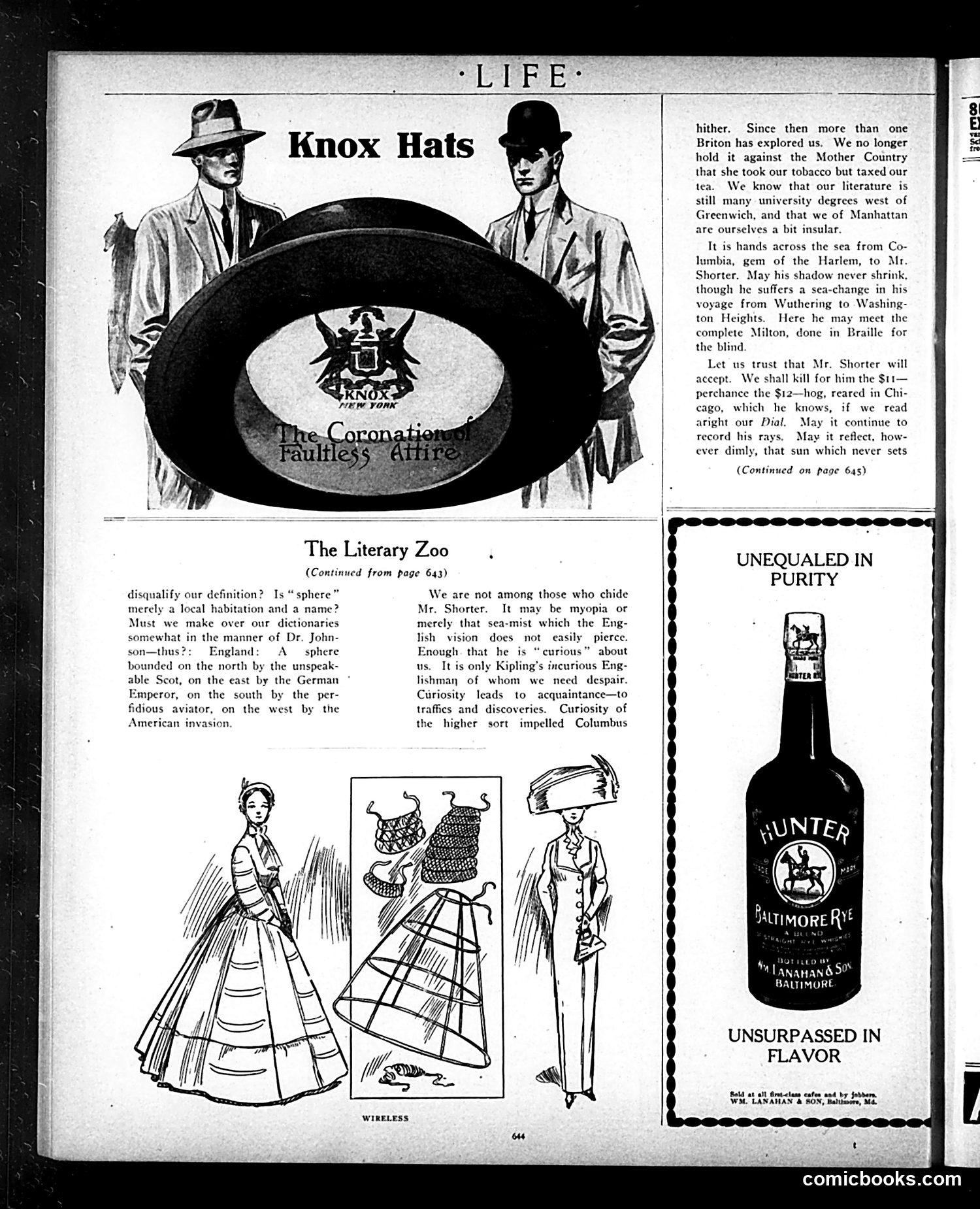
This page satirizes Anglo-American literary and cultural relations, likely from the early 20th century. "The Literary Zoo" column mocks the English (personified as "Mr. Shorter," likely editor of a British publication) for their condescending curiosity about Americans. The satire attacks English insularity and superiority. The text redefines "England" as a geographic sphere bounded by "the unspeakable Scot," the German Emperor, a "perfidious aviator," and "American invasion"—mocking British self-importance and anxiety about American cultural influence. The piece sarcastically thanks the English for their curiosity about American literature, while pointing out that American culture remains undervalued ("many university degrees west of Greenwich"). It concludes with backhanded praise, offering to slaughter a Chicago hog for Mr. Shorter—mixing hospitality with thinly veiled mockery of English pretension and American resentment of British cultural dominance. The advertisements for Knox hats and Hunter whiskey frame the content as consumer-targeted satire.
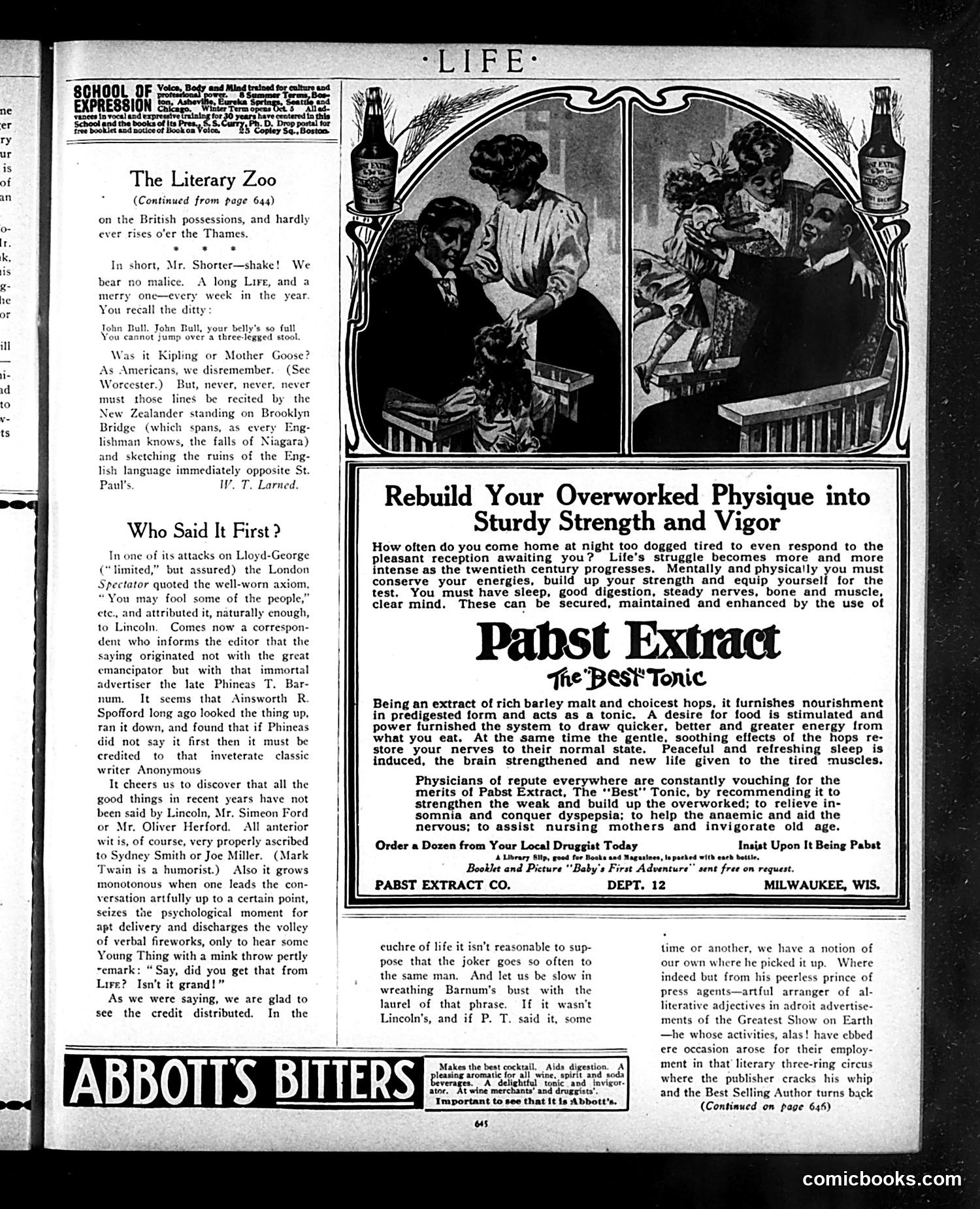
This page contains **literary commentary and period advertisements** rather than traditional political cartoons. **"The Literary Zoo"** section discusses literary attribution and wit—critiquing how Americans over-credit Lincoln with famous quotes. The piece notes that "You may fool some of the people" likely originated with showman P.T. Barnum, not Lincoln, and humorously observes that people tediously attribute all clever remarks to historical figures or Mark Twain. **The illustrations** show domestic scenes of people socializing, seemingly illustrating themes about modern life's exhaustion and social interaction. **The advertisements**—for Pabst Extract tonic and Abbott's Bitters—dominate the page. These patent medicines promised to cure fatigue and digestive issues caused by modern industrial life, a common early-20th-century marketing pitch targeting overworked Americans. The Pabst ad specifically addresses people coming home "too dogged tired," framing their product as essential to managing contemporary stress. The page is primarily **commercial content** dressed as cultural commentary.
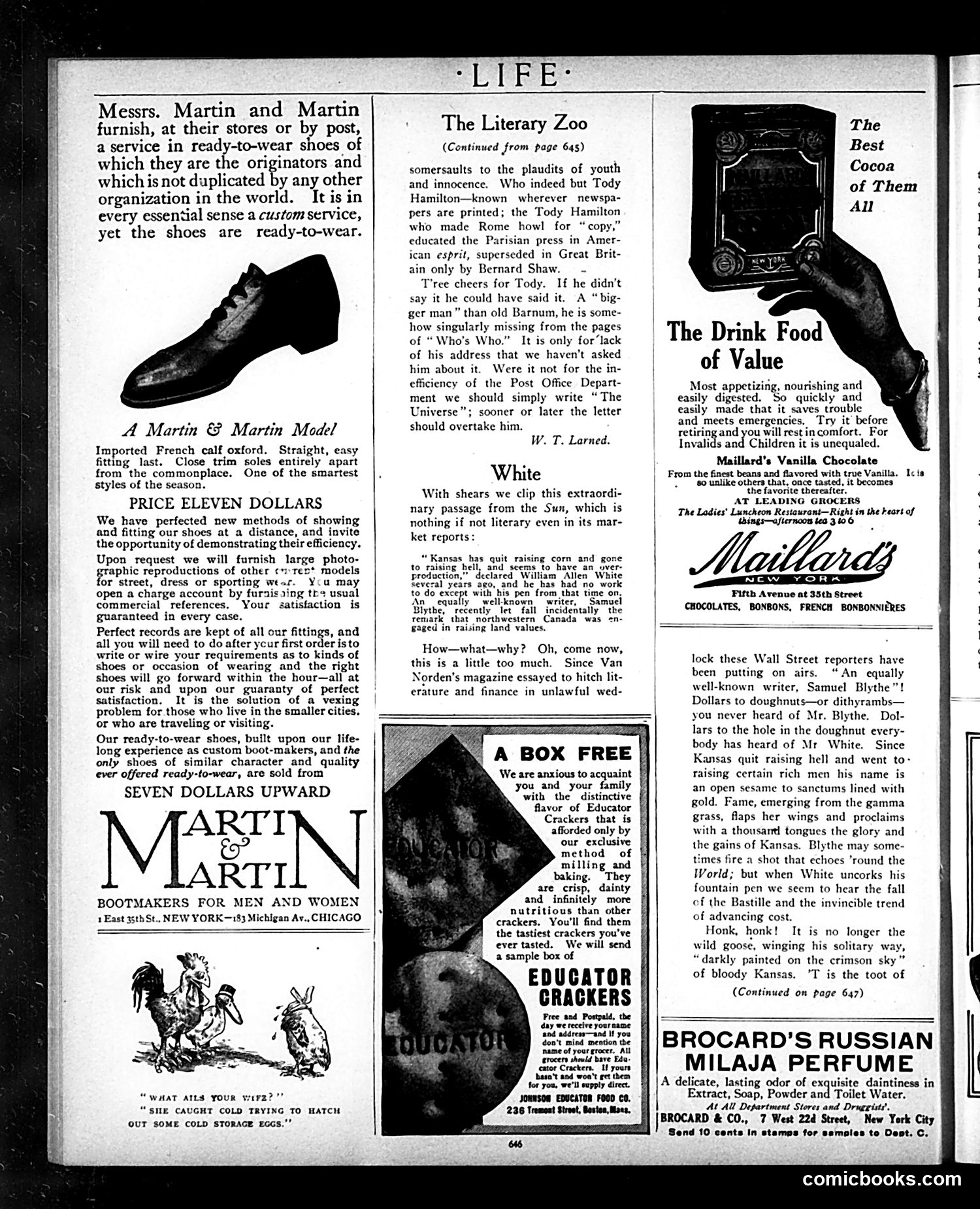
This page is primarily **advertising**, though it includes a short satirical literary section titled "The Literary Zoo." ## "The Literary Zoo" Section The text satirizes literary figures and their pretensions. It mocks **Tody Hamilton**, a newspaper reporter, exaggerating his fame and importance ("bigger man than old Barnum") while noting he's mysteriously absent from *Who's Who*. The satire continues with commentary on William Allen White and Samuel Blythe, criticizing them for mixing serious literature with financial topics—satirizing the trend of writers trying to discuss business and economics. The bottom section ("White") continues this critique, suggesting that attempting to blend literature with financial matters is absurd and inappropriate. ## The Cartoon The small cartoon at bottom left depicts a husband asking "What ails your wife?" The wife responds she "caught cold trying to hatch out some cold storage eggs"—a joke about the absurdity of trying to hatch artificially stored eggs, likely mocking foolish domestic decisions or women's irrationality. **The rest of the page is shoe and cracker advertisements.**
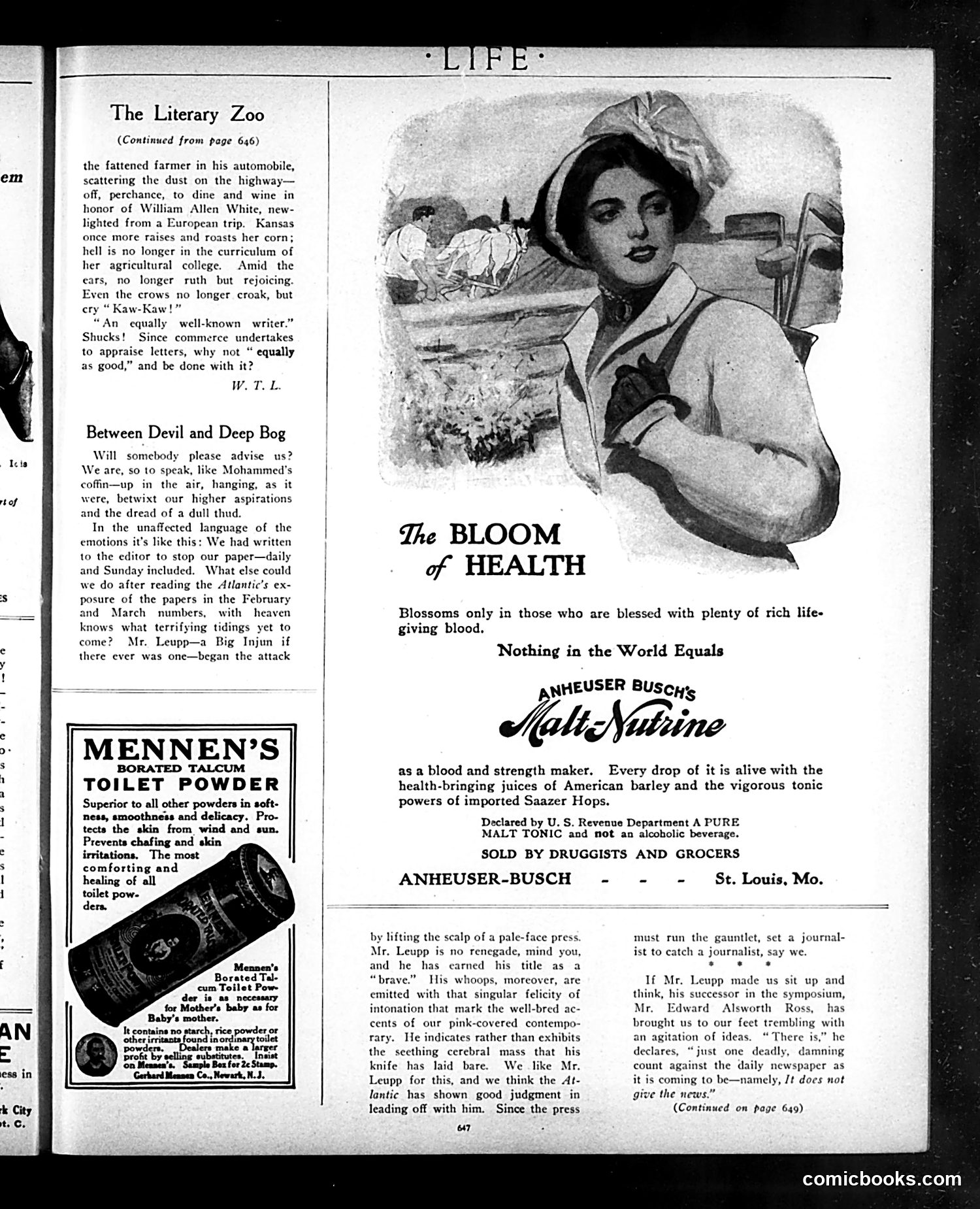
This page mixes literary satire with period advertisements. "The Literary Zoo" section satirizes American writers, particularly referencing **William Allen White**, a prominent Kansas journalist and editor known for his conservative views. The piece mocks the transformation of rural Kansas from hardship ("hell is no longer in the curriculum") to prosperity, suggesting White represents this shift. The "Between Devil and Deep Bog" section critiques **newspaper journalism** itself. It references an Atlantic magazine exposé (February-March issue, date unclear) attacking the press. The author uses the metaphor of being "suspended" between ideals and reality regarding their newspaper subscription. **Mr. Leupp** (appears to be an Atlantic editor/critic) is praised for "scalping" the pale-face press—using Native American imagery to describe aggressive journalistic criticism. Edward Alsworth Ross's contribution allegedly argues newspapers fail at their fundamental duty: reporting actual news. The advertisements (Mennen's talcum powder, Anheuser-Busch's "Malt Nutrine") represent the commercial interests the satire implicitly critiques.
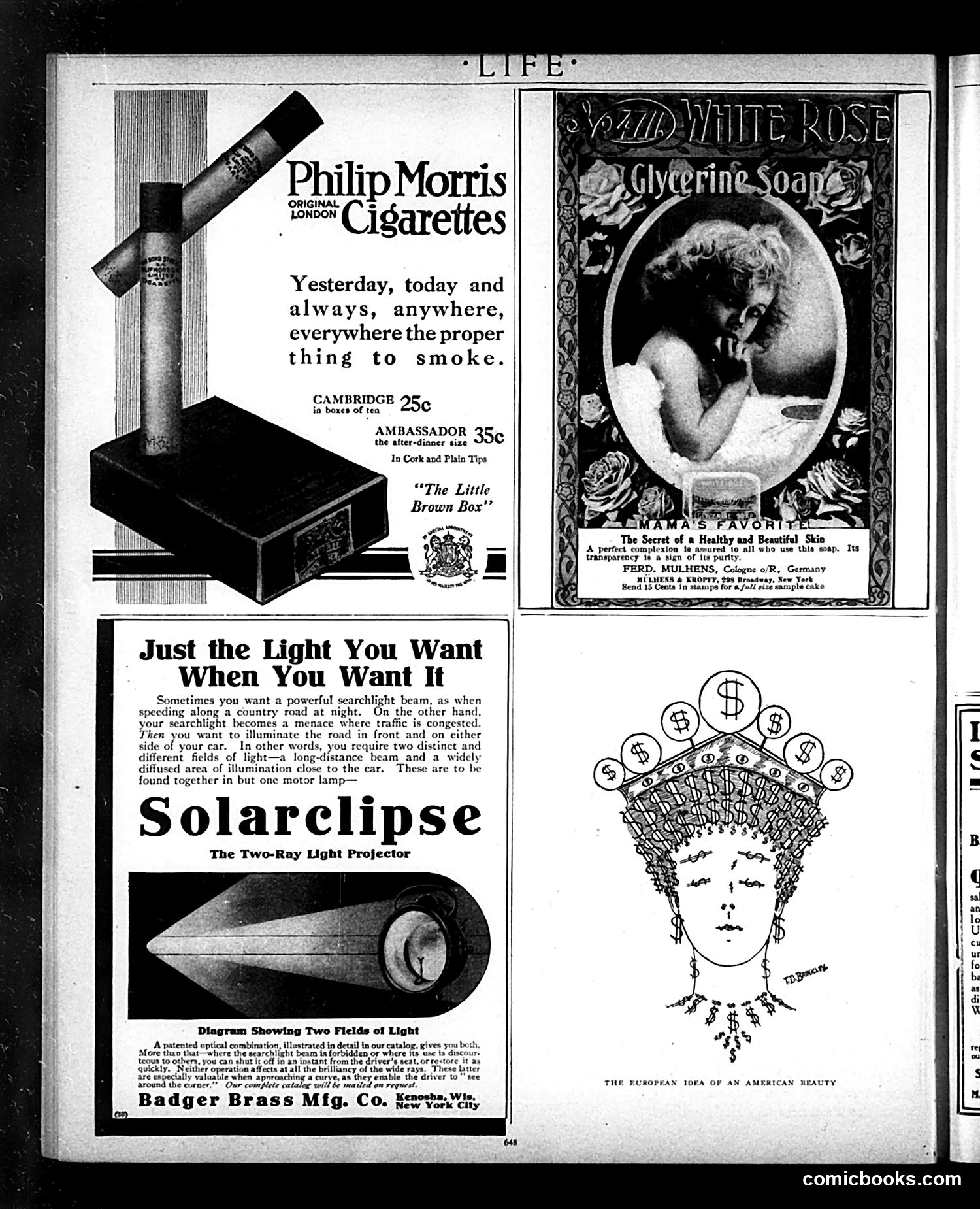
This page is primarily **advertising**, not political satire. It contains four commercial advertisements from what appears to be the early 20th century: 1. **Philip Morris Cigarettes** — promotes smoking as universally appropriate ("yesterday, today and always") 2. **White Rose Glycerine Soap** — features a cherubic figure and promises "healthy and beautiful skin" 3. **Solareclipse automobile headlights** — explains dual-beam technology for different driving conditions 4. **"The European Idea of an American Beauty"** — an illustration (bottom right) showing a stylized woman's head with elaborate hair ornamentation and dollar signs, sardonically commenting on American beauty standards and consumerism The only satirical element is the final illustration's commentary on American beauty culture being driven by money and European fashion influence. The page otherwise reflects typical early-1900s advertising priorities: tobacco, personal grooming, automotive technology, and cultural aspirations.
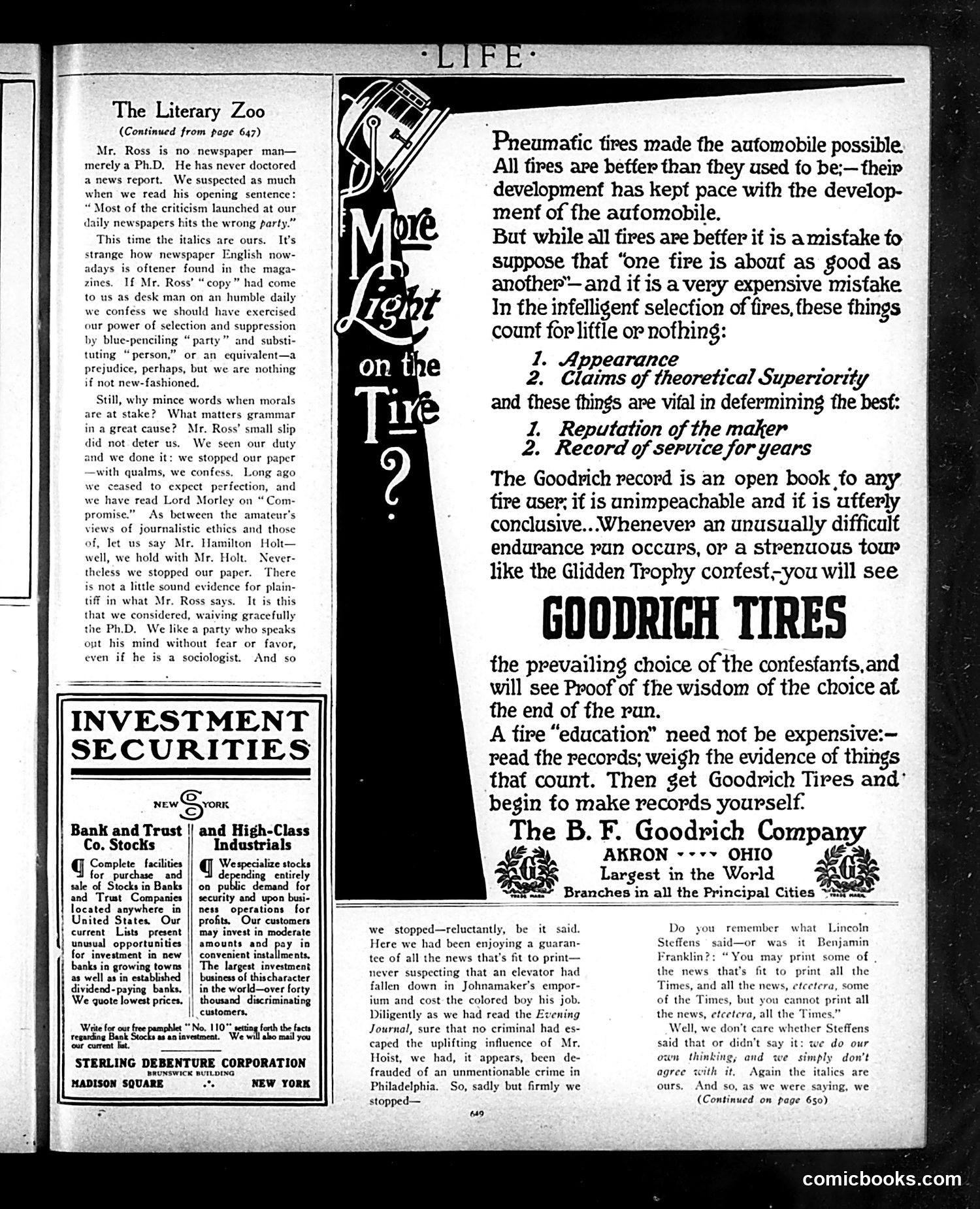
This page is primarily **advertising**, dominated by a full-page Goodrich Tires ad. The editorial content is secondary. The left column continues a satirical piece about "The Literary Zoo," discussing Mr. Ross (apparently an academic Ph.D., not a newspaper professional) who criticized how newspapers are blamed for their own problems. The Life editors humorously debate whether to edit his grammar, ultimately deciding his moral argument outweighs his stylistic slips. They reference Hamilton Holt and Lord Morley on compromise, suggesting intellectual credibility matters more than technical correctness in serious matters. The page also contains investment securities advertisements. The Goodrich Tires advertisement uses competitive messaging typical of early automotive advertising, emphasizing brand reputation and endurance-race performance ("Glidden Trophy contest") as proof of quality—a common marketing strategy when tire technology was still novel and consumers lacked reliable purchasing guidance.
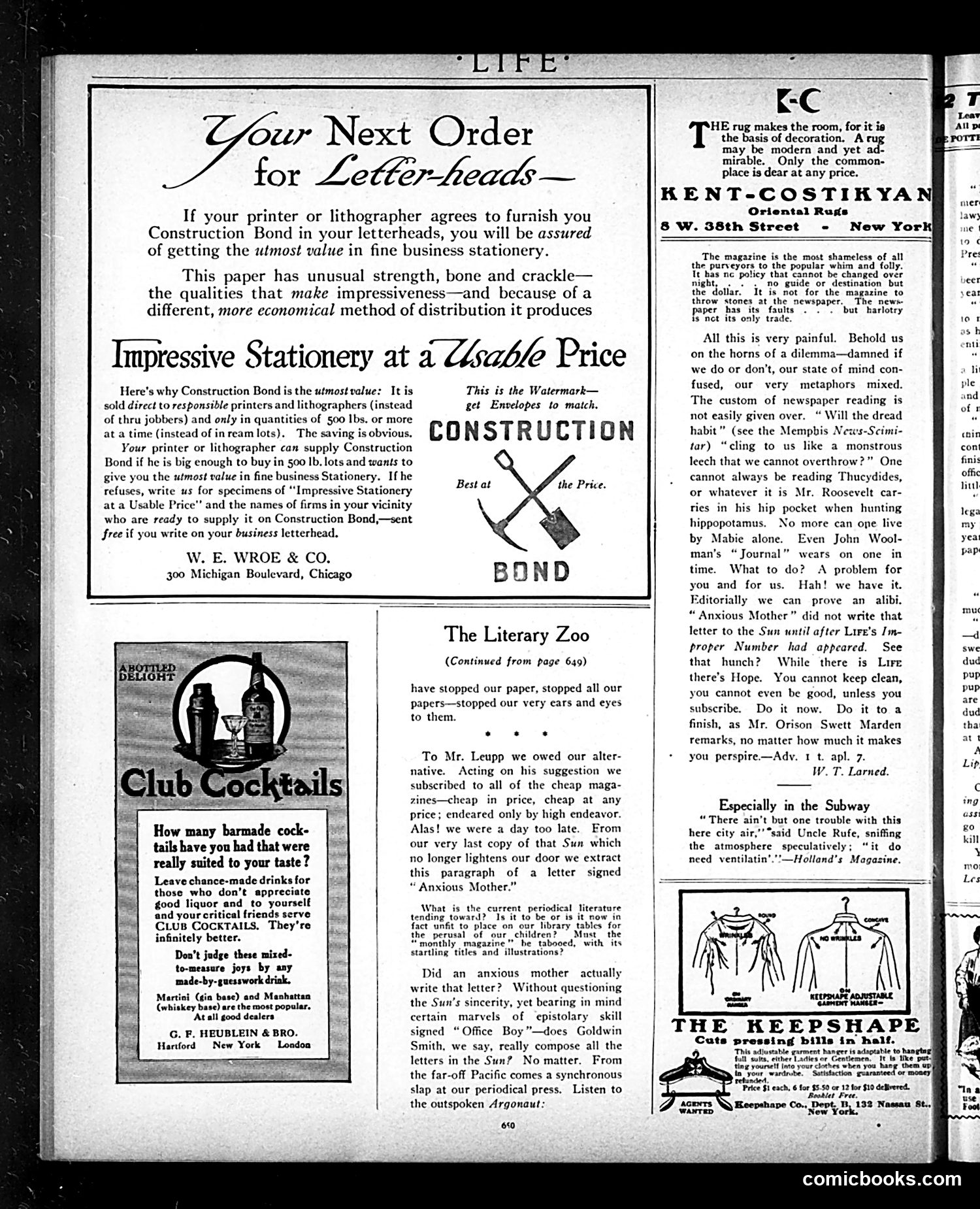
This page is primarily **advertisements and editorial commentary**, not political cartoons. The main content is "The Literary Zoo," a satirical column criticizing American periodical literature. The piece mocks magazines and newspapers for chasing profit over principle. It describes magazines as "shameless purveyors to popular whim and folly," driven solely by money rather than editorial integrity. The column contrasts cheap magazines with serious journalism, while acknowledging that newspapers themselves have ethical problems. The satire targets the public's addiction to sensationalist reading—comparing the "habit" to "a monstrous leech." An "Anxious Mother" letter questions whether contemporary periodicals are fit for family libraries, reflecting turn-of-the-century concerns about media's moral influence. The surrounding ads (letterhead, cocktails, Oriental rugs) represent the commercial interests Life was satirizing—advertisers driving content decisions.
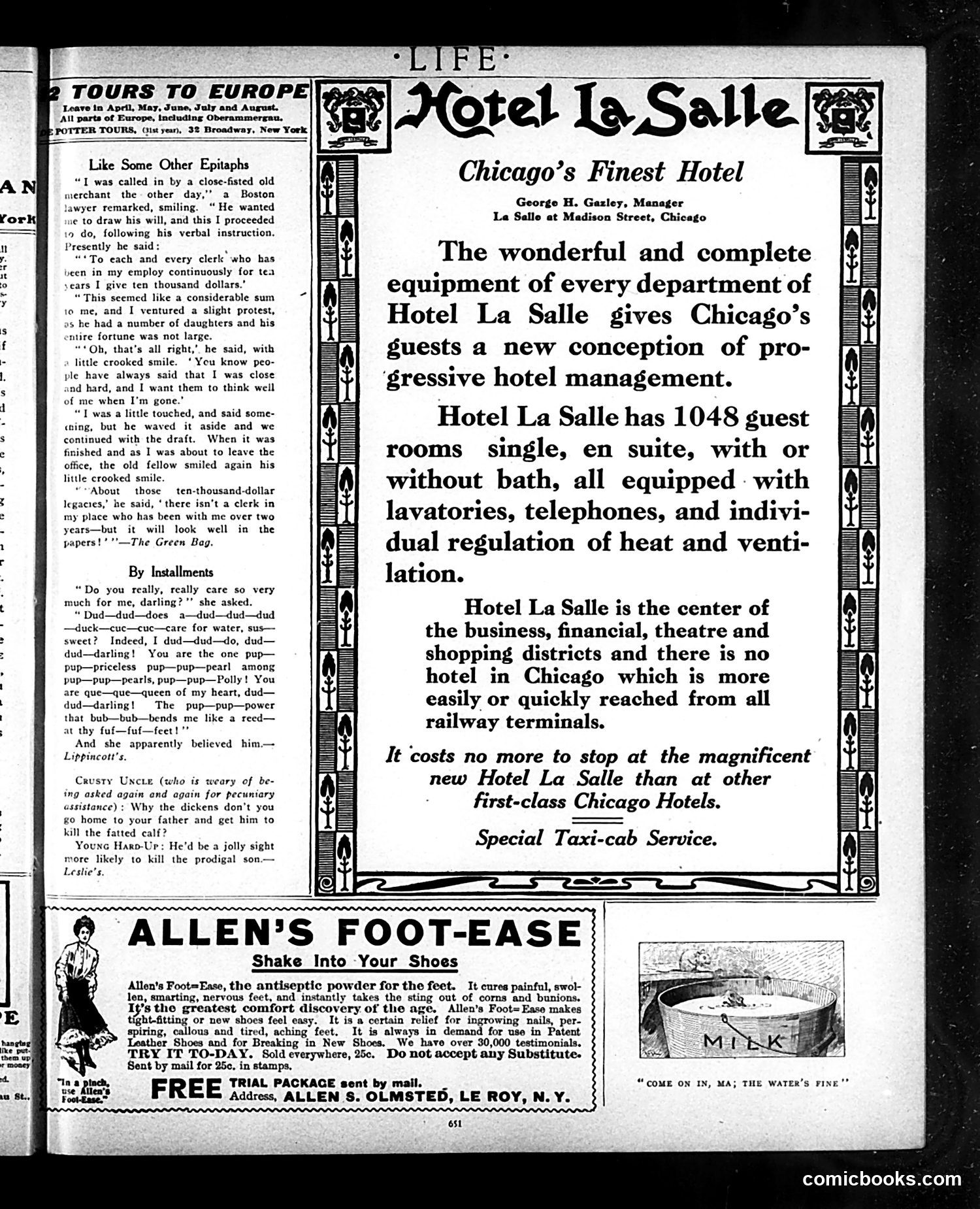
This page is primarily **advertising**, not satire or political commentary. The dominant content is a large advertisement for **Hotel La Salle** in Chicago, emphasizing its 1,048 guest rooms, modern amenities (lavatories, telephones, heat/ventilation), central location, and competitive pricing—typical early-20th-century hotel marketing. Below are smaller items: a humorous anecdote about a Boston lawyer and his will, comic installments with domestic humor ("Do you really care..."), and advertisements for **Allen's Foot-Ease** powder and European tours. The small illustration captioned "Come on in, Ma; the Water's Fine" appears to be a separate, unrelated cartoon about water/bathing. **No political references or satirical targets are evident.** This is a standard magazine page mixing light humor, advertisements, and brief comedic stories—typical Life magazine fare from the early 1900s designed to appeal to middle-class readers.
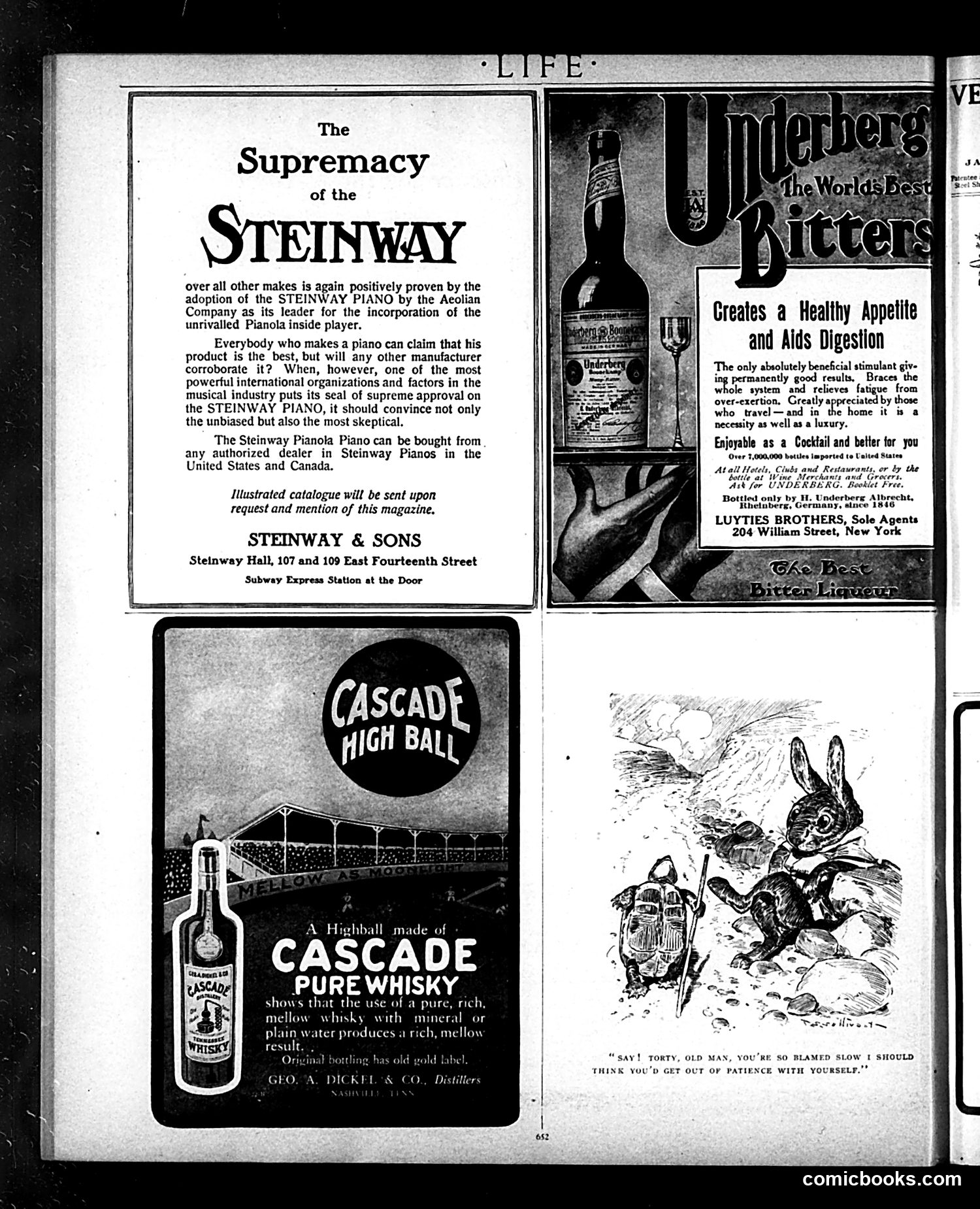
This is primarily an **advertising page** with one small cartoon. The advertisements promote luxury goods (Steinway pianos, Underberg bitters, Cascade whisky) targeting affluent readers—typical of Life magazine's early 20th-century audience. The **only cartoon** appears at bottom right: a rabbit character (appears elderly, called "Torty") is being scolded by another character for being slow. The caption reads: "Say! Torty, old man, you're so blamed slow I should think you'd get out of patience with yourself." This is likely a **generic humor cartoon** without specific political satire—simply poking fun at slowness/impatience through anthropomorphized animals. The joke relies on wordplay: the speaker suggests the old turtle should lose patience *with himself* rather than others losing patience with him. No major political figures or events are referenced. The page primarily reflects consumer culture and advertising practices of the era.
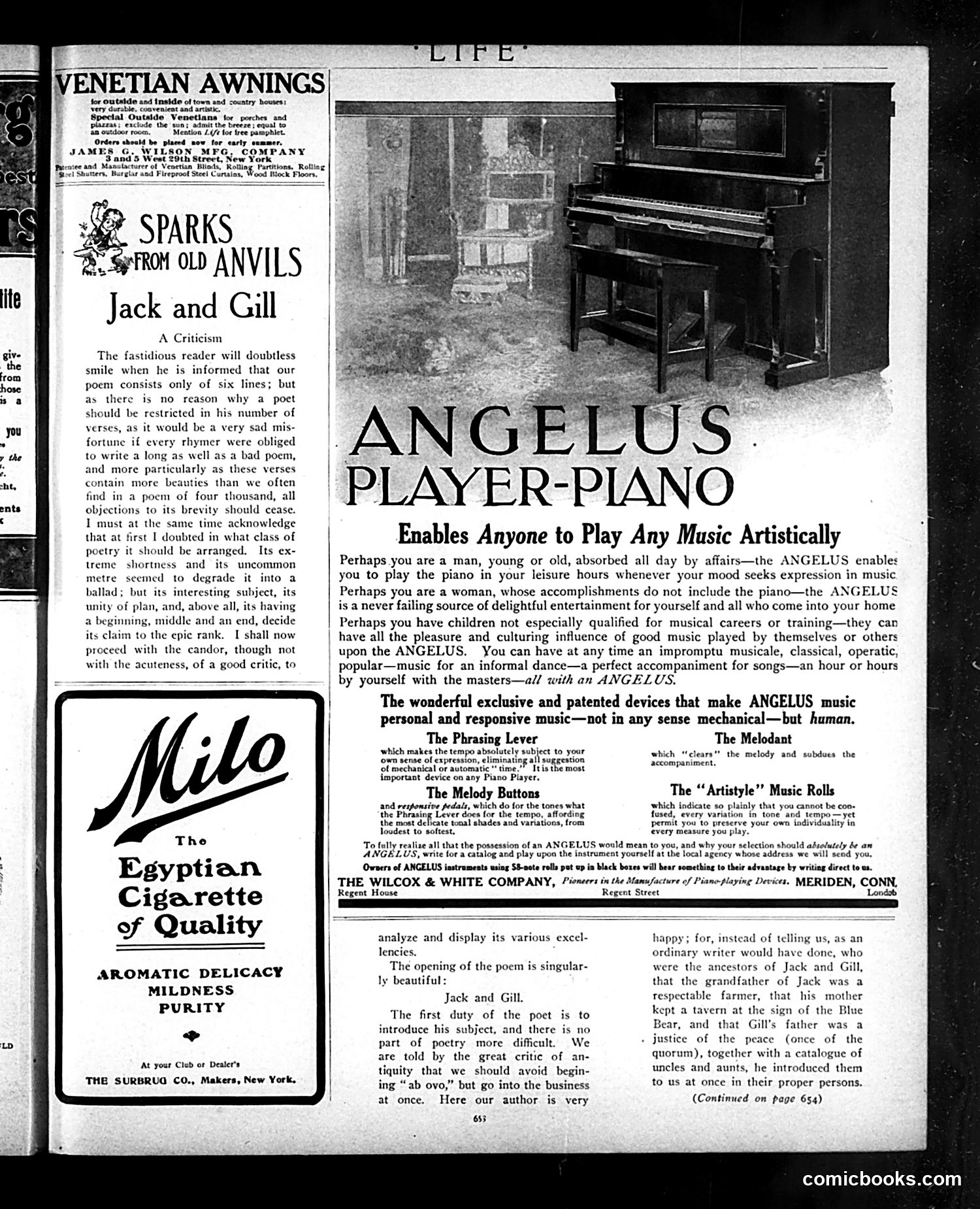
This page mixes advertisements with literary satire. The main content is "Sparks from Old Anvils: Jack and Gill—A Criticism," which mocks overwrought literary analysis. The critic absurdly defends a six-line poem (the nursery rhyme "Jack and Gill") by claiming it possesses "epic rank" with "beginning, middle and an end"—inflating trivial doggerel through pretentious scholarly language. The satire targets pompous literary critics who employ grandiose terminology to legitimize mediocre work. The surrounding advertisements—for Angelus player-pianos, Milo cigarettes, and Venetian awnings—represent typical early 20th-century consumer goods marketing. The player-piano ad notably promises that anyone, regardless of musical ability, can play "artistically," reflecting period democratization of leisure and culture through technology. The page exemplifies *Life* magazine's characteristic blend of consumer culture and gentle mockery of intellectual pretension.
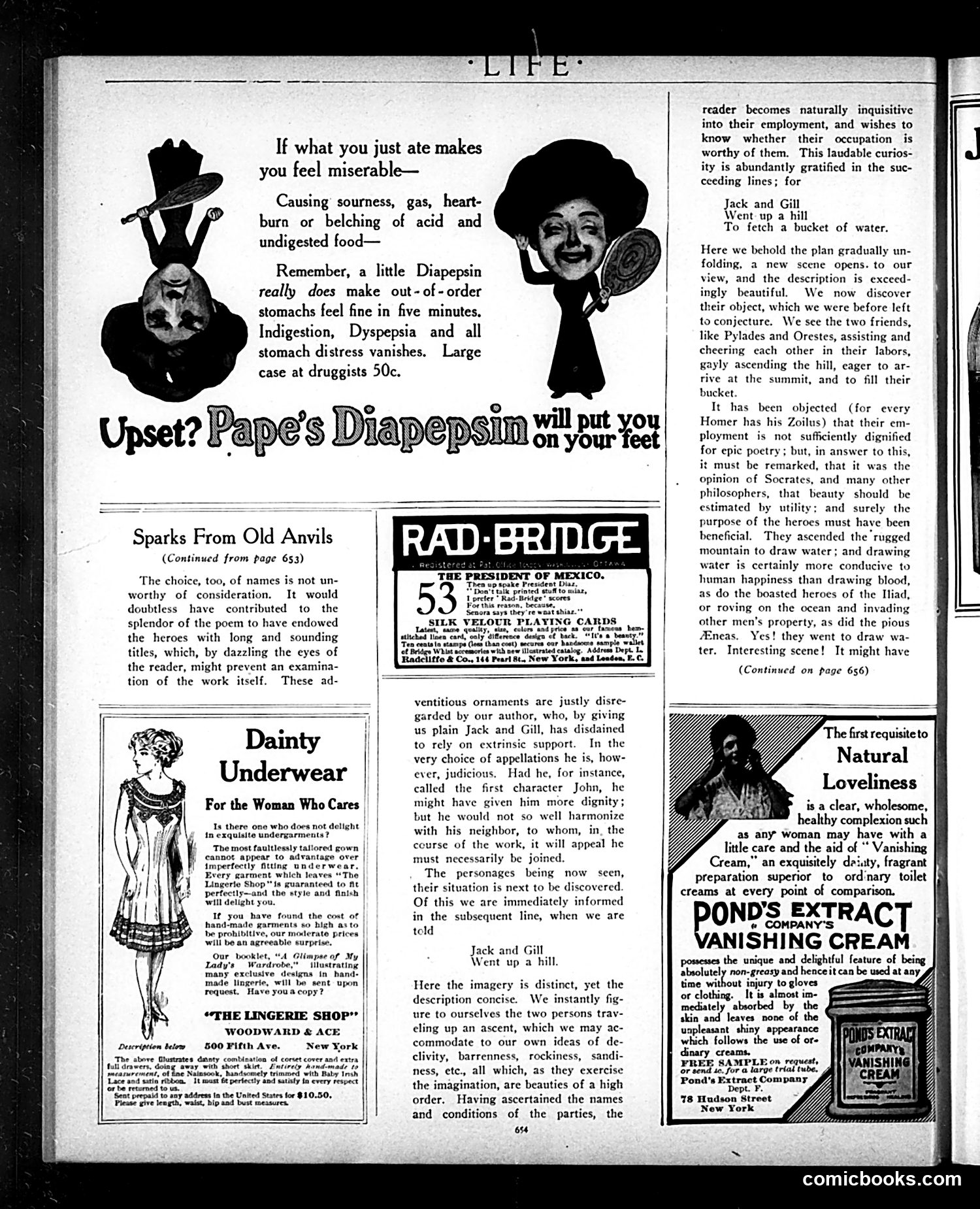
This page consists primarily of **period advertising** rather than political satire. The main content includes: **Pape's Diapepsin advertisement**: A digestive remedy ad featuring a caricatured figure (likely ethnic stereotype common to 1910s-20s advertising) promoting indigestion relief at 50 cents. **Literary criticism ("Sparks from Old Anvils")**: A humorous mock-scholarly analysis of the nursery rhyme "Jack and Gill," treating it with grandiose literary language typically reserved for epic poetry. The satire mocks overwrought academic criticism by applying Homeric comparisons to a children's rhyme about fetching water. **Lingerie and cosmetic ads**: Standard period advertisements for women's undergarments and Pond's vanishing cream. The page reflects early 20th-century consumer culture and advertising aesthetics rather than explicit political commentary. The "Jack and Gill" piece represents Life magazine's characteristic humor—intellectual satire targeting pretentious literary analysis.
This page is primarily **advertising**, not satirical content. It contains four distinct advertisements for luxury goods: 1. **J. & F. Martell Cognac** — A French brandy founded 1715, marketed as "fine old liqueur brandies," with sole U.S. agents listed as G.S. Nicholas & Co. in New York. 2. **Thomas Cort Inc.** — A custom boot-maker from Newark, New Jersey, advertising ready-to-wear fine shoes ($8-15 retail), positioning themselves as offering custom quality at accessible prices. 3. **McCallum Silk Hosiery** — Northampton, Massachusetts manufacturer promoting silk stockings and men's socks, emphasizing durability and quality comparable to imported goods at lower cost. 4. **"The Flag of All Nations"** — A small illustration (unclear reference) positioned between advertisements. The page reflects early 20th-century consumer marketing targeting affluent readers, emphasizing European heritage, quality craftsmanship, and value. No political satire is evident.
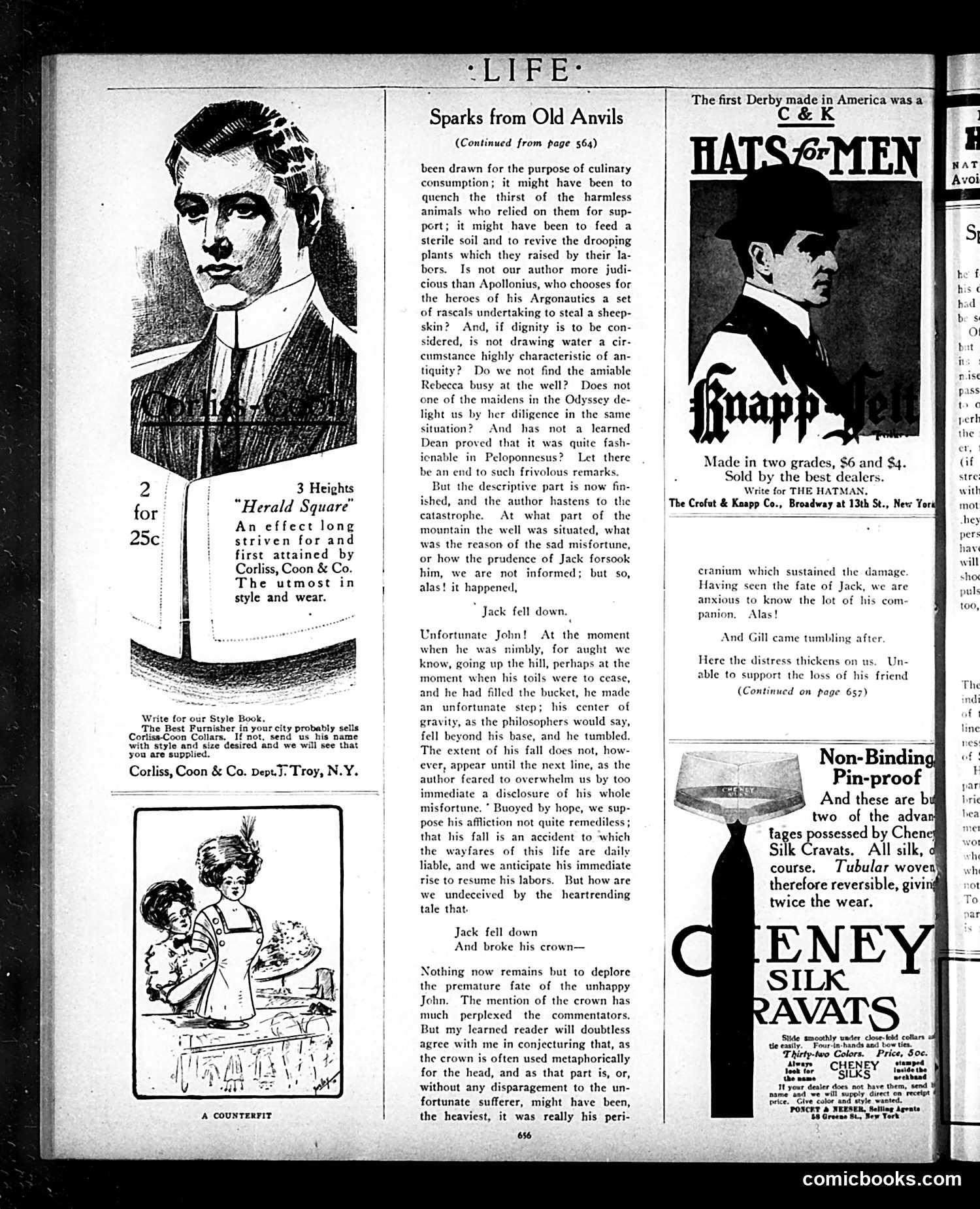
This page is primarily **literary satire and advertising**, not political cartooning. The main text, "Sparks from Old Anvils," is a mock-scholarly critique of the nursery rhyme "Jack and Jill." The author applies absurdly pedantic literary analysis to the children's poem—defending the "dignity" of drawing water, comparing Jack to characters in classical epics, and debating whether "crown" refers to his head. The satire mocks overwrought academic criticism and pretentious literary commentary that treats trivial subjects with unwarranted seriousness. The illustrations are period advertisements: a gentleman's collar by Corliss-Coon & Co., a children's illustration labeled "A Counterfeit," and ads for Knapp hats and Cheney silk cravats. These advertisements are unrelated to the satirical text. The humor targets not a political figure but rather the absurdity of excessive scholarly interpretation applied to nursery rhymes—a gentle jab at pompous literary criticism.
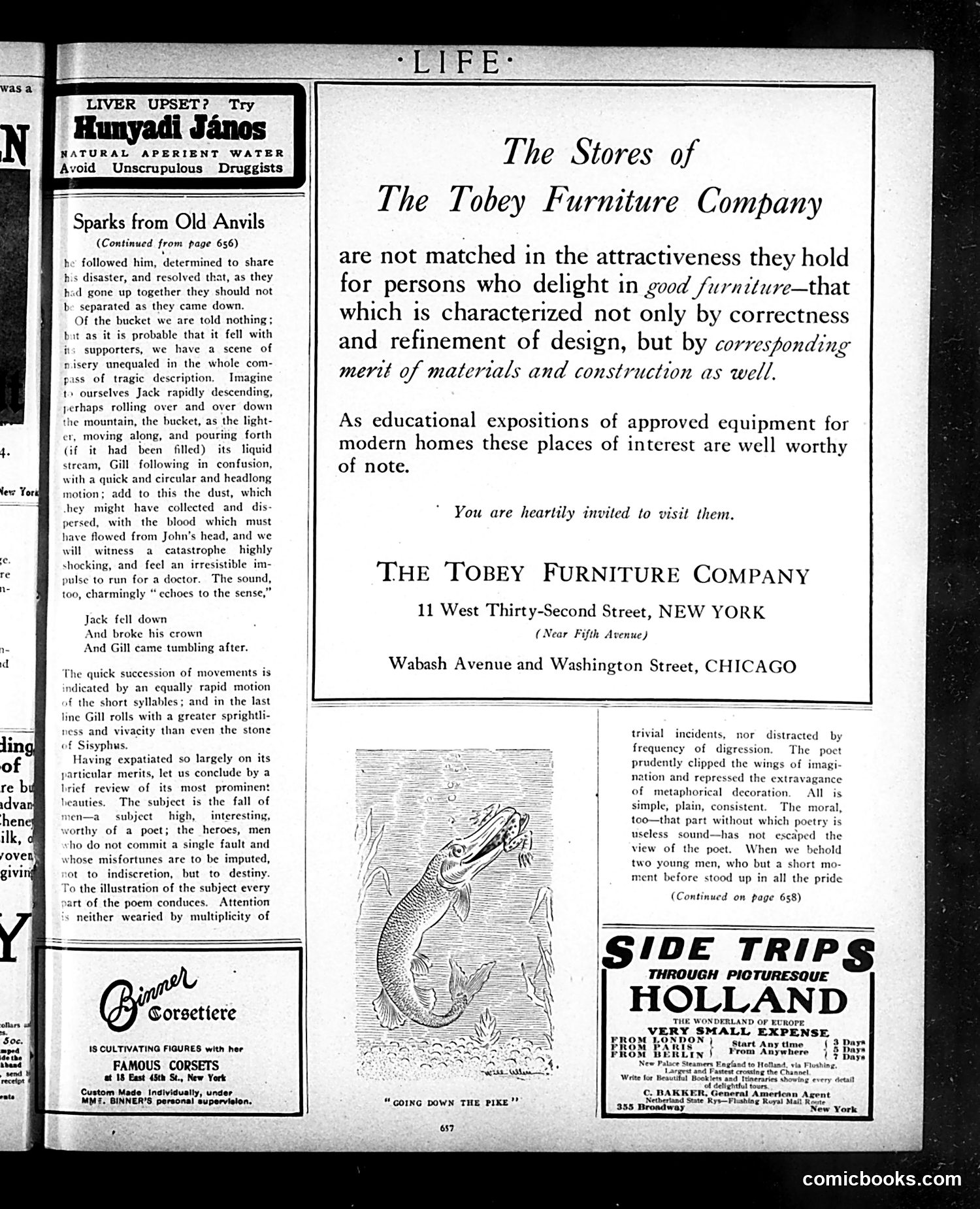
This page is primarily **advertising and literary content**, not political satire. The main article, "Sparks from Old Anvils," is a scholarly literary analysis of the nursery rhyme "Jack and Jill"—treating the children's verse as serious poetry deserving critical examination of its structure, meter, and moral lessons. This reflects Victorian-era literary pretension, where critics solemnly analyzed even simple folk rhymes as worthy artistic subjects. The single illustration shows a fish ("Going Down the Pike"), accompanying the nursery rhyme discussion. The surrounding ads are typical period marketing: Hunyadi János mineral water for digestive complaints, Binner corsetière for women's figure-shaping garments, Tobey Furniture Company showrooms, and Holland tour packages. **The satire, if any, lies in the overwrought academic treatment of a trivial children's rhyme**—mocking how Victorian scholars elevated minor works to grandiose critical importance. The page itself represents Life magazine's typical blend of satire, advertisements, and serialized content from this era.
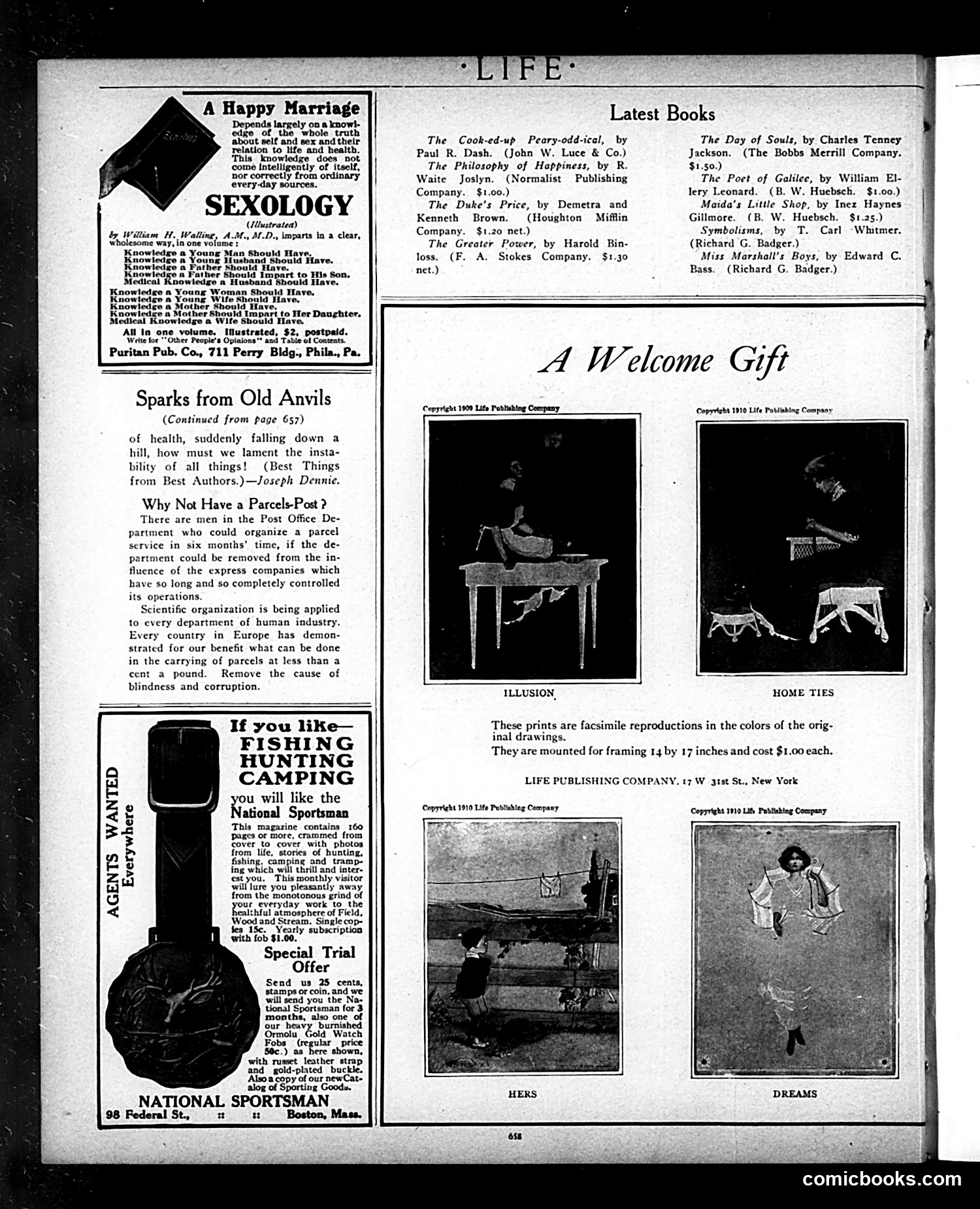
This page is primarily **advertising and book listings** from an early 1900s Life magazine, with limited satirical content. The main notable items: **"Sexology" Advertisement**: A sex education book pitched as essential knowledge for married couples and parents—reflecting early 20th-century anxieties about sexual ignorance. The publisher's claim that happy marriages "depend largely" on this knowledge suggests such topics were considered taboo but increasingly discussed. **"Why Not Have a Parcels-Post?"** Opinion piece: Critiques the Post Office for being controlled by express companies (like railroad monopolies), preventing cheaper parcel delivery available in Europe. This reflects Progressive Era concerns about corporate influence on government. **Sporting Magazine Ad**: Standard period advertising for *National Sportsman* magazine targeting outdoor enthusiasts—unremarkable by modern standards. The page contains **no actual political cartoons**, just commercial content typical of early 1900s magazines, when Life mixed satire with advertisements addressing contemporary social concerns (sexual education, government corruption, leisure culture).
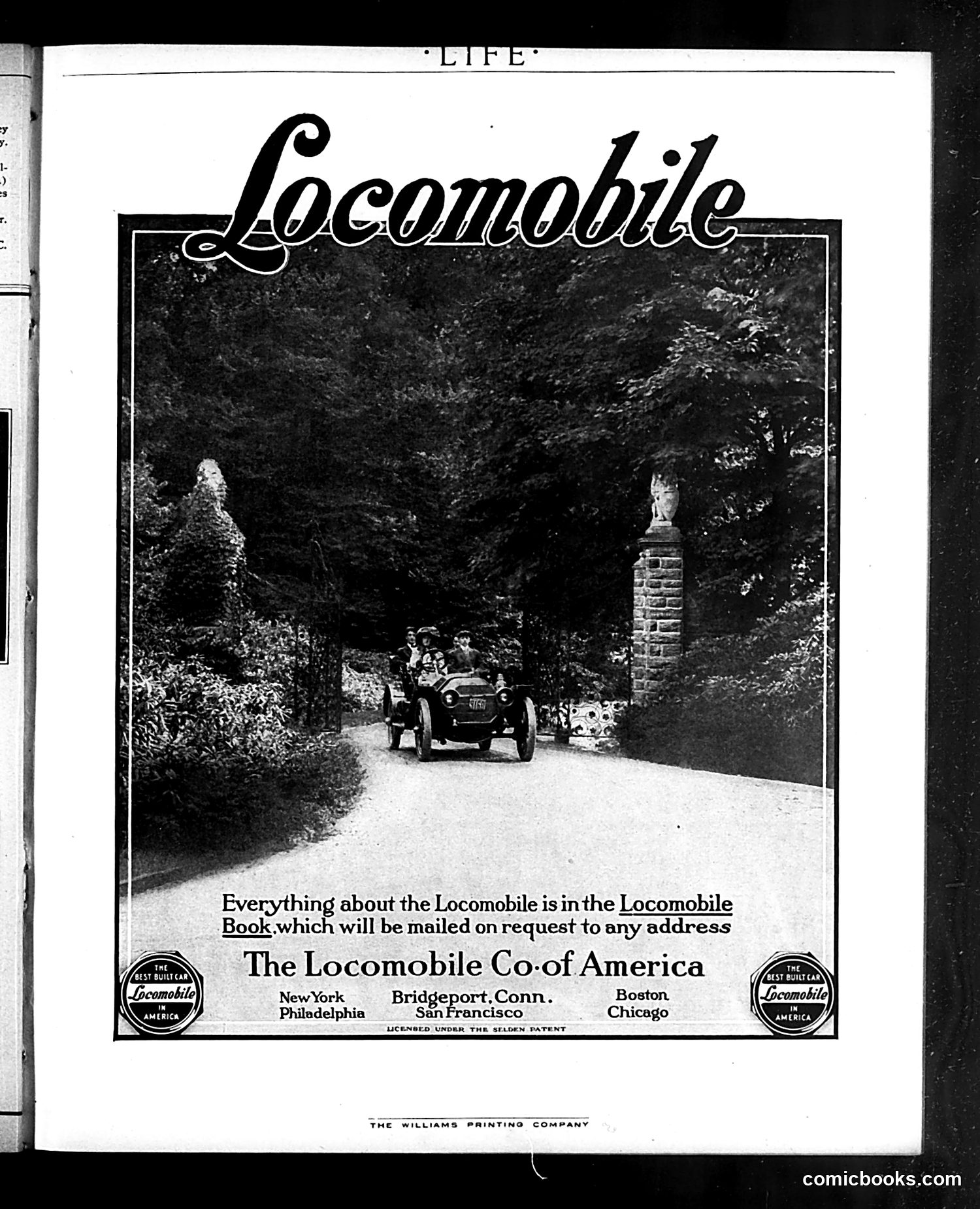
This is primarily an **advertisement**, not a political cartoon. It appears from the *Life* magazine and promotes the Locomobile automobile. The image shows a racing car driving through a tree-lined estate or park road, emphasizing the vehicle's performance and elegance. The ad promises that a "Locomobile Book" detailing everything about the car will be mailed on request. Notable detail: the fine print mentions the "Selden Patent," referring to a significant early automobile patent that was central to industry licensing disputes in that era. The Locomobile Co. of America lists offices in major cities (New York, Philadelphia, Boston, Chicago, Bridgeport, and San Francisco), indicating a substantial national operation. This appears to be a straightforward product advertisement rather than satirical content.
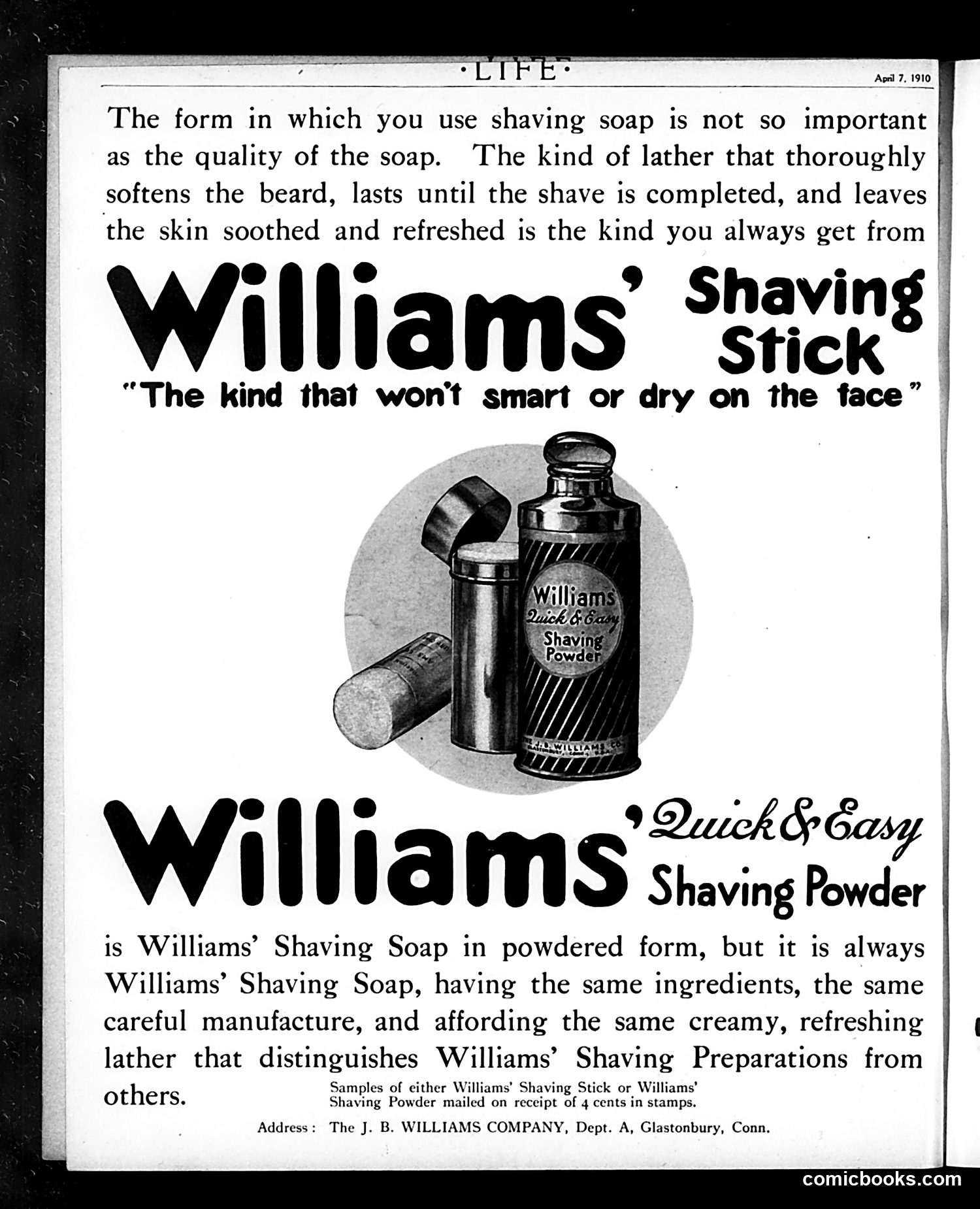
This is **not a cartoon or satirical content**—it is a straightforward **advertisement** for Williams' shaving products, appearing in *Life* magazine on April 7, 1910. The page promotes two related products: Williams' Shaving Stick and Williams' Quick & Easy Shaving Powder. The ad argues that soap quality matters more than form, emphasizing that both products deliver the same "creamy, refreshing lather" that softens the beard without causing irritation ("won't smart or dry on the face"). The ad includes a product image and offers samples for 4 cents in stamps, with contact information for J.B. Williams Company in Glastonbury, Connecticut. There is no political satire, caricature, or joke—simply period advertising copy highlighting product benefits to contemporary male readers.