
Life, 1910-04-07 · page 53 of 76
Life — April 7, 1910 — page 53: what you’re looking at
What you’re looking at
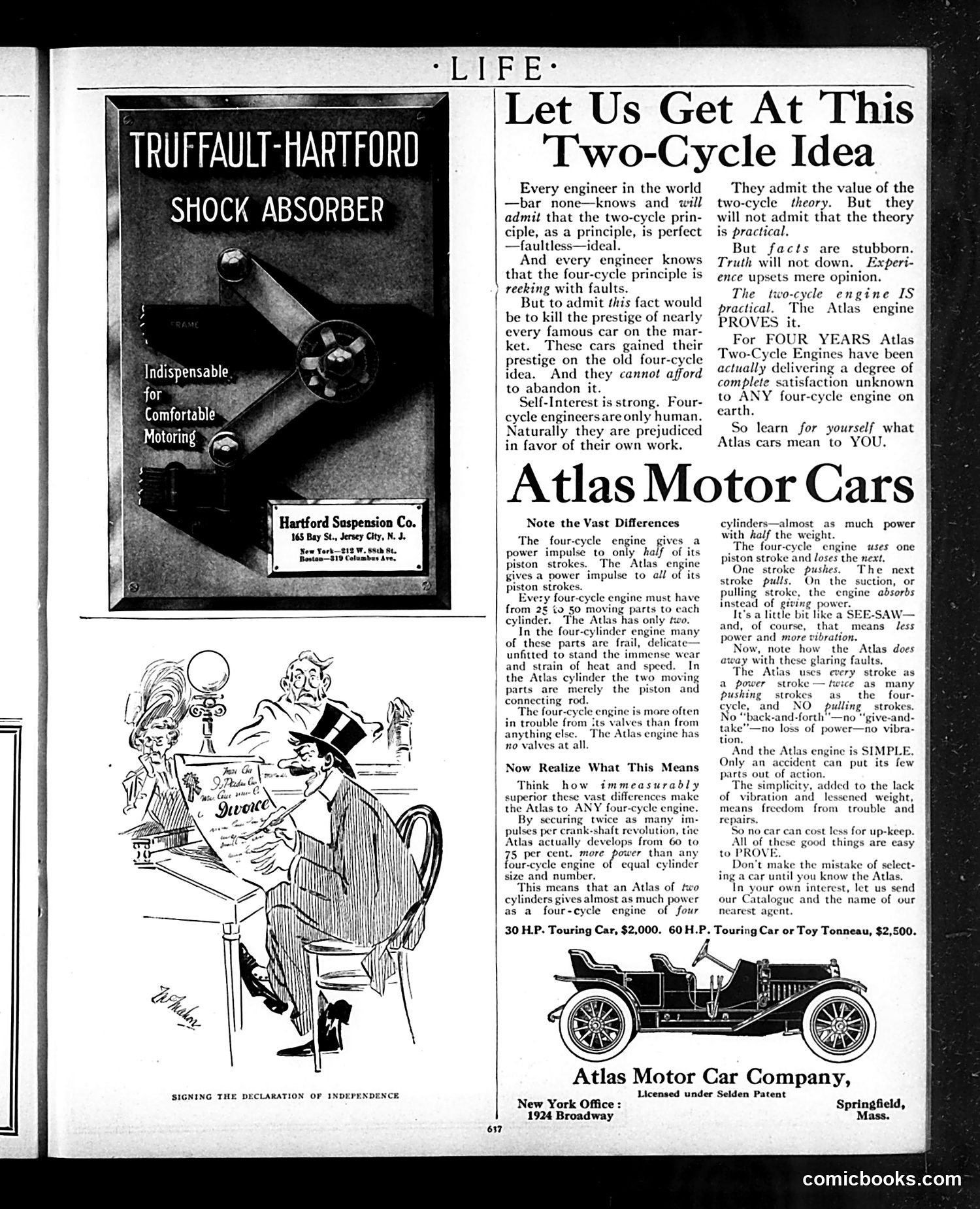
This page mixes political satire with automotive advertising. The cartoon, titled "Signing the Declaration of Independence," depicts figures in period costume signing a document—likely satirizing the Atlas Motor Company's argument about engineering "independence" from four-cycle engine orthodoxy. The figures appear caricatured in a humorous style typical of Life magazine's satirical approach. The accompanying advertisement argues that Atlas's two-cycle engines are technically superior to dominant four-cycle engines, but that established car manufacturers won't admit it due to self-interest and sunk prestige. The satire suggests these manufacturers are like reluctant signatories breaking from tradition—they acknowledge the superior principle but resist practical adoption. The cartoon reinforces the David-versus-Goliath narrative: Atlas as the revolutionary underdog challenging entrenched automotive interests through engineering truth rather than market inertia. It's promotional satire disguised as social commentary about institutional resistance to innovation.
📄 Transcribed text from this page (OCR, searchable)
Machine-transcribed from the original scan — historical spelling and the odd misread are preserved.
bled TRUFFAULT-HARTFORD SHOCK ABSORBER for ; Comfortable” Motoring +] Hartford Suspension Co. Bi 165 Bay St., Jersey City, N. J. 212 W. $8eh Bt. Colambas Ave. SIGNING THE DECLARATION OF INDEPENDENCE Let Us Get At This Two-Cycle Idea Every engineer in the world —bar none—knows and will admit that the two-cycle prin- ciple, as a principle, is perfect —faultless—ideal. And every engineer knows that the four-cycle principle is reeking with faults. But to admit this fact would be to kill the prestige of nearly every famous car on the mar- ket. These cars gained their prestige on the old four-cycle idea. And they cannot afford to abandon it. Self-Interest is strong. Four- cycle engineers are only ne Naturally they are prejudiced in favor of their own work. They admit the value of the two-cycle theory. But they will not admit that the theory is practical. But facts are stubborn. Truth will not down. Experi- ence upsets mere opinion. The two-cycle engine IS practical. The Atlas engine PROVES it. For FOUR YEARS Atlas Two-Cycle Engines have been actually delivering a degree of complete satisfaction unknown to ANY four-cycle engine on earth, So learn for yourself what Atlas cars mean to YOU, Atlas Motor Cars Note the Vast Differences The four-cyc! power impulse to on piston strokes. The Atlas engine gives a power impulse to al! of its piston stroke Every four-cycle engine must have from 2§ ¢o 50 moving parts to cach cylinder. The Atlas has only two. n the four-cylinder engine many | of these parts are frail, de! unfitted to stand the immense wear and strain of heat and speed. In the Atlas cylinder the two moving parts are merely the piston and connecting rod. The four-cycle engine is more often in trouble from its valves than from anything else. The Atlas engine has no valves at all. | Now Realize What This Means Think how immeasurably superior these vast differences make the Aas to. ANY four-cycle engine. By securing twice as many im- pulses per crank-shaft revolution, the Atlas actually develops from 60 to 75 per cent. more power than any four-cycle engine of equal cylinder ize and number. This means that an Atlas of feo cylinders gives almost as much power as a four-cycle engine of four inders—almost as much power th half the weight. TI le engine uses one and loses the next. One stroke pushes. The next stroke pulls. On the suction, or pulling stroke engine absorbs instead of giving power. It’s a little bit like a SEE-SAW— and, of course, that. means less power and more vibration. Now, note how the Atlas does away with these glaring faults, The Atlas uses every stroke as a power stroke — twice as many pushing strokes as the _four- cycle, and NO pulling strokes. No “back-and-forth'’—1 ‘gi nd- take""—no loss of power—no vibra- tion, And the Atlas engine is SIMPLE. Only an accident can put its few parts out of action. The simp! added to the lack of vibration and. lessened weight, means freedom from trouble and repairs. So no car can cost less for up-keep. All of these good things are easy to PROVE Don't make the ke of select- ing a car until you know the Atlas. In_your own interest, let us send our Catalogue and the name of our nearest agent. 30 H.P. Touring Car, $2,000. 60H.P. Touring Car or Toy Tonneau, $2,500. Atlas Motor Car Company, Licensed under Selden Patent New York Office : 1924 Broadway Springfield, Mass. comicbooks.com