
Life, 1910-04-07 · page 44 of 76
Life — April 7, 1910 — page 44: what you’re looking at
What you’re looking at
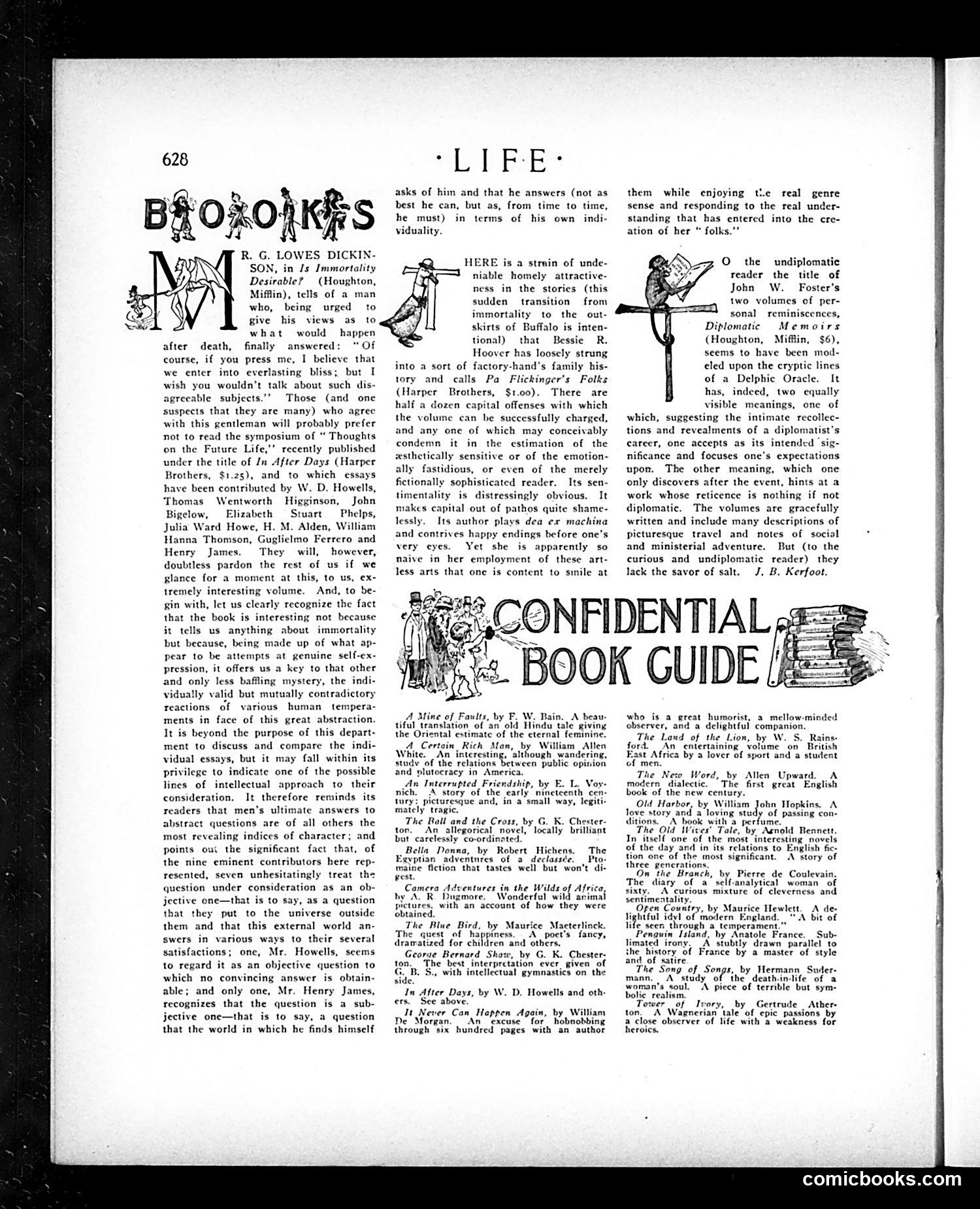
This page reviews literary works addressing **late 19th/early 20th-century intellectual concerns**. The main article discusses a book symposium titled *In After Days*, featuring essays by prominent American writers (W.D. Howells, Henry James, Julia Ward Howe, et al.) debating immortality and the afterlife. The reviewer notes that these essays are valuable not for answering metaphysical questions, but for revealing **individual temperaments and character** through how each writer approaches ultimate existential questions. Notably, the piece distinguishes Henry James as uniquely recognizing the question as **subjective**—answering from personal perspective rather than seeking external cosmic truth. The secondary review discusses *Pa Flickinger's Folks*, praising its authentic portrayal of working-class family life while critiquing its obvious sentimentality and contrived happy endings—typical period concerns about balancing commercial appeal with literary sophistication. The page reflects **genteel magazine culture** engaging serious philosophical and literary questions for educated readers.
📄 Transcribed text from this page (OCR, searchable)
Machine-transcribed from the original scan — historical spelling and the odd misread are preserved.
R. G. LOWES DICKIN- SON, in Is Immortality Desirable? (Houghton, Mifflin), tells of a man who, being urged to give his views as to what would happen after death, finally “Of course, if you press me, I believe that we enter into everlasting bliss; but I wish you wouldn’t talk about such dis- agreeable subjects."’ Those (and one suspects that they are many) who agree with this gentleman will probably prefer not to read the symposium of “ Thoughts on the Future Life,” recently published under the title of Jn After Days (Harper Brothers, $1.25), and to which essays have been contributed by W. D. Howells, ‘Thomas Wentworth Higginson, John Bigelow, Elizabeth Stuart Phelps, Julia Ward Howe, H. M. Alden, William Hanna Thomson, Guglielmo Ferrero and Henry James. They will, however, answered doubtless pardon the rest of us if we glance for a moment at this, to us, ex- tremely interesting volume. And, to be- gin with, let us clearly recognize the fact that the book is interesting not because it tells us anything about immortality but because, being made up of what ap- pear to be attempts at genuine self-ex- pression, it offers us a key to that other and only less baffling mystery, the indi- vidually valid but mutually contradictory reactions of various human tempera- ments in face of this great abstraction. It is beyond the purpose of this depart- ment to discuss and compare the indi- vidual essays, but it may fall within its privilege to indicate one of the possible lines of intellectual approach to their consideration. It therefore reminds its readers that men’s ultimate answers to abstract questions are of all others the most revealing indices of character; and points out the significant fact that, of the nine eminent contributors here rep- resented, seven unhesitatingly treat the question under consideration as an ob- jective one—that is to say, as a question that they put to the universe outside them and that this external world an- swers in various ways to their several satisfactions; one, Mr. Howells, scems to regard it as an objective question to which no convincing answer is obtain- able; and only one, Mr. Henry James, recognizes that the question is a sub- jective one—that is to say, a question that the world in which he finds himself asks of him and that he answers (not as best he can, but as, from time to time, he must) in terms of his own indi- viduality. HERE is a strain of unde- able homely attractive- ness in the stories (this sudden transition from immortality to the out- skirts of Buffalo is inten- tional) that Bessie R. Hoover has loosely strung into a sort of factory-hand’s family his- tory and calls Pa Flickinger’s Folks (Harper Brothers, $1.00). There are half a dozen capital offenses with which the volume can be successfully charged, and any one of which may conceivably condemn it in the estimation of the xsthctically sensitive or of the emotion- ally fastidious, or even of the merely fictionally sophisticated reader. Its sen- timentality is distressingly obvious. It makes capital out of pathos quite shame- lessly. Its author plays dea ex machina and contrives happy endings before one’s very eyes. Yet she is apparently so naive in her employment of these art- less arts that one is content to smile at them while enjoying the real genre sense and responding to the real under- standing that has entered into the cre- ation of her “ folks.”” the undiplomatic reader the title of John W. Foster’s two volumes of per- sonal reminiscences, Diplomatic Memoirs (Houghton, Mifflin, $6), seems to have been mod- eled upon the cryptic lines of a Delphic Oracle. It has, indeed, two equally visible meanings, one of which, suggesting the intimate recollec- tions and revealments of a diplomatist's career, one accepts as its intended ‘sig- nificance and focuses one's expectations upon. The other meaning, which one only discovers after the event, hints at a work whose reticence is nothing if not diplomatic. The volumes are gracefully written and include many descriptions of picturesque travel and notes of social and ministerial adventure. But (to the curious and undiplomatic reader) they lack the savor of salt. J, B. Kerfoot. NFIDENTIAL A Mine of Faults, by F. W. Bain. A be: tiful ‘translation. of ‘an old Hindu tale giving the Oriental estimate of the eternal feminine. A Certain Rich Man, by William Allen White. An interesting, ‘although wandering, study of the relations between public opinion and plutocracy in America. An Interrupted Friendship, nich. A story of the early’ nineteenth c tury? picturesque and, in a small way, leg mately tragic. The Rall and the Cross, by G. K. Chester- ton. An allegorical novel, locally brilliant but carelessly co-ordinated Bella Donna, by Robert Hichens. The Egyptian adventures of a declassée. | Pto- maine fiction that tastes well but won't di- gest Camera Adventures in the Wilds of Africa, hy ALR. Dugmore. Wonderful wild animal pictures, with an account of how they were obtained. The Blue Bird, by Maurice Maeterlinck. The quest of happiness. A poet's fancy, drarratized for children and others. George Bernard Shaw, by G. K. Chester: ton, The best interpretation ever given of GB. S. with intellectual gymnastics on the s, by W. D. Howells and oth- It Never Can Happen Again, by William De Morgan. An excuse for’ hobnobbing through six hundred pages with an author who is a great humorist, a mellow-minded observer, and a delightful companion. The Land of the Lion, by W. S. Rains ford. An entertaining volume on’ British East Africa by a lover of sport and a student of men. The New Word, by Allen modern dialectic. “The first book of the new century. Old Harbor, by William John Hopkins. A love story and a loving study of passing con- ditions. “A book with a perfume. The Old Wives’ Tale, by Agnold Bennett. In itself one of the most interesting novels of the day and in its relations to English fic- tion one of the most significant. A story of three generations. On the Branch, by Pierre de Coulevain, The diary of a’ self-analytical woman of sixty. A’ curious mixture of cleverness and sentimentality. Open Country, by Maurice Hewlett, A de- lightful idvl of modern England. "A bit of life seen through a temperament. Penguin Island, by Anatole France. Sub- limated irony, A stubtly drawn parallel to the history of France by a master of style and of satire The Song of Songs, by Hermann Suder- mann. "A study of the deathin-life of a woman's soul. A piece of terrible but sym- bolic realism. Tower of Ivory, by Gertrude Ather- ton, A Wagnerian tale of epic passions by a close observer of life with a weakness for eroics. Upward. A great English comicbooks.com