
Life, 1910-04-07 · page 36 of 76
Life — April 7, 1910 — page 36: what you’re looking at
What you’re looking at
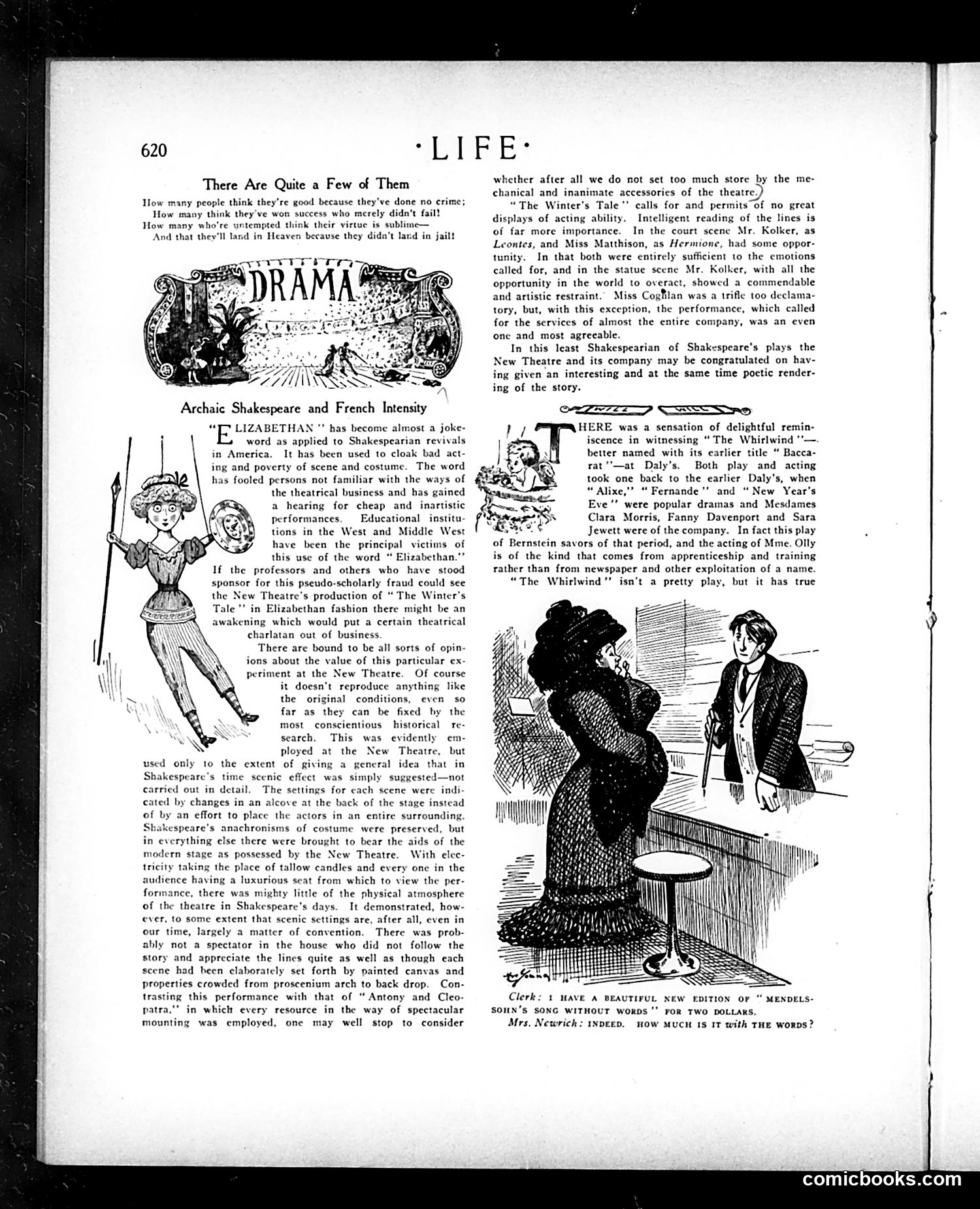
This page critiques theatrical productions, particularly the New Theatre's staging of Shakespeare's *The Winter's Tale* in "Elizabethan" style. **The Main Satire:** The term "Elizabethan" has become a joke—a fraudulent excuse used by cheap theaters and educational institutions to justify poor acting and minimal sets. The article mocks this "pseudo-scholarly fraud." **The Point:** The New Theatre's production proves that elaborate scenery is unnecessary; audiences follow the story through acting and dialogue alone. This challenges the theatrical convention of spectacular mounting. **The Cartoon:** The small illustration shows a character discussing Mendelssohn's "Song Without Words"—a humorous parallel about how meaning exists without literal ornamentation, reinforcing the article's argument. **The Verdict:** The production succeeds despite minimal spectacle, with actors Kolker and Matthison praised for emotional restraint. The review suggests theater should prioritize performance over mechanical accessories.
📄 Transcribed text from this page (OCR, searchable)
Machine-transcribed from the original scan — historical spelling and the odd misread are preserved.
620 *LIFE: There Are Quite a Few of Them How many people think they’re good because they've done no crime; How many think they’ve won success who merely didn’t fail! How many who're untempted think their virtue is sublime— And that they'll land in Heaven because they didn’t land in jail! Archaic Shakespeare and French Intensity “I> LIZABETHAN "' has become almost a joke- word as applied to Shakespearian revivals in America. It has been used to cloak bad act- ing and poverty of scene and costume. The word has fooled persons not familiar with the ways of the theatrical business and has gained a hearing for cheap and inartistic performances. Educational institu- tions in the West and Middle West have been the principal victims of this use of the word “ Elizabethan.”” If the professors and others who have stood sponsor for this pseudo-scholarly fraud could see the New Theatre's production of “ The Winter's Tale’ in Elizabethan fashion there might be an awakening which would put a certain theatrical charlatan out of business. There are bound to be all sorts of opin- ions about the value of this particular ex: periment at the New Theatre. Of course it doesn’t reproduce anything like the original conditions, even so far as they can be fixed by the most conscientious historical _re- search. This was evidently em- ployed at the New Theatre, but used only to the extent of giving a general idea that in Shakespeare's time scenic effect was simply suggested—not carried out in detail. The settings for each scene were indi- cated by changes in an alcove at the back of the stage instead of by an effort to place the actors in an entire surrounding. Shakespeare’s anachronisms of costume were preserved, but in everything else there were brought to bear the aids of the modern stage as possessed by the New Theatre. With elec- tricity taking the place of tallow candles and every one in the audience having a luxurious seat from which to view the per- formance, there was mighty little of the physical atmosphere of the theatre in Shakespeare's days. It demonstrated, how- ever, to some extent that scenic settings are, after all, even in our time, largely a matter of convention. There was prob- ably not a spectator in the house who did not follow the story and appreciate the lines quite as well as though each scene had heen claborately set forth by painted canvas and properties crowded from proscenium arch to back drop. Con- trasting this performance with that of “Antony and Cleo- patra," in which every resource in the way of spectacular mounting was employed, one may well stop to consider whether after all we do not set too much store by the me- chanical and inanimate accessories of the theatre. “The Winter's Tale" calls for and permits“of no great displays of acting ability. Intelligent reading of the lines is of far more importance. In the court scene Mr. Kolker, as Leontes, and Miss Matthison, as Hermione, had some oppor- tunity. In that both were entirely sufficient to the emotions called for, and in the statue scene Mr. Kolker, with all the opportunity in the world to overact, showed a commendable and artistic restraint. Miss Coghlan was a trifle too declama- tory, but, with this exception, the performance, which called for the services of almost the entire company, was an even one and most agreeable. In this least Shakespearian of Shakespeare's plays the New Theatre and its company may be congratulated on hav- ing given an interesting and at the same time poctic render- ing of the story. ORES DSSS n HERE was a sensation of delightful remin- iscence in witnessing “The Whirlwind "—. better named with its earlier title “ Bacca- rat’"—at Daly's. Both play and acting took one back to the earlier Daly's, when “ Alixe,” “ Fernande” and “New Year's Eve’? were popular dramas and Mesdames Clara Morris, Fanny Davenport and Sara . Jewett were of the company. In fact this play of Bernstein savors of that period, and the acting of Mme. Olly is of the kind that comes from apprenticeship and training rather than from newspaper and other exploitation of a name. “The Whirlwind” isn’t a pretty play, but it has true Clerk: 1 MAVE A BEAUTIFUL NEW EDITION OF SOMN’S SONG WITHOUT WORDS '’ FOR TWO DOLLARS. Mrs. Newrich: 1xpeep. now Mucu 18 1T with THE WoRDS? comicbooks.com