
Life, 1910-04-07 · page 24 of 76
Life — April 7, 1910 — page 24: what you’re looking at
What you’re looking at
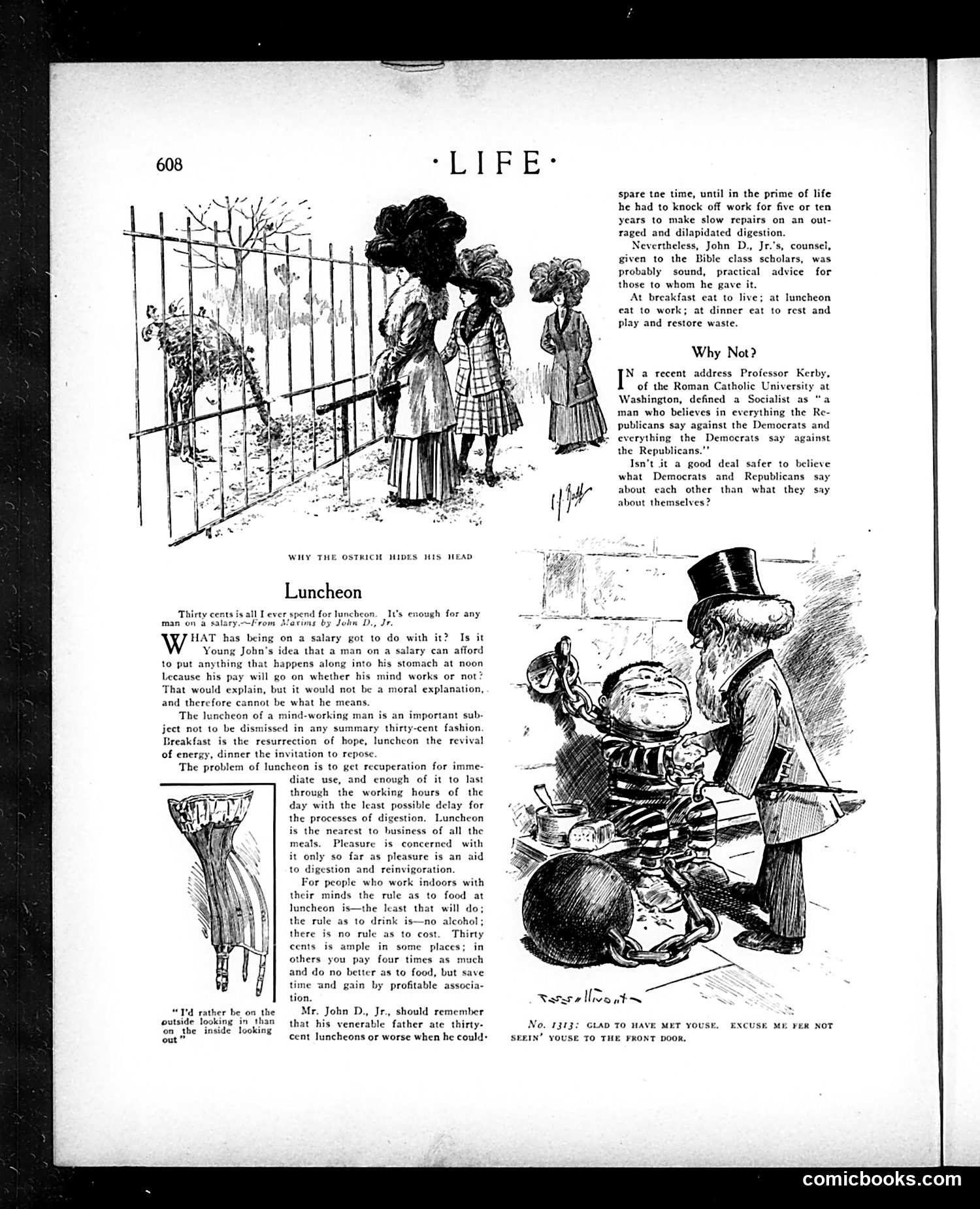
This page contains two separate satirical pieces: **"Luncheon"** mocks John D. Rockefeller Jr.'s advice that salaried workers need only spend thirty cents on lunch. The article argues this misses the point—lunch's real value for mental workers is recuperation and efficiency, not mere cost-cutting. The satire suggests Rockefeller Jr. ignores his own father's experience: the senior Rockefeller ate cheap lunches while building his fortune, but eventually suffered health collapse from years of poor nutrition. The critique implies Jr. gives impractical advice to Bible class scholars without understanding the actual needs of working people. **"Why Not?"** satirizes political hypocrisy. Professor Kerby's definition of a Socialist (someone believing everything opponents say against each other) is used to suggest that voters would do better trusting what Democrats and Republicans *say about each other* than what either party says *about itself*—implying all politicians are inherently dishonest about their own motivations. The cartoon showing an ostrich hiding its head illustrates willful ignorance or avoidance of reality.
📄 Transcribed text from this page (OCR, searchable)
Machine-transcribed from the original scan — historical spelling and the odd misread are preserved.
WHY THE OSTRICH MIDES HIS MEAD Luncheon Thirty cents is all I ever spend for luncheon, It's enough for any man on a salary.~From Matims by John D., Jr. HAT has being on a salary got to do with it? Is it Young John’s idea that a man on a salary can afford to put anything that happens along into his stomach at noon Lecause his pay will go on whether his mind works or not? That would explain, but it would not be a moral explanation, and therefore cannot be what he means. The luncheon of a mind-working man is an important sub: ject not to be dismissed in any summary thirty-cent fashion. Breakfast is the resurrection of hope, luncheon the revival of energy, dinner the invitation to repose The problem of luncheon is to get recuperation for imme- diate use, and enough of it to last through the working hours of the day with the Icast possible delay for the processes of digestion. Luncheon is the nearest to business of all the meals. Pleasure is concerned with it only so far as pleasure is an aid to digestion and reinvigoration. For people who work indoors with their minds the rule as to food at luncheon is—the least that will do; the rule as to drink is—no alcohol ; there is no rule as to cost. Thirty cents is ample in some places; in others you pay four times as much and do no better as to food, but save time and gain by profitable associa- tion. Mr. John D., Jr. should remember his vene father ate thirty- cent luncheons or worse when he could “T'd rather be oa the outside looking in than ‘on the inside looking spare tne time, until in the prime of life he had to knock off work for five or ten years to make slow repairs on an out- raged and dilapidated digestion. Nevertheless, John D., Jr.’s, counsel, given to the Bible class scholars, was probably sound, practical advice for those to whom he gave it. At breakfast eat to live; at luncheon cat to work; at dinner eat to rest and play and restore waste. Why Not? N a recent address Professor Kerby, of the Roman Catholic University at Washington, defined a Socialist as “a man who believes in everything the Re- publicans say against the Democrats and everything the Democrats say against the Republicans.”” Isn't it a good deal safer to believe what Democrats and Republicans say about cach other than what they say about themselves? yeores elles pt~ No. 1313: CLAD TO HAVE MET YouSE. SEEIN’ YOUSE TO THE FRONT DOOR, EXCUSE ME PER NOT comicbooks.com