
Life, 1910-04-07 · page 40 of 76
Life — April 7, 1910 — page 40: what you’re looking at
What you’re looking at
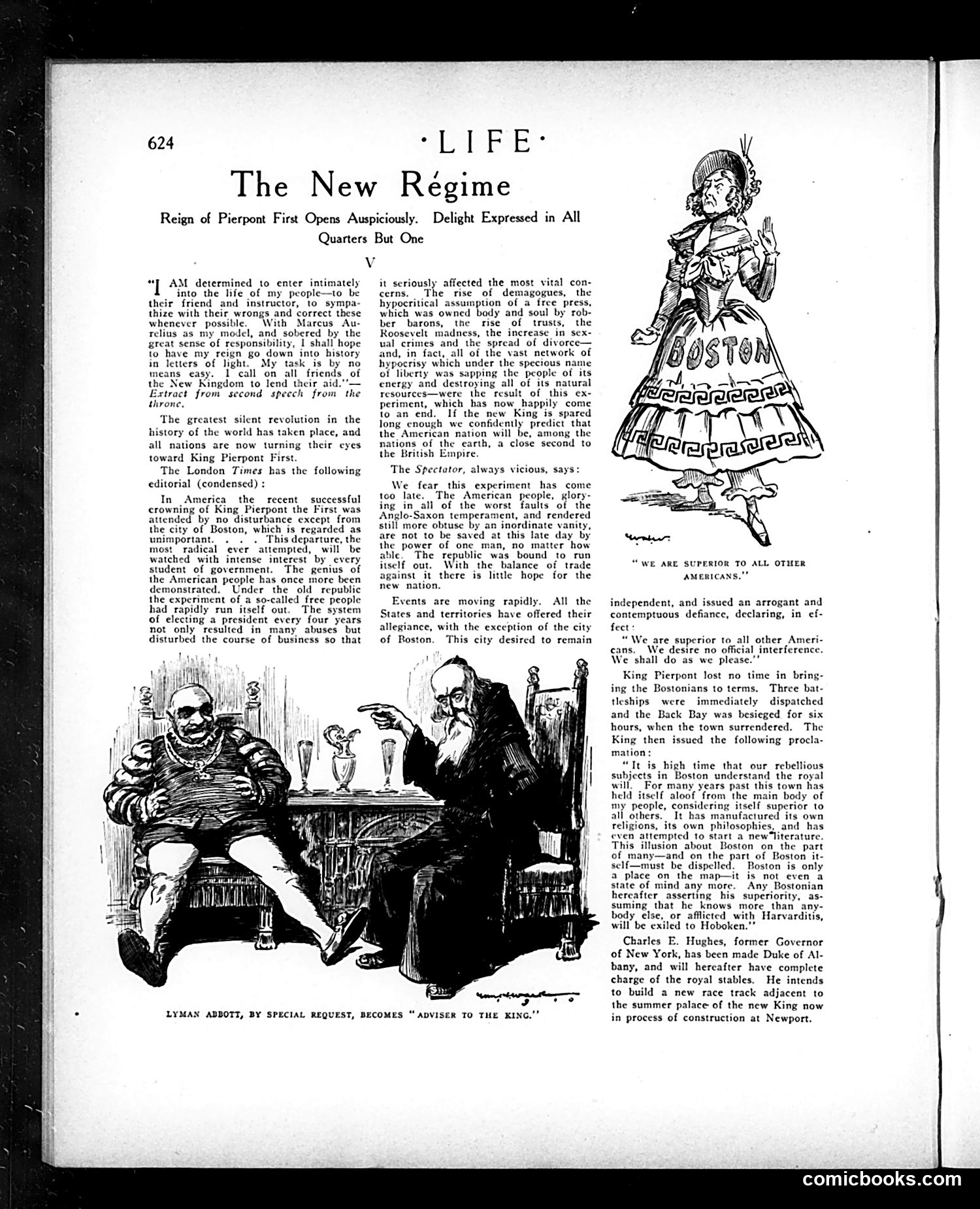
This Life magazine page satirizes the replacement of American democracy with a monarchy under "King Pierpont First"—likely referring to **J.P. Morgan**, the powerful banker whose influence over American economics and politics was vast. The satire mocks both American institutional failure and the public's apparent willingness to abandon democracy. The London Times editorial praises the change, claiming the republic "run itself out" due to demagoguery, corrupt press, trusts, and divorce—blaming democracy's failures. The opposing Spectator view suggests Americans are too obtuse to be saved. **The key joke**: Boston alone rebels, demanding independence from the new "King," and is forcefully subdued by battleships. This references Boston's historical identity as an independent-minded intellectual center, now absurdly treated as seditious for refusing royal allegiance. The cartoon shows an advisor consulting the corpulent "King"—visualizing how financial oligarchy has replaced electoral government. The satire warns that unchecked corporate power and public complacency could literally transform America into a monarchy.
📄 Transcribed text from this page (OCR, searchable)
Machine-transcribed from the original scan — historical spelling and the odd misread are preserved.
Reign of Pierpont First Opens Auspiciously. Ale PSE The New Régime Delight Expressed in All Quarters But One "] AM determined to enter intimately into the life of my people—to be their friend and instructor, to sympa- thize with their wrongs and correct these whenever possible. With Marcus Au- relius as my model, and sobered by the great sense of responsibility, I shall hope to have my reign go down into history in letters of light. My task is by no means easy. I call on all friends, of the New Kingdom to lend their aid.""— Extract from second speech from the throne, The greatest silent revolution in the history of the world has taken place, and all nations are now turning their eyes toward King Pierpont First. The London Times has the following editorial (condensed In America the recent successful crowning of King Pierpont the First was attended by no disturbance except from the city of Boston, which is regarded as unimportant. . . . This departure, the most radical ‘ever “attempted, will’ be watched with intense interest’ by every student of government. The genius of the American people has once more been demonstrated. Under the old republic the experiment of a so-called free people had rapidly run itself out. The system of electing a president every four years not only resulted in many abuses but disturbed the course of business so that FR AM in iy ? Mae) it seriously affected the most vital con- cerns. The rise of demagogues, the hypocritical assumption of a free press, which was owned body and soul by rob- ber barons, the rise of trusts, the dness, the increase in sex- mes and the spread of divorce— and, in fact, all of the vast network of hypocrisy which under the specious name of liberty was sapping the people of its energy and destroying all of its natural resources—were the result of this ex- periment, which has now happily come to an end. If the new King is spared long enough we confidently predict that the American nation will be, among the nations of the earth, a close second to the British Empire. The Spectator, always vicious, says: We fear this experiment has come 0 late. The American people, glory- ing in all of the worst faults of the Anglo-Saxon temperament, and rendered still more obtuse by an inordinate vanity, are not to be saved at this late day by the power of one man, no matter how able. The republic was bound to run itself out. With the balance of trade against it there is little hope for the new nation. Events are moving rapidly. All. the States and territories have offered their allegiance, with the exception of the city of Roston. This city desired to remain “WE ARE SUPERIOR TO ALL OTHER AMERICAN: independent, and issued an arrogant and contemptuous defiance, declaring, in ef- fect: “We are superior to_all other Ameri cans. We desire no official interference. We shall do as we please.” King Pierpont lost no time in bring- ing the Bostonians to terms. Three bat- tleships were immediately dispatched and the Back Bay was besieged for six hours, when the town surrendered. King then issued the following procla- mation: “It is high time that our rebellious subjects in Boston understand the royal will. For many years past this town has held itself aloof from the main body of my people, considering itself superior to all others.’ It has manufactured its own religions, its own philosophies, and has even attempted to start a new*literature This illusion about Boston on the part of many—and on the part of Boston it- self—must be dispelled. Boston is only a place on the map—it is not even a state of mind any more. Any Bostonian hereafter asserting his superiority, as- suming that he knows more than any- body else, or afflicted with Harvarditis, will be exiled to Hoboken. Charles E. Hughes, former Governor of New York, has been made Duke of Al- bany, and will hereafter have complete charge of the royal stables. He intends to build a new race track adjacent to the summer palace of the new King now in process of construction at Newport. comicbooks.com