
Life, 1910-04-07 · page 37 of 76
Life — April 7, 1910 — page 37: what you’re looking at
What you’re looking at
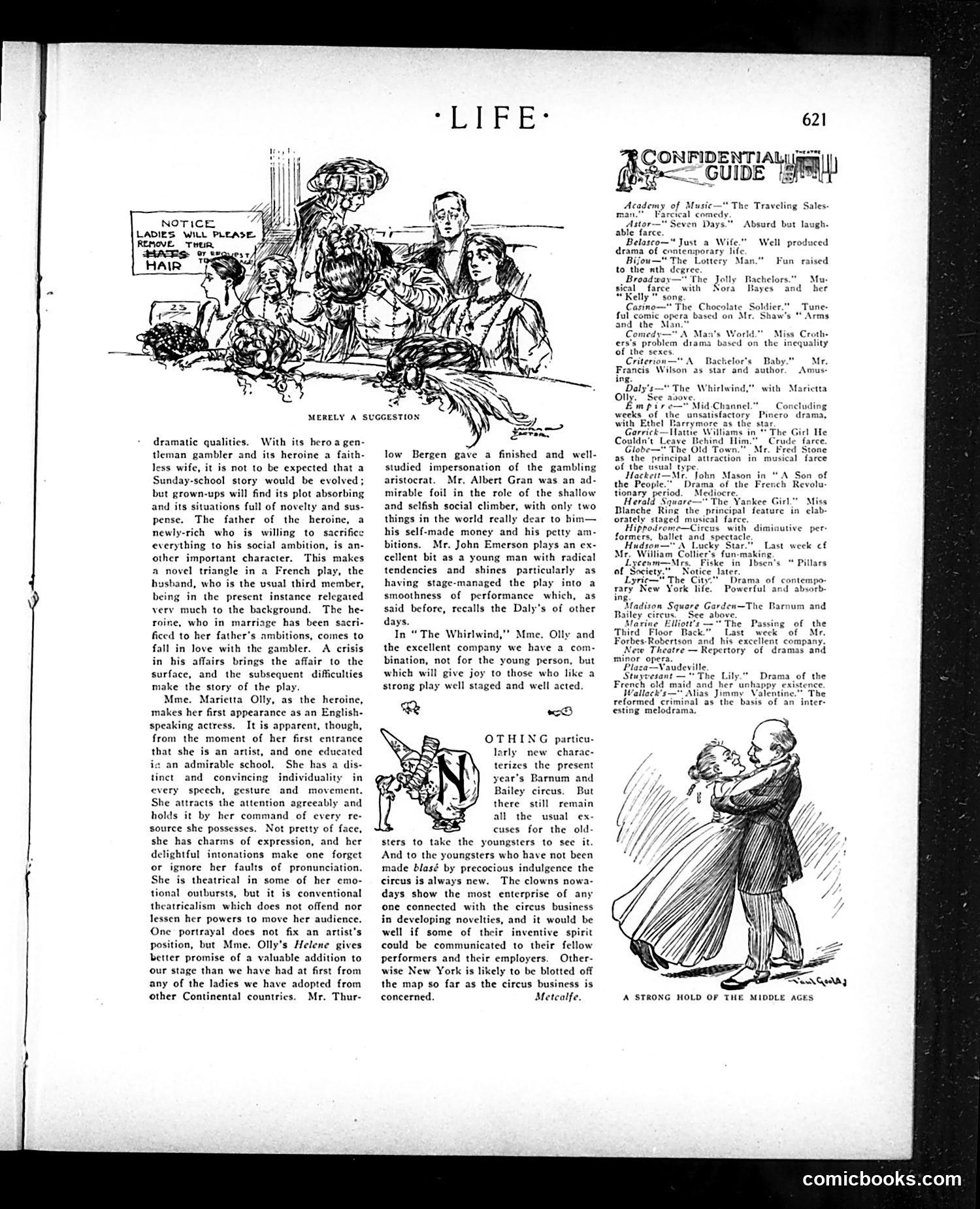
This page contains theatrical reviews and commentary on New York entertainment circa early 1900s. **Main Content:** - A review of the French play "The Whirlwind" (starring Mme. Marietta Olly), praising the actress's debut in English-language theater despite minor pronunciation faults. The plot involves a faithless wife, a gambler, and a socially ambitious father—noting the husband is "relegated very much to the background," an unusual dramatic triangle. - A brief notice about Barnum and Bailey's circus, lamenting that while still popular with children, it lacks innovation compared to previous years. The critic notes clowns show more creativity than other performers. **Left Illustration:** "Merely a Suggestion" cartoon shows women at a salon or social gathering with prominent, elaborate hair styles, with a notice requesting "Ladies will please refrain from wearing their hair" (presumably referring to theatrical wigs or oversized constructions). This likely satirizes current fashion excess. The "Confidential Guide" section lists current theater productions with brief critiques.
📄 Transcribed text from this page (OCR, searchable)
Machine-transcribed from the original scan — historical spelling and the odd misread are preserved.
NoTICE LADIES WILL PLEASE dramatic qualities. With its hero a gen- tleman gambler and its heroine a faith- less wife, it is not to be expected that a Sunday-school story would be evolved; but grown-ups will find its plot absorbing and its situations full of novelty and sus- pense. The father of the heroine, a newly-rich who is willing to sacrifice everything to his social ambition, is an- other important character. This makes a novel triangle in a French play, the husband, who is the usual third member, being in the present instance relegated very much to the background. The he- roine, who in marriage has been sacri- ficed to her father’s ambitions, comes to fall in love with the gambler. A crisis in his affairs brings the affair to the surface, and the subsequent difficulties make the story of the play. Mme. Marietta Olly, as the heroine, makes her first appearance as an English- speaking actress. It is apparent, though, from the moment of her first entrance that she is an artist, and one educated ia an admirable school. She has a dis- tinct and convincing individuality in every speech, gesture and movement. She attracts the attention agreeably and holds it by her command of every re- source she possesses. Not pretty of face, she has charms of expression, and her delightful intonations make one forget or ignore her faults of pronunciation. She is theatrical in some of her emo- tional outbursts, but it is conventional theatricalism which does not offend nor lessen her powers to move her audience. One portrayal does not fix an artist's position, but Mme. Olly’s Helene gives better promise of a valuable addition to our stage than we have had at first from any of the ladies we have adopted from other Continental countries. Mr. Thur- MERELY A SUGGESTION low Bergen gave a finished and well- studied impersonation of the gambling aristocrat. Mr. Albert Gran was an ad- mirable foil in the role of the shallow and selfish social climber, with only two things in the world really dear to b his self-made money and his petty am- bitions. Mr. John Emerson plays an ex- cellent bit as a young man with radical tendencies and shines particularly as having stage-managed the play into a smoothness of performance which, as said before, recalls the Daly's of other m— The Whirlwind,” Mme. Olly and the excellent company we have a com- bination, not for the young person, but which will give joy to those who like a strong play well staged and well acted. oS OTHING particu- larly new charac- terizes the present year’s Barnum and Bailey circus. But there still remain all the usual ex- cuses for the old- sters to take the youngsters to see it. And to the youngsters who have not been made blasé by precocious indulgence the circus is always new. The clowns nowa- days show the most enterprise of any one connected with the circus business in developing novelties, and it would be well if some of their inventive spirit could be communicated to their fellow performers and their employers. Other- wise New York is likely to be blotted off the map so far as the circus business is concerned. Metcalfe. 621 CONFIDENTIAL a GUIDE 134! Academy of Music— The Traveling Sales- man.” Farcical comedy Astor—“ Seve: able farce. Belasco—“ Just a Wife.” Absurd but laugh. Days.” Well produced drama of contensporary life. Bijou—" The Lottery Ma: Fun raised to the nth degree. Broadway—" The Jolly Rachelors.” | Mu- sical farce with Nora Bayes and ‘her “Kelly” song Casino—* The Chocolate Soldier.” Tune- ful comic opera based on Mr. Shaw's * Arms and the Man.” Comedy—" A Man's World.” Miss Croth- ers’s problem diama based on the inequality of the sexes Criterion—" A Bachelor's Bab: Mr. Francis Wilson as star and author. Amus: ing. Daly's—" The Whielw with Marietta Olly. "See avove Bm pirc—" Mid-Channel.” Concluding Pinero dra star weeks of the unsatisfacto with Ethel Barrymore as t Gorrick—Hattie Williams in, The Gicl He Couldn't Leave Behind Him." Crude farce. Globe—" The Old Town.” Mr. Fred Stone as the principal attraction in ical farce of the usual type. Hackett—Mr. John Mason in “A Son of the People.” Drama of the French Revolu- tionary period. Mediocre. Herald Square—"* The Yankee Girl.” Miss Blanche Ring the principal feature in elab- orately staged musical farce. Hippodrome—Circus with dimi formers, pectacle. Hudson—"\ Lucky Star." Last week cf Mr. William Collier's fun-making. utive per Lycenm—Mrs. Fiske in Ibsen's “ Pillars of Society." Notice, later. Lyric—" The City.” Drama of contempo rary New York life. Powerful and absorb- Madison Squere Garden—The Bai and Bailey circus. See above. Marine Elliott's —" The Passing of the Third Floor Back.” ast week of Forbes-Robertson and his excellent company. New Theatre — Repertory of dramas and minor opera. Plaza—Vaudeville. Stuyvesant —" The Lily.” Drama of the French old maid and her unhappy ex Wallack’s—" Mias Jimmy Valentine.” The reformed criminal as the basis of an inter- esting melodrama, A STRONG HOLD OF THE MIDDLE AGES. comicbooks:com