
Life, 1910-04-07 · page 30 of 76
Life — April 7, 1910 — page 30: what you’re looking at
What you’re looking at
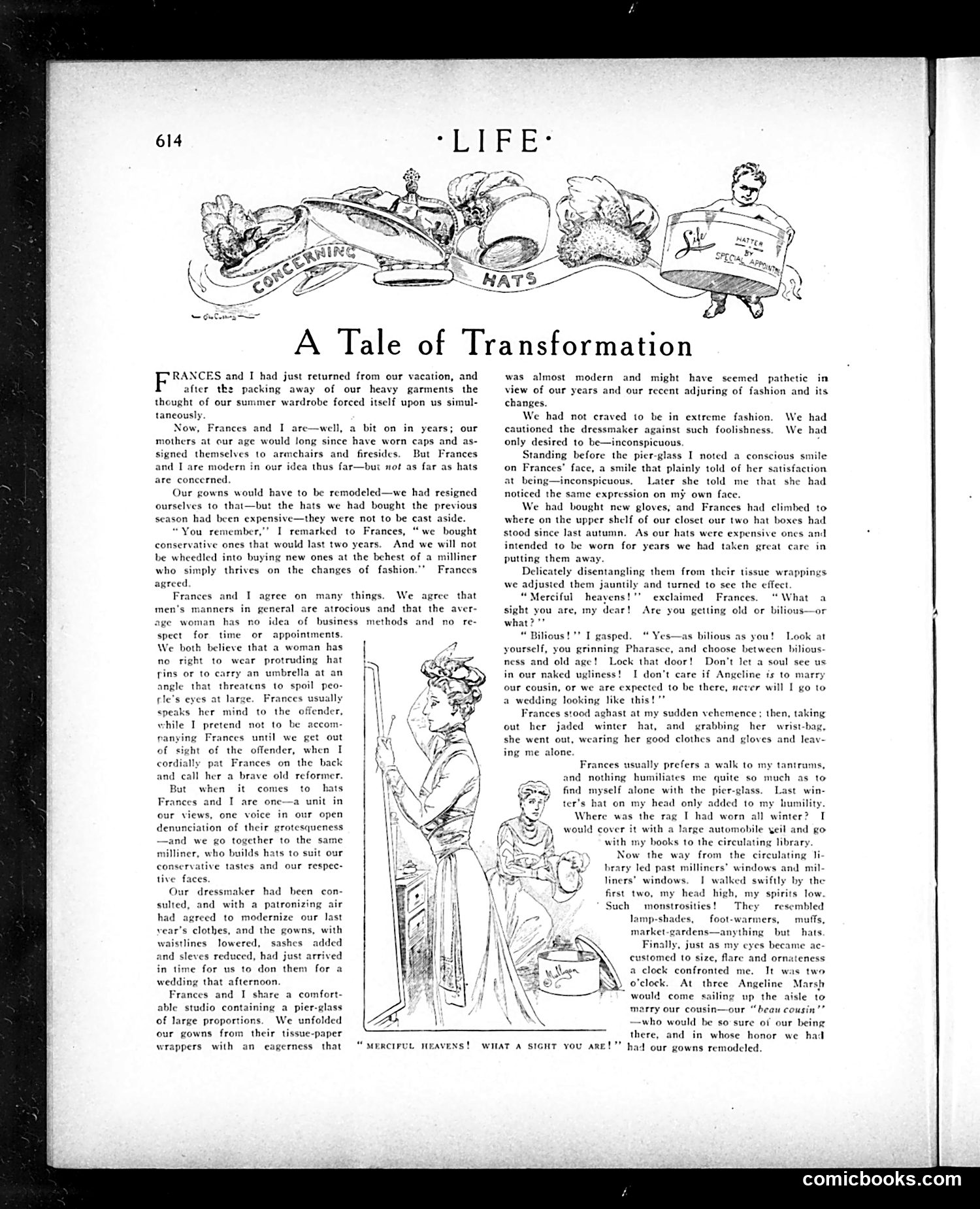
This satirical story mocks 1920s women's fashion obsession and hypocrisy about modernism. Two middle-aged women, Frances and the narrator, pride themselves on being "modern" and rejecting frivolous fashion changes. They deliberately buy conservative hats meant to last years, scorning milliners who profit from constant style updates. However, when they retrieve their "expensive" hats from storage after summer vacation, they're horrified by how dated they've become—so much so that they refuse to wear them to a wedding, despite their recent declarations against fashion tyranny. The joke is their complete capitulation: Frances immediately goes shopping for a new hat, betraying their stated principles. The satire targets the contradiction between women claiming independence from fashion while remaining enslaved to it, and mocks the fashion industry's deliberate planned obsolescence designed to keep women buying.
📄 Transcribed text from this page (OCR, searchable)
Machine-transcribed from the original scan — historical spelling and the odd misread are preserved.
A Tale of Transformation CES and I had just returned from our vacation, and after the packing away of our heavy garments the thought of our summer wardrobe forced itself upon us simul- taneously Now, Frances and I are—well, a bit on in years; our mothers at cur age would long since have worn caps and as- signed themselves to armchairs and firesides. But Frances and I are modern in our idea thus far—but not as far as hats are concerned. Our gowns would have to be remodeled—we had resigned ourselves to that—but the hats we had bought the previous season had been expensive—they were not to be cast aside. “You remember,"’ I remarked to ces, “we bought conservative ones that would last two years. And we will not be wheedled into buying new ones at the behest of a milliner who simply thrives on the changes of fashion."? Frances rances and I agree on many things. We agree that men’s manners in general are atrocious and that the aver- age woman s no idea of business methods and no re- spect for time or appointments We both believe that a woman has no right to wear protruding hat rins or to carry an umbrella at an angle that threatens to spoil peo- fle’s eyes at large. Frances usually speaks her mind to the offender, while I pretend not to be accom- panying Frances until we get out of sight of the offender, when I cordially pat Frances on the back and call her a brave old reformer. But when it com to hats Frances and I are one—a unit in our views, one voice in our open denunciation of their grotesqueness and we go together to the same milliner, who builds hats to suit our conservative tastes and our respec- tive faces Our dressmaker had been con- sulted, and with a patronizing air had agreed to modernize our last vear’s clothes, and the gowns, with waistlines lowered, sashes added and sleves reduced, had just arrived in time for us to don them for a wedding that afternoon Frances and I share a comfort- able studio containing a_pier-glass of large proportions. We unfolded was almost modern and might have scemed pathetic in view of our years and our recent adjuring of fashion and its chang We had not craved to be in extreme fashion. cautioned the dressmaker against such foolishness. only desired to be—inconspicuous. nding before the pier-glass I noted a conscious smile on Frances’ face, a smile that plainly told of her satisfaction at being—inconspicuous. Later she told me that she had noticed the same expression on my own face. We had bought new gloves, and Frances had climbed to where on the upper shelf of our closet our two hat boxes had stood since Jast autumn. As our hats were expensive ones and intended to be worn for years we had taken great care in putting them away Delicately disentangling them from their tissue wrappings we adjusted them jauntily and turned to see the effect “Merciful, heayens!"’ exclaimed Frances. “What a sight you are, my dear! Are you getting old or bilious—or what?” We had We had “ Bilious!"" I gasped.“ Yes—as bilious as you! Look at yourself, you grinning Pharasce, and choose between bilious- ness and old age! Lock tha Don't let a soul see us in our naked ugliness! I don’t care if Angeline is to mar our cousin, or we are expected to be there, never will | go to a wedding looking like this!” Frances stood aghast at my sudden vehemence ; then, taking out her jaded winter hat, and grabbing her wrist-bag, she went out, wearing her good clothes and gloves and leav- ing me alone door! Frances usually prefers a walk to my tantrums, and nothing humiliates me quite so much as to find myself alone with the pier-glass. twine ter’s hat on my head only added to my humility. Where would cover it with a large automobile yeil and go with my books to the circulating library Now the way from the circulating li brary led past milliners’ windows and n liners’ windows, I walked swiftly by the first two, my head high, my spirits low Such monstrosities! They resembled lamp-shades, was the rag I had worn all winter? T foot-warmers, muffs, market-gardens—anything but hats Finally, just as m customed to size, flare and ornateness A, « clock confronted me. It was two WQS o'clock. At three Angeline Marsh would come sailing up the aisle to marry our cousin—our “beau cousin’? -who would be so sure of our being y eyes became ac our gowns from their tissue-paper wrappers with an eagerness that “MERCIFUL MEAVENS! WHAT A SIGHT you are!’ there, and in whose honor we had 1 our gowns remodeled. comicbooks.com