
Life, 1910-04-07 · page 31 of 76
Life — April 7, 1910 — page 31: what you’re looking at
What you’re looking at
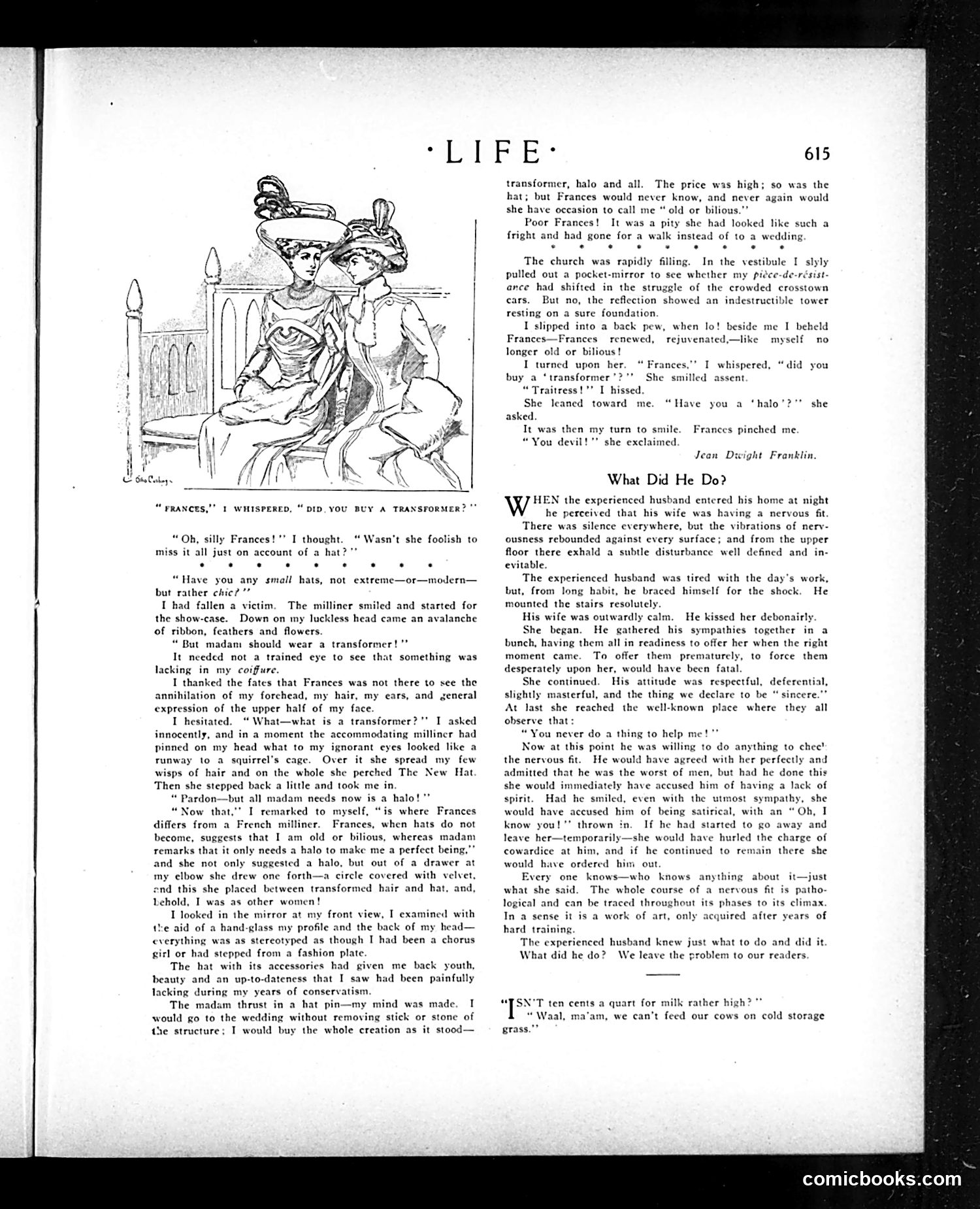
This page contains two separate pieces of satirical fiction from *Life* magazine, a prominent American humor publication. **The Cartoon and Main Story**: The illustrated narrative mocks women's obsession with fashionable hats around the early 1900s. A "transformer" was a wire frame device used to create the exaggerated, architecturally complex hairstyles of the era. The joke centers on two women, Frances and the narrator, both trying to outdo each other with increasingly elaborate hat constructions—adding "transformers," "halos" (velvet circles), and excessive trimmings. The satire targets both women's vanity and the absurdity of fashion industry manipulation, wherein a milliner convinces customers they look "old or bilious" without these expensive additions. The irony: Frances secretly bought the same outfit, making their competitive spending mutually foolish. **"What Did He Do?"**: A separate story satirizing marital dynamics, presenting a husband trying to manage his wife's unexplained "nervous fit"—a common period trope depicting female emotionalism as both mysterious and burdensome to men. Both pieces reflect early-1900s gender stereotypes: women as fashion-obsessed and emotionally volatile, men as weary but dutiful.
📄 Transcribed text from this page (OCR, searchable)
Machine-transcribed from the original scan — historical spelling and the odd misread are preserved.
f *LIFE: 615 ieeeeeETEe | pre ShaCabeys “ FRANCES,’ 1 WHISPERED, “ DID. YOU BUY A TRANSFORMER?" “Oh, silly Frances! I thought. “ Wasn't she foolish to miss it all just on account of a hat?” “Have you any small hats, not extreme—or—modern— but rather chic? ”” I had fallen a victim. The milliner smiled and started for the show-case. Down on my luckless head came an avalanche of ribbon, feathers and flowers. “But madani should wear a transformer!" It needed not a trained eye to see that something was lacking in my coiffure. I thanked the fates that Frances was not there to see the annihilation of my forehead, my hair, my ears, and general expression of the upper half of my face. I hesitated. “ What—what is a transformer?’ I asked innocently, and in a moment the accommodating milliner had pinned on my head what to my ignorant eyes looked like a runway to a squirrel’s cage. Over it she spread my few wisps of hair and on the whole she perched The New Hat Then she stepped back a little and took me in. “ Pardon—but all madam needs now is a halo!" Now that," I remarked to myself, “is where Frances differs from a French milliner. Frances, when hats do not become, suggests that I am old or bilious, whereas madam remarks that it only needs a halo to make me a perfect being,” and she not only suggested a halo, but out of a drawer at my elbow she drew one forth—a circle covered with velvet, and this she placed between transformed hair and hat, and, Lehold, I was as other women! I looked in the mirror at my front view, I examined with the aid of a hand-glass my profile and the back of my head— everything was as stereotyped as though I had been a chorus girl or had stepped from a fashion plate The hat with its accessories had given me back youth, beauty and an up-to-dateness that I saw had been painfully lacking during my years of conservatism. The madam thrust in a hat pin—my mind was made. 1 would go to the wedding without removing stick or stone of the structure; I would buy the whole creation as it stood— transformer, halo and all. The price was high; so was the hat; but Frances would never know, and never again would she have occasion to call me “old or bilious.”” Poor Frances! It was a pity she had looked like such a fright and had gone for a walk instead of to a wedding The church was rapidly filling. In the vestibule I slyly pulled out a pocket-mirror to sce whether my piéce-de-résist- ance had shifted in the struggle of the crowded crosstown cars. But no, the reflection showed an indestructible tower resting on a sure foundation I slipped into a back pew, when lo! beside me I beheld Frances—Frances renewed, rejuvenated,—like myself no longer old or bilious! I turned upon her buy a ‘transformer ’? “Traitress!"” I hissed She leaned toward me. “Have you a ‘halo’?” asked. Tt was then my turn to smile “You devil!” she exclaimed Frances,”’ I whispered, She smilled assent did you she Frances pinched me. Jean Dwight Franklin. What Did He Do? HEN the experienced husband entered his home at night he perceived that his wife was having a nervous fit. There was silence everywhere, but the vibrations of nerv- ousness rebounded against every surface; and from the upper floor there exhald a subtle disturbance well defined and in- evitable The experienced husband was tired with the day's work, but, from long habit, he braced himself for the shock. He mounted the stairs resolutely. His wife was outwardly calm. He kissed her debonairly. She began. He gathered his sympathies together in a bunch, having them all in readiness to offer her when the right moment came. To offer them prematurely, to force them desperately upon her, would have been fatal. She continued. His attitude was respectful, deferential, slightly masterful, and the thing we declare to be “ sincere.”” At last she reached the well-known place where they all observe that: “You never do a thing to help me!” Now at this point he was willing to do anything to chee’ the nervous fit. He would have agreed with her perfectly and admitted that he was the worst of men, but had he done this she would immediately have accused him of having a lack of spirit. Had he smiled, even with the utmost sympathy, she would have accused him of being satirical, with an “Oh, I know you!’ thrown in. If he had started to go away and leave her—temporarily—she would have hurled the charge of cowardice at him, and if he continued to remain there she would have ordered him out Every one knows—who knows anything about it—just what she said. The whole course of a nervous fit is patho- logical and can be traced throughout its phases to its climax. In a sense it is a work of art, only acquired after years of hard training. The experienced husband knew just what to do and did it What did he do? We leave the problem to our readers. milk rather high? ** . we can’t feed our cows on cold storage 'T ten cents a quart for “Waal, m. grass."” comicbooks:.com