
Life, 1910-04-07 · page 20 of 76
Life — April 7, 1910 — page 20: what you’re looking at
What you’re looking at
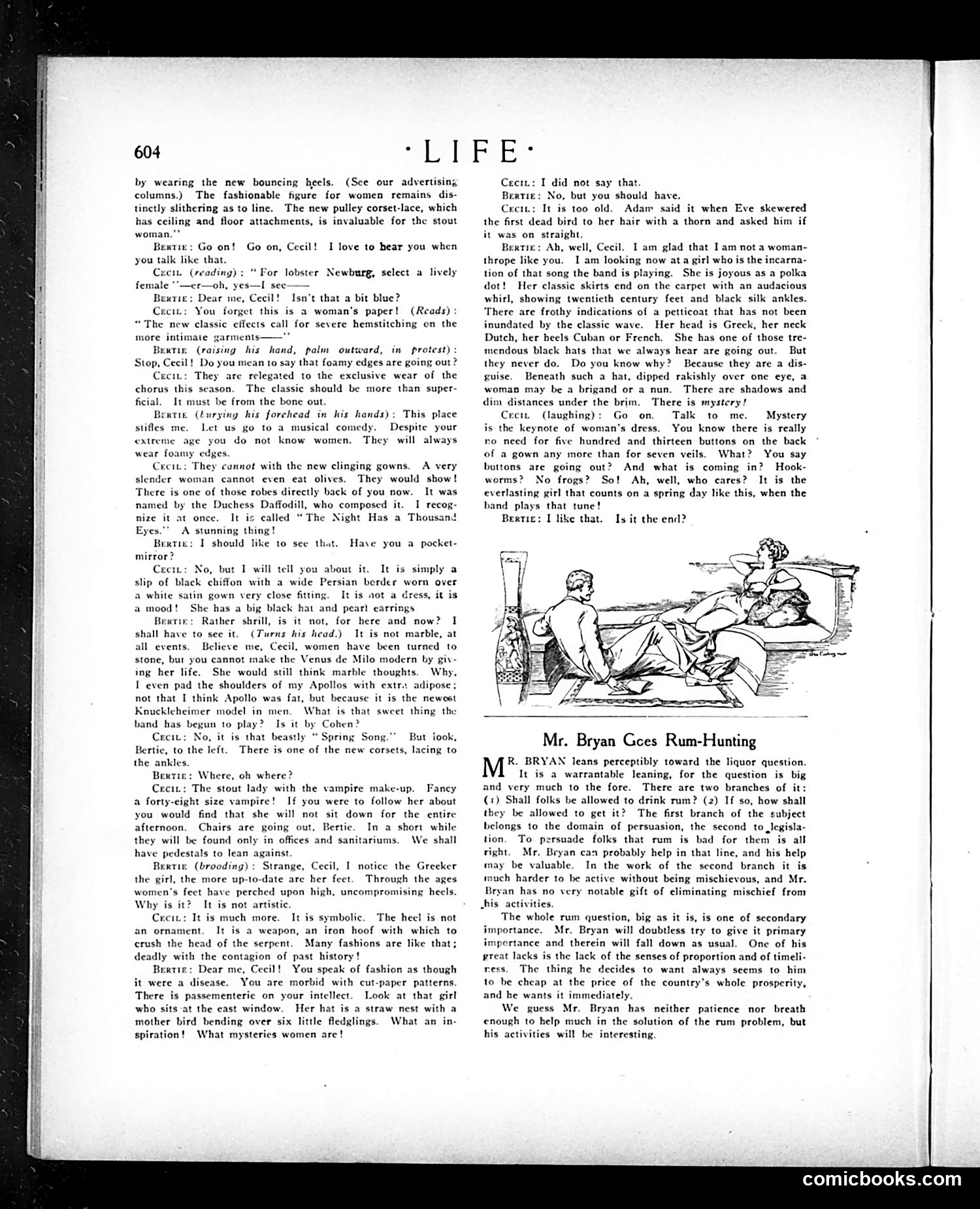
This page contains a satirical dialogue between two male characters—Cecil and Bertie—discussing contemporary women's fashion circa the 1910s-1920s. The satire targets absurd fashion trends of the era: restrictive corsets with "pulley" lacing, impossibly clinging gowns that prevent eating olives, impractical footwear, and elaborate hats. The humor operates on multiple levels: Cecil earnestly describes ridiculous garment details as if they're reasonable, while Bertie alternates between mock enthusiasm and exasperation. The text mocks both the fashion industry's illogical demands on women's bodies and men's befuddled, pseudo-philosophical responses to women's fashion choices. A small illustration titled "Mr. Bryan Goes Rum-Hunting" appears separately, accompanied by text discussing William Jennings Bryan's temperance activism and the prohibition debate—unrelated to the fashion dialogue above it. The page exemplifies *Life* magazine's satirical approach to gender relations and consumer culture.
📄 Transcribed text from this page (OCR, searchable)
Machine-transcribed from the original scan — historical spelling and the odd misread are preserved.
604 by wearing the new bouncing heels. (Sce our advertising columns.) The fashionable figure for women remains dis- tinctly slithering as to line. The new pulley corset-lace, which has ceiling and floor attachments, is invaluable for the stout woman."* Bextiz: Go on! you talk like that. Cuct. (reading): “For lobster Newburg, select a lively female ""—er—oh, yes—I see— Bexrie: Dear me, Cecil! Isn't that a bit blue? Ceci: You forget this is a woman's paper! (Reads) : “The new classic effects call for severe hemstitching on the more intimate garments. Berti, (raising his hand, palm outward, in protest): Stop, Cecil! Do you mean to say that foamy edges are going out? Ceci: They are relegated to the exclusive wear of the chorus this season. The classic should be more than super- ficial. It must be from the bone out Bratz (Lurying his forehead in his hands): This place stifles me. Let us go to a musical comedy. Despite your Go on, Cecil! I love to hear you when extreme age you do not know women, They will always wear foamy edges Ceci: They cannot with the new clinging gowns, A very slender woman cannot even eat olives. They would show! There is one of those robes directly back of you now. It was named by the Duchess Daffodill, who composed it. I recog- nize it at once. It is called “The Night Has a Thousand Eyes.’ A stunning thing! Beatie: I should like to see that. mirror? Cece: No, but I will tell you about it. It is simply a slip of black chiffon with a wide Persian border worn over a white satin gown very close fitting. It is not a dress, it is She has a big black hat and pear! earrings Bextiex: Rather shrill, is it not, for here and now? I shall have to see it. (Turns his head.) It is not marble, at all events. Believe me, Cecil, women have been turned to stone, bur you cannot make the Venus de Milo modern by giv- ing her life. She would still think marble thoughts. Why. I even pad the shoulders of my Apollos with extra adipose; not that I think Apollo was fat, but because it is the newest Knuckleheimer model in men, What is that sweet thing the band has begun to play? Is it by Cohen? Cecit: No, it is that beastly “Spring Song.” But iook, Bertie, to the left. There is one of the new corsets, lacing to the ankles. Bertie: Where, oh where? Ceci: The stout lady with the vampire make-up. Fancy a forty-eight size vampire! If you were to follow her about you would find that she will not sit down for the entire afternoon. Chairs are going out, Bertie. In a short while they will be found only in offices and sanitariums, We shall have pedestals to lean against Bertie (brooding): Strange, Ce I notice the Greeker the girl, the more up-to-date are her feet. Through the ages women’s feet have perched upon high, uncompromising heels. Why is it? It is not artistic Ceci: It is much more. The heel is not an ornament. It is a weapon, an iron hoof with which to crush the head of the serpent. Many fashions are like that; deadly with the contagion of past history! Bertie: Dear me, Cecil! You speak of fashion as though it were a disease. You are morbid with cut-paper patterns There is passementerie on your intellect. Look at that girl who sits-at the east window. Her hat is a straw nest with a mother bird bending over six little fledglings. What an in- spiration! What mysteries women are! Have you a pocket- a mood! It is symbolic gL |b el ekg Cectt.: I did not say that Bertie: No, but you should have. Ceci: It is too old. Adam said it when Eve skewered the first dead bird to her hair with a thorn and asked him if it was on straight. Bertie: Ah, well, Cecil. [am glad that Iam not a woman- thrope like you. I am looking now ata girl who is the incarna- tion of that song the band is playing. She is joyous as a polka dot! Her classic skirts end on the carpet with an audacious whirl, showing twentieth century feet and black silk ankles. here are frothy indications of a petticoat that has not been inundated by the classic wave. Her head is Greek, her neck Dutch, her heels Cuban or French. She has one of those tre- mendous black hats that we always hear are going out. But they never do. Do you know why? Because they are a dis- guise. Beneath such a hat, dipped rakishly over one eye, a woman may be a brigand or a nun. There are shadows and dim distances under the brim. There is mystery! Crew. (laughing): Go on. Talk to me. Mystery is the keynote of woman's dress. You know there is really no need for five hundred and thirteen buttons on the back of a gown any more than for seven veils. What? You say buttons are going out? And what is coming in? Hook- worms? No frogs? So! Ab, well, who cares? It is the everlasting girl that counts on a spring day like this, when the band plays that tune! Bertie: I like that. Is it the end? Mr. Bryan Gces Rum-Hunting R. BRYAN leans perceptibly toward the liquor question. It is a warrantable leaning, for the question is big and very much to the fore. There are two branches of it: (4) Shall folks be allowed to drink rum? (2) If so, how shall they be allowed to get it? The first branch of the subject belongs to the domain of persuasion, the second to legisla- tion. To persuade folks that rum is bad for them is all right. Mr. Bryan can probably help in that line, and his help may be valuable. In the work of the second branch it is much harder to be active without being mischievous, and Mr. Bryan has no very notable gift of eliminating mischief from ahis activities. The whole rum question, big as it is, is one of secondary importance. Mr. Bryan will doubtless try to give it primary importance and therein will fall down as usual. One of his great lacks is the lack of the senses of proportion and of timeli- ress. The thing he decides to want always seems to him to be cheap at the price of the country’s whole prosperity, and he wants it immediately. We guess Mr. Bryan has neither patience nor breath enough to help much in the solution of the rum problem, but his activities will be interesting. comicbooks.com