
Life, 1910-04-07 · page 46 of 76
Life — April 7, 1910 — page 46: what you’re looking at
What you’re looking at
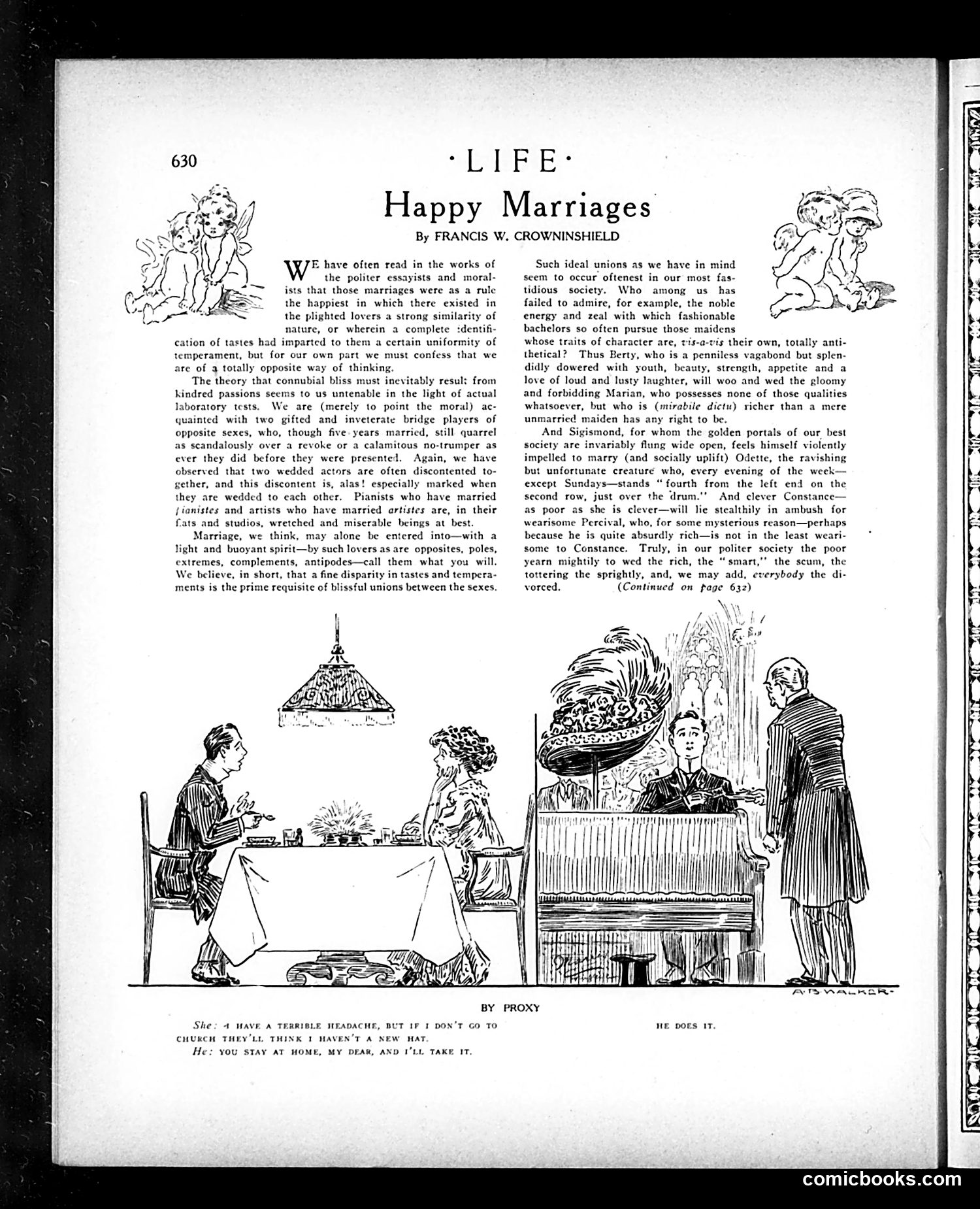
This article by Francis W. Crowninshield argues that successful marriages require *opposite* personalities, not compatible ones. He supports this with upper-class examples: a poor but charming man marrying a wealthy, gloomy woman; a chorus girl (who performs "fourth from the left...every evening except Sundays") marrying into high society; a poor-but-clever woman pursuing a rich man. The accompanying cartoon titled "By Proxy" satirizes superficial society priorities. A woman claims a headache but insists on attending church—not for faith, but to display her new hat. Her husband offers to take the hat himself and attend in her place, mocking how appearance matters more than genuine participation in social rituals. Together, these pieces skewer early 20th-century high society's materialism and status-obsession, suggesting marriages are often transactional arrangements between opposite classes rather than unions based on genuine compatibility.
📄 Transcribed text from this page (OCR, searchable)
Machine-transcribed from the original scan — historical spelling and the odd misread are preserved.
Er SEsE Happy Marriages By FRANCIS W, CROWNINSHIELD E have often read in the works of the politer essayists and moral- ists that those marriages were as a rule the happiest in which there existed in the plighted lovers a strong similarity of nature, or wherein a complete :dentifi- cation of tastes had imparted to them a certain uniformity of temperament, but for our own part we must confess that we are of a totally opposite way of thinking. The theory that connubial bliss must inevitably resul: from kindred passions seems to us untenable in the light of actual laboratory tests. We are (merely to point the moral) ac- quainted with two gifted and inveterate bridge players of opposite sexes, who, though five years married, still quarrel as scandalously over a revoke or a calamitous no-trumper as ever they did before they were presented. Again, we have observed that two wedded actors are often discontented to- gether, and this discontent is, alas! especially marked when they are wedded to each other. Pianists who have married Lianistes and artists who have married artistes are, in their fats and studios, wretched and miserable beings at best. Marriage, we think, may alone be entered into—with a light and buoyant spirit—by such lovers as are opposites, poles, extremes, complements, antipodes—call them what you will. We believe, in short, that a fine disparity in tastes and tempera- ments is the prime requisite of blissful unions between the sexes. Such ideal unions as we have in mind seem to occur oftenest in our most fas- tidious society. Who among us has failed to admire, for example, the noble energy and zeal with which fashionable bachelors so often pursue those maidens whose traits of character are, vis-a-vis their own, totally anti- thetical? Thus Berty, who is a penniless vagabond but splen- didly dowered with youth, beauty, strength, appetite and a love of loud and lusty laughter, will woo and wed the gloomy and forbidding Marian, who possesses none of those qualities whatsoever, but who is (mirabile dictu) richer than a mere maiden has any right to be. smond, for whom the golden portals of our, best society are invariably flung wide open, feels himself violently impelled to marry (and socially uplift) Odette, the ravishing but unfortunate creature who, every evening of the week— except Sundays—stands “fourth from the left end on the second row, just over the drum.'’ And clever Constance- as poor as she is clever—will lie stealthily in ambush for wearisome Percival, who, for some mysterious reason—perhaps because he is quite absurdly rich—is not in the least weari- some to Constance. Truly, in our politer society the poor yearn mightily to wed the rich, the “smart,”” the scum, the tottering the sprightly, and, we may add, everybody the di- vorced. (Continued on page 632) {i TUT il Hh Nt BY PROXY She: 4 Wave A TERRIBLE HEADACHE, BUT IF 1 DON'T Go TO CHURCH THEY'LL THINK 1 HAVEN'T A NEW HAT, He: you STAY AT HOME, MY DPAR, AND I'LL TAKE IT, NE DOES 17 comicbooks.com