
A complete issue · 80 pages · 1910
Life — March 3, 1910
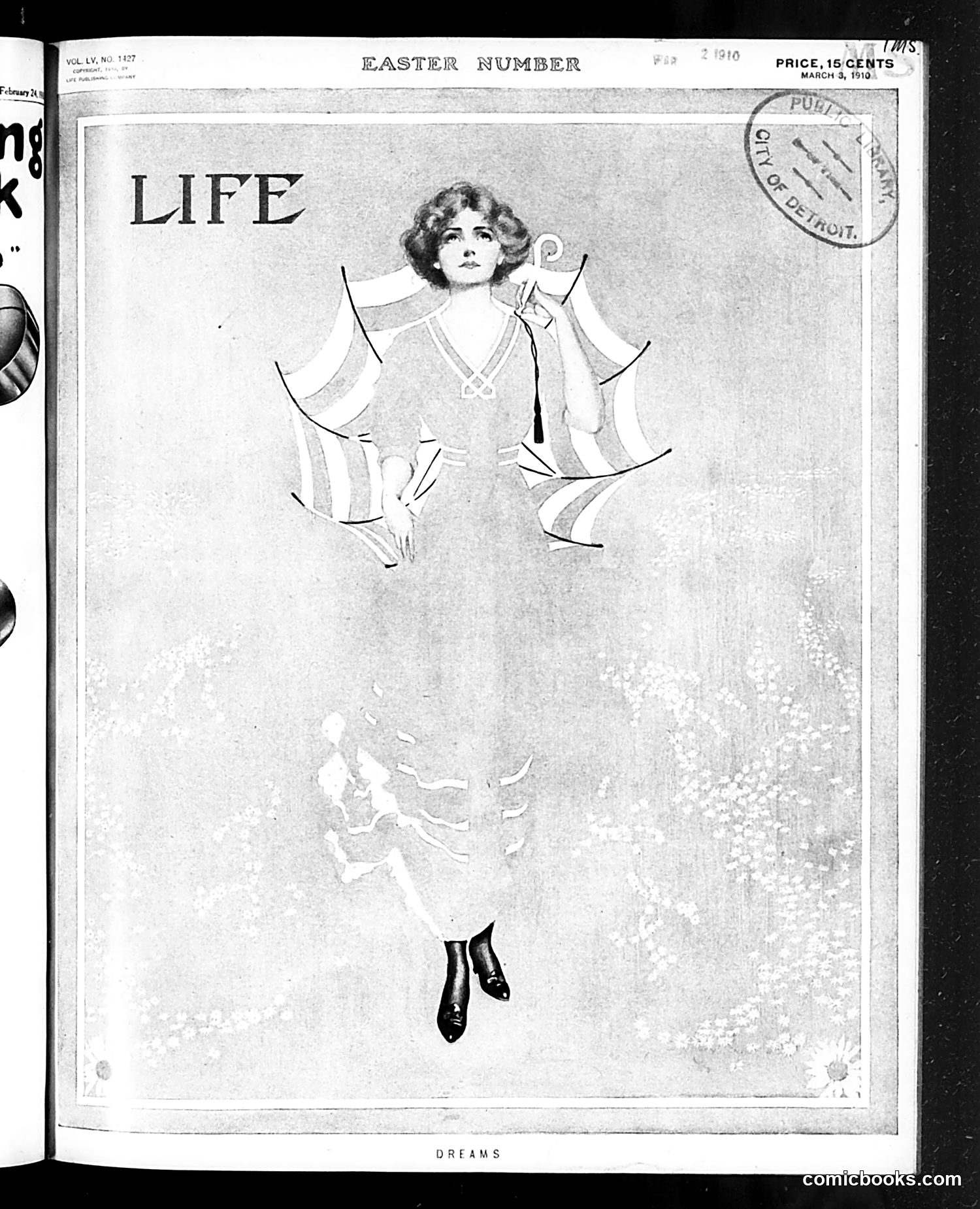
This is the cover of Life magazine's Easter Number (March 1910), priced at 16 cents. The illustration depicts a woman in elegant Edwardian dress, floating or ascending upward with wings emerging from her shoulders. She wears a fashionable white gown with decorative elements and dark shoes, gazing upward with a serene expression. The caption reads "DREAMS," suggesting the image represents idealized aspirations or fantasies. Given the Easter timing and the ethereal, heavenly imagery with wings, this likely comments on spiritual aspirations or romantic ideals—themes common to Life's satirical social commentary of the era. The figure's fashionable appearance and upward gaze suggest commentary on women's dreams and social expectations during the Progressive Era.
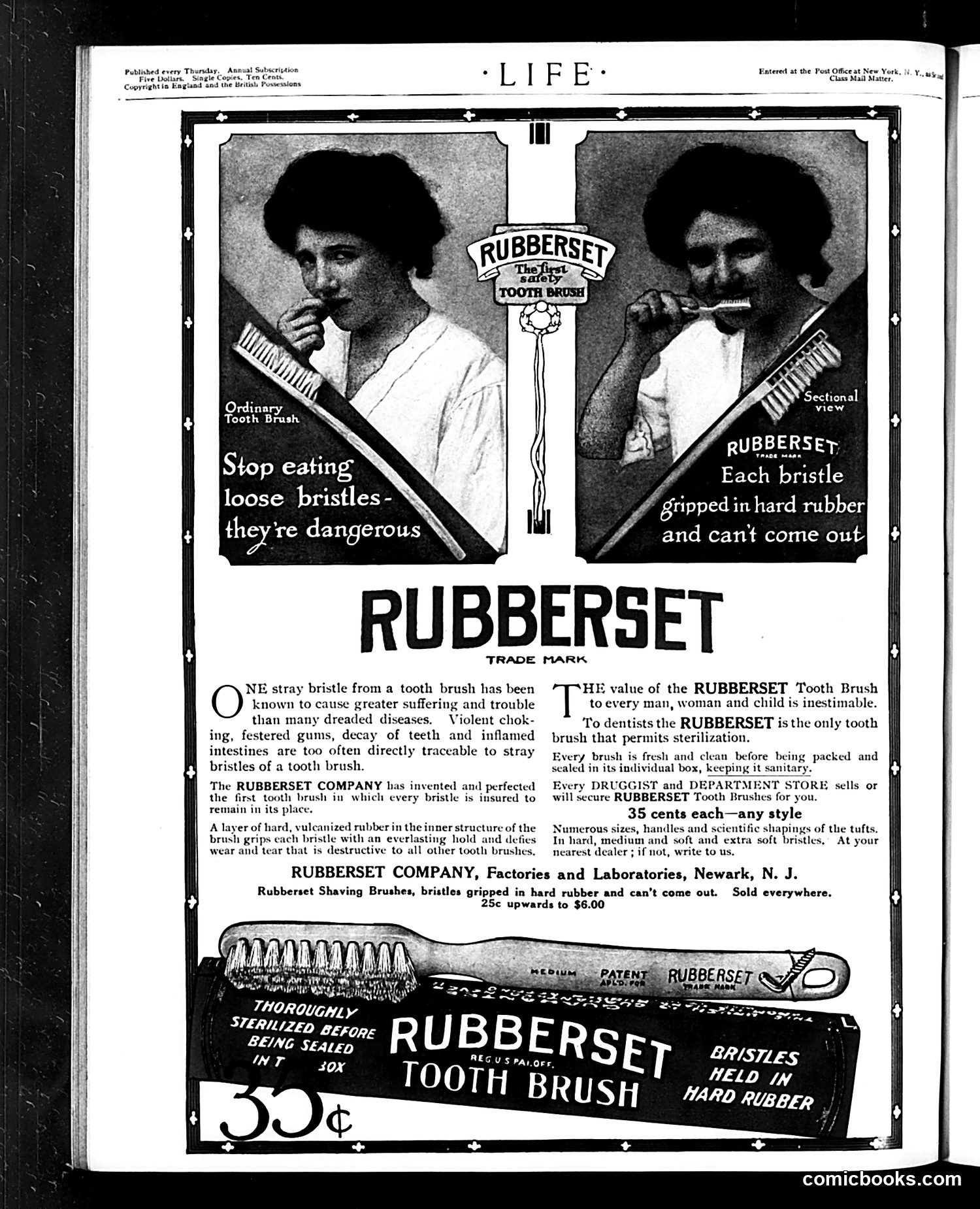
This page is **primarily an advertisement**, not satire or political commentary. It promotes the Rubberset brand tooth brush, sold by the Rubberset Company of Newark, N.J. The ad uses comparative imagery: an ordinary tooth brush (left) versus the Rubberset model (right). The marketing pitch warns that loose bristles from standard brushes are "dangerous"—causing choking, gum disease, and tooth decay. Rubberset's solution: bristles "gripped in hard rubber and can't come out." The ad emphasizes hygiene, sterilization capability, and medical endorsement from dentists and druggists. Priced at 35 cents, this represents typical early-20th-century consumer advertising emphasizing health and safety as selling points. No political content or satire is present.
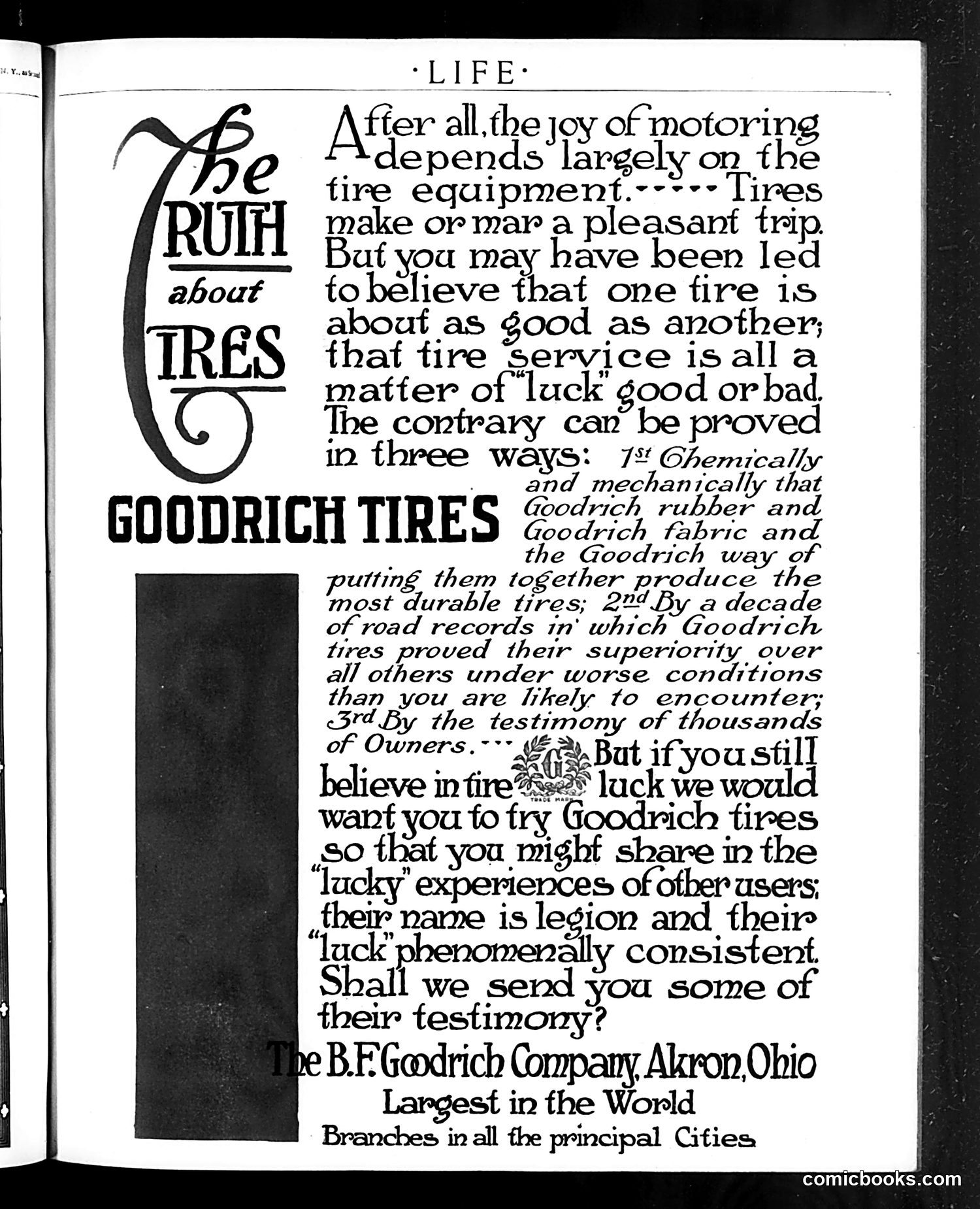
This is primarily a **Goodrich Tires advertisement**, not satirical content. The page features "The Truth about Tires," a promotional article arguing that tire quality genuinely matters—contrary to what consumers might believe. The ad claims Goodrich tires are superior through three points: superior materials and construction, a decade of road-record superiority, and thousands of satisfied customers. The tone is somewhat tongue-in-cheek: the company humorously acknowledges that skeptical consumers might attribute good tire performance to "luck" rather than quality. It then proposes that if people believe in "tire luck," they should try Goodrich to experience the same "phenomenally consistent" good fortune as other users. The large dark rectangle appears to be a space for an image or additional content.
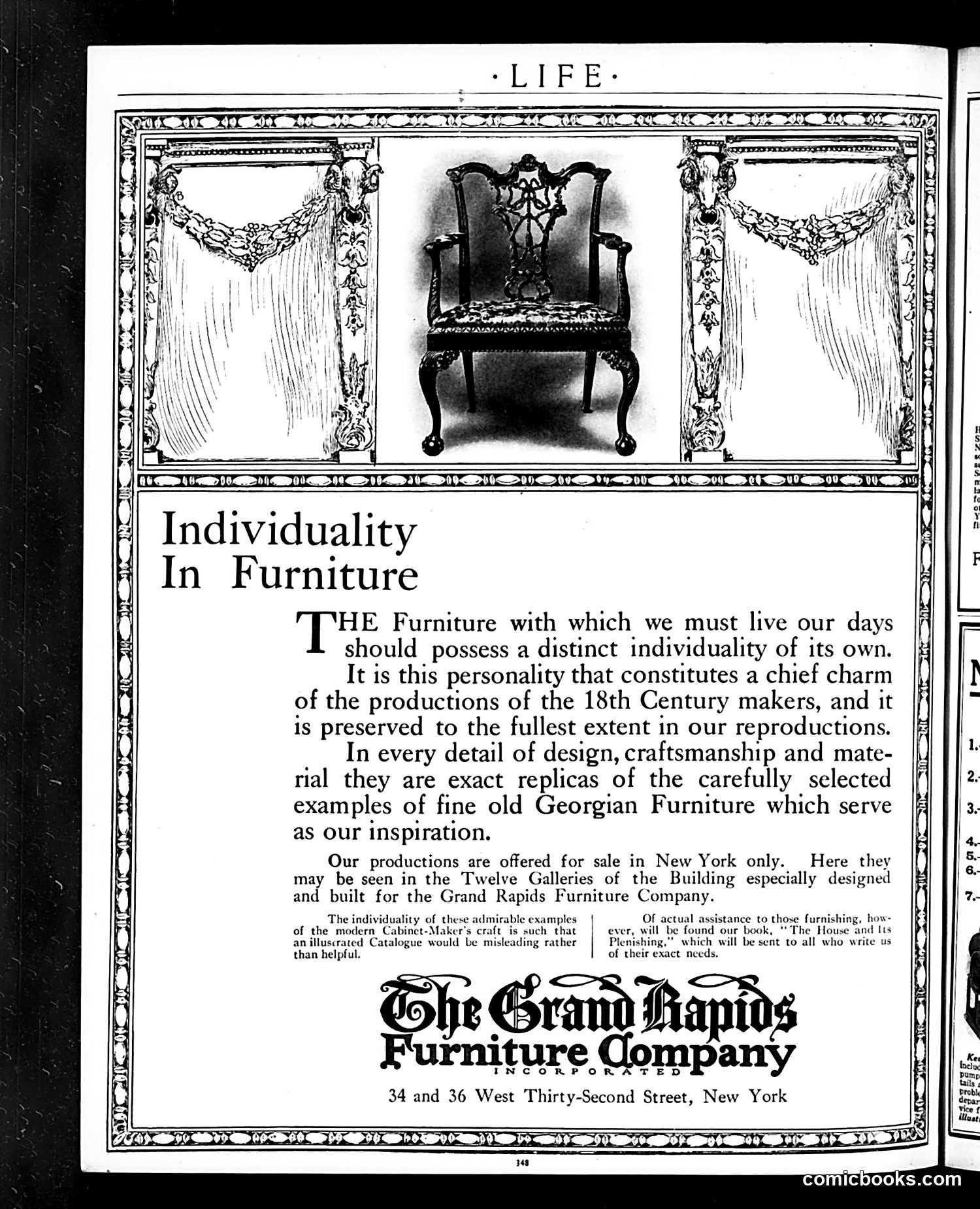
This page is **primarily an advertisement**, not a political cartoon or satire. It's a vintage ad from *Life* magazine for the Grand Rapids Furniture Company, promoting their reproduction Georgian furniture. The ad emphasizes that their furniture possesses "distinct individuality" and faithful craftsmanship, claiming to be "exact replicas" of carefully selected 18th-century Georgian originals. The ornate decorative chair illustrated exemplifies this classical style. The only satirical element appears subtle: the ad notes that an "illustrated Catalogue would be misleading rather than helpful," suggesting competitors rely on misleading marketing—a gentle jab at the furniture industry's sales practices. Otherwise, this is straightforward period advertising emphasizing quality, authenticity, and refined taste to wealthy consumers in New York.
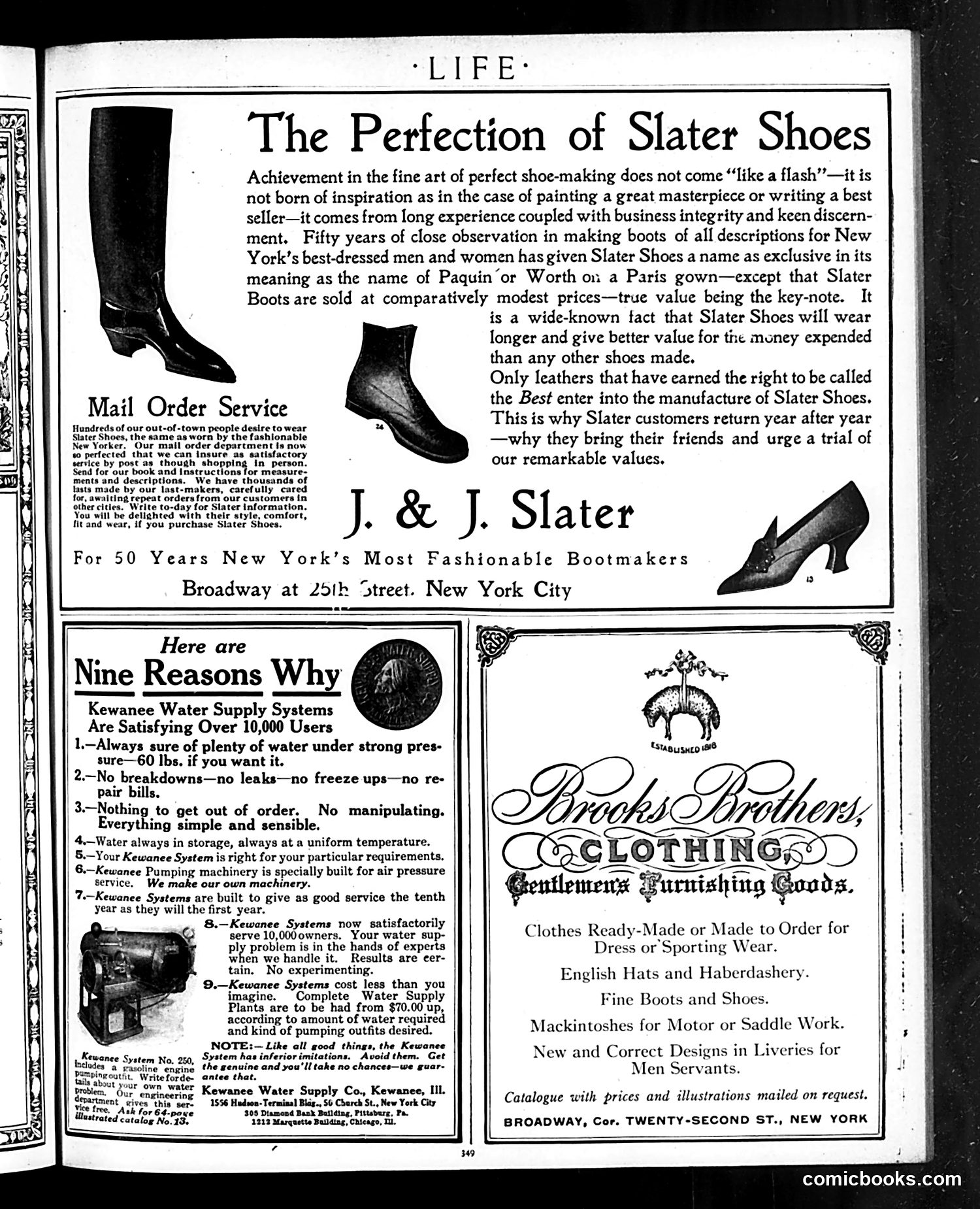
This page is **primarily advertising**, not satirical content. It contains three advertisements from what appears to be an early 20th-century issue of Life magazine: 1. **J. & J. Slater** (top): A shoe company advertisement emphasizing 50 years of experience making boots for New York's fashionable clientele, with mail-order service available. 2. **Kewanee Water Supply Systems** (bottom left): Lists nine reasons why their water systems satisfy over 10,000 users, highlighting reliability and cost-effectiveness. 3. **Brooks Brothers** (bottom right): Announces ready-made and custom clothing, hats, boots, and livery designs for gentlemen. There is **no political cartoon or satire** present on this page. It's a straightforward commercial section typical of early 20th-century magazine layouts.
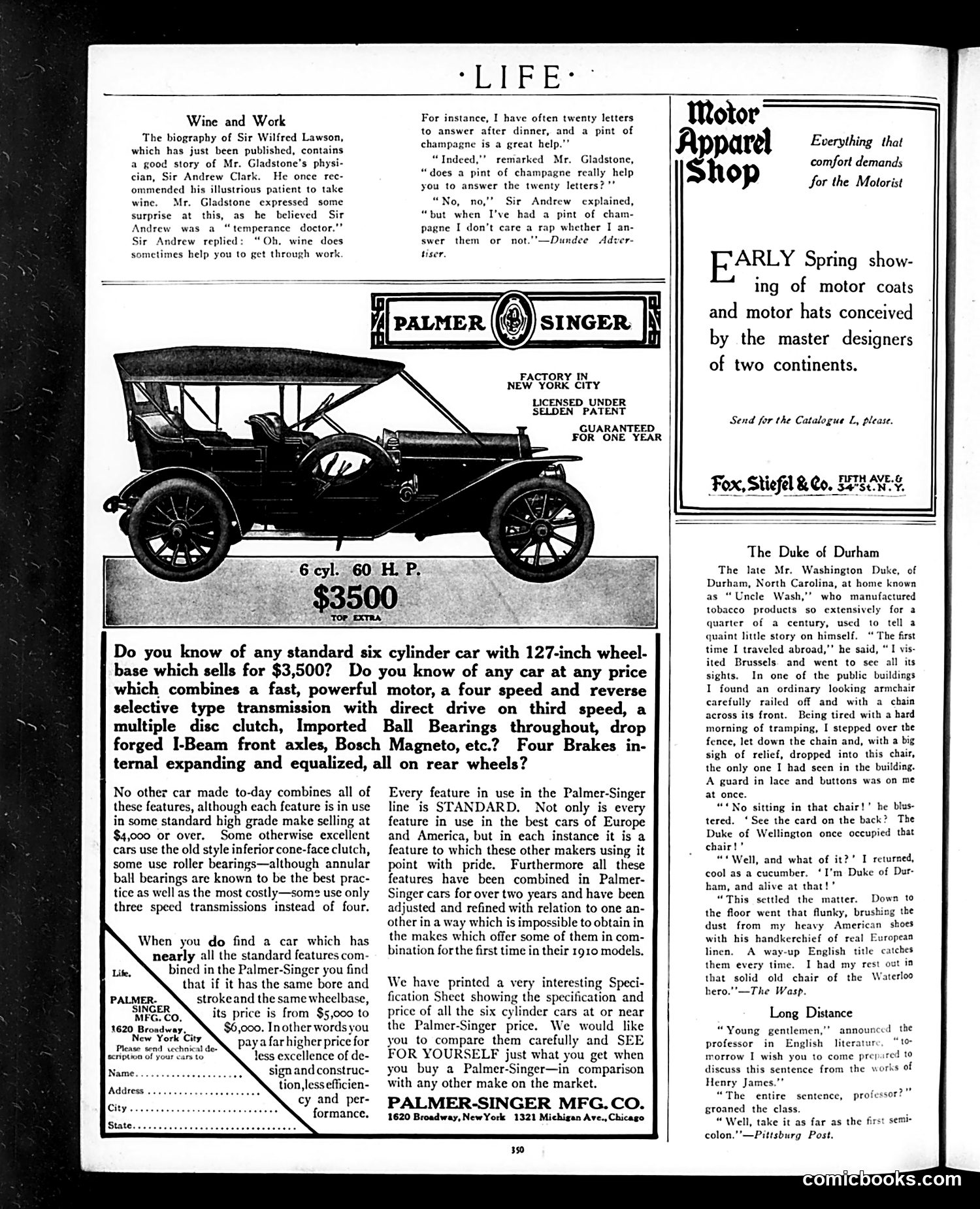
This page is primarily **advertising and feature content**, not political satire or cartoons. The main content includes: 1. **"Wine and Work"** — a brief article discussing whether wine helps productivity, quoting Sir Andrew Clark's medical views. 2. **Palmer-Singer automobile advertisement** — a large ad for a luxury car priced at $3,500, emphasizing its six-cylinder engine, 127-inch wheelbase, and advanced features like ball bearings and disc clutches. The ad challenges readers to find comparable features in competing vehicles. 3. **Motor Apparel Shop advertisement** — promoting spring motor coats and hats. 4. **Two brief anecdotal pieces** — "The Duke of Durham" (about a North Carolina tobacco manufacturer) and "Long Distance" (a literary reference to Henry James). There are **no political cartoons or satirical commentary** on this page.
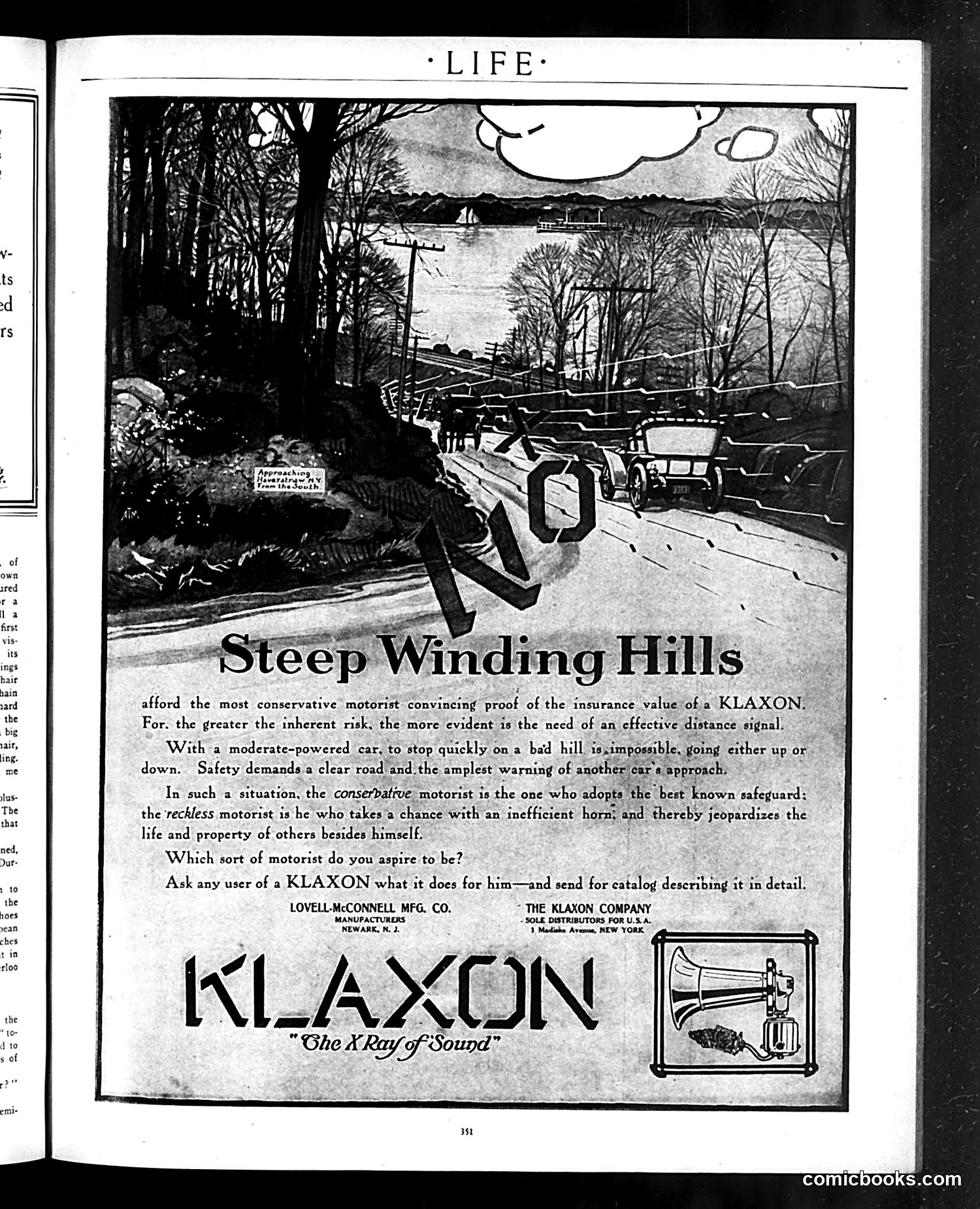
This is an advertisement, not a cartoon or satire. It promotes the Klaxon car horn ("The X-Ray of Sound"), manufactured by Lovell-McConnell Mfg. Co. and distributed by The Klaxon Company in New York. The ad uses a safety argument to sell the product. The illustration shows a car descending steep winding hills—a dangerous driving scenario. The text argues that conservative motorists need effective warning signals; a Klaxon horn allows drivers to alert others of their approach, preventing accidents. The implicit criticism targets "reckless motorists" who use insufficient horns, thereby endangering themselves and others. For modern readers: this is an early automobile-safety advertisement leveraging fear and moral judgment to promote a specific safety device during the early automotive era.
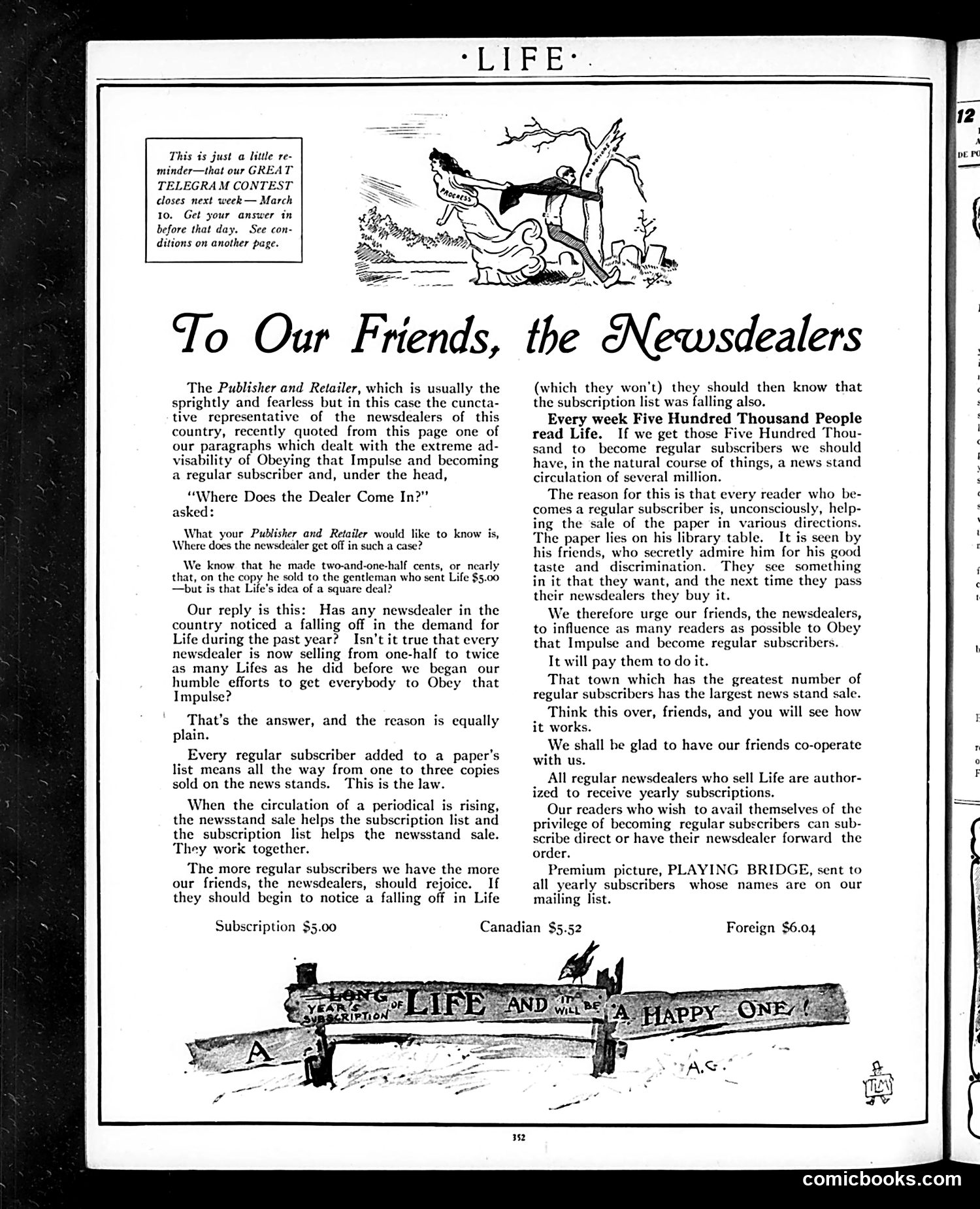
This is primarily an advertisement and appeal to newsstand dealers, not a political cartoon. Life magazine is urging newsdealors to promote subscriptions rather than relying on single-copy sales. The key argument: regular subscribers increase a publication's value and circulation numbers. Life claims "Every week Five Hundred Thousand People read Life" and appeals to dealers to convert casual buyers into subscriptions at $5.00 (Canadian $5.52, Foreign $6.04). The small cartoon at top shows figures encouraging action, while the bottom illustration depicts a sign reading "Life and a happy one"—a visual pun about the magazine's name. This reflects early-twentieth-century publishing economics where subscription lists were crucial business metrics for magazines.
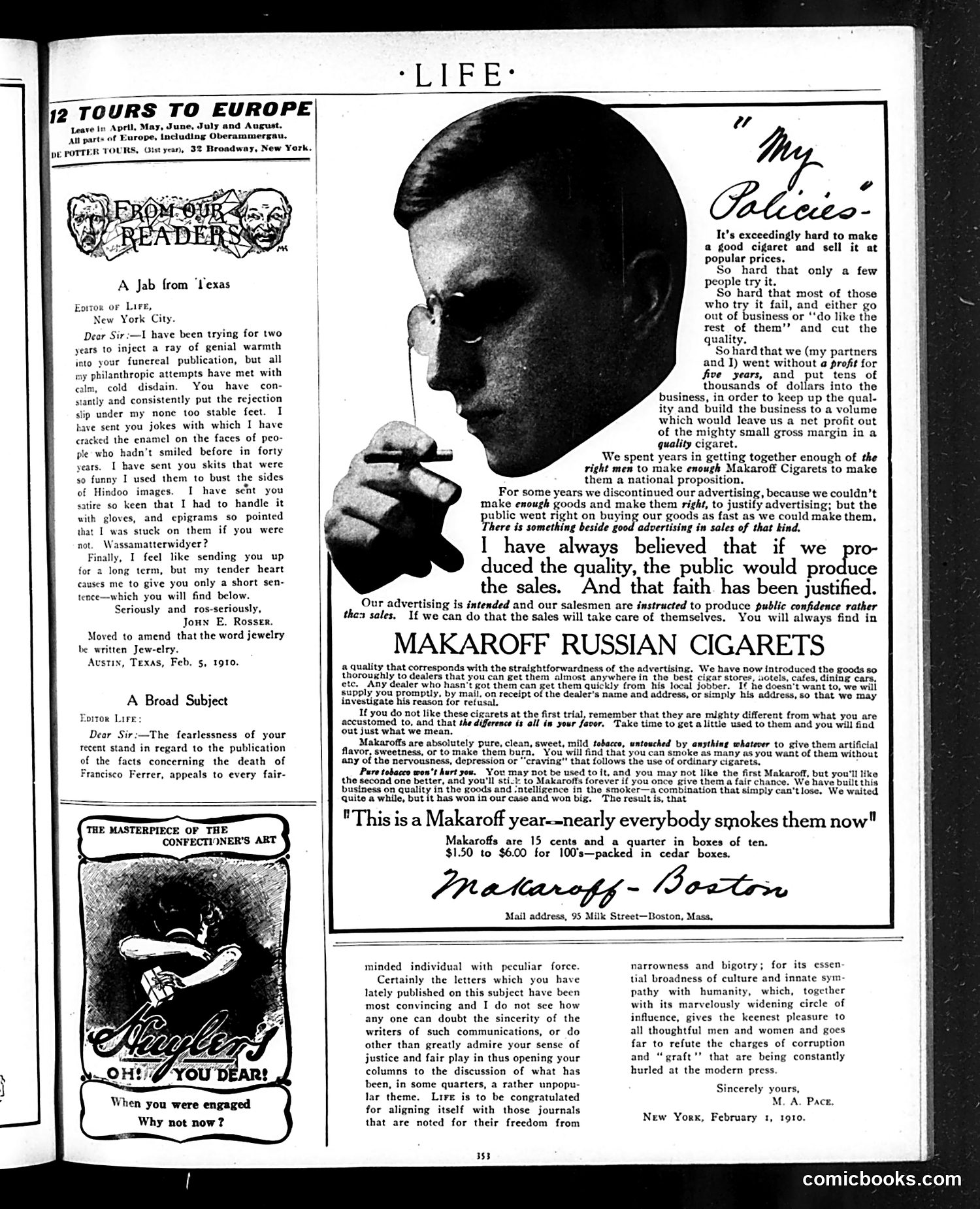
This page is primarily a **Makaroff Russian Cigarettes advertisement** occupying most of the space, featuring a large photograph of a man's face in profile smoking a cigarette. The ad's argument centers on **quality over quantity**: the company claims they deliberately limited advertising to maintain high standards, believing that quality products will sell themselves through word-of-mouth rather than aggressive marketing. In the left column are reader letters addressing unrelated topics (Texas humor, Francisco Ferrer's death). Below is a small **Sunglow cigarette advertisement** with the slogan "Oh! You Dear!" featuring a couple, playing on romantic/engagement themes common in early 20th-century advertising. The page reflects **1910 consumer culture**, where cigarette brands competed partly through claims of superior manufacturing standards rather than mass-marketing tactics—a notably different sales philosophy from modern advertising.
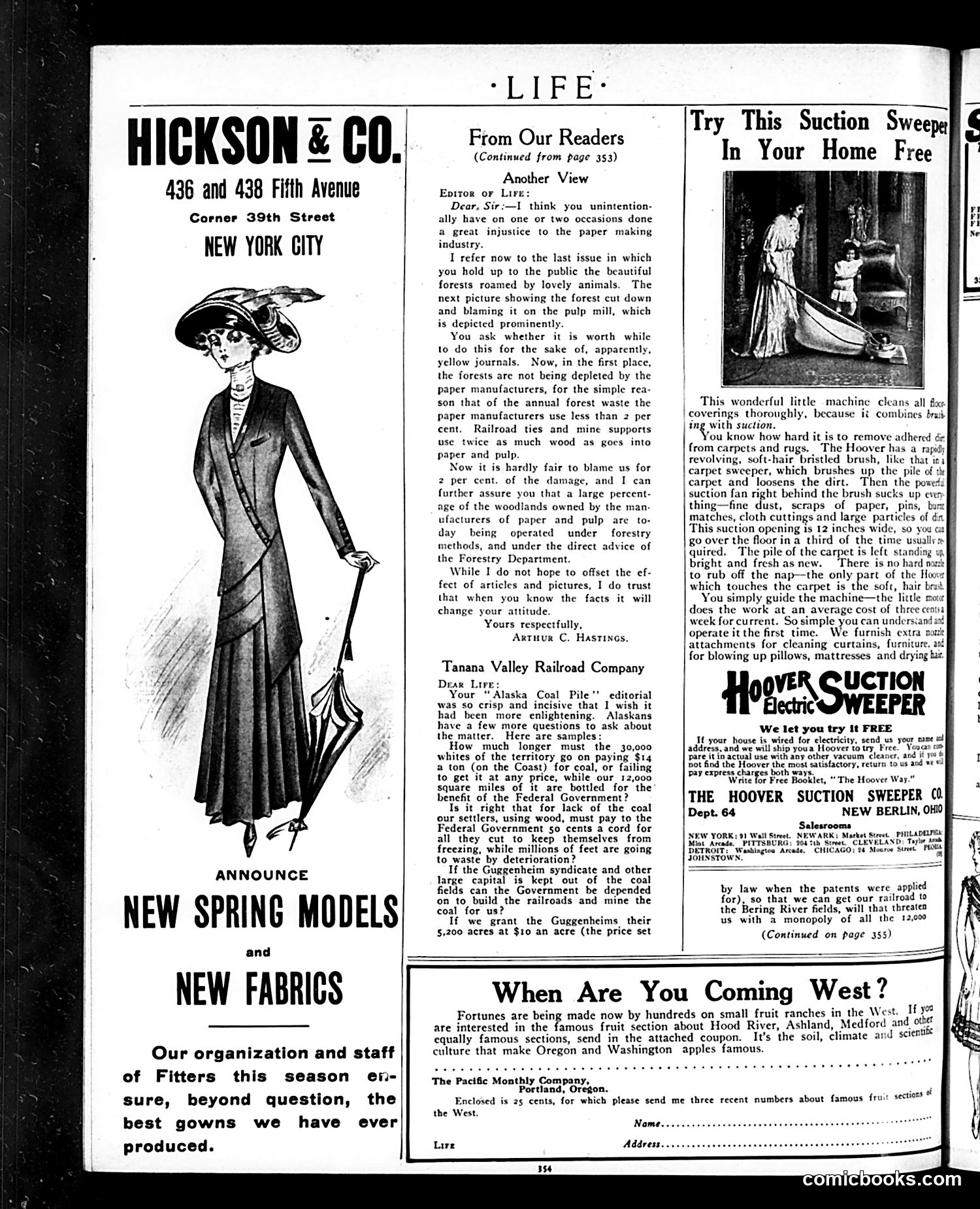
This page is primarily **advertising and reader letters**, not political satire. The left side features a **Hickson & Co. fashion advertisement** showing a stylishly dressed woman in a wide-brimmed hat and long coat, announcing "new spring models and new fabrics." The illustration represents fashionable women's clothing of the era. The center contains **"From Our Readers"** — letters debating forestry and coal mining practices. One writer defends paper/pulp industry practices against environmental criticism; another challenges Alaska coal policy. The right side advertises the **Hoover Suction Electric Sweeper**, a vacuum cleaner, emphasizing its ability to remove dust and dirt through suction technology — positioning it as a modern household innovation. There is **no political cartoon** on this page. It reflects early 20th-century consumer culture and industrial debates.
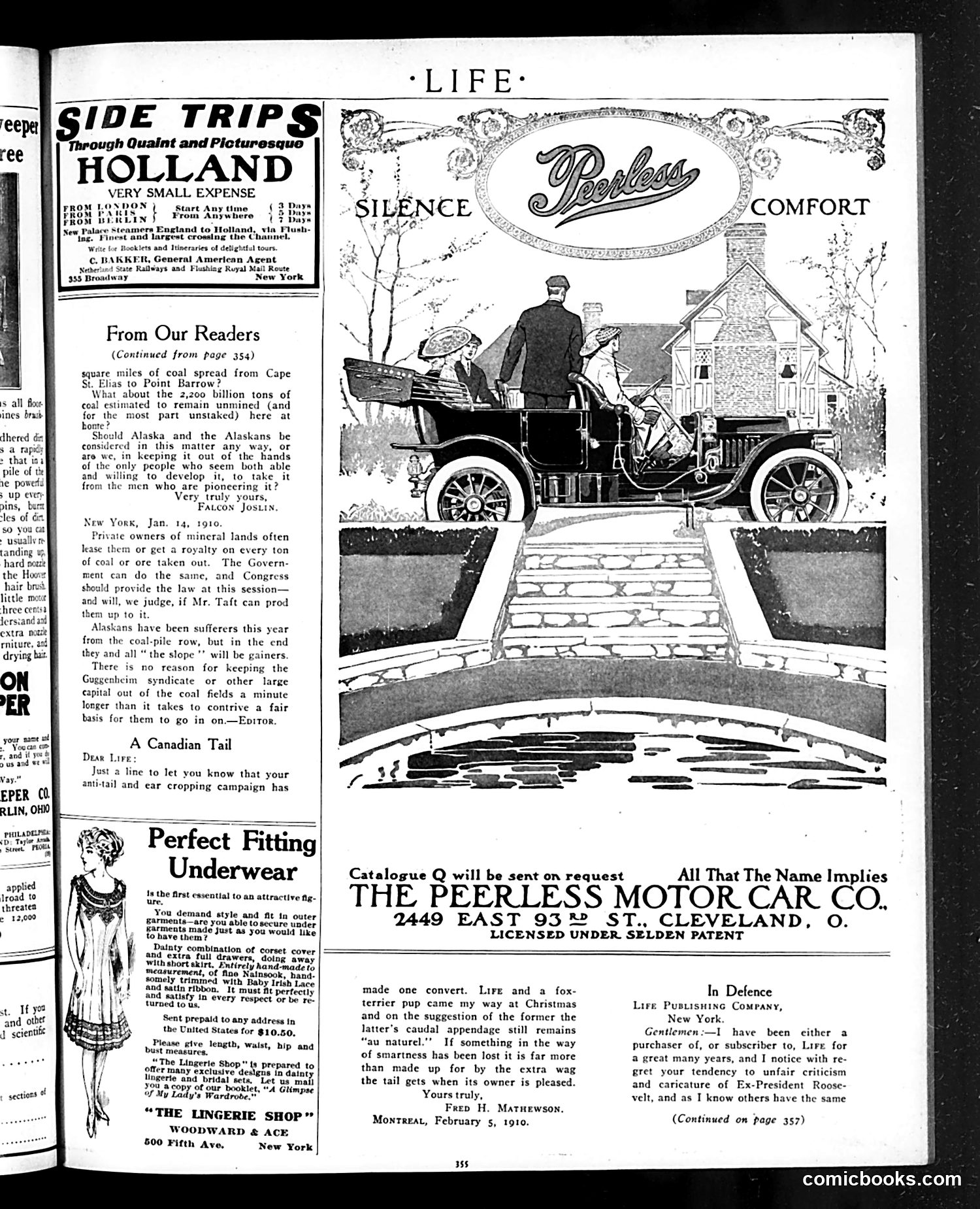
This page is primarily a **motor car advertisement** for the Peerless Motor Car Company of Cleveland, Ohio, dated 1916. The central image depicts an elegant early automobile with well-dressed passengers arriving at a stately home, emphasizing luxury and comfort. The ad's tagline—"Peerless: Silence, Comfort"—highlights the vehicle's refined qualities, appealing to affluent buyers. The surrounding content includes readers' letters on unrelated topics (coal reserves, Alaska development, dog tail-cropping), plus an advertisement for "Perfect Fitting Underwear" by the Lingerie Shop in New York. This represents typical **Life magazine content**: satirical commentary mixed with upscale consumer advertising targeting wealthy, educated readers. The Peerless brand positioning reflects early 20th-century automotive marketing emphasizing reliability and social status.
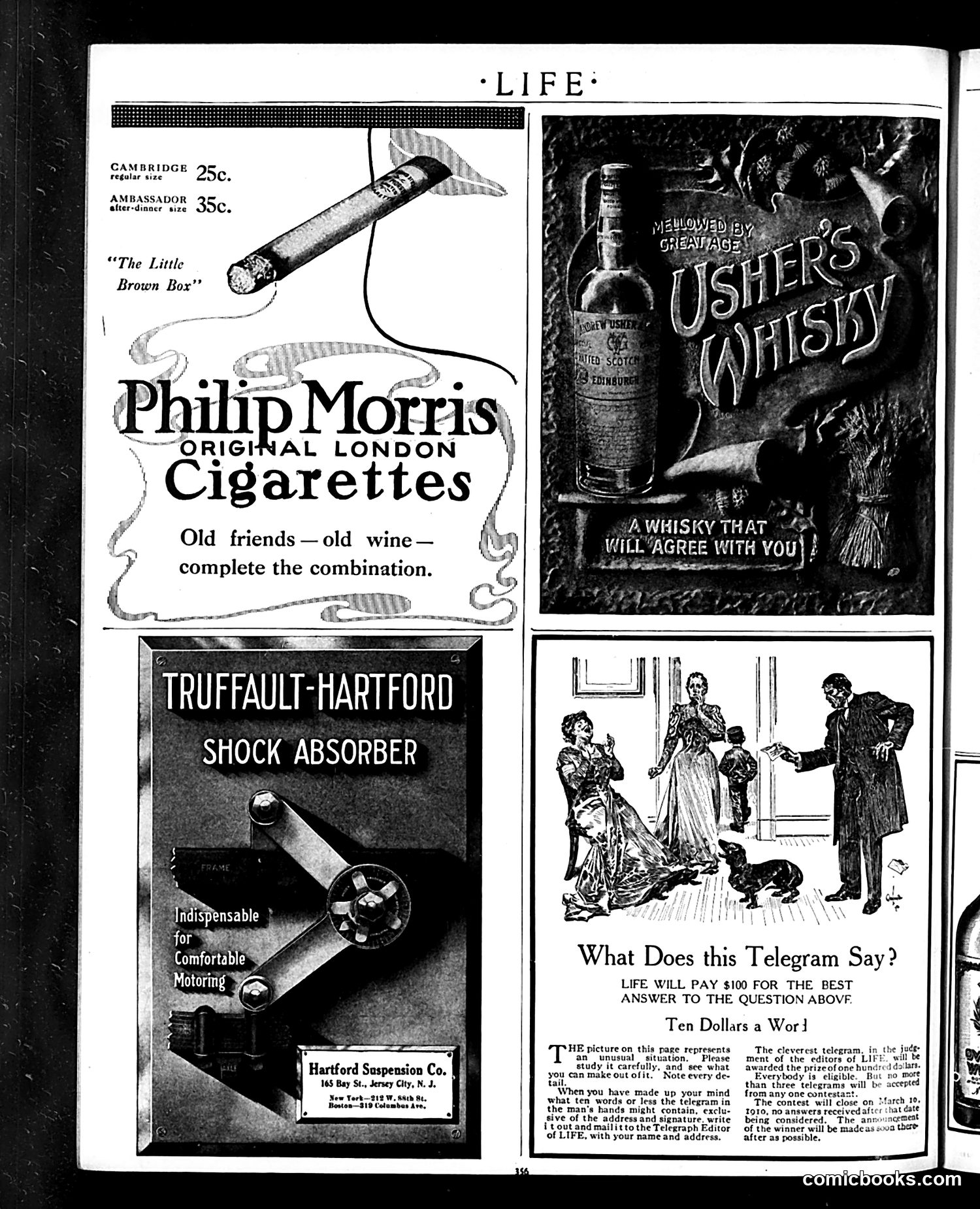
This page is primarily **advertising**, not satirical content. It contains three advertisements: 1. **Philip Morris Cigarettes** - promoting "Original London" cigarettes with their "Little Brown Box" packaging, using the slogan "Old friends—old wine—complete the combination." 2. **Truffault-Hartford Shock Absorber** - marketing auto suspension technology as "indispensable for comfortable motoring." 3. **Life Magazine Contest** - "What Does this Telegram Say?" - a reader participation contest offering $100 for solving a puzzle shown in an illustration of people examining a telegram. The entry fee is ten dollars per word. The illustrated scene appears to depict a domestic social situation, but without clearer visibility of the telegram's text, the specific puzzle cannot be determined. This was a common engagement tactic for magazines of this era.
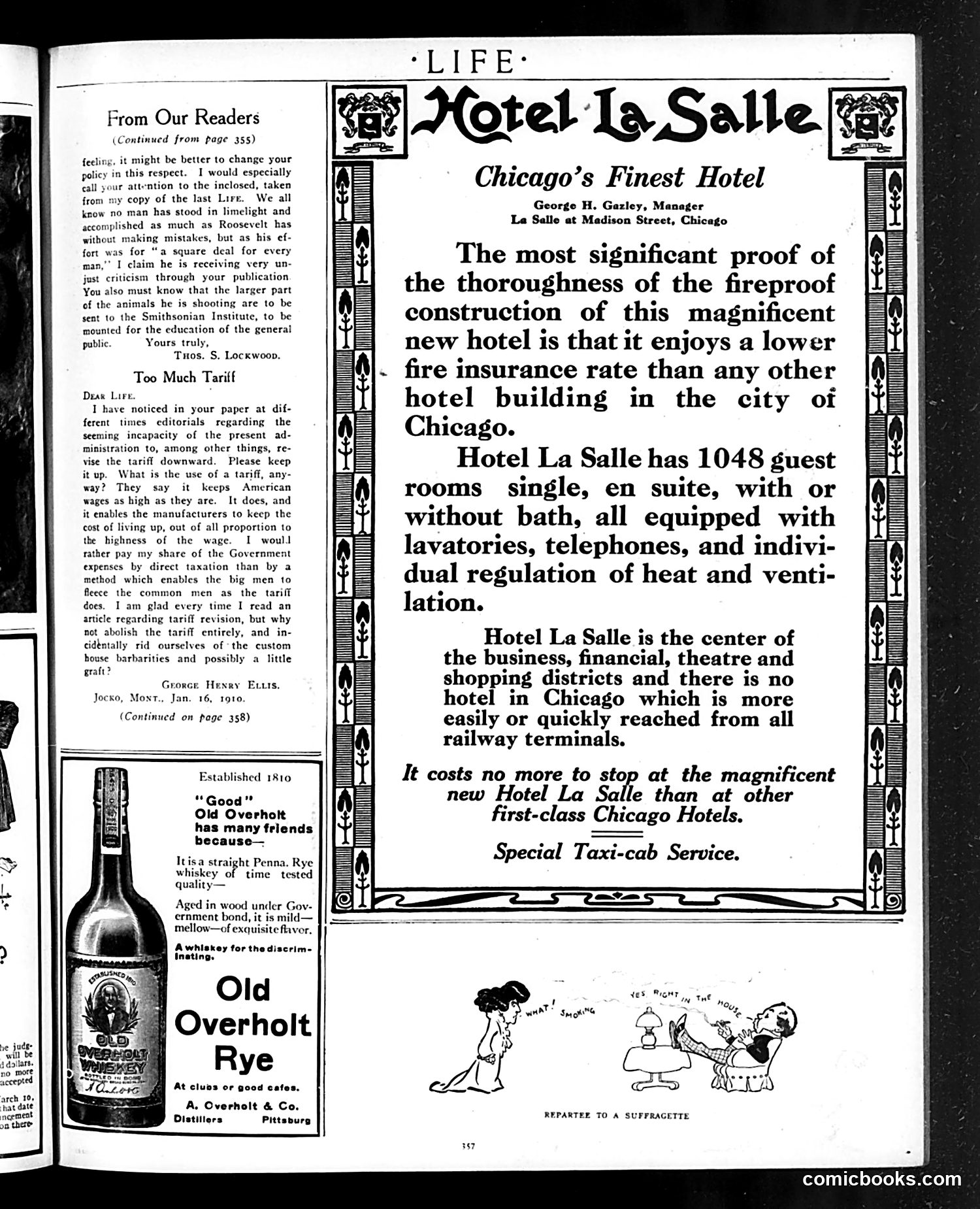
This page is primarily **advertising** for Hotel La Salle in Chicago, with a small cartoon at the bottom. The cartoon labeled "Repartee to a Suffragette" depicts a woman (identified by her actions as a suffragette—a women's voting rights activist) appearing to hit or confront a man. The man responds with what appears to be a dismissive or mocking retort, suggesting the cartoon satirizes the emerging women's suffrage movement by portraying suffragettes as aggressive or unreasonable. The joke relies on early-20th-century anti-suffrage sentiment—mocking women advocating for voting rights by depicting them as unladylike or confrontational. This reflects the period's social resistance to women's political participation, presented here as humorous "repartee."
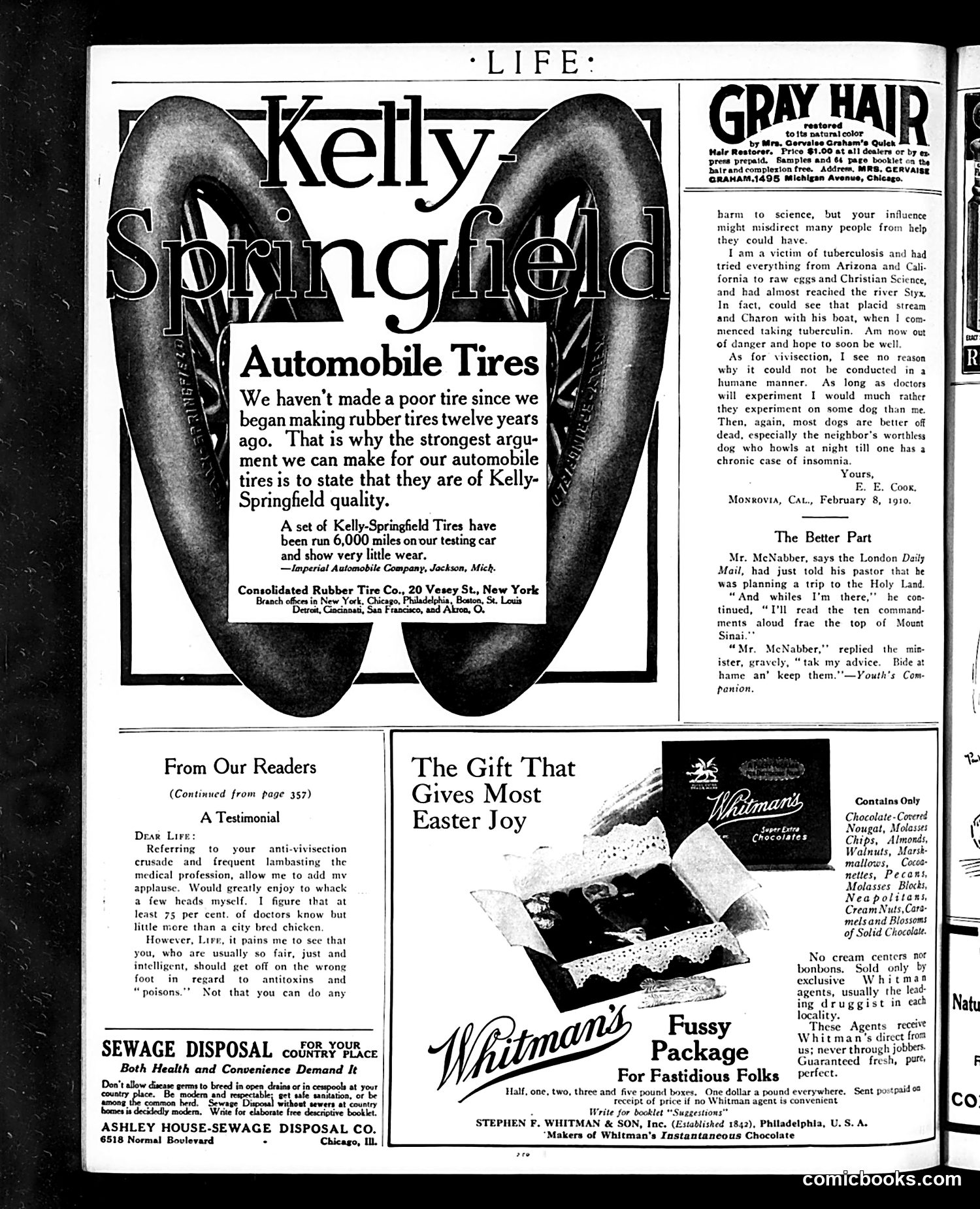
This page is primarily **advertising and reader letters**, not political satire. The main content includes: **Large Advertisement**: Kelly-Springfield Automobile Tires dominates the left side, claiming superior quality after twelve years of manufacturing. This is straightforward product promotion with testimonial from Imperial Automobile Company. **Reader Letters Section**: "From Our Readers" contains a testimonial supporting Life's anti-vivisection editorial stance. A doctor defends animal testing as necessary medical progress, arguing dogs deserve experimentation more than humans—a darkly humorous argument in favor of vivisection. **Other Advertisements**: Whitman's chocolates (Easter gift), Ashley House sewage disposal systems, and Mrs. Gervalee Graham's hair restoration product complete the page. The only satirical content is the brief "Better Part" anecdote about Mr. McNabber planning a Holy Land pilgrimage to read the Ten Commandments—the minister's deadpan reply that he should stay home and keep them instead is gentle Scottish humor, not political commentary.
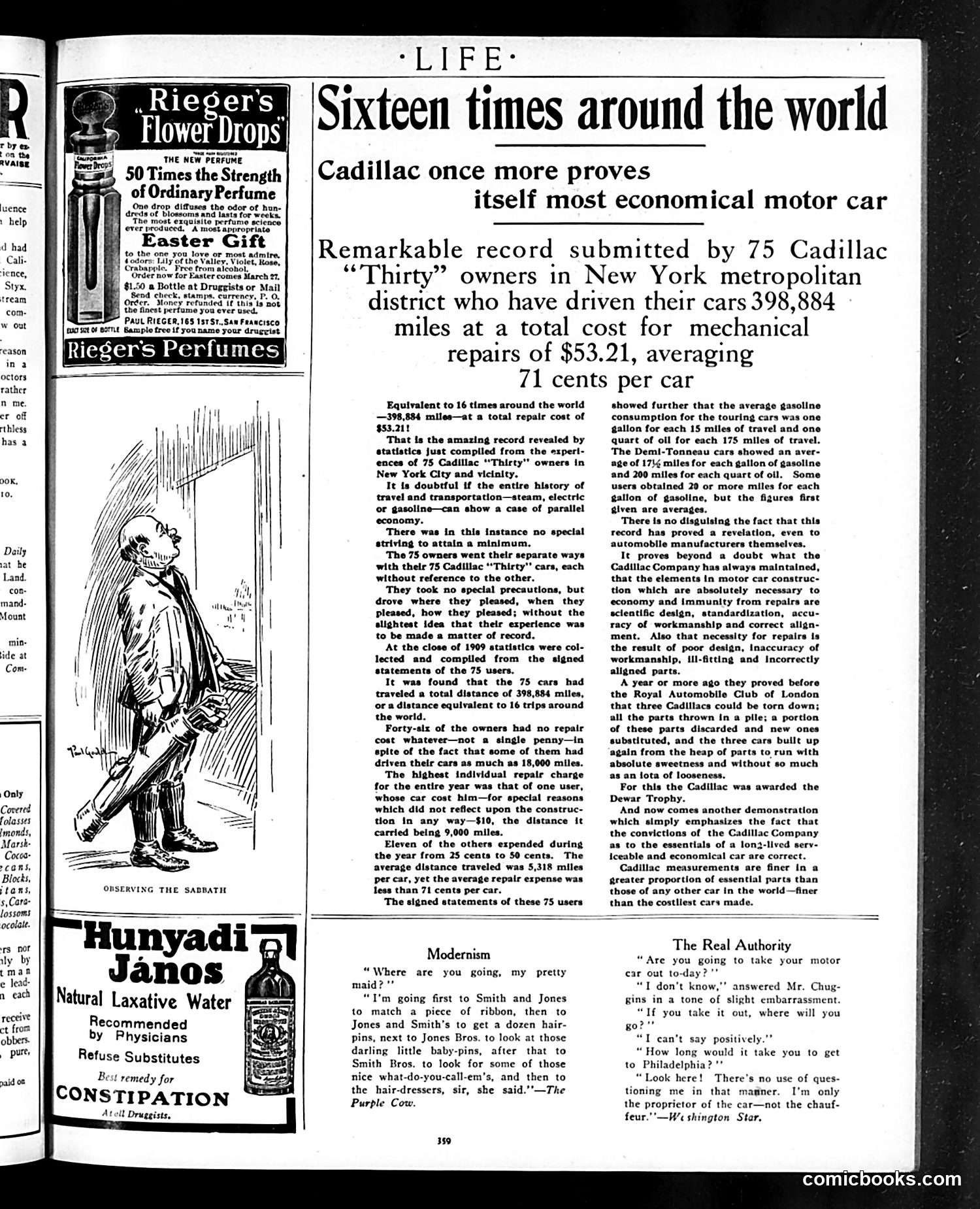
The page's main cartoon depicts a figure observing the Jewish Sabbath—likely showing religious observance through rest and prayer. The sketch shows a man in traditional dress with what appears to be a prayer shawl, positioned in a contemplative pose. The caption "OBSERVING THE SABBATH" labels the scene directly. The cartoon appears to be satire on religious practice, though the exact satirical point is unclear from the image alone. It may comment on the contrast between strict religious observance and modern American life, or perhaps mock particular aspects of Sabbath tradition. The page itself is primarily devoted to a Cadillac automobile advertisement celebrating fuel economy—75 owners achieved 398,884 miles with only $53.21 in repairs. This represents the magazine's typical mixing of editorial content with advertising.
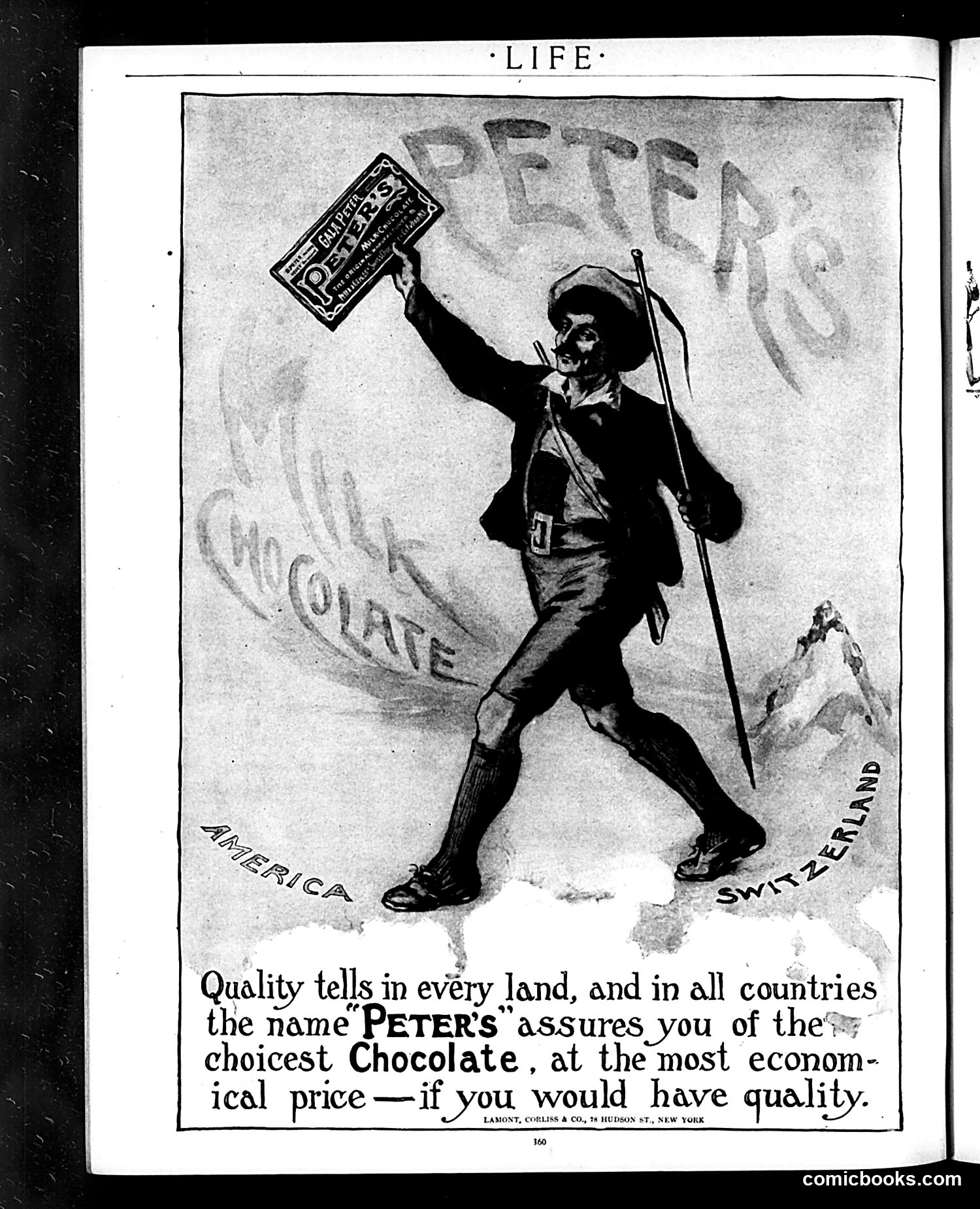
This is a **commercial advertisement**, not political satire. It depicts a mountaineer or alpine guide planting a Peter's Chocolate box like a flag atop a peak, with "PETER'S" visible in the background sky. The figure stands between labeled regions: "AMERICA" (left), "SWITZERLAND" (right), and "COLGATE" (center). The ad's message claims Peter's chocolate achieves quality across all lands and countries—using the mountaineering imagery to suggest conquering peaks of excellence. The Swiss reference likely evokes Switzerland's reputation for fine chocolate production. The overall pitch: Peter's chocolate offers superior quality at affordable prices, wherever you are. This appears to be early-to-mid 20th century advertising using patriotic/geographic imagery common to that era.
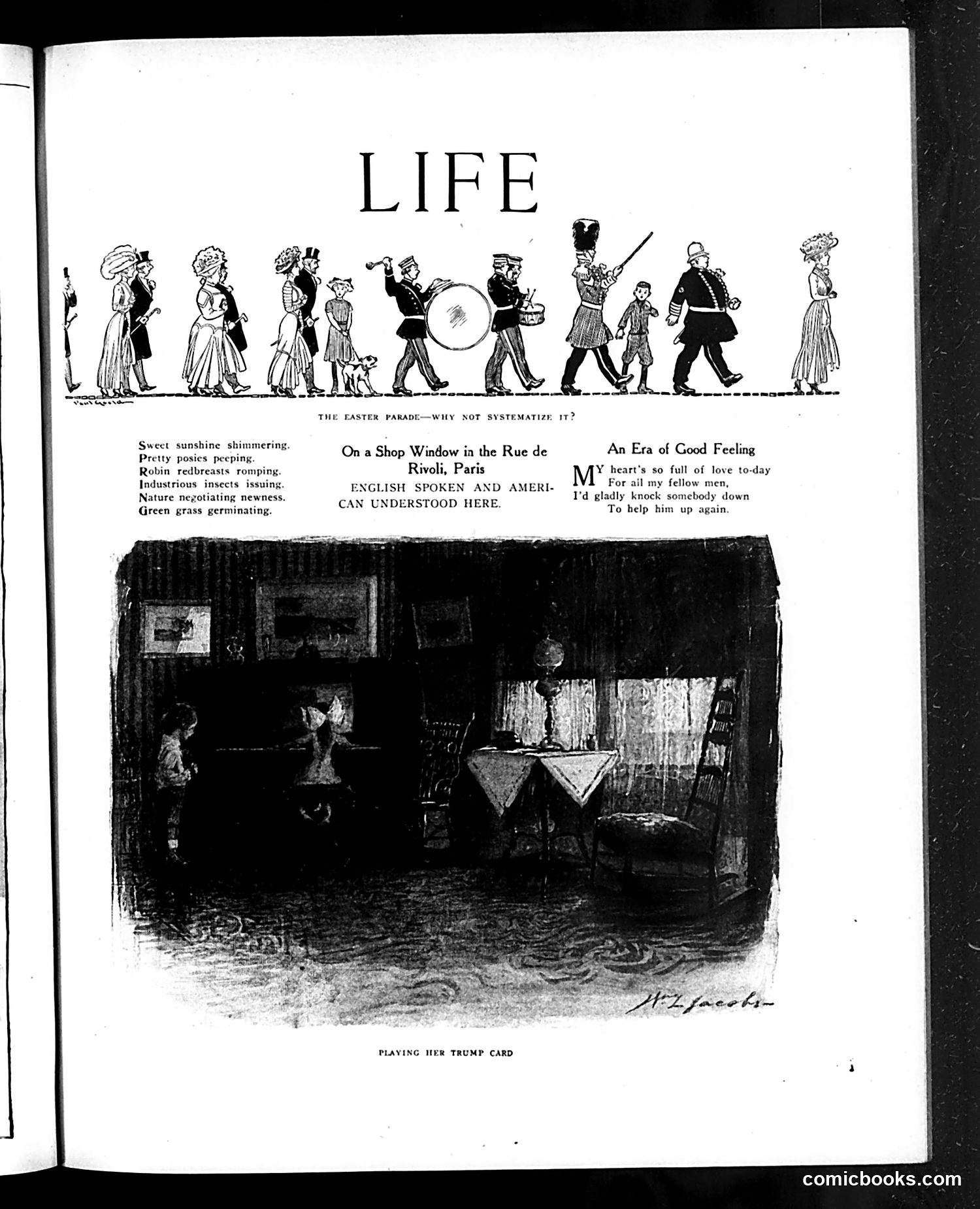
This page from *Life* magazine features satirical commentary on the Easter Parade tradition and Parisian culture. **The Top Illustration** mocks the Easter Parade's ritualistic nature, showing a procession of fashionably dressed figures. The caption "Why Not Systematize It?" suggests satirizing the parade's predictable formality—the same people, same clothes, same movements repeated annually. The poetic list ("Sweet sunshine shimmering / Pretty posies peeping") parodies the clichéd sentimentality surrounding spring traditions. **The Middle Section** references a Parisian shop window on the Rue de Rivoli, noting that "English Spoken and American Understood Here"—likely mocking American tourists in Paris and the encroachment of English language/culture in European tourist destinations. **The Poem** titled "An Era of Good Feeling" is ironic: the speaker claims universal love while admitting they'd "knock somebody down / To help him up again"—satirizing hypocritical benevolence or performative goodwill. **"Playing Her Trump Card"** (bottom caption) appears unrelated, likely referencing another cartoon or context not visible on this page.
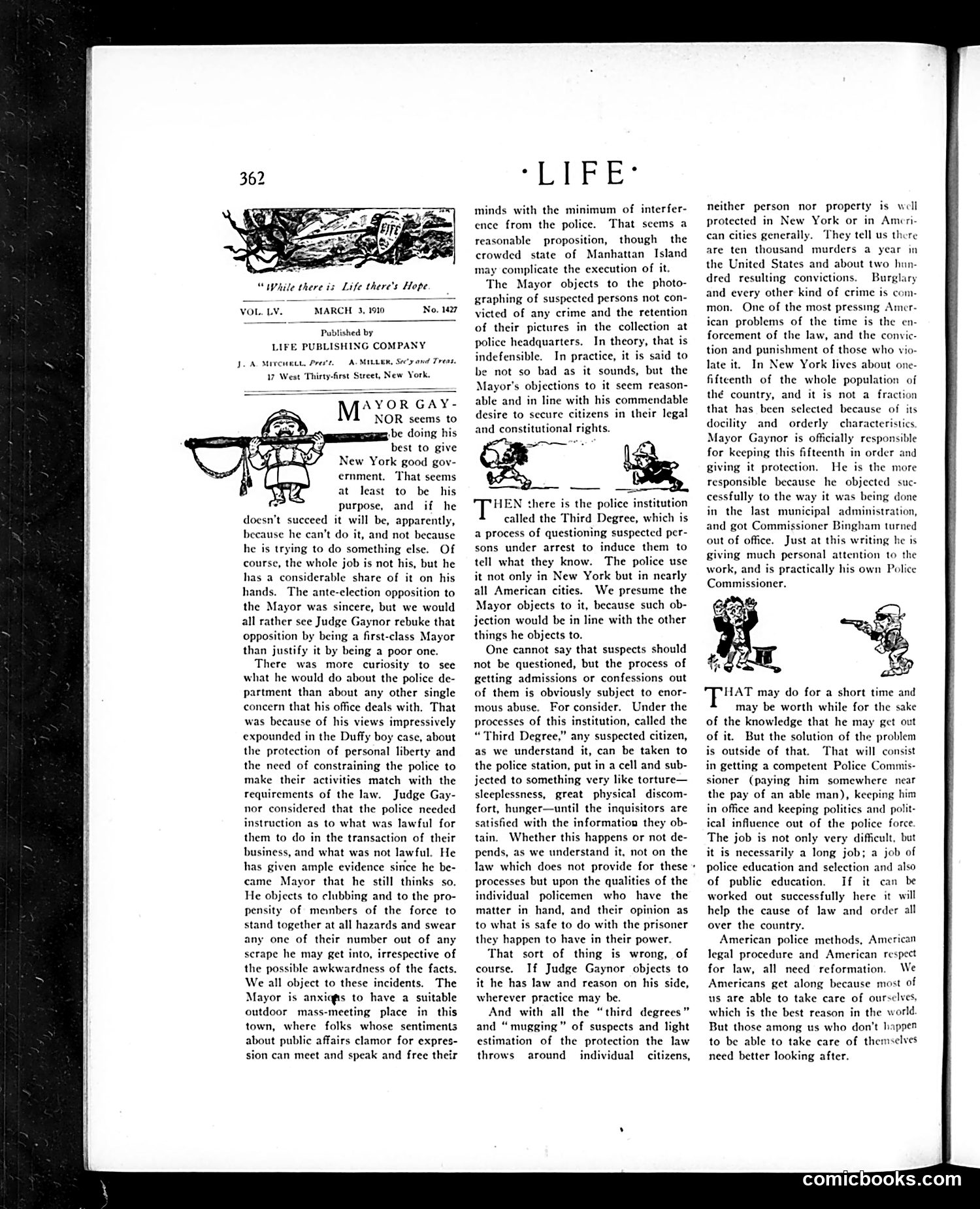
This 1910 *Life* magazine page critiques NYC Mayor Gaynor's police reforms through editorial commentary rather than visual satire. The small decorative cartoons are generic illustrations, not caricatures of specific figures. The article discusses Gaynor's objections to police practices: physical brutality ("clubbing"), photographing suspects without conviction, and the "Third Degree"—coercive interrogation involving sleeplessness and physical discomfort used to extract confessions. The writer supports Gaynor's reform efforts, arguing these practices violate constitutional protections. However, he acknowledges the practical difficulty: police discretion allows abuse regardless of law. The solution proposed is appointing a competent Police Commissioner to supervise and educate officers—recognizing that legal restraints alone cannot prevent misconduct without proper institutional oversight and accountability. This reflects Progressive Era concerns about police power and civil liberties in American cities.
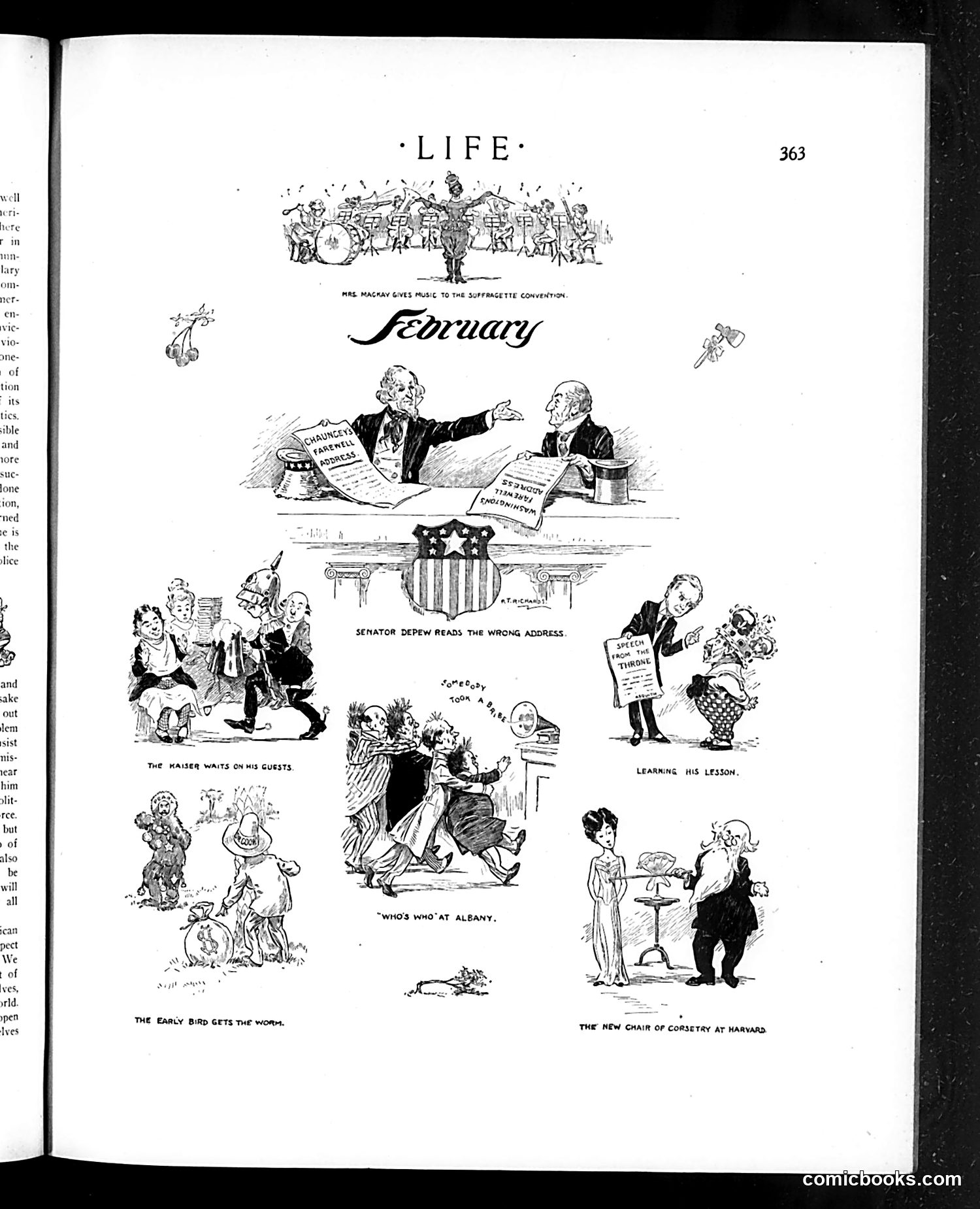
This page collects six separate satirical cartoons commenting on early 20th-century American politics and social issues: **Top**: "Mrs. Mackay Gives Music to the Suffragette Convention"—mocking women's suffrage activism. **Center**: "Senator Depew Reads the Wrong Address"—appears to ridicule a specific senator's public embarrassment (likely Chauncey Depew, a prominent politician known for gaffes). **Surrounding vignettes** target: - "The Kaiser Waits on His Guests"—likely commenting on international relations - "Who's Who at Albany"—satirizing New York state politics - "Learning His Lesson"—unclear without more context - "The Early Bird Gets the Worm" and "The New Chair of Carpentry at Harvard"—social commentary on ambition and education The cartoons use exaggerated caricature to mock contemporary political figures, women's rights movements, and institutional absurdities—typical of *Life* magazine's satirical approach to American life during the Progressive Era.
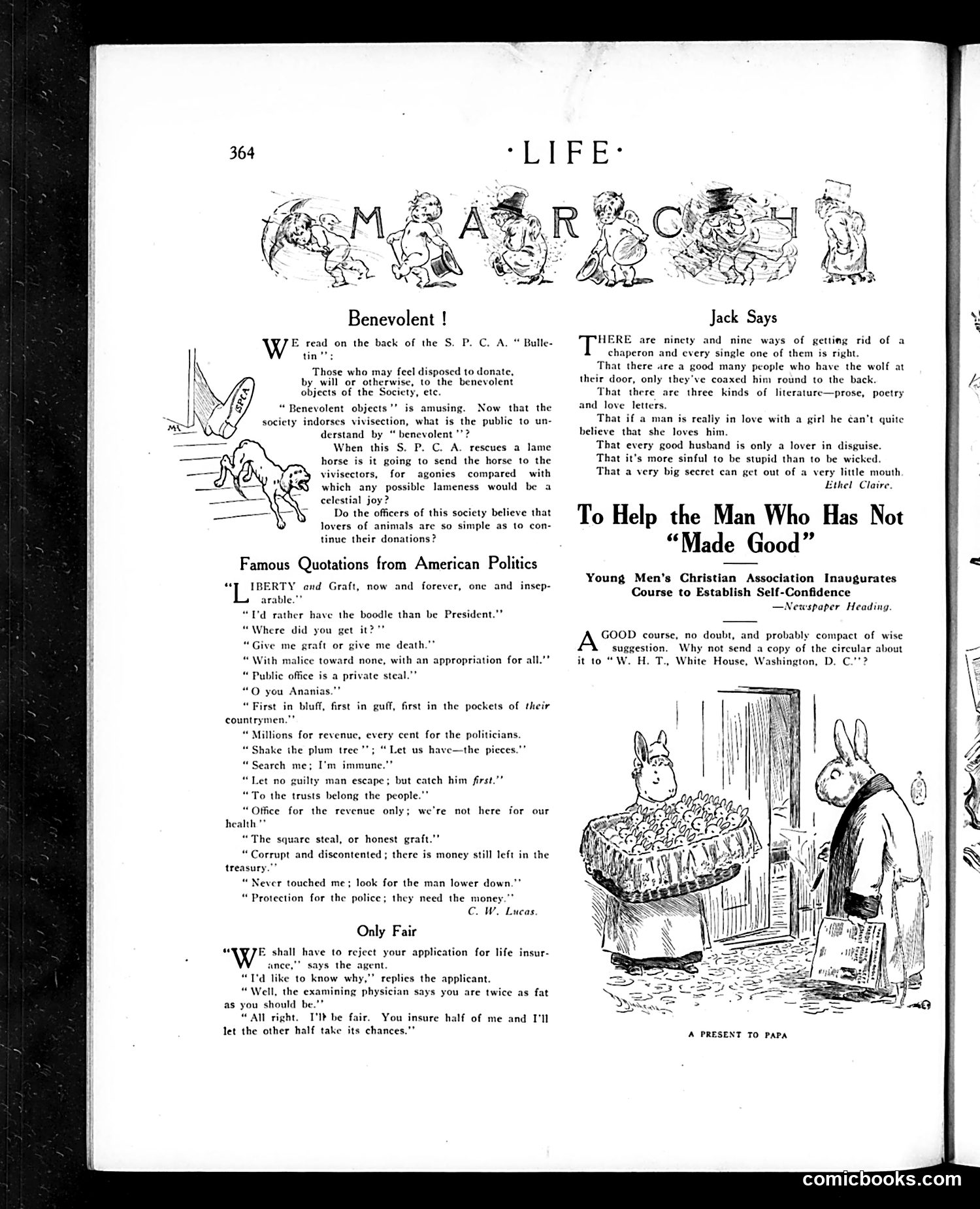
This page contains three satirical pieces mocking American institutions and politics: **"Benevolent!"** attacks the S.P.C.A. (Society for the Prevention of Cruelty to Animals) for hypocrisy—the organization endorses vivisection (animal experimentation) while soliciting donations as a "benevolent" charity. The satire questions how donors can continue supporting an organization that causes animal suffering. **"Famous Quotations from American Politics"** is a scathing compilation of cynical, invented "quotes" parodying American politicians' corruption. Phrases like "Public office is a private steal" and "Millions for revenue, every cent for the politicians" mock widespread graft and embezzlement in government. **"Only Fair"** is a brief comedic exchange about life insurance, where an overweight applicant proposes the insurance company insure only half of him. The page reflects early-20th-century Progressive Era concerns: animal welfare, government corruption, and institutional hypocrisy. The humor relies on readers' frustration with perceived widespread dishonesty in public life.
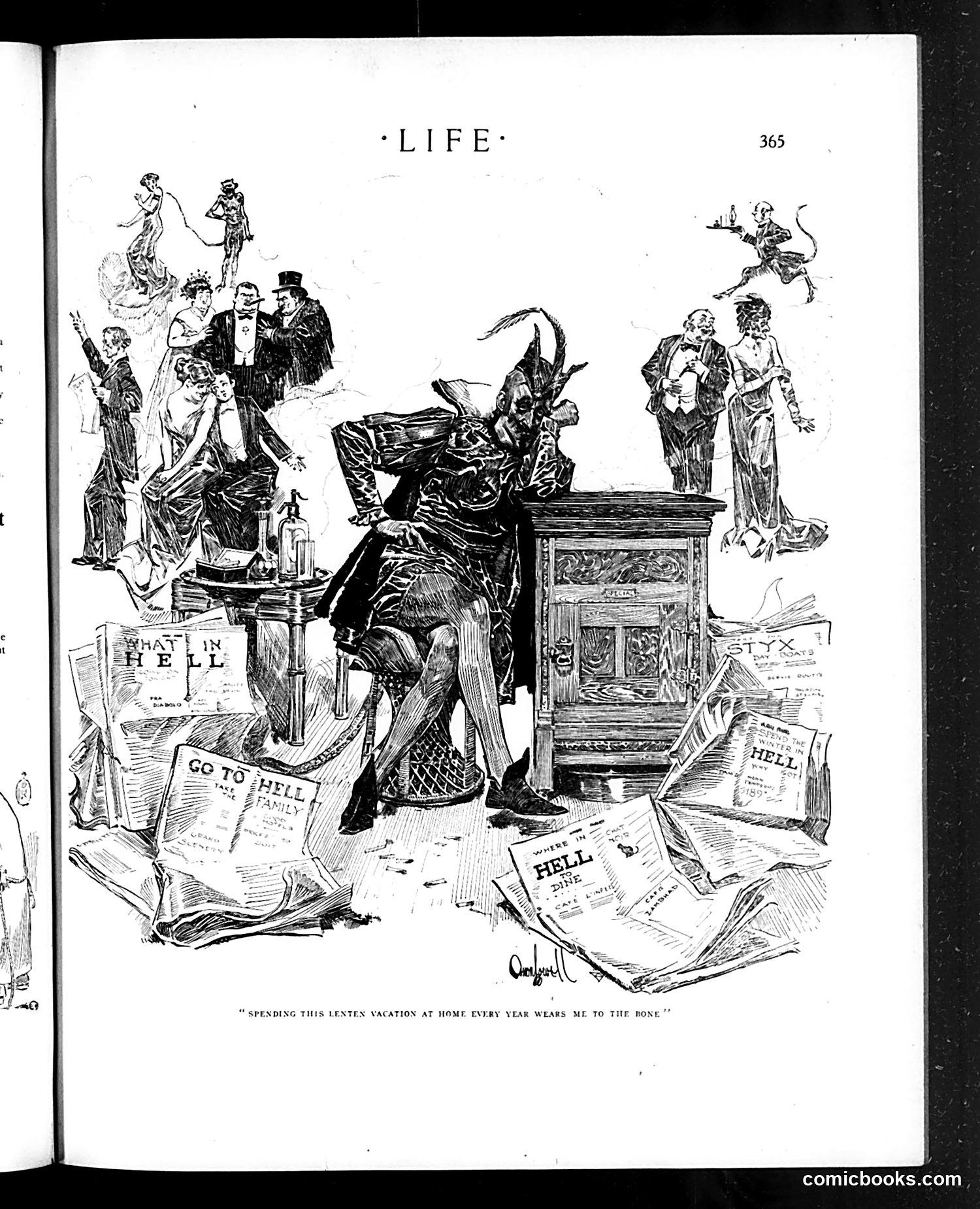
This cartoon satirizes someone spending their Lenten vacation at home. The central figure, appearing worn and skeletal, sits surrounded by religious literature ("Hell," "Go to Hell," "What is Hell") and bottles—suggesting either excessive drinking or medicine to cope with boredom. The caption's complaint about being "worn to the bone" is visualized literally: the figure appears death-like. The joke critiques the tedium of staying home during Lenten vacation (a Catholic observance period) rather than traveling or enjoying leisure elsewhere. The visiting well-dressed figures in the background appear oblivious or judgmental, contrasting with the protagonist's suffering. The satire mocks both the restrictive nature of religious observance and the dull domesticity it enforces, while the hellish literature suggests the vacation itself feels like punishment rather than rest.
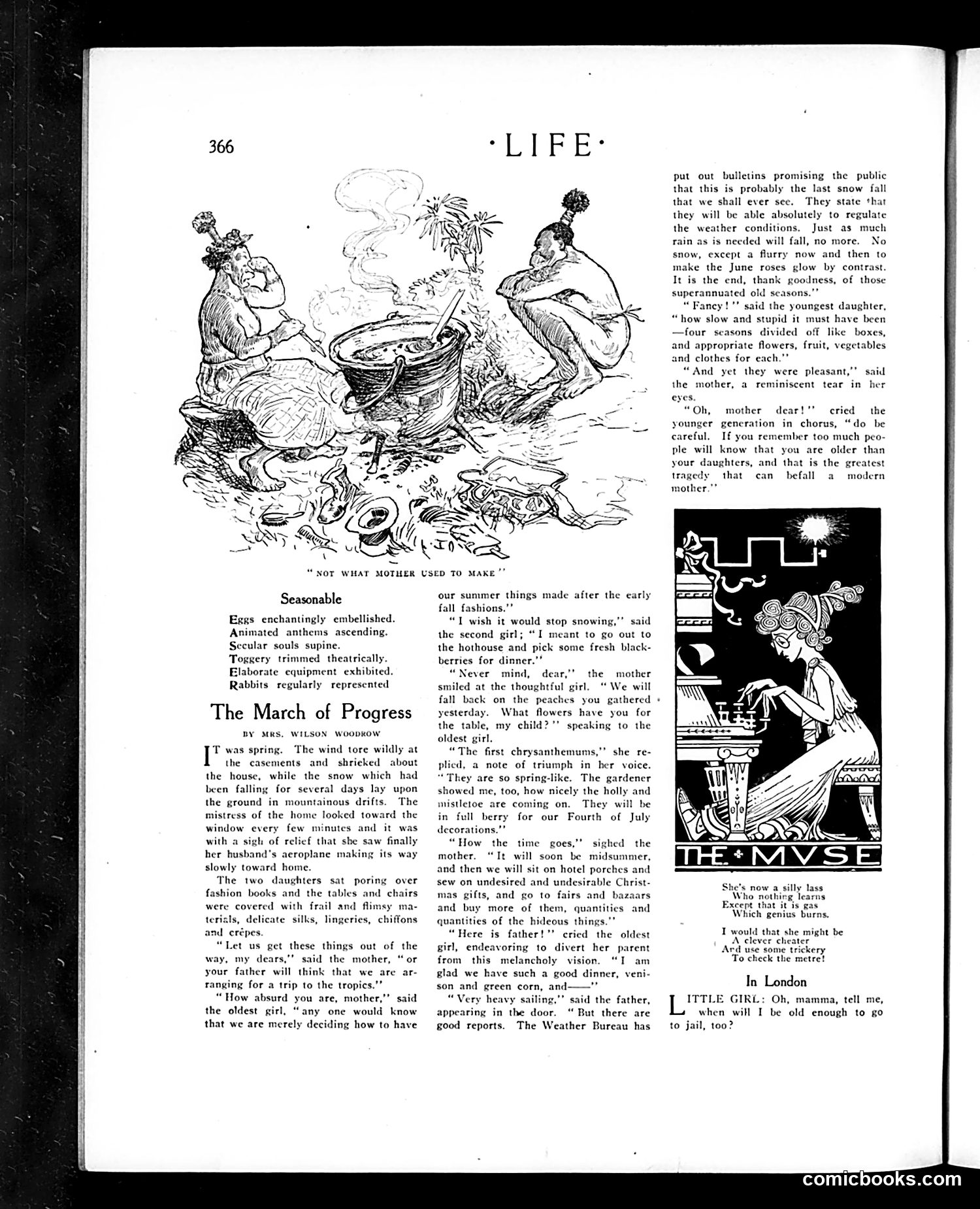
This story by Mrs. Wilson Woodrow satirizes early 20th-century "progress" and its absurd consequences. The setup is deliberately overwrought: a husband arrives home by aeroplane in spring snow; the family discusses summer fashions in winter, picks fresh blackberries from a hothouse in snowing weather, and displays chrysanthemums and holly meant for July Fourth—all simultaneously. The joke peaks when the father announces the Weather Bureau can now regulate weather perfectly, eliminating seasons entirely. The mother's nostalgic tear about the old four-season system horrifies her daughters, who warn that remembering pleasant past experiences risks making her seem *old*—"the greatest tragedy that can befall a modern mother." The satire targets: technological hubris (weather control), seasonal disconnection through modern comforts, and the era's youth culture's dismissal of anything historical. It mocks how "progress" creates absurdity while destroying natural rhythms and honest sentiment.
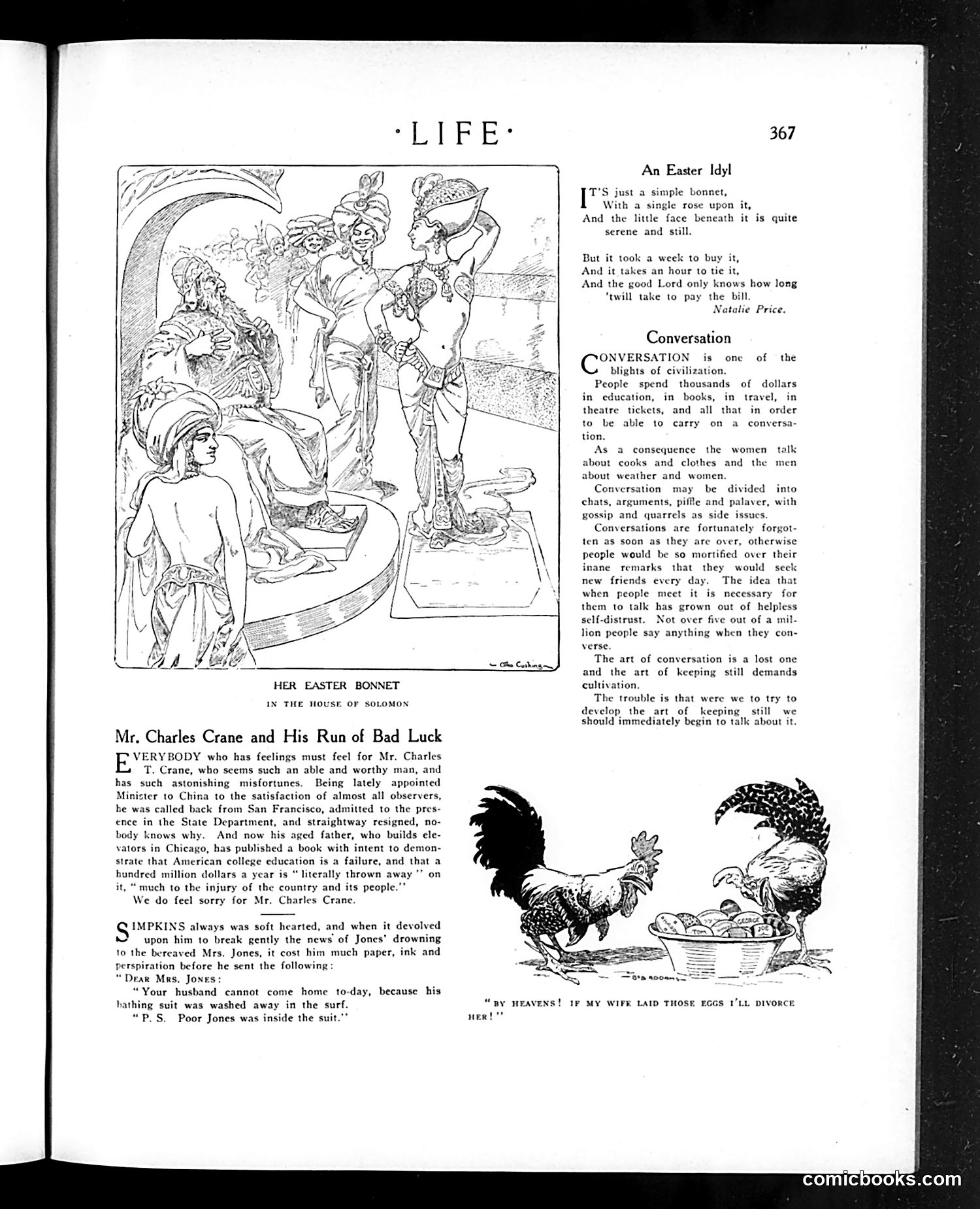
This page contains three satirical pieces typical of early 20th-century Life magazine humor: **"Mr. Charles Crane and His Run of Bad Luck"**: Mocks diplomat Charles T. Crane, recently appointed Minister to China but who mysteriously resigned after arriving in San Francisco. The piece expresses mock sympathy while implying his bad judgment, compounded by his father's published criticism of American college education as wasteful. **"Her Easter Bonnet"**: A poem lamenting the expense and time involved in purchasing and maintaining an Easter hat—satirizing women's fashion consumption and the hidden costs of maintaining social appearances. **"Conversation"**: A cynical essay arguing that people waste enormous resources learning to converse, yet most conversation is trivial gossip or weather talk. It satirizes the emptiness of polite society discourse and suggests genuine silence might be preferable. The bottom cartoon shows a rooster discovering eggs, quipping he'll divorce his wife—crude humor about infidelity and misattributed paternity.
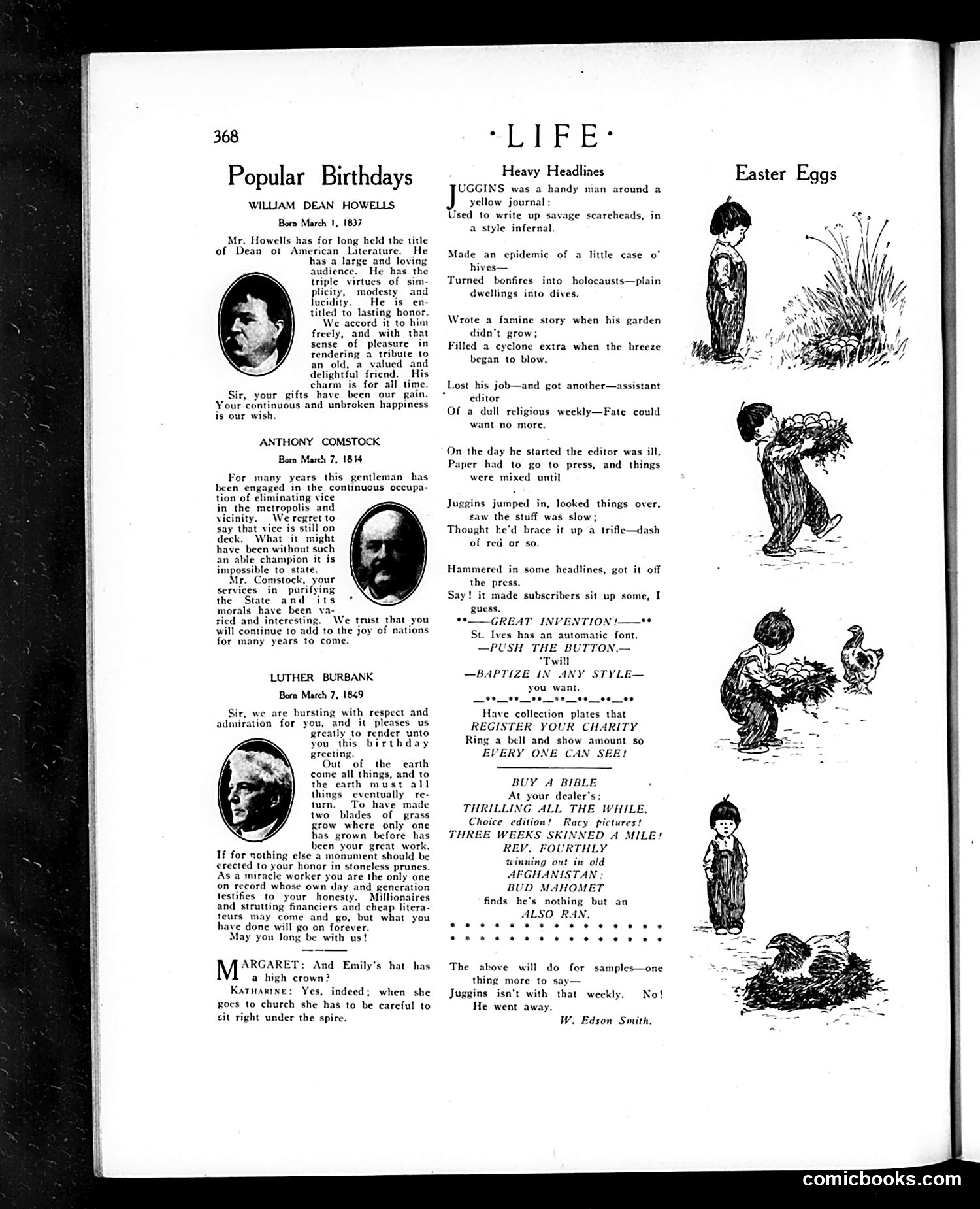
This page satirizes sensationalist newspaper journalism through the character "Juggins," a hack writer at a "yellow journal" (a term for newspapers known for exaggerated, inflammatory reporting). The joke traces Juggins's career: he sensationalizes minor events—turning a small case of hives into "holocausts," a garden failure into famine coverage, a breeze into a cyclone story. When demoted to a dull religious weekly, Juggins can't help himself and "jazzes up" the content with dramatic red-inked headlines. This actually *works*—subscribers respond—but he's fired anyway, unable to find work in respectable journalism. The satire targets both yellow journalism's dishonesty and the incompatibility between sensationalism and legitimate media. The accompanying mockvertisements (automatic fonts, Bible as "thrilling" adventure) reinforce the era's anxiety about media manipulation and commercialism corrupting public discourse.
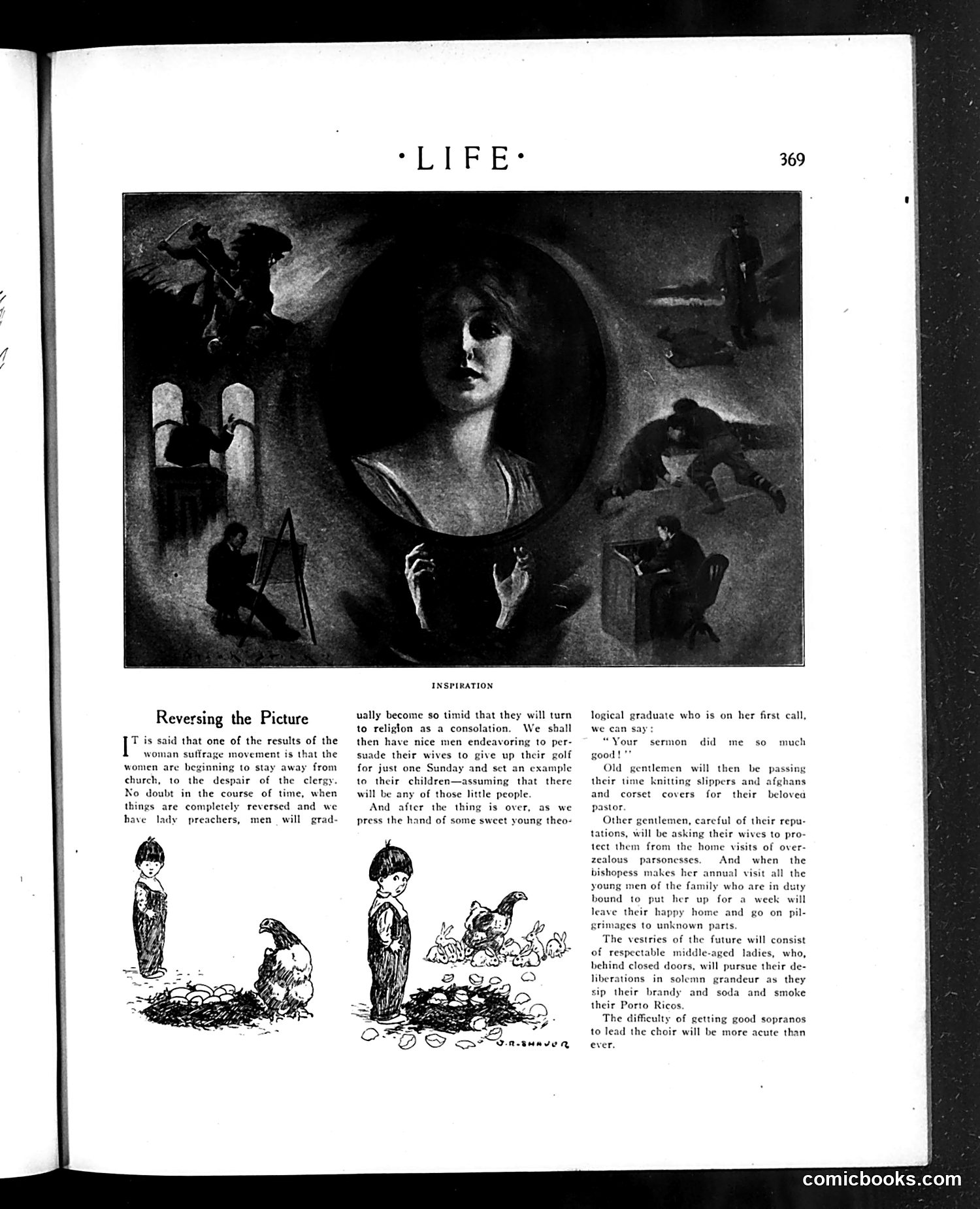
This satirical piece mocks the women's suffrage movement by imagining a "reversed" future where women dominate religious institutions as preachers and church leaders, while men become timid congregants. The joke plays on anxieties about gender role reversal: the author facetiously suggests that if women gain power (through suffrage), they'll inevitably take over the church, forcing men to abandon golf and accept nagging "parsonesses" (female pastors). The satire portrays this hypothetical future as absurd—middle-aged women smoking cigars in vestry meetings, men fleeing their homes to avoid pastoral visits. The accompanying illustrations show nuns or religious figures in contemplative poses, reinforcing the religious theme. The underlying message reflects early 20th-century conservative resistance to suffrage: granting women voting rights supposedly threatens traditional male authority in all institutions, including religion. The exaggerated predictions are meant to seem ridiculous, thereby delegitimizing actual suffrage arguments.
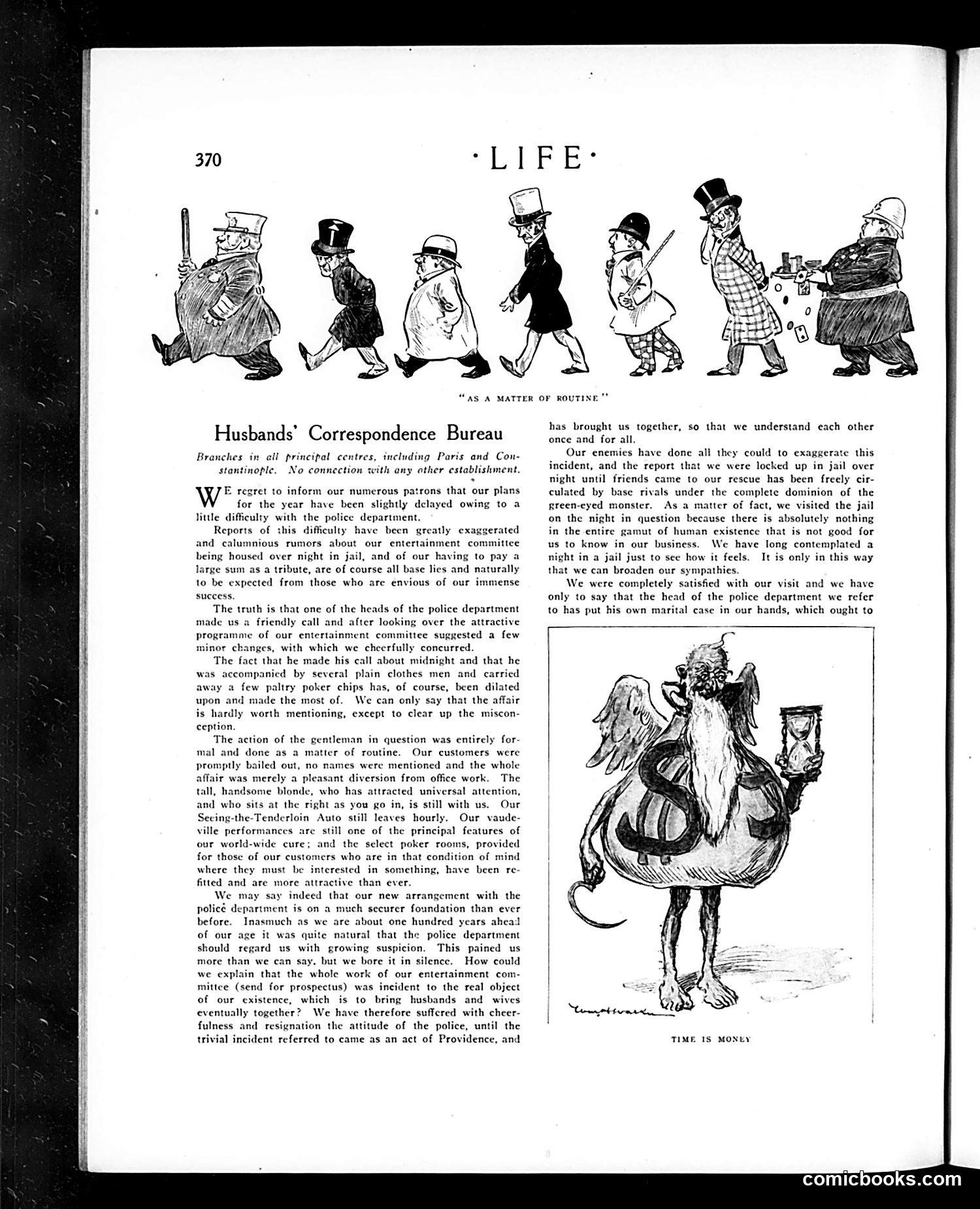
This page satirizes a **matrimonial/matchmaking service** that was raided by police, likely for operating illegally or running a front for vice. The text is a darkly humorous "response" claiming the raid was merely routine and helpful. **The satire works through false innocence**: The bureau claims to reunite husbands and wives, yet the details reveal the actual operation—poker games, late-night "entertainment," police carrying away poker chips, midnight raids by plainclothes officers, and bail money required. The phrase "Seeing-the-Tenderloin Auto" references New York's notorious red-light district. **Key joke**: The bureau insists the police raid was beneficial, that customers were "promptly bailed out," and that the police chief now trusts them enough to refer his own marital case—implying corruption or complicity. The cartoon strip "AS A MATTER OF ROUTINE" (top) shows figures progressing through increasingly criminal-looking situations, visualizing the escalation. The illustration "TIME IS MONEY" depicts an hourglass-bodied figure—suggesting time wasted or mortality—likely commenting on the bureau's dubious practices.
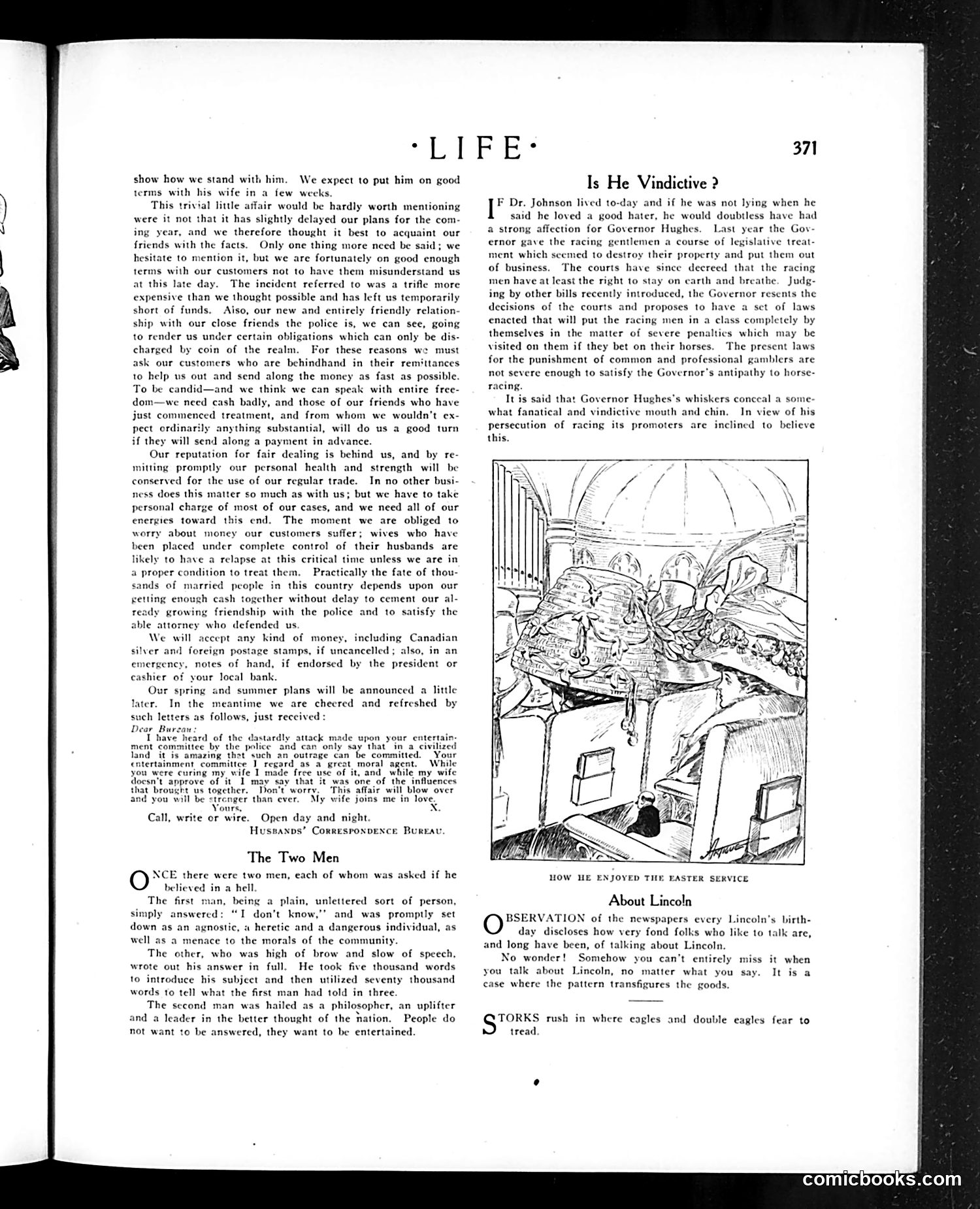
This page contains two distinct pieces of satire: **"Is He Vindictive?"** section discusses Governor Hughes and horse-racing legislation. The accompanying illustration depicts what appears to be a crowded indoor scene (captioned "HOW HE ENJOYED THE EASTER SERVICE"), likely satirizing Hughes's public persona or perceived hypocrisy regarding entertainment and moral issues. **"The Two Men"** is a satirical parable contrasting intellectual pretension with plain truth-telling. A simple man answers "I don't know" about belief in hell and is condemned as dangerous; an educated man writes 75,000 words saying essentially the same thing and is praised. The satire mocks how society rewards verbose intellectualism over honest simplicity, valuing *how* something is said over *what* is said. The large text block above appears to be a humorous letter from a dubious "Husband's Correspondence Bureau" seeking donations while implying involvement with police and marital "treatment"—likely satirizing fraudulent advice columnists or quack practitioners of the era. The page criticizes both political hypocrisy and the gap between substance and style in public discourse.
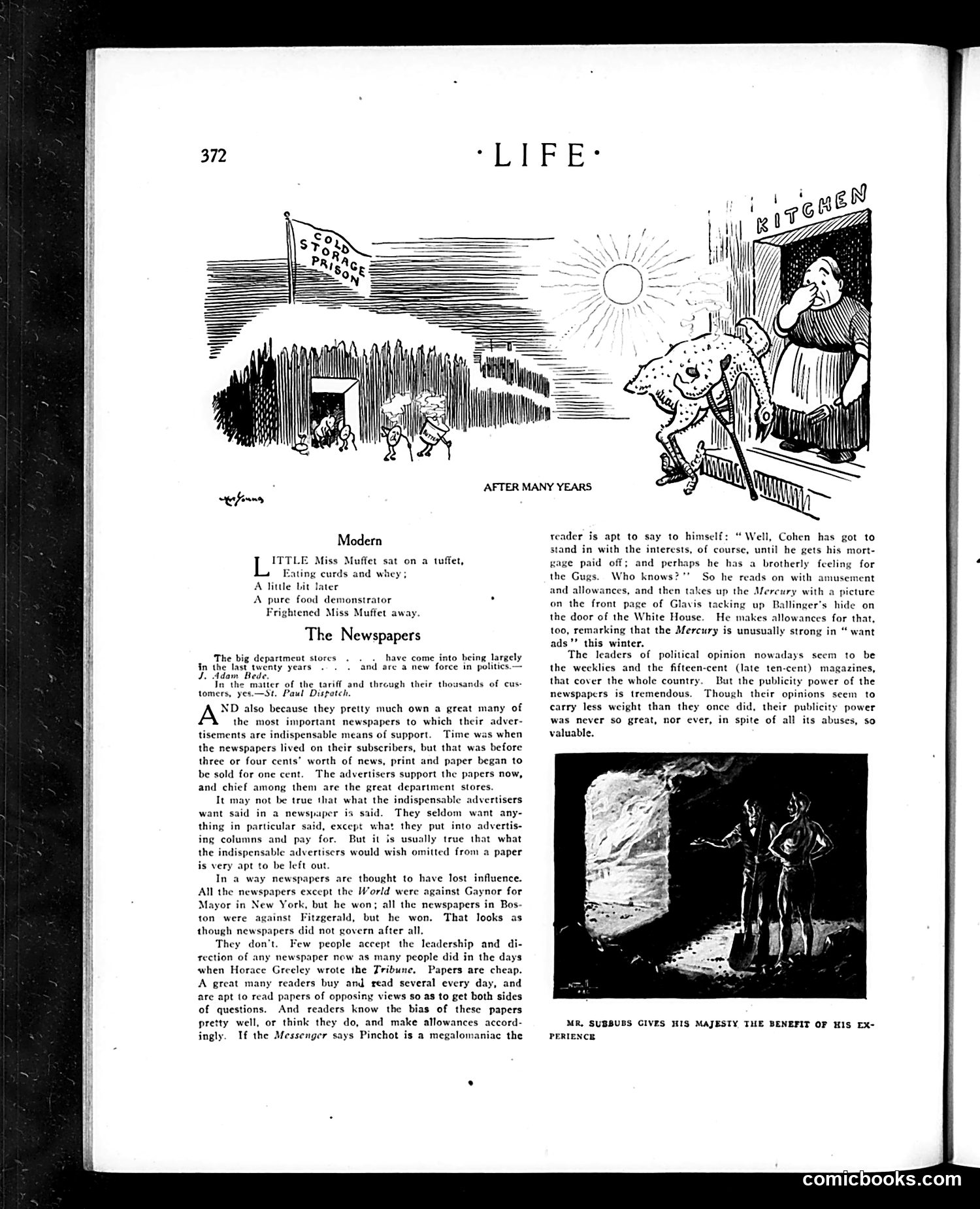
This article critiques newspaper influence and bias in early 20th-century America. The key argument: newspapers once depended on subscribers but now rely on advertising revenue from department stores, which therefore control editorial content through economic pressure rather than direct orders. The opening poem parodies "Little Miss Muffet," replacing the spider with a "pure food demonstrator"—likely referencing Progressive Era food safety scandals and sensationalist newspaper coverage. The article references specific political victories (Gaynor, Fitzgerald winning despite newspaper opposition) to argue newspapers have less direct influence than before. However, their **publicity power** remains enormous—they shape what stories appear, what gets omitted. The cartoons illustrate this tension: readers now read multiple papers with opposing views and recognize bias (the text mentions readers making allowances for papers' obvious interests). The second cartoon's caption about "Mr. Subbubs" and "majesty" appears to satirize how ordinary people now skeptically navigate newspaper narratives. The core message: newspapers are powerful but their power is structural (agenda-setting) rather than persuasive.
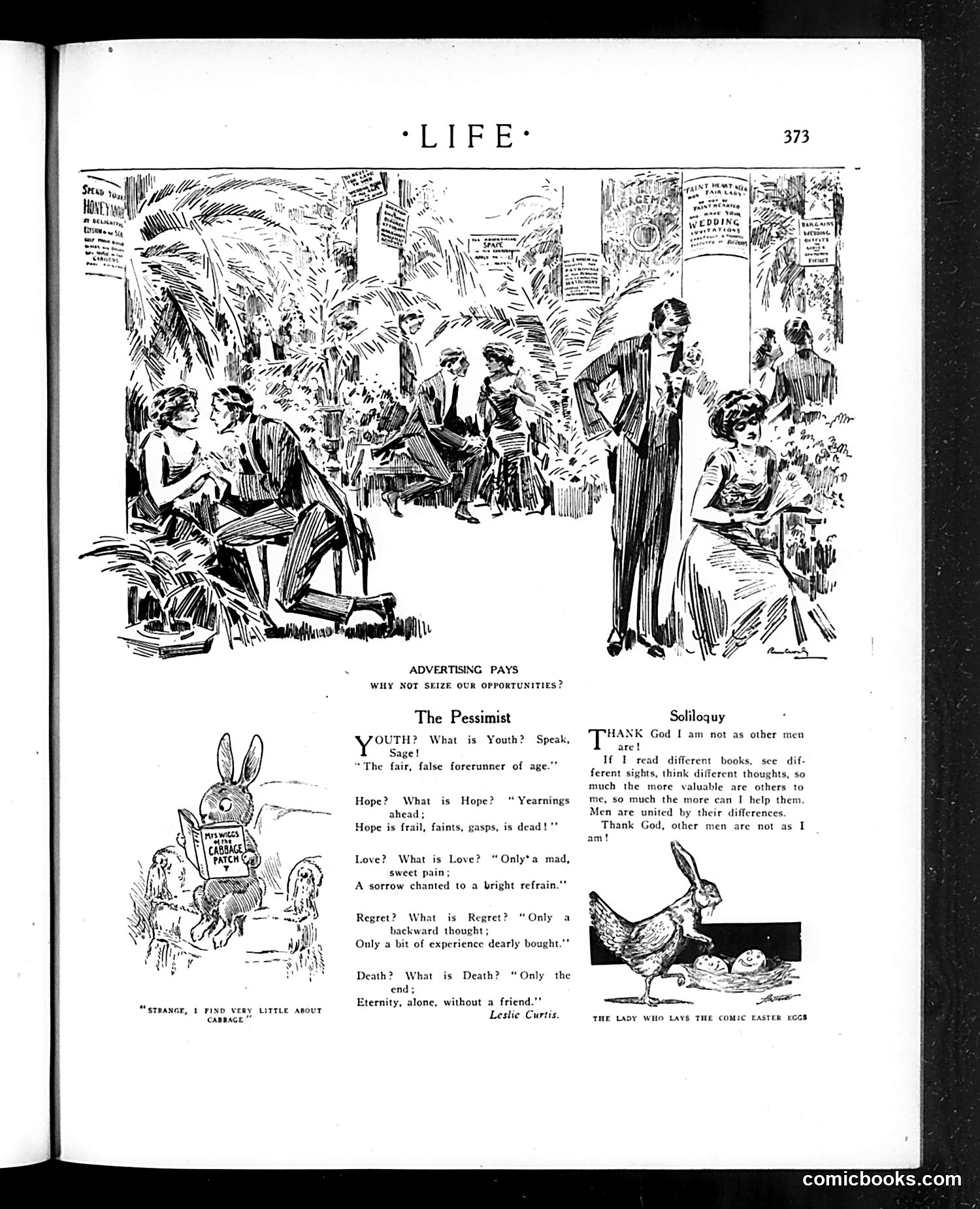
This page satirizes optimism versus pessimism through two contrasting pieces. "The Pessimist" by Leslie Curtis presents cynical definitions of youth, hope, love, regret, and death—each reduced to disappointment or futility. It's a dark, nihilistic meditation. "Soliloquy" offers the opposing view: a character (likely representing an intellectual or aesthete) celebrates individuality and human difference as sources of value and connection. The irony is sharp—the speaker claims gratitude that others *aren't* like him, yet this seemingly arrogant statement actually argues that diversity strengthens society because people can learn from differences. The top cartoon shows an advertising or business scene, with the headline "Advertising Pays—Why Not Seize Our Opportunities?" suggesting commercial optimism. The Easter egg illustration references the humor column's seasonal content. Overall, the page contrasts dark philosophy with self-satisfied individualism, typical of Life magazine's satirical approach to social attitudes.
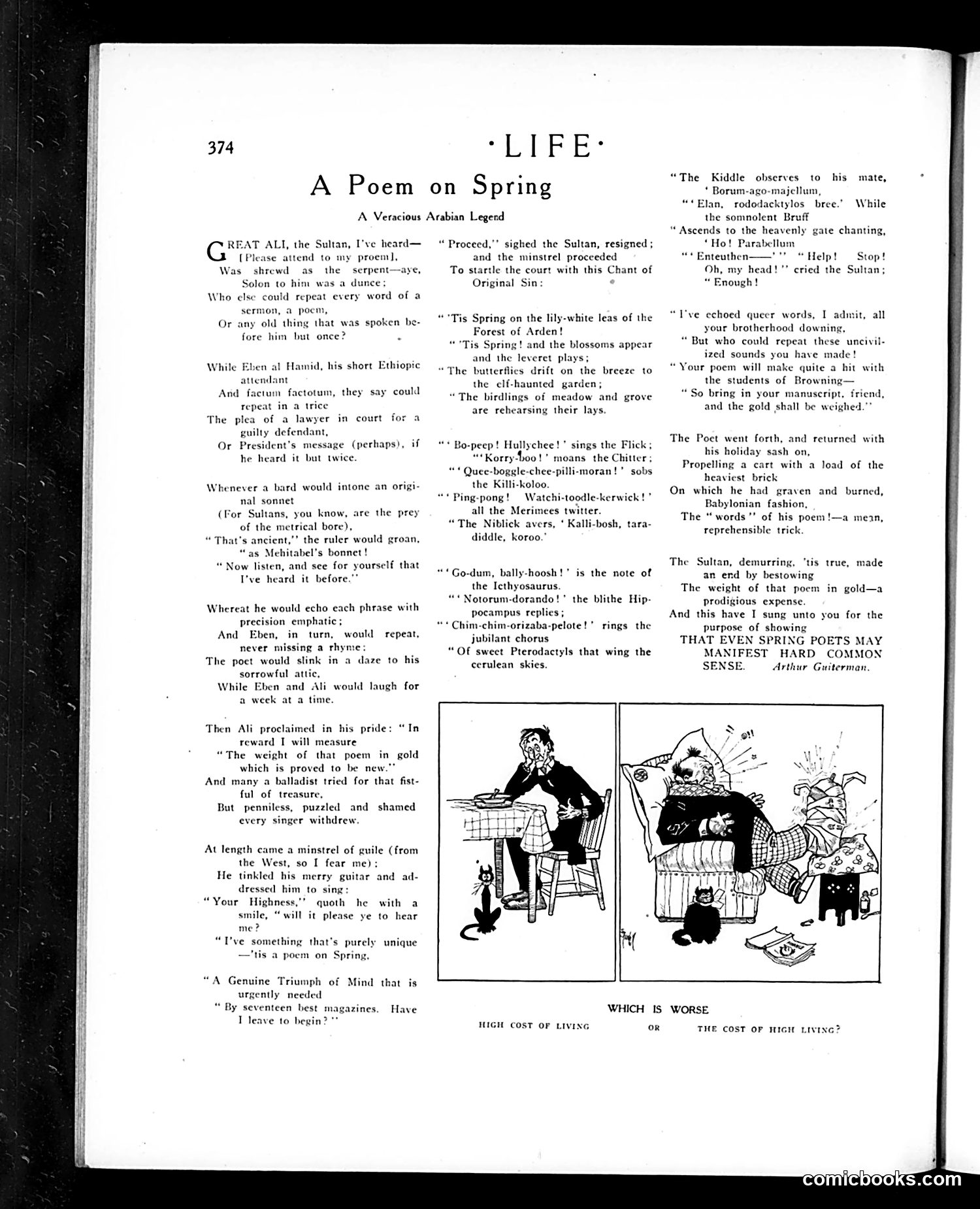
This page presents a satirical poem by Arthur Guiterman mocking pretentious modernist poetry and literary fraud. The narrative frames a wily Western minstrel who wins the Sultan's gold reward for an "original" poem by reciting gibberish animal sounds ("Bo-peep! Hullychee!" "Korry-boo!") presented as profound Spring verse. The satire targets early 20th-century "difficult" poetry—works readers found incomprehensible but culturally praised. By demonstrating that nonsense can pass as serious literature when sufficiently obscure, Guiterman critiques both pretentious poets and credulous critics. The moral: even Spring poetry (traditionally simple subjects) becomes absurdly overwrought in modern hands. The accompanying cartoon illustrates the cost-of-living debate visually—likely contrasting wealthy excess with working-class struggle, a common contemporary concern during this period.
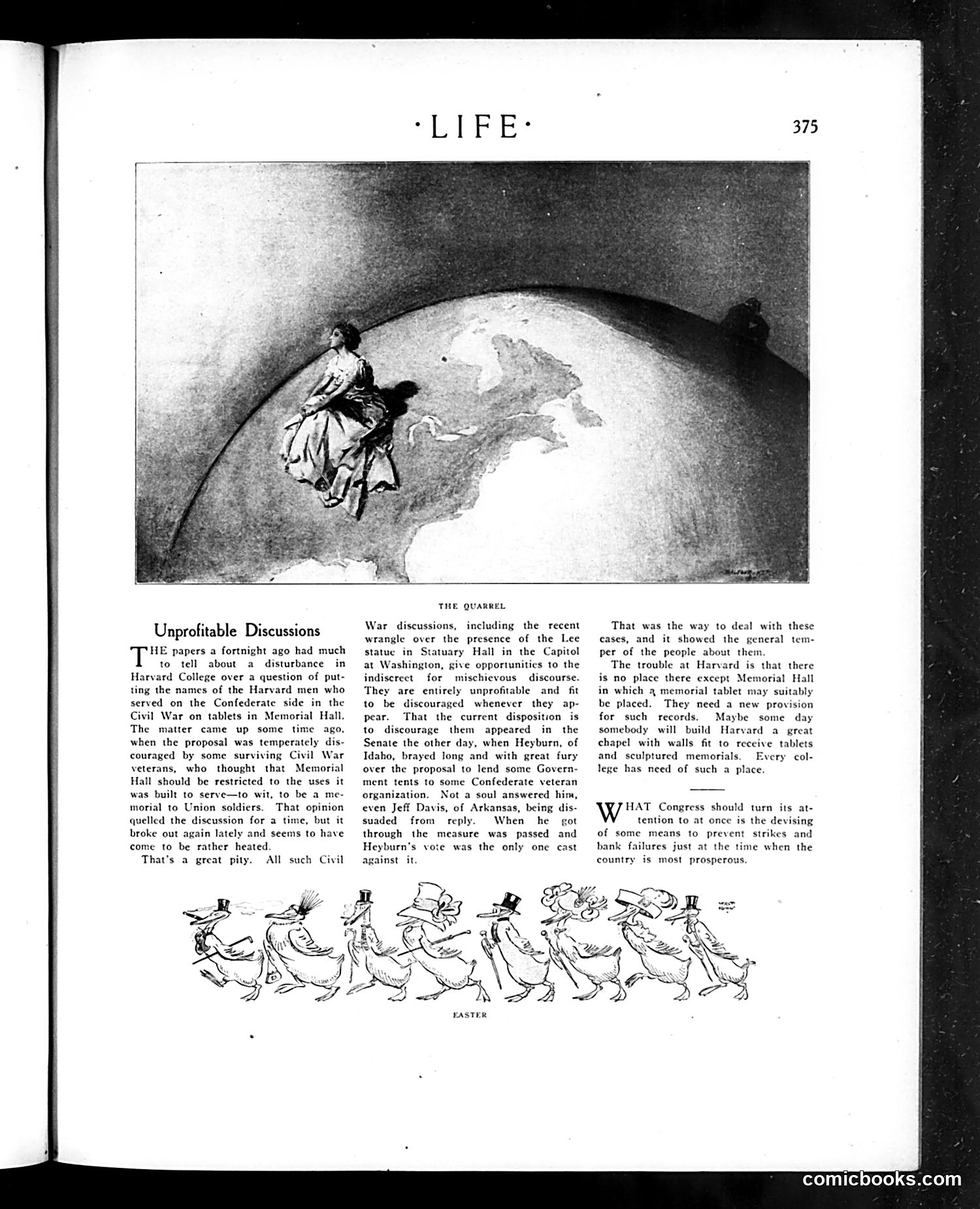
This page discusses Civil War memorial disputes rather than presenting political cartoons. The main article, "Unprofitable Discussions," addresses two controversies: 1. **Harvard Memorial Hall controversy**: Harvard faced debate over whether to inscribe names of alumni who served the Confederacy on memorial tablets. Union veterans opposed this, arguing the hall should commemorate only Union soldiers. 2. **Lee statue in Capitol**: A related dispute involved a Confederate statue in the Capitol's Statuary Hall in Washington. The editorial argues these debates are "unprofitable" and advocates ignoring provocative voices—citing Senator Heyburn of Idaho, who railed against lending government tents to Confederate veterans, with no one bothering to respond. The point: Post-Civil War America should discourage divisive war-memory disputes rather than relitigate sectional conflicts. The bottom cartoons ("Easter") appear decorative rather than satirical.
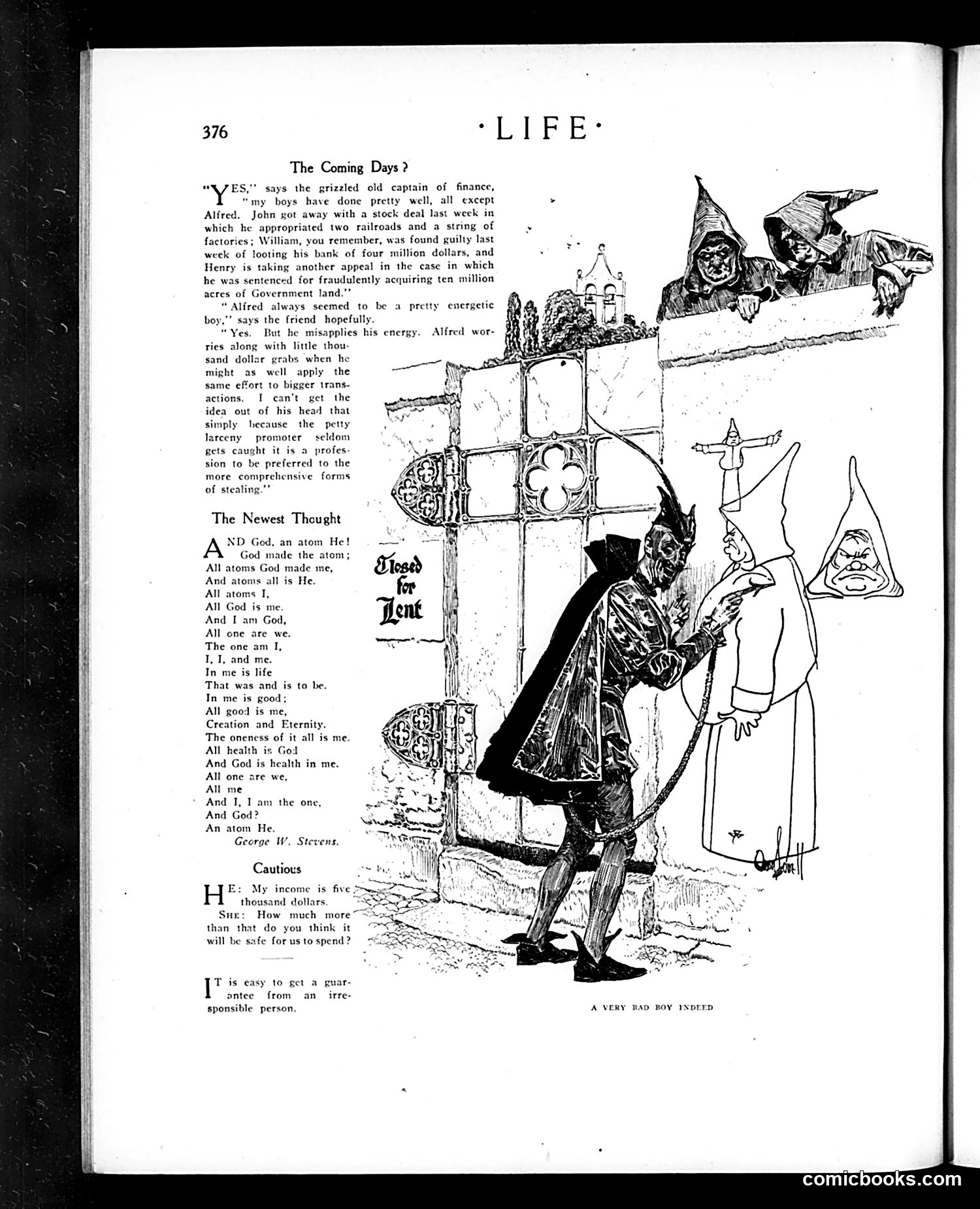
**Main Cartoon: "A Very Bad Boy Indeed"** The illustration depicts a demonic or devilish figure (marked "Blessed for Lent") at a ornate gate/fence, appearing to tempt or interact with robed religious figures. This is satirizing the hypocrisy of wealthy industrialists in the Gilded Age. **"The Coming Days?" Section** This text-based satire presents a wealthy "captain of finance" praising his sons' criminal accomplishments: one stole railroads and factories, another embezzled millions from his bank, a third fraudulently acquired government land. The father criticizes only Alfred for pursuing "petty larceny" instead of "more comprehensive forms of stealing"—mocking how big-business theft was socially acceptable while small-time crime was condemned. **The Satire's Point** Life magazine is mocking the Gilded Age's moral inversion: massive corporate fraud by wealthy men went unpunished and earned respect, while minor theft was prosecuted. The magazine contrasts this with "The Newest Thought" (spiritual poetry) and "Cautious" (a joke about living beyond means), suggesting broader social contradictions about morality and money.
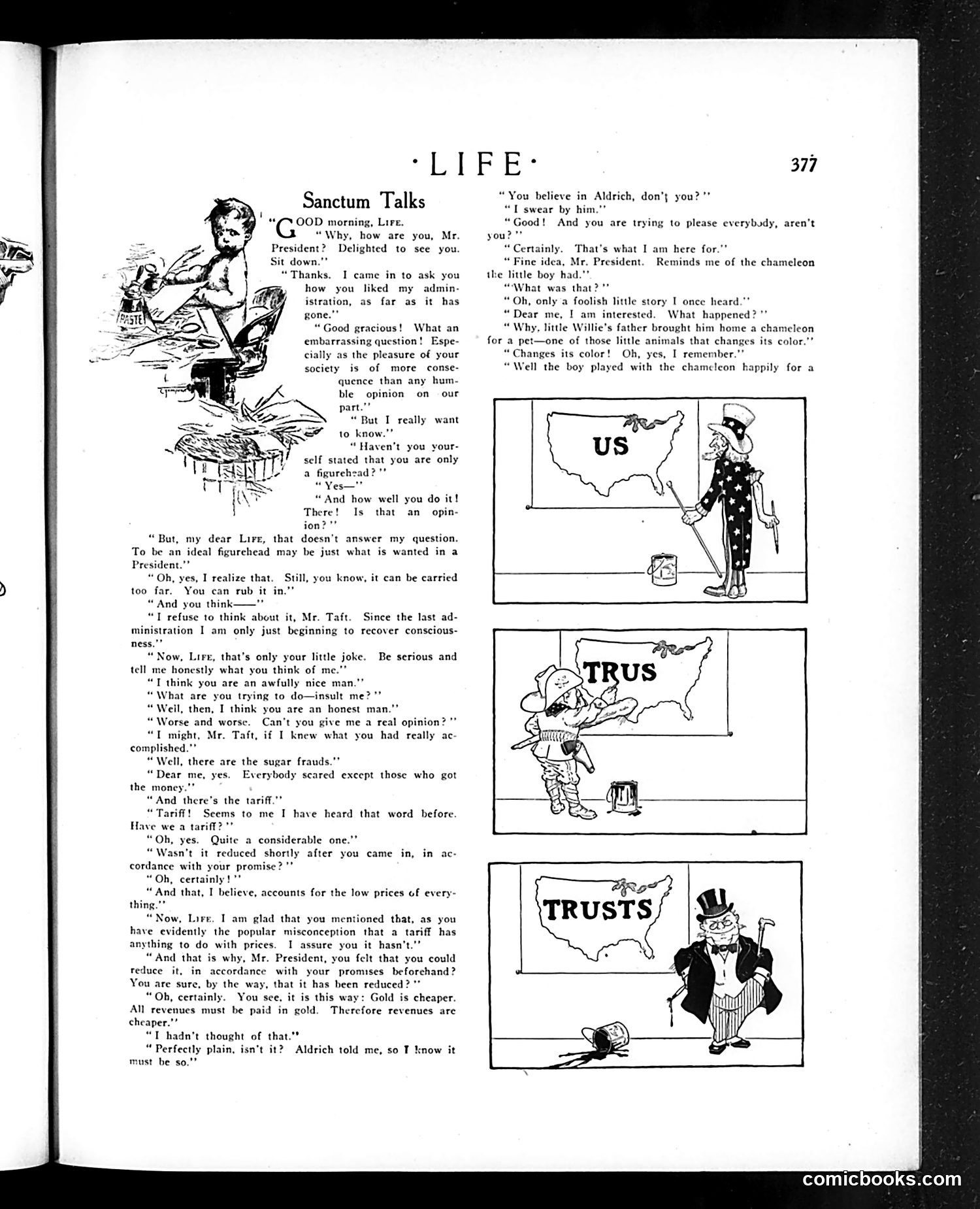
This page satirizes President William Howard Taft's administration through a dialogue between a *Life* magazine editor and Taft himself. The cartoon trio on the right uses map imagery to mock Taft's policies: "US" (United States), "TRUS" (Trust), and "TRUSTS" shows Uncle Sam shrinking while trusts grow—criticizing his failure to aggressively combat monopolies as his predecessor Theodore Roosevelt had done. The dialogue mocks Taft as an ineffectual figurehead who accomplishes nothing meaningful. The chameleon story (a creature that changes colors to blend in) is a direct insult: Taft changes positions to please everyone, standing for nothing. The satire targets his tariff policy and the "sugar frauds" scandal. Taft's circular logic about gold being cheaper therefore revenues being cheaper is absurdist humor—nonsensical reasoning that highlights his incompetence. References to "Aldrich" (likely Senator Nelson Aldrich, a conservative Republican) suggest Taft is merely following others' directives rather than leading independently.
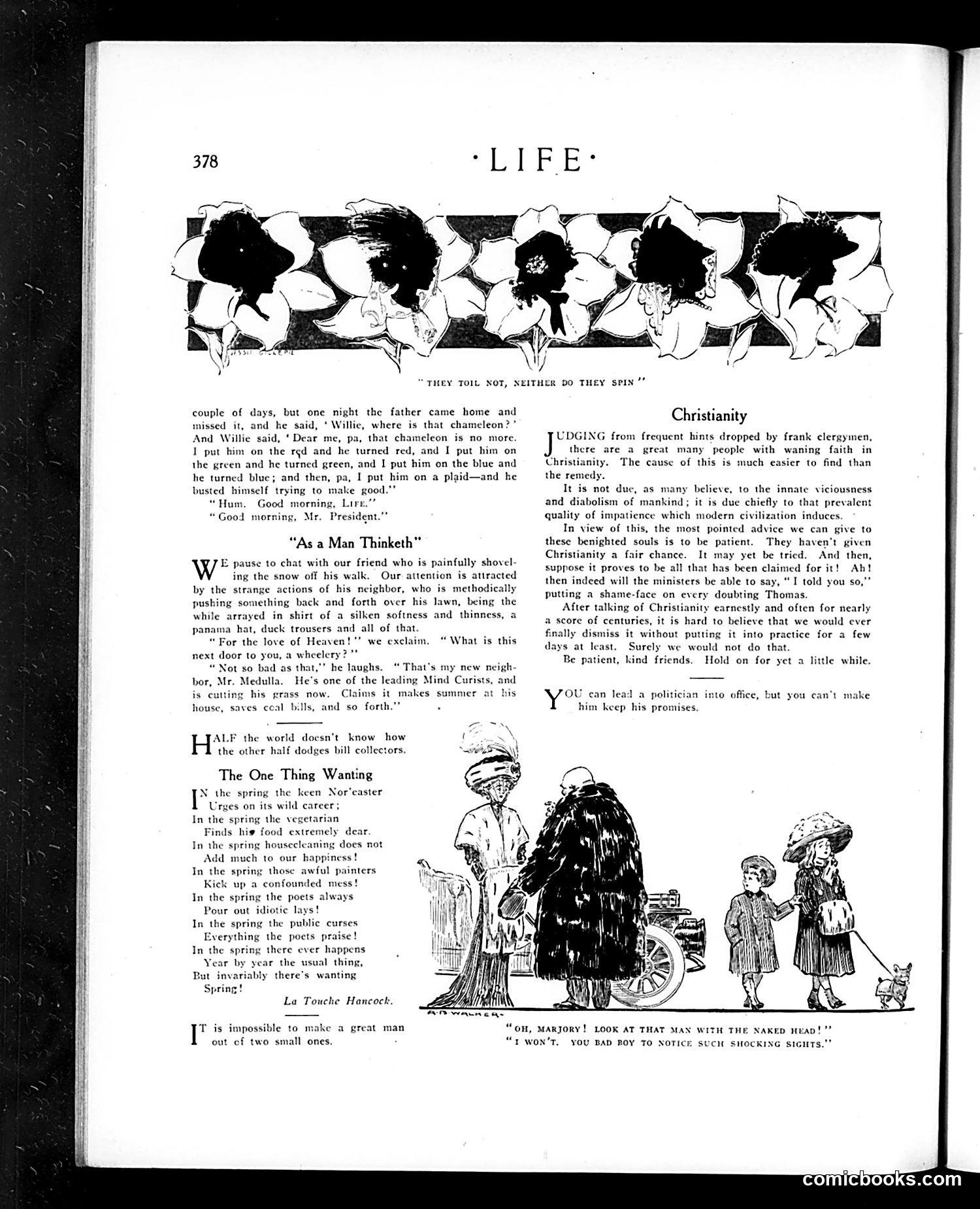
This page contains several satirical pieces mocking contemporary American quirks and beliefs: **"As a Man Thinketh"** ridicules "Mind Curists"—practitioners of New Thought, a popular early-1900s movement claiming mental power over reality. The neighbor, Mr. Medulla, supposedly "cuts his grass" through willpower alone to create summer and save on coal bills, exemplifying the movement's absurd claims. **"The One Thing Wanting"** is a humorous poem by La Touche Hancock about spring, noting that despite nature's renewal, people perpetually want something missing—suggesting human discontent is unchanging. **The Christianity section** sarcastically advises skeptics to be patient with religion, which hasn't been "put into practice" despite centuries of preaching. It mocks both clergy and doubters. **The bottom cartoon** depicts a child pointing at a bald man, with the caption satirizing Victorian propriety—the mother scolds the child for noticing such "shocking sights," highlighting society's prudish hypocrisy about natural human appearance.
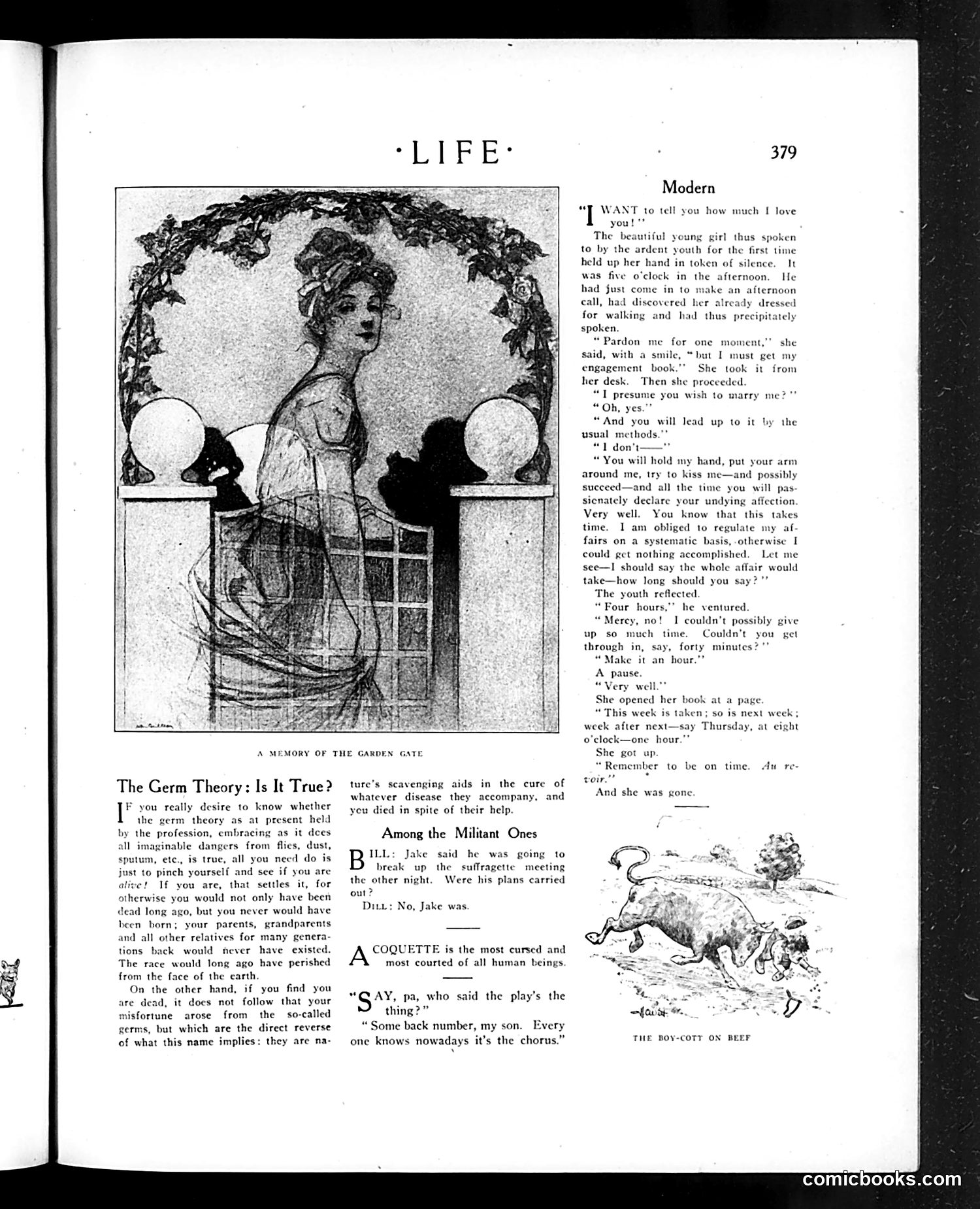
This page contains three satirical pieces mocking modern life: **"A Memory of the Garden Gate"** (top illustration): Shows a romantic couple at a garden gate. The accompanying narrative parodies the mechanical nature of modern courtship—a young woman treats her suitor's marriage proposal like a business appointment, consulting her "engagement book" and scheduling their entire romantic progression (hand-holding, arm-around-waist, kiss attempts, declarations) for Thursday at 8 PM, allowing exactly one hour. The satire targets both the loss of spontaneity in relationships and women's growing independence/practicality. **"The Germ Theory"**: A humorous column debunking excessive fear of germs by pointing out humanity survived for generations before germ theory existed. **"Among the Militant Ones"**: A joke about suffragettes—Jake planned to disrupt a women's suffrage meeting but got beaten up instead ("Were his plans carried out? No, Jake was"). The overall theme critiques modern social changes: romantic detachment, scientific anxiety, and women's activism.
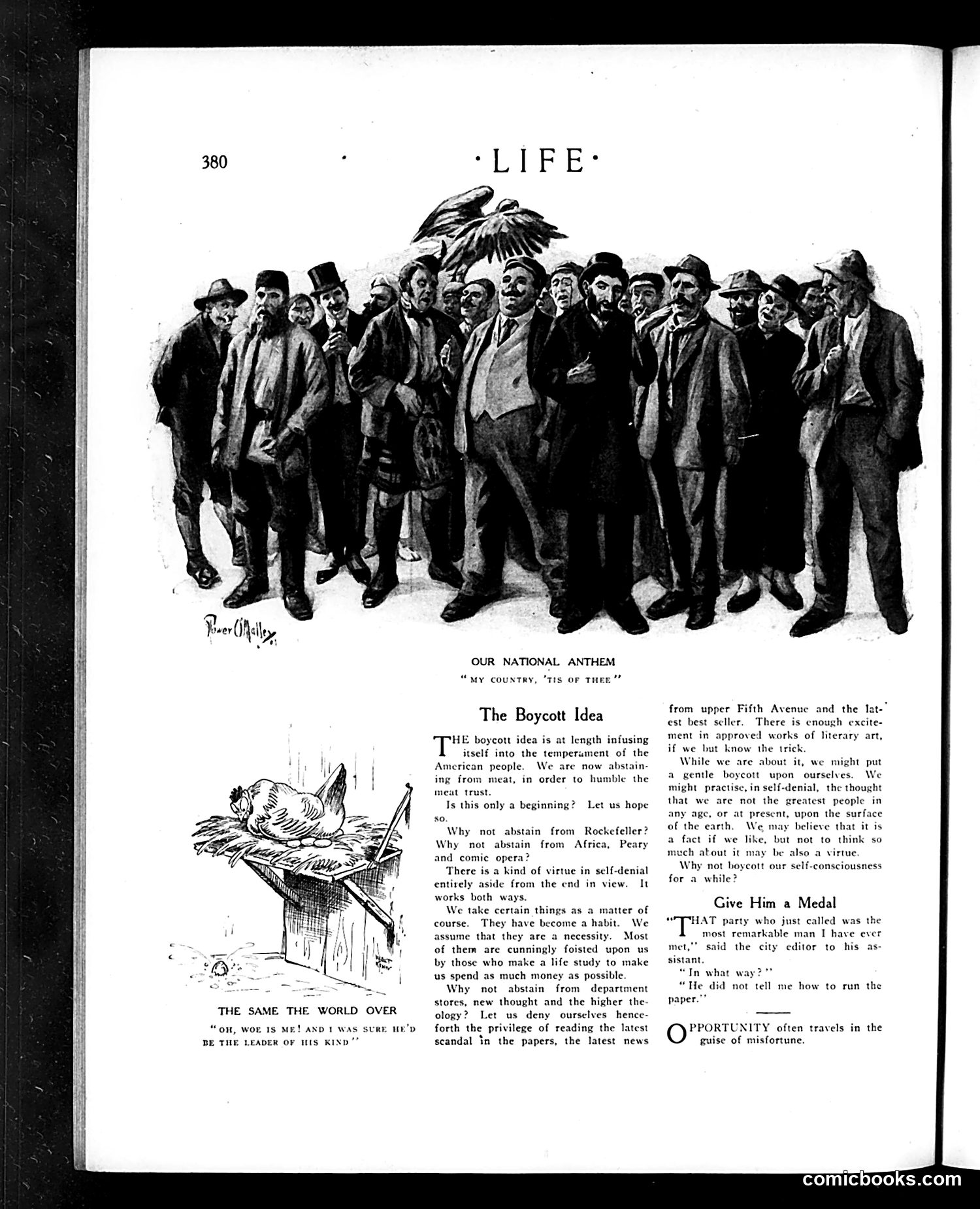
This satirical page critiques the American "boycott" movement of the early 1900s, likely targeting the meat boycott against the "meat trust" (monopolistic meat-packing corporations). **Top cartoon**: Shows a dejected rooster beneath the caption "Oh, woe is me! And I was sure he'd be the leader of his kind"—mocking how the boycott movement affects even farm animals. **"The Boycott Idea" essay**: Satirizes boycott logic by proposing absurd extensions: Why stop at meat? Why not boycott Rockefeller, Africa, Peary expeditions, department stores, theology, and newspapers? The satire peaks when suggesting Americans boycott their own self-consciousness and vanity—implying the real problem isn't external monopolies but American overconsumption and self-importance. **"Give Him a Medal"**: A brief joke praising a newspaper visitor who *didn't* tell the editor how to run his paper—poking fun at public meddling and unsolicited advice. The page's overall message: While boycotts address real corporate abuses, they reflect deeper American character flaws—materialism, arrogance, and constant complaining.
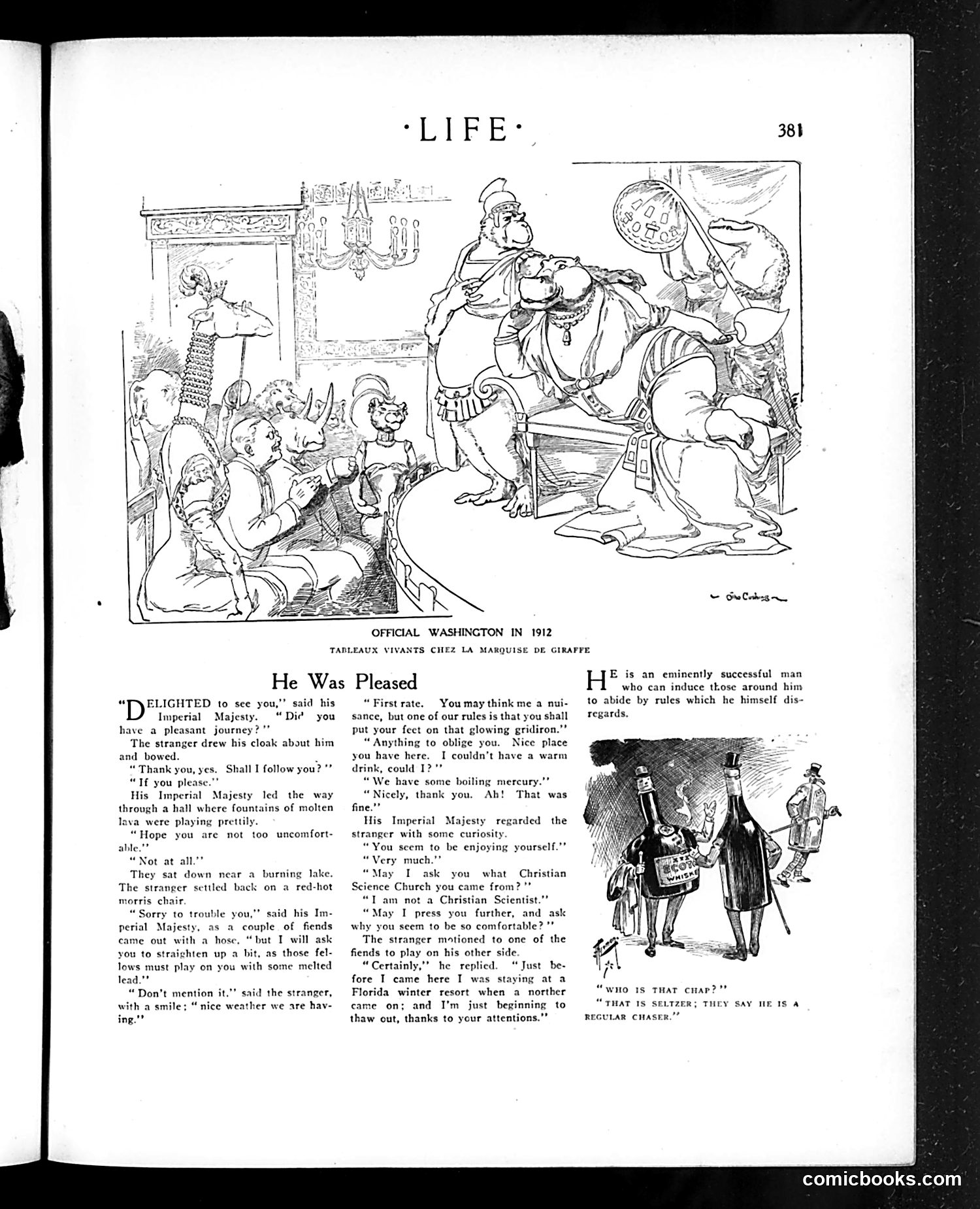
This 1912 Life magazine satire depicts "Official Washington" as a hellish salon where an imperious host (likely representing a political authority figure, possibly President Taft or a cabinet member) tortures a visiting stranger with molten lava, red-hot chairs, and melted lead—yet the stranger remains cheerfully compliant. The joke is that this "eminently successful man" can impose absurd, painful rules on others while they accept them gracefully. The stranger's comfort despite the torment suggests he's recently endured worse (a Florida winter resort's "norther"), making even hellish hospitality seem pleasant by comparison. The satire critiques Washington's power dynamics: how political leaders enforce arbitrary rules and discomforts on the public, who accept them without protest. The final caption about "Seltzer" as "a regular chaser" appears to be a separate joke about Washington social types.
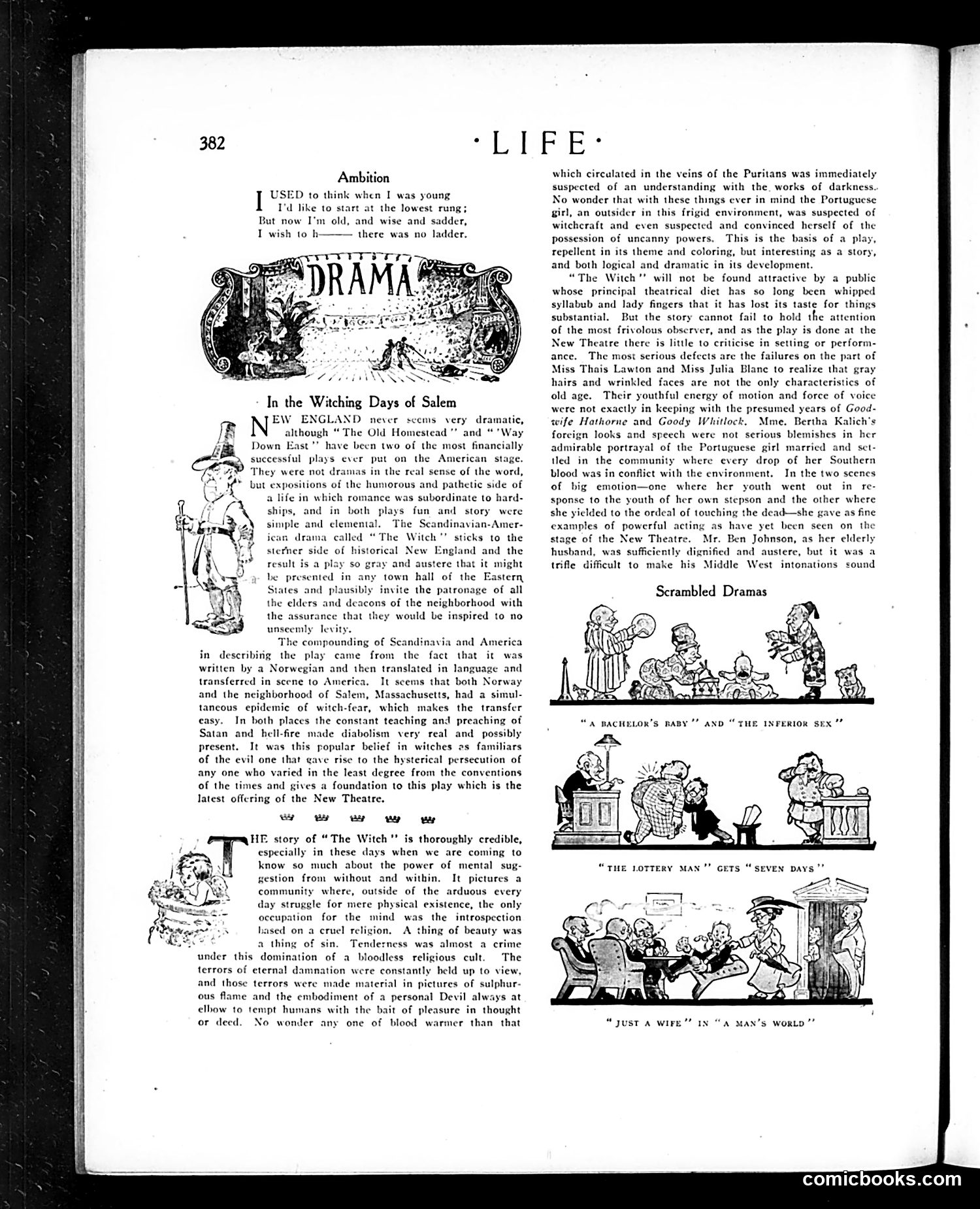
This page contains two sections: a brief poem titled "Ambition" mocking youthful aspirations, and a theater review of "The Witch," a play adapted from Norwegian source material and set in historical Salem, Massachusetts. The review analyzes how the play dramatizes witch-trial hysteria by depicting a community where Puritan religious severity—obsession with sin, damnation, and Satan—created psychological conditions for persecution. A Portuguese outsider girl becomes suspected of witchcraft, embodying how rigid religious conformity breeds intolerance of difference. The critic argues the play's dark subject matter won't appeal to audiences accustomed to lighter theatrical fare ("whipped syllabub and lady fingers"), yet praises its logical development and New Theatre production values, while critiquing specific actresses' inability to convincingly portray elderly characters through more than cosmetic aging effects. The "Scrambled Dramas" cartoons below offer comedic play titles satirizing contemporary social concerns.
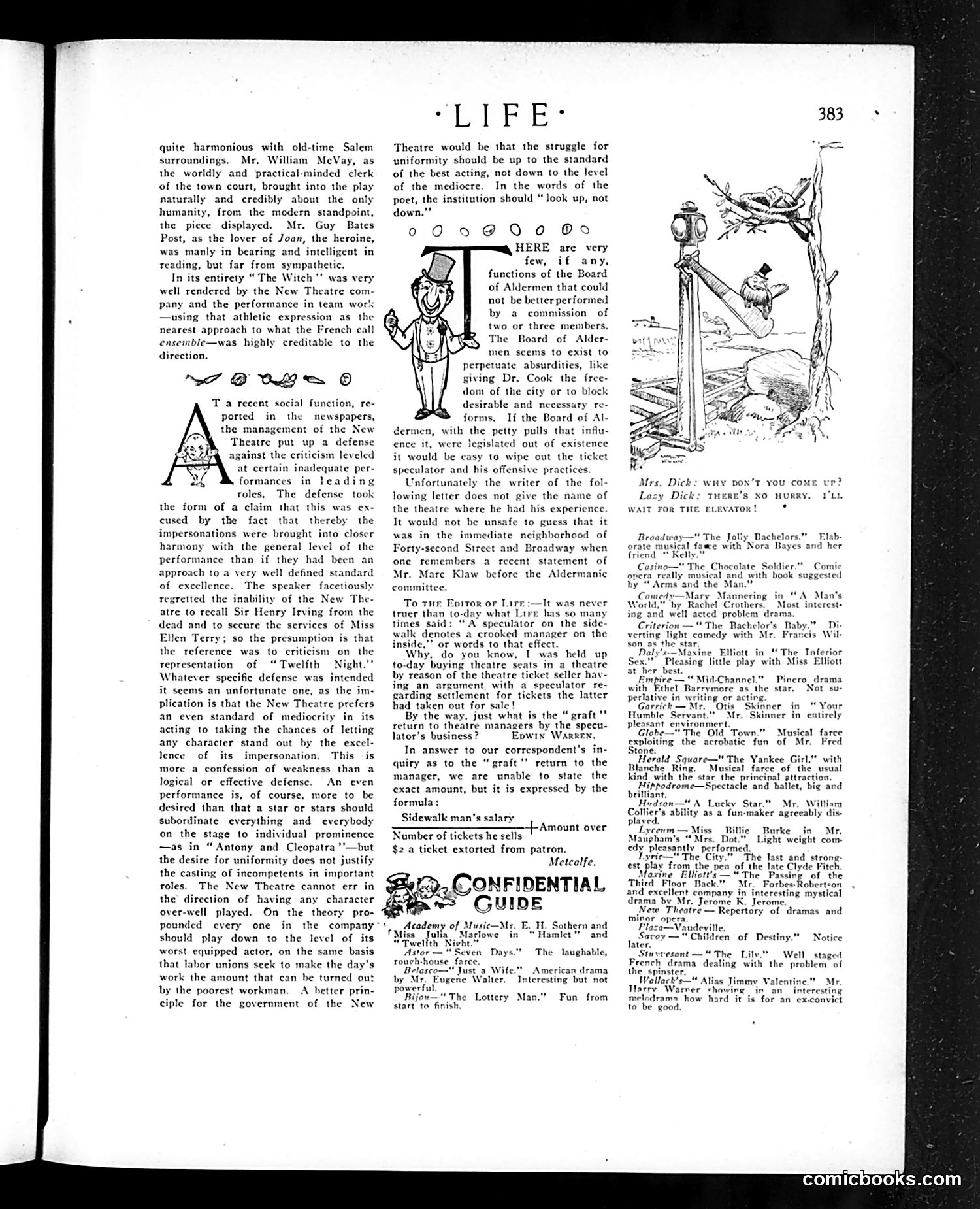
This page critiques the **New Theatre's artistic mediocrity**. The main text attacks the theater's defense of uneven performances—claiming poor acting in leading roles was justified to maintain "uniformity." The critic argues this inverts proper standards: the company should elevate weaker performers to match excellence, not lower stars to match incompetence. The labor-union analogy compares this wrongly to workers standardizing output at the slowest member's pace. A secondary piece targets the **Board of Aldermen's ineffectiveness**, suggesting they exist mainly for trivial gestures (like awarding explorer Dr. Cook citizenship) rather than meaningful reform. It references ticket speculation near **Broadway/42nd Street**, implying corruption around theater ticketing. The writer mentions Marc Klaw (a prominent Broadway producer/theater owner) testifying before the aldermanic committee, suggesting theater-district political entanglement. Together, these pieces satirize institutional mediocrity and urban corruption.
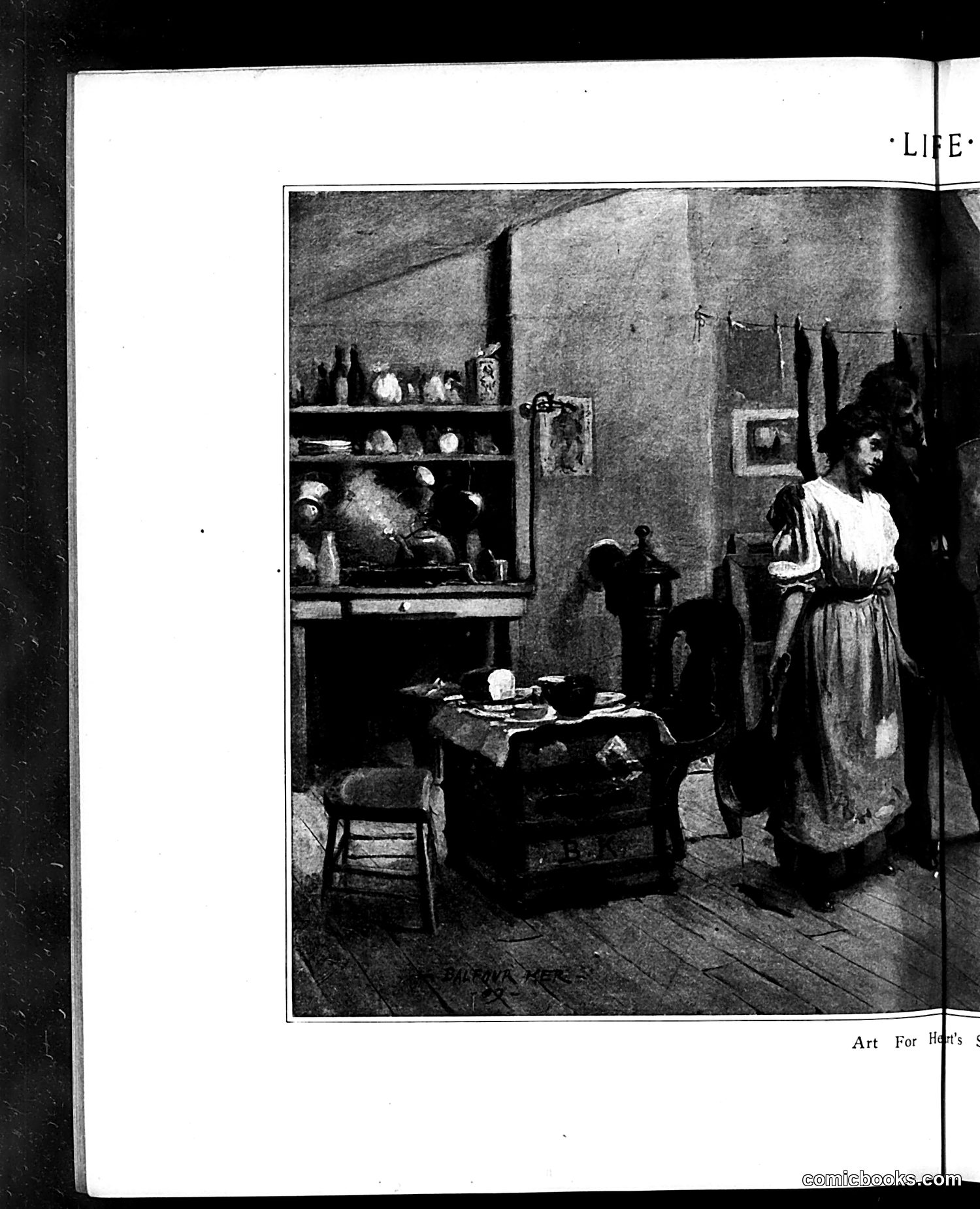
This page appears to be from *Life* magazine's satirical section. The image shows a domestic interior scene with a woman standing in what seems to be modest or working-class surroundings—simple furnishings, shelves with basic household items, and a small table set for a meal. The caption "Art For Hall's Sake" is a pun on "Art for Art's Sake," the aesthetic movement emphasizing art's value independent of practical purpose. Here, the satire likely mocks either pretentious artistic aspirations in humble circumstances, or critiques the gap between artistic ideals and everyday domestic reality. The woman's pose and the sparse setting suggest commentary on either class consciousness or the incongruity of high artistic aspirations in ordinary working-class life. Without additional context, the specific target of satire remains somewhat unclear.
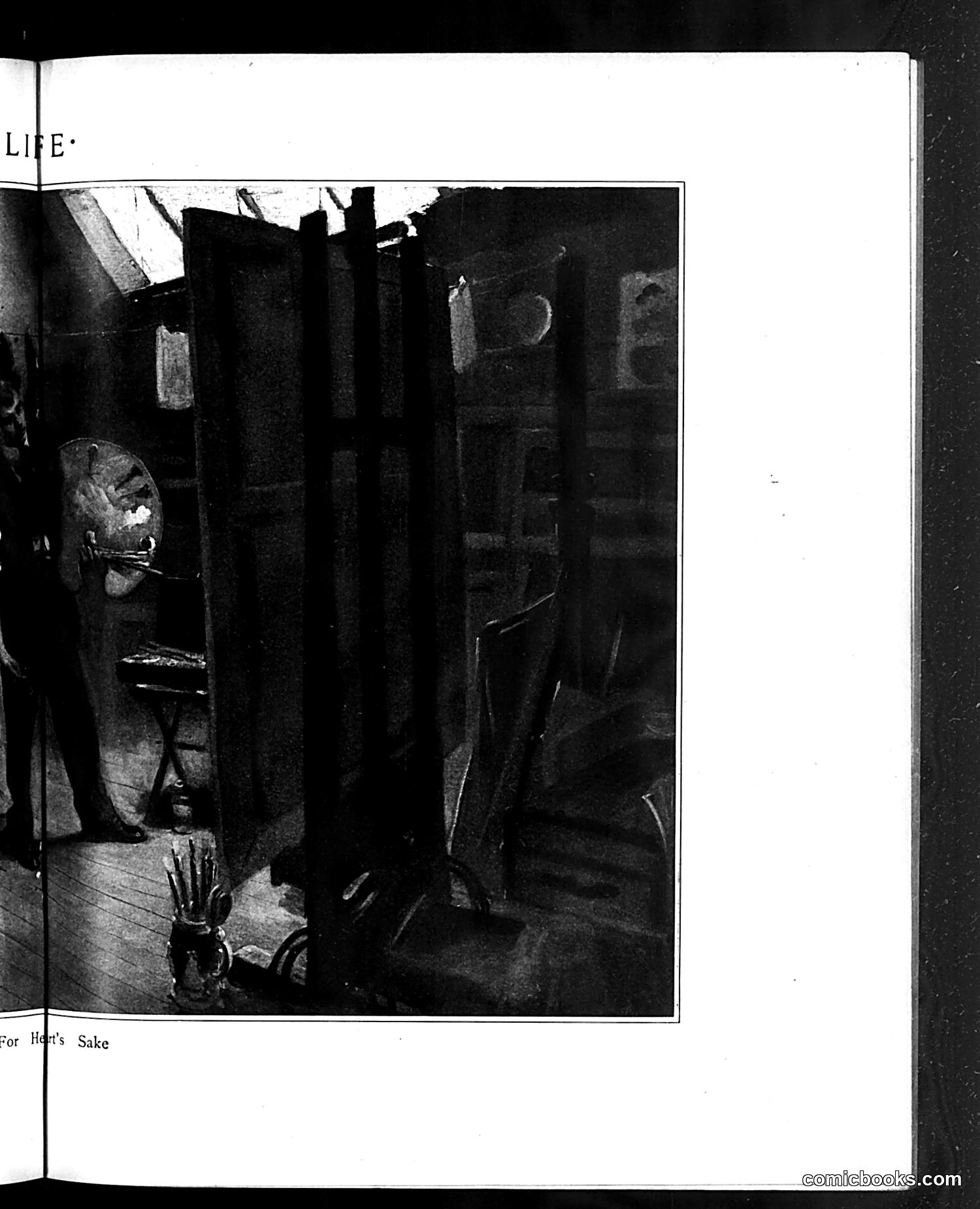
This page from *Life* magazine shows a black and white photograph rather than a traditional cartoon. The image depicts what appears to be a dramatic interior scene with strong shadows cast by vertical structural elements (possibly bars or posts), creating a theatrical, film noir-like atmosphere. The partial visible caption reads "For Hell's Sake," suggesting satirical commentary, though the full caption is cut off. Without the complete text, the specific subject and satirical target remain unclear. The dramatic lighting and composition suggest this may be critiquing a serious social or political situation—possibly related to imprisonment, confinement, or institutional conditions—but the exact reference cannot be determined from the visible portion alone.
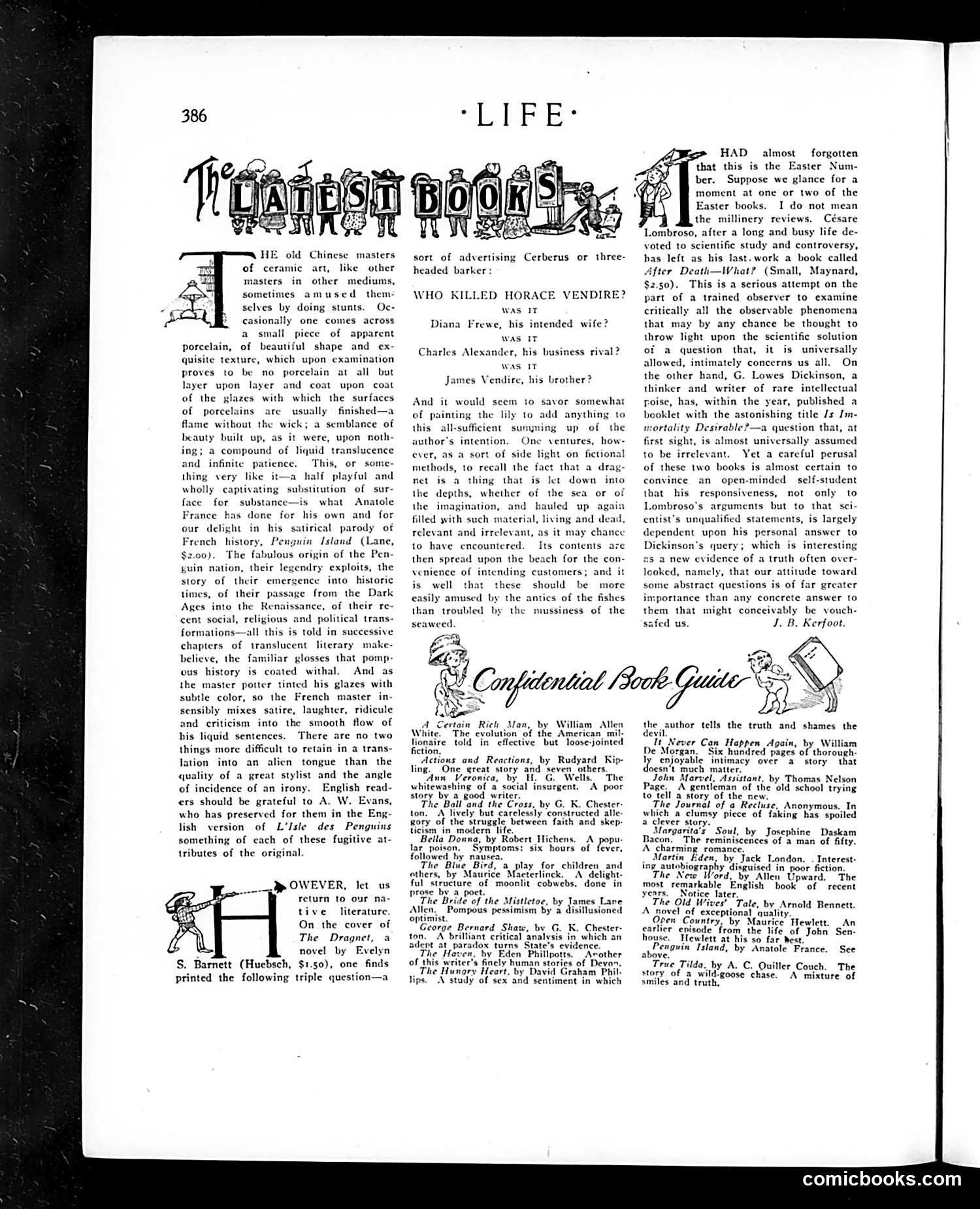
This is a book review section from Life magazine featuring three novel reviews. The page critiques *Penguin Island* by Anatole France, praised for its satirical parody of French history using elaborate literary "glazing" (surface beauty masking substance). The reviewer compares France's ironic style to Chinese porcelain craftsmen who create hollow beauty. *The Dragnet* by Evelyn S. Barnett is reviewed with the publisher's sensational three-question murder mystery hook ("Who Killed Horace Vendire?") analyzed as an obvious but effective marketing technique. The final section mentions Easter books, including Césare Lombroso's *After Death—What?*, a serious scientific examination of afterlife phenomena. The page also advertises a "Confidential Book Guide" recommending additional titles. The satire targets both pretentious literary styling and cheap mystery novel marketing tactics.
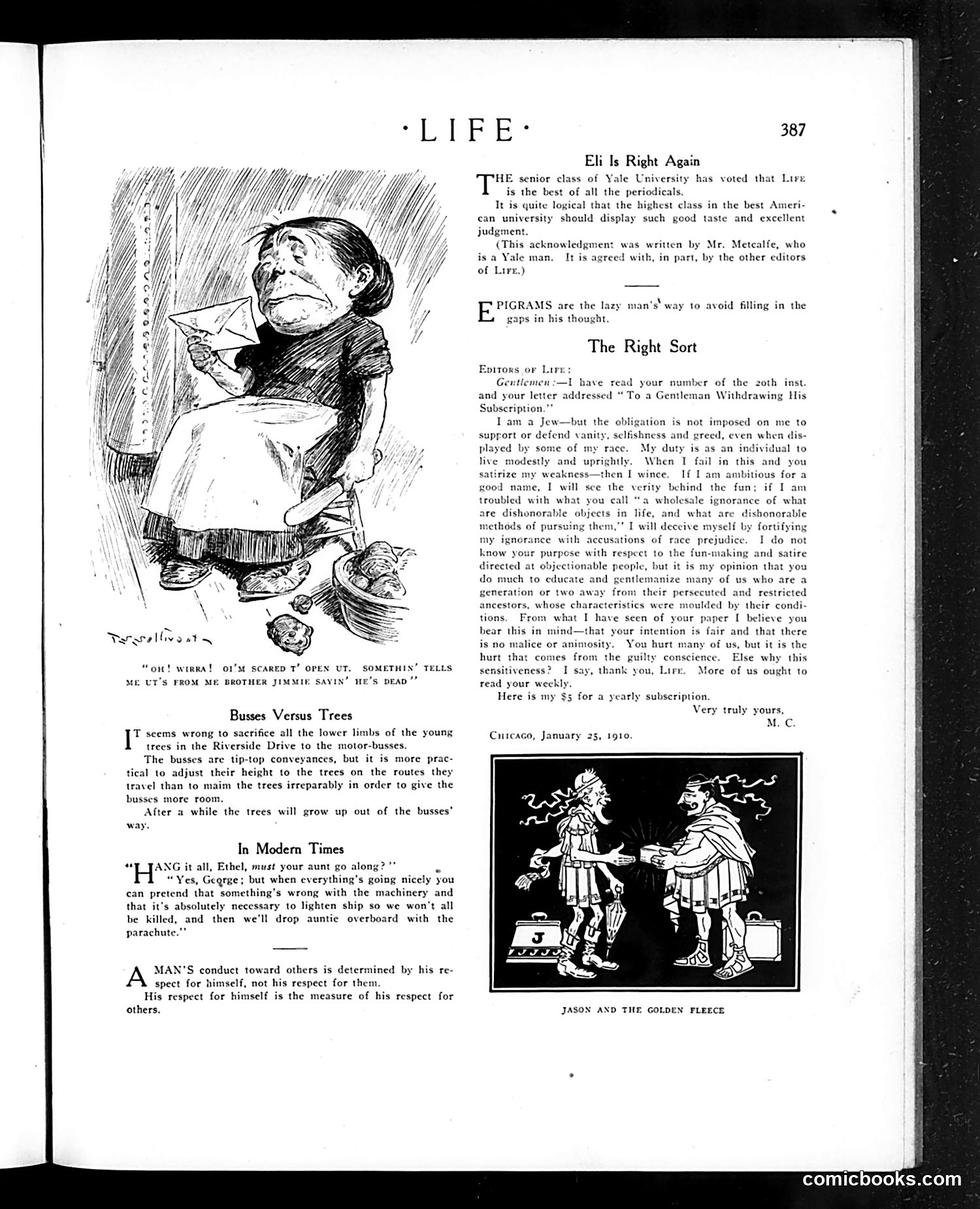
This page from *Life* magazine (dated January 25, 1910) contains several satirical pieces: **Main Cartoon (top left):** An Irish immigrant, identifiable by stereotypical dialect ("O1'M SCARED T' OPEN UT"), dreads opening mail fearing news of his brother's death. The joke plays on working-class anxiety and ethnic caricature common to early 20th-century American humor. **"Busses Versus Trees":** A practical complaint about motor-buses on Riverside Drive being too tall and damaging tree branches—arguing buses should adjust to trees rather than vice versa. **"In Modern Times":** A philosophical quip about self-respect determining conduct toward others. **"The Right Sort":** A reader's letter—likely from a Jewish contributor—defending *Life*'s satirical treatment of ethnic and social foibles. He argues satire serves educational purpose, not malice, and supports the magazine's fair intent to "civilize" recent immigrant generations. This reveals *Life*'s self-conception as a genteel, reformist publication using humor for social improvement. The bottom illustration depicts the mythological Jason and the Argonauts.
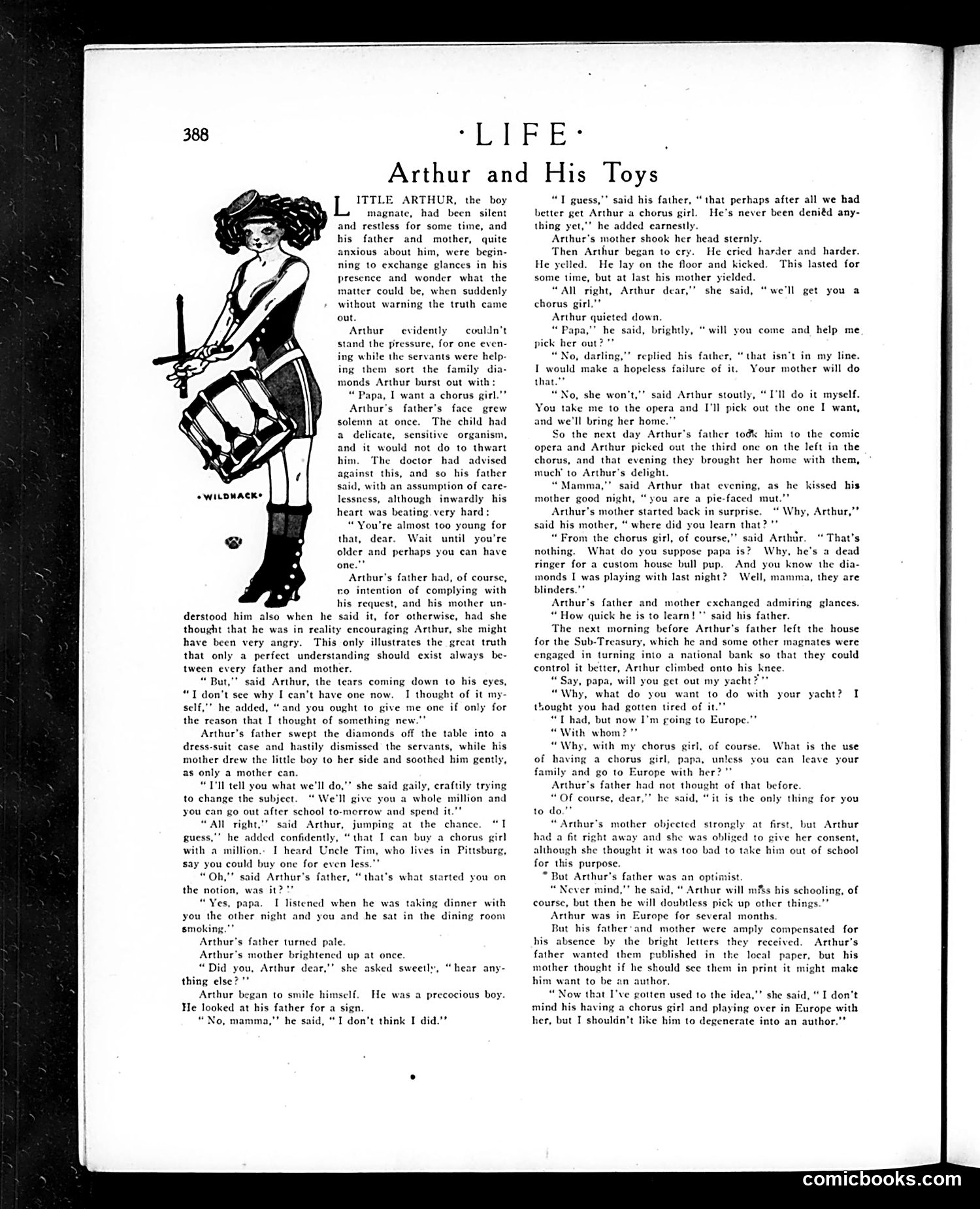
This is a satirical story about wealth and parental indulgence in the early 20th century. "Little Arthur" is a spoiled rich boy whose parents — unable to deny him anything — give him a million dollars to spend after he demands a "chorus girl" (a performer in musical theater, often associated with loose morality). The satire targets: **Wealthy excess**: Arthur casually discusses "family diamonds" and receives a million dollars as casual spending money. **Parental weakness**: His parents' inability to refuse him, even when his request is inappropriate for a child. **Class commentary**: His Uncle Tim's casual mention of buying chorus girls reveals the casual immorality of wealthy men. **The joke's dark edge**: Arthur ultimately gets what he wants — the parents actually take him to the opera and he literally selects and brings home a chorus girl, suggesting wealthy families will rationalize almost any indulgence for their children. The illustration shows a boy in formal dress, emphasizing his privileged status. The humor is cynical, depicting wealth as corrosive to proper parenting and morality.
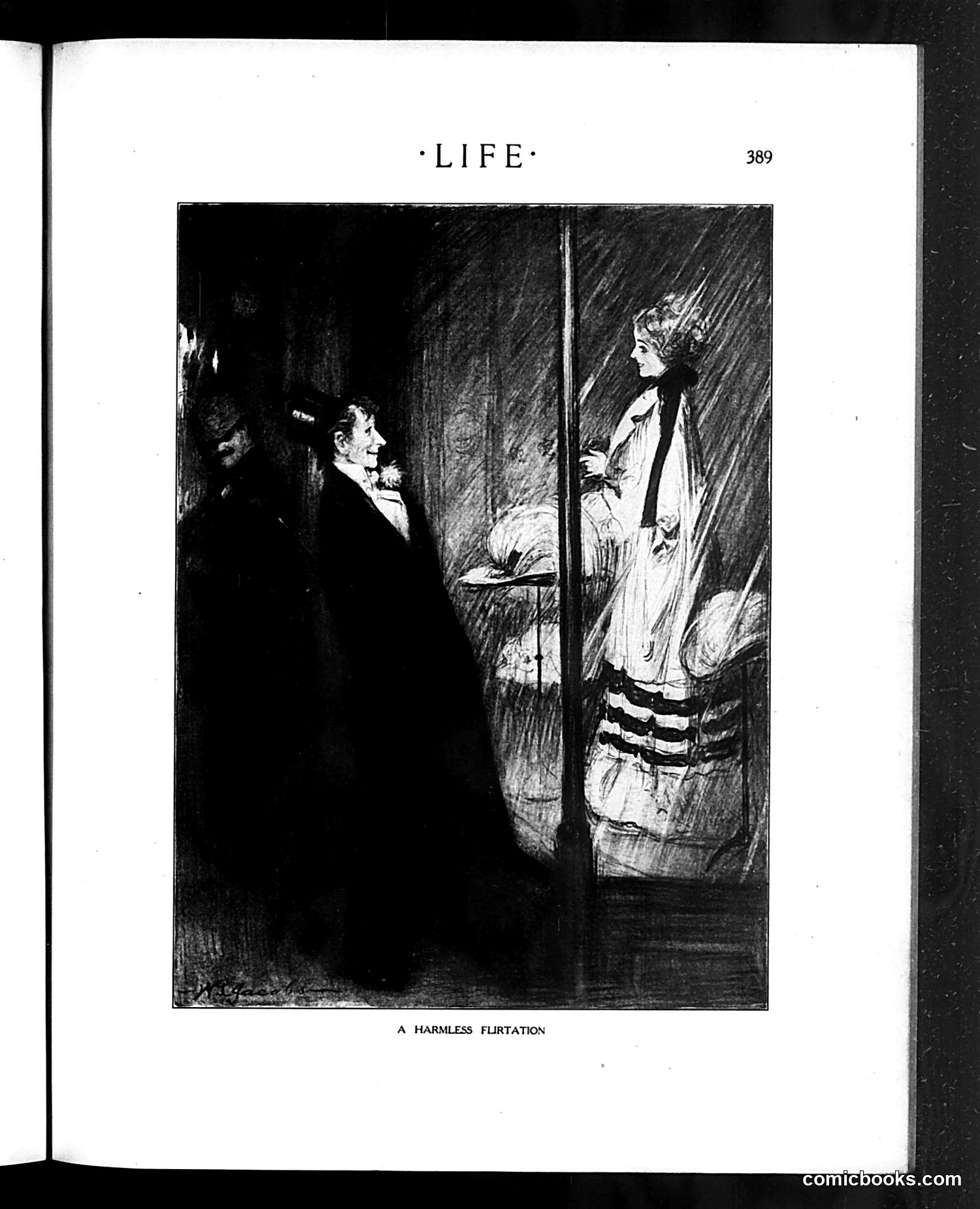
This satirical illustration depicts a scene of social interaction between two figures in what appears to be late 19th or early 20th-century dress. A man in dark formal attire, shown in profile on the left, observes a woman in an elaborate white gown with a tiara and dark sash, who stands elevated (possibly on a stage or platform) on the right. The title "A Harmless Flirtation" suggests ironic commentary on social courtship rituals of the era. The dramatic lighting, the woman's theatrical pose and ornate costume, and the man's formal stance suggest this depicts either literal stage performance or the performative nature of social flirtation itself—perhaps satirizing how courtship involved artifice and theatrical display rather than genuine interaction.
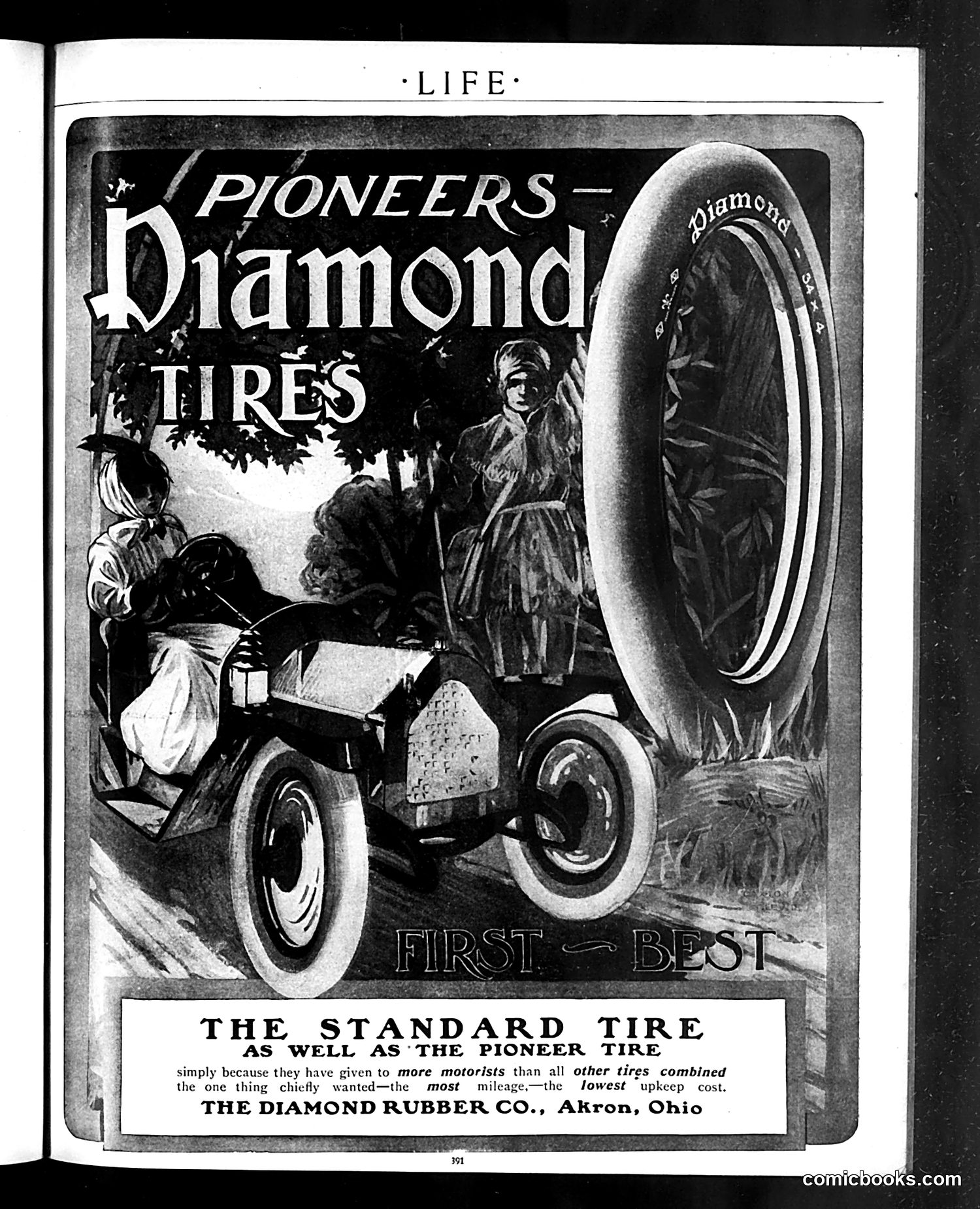
This is a **Diamond Rubber Company advertisement**, not political satire. The page uses the word "Pioneers" to evoke American frontier imagery—the illustration shows a family in a horse-drawn vehicle encountering a giant Diamond tire, suggesting the tire represents progress and reliability for modern motorists. The ad's claim that Diamond tires have given "more motorists than all other tires combined" the "most mileage" and "lowest upkeep cost" is a competitive boast against rival tire manufacturers. The "Pioneer" branding connects the product to American values of durability and pioneering spirit. This is straightforward early-20th-century advertising using nationalist mythology to sell consumer goods—the Diamond Rubber Company was based in Akron, Ohio, a major tire manufacturing hub.
This appears to be a serialized science fiction story about Dr. Thornbur, who has invented a machine enabling mental telepathy. The narrative depicts an experiment where a man named Greenson is fitted with an electrical apparatus—a "metal network" of fine meshes—designed to attune his mind to that of a wealthy man named Leterber, allowing Greenson to perceive Leterber's thoughts across distance. The satire likely mocks contemporary fascination with new technology and pseudo-scientific claims of the early 20th century. The mechanical apparatus for "reading minds" parodies legitimate scientific advancement while playing on public credulity regarding wireless telegraphy and similar innovations. The story presents as plausible what is essentially magical thinking dressed in technological language—a common target of *Life* magazine's satirical commentary on American gullibility and scientific pretension.
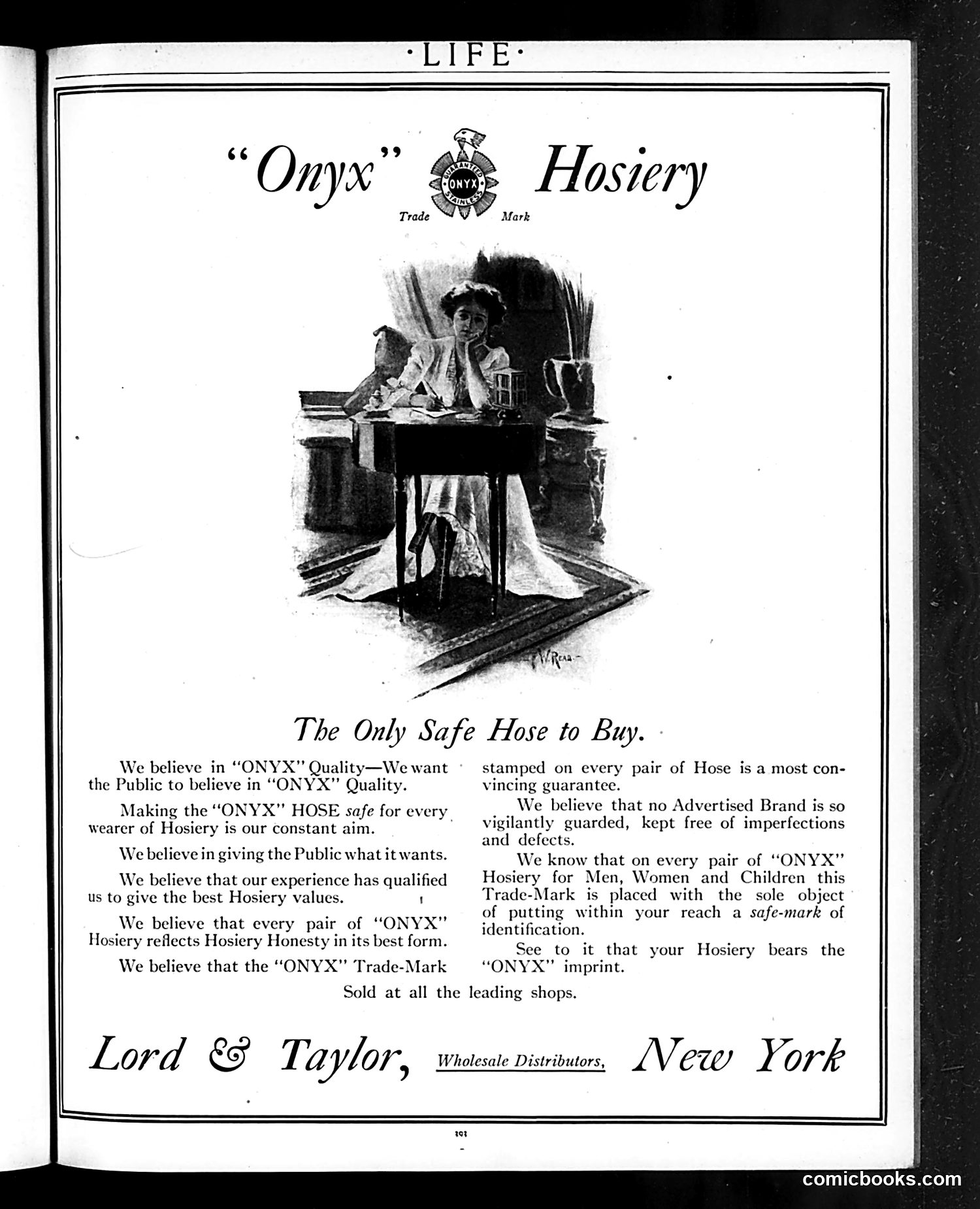
This is a **product advertisement**, not political satire. The page promotes "Onyx" brand hosiery (socks and stockings) distributed by Lord & Taylor in New York. The illustration shows a woman at a desk, presumably a satisfied customer or representative endorsing the product. The ad's messaging emphasizes quality assurance and brand trust—repeating the word "believe" to establish confidence in the product's safety and construction. The satire, if any, is subtle and typical of early 20th-century advertising: the company uses language about "Hosiery Honesty" and "safe-mark of identification" to suggest competitors' products may be unsafe or dishonest by comparison. The repeated assertions about quality and vigilant guarding imply that without the "Onyx" trademark, consumers risk purchasing defective hosiery. This reflects an era when branded goods were becoming competitive and manufacturers used advertising to differentiate themselves through claims of superior safety and reliability.
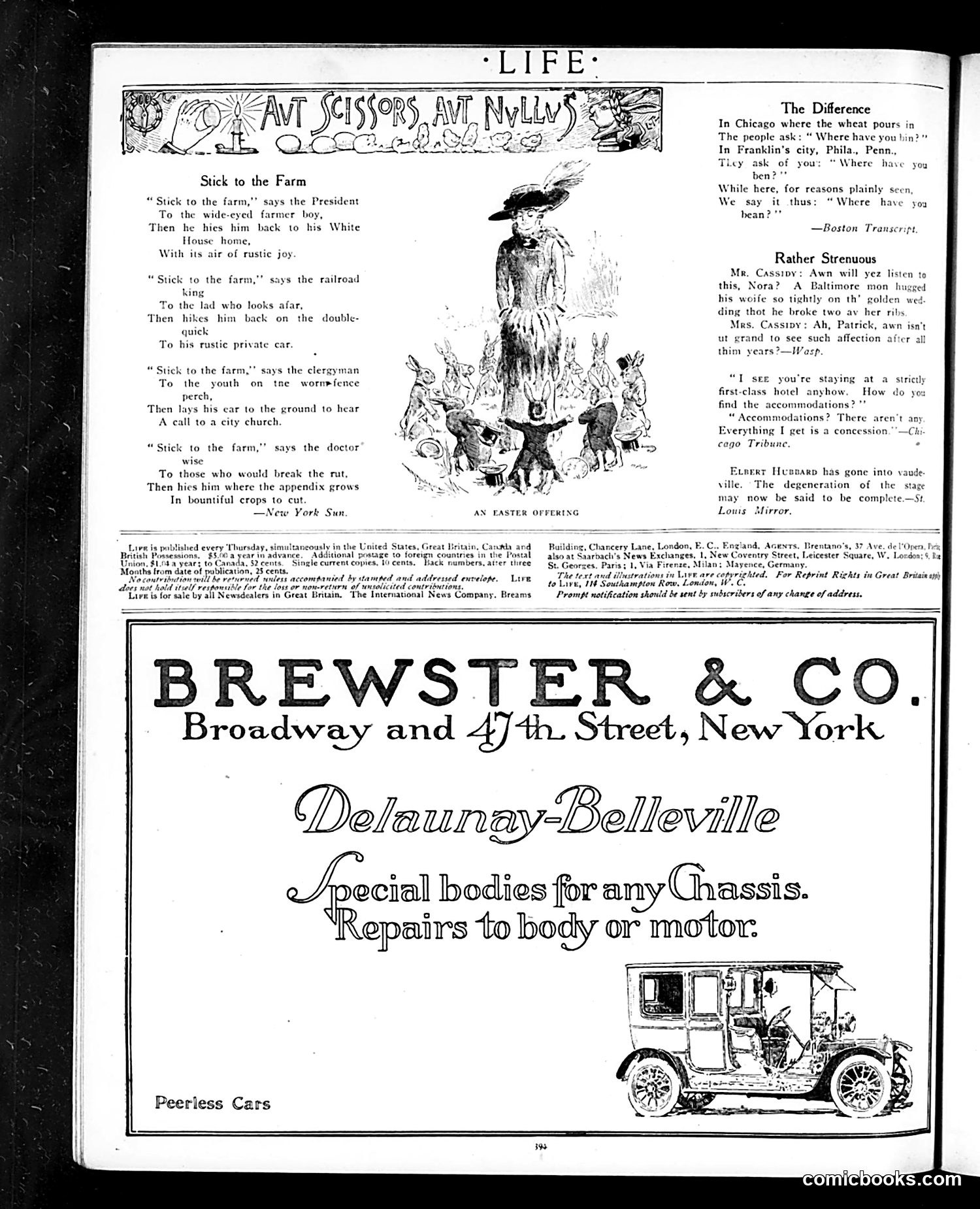
This page features a poem-cartoon satirizing advice given to farmers to remain in agricultural work, despite urban opportunities. The central illustration shows a scarecrow figure surrounded by animals—a visual metaphor for rural life's limitations. The satire targets multiple authority figures (the President, railroad king, clergyman, doctor) all telling farmers' sons to "stick to the farm," yet each figure themselves abandons rural life for city comforts: the President returns to his "White House home," the railroad man to his "private car," the clergyman to hear "a city church," the doctor to practice surgery in towns. The joke is the hypocrisy: those in power advocate agrarian virtue while personally enjoying urban benefits. The accompanying shorter jokes on the right—about Chicago wheat, Baltimore affection, and hotel accommodations—continue this theme of gap between public advice and private reality. The page also includes period advertisements for Brewster & Co. automobiles and Delaunay-Belleville cars, reflecting early 20th-century commercial culture.
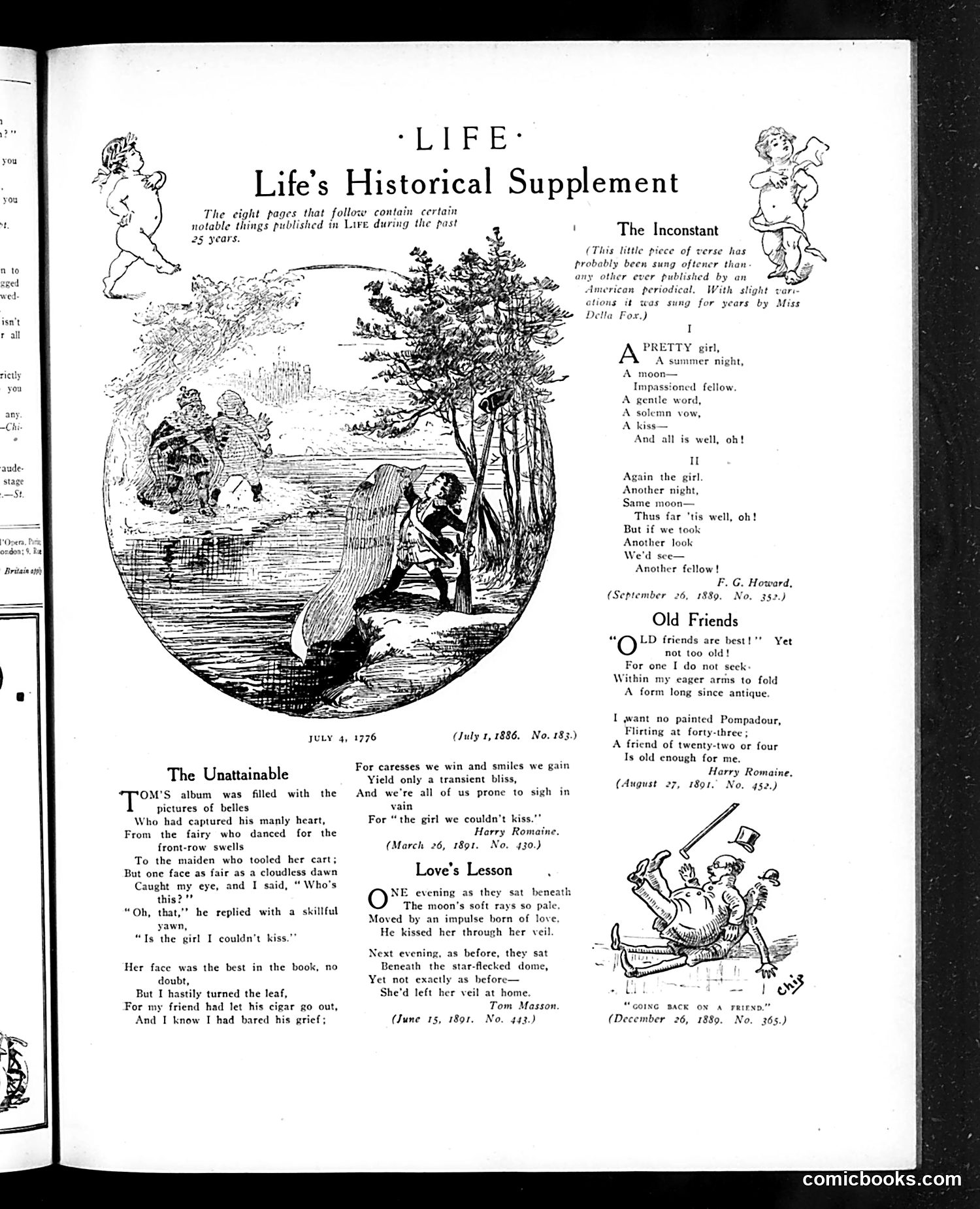
This page collects humorous verses previously published in *Life* magazine over 25 years, showcasing the publication's satirical take on romance and courtship—central concerns of late-19th-century American society. The poems mock romantic conventions: "The Unattainable" suggests that unattainable women are most desirable; "The Inconstant" depicts a woman's serial infidelities; "Old Friends" pokes fun at aging women trying to appear youthful; and "Love's Lesson" suggests a woman's boldness disappears once she removes her veil (implying she used it to mask her true self or create mystery). The accompanying Victorian-era illustrations show couples in romantic scenarios. The satire targets both male romantic delusion and female duplicity—common *Life* magazine themes that reflected anxieties about courtship, marriage, and changing gender roles in the Gilded Age. The humor is genteel and somewhat cynical about love's promises.
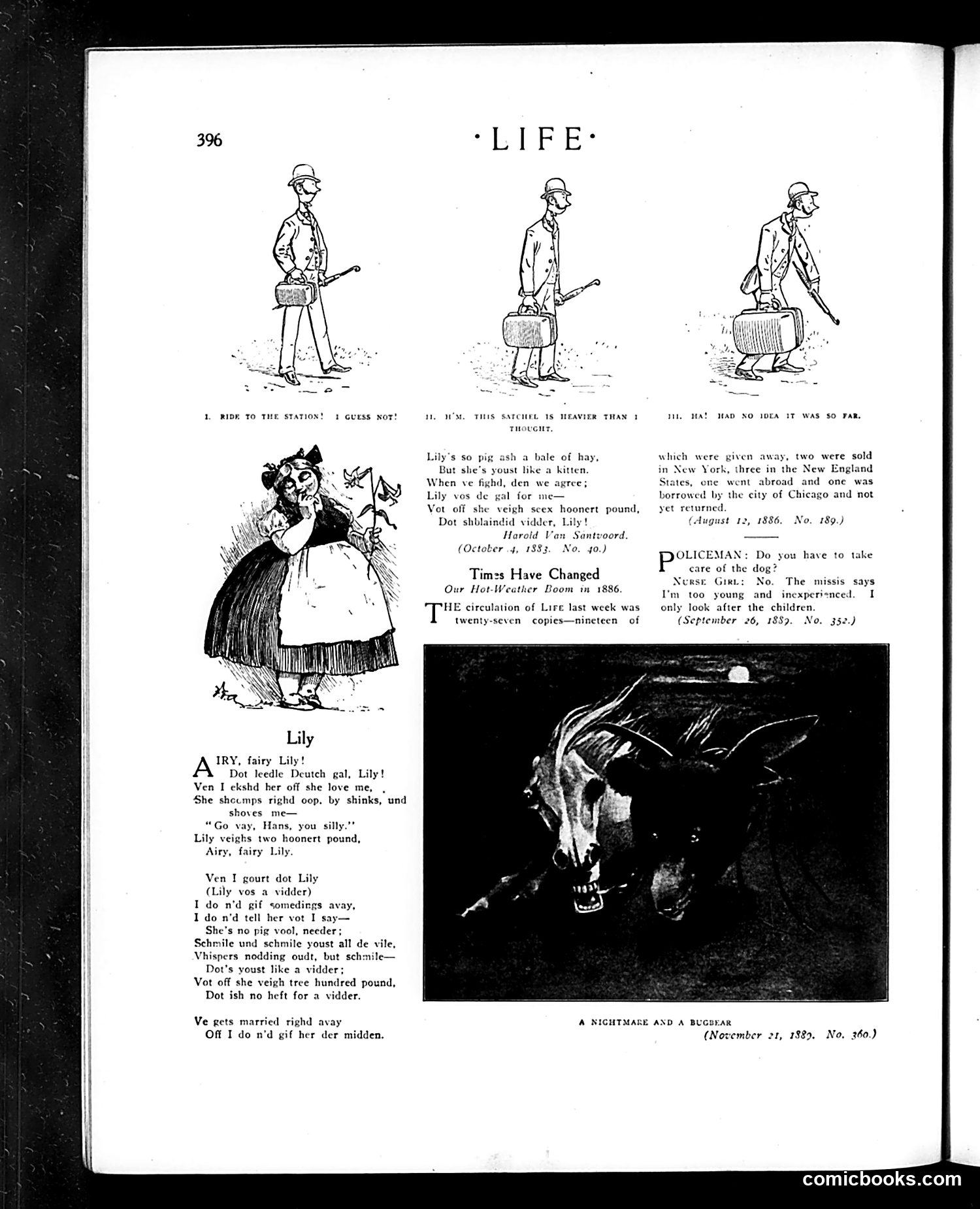
This page contains three distinct satirical pieces from 1880s Life magazine: **Top Strip:** Three sequential panels mock a commuter's complaints about his heavy suitcase during a trip to the station—visual humor about everyday inconvenience. **"Lily" Poem & Illustration:** A German-accented monologue (rendered in exaggerated dialect) about a man's wife. The humor trades on ethnic stereotyping common to the era: a German immigrant describes his large, quarrelsome wife in broken English. The caricatured woman in the illustration reinforces period stereotypes. The joke relies on audience familiarity with this comedic type. **"Times Have Changed":** Self-referential satire: Life jokes that its circulation was only 27 copies the previous week (19 given away, 2 sold in New York, 3 in New England, one borrowed by Chicago and never returned). This is meta-humor about the magazine's own modest readership. **"Do You Have to Take Care of the Dog?":** A brief exchange where a young nurse says she only watches the children, not the dog—implying the children require similar basic care to animals. All reflect Victorian-era humor conventions and editorial attitudes.
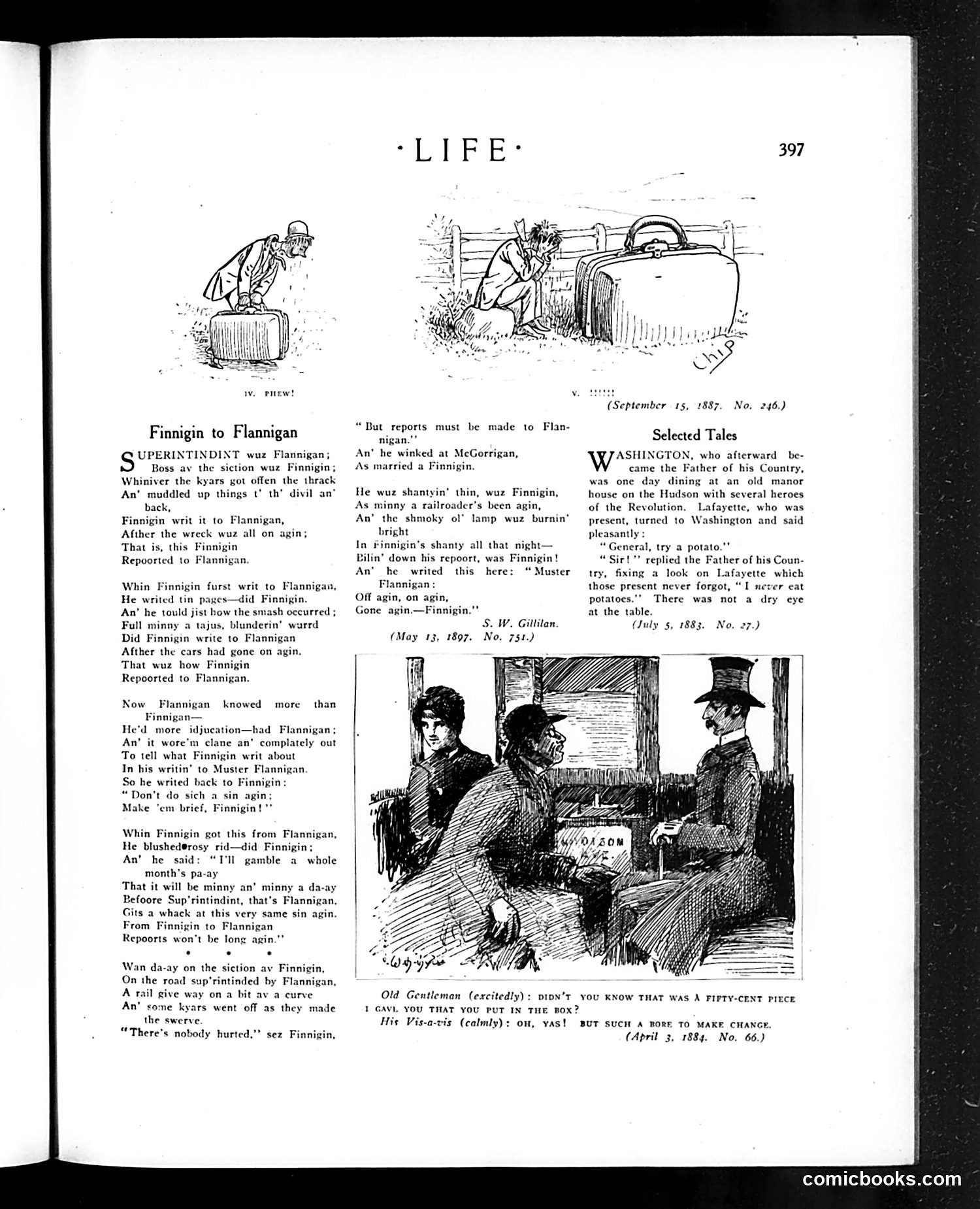
This page contains three satirical pieces from 1880s Life magazine: **"Finnigin to Flannigan"** (top left): A humorous poem in exaggerated Irish-American dialect mocking railroad bureaucracy. A worker named Finnigin must report accidents to his boss Flannigan. The joke: Finnigin writes exhaustively detailed reports, so Flannigan demands brevity. When a rail accident occurs, Finnigin's entire report reads "Off agin, on agin, / Gone agin.—Finnigin"—the ultimate brief response, implying the solution to railroad disasters is simply to get trains running again regardless of safety. **The cartoon (bottom)**: An old gentleman accuses someone of putting a fifty-cent piece in a collection box, but the person admits to deliberately using it because making change would be "a bore"—satirizing self-serving dishonesty masked as convenience. **"Selected Tales"** (right): An anecdote where George Washington refuses to eat potatoes at dinner, apparently as a matter of principle, leaving guests emotional—unclear satire, possibly mocking excessive reverence for the founding fathers.
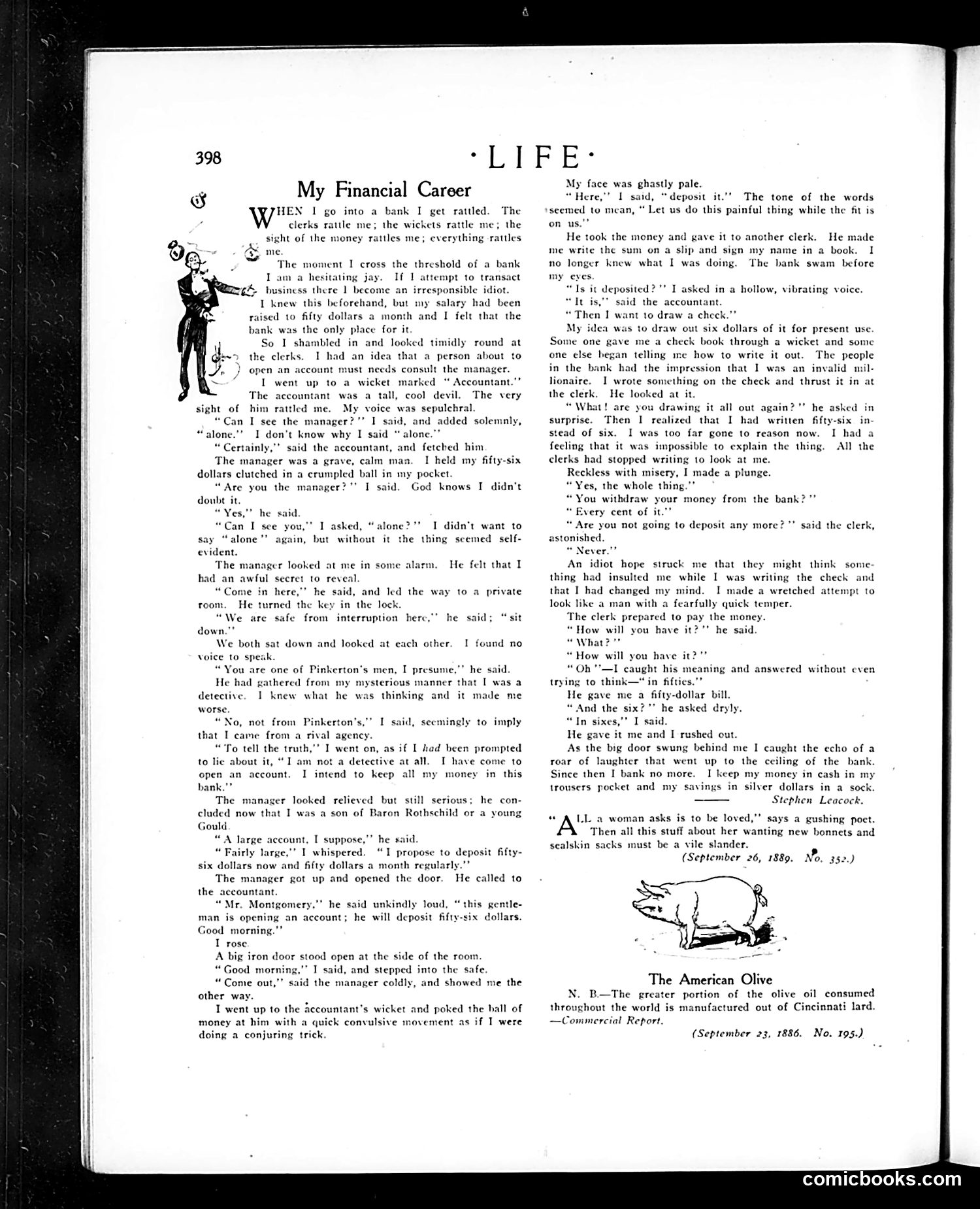
This is a comic narrative (not a political cartoon) by Stephen Leacock about a man's anxiety depositing his first modest bank account of $56. The humor satirizes the gap between a nervous depositor's self-perception and how bankers interpret his behavior. The protagonist's awkward mannerisms—asking to see the manager "alone," speaking in hushed tones, clutching crumpled bills—cause the bank manager to suspect he's either a Pinkerton detective or an extremely wealthy industrialist (referencing the famously rich Rothschild family and railroad magnate Jay Gould). The joke is that ordinary banking terrifies him so completely that simple transactions become theatrical events. His attempt to withdraw six dollars is misread as withdrawing everything. The satire mocks both the narrator's social anxiety and banks' tendency to misjudge customers based on mysterious behavior rather than facts. This was typical humorous fare for *Life* magazine's sophisticated urban audience.
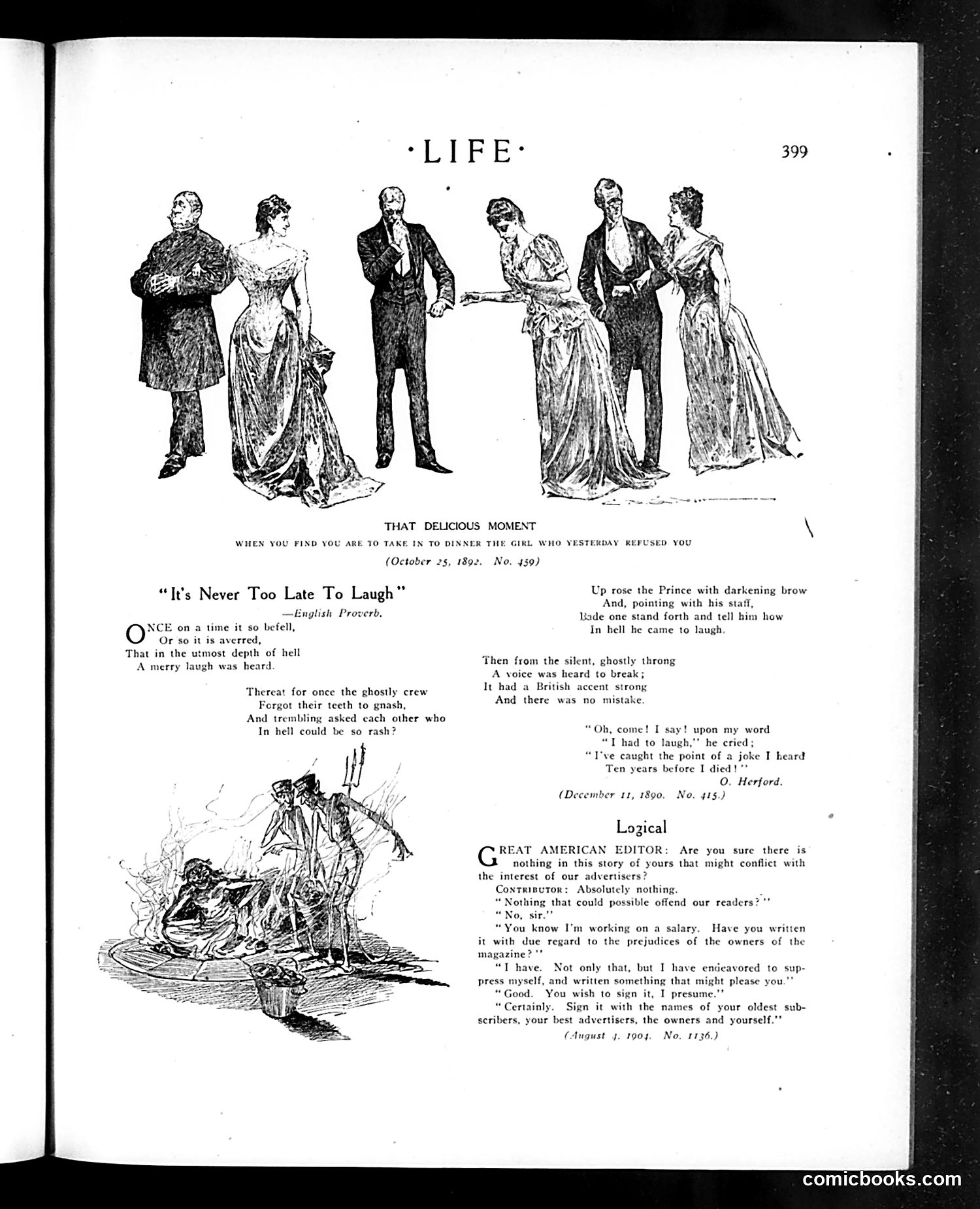
**"It's Never Too Late To Laugh"** adapts an English proverb through a humorous poem about Hell's residents discovering laughter. A damned soul with a British accent laughs after recalling a joke heard ten years before death—the joke being that it took him a decade to understand it. The satire mocks British stuffiness and slow wit. **"Logical"** satirizes magazine editorial compromise. A Great American Editor pressures a contributor to ensure the story offends no advertisers, owners, or readers—essentially demanding the writer suppress his own voice. The contributor's absurd solution—signing the piece with subscribers', advertisers', owners', and the editor's names instead of his own—exposes how corporate interests erase authorship and editorial integrity. This critiques the commercialization of publishing and loss of independent journalism.
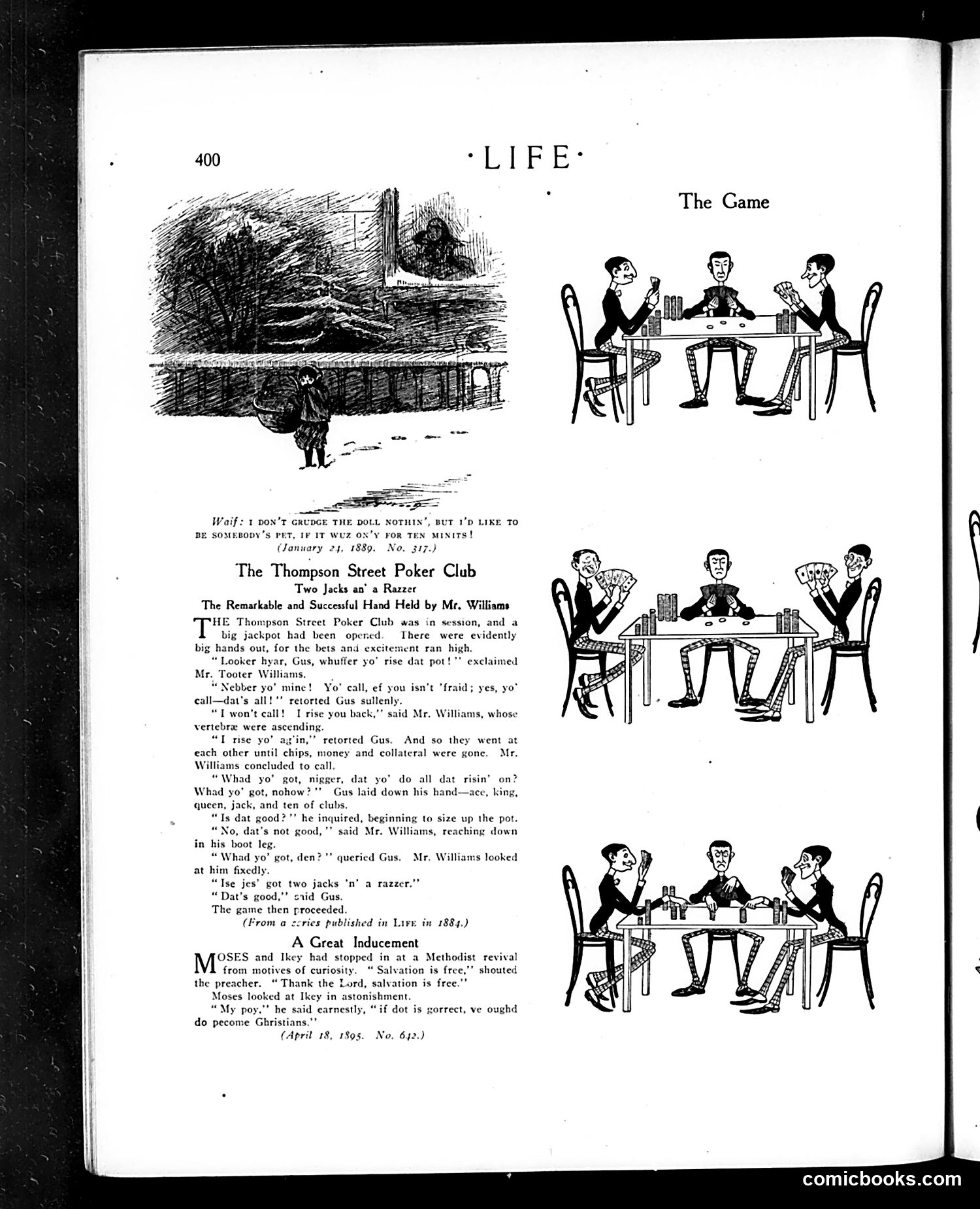
This 1889 *Life* magazine page contains two separate satirical pieces using racist dialect and caricature—common in period American humor but deeply offensive by modern standards. **"The Thompson Street Poker Club"** depicts a poker game between white and Black players using exaggerated dialect ("Whad yo' got, nigger"). The humor relies on the punchline that one player wins with "two jacks 'n' a razzer" (a bluff or worthless hand)—mocking the supposed foolishness of the Black player who accepts this. **"A Great Inducement"** features Jewish characters (Moses and Ikey) responding to a preacher's announcement that "salvation is free" by deciding to convert—the joke being that they only value religion if it's free/costs nothing, playing on antisemitic stereotypes about Jewish frugality. Both pieces use ethnic caricature and dialect to demean their subjects. This reflects *Life*'s satirical approach, which often targeted marginalized groups for mockery rather than punching at power.
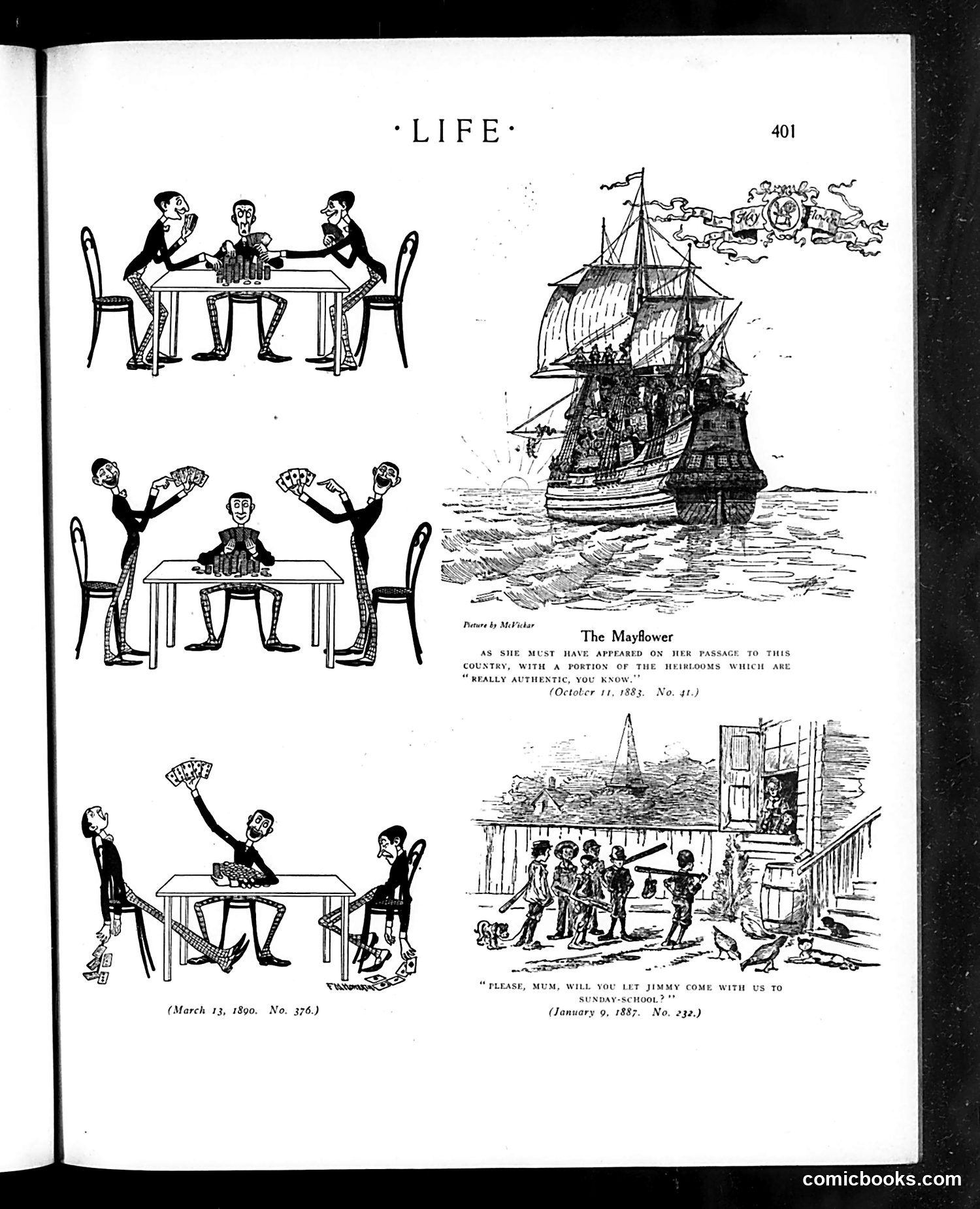
This *Life* magazine page contains three distinct satirical cartoons spanning 1883-1890: **Top left cartoons** depict gambling scenes—men at tables with cards and money, showing increasingly desperate financial situations. The progression satirizes gambling's ruinous effects on wealth and social status. **Center/right: "The Mayflower"** mocks wealthy Americans' obsession with genealogy and "authentic" colonial heirlooms. The ship is depicted carrying piles of possessions, satirizing how the nouveau riche claimed prestige through invented ancestral connections and dubious artifacts—a common target of *Life*'s satire about class pretension. **Bottom: Sunday School scene** appears to satirize either working-class desperation (a mother asking if her son "Jimmy" can attend) or social hypocrisy around religious education and class divisions. Together, these cartoons reflect *Life*'s recurring themes: mocking gambling addiction, ridiculing false claims to old-money respectability, and critiquing social inequality in Gilded Age America.
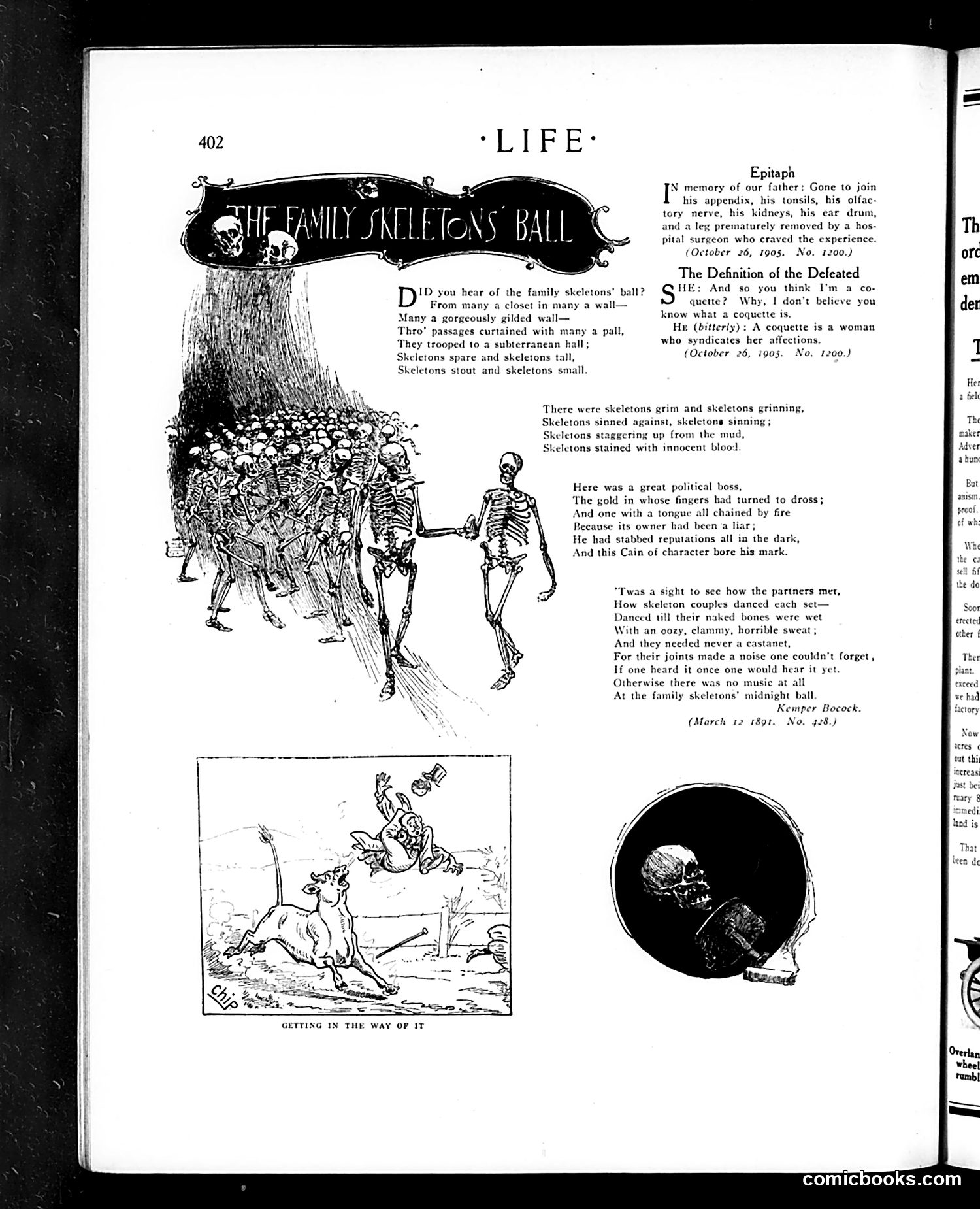
This satirical poem and illustration mock the hypocrisy of the wealthy and powerful—their hidden scandals and moral failures concealed behind respectable facades. The main figure is a "great political boss" whose ill-gotten wealth ("gold in whose fingers had turned to dross") represents corruption. Another skeleton represents a liar whose tongue was "chained by fire," and one who "stabbed reputations all in the dark"—likely referencing actual political figures or types recognizable to 1905 readers. The "family skeletons" metaphor—dark secrets hidden in closets—literalizes as grotesque dancing skeletons emerging from gilded walls and subterranean passages. Their rattling bones create involuntary music, suggesting their sins cannot remain hidden forever. The satire targets elite hypocrisy: respectable society conceals moral corruption. The poem implies that eventually, everyone's "skeletons" emerge into public view. The 1905 date suggests this reflects contemporary Progressive-era scandals and public corruption exposés.
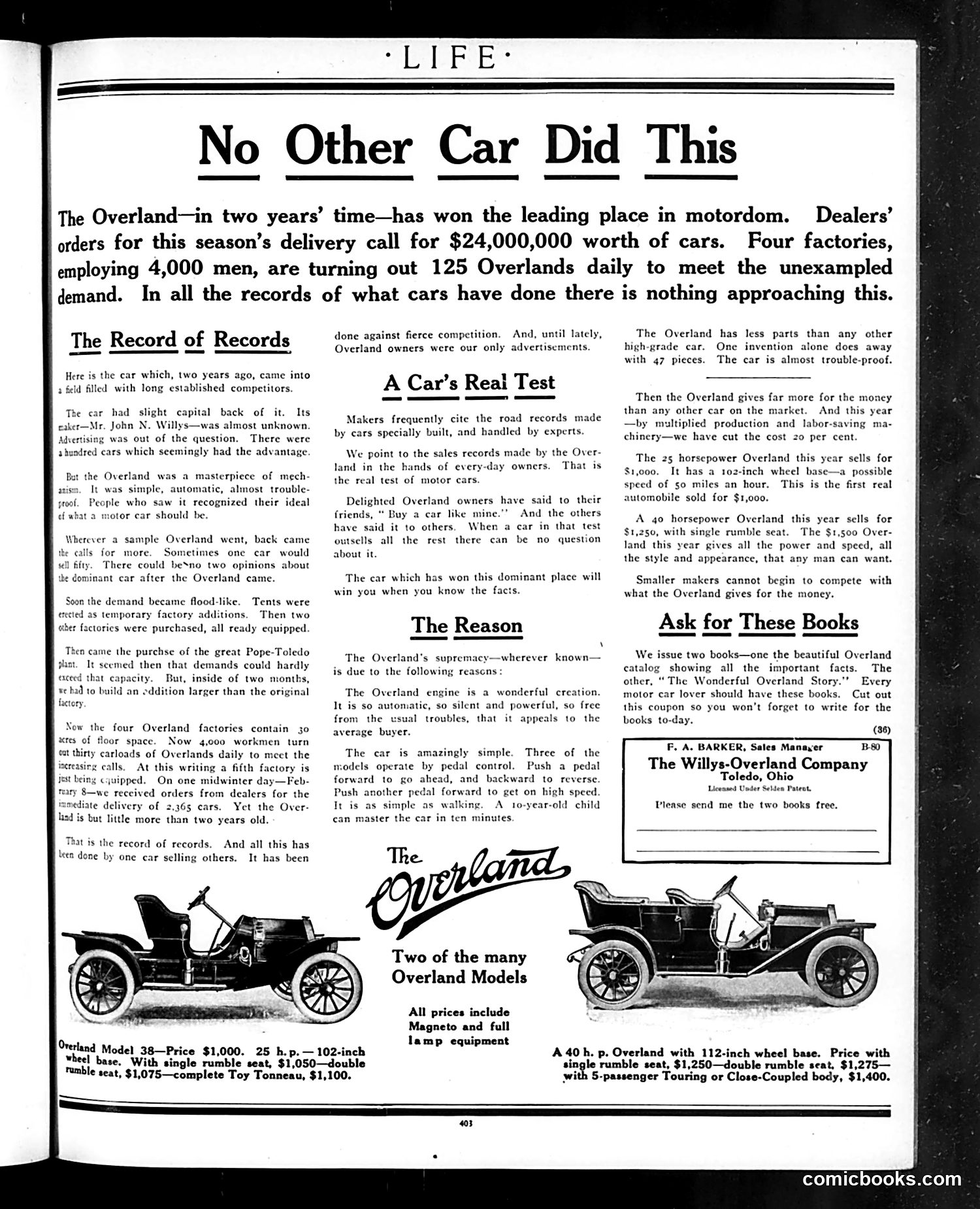
This is **not a cartoon or satire**—it's a straightforward **automobile advertisement** for the Overland car, published in *Life* magazine (which was a humor and general-interest publication, not primarily political satire). The page celebrates the Overland's remarkable market success: in just two years, it became the best-selling car in America, with $24 million in dealer orders and 125 cars produced daily across four factories. The advertiser emphasizes the car's simplicity (operated by pedals, mastered by a 10-year-old), reliability ("almost trouble-proof"), and value ($1,000 for a 25-horsepower model). The "record" being promoted is purely commercial: rapid growth through word-of-mouth sales from satisfied everyday owners, not racing achievements or technical innovations. Two car models are shown, and readers are invited to request free promotional booklets. This represents early-1900s mass-marketing strategy: building brand credibility through accessible engineering and affordability rather than luxury positioning.
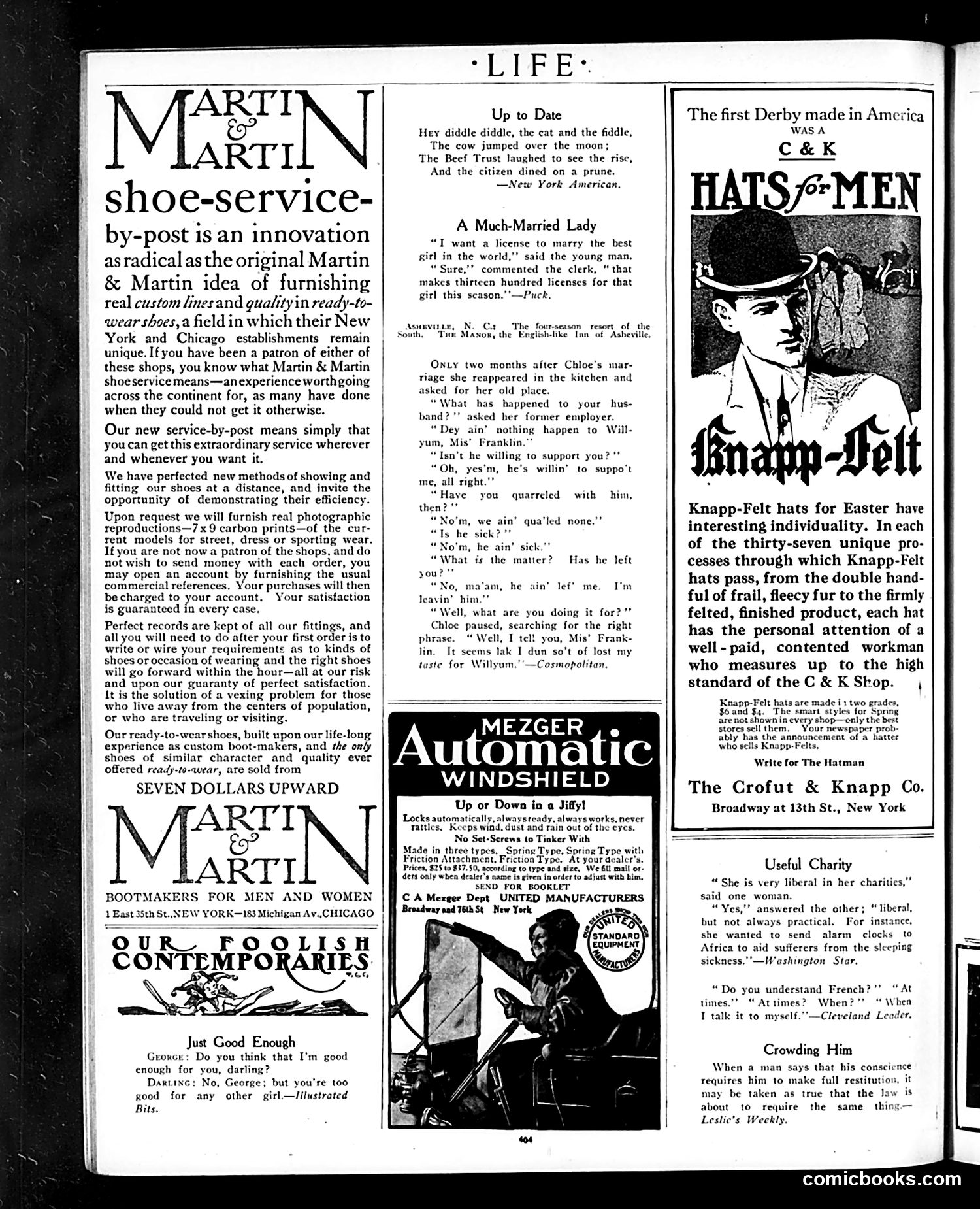
This page is primarily **advertising content** from an early 20th-century American satirical magazine, interspersed with brief humorous items. The advertisements promote consumer goods: Martin & Martin shoe mail-order service, Mezger automatic windshields, and C&K Knapp-Felt hats. The small jokes and quotations scattered throughout reflect contemporary social humor: - The "Up to Date" verse satirizes the Beef Trust (monopolistic meat-packing companies under public scrutiny) and economic hardship (citizens reduced to eating prunes) - "A Much-Married Lady" mocks marriage licensing and infidelity - The Chloe anecdote uses racist dialect humor (common for the era) about a domestic worker leaving employment - "Just Good Enough" presents a joke about female romantic expectations These items reflect early 1900s preoccupations: corporate monopolies, marital instability, class dynamics, and gender relations. The humor is gentle, domestic, and reflects *Life* magazine's satirical approach to middle-class American life and concerns.
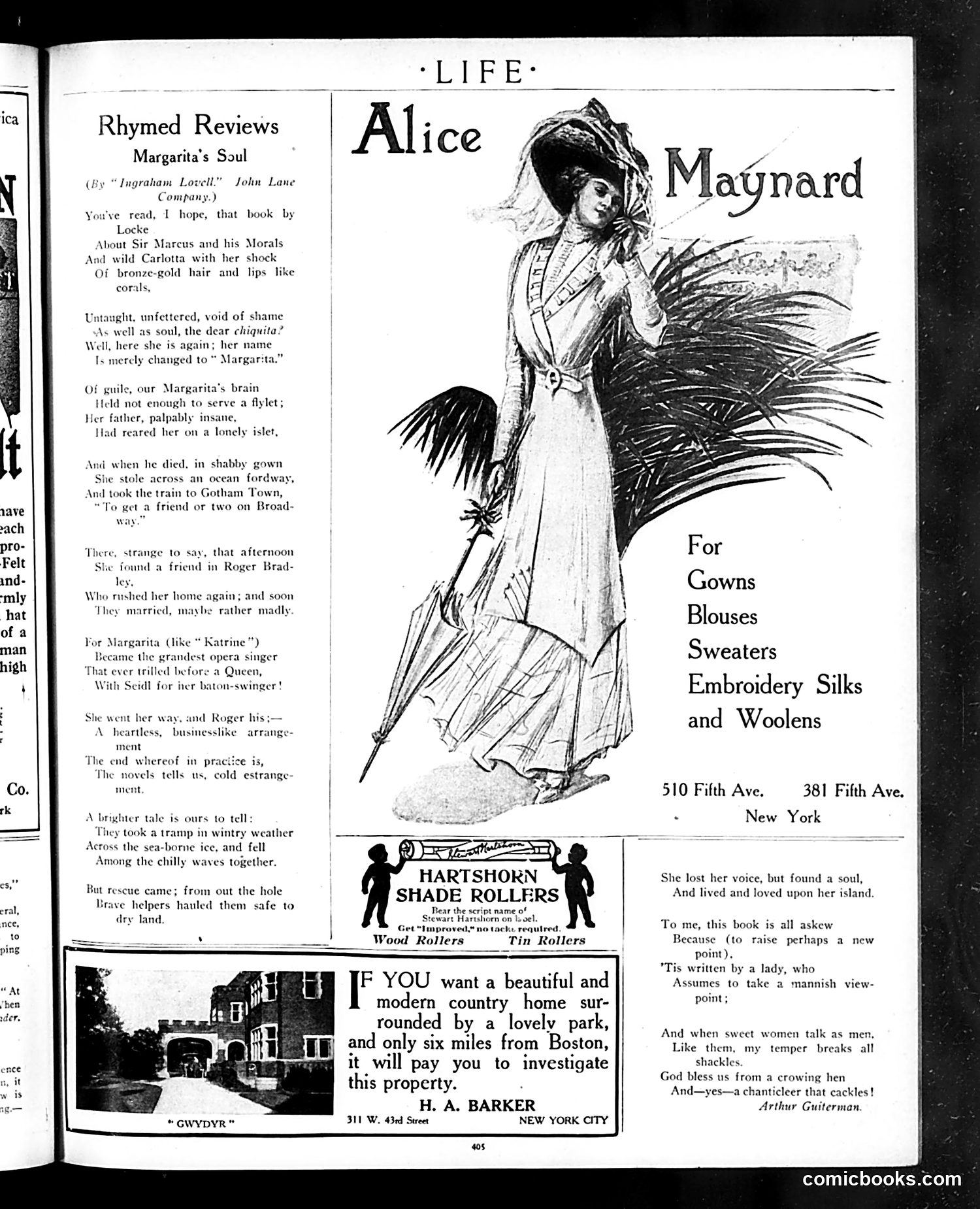
This page contains a **book review in verse** of "Margarita's Soul," critiquing both the novel and its author's perspective. **The Satire:** The reviewer mocks a female author for adopting a "mannish viewpoint"—writing about women in ways the (male) reviewer finds inappropriate. The plot synopsis shows a naive woman (Margarita) who becomes an opera singer, marries hastily, nearly drowns with her husband, loses her voice but "finds a soul," and retreats to an island. **The Social Critique:** The reviewer's complaint reveals period gender attitudes: he objects that the author "assumes to take a mannish view-point" and complains "when sweet women talk as men, / Like them, my temper breaks all shackles." He concludes sarcastically blessing protection "from a crowing hen"—mocking women stepping outside traditional feminine roles. **Context:** This reflects early 20th-century anxiety about women's changing social positions. The review itself inadvertently demonstrates the very male condescension it illustrates, making it likely satirical commentary on literary sexism rather than sincere criticism.
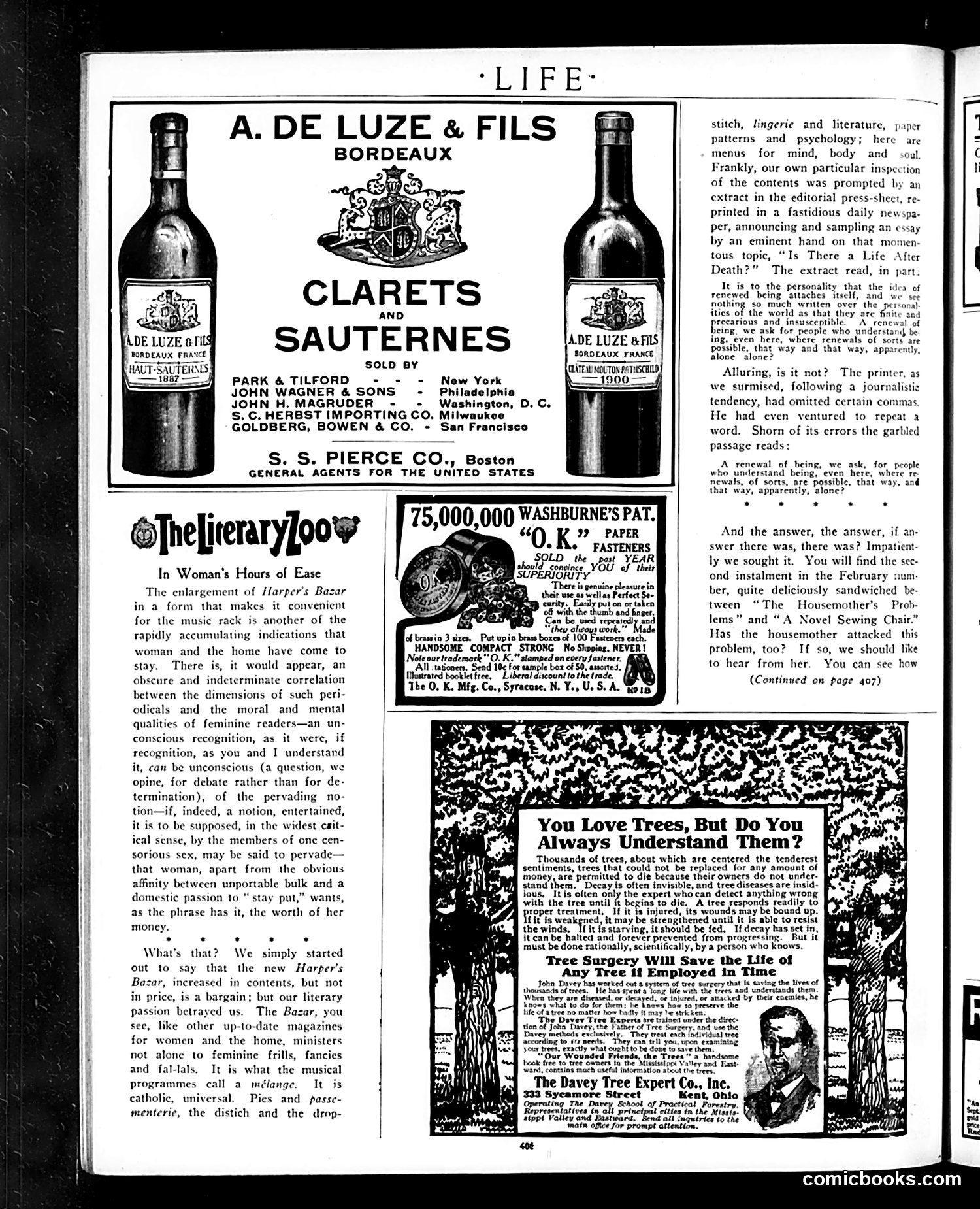
This is primarily an **advertising and editorial page** with minimal satirical content. The page features: **Advertisements:** - A De Luze & Fils wine advertisement for Bordeaux clarets and Sauternes (top) - Washburne's patent paper fasteners (middle right) - The Davey Tree Expert Company (bottom) **Editorial Content:** "The Literary Zoo" section satirizes the expansion of *Harper's Bazaar* magazine. The author humorously critiques how women's magazines combine disparate content—from philosophy ("Is There a Life After Death?") to domestic concerns ("A Novel Sewing Chair")—suggesting this reflects confused assumptions about female readers' intellectual capacity. The piece mockingly notes a typographical error in the philosophical essay, then absurdly contextualizes it among homemaking content. **No political cartoons appear on this page.** The satire is gentle and literary rather than political, targeting magazine editorial choices and assumptions about women's interests.
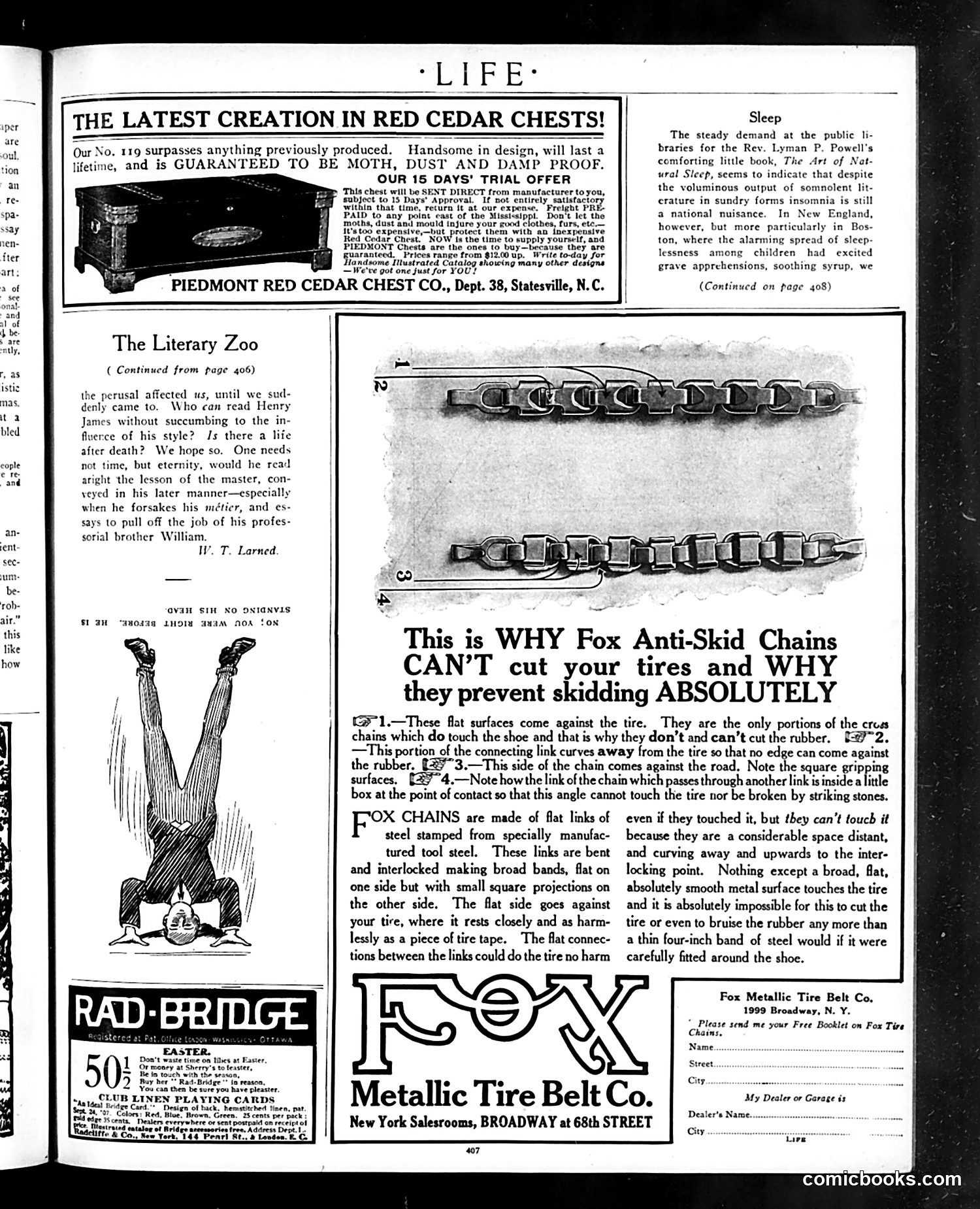
This page contains primarily **advertisements and literary content**, not political satire. The main items are: 1. **Red Cedar Chest ad** (top): Promotes moth-proof storage chests, offering a 15-day trial. Standard consumer advertising. 2. **"The Literary Zoo"** (left column): A literary essay continuing from page 406, discussing Henry James's writing style and its soporific effect on readers. The author (W.T. Larned) makes a joke about needing "eternity" to read James properly. 3. **Fox Anti-Skid Chains ad** (dominant right side): Technical product advertisement with detailed diagrams explaining why the chain design prevents tire damage. The numbered illustrations show cross-sections of how the flat links contact the tire safely without cutting rubber. 4. **Rad-Bridge card game ad** (bottom left): Brief advertisement for Easter-themed playing cards. There is **no political cartoon or satire** on this page. It represents a typical early 20th-century magazine layout mixing editorial content with commercial advertisements.
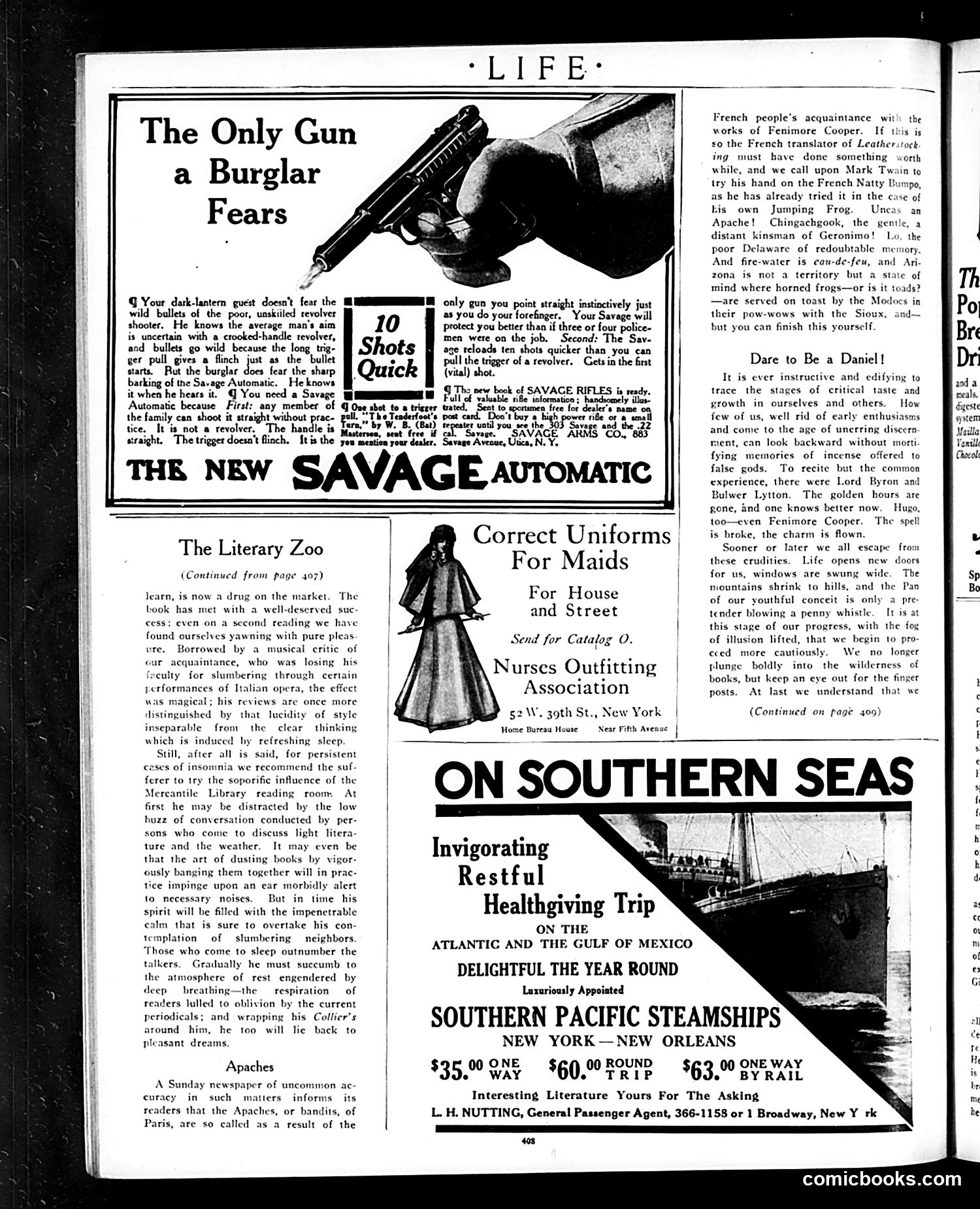
This page contains early 20th-century advertisements and commentary. The main cartoon advertises the Savage Automatic pistol, claiming it's "the only gun a burglar fears." The ad uses pseudo-technical language to market the weapon's reliability and quick-reload capability to ordinary homeowners concerned about burglary. The accompanying text references Fenimore Cooper's frontier novels and Native American groups (Apaches, Modocs, Sioux), reflecting period attitudes treating these as exotic subjects for entertainment. "Dare to Be a Daniel" discusses literary taste, criticizing earlier enthusiasm for romantic authors like Byron and Cooper as immature. The page also advertises maid uniforms, nursing outfits, and cruise ship travel—typical Life magazine commercial content. The "Literary Zoo" section continues discussion of popular books. Overall, this reflects early 1900s consumer culture, attitudes toward weaponry, and dated cultural references that would confuse modern readers unfamiliar with that era's commercial advertising and literary canon.
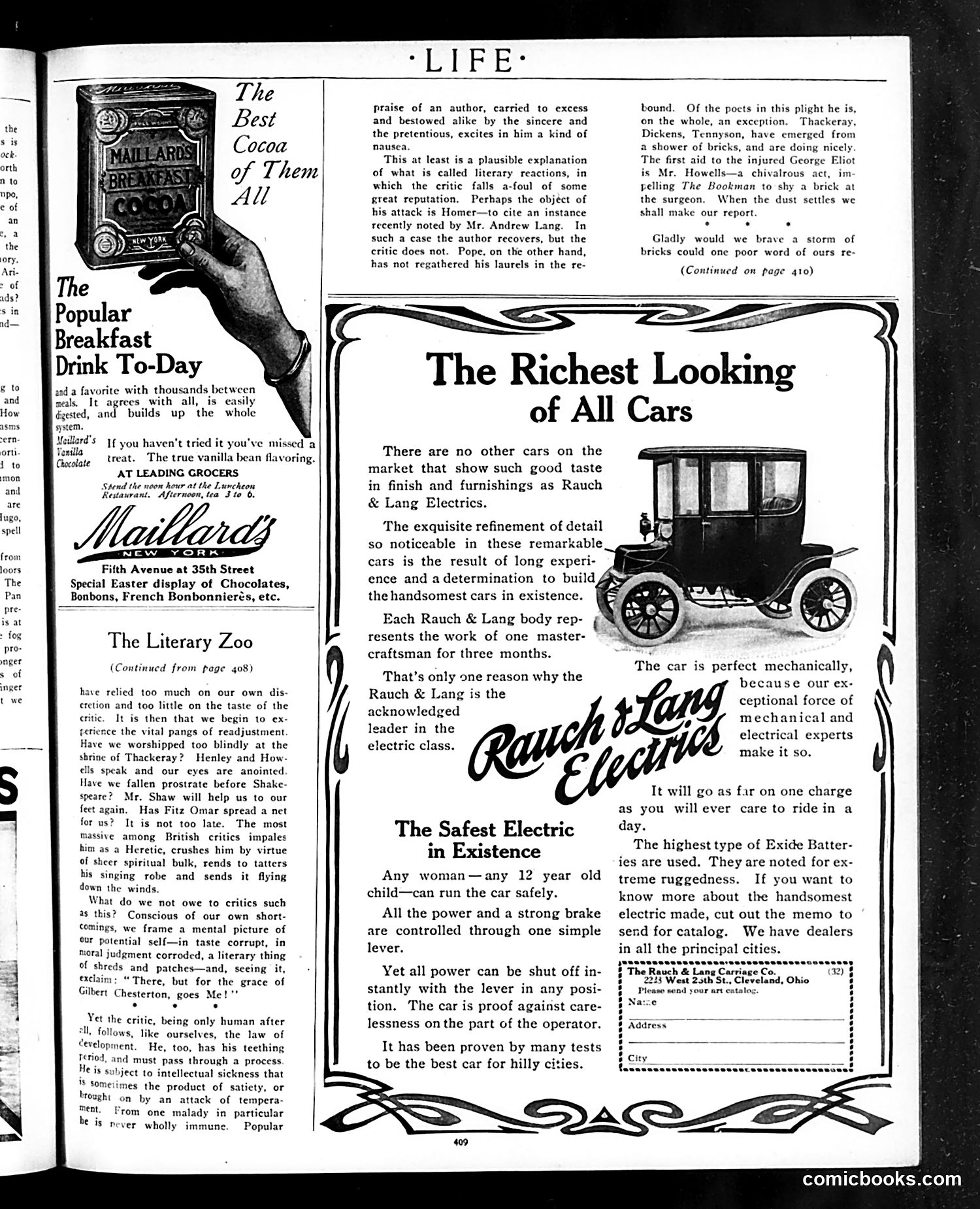
This page contains **two distinct sections**: a literary essay and period advertising. ## "The Literary Zoo" (left column) This is a satirical essay about literary critics and their tendency to attack established authors after they gain popular acclaim. The author argues critics experience "nausea" when an author becomes too universally praised, leading them to unfairly attack reputations like Homer or Pope. The piece humorously suggests critics themselves are subject to intellectual "sickness" and temporary fashions in taste—they're not infallible judges but flawed humans following trends. ## Advertisements (right side) The page features period ads for Maillard's cocoa (emphasizing vanilla flavoring and digestibility) and a **Rauch & Lang Electric car**—notable because it's marketed specifically to women and children as safe and simple to operate (one lever controls everything). This reflects early 1900s attitudes: electric cars were seen as safer, cleaner alternatives to gasoline vehicles, particularly appealing to female drivers in an era when women had limited transportation independence. Both sections reflect early 20th-century cultural concerns: intellectual pretension and evolving gender roles in consumer culture.
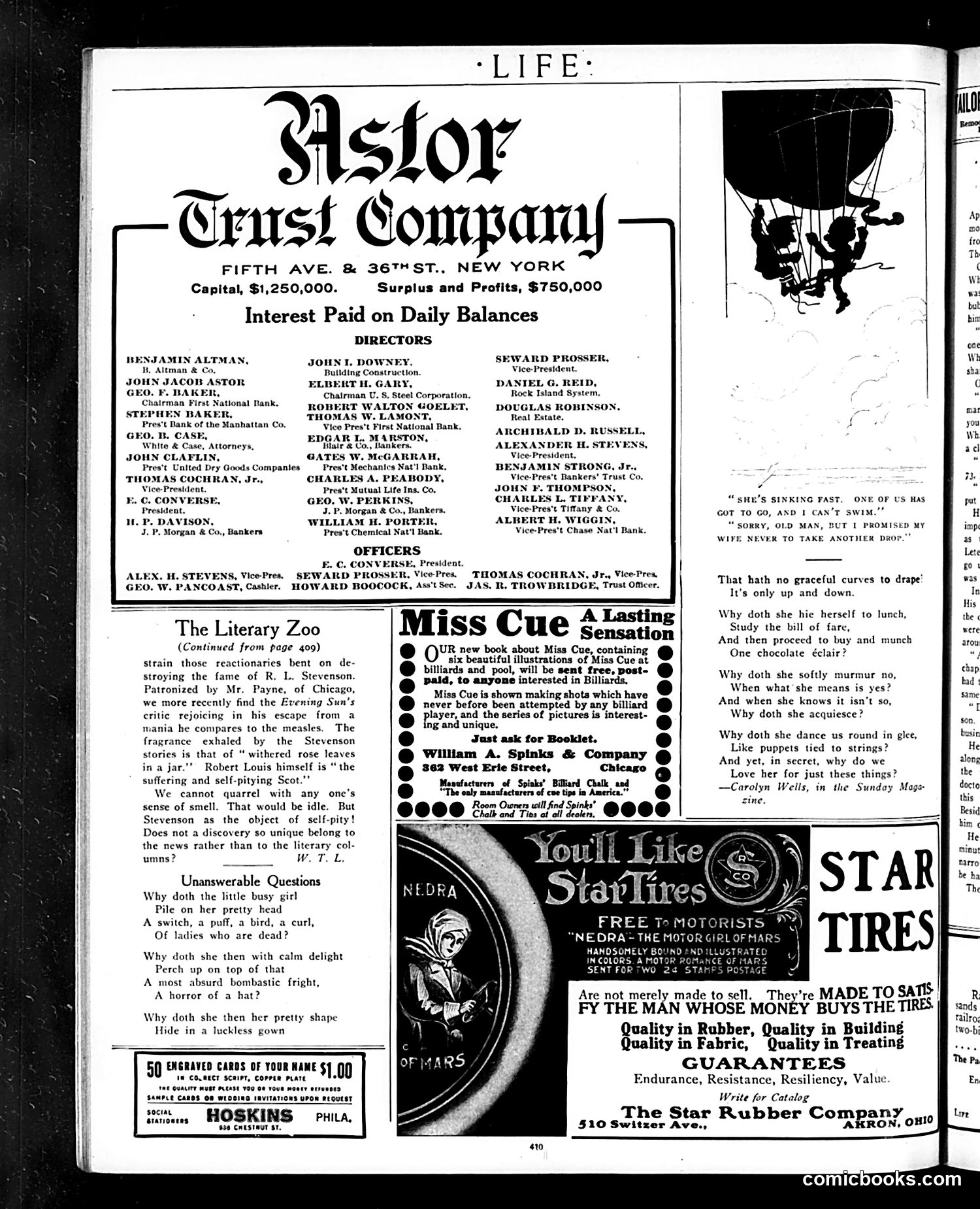
This page is primarily **advertising and business notices** rather than editorial content. The main elements include: **Astor Trust Company Advertisement**: A prominent bank advertisement listing wealthy New York directors (Astors, Altmans, Vanderbilts, etc.), emphasizing capital and surplus figures typical of Gilded Age financial institutions. **"The Literary Zoo"**: A brief literary column mocking critics who attacked Robert Louis Stevenson's reputation, defending the author against dismissive reviews. **"Unanswerable Questions"**: Verses by Carolyn Wells humorously questioning women's fashion and behavior choices—typical early-1900s light satire about female vanity and contradictions (why wear uncomfortable clothing? why say "no" when meaning "yes?"). **Minor Advertisements**: Including Miss Cue billiards book, Star Tires, Hoskins stationery, and Nedra motorcar serial fiction. The page reflects **early 20th-century concerns**: banking prominence, literary criticism, and gentle gender-based humor. Most content is commercial rather than satirical.
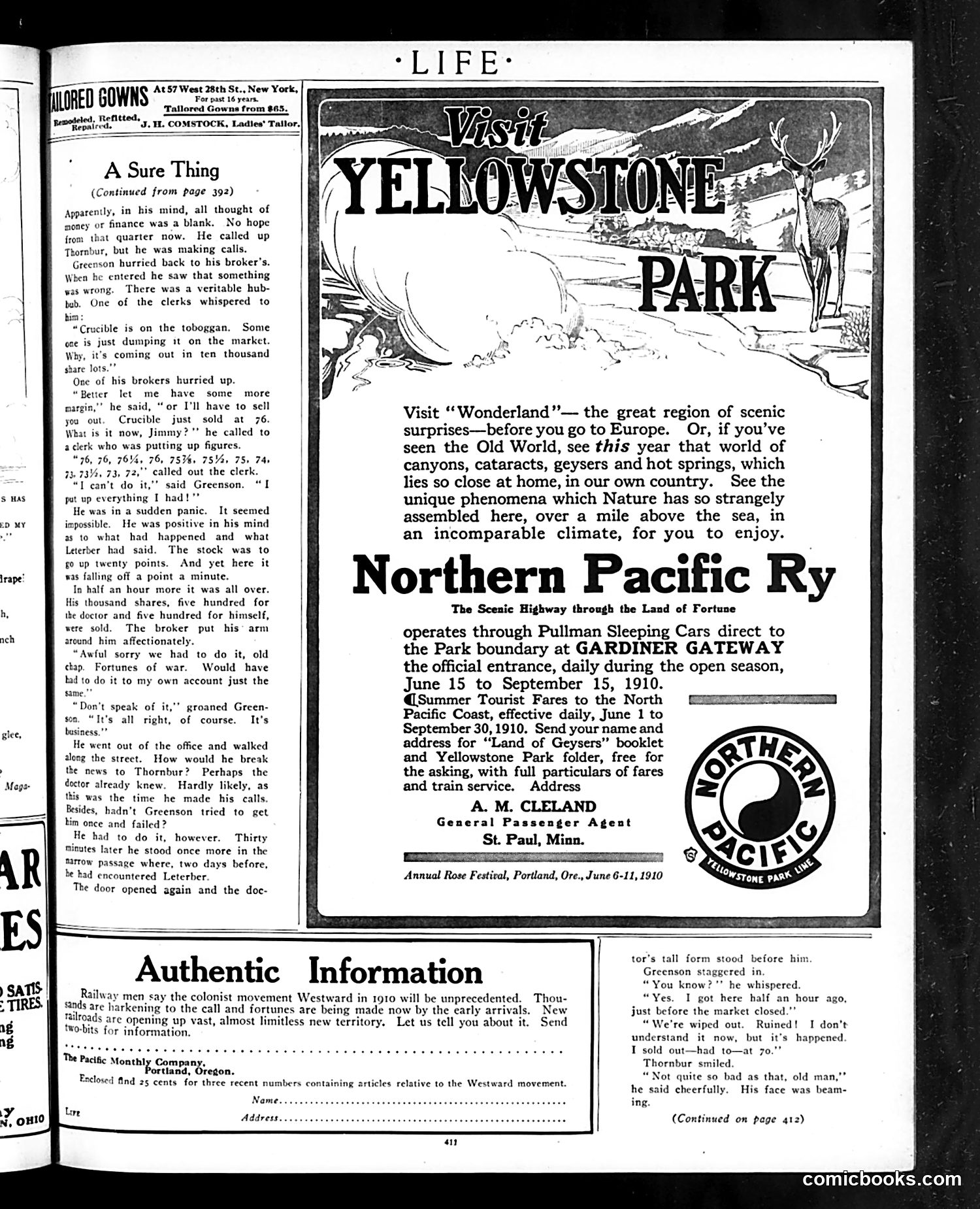
This page presents a serialized fiction story about stock market speculation. The narrative follows a character named Greenson who attempts to profit from a tip about Crucible stock rising twenty points. However, the stock instead crashes unexpectedly, forcing him to liquidate his holdings at a devastating loss of approximately 30 points per share. The story illustrates a cautionary tale about financial overconfidence and market unpredictability—themes relevant to 1910 readers during an era of rapid industrial speculation. Greenson's certainty proves baseless; despite his conviction in inside information, the market moves opposite to expectations, wiping out his investment. The remainder of the page contains tourism advertising for Yellowstone Park and Northern Pacific Railway, plus an "Authentic Information" section promoting westward colonization opportunities—representing contemporary business optimism contrasting sharply with the story's financial cautionary message.
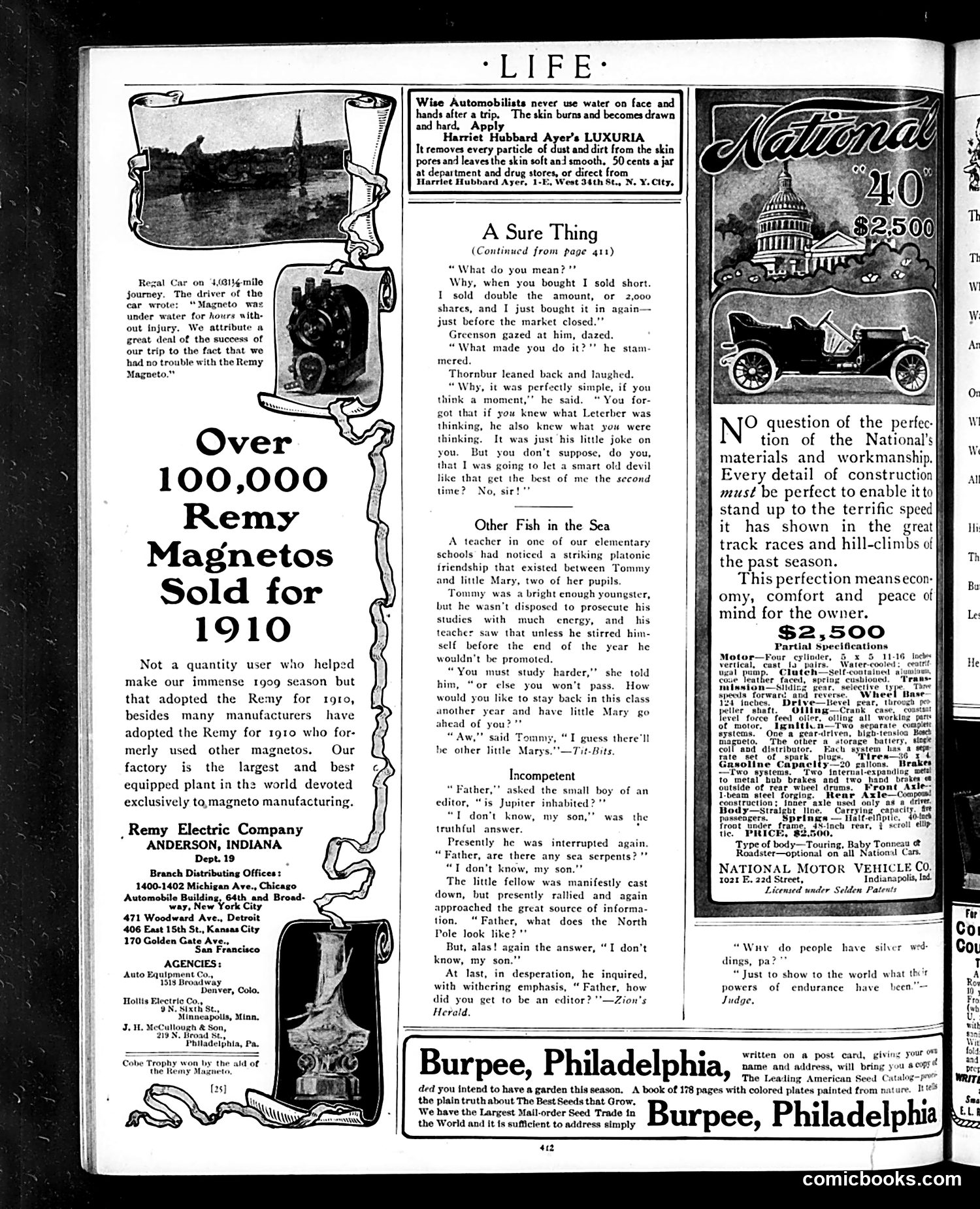
This page is primarily **advertising**, dominated by two major car/automotive product ads (Remy Magnetos and National Motor Vehicle), interspersed with short humorous stories typical of Life's satirical content. **The humor pieces** are lightweight social jokes: - "A Sure Thing": A stock market anecdote about an investor outsmarting another by predicting his opponent's psychology - "Other Fish in the Sea": A sentimental story about a boy choosing studies over romance (the punchline: there are other girls) - "Incompetent": A joke mocking a newspaper editor who admits ignorance on various topics, finally asked how he became an editor—implying editors are incompetent None contain political satire or caricature. The page reflects early 1910s consumer culture, emphasizing new automobile technology and modern conveniences (skincare products), alongside gentle domestic humor. This is representative of Life's evolution from sharp political satire toward lifestyle magazine content.
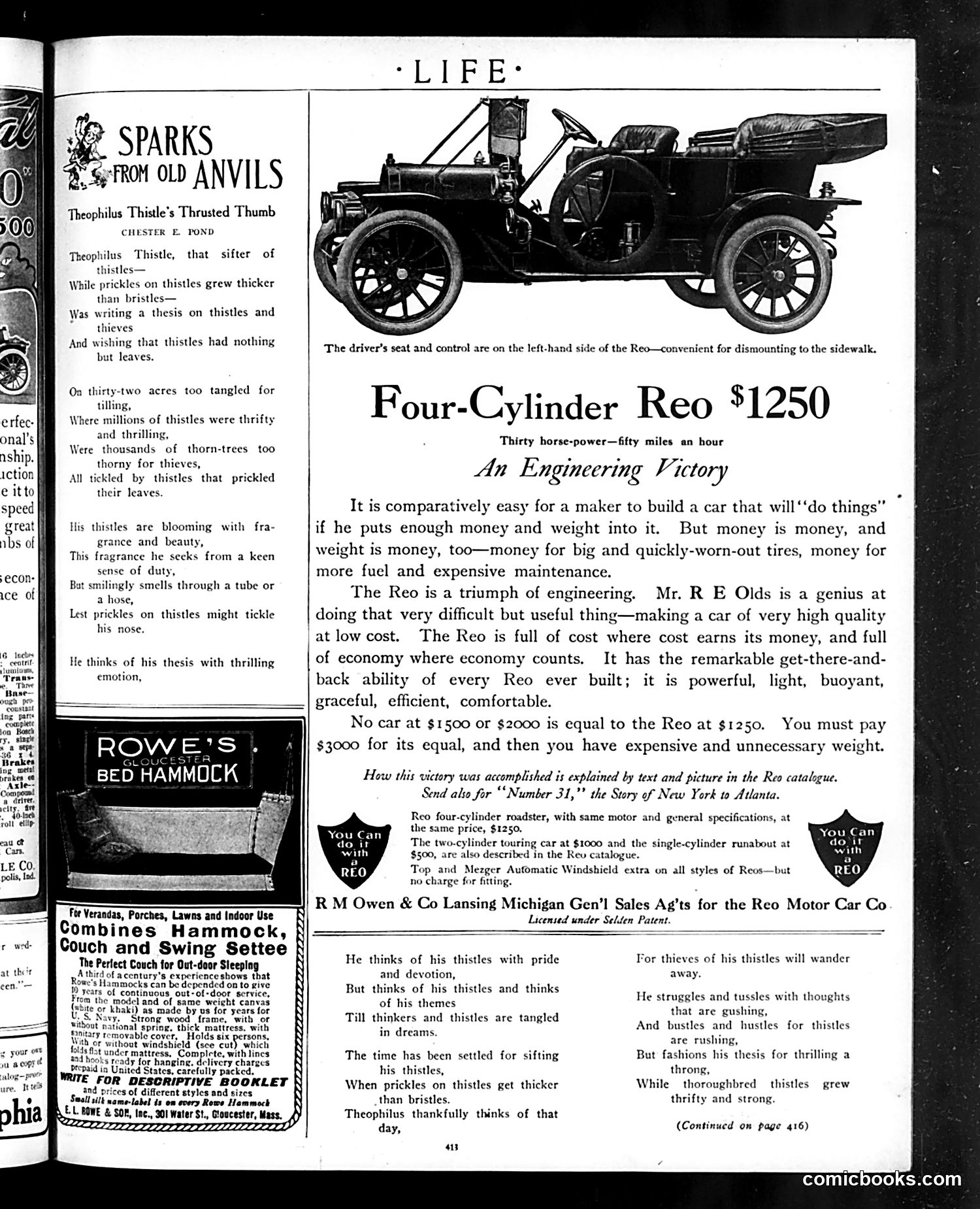
This page contains a humorous tongue-twister poem titled "Sparks from Old Anvils" by Chester E. Pond, featuring the character Theophilus Thistle attempting to write an academic thesis about thistles and thieves. The joke relies entirely on **alliteration and sound repetition**—the difficulty of pronouncing phrases like "Theophilus Thistle's thrusted thumb" and "thistles and thieves" tangled together. It's absurdist wordplay humor typical of early 20th-century magazines. The remainder of the page is **automobile advertising** for the Reo Motor Car Company, emphasizing engineering efficiency and affordable pricing ($1250). No political satire, caricature, or social commentary appears here. This is primarily light entertainment and product marketing, with no figures or events requiring historical context to understand.
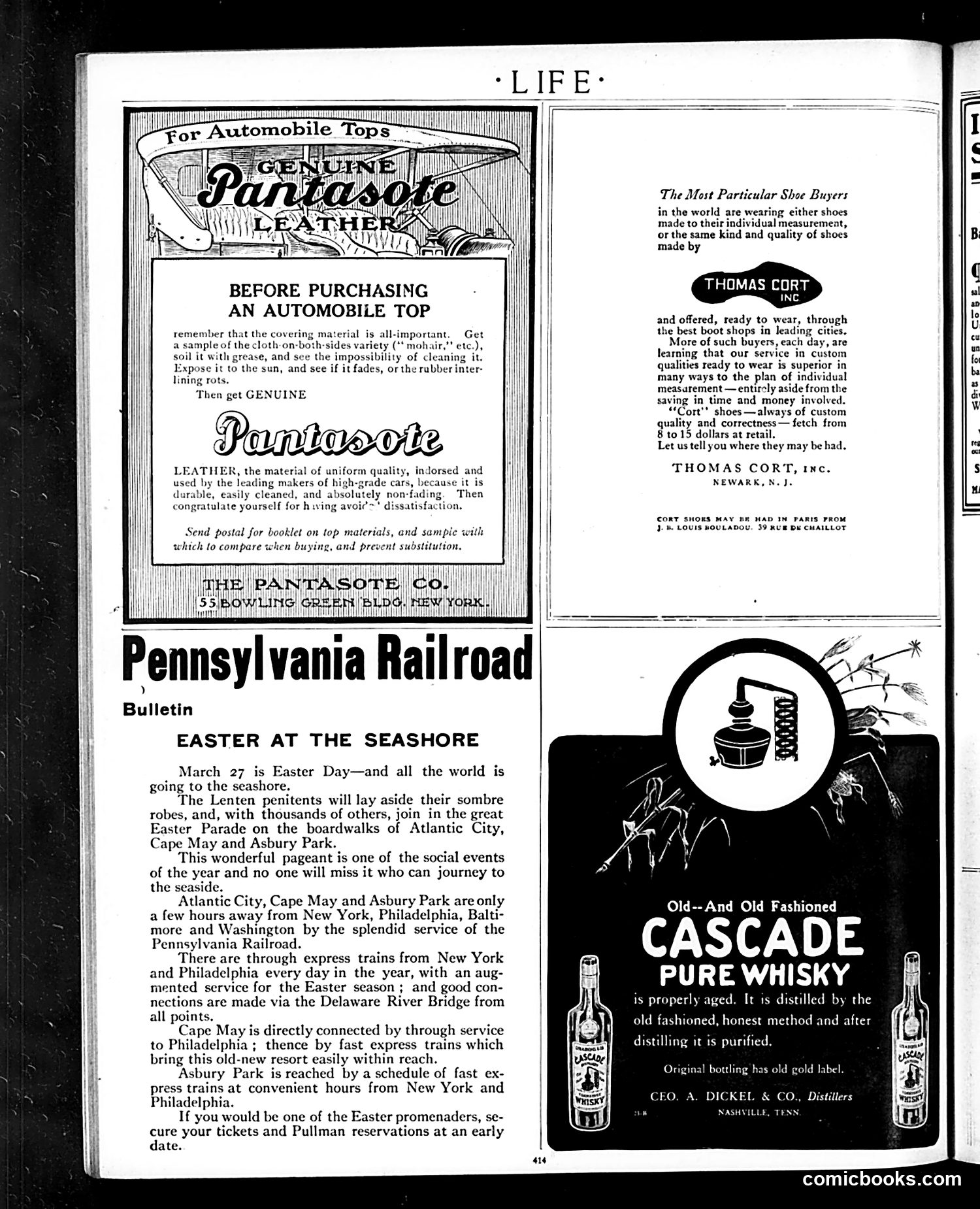
This page contains **no political cartoons or satire**—it is primarily **advertisements and travel promotion**. The content includes: 1. **Pantasote Leather ad** (top left): Advises buyers to test automobile top materials before purchasing, promoting Pantasote leather as durable and fade-resistant. 2. **Thomas Cort Inc. shoe ad** (right): Markets custom-made or quality ready-made shoes sold through major retailers. 3. **Pennsylvania Railroad bulletin** (center-lower): Promotes Easter travel to Atlantic City, Cape May, and Asbury Park via railroad service, describing the "Easter Parade" as a major social event where people display new spring clothing on boardwalks. 4. **Cascade Pure Whisky ad** (bottom right): Emphasizes traditional distilling methods and aging. The page reflects **early 20th-century commercial culture**—advertising leisure travel, consumer goods, and luxury products to affluent readers. The Easter Parade reference reflects the era's tradition of displaying fashionable spring attire publicly, a significant social ritual before modern entertainment alternatives.
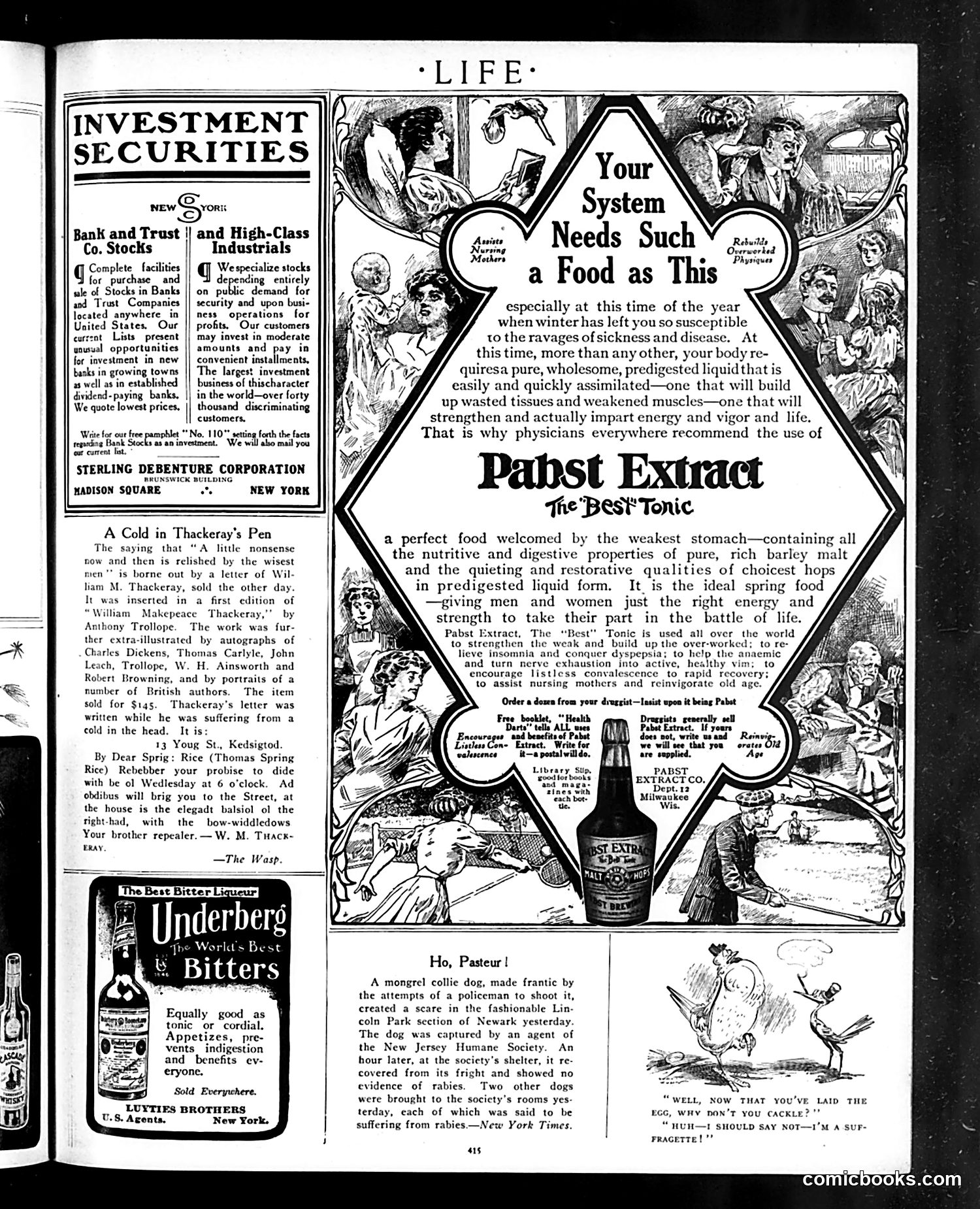
This page contains **vintage advertisements** rather than political cartoons. The primary content is a large ad for **Pabst Extract**, a malt beverage marketed as a medicinal "tonic" and "food." The ad's pitch reflects early 20th-century patent medicine culture: it claims the product strengthens the weak, cures insomnia, aids digestion, and helps nursing mothers—assertions that would be illegal today. The elaborate illustration shows idealized figures of health and vitality, appealing to consumers' anxieties about winter illness and weakness. Below is an unrelated humor piece about a letter by author William Thackeray written while he had a head cold, showing his misspellings—a lighthearted literary anecdote. The page also includes ads for investment securities and **Underberg Bitters**, another medicinal alcohol product. These reflect a pre-FDA era when such beverages made sweeping health claims without regulation, marketing themselves as solutions to vague ailments like "nerve exhaustion" and "listlessness."
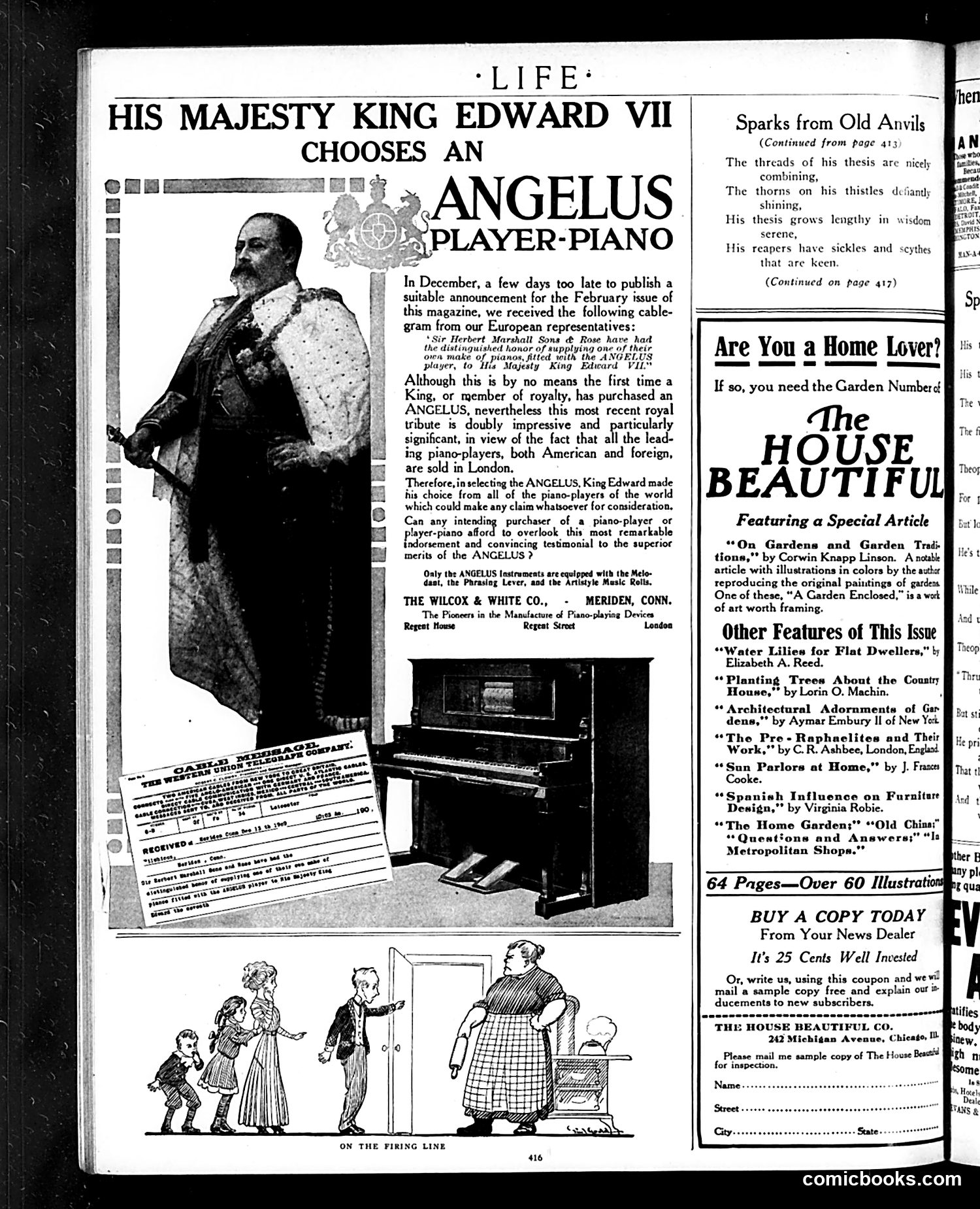
This page is primarily a **full-page advertisement** for the Angelus player-piano, disguised as editorial endorsement. The satire lies in its heavy-handed use of royal prestige. **The Hook:** The headline announces that King Edward VII has purchased an Angelus piano-player. A telegram from European representatives claims this choice carries special significance because the King selected from "all of the piano-players of the world." **The Joke:** Life is mocking the advertising industry's shameless exploitation of celebrity endorsement. By framing a commercial purchase as a royal "tribute" of "impressive" and "significant" importance, the ad suggests that a consumer product gains legitimacy through association with monarchy—absurdly inflating a simple business transaction into evidence of superiority. **The Cartoon Below:** Shows a domestic scene labeled "On the Firing Line," likely satirizing everyday family tensions (appears unrelated to the piano ad above). The page exemplifies early 1900s satirical advertising critique, where Life magazine would editorially mock commercial desperation even while accepting ads.
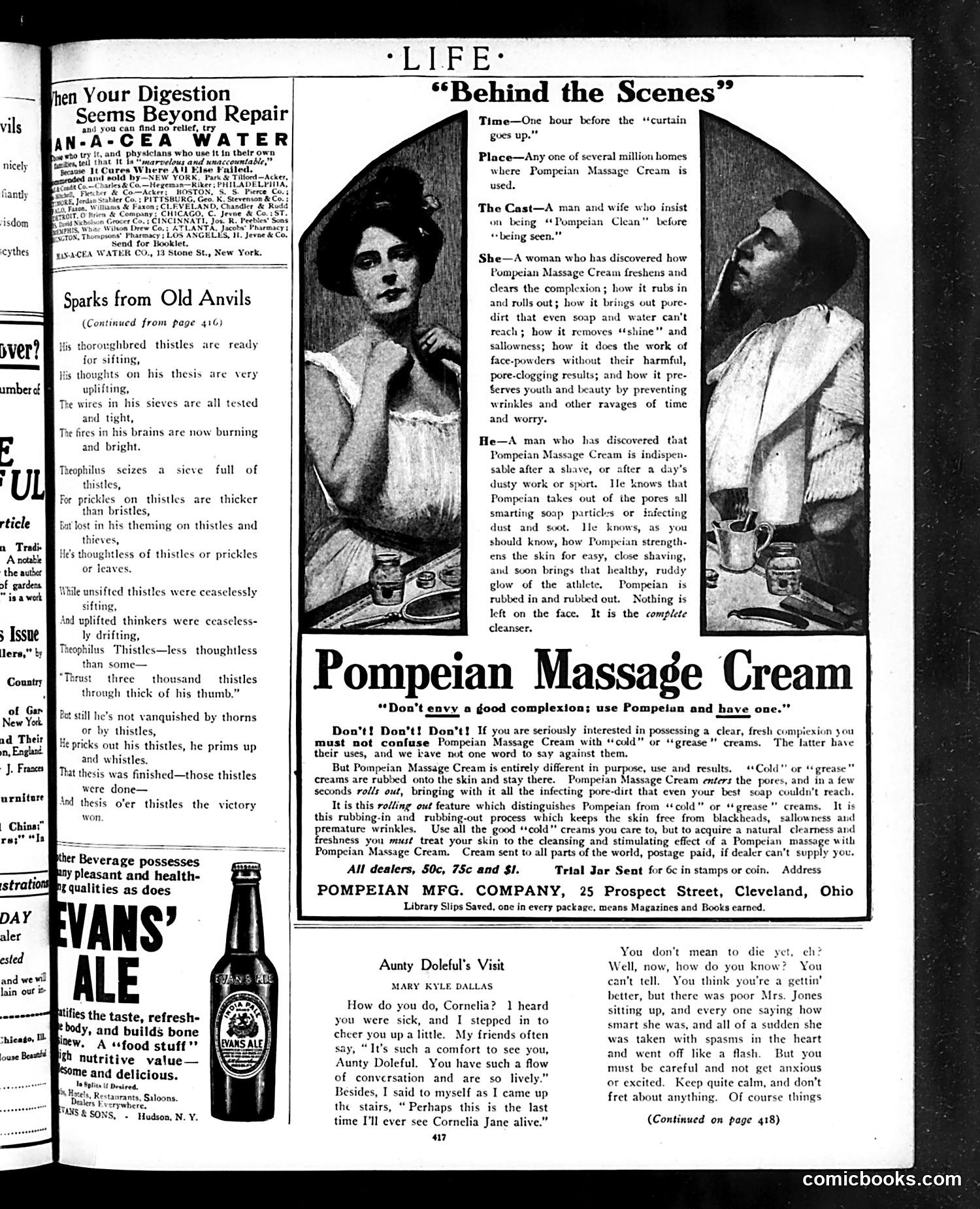
This page contains two distinct sections: **"Sparks from Old Anvils"** is a whimsical poem about Theophilus Thistles, a character whose mind works in clever, rapid-fire ways—"thoughts" and "wires" are "tested and tight," his "brains are burning bright." The poem plays with alliteration and wordplay, suggesting a brilliant but scattered thinker who triumphs through mental agility rather than conventional means. It's lighthearted intellectual humor with no obvious political content. **"Behind the Scenes"** is a faux-documentary advertisement for Pompeian Massage Cream. It presents a domestic scene of a couple obsessed with being "Pompeian Clean" before appearing in public, emphasizing the product's supposed ability to cleanse pores and maintain youthful appearance. The marketing copy contrasts Pompeian with competing "cold" or "grease" creams, claiming superior results through its "rolling" action. Both sections are primarily **advertising content**—the poem may serve as filler material common in magazines of this era. There is no political satire evident on this page.
This page is primarily **advertising** rather than editorial cartoon content. It contains: 1. **Tobey Furniture advertisement** - promoting handmade furniture emphasizing elegance, rare woods, and craftsmanship, with locations in New York and Chicago. 2. **"Sparks From Old Anvils"** - a brief humorous anecdote about a gossipy woman warning someone about domestic dangers (children near water, a suspicious man at the gate, disease outbreaks in the village). The humor derives from her catastrophizing and meddlesome nature—a satirical jab at pearl-clutching Victorian anxieties and busybodies. 3. **Other advertisements** - for Calox tooth powder, Old James Pepper Whisky, and The Pacific Monthly (promoting Western settlement). There are no identifiable political figures or specific satirical cartoons on this page. The "Sparks" piece is gentle social satire about gossip culture and paranoid domesticity rather than political commentary.
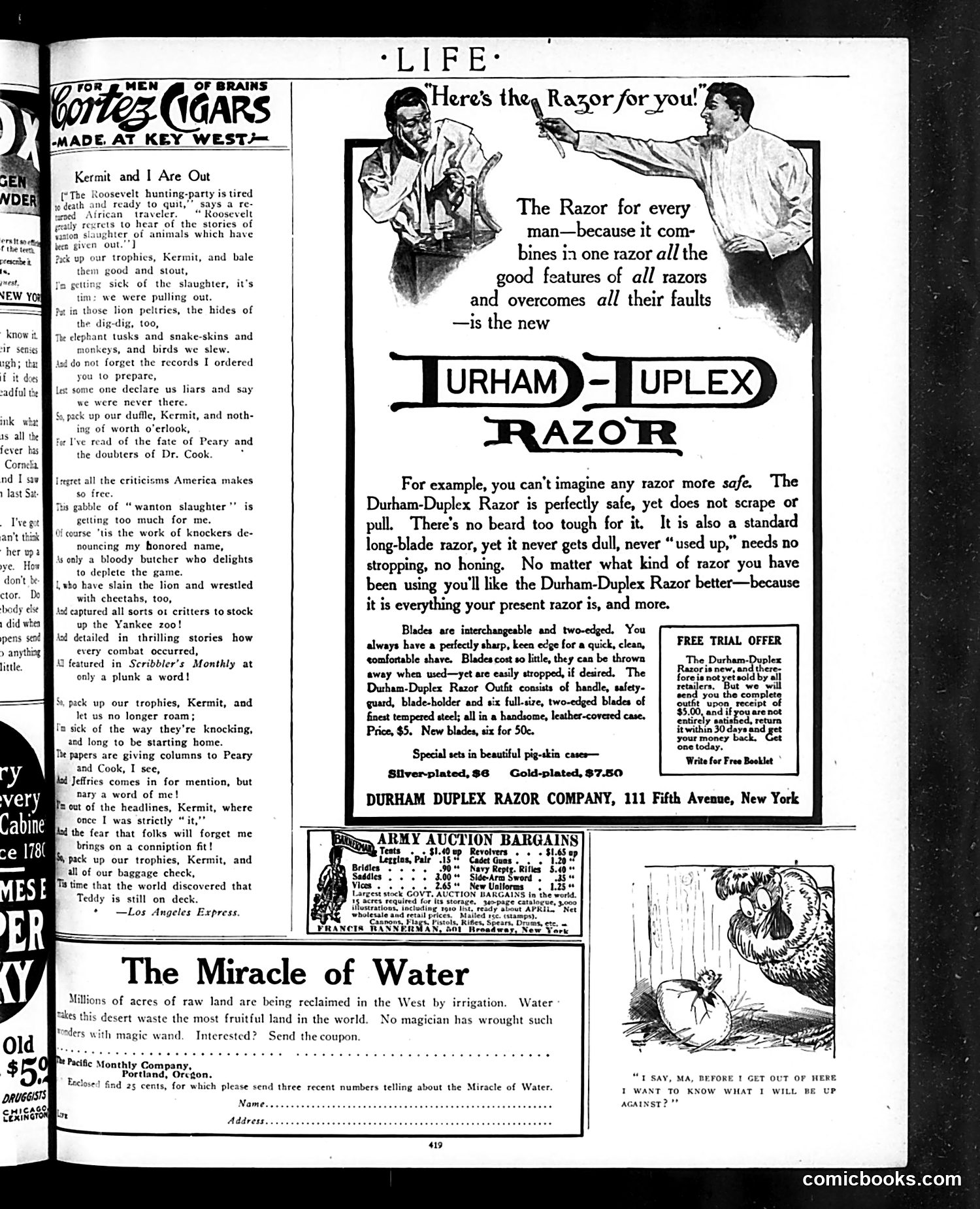
The main cartoon depicts **Theodore Roosevelt** and his son **Kermit** returning from an African hunting expedition, exhausted and wanting to end the slaughter. Roosevelt says they're "getting sick of the slaughter" and "pulling out," having collected numerous animal trophies (lion pelts, elephant tusks, snake skins, birds). The satire targets Roosevelt's famous 1909-1910 African safari, which drew American criticism for "wanton slaughter." The cartoon mocks both Roosevelt's hunting obsession and the growing public skepticism about his claims—referencing contemporary explorer controversies (Peary and Dr. Cook's disputed polar expeditions). Roosevelt's own boasts about his adventures are presented as potentially unbelievable to skeptical Americans ("some one declare us liars"). The page is otherwise dominated by a **Durham-Duplex Razor advertisement** promoting a new safety razor, and smaller ads for an Army auction and irrigation land sales. The cartoon and advertisements occupy equal space, typical of Life magazine's mixed editorial-commercial format.
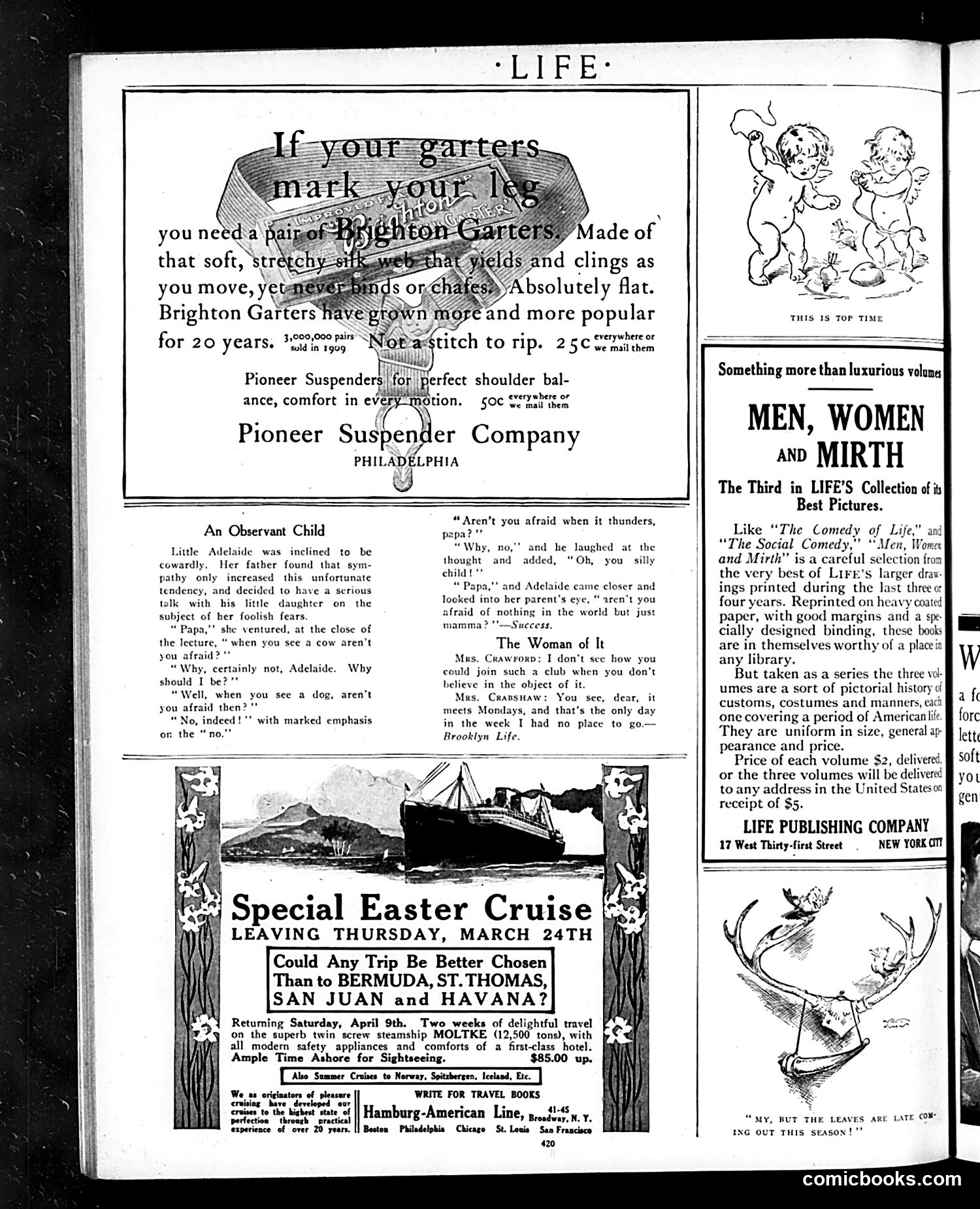
This is primarily an **advertising page** from Life magazine, with two brief humorous anecdotes interspersed. **The cartoons/jokes:** 1. **"An Observant Child"** — A father tries to cure his daughter's cowardice through logic, but she deflates his reasoning by pointing out he shows fear of things too (cows, dogs). The satire targets parental hypocrisy and the ineffectiveness of lecturing children about bravery. 2. **"The Woman of It"** — A society woman joins a club she doesn't believe in simply because its Monday meetings provide a convenient excuse to escape home. This mocks women's social conformity and the hollow nature of club membership. Both jokes reflect early-20th-century attitudes about gender roles and child-rearing. **The advertisements** promote Brighton Garters, Pioneer Suspenders, Life Publishing Company's illustrated volumes, and Hamburg-American Line's Easter cruise to Caribbean destinations—typical consumer goods and leisure activities of the era.
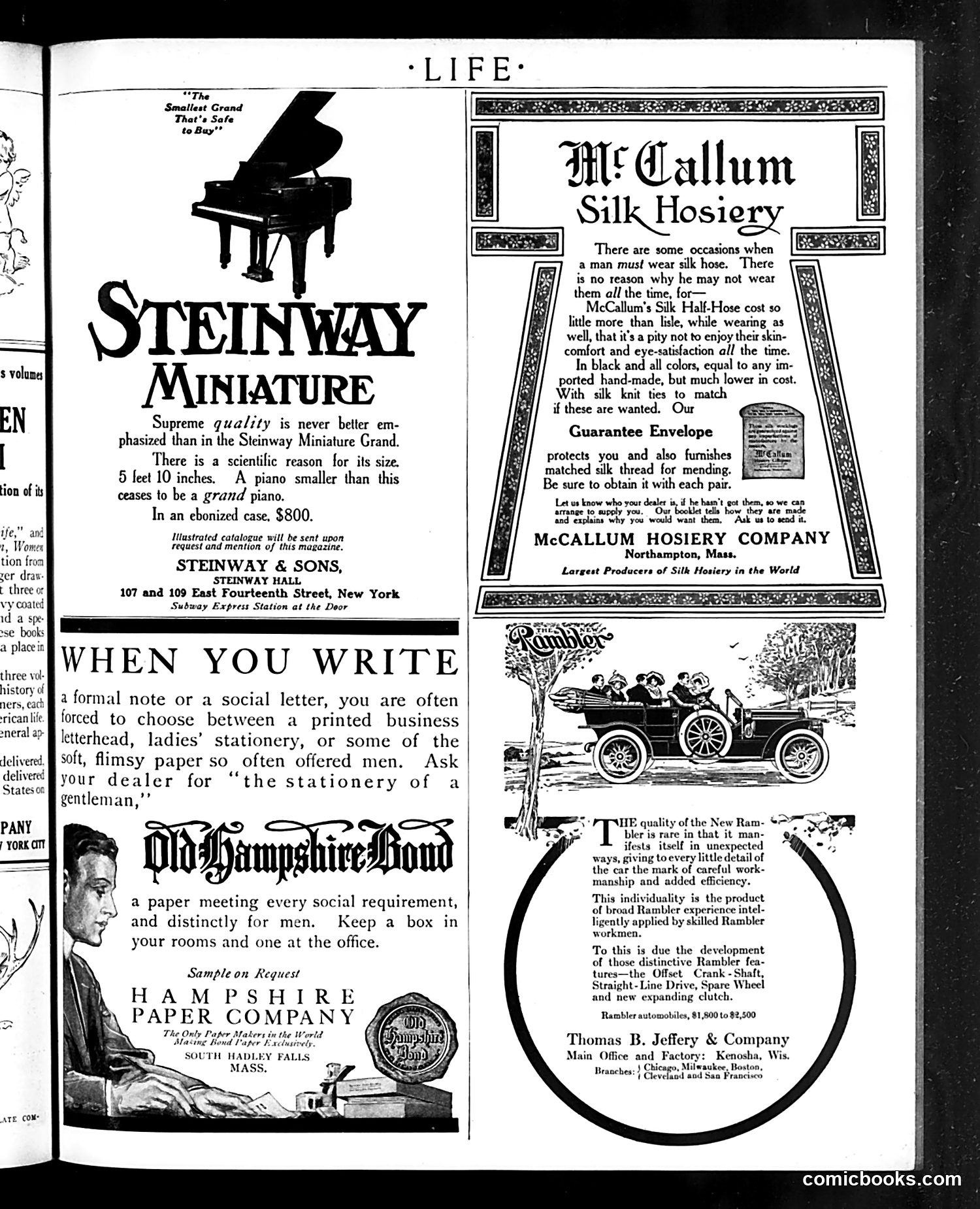
This is primarily an **advertising page** from Life magazine, not a satirical cartoon page. It contains five distinct advertisements: 1. **Steinway Miniature Grand Piano** ($800) — emphasizing quality and compact size 2. **McCallum Silk Hosiery** — marketing silk socks to men, arguing they're worth the small extra cost over cheaper alternatives 3. **Hampshire Paper Company** — promoting "gentleman's stationery" as distinct from ladies' or business letterhead 4. **Rambler Automobiles** ($1,800-$2,500) — highlighting craftsmanship and innovative features 5. **Old Hampshire Bond Paper** — another stationery advertisement The page reflects early 20th-century consumer culture and gender norms—notably the assumption that men needed *specific* products marketed to their masculinity (men's stationery, silk hosiery). There is no political satire visible. The advertisements showcase luxury goods targeting affluent readers.
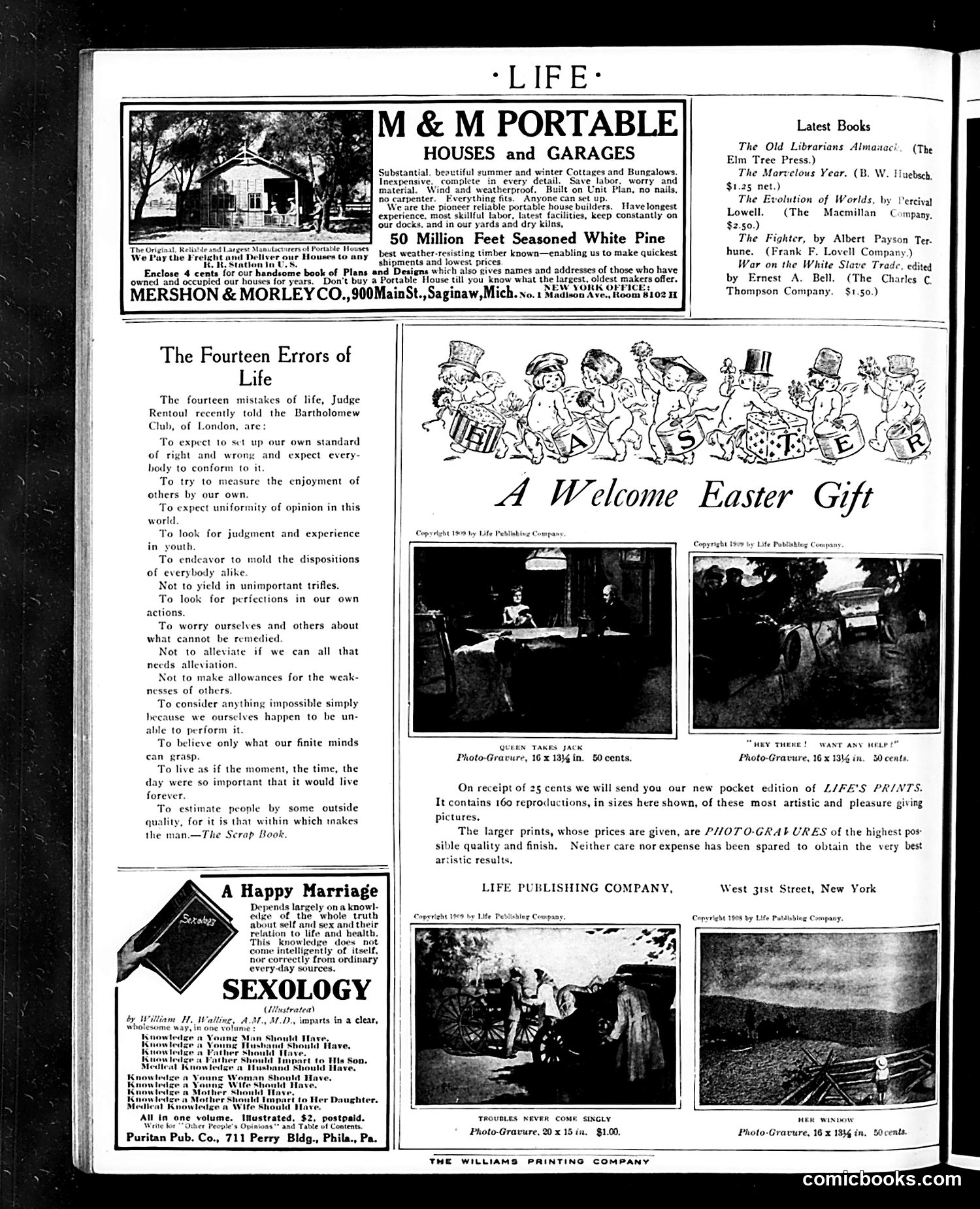
This is primarily an **advertising and book review page** from Life magazine, not a political cartoon page. The main content includes: **"The Fourteen Errors of Life"** — a moral/philosophical list from Judge Rentoul of London's Bartholomew Club, addressing common human mistakes like imposing one's own standards on others, worrying about unchangeable problems, and judging people by superficial qualities rather than character. **"A Welcome Easter Gift"** — promotes Life Publishing Company's photo-gravure prints, offering pocket editions for 25 cents. **Other advertisements** include M&M Portable Houses (prefabricated homes), a book on "Sexology" by William H. Walling (addressing marriage education), and various other publications. The cartoons visible are minor—small illustrated vignettes accompanying the Easter gift section showing figures in period dress, appearing to be Easter-themed rather than satirical. This page reflects early 1900s Life magazine content: moral instruction, home/domestic products, and educational literature targeting middle-class readers.
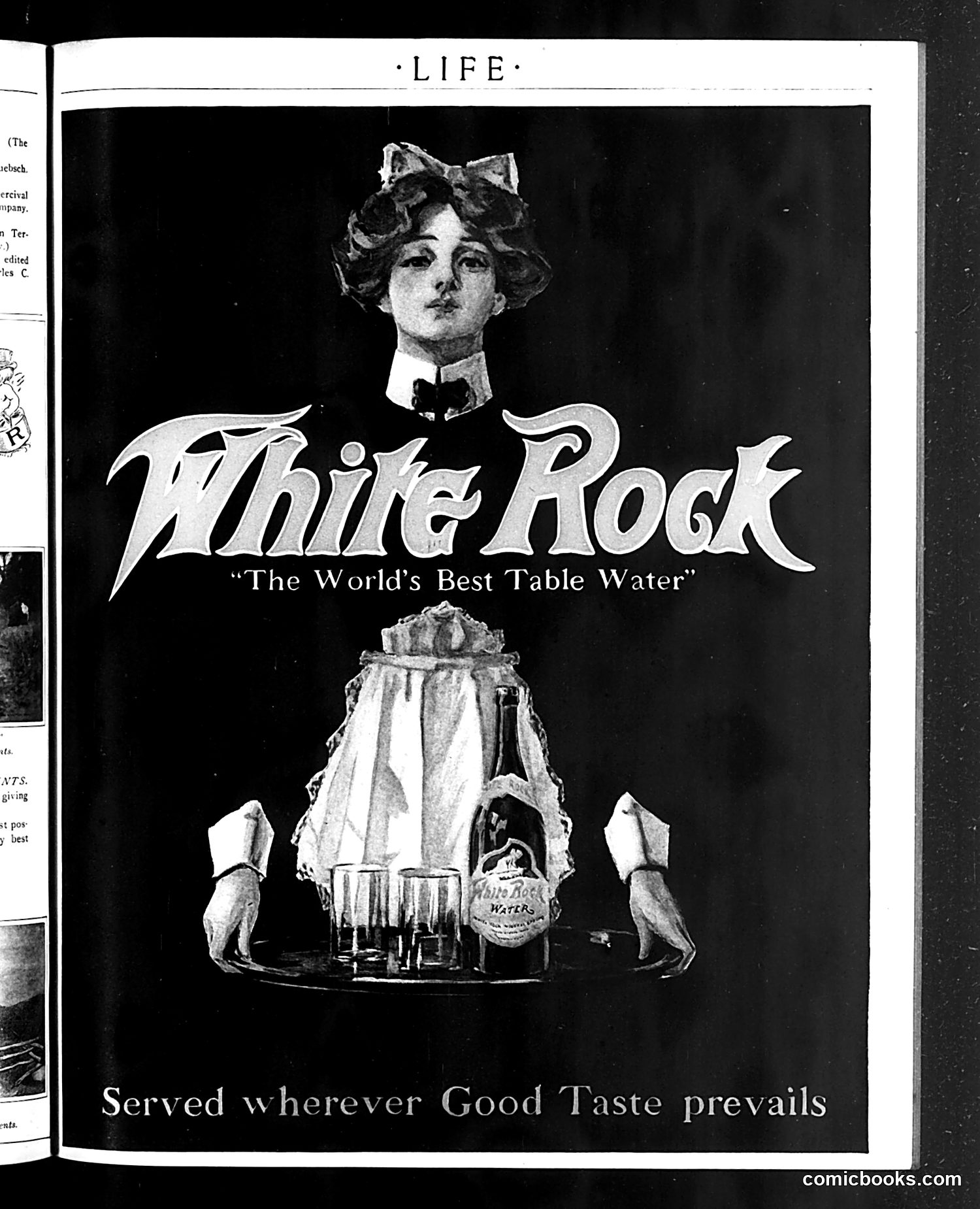
This is a full-page advertisement for White Rock table water, not political satire. It appeared in *Life* magazine and features an elegantly dressed woman in early 20th-century fashion (upswept hair, bow, high collar) presenting a bottle of White Rock water. The ad's messaging emphasizes luxury and refinement: "The World's Best Table Water" and "Served wherever Good Taste prevails." The aesthetic—the refined woman, ornate bottle presentation, formal styling—targets affluent consumers by associating the product with sophistication and social status. This represents how *Life* magazine supported itself through advertising, using the publication's sophisticated readership as a marketing platform for premium consumer goods.
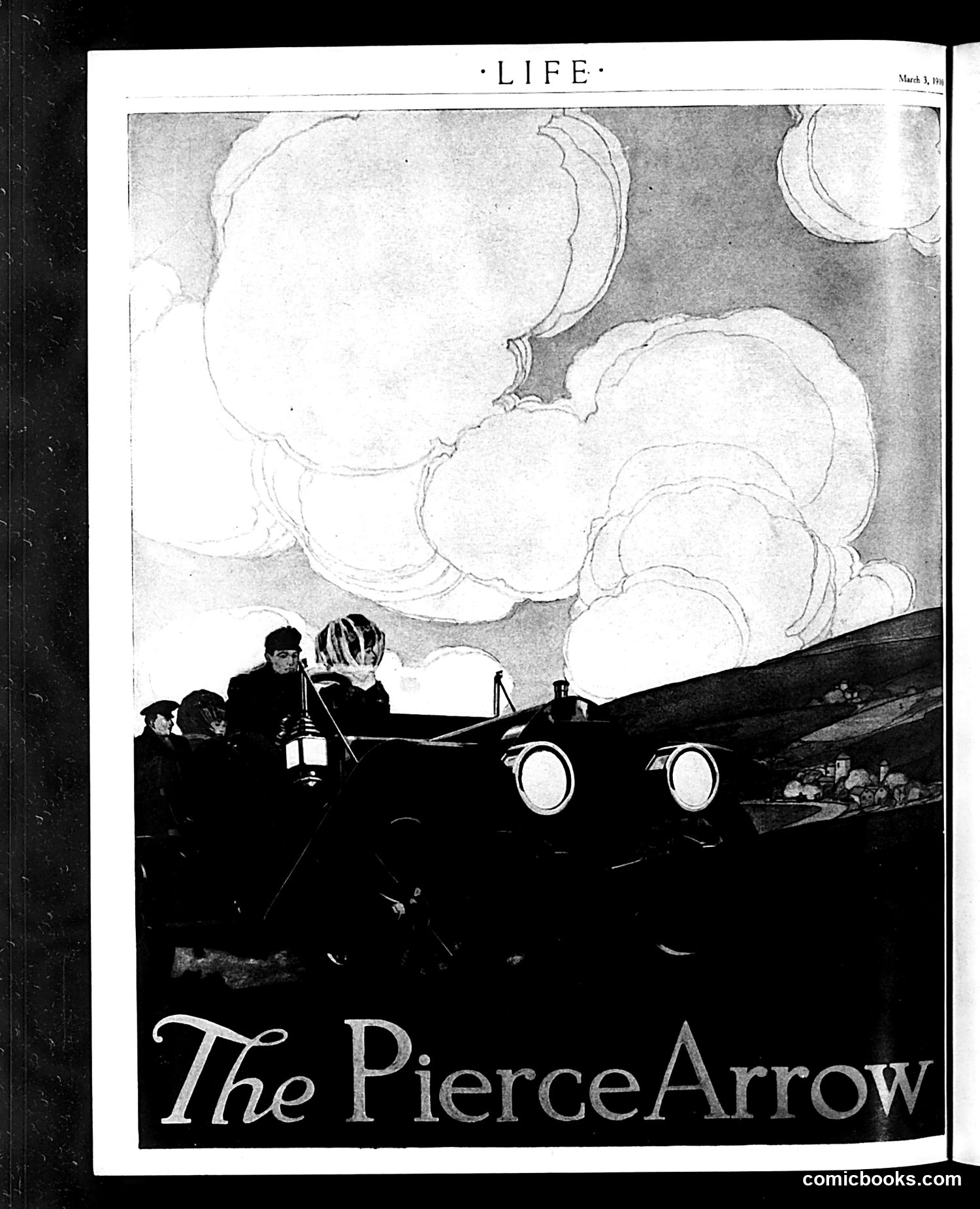
This is a full-page advertisement for the Pierce-Arrow automobile, appearing in *Life* magazine. The image depicts a dramatic nighttime scene: figures in formal attire stand beside a Pierce-Arrow car with distinctive large headlights, gazing upward at an impressive display of clouds illuminated against a dark sky—likely meant to evoke wonder or luxury. The ad uses romantic, aspirational imagery typical of early automotive advertising, positioning the Pierce-Arrow as a vehicle associated with elegance and refined taste. The headline "The Pierce-Arrow" emphasizes the brand name. This represents vintage marketing that appeals to wealthy consumers through aesthetic appeal rather than practical specifications—a common strategy in *Life* magazine's affluent readership.