
Life, 1910-03-03 · page 39 of 80
Life — March 3, 1910 — page 39: what you’re looking at
What you’re looking at
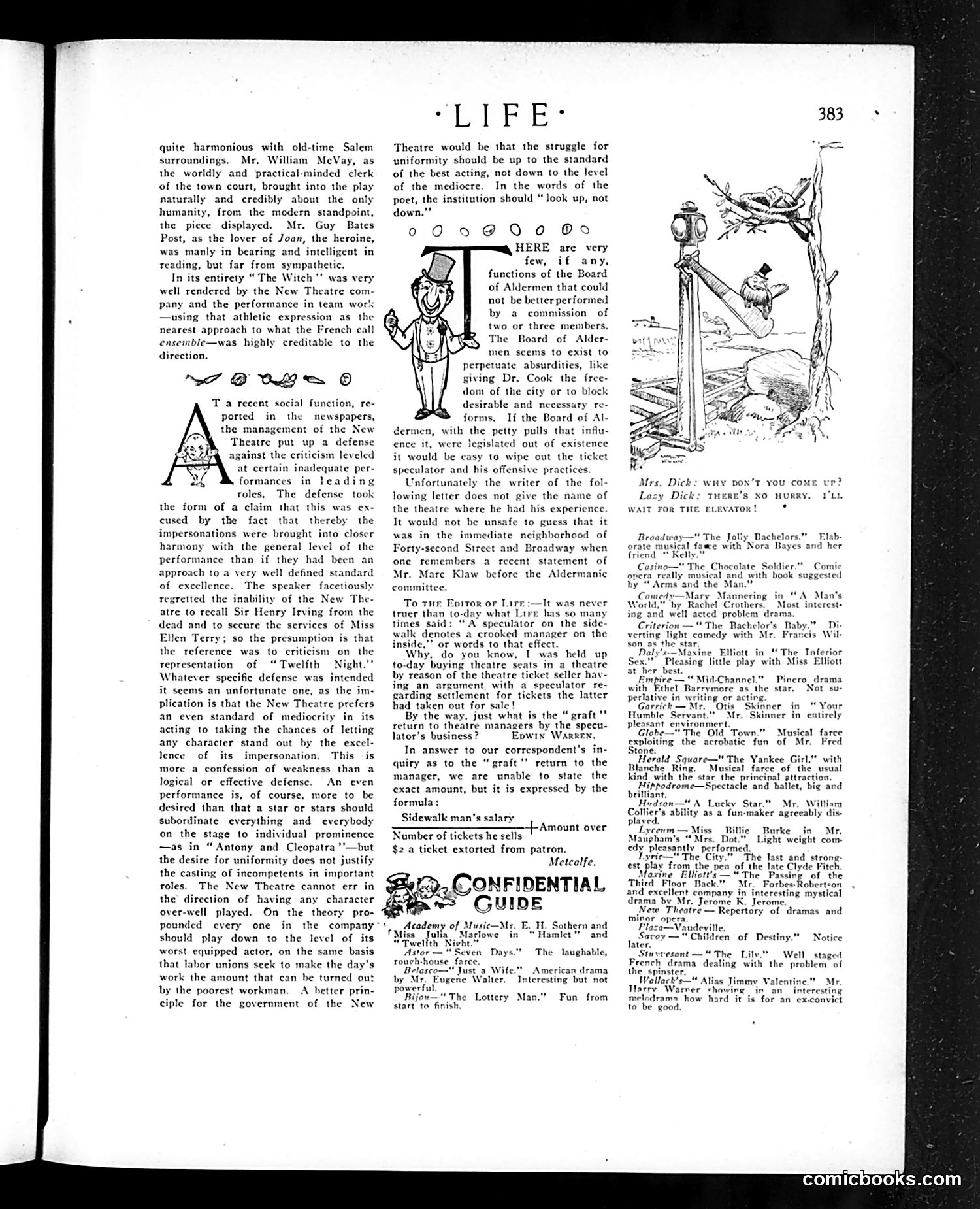
This page critiques the **New Theatre's artistic mediocrity**. The main text attacks the theater's defense of uneven performances—claiming poor acting in leading roles was justified to maintain "uniformity." The critic argues this inverts proper standards: the company should elevate weaker performers to match excellence, not lower stars to match incompetence. The labor-union analogy compares this wrongly to workers standardizing output at the slowest member's pace. A secondary piece targets the **Board of Aldermen's ineffectiveness**, suggesting they exist mainly for trivial gestures (like awarding explorer Dr. Cook citizenship) rather than meaningful reform. It references ticket speculation near **Broadway/42nd Street**, implying corruption around theater ticketing. The writer mentions Marc Klaw (a prominent Broadway producer/theater owner) testifying before the aldermanic committee, suggesting theater-district political entanglement. Together, these pieces satirize institutional mediocrity and urban corruption.
📄 Transcribed text from this page (OCR, searchable)
Machine-transcribed from the original scan — historical spelling and the odd misread are preserved.
quite harmonious with old-time Salem surroundings. Mr. William McVay, as the worldly and practical-minded clerk of the town court, brought into the play naturally and credibly about the only humanity, from the modern standpoint, the piece displayed. Mr. Guy Bates Post, as the lover of Joan, the heroine, was manly in bearing and intelligent in reading, but far from sympathetic. In its entirety “The Witch ’ was very well rendered by the New Theatre com- pany and the performance in team wor's —using that athletic expression as the nearest approach to what the French call ensemble—was highly creditable to the direction. =Z DBD OLGm © T a recent social function, re- ported in the newspapers, the management of the New Theatre put up a defense against the criticism leveled at certain inadequate per- formances in leading roles. The defense took the form of a claim that this was ex- cused by the fact that thereby the impersonations were brought into closer harmony with the general level of the performance than if they had been an approach to a very well defined standard of excellence. The speaker facetiously regretted the inability of the New The- atre to recall Sir Henry Irving from the dead and to secure the services of Miss Ellen Terry; so the presumption is that the reference was to criticism on the representation of “Twelfth Night.” Whatever specific defense was intended it seems an unfortunate one, as the im- plication is that the New Theatre prefers an even standard of mediocrity in its acting to taking the chances of letting any character stand out by the excel- lence of its impersonation, This is more a confession of weakness than a logical or effective defense. An even performance is, of course, more to be desired than that a star or stars should subordinate everything and everybody on the stage to individual prominence —as in “Antony and Cleopatra ’—but the desire for uniformity does not justify the casting of incompetents in important roles. The New Theatre cannot err in the direction of having any character over-well played. On the theory pro- pounded every one in should play down to the level of its worst equipped actor, on the same basis that labor unions seek to make the day's work the amount that can be turned ou: by the poorest workman. A better prin- ciple for the government of the New the company * *L TPE Theatre would be that the struggle for uniformity should be up to the standard of the best acting, not down to the level of the mediocre. In the words of the poet, the institution should “look up, not down.” 0090980900008 HERE are very few, if any, functions of the Board of Aldermen that could not be better performed by a commission of two or three members, The Board of Alder- men scems to exist to absurdities, like giving Dr. Cook the free- dom of the city or to block desirable and necessary re- forms. If the Board of Al- dermen, with the petty pulls that influ- ence it, legislated out of existence it would be casy to wipe out the ticket speculator and his offensive practices. Unfortunately the writer of the fol- lowing letter does not give the name of the theatre where he had his experience. It would not be unsafe to guess that it was in the immediate neighborhood of Forty-second Strect and Broadway when one remembers a recent statement of Mr. Mare Klaw before the Aldermanic committee. were To tur Epitor oF Lire:—It was never truer than to-day what Lire has so many times said: “A speculator on the side- walk denotes a crooked manager on the inside,” or words to that effect. Why, do you know, I was held up to-day buying theatre seats in a theatre by reason of the theatre ticket seller hav- ing an argument, with a speculator re- garding scttlement for tickets the latter had taken out for sale! . By the way, just what is the “graft return to theatre managers by the specu- lator’s business? Epwix WARREN. In answer to our correspondent’s in- quiry as to the “graft” return to the manager, we are unable to state the exact amount, but it is expressed by the formula : Sidewalk man's salary FH Anmount over Number of tickets he sells + $2. a ticket extorted from patron. Metcalfe. ». CONFIDENTIAL > GUIDE E. H. Sothern and "Academy of Music—Mr “Hamlet” and ‘Miss Julia, Mariowe “Twelfth ” Astor — "Seven Days.” rouch-house, farce. Belasco—" Just a Wife.” by Mr. Eugene Walter. powerful. Rijow— The Lottery Man." start to finish. The laughable, American drama interesting but not Fun from Mrs, Dick: wuy pox’t you come ur Lazy Dick; tHeRe’s NO HURRY. Vin WAIT FOR THE ELEVATOR! Broadway—" The Joliy Bachelors.” Flab- orate musical fame with Nora Bayes and her friend“ Kelly.” Casi The Chocolate Soldier.” Comi opera really musical and with book suggested hy “Arms and the Man. Comedy—Mary World,” by Ra ing and well a Criterion —" The Bac! verting light comedy with M son as the star Daly’s-——Maxine Elliott in “The Inferior Sex.” Pleasing little play with Miss Elliott at her best. Empire —“ Mid-Channel.” — Pinero. with Ethel Barrymore as the star. perlative in writing or acting. Garrick —Mr. Otis Skinner Humble Servant.” Mr. Skinner pleasant environmert, Globe—" The Old Town.” Musical farce exploiting the acrobatic fun of Mr. Fred Stone. Herald Square—" The Yankee Girl," wil Blanche Ring. Musical farce of ‘the usual kind with the star the principal attraction Hippodrome—Spectacle and ballet, big ard brilliant. Hudson—" A Lucky Star.” Mr. William Collier's ability as a fun-maker agreeably dis- played Lyceum — Miss Tillie Burke in Mr. Maugham Mrs. Dot.” Light weight com- edy pleasantly performed. Lyric—" The City."” ‘The last and strong: est play from the pen of the late Clyde Fitch. Marine Fllictt's—" The Passing of the rare Figor Back.” By, Forbes-Robertson and excellent company in interesting mystical drama by Mr. Jerome K. Jerome. New Theatre — Repertory of dramas and minor opera las Vaudeville. Children of Destiny.” Stuvvesant —“ The Lilv." Well staged French drama dealing with the problem of the spinster. Wellack’s—" Alias Jimmy Valentine.” Mr, Torry Warner showing in an interesting melodrama how hard it is for an ex-convict to he good. Mannering in “A Man's lor’s: Bab - Francis Wi drama Not su- Notice comicbooks.com