
Life, 1910-03-03 · page 18 of 80
Life — March 3, 1910 — page 18: what you’re looking at
What you’re looking at
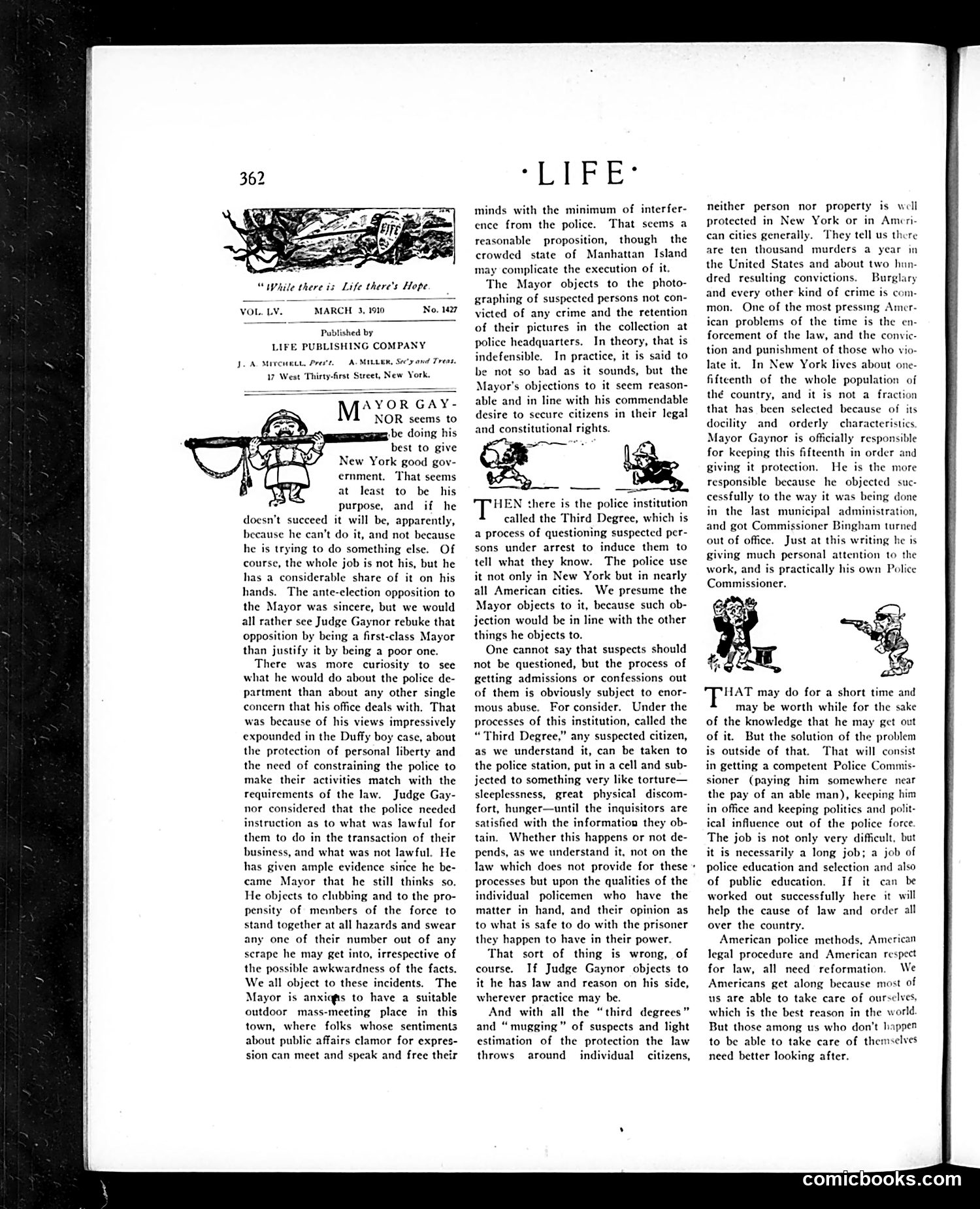
This 1910 *Life* magazine page critiques NYC Mayor Gaynor's police reforms through editorial commentary rather than visual satire. The small decorative cartoons are generic illustrations, not caricatures of specific figures. The article discusses Gaynor's objections to police practices: physical brutality ("clubbing"), photographing suspects without conviction, and the "Third Degree"—coercive interrogation involving sleeplessness and physical discomfort used to extract confessions. The writer supports Gaynor's reform efforts, arguing these practices violate constitutional protections. However, he acknowledges the practical difficulty: police discretion allows abuse regardless of law. The solution proposed is appointing a competent Police Commissioner to supervise and educate officers—recognizing that legal restraints alone cannot prevent misconduct without proper institutional oversight and accountability. This reflects Progressive Era concerns about police power and civil liberties in American cities.
📄 Transcribed text from this page (OCR, searchable)
Machine-transcribed from the original scan — historical spelling and the odd misread are preserved.
“While there iz Life there's Hope. No. 1427 MARCH 3, 1910 Published by LIFE PUBLISHING COMPANY A MUTCHELL, Preee, AL MILLER, Siéy and Treas, rty-first Street, New York, AYOR GAY- NOR seems to spas: be doing his best to give New York good gov- ernment. That seems at least to be his purpose, and if he doesn’t succeed it will be, apparently, because he can't do it, and not because he is trying to do something else. Of course, the whole job is not his, but he has a considerable share of it on his hands. The ante-election opposition to the Mayor was sincere, but we would all rather see Judge Gaynor rebuke that opposition by being a first-class Mayor than justify it by being a poor one. There was more curiosity to see what he would do about the police de- partment than about any other single concern that his office deals with. That was because of his views impressively expounded in the Duffy boy case, about the protection of personal liberty and the need of constraining the police to make their activities match with the requirements of the law. Judge Gay- nor considered that the police needed instruction as to what was lawful for them to do in the transaction of their business, and what was not lawful. He has given ample evidence since he be- came Mayor that he still thinks so, He objects to clubbing and to the pro- pensity of members of the force to stand together at all hazards and swear any one of their number out of any scrape he may get into, irrespective of the possible awkwardness of the facts. We all object to these incidents. The Mayor is anxiqps to have a suitable outdoor mass-meeting place in this town, where folks whose sentiments about public affairs clamor for expres- sion can meet and speak and free their *LIPE* minds with the minimum of interfer- ence from the police. That scems a reasonable proposition, though the crowded state of Manhattan Island may complicate the execution of it. The Mayor objects to the photo- graphing of suspected persons not con- victed of any crime and the retention of their pictures in the collection at police headquarters. In theory, that is indefensible. In practice, it is said to ¢ not so bad as it sounds, but the Mayor's objections to it seem reason- able and in line with his commendable desire to secure citizens in their legal and constitutional rights. "THEN there is the police institution called the Third Degree, which is a process of questioning suspected per- sons under arrest to induce them to tell what they know. The police use it not only in New York but in nearly all American cities. We presume the Mayor objects to it, because such ob- jection would be in line with the other things he objects to. One cannot say that suspects should not be questioned, but the process of getting admissions or confessions out of them is obviously subject to enor- mous abuse. For consider. Under the processes of this institution, called the “Third Degree,” any suspected citizen, as we understand it, can be taken to the police station, put in a cell and sub- jected to something very like torture— sleeplessness, great physical discom- fort, hunger—until the inquisitors are satisfied with the information they ob- tain. Whether this happens or not de- pends, as we understand it, not on the law which does not provide for these + processes but upon the qualities of the individual policemen who have the matter in hand, and their opinion as to what is safe to do with the prisoner they happen to have in their power. That sort of thing is wrong, of course. If Judge Gaynor objects to it he has law and reason on his side, wherever practice may be. And with all the “third degrees” and “mugging” of suspects and light estimation of the protection the law throws around individual citizens, neither person nor property is well protected in New York or in Ameri- can cities generally. They tell us there are ten thousand murders a year in the United States and about two han- dred resulting convictions. Burglary and every other kind of crime is com- mon. One of the most pressing Amer- ican problems of the time is the en- forcement of the law, and the convic- tion and punishment of those who vio- late it. In New York lives about one- fifteenth of the whole population of thé country, and it is not a fraction that has been selected because of its docility and orderly characteristics. Mayor Gaynor is officially responsible for keeping this fifteenth in order and giving it protection. He is the more responsible because he objected suc- cessfully to the way it was being done in the last municipal administration, and got Commissioner Bingham turned out of office. Just at this writing he is giving much personal attention to the work, and is practically his own Police Commissioner. HAT may do for a short time and may be worth while for the sake of the knowledge that he may get out of it. But the solution of the problem is outside of that. That will consist in getting a competent Police Commis- sioner (paying him somewhere near the pay of an able man), keeping him in office and keeping politics and polit- ical influence out of the police force. The job is not only very difficult, but it is necessarily a long job; a job of police education and selection and also of public education. If it can be worked out successfully here it will help the cause of law and order all over the country. American police methods, American legal procedure and American respect for law, all need reformation. We Americans get along because most of us are able to take care of ourselves, which is the best reason in the world. But those among us who don’t happen to be able to take care of themselves need better looking after. comicbooks.com