
Life, 1910-03-03 · page 54 of 80
Life — March 3, 1910 — page 54: what you’re looking at
What you’re looking at
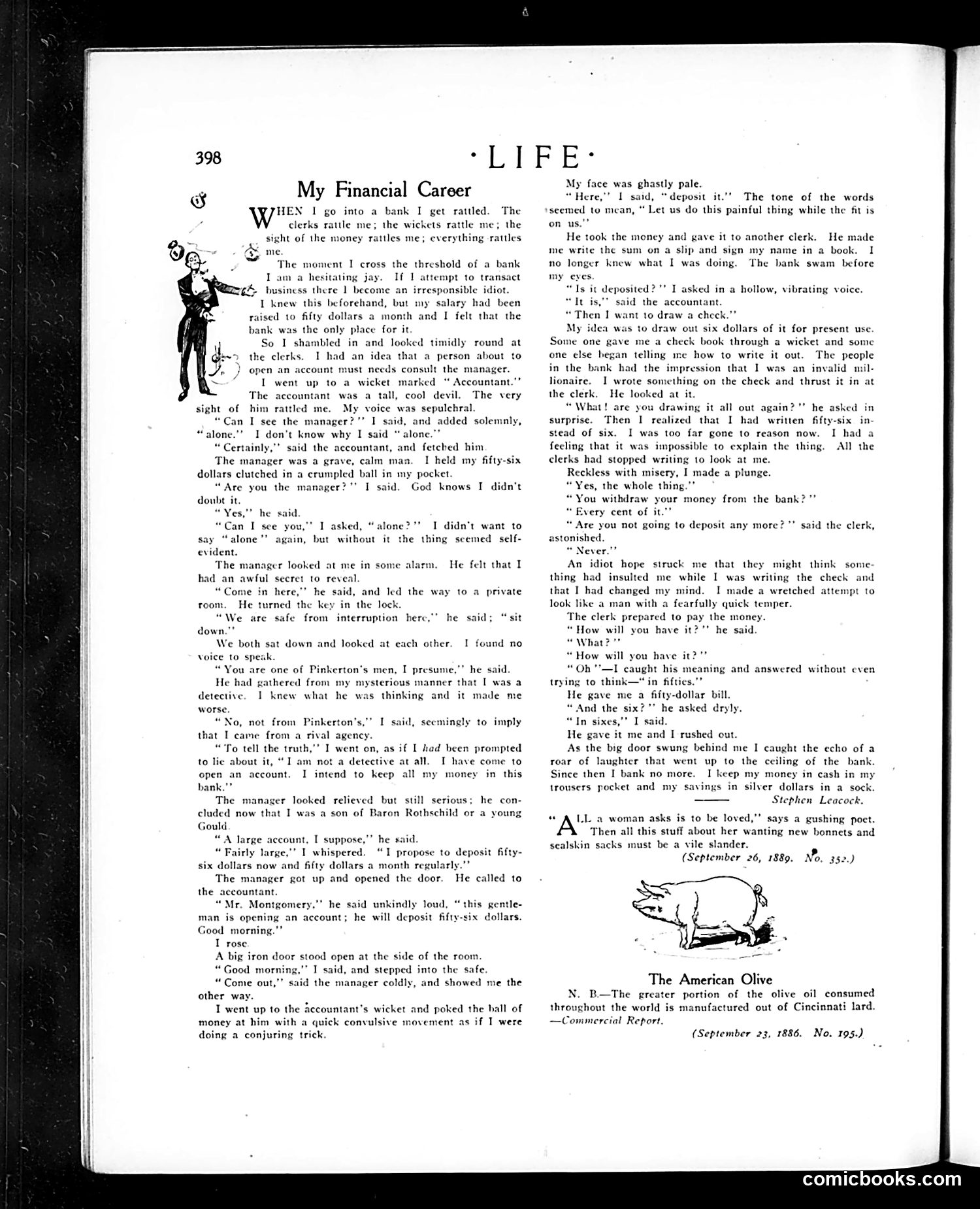
This is a comic narrative (not a political cartoon) by Stephen Leacock about a man's anxiety depositing his first modest bank account of $56. The humor satirizes the gap between a nervous depositor's self-perception and how bankers interpret his behavior. The protagonist's awkward mannerisms—asking to see the manager "alone," speaking in hushed tones, clutching crumpled bills—cause the bank manager to suspect he's either a Pinkerton detective or an extremely wealthy industrialist (referencing the famously rich Rothschild family and railroad magnate Jay Gould). The joke is that ordinary banking terrifies him so completely that simple transactions become theatrical events. His attempt to withdraw six dollars is misread as withdrawing everything. The satire mocks both the narrator's social anxiety and banks' tendency to misjudge customers based on mysterious behavior rather than facts. This was typical humorous fare for *Life* magazine's sophisticated urban audience.
📄 Transcribed text from this page (OCR, searchable)
Machine-transcribed from the original scan — historical spelling and the odd misread are preserved.
My Financial Career HEN 1 go into a bank I get rattled. The clerks rattle me; the wickets rattle me; the sight of the money rattles me; everything rattles me. The moment I cross the threshold of a bank Tam a hesitating jay. If 1 attempt to transact GA business there 1 become an irresponsible idiot. I knew this beforehand, but my salary had been raised to fifty dollars a month and I felt that the bank was the only place for it 0 I shambled in and looked timidly round at the clerks. I had an ide open an account must needs consult the manager. I went up to a wicket marked “ Accountant The accountant was a tall, cool devil. The very sight of him rattled me. My voice was sepulchral. Can I see the manager? '" I said, and added solemn lone."? 1 don't know why I said “ alone Certainly,’ said the accountant, and fetched him The manager was a grave, calm man. I held my fifty-six dollars clutched in a crumpled ball in my pocket I said. God knows I didn’t that a person about to “Are you the manager? doubt it “Yes,"" he said. “Can I sce you," 1 asked, “alone?’’ I didn’t want to say “alone ’’ again, but without it the thing scemed self- evident. The manager looked at me in some alarm. He felt that I had an awful secret to reveal “Come in here," he said, and led the way to a private room. He turned the key in the lock. “We are safe from interruption here, down.” We both sat down and looked at each other. I found no voice to speak. “You are one of Pinkerton’s men, I presume," he said He had gathered from my mysterious manner that I was a I knew what he was thinking and it made me he said; detective worse, “No, not from Pinkerton’s,”” I said, seemingly to imply that I came from a rival agency. “fo tell the truth," I went on, as if I had been prompted to lie about it, “Iam not a detective at all. I have come to open an account. I intend to keep all my money in this bank." The manager looked relieved but still serious; he con- cluded now that I was a son of Baron Rothschild or a young Gould “A large account, I suppose,"’ he said. “ Fairly large,’ I whispered. “1 propose to deposit fifty- six dollars now and fifty dollars a month regularl The manager got up and opened the door. the accountant. “Mr. Montgomery,”’ he said unkindly loud, “this gentle- man is opening an account; he will deposit fifty-six dollars. Good morning. I rose. A big iron door stood open at the side of the room “Good morning,”’ I said, and stepped into the safe “Come out,’’ said the manager coldly, and showed me the other way. I went up to the Accountant's wicket and poked the ball of money at him with a quick convulsive movement as if I were doing a conjuring trick He called to My face was ghastly pale. “Here,” 1 said, “deposit it.” The tone of the words seemed to mean, “ Let us do this painful thing while the fit is on us."" He took the money and gave it to another clerk. He made me write the sum on a slip and sign my name in a book. I no longer knew what I was doing. The bank swam before my eyes. “Is it deposited?" I asked in a hollow, vibrating voice. “It is,’ said the accountant. “Then I want to draw a cheek.” My idea was to draw out six dollars of it for present us Some one gave me a check book through a wicket and some one else hegan telling me how to write it out. The people in the bank had the impression that 1 was an invalid mil- lionaire. I wrote something on the check and thrust it in at the clerk. He looked at it “What! are you drawing it all out again?"? he asked in surprise. Then I realized that I had written fifty-six in stead of six. I was too far gone to reason now. I had a feeling that it was impossible to explain the thing. All the clerks had stopped writing to look at me. Reckless with misery, I made a plunge. Yes, the whole thing.”’ You withdraw your money from the bank? Every cent of it.” “ Are you not going to deposit any more?" astonished. said the clerk, ” Never.” An idiot hope struck me that they might think some thing had insulted me while I was writing the check and that I had changed my mind. I made a wretched attempt to look like a man with a fearfully quick temper. ‘The clerk prepared to pay the money. “How will you have it?" he said. “What? “How will you have it? “Oh —I caught his meaning and answered withou trying to think—" in fifties. He gave me a fifty-dollar bill. “And the six?" he asked dryly. I said. He gave it me and I rushed out. As the big door swung behind me I caught the echo of a roar of laughter that went up to the cei Since then I bank no more. I keep my money in cash ii trousers pocket and my savings in silver dollars in a sock. Stephen Leacock. * ALL a woman asks is to be loved,"" says a gushing poct. AAT yhel an this eal abun her wanting nev borate oe sealskin sacks must be a vile slander. (September 26, 1889. No. 352.) The American Olive B—The greater portion of the olive oil consumed throughout the world is manufactured out of Cincinnati lard —Commercial Report. (September 23, 1886. No. 195.) comicbooks.com