
Life, 1910-03-03 · page 46 of 80
Life — March 3, 1910 — page 46: what you’re looking at
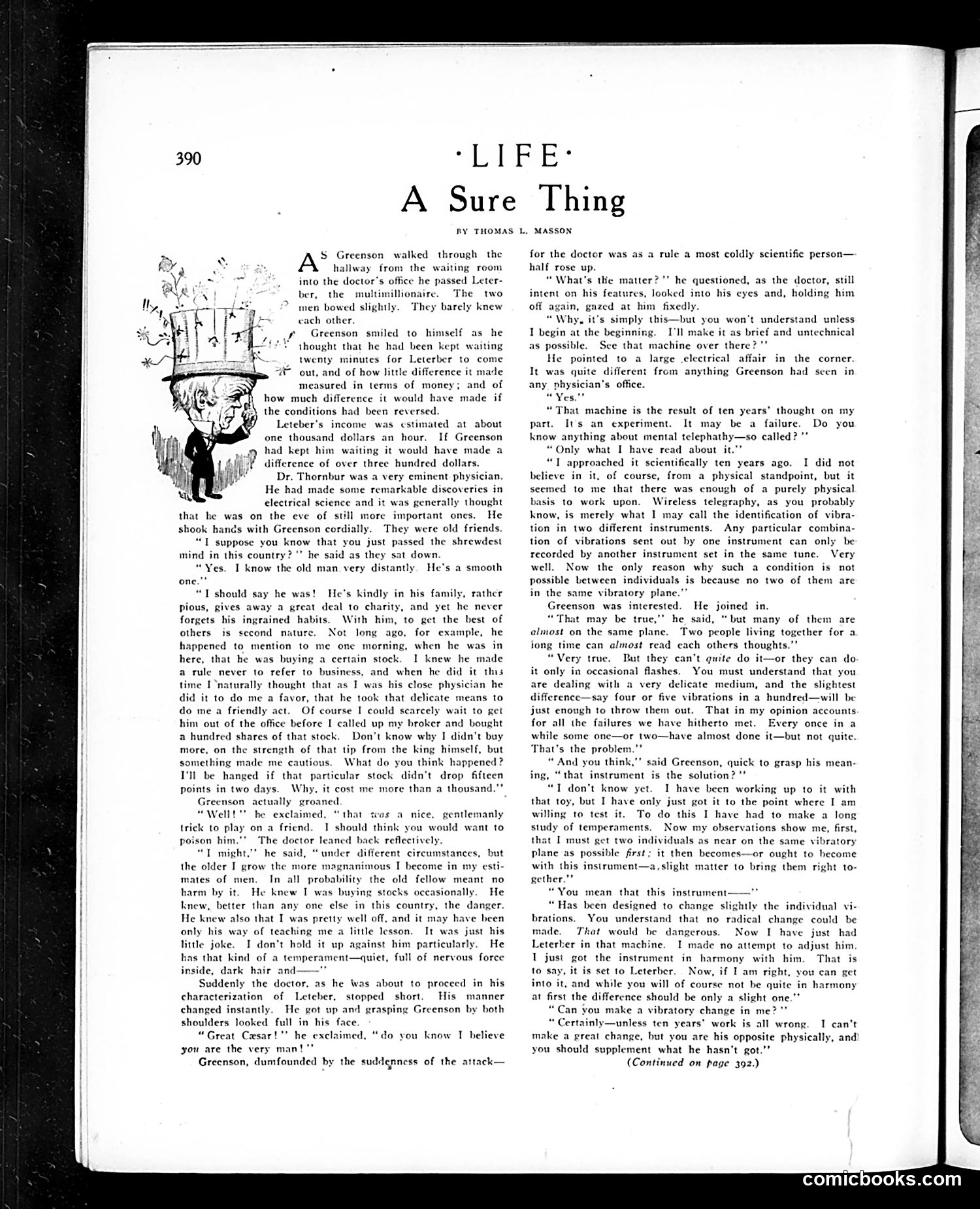
A restored page from Life, 1910-03-03. Page through the whole issue in the reader above.
📄 Transcribed text from this page (OCR, searchable)
Machine-transcribed from the original scan — historical spelling and the odd misread are preserved.
a Oe Oe A Sure Thing RY THOMAS L. MASSON S Greenson walked through the hallway from the waiting room into the doctor's office he passed Leter- ber, the multimillionaire. The two men bowed slightly h other. Greenson smiled to himself as he '*< yhought that he had been kept waiting twenty minutes for Leterber to come “4 out, and of how little difference it made measured in terms of money; and of how much difference it would have made if \ the conditions had been reversed. Leteber's income was estimated at about one thousand dollars an hour. If Greenson 4 had kept him waiting it would have made a difference of over three hundred dollars. Dr. Thornbur was a very eminent physician. He had made some remarkable discoveries in electrical science and it was generally thought that he was on the eve of still more important ones. He shook hands with Greenson cordially. They were old friends “TL suppose you know that you just passed the shrewdest mind in this country?" he said as they sat down Yes. I know the old man. very distantly. He's a smooth one.”" “I should say he was! He's kindly in his family, rather pious, gives away a great deal to charity, and yet he never forgets his ingrained habits. With him, to get the best of others is second nature. long ago, for example, he ppened to mention to me one morning, when he was in here, that he was buying a certain stock. I knew he made a rule never to refer to business, and when he did it ths time I’naturally thought that as I was his close physician he did it to do me a favor, that he took that delicate means to do me a friendly act. Of course I could scarcely wait to get him out of the office before I called up my broker and bought a hundred shares of that stock. Don't know why I didn’t buy more, on the strength of that tip from the king himself, but something made me cautious. What do you think happened? I'll be hanged if that particular stock didn't drop fifteen points in two days. Why, it cost me more than a thousand. Greenson actually groaned They barely knew Well!” he exclaimed, “that sos a nice, gentlemanly trick to play on a friend. I should think you would want to poison him.’’ The doctor leaned back reflectively “T might,” he said, “under different circumstances, but the older I grow the more magnanimous I become in my esti- mates of men, In all probability the old fellow meant no harm by it. He knew I was buying stocks occasionally. He knew, better than any one else in this country, the danger. He knew also that I was pretty well off, and it may have heen only his way of teaching me a little lesson. It was just his little joke. I don’t hold it up against him particularly. He has that kind of a temperament—auiet, full of nervous force inside, dark hair and— Suddenly the doctor, as he was about to proceed in his characterization of Letcher, stopped short, His manner changed instantly. He got up and grasping Grenson by both shoulders looked full in his face. “Great Cxsar!"? he exclaimed, “do you know T believe you are the very man!" Greenson, dumfounded by the suddenness of the attack— for the doctor was half rose up. “What's the matter?’ he questioned, as the doctor, still intent on his features, looked into his eyes and, holding him off again, gazed at him fixedly. “Why, it’s simply this—but you won't understand unless I begin at the beginning. I'll make it as brief and untechnical as possible. Sce that machine over there? "” He pointed to a large electrical affair in the corner. It was quite different from anything Greenson had seen in any. physician’s office. “That machine is the result of ten years’ thought on my part. Its an experiment. It may be a failure. Do you know anything about mental telephathy—so called?" “Only what I have read about it.” “I approached it scientifically ten years ago. I did not believe in it, of course, from a physical standpoint, but it seemed to me that there was enough of a purely physical basis to work upon. Wireless telegraphy, as you probably know, is merely what I may call the identification of vibra- tion in two different instruments. Any particular combina tion of vibrations sent out by one instrument can only be recorded by another instrument set in the same tune. Very well. Now the only reason why such a condition is not possible Letween individuals is because no two of them are in the same vibratory plan Greenson was interested. He joined in. “That may be true,” he said, “but many of them are almost on the same plane. Two people living together for a iong time can almost read cach others thoughts.” “Very truc. But they can’t quite do it—or they can do it only in occasional flashes. You must understand that you are dealing with a very delicate medium, and the slightest difference—say four or five vibrations in a hundred—will be just enough to throw them out. That in my opinion accounts. for all the failures we have hitherto met. Every once in a le some one—or two—have almost done it—but not quite That's the problem.” “And you think,”’ said Greenson, quick to grasp his mean- ing, “that instrument is the solution?” “T don't know yet. I have been working up to it with that toy, but I have only just got it to the point where I am willing to test it. To do this I have had to make a long study of temperaments. Now my observations show me, first, that I must get two individuals as near on the same vibratory plane as possible first; it then becomes—or ought to become with this instrument—a,slight matter to bring them right to- gether, “You mean that this instrument— “Has been designed to change slightly the individual vi- brations. You understand that no radical change could be made. That would be dangerous. Now I have just had Leterker in that machine. I made no attempt to adjust him: I just got the instrument in harmony with him. That is to say, it is set to Leterber. Now, if Tam right, you can get into it, and while you will of course not be quite in harmony at first the difference should be only a slight one.”* “Can you make a vibratory change in me?" “ Certainly—unless ten years’ work is all wrong. I can't make a great change, but you are his opposite physically, and you should supplement what he hasn't got.’” (Continued on page 392.) a rule a most coldly scientific person— comicbooks.com