
Life, 1910-03-03 · page 44 of 80
Life — March 3, 1910 — page 44: what you’re looking at
What you’re looking at
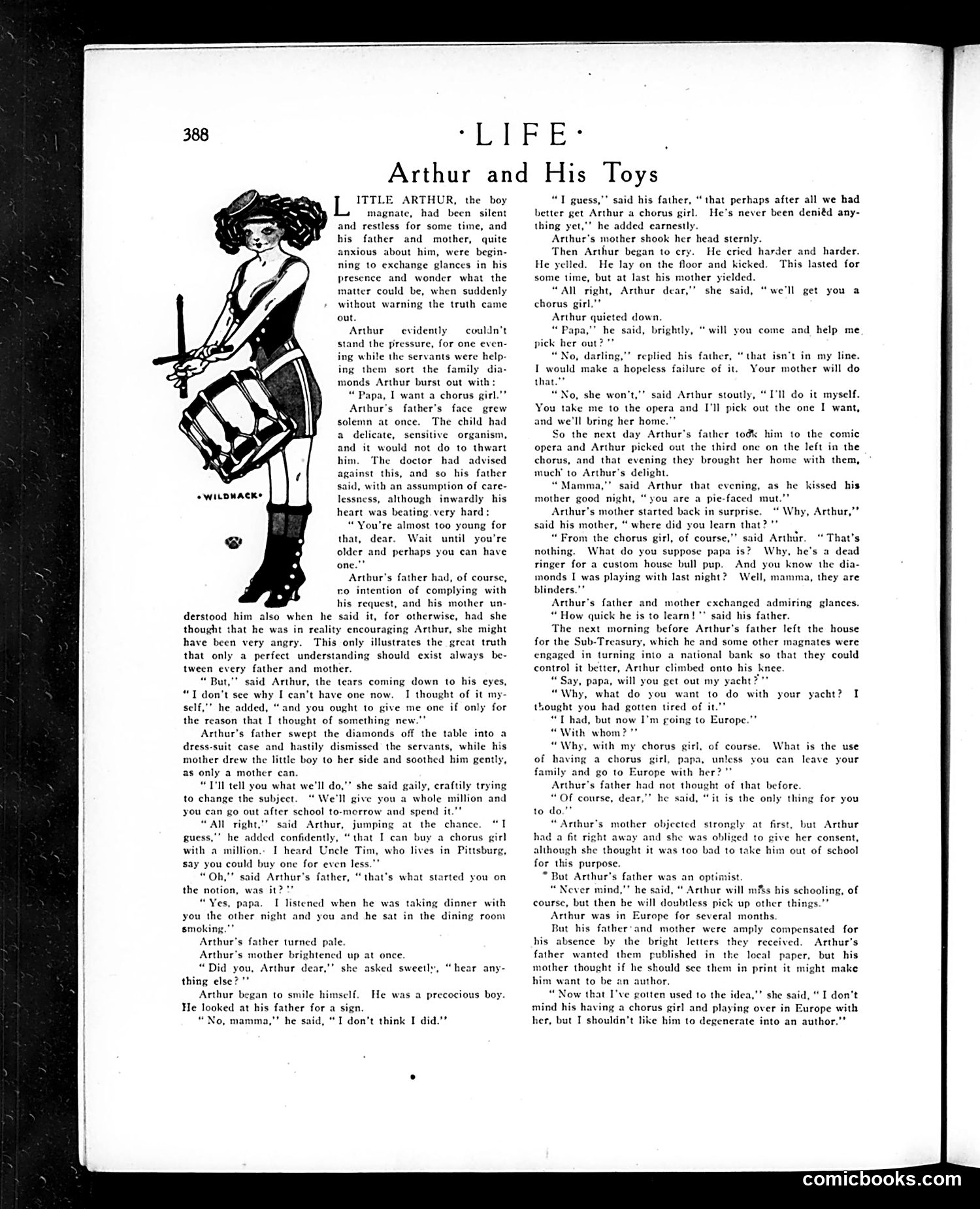
This is a satirical story about wealth and parental indulgence in the early 20th century. "Little Arthur" is a spoiled rich boy whose parents — unable to deny him anything — give him a million dollars to spend after he demands a "chorus girl" (a performer in musical theater, often associated with loose morality). The satire targets: **Wealthy excess**: Arthur casually discusses "family diamonds" and receives a million dollars as casual spending money. **Parental weakness**: His parents' inability to refuse him, even when his request is inappropriate for a child. **Class commentary**: His Uncle Tim's casual mention of buying chorus girls reveals the casual immorality of wealthy men. **The joke's dark edge**: Arthur ultimately gets what he wants — the parents actually take him to the opera and he literally selects and brings home a chorus girl, suggesting wealthy families will rationalize almost any indulgence for their children. The illustration shows a boy in formal dress, emphasizing his privileged status. The humor is cynical, depicting wealth as corrosive to proper parenting and morality.
📄 Transcribed text from this page (OCR, searchable)
Machine-transcribed from the original scan — historical spelling and the odd misread are preserved.
‘LIFE: Arthur and His Toys ITTLE ARTHUR, the boy magnate, had been silent and restless for some time, and his father and mother, quite anxious about him, were begin- ning to exchange glances in his presence and wonder what the natter could be, when suddenly without warning the truth came out. Arthur stand the pressure, for one even- ing while the servants were help ing them sort the family dia- monds Arthur burst out with “ Papa, I want a chorus girl.’ Arthur's father’s face grew solemn at once. The child had a delicate, sensitive organism, and it would not do to thwart him. The doctor had advised against this, and so his father said, with an assumption of care- lessness, although inwardly his heart was beating. very hard: “You're almost too young for that, dear. Wait until you're older and perhaps you can have one.”* Artbur’s father had, of course, no intention of complying with his request, and his mother un- derstood him also when he said it, for otherwise, had she thought that he was in reality encouraging Arthur, she might have been very angry. This only illustrates the great truth that only a perfect understanding should exist always be- tween every father and mother. “ But,” said Arthur, the tears coming down to his eyes, I don’t see why I can’t have one now. I thought of it my- self," he added, “and you ought to give me one if only for the reason that I thought of something new."’ Arthur's father swept the diamonds off the table into a dress-suit case and hastily dismissed the servants, while his mother drew the little boy to her side and soothed him gently, as only a mother can. “T'll tell you what we'll do,” she said gaily, craftily trying to change the subject.“ We'll give you a whole million and you can go out after school to-morrow and spend it.”* “AML right,” said Arthur, jumping at the chance. “I guess,” he added confidently, “that I can buy a chorus girl with a million. I heard Uncle Tim, who lives in Pittsburg, say you could buy one for even less.”” “Ob,” said Arthur's father, “that’s what started you on the notion, was it? ' “Yes, papa. I listened when he was taking dinner with you the other night and you and he sat in the dining room smoking.”” Arthur's father turned pale. Arthur's mother brightened up at once. “Did you, Arthur dear,"’ she asked sweetly, “hear any- thing else?” Arthur began to smile himself, He looked at his father for a sign. “No, mamma,” he said, “I don’t think I did.’”? couldn't evidently He was a precocious boy. I guess,"* said his father, “that perhaps after all we had better get Arthur a chorus girl. He's never been deniéd any- thing yet,"’ he added earnestly Arthur's mother shook her head sternly. Then Arthur began to cry. He cried harder and harder. He yelled. He lay on the floor and kicked. This lasted for some time, but at last his mother yielded. “All right, Arthur dear,” she said, “we'll get you a chorus girl.” Arthur quieted down, “Papa,” he said, brightly, “will you come and help me pick her out?" “No, darling,” replied his father, “that isn't in my line. I would make a hopeless failure of it. Your mother will do tha “No, she won’t,”’ said Arthur stoutly, “I'll do it myself. You take me to the opera and I'll pick out the one I want, and we'll bring her home. So the next day Arthur's father tod him to the comic opera and Arthur picked out the third one on the left in the chorus, and that evening they brought her home with them, much’ to Arthur's delight. Mamm, aid Arthur that evening, as he kissed his mother good night, “you are a pie-faced mu Arthur's mother started back in surprise. “* Why said his mother, “ where did you learn that?" “From the chorus girl, of course,"’ said Arthur. “ That's nothing. What do you suppose papa is? Why, he's a dead ger for a custom house bull pup. And you know the dia- monds I was playing with last night? Well, mamma, they are blinders.”” Arthur's father and mother exchanged admiring glances. “How quick he is to learn! "* said his father. The next morning before Arthur's father left the house for the Sub-Treasury, which he and some other magnates were engaged in turning into a national bank so that they could control it better, Arthur climbed onto his knee. “Say, papa, will you get out my yacht?”* “Why, what do you want to do with your yacht? I thought you had gotten tired of it.” I had, but now I’m going to Europe." “With whom?” “Why, with my chorus girl, of course. What is the use of having a chorus girl, papa, unless you can leave your family and go to Europe with her?” Arthur's father had not thought of that before. “OF course, dear,"” he said, “it is the only thing for you to do."* “Arthur's mother objected strongly at first, but Arthur had a fit right away and she was obliged to give her consent, although she thought it was too bad to take him out of school for this purpose. * But Arthur's father was an optimist. “Never mind," he said, “ Arthur will mfs his schooling, of course, but then he will doubtless pick up other things.”” Arthur was in Europe for several months. But his father*and mother were amply compensated for his absence by the bright letters they received father wanted them published in the local paper, mother thought if he should see them in print it might make him want to be an author. “ Now that I've gotten used to the idea,”” she said, “I don’t mind his having a chorus girl and playing over in Europe with her, but I shouldn't like him to degenerate into an author.”” Arthur,” comicbooks.com