
Life, 1910-03-03 · page 30 of 80
Life — March 3, 1910 — page 30: what you’re looking at
What you’re looking at
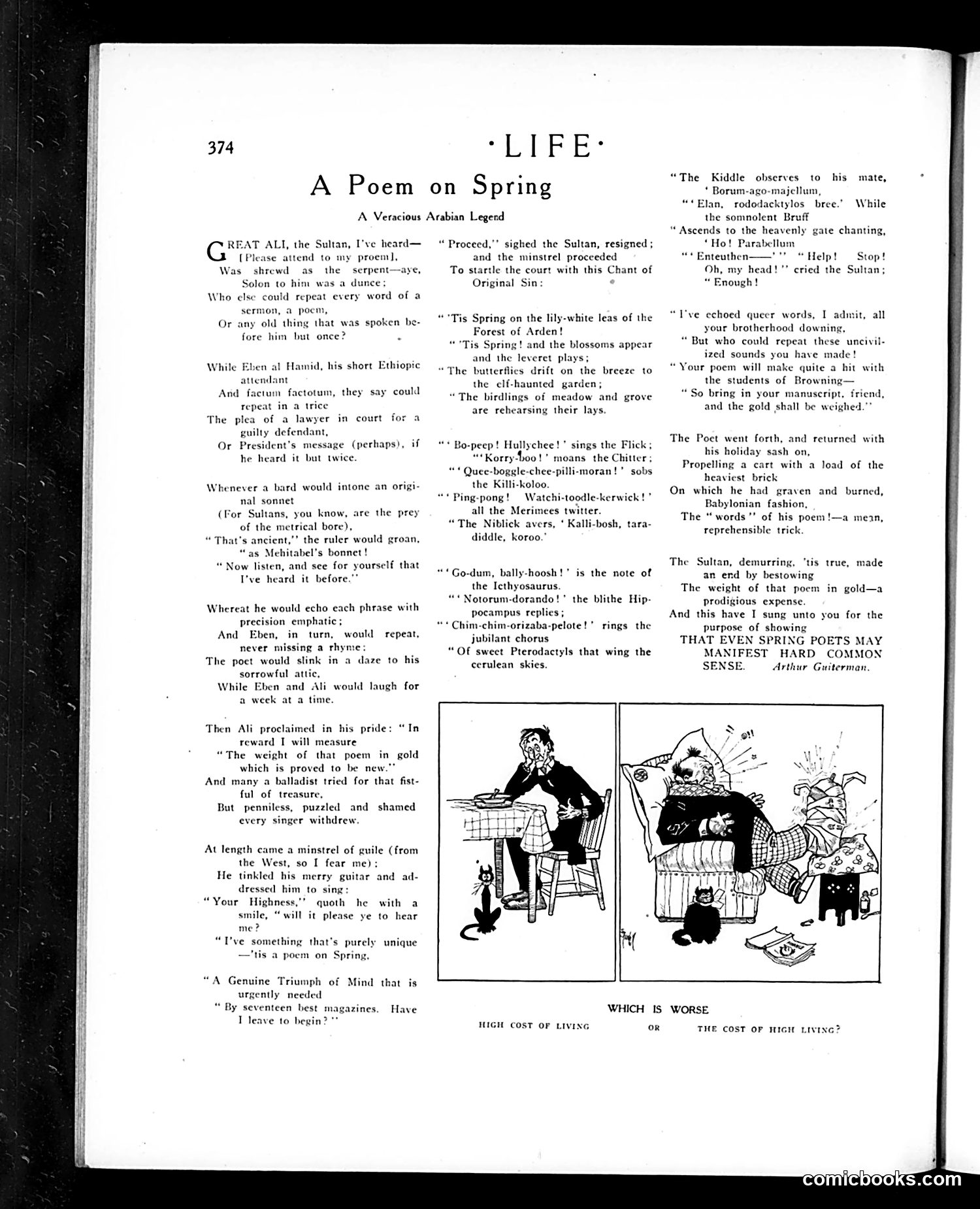
This page presents a satirical poem by Arthur Guiterman mocking pretentious modernist poetry and literary fraud. The narrative frames a wily Western minstrel who wins the Sultan's gold reward for an "original" poem by reciting gibberish animal sounds ("Bo-peep! Hullychee!" "Korry-boo!") presented as profound Spring verse. The satire targets early 20th-century "difficult" poetry—works readers found incomprehensible but culturally praised. By demonstrating that nonsense can pass as serious literature when sufficiently obscure, Guiterman critiques both pretentious poets and credulous critics. The moral: even Spring poetry (traditionally simple subjects) becomes absurdly overwrought in modern hands. The accompanying cartoon illustrates the cost-of-living debate visually—likely contrasting wealthy excess with working-class struggle, a common contemporary concern during this period.
📄 Transcribed text from this page (OCR, searchable)
Machine-transcribed from the original scan — historical spelling and the odd misread are preserved.
‘LID Ee A Poem on Spring A Veracious Arabian Legend REAT ALI, the Sultan, I've heard— [Please attend to my proem], Was shrewd as the serpent— Solon to hi Who else could reps sermon, a poem, Or any old thing that was spoken be- fore him but once? was a dunce; t every word of a While Eben al Hamid, his short Ethiopic attendant um factotum, they say could repeat in a trice The plea of a lawyer in uilty defendant, Or President's message (perhaps), if he heard it but twice. And court for a Whenever a bard would intone an origi- nal sonnet (For Sultans, you know, are the prey of the metrical bore), "s ancient,”’ the ruler would groan, “as Mehitabel’s bonnet! Now listen, and see for yourself that I've heard it before.’” Whereat he would echo each phrase with precision emphatic; Eben, in turn, would never missing a rhyme: The poet would slink in a daze to his sorrowful attic, While Eben and Ali would laugh for a week at a time. And repeat, Then Ali proclaimed in his pride: “In reward I will measure “The weight of that poem in gold which is proved to be new.” And many a balladist tried for that fist- ful of treasure, penniless, puzzled and every singer withdrew. But shamed At length came a minstrel of guile (from the West, so I fear me); He tinkled his merry guitar and ad- dressed him to sing: Highne quoth he with a smile, “will it please ye to hear “Your me? “T've something that’s purely unique —'tis a poem on Spring, “A Genuine Triumph of Mind that is urgently needed “ By seventeen best ] leave to begin? azines. Have “ Proceed,’’ sighed the Sultan, resigned ; and the minstrel proceeded To startle the court with this Chant of Original Sin: ; “Tis Spring on the lily-white leas of the Forest of Arden! and the blossoms appear and the leveret plays; “The butterflies drift on the breeze to the elf-haunted garden; “The birdlings of meadow and grove are rehearsing their lays. “* Bo-peep! Hullychee! * sings the Flick; “*Korry-boo!’ moans the Chitter ; “* Quee-boggle-chee-pilli-moran!' sobs the Killi-koloo. Ping-pong! Watchi-toodle-kerwick ! all the Merimees twitter. “The Niblick avers, ‘ Kalli-bosh, tara- diddle, koroo.” “*Go-dum, bally-hoosh!" is the note of the Icthyosaurus. torum-dorando ! ° pocampus replies; Chim-chim-orizaba-pelote!" rings the jubilant chorus “Of sweet Pterodactyls that wing the cerulean skies. the blithe Hip- “The Kiddle observes to his * Borum-ago-majellum, “*Elan, rododacktylos bree.’ the somnolent Bruff “Ascends to the heavenly “Ho! Parabellu “+ Enteuthen: Oh, my head! “ Enough ! mate, While te chanting, “Help! * cried the Sultan; Stop! “I've echoed queer words, 1 admit, all your brotherhood downing, “ But who could repeat these uncivil- ized sounds you have made! "Your poem will make quite a hit with the students of Browning— “So bring in your manuscript, friend, and the gold shall be weighed.”’ The Poet went forth, and returned with his holiday sash on, Propelling a cart with a load of the heaviest brick On which he had graven and Babylonian fashion, The “ words" of his poem!—a mean, reprehensible trick burned, The Sultan, demurring, ‘tis true, made an end by bestowing The weight of that pocm in gold—a prodigious expense And this have T sung unto you for the purpose of showing THAT EVEN SPRING POETS MAY y HARD COMMON Arthur Guiterman. zee WHICH IS WORSE HIGH COST OF LIVING oR THE COST OF HIGH Livixc?