
Life, 1910-03-03 · page 38 of 80
Life — March 3, 1910 — page 38: what you’re looking at
What you’re looking at
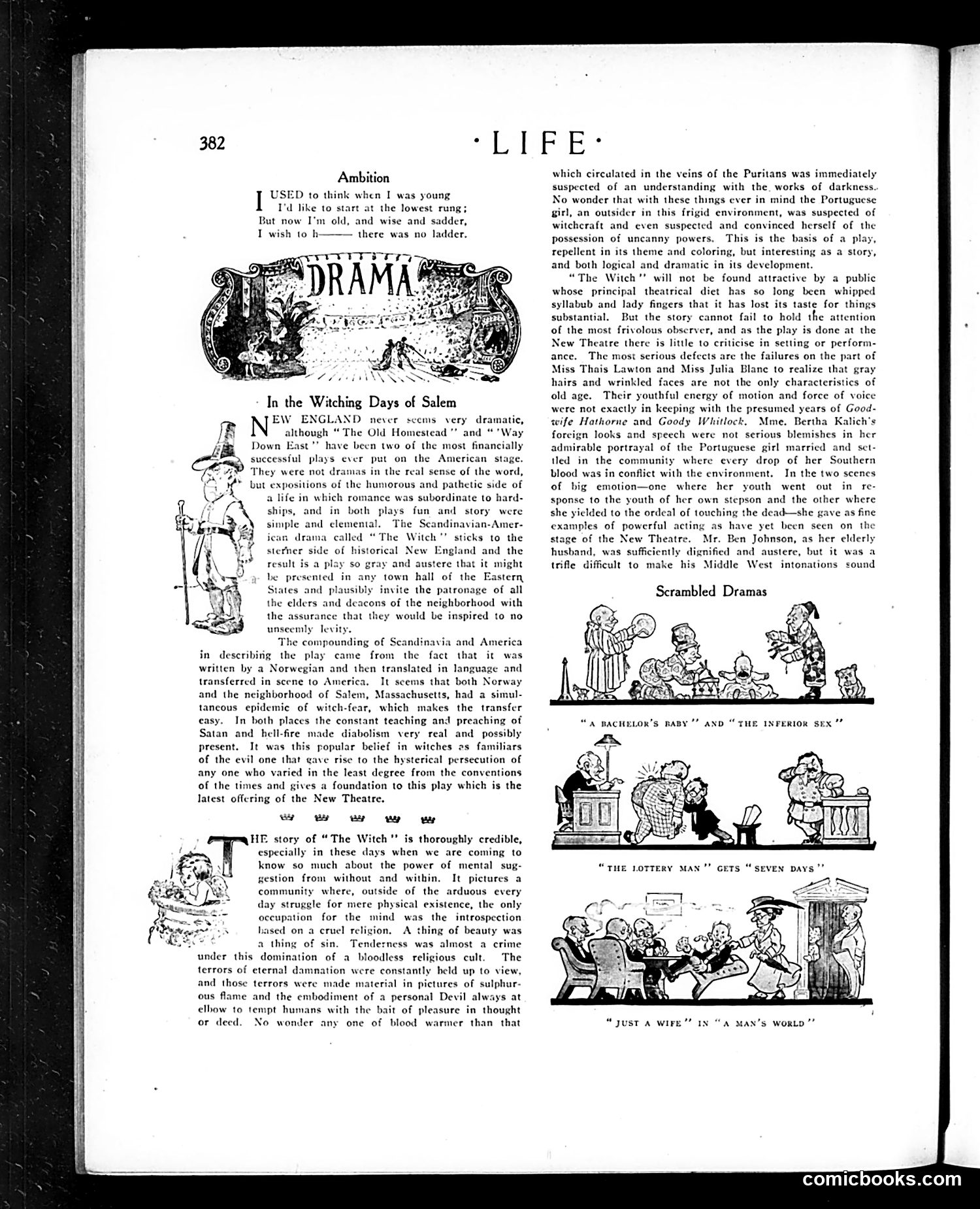
This page contains two sections: a brief poem titled "Ambition" mocking youthful aspirations, and a theater review of "The Witch," a play adapted from Norwegian source material and set in historical Salem, Massachusetts. The review analyzes how the play dramatizes witch-trial hysteria by depicting a community where Puritan religious severity—obsession with sin, damnation, and Satan—created psychological conditions for persecution. A Portuguese outsider girl becomes suspected of witchcraft, embodying how rigid religious conformity breeds intolerance of difference. The critic argues the play's dark subject matter won't appeal to audiences accustomed to lighter theatrical fare ("whipped syllabub and lady fingers"), yet praises its logical development and New Theatre production values, while critiquing specific actresses' inability to convincingly portray elderly characters through more than cosmetic aging effects. The "Scrambled Dramas" cartoons below offer comedic play titles satirizing contemporary social concerns.
📄 Transcribed text from this page (OCR, searchable)
Machine-transcribed from the original scan — historical spelling and the odd misread are preserved.
LIPFE* Ambition I USED to think when I was young I'd like to start at the lowest rung But now I'm old, and wise and sadder, I wish to h— there was no ladder. In the Witching Days of Salem EW ENGLAND never scems very dramatic, although “ The Old Homestead” and “ "Way Down East’ have been two of the most financially successful plays ever put on the American stage. They were not dramas in the real sense of the word, but expositions of the humorous and pathetic side of a life in which romance was subordinate to hard- ships, and in both plays fun and story were simple and elemental. The Scandinavian-Amer- jean drama called “ The Witch’ sticks to the stefner side of historical New England and the result is a play so gray and austere that it might be presented in any town hall of the Eastern States and plausibly invite the patronage of all the elders and deacons of the neighborhood with the assurance that they would be inspired to no unseemly. levity. The compounding of Scandinavia and America in describirig the play came from the fact that it was written by a Norwegian and then translated in language and transferred in scene to America. It scems that both Norway and the neighborhood of Salem, Massachusetts, had a simul- tancous epidemic of witch-fear, which makes the transfer easy. In both places the constant teaching and preaching of Satan and hell-fire made diabolism very real and possibly present. It was this popular belief in witches es familiars of the evil one that gave rise to the hysterical persecution of any one who varied in the least degree from the conventions of the times and gives a foundation to this play which is the latest offering of the New Theatre. wow ee oe ow HE story of “The Witch"? is thoroughly credible, especially in these days when we are coming to know so much about the power of mental sug- gestion from without and within, It pictures a community where, outside of the arduous every day struggle for mere physical existence, the only occupation for the mind was the introspection hased on a cruel religion, A thing of beauty was a thing of sin. Tenderness was almost a crime under this domination of a bloodless religious cult. The terrors of eternal damnation were constantly held up to view, and those terrors were made material in pictures of sulphur- ous flame and the embodiment of a personal Devil always at elbow to tempt humans with the bait of pleasure in thought or deed. No wonder any one of blood warmer than that which circulated in the veins of the Puritans was immediately suspected of an understanding with the. works of darkness No wonder that with these things ever in mind the Portuguese girl, an outsider in this frigid environment, was suspected of witchcraft and even suspected and convinced herself of the possession of uncanny powers. This is the basis of a play, repellent in its theme and coloring, but interesting as a story, and both logical and dramatic in its development. “The Witch ' will not be found attractive by a public whose principal theatrical diet has so long been whipped syllabub and lady fingers that it has lost its taste for things substantial. But the story cannot fail to hold the attention of the most frivolous observer, and as the play is done at the New Theatre there is little to criticise in setting or perform- ance. The most serious defects are the failures on the part of Miss Thais Lawton and Miss Julia Blane to realize that gray airs and wrinkled faces are not the only characteristics of old age. Their youthful energy of motion and force of voice were not exactly in keeping with the presumed years of Good- wife Hathorne and Goody Whitlock. Mme. Bertha Kalich’s foreign looks and speech were not serious blemishes in her admirable portrayal of the Portuguese girl married and set- tled in the community where every drop of her Southern blood was in conflict with the environment, In the two scenes of big emotion—one where her youth went out in re- sponse to the youth of her own stepson and the other where she yielded to the ordeal of touching the dead—she gave as fine examples of powerful acting as have yet been seen on the stage of the New Theatre. Mr. Ben Johnson, as her elderly husband, was sufficiently dignified and austere, but it was a trifle difficult to make his Middle West intonations sound Scrambled Dramas “ yuST A WIFE’? IN “A MaN’s wort ’” comicbooks.com