
Life, 1910-03-03 · page 42 of 80
Life — March 3, 1910 — page 42: what you’re looking at
What you’re looking at
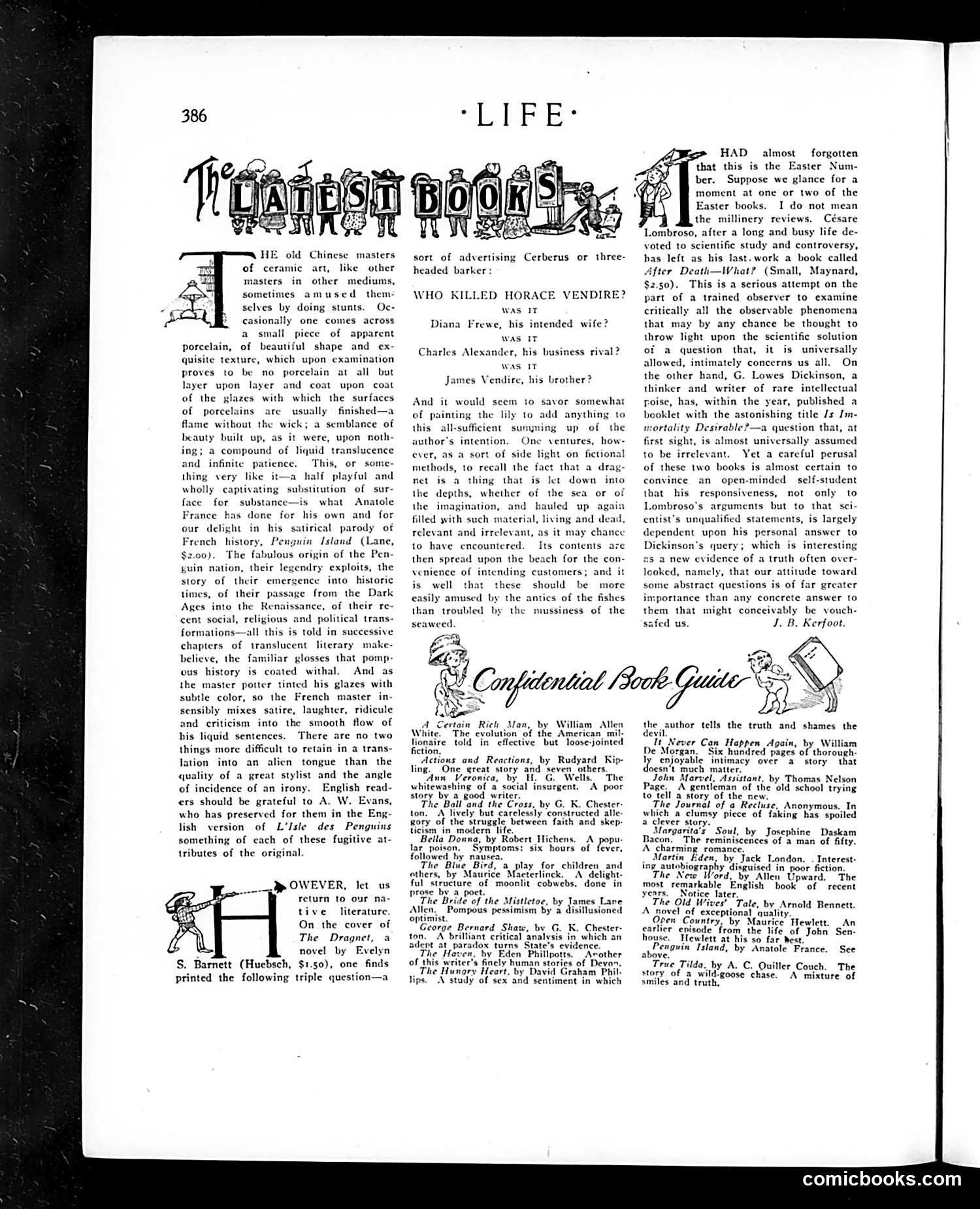
This is a book review section from Life magazine featuring three novel reviews. The page critiques *Penguin Island* by Anatole France, praised for its satirical parody of French history using elaborate literary "glazing" (surface beauty masking substance). The reviewer compares France's ironic style to Chinese porcelain craftsmen who create hollow beauty. *The Dragnet* by Evelyn S. Barnett is reviewed with the publisher's sensational three-question murder mystery hook ("Who Killed Horace Vendire?") analyzed as an obvious but effective marketing technique. The final section mentions Easter books, including Césare Lombroso's *After Death—What?*, a serious scientific examination of afterlife phenomena. The page also advertises a "Confidential Book Guide" recommending additional titles. The satire targets both pretentious literary styling and cheap mystery novel marketing tactics.
📄 Transcribed text from this page (OCR, searchable)
Machine-transcribed from the original scan — historical spelling and the odd misread are preserved.
HE old Chinese masters of ceramic art, like other masters in other mediums, sometimes selves by doing stunts. Oc- casionally one comes across a small piece of apparent porcelain, of beautiful shape and ex quisite texture, which upon examination proves to be no porcelain at all but layer upon layer and coat upon coat of the glazes with which the surfaces of porcelains are usually finished—a flame without the wick; a semblance of beauty built up, as it were, upon noth- ing; a compound of liquid translucence and infinite patience. This, or some- thing very like it—a half playful and wholly captivating substitution of sur- face for substance—is what Anatole ance has done for his own and for our delight in his satirical parody of French history, Penguin Island (Lane, $2.00). The fabulous origin of the Pen- guin nation, their legendry exploits, the story of their emergence into historic times, of their passage from the Dark Ages into the Renaissance, of their re- cent social, religious and political trans- formations—all this is told in successive chapters of translucent literary make- believe, the familiar glosses that pomp ous history is coated withal. And the master potter tinted his glazes with subtle color, so the French master in sensibly mixes satire, laughter, ridicule and criticism into the smooth flow of his liquid sentences. There are no two things more difficult to retain in a trans- lation into an alien tongue than the quality of a great stylist and the angle of incidence of an irony. English read- ers should be grateful to A. W. Evans, who has preserved for them in the Eng- lish version of L’'Isle des Penguins something of cach of these fugitive at- tributes of the original. amused them: __--—gP OWEVER, Iet_ us return to our na- tive literature. On the cover of The Dragnet, a ‘ novel by Evelyn S. Barnett (Huebsch, $1.50), one finds printed the following triple question—a sort of advertising Cerberus or three- headed barker: WHO KILLED HORACE VENDIRE? Was IT Diana Frewe, his intended wife? Was IT Charles Alexander, his bus Was IT James Vendire, his brother? ness rival? And it would seem to savor somewhat of painting the lily to add anything to all-sufficient sunyning up of the author's intention. One ventures, how- ever, as a sort of side light on fictior methods, to recall the fact that a drag net is a thing that is let down into the depths, whether of the sea or of the imagination, and hauled up filled with such material, living and dead, t and irrelevant, as it may chance to have encounter Its contents are then spread upon the beach for the con- venience of intending customers; and it is well that these should be more easily amused by the antics of the fishes than troubled by the ess of the this again releva mussi HAD almost forgotten that this is the Easter Num- ber. Suppose we glance for a moment at one or two of the Easter books. I do not mean the millinery reviews. Césare Lombroso, after a long and busy life de- voted to scientific study and controversy, bas left as his last.work a book called After Death—What? (Small, Maynard, $2.50). This is a serious attempt on the part of a trained observer to examine critically all the observable phenomena that may by any chance be thought to throw light upon the scientific solution of a question that, it is universally allowed, intimately concerns us all. On the other hand, G. Lowes Dickinson, a thinker and writer of rare intellectual poise, has, within the year, published a booklet with the astonishing title /s Jm- mortality Desirable?—a question that, at first sight, is almost universally assumed to be irrelevant. Yet a careful perusal of these two books is almost certain to convince an open-minded self-student that his responsiveness, not only to Lombroso’s arguments but to that sci- entist’s unqualified statements, is largely dependent upon his personal answer to Dickinson's query; which is interesting s a new evidence of a truth often over- looked, namely, that our attitude toward some abstract questions is of far greater importance than any concrete answer to them that might conceivably be vouch- safed us. J. B. Kerfoot. nlial [Sook Certain Rich Man, by William Allen White.” The evolution of the American, mil- Hionaire told in effective but loose-jointed fiction. actions and Reactions, by Rudyard Kip- ling. One great story and seven. others, ‘Ann Veronica, by H. G. Wells. The whitewashing of a social insurgent. A poor story by a good writer. The Ball and the Cross, by G. K. Chester ton. A lively but carelessly constructed alle- gory of the struggle between faith and skep: ticism in_modern life. Bella Donna, by Robert Hichens. A popu lar poison. Symptoms: six hours of fever, followed by nausea. The Biue Bird, a play for children and ethers, by Maurice Maeterlinck. A delight- ful structure of moonlit cobwebs, done in prose by a poet. The Bride of the Mistletoe, by Tames Lane Allen. Pompous pessimism by a disillusioned optimist. George Bernard Shaw, by G. K. Chester: ton. A brilliant critical analysis in’ which an adept ‘at paradox turns State's evidence. The Haven, by Eden Phillpotts. Arother of this writer's finely human stories of Devon. The Hunary Heart, by David Graham Phil lips. A study of sex’and sentiment in which fhe author tells the truth and shames the devi It Never Can Happen Again, by William De Morgan, Six hundred pages of thorough: ly enjoyable intimacy over a story. that foesn’t much matter. John Marvel, Assistant, by Thomas Nelson Page, A gentleman of the old school trying to tell a story of the new. The Journal of a Recluse, Anonymous. In which a clumsy piece of faking has spoiled a clever story. Margarita’s’ Soul, by Josephine Daskam Bacon. The reminiscences of a man of fifty. A charming romance. Martin Eden, by Jack London. ing autobiography disguised in poor fiction. The New Word, by Allen Upward. The most remarkable English recent years, Notice later, The Old Wives’ Tale, by Arnold Bennett. A novel of exceptional auality. Open Country. by Maurice Hewlett. An carlier enisode from the life of John Sen- house. Hewlett at his so far Rest, anpenonin Island, by Anatole France. See True Tilda. by A. C. Ouiller Couch story of a wild-goose chase. smiles and truth, Interest- book of The A mixture of comicbooks.com