
Life, 1910-03-03 · page 28 of 80
Life — March 3, 1910 — page 28: what you’re looking at
What you’re looking at
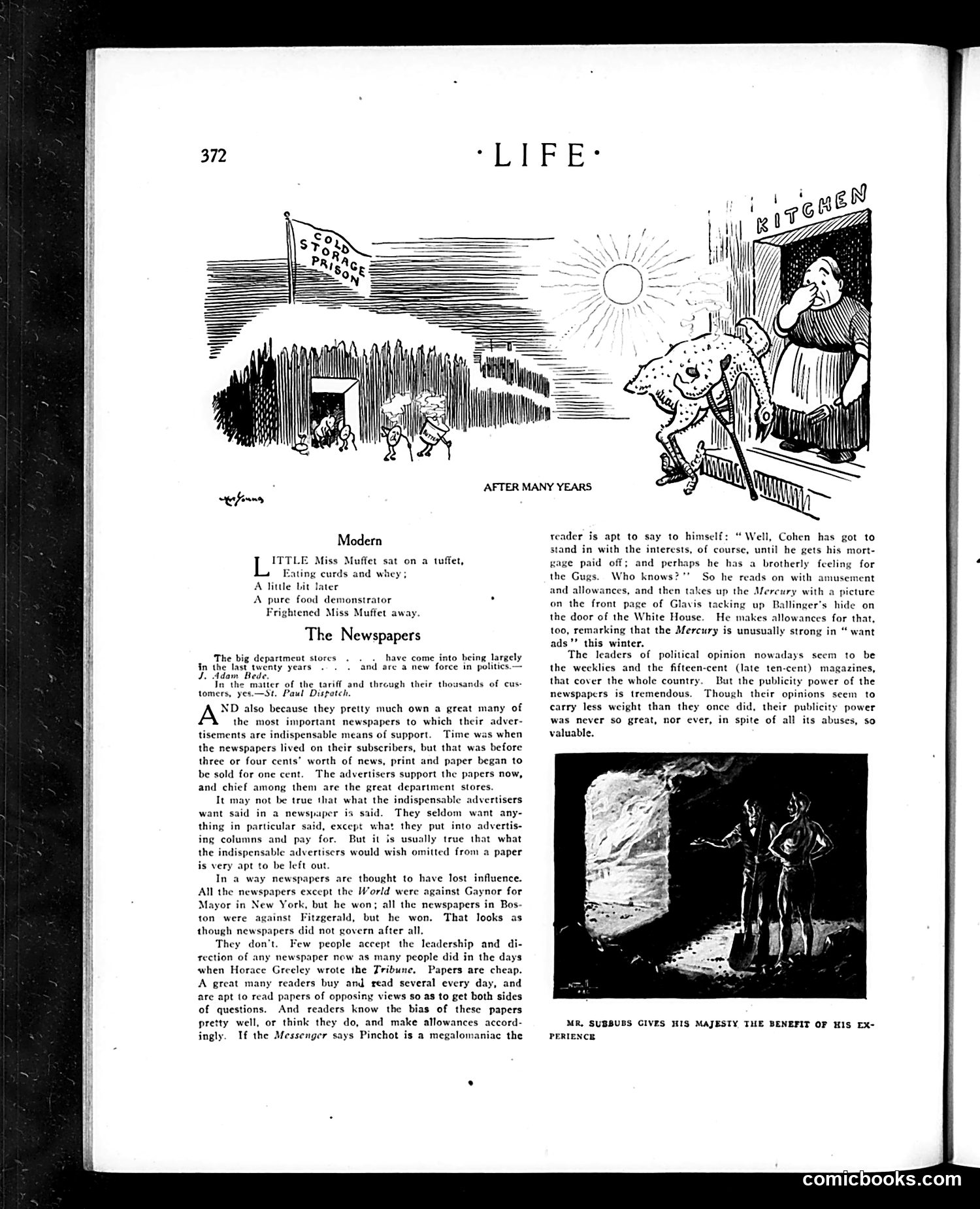
This article critiques newspaper influence and bias in early 20th-century America. The key argument: newspapers once depended on subscribers but now rely on advertising revenue from department stores, which therefore control editorial content through economic pressure rather than direct orders. The opening poem parodies "Little Miss Muffet," replacing the spider with a "pure food demonstrator"—likely referencing Progressive Era food safety scandals and sensationalist newspaper coverage. The article references specific political victories (Gaynor, Fitzgerald winning despite newspaper opposition) to argue newspapers have less direct influence than before. However, their **publicity power** remains enormous—they shape what stories appear, what gets omitted. The cartoons illustrate this tension: readers now read multiple papers with opposing views and recognize bias (the text mentions readers making allowances for papers' obvious interests). The second cartoon's caption about "Mr. Subbubs" and "majesty" appears to satirize how ordinary people now skeptically navigate newspaper narratives. The core message: newspapers are powerful but their power is structural (agenda-setting) rather than persuasive.
📄 Transcribed text from this page (OCR, searchable)
Machine-transcribed from the original scan — historical spelling and the odd misread are preserved.
ITTLE Miss Muffet sat on a tuffet, ating curds and whey; A little bit later A pure food demonstrator Frightened Miss Muffet away. The Newspapers have come into being largely The big department stores and are a new force in politics. — in the last twenty years J. Ada: Rede. In the matter of the tariff and through their thousands of cus » yes. — St. Paul Dispatch. ND also because they pretty much own a great many of the most important newspapers to which their adver- tisements are indispensable means of support. Time was when the newspapers lived on their subscribers, but that was before three or four cents’ worth of news, print and paper began to be sold for one cent. The advertisers support the papers now, and chief among them are the great department stores. It may not be true that what the indispensable advertisers want said in a newspaper is said. They seldom want any- thing in particular said, except what they put into advertis- ing columns and pay for. But it is usually true that what the indispensable advertisers would wish omitted from a paper is very apt to be left out. In a way newspapers are thought to have lost influence. All the newspapers except the World were against Gaynor for Mayor in New York, but he won; all the newspapers in Bos- ton were against Fitzgerald, but he won. That looks as though newspapers did not govern after all. They don’t. Few people accept the leadership and di- rection of any newspaper now as many people did in the days when Horace Greeley wrote the Tribune, Papers are cheap. A great many readers buy and read several every day, and are apt to read papers of opposing views so as to get both sides of questions. And readers know the bias of these papers pretty well, or think they do, and make allowances accord- ingly. If the Messenger says Pinchot is a megalomaniac the reader is apt to say to himself: “Well, Cohen has got to stand in with the interests, of course, until he gets his mort- gage paid off; and perhaps he has a brotherly f for the Gugs. Who knows? and allowances, and then on the front page of Glavis tacking up Ballinger’s hide on the door of the White House. He makes allowances for that, too, remarking that the Mercury is unusually strong in “ want ads"? this winter. The leaders of political opinion nowadays se to be the weeklies and the fifteen-cent (late ten-cent) magazines, that cover the whole country. But the publicity power of the newspapers is tremendous. Though their opinions seem to carry less weight than they once did, their publicity power was never so great, nor ever, in spite of all its abuses, so valuable. So he reads on with amusement sup the Mercury with a picture MR, SUBBUBS GIVES HIS MAJESTY THE BENEFIT OF HIS EX- PERIENCE comicbooks.com