
Life, 1910-03-03 · page 36 of 80
Life — March 3, 1910 — page 36: what you’re looking at
What you’re looking at
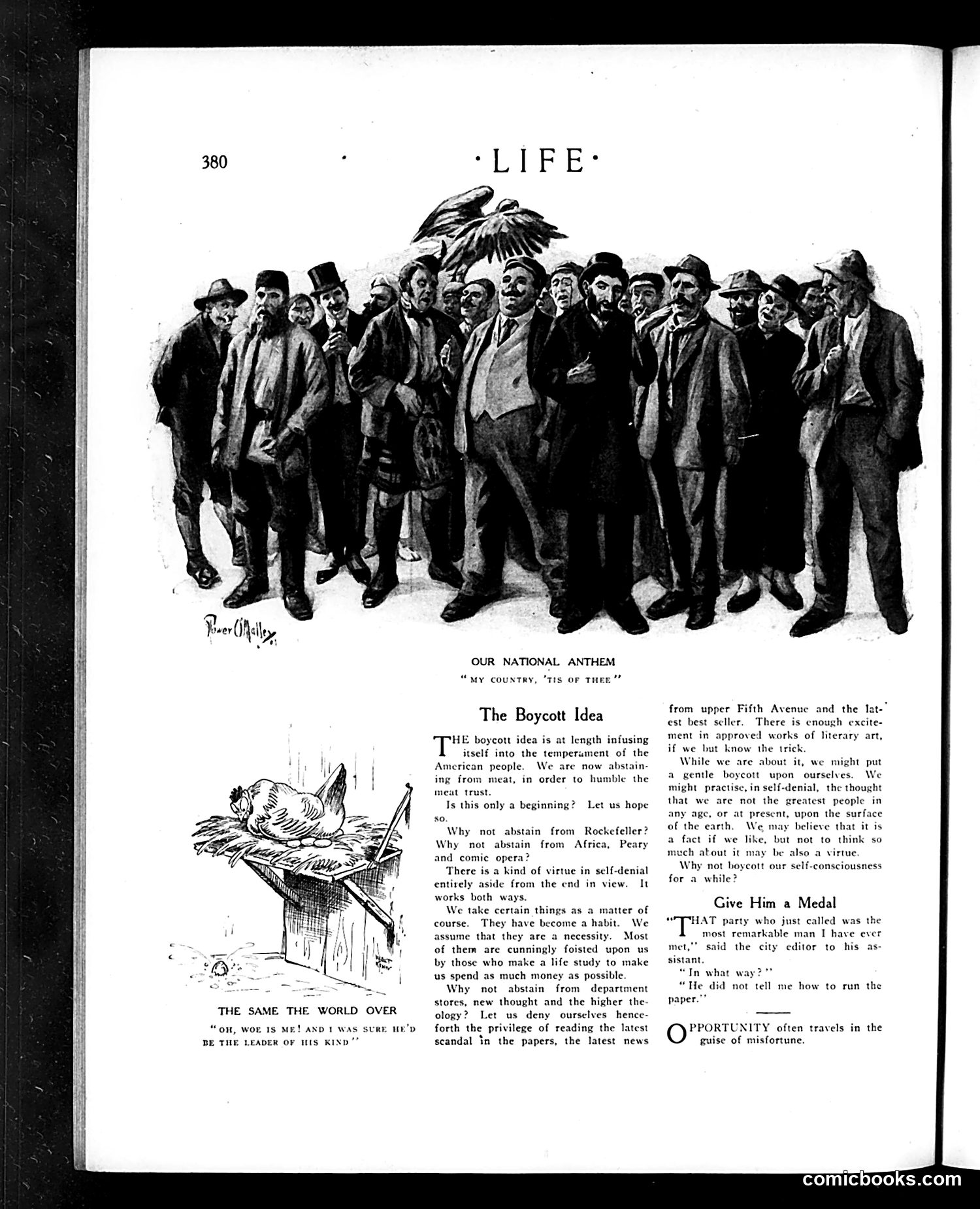
This satirical page critiques the American "boycott" movement of the early 1900s, likely targeting the meat boycott against the "meat trust" (monopolistic meat-packing corporations). **Top cartoon**: Shows a dejected rooster beneath the caption "Oh, woe is me! And I was sure he'd be the leader of his kind"—mocking how the boycott movement affects even farm animals. **"The Boycott Idea" essay**: Satirizes boycott logic by proposing absurd extensions: Why stop at meat? Why not boycott Rockefeller, Africa, Peary expeditions, department stores, theology, and newspapers? The satire peaks when suggesting Americans boycott their own self-consciousness and vanity—implying the real problem isn't external monopolies but American overconsumption and self-importance. **"Give Him a Medal"**: A brief joke praising a newspaper visitor who *didn't* tell the editor how to run his paper—poking fun at public meddling and unsolicited advice. The page's overall message: While boycotts address real corporate abuses, they reflect deeper American character flaws—materialism, arrogance, and constant complaining.
📄 Transcribed text from this page (OCR, searchable)
Machine-transcribed from the original scan — historical spelling and the odd misread are preserved.
THE SAME THE WORLD OVER “om, WOE 1S ME! AND T WAS SURE Ie’D BE THE LEADER OF I1fS KIND” OUR NATIONAL ANTHEM “My COUNTRY, "TIS OF THEE’? The Boycott Idea HE boycott idea is at length infusing itself into the temperament of the American people. We are now abstain- ing from meat, in order to humble the meat trust. Is this only a beginning? so. Why not abstain from Why not abstain from and comic opera? There is a kind of virtue in self-denial entirely aside from the end in v works both ways. We take certain things as a matter of course. They have become a habit. We assume that they are a necessity. Most of them are cunningly foisted upon us by those who make a life study to make us spend as much money as possible. Why not abstain from department stores, new thought and the higher the ology? Let us deny ourselves hence- forth the privilege of reading the latest scandal in the papers, the latest news Let us hope Rockefeller? Africa, Peary from upper Fifth Avenue and the lat-) est best seller, There is cnough excite- nt in approved works of literary art, if we but know the trick. While we are about it, we might put a gentle boycott upon ourselves. We might practise, in self-denial, the thought that we are not the greatest people in any age, or at present, upon the surface of the earth. We may believe that it is a fact if we like, but not to think so much atout it may Why not boycott our self-consciousness for a while? Give Him a Medal “THAT party who just called was the most remarkable man I have ever met," said the city editor to his as- sistant. “Tn what way?” “Te did not tell me how to run the paper.”” be also a virtue. PPORTUNITY often travels in the guise of misfortune. comicbooks.com