
A complete issue · 54 pages · 1928
Life — June 7, 1928
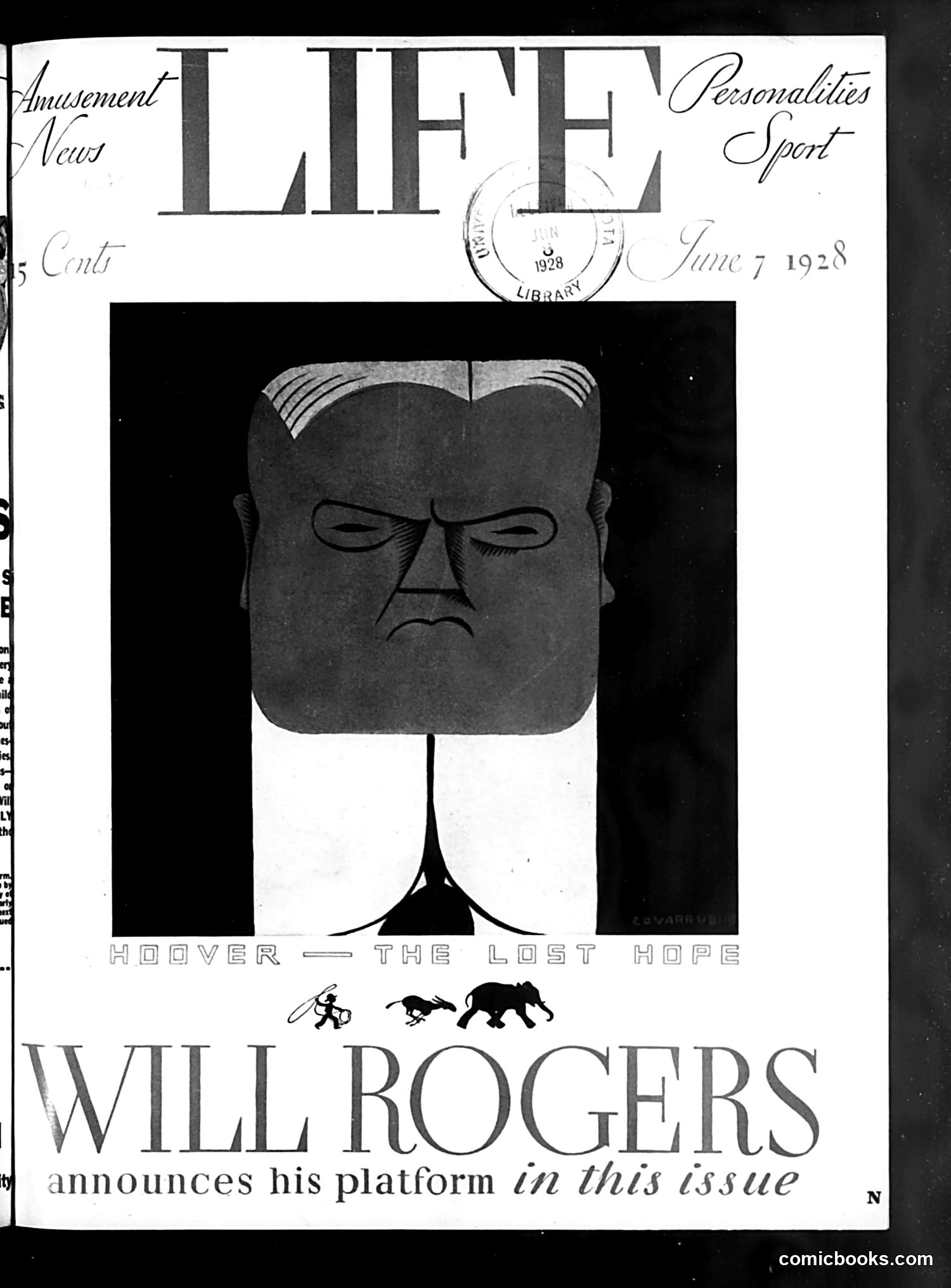
This is a Life magazine cover from June 7, 1928 featuring political satire about Herbert Hoover's presidential campaign. The large caricature depicts a stern, angry face labeled "HOOVER — THE LOST HOPE," with the figure's body composed of pages (suggesting he's a "paper" candidate or hollow platform). Below are small silhouettes of a man running, an eagle, and a bear—likely representing different political factions or concerns. The satire suggests Hoover has become an unpopular or defeated figure despite his candidacy. The announcement that "WILL ROGERS announces his platform in this issue" indicates the magazine is using prominent humorist Rogers to critique Hoover's actual platform, treating the politician as a subject of ridicule rather than serious consideration.
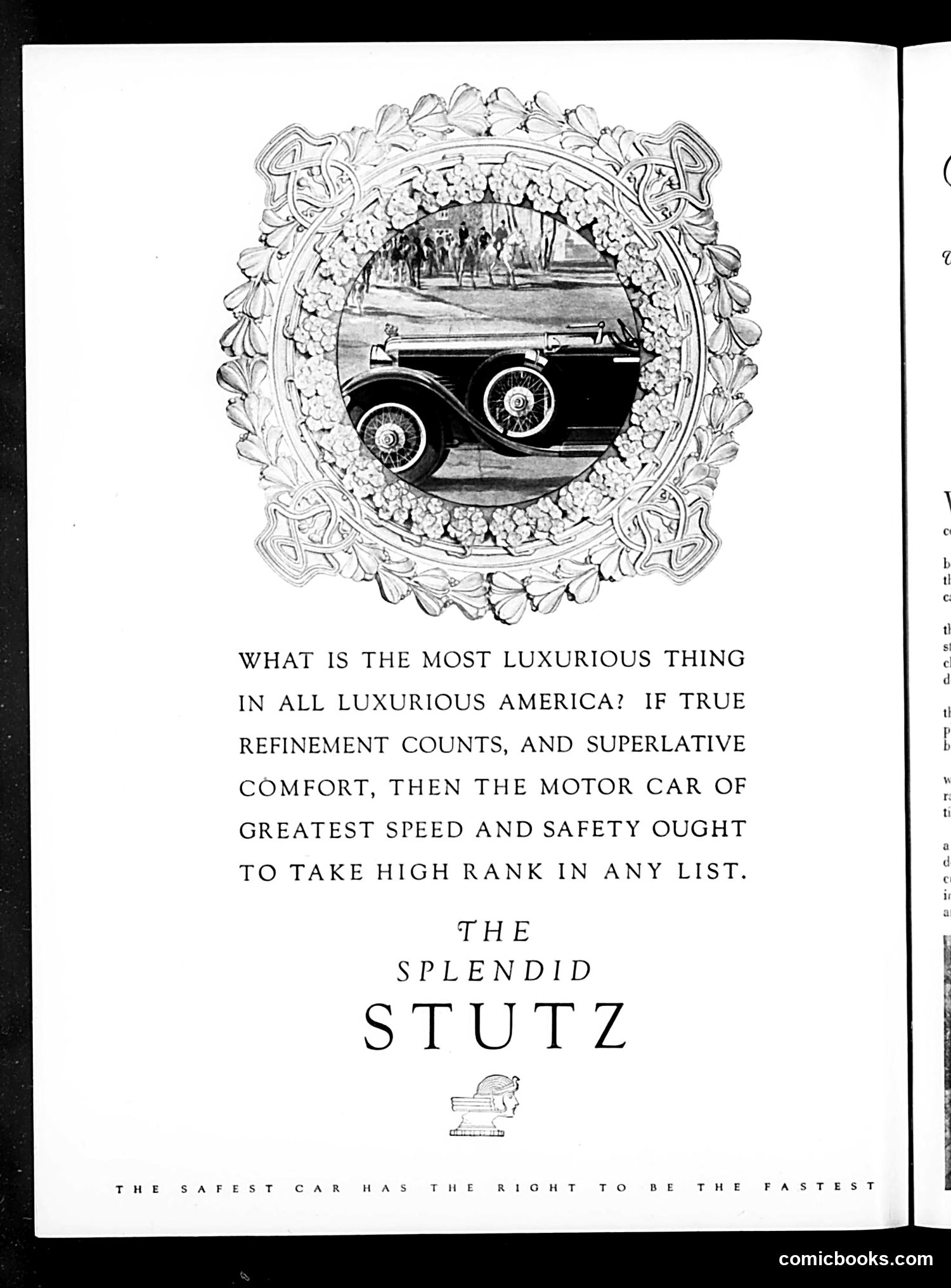
This is a **Stutz automobile advertisement**, not a political cartoon. The ornate frame contains a photograph of a luxury car from approximately the 1920s-1930s era. The ad's text argues that if refinement and comfort define luxury in America, then high-speed, safe motor cars deserve prominence. The tagline "The safest car has the right to be the fastest" promotes the Stutz brand as combining both safety and performance—claims typical of luxury car marketing during the automotive industry's rapid expansion. The elaborate decorative border and classical typography emphasize exclusivity and prestige. This represents early automotive advertising's strategy of associating cars with wealth and sophistication. There is no political satire present—this is straightforward commercial promotion.
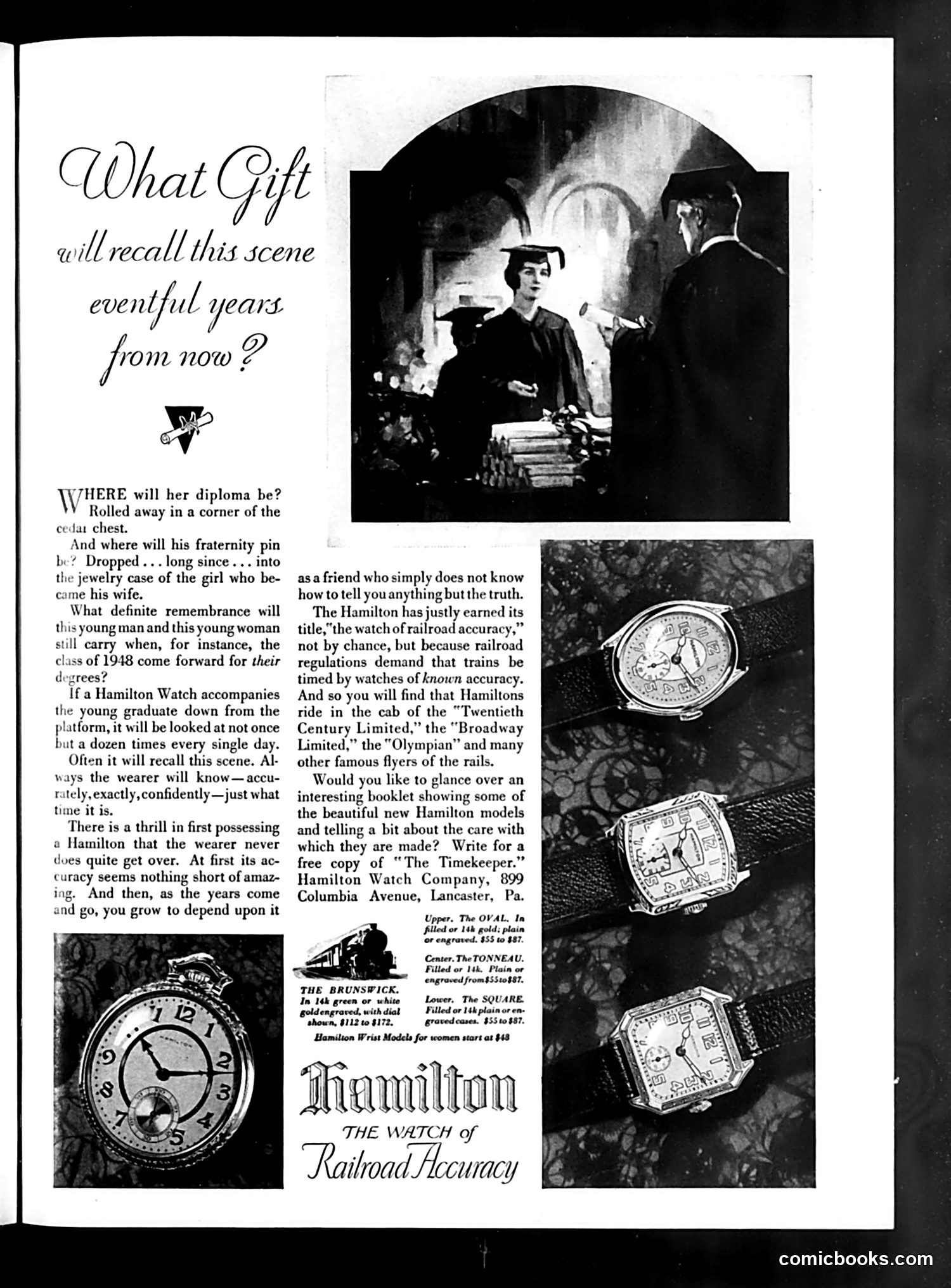
This page is primarily a **Hamilton Watch Company advertisement**, not satire or political commentary. The ad uses a sentimental narrative framing: a graduation gift of a Hamilton watch will be remembered fondly throughout the recipient's life. The text emphasizes the watch's reliability and precision—Hamilton watches were famously used on railroads, hence the tagline "The Watch of Railroad Accuracy." The visual elements show: - A scene of gift-giving (top) - Various Hamilton watch models available for women and men - Close-up photographs of the watches themselves The emotional appeal targets parents/gift-givers by suggesting a Hamilton watch becomes a meaningful keepsake. The railroad accuracy angle establishes the product's credibility through association with rigorous timekeeping standards. This is straightforward commercial marketing, not satire.
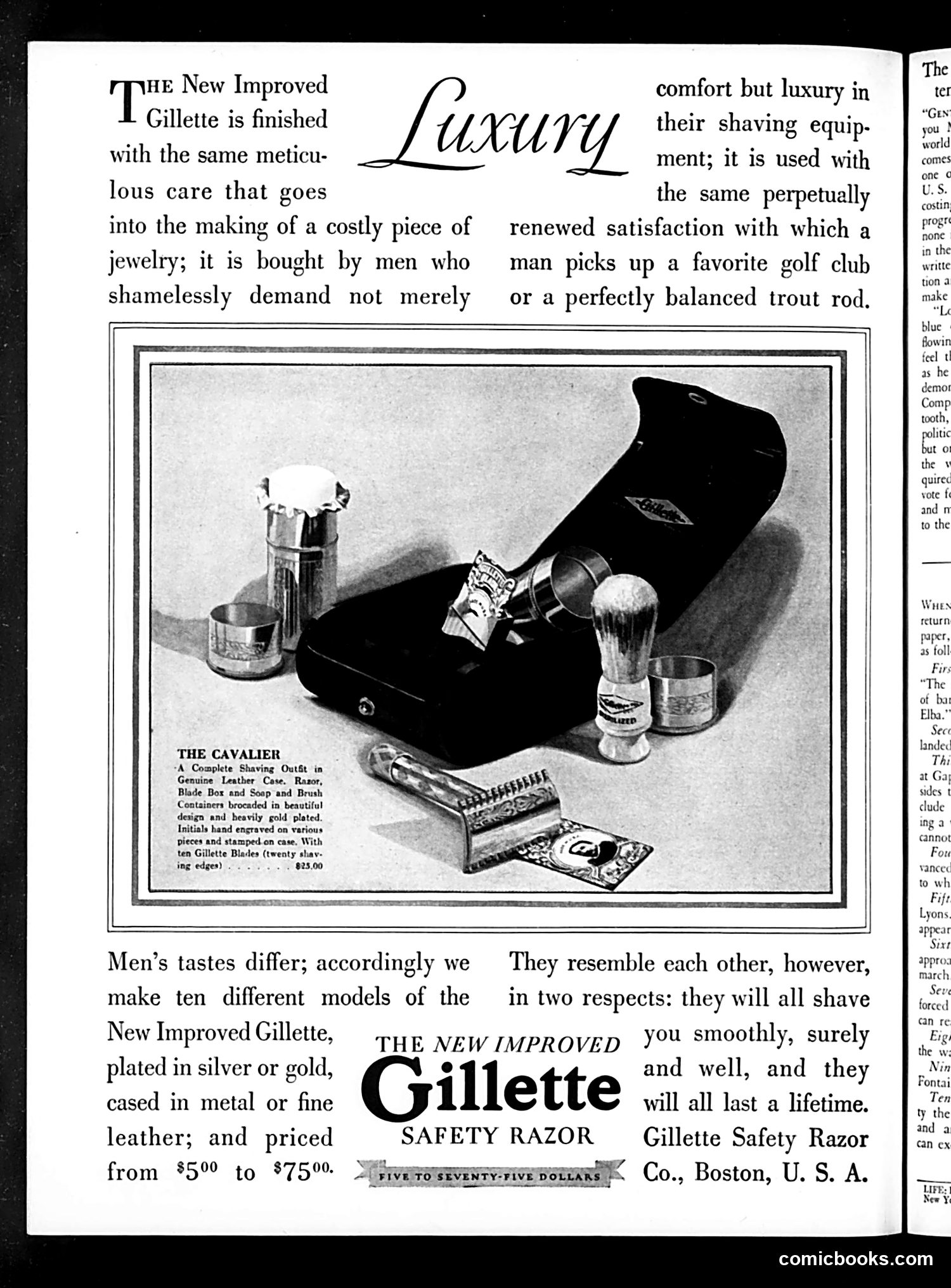
This page is primarily **advertising, not satire or editorial content**. It promotes the "New Improved Gillette Safety Razor" as a luxury item. The ad emphasizes that the Gillette razor represents not mere "comfort but luxury"—comparable to owning fine jewelry or sporting equipment like golf clubs. The central image shows "The Cavalier," an ornate shaving set housed in an elegant black case with multiple accessories (brushes, soap containers, blade boxes). The copy notes Gillette manufactures ten models priced from $5 to $75, with decorative gold plating and leather cases. The marketing strategy targets affluent male consumers who "shamelessly demand" quality goods. This reflects early 20th-century consumer culture, where personal grooming products were positioned as status symbols rather than mere necessities.
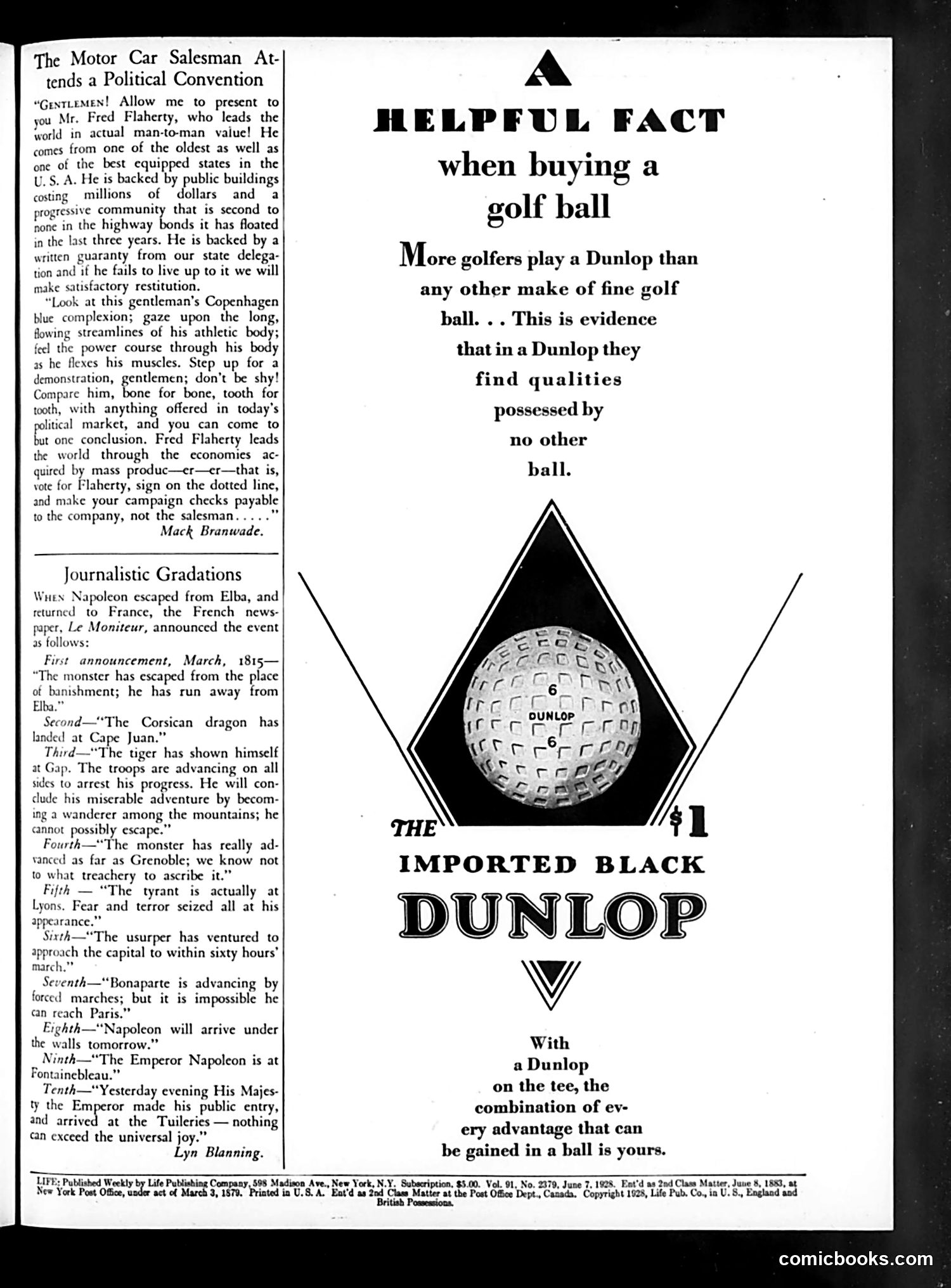
This page is primarily **advertising**, not political satire. The right side features a full-page Dunlop golf ball advertisement from 1928, emphasizing that "more golfers play a Dunlop than any other make." The left side contains two distinct items: 1. **"The Motor Car Salesman Attends a Political Convention"** — a humorous piece by Mack Braneade presenting Fred Flaherty, described as leading "the world in actual man-to-man value," backing a political candidate. This appears to be light satire mocking salesmanship tactics applied to politics. 2. **"Journalistic Gradations"** — a humorous section showing how French newspaper *Le Moniteur* reported Napoleon's 1815 escape from Elba with increasingly dramatic language, from "monster" to "tyrant" to "Emperor," satirizing how media framing shifts based on political allegiance. Neither involves substantial political commentary relevant to modern readers.
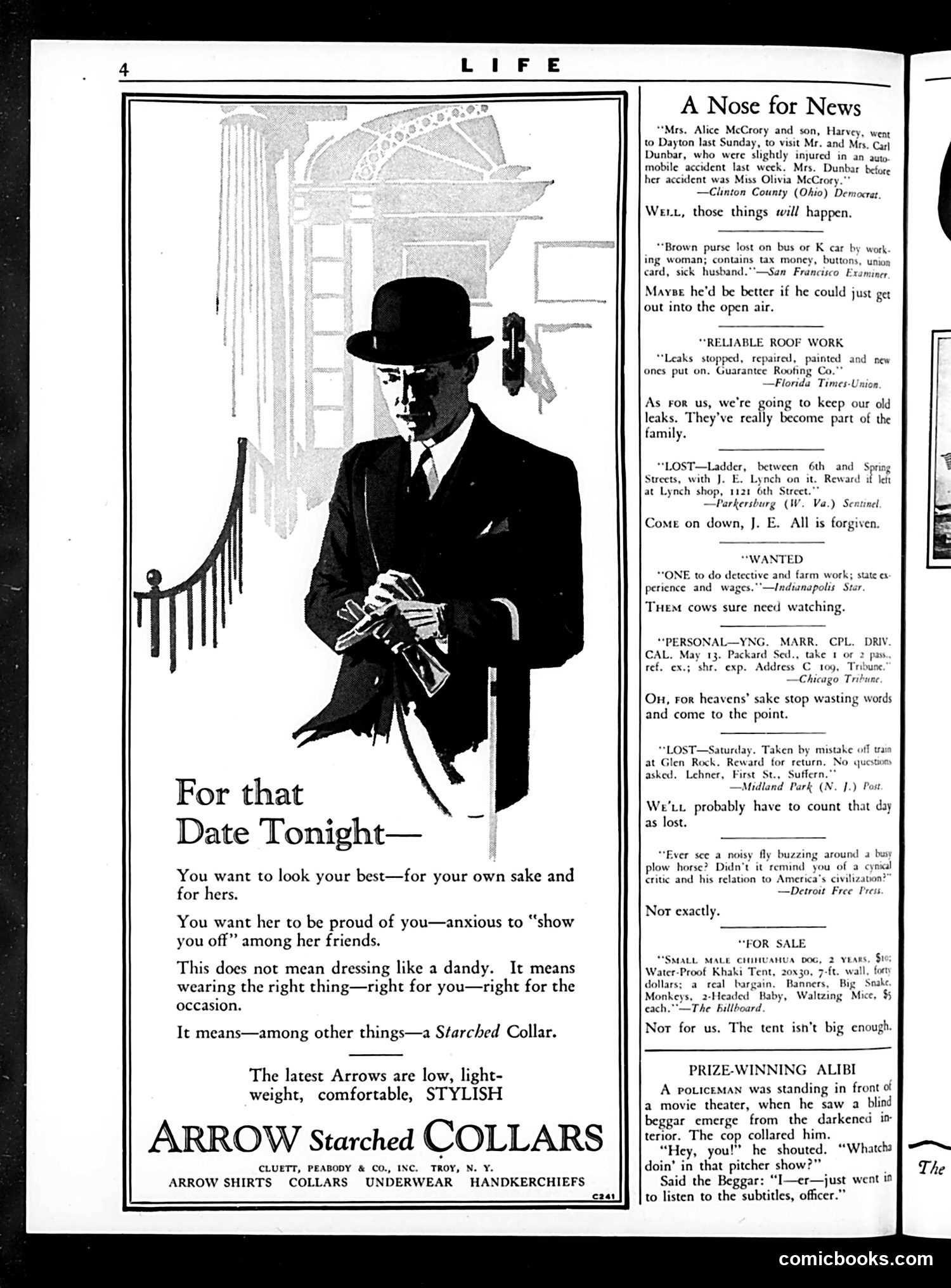
This page is primarily a **commercial advertisement** for Arrow brand starch collars and shirts, not political satire or comics. The large illustration depicts a well-dressed man in formal attire with a bowler hat, holding money—representing an eligible bachelor preparing for a date. The accompanying text uses social pressure and aspirational messaging to sell the product: dressing well shows respect for both oneself and one's date, and a "Starched Collar" signals style and propriety without appearing ostentatious. The "A Nose for News" column on the right contains typical vintage classified ads and humorous society snippets—lost items, job wanted notices, and anecdotes—which were common filler content in Life magazine. This reflects early 20th-century publication practices mixing advertising with editorial material.
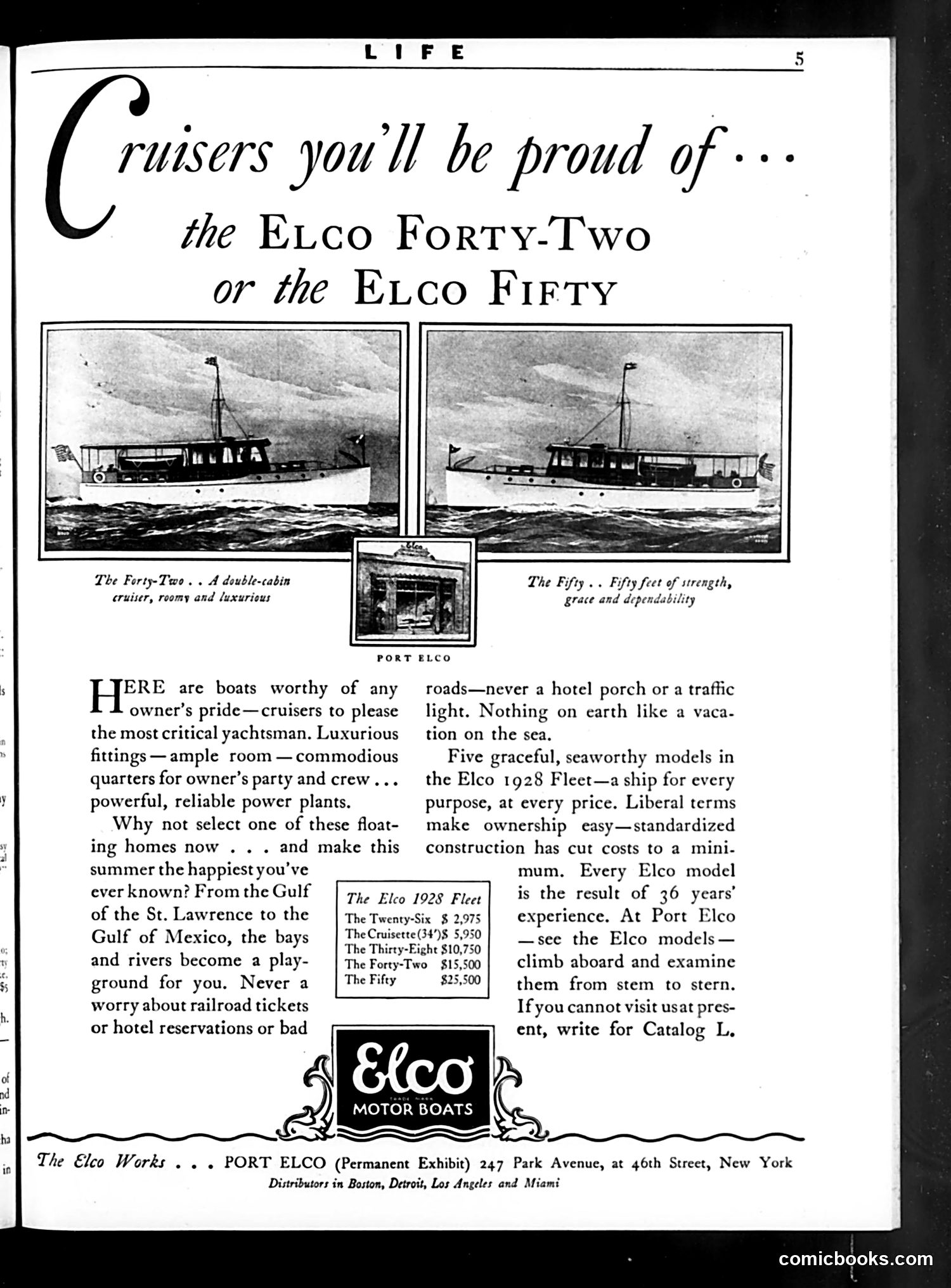
This page is primarily an advertisement for Elco Motor Boats, not a political cartoon or satirical content. It showcases two boat models—the "Forty-Two" and the "Fifty"—with images and promotional text emphasizing their luxury, reliability, and spacious accommodations. The ad targets wealthy yacht owners, positioning these vessels as vacation alternatives to traditional travel. It highlights the 1928 Elco fleet's five models at various price points ($2,975–$25,500), emphasizing affordability relative to the luxury offered. The marketing message appeals to the leisure class: these boats promise freedom from "railroad tickets or hotel reservations," allowing owners to vacation on waterways from the St. Lawrence to the Gulf of Mexico. The tone is aspirational rather than satirical—this reflects 1920s consumer culture marketing to affluent Americans during the pre-Depression era.
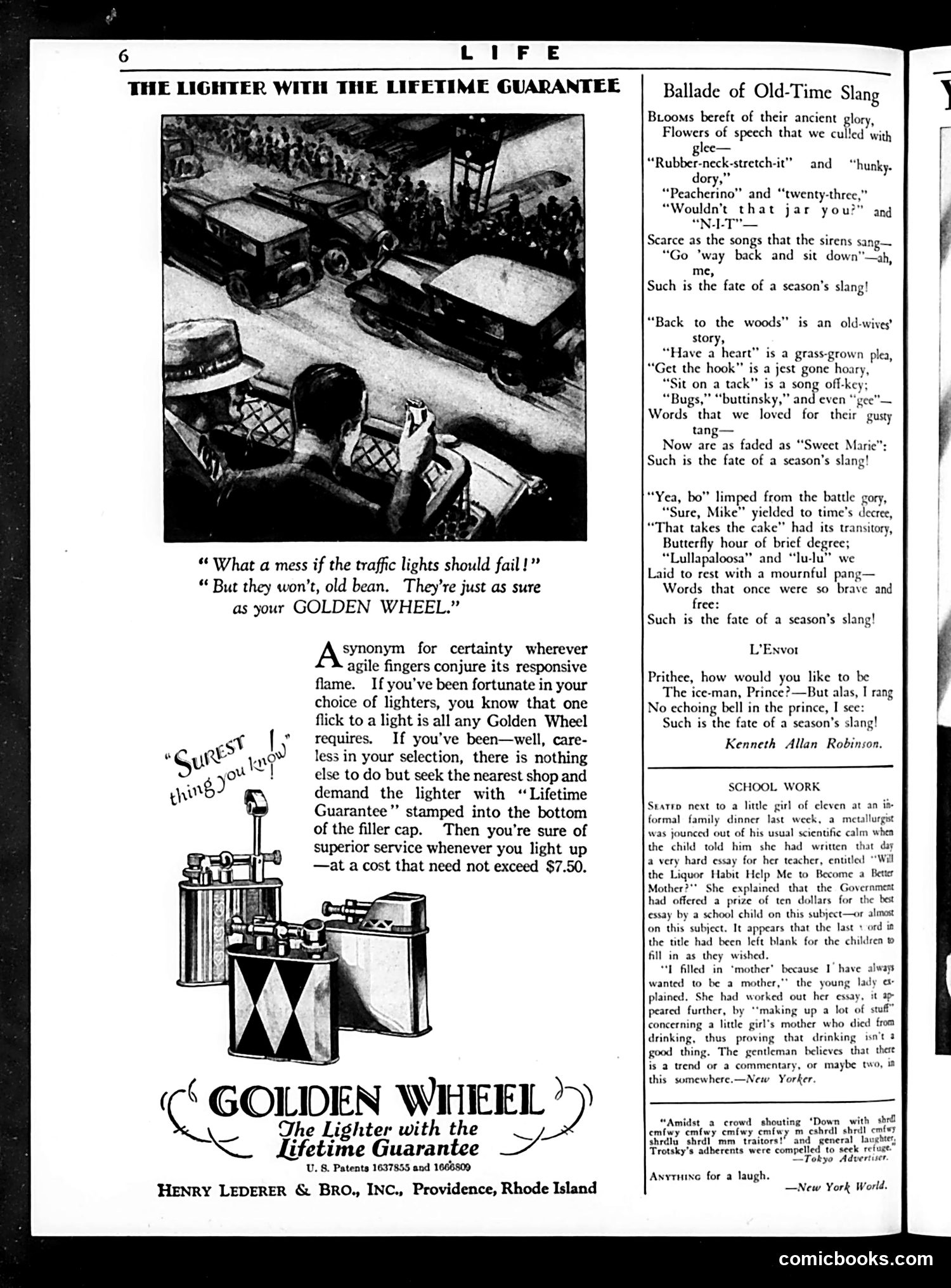
This page is primarily **advertising** for the Golden Wheel lighter, which claims a "Lifetime Guarantee." The advertisement promises reliability comparable to a "traffic light" — a modern convenience readers would recognize as dependable infrastructure. The accompanying image shows a crowded street scene with vehicles and pedestrians, illustrating the urban traffic context the lighter's reliability joke references. The right column contains unrelated **satirical poetry and brief commentary pieces**, including "Ballad of Old-Time Slang" (lamenting obsolete slang terms) and "School Work" (mocking a child's essay claiming alcohol isn't harmful). The overall page mixes commercial promotion with Life magazine's typical satirical humor, rather than presenting political commentary or caricature. The Golden Wheel ad occupies the dominant space.
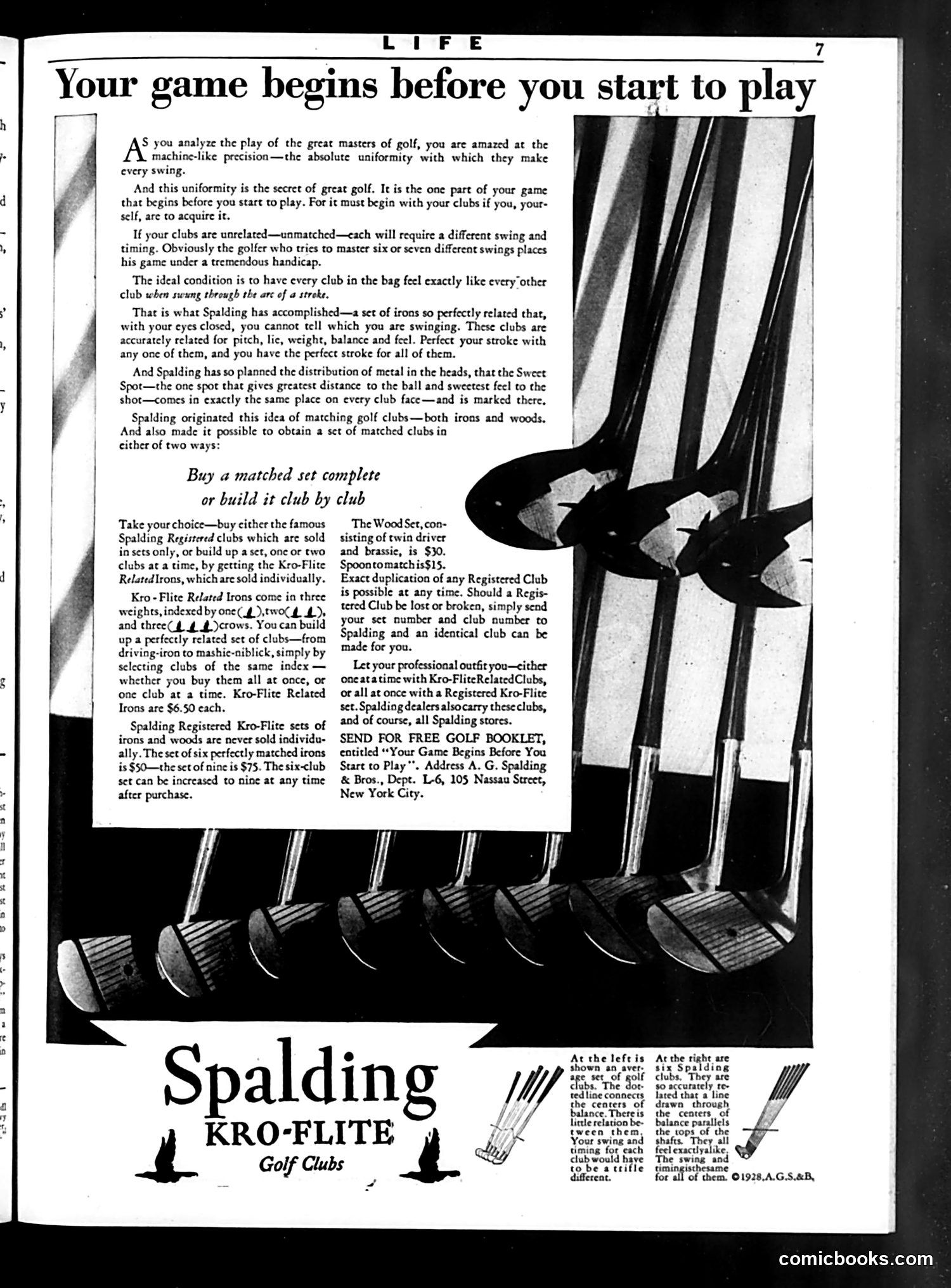
This is primarily **advertising content**, not satire or political commentary. The page promotes Spalding Kro-Flite golf clubs in *Life* magazine (a general-interest publication, not primarily satirical despite its name). The advertisement argues that quality golf clubs should feel uniform and "matched" — a selling point emphasizing manufacturing precision. The visual shows a row of irons and woods displaying consistent design. The text discusses how Spalding achieves this uniformity through careful metal distribution in club heads, ensuring identical "sweet spots" across all clubs. This was apparently a novel marketing claim at the time (copyright 1928). There is **no political cartoon or satire** on this page — it's a straightforward product advertisement using technical specification as its persuasive strategy.
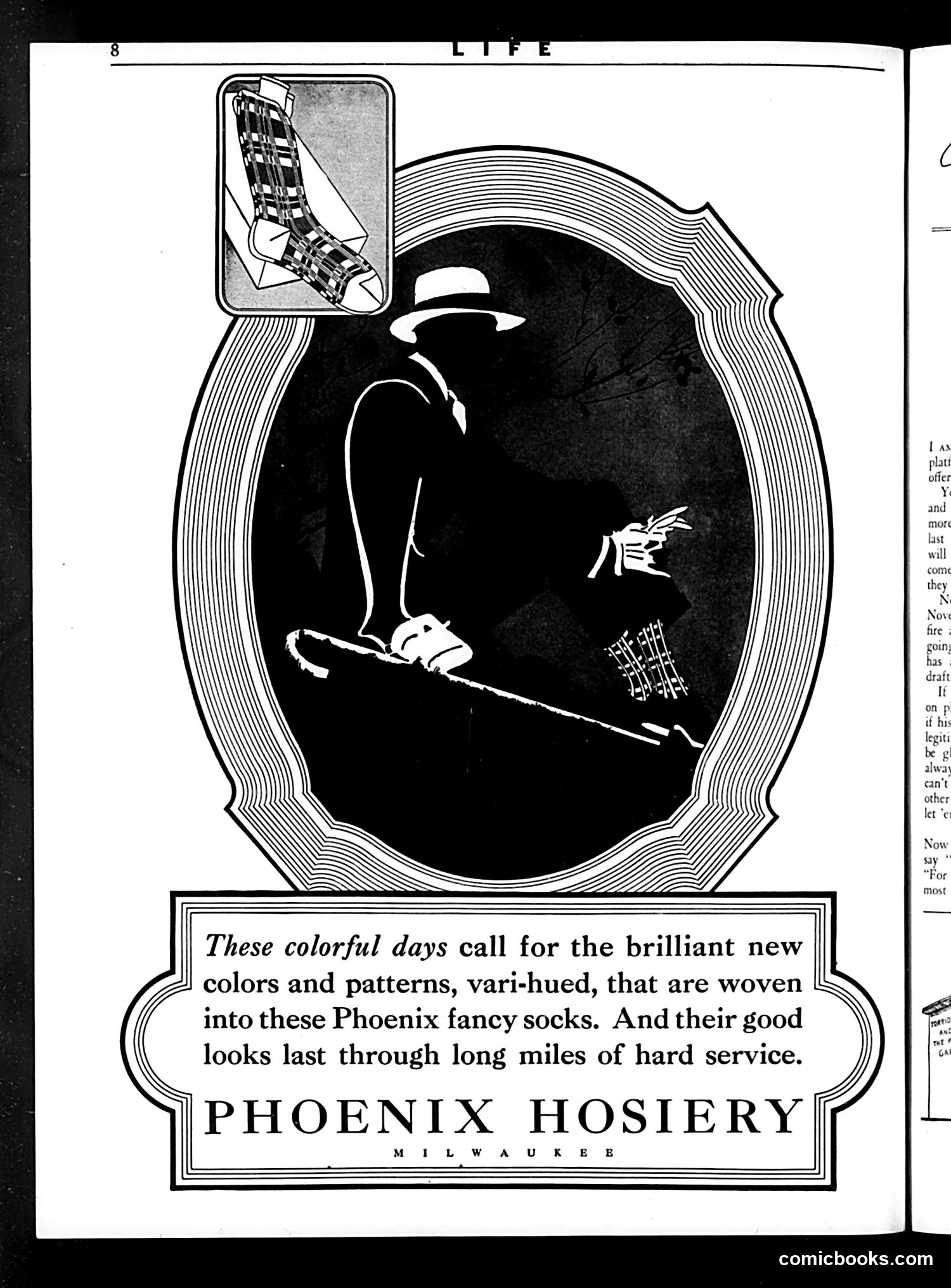
This is a vintage advertisement for Phoenix Hosiery from Milwaukee, not a political cartoon. The image shows a silhouetted figure in a hat and suit examining or displaying colorful socks, with an inset illustration of the actual product (patterned socks) in the upper left. The ad's pitch emphasizes that Phoenix socks combine stylish "brilliant new colors and patterns, vari-hued" with durability—they maintain their "good looks" through "long miles of hard service." The silhouetted figure appears to be a well-dressed gentleman, suggesting the product targets male consumers concerned with both fashion and practicality. The decorative art deco-style border frames the message as upscale merchandise.
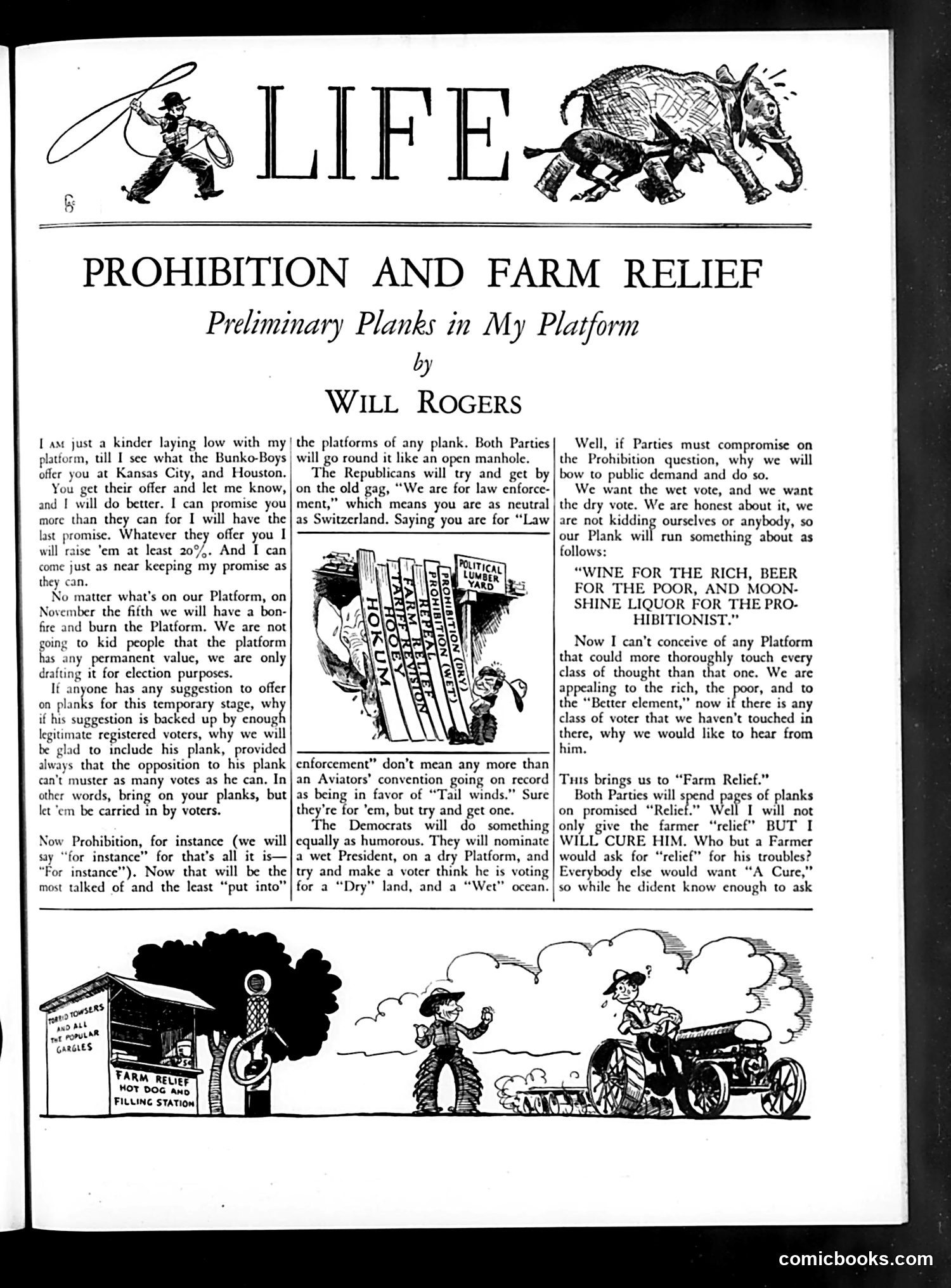
Will Rogers uses satire to mock both major political parties' platform promises. The main cartoon depicts a collapsing structure labeled "Political Planks," suggesting campaign promises are unstable. Rogers ridicules the Prohibition debate specifically, proposing absurdist alternatives: "Wine for the rich, beer for the poor, and moonshine liquor for the prohibitionist." He's satirizing how both parties would campaign on Prohibition despite widespread public support for alcohol. On Farm Relief, Rogers is even more scathing, claiming neither party will actually help farmers—they'll only offer vague promises. He writes sardonically: "I WILL CURE HIM. Who but a Farmer would ask for 'relief' for his troubles?" The bottom cartoon shows a farmer with a tractor, illustrating the agricultural focus. Rogers' point: political platforms are hollow promises disconnected from real solutions.
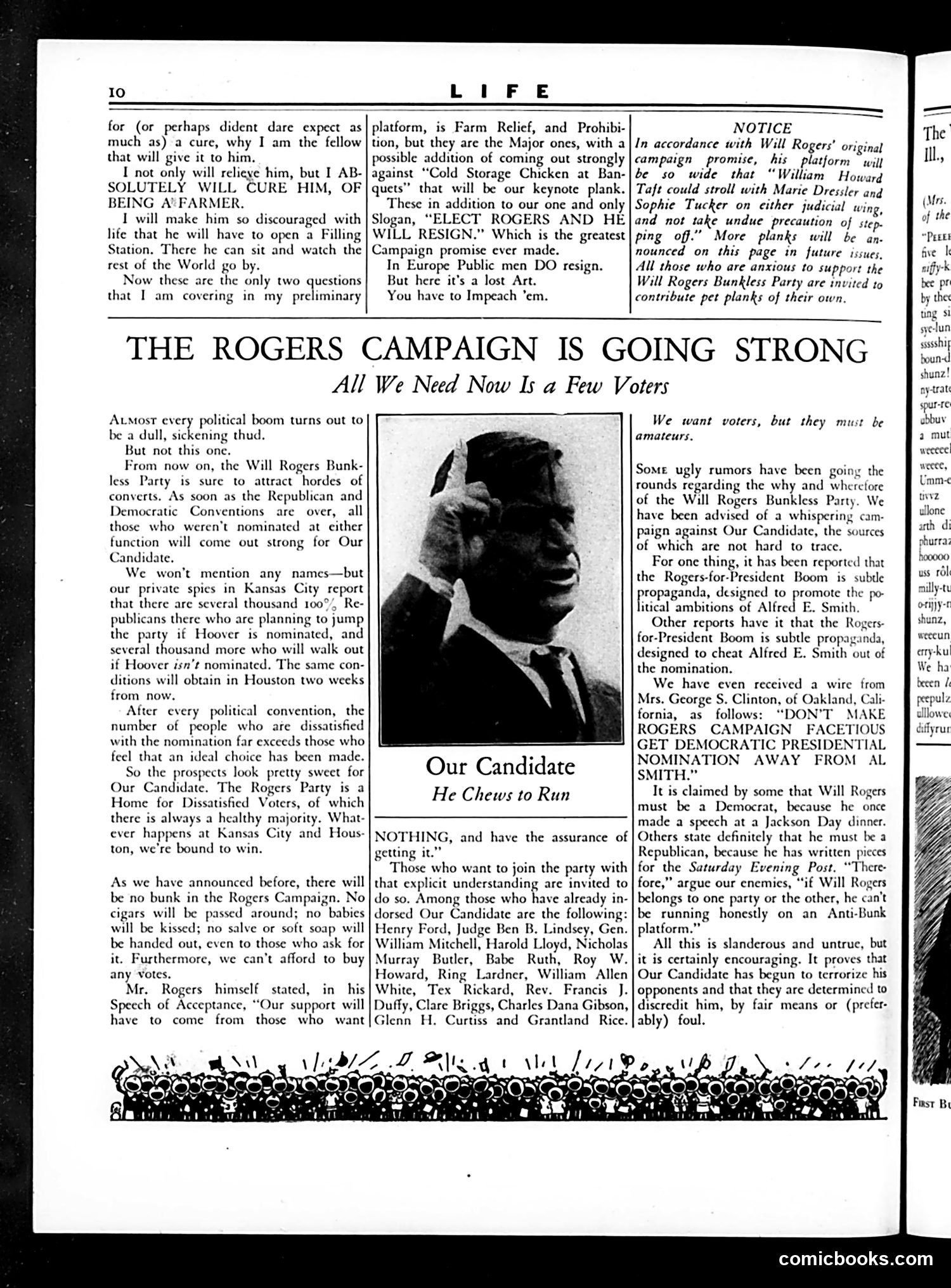
This is a satirical political advertisement for Will Rogers' fictional presidential campaign. The page mocks political conventions and campaign practices of the era. The central image shows a caricatured face (Rogers), labeled "Our Candidate: He Chews to Run"—a joke about Rogers' distinctive habit of chewing gum. The text claims the "Rogers Bunkless Party" will attract disaffected voters from both major parties. The satire targets typical campaign tactics: the page lists prominent supporters (Henry Ford, Babe Ruth, etc.) and claims the campaign won't buy votes or use "soft soap." It ridicules how political campaigns promise much while delivering little, suggesting Rogers—as an outsider humorist—offers an honest alternative to conventional politicians. The humor relies on readers' familiarity with Rogers as a public figure known for folksy commentary.
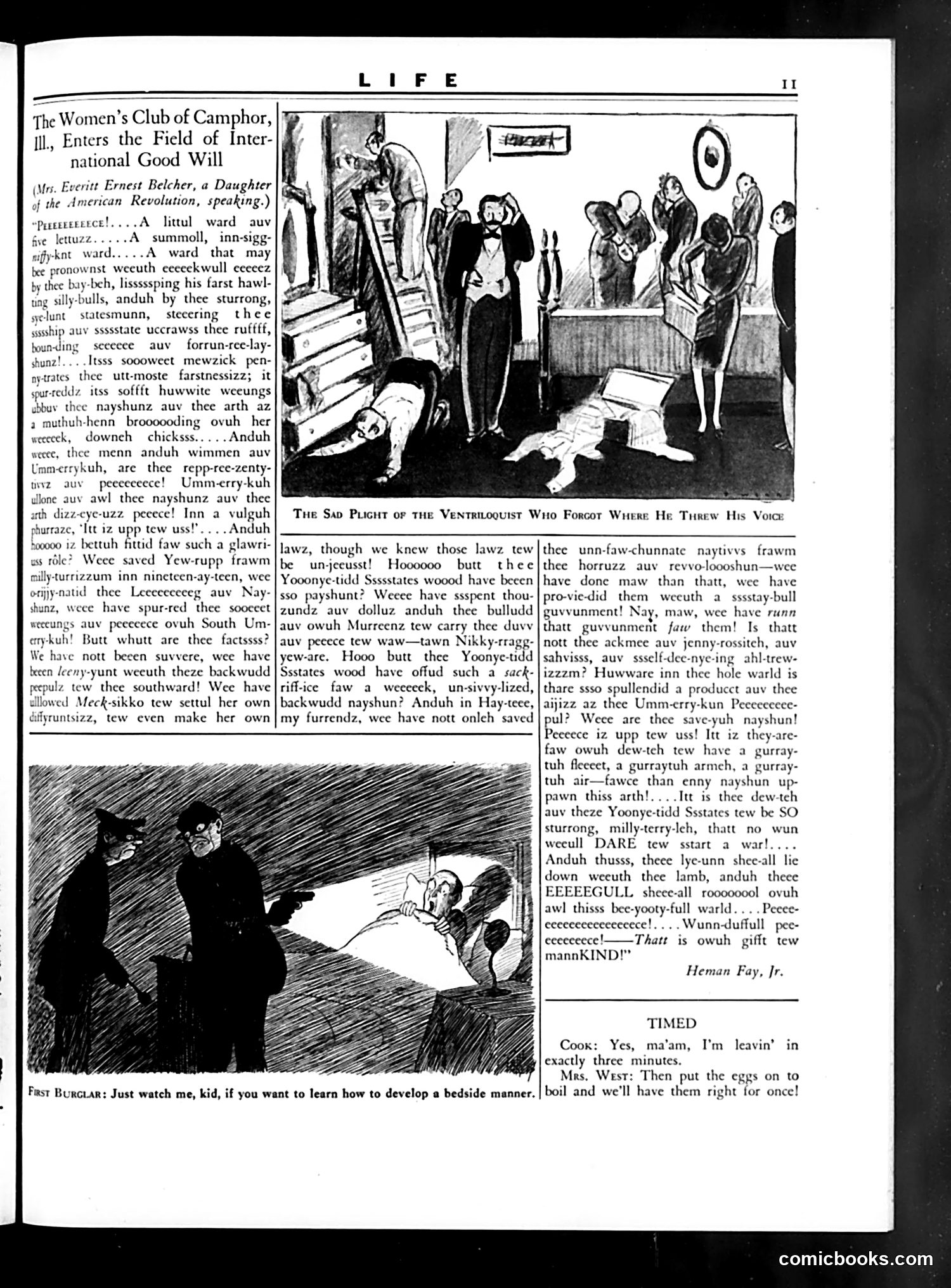
This page satirizes **ventriloquism as a metaphor for female political participation**. The top cartoon mocks the Women's Club of Camphor, Illinois entering "international good will" efforts—implying women are merely puppets controlled by men, lacking independent voices. The main illustration shows a ventriloquist manipulating a dummy labeled "The Sad Plight of the Ventriloquist Who Forgot Where He Threw His Voice," suggesting confusion about who actually speaks for whom in women's activism. The accompanying pseudo-phonetic text parodies overwrought oratory, mocking both the ventriloquist's affected speech and the absurdity of women's clubs as hollow performance rather than genuine civic engagement. The bottom comic about bedside manner offers domestic humor unrelated to the political satire above.
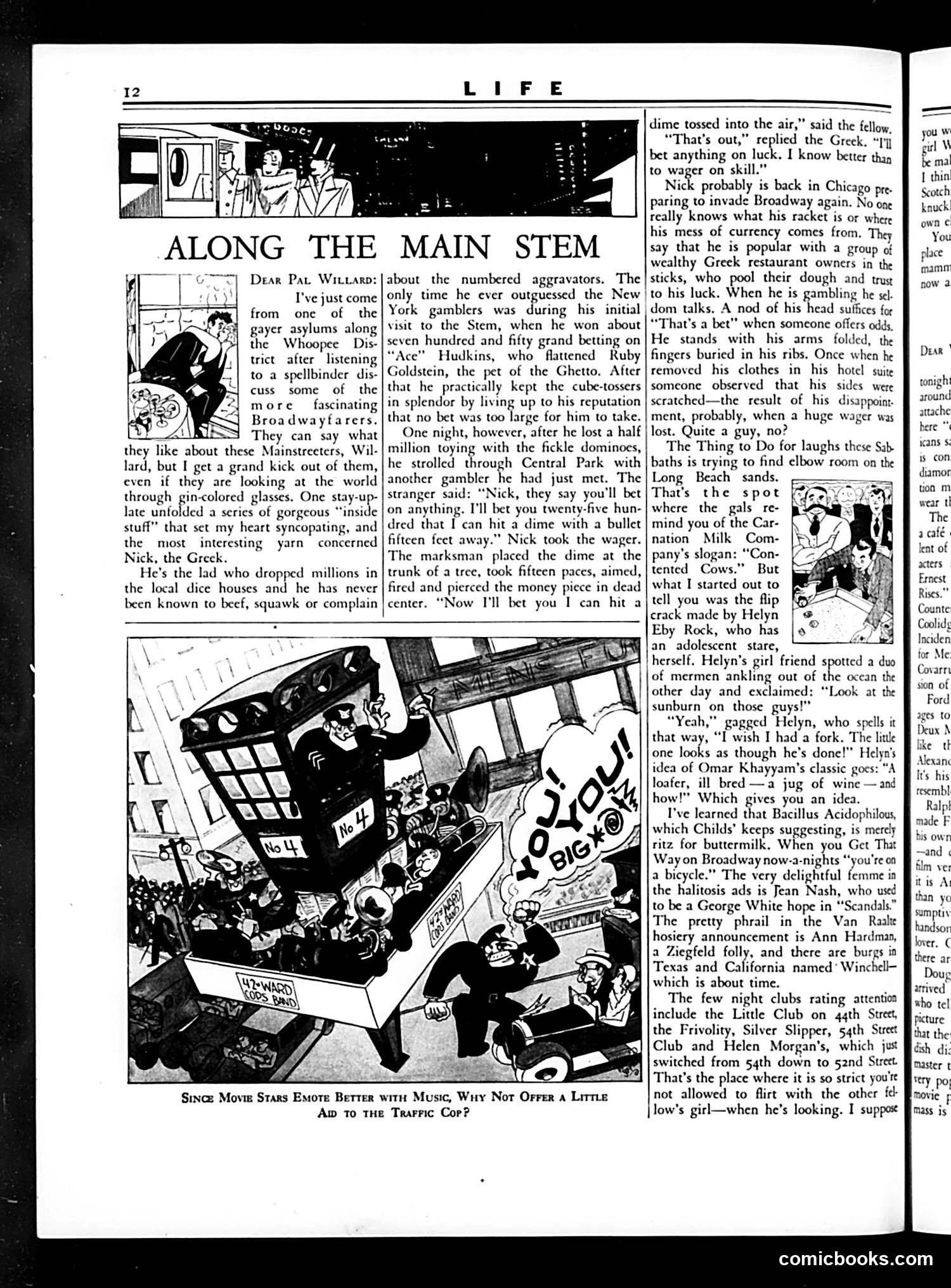
This page from *Life* magazine contains a gossip column titled "Along the Main Stem" discussing Broadway nightlife and celebrities. The large illustration depicts a chaotic traffic scene with a police officer and overloaded delivery vehicle, captioned: "Since Movie Stars Emote Better with Music, Why Not Offer a Little Aid to the Traffic Cop?" The satire mocks the growing use of background music in films by suggesting that if emotional performances require musical accompaniment, perhaps adding music would help calm the chaos of urban traffic and assist harried police officers. It's a tongue-in-cheek jab at Hollywood's increasing reliance on orchestral scores to enhance dramatic scenes—a relatively new practice in 1920s cinema—extending the joke absurdly to real-world problems.
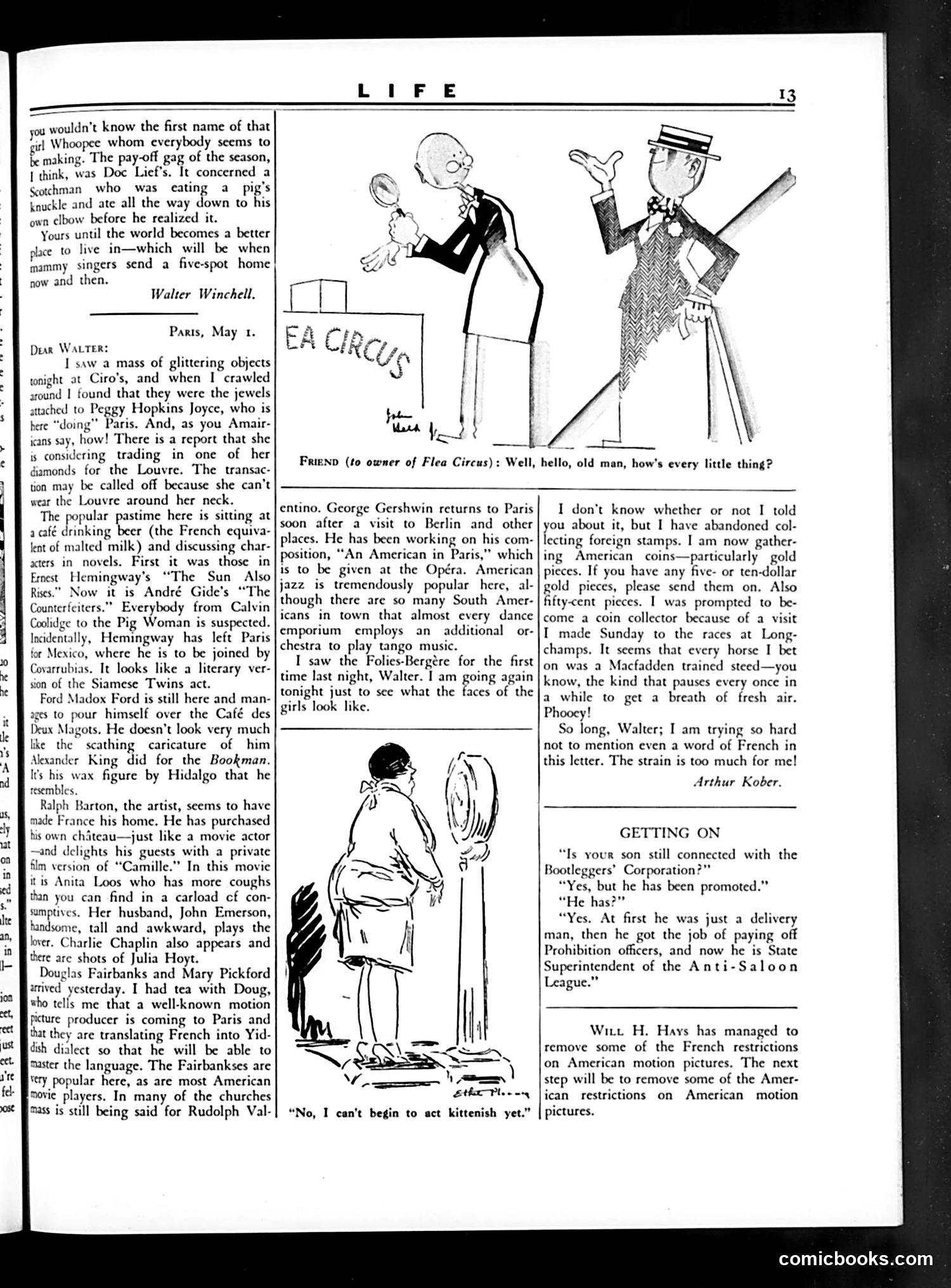
This page contains **letters to the editor and social commentary** rather than political cartoons. The visible illustrations are satirical sketches accompanying gossip-style reporting about Paris and entertainment figures. Key references include: - **Peggy Hopkins Joyce**: A jewelry-wearing socialite being gossiped about regarding Louvre diamond transactions - **George Gershwin**: Returning to Paris after Berlin, with his composition "An American in Paris" premiering at the Opéra - **Flea Circus**: A satirical illustration showing a circus performer with an audience member The tone mocks American expatriates in 1920s Paris, wealth-flaunting socialites, and Prohibition-era America (referenced in "Anti-Saloon League"). The humor targets both French cultural pretension and American excess during this era.
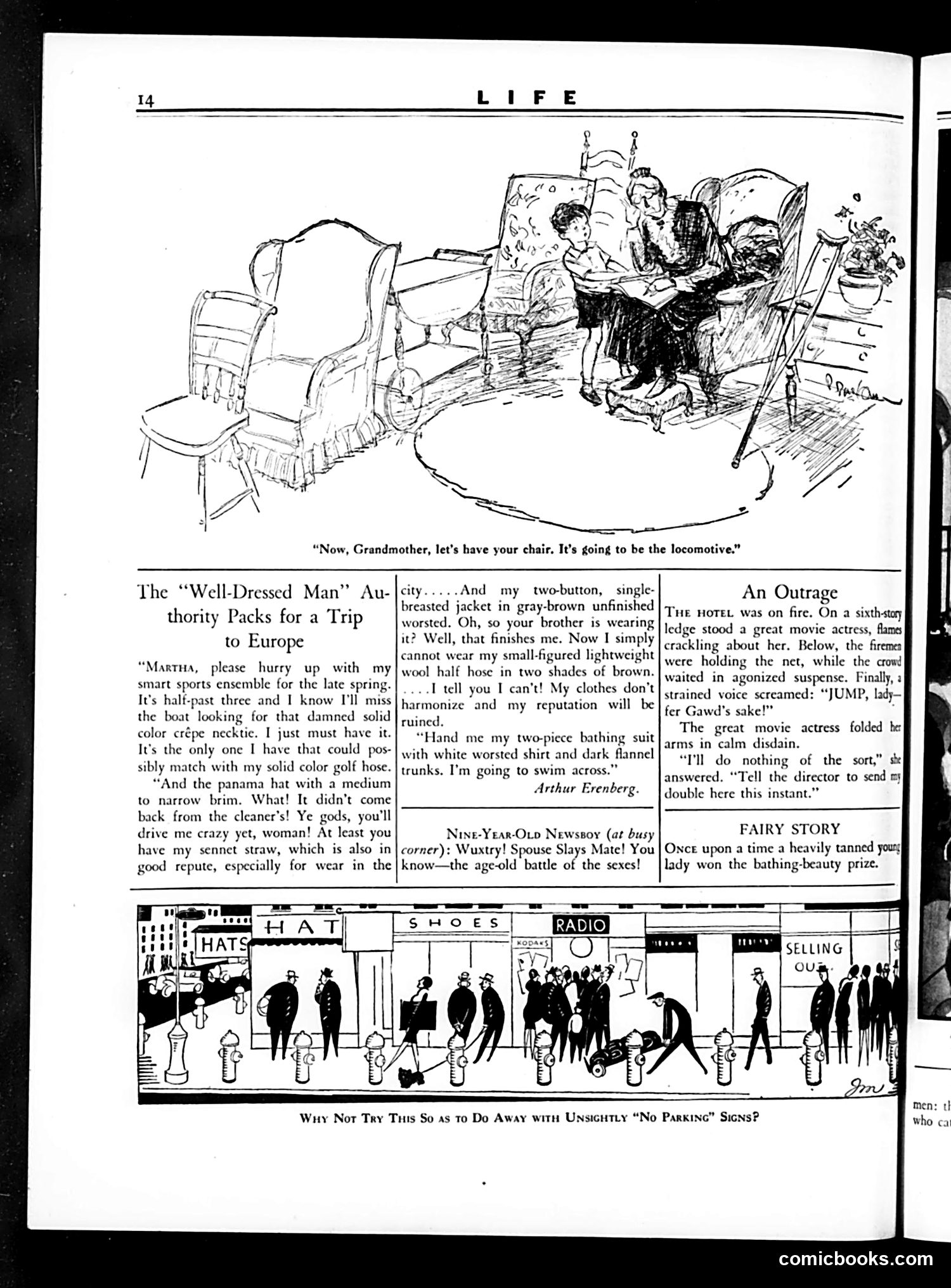
**Top Cartoon**: Shows children playing with grandmother's furniture, pretending chairs are a "locomotive." The caption reads: "Now, Grandmother, let's have your chair. It's going to be the locomotive." This depicts imaginative child's play repurposing household items—a relatable domestic humor piece about children's creativity and the wear-and-tear they inflict on furniture. **Middle Section**: Contains fashion advice ("Well-Dressed Man" authority packing for European travel) and brief humorous snippets about clothing choices and a hotel fire incident. **Bottom Cartoon**: Depicts a crowded street with storefronts (Hats, Shoes, Radio, Selling Club visible) filled with fire hydrants instead of parking meters. The caption asks why cities don't eliminate unsightly "No Parking" signs by using this alternative—satirizing urban clutter and parking regulation problems.
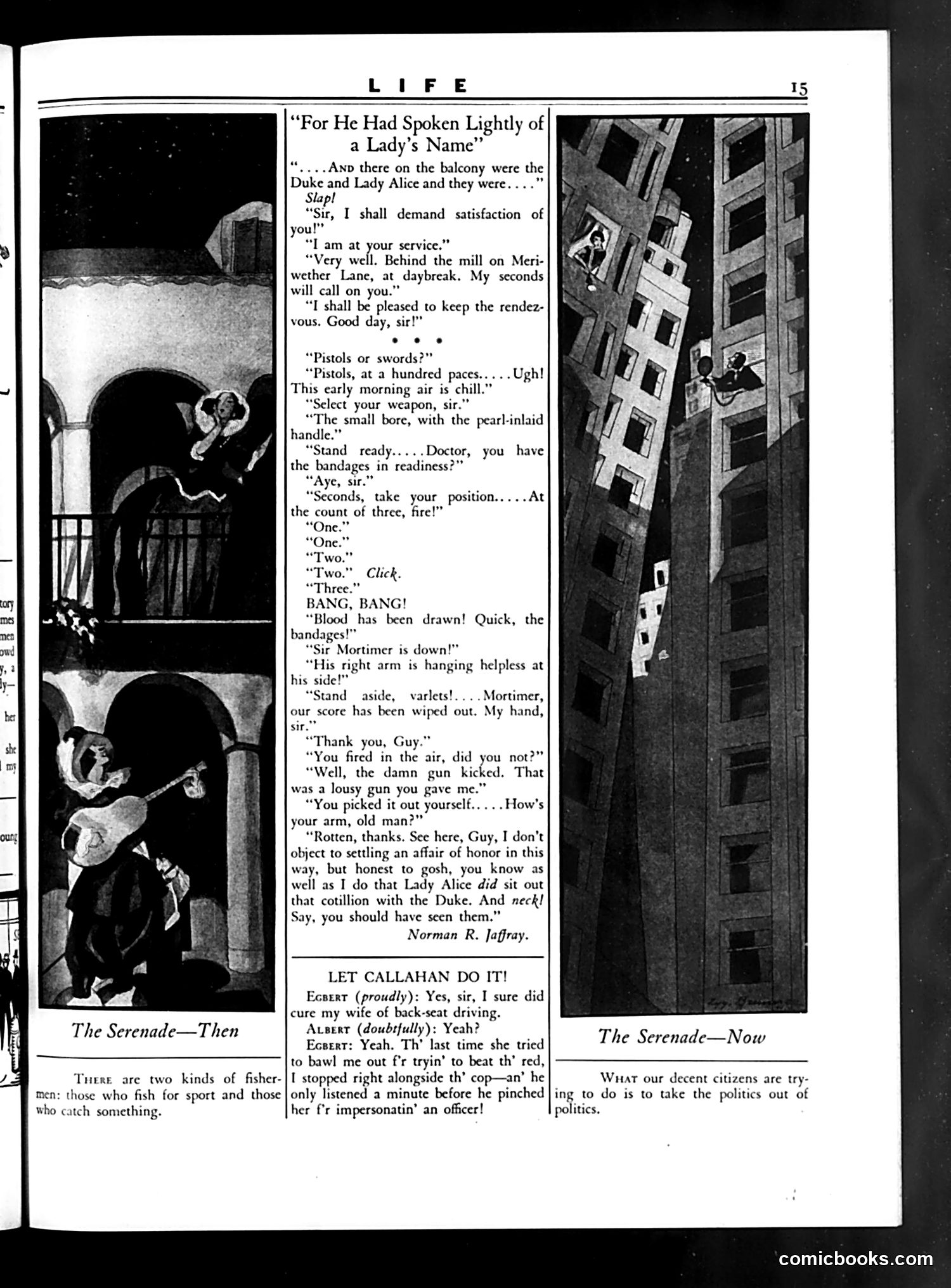
This page contains a two-panel satirical comparison about dueling etiquette. The "Then" panel (left) depicts a dramatic historical duel scene with formal procedures—weapons selection, bandages prepared, and ritualized counting to fire. The "Now" panel (right) shows a modern urban setting where two figures appear at a building window, suggesting romance or casual flirtation. The satire critiques how Americans of the period have abandoned formal honor codes. The text emphasizes this: one character notes that settling affairs of honor through dueling is outdated, yet the fundamental issue—a lady's reputation—remains unchanged. The final caption about "taking the politics out of politics" suggests this reflects broader cultural shifts toward less formal, more pragmatic social conduct in early 20th-century America.
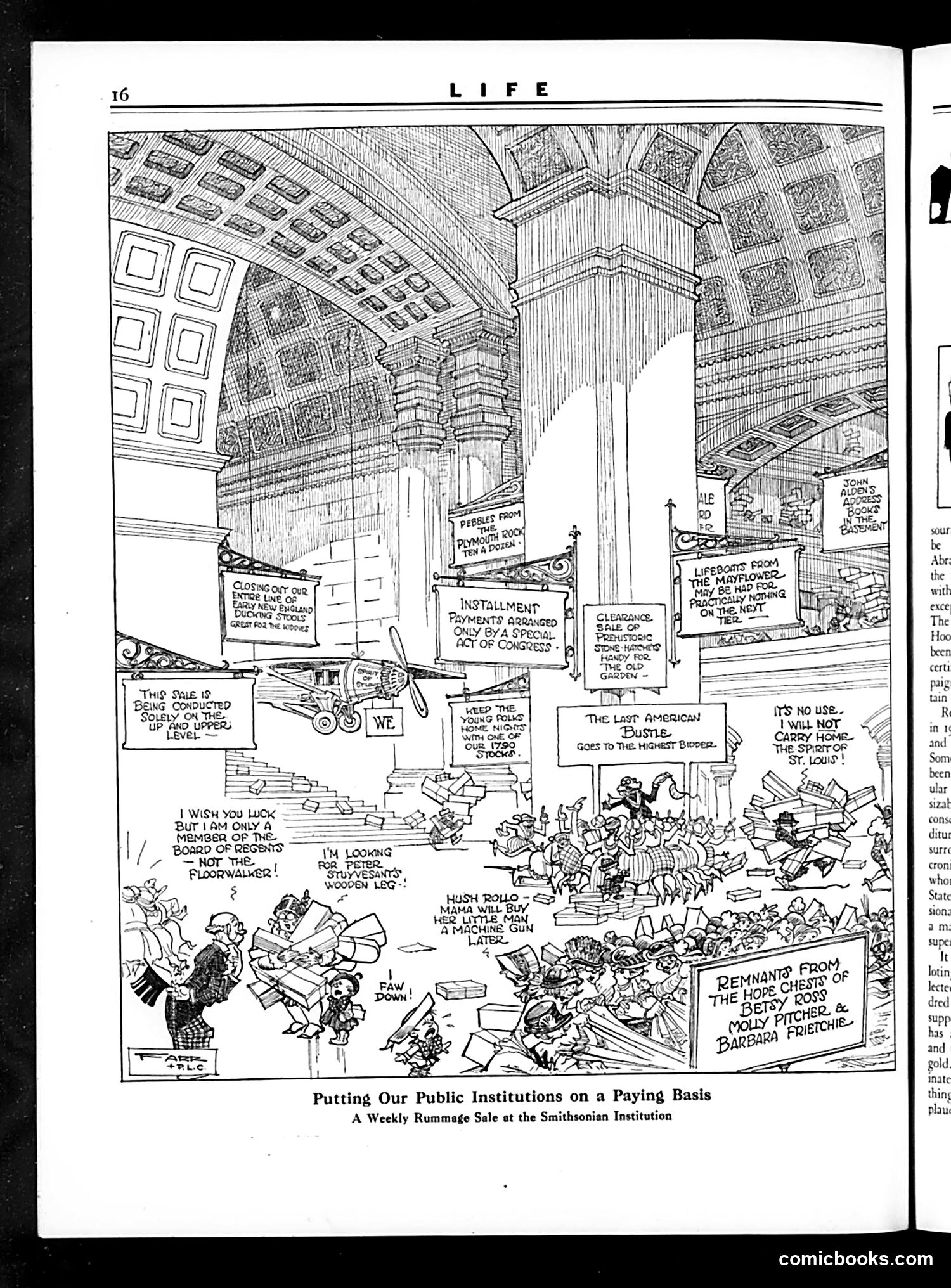
This cartoon depicts a chaotic rummage sale at the Smithsonian Institution, satirizing pressure to make public institutions financially self-sufficient. The title suggests converting tax-funded institutions into profit-generating enterprises. The scene shows various items being auctioned, including items labeled with references to American historical artifacts and cultural treasures. A prominent airplane and various merchandise appear among crowds of buyers and sellers in the grand hall. The satire criticizes the notion of commercializing public institutions meant to serve educational and cultural purposes. By portraying the Smithsonian reduced to a flea market hawking artifacts, the cartoonist mocks the idea of forcing government institutions to operate like private businesses rather than public services.
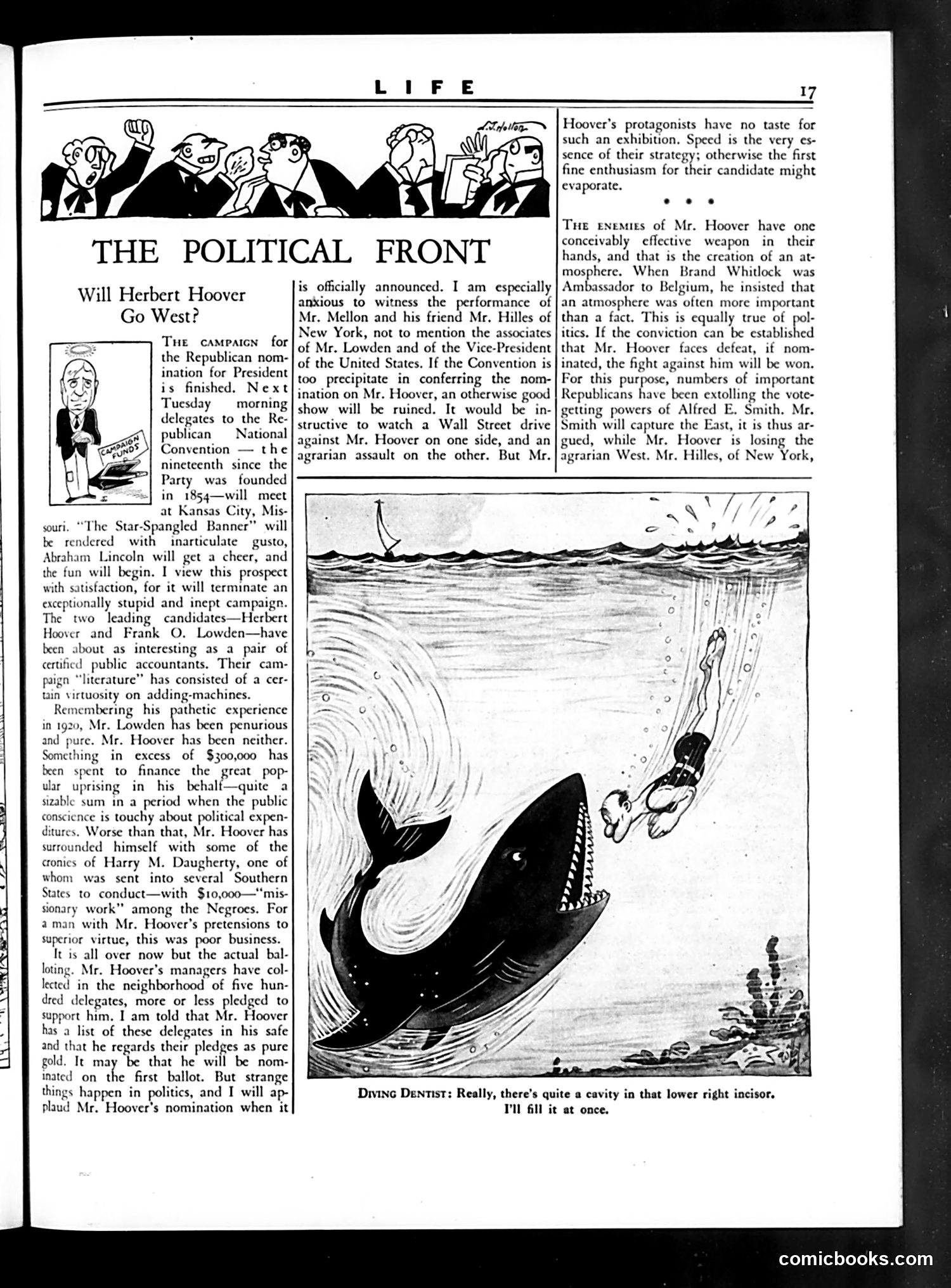
This page discusses Herbert Hoover's 1928 Republican presidential campaign leading up to the party convention. The article notes Hoover's campaign strategy involves avoiding public appearances to prevent his support from "evaporating," while his opponents use negative tactics. The main cartoon below depicts a large whale labeled as political opposition attempting to swallow a diver (representing Hoover or his campaign). The caption reads "Diving Dentist: Really, there's quite a cavity in that lower right incisor. I'll fill it at once." The satire suggests Hoover's enemies are attempting to destroy him politically, but the image implies he'll overcome this threat—the dentist will "fill" the cavity, suggesting Hoover will repair the damage and prevail.
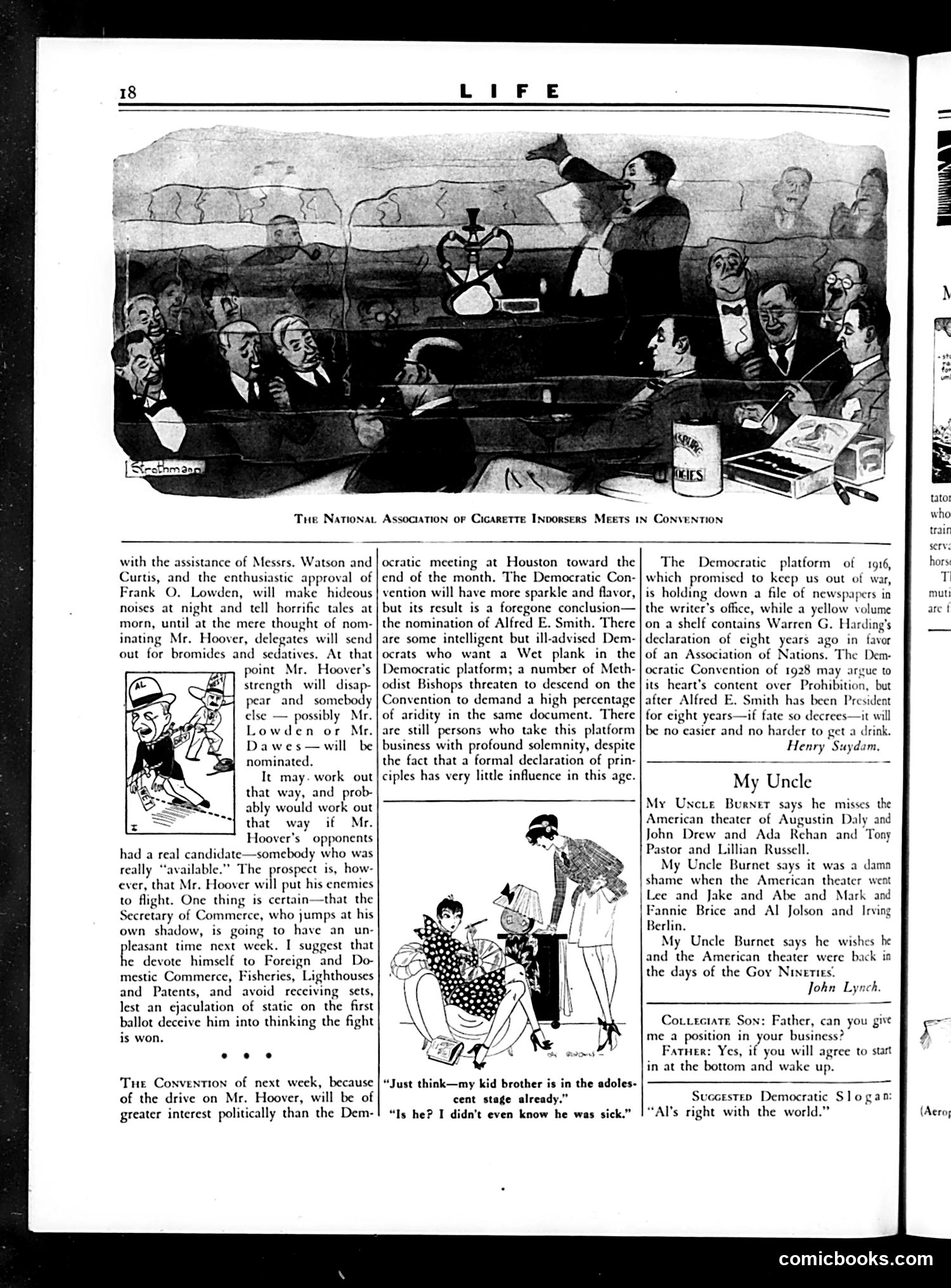
**Main Cartoon**: "The National Association of Cigarette Importers Meets in Convention" satirizes the 1928 Republican Convention's internal struggle over nominating Herbert Hoover for president. The cigarette-importers framing is a thin disguise for political delegates. The text reveals that Hoover's opponents (Watson, Curtis, Lowden, Dawes) are maneuvering against him, but lack a viable alternative candidate. The satire suggests their opposition will ultimately fail—Hoover will secure nomination despite their scheming. **Context**: Hoover served as Secretary of Commerce and was the presumed Republican frontrunner. The article contrasts this with the Democratic Convention's predetermined outcome: Alfred E. Smith's nomination. **Side Commentary**: The page includes brief satirical pieces mocking political platforms (comparing 1916 Democratic promises about avoiding war with actual outcomes) and personal nostalgia pieces about theater and family. The overall message: Republican infighting is theater, but Hoover will win regardless.
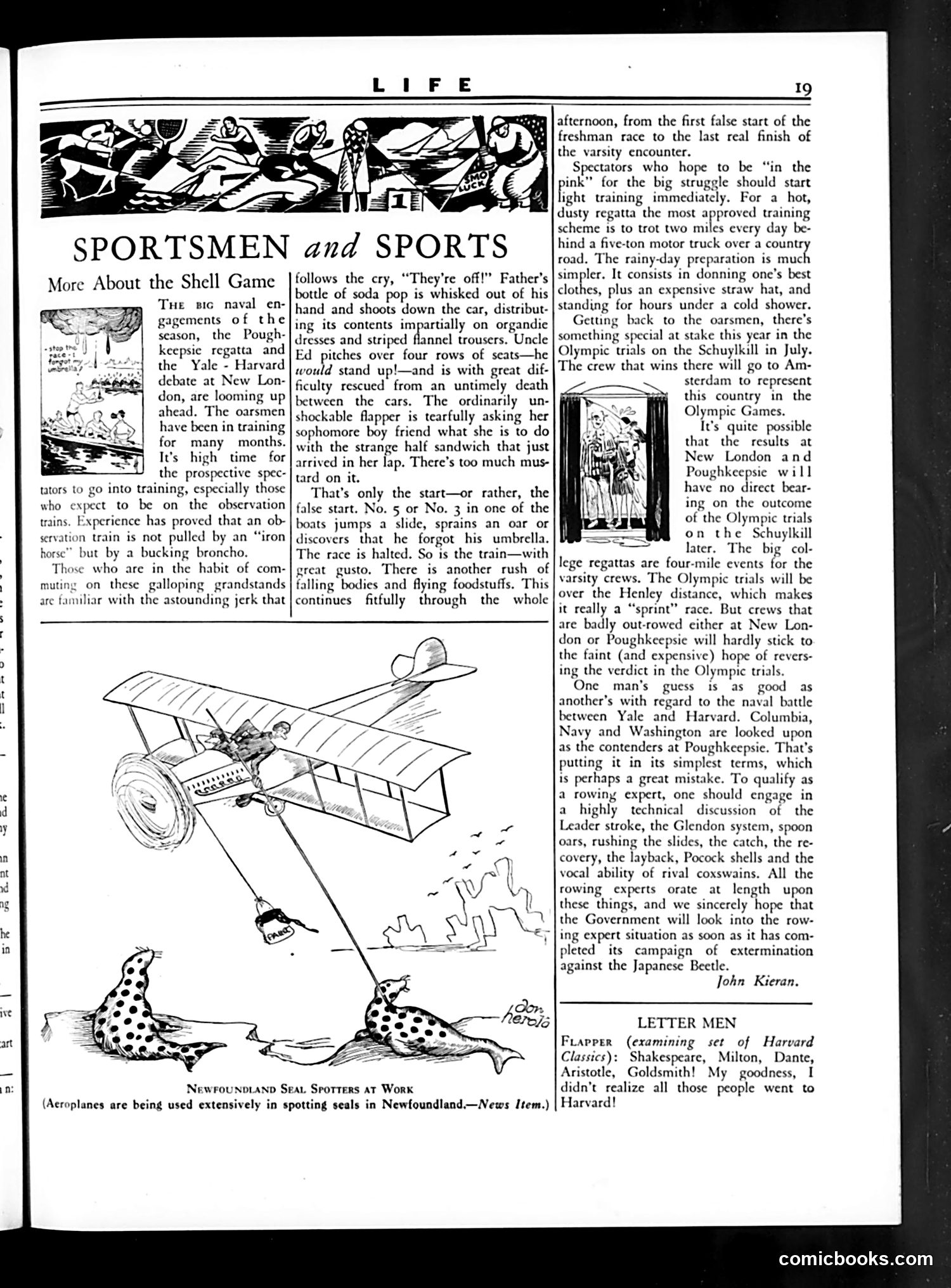
This page satirizes the chaos of attending rowing regattas (boat races) at elite universities like Yale and Harvard. The main cartoon illustrates why spectators need "training" to attend: the observation trains carrying fans undergo violent lurching and jerking, causing passengers to lose balance, spill food and drinks, and tumble between cars. The joke mocks both the physical ordeal of watching these events and the pretentiousness of rowing culture. The author humorously suggests spectators should condition themselves like athletes to endure the bumpy train rides. The accompanying cartoon shows amusingly literal "seal spotting" in Newfoundland—an airplane spotting actual seals—a humorous visual pun on the news item about using aircraft for reconnaissance. The text also discusses competitive dynamics between Yale, Harvard, Columbia, Navy, and Washington crews, with tongue-in-cheek commentary on rowing jargon and expertise.
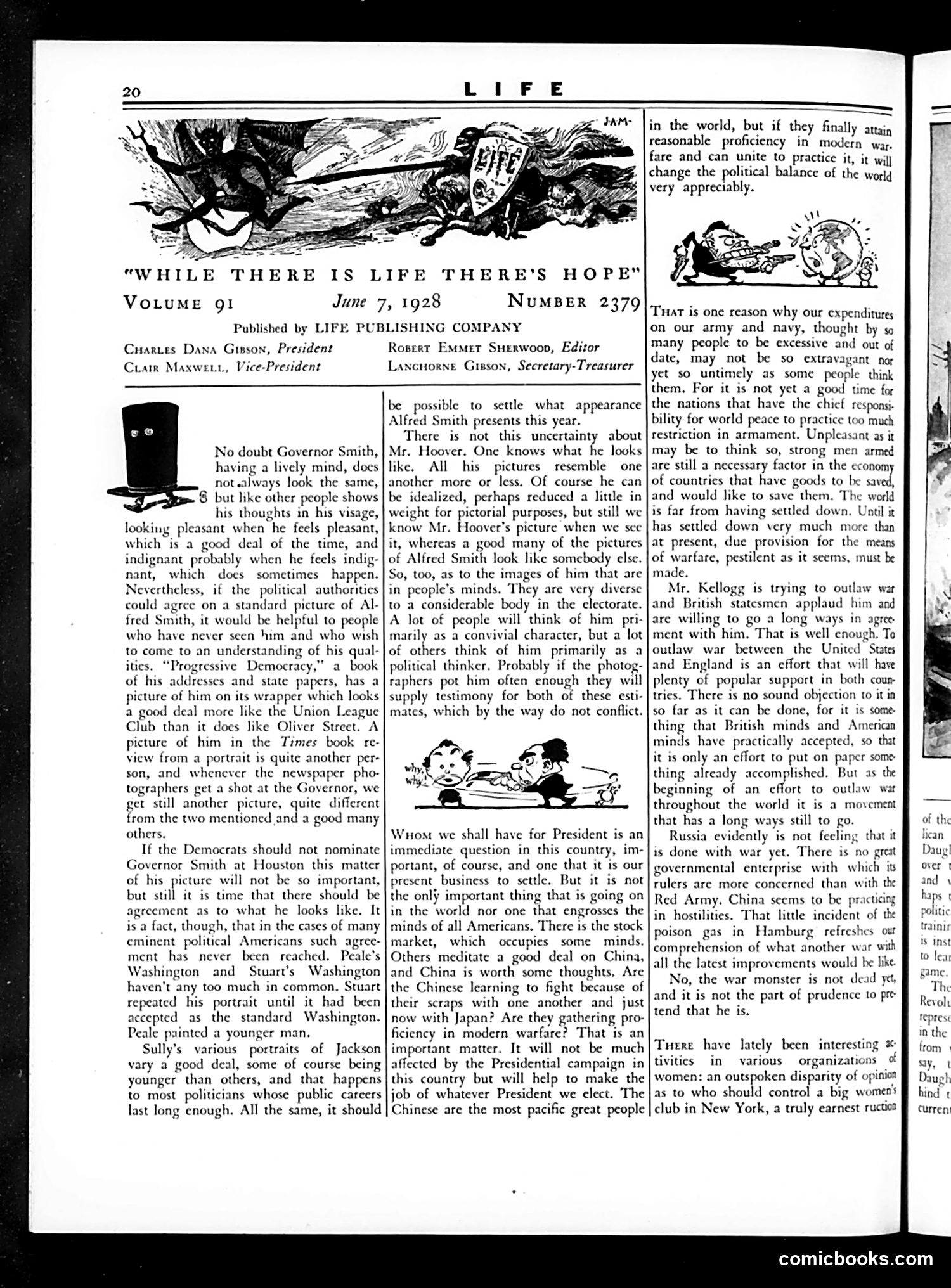
This page satirizes the inconsistency in how Governor **Alfred Smith** (Democratic presidential candidate) appears across different portraits and photographs. The text notes that Smith's various official portraits—from his book jacket to newspaper photos to painted portraits—depict him so differently that the public cannot form a unified mental image of him. The satire contrasts this with **Herbert Hoover** (the Republican candidate, implied but not named), whose appearance remains consistent across all representations. The author argues this matters politically: Smith's image ranges from appearing as a "convivial character" to a serious "political thinker," while Hoover's steady appearance projects clarity and consistency. The piece humorously references historical precedent (different portraits of Washington and Jackson), suggesting that with repeated exposure, Smith's image would eventually standardize—though this hadn't yet occurred by June 1928. The broader point: visual consistency and recognizable identity carry political weight in elections.
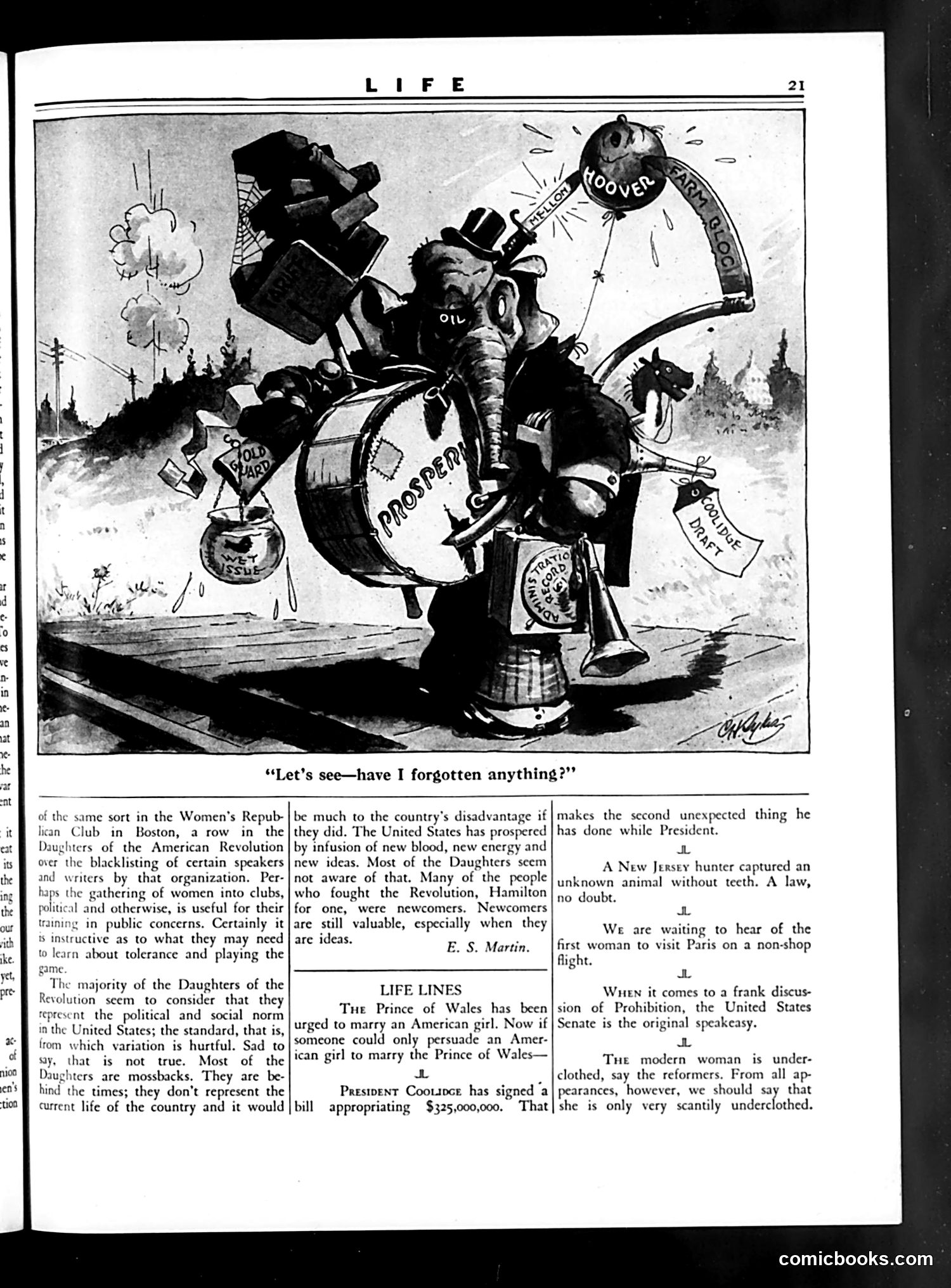
This satirical cartoon depicts an elephant (symbol of the Republican Party) juggling various campaign promises and political issues while balanced precariously. The labels visible include references to "Prosperity," "Old Guard," and what appears to be campaign pledges. The cartoon mocks Republican campaign promises, suggesting the party is trying to keep multiple contradictory commitments in the air simultaneously—implying they cannot deliver on all of them. The elephant's anxious pose ("Have I forgotten anything?") suggests the difficulty of maintaining this balancing act. The accompanying "Life Lines" section critiques the Daughters of the American Revolution as backward-looking "mossbacks" opposed to new ideas and speakers, contrasting them with the country's actual need for fresh perspectives. Other brief satirical items mock President Coolidge, Prohibition enforcement, and evolving women's fashion standards—typical of Life magazine's social commentary during the 1920s.
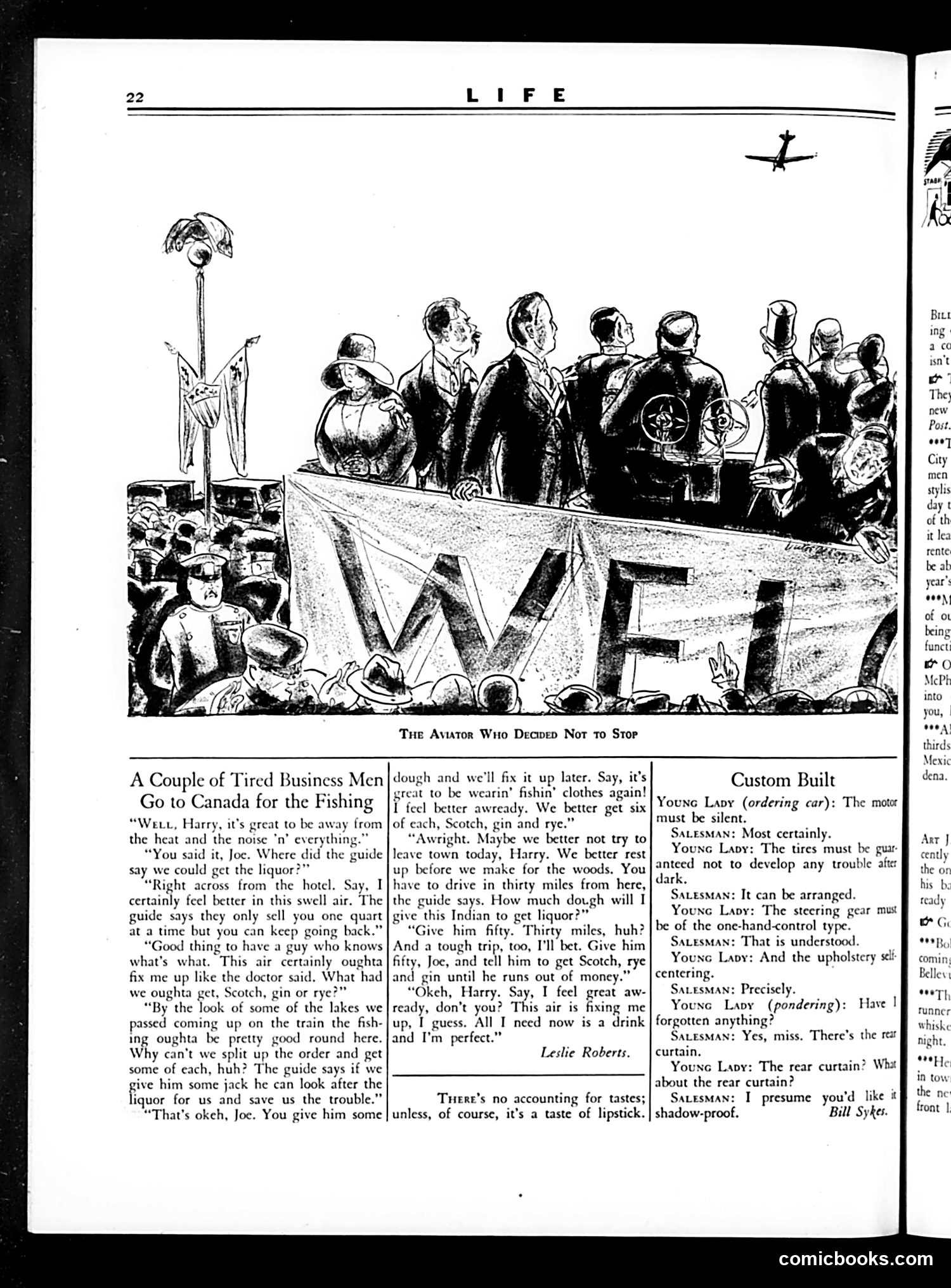
**The Main Cartoon: "A Couple of Tired Business Men Go to Canada for the Fishing"** Two businessmen claim they're escaping to Canada to fish and enjoy fresh air for their health. However, the entire conversation reveals their true agenda: acquiring alcohol. They repeatedly discuss quantities of liquor (Scotch, gin, rye), ask the guide to procure it, and plan to bribe him with cash. The irony is sharp—they claim the trip will "fix them up like the doctor said," but they're actually planning a drinking expedition. **Historical Context:** This satirizes Prohibition-era (1920s-1933) behavior. With alcohol banned in the U.S., Americans frequently crossed into Canada to obtain liquor legally. The cartoon mocks the transparent hypocrisy: businessmen pretending health-conscious motives while openly plotting alcohol procurement. **Secondary Cartoon: "Custom Built"** A young woman orders a custom car with unusual specifications: silent motor, tires guaranteed trouble-free "after dark," one-hand steering control, and a "shadow-proof" rear curtain. The salesman's final suggestion reveals the joke—she's ordering a getaway vehicle for illicit romantic encounters ("shadow-proof" implies concealment from view). Both pieces satirize how Prohibition-era Americans openly circumvented laws.
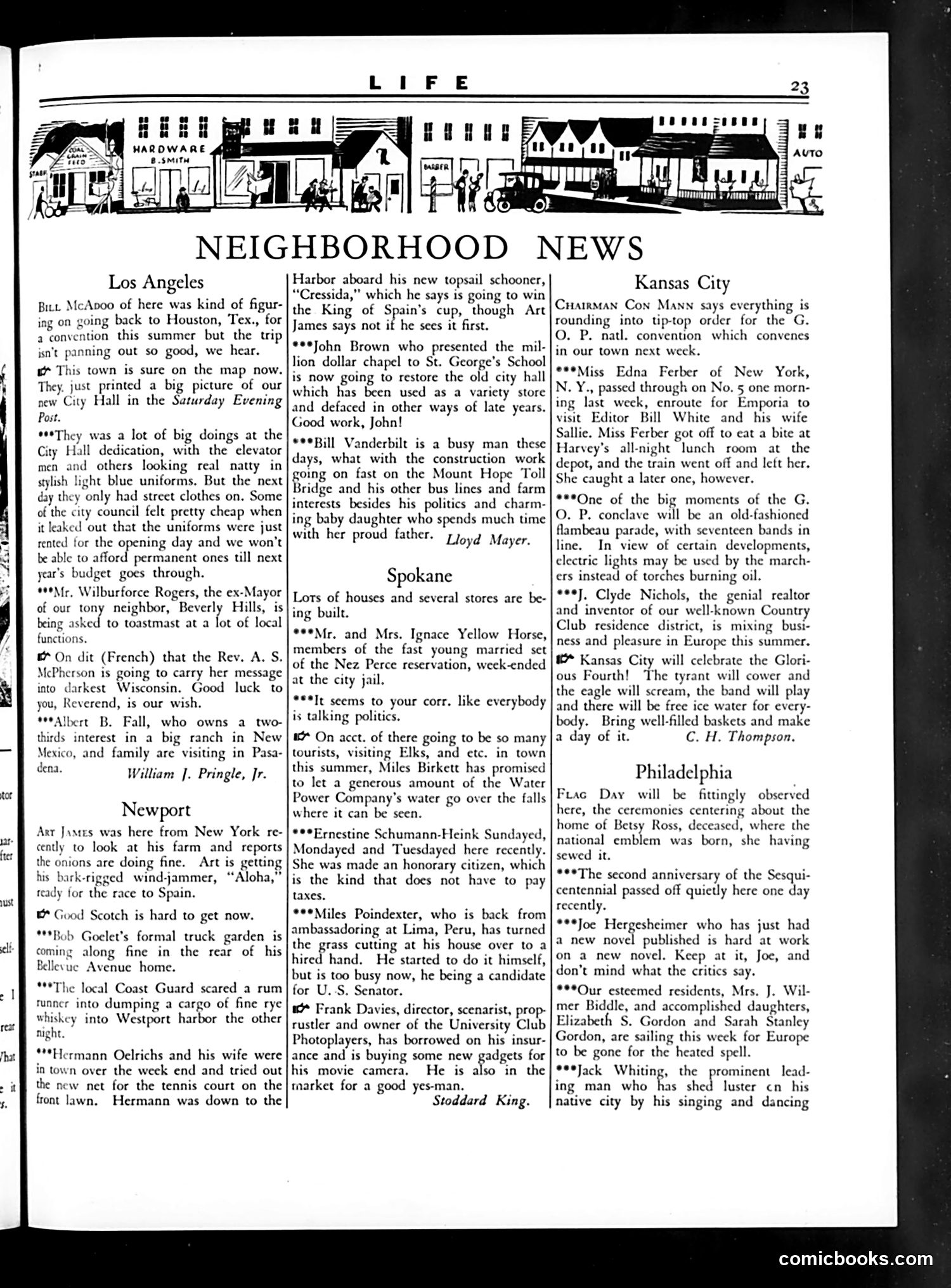
This is a **humor column** rather than a political cartoon. "Neighborhood News" presents satirical gossip items from wealthy American towns—Los Angeles, Newport, Spokane, and Kansas City. The satire targets **upper-class excess and pretension**: - Los Angeles: A new City Hall so cheap it rents uniforms for dedication day rather than buying them - Newport: Wealthy socialites (Vanderbilt, Oelrichs, Goelet) engage in trivial pursuits—yacht races, formal gardens—while one item mocks rum-running during Prohibition - Spokane: A Native American couple (Yellow Horse family) weekend at the city jail; politician Miles Poindexter is too busy campaigning to cut his own grass - Kansas City: References to "tyrant" and celebratory parades The tone is gentle mockery of the idle rich and their absurd priorities. The final byline "Stoddard King" suggests a regular columnist. This reflects *Life* magazine's satirical tradition of poking fun at American social hierarchies and wealthy eccentricity.
This page from *Life* magazine consists primarily of **society gossip and local news** organized by city (Boston, St. Louis, New York, Houston, Montreal). It's not a political cartoon page, but rather a "Neighborhood News" column—a popular *Life* feature mixing celebrity mentions with gentle satire of local social pretensions. The humor targets upper-class figures through: - **Backhanded compliments**: E.W. Preston hasn't gone five years without wearing a flower—suggesting affectation; Sherman Whipple now needs a second brief case (mock-celebration of prosperity). - **Social climbing**: Alvan T. Fuller (Massachusetts Governor and auto dealer) is buying oil paintings; people rushing to adopt summer fashions. - **Absurdist observations**: The Statue of Justice hasn't endorsed cigarettes; a financial genius belongs to the "4:30 Daylight Saving Poker Club." References like **Al Smith** (1920s Democratic politician) and **Senator Reed** (likely James Bayard Reed) ground this in early 1920s politics, though obliquely. The tone is affectionate mockery of leisure-class habits rather than sharp satire—typical of *Life*'s society column voice.
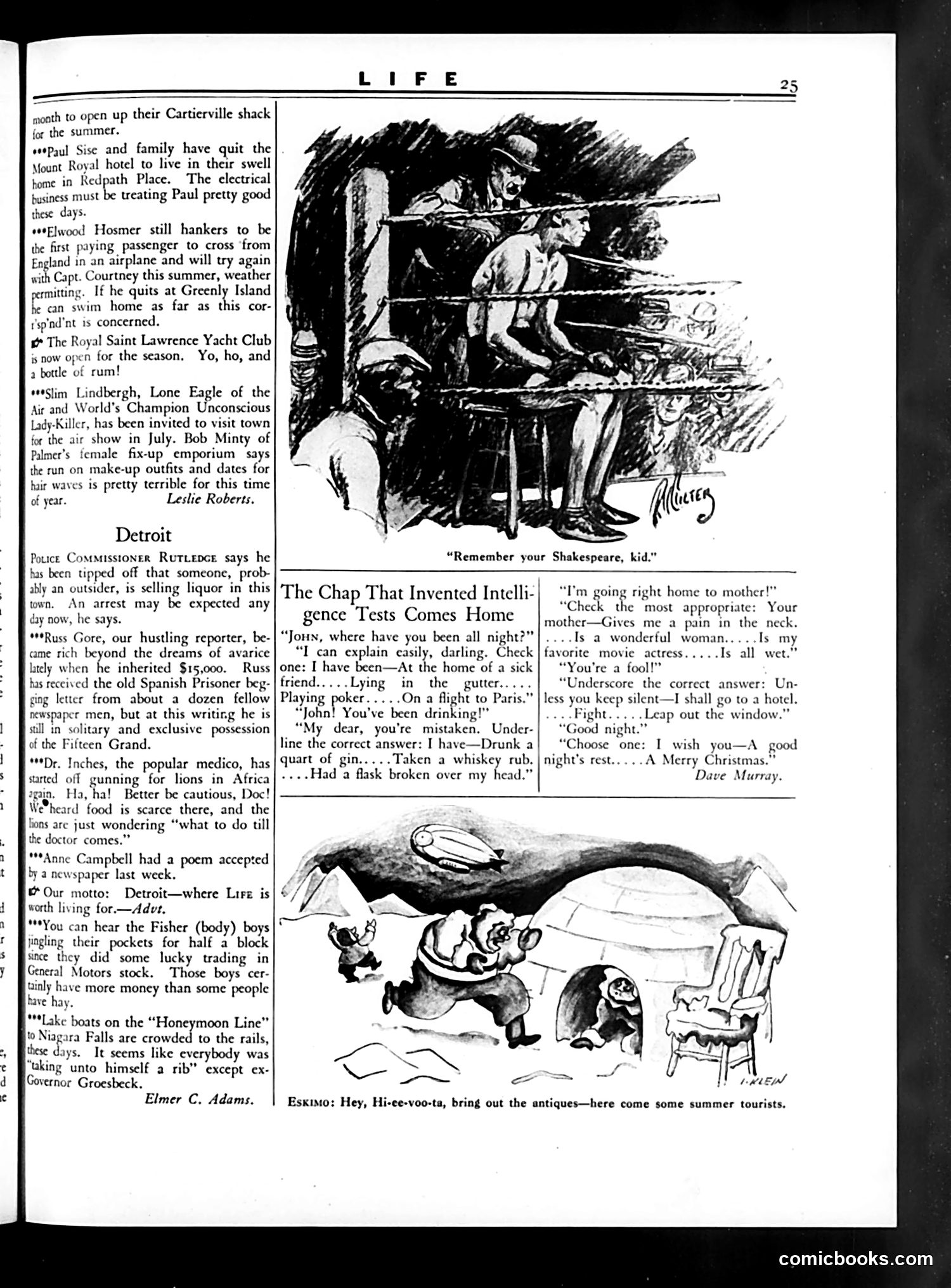
This page contains two distinct satirical pieces: **Upper cartoon** (signed Allister): A WWI-era military scene showing soldiers in a trench. The caption "Remember your Shakespeare, kid" suggests a soldier instructing a younger recruit to recall literary knowledge amid warfare—dark humor about the contrast between classical education and brutal combat reality. **Main article**: "The Chap That Invented Intelligence Tests Comes Home" mocks the then-popular intelligence testing movement by showing a husband using multiple-choice format answers to deflect his wife's marital complaints. Each of his responses offers absurd alternatives ("Lying in the gutter" vs. visiting sick friends; admitting to drinking vs. denying it). The satire targets how intelligence tests, a new scientific fad, reduce complex human situations to reductive checkboxes—suggesting the tests miss actual wisdom or character. **Lower cartoon** (signed Krargan): Depicts an Eskimo showing "antiques" to summer tourists—satirizing tourists' expectations that indigenous peoples exist as curiosities for entertainment rather than as modern people. The page reflects 1920s American anxieties about modernization, scientific methodology, and cultural tourism.
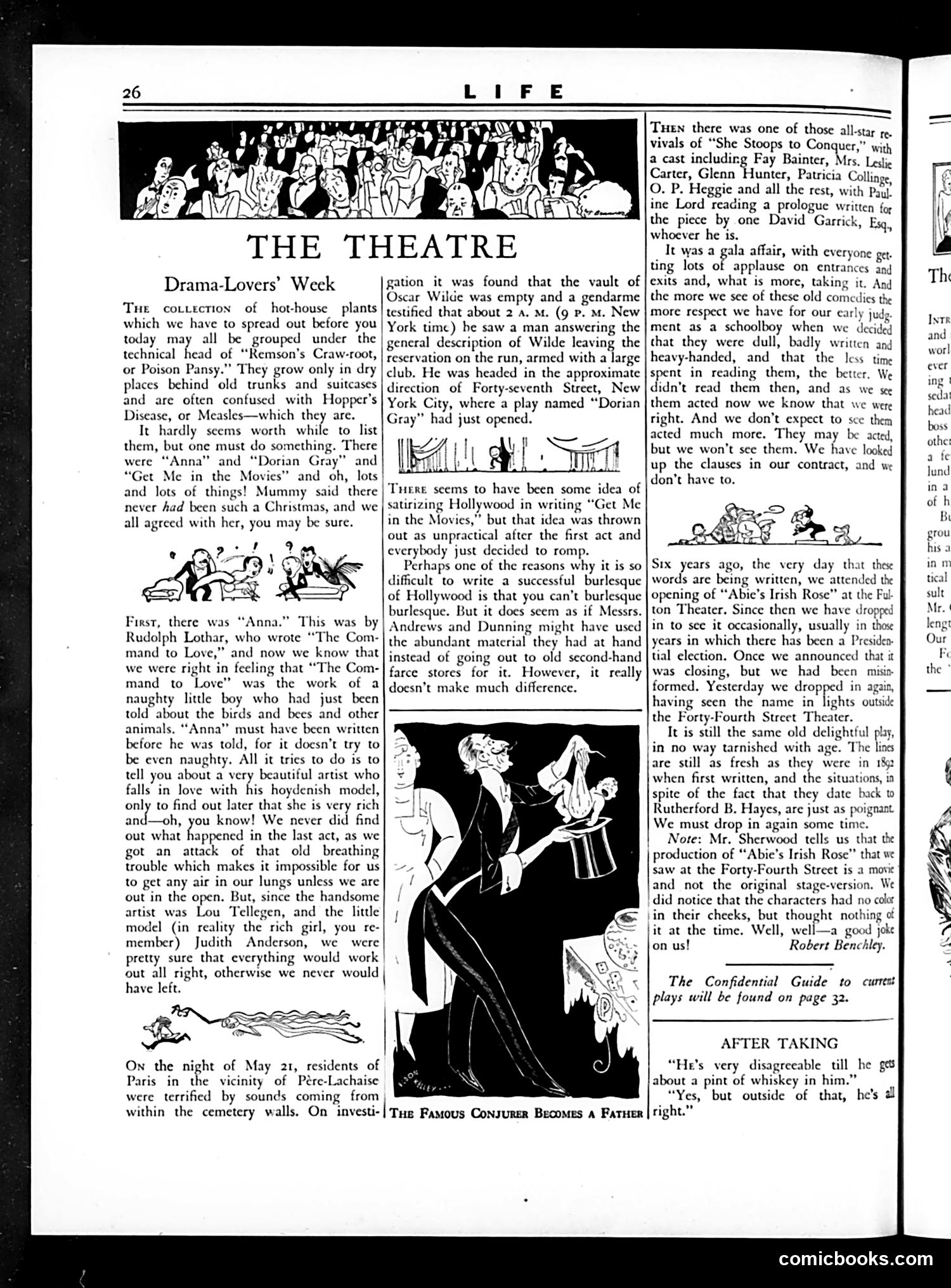
This is a theater review column satirizing recent Broadway productions. The author mockingly criticizes several plays as mediocre or poorly written, using colorful botanical metaphors ("hot-house plants," "Poison Pansy") to dismiss them as artificial and overgrown in dry places. The specific targets include: - **"Anna"** — a romance by Rudolph Lothar, criticized as naive and predictable - **"Dorian Gray"** — a theatrical adaptation, with a humorous fantasy that Oscar Wilde's ghost fled his Paris grave to protest the play's opening on 47th Street - **"Get Me in the Movies"** — accused of abandoning satirical intent after act one to become mere farce - **"She Stoops to Conquer"** revival — praised for its cast (Fay Bainter, Glenn Hunter, Patricia Collinge, O.P. Heggie) but dismissed as a dull, poorly-written classic the author refuses to attend again The humor relies on the reviewer's acerbic tone and admission of deliberately not engaging with the material—claiming breathing troubles during "Anna" while confidently predicting its plot anyway. The satire targets both bad playwriting and theatrical pretension of the era.
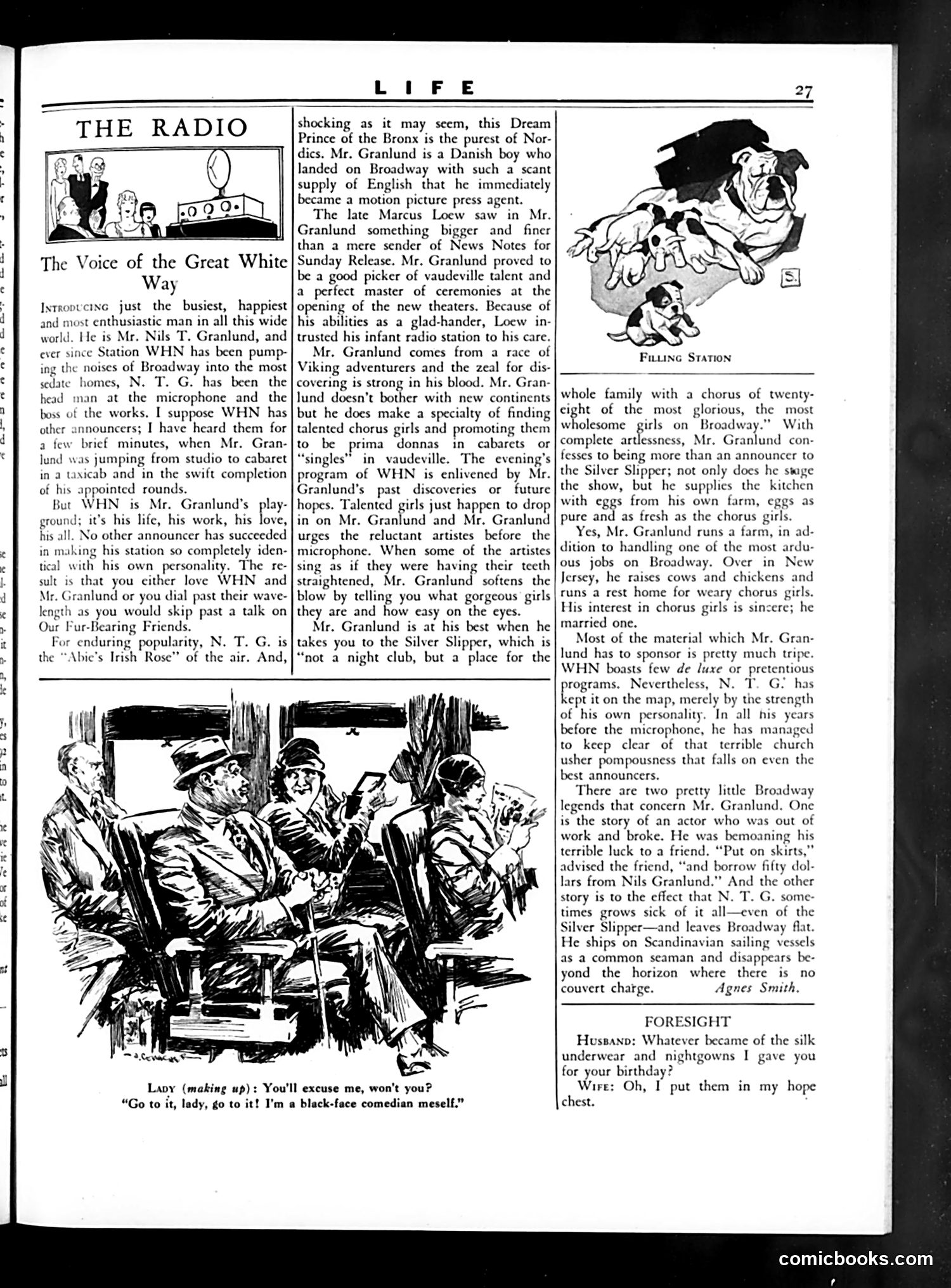
This is a profile-essay celebrating Nils T. Granlund, announcer and programming director for radio station WHN in New York. The text praises his showmanship and tireless energy in promoting Broadway talent, particularly chorus girls, whom he discovers, promotes, and even employs on his New Jersey farm. The satire is gentle: the writer mocks Granlund's relentless self-promotion and his tendency to romanticize mediocre performers ("singing as if they were having their teeth straightened"). The "Filling Station" cartoon appears to critique his ubiquity—he's everywhere, supplying Broadway with "product" like a gas pump. The lower cartoon shows a blackface comedian, reflecting 1920s entertainment conventions now considered offensive. The "Foresight" joke is unrelated domestic humor. Overall, the piece treats Granlund as an emblematic showman who succeeded through personality rather than refined taste.
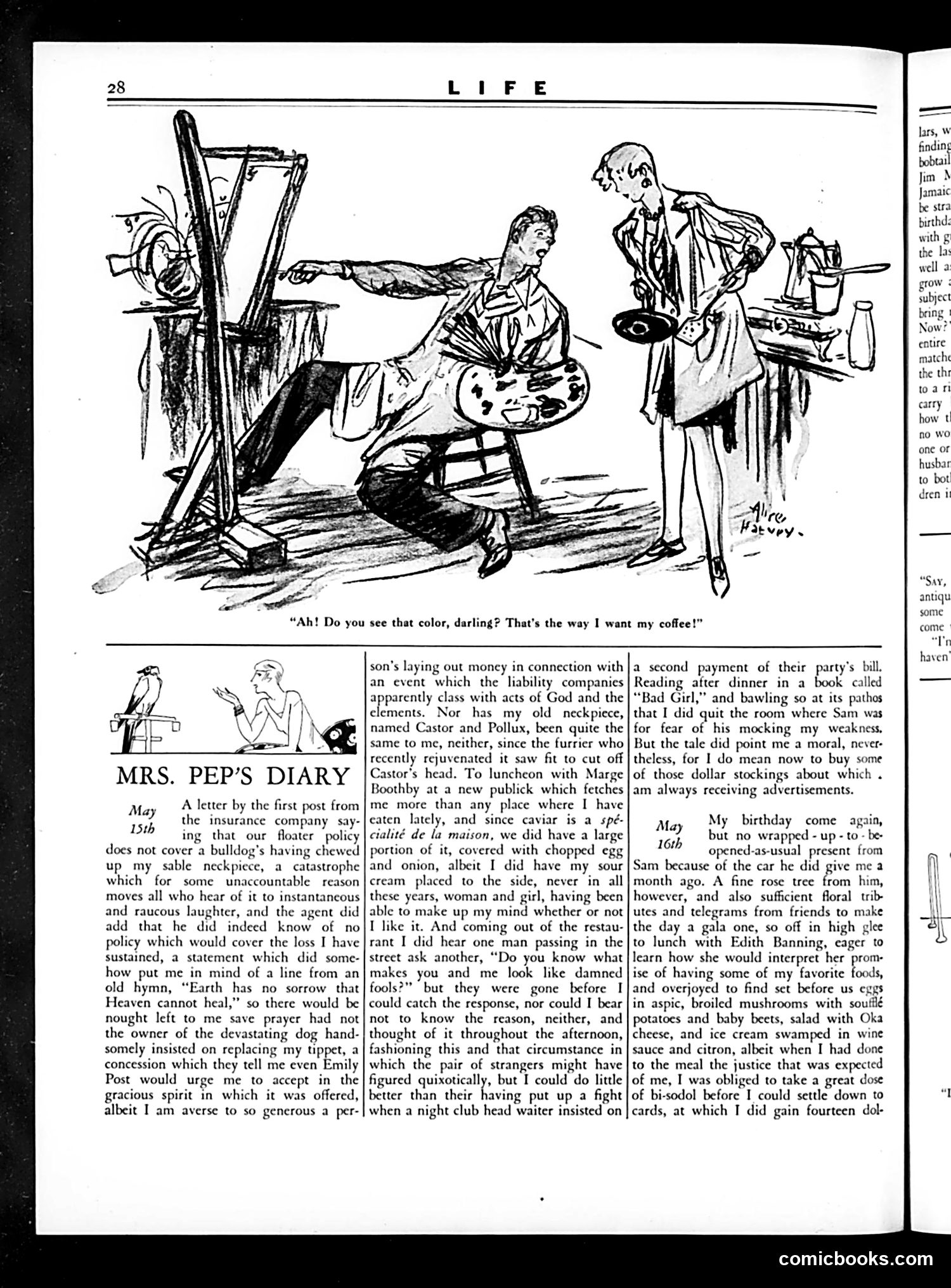
**Top Cartoon:** A man sits at an easel painting while his wife watches. He's showing her a paint color, claiming "That's the way I want my coffee!" The satire mocks artistic pretension—the painter is so absorbed in color theory that he's lost perspective on ordinary life, conflating aesthetic concerns with basic needs. It's gentle mockery of the artistic temperament. **Mrs. Pep's Diary:** This is a society column written in a deliberately overwrought, verbose style that parodies upper-class women's diaries. The entries catalog trivial social events (lunches, birthday celebrations, card games) with elaborate, affected language ("spécialité de la maison," "auixoneally"). The humor lies in the contrast between the breathless, precious tone and the mundane content—a dog chewed a fur stole, she attended lunch, she won fourteen dollars at cards. The diary mocks how wealthy women of the era took their small social dramas extremely seriously, documenting them with pretentious verbosity. It's satirizing class affectation and the self-importance of society life.
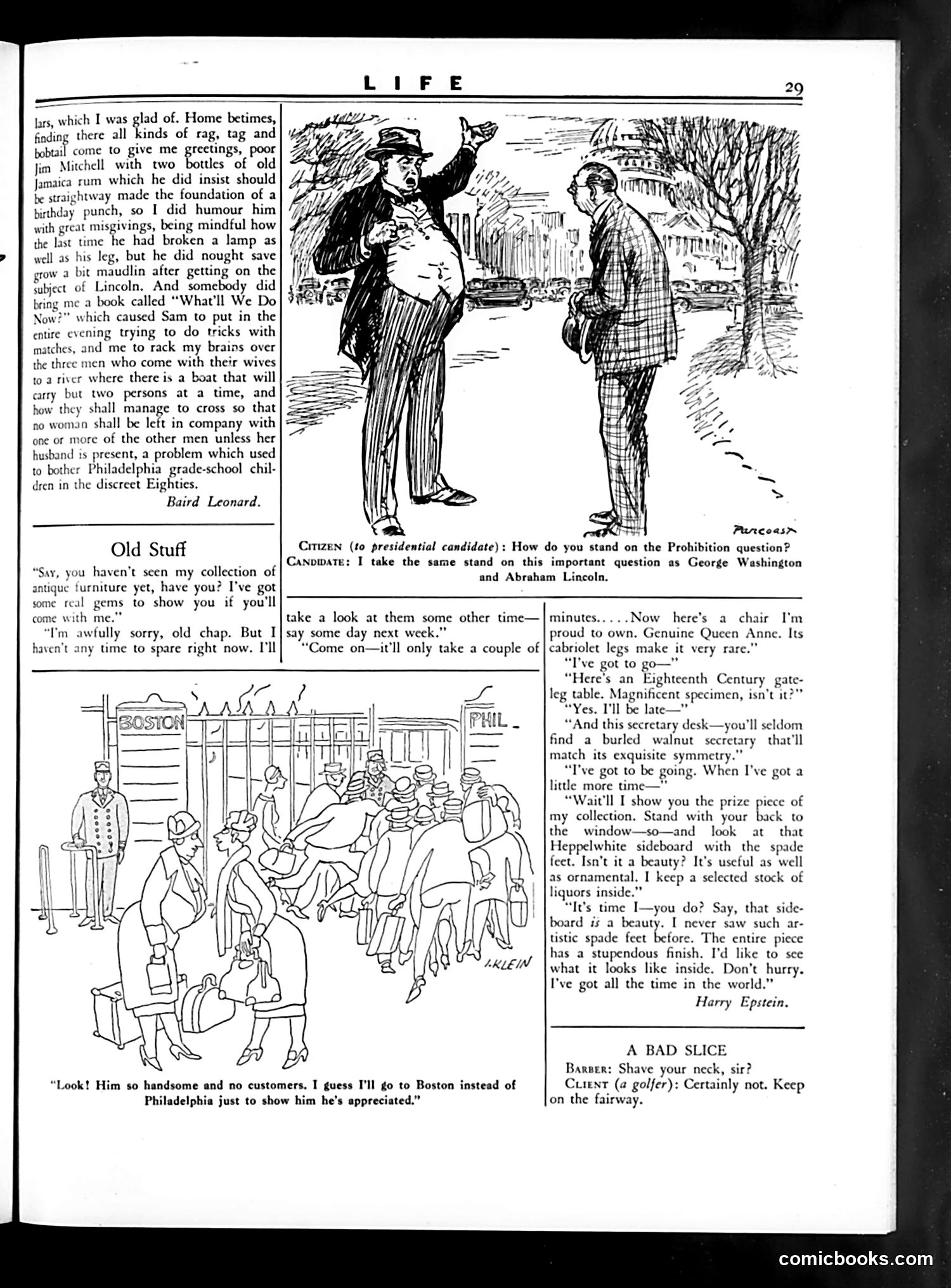
This page contains three satirical pieces typical of early 20th-century American humor: **"Old Stuff"** (top cartoon): Mocks the tedium of antique-furniture enthusiasts who trap acquaintances into lengthy, unwanted tours. The joke: a man desperate to leave suddenly becomes interested when the furniture owner mentions liquor hidden inside a Heppelwhite sideboard—revealing that prohibition-era alcohol storage was the real "collectible." **"Prohibition Cartoon"** (center): A presidential candidate evades the Prohibition question by claiming he takes "the same stand as George Washington and Abraham Lincoln"—a non-answer that appears clever but is meaningless. This satirizes evasive political rhetoric during the Prohibition debate. **"A Bad Slice"** (bottom): A golf-themed pun. A barber asks a golfer to shave his neck; the golfer refuses with "Keep on the fairway"—golfing terminology misapplied to barbering for comedic effect. The page reflects 1920s concerns: Prohibition's unpopularity, evasive politicians, and leisure-class pastimes.
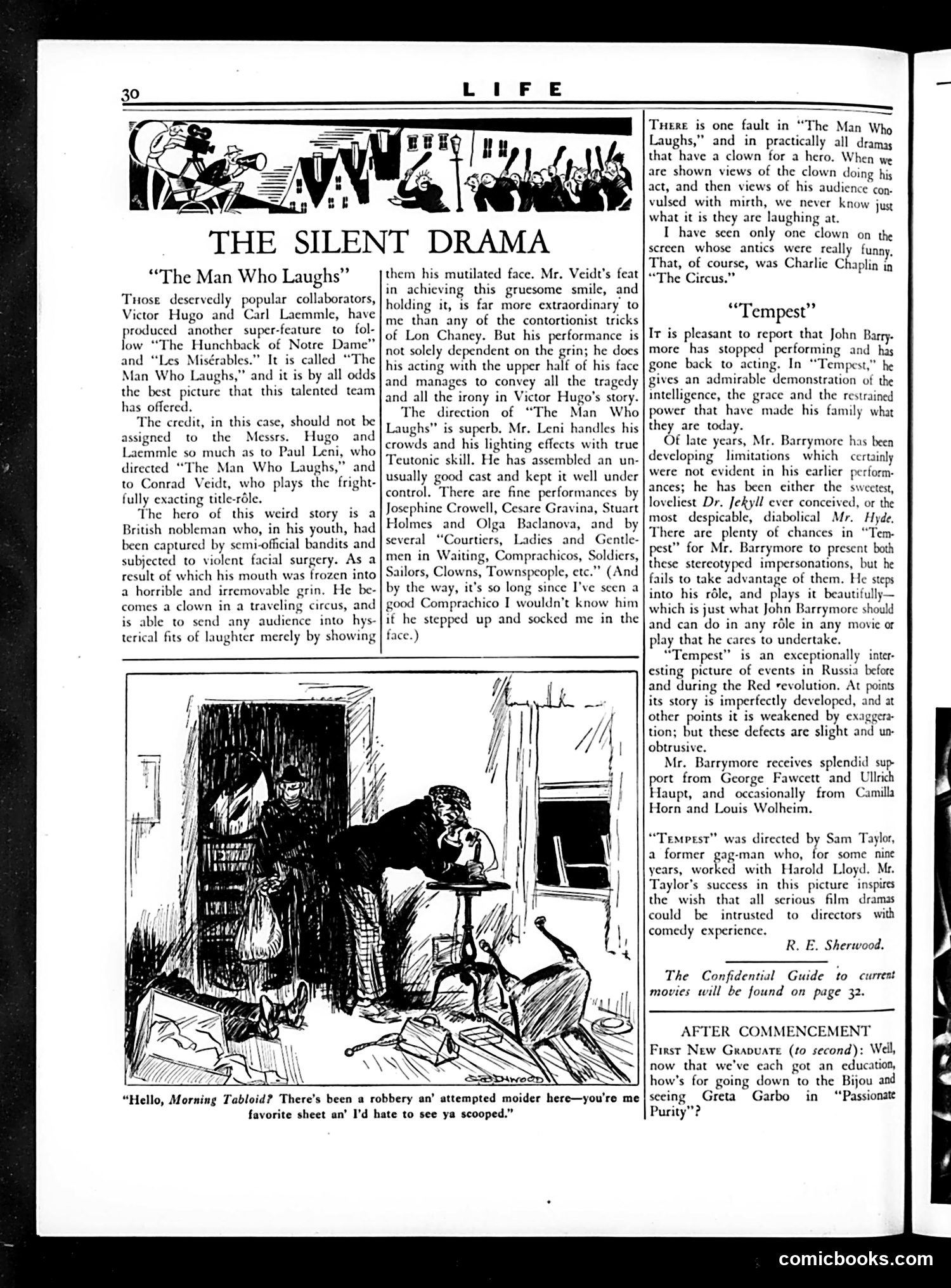
This is a film review page from Life magazine's "Silent Drama" column, circa mid-1920s. The main content reviews two films: **"The Man Who Laughs"** — adapted from Victor Hugo's novel, starring Conrad Veidt as a British nobleman whose mouth was surgically frozen into a permanent grin, forcing him to become a circus clown. The reviewer praises Veidt's acting and director Paul Leni's technique, but notes a flaw common to clown-centered dramas: audiences never know what makes the character's antics funny. The reviewer singles out Charlie Chaplin's "The Circus" as the only film where a clown's humor actually registers on screen. **"Tempest"** — stars John Barrymore in a film about pre-Revolutionary Russia. The reviewer praises Barrymore for restraint and intelligence in his acting, contrasting this favorably with his tendency toward extreme characterizations (Jekyll/Hyde types). The cartoon below depicts a crime reporter calling a newspaper editor, using slang typical of crime journalism of the era ("moider" for murder, "scooped" meaning beaten on a story).
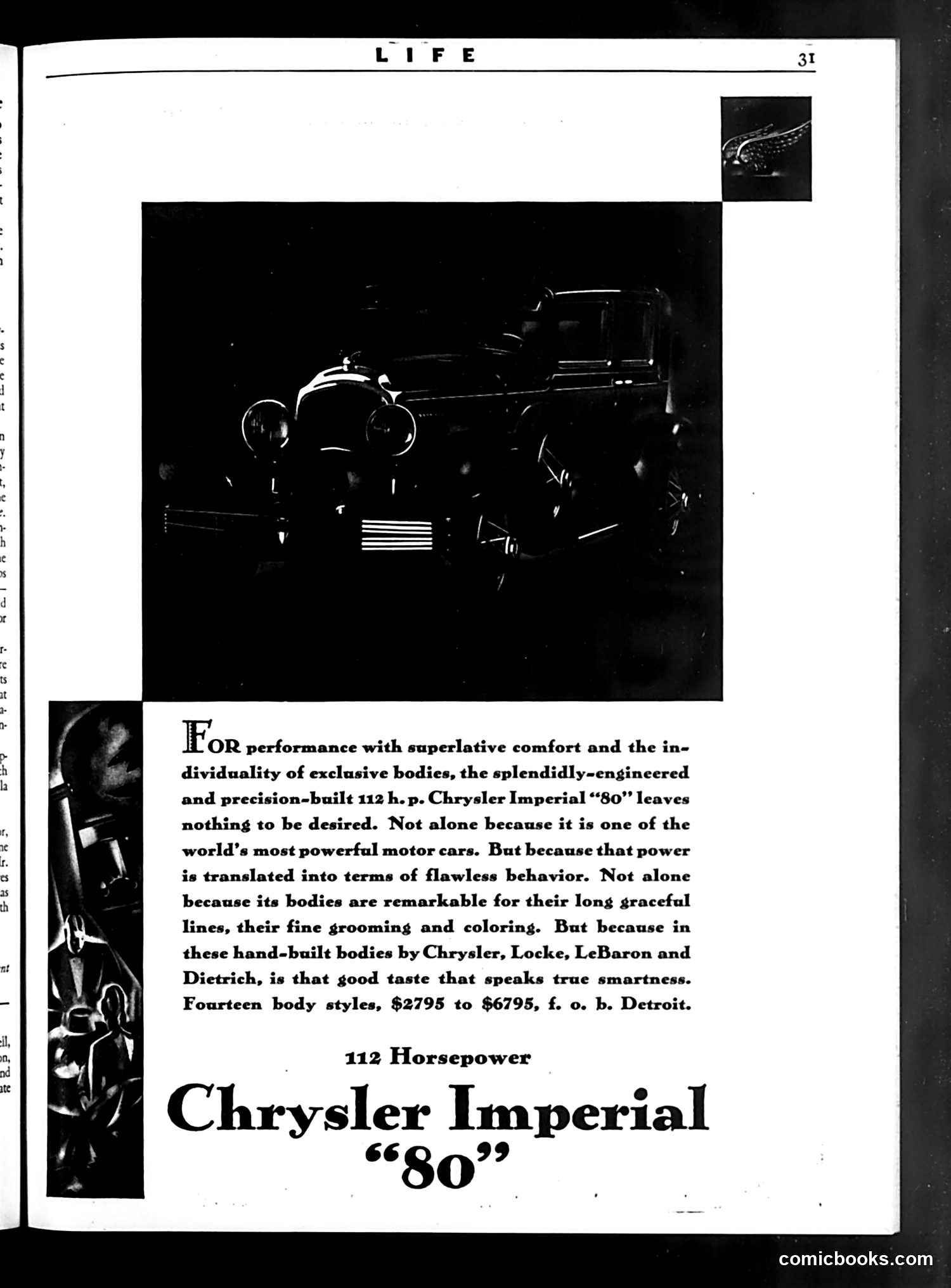
This is **not a cartoon or satire**—it's a straightforward **automobile advertisement** from Life magazine (page 31). The large photograph shows a Chrysler Imperial "80" luxury car photographed dramatically against a dark background to highlight its sleek lines and engineering. The text promotes the vehicle's 112-horsepower engine, hand-built bodies (crafted by prestigious coachbuilders like Locke and LeBaron), and exclusivity. It emphasizes that power translates to "flawless behavior" and that the car's graceful design demonstrates "good taste" and "smartness." The price range ($2,795–$6,795 f.o.b. Detroit) targets wealthy buyers. Small inset photographs on the sides show mechanical details. This represents typical 1920s-30s luxury car marketing emphasizing both performance and aesthetic refinement as markers of social status.
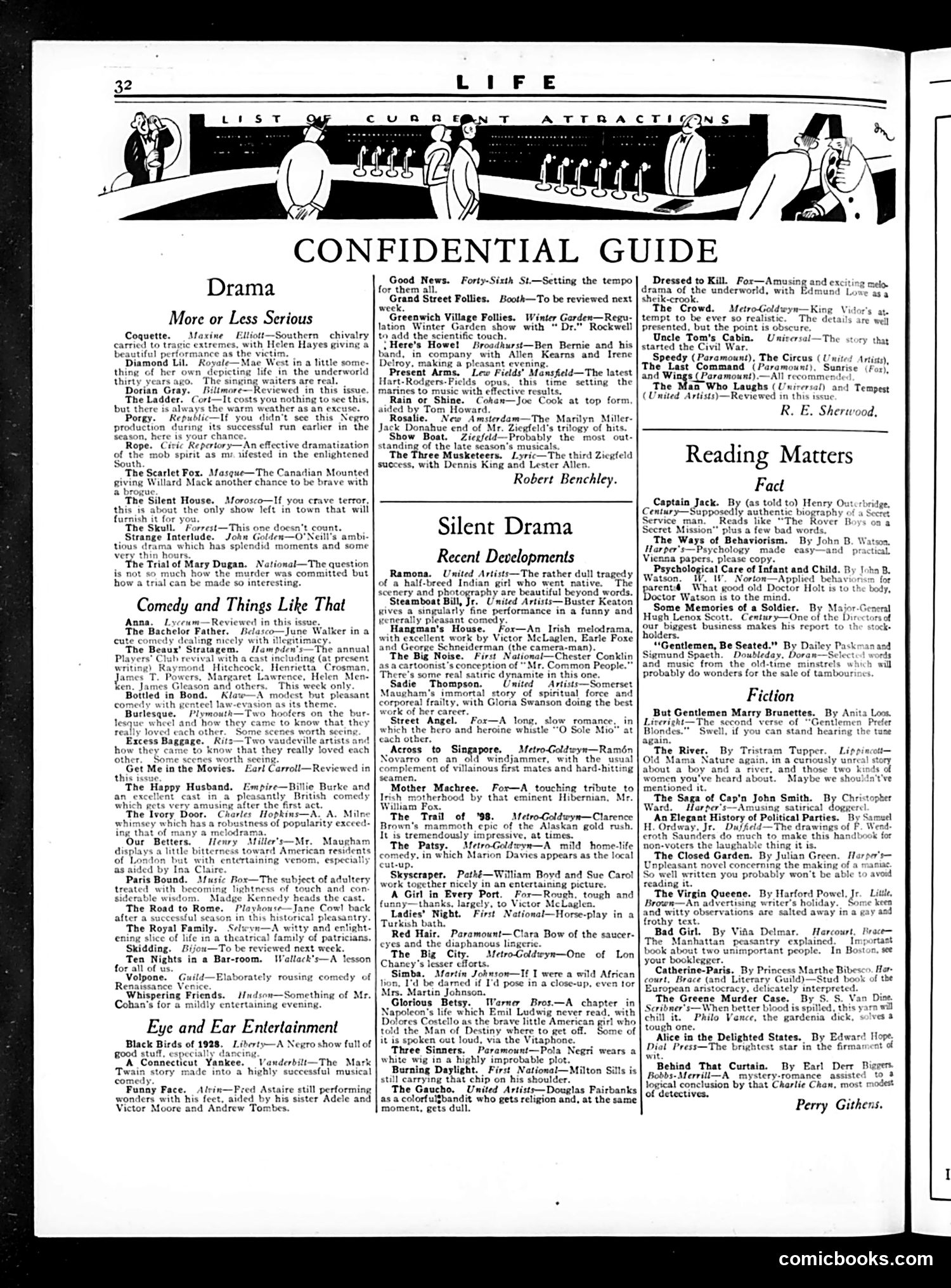
This page is a **theatre guide and review section**, not a political cartoon page. It lists current Broadway productions with brief critical assessments, organized by genre: "Drama," "Comedy and Things Like That," and "Eye and Ear Entertainment" (musicals/vaudeville). The decorative header illustration at top shows stylized figures in a nightclub or theatre setting, typical of Life's 1920s aesthetic—it's decorative, not satirical commentary. The actual content reviews shows like *Strange Interlude*, *Show Boat*, *A Connecticut Yankee*, and *The Trial of Mary Dugan*, offering quick judgments ("It costs you nothing to see this") for readers deciding what to attend. This reflects the Jazz Age theatre boom, with Ziegfeld productions and musicals prominently featured. The right column shifts to "Reading Matters"—book reviews on psychology, biography, and fiction. **This is a cultural guide page, not political satire.** It documents 1920s American entertainment preferences and critical taste.
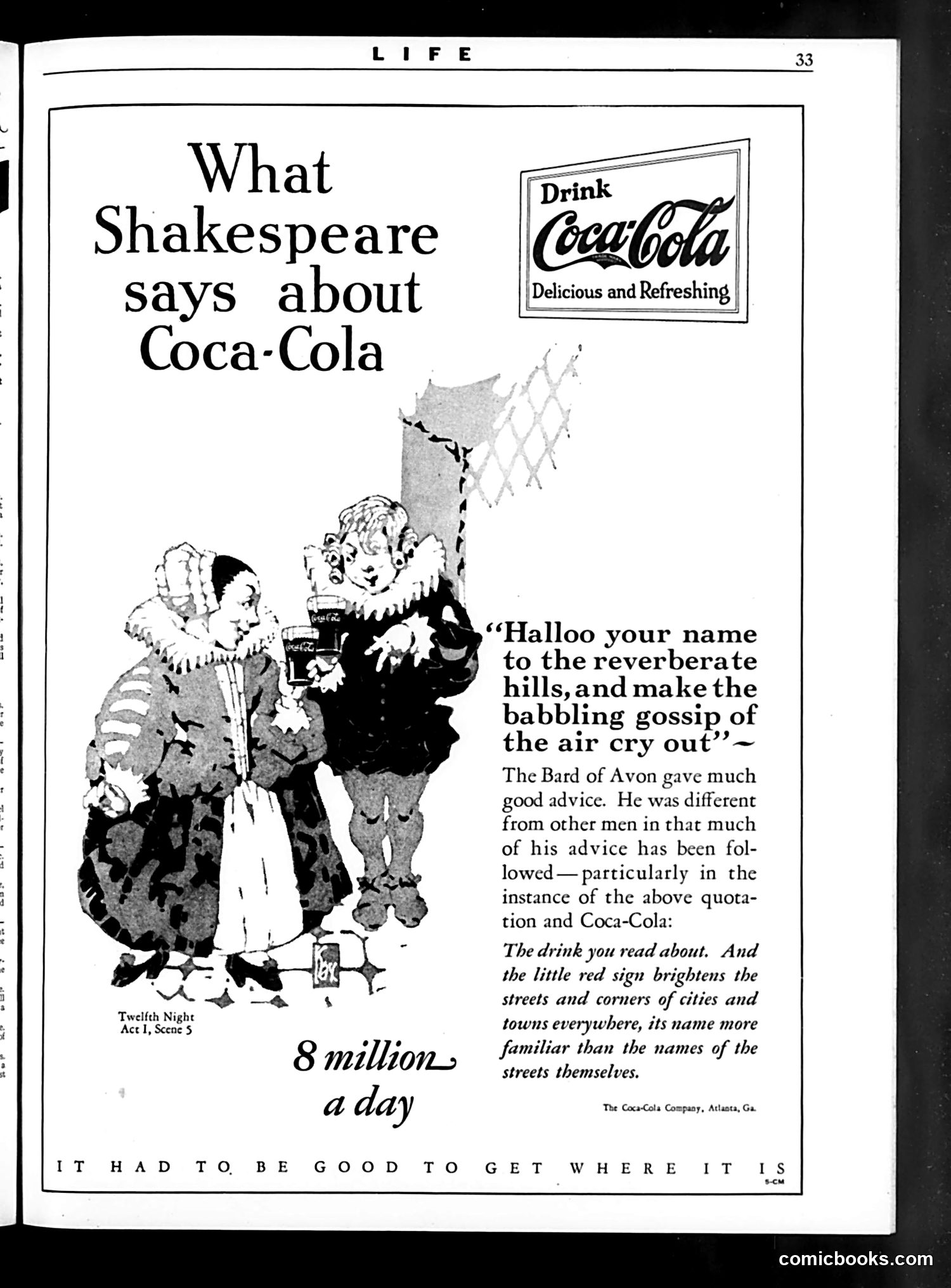
This is a **Coca-Cola advertisement** disguised as satirical content. It uses Shakespeare to promote the soft drink. The illustration shows characters from *Twelfth Night* (identifiable by the caption) sharing Coca-Cola. The ad attributes a real Shakespeare quote about making one's name echo widely to suggest that Coca-Cola has achieved exactly that—becoming ubiquitous in American towns. The satire is **self-directed**: the ad jokingly claims Shakespeare himself was giving marketing advice centuries before Coca-Cola existed. The tagline "8 million a day" and the closing statement ("It had to be good to get where it is") reinforce the product's market dominance. The point: by invoking Shakespeare's authority and wit, the ad elevates a commercial product to cultural significance while implying that widespread popularity equals quality. For modern readers, this represents early **brand advertising masquerading as humor**—a technique still common today.
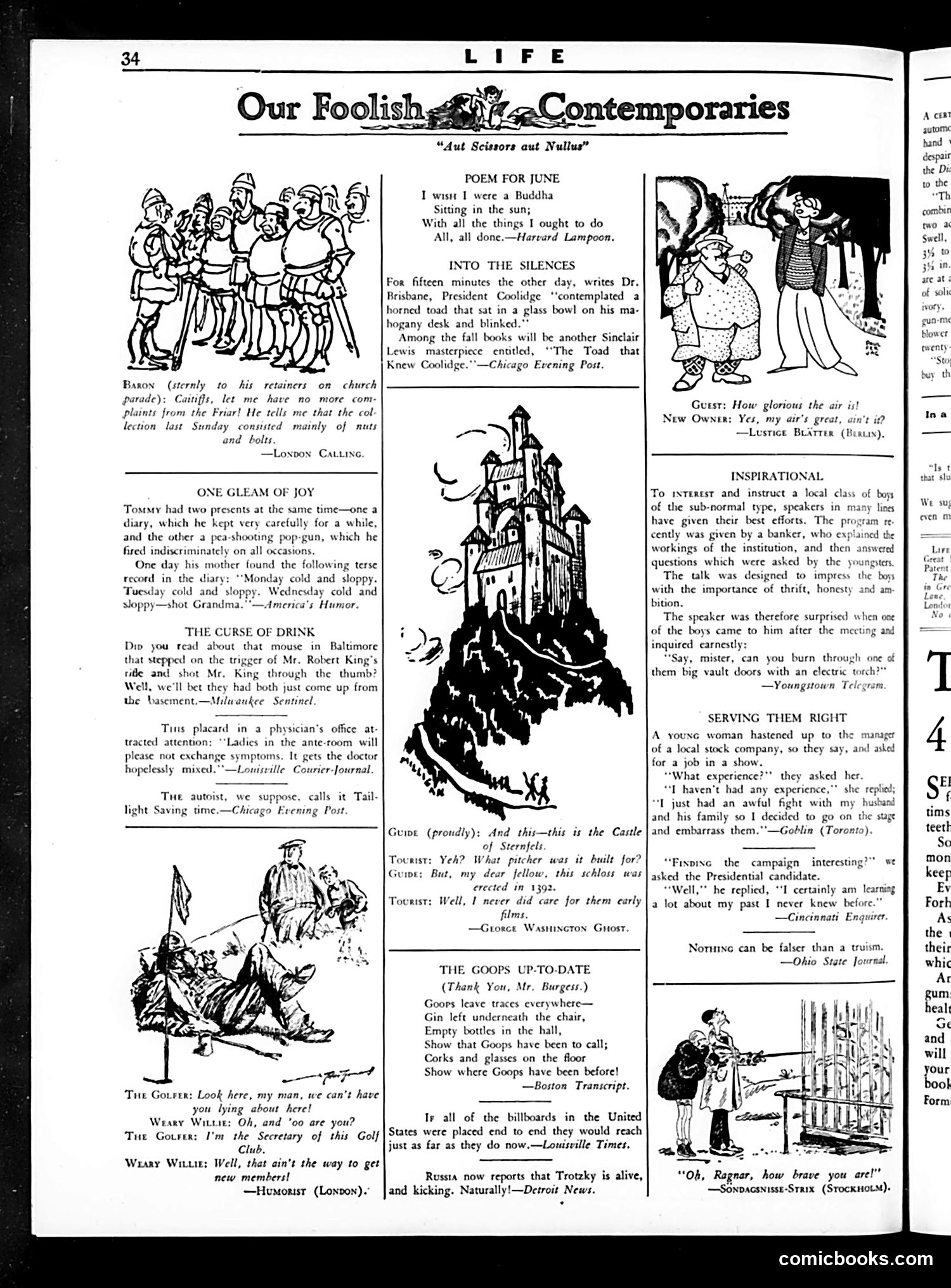
This page from *Life* magazine (undated, but references to Coolidge and Trotsky suggest early 1920s) collects short humorous pieces satirizing contemporary society: **Key targets include:** - **Prohibition-era drinking** ("The Curse of Drink," "The Goops Up-to-Date"): Jokes about hidden alcohol and messy drinkers reflect the absurdity of Prohibition enforcement. - **President Coolidge**: The famous anecdote about him silently watching a toad mocks his reputation for taciturn, do-nothing leadership. - **American cultural pretension**: A tourist asks what Hollywood star a 14th-century castle was built for—satirizing Americans' film-obsessed ignorance of European history. - **Advertising excess**: The observation that all U.S. billboards "would reach just as far as they do now" jokes that billboards are everywhere yet accomplish nothing. **The overall tone** is gentle mockery of modern absurdities: bad manners, Prohibition hypocrisy, cultural ignorance, and commercial excess. The cartoons use simple ink drawings typical of the era's newspaper humor.
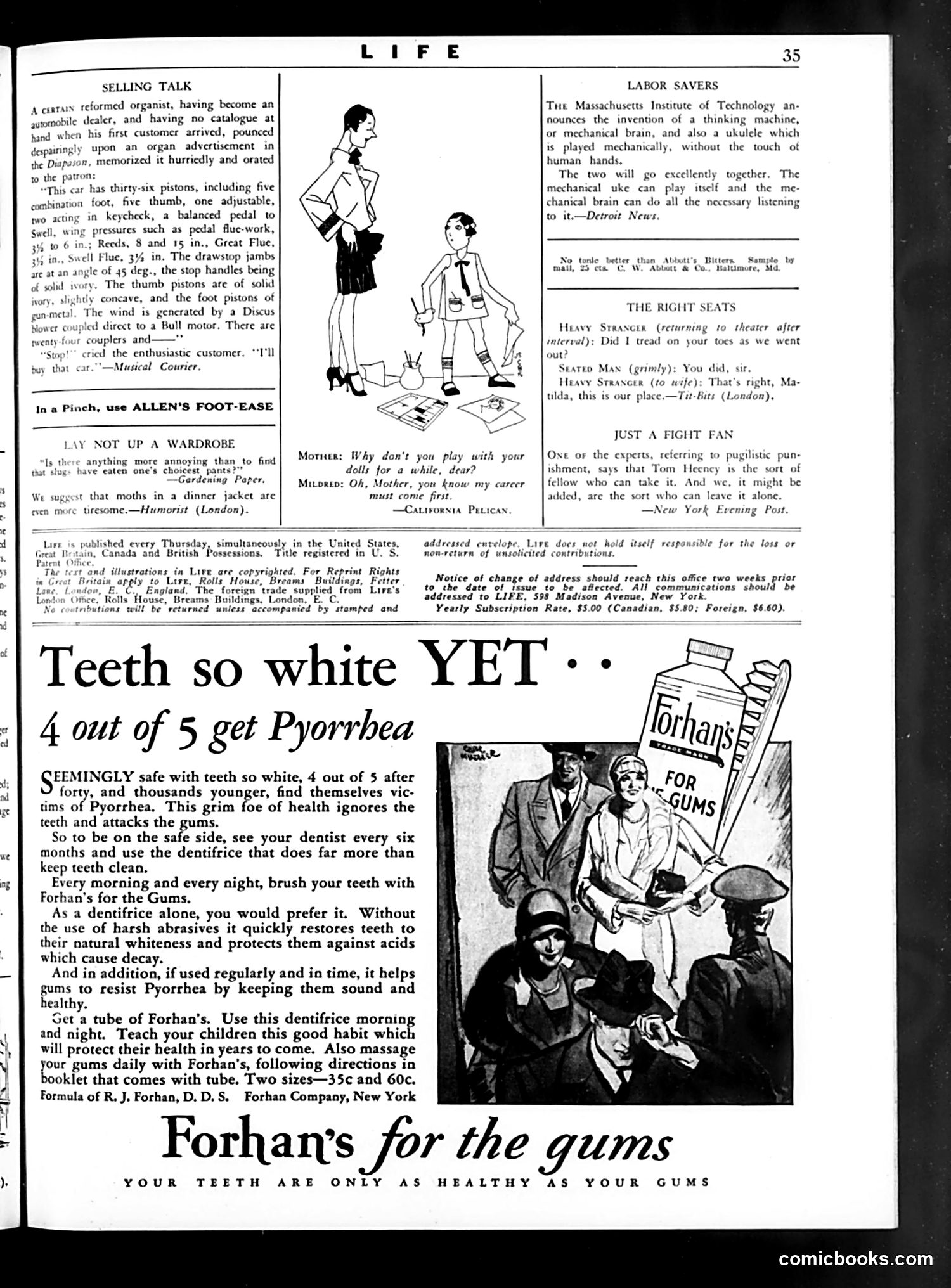
This page contains several short satirical pieces typical of Life's humor format: **"Selling Talk"** mocks a car salesman who, lacking product knowledge, plagiarizes an organ advertisement to pitch an automobile—confusing automotive and musical terminology to absurd effect. The joke satirizes both salesmen's ignorance and the era's aggressive advertising culture. **"Labor Savers"** is a two-sentence quip about MIT's new "thinking machine" (mechanical brain) and mechanical ukulele. The satire suggests these innovations are perfectly matched: the machine won't need human judgment to appreciate the automated music. **"The Right Seats"** depicts theater etiquette gone wrong—a clumsy patron treading on someone's toes, then insisting they must be in the correct seats because "this is our place," implying entitlement. **"Just a Fight Fan"** contrasts boxing enthusiasts who admire pugilists' toughness with ordinary people who wisely avoid physical violence. The large **Forhan's toothpaste advertisement** dominates the lower half, warning that 4 of 5 develop pyorrhea (gum disease) despite white teeth, promoting daily brushing.
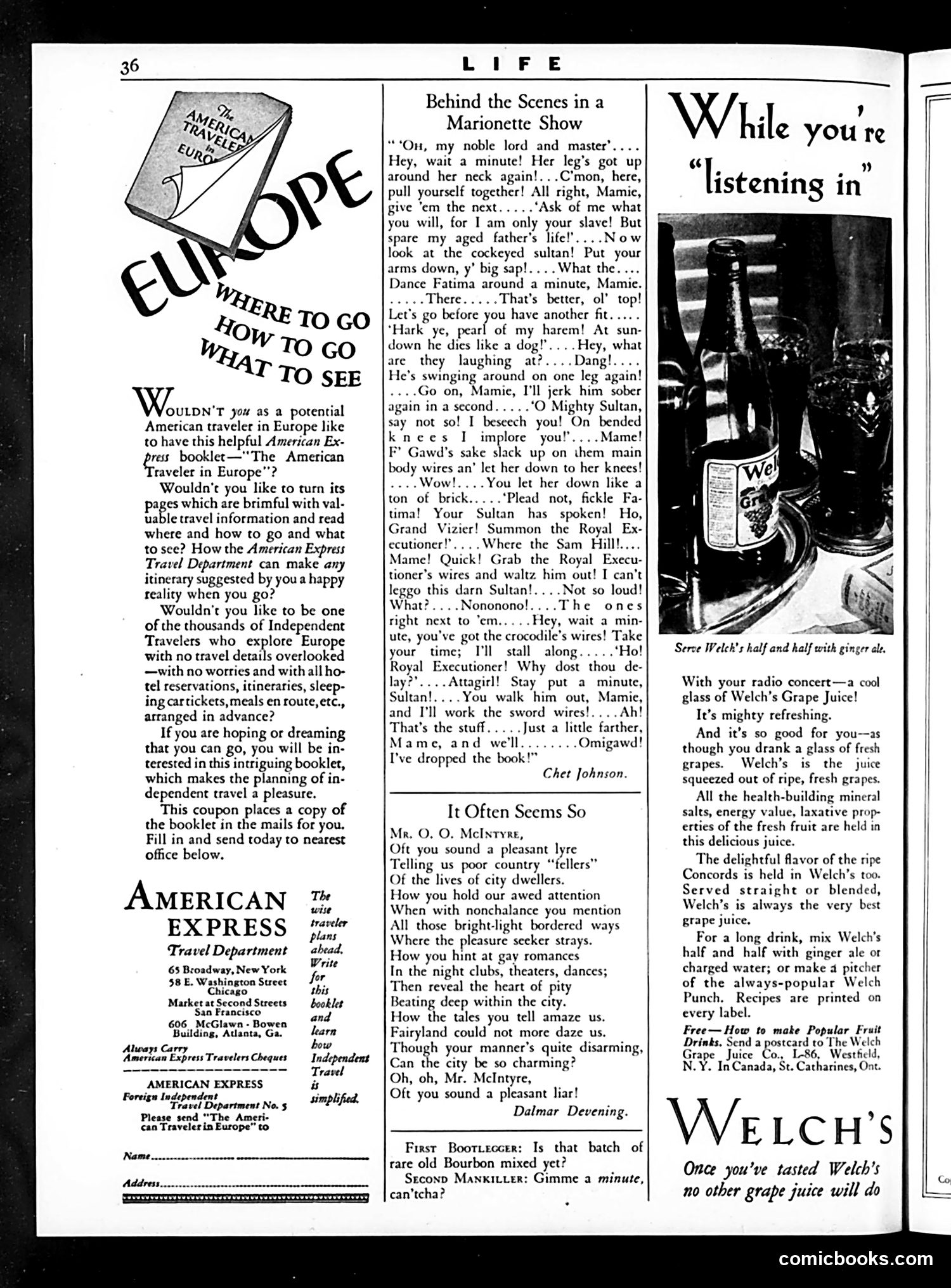
This page contains **advertisements and satirical content** rather than political cartoons. **Main Content:** - **American Express travel ad** (left): Promotes independent European travel planning services, appealing to affluent American tourists - **"Behind the Scenes in a Marionette Show"** (center): A humorous essay by Chet Johnson depicting chaotic backstage control of a melodramatic puppet performance, with operators frantically managing tangled wires while the overwrought narrative continues onstage—satirizing the gap between theatrical illusion and messy reality - **"It Often Seems So"** (center): A poem by Dalmar Devening gently mocking columnist O. O. McIntyre, accusing him of romanticizing city life while misleading rural readers—the final line calls him "a pleasant liar" - **Welch's Grape Juice ad** (right): Promotes the beverage as refreshing radio-listening accompaniment The page reflects 1920s-30s concerns: American tourism, urban-versus-rural perspectives, and media influence on public perception.
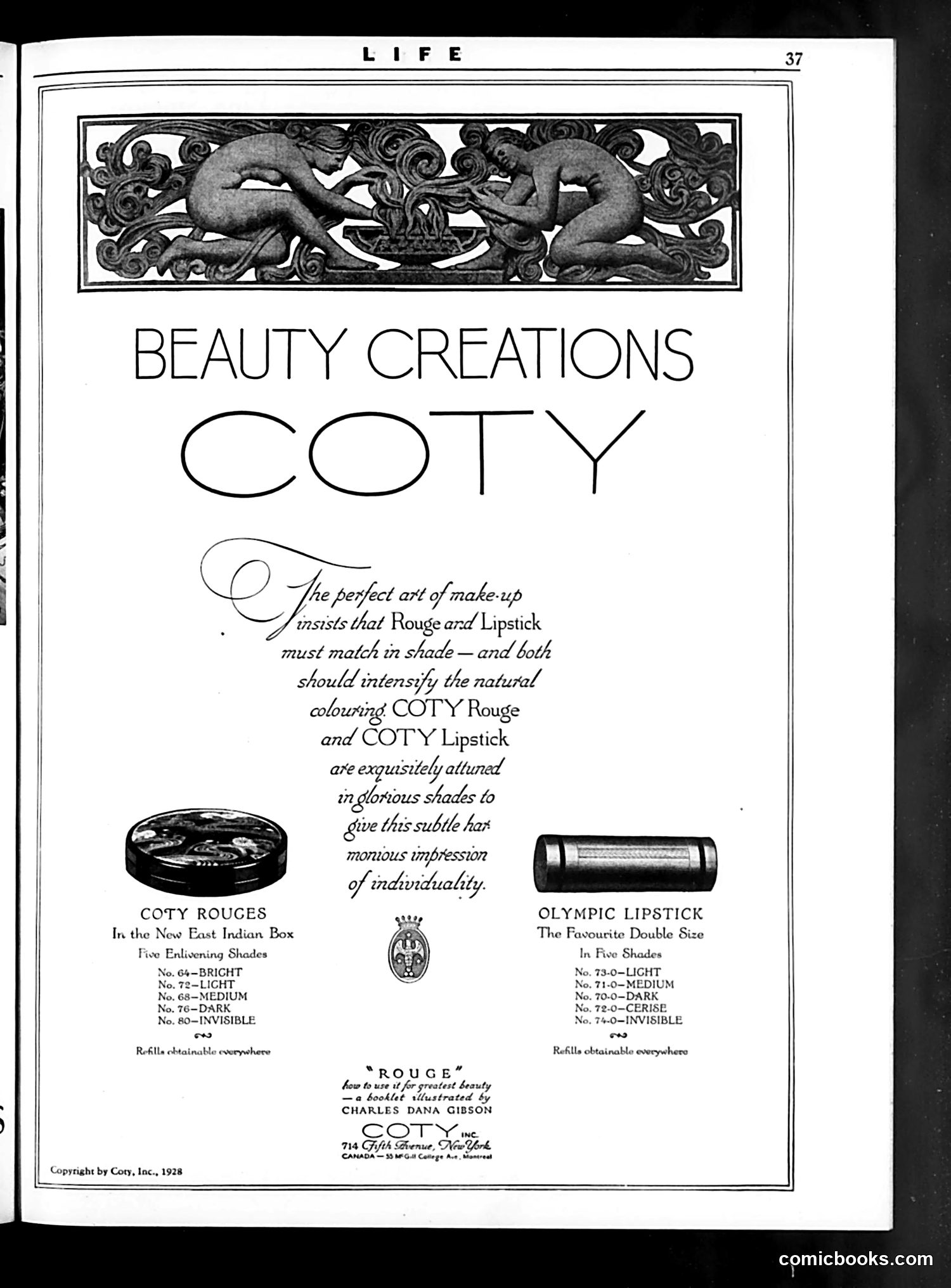
This is **not a cartoon or satire**—it's a **cosmetics advertisement** for Coty beauty products, specifically rouge and lipstick. The decorative header features classical cherubs in an ornamental design typical of 1920s advertising aesthetics. The page promotes the idea that rouge and lipstick should match in shade to enhance natural coloring and convey individuality—a beauty standard of the era. The ad lists five available shades for both products, includes refill availability, and prominently features Charles Dana Gibson's name (the famous "Gibson Girl" illustrator), lending prestige through association with a celebrated artist. Published in 1928, this reflects the cosmetics industry's growth during the Jazz Age, when makeup became increasingly acceptable and fashionable for women—a significant social shift from earlier Victorian attitudes.
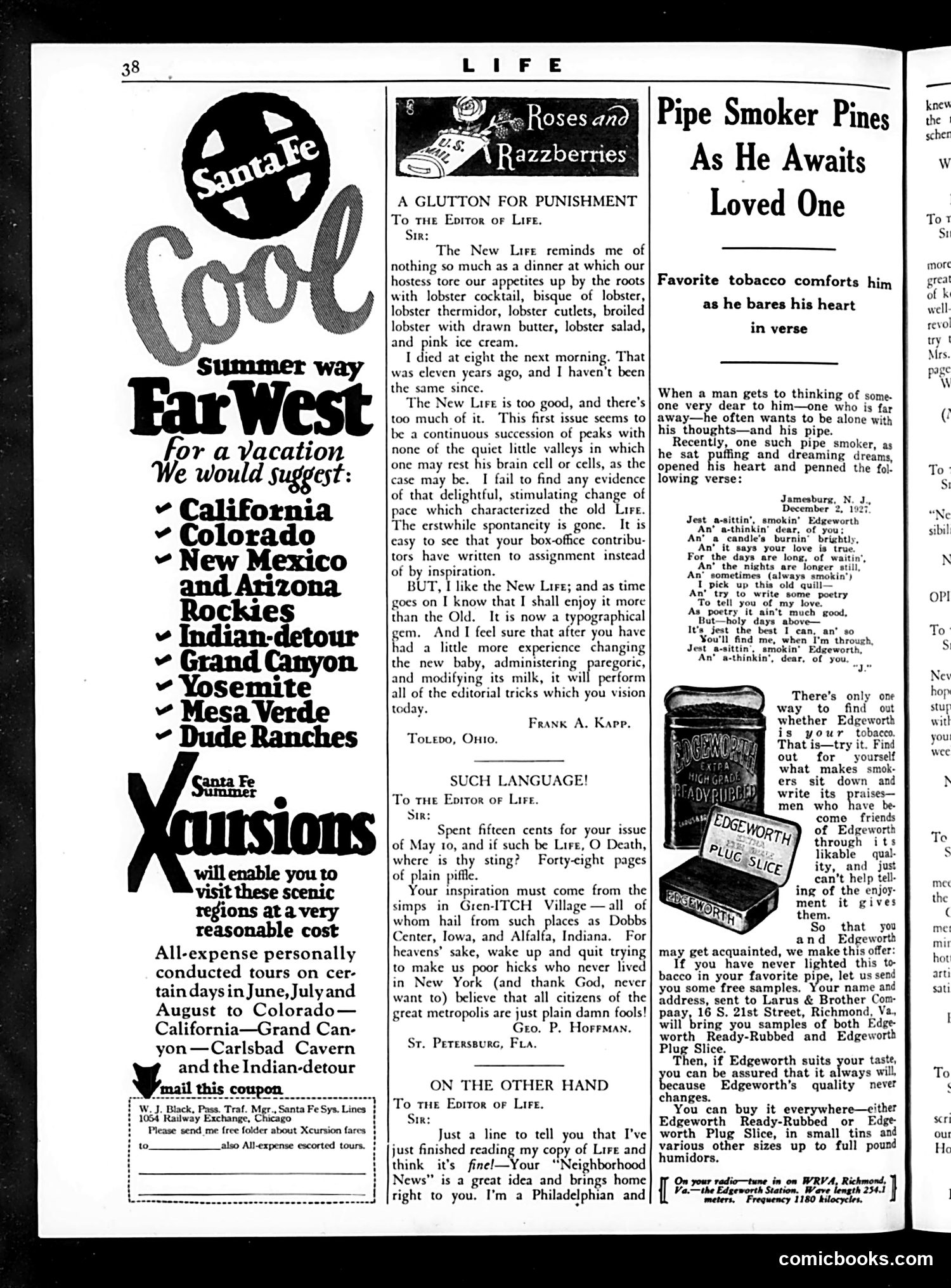
This page is primarily **advertising and reader letters**, not political satire. The main content includes: 1. **Santa Fe Railway ad** (left): Promotes summer vacation excursions to western U.S. destinations (California, Colorado, Grand Canyon, Yosemite) as affordable "all-expense" tours. 2. **Reader letters** (center): Three letters critiquing *Life* magazine's recent redesign. One complains it's overstimulating ("too good, and there's too much of it"); another harshly criticizes it as "forty-eight pages of plain piffle" with uninspired writing; a third praises the new "Neighborhood News" feature. 3. **Edgeworth tobacco ad** (right): Features romantic verse from a man in Jamesburg, N.J., waiting for his beloved while smoking Edgeworth pipe tobacco—framing the product as a comfort during separation. The page reflects 1920s consumer culture and early *Life* magazine's redesign reception, with no political cartoons or satire present.
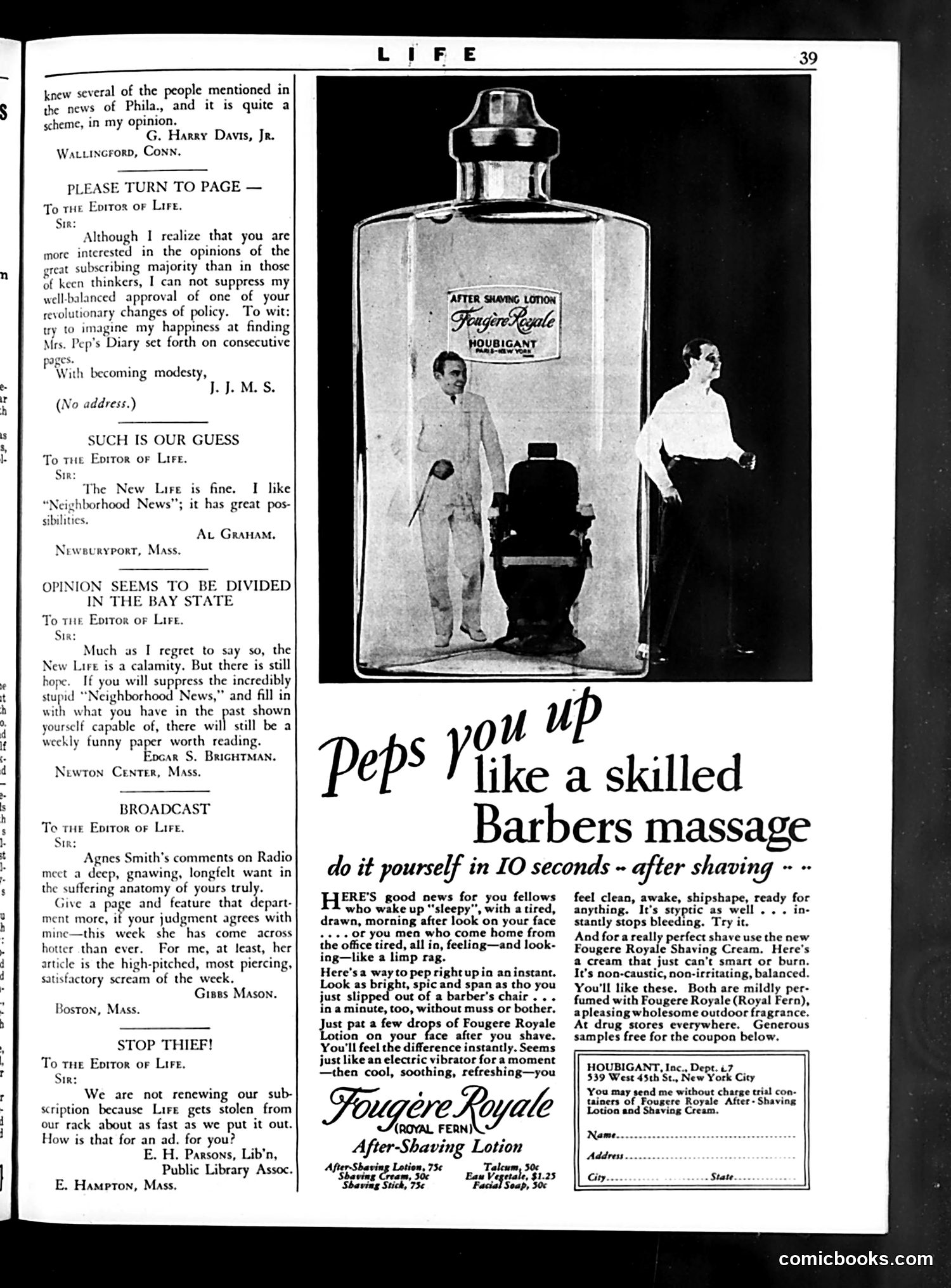
This page contains reader letters to *Life* magazine's editor, followed by a full-page advertisement for Fougere Royale after-shaving lotion. The letters section shows divided opinion about *Life*'s recent redesign. Readers praise new features like "Mrs. Pep's Diary," "Neighborhood News," and Agnes Smith's radio commentary, while others criticize the changes as a "calamity" and request a return to past content. One librarian complains that copies are stolen too quickly from public racks. The advertisement features a large bottle of Fougere Royale lotion with three illustrated men at different stages of grooming. The pitch promises that applying the lotion after shaving takes only 10 seconds and mimics "a skilled barber's massage"—reviving tired, "sleepy" men and making them look "bright, spic and span." The ad emphasizes the lotion's non-irritating formula and pleasant herbal fragrance, with a coupon offering free samples.
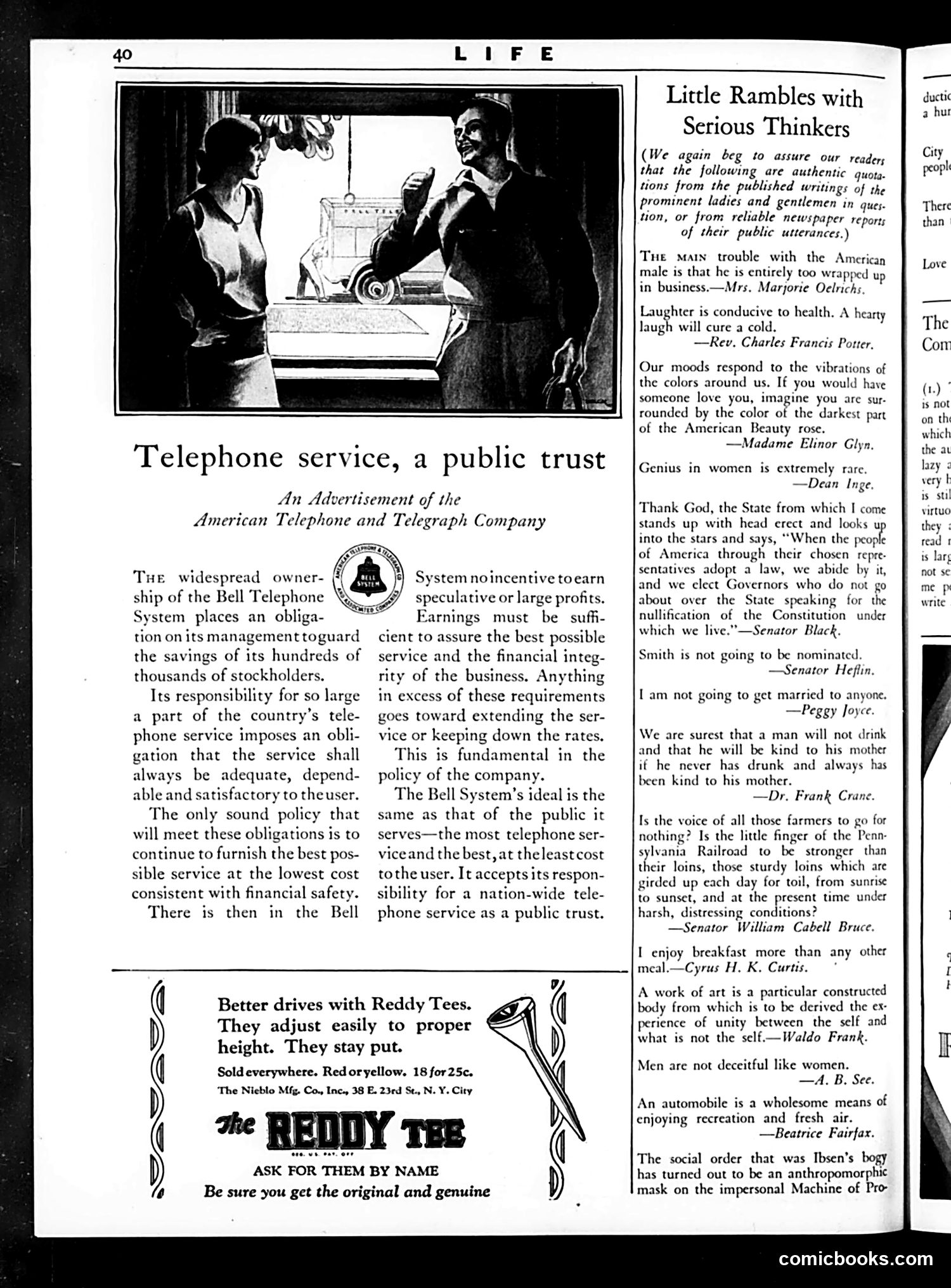
This page contains **two distinct elements**: a full-page **AT&T advertisement** and a satirical column titled "Little Rambles with Serious Thinkers." The **AT&T ad** presents the Bell Telephone System as a "public trust," arguing it has no incentive for excessive profits—only to provide optimal service at lowest cost. This is corporate messaging defending regulated utilities against criticism about monopolistic practices. The **satire section** mocks prominent public figures by collecting their published quotes on trivial or absurd topics. Examples include socialite Marjorie Oelrichs complaining about American males' work obsession, actress Peggy Joyce declaring she won't marry, and various celebrities offering platitudes about breakfast, automobiles, and love. The implicit joke: these supposedly "serious thinkers" are offering vapid, self-evident, or contradictory wisdom. Life is ridiculing celebrity culture and the prominence given to wealthy figures' trivial pronouncements in newspapers.
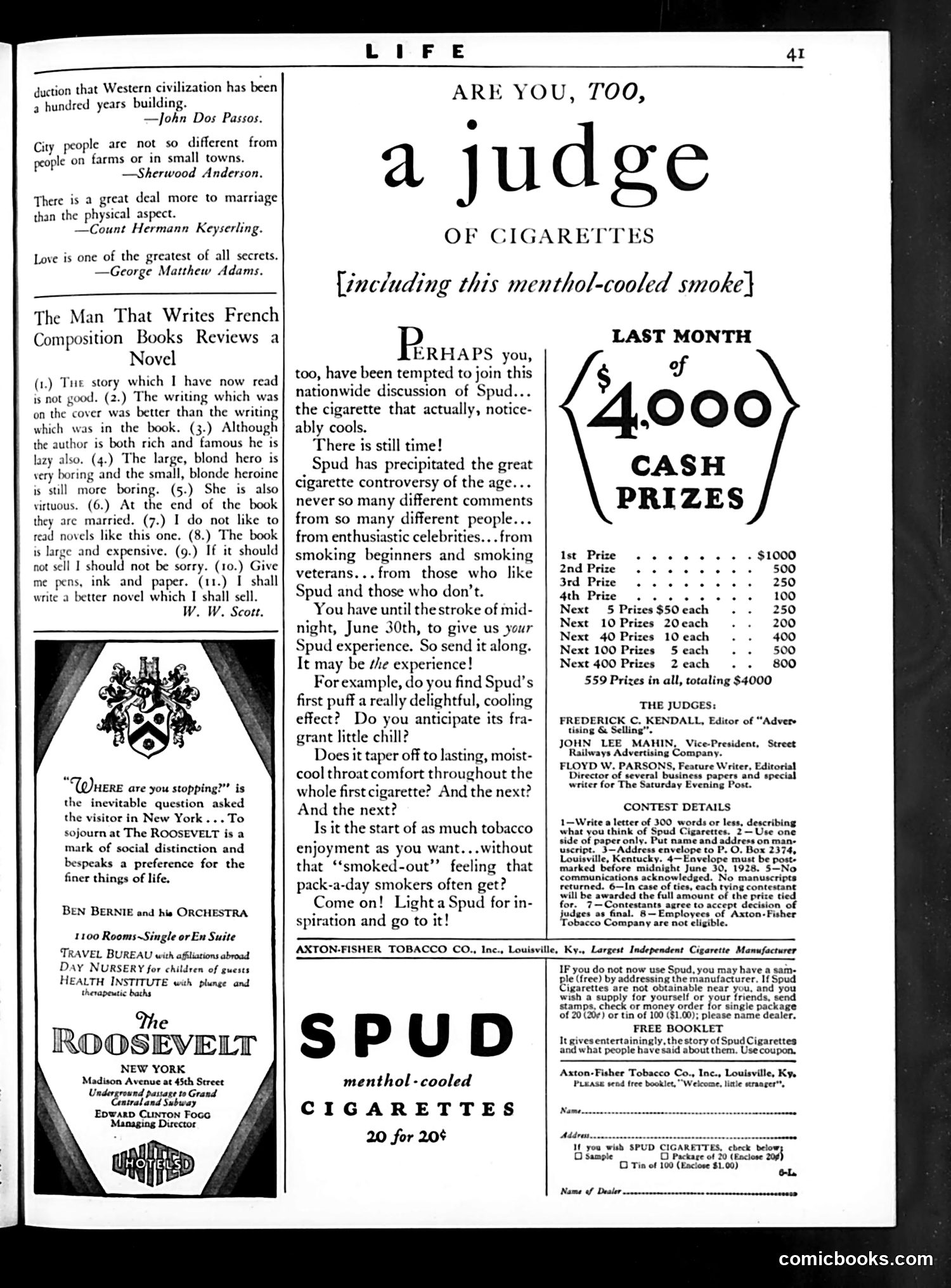
This page is primarily a **cigarette advertisement** for Spud menthol cigarettes, disguised as editorial content. The "cartoon" element is minimal—mostly the page functions as a promotional contest. **The Setup:** Spud frames cigarette smoking as a consumer debate worthy of public judgment. The ad invites readers to submit 300-word letters describing their Spud experience, with cash prizes totaling $4,000 (substantial for 1928). **The Satire/Hook:** By calling readers "judges of cigarettes" and positioning smoking as a legitimate topic for serious commentary from "enthusiastic celebrities," "smoking beginners," and "veterans," the ad legitimizes what was becoming a controversial habit. The repeated questions about cooling effects and throat comfort attempt to make smoking sound like a rational sensory evaluation rather than an addictive vice. **Historical Context:** This reflects 1920s cigarette marketing at its peak, before health warnings. The menthol "cooling" angle was novel marketing. The contest exploited Americans' love of prizes and public participation. The page also includes unrelated hotel and literary content, typical of Life's mixed editorial/advertising format.
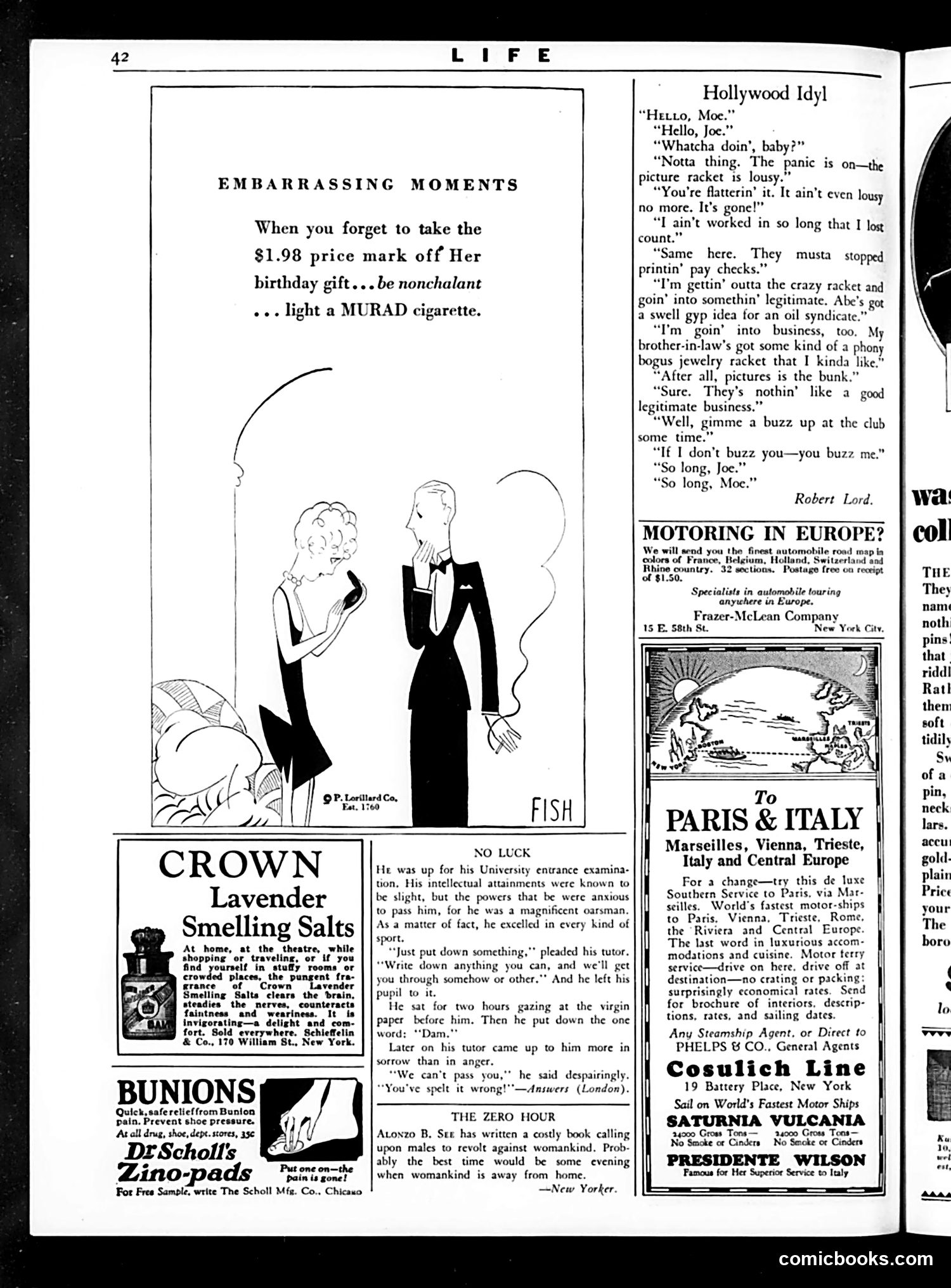
The main cartoon, titled "Embarrassing Moments," depicts a couple at what appears to be a formal event. The joke addresses a common social embarrassment: forgetting to remove a price tag ($1.98) from a gift before presenting it to someone. The cartoon's advice—to "be nonchalant" and "light a MURAD cigarette"—suggests smoking as a way to deflect attention from the awkward situation, reflecting 1920s-30s attitudes about cigarettes as a casual, sophisticated prop. The page is otherwise dominated by **advertisements** for consumer products (smelling salts, bunion pads, travel services) and three brief humorous anecdotes in text form: one about a student who can only write "Dam" on an exam (and misspells it), another mocking a male-revolt book, and a third titled "Hollywood Idyl" featuring two out-of-work film industry figures discussing the industry collapse, likely referencing the Great Depression's impact on Hollywood.
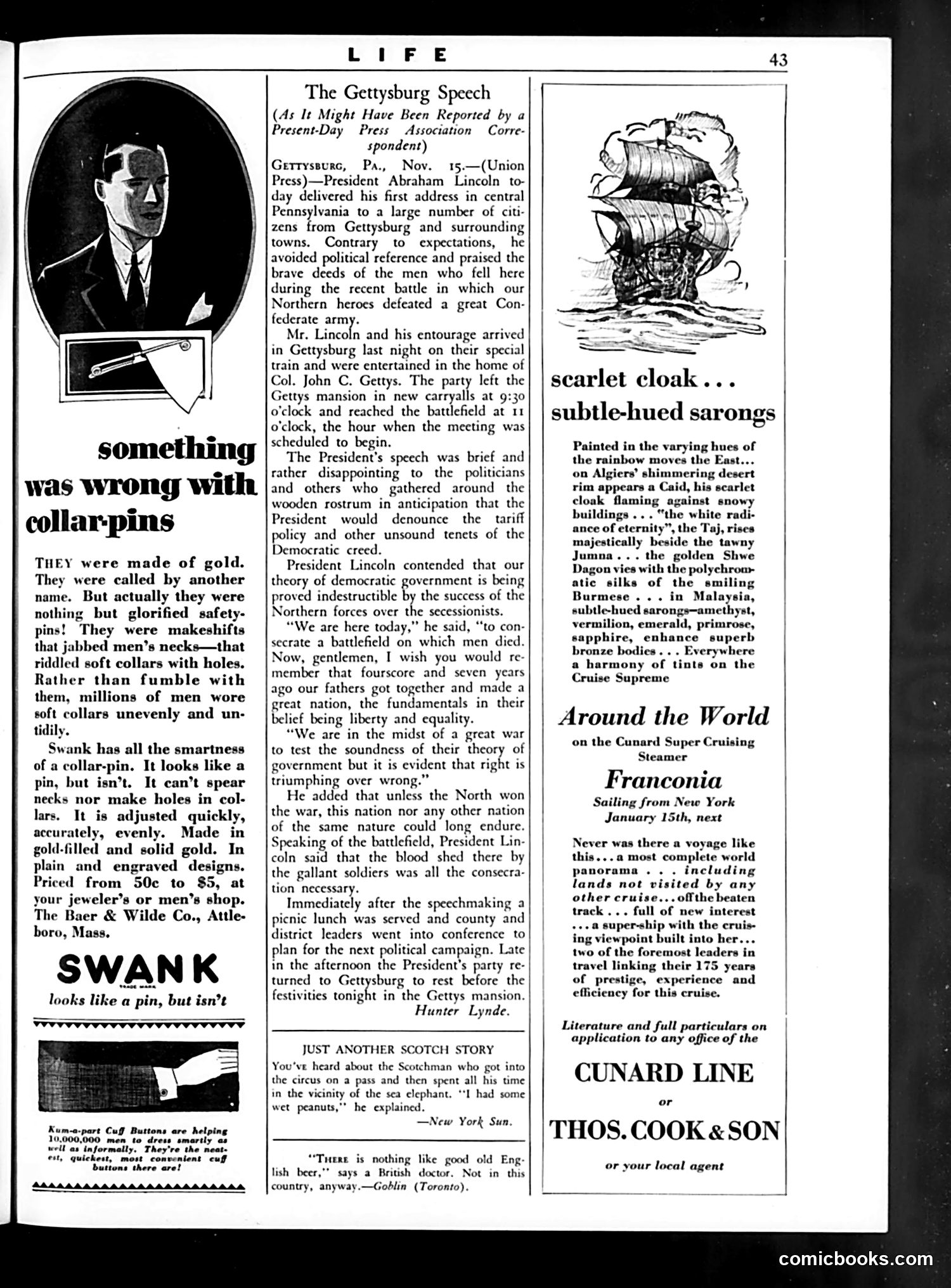
This page contains two main satirical pieces: **"The Gettysburg Speech" (center):** A mock newspaper account of Lincoln's 1863 Gettysburg Address, written as it might be reported by a modern (to 1920s readers) press correspondent. The satire targets contemporary journalism's sensationalism and focus on trivial details—the reporter emphasizes train schedules, lodging arrangements, and post-speech political scheming rather than the speech's historical significance. It's a commentary on how modern journalism strips gravitas from momentous events through mundane, mechanical reporting. **"Something Was Wrong With Collar-Pins" (left):** An advertisement disguised as satire, mocking safety-pin-style collar fasteners as flawed designs that damage clothing. The "Swank" brand offered an improved alternative. This is primarily product advertising. The bottom contains light humor about Scottish frugality and a beer advertisement. The page satirizes both modern journalism's triviality and consumer culture through mock-earnest advertising copy.
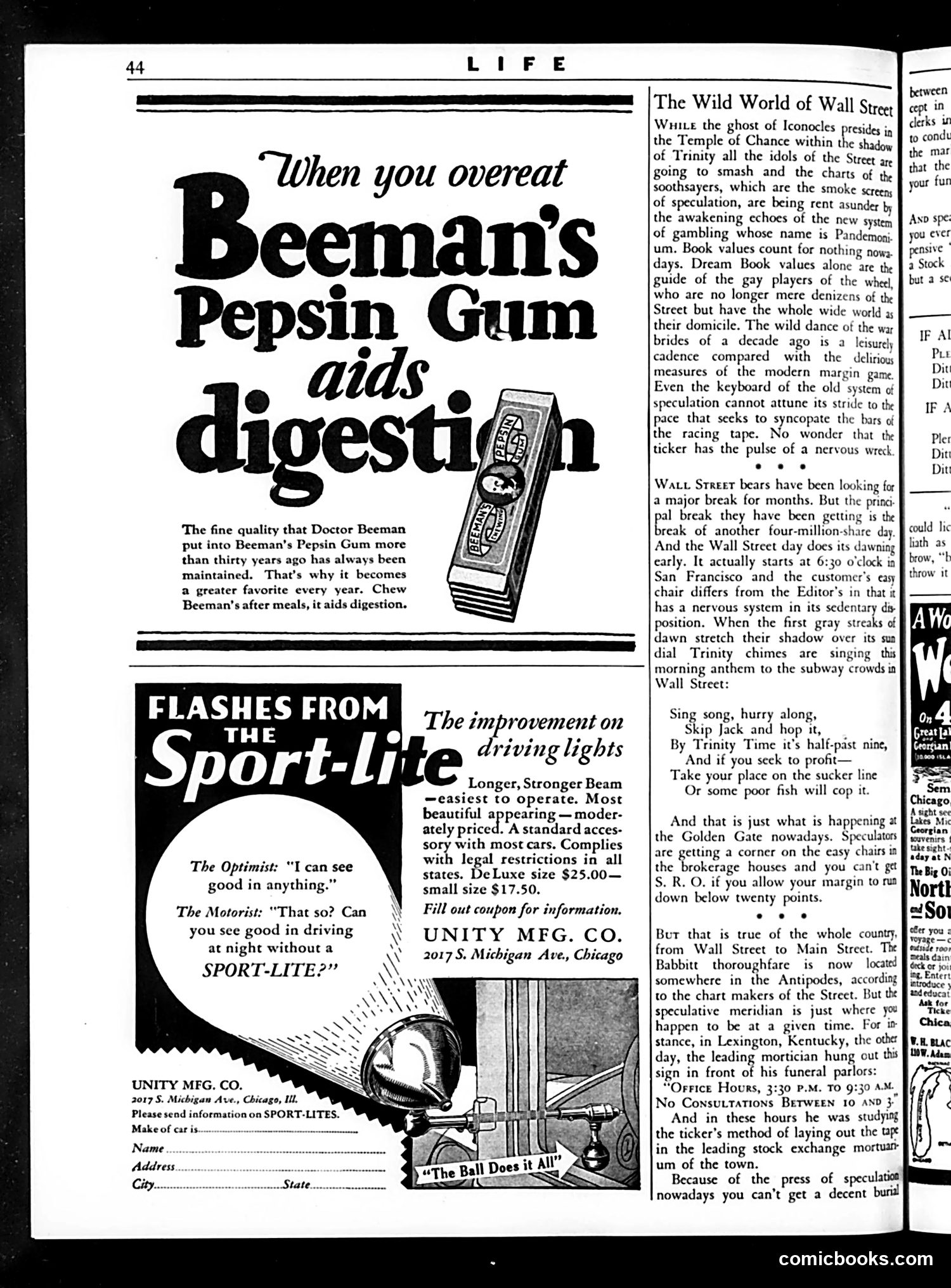
This page combines three advertisements with a satirical essay on 1920s Wall Street speculation. The **ads** are straightforward period marketing: Beeman's Pepsin Gum aids digestion; Sport-Lite driving lights improve nighttime safety; Unity MFG promotes automotive accessories. The **main satire**, "The Wild World of Wall Street," mocks the frenzied stock market speculation of the era (likely mid-1920s, before the 1929 crash). The author uses flowery, breathless language to describe how speculation has consumed American life—from Wall Street traders to a mortician in Kentucky who keeps hours matching stock market times rather than serving the dead. The piece ridicules how margin trading (buying stocks with borrowed money) has replaced rational investment. It suggests speculators inhabit a chaotic "Temple of Chance" where "book values count for nothing" and the stock ticker's relentless pace creates nervous exhaustion. The mordant humor culminates in the mortician joke: even death itself must wait for the market to close—capitalism has invaded every aspect of American life, rendering normal business secondary to stock gambling.
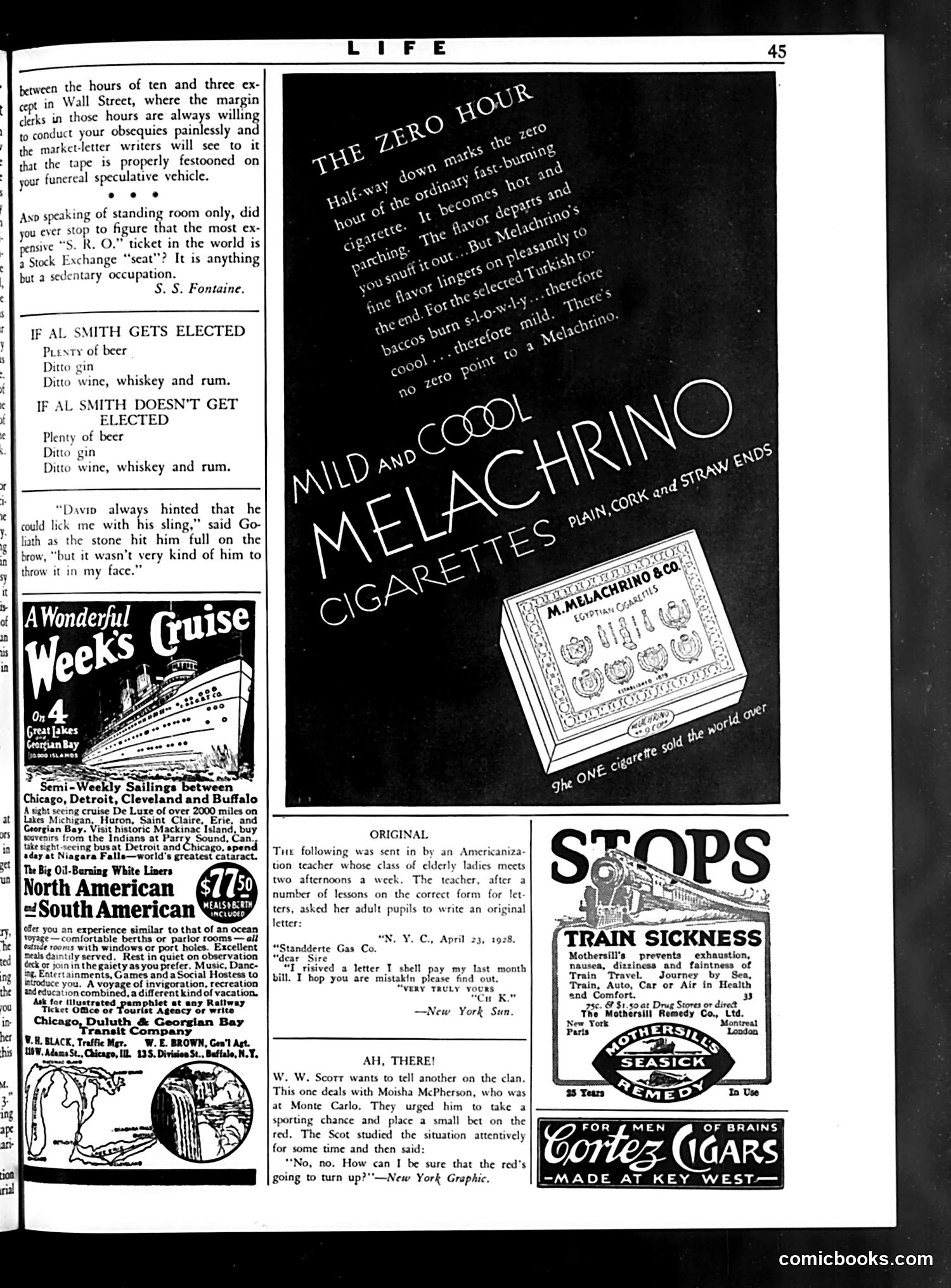
This page primarily contains **satirical commentary and advertisements** rather than political cartoons. The main satire concerns **Al Smith's 1928 presidential campaign**. The "IF AL SMITH GETS ELECTED / IF AL SMITH DOESN'T GET ELECTED" section mocks Smith by suggesting the outcome is irrelevant—either way, Americans will drink alcohol. This references Smith's opposition to Prohibition, making him controversial among dry voters. The joke implies his stance on drinking is the only issue that matters to voters, undercutting serious political debate. The opening text satirizes **Wall Street speculation and stock market culture**, referring to brokers' willingness to conduct financial "obsequies" (deaths) of speculators' fortunes, and the high cost of Stock Exchange "seats" (memberships). The "Original" section humorously showcases an **elderly immigrant's poorly written English letter**, illustrating Americanization class efforts of the era. The page is otherwise filled with period advertisements for cruises, cigarettes, and remedies—typical Life magazine content.
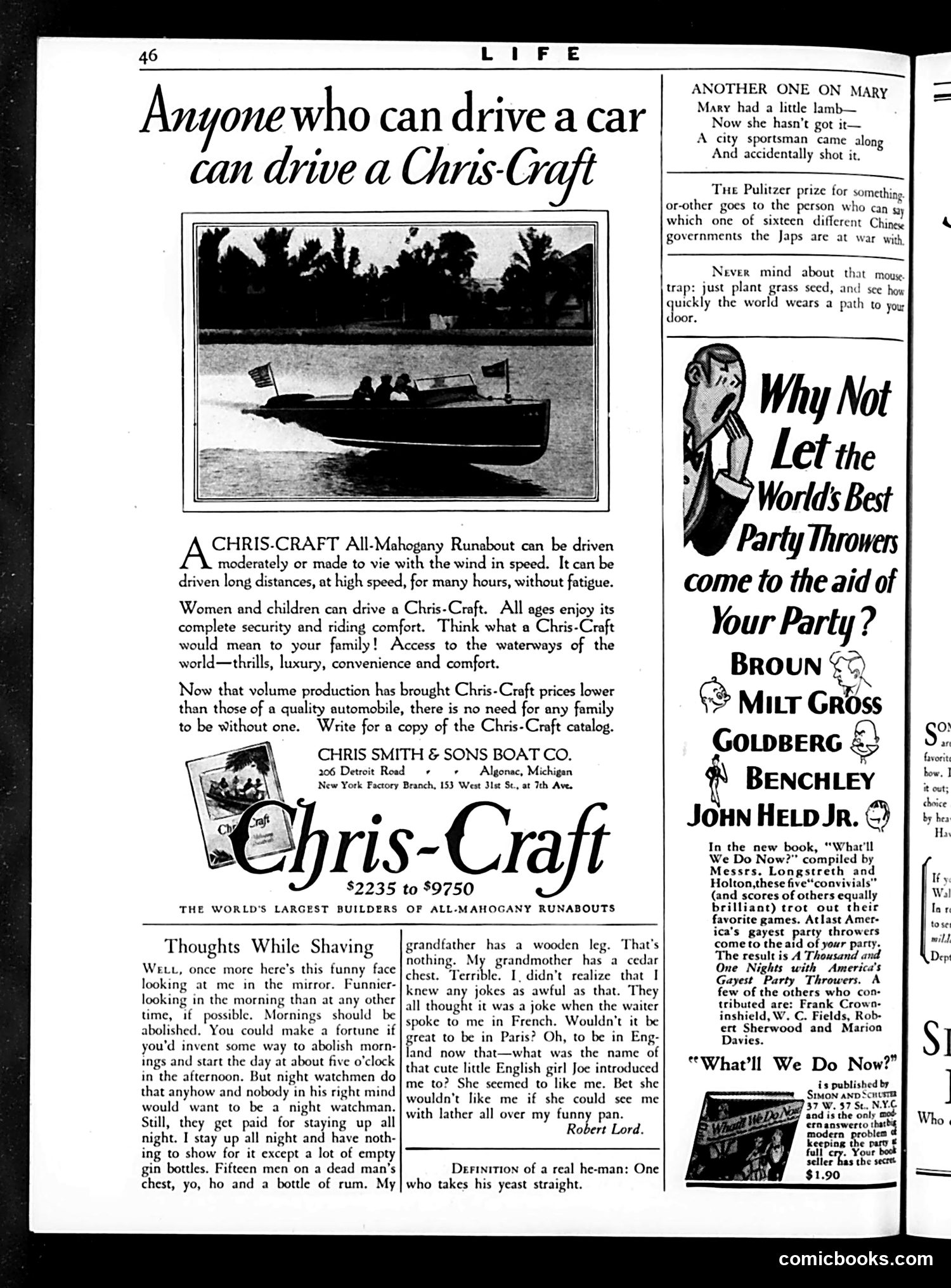
This page is primarily **advertising and humor columns**, not political cartooning. **Main Content:** The Chris-Craft boat advertisement dominates, claiming that anyone who can drive a car can operate their mahogany speedboats ($2,235–$9,750). It targets affluent families seeking luxury and leisure access to waterways. **"Thoughts While Shaving"** is a humorous column by Robert Lord—stream-of-consciousness rambling about morning grogginess, silly jokes, and random memories. It's light satirical commentary on everyday absurdity, not political. **Side jokes** include: - A dark children's rhyme about Mary's lamb being shot by a sportsman - A quip about the Pulitzer Prize and Japan's multiple warring Chinese governments (referencing 1930s Sino-Japanese conflict) - An advertisement for a party-planning book featuring celebrities like W.C. Fields The page reflects 1930s American consumer culture and leisure, with humor aimed at affluent readers. There's no coherent political argument—just period advertisements and light comedic content.
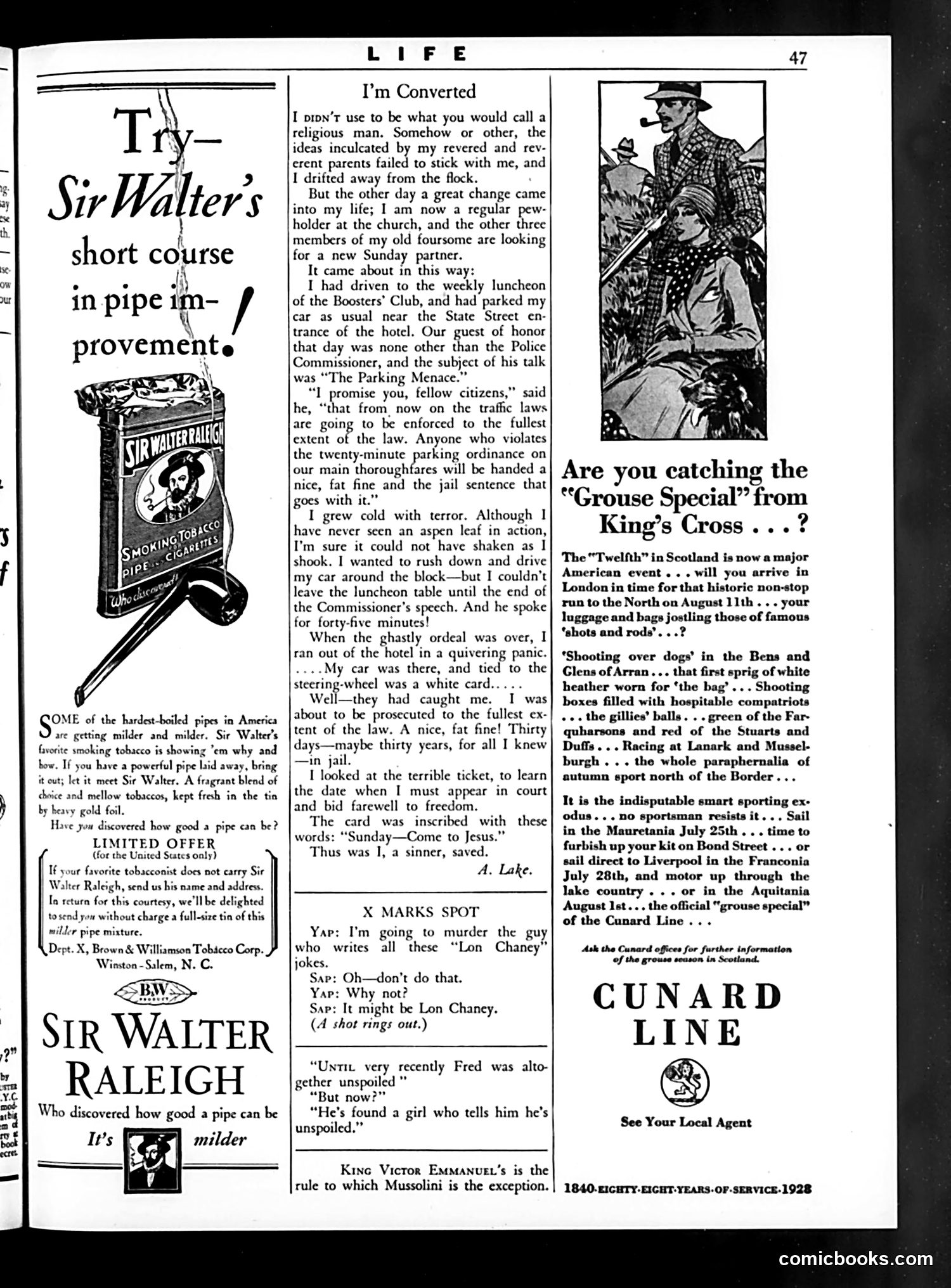
This page contains **Sir Walter Raleigh pipe tobacco advertising** (the dominant content) alongside several brief humorous pieces and a Cunard Line ocean liner advertisement. The main satirical story, "I'm Converted," mocks both religious hypocrisy and parking enforcement. A non-religious businessman parks illegally near a hotel for a Boosters' Club lunch where the Police Commissioner threatens strict enforcement of parking laws. Terrified he'll be ticketed and jailed, the man discovers his car has instead received a religious tract reading "Sunday—Come to Jesus"—leading him to suddenly become a church regular. The joke satirizes his shallow, fear-based "conversion" and the absurdity of enforcing traffic laws through jail sentences. Secondary jokes include mocking "Lon Chaney" movie references and commenting on Mussolini as an exception to Italian King Victor Emmanuel III's rule. The page primarily functions as **commercial advertising**, with satirical content secondary.
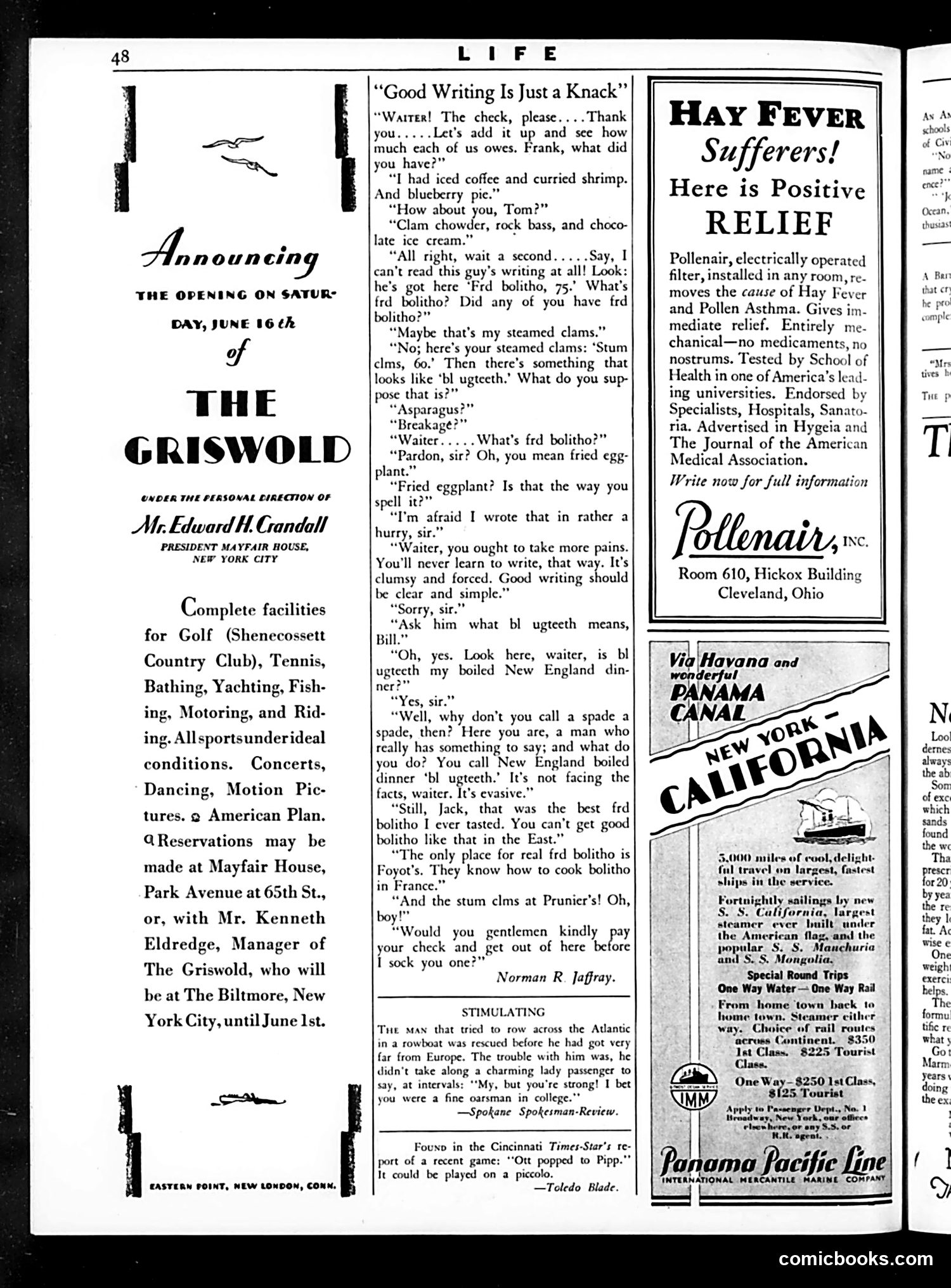
This satirical piece mocks pretentious diners who critique a waiter's penmanship while he struggles to read their own illegible handwriting. The waiter has written items like "Frd bolitho" (fried eggplant) and "bl ugteeth" (boiled New England dinner) in hasty scrawl. The customers lecture him about clear, simple writing and "facing the facts"—yet they've misread his notes entirely and don't recognize their own meals. One diner even praises the "frd bolitho," showing they're equally confused. The joke inverts the power dynamic: intellectuals patronize a working man about writing standards while demonstrating their own inability to read basic script. The final line—the exasperated waiter threatening to sock them—suggests the absurdity of the customers' smugness. The satire targets pompous middle-class pretension about language and literacy.
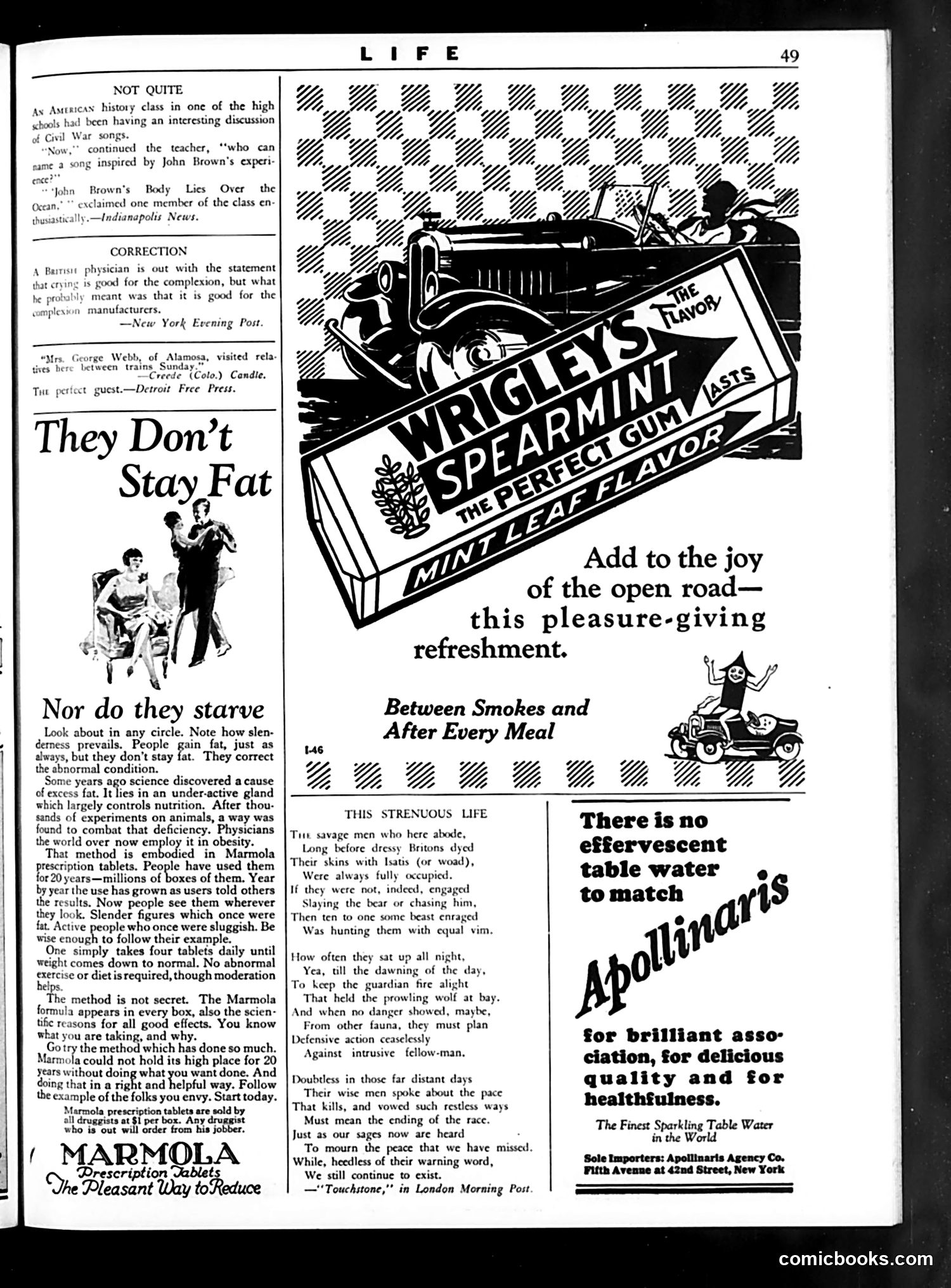
This page combines short satirical pieces with period advertisements. The main humor comes from brief anecdotes: **"Not Quite"** jokes about a history class where a student confuses "John Brown's Body" (the Civil War marching song) with "John Brown's Body Lies Over the Ocean"—a nonsensical misremembering. **"Correction"** mocks a doctor's claim that crying benefits complexion, suggesting the real beneficiaries are cosmetics manufacturers. The page's largest content is advertising for **Marmola**, a weight-loss tablet marketed to 1920s consumers seeking slenderness. The ad promises results without diet or exercise—reflecting era anxieties about body image. **"This Strenuous Life"** is a poem (attributed to *Touchstone/London Morning Post*) comparing ancient savages' busy, dangerous lives to modern concerns about "the pace that kills," before ironically noting we survive despite predictions otherwise. The remaining ads promote **Wrigley's Spearmint gum** and **Apollinaris** sparkling water as refreshments. The page reflects 1920s consumer culture, body-image anxiety, and nostalgic romanticism about "primitive" life.
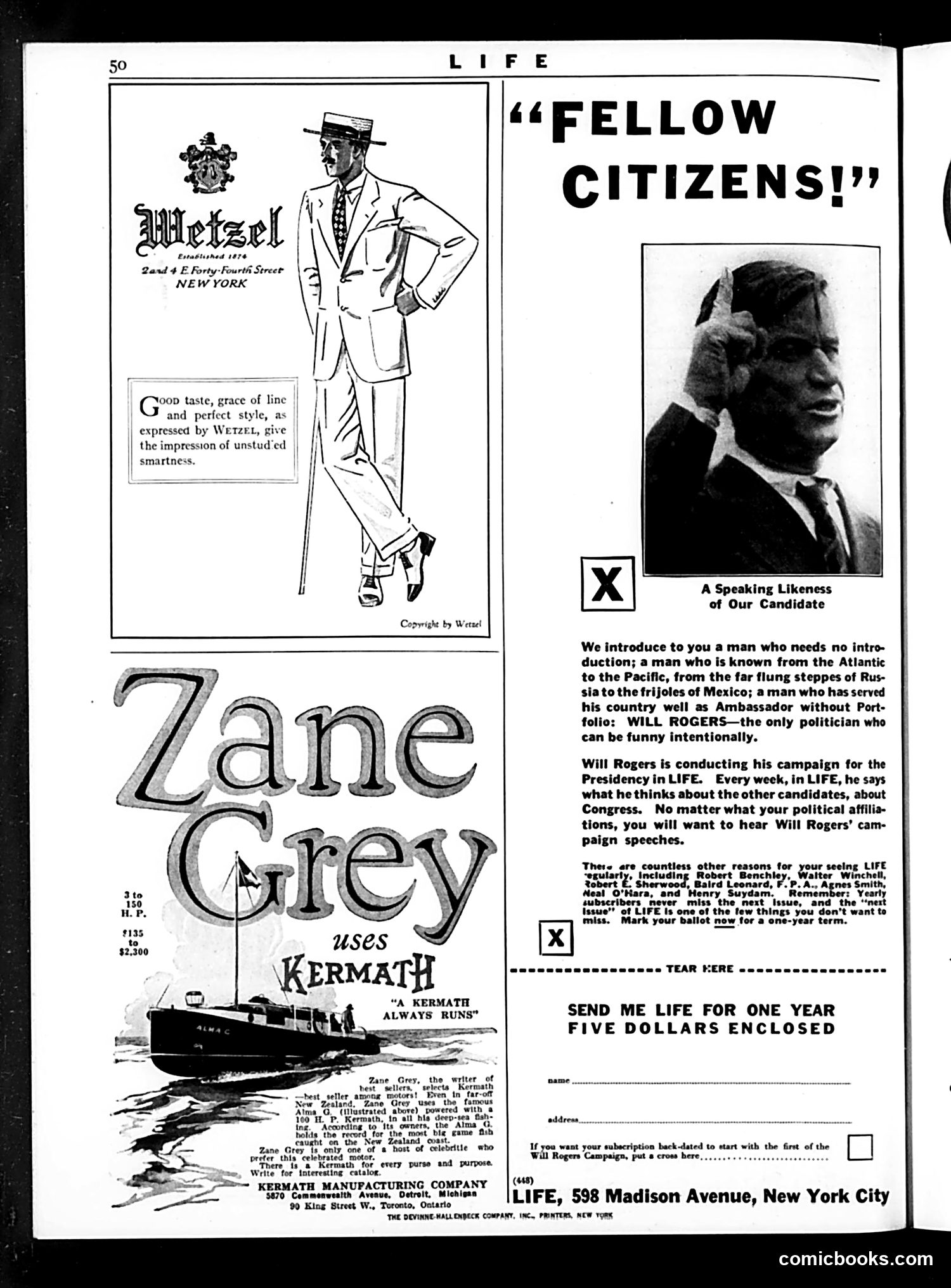
This page advertises **Life magazine's 1928 presidential campaign coverage** featuring **Will Rogers**, the famous humorist and social commentator. The "Fellow Citizens!" heading mimics political campaign rhetoric, which is the joke—Rogers was a comedian, not a serious candidate, yet Life positioned his weekly satirical political commentary as essential reading. The page emphasizes Rogers' widespread fame and his unique ability to be "funny intentionally" while critiquing other candidates and Congress. This suggests Rogers offered humorous but pointed political observation during a significant election year. The surrounding advertisements (Wetzel clothing, Zane Grey/Kermath motors) were typical Life content. The subscription form invites readers to start their year-long subscription aligned with Rogers' campaign series, making his commentary the magazine's primary draw. The satire targets both politics (treating humor as serious commentary) and magazine marketing itself.
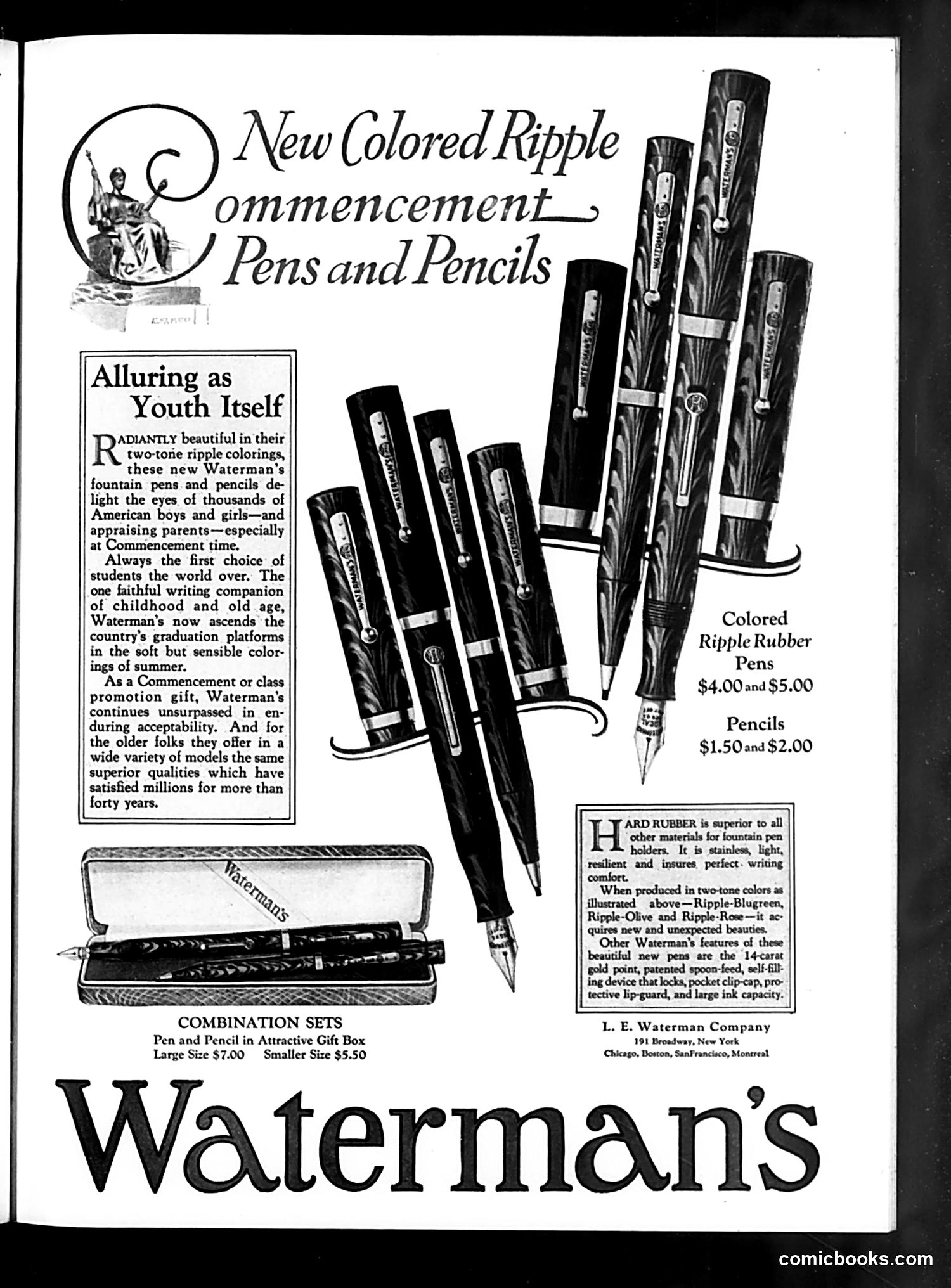
This is primarily a **Waterman's fountain pen advertisement**, not political satire. The page promotes new "Colored Ripple" pens and pencils marketed as ideal Commencement (graduation) gifts. The decorative header features a classical female figure (likely Wisdom or Learning) and uses ornate typography typical of 1920s-30s advertising design. The ad emphasizes that Waterman's pens are "Always the first choice of students" and highlights the appeal of new two-tone ripple colorings (Ripple-Bluegreen, Ripple-Olive, Ripple-Rose) to "American boys and girls" and their parents. It stresses quality features: hard rubber construction, 14-carat gold points, and self-filling mechanisms. Pricing ranges from $1.50-$5.00 for individual items, with combination gift sets at $5.50-$7.00. There is **no political cartoon or satire** on this page—it is straightforward commercial advertising emphasizing product reliability and aesthetic appeal for graduation season purchasing.
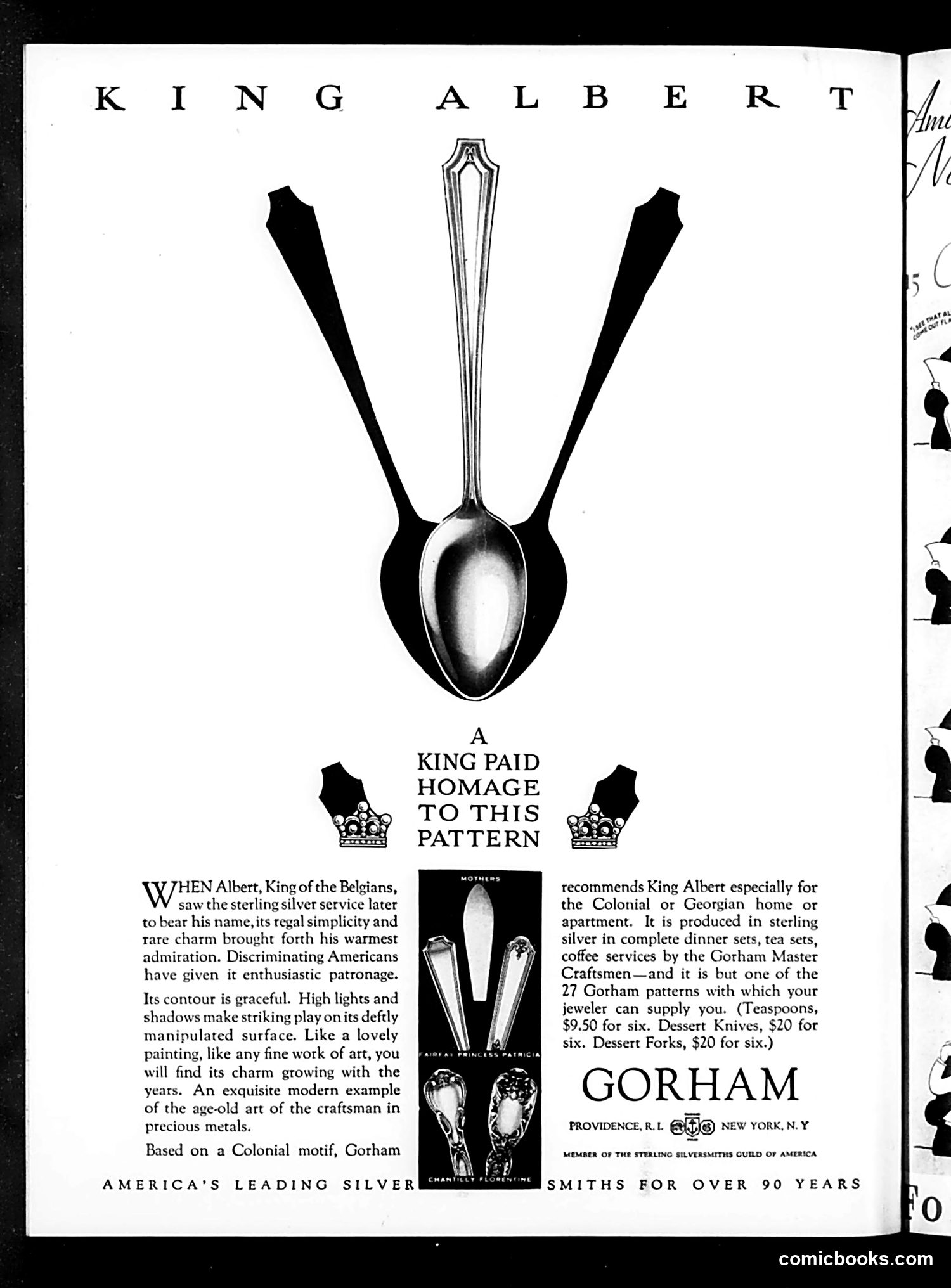
This is primarily a **silverware advertisement**, not political satire. Gorham, a major American silver manufacturer, markets their "King Albert" pattern flatware by claiming King Albert of Belgium admired and endorsed the design's "regal simplicity." The page uses royal prestige as a sales tool—the headline "A KING PAID HOMAGE TO THIS PATTERN" suggests that having a European monarch's approval validates the product for American consumers seeking refined taste. This appeals to middle-class aspirations for elegance and sophistication. The text emphasizes the pattern's "Colonial motif," linking it to American heritage while leveraging foreign royal endorsement. It's a straightforward commercial strategy: associate the product with both American tradition and European aristocratic refinement to attract "Discriminating Americans." There is **no cartoon or satire here**—this is a straight advertisement using celebrity/royal endorsement as marketing.