
Life, 1928-06-07 · page 28 of 54
Life — June 7, 1928 — page 28: what you’re looking at
What you’re looking at
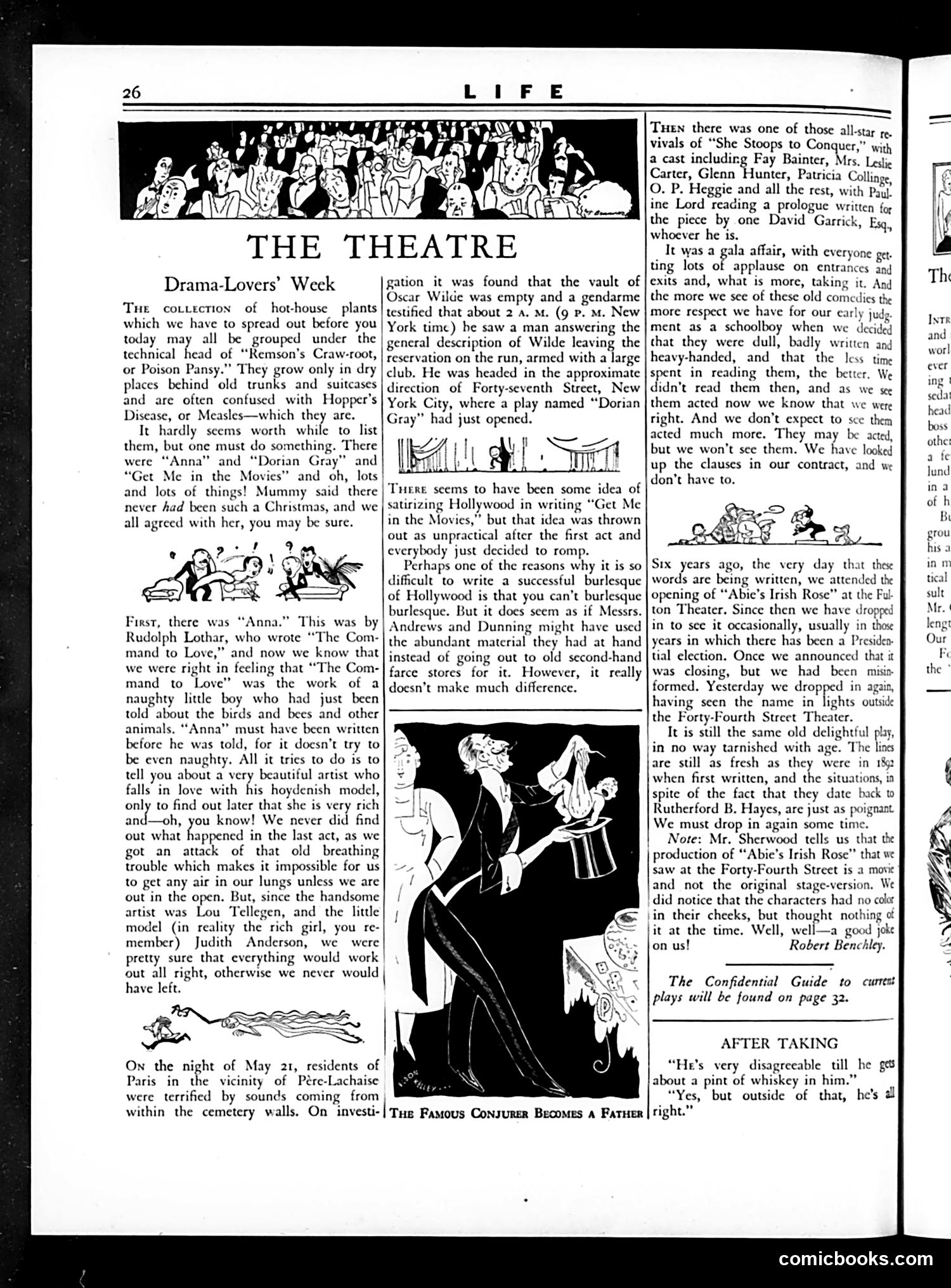
This is a theater review column satirizing recent Broadway productions. The author mockingly criticizes several plays as mediocre or poorly written, using colorful botanical metaphors ("hot-house plants," "Poison Pansy") to dismiss them as artificial and overgrown in dry places. The specific targets include: - **"Anna"** — a romance by Rudolph Lothar, criticized as naive and predictable - **"Dorian Gray"** — a theatrical adaptation, with a humorous fantasy that Oscar Wilde's ghost fled his Paris grave to protest the play's opening on 47th Street - **"Get Me in the Movies"** — accused of abandoning satirical intent after act one to become mere farce - **"She Stoops to Conquer"** revival — praised for its cast (Fay Bainter, Glenn Hunter, Patricia Collinge, O.P. Heggie) but dismissed as a dull, poorly-written classic the author refuses to attend again The humor relies on the reviewer's acerbic tone and admission of deliberately not engaging with the material—claiming breathing troubles during "Anna" while confidently predicting its plot anyway. The satire targets both bad playwriting and theatrical pretension of the era.
📄 Transcribed text from this page (OCR, searchable)
Machine-transcribed from the original scan — historical spelling and the odd misread are preserved.
THE THEATRE Drama-Lovers’ Week Tue cotection of hot-house _ plants which we have to spread out before you today may all be grouped under the technical head of ‘Remson’s Craw-root, or Poison Pansy.” They grow only in dry places behind old trunks and_ suitcases and are often confused with Hopper’s Disease, or Measles—which they are. It hardly seems worth while to list them, but one must do something. There were “Anna” and “Dorian Gray” and “Get Me in the Movies” and oh, lots and lots of things! Mummy said there never had been such a Christmas, and we all agreed with her, you may be sure. First, there was “Anna.” This was by Rudolph Lothar, who wrote “The Com- mand to Love,” and now we know that we were right in feeling that “The Com- mand to Love” was the work of a naughty little boy who had just been told about the birds and bees and other animals. “Anna” must have been written before he was told, for it doesn’t try to be even naughty. All it tries to do is to tell you about a very beautiful artist who falls in love with his hoydenish model, only to find out later that she is very rich and—oh, you know! We never did find out what happened in the last act, as we got an attack of that old breathing trouble which makes it impossible for us to get any air in our lungs unless we are out in the open. But, since the handsome artist was Lou Tellegen, and the little model (in reality the rich girl, you re- member) Judith Anderson, we were pretty sure that everything would work out all right, otherwise we never would | have left. On the night of May 21, residents of Paris in the vicinity of Pére-Lachaise were terrified by sounds coming from ) within the cemetery walls. On investi- | Tre Famous Consurer Becomes a Fatuer | right.” gation it was found that the vault of Oscar Wilde was empty and a gendarme testified that about 2 a. M. (9 Pp. M. New York timc) he saw a man answering the general description of Wilde leaving the reservation on the run, armed with a large club. He was headed in the approximate direction of Forty-seventh Street, New York City, where a play named “Dorian Gray” had just opened. LA Vfl There seems to have been some idea of satirizing Hollywood in writing “Get Me in the Movies,” but that idea was thrown out as unpractical after the first act and everybody just decided to romp. Tuen there was one of those all-star re vivals of “She Stoops to Conquer,” with a cast including Fay Bainter, Mrs. Leslie Carter, Glenn Tranter, Patricia Collinge O. P. Heggie and all the rest, with Paul, ine Lord reading a prologue written {or the piece by one David Garrick, Esq, whoever he is. , It was a gala affair, with everyone get. ting lots of applause on entrances and exits and, what is more, taking it. And the more we see of these old comedies the more respect we have for our early judg ment as a schoolboy when we decided chat they were dull, badly written and heavy-handed, and that the less time spent in reading them, the better. We didn’t read them then, and as we se them acted now we know that we were right. And we don’t expect to sce them acted much more, They may be acted, but we won't see them. We have looked up the clauses in our contract, and we don’t have to. Perhaps one of the reasons why it is so] Six years ago, the very day that thee difficult to write a successful burlesque | words are being written, we attended the of Hollywood is that you can’t burlesque | opening of “Abic’s Irish Rose” at the Ful burlesque. But it does seem as if Messrs. | ton Theater. Since then we have dropped Andrews and Dunning might have used ] in to see it occasionally, usually in thos the abundant material they had at hand instead of going out to old second-hand farce stores for it. However, it really doesn’t make much difference. years in which there has been a Presiden- tial election. Once we announced that it was closing, but we had been mi formed. Yesterday we dropped in ag: having seen the name in lights outside the Forty-Fourth Street Theater. It is still the same old delightful p! jin no way tarnished with age. The lines are still as fresh as they were in 182 when first written, and the situations, in spite of the fact that they date back Rutherford B. Hayes, are just as poignant We must drop in again some time. Note: Mr. Sherwood tells us that the production of “Abie’s Irish Rose’? that we saw at the Forty-Fourth Street is a movie and not the original stage-version. We did notice that the characters had no color in their cheeks, but thought nothing of Jit at the time. Well, well—a good joke on us! Robert Benchiley. The Confidential Guide to current plays will be found on page 32. AFTER TAKING “He's very disagreeable till he ges about a pint of whiskey in him.” “Yes, but outside of that, he’s dl Th IntR and worl ever ing | seda head boss othe a fe Jund ina of h Be grou his a in m tical sult Mr. | lengt Our Fe the comicbooks.com