
Life, 1928-06-07 · page 22 of 54
Life — June 7, 1928 — page 22: what you’re looking at
What you’re looking at
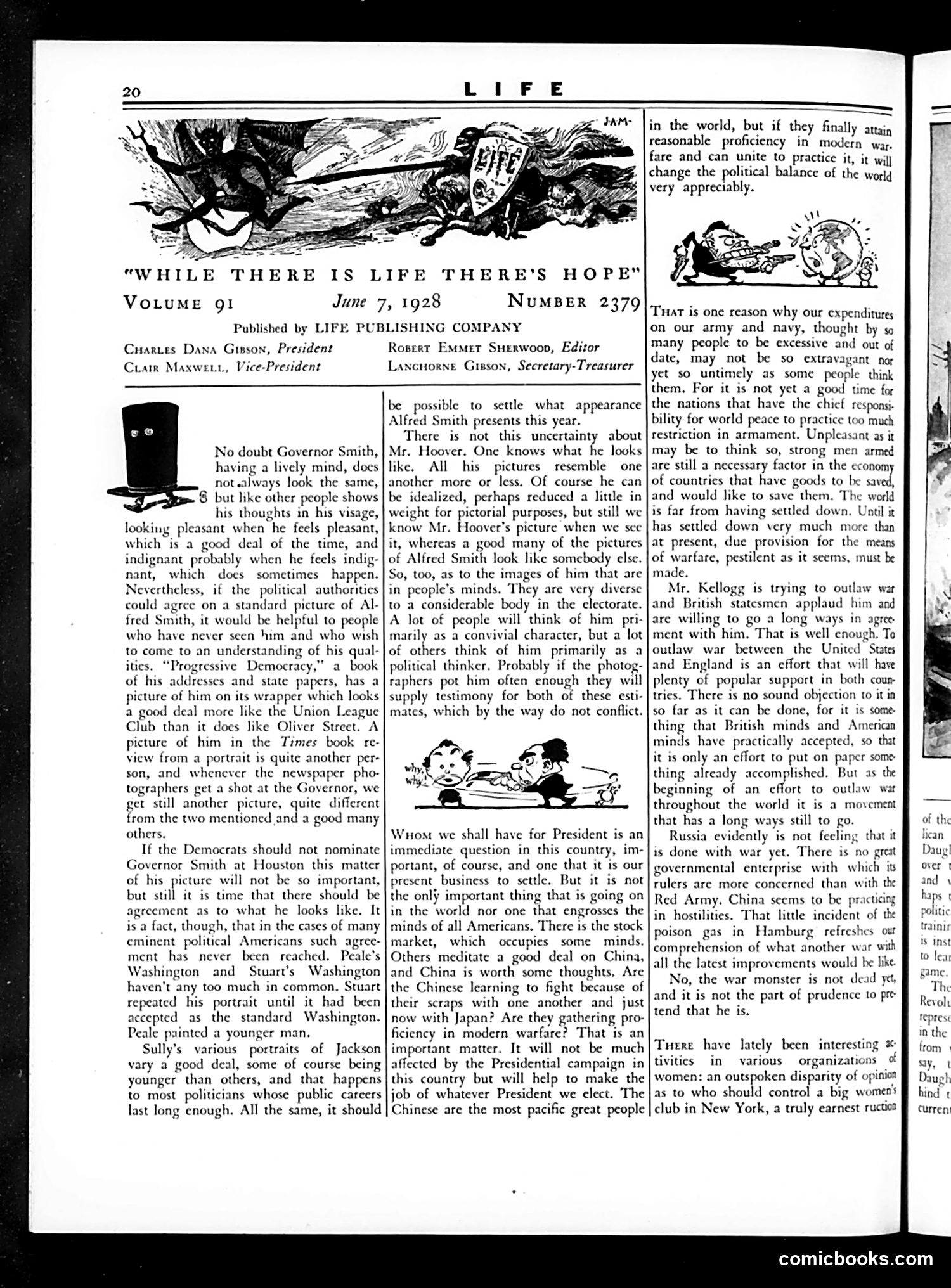
This page satirizes the inconsistency in how Governor **Alfred Smith** (Democratic presidential candidate) appears across different portraits and photographs. The text notes that Smith's various official portraits—from his book jacket to newspaper photos to painted portraits—depict him so differently that the public cannot form a unified mental image of him. The satire contrasts this with **Herbert Hoover** (the Republican candidate, implied but not named), whose appearance remains consistent across all representations. The author argues this matters politically: Smith's image ranges from appearing as a "convivial character" to a serious "political thinker," while Hoover's steady appearance projects clarity and consistency. The piece humorously references historical precedent (different portraits of Washington and Jackson), suggesting that with repeated exposure, Smith's image would eventually standardize—though this hadn't yet occurred by June 1928. The broader point: visual consistency and recognizable identity carry political weight in elections.
📄 Transcribed text from this page (OCR, searchable)
Machine-transcribed from the original scan — historical spelling and the odd misread are preserved.
“WHILE THERE IS LIFE THERE'S HOPE" VOLUME gI1 June 7, 1928 NuMBER 2379 Published by LIFE PUBLISHING COMPANY Cnarres Dana Gisson, President Cram Maxwewr, Vice-President Rosert Emmet Suerwoon, Editor Lancriorne Giason, Secretary-Treasurer No doubt Governor Smith, having a lively mind, does not always look the same, 8 but like other people shows his thoughts in his visage, looking pleasant when he feels pleasant, which is a good deal of the time, and indignant probably when he feels indig- nant, which docs sometimes happen. Nevertheless, if the political authorities could agree on a standard picture of Al- fred Smith, it would be helpful to people who have never seen him and who wish to come to an understanding of his qual- ities. “Progressive Democracy,” a book of his addresses and state papers, has a picture of him on its wrapper which looks a good deal more like the Union League Club than it does like Oliver Street. A picture of him in the Times book re- view from a portrait 1s quite another per- son, and whenever the newspaper pho- tographers get a shot at the Governor, we get still another picture, quite different from the two mentioned and a good many others. If the Democrats should not nominate Governor Smith at Houston this matter of his picture will not be so important, but still it is time that there should be agreement as to what he looks like. It is a fact, though, that in the cases of many eminent political Americans such agree- ment has never been reached. Peale’s Washington and Stuart's Washington haven't any too much in common. Stuart repeated his portrait until it had been accepted as the standard Washington. Peale painted a younger man. Sully’s various portraits of Jackson vary a good deal, some of course being younger than others, and that happens to most politicians whose public careers last long enough. All the same, it should be possible to settle what appearance Alfred Smith presents this year. There is not this uncertainty about Mr. Hoover. One knows what he looks like. All his pictures resemble one another more or less. Of course he can be idealized, perhaps reduced a litle in weight for pictorial purposes, but still we know Mr. Hoover's picture when we sce it, whereas a good many of the pictures of Alfred Smith look like somebody else. So, too, as to the images of him that are in people’s minds. They are very diverse to a considerable body in the electorate. A lot of people will think of him pri- marily as a convivial character, but a lot of others think of him primarily as a political thinker. Probably if the photog- raphers pot him often enough they will supply testimony for both of these esti- mates, which by the way do not conflict. Wuom we shall have for President is an immediate question in this country, im- portant, of course, and one that it is our present business to settle. But it is not the only important thing that is going on in the world nor one that engrosses the minds of all Americans. There is the stock market, which occupies some minds. Others meditate a good deal on China, and China is worth some thoughts. Are the Chinese learning to fight because of their scraps with one another and just now with Japan? Are they gathering pro- ficiency in modern warfare? That is an important matter. It will not be much affected by the Presidential campaign in this country but will help to make the job of whatever President we elect. The Chinese are the most pacific great people in the world, but if they finally attain reasonable proficiency in modern war. fare and can unite to practice it, it will change the political balance of the world very appreciably. Tuat is one reason why our expenditures on our army and navy, thought by so many people to be excessive and out of date, may not be so extravagant nor yet so untimely as some people think them. For it is not yet a good time for the nations that have the chief responsi- bility for world peace to practice too much restriction in armament. Unpleasant as it may be to think so, strong men armed are still a necessary factor in the economy of countries that have goods to be saved, and would like to save them. The world is far from having settled down. Until it has settled down very much more than at present, due provision for the means of warfare, pestilent as it seems, must be made. Mr. Kellogg is trying to outlaw war and British statesmen applaud him and are willing to go a long ways in agree- ment with him. That is well enough. To outlaw war between the United States and England is an effort that will have plenty of popular support in both coun- tries. There is no sound objection to it in so far as it can be done, for it is some- thing that British minds and American minds have practically accepted, so that it is only an effort to put on paper some- thing already accomplished. But as the beginning of an effort to outlaw war throughout the world it is a movement that has a long ways still to go. Russia evidently is not feeling that it is done with war There is no great governmental enterprise with which its rulers are more concerned than with the Red Army. China seems to be practicing in hostilities. That little incident of the poison gas in Hamburg refreshes our comprehension of what another war with all the latest improvements would be like No, the war monster is not dead yet, and it is not the part of prudence to pre tend that he is. Tuere have lately been interesting x tivities in various organizations o women: an outspoken disparity of opinios as to who should control a big women’s club in New York, a truly earnest ructios trainir 1S inst to lear game The Revolt Feprese in the trom say, 1 Daugh hind t curren comicbooks.com