
Life, 1928-06-07 · page 32 of 54
Life — June 7, 1928 — page 32: what you’re looking at
What you’re looking at
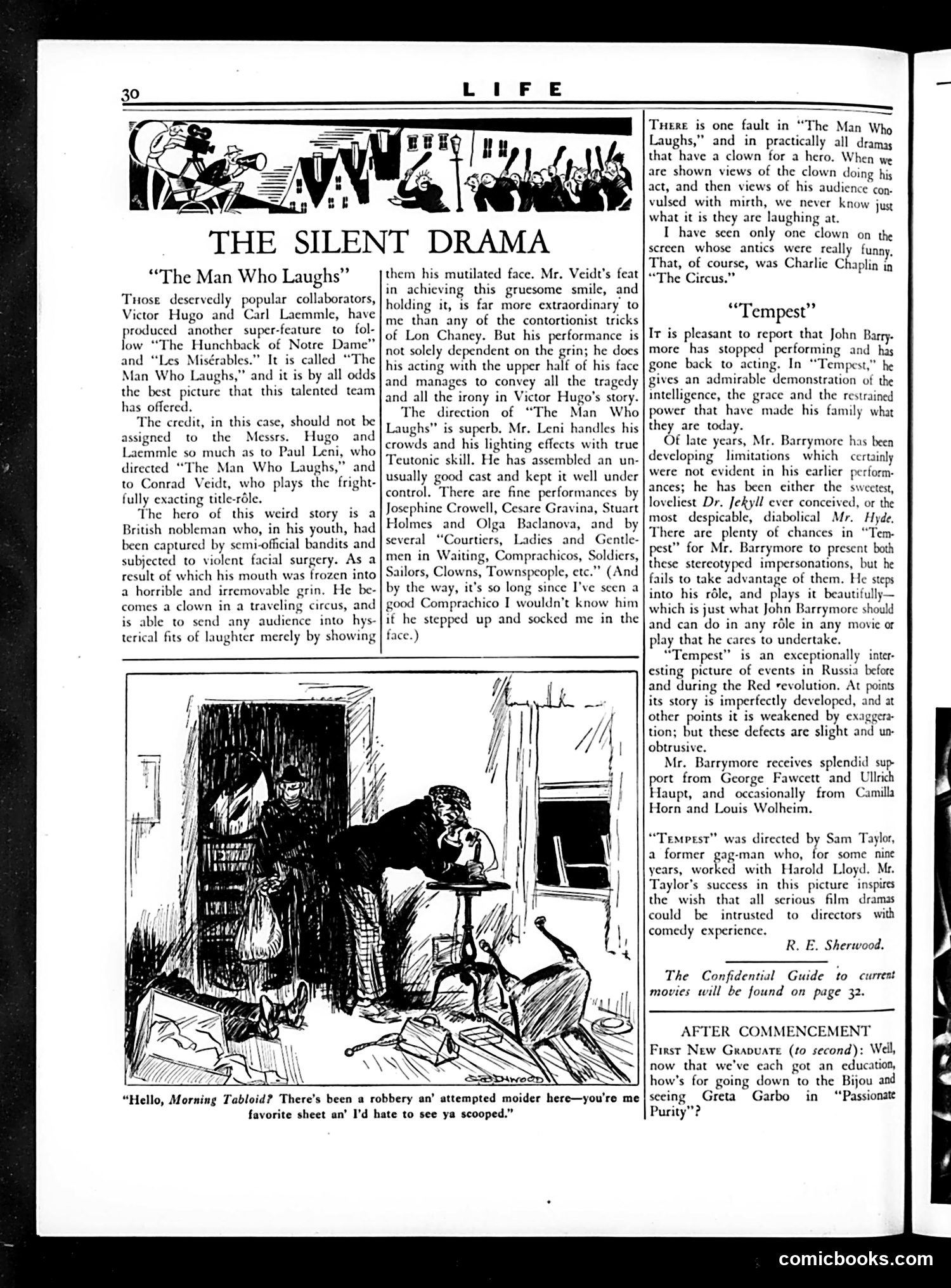
This is a film review page from Life magazine's "Silent Drama" column, circa mid-1920s. The main content reviews two films: **"The Man Who Laughs"** — adapted from Victor Hugo's novel, starring Conrad Veidt as a British nobleman whose mouth was surgically frozen into a permanent grin, forcing him to become a circus clown. The reviewer praises Veidt's acting and director Paul Leni's technique, but notes a flaw common to clown-centered dramas: audiences never know what makes the character's antics funny. The reviewer singles out Charlie Chaplin's "The Circus" as the only film where a clown's humor actually registers on screen. **"Tempest"** — stars John Barrymore in a film about pre-Revolutionary Russia. The reviewer praises Barrymore for restraint and intelligence in his acting, contrasting this favorably with his tendency toward extreme characterizations (Jekyll/Hyde types). The cartoon below depicts a crime reporter calling a newspaper editor, using slang typical of crime journalism of the era ("moider" for murder, "scooped" meaning beaten on a story).
📄 Transcribed text from this page (OCR, searchable)
Machine-transcribed from the original scan — historical spelling and the odd misread are preserved.
THE SILENT DRAMA “The Man Who Laughs” Tuose deservedly popular collaborators, Victor Hugo and Carl Laemmle, have produced another super-feature to fol- low “The Hunchback of Notre Dame” and “Les Misérables.” It is called “The Man Who Laughs,” and it is by all odds the best picture that this talented team has offered. The credit, in this case, should not be assigned to the Messrs. Hugo and Laemmle so much as to Paul Leni, who directed “The Man Who Laughs,” and to Conrad Veidt, who plays the fright- fully exacting title-réle. The hero of this weird story is a British nobleman who, in his youth, had been captured by semi-official bandits and subjected to violent facial surgery. As a result of which his mouth was frozen into a horrible and irremovable grin. He be- comes a clown in a traveling circus, and is able to send any audience into hys- terical fits of laughter merely by showing them his mutilated face. Mr. Veidt's feat in achieving this gruesome smile, and holding it, is far more extraordinary to me than any of the contortionist tricks of Lon Chaney. But his performance is not solely dependent on the grin; he does his acting with the upper half of his face and manages to convey all the tragedy and all the irony in Victor Hugo's story. The direction of “The Man Who Laughs” is superb. Mr. Leni handles his crowds and his lighting effects with true Teutonic skill. He has assembled an un- usually good cast and kept it well under control. There are fine performances by Josephine Crowell, Cesare Gravina, Stuart Holmes and Olga Baclanova, and by several “Courtiers, Ladies and Gentle- men in Waiting, Comprachicos, Soldiers, Sailors, Clowns, Townspcople, etc.” (And by the way, it’s so long since I've seen a good Comprachico I wouldn’t know him if he stepped up and socked me in the face.) “Hello, Morning Tabloid? There's been a robbery an’ attempted moider here—you're me favorite sheet an’ I'd hate to see ya scooped.” Tuere is one fault in “The Man Who Laughs,” and in practically all dramas that have a clown for a hero. When we are shown views of the clown doing his act, and then views of his audience con. vulsed with mirth, we never know just what it is they are laughing at. I have seen only one clown on the screen whose antics were really funny, That, of course, was Charlie Chaplin in “The Circus.” “Tempest” Ir is pleasant to report that John Barry- more has stopped performing and has gone back to acting. In “Tempest,” he gives an admirable demonstration of the intelligence, the grace and the restrained power that have made his family what they are today. Of late years, Mr. Barrymore has been developing limitations which certainly were not evident in his earlier perform. ances; he has been cither the sweetest, loveliest Dr. Jekyll ever conceived, or the most despicable, diabolical Mr. Hyde, There are plenty of chances in “Tem- pest” for Mr. Barrymore to present both these stereotyped impersonations, but he fails to take advantage of them. He steps into his réle, and plays it beautifully— which is just what John Barrymore should and can do in any réle in any movie or play that he cares to undertake. “Tempest” is an exceptionally inter- esting picture of events in Russia before and during the Red revolution. At points its story is imperfectly developed, and at other points it is weakened by exaggera- tion; but these defects are slight and un- obtrusive. Mr. Barrymore receives splendid sup || port from George Fawcett and Ullrich Haupt, and occasionally from Camilla Horn and Louis Wolheim. “Tempest” was directed by Sam Taylor, a former gag-man who, for some nine years, worked with Harold Lloyd. Mr. Taylor's success in this picture inspires the wish that all serious film dramas could be intrusted to directors with comedy experience. R. E. Sherwood. The Confidential Guide to. current movies will be found on page 32. AFTER COMMENCEMENT First New Grapuate (to second): Wel, now that we've cach got an education, how’s for going down to the Bijou and seeing Greta Garbo in ‘Passionate Purity"? comicbooks.com