
Life, 1928-06-07 · page 21 of 54
Life — June 7, 1928 — page 21: what you’re looking at
What you’re looking at
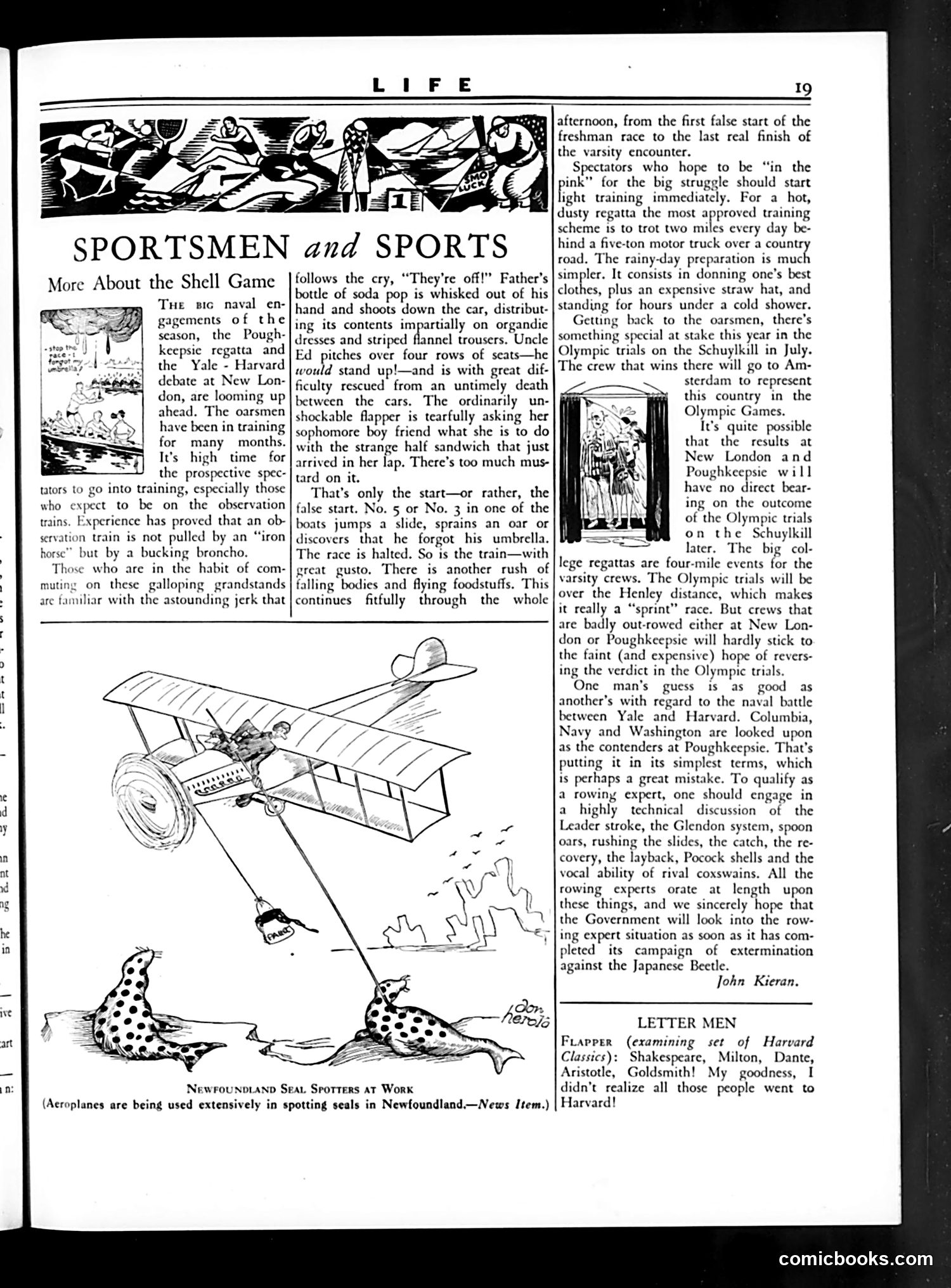
This page satirizes the chaos of attending rowing regattas (boat races) at elite universities like Yale and Harvard. The main cartoon illustrates why spectators need "training" to attend: the observation trains carrying fans undergo violent lurching and jerking, causing passengers to lose balance, spill food and drinks, and tumble between cars. The joke mocks both the physical ordeal of watching these events and the pretentiousness of rowing culture. The author humorously suggests spectators should condition themselves like athletes to endure the bumpy train rides. The accompanying cartoon shows amusingly literal "seal spotting" in Newfoundland—an airplane spotting actual seals—a humorous visual pun on the news item about using aircraft for reconnaissance. The text also discusses competitive dynamics between Yale, Harvard, Columbia, Navy, and Washington crews, with tongue-in-cheek commentary on rowing jargon and expertise.
📄 Transcribed text from this page (OCR, searchable)
Machine-transcribed from the original scan — historical spelling and the odd misread are preserved.
19 SPORTSMEN and SPORTS More About the Shell Game Tue pic naval en- gagements of the season, the Pough- keepsie regatta and the Yale - Harvard debate at New Lon- don, are looming up ahead. The oarsmen have been in training for many months. It’s high time for the prospective spec- tators to go into training, especially those who expect to be on the observation tains. Experience has proved that an ob- train is not pulled by an “iron but by a bucking broncho. Those who are in the habit of com- : on these galloping grandstands follows the cry, “They're off!” Father's bottle of soda pop is whisked out of his hand and shoots down the car, distribut- ing its contents impartially on organdie dresses and striped flannel trousers. Uncle Ed pitches over four rows of seats—he would stand up!—and is with great dif- ficulty rescued from an untimely death between the cars. The ordinarily un- shockable flapper is tearfully asking her sophomore boy friend what she is to do with the strange half sandwich that just arrived in her lap. There’s too much mus- tard on it. That's only the start—or rather, the false start. No. 5 or No. 3 in one of the boats jumps a slide, sprains an oar or discovers that he forgot his umbrella. The race is halted. So is the train—with great gusto, There is another rush of falling bodies and flying foodstuffs. This continues fitfully through the whole Newrounptanp Seat Spotters at Work (Aeroplanes are being used extensively in spotting seals in Newfoundland—News Item.) afternoon, from the first false start of the freshman race to the last real finish of the varsity encounter. Spectators who hope to be “in the ink” for the big struggle should start ight training immediately. For a hot, dusty regatta the most approved training scheme is to trot two miles every day be- hind a five-ton motor truck over a countr road. The rainy-day preparation is ‘tach simpler. It consists in donning one’s best clothes, plus an expensive straw hat, and standing for hours under a cold shower. Getting back to the oarsmen, there's something special at stake this year in the Olympic trials on the Schuylkill in July. The crew that wins there will go to Am- sterdam to represent this country in the Olympic Games. It’s quite possible that the results at New London and Poughkeepsie will have no direct bear- ing on the outcome of the Olympic trials on the Schuylkill later. The big col- lege regattas are four-mile events for the varsity crews. The Olympic tials will be over the Henley distance, which makes it really a “sprint” race. But crews that are badly out-rowed either at New Lon- don or Poughkeepsie will hardly stick to the faint (and expensive) hope of revers- ing the verdict in the Olympic trials. One man’s guess is as good as another’s with regard to the naval battle between Yale and Harvard. Columbia, Navy and Washington are looked upon as the contenders at Poughkeepsie. That's putting it in its simplest terms, which 1s perhaps a great mistake. To qualify as a rowing expert, one should engage in a highly technical discussion of the Leader stroke, the Glendon system, spoon oars, rushing the slides, the catch, the re- covery, the layback, Pocock shells and the vocal ability of rival coxswains. All the rowing experts orate at length upon these things, and we sincerely hope that the Government will look into the row- ing expert situation as soon as it has com- pleted its campaign of extermination against the Japanese Beetle. John Kieran. LETTER MEN Farrer (examining set of Harvard Classics): Shakespeare, Milton, Dante, Aristotle, Goldsmith! My goodness, I didn’t realize all those people went to Harvard! comicbooks.com