
Life, 1928-06-07 · page 29 of 54
Life — June 7, 1928 — page 29: what you’re looking at
What you’re looking at
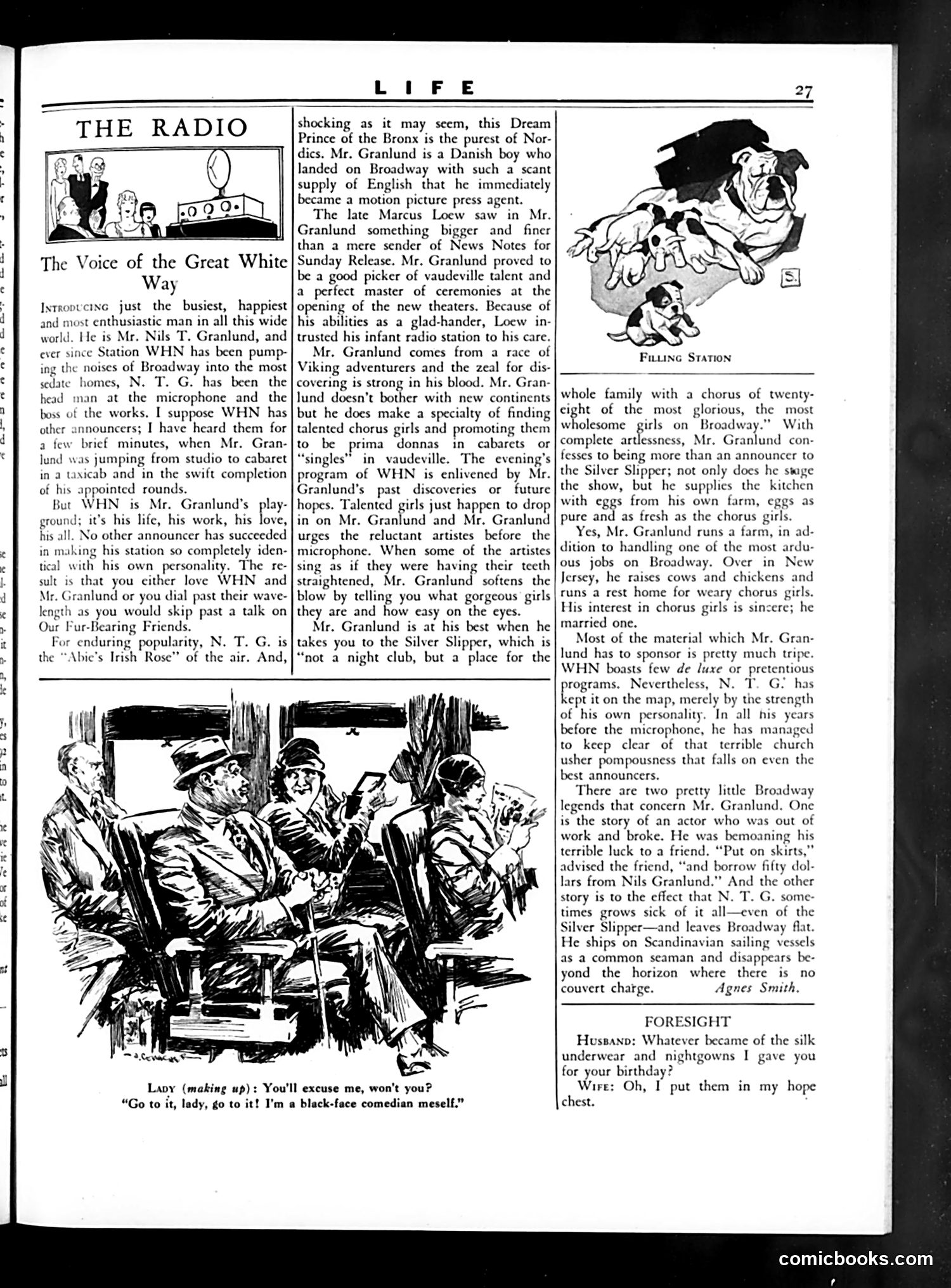
This is a profile-essay celebrating Nils T. Granlund, announcer and programming director for radio station WHN in New York. The text praises his showmanship and tireless energy in promoting Broadway talent, particularly chorus girls, whom he discovers, promotes, and even employs on his New Jersey farm. The satire is gentle: the writer mocks Granlund's relentless self-promotion and his tendency to romanticize mediocre performers ("singing as if they were having their teeth straightened"). The "Filling Station" cartoon appears to critique his ubiquity—he's everywhere, supplying Broadway with "product" like a gas pump. The lower cartoon shows a blackface comedian, reflecting 1920s entertainment conventions now considered offensive. The "Foresight" joke is unrelated domestic humor. Overall, the piece treats Granlund as an emblematic showman who succeeded through personality rather than refined taste.
📄 Transcribed text from this page (OCR, searchable)
Machine-transcribed from the original scan — historical spelling and the odd misread are preserved.
THE RADIO The Voice of the Great White Way Ixtropuctnc just the busiest, happiest and most enthusiastic man in all this wide world. He is Mr. Nils T. Granlund, and ever since Station WHN has been pump- ing the noises of Broadway into the most sedate homes, N. T. G. has been the head man at the microphone and the boss of the works. I suppose WHN has other announcers; I have heard them for a few brief minutes, when Mr. Gran- lund was jumping from studio to cabaret in a taxicab and in the swift completion of his appointed rounds. But WHN is Mr. Granlund’s play- ground; it’s his life, his work, his love, his all. No other announcer has succeeded in making his station so completely iden- tical with his own personality. The re- sult is that you either love WHN and Mr. Granlund or you dial past their wave- length as you would skip past a talk on Our Fur-Bearing Friends. For enduring popularity, N. T. G. is the “Abie’s Trish Rose’ of the air. And, shocking as it may seem, this Dream Prince of the Bronx is the purest of Nor- dics. Mr. Granlund is a Danish boy who landed on Broadway with such a scant supply of English that he immediately became a motion picture press agent. The late Marcus Loew saw in Mr. Granlund something bigger and_ finer than a mere sender of News Notes for Sunday Release. Mr. Granlund proved to be a good picker of vaudeville talent and a perfect master of ceremonies at the opening of the new theaters. Because of his abilities as a glad-hander, Loew in- trusted his infant radio station to his care. Mr. Granlund comes from a race of Viking adventurers and the zeal for dis- covering is strong in his blood. Mr. Gran- lund doesn’t bother with new continents but he does make a specialty of finding talented chorus girls and promoting them to be prima donnas in cabarets or “singles” in vaudeville. The evening's program of WHN is enlivened by Mr. Granlund’s past discoveries or future hopes. Talented girls just happen to drop in on Mr. Granlund and Mr. Granlund urges the reluctant artistes before the microphone. When some of the artistes sing as if they were having their teeth straightened, Mr. Granlund softens the blow by telling you what gorgeous girls they are and how easy on the eyes. Mr. Granlund is at his best when he takes you to the Silver Slipper, which is “not a night club, but a place for the Lavy (making up): You'll excuse me, won't you? “Go to it, lady, go to it! I'm a black-face comedian meself.” Fituinc Station whole family with a chorus of twenty- eight of the most glorious, the most wholesome girls on Broadway.” With complete artlessness, Mr. Granlund con- fesses to being more than an announcer to the Silver Slipper; not only does he smge the show, but he supplies the kitchen with eggs from his own farm, eggs as pure and as fresh as the chorus girls. Yes, Mr. Granlund runs a farm, in ad- dition to handling one of the most ardu- ous jobs on Broadway. Over in New Jersey, he raises cows and chickens and runs a rest home for weary chorus girls. His interest in chorus girls is sincere; he married one. Most of the material which Mr. Gran- lund has to sponsor is pretty much tripe. WHN boasts few de luxe or pretentious rograms. Nevertheless, N. T. G. has kepe it on the map, merely by the strength of his own personality. In all his years before the microphone, he has man to keep clear of that terrible church usher pompousness that falls on even the best announcers. There are two pretty little Broadway legends that concern Mr. nlund. One is the story of an actor who was out of work and broke. He was bemoaning his terrible luck to a friend. “Put on skirts,” advised the friend, “and borrow fifty dol- lars from Nils Granlund.” And the other story is to the effect that N. T. € times grows sick of it all—even of the Silver Slipper—and leaves Broadway flat. He ships on Scandinavian sailing vessels as a common seaman and disappears be- yond the horizon where there is no couvert charge. Agnes Smith, + some- FORESIGHT Hussanv: Whatever became of the silk underwear and nightgowns I gave you for your birthday? Wire: Oh, I put them in my hope chest. comicbooks.com t