
A complete issue · 48 pages · 1916
Life — May 18, 1916
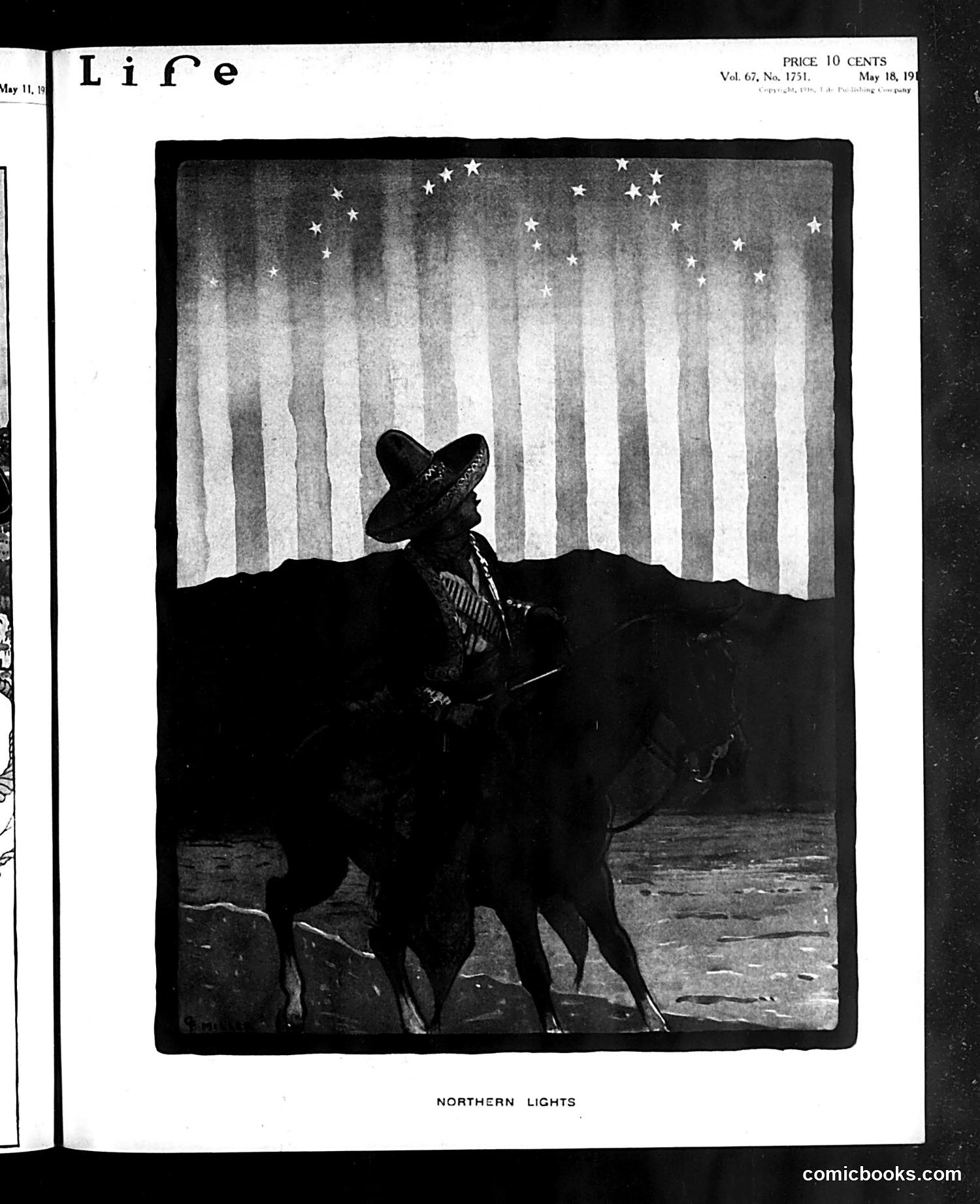
This silhouette illustration depicts a cowboy on horseback gazing at the American flag's vertical stripes illuminated in the night sky, with stars above. The title "Northern Lights" is a pun—literally referencing the aurora borealis, but symbolically suggesting the flag as America's guiding light. Given the 1918 publication date (during World War I), this appears to be patriotic imagery encouraging American resolve or hope during the war effort. The cowboy—a distinctly American figure—contemplates the flag as an inspiring vision, suggesting national unity and ideals worth fighting for. The romantic, silhouetted composition emphasizes emotional connection to American values rather than depicting specific political figures or events.
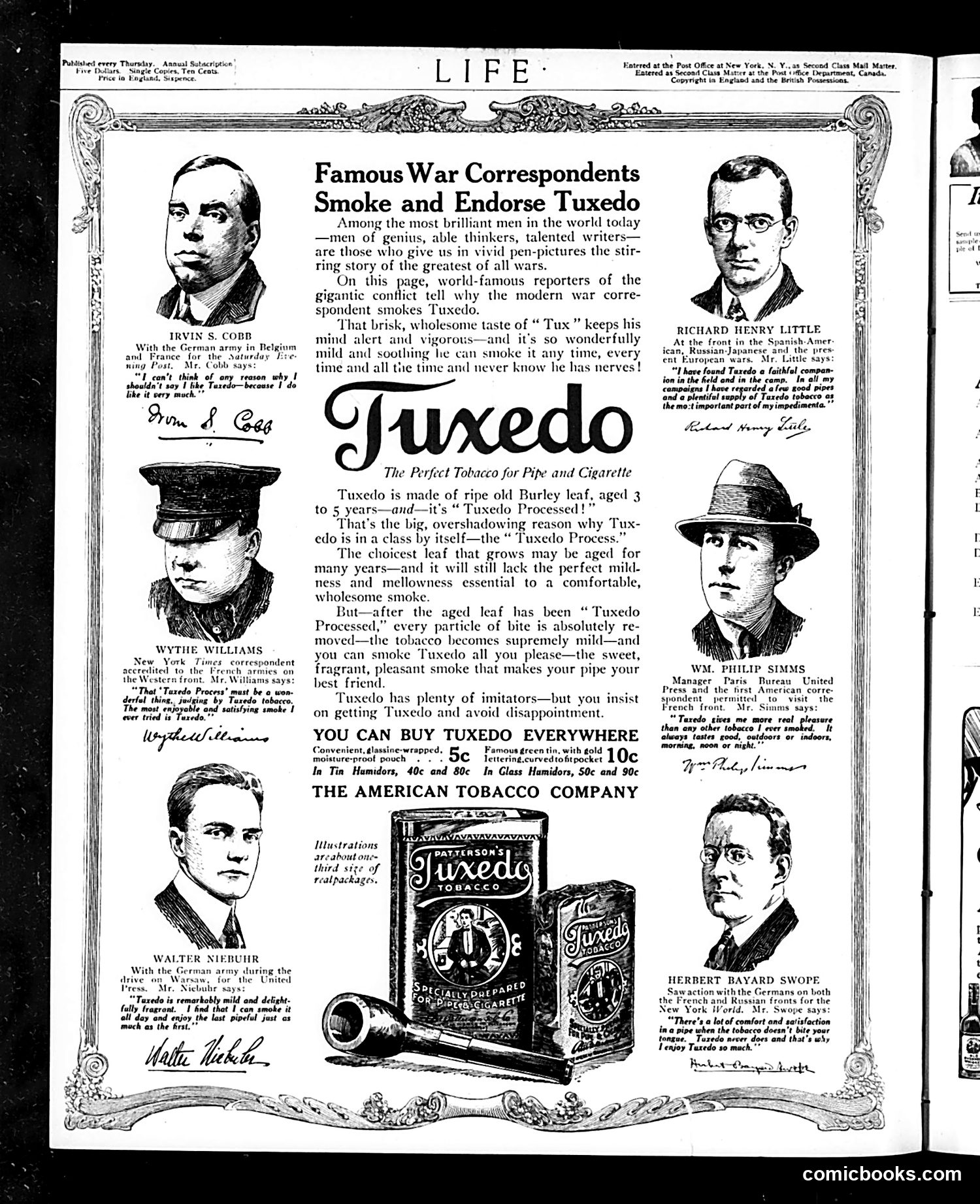
The advertisement for Tuxedo tobacco features endorsements from five famous World War I correspondents: Irvin S. Cobb, Wythe Williams, Walter Niebuhr, Richard Henry Little, and Herbert Bayard Swope. Each correspondent provides a signed testimonial praising the tobacco brand. The "satire" here is subtle and commercial rather than political: Life magazine (known for humor) is humorously presenting serious war reporters as tobacco enthusiasts. The joke relies on the incongruity of dignified journalists endorsing a consumer product, lending their prestige to sell cigarettes and pipe tobacco. This represents early 20th-century advertising strategy: using celebrity endorsements from respected public figures to build brand credibility. No specific political event or cartoon is being satirized—this is straightforward product marketing disguised as editorial content.
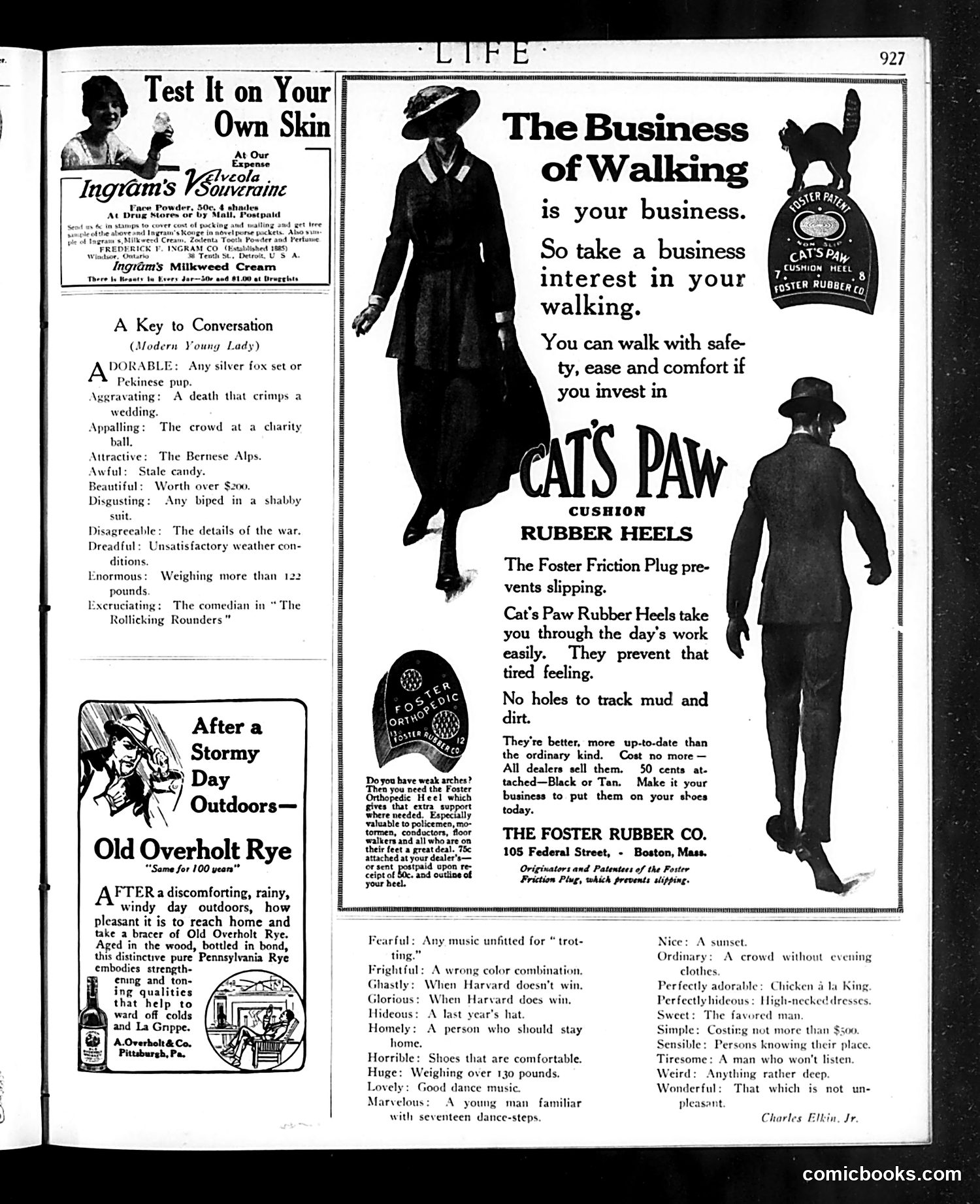
This page is primarily **advertising rather than political satire**. The main content consists of three ads: 1. **Ingram's Face Powder** ("Test It on Your Own Skin") — a cosmetics advertisement 2. **Cat's Paw Cushion Rubber Heels** — shoe heels featuring "Foster Friction Plug" technology to prevent slipping 3. **Old Overholt Rye** — whiskey advertised as suitable after stormy weather outdoors The only satirical element is a small "Key to Conversation (Modern Young Lady)" column defining contemporary slang terms like "Adorable," "Appalling," and "Marvelous" — mild social commentary on frivolous modern speech rather than political commentary. The page reflects 1920s consumer culture and advertising trends rather than containing meaningful political or social satire.
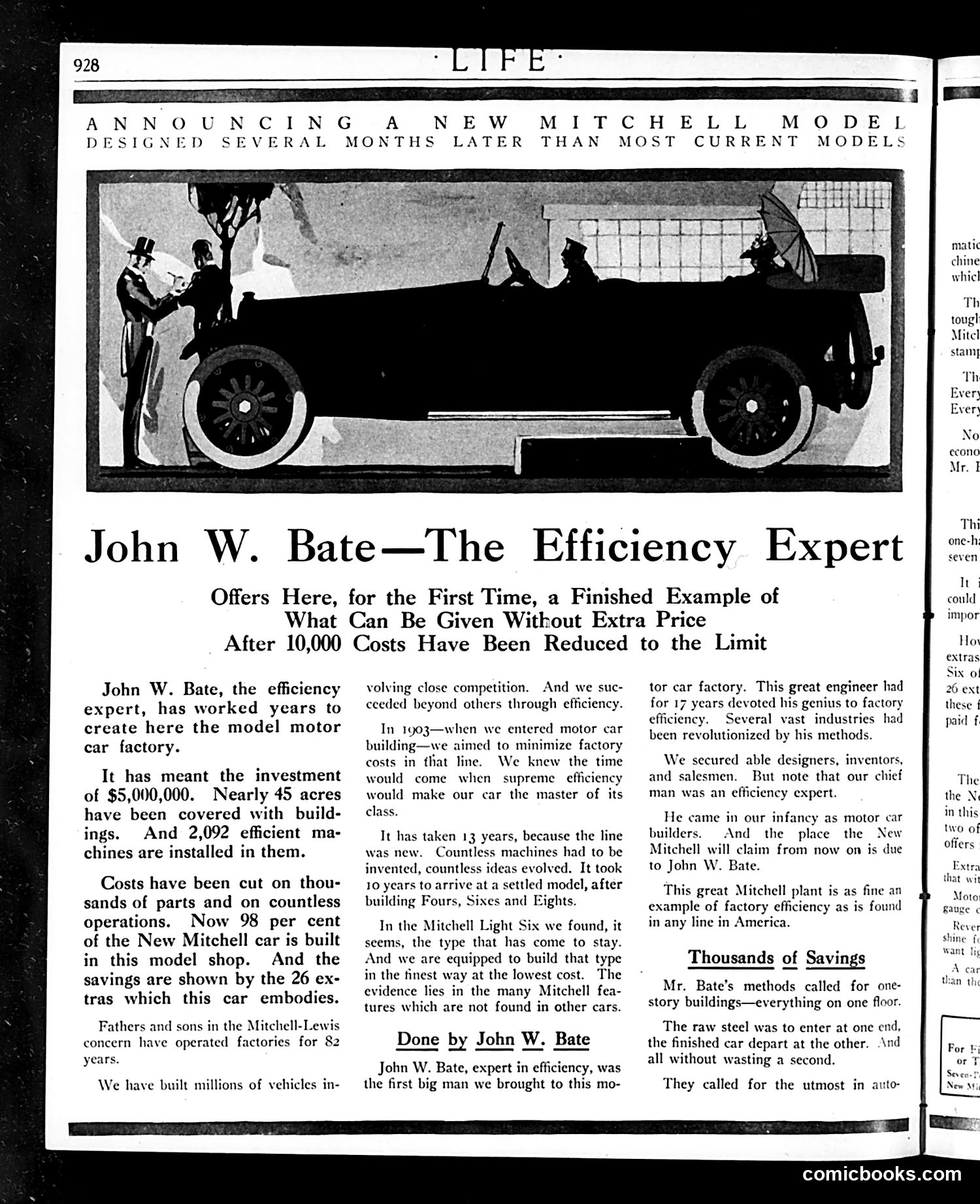
This is not satire—it's a straightforward **advertisement** for Mitchell automobiles, specifically announcing a new model designed by efficiency expert John W. Bate. The silhouette illustration shows a luxury touring car with well-dressed passengers, emphasizing elegance and status. The text promotes Bate's credentials: he reduced manufacturing costs through efficiency innovations at Mitchell's factory (reportedly saving thousands through streamlined production methods and a one-story building layout). The "satire" framing comes from Life magazine's editorial context—the publication often ran advertisements alongside humorous content. However, this particular page is promotional, celebrating American industrial efficiency and manufacturing innovation as competitive advantages during the early automotive era (circa 1916).
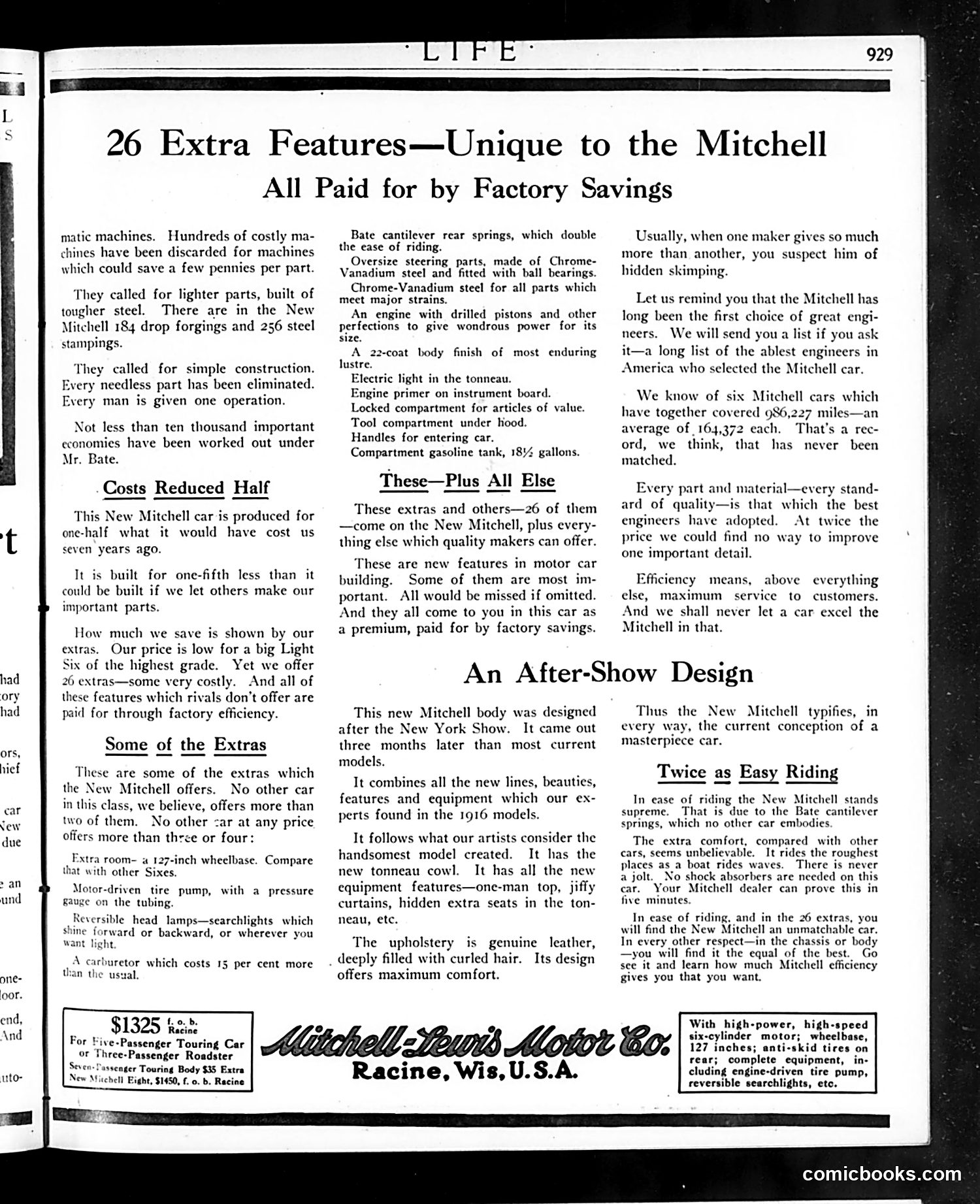
This page is **not a cartoon or satirical piece** — it's a straightforward automobile advertisement for the Mitchell-Lewis Motor Company of Racine, Wisconsin. The ad promotes their "New Mitchell" car, highlighting 26 "extra features" claimed to be unique to their brand. Key selling points include cost efficiency ("Costs Reduced Half"), quality construction, and specific mechanical innovations like Chrome-Vanadium steel parts and Bate cantilever springs. The ad emphasizes the car was designed "after the New York Show" and represents current automotive design standards. The price listed is $1,325 for a five-passenger touring car. This is standard early automotive advertising, not satire.
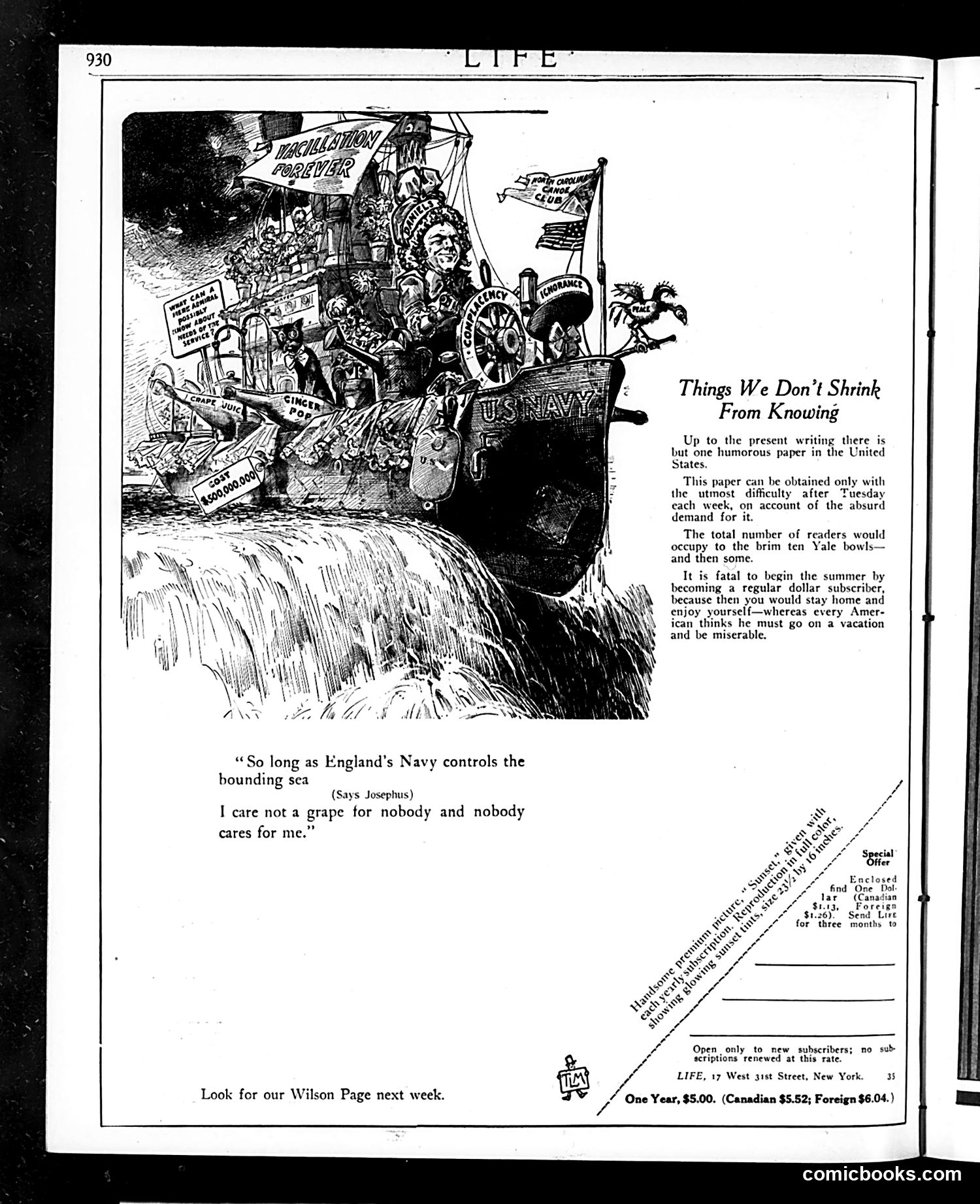
This LIFE magazine page satirizes American isolationism during a period when England faced naval threats (likely WWI or WWII era, based on the "U.S. Navy" vessel depicted). The central cartoon shows a crowded ship labeled "U.S. Navy" packed with American institutions and symbols—appearing to represent American society—sailing away from danger. The quote "So long as England's Navy controls the bounding sea" (attributed to Josephus) sarcastically suggests Americans feel safe relying on British naval protection while remaining detached. The accompanying text mocks American complacency: readers won't shrink from knowing about this "humorous paper," yet many Americans assume they can avoid vacation involvement in world affairs—the ironic point being that geographic isolation provides false security when global events demand attention. The satire criticizes American detachment from international responsibilities.
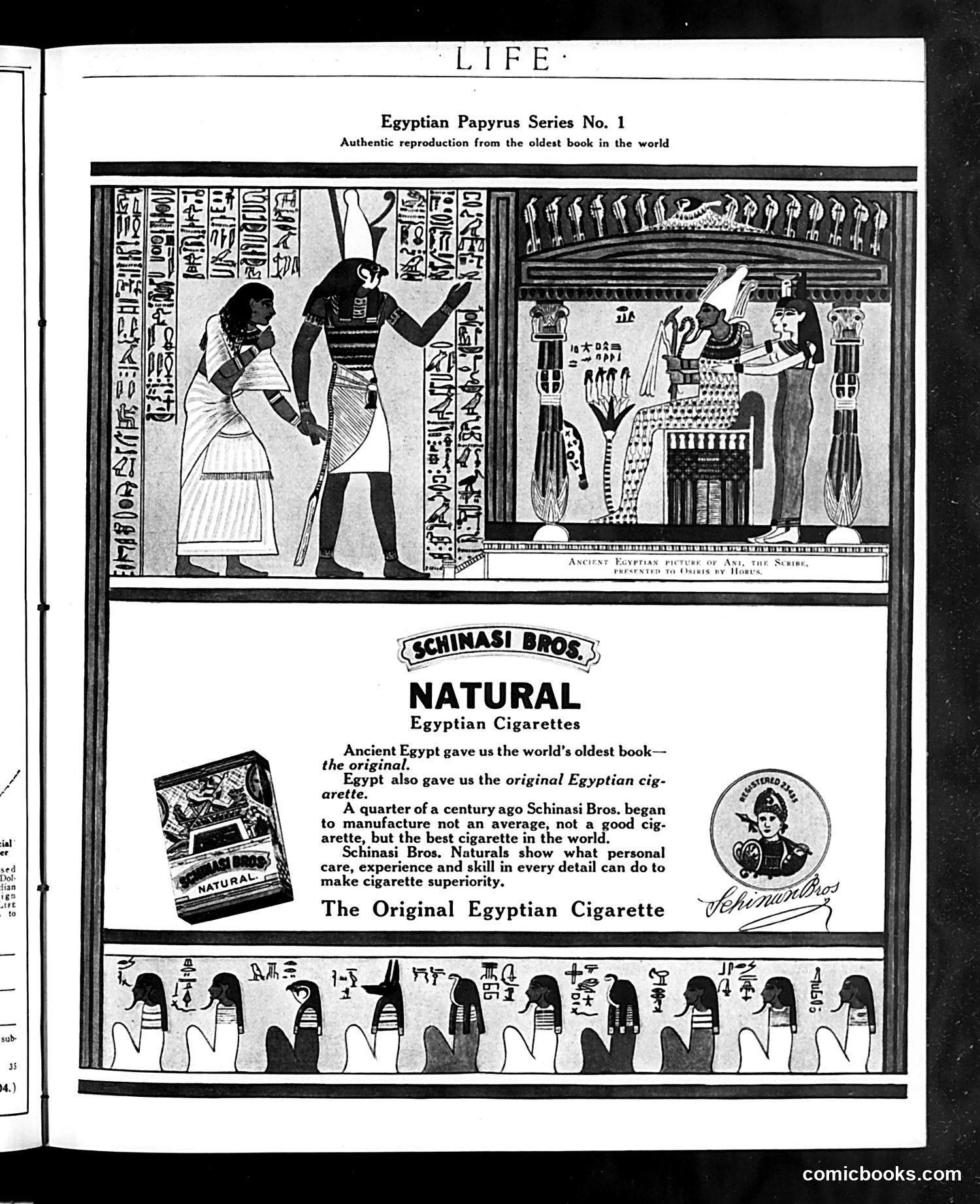
This page combines educational content with advertising. The top shows authentic reproductions from ancient Egyptian papyri, depicting religious or ceremonial scenes with hieroglyphics. The caption identifies one scene as "Ancient Egyptian picture of Anu, the nurse, exposed to Osiris by Horus." The bulk of the page advertises Schinasi Bros. "Natural Egyptian Cigarettes," claiming they represent the original Egyptian cigarette formula. The advertisement plays on Egypt's ancient prestige, asserting these are "the best cigarette in the world" made with superior craftsmanship. The bottom decorative border repeats Egyptian motifs (appears to show mummified figures with hieroglyphics), reinforcing the Egyptian theme as marketing appeal rather than satire. This is primarily a sophisticated advertisement leveraging historical authenticity for product prestige.
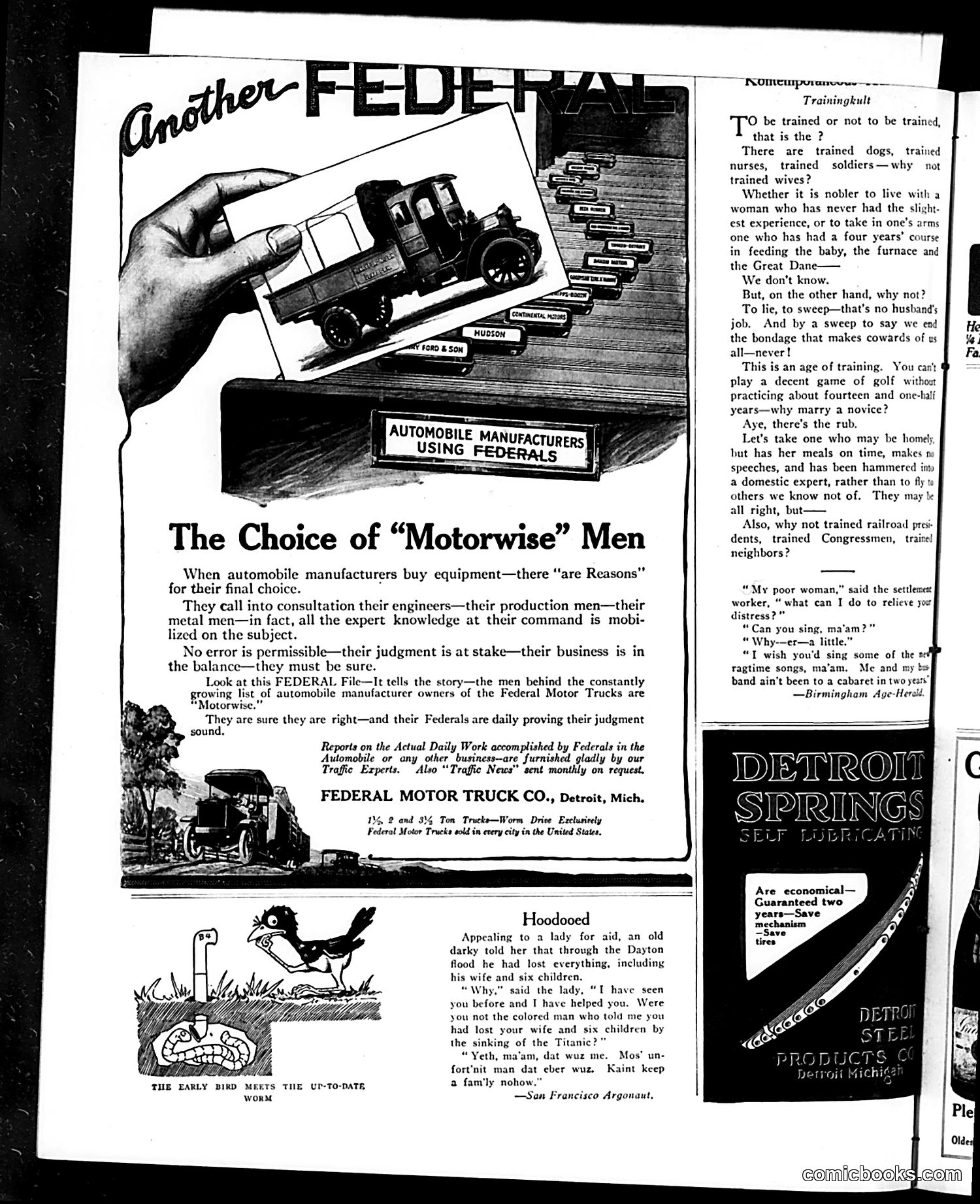
**Main Advertisement (Top):** Federal Motor Truck Company promotes their vehicles to automobile manufacturers, claiming that "motorwise" men—engineers, production workers, and metal men—choose Federals because of their proven reliability. The hand holding a tiny truck demonstrates the product's trustworthiness. **Right Column Essay:** "To be trained or not to be trained" debates whether wives need formal domestic training. The author questions why society trains dogs, nurses, and soldiers but not wives, arguing that capable untrained women are preferable to those merely performing learned behaviors. **Bottom Cartoon:** "The Early Bird Meets the Up-to-Date Worm" shows a bird discovering a worm wearing modern dress, a simple visual gag about technology and evolution making traditional advantages obsolete.
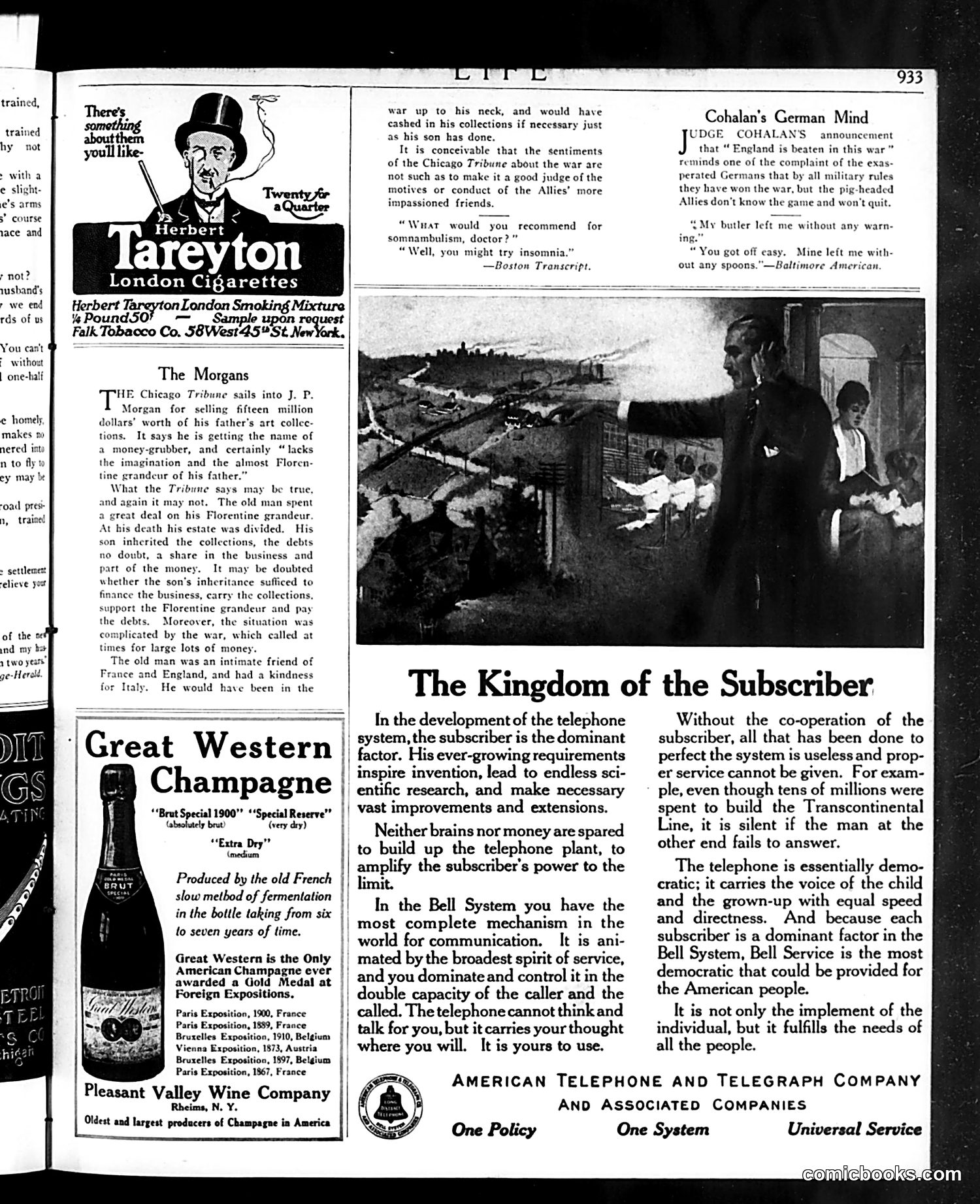
This page is primarily **advertising and corporate messaging** rather than political satire. The Herbert Tareyton cigarette ad features a man in a top hat with the tagline "There's something about them you'll like"—typical early 20th-century tobacco marketing. The central feature is a Bell System advertisement titled "The Kingdom of the Subscriber," presenting the telephone as democratizing technology that empowers individual users. This is corporate propaganda celebrating American business infrastructure rather than satire—the text emphasizes how subscribers "dominate and control" the telephone system, framing consumerism as civic participation. Additional advertisements include Great Western Champagne and Pleasant Valley Wine Company products. **No political cartoons or satirical commentary appear on this page.**
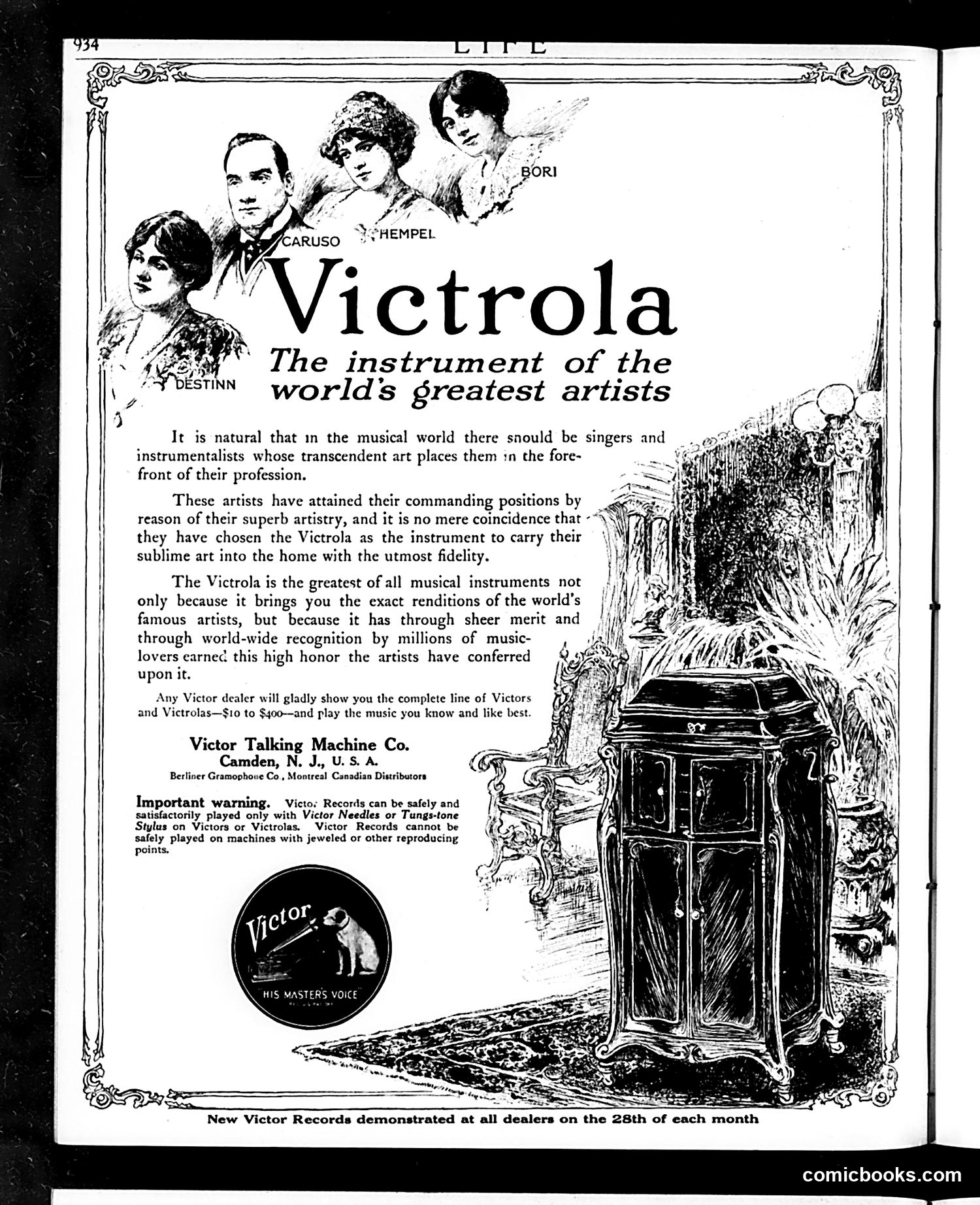
This is a **Victrola phonograph advertisement**, not a satirical cartoon. The page shows portraits of famous early 20th-century opera singers and entertainers—labeled Caruso, Hempel, Bori, and Destinn—endorsing the Victor Talking Machine Company's Victrola record player. The advertisement's pitch is straightforward: these world-class artists have chosen the Victrola to reproduce their performances at home, implying the device's superior sound quality. The ornate cabinet illustration emphasizes the Victrola as a luxury furniture piece. An "Important warning" at bottom cautions that Victor records require specific Victor needles to avoid damaging the equipment—essentially protecting the company's proprietary system from cheaper competitors. This reflects early mass-marketing strategy: celebrity endorsements lending prestige to consumer technology.
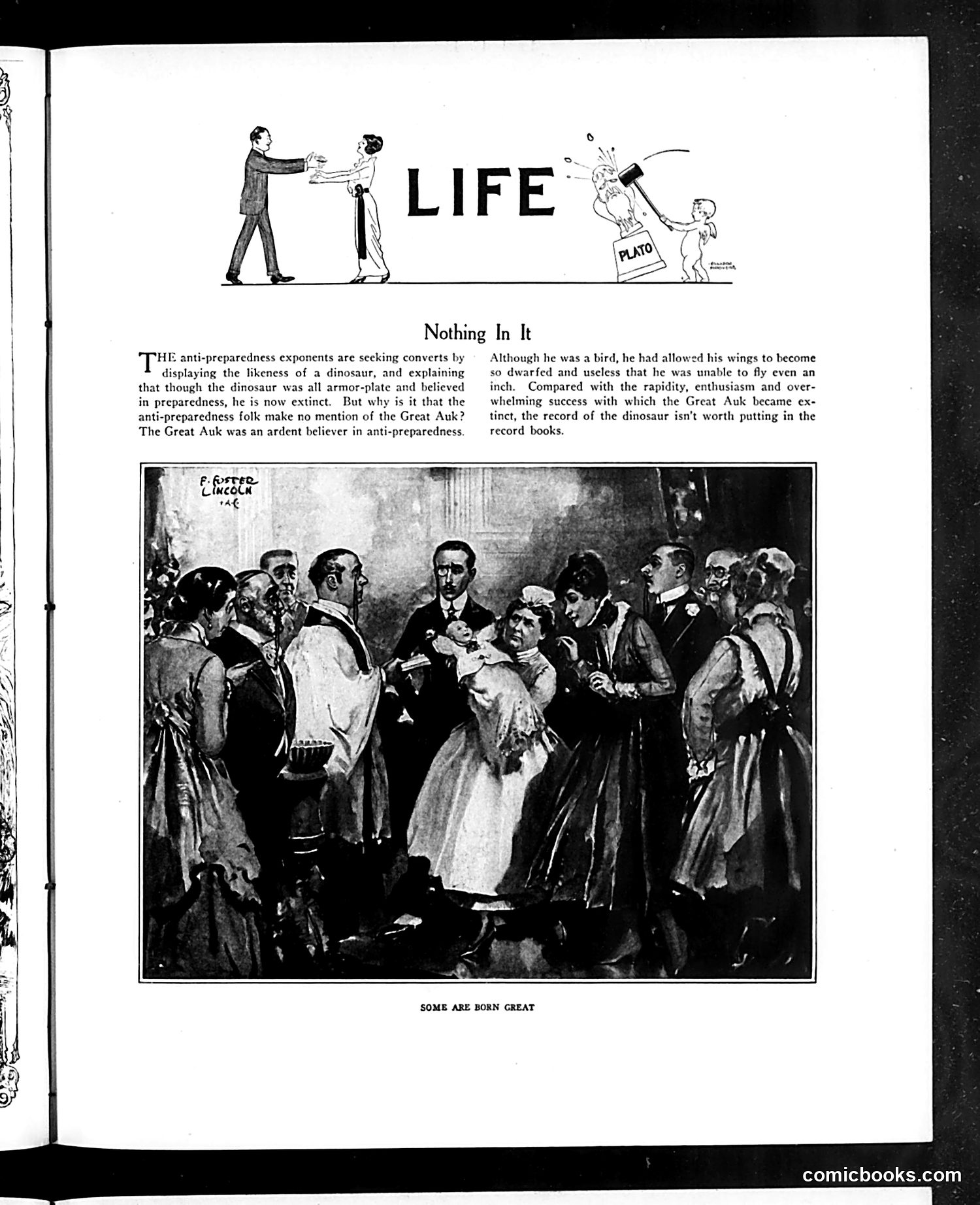
This Life magazine page satirizes anti-preparedness advocates. The header cartoon shows a man and woman happily exchanging items labeled "PLATO," while a cherub swings a hammer—suggesting naive pacifists focused on philosophy rather than practical defense. The article "Nothing In It" mocks those claiming "anti-preparedness" is extinct. It compares such believers to the "Great Auk"—a now-extinct flightless bird—sarcastically noting the bird's uselessness mirrors the anti-preparedness position. The illustration "Some Are Born Great" depicts what appears to be a social gathering or medical scene, though its specific connection to the anti-preparedness theme remains unclear from the visible content. Overall, the page argues that anti-war/anti-military sentiment persists despite claims otherwise, and that such pacifism is as obsolete and ineffective as an extinct bird.
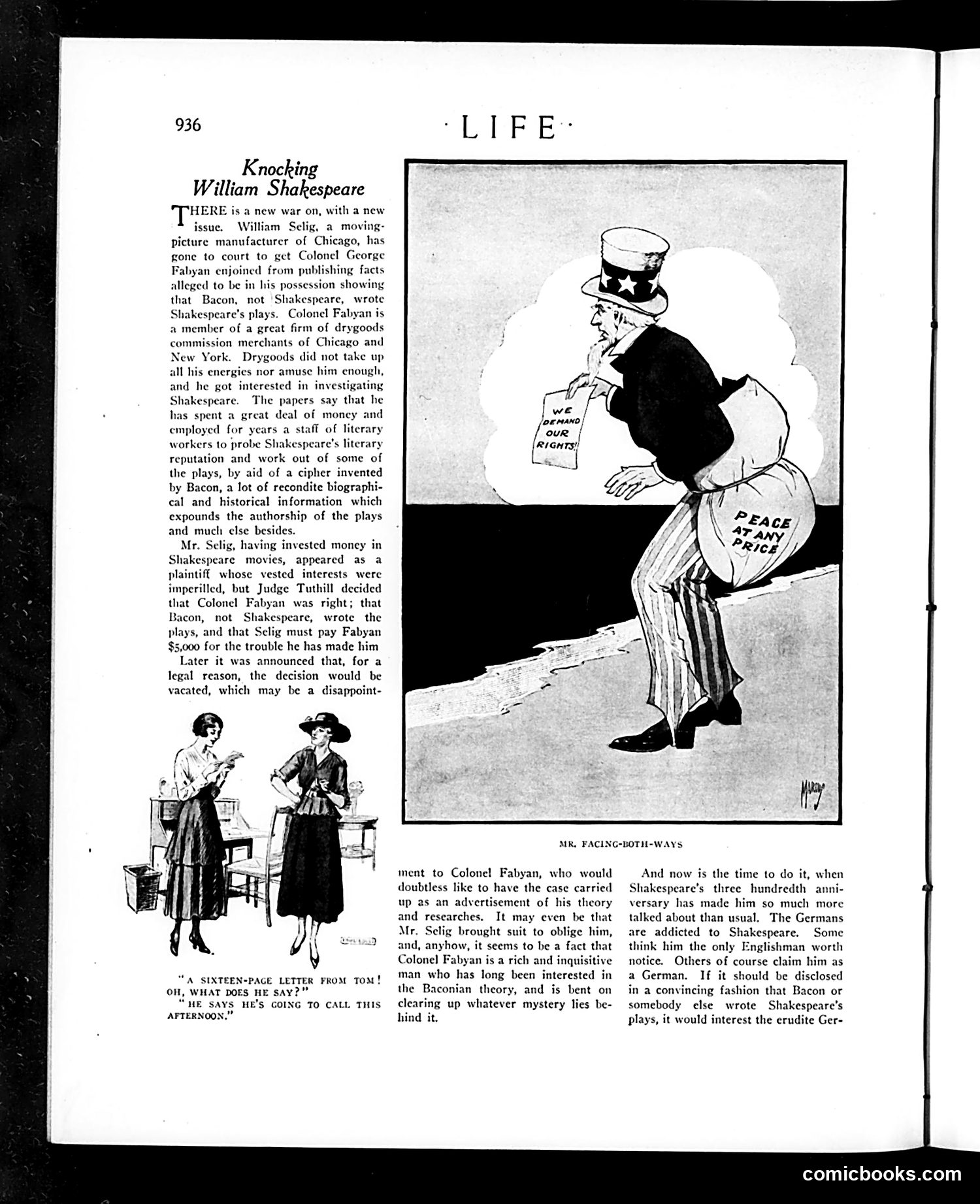
This page satirizes a legal dispute over Shakespeare's authorship. William Selig, a Chicago moving-picture manufacturer, sued Colonel George Fabyan to prevent him from publishing materials claiming Shakespeare didn't write the plays—instead attributing them to Francis Bacon. The main cartoon, titled "Mr. Facing-Both-Ways," depicts Uncle Sam (identifiable by his top hat and stars) straddling a fence between "We Demand Our Rights" and "Peace at Any Price," illustrating the contradiction of supporting both positions simultaneously. The article notes that Judge Tuthill ruled in Fabyan's favor, requiring Selig to pay $5,000. The satire criticizes how the Shakespeare authorship controversy—then a serious intellectual debate—became entangled in commercial interests and legal wrangling.
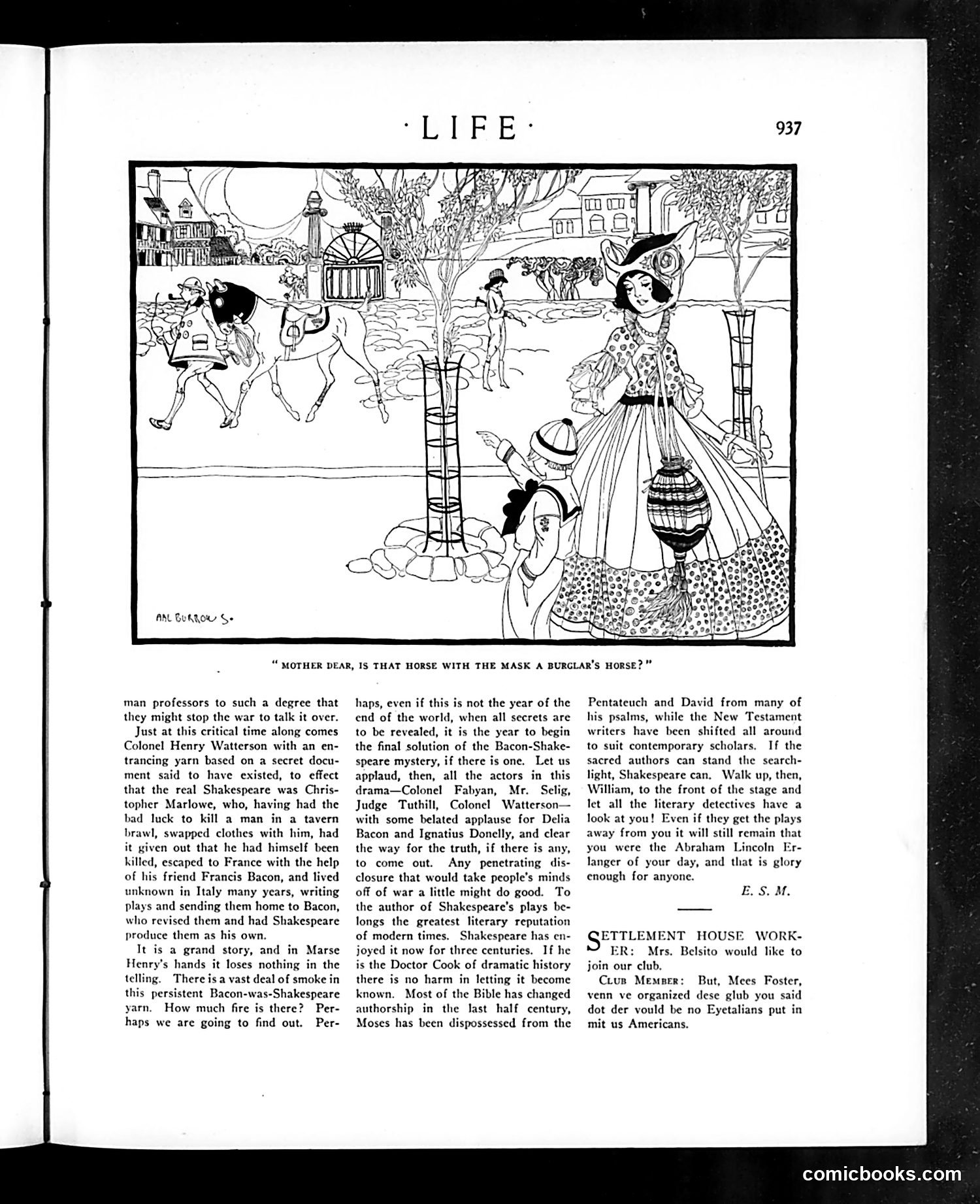
The cartoon depicts a mother asking her child, "Mother dear, is that horse with the mask a burglar's horse?" in what appears to be a public park or town square setting. The joke likely plays on children's literal interpretation of language. The "mask" probably refers to the dark markings on the horse's face (a common equine feature), which the child humorously mistakes for an actual burglar's disguise. This reflects early-20th-century concerns about crime and burglary, while poking fun at how children interpret adult warnings about criminals and suspicious characters. The cartoon is signed by the artist and follows typical Life magazine humor conventions: gentle, family-friendly satire about domestic life and childhood misunderstandings.
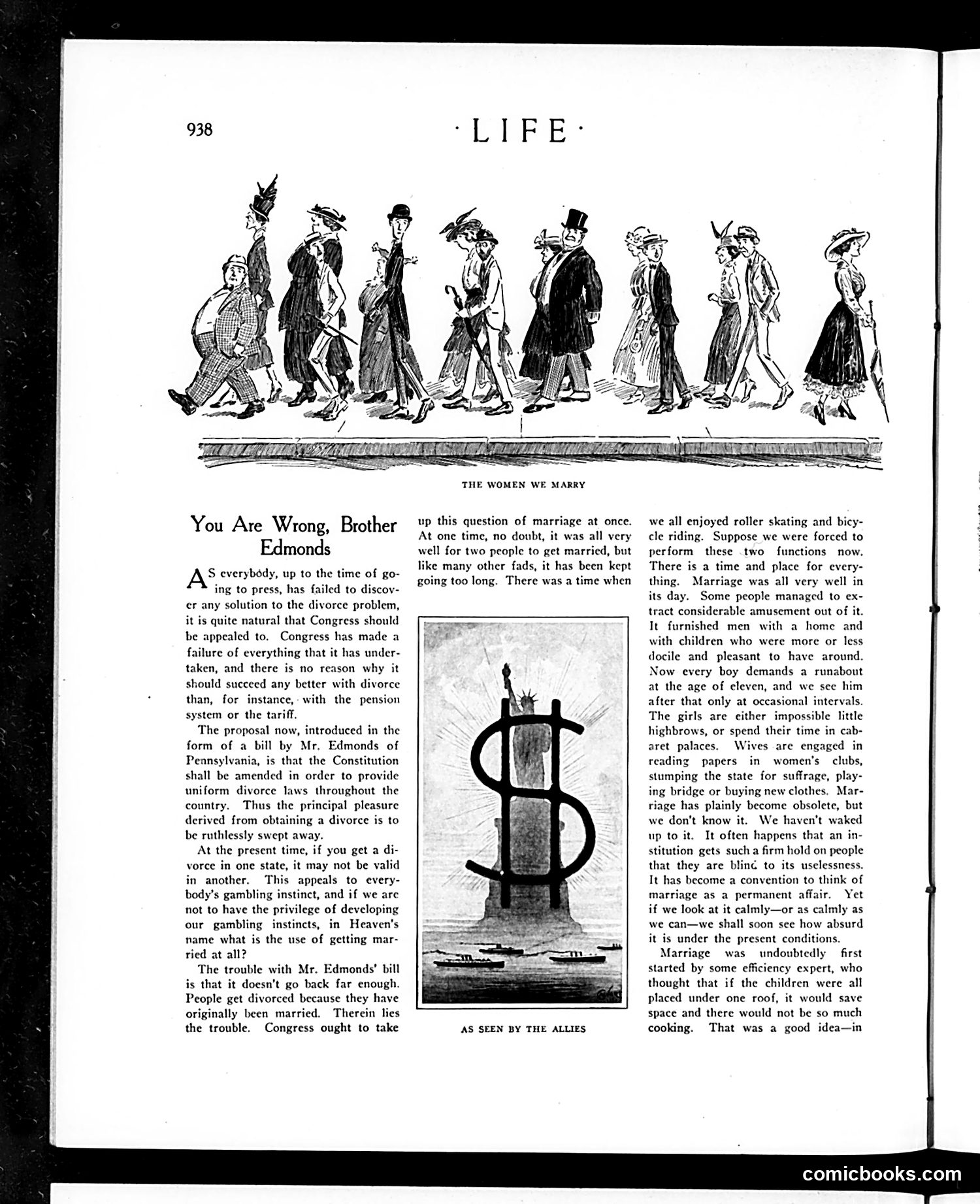
This page from *Life* magazine satirizes marriage and divorce reform. The main article, "You Are Wrong, Brother Edmonds," argues against a proposed bill by Mr. Edmonds of Pennsylvania that would standardize divorce laws nationwide. The cartoon at top, titled "The Women We Marry," depicts a line of women in various states of fashionable dress and demeanor—likely satirizing the diversity of modern women and changing gender roles. The central illustration, "As Seen by the Allies," shows a dollar sign with what appears to be a classical monument, likely criticizing how marriage has become commercialized or how financial considerations dominate matrimonial decisions. The text mocks the notion that marriage is "obsolete" and argues marriage reform should address why people marry in the first place, rather than simply making divorce easier.
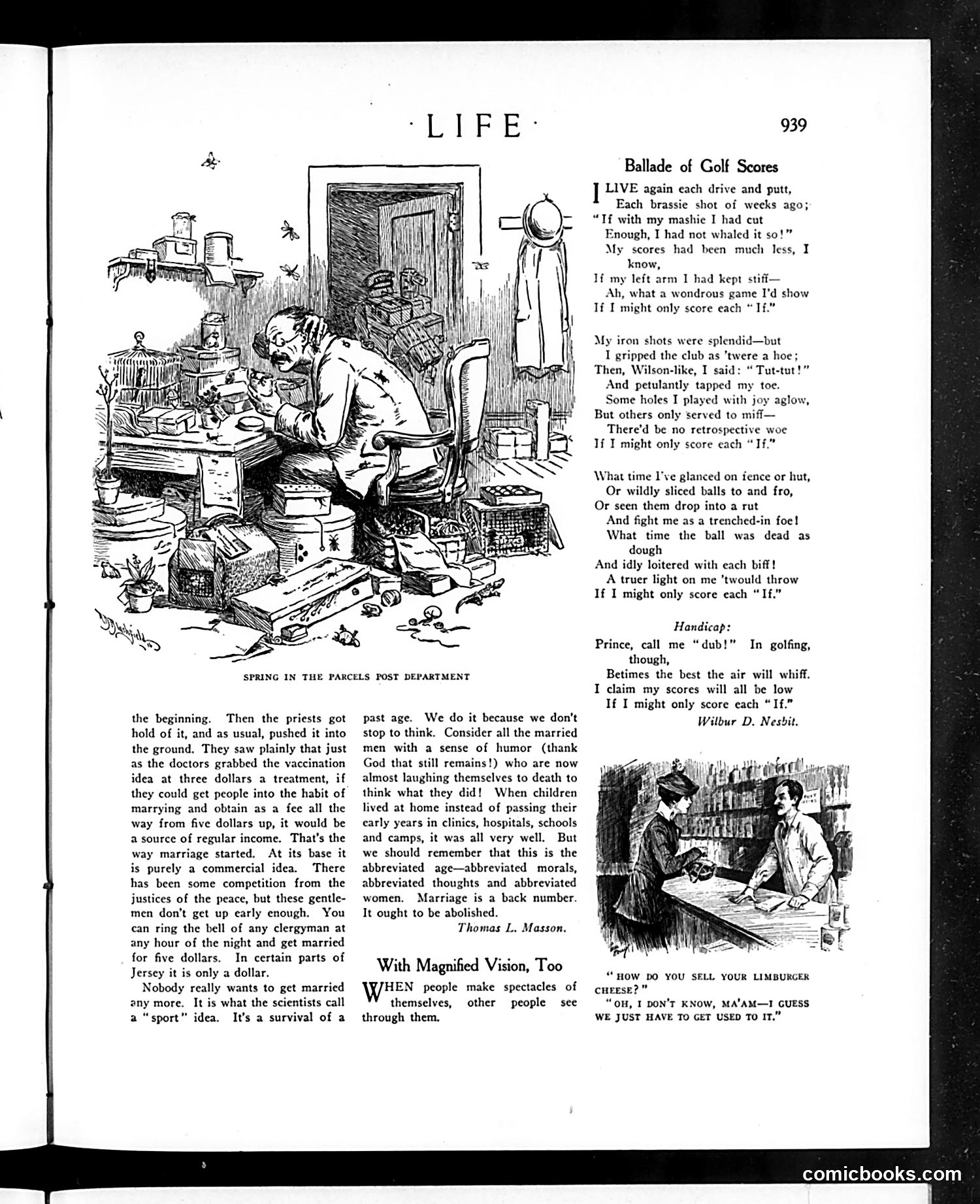
This cartoon satirizes the U.S. Parcels Post system, likely from the early 1900s when this service was new. The illustration shows a postal worker overwhelmed by an enormous pile of parcels, packages, and mail in chaotic disarray around his desk. The joke appears to target the inefficiency or chaos of the newly-established Parcels Post—the worker is literally buried under the volume of packages. "Spring" suggests seasonal increase in mail volume, but the cartoon implies the system itself is fundamentally unmanageable. The accompanying text discusses marriage as a commercial transaction, unrelated to the cartoon's visual humor about postal system mismanagement.
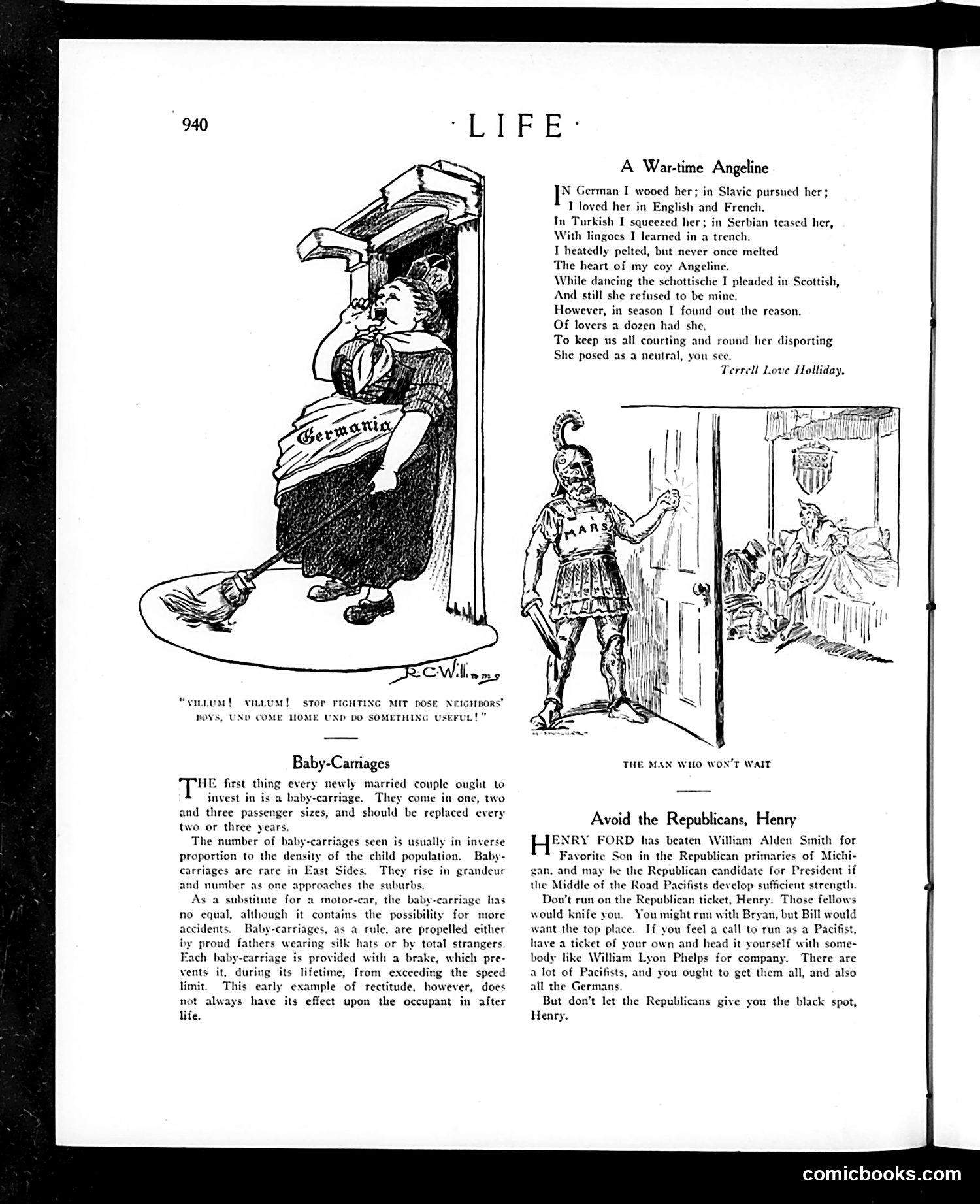
**Top Cartoon:** A German woman ("Germania") being swept by a broom while speaking broken English with a German accent, telling boys to stop fighting neighbors and do something useful. This satirizes German immigrants during World War I, mocking both their accent and the stereotype that German-Americans sympathized with Germany rather than America. **"A War-time Angeline" Poem:** A humorous account of a woman who flirted with soldiers from multiple nations (German, Slavic, Turkish, Serbian, Scottish) during WWI, but refused commitment to any. The joke: she was actually a "neutral" playing multiple suitors simultaneously—likely mocking Switzerland's neutrality or women accused of divided loyalties during wartime. **"Baby-Carriages" Section:** Domestic satire about the class implications of baby carriages, noting they're rare in poor urban areas but common in wealthy suburbs. **"Avoid the Republicans, Henry":** Political commentary advising Henry Ford not to run as a Republican presidential candidate, suggesting Republicans would betray him, and recommending instead a Pacifist ticket—reflecting 1916 pre-WWI isolationist politics.
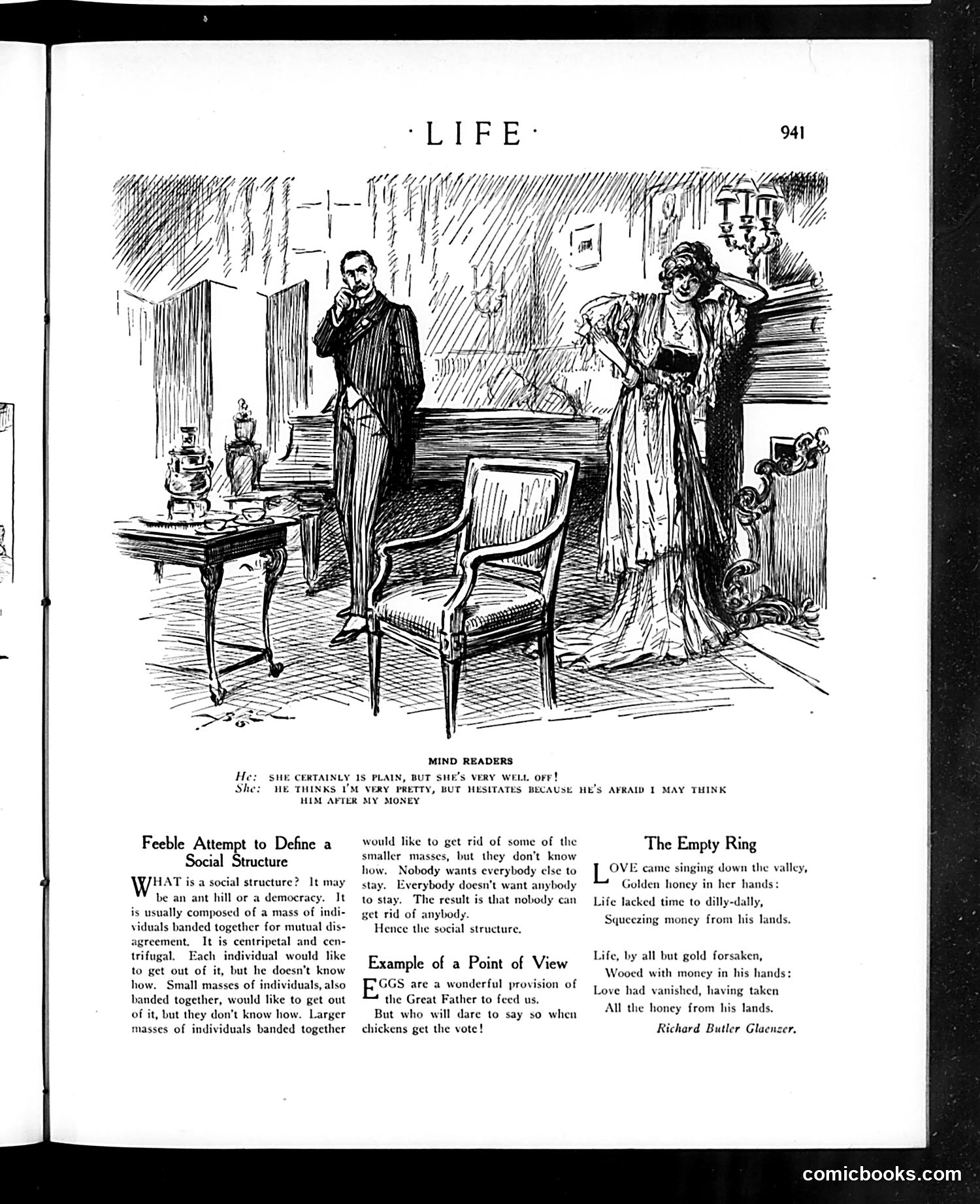
The top cartoon satirizes romantic courtship and mercenary motives. A well-dressed couple engages in mutual suspicion: he assumes she's plain but marrying for money; she thinks he's handsome but fears he's after her wealth. The joke reveals how both parties suspect the *other* of gold-digging—a common anxiety among the wealthy middle class about romantic sincerity. Below, three brief satirical pieces mock social pretension and logic: 1. **"Social Structure"** parodies pseudo-intellectual definitions by comparing society to an ant hill, then ironically concluding that despite everyone wanting to leave or exclude others, no one can actually escape—a darkly comic view of social obligation. 2. **"Point of View"** jokes that chickens getting voting rights would make eating eggs morally complicated—absurdist humor about democratic expansion. 3. **"The Empty Ring"** is a melancholic poem about a marriage where Love exchanges passion for Money, ultimately losing authenticity—critiquing materialistic marriage. All reflect early 20th-century anxieties about wealth, class, and authentic human connection.
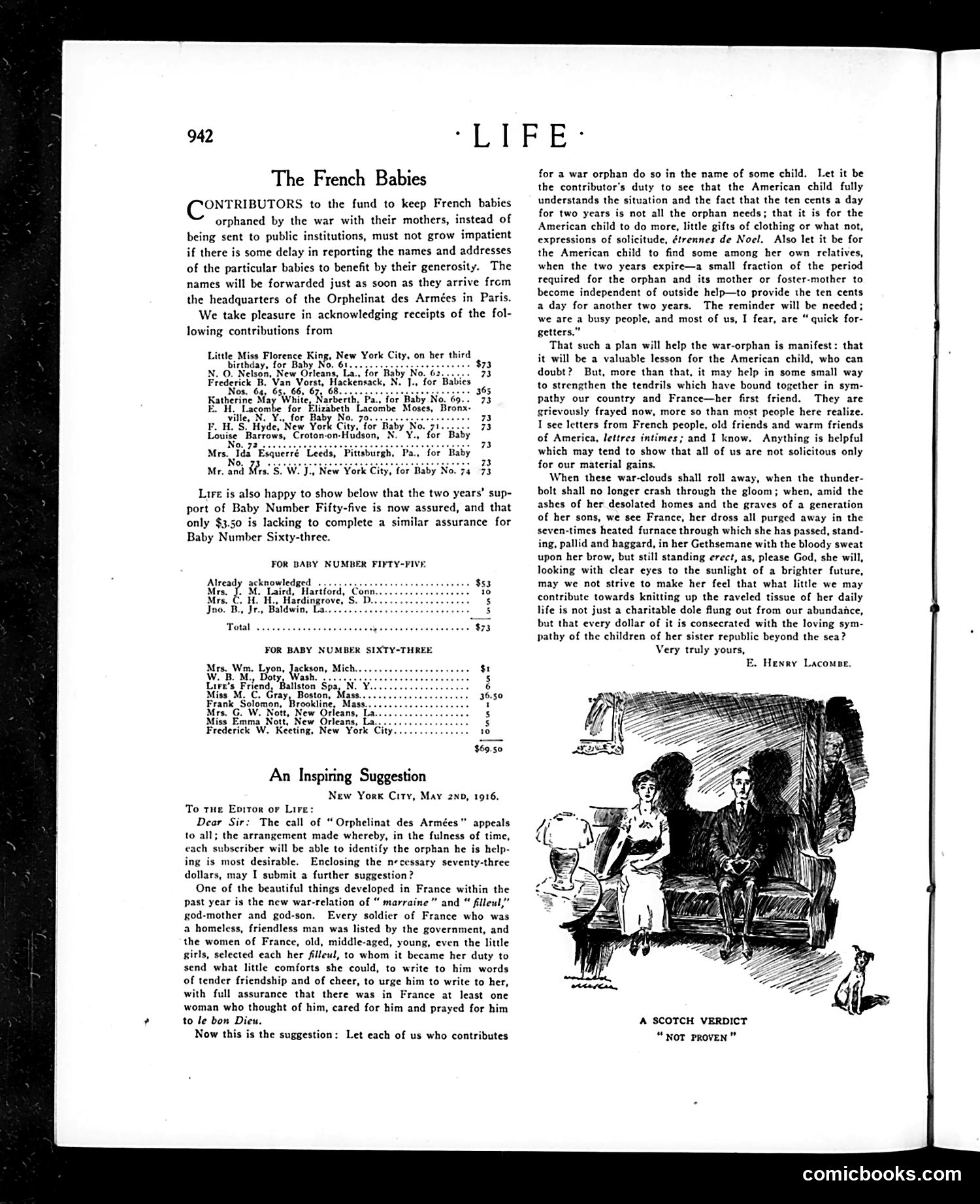
This cartoon illustrates the article's discussion of Franco-American relations during World War I. The sketch shows what appears to be a courtroom or official proceeding, with figures in formal dress examining or questioning someone—likely representing the symbolic "trial" of American commitment to French war relief. The title "Not Proven" references Scottish legal tradition, where a verdict can be "not guilty," "guilty," or "not proven" (meaning insufficient evidence). The cartoonist sardonically applies this to America's charitable response to French war orphans: Americans claim to support France, their "first friend," but the evidence of actual, sustained commitment remains uncertain or unproven. The surrounding text emphasizes that American contributors often give generously but briefly, then forget their obligations—"quick forgetters," as the editor notes. The cartoon thus critiques American good intentions that lack follow-through, particularly regarding the two-year sponsorship program for French orphans.
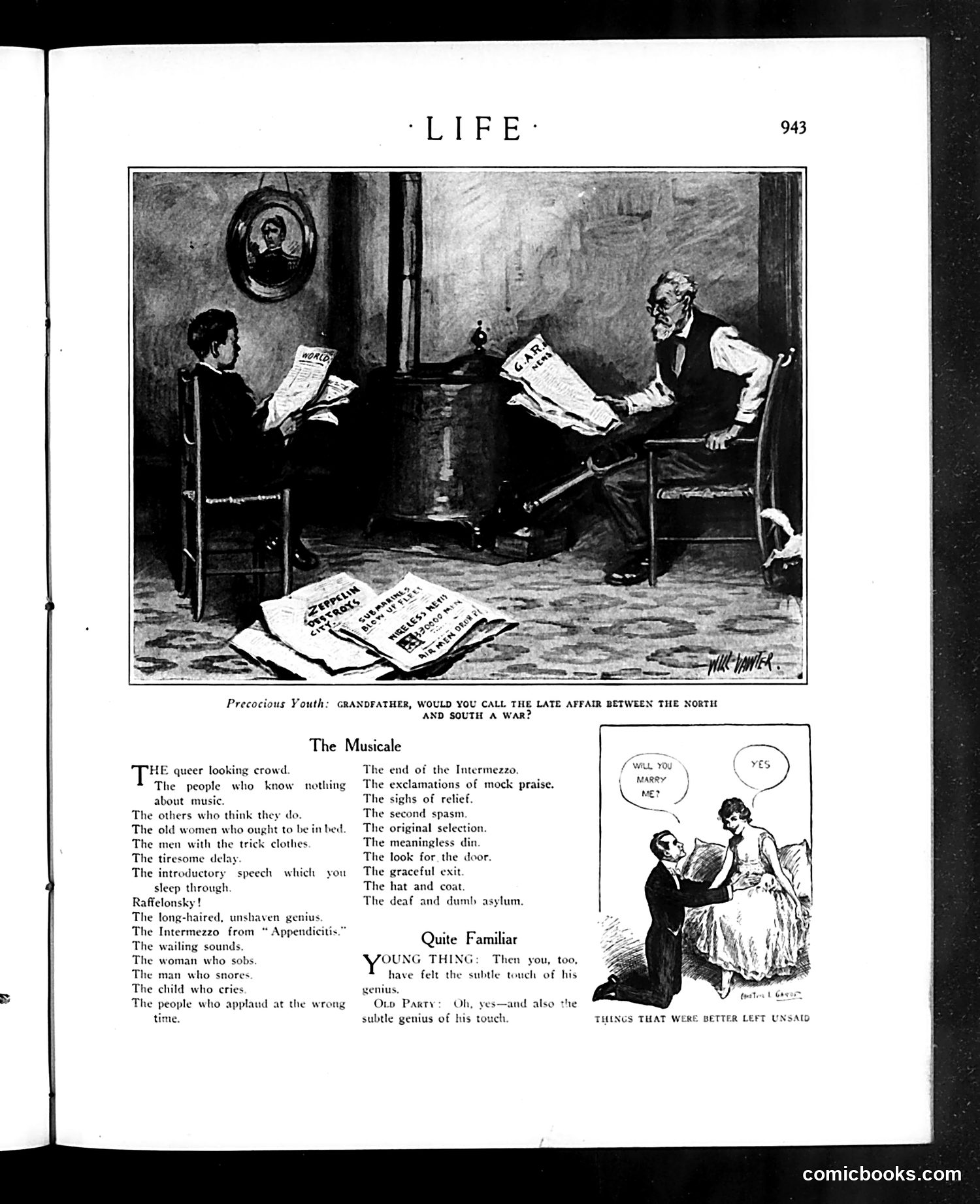
**Top Cartoon**: A child asks a grandfather whether to call the Civil War a "war." The satire mocks adults who euphemistically avoid naming historical conflicts—here, the grandfather and child both read newspapers about the subject while apparently dodging direct discussion of it. It's commentary on evasive language around serious national trauma. **"The Musicale"**: A satirical list mocking pretentious concert-goers. It catalogs the absurdities of classical music performances: people who don't understand music but pretend to, bored elderly attendees, the tedious introductory speech, fake praise, and the relief when it ends. The reference to "Raffelonsky" and "Appendicitis" appears to mock obscure or absurd modernist composition. **"Quite Familiar"**: A brief comic dialogue where a young woman and older party member flirtatiously exchange compliments about each other's "subtle touch of genius"—innuendo that becomes awkward. The title suggests this is a tired, predictable social interaction better left unspoken. All three pieces target social pretension and uncomfortable truths people avoid addressing directly.
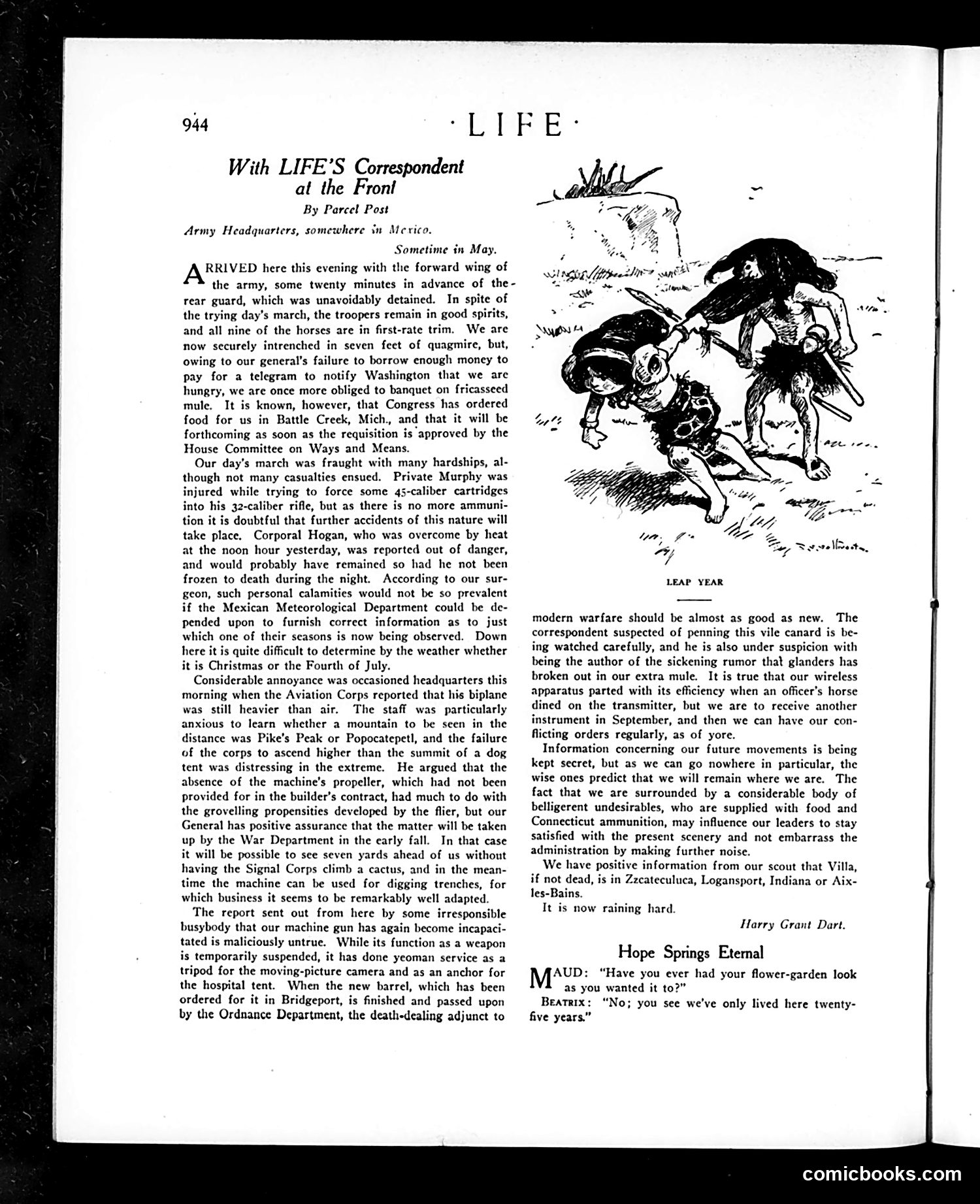
This page satirizes American military inefficiency during what appears to be the Mexican campaign (referenced as "somewhere in Mexico"). The correspondent's "letter from the front" uses deadpan humor to expose chronic failures: troops eating "fricasseed mule" because the general failed to telegraph Washington for proper rations; soldiers freezing and overheating due to unpredictable weather; an Aviation Corps biplane that can't fly because its propeller was never included in the original contract; a machine gun that doesn't function as a weapon but serves as a tent pole; wireless equipment destroyed when a horse ate the transmitter. The cartoon (titled "LEAP YEAR," showing a mule carrying supplies) visualizes the absurd reliance on inadequate pack animals. The satire targets military bureaucracy, poor logistics, incompetent leadership, and the contrast between official military competence and actual field reality. The tone suggests American readers should recognize these failures as unacceptable for a major power.
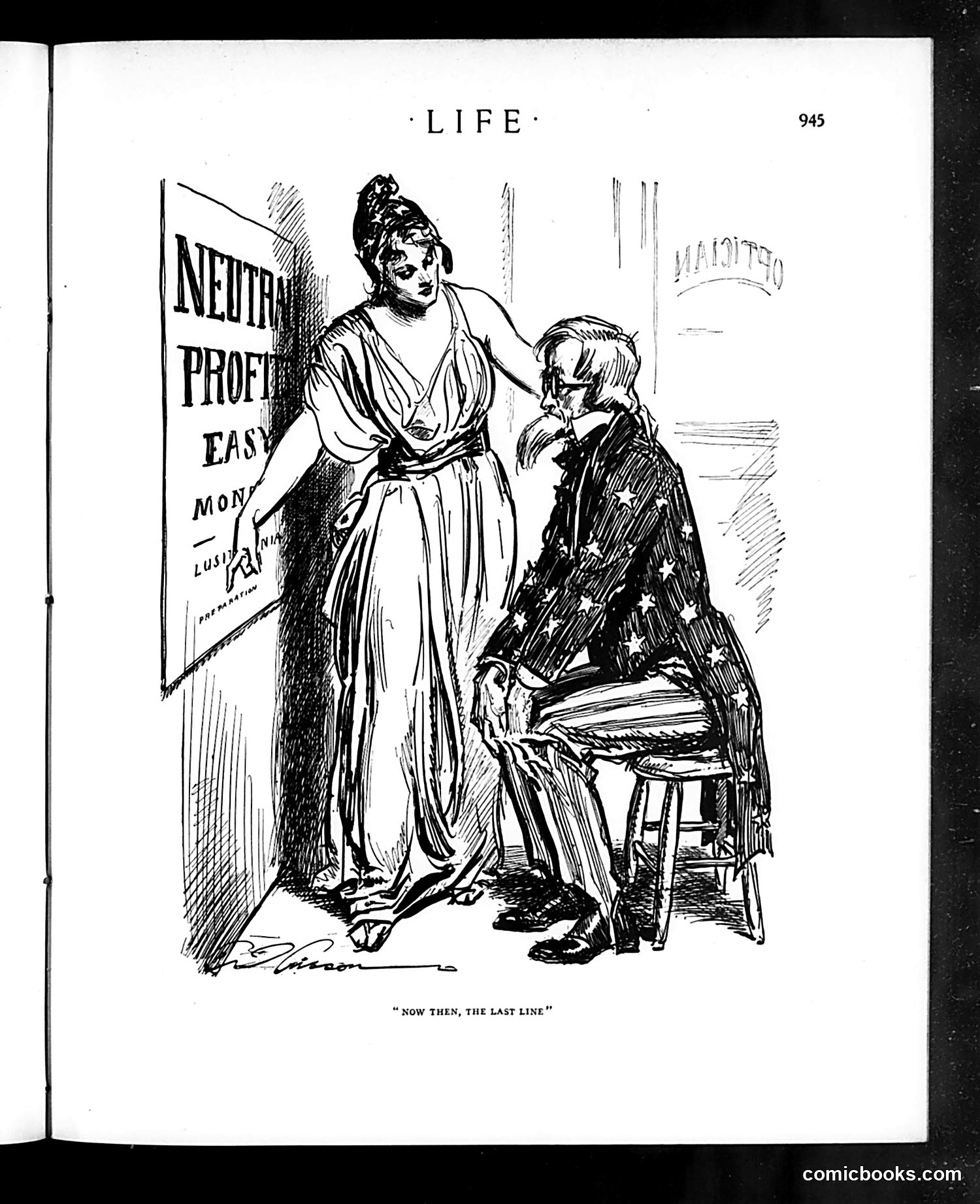
This Life magazine cartoon depicts a woman pointing to a sign advertising "NEUTRAL PROFIT EASY MONEY" while addressing a seated man in a star-patterned outfit (suggesting Uncle Sam or American authority). The caption "Now Then, The Last Line" suggests she's presenting a final argument or appeal. The satire appears to target wartime profiteering or neutral-country financial exploitation—likely referencing America's commercial dealings during a period of declared neutrality (possibly WWI era). The woman represents commercial interests or temptation, while the man represents American government neutrality policy. The cartoon mocks the contradiction between official neutrality and the profit motive, suggesting that financial incentives undermine stated political positions. The "last line" implies this is the final persuasive argument before neutrality is abandoned.
This page addresses the submarine warfare crisis between the U.S. and Germany. The small cartoon (upper left) appears to show figures in distress, likely representing the tension over German U-boat attacks on merchant and passenger ships. The main article discusses Germany's May 4th communication pledging to warn merchant vessels before sinking them—a response to American diplomatic pressure threatening to sever relations. The text expresses skepticism about Germany's promises, noting the U.S. remains "on the brink of war" with Germany. The article presents a precarious diplomatic situation: Germany claims restraint, but the author doubts it will last. The piece also analyzes Germany's war position—exhausted, unable to decisively defeat France at Verdun, and facing food shortages—suggesting Germany both wants peace and lacks confidence in victory. This reflects pre-1917 American neutrality debates and growing concerns about submarine warfare, particularly following the *Lusitania* sinking in 1915.
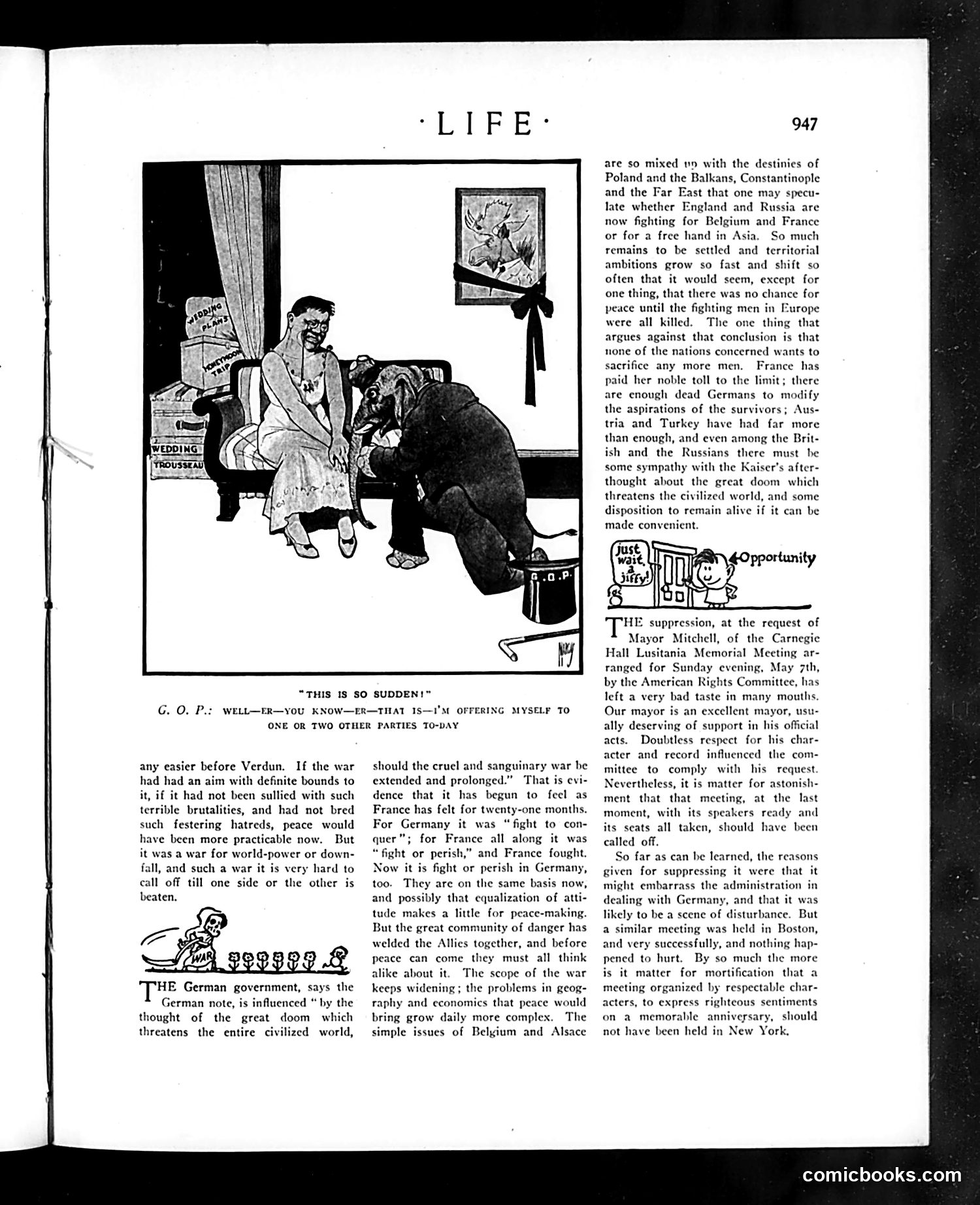
The main cartoon depicts the Republican Party (labeled "G.O.P.") as a woman in a wedding dress, awkwardly proposing to other political parties. The figure sits holding a "Wedding Trousseau" bag, offering herself to "one or two other parties to-day." This satirizes Republican political desperation during what appears to be WWI-era American politics. The cartoonist mocks the GOP's apparent willingness to align with competing parties, suggesting internal weakness or loss of political principle. The bride imagery emphasizes the absurdity and shamelessness of the proposal. The surrounding text discusses broader WWI peace negotiations and Mayor Mitchell's controversial suppression of a Lusitania Memorial Meeting at Carnegie Hall—an event meant to commemorate the 1915 ship sinking. The mayor's censorship is criticized as cowardly and unworthy of New York, suggesting the suppression was politically motivated rather than justified.
The OCR text is corrupted and unreadable, so I must rely on the image alone. This appears to be a medieval or fantasy-themed illustration showing a military or courtly scene. The image depicts armored figures in the foreground (lower portion) observing a mounted procession or army in the background. Flags and banners are visible among what appear to be soldiers or knights. The artistic style and composition suggest this may be illustrating a historical narrative or satirical commentary about aristocratic or military affairs. However, **without legible text or clearer context, I cannot definitively identify the specific figures, historical events, or satirical points being made.** The page header reads "LIFE," confirming this is from the satirical magazine, but the specific cartoon's subject and intent remain unclear from the image alone.
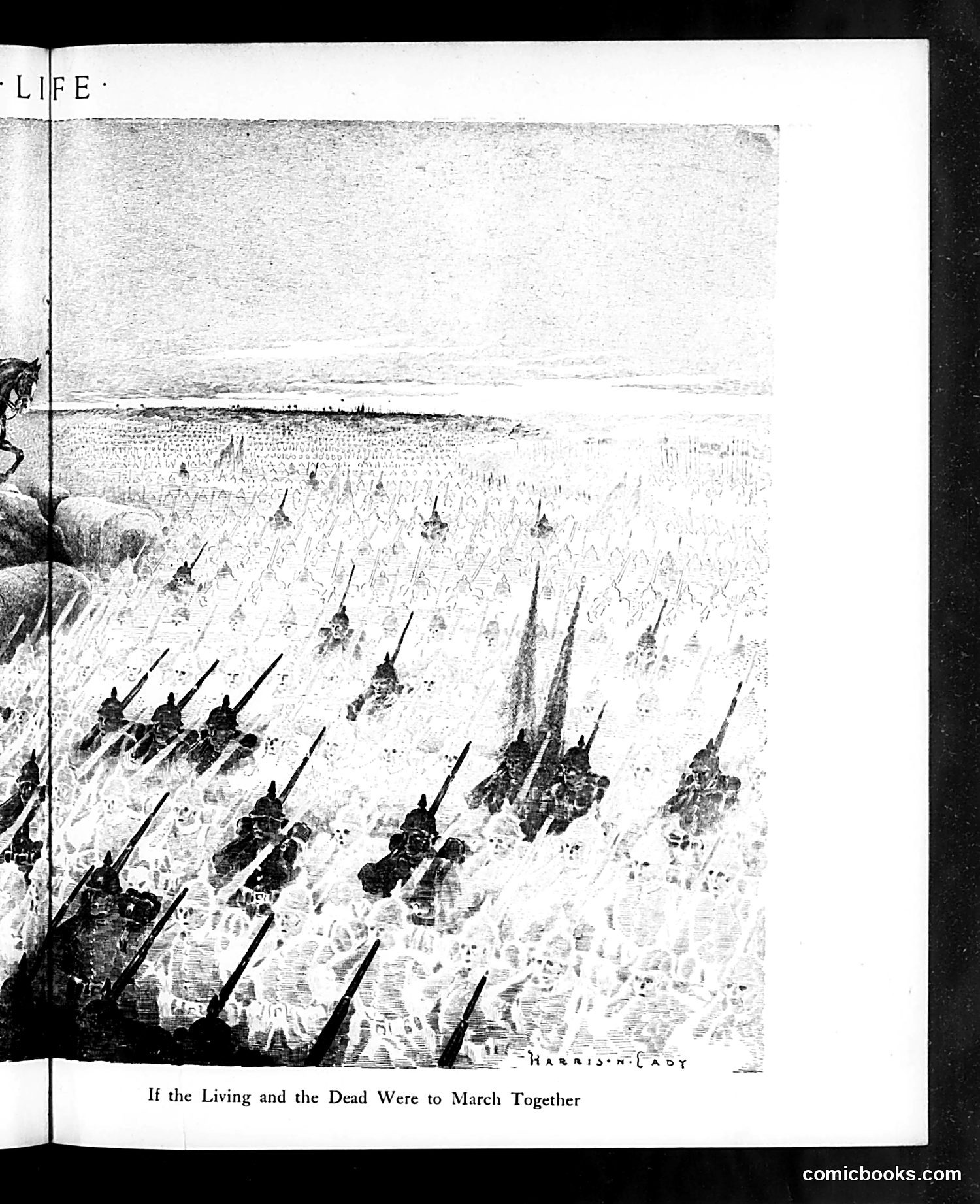
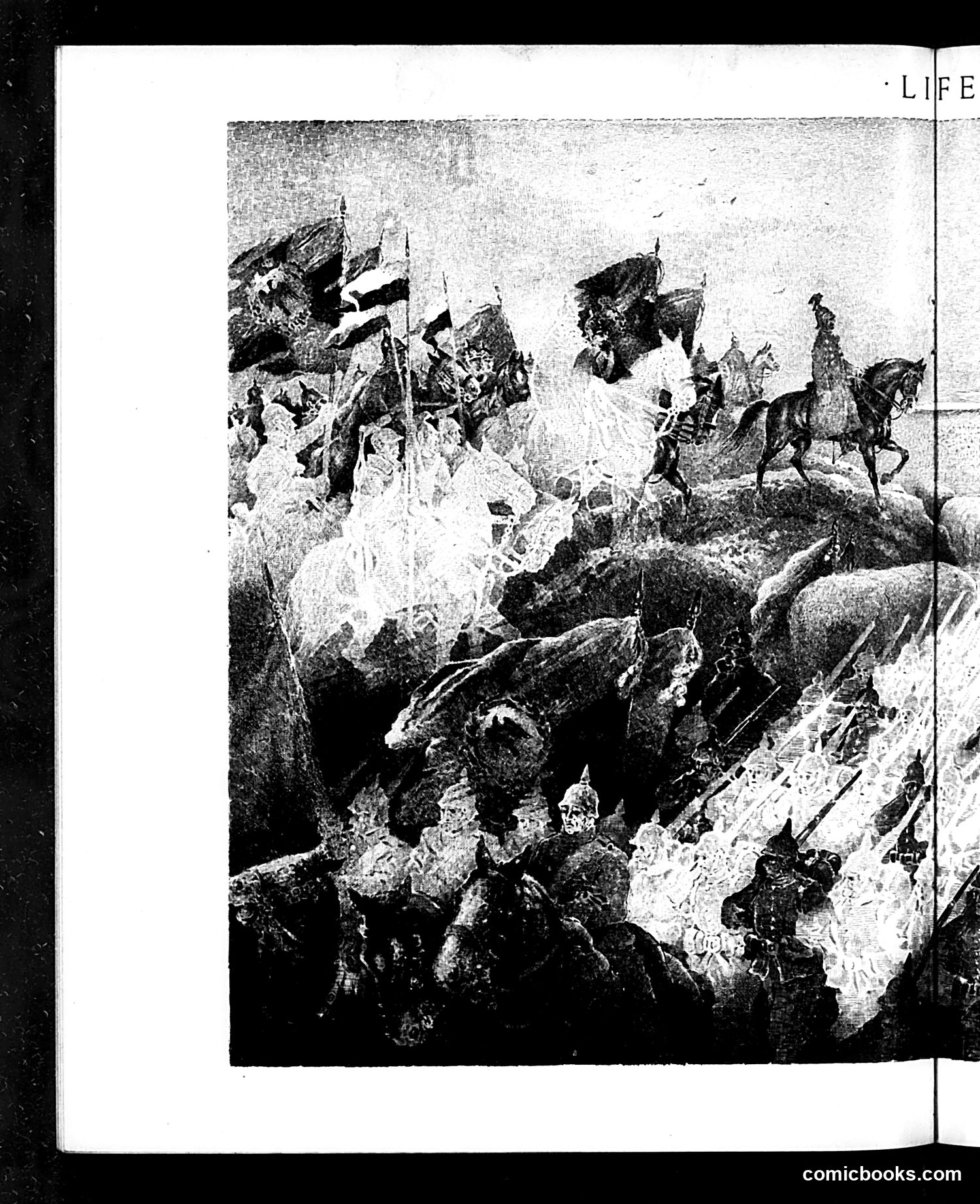
This is a wartime editorial illustration by Harrison Cady showing military figures in formation marching through snow. The caption "If the Living and the Dead Were to March Together" suggests a grim commentary on war casualties. The image depicts soldiers in disciplined ranks advancing across a snowy landscape—likely referencing World War I or II combat. The dark figures with bayoneted rifles create a stark visual of organized military force. The satire's point appears to be bitter social commentary: the caption implies that if fallen soldiers ("the Dead") could rejoin the living in formation, the marching ranks would be vastly larger, emphasizing the massive human cost of war. It's a stark anti-war or war-critical statement using the visual metaphor of combined living and deceased soldiers to highlight casualty tolls.
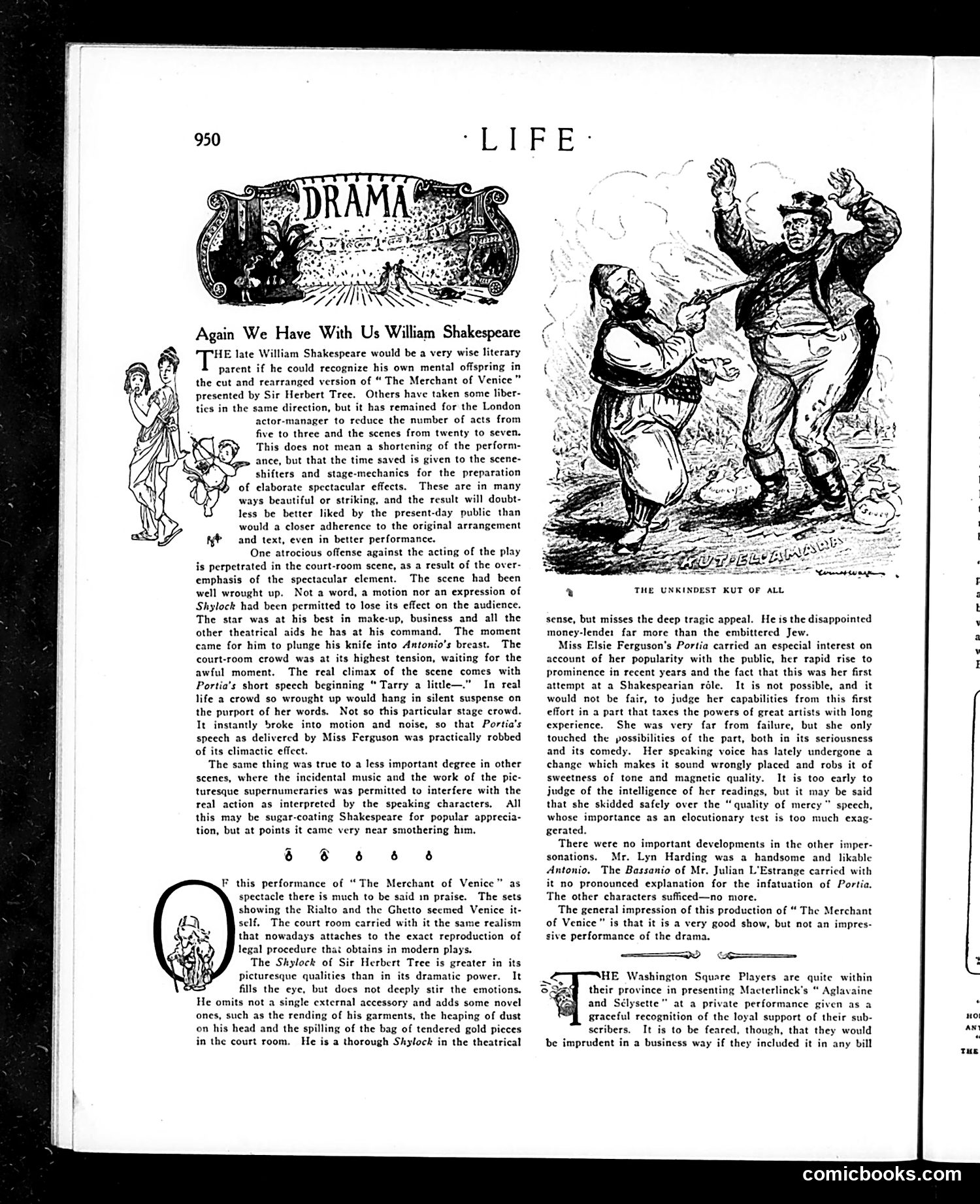
This is a theater review critiquing Sir Herbert Tree's production of Shakespeare's *The Merchant of Venice*. The cartoon titled "The Unkindest Kut of All" (visible on the right) depicts a figure being stabbed, likely referencing Shylock's knife attack on Antonio—the play's climactic moment. The review's satire targets Tree's directorial choices: he reduced the five-act play to three acts and twenty scenes to seven, not to shorten performance time, but to allow more time for elaborate scenic effects and stage machinery. The critic argues this "sugar-coats Shakespeare for popular appreciation" and actually undermines the drama. The review particularly criticizes Tree's performance as Shylock for emphasizing theatrical spectacle and external details (costume business, stage effects) over genuine emotional depth and tragic power. It also notes Miss Elsie Ferguson's capable but somewhat limited debut as Portia. The central complaint: prioritizing visual grandeur and mechanical effects drowns out the actors and Shakespeare's actual dramatic impact.
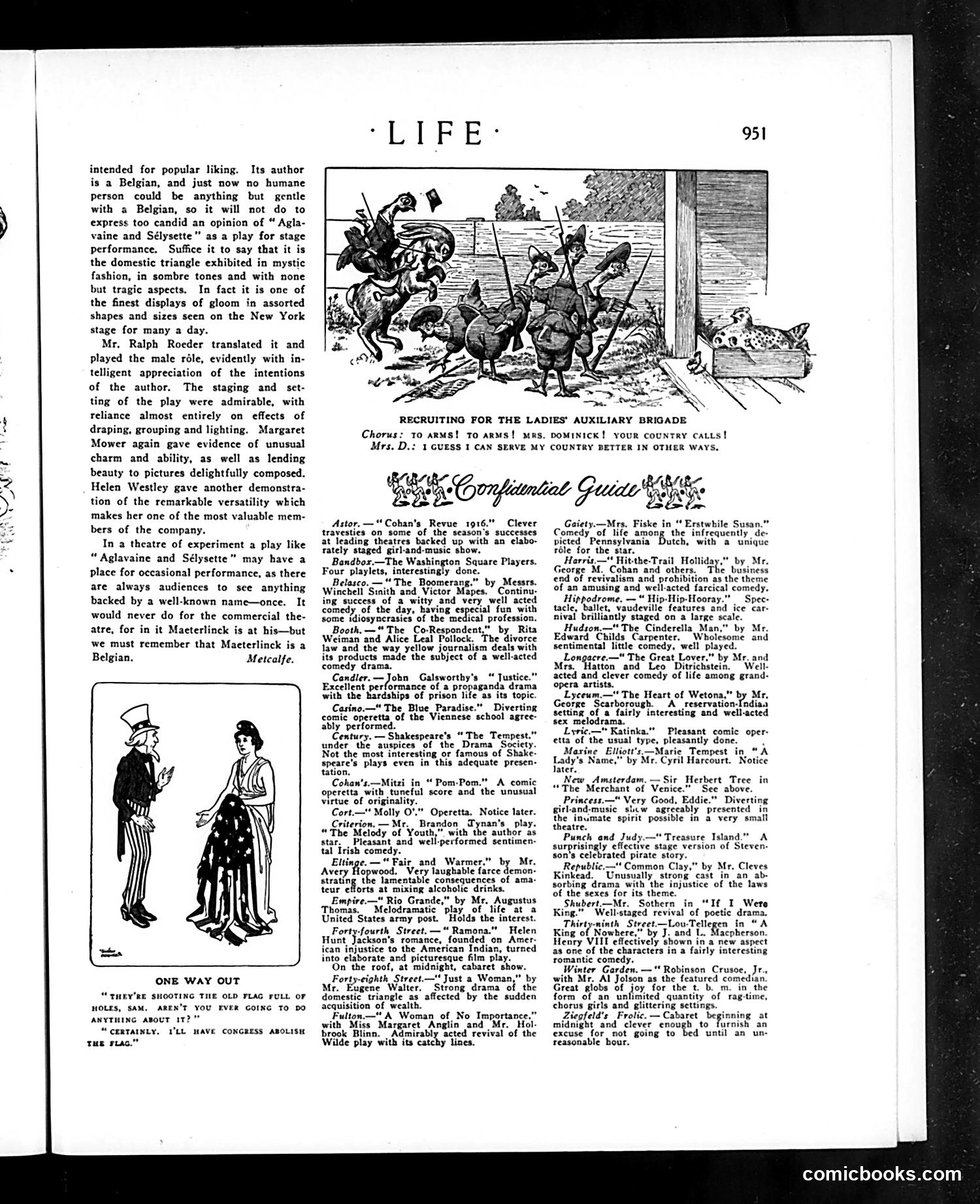
This page combines theater reviews with two cartoons satirizing WWI-era American attitudes. **"One Way Out"** (top left): A man complains that the American flag is being "shot full of holes," asking his companion Sam what he'll do about it. Sam's absurd solution—"I'll have Congress abolish the flag"—mocks defeatist or isolationist attitudes toward war damage, suggesting that avoiding the problem entirely is cowardly. **"Recruiting for the Ladies' Auxiliary Brigade"** (center): A woman is asked to join military service, responding she can "serve my country better in other ways." This satirizes women reluctant to support the war effort, implying their domestic role is insufficient patriotic contribution during wartime. Both cartoons use humor to pressure American civilian support for WWI, which the U.S. officially entered in 1917. The page's theater reviews appear standard contemporary entertainment coverage.
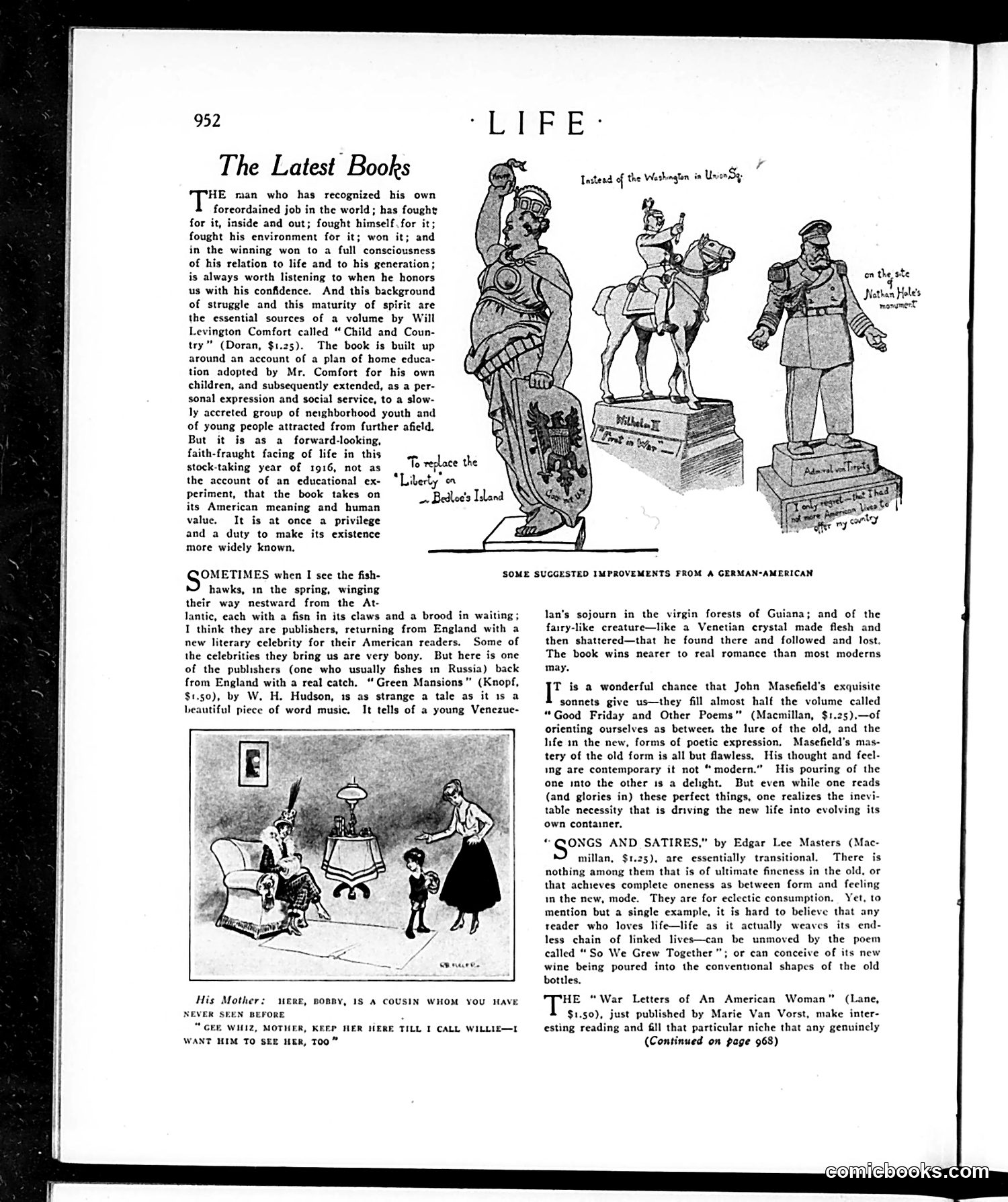
This is a book review section from Life magazine (circa 1916, based on reference to "stock-taking year of 1916"). The page reviews several newly published works. The cartoon at top shows German-American figures presenting "improvements" to American monuments—a satirical jab at German-American cultural influence during WWI tensions. The statue labeled "Nathan Hale's Monument" appears modified, likely mocking German-American attempts to reshape American identity. Below is an unrelated domestic cartoon about a child wanting his cousin to meet "Willie." The reviews themselves are straightforward literary criticism of books by W.L. Comfort, W.H. Hudson, John Masefield, and Edgar Lee Masters—praising their literary merit and contemporary relevance. The fish-hawk metaphor compares publishers to birds bringing literary "catches" from England and Russia. The satire targets German-American cultural pretensions during a period of rising anti-German sentiment in America.
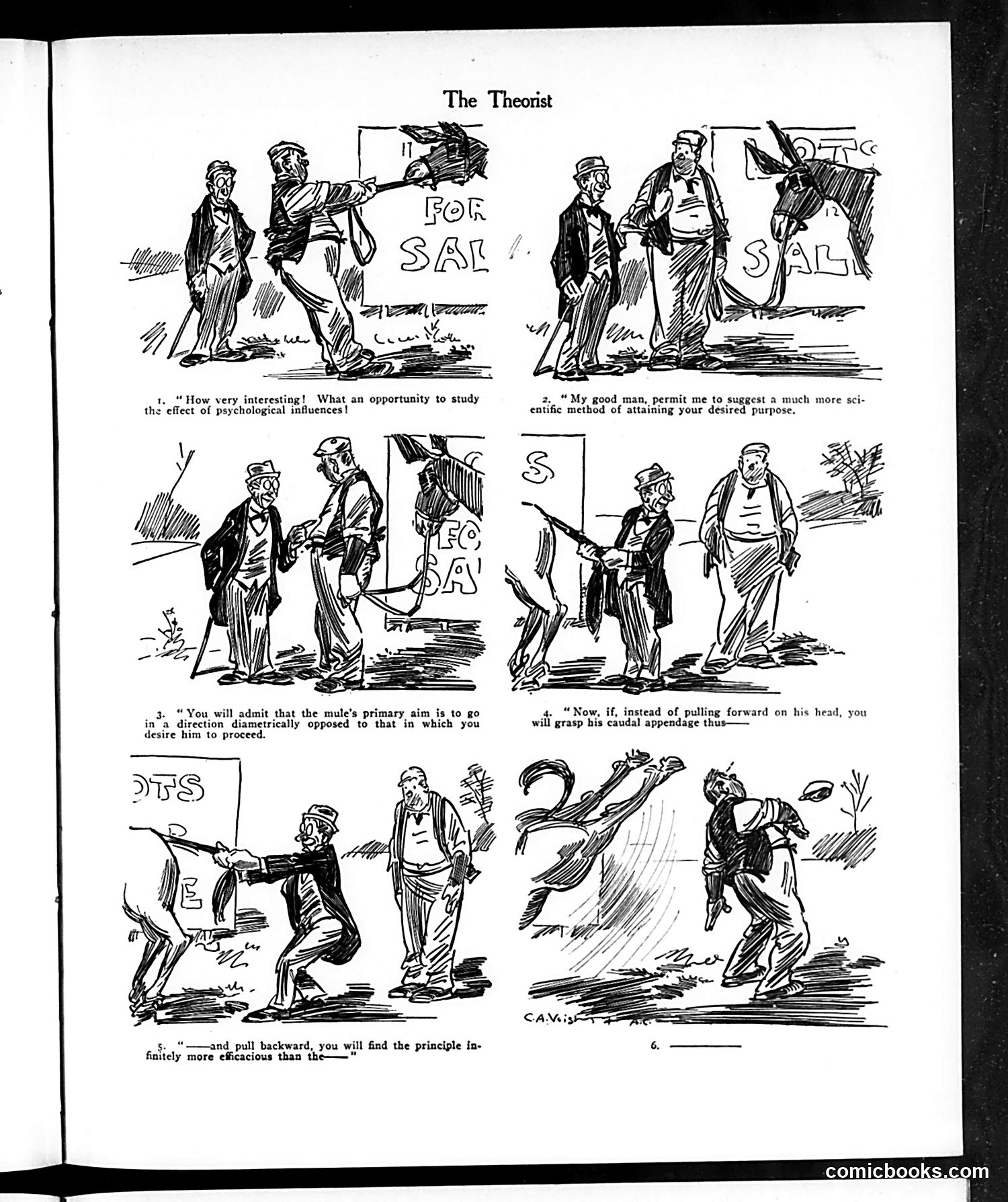
This satirical comic mocks academic over-intellectualization. It depicts a theorist attempting to move a mule using increasingly elaborate pseudo-scientific language and methods. The humor builds across panels: the theorist initially observes the mule's stubborn behavior with academic detachment (panel 1), then proposes a "scientific method" involving the mule's "caudal appendage" (tail) instead of pulling its head (panels 2-4). By panel 5, he's explaining complex principles while the mule remains unmoved. The joke is clear: the theorist uses pompous terminology ("psychological influences," "diametrically opposed," "efficacious") to describe simple concepts, yet his elaborate approach fails where direct action would succeed. This satirizes intellectuals who complicate practical problems with jargon rather than achieving results—a common target of *Life* magazine's social satire.
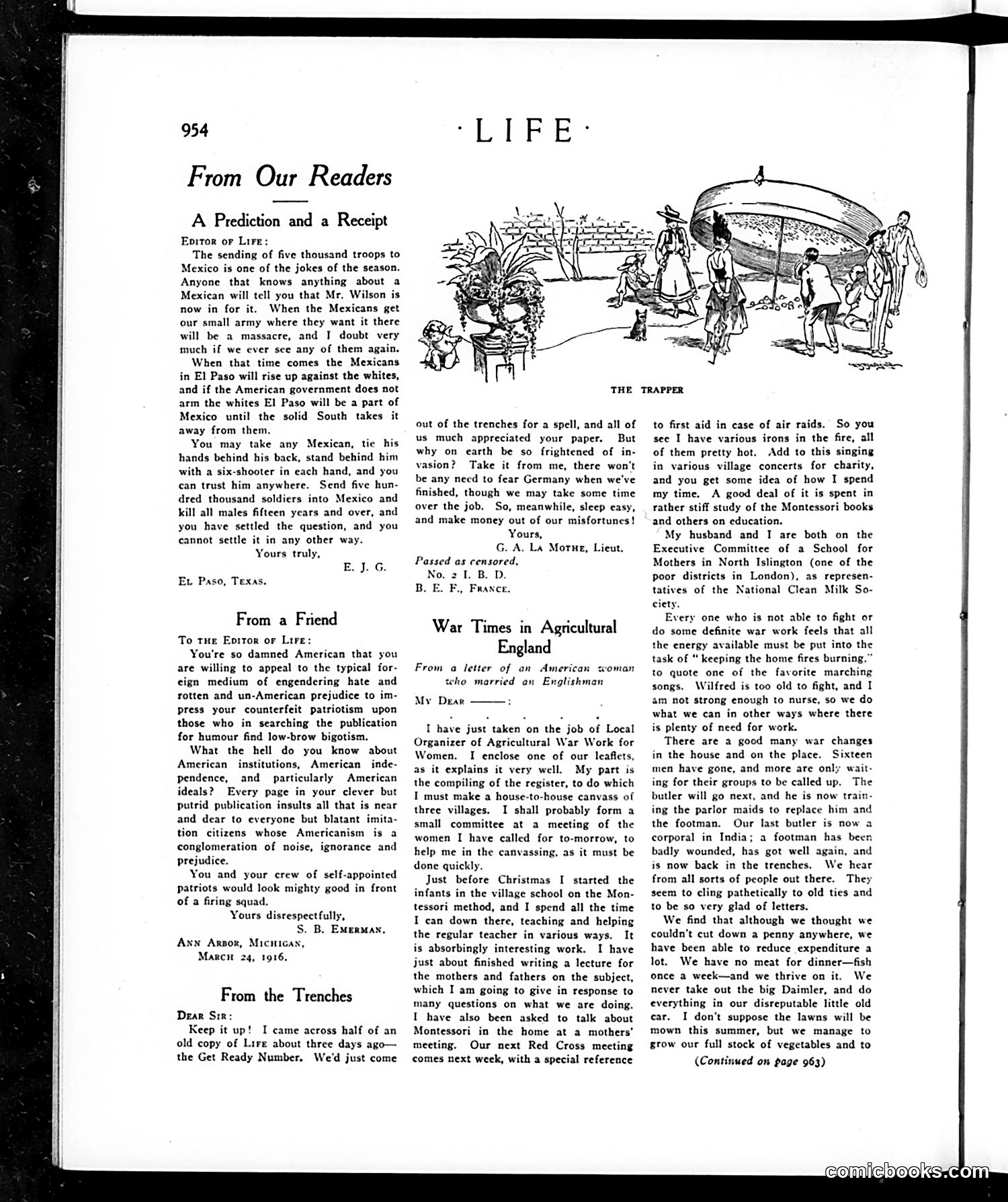
This page contains reader letters responding to Life's editorial content, primarily about U.S.-Mexico relations and World War I. **"A Prediction and a Receipt"** presents an inflammatory letter from El Paso predicting disaster if American troops are sent to Mexico—advocating instead for mass killing of Mexican males. Life published this extremist view alongside a rebuke from "A Friend," who attacks Life itself for promoting "hate and rotten and un-American prejudice" through bigoted content. **"From the Trenches"** features a British officer reassuring Americans not to fear German invasion, urging them to profit from the war instead—likely satirizing American profiteering from WWI. **"War Times in Agricultural England"** is a correspondent's account of wartime domestic work, describing village agricultural organization and Montessori education efforts—illustrating civilian contribution to the war effort. The cartoon **"The Trapper"** (illustration) remains unclear without additional context. The page reflects 1916 tensions: Mexican-American conflict, American neutrality debates, and WWI's widening impact.
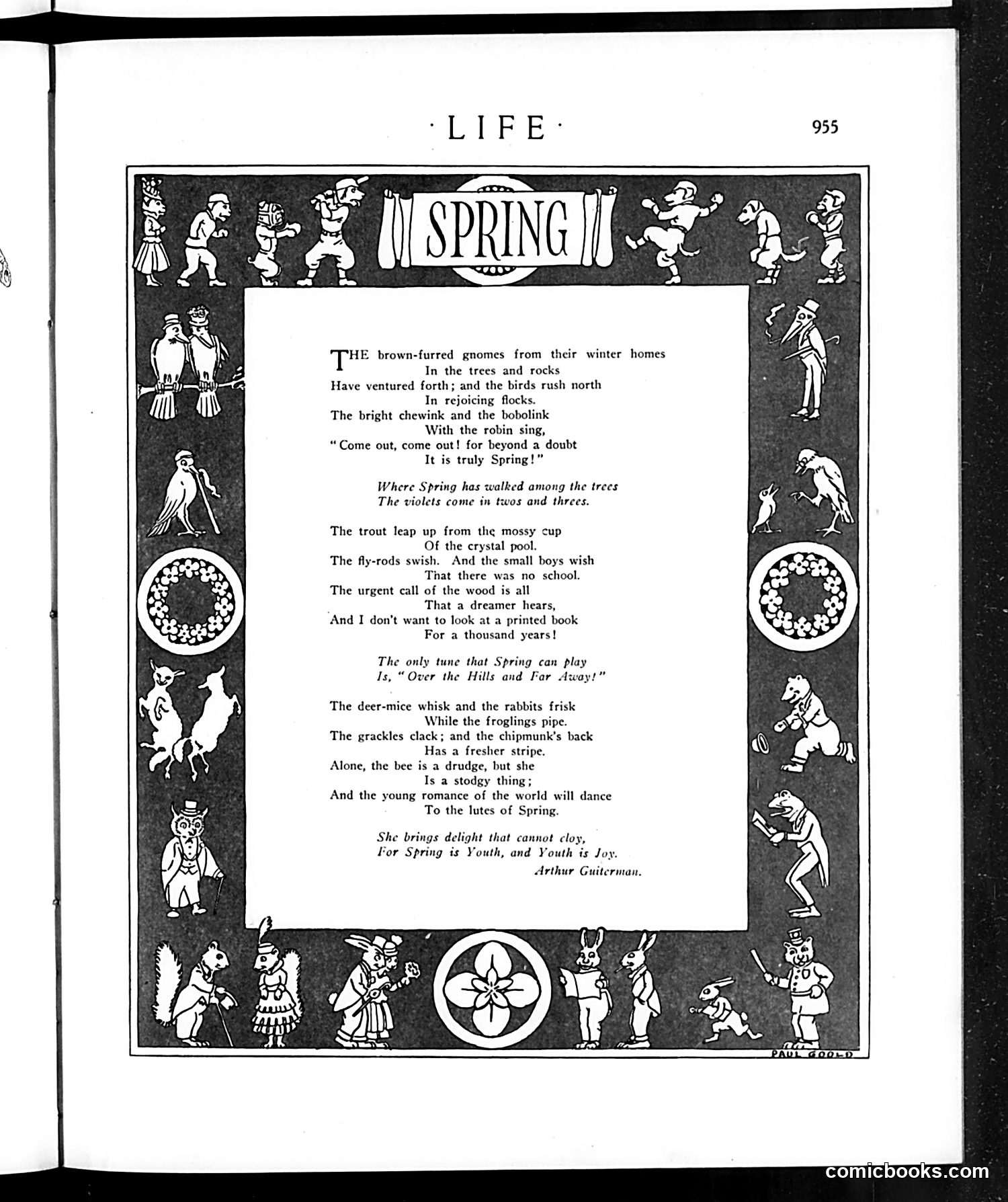
This is a decorative poem celebrating springtime, surrounded by an ornamental border of whimsical illustrations. The page contains no political satire or social commentary—it's purely celebratory verse. The poem romanticizes spring's arrival: animals emerge, birds return north, and nature awakens. A key theme is spring's irresistible call to abandon indoor life ("I don't want to look at a printed book / For a thousand years!") and schoolwork ("the small boys wish / That there was no school"). The border illustrations depict playful figures—children, animals, mythological creatures—reinforcing the season's association with youthful joy and renewal. The final lines equate Spring with Youth and Youth with Joy, making this an idealized, sentimental tribute to the season's transformative power rather than commentary on contemporary issues.
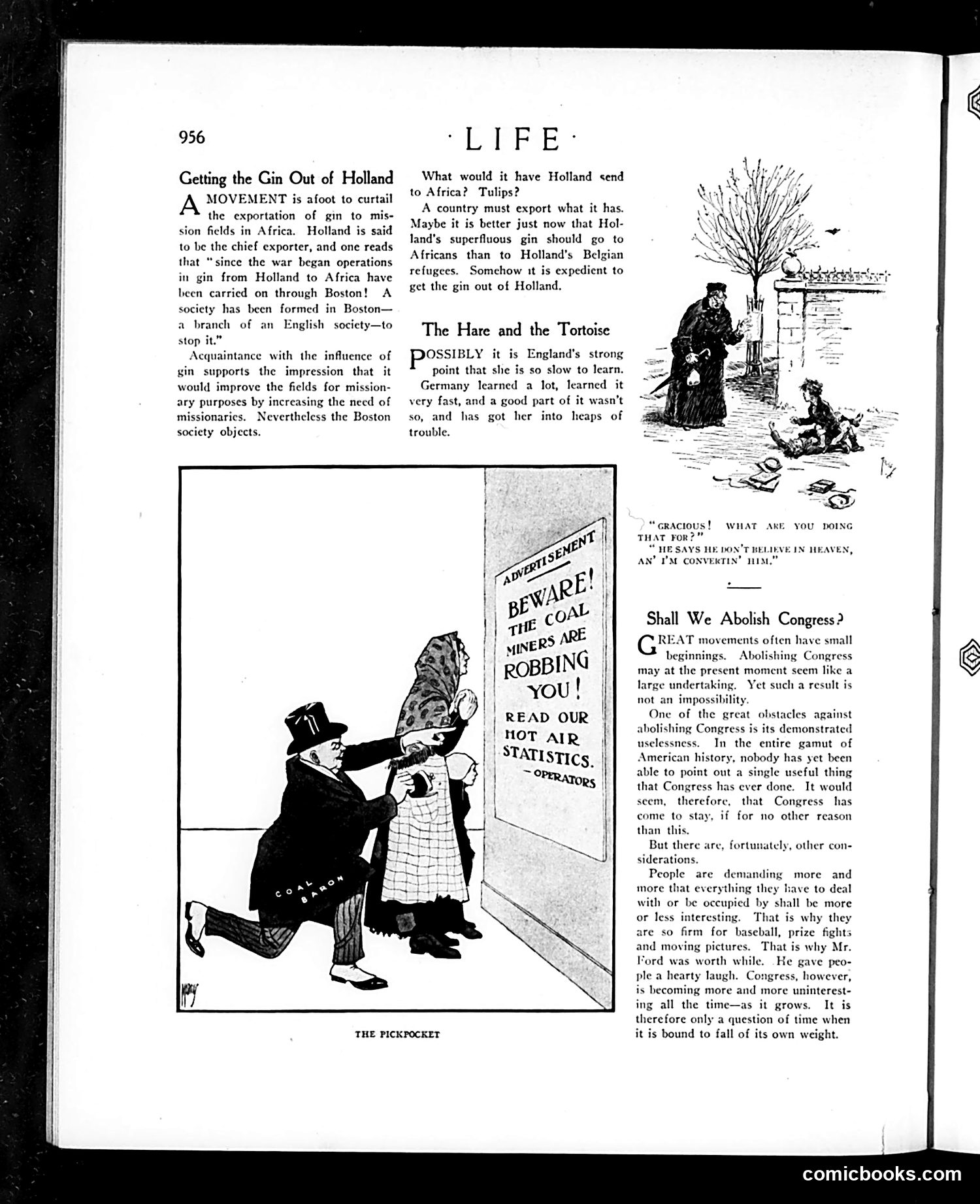
This page contains three separate satirical pieces typical of Life magazine's political humor: **"Getting the Gin Out of Holland"** mocks the temperance movement's moral crusade against Dutch gin exports to African missions. The satire suggests the reformers' logic is backwards—that gin might actually *help* missionary work by creating greater need for missionaries. The piece cynically notes Holland needs to export *something*, and perhaps gin is preferable to burdening Belgian refugees. **"The Pickpocket"** (cartoon) shows a man stealing from a woman's purse while she attempts to convert him to religion. The caption reveals his claim he doesn't believe in heaven, and she's "convertin' him"—satirizing the contradiction between professed Christian values and actual behavior. **"Shall We Abolish Congress?"** is tongue-in-cheek political satire arguing Congress should be abolished, not because it's harmful, but because it's *boring*. The author sarcastically claims Congress has never accomplished anything useful, and suggests it will eventually collapse under its own irrelevance as Americans demand entertainment over institutional governance.
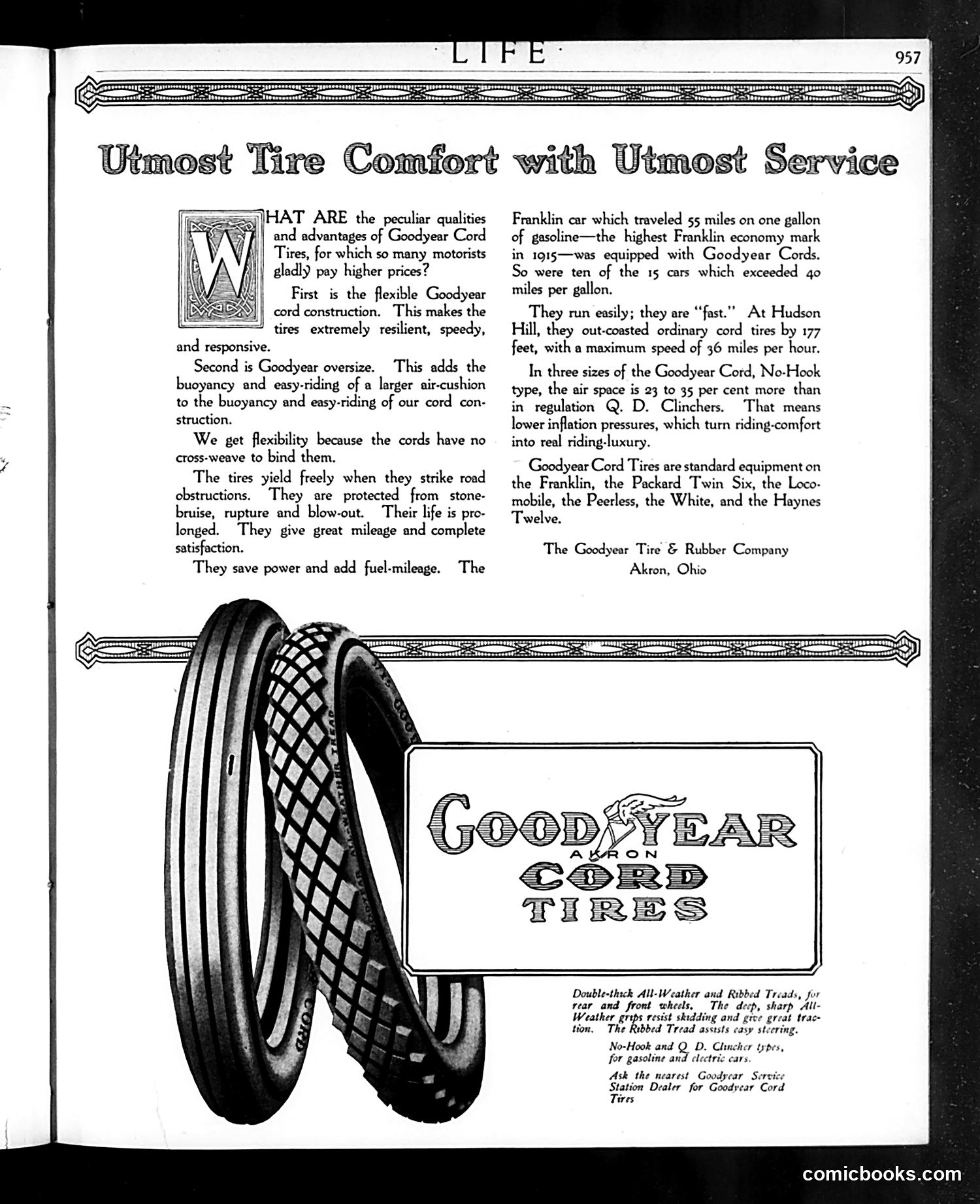
This is **not a cartoon or satire**—it's a straightforward **automobile tire advertisement** from Life magazine (page 957). The ad promotes Goodyear Cord Tires, emphasizing their superior construction and performance benefits: flexibility, durability, fuel efficiency, and comfort. It includes testimonial evidence—a Franklin car achieving 55 miles per gallon and outperforming competitors at Hudson Hill. The text lists prestigious car brands using Goodyear Cords as standard equipment: Franklin, Packard Twin Six, Locomobile, Peerless, White, and Haynes Twelve. These were luxury automobiles of the 1910s era, lending credibility through association. The visual shows two tire designs side-by-side, illustrating the cord construction and tread patterns. The Goodyear Tire & Rubber Company (Akron, Ohio) was a major manufacturer competing in the growing automotive market. This reflects early-20th-century advertising strategies: technical specifications, performance comparisons, and luxury brand endorsements targeting affluent motorists.
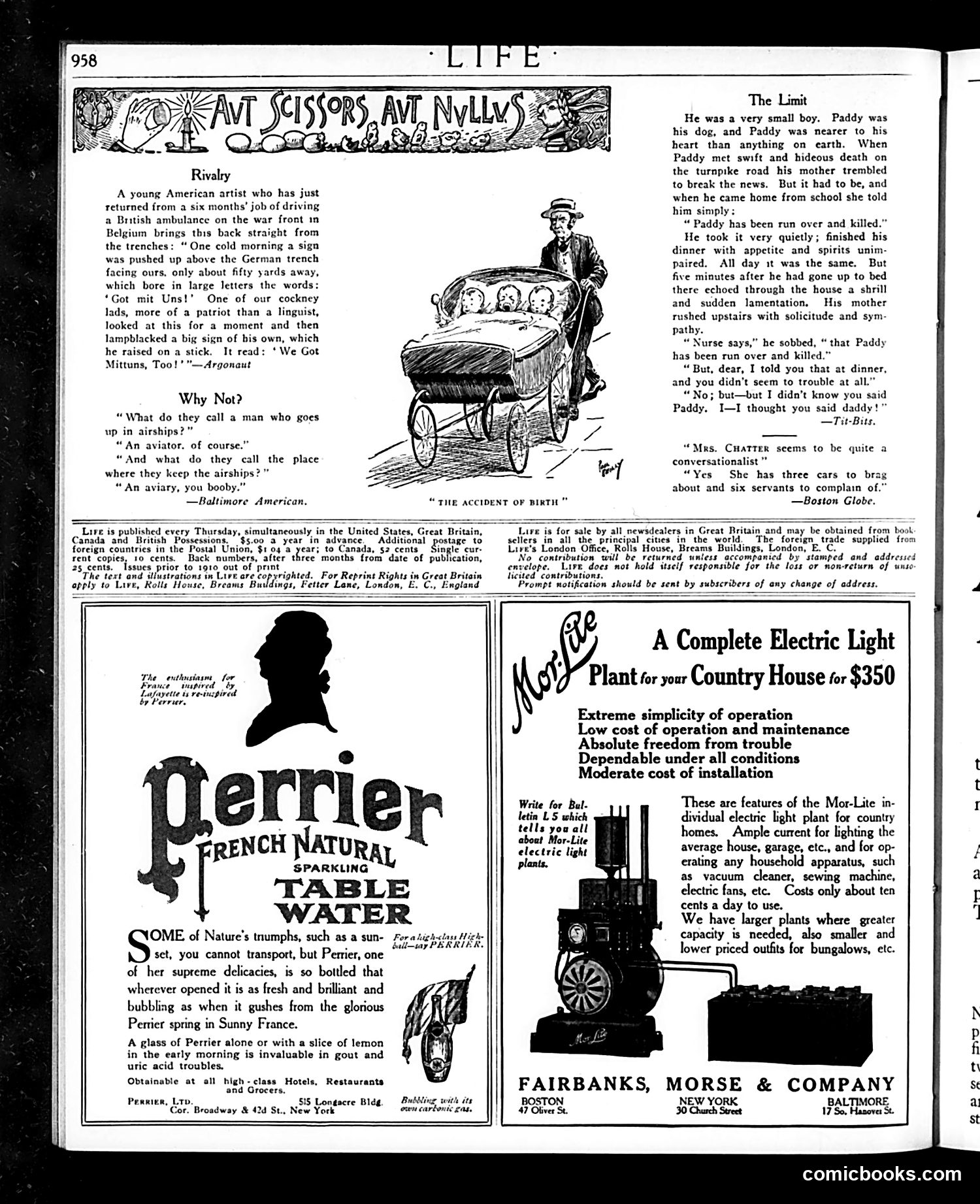
This page contains several satirical pieces and advertisements typical of Life's early 20th-century format: **The cartoons/jokes** mock wartime attitudes and domestic life. "The Accident of Birth" shows a trench-warfare anecdote where British soldiers humorously respond to a German "Got mit Uns!" ("God with us") sign with "We Got Mittuns, Too!"—a cockney soldier's intentional misinterpretation that deflates German solemnity through linguistic mishap. The other jokes target airship terminology and a child's confusion between "Paddy" (his dog) and "Daddy," exploiting the emotional gap between casual afternoon news and bedtime realization. **The advertisements** (Perrier sparkling water, Fairbanks Morse electric generators) represent typical early-1900s marketing to affluent readers, positioning luxury goods and modern conveniences as essential status markers. The page reflects wartime-era humor—particularly the gap between Germanic military propaganda and British working-class irreverence—while domestic humor emphasizes sentimental family bonds in an increasingly modernized world.
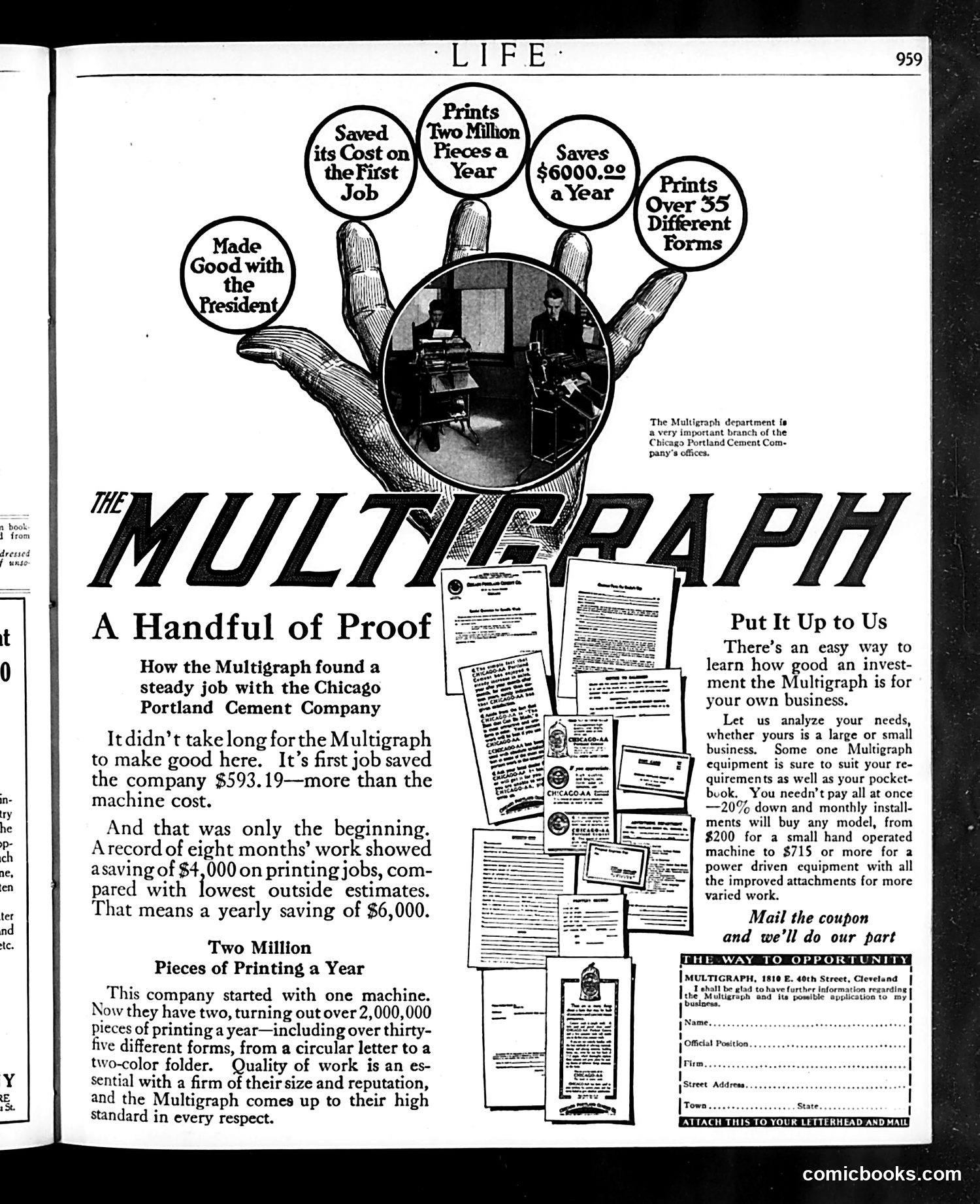
This is a **business advertisement**, not satire or political commentary. It promotes the Multigraph, a printing and duplicating machine, to early 20th-century business owners. The hand illustration at the top is a visual metaphor showing the machine's benefits as "fingers" or achievements: cost savings ($593.19 on the first job, $6,000 annually), high production volume (2 million pieces yearly), versatility (35+ forms), and endorsement from a major client (the Chicago Portland Cement Company). The accompanying photographs and sample documents demonstrate the machine's actual output quality and variety. The "Put It Up to Us" section pitches flexible payment plans ($200–$715) to make the technology accessible to small and large businesses alike. This represents early industrial marketing—using concrete data and client testimonials to convince business owners that mechanized printing would increase efficiency and reduce costs. There is no hidden satirical message; it's straightforward product promotion aimed at business readers of *Life* magazine.
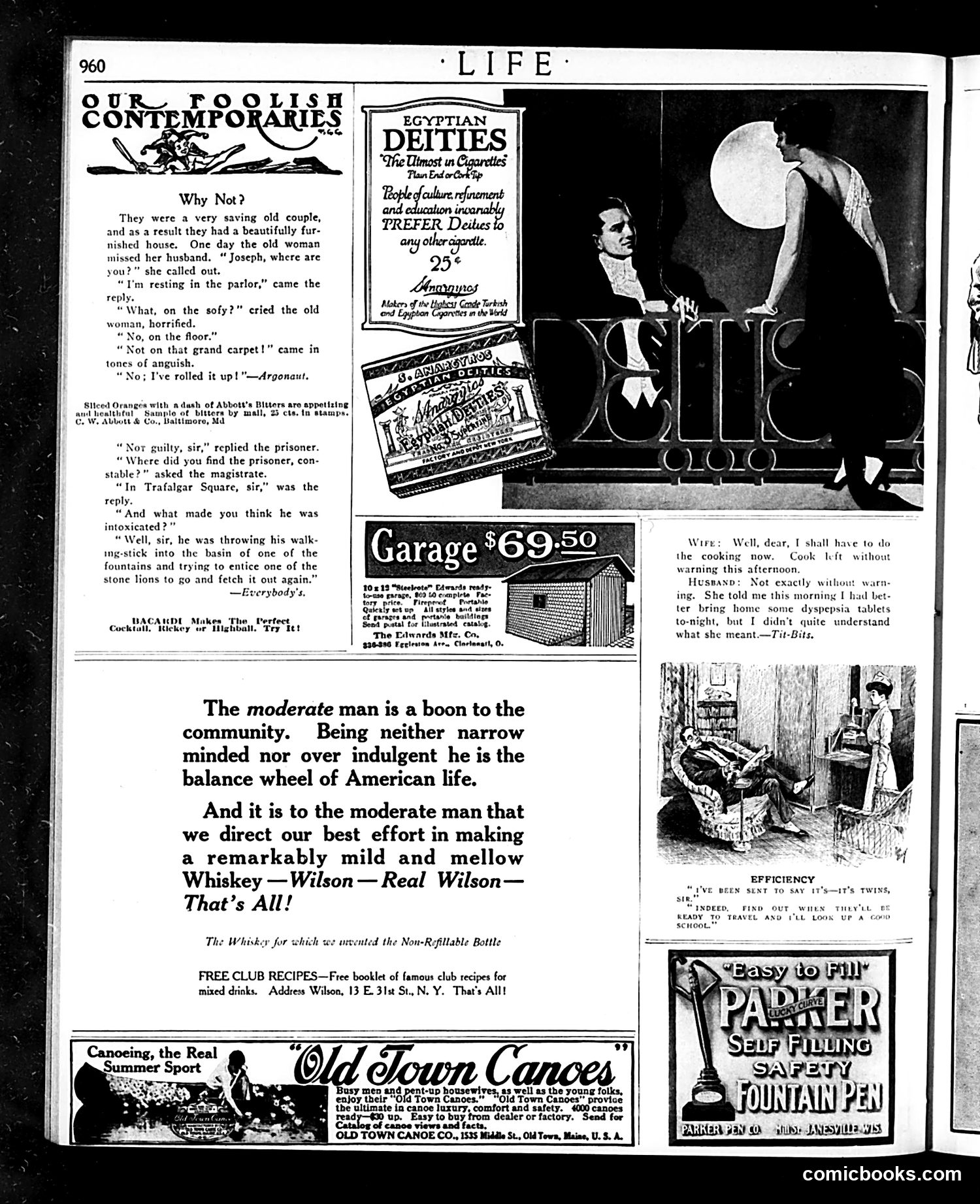
This page combines several short humorous anecdotes with period advertisements. The main cartoons satirize domestic life and miserliness: **"Why Not?"** mocks an overly frugal elderly couple. The wife discovers her husband resting on the floor rather than furniture—he's rolled up their expensive carpet to preserve it. The joke targets extreme penny-pinching that defeats the purpose of owning nice possessions. Other brief jokes ridicule public drunkenness and marital miscommunication around household duties. **Advertisements** dominate the lower half, promoting Egyptian Deities cigars, a $69.50 garage kit, Wilson whiskey (emphasizing "moderation"), Parker fountain pens, Old Town Canoes, and other consumer goods typical of the 1920s. The whiskey ad notably appeals to "the moderate man" as society's stabilizing force—reflecting Prohibition-era tensions where moderate drinking was positioned as respectable versus abstinence or excess. The page reflects early 20th-century middle-class anxieties about consumption, domesticity, and propriety.
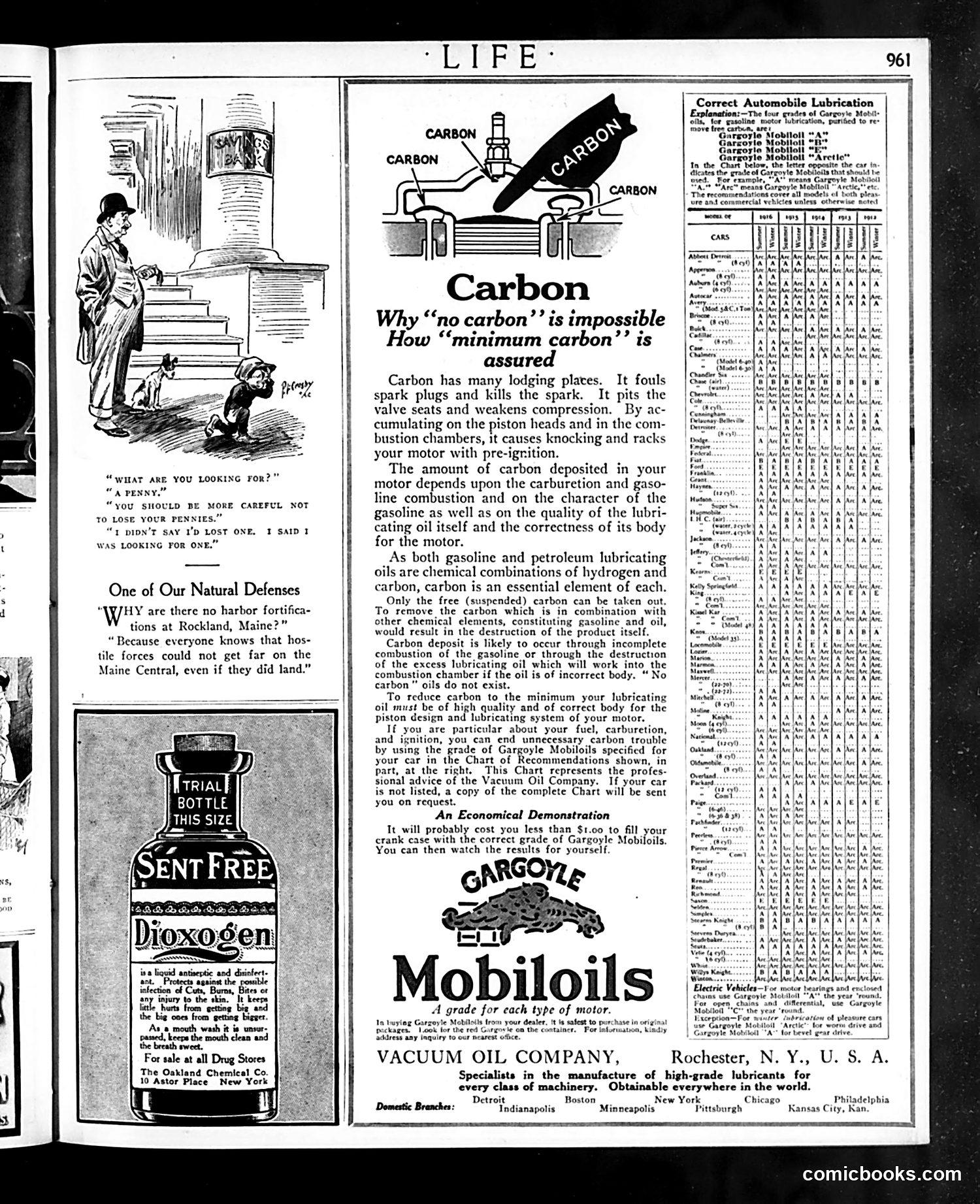
This page mixes humor with advertising. The **cartoon** (top left) shows a man and boy at a train station. The joke plays on the boy's misunderstanding: when the man says he's "looking for one" (a lost penny), the boy thinks he means a train, responding with a railroad joke. The caption references the **Maine Central Railroad**, joking that it's so unreliable that enemy forces couldn't use it to invade—a mild jab at the railroad's poor service reputation. The page is dominated by **advertisements**: Dioxogen antiseptic and Gargoyle Mobiloils (motor oil). The Mobiloils ad addresses a contemporary automotive concern—engine carbon buildup—using technical explanations to sell their product as the solution for "minimum carbon" engines. This reflects early-20th-century anxiety about new car maintenance and manufacturers' competitive claims. The chart listing car makes suggests this is from the 1910s-1920s when automobile ownership was becoming common and lubrication standards varied widely.
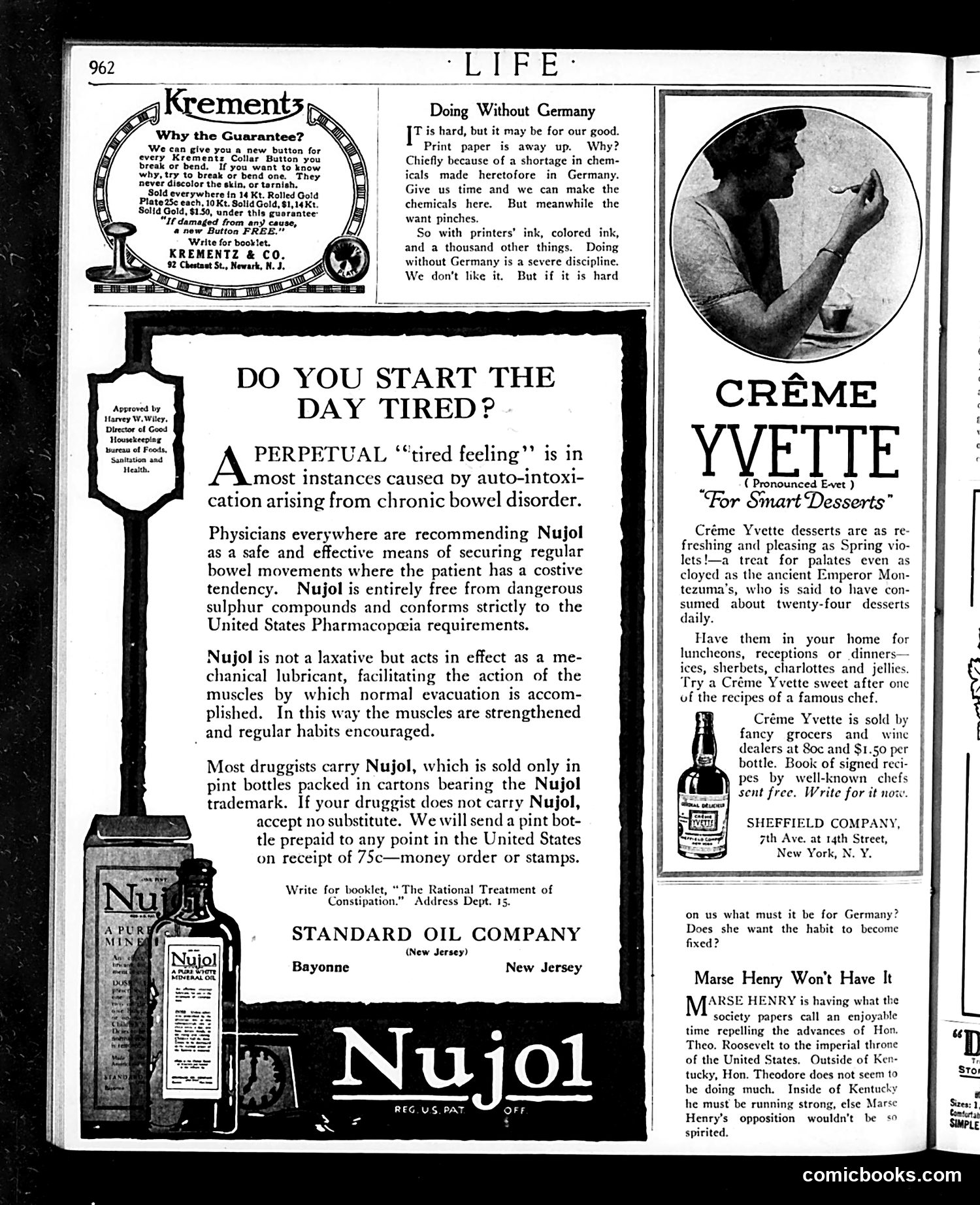
This page reflects **World War I-era American concerns** about German trade dependence. The featured article "Doing Without Germany" discusses wartime shortages—print paper and industrial chemicals formerly supplied by Germany are now unavailable, forcing American industries to develop domestic alternatives. The tone is pragmatic but resigned: inconvenient, but necessary for American interests. The satire targets American reliance on German manufacturing. By highlighting everyday scarcities (paper, ink, chemicals), Life suggests Americans must endure hardship to achieve economic independence from Germany—a pointed commentary during a period of U.S. neutrality debate. The remaining content is **advertisements** (Nujol laxative, Crème Yvette liqueur, Krementz buttons) and a brief political note about "Marse Henry" (likely journalist Henry Watterson) opposing Theodore Roosevelt's political ambitions.
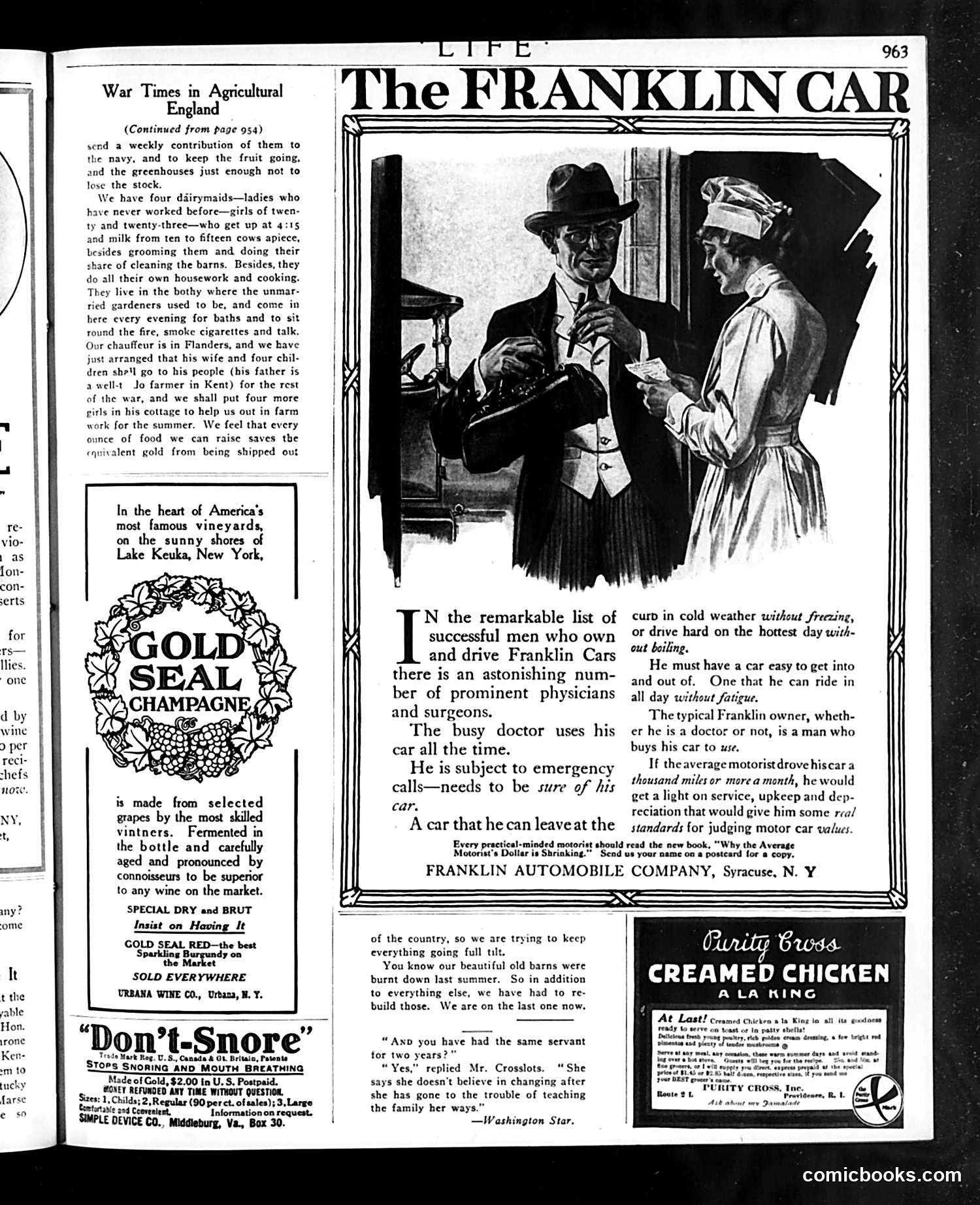
This page is primarily **advertising**, not political satire. The main content is a Franklin Automobile Company advertisement featuring an illustration of two men examining a car engine. The ad targets **physicians and surgeons**, emphasizing the Franklin's reliability for doctors making emergency calls. It highlights practical features: the car won't freeze in cold weather or overheat in heat, is easy to enter/exit, and allows all-day driving without fatigue. The accompanying text quotes doctors praising the Franklin's dependability for professional use requiring frequent, demanding travel. The page also includes vintage ads for **Gold Seal Champagne** and a "Don't-Snore" anti-snoring device, plus a comic snippet about a servant's employment loyalty—typical Life magazine filler content. This represents early 20th-century automotive marketing targeting professional, affluent consumers.
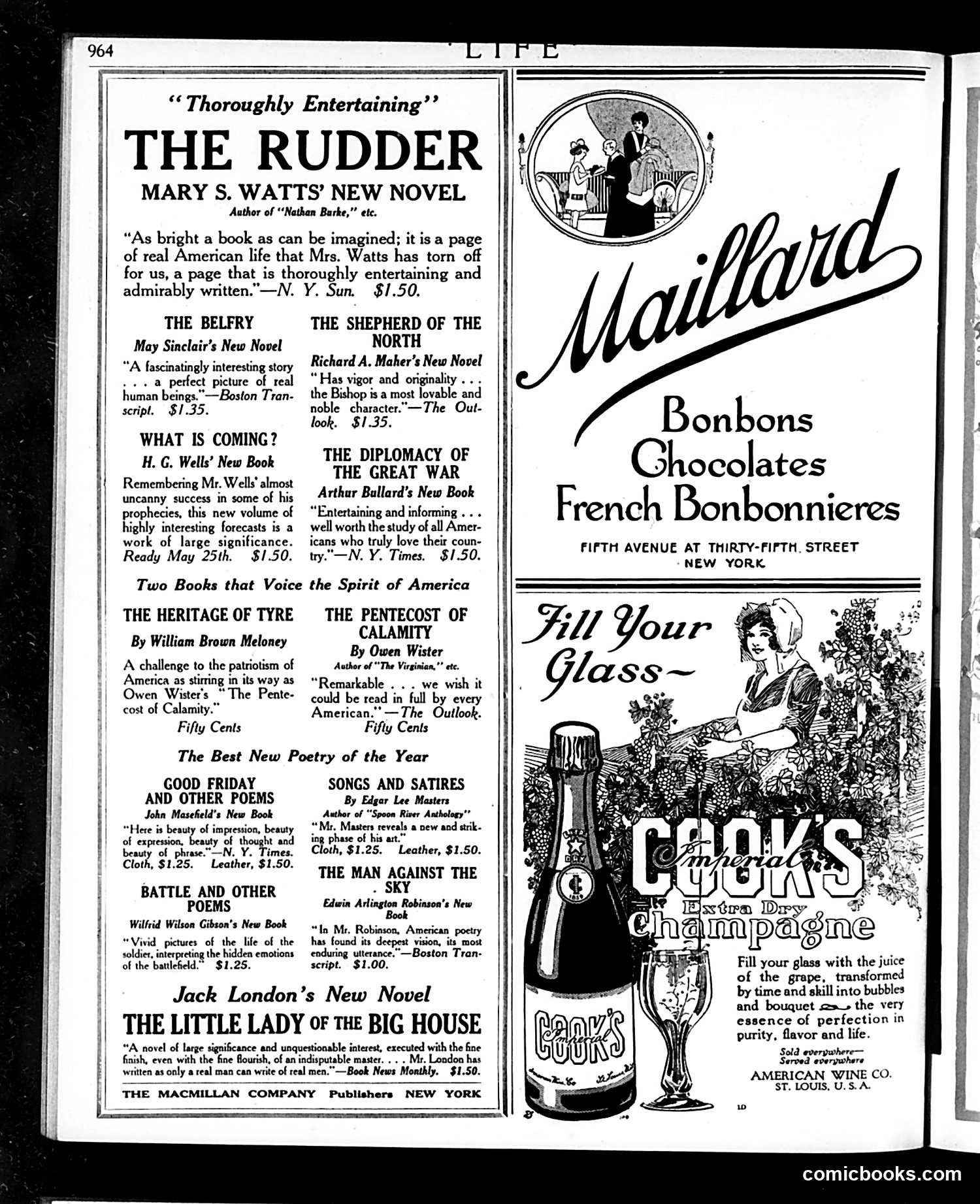
This page is primarily **advertising**, not political satire. The left side showcases new novels and poetry collections from 1916-era publishers (Macmillan), emphasizing patriotic American themes—titles like "The Heritage of Tyre" and "The Pentecost of Calamity" appear designed to appeal to readers concerned with national identity during WWI. The right side features two product advertisements: **Maillard chocolates** and **Cook's champagne**. These luxury goods represent the era's consumer culture targeting affluent readers. The only visual element is an ornamental circular illustration accompanying the Maillard ad, showing fashionable figures in period dress. There is **no political cartoon or satire** on this page. It reflects early-20th-century *Life* magazine's dual function as both literary arbiter and advertising vehicle for upscale products and publications.
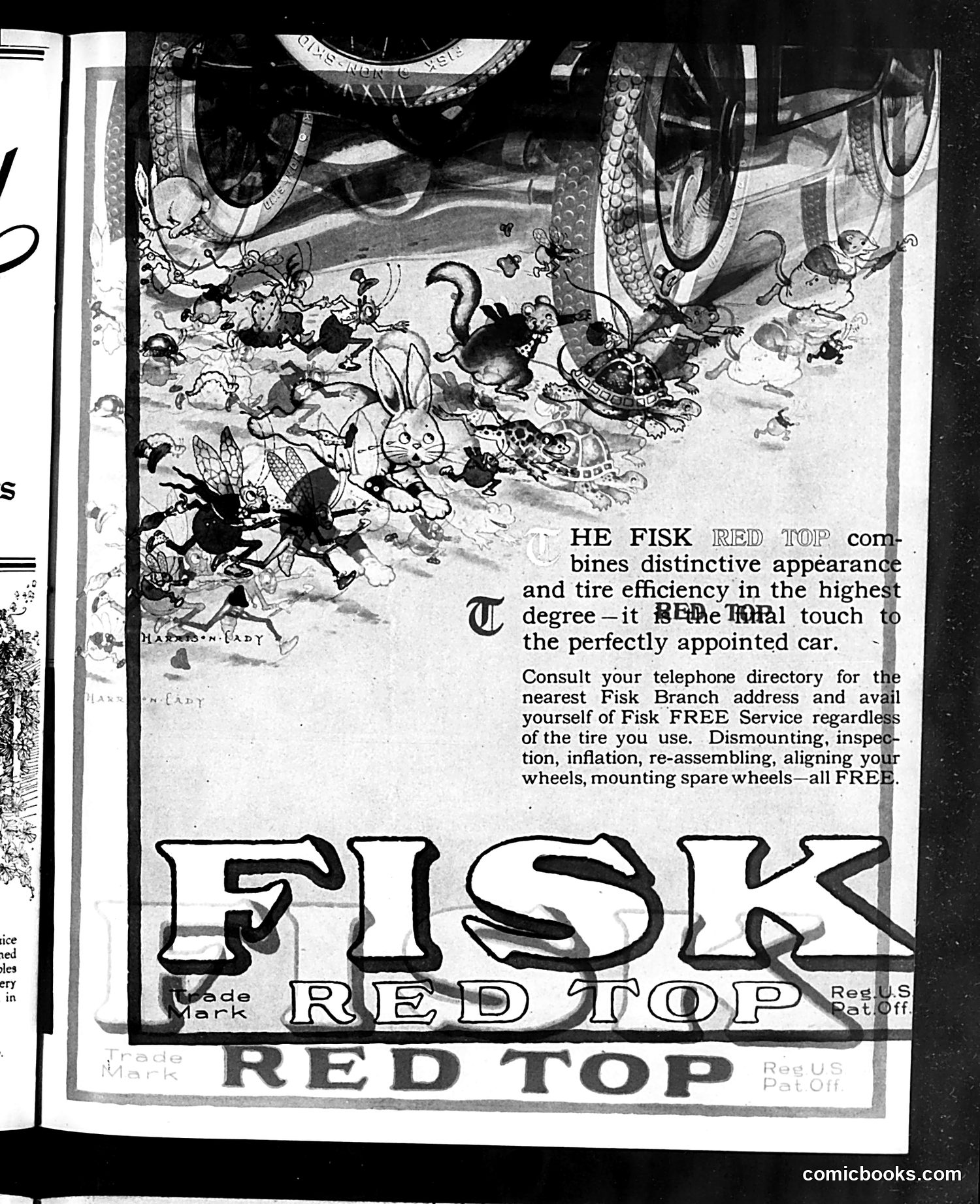
This is a **commercial advertisement**, not political satire. It promotes Fisk Red Top automobile tires, a real brand from the early 20th century. The whimsical illustration depicts animals (rabbits, mice, insects, a turtle) gathered beneath an enormous automobile tire, creating a fantastical scene. This visual appeal was typical of advertising from this era—using imaginative artwork to draw reader attention. The text emphasizes two selling points: the tire's distinctive appearance and superior efficiency, plus Fisk's free service offerings (dismounting, inspection, inflation, wheel alignment). The phrase "the final touch to the perfectly appointed car" suggests the tire as a status symbol for well-to-do motorists. The illustrated animals may simply represent whimsy to capture interest, rather than conveying specific satirical meaning.
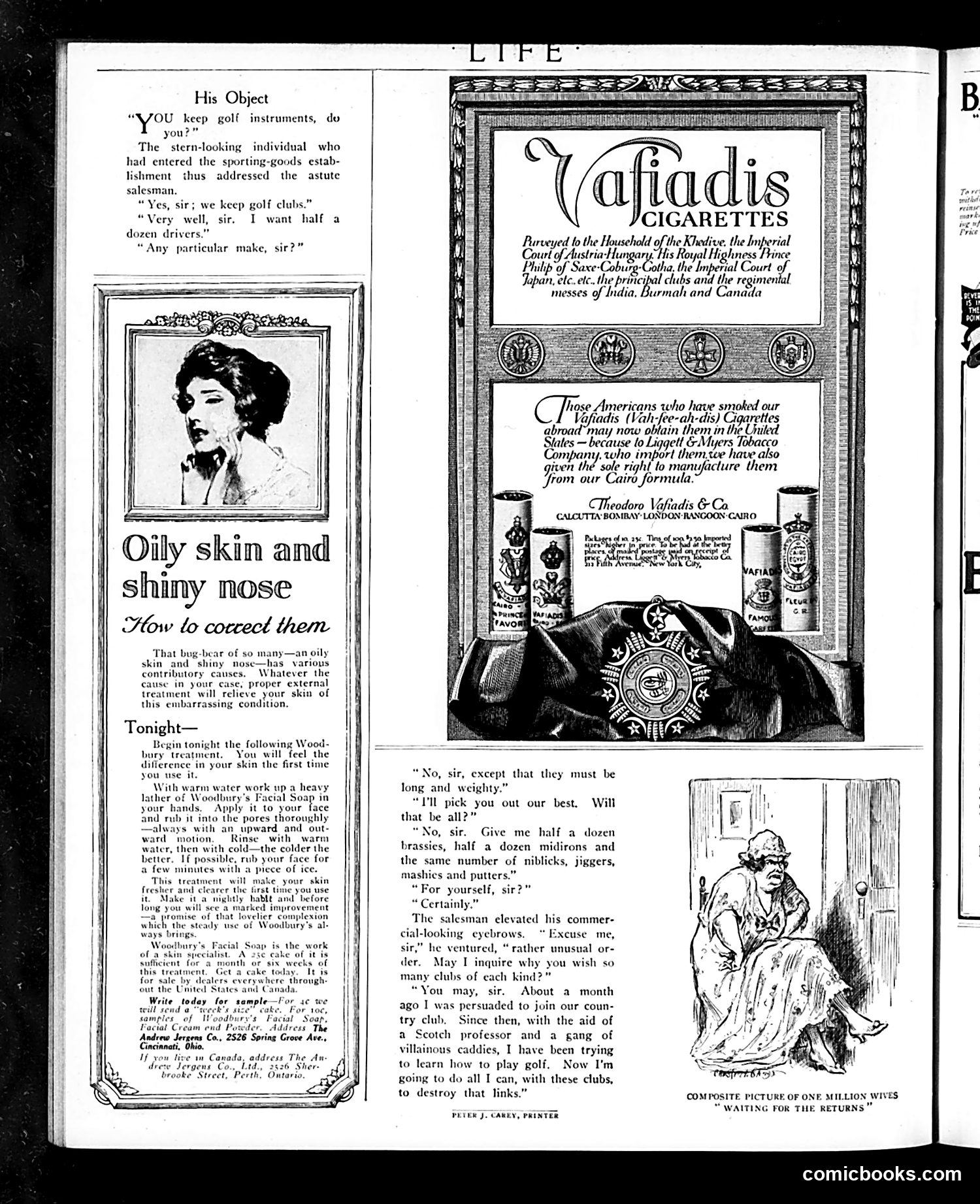
This page contains two distinct pieces of humor: **Left side - "His Object":** A brief comic dialogue where a customer enters a sporting goods store demanding "half a dozen drivers" of golf clubs. The salesman assumes he means golf equipment, but the customer's insistence on "long and weighty" clubs and large quantities of various implements suggests a darker purpose—the customer appears to be acquiring weapons (drivers, brassies, etc. are golf club names, but the dialogue plays on double meanings) to commit violence, likely against the country club or golf links he mentions resenting. **Right side:** A full-page advertisement for Vafiadis cigarettes, positioned as an upscale imported product sold to royalty and military establishments worldwide. **Bottom right:** An unrelated illustration captioned "Composite Picture of One Million Wives Waiting for the Returns"—likely referencing election night, showing a wife anxiously awaiting her husband's return. The satire targets newly wealthy Americans joining country clubs and struggling with golf, portrayed as absurdly frustrated by the sport.
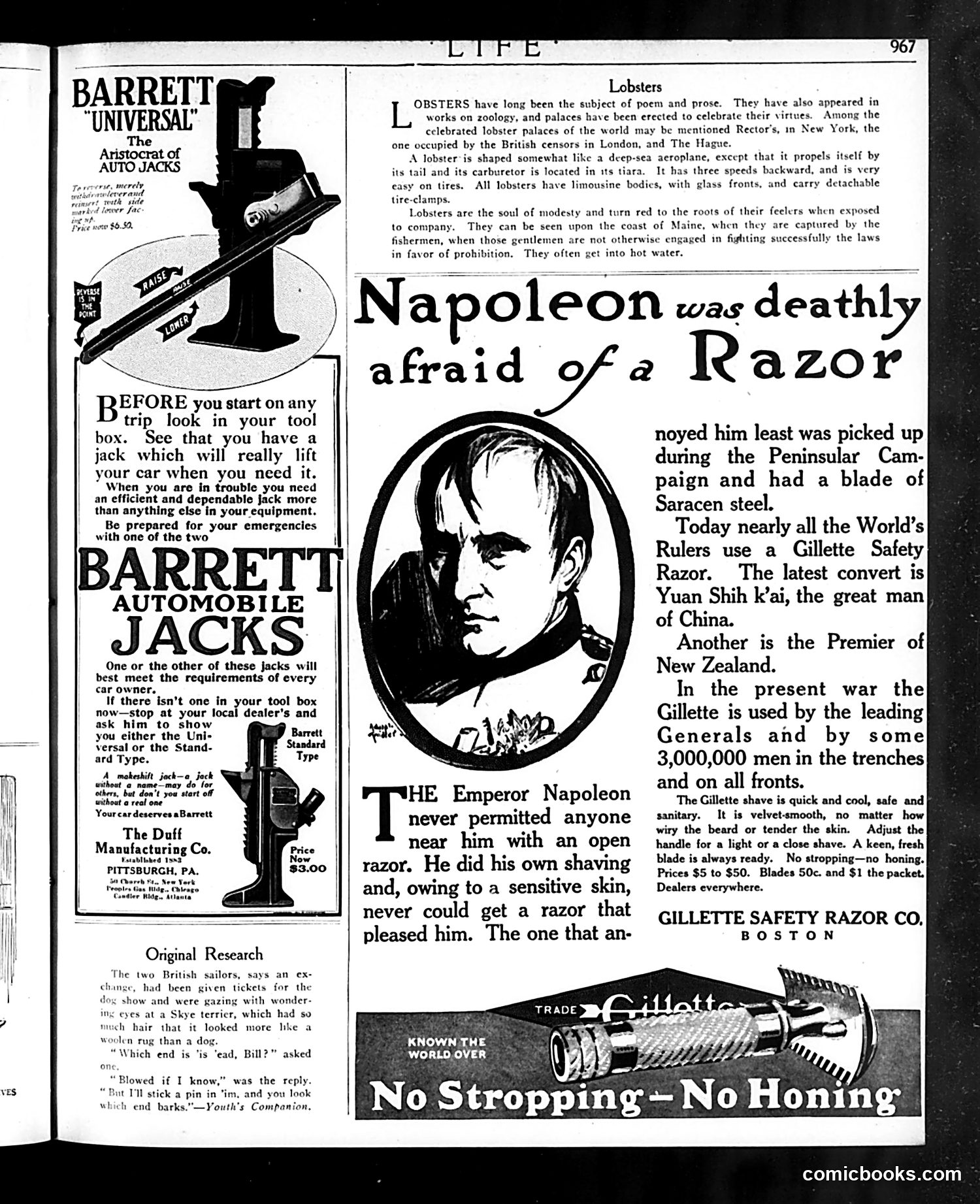
This page contains mixed content: a humorous article about lobsters, product advertisements, and a major advertisement for Gillette Safety Razors. The **Napoleon anecdote** is the page's centerpiece—a fictional claim that the Emperor was "deathly afraid of a Razor" because he had an excessively sensitive skin and could never find a razor that pleased him. The story serves as the hook for the Gillette advertisement, which claims that modern world leaders (including Yuan Shih k'ai of China and New Zealand's Premier) now use Gillette razors, and that soldiers across WWI fronts rely on them. The humor lies in the absurd contrast: if even Napoleon—history's greatest military figure—was undone by shaving difficulties, surely any modern man needs Gillette's superior product. It's satirical advertising wrapped in false historical "fact," typical of Life's era. The lobster article is whimsical satire describing lobsters in mock-technical language, comparing them to automobiles.
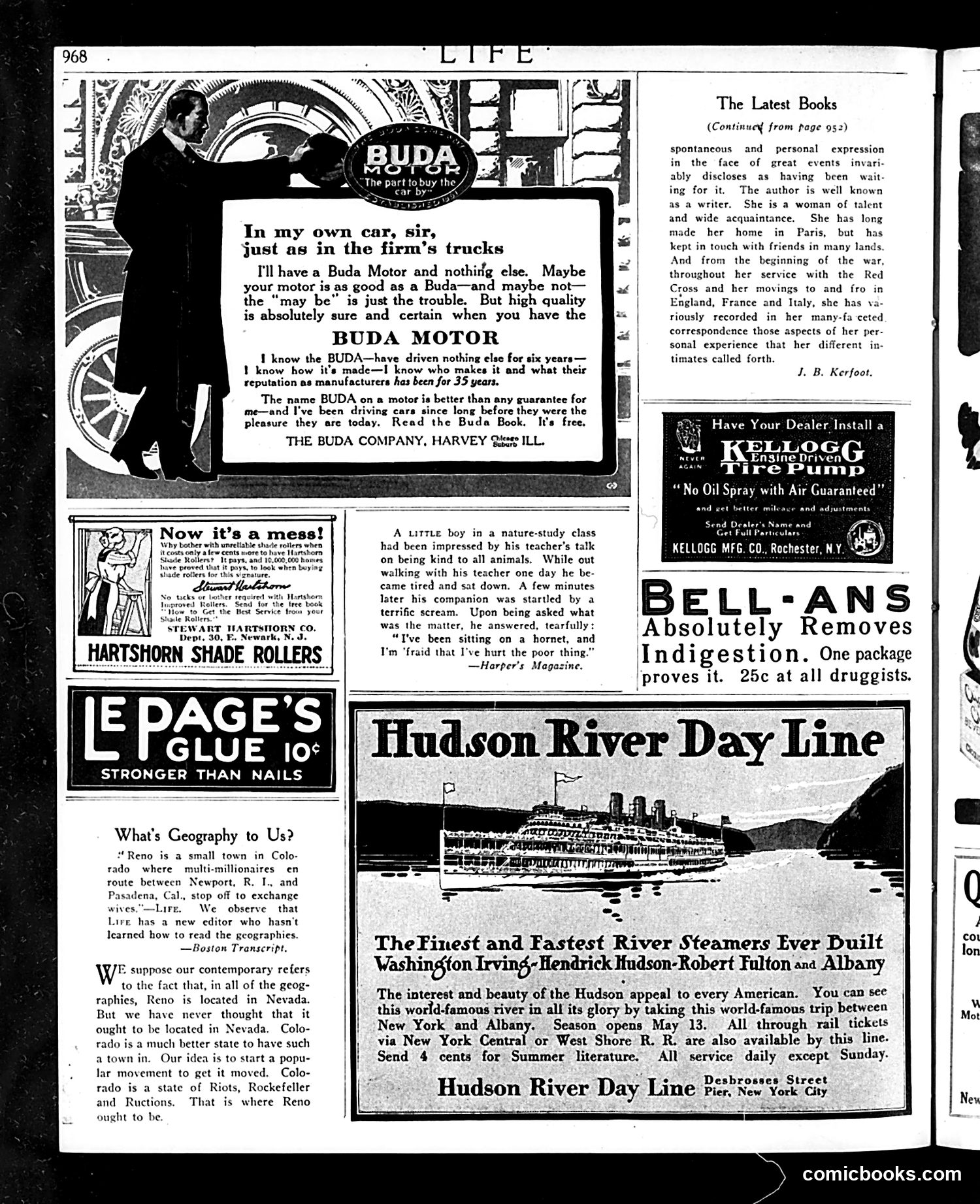
This page consists primarily of **advertisements and filler content** rather than political satire. The notable items: **"Reno" Joke**: The Boston Transcript sardonically defines Reno, Nevada as "a small town in Colorado where multi-millionaires en route between Newport, R.I. and Pasadena, Cal., stop off to exchange wives." Life's editor responds that while Reno is actually in Nevada, Colorado would be a more appropriate location—implying Colorado is a state of "Riots, Rockefeller and Ructions" (disorder and upheaval). This references Colorado's reputation for labor violence and Rockefeller family industrial conflicts during the early 20th century. **Other Content**: The page features standard period advertisements (Buda Motors, Hartshorn Shade Rollers, Bell-Ans digestive aid) and a brief anecdote about a schoolboy sympathizing with a hornet he accidentally sat on. The "geography" joke relies on contemporary awareness of Colorado's troubled industrial history to land its humor about where a divorce mill logically belongs.
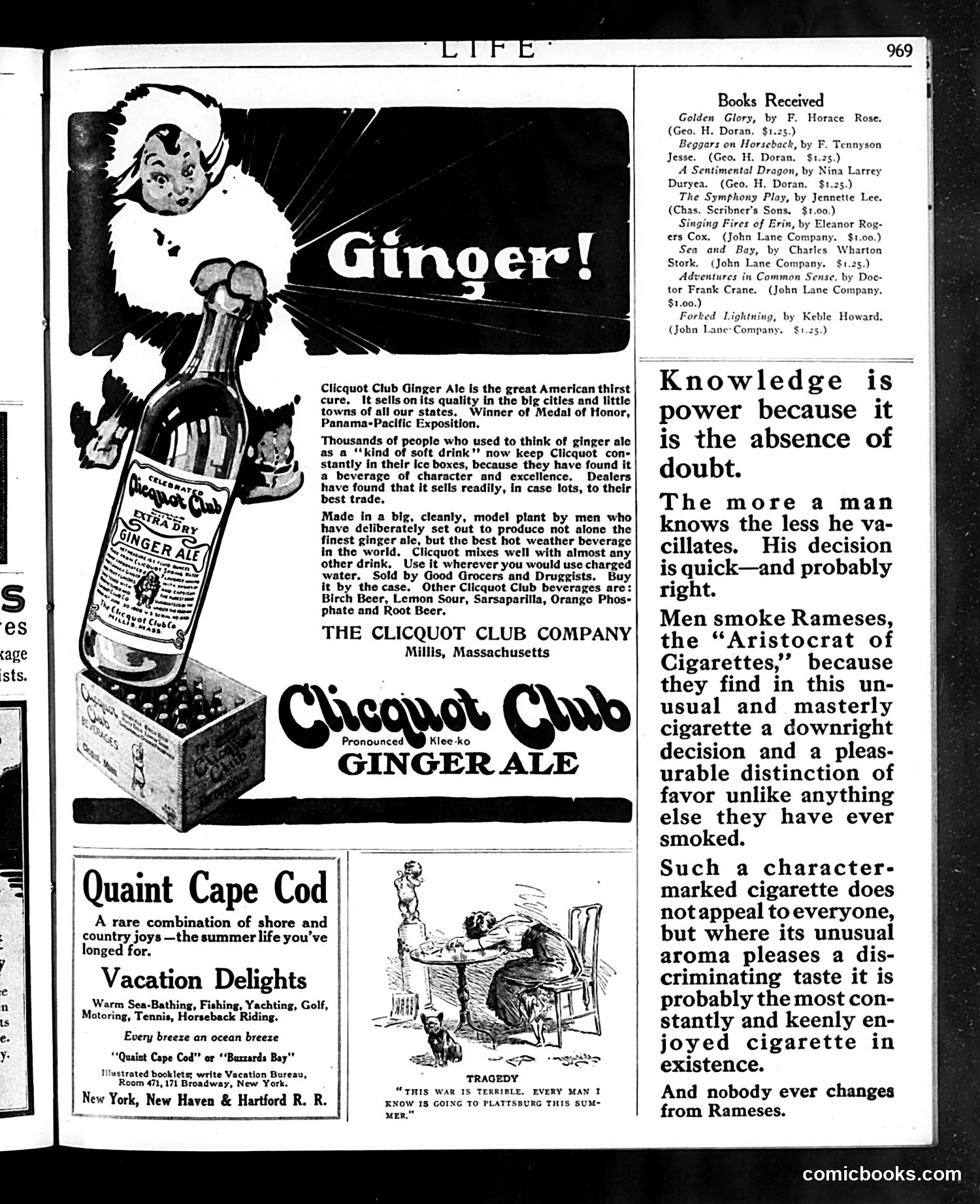
This page is primarily **advertising**, not satire or political cartooning. It contains: 1. **Clicquot Club Ginger Ale ad**: Features a jovial character promoting ginger ale as "the great American thirst cure," winner of a Panama-Pacific Exposition medal. The ad emphasizes quality and widespread availability. 2. **Rameses Cigarette ad**: Claims these are the "Aristocrat of Cigarettes" with an "unusual" aroma appealing to discriminating smokers. The tagline promises permanence: "nobody ever changes from Rameses." 3. **Cape Cod vacation ad**: Promotes shore tourism with activities like fishing and yachting. 4. **Small "Tragedy" cartoon**: Shows a figure with text referencing Plattsburg—likely referring to **military training camps** during WWI era preparedness, suggesting men will enlist rather than vacation. The page reflects early 20th-century consumer advertising and mild wartime references, not political satire. A "Books Received" section lists recent publications.
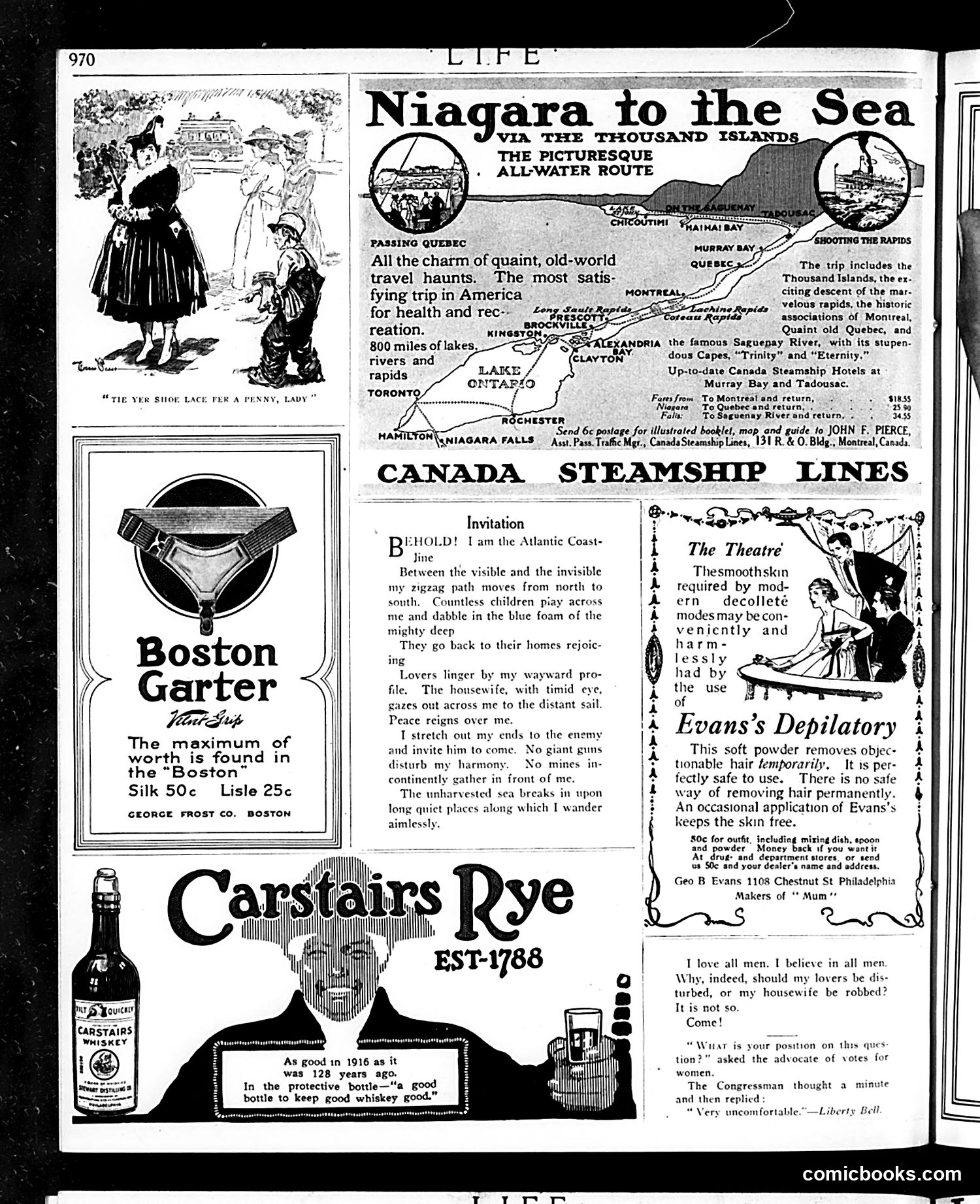
This page is primarily **advertisements and filler content** rather than political satire. The main elements: 1. **"Niagara to the Sea"** – A Canada Steamship Lines travel advertisement promoting a scenic 800-mile waterway route through Ontario's lakes and rapids, marketed for health and recreation. 2. **Boston Garter ad** – Hosiery product advertisement emphasizing quality and value. 3. **Carstairs Rye whiskey** – Features a generic older gentleman claiming the product has remained unchanged for 128 years, a common advertising claim linking longevity to reliability. 4. **Evans's Depilatory** – Hair removal product advertisement aimed at women adopting modern "decolleté" (low-cut) fashion. 5. **A brief joke** about a congressman uncomfortable answering a question on women's suffrage. The page reflects early 20th-century consumer culture and contemporary social issues (women's voting rights, evolving fashion standards for women). No specific political figures are caricatured—this is standard period advertising filler.
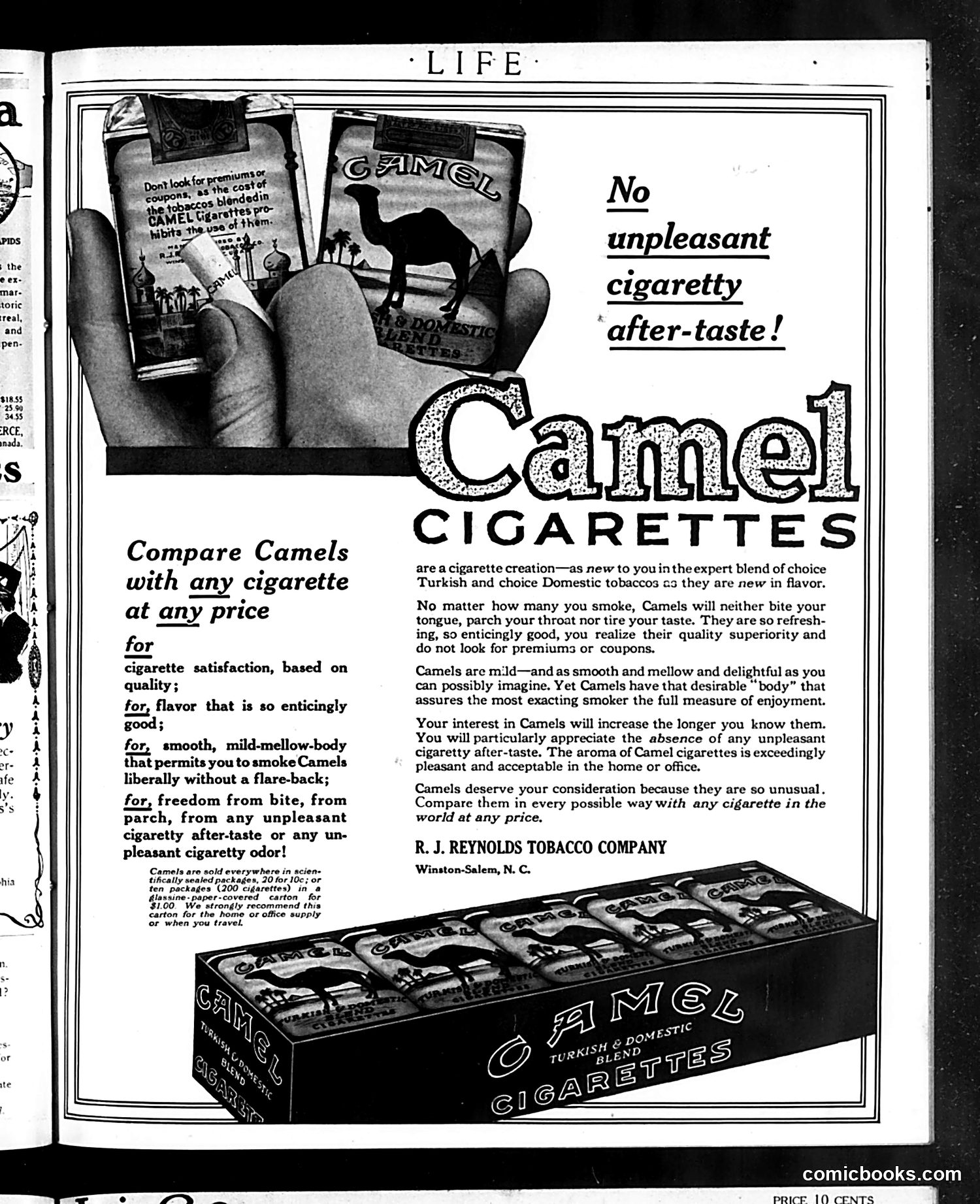
This is a **cigarette advertisement**, not satire or political content. It's a Camel cigarettes ad from an early 20th-century *Life* magazine. The image shows two hands holding Camel and competitor cigarette packs. The ad's central claim—repeated throughout—is that Camels cause "no unpleasant cigaretty after-taste," positioning the brand as superior in smoothness and flavor. Key selling points listed include: quality, flavor, mild body allowing "liberal" smoking without irritation, and absence of bite or parched throat. The ad also emphasizes that Camels require no "premiums or coupons" (unlike competitors), and stresses the product's pleasant aroma for home and office use. **For modern readers**: This represents pre-health-warning tobacco advertising that made explicit health/comfort claims now forbidden. The casual assumption that heavy smoking ("smoke Camels liberally") poses no problems reflects an era before cigarette dangers were widely acknowledged or regulated.
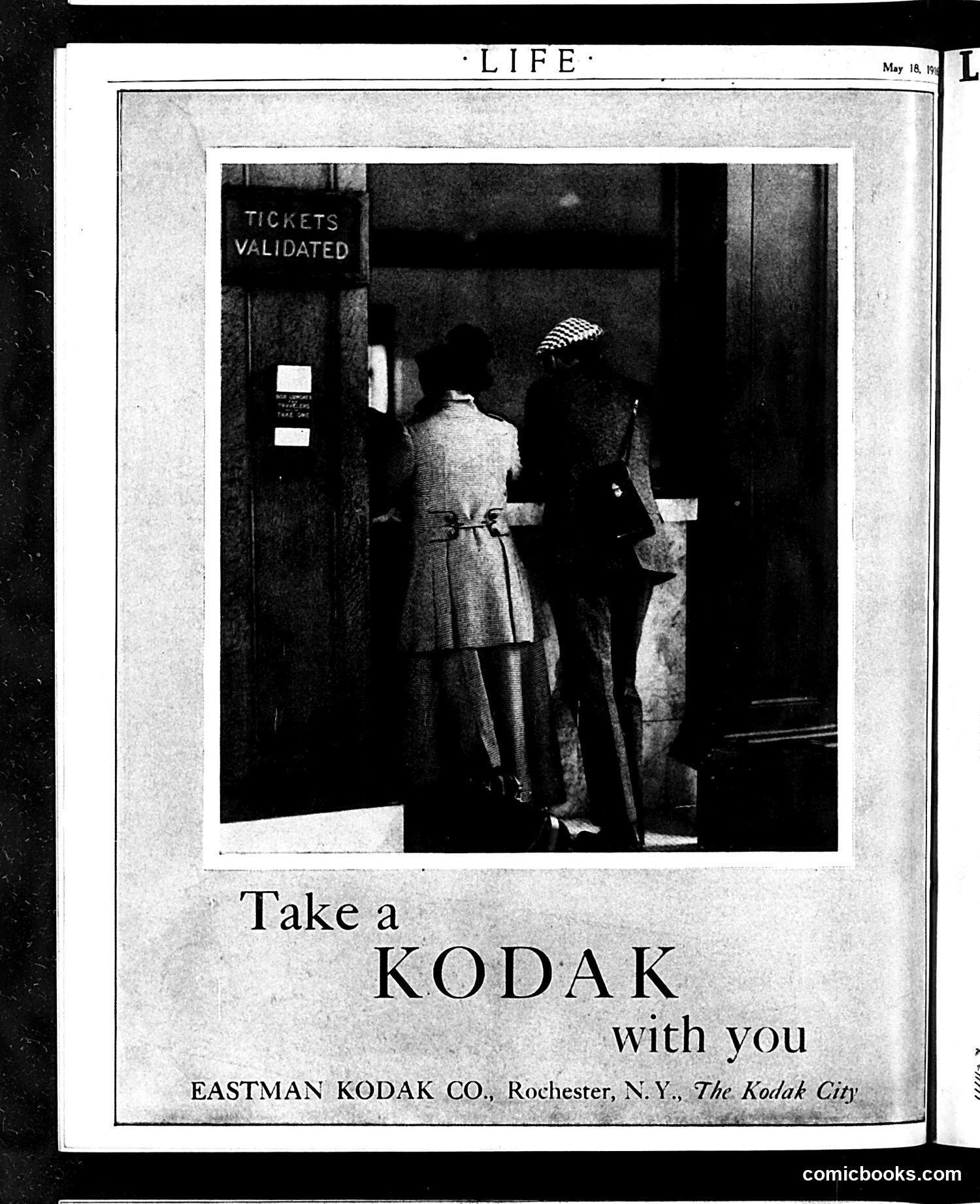
This is a **Kodak advertisement**, not a political cartoon or satire. The page shows a black and white photograph of two women entering what appears to be a theater or entertainment venue (note the "TICKETS VALIDATED" sign visible on the door). The advertisement's message is straightforward: "Take a KODAK with you" — encouraging consumers to bring portable cameras to social outings and events to photograph their experiences. The image demonstrates the practical use case by showing an everyday social scene. This represents early 20th-century consumer marketing promoting photography as a leisure activity. There is no political satire or social commentary present — it's simply a commercial promoting the Eastman Kodak Company's cameras to Rochester, New York audiences.