
Life, 1916-05-18 · page 28 of 48
Life — May 18, 1916 — page 28: what you’re looking at
What you’re looking at
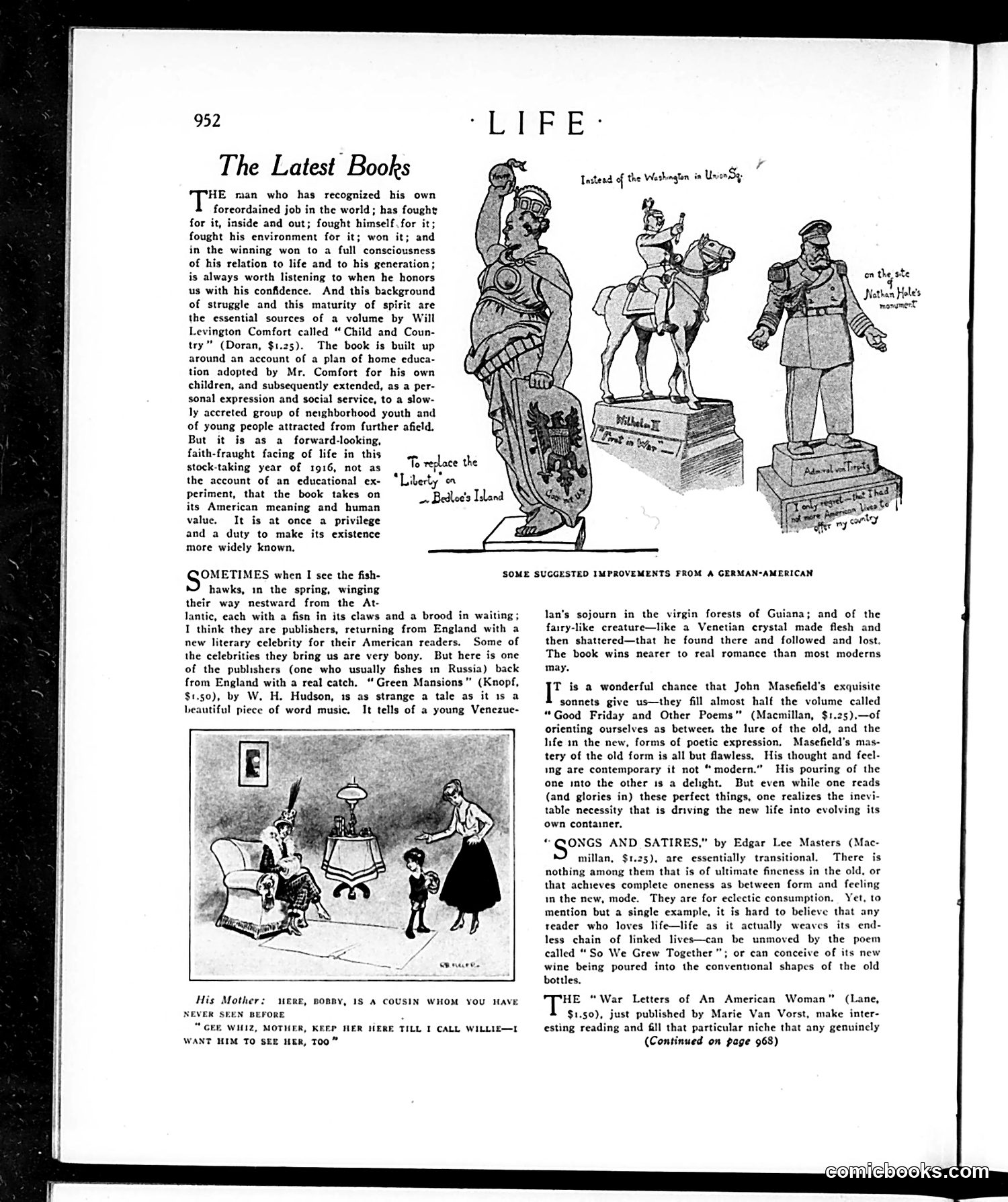
This is a book review section from Life magazine (circa 1916, based on reference to "stock-taking year of 1916"). The page reviews several newly published works. The cartoon at top shows German-American figures presenting "improvements" to American monuments—a satirical jab at German-American cultural influence during WWI tensions. The statue labeled "Nathan Hale's Monument" appears modified, likely mocking German-American attempts to reshape American identity. Below is an unrelated domestic cartoon about a child wanting his cousin to meet "Willie." The reviews themselves are straightforward literary criticism of books by W.L. Comfort, W.H. Hudson, John Masefield, and Edgar Lee Masters—praising their literary merit and contemporary relevance. The fish-hawk metaphor compares publishers to birds bringing literary "catches" from England and Russia. The satire targets German-American cultural pretensions during a period of rising anti-German sentiment in America.
📄 Transcribed text from this page (OCR, searchable)
Machine-transcribed from the original scan — historical spelling and the odd misread are preserved.
952 The Latest Books HE ran who has recognized his own foreordained job in the world; has fought for it, inside and out; fought himself for it; fought his environment for it; won it; and in the winning won to a full consciousness of his relation to life and to his generation; is always worth listening to when he honors us with his confidence. And this background of struggle and this maturity of spirit are the essential sources of a volume by Wi Levington Comfort called “Child and Coun- try” (Doran, $1.25). The book is built up around an account of a plan of home educa- tion adopted by Mr. Comfort for his own children, and subsequently extended, as a per- sonal expression and social service, to a slow- ly accreted group of neighborhood youth and of young people attracted from further afield. But it is as a forward-looking, faith-fraught facing of life in this stock-taking year of 1916, not as the account of an educational ex- periment, that the book takes on its American meaning and human value. It is at once a privilege and a duty to make its existence more widely known, To replace the “Liberty” o ~~ Bedloe's Island OMETIMES when I see the fish- hawks, in the spring, winging their way nestward from the At- lantic, each with a fisn in its claws and a brood in waiting; I think they are publishers, returning from England with a new literary celebrity for their American readers. Some of the celebrities they bring us are very bony. But here is one of the publishers (one who usually fishes in Russia) back from England with a real catch. “ Green Mansions” (Knopf, $1.50), by W. H. Hudson, 1s as strange a tale as it 1s a beautiful piece of word music. It tells of a young Venezue- His Mother: Were, ponny, 18 A COUSIN WHOM YoU MAVE NEVER SEEN BEFORE : “GrR WHIZ, MOTHER, KEEP HER WERE TILL I CALL WILLIE—1 WANT HIM TO SEE HER, TOO” on the ste Nothan Hale's mower SOME SUGGESTED IMPROVEMENTS FROM A GERMAN-AMERICAN Jan's sojourn in the virgin forests of Guiana; and of the fairy-like creature—like a Venetian crystal made flesh and then shattered—that he found there and followed and lost. The book wins nearer to real romance than most moderns may. T is a wonderful chance that John Masefield’s exquisite sonnets give us—they fill almost half the volume called “Good Friday and Other Poems” (Macmillan, $1.25).—of orienting ourselves as betwee the lure of the old, and the life in the new, forms of poetic expression, Masefield’s mas- tery of the old form is all but flawless. thought and feel- ing are contemporary it not “modern.” His pouring of the one into the other 1s a delight. But even while one reads (and glories in) these perfect things, one realizes the inevi- table necessity that is driving the new life into evolving its own container, ONGS AND SATIRES,” by Edgar Lee Masters (Mac- millan, $1.25), are essentially transitional. There is nothing among them that is of ultimate fineness in the old. or that achieves complete oneness as between form and feeling in the new, mode. They are for eclectic consumption. Yet, to mention but a single example, it is hard to believe that any reader who loves life—life as it actually weaves its end- less chain of linked lives—can be unmoved by the poem called “So We Grew Together”; or can conceive of its new wine being poured into the conventional shapes of the old bottles. HE “War Letters of An American Woman” (Lane, $1.50), just published by Marie Van Vorst, make inter- esting reading and fill that particular niche that any genuincly (Continued on page 968)