
Life, 1916-05-18 · page 22 of 48
Life — May 18, 1916 — page 22: what you’re looking at
What you’re looking at
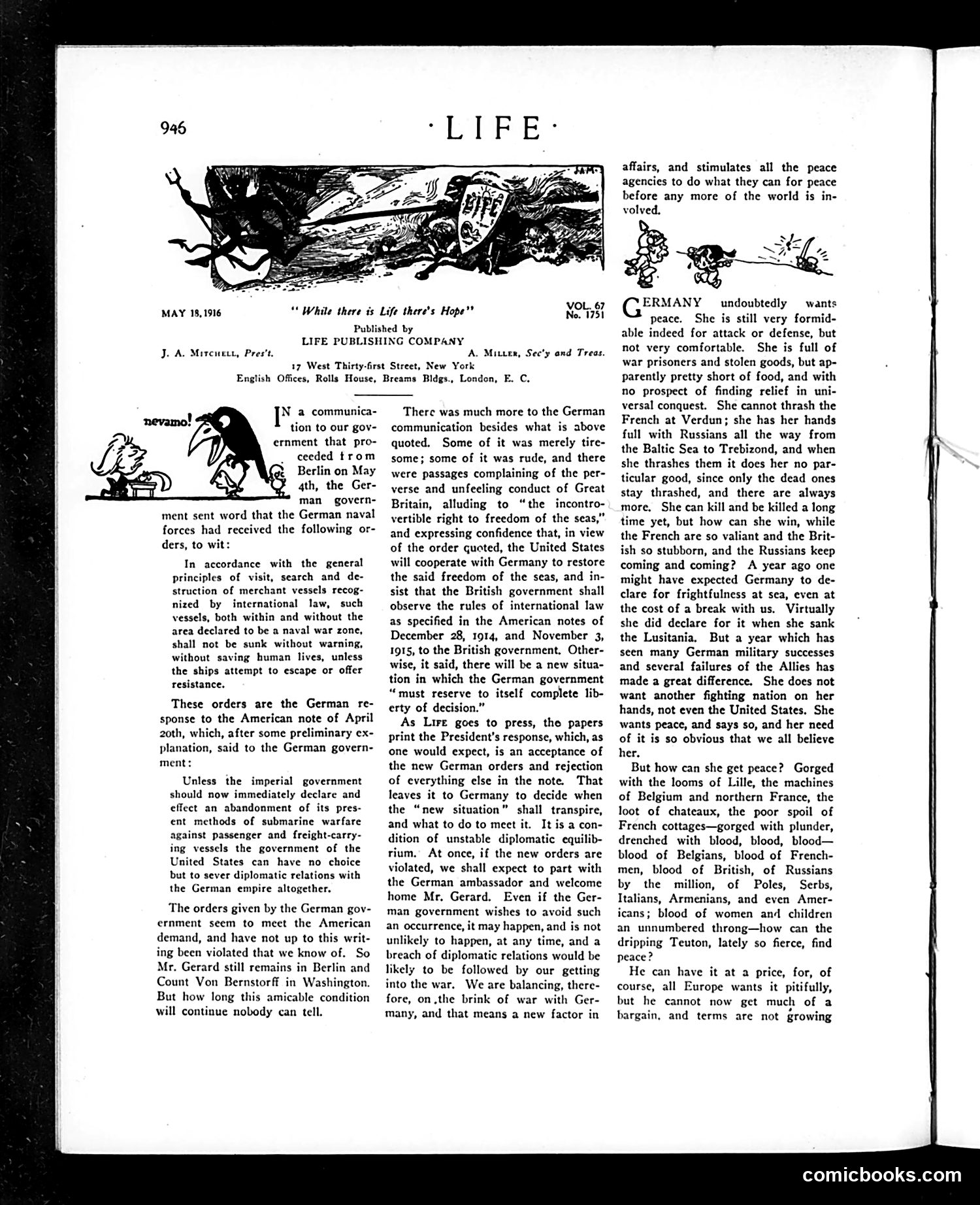
This page addresses the submarine warfare crisis between the U.S. and Germany. The small cartoon (upper left) appears to show figures in distress, likely representing the tension over German U-boat attacks on merchant and passenger ships. The main article discusses Germany's May 4th communication pledging to warn merchant vessels before sinking them—a response to American diplomatic pressure threatening to sever relations. The text expresses skepticism about Germany's promises, noting the U.S. remains "on the brink of war" with Germany. The article presents a precarious diplomatic situation: Germany claims restraint, but the author doubts it will last. The piece also analyzes Germany's war position—exhausted, unable to decisively defeat France at Verdun, and facing food shortages—suggesting Germany both wants peace and lacks confidence in victory. This reflects pre-1917 American neutrality debates and growing concerns about submarine warfare, particularly following the *Lusitania* sinking in 1915.
📄 Transcribed text from this page (OCR, searchable)
Machine-transcribed from the original scan — historical spelling and the odd misread are preserved.
MAY 18,1916 “While there is Life there's Hope” No. 1751 Published by LIFE PUBLISHING COMPANY J. A. Mircunte, Pres’t. A. Miter, Sec'y and Treas. 17 West Thirty-first Street, New York English Offices, Rolls House, Breams Bldgs., London, E. C. N a communica- tion to our gov- ernment that pro- ceeded trom Berlin on May 4th, the Ger- man govern- ment sent word that the German naval forces had received the following or- ders, to wit: In accordance with the general principles of visit, search and de- struction of merchant vessels recog- nized by international law, such vessels, both within and without the area declared to be a naval war zone, shall not be sunk without warning, without saving human lives, unless the ships attempt to escape or offer resistance. These orders are the German re- sponse to the American note of April 2oth, which, after some preliminary ex- planation, said to the German govern- ment: Unless the imperial government should now immediately declare and effect an abandonment of its pres- ent methods of submarine warfare against passenger and freight-carry- ing vessels the government of the United States can have no choice but to sever diplomatic relations with the German empire altogether. ‘The orders given by the German gov- ernment seem to meet the American demand, and have not up to this writ- ing been violated that we know of. So Mr. Gerard still remains in Berlin and Count Von Bernstorff in Washington. But how long this amicable condition will continue nobody can tell. There was much more to the German communication besides what is above quoted. Some of it was merely tire- some; some of it was rude, and there were passages complaining of the per- verse and unfeeling conduct of Great Britain, alluding to “the incontro- vertible right to freedom of the seas,” and expressing confidence that, in of the order quoted, the United States will cooperate with Germany to restore the said freedom of the seas, and in- sist that the British government shall observe the rules of international law as specified in the American notes of December 28, 1914, and November 3, 1915, to the British government, Other- wise, it said, there will be a new situa- tion in which the German government “must reserve to itself complete lib- erty of decision.” As Lire goes to press, the papers print the President's response, which, as one would expect, is an acceptance of the new German orders and rejection of everything else in the note. That leaves it to Germany to decide when the “new situation” shall transpire, and what to do to meet it. It is a con- dition of unstable diplomatic equilib- rium. At once, if the new orders are violated, we shall expect to part with the German ambassador and welcome home Mr, Gerard. Even if the Ger- man government wishes to avoid such an occurrence, it may happen, and is not unlikely to happen, at any time, and a breach of diplomatic relations would be likely to be followed by our getting into the war. We are balancing, there- fore, onthe brink of war with Ger- many, and that means a new factor in affairs, and stimulates all the peace agencies to do what they can for peace before any more of the world is in- volved, G ERMANY undoubtedly —_ wants peace. She is still very for able indeed for attack or defense, but not very comfortable. She is full of war prisoners and stolen goods, but ap- parently pretty short of food, and with no prospect of finding relief in uni- versal conquest. She cannot thrash the French at Verdun; she has her hands full with Russians all the way from the Baltic Sea to Trebizond, and when she thrashes them it does her no par- ticular good, since only the dead ones stay thrashed, and there are always more, She can kill and be killed a long time yet, but how can she win, while the French are so valiant and the Brit- ish so stubborn, and the Russians keep coming and coming? A year ago one might have expected Germany to de- clare for frightfulness at sea, even at the cost of a break with us. Virtually she did declare for it when she sank the Lusitania. But a year which has seen many German military successes and several failures of the Allies has made a great difference. She does not want another fighting nation on her hands, not even the United States. She wants peace, and says so, and her need of it is so obvious that we all believe her. But how can she get peace? Gorged with the looms of Lille, the machines of Belgium and northern France, the loot of chateaux, the poor spoil of French cottages—gorged with plunder, drenched with blood, blood, blood— blood of Belgians, blood of French- men, blood of British, of Russians by the million, of Poles, Serbs, Italians, Armenians, and even Amer- icans; blood of women and children an unnumbered throng—how can the dripping Teuton, lately so fierce, find peace? He can have it at a price, for, of course, all Europe wants it pitifully, but he cannot now get much of a bargain, and terms are not growing comicbooks.com